




Abstract
This study extends current understanding of digital competence by exploring alternative skill sets harnessed by digitally disadvantaged groups that enable their practices to continue. By combining practice theory with the socially extended mind framework, we address the research question: What forms of offline competence support the integration of digital practices among a disadvantaged consumer group, and how do these competences influence the cohesion and continuity of their practices? Through an ethnography of a ‘Street Church’ community, we demonstrate how different forms of offline social interaction (i.e., sequential, synchronised, substitutive) and group culture function as valuable resources for guiding digital practices, without requiring practice carriers to embody digital skills. This study challenges conventional conceptualisations of competence, illustrating that competence no longer needs to be embodied but can be borrowed. This shifts the focus away from what defines competence to how different forms can produce similar outcomes in practices.
Keywords
Introduction
As modern technologies permeate daily life, digital competence has become critical for meaningful participation in social, economic, and civic life (Fisk et al., 2023; Lambert et al., 2023). Typically measured by an individual’s ability to operate digital devices and platforms effectively (Van Dijk and Van Deursen, 2014), digital competence is often viewed in binary terms (e.g., have-have not), as digital literacy and skills serve as common benchmarks for determining online inclusion and exclusion (Helsper and Eynon, 2013). Consequently, discourse concerning the digital divide has evolved beyond material access to include differences in usage patterns, knowledge and skills among societal groups (DiMaggio et al., 2004), highlighting how offline disadvantages carry into the digital realm, hindering equitable participation opportunities (Park and Humphry, 2019).
Despite the breadth of definitions for digital competence in research on digital literacy (see Helsper and Eynon, 2013; Van Deursen et al., 2016; Van Deursen and Van Dijk, 2013; Van Dijk, 2005), prevailing frameworks typically focus on, and measure skills directly related to digital devices. This approach mainly determines what skills meet an arbitrary threshold for inclusion, rather than analysing how different bundles of competences can produce similar outcome. To address these limitations, this study advocates for a broader perspective on digital competence – one that includes contextually grounded knowledge emerging from social environments. We demonstrate how a disadvantaged consumer group borrows digital competence in dialogue with the cultural and social ethos of their community, thereby extending current understanding of digital competence by showing how groups labelled as ‘low-skilled’ find alternative ways to engage with technology (Chen and Li, 2022; Ma et al., 2016).
This reliance on social interaction to overcome technological barriers highlights alternative forms of competence that can be utilised to sustain digital practices but remain underexplored in current digital and practice-based frameworks (Shove et al., 2012; Van Deursen et al., 2016; Van Deursen et al., 2014). Central to this gap are the narrow ways in which competence is conceptualised in both digital and practice-based research (Shove et al., 2012; Van Deursen et al., 2016). These accounts often privilege the cognitive and embodied aspects of competence linked to task performance or object interaction while neglecting its socially embedded and relational dimensions. Although leading practice theorists recognise the social and material dynamics that influence competence (e.g., Reckwitz, 2002; Schatzki, 2002; Shove et al., 2012), such as infrastructures and social norms, some consumption scholars following this tradition emphasise its embodied and cognitive aspects by focusing on the skills, know-how, and practical understandings needed to adapt or enact practices (e.g., Fuentes et al., 2021; Magaudda, 2011; Shekhar et al., 2020; Thomas and Epp, 2019). This emphasis risks reinforcing dichotomies (e.g., have-have not, knowledgeable-unknowledgeable) while perpetuating a simplistic view of how practices should be carried out.
As recent scholarship has noted that practice-oriented research often neglects the social and interactional dynamics that shape practices (e.g., Evans, 2019; Halkier, 2020), our study responds to this gap by exploring how competence circulates through different forms of social interaction, particularly where conventional markers of digital competence are absent or uneven. Drawing on practice theory and the socially extended mind, we address the following research question: What forms of offline competence support the integration of digital practices among a disadvantaged consumer group, and how do these competences influence the cohesion and continuity of their practices? In doing so, this study redirects attention away from a deficit-based perspective prevalent in existing research addressing knowledge gaps and barriers (Fisk et al., 2023) by focusing on the alternative skill sets that can be harnessed to stabilise practices. These skill sets, although outside the usual boundaries of what is regarded as competence in online domains, nonetheless play a crucial role.
By shifting attention from the competence embedded in the individual to the cognitive properties shared across a social group, this study transforms a user group, traditionally characterised by perceived deficits, into a coordinated competence distribution system. As this study examines how individuals mobilise this social system to acquire and discard of the competence needed to sustain their digital practices, we depart from the prevailing notions of competence in practice-oriented research and contribute to the literature by demonstrating how it no longer needs to be embodied since it can be borrowed. This pertains to digital capabilities and skills that can be drawn upon as needed but remain rooted in the offline social exchange between two or more individuals. Thus, competence is no longer an individual cognitive attribute but rather a property of the wider social group (Reckwitz, 2002).
Moreover, by showing how practice trajectories shift in accordance with different patterns of social interaction (i.e., sequential, synchronised, substitutive), this study contributes to digital skill-based literature (e.g., Helsper and Eynon, 2013; Van Deursen et al., 2016; Van Deursen et al., 2014) by demonstrating that social competence used to mobilise offline networks can achieve parity with digital skills. For digitally disadvantaged consumer groups, these socially embedded skills serve as alternative, yet equally effective, skill sets for navigating online spaces. To further frame our contributions, we begin by reviewing the practice theory literature alongside research on the digital divide to justify our focus on competence and to grasp its current conceptualisation in both digital and practice-based theoretical terms. Following this, we integrate practice-based literature with frameworks exploring extended and distributed cognition to strengthen our claim that minds can be extended, and hence competence can be borrowed, when resources are utilised effectively in social contexts.
Literature review
Practice theory and disadvantaged consumers
Analysing social phenomena through the lens of practice is complex, as practice theory does not represent a single, unified theory. Rather, it encompasses various theoretical interpretations that emphasise how social life unfolds through active participation in everyday routines, rituals, habits, and traditions (Shove et al., 2012). In recent years, marketing and consumption scholars have shown increased interest in theories of practice as a valuable framework for comprehending a spectrum of consumption phenomena, including the repetitive aspects embedded in everyday practices (Arsel and Bean, 2013; Dyen et al., 2018), along with their evolutionary shifts (Duester and Bennett, 2023; Laitinen et al., 2025). Practice theory further demonstrates its versatility by serving as a framework to explore diverse consumption situations and contexts, such as adapting to various social roles (Thomas and Epp, 2019), responding to environmental disruption (Phipps and Ozanne, 2017; Venugopal et al., 2019), and even fostering sustainable behaviour change (Gonzalez-Arcos et al., 2021). The diverse contexts and phenomena demonstrate that the flexibility intrinsic to practice theory renders it fertile ground for examining many ordinarily overlooked dimensions of consumption embedded in daily life (Warde, 2014).
Overview of key studies applying practice theory to technology-mediated consumption.
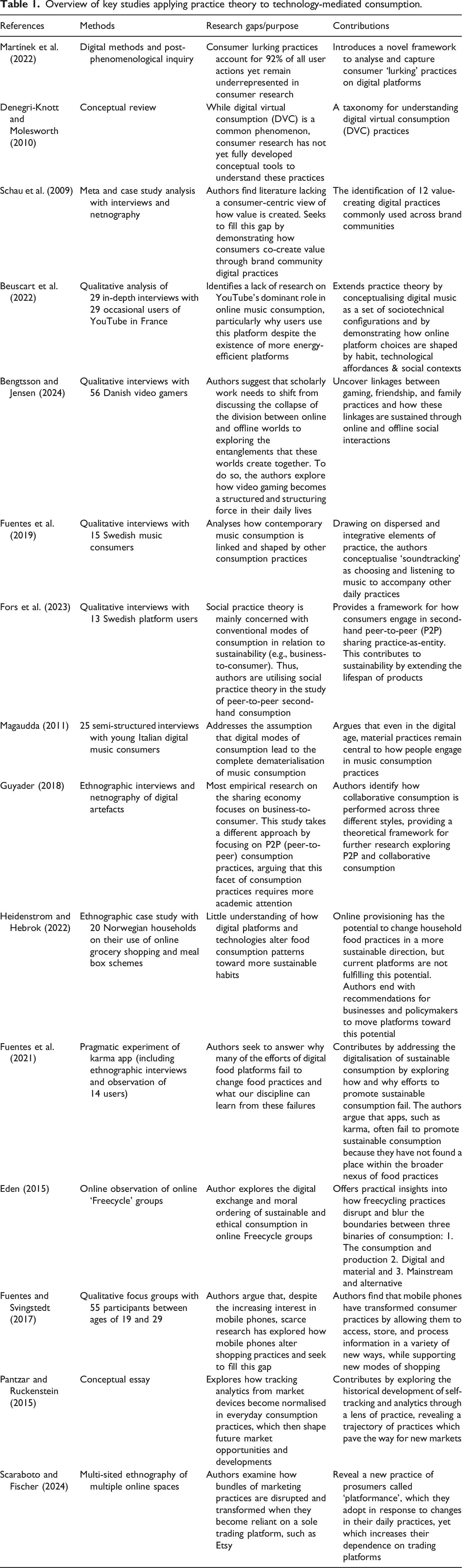
Given the paucity of marketing and consumer research on the digital practices of disadvantaged consumers, we initially turn to digital media scholarship focusing on digital exclusion to better understand how their digital practices are carried out. Scholars in this field have highlighted that, despite increasing access to technology as availability and affordability expand (Van Deursen et al., 2017), inequalities persist in terms of usage patterns, engagement, motivation and levels of skill (Hargittai, 2002). Thus, according to the stratification hypothesis, which suggests that human capital extends to online fields to shape users’ skills and interactions, socioeconomic variables alongside education continue to emerge as key determinants influencing the formation of digital competence (Chen and Li, 2022; Cruz-Jesus et al., 2016; DiMaggio et al., 2004). This underscores how users seldom approach technology as a blank slate but rather through the lens of their social and cultural backgrounds (Ragnedda and Ruiu, 2018). Hence, knowledge gaps are said to persist, especially evident in the operational and navigational skill-based challenges disadvantaged user groups face when using mobile devices or internet-based platforms (Chen and Li, 2022; DiMaggio et al., 2004; Ma et al., 2016). Viewing these cumulative findings through a lens of practice, it becomes plausible to suggest that competence, as a key element of practice, acts as a major obstacle to practice performances among socioeconomically and educationally disadvantaged consumer groups.
However, despite the barriers encountered by disadvantaged user groups, research also demonstrates their persistence in integrating technology into their daily lives. For example, scholars highlight the use of creative coping techniques such as rote learning of navigational paths (Friscira et al., 2012) or memorising names and icons pictographically to bypass limited digital literacy and skills (Ahmed et al., 2013). Although these examples demonstrate that their digital practices clearly persist, how they persist remains under-theorised from a practice-based perspective, especially regarding how competence is enacted. In light of the ongoing tensions surrounding how influences engagement with technologies among disadvantaged user groups, the next section reviews how competence is conventionally understood across academic domains to establish the baseline for this study.
Understanding competence
Conceptualising competence is complex due to its disciplinary variability, making it a ubiquitous term that includes a vast range of domain-specific applications (Batat, 2014; Findsrud et al., 2018). In consumer-related contexts, competence was originally associated with traits such as savviness (MacDonald and Uncles, 2007), or expertise (Alba and Hutchinson, 1987), both seen as ways to improve consumer decision-making and satisfaction. Within digital scholarship, skills and competences are concepts often discussed yet inconsistently defined (Becirovic, 2023). Within sociological frameworks, such as practice theory, competence is understood less as a measurable skill and more as a tacit, embodied, and practical capacity that allows individuals to learn, enact, and adapt social practices (Bourdieu, 1984; Giddens, 1984; Schatzki, 2002). Scholars in this tradition describe competence in varied but related ways: as embedded in the practice carrier’s “mental activities” (Reckwitz, 2002), “practical understanding” (Giddens, 1984), “general understandings” (Schatzki, 2002), or level of know-how and technique (Shove et al., 2012). Yet across these interdisciplinary variations, a consistent theme emerges in which competence is primarily understood as an embodied or cognitive attribute that links individuals to the performance of practices through knowledge and skill.
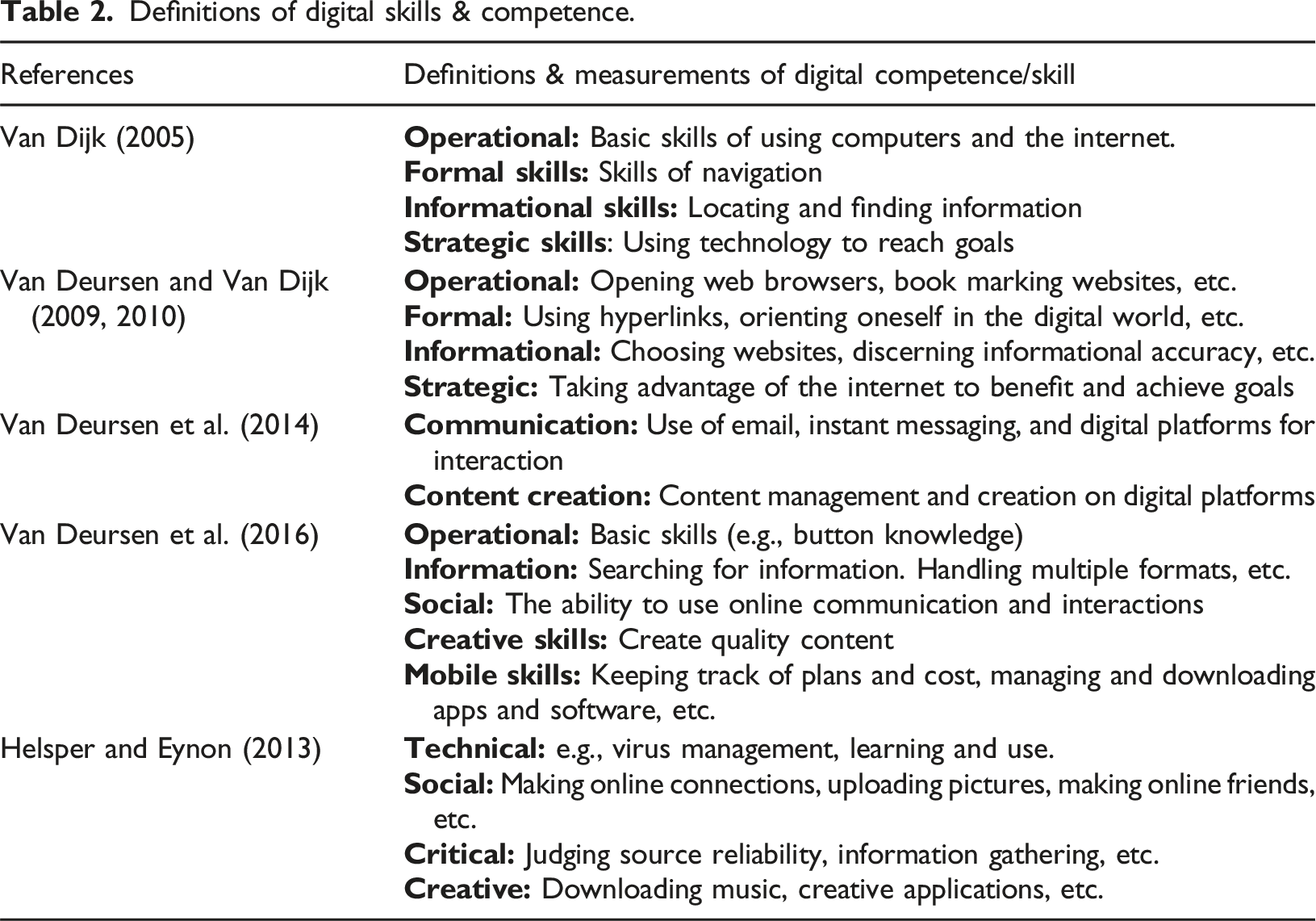
Definitions of digital skills & competence.
When returning to theories of practice to explore how competence develops both socially and contextually, scholars have proposed that competence can be embedded locally and outside the carrier, distributed across materials and objects (Shekhar et al., 2020; Watson and Shove, 2008). This perspective suggests that the ‘doing’ of a practice is not solely a human effort, but a hybrid task co-evolving between humans and artefacts. In this fashion, humans and objects create a “hybridized and distributed” knowledge system that synergistically coalesces in practice (Watson and Shove, 2008: 80). However, this framework suggests that a certain degree of familiarity and expertise in interacting with objects and entities must be established before cognition, and thus competence, can be extended. Drawing on Watson and Shove’s (2008) example, the carrier who possesses prior understanding of how to engage with and mobilise a tool has a better ability to interact with the world compared to a human lacking the tool or the capacity to engage with it. In the context of digitally disadvantaged consumer groups, where existing research highlights their skill deficits, these arguments fail to explain how their digital practices persist. As existing research focuses on the success of these distributed systems in extending competence and practices (Hutchins, 1995; Jenkins and Denegri-Knott, 2017), questions remain about the practical implications for a digitally disadvantaged practice carrier who fails to establish a hybrid system with their digital device.
Beyond its application to material objects, Shove et al.’s (2012) conceptualisation of competence provides a compelling account of how competence can be abstracted from one location and placed into another, allowing it to move across practices and between people. This alludes to the idea that competence can temporarily exist “in limbo” (p. 49), awaiting apprehension by the next carrier. However, the authors claim that for an individual to understand the competence in circulation, they must have prior knowledge and experience of the practice, stating that “know-how can only travel to sites in which practitioners are already prepared to receive it because of prior, first-hand, practice-based experience” (p. 49). Regarding the digital practices of disadvantaged users, this theorisation compels us to reconsider how digital competences are utilised and exchanged when the disadvantaged user lacks prior experience of practical familiarity with digital practices in the first place.
Thus, while Shove et al.’s (2012) account of how competence moves across sites and Watson and Shove’s (2008) focus on its material flow offer valuable insights, they risk depicting the processes and pathways through which competence flows in ways that can be exclusionary, thereby reinforcing exclusion. Therefore, we suggest that practice theory, in its current form, has limitations in explaining how competence circulates within disadvantaged consumer contexts. Consequently, we turn to theories of socially distributed and extended cognition, which offer a more relational perspective on how competence is disseminated and shared among people and groups. Since the core of our argument is that individuals can draw on their social competence to sustain their digital practices, these cognitive theories complement practice theories by enabling exploration of how competence circulates relationally, shaped by culture, environment, and group communication.
Extended mind, extended competence
The extended mind concept partially transcends the Cartesian view of cognition, which considers mental activities as solely residing within the head, by emphasising the role that an individual’s environment plays in shaping cognitive processing (Clark and Chalmers, 1998; Tollefsen, 2006). Extended mind theory, as a form of active externalism, has been used in consumption research to primarily explore how technological advancements such as search engines (Ward, 2013), automation (Novak and Hoffman, 2023), and voice recognition of smart devices (Schweitzer et al., 2019) can enrich, replace, and even augment the human mind. Thus, extended mind theory aligns with other theoretical notions of externalism (e.g., Hurley, 1998; Putnam, 1975) in its support for moving beyond traditional ideas of cognition that confine mental processes to skin and skull, by viewing cognition as “something that is often an environmentally extended process” (Smart et al., 2010: 5). Under this premise, to fully understand how competence is embedded within digital practices, we must look beyond the practice carrier to understand how competence is embedded within a broader network of environmental influences.
The seminal foundations of the extended mind framework can be traced to Hutchins’ (1995) concept of distributed cognition, which examines how cognitive processes are distributed across culture and context. Underscoring the importance of communication, Hutchins (1995) draws on naval military navigation to demonstrate how social and cognitive processes merge within a system of distributed cognition, where humans and artefacts collaborate to perform cognitive tasks that no single person could accomplish alone. Building on Hutchins’ emphasis on group culture and communication, we examine how different patterns of offline social interaction give rise to a system of shared cognition within the ‘Street Church’ community group, where members can utilise and share digital competence in circulation.
However, at the core of Hutchins’s (1995) notion of distributed cognition is collective ownership of cognition and the shared nature of cognitive processes. Since this study aims to explore how individual cognition is extended through interactions with another person or a group, we adopt the concept of the socially extended mind, which emphasises the role of social interactions in shaping and enhancing individual cognitive processes (Candiotto, 2023; Gallagher, 2013). This phenomenon becomes apparent when deeply cultivated bonds between two individuals develop to the extent that an aspect of one’s knowledge may be seen as existing within the biological framework of the other (Candiotto and Piredda, 2019). Therefore, instead of engaging in philosophical discussions centred on minds attaching to objects to extend cognition and competence (Clark and Chalmers, 1998; Watson and Shove, 2008), the socially extended mind framework allows us to illustrate how knowledge and skills are not prerequisites for engaging with objects and thus allowing practices to proceed. As participants utilise their social competence to mobilise their offline network for assistance, we demonstrate how competence no longer needs to be embodied since it can be borrowed, located externally from the carrier and used as required without necessarily leading to the embodiment or transfer of new knowledge and skills.
By focusing on intragroup communication, this study responds to the scholarly critique from Halkier (2020) and Evans (2019), who argue that practice-oriented studies of consumption have increasingly prioritised aspects such as routine, embodiment, and materiality, often at the expense of engaging with broader social dimensions of practice, instead discarding them like “babies in bathwater” (Halkier, 2020: 400). Accordingly, this study explores how digital competence emerges not simply from embodied digital skills, but through the social and cultural interactions and contexts surrounding the ‘Street Church’ community group. Consistent with Halkier (2020), this study defines social interactions as “open-ended embodied and discursive co-enactments, enabled and conditioned by what is socially doable” (p. 402). That is, social interactions are the co-created conversational patterns between two or more ‘Street Church’ members that are not pre-determined and can evolve in multiple directions. These modes of communication are primarily discursive, but also encompass embodied aspects, as members interpret what is said through bodily movements and other forms of nonverbal communication. More importantly, these modes of communication are fundamentally shaped by the culture and social norms of the ‘Street Church’ community group.
Methodology
Research context
The ‘Street Church’ is a small community located in South Auckland, New Zealand, founded by two local pastors in 2005. Members gather every Sunday morning outside the local football club to share a Bible verse over breakfast, fostering hope and mutual understanding as they navigate hardships. All members face severe educational and socioeconomic barriers, chronic homelessness and mental health struggles. Like many homeless people worldwide (Humphry, 2014, 2021), most ‘Street Church’ members own mobile phones. Preliminary observations revealed how limited literacy and exposure make social reliance crucial to their digital practices as members consistently depend on each other to troubleshoot and reconfigure digital processes. As the research team witnessed how these social interactions unfolded, it became evident that observing the digital practices of any one member reflected the group’s collective cognition as members consistently exchanged tips and tricks. These initial observations prompted our deeper inquiry into how distributed cognition flows through the community to affect individual digital practices. This, in turn, reinforced our decision to emphasise competence as the focal element of practice in this study.
Participant overview
Profile of participants.
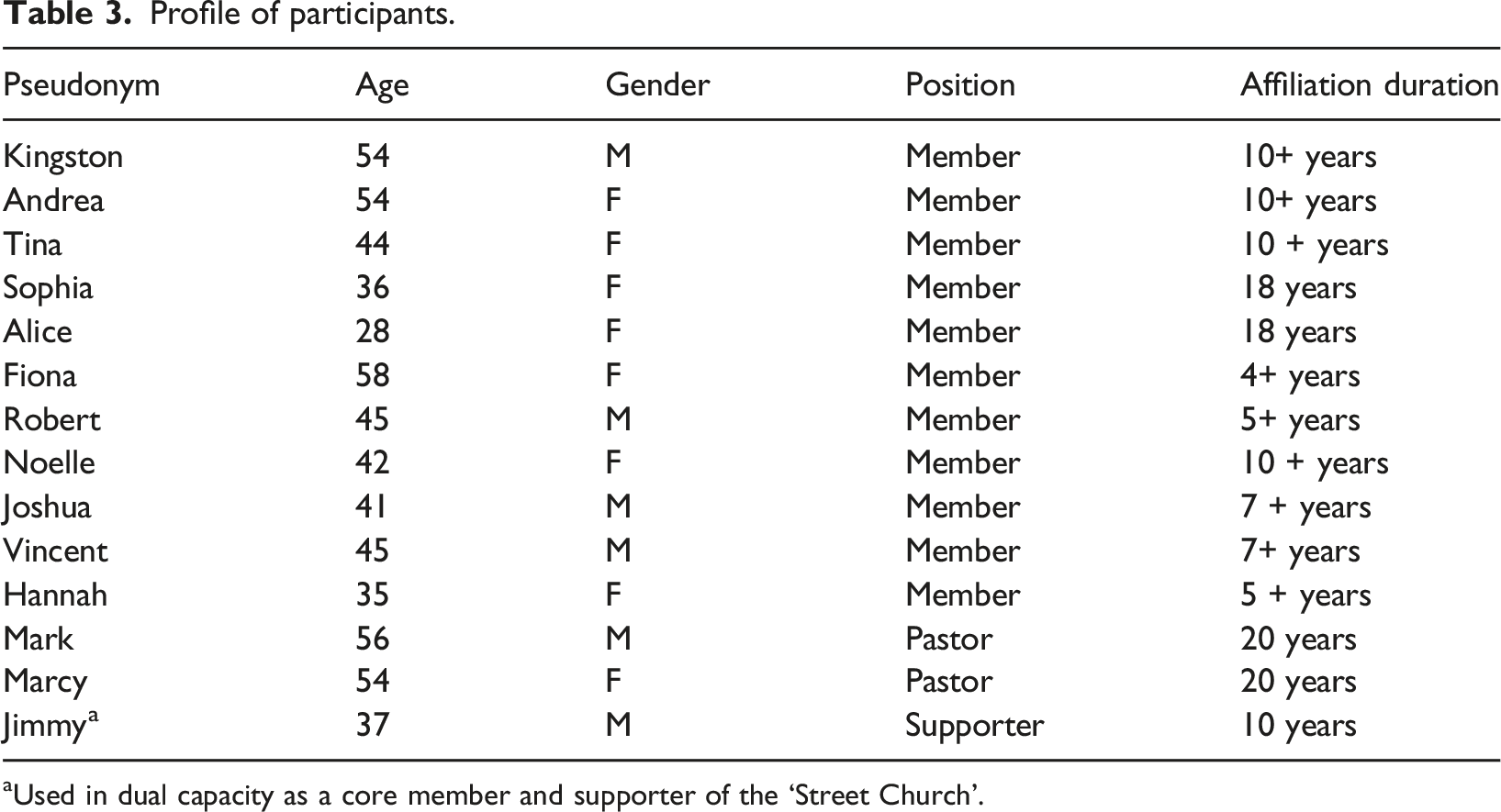
aUsed in dual capacity as a core member and supporter of the ‘Street Church’.
Methodological overview
After gaining ethics approval, the fieldwork was conducted over a 3-year period. During the first year, the first author engaged in ongoing rapport-building and iterative adaptation of the study design, followed by 12 months of participant observation, and concluded with two formal interviews with each participant in the final year.
Participant observation
Participant observation spanned a 12-month period where the first author engaged weekly with participants through informal conversations at Sunday gatherings, visits to the Pastors’ residence, where members usually congregate, and by offering transportation to the meetups. Field notes were recorded after each encounter and contained detailed descriptions, jottings, or key phrases about member social interactions, in situ encounters with technology, group rituals, and the first author’s thoughts and feelings. While participant observation facilitated continuous interactions, it lacked access to participants’ thoughts, emotions, and beliefs. Therefore, participants took part in two in-depth interviews to explore their firsthand experiences with technology and the meanings they attribute to engaging in a digitalised world.
Collage construction interview
The first in-depth interview utilised collage construction, where participants were asked to place meaningful images from magazines that represented their personal experiences with technology at the centre of the page, with less meaningful ones positioned towards the edges (Koll et al., 2010). The researcher supplied participants with a large box of unassorted magazines, as participants’ transient lifestyles often limited access to such materials. Unlike other collage-based methods that ask participants to gather their own imagery (Bone et al., 2014), we anticipated this approach might pose a barrier to engagement. During and after the collage was constructed, the first author probed participants about the stories behind their image choices and the thoughts, emotions and memories they evoked. These interviews ranged from 1 to 2.5 hours, depending on the participants’ ability to articulate and their willingness.
Contextual inquiry interview
To better understand how participants performed digital practices, we utilised contextual inquiry, as an in-depth interview method rooted in ethnography, to directly observe how participants interacted with technology in a naturalistic setting (Holtzblatt and Jones, 1993). These interviews were arranged as a ‘shadowing’ activity where participants opted to complete an exercise using either a laptop or a mobile device. These participant-led activities varied according to individual needs and included applying for jobs, learning about their whakapapa [family history], culture, or even researching a health condition affecting a loved one.
While the interviews were conducted one-on-one with the researcher, this method offered insights into the social and behavioural aspects of their digital practices. Unlike the broader group dynamics observed during participant observation at the Sunday meetups, which often involved informal troubleshooting and shared problem-solving, contextual inquiry enabled closer observation of participants’ step-by-step engagement with technology. It revealed not only the specific barriers they encountered but also how they sought assistance in real time, turning to the researcher as a trusted social resource. Participants had complete control over the device and were encouraged to use the ‘think out loud’ protocol to verbalise their thoughts and emotions throughout (Zarcadoolas et al., 2002). These interviews ranged from 1 to 1.5 hours, depending on participants’ engagement.
Semi structured interview with pastors
After completing data collection, a semi-structured interview was conducted with the Pastors of the ‘Street Church’ community. As part of community consultation and data triangulation, preliminary findings were discussed with these ‘experts’ who offered their informed interpretation on the subject matter which helped embed further meaning (Hill, 1991). As community consultation is seldom a single event, the Pastors and the one additional supporter were consulted about any additional insights as they unfolded, with key quotes and phrases added to the field notes.
Data analysis
The final dataset comprised 24 hours of audio recordings, 531 pages of transcribed interview text, and 35 pages of A4 reflexive and observational field notes. Data analysis followed an iterative process as the first author oscillated between observation, transcription, interpretation, comparison, triangulation, and further data collection until themes genuinely reflected the entirety of the data (Muniz et al., 2001). This analytical process was guided by Braun and Clarke’s (2006) thematic process where deep familiarisation led to inductive analysis by identifying semantic and latent codes while considering emic and etic interpretations. Throughout this analytical process, themes amassed, collapsed, and later converged to produce a thematic map that guided the portrayal of the cultural sharing group. To ensure trustworthiness, member checks occurred with key participants alongside ongoing consultation with both Pastors to validate findings. To maintain alignment with the data and mitigate potential bias stemming from the first author’s positionality in the field, emergent findings were also cross-checked by the second and third authors.
Findings
Aligning with Rinkinen (2013), who notes how disruption transforms the role of practice carriers from passive bystanders to proactive managers of their own practices, through our fieldwork, we observed that ‘Street Church’ members remained persistent in engaging with digital devices, despite the daily technological barriers they encountered. Instead of becoming passive due to their struggles with opening Internet browsers, navigating pathways that require adequate spelling, or distinguishing between page layouts, members actively collaborate by drawing on each other’s fragmented digital skills to shape their own digital practices. In this manner, interviews and observations demonstrate participants borrowing competence from each other through three social interaction pathways: by seeking one-on-one assistance as members teach digital processes to each other (sequential), by pooling their competences together (synchronised), or by leveraging the digital skills of others without undergoing the learning process themselves (substitutive). These patterns of offline social interaction highlight how engaging in digital activities leads to complex exchanges for digitally disadvantaged groups. As the findings will reflect, configuring digital practices first requires navigating the social complexities of participants’ relationships with other ‘Street Church’ members who are frequently relied on for digital support. By observing how this social competence unfolds, we can inform our theorisation of borrowed competence, an umbrella term that captures these distinct yet interrelated flows of support.
To borrow, by definition, means to take and use something with the understanding that it will be returned. In this context, we use the term borrowed competence to describe digital competence that is used to perform a task but is not necessarily internalised by the participant. Instead, the competence remains embedded within the social system of the group where it is circulated, shared, and drawn upon as needed. As the findings will demonstrate, this is not a case of passive dependence or merely delegation. Rather, borrowed competence is enacted within a tacit and relational system of social obligation, where members reciprocate support to the group through assistance, presence, or other forms of contribution implicitly and over time. Thus, borrowed competence departs from the idea of progressive internalisation of knowledge and skills and instead speaks to a more relational mode of engaging in practice, where competence is shared rather than possessed, and where ongoing practices depend on the social interactions that sustain them.
The remainder of the findings are organised around these patterned interactions to illustrate how social dynamics influence and alter the trajectories of their practices in various ways. For example, when ‘Street Church’ members seek assistance from one another through sequential flows, digital practices remain fragile, yet functional, as offline social interactions allow members to continue their digital practices by rote learning steps from others in their network. While synchronised flows seem to show significant progress as members gain more independent and routine access by gradually embodying new digital skills, it may be considered the most volatile enactment of practice since the culture of implicit trust may lead to misguided online activity. Instead, we observe stability emerging in substitutive flows unexpectedly when members solely rely on others to perform digital practices on their behalf. Collectively, these findings suggest that practices become more stable when competence is borrowed rather than fully embodied. This reinforces our novel understanding about the formation of competence as we find that digital competence no longer needs to be embodied for the practice to persist. New forms of competence can seamlessly replace existing ones to uphold a particular practice.
Sequential flows of social interaction
Directly seeking help from one another facilitated a sequential dissemination of digital competence throughout the network, creating a domino effect where learning a skill from one member often led to being called upon to teach another in quick succession. In this regard, Andrea has taught Kingston the majority of his technical know-how, which she had learned from others in the community. Kingston explains: “I didn’t know how to text or anything until I met this one here [pointing to Andrea] and she showed me.” Sequential learning often took the form of rote learning – a surface learning approach to superficially overcome barriers by memorising procedural steps through repetition and rehearsal without gaining any deeper understanding of the procedure being carried out (Ahmed and Ahmad, 2017). Tina illustrates how this learning process usually occurs during her social exchanges with others in the community by saying: “If it’s easy enough, I’ll get it straight away, and then I’ll go back to the beginning and I’ll do it myself. And then I’ll go, ‘I do this and do that?’ and they go, ‘yeah, yeah, yeah’. Sweet, I know how to do it then.”
As participants described the process of memorising procedural steps from each other, it became evident that this involves linking new digital competence to pre-existing cognitive coping strategies. For example, members often deploy pattern matching and pictographic thinking to overcome their difficulties with comprehending text. In this manner, Tina has learnt from others that she can use her Google Chromecast by matching “that little square thing” at the top of her mobile phone screen with the streaming action it triggers. Similarly, Noelle has learnt digital competences in her new workplace by associating procedural steps with available visual and spatial cues. Thus, Noelle does not know the names of applications on her computer screen but remembers the procedural steps and can carry them out once she finds the icon on her home screen: “There are some applications that we use that I wouldn’t know the name of, but I’ll just go by the picture and press into it…I just know the picture.”
These observations highlight a key disagreement with the claims made about the hardships faced by digitally disadvantaged groups when applying their digital competence to operate digital devices effectively (Summers and Summers, 2005; Zarcadoolas et al., 2002). Our findings suggest that members have managed to establish a functional working relationship with digital devices despite digital competence remaining outside the practice. Since rote learning prioritises recall over comprehension, our findings indicate that the ability to engage with technology does not always require the deep understanding emphasised by traditional frameworks of digital competence (e.g., Helsper and Eynon, 2013; Van Deursen et al., 2016; Van Deursen et al., 2014). Instead, this finding reframes digital skills by questioning the alternative types of competence that are responsible for holding these practices together.
What emerges, instead, is a hybrid relationship between practice carriers and their fellow community members, as individuals continually oscillate between one another for support; a dynamic akin to the practical know-how and resource sharing that occurs within informal networks of friends and family (Shekhar et al., 2020; Smit et al., 2024). This dependent relationship is exemplified by Joshua, who must constantly turn back to his primary social support to retrieve documents from his computer: “So Maria showed me how to do autosave. Just make sure that little disc thing or whatever [referring to icon]. She showed me, always keep that on, so if it does happen or you lose something, it’s already saved somewhere in the fucking computer and Maria will find it.” In this way, a feedback loop emerges, whereby fragmented forms of digital competence are sequentially transmitted through the network, allowing digital practices to stabilise when the newly acquired digital competences align with well-established cognitive coping strategies. Yet, when technological demands surpass individual coping and cognitive resources, participants must rely on their offline social supports, creating a functioning yet fragile way of (re)configuring digital practices.
Synchronised flows of social interaction
Synchronised flows depict moments when two or more participants come together to exchange tips, troubleshoot, and collaboratively solve digital challenges. Unlike sequential flows, where participants are more likely to receive instruction from a knowledgeable other, synchronised flows demonstrate participants engaging in a mutual exchange of skills and insights, learning alongside each other through collaborative problem-solving. For example, Joshua describes how learning the procedural skills to navigate his mobile phone was initiated by the community, who rallied together to collectively overcome barriers that would have otherwise stifled his practices. When asked how he learned to use his mobile phone, he replies: “Just going through the years of having a group of friends who have their devices, and then sometimes, we’d all get the same device, and then we could all bloody tee up, you know.” Similarly, Tina acknowledges how collaborative learning helps her to spell words, which has subsequently enhanced her ability to engage with digital devices: “If I can’t spell it, they’ll spell it for me…because we might want to look up one of the things, mini-golf or whatever. The other day, it was Rainbows End [theme park]; I didn’t know how to spell ‘Rainbow’. So, one of the kids spelt it for me, he went away onto his phone and got it right and then showed me how to spell it.”
This collective, simultaneous form of engagement was the only flow of social interaction in our findings that suggested the gradual embodiment of new competences, as participants moved towards greater independence in their own digital practices through initial participation in this active learning process. Thus, unlike sequential flows, where members still engage in digital practices but lack the conventional skills and thus remain dependent on others, collaborative progress through synchronised flows enables participants to collectively build digital competence through the shared ‘doing’ rather than passive instruction. This flow of interaction better accommodates the learning style of participants who, like Tina, expressed they learn best by “physically do[ing] stuff.” Thus, tapping into the experiential connection between doing, interacting, and learning embedded within synchronised flows empowers Tina by reducing her reliance on the group. As she explains: “I don’t have to ask too much these days. I still ask, but not like constantly, it’s like I got some brain cells back.”
However, given the strong bonds among ‘Street Church’ members, we find that these newly embodied competences are influenced by the culture of implicit trust that generally serves as the glue in systems of distributed cognition (Gallagher and Petracca, 2024; Hutchins, 1995). Thus, much like the amateur decorators who implicitly trust materials such as non-drip paint to “know” how to perform without their skilled input (Watson and Shove, 2008), and like Otto who relies on his notebook to serve as an extension of his biological memory (Clark and Chalmers, 1998), the information and guidance circulated among ‘Street Church’ members is not subject to the same level of scrutiny as information coming from outside the community. Thus, when asked how she stayed informed during the Covid-19 pandemic, Tina described her reliance on Darcy to interpret and validate content rather than the reputable websites or agencies she still struggles to access alone: “She [Darcy] would look up things, because she’s an online person a lot. She’s constantly on technology, and she would tell me stuff or send me stuff to read if I can’t look it up.” When asked what kind of content Darcy shared, Tina explained: “Just funny stuff on messenger or TikTok…if I was struggling [to understand information], I’d just ring her and go “How did you find that out? I’m getting this information.” And she goes, “That’s wrong. That’s false information. This is the right information.
Woermann and Rokka (2015) describe practice alignment as instances where no component “sticks out” or disrupts the seamless enactment of a practice. In contrast, misalignment occurs when one or more elements threaten or harm practice performances, thereby demanding the practitioner’s attention. Akin to other scholars who find practice misalignments between the ‘doing’ and ‘understanding’ of a practice (Phipps and Ozanne, 2017; Spotswood and Gurrieri, 2023; Thomas and Epp, 2019), we find the implicit trust that facilitates participants’ uptake of new knowledge and skills also posing a risk to what is learned in new contexts when that trust is enacted outside the ‘Street Church’ community. For example, as their cultural ways of learning migrate to online spaces and becomes replicated in their social networking behaviour, members tend to seek out homogenous online communities that amplify the conspiracies and negative beliefs prevalent within their physical ‘Street Church’ community. These social networks have become their secondary source of truth, as Sophia explains: “It [Facebook] teaches you everything overall. Anything you want to know, or anything you’ve thought, it’s right there.”
Thus, implicit trust does not always align with the conduct required for safe and effective online learning, as Pastor Mark highlights when reflecting on how easily members fall prey to online misinformation: “Some of the guys, probably a good half of the guys, had some really outrageous conspiracy theories, got from online. That’s the thing we’ve found, even with Kingston and Andrea, things like political opinions and stuff. Yeah, Vatican, Illuminati, all that stuff, they see something, and they take it for real.” Thus, over time, with the reinforcement of platform algorithms, participants dwell within these online echo chambers that create a form of “ideological isolation” by strengthening their distrustful dispositions toward anything beyond their sphere of familiarity (Flaxman et al., 2016: 313). Similar to how Robinson and Arnould (2019) describe the “unpleasant unpredictability” that emerges during moments of hysteresis, where consumers experience a mismatch between their practical understandings and changing context (Bourdieu, 1984), we conceptualise this misalignment as a disconnection between participants existing learning and communication practices and those required for effective engagement in online spaces. In such moments, the disposition to implicitly trust the knowledge imparted within synchronised flows can lead their practices to go astray in digital spaces, creating a discord between how they can safely engage in the two social environments they inhabit simultaneously.
Substitutive flows of social interaction
Within substitutive flows of interaction, we find participants effectively substituting their offline social competence to utilise others to engage in digital practices on their behalf. In this form of social exchange, digital competence remains solely with other community members, and the carrier does not take part in any active learning process. Instead, digital competence is only ever loaned out to carriers in times of need. For many members of the ‘Street Church’ community, this is their only strategy for getting by with technology in daily life. As Pastor Marcy explains: “Rhys, he doesn’t really have a phone. He’s always relied on Alice or his girlfriends to manage all that kind of stuff for him. So, if you want to get hold of him, you’ve got to go through this person, and they will find him somewhere.” When engaging participants in conversation, it became evident that they had developed a working awareness of who in their network held the particular digital skills they required. Over time, this awareness functioned like a competence-based rolodex, as Joshua illustrates when asked how he organised his flights for a previous trip, “I got Donna to do it for me…she already knows my debit card number. Like, honestly, I’m shit at this. Even when I was studying, Maria helped me heaps. Abigail helped me heaps, just to find…what was I struggling with? Oh, referencing.” Interviews and observations reveal that other ‘Street Church’ members do not intervene to assist these participants due to passive inaction. Rather, this form of digital support is activated through deliberate social requests as participants learn whom to ask and what to expect.
As is often the case with proxy use (Grošelja et al., 2022), the motivation for leveraging others to perform digital practices on their behalf is often to alleviate experiences of overwhelm and cognitive overload. Joshua explains: “I’m shit at it [technology]. I don’t use it as often as I should, and when I do get that opportunity, I get others to do it for me. Because I just say and they do, and it happens. I don’t know if that’s just laziness or what causes it. Maybe the fear of fucking it up, I suppose it’s a combination of all of it, and I’ve just found it easier for others to support me.” Hence, Vincent describes the fear and trepidation he feels when engaging in digital practices without a proxy user: “I’ve only started getting into this [technology]. It’s a little bit different because when I had a partner, it was more she did everything for me. She was doing the bank accounts. She was putting in my password for Facebook. I didn’t really know how to deal with it. I just always couldn’t… just didn’t know how.” Without the ability to substitute social interaction for the digital competence of others, individuals like Vincent would remain permanently excluded from digital spaces, as partially demonstrated by his attempts to bank online: “I went to the bank to get bank statements. I don’t do any online. They’re always saying ‘this is how you do online banking’ [but] passwords and all that stuff. As soon as I go on, I don’t know [how].”
Instead of a one-sided dynamic, members possess a deep understanding of the group’s cultural ethos regarding reciprocity and actively seek to establish mutually beneficial exchanges to promote the flow of competence over time. Therefore, just as Maria has become Joshua’s primary source of digital support, Maria relies on Joshua to coach her in Te Reo Māori. As Joshua explains: “She’s [Maria] got her second degree in Te Reo Māori, which is cool, I feel like I can help her with that stuff.” In a similar vein, Tina transports carloads of goods from her home as a token of reciprocity for the ongoing support (digital and otherwise) that she receives from the Pastor’s family: “Every time I was going up [to Sunday gatherings] …I was bringing up carloads because that family has done everything for me. So, it’s just my way of giving back.” This reciprocal give-and-take demonstrates how all community members actively contribute to shaping the flow of competence over time.
Thus, we propose that substitutive flows entail more sophisticated forms of social competence, including awareness of others’ skills and understanding the tacit rules of reciprocity and exchange. That is, unlike sequential flows of interaction, which involve asking and receiving instruction, or synchronised flows, which rely on collaborative engagement, substitutive flows require the subtle skills of eliciting action from others. This not only involves asking but also reciprocating and carefully timing requests so that others can step in on their behalf. In this respect, we find substitutive flows to represent instances where members effectively barter their social competence for the digital competence of others, all whilst demonstrating their ingenuity in organising their environment to simplify cognitive tasks (Clark, 1997). If we liken this strategy to the idea that interactions with material objects can serve as functional equivalents to internal cognitive processes (Clark and Chalmers, 1998; Watson and Shove, 2008), then substitutive flows suggest that offline social competence can achieve parity with digital competence in enabling successful digital navigation.
Paradoxically, substitutive flows appear the most stable. We propose that this stability results from ongoing offline interactions that occur in the background, replacing the relationality that technology erodes from them. For example, when participants reflected on technology more broadly, they expressed a preference for face-to-face interaction, which they tend to associate with emotional clarity and shared understanding. Thus, Joshua explains his preference for offline communication because he can “see somebody’s reaction, and it’s just there. You know they’ve received the message, or whatever has been relayed to them.” This preference for physical presence is reinforced by Pastor Mark, who highlights the importance of simply showing up and being reliably present for ‘Street Church’ members: “Consistency’s a big thing for these guys. Being there consistently. Because that’s where a lot of people lose them. With consistency.” Thus, Pastor Mark highlights a downside of technology for the ‘Street church’ community: “A lot of the technology side, what I’ve seen too, but it depersonalises things…people can’t go in [to places] …there’s no relationship now, it’s all online. Some people just can’t do it. So, it takes away from [them], it tries to put people in a sameness, and a homogenous type of thing.”
While synchronised flows revealed the consequences for knowledge and understanding when online practices diverge from participants’ social and cultural ethos, substitutive flows illustrate the opposite: digital engagement stabilises and improves when online practices align with their offline values and ways of doing. That is, when participants find ways to engage with technology that resonate with their offline cultural ethos, they become more motivated to pursue digital progress, inclusion, and personal growth. This harmony is evident in participants’ responses when asked about the meaning of being ‘digitally connected’. Participants frequently emphasised the importance of community connection, as illustrated by Tina who describes this as “talking to people. That’s what I’d say it is – communicating with people.” Likewise, Noelle states that it is the “people” who give meaning to her online activities. Collectively, these findings reinforce how substitutive flows, which boost offline relationships, provide a stabilising effect on participants’ digital engagement.
Discussion
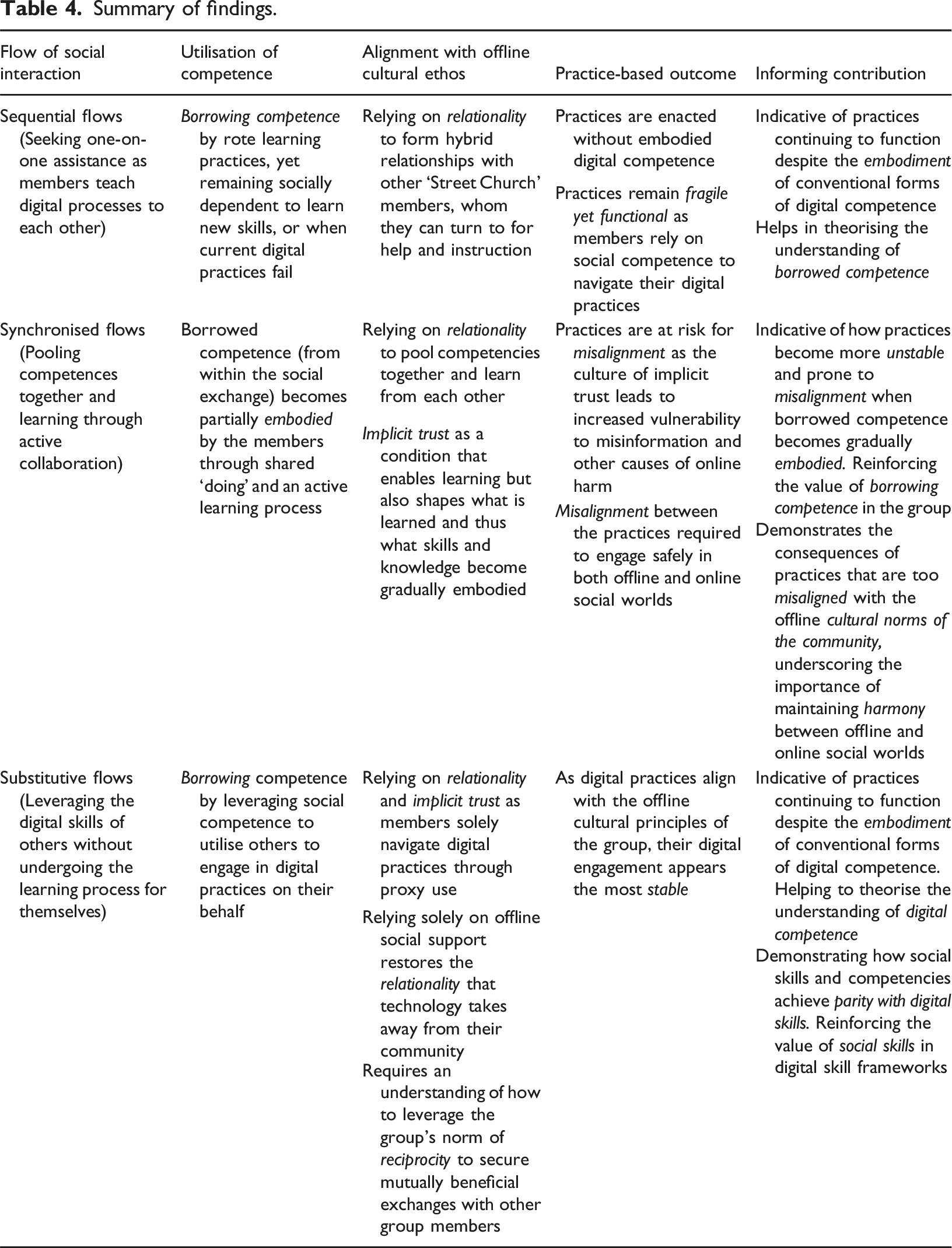
Summary of findings.
Shove et al. (2012) treat competence as a mobile element of practice, one that can be abstracted (separated from its original context) and reversed (adapted and translated) elsewhere, provided it can be appropriately decoded by the practitioner. While this framing is valuable for understanding how competence develops and spreads, it implies that competence can be easily transferred as long as the recipient already possesses sufficient understanding of the practice. Our findings, however, show that this process is more complex for disadvantaged consumer groups who often rely on others to assist their comprehension of a practice. Rather than decoding the knowledge themselves, participants mobilise their networks to do so on their behalf. Borrowed competence thus refers to situations where practice carriers can access and act on required knowledge and skills through others, without necessarily needing to decode, understand, or embody that competence for themselves.
Thus, instead of viewing competence as being embodied by the consumer (Magaudda, 2011), embedded in objects (Watson and Shove, 2008), or located in the minds of others (Shehkar et al., 2020), we define borrowed competence as the competence that remains embedded within social interactions. In this manner, competence persists outside the carrier, residing in the exchange itself and accessible to all involved parties. This departs from much of the consumption literature, which often emphasises embodied and cognitive dimensions of competence. For example, Magaudda (2011) and Shekhar et al. (2020) explore the new knowledge and skills consumers must internalise in response to material changes in practice. Thomas and Epp (2019) highlight tensions that arise when embodied competence misaligns with the actual ‘doing’ of a practice, while Fuentes and Svingstedt (2017) discuss how consumers acquire and utilise internalised competences in mobile shopping. This focus may stem from how Shove et al. (2012) have “lumped multiple forms of understanding and practical knowledgeability together” (p. 24) into the singular concept of competence, which risks obscuring the social and environmental dynamics that traditionally underpinned practice theory. Reinterpreting these studies through the lens of borrowed competence invites a shift in focus toward exploring how relational modes of competence shape consumers’ adaptation to new materials or practices, particularly for those facing unfamiliarity or disadvantage.
Building on this, although there is increasing interest in how competence is embedded in objects and materials (e.g., Jenkins and Denegri-Knott, 2017; Watson and Shove, 2008), its grounding in social interaction remains relatively under-theorised. As Halkier (2020) notes, in many influential studies of consumption grounded in practice theory, social interaction is “either not mentioned, is underplayed, or is simply understood as coordination” (p. 400). Our conceptualisation of borrowed competence thus helps bridge this gap by accounting for how disadvantaged consumers sustain their digital practices through relational means, even when they cannot fully embody the competence themselves. These insights may also resonate with scholars working in adjacent fields such as Actor-Network Theory and Assemblage Theory, regarding how action is shaped by systems of human and non-human actors. While these domains increasingly attend to non-human entities (Schneider-Kamp et al., 2024), our findings remind us not to neglect the important role of human others who, through their interactions and shared competence, form systems and institutions that guide action (see also Gallagher, 2013). Although theories of mind extension are renowned in philosophy, we argue that their guiding principles also offer valuable tools for consumer research across different traditions, enabling a better understanding of the broader environmental dynamics that shape cognition and action.
As noted in the literature review, digital skills are broadly defined, with multiple overlapping definitions and methods of measurement. Despite this variation, Table 2 highlights key commonalities in how they are conceptualised within digital divide research. Firstly, skills are often regarded as an umbrella term covering a range of competences, from basic to more advanced, for creating, deciphering, evaluating, and sharing information on digital devices. Second, most measurements focus narrowly on skills directly applied to the device, overlooking broader competences rooted in users’ everyday contexts that are equally effective for navigating digital domains. Instead, these frameworks reinforce a deficit-based perspective by classifying those who do not meet these thresholds as lacking in a specific way.
However, substitutive flows of interaction reveal how participants exchange their social competence for others’ digital skills, pointing to a novel understanding of how skills outside of these frameworks can be practically applied to achieve a similar outcome. Therefore, we advocate for a broader perspective on how digital skills are conceptualised, defined, and measured by recognising other essential skill sets emerging from social and cultural backgrounds that are equally effective in navigating digital domains and achieving stability and continuity in practice. Doing so may help bridge the skill-based chasms articulated in digital media studies on digital inclusion while reducing the deficit labelling often cast upon disadvantaged social groups (Fisk et al., 2023).
A final insight we wish to emphasise is the fundamental role of offline culture in stabilising participants’ digital practices. As Table 4 highlights, substitutive flows restore the relationality that participants feel technology takes away from them. Since these flows depend on proxy use, participants must implicitly trust others with sensitive information when they allow other members to perform practices on their behalf and display reciprocity by establishing a relationship based on give-and-take. However, when online contexts suddenly demand behaviours that are unfamiliar to their offline cultural principles, practices become destabilised, as illustrated by synchronised flows where participants trust misinformation, which threatens both their online and offline safety. Evidently, substitutive flows are more oriented toward positive and secure experiences that promote digital inclusion. This underlines the necessity of understanding how skill development occurs within a broader ecosystem where synergies between offline and online worlds must be maintained.
Therefore, we not only advocate for a more socially oriented understanding of skills but also support more contextually grounded and community-led approaches to skill development. Instead of adopting a top-down approach where services and organisations are tasked with designing programmes without meaningful input from users, this study calls for more bottom-up approaches where the community itself is mobilised to co-design and co-develop programmes that reflect the lives and experiences of those they aim to serve. While Fisk et al. (2023) demonstrate the importance of services in developing consumers’ capabilities to promote digital inclusion, engaging with services from a position of disadvantage or vulnerability can trigger experiences of stigmatisation, which act as barriers to effective learning (Adkins and Ozanne, 2005). Therefore, rather than forcing individuals into unfamiliar settings or environments that may not foster a positive learning experience, our findings indicate that a more effective approach would be to utilise the avenues and resources they already feel comfortable using. This not only alleviates some of the burden experienced by service providers (Fisk et al., 2023), but also allows members to upskill and empower each other, further strengthening the relational bonds they see as vital to their community.
Conclusion
In summary, we contend that broadening the concept of competence to include unconventional ways in which carriers combine knowledge and skills into their practices opens new avenues for observing how practices persist beyond what traditional research might see as misalignment or failure. By highlighting how participants borrow competence through social interactions, and how the skills involved in mobilising others’ expertise achieve parity with digital skills, our findings caution against conflating disadvantage with digital exclusion. Rather than viewing disadvantage as a personal deficit, we encourage researchers to see it as a form of difference that shapes alternative, yet equally effective, ways of engaging in practice. Future research could examine how various types of competence manifest among other disadvantaged consumer groups, or how borrowed competence operates in other practice-based contexts. Doing so contributes to a strengths-based approach by moving beyond binary labels that unnecessarily classify individuals as vulnerable and instead recognises them as capable individuals who bring diverse skills and resources to consumption settings as complex human beings.
Supplemental Material
Supplemental Material - Borrowed competence: Socially extending the mind to extend digital practices
Supplemental Material for Borrowed competence: Socially extending the mind to extend digital practices by Cordelia R. Stewart, Sheau-Fen (Crystal) Yap, Krzysztof Kubacki in Marketing Theory
Footnotes
Acknowledgements
We extend our appreciation to all the participants for entrusting us with their valuable reflections and experiences. We appreciate their time and effort dedicated to the research project. We also wish to thank our reviewers for their insightful feedback, which greatly aided the development and refinement of this paper.

Ethical considerations
Ethical approval was sought in two stages Auckland University of Technology (AUT) who approved all phases of data collection on 21st November 2021 (Phase 1) and 14 July 2022 (Phase 2) without amendment. Approval number: 21/412.
Consent to participate
Written informed consent was obtained for all participants prior to enrolment in the study, in accordance with the ethical approval granted by Auckland University of Technology (AUT).
Consent for publication
The authors confirm that written informed consent to publish has been obtained from all participants involved. The consent forms are retained by the authors and are not included in the submission.
Funding
The authors received no financial support for the research, authorship, and/or publication of this article.
Declaration of conflicting interests
The authors declared no potential conflicts of interest with respect to the research, authorship, and/or publication of this article.
Data Availability Statement
The data contains a significant amount of sensitive and identifiable information and removing it may compromise the meaningfulness of the data. As a result, the data is not publicly available. However, to support transparency and trustworthiness in the findings, a web appendix containing representative quotes has been included with the original manuscript. Additional access may be considered upon reasonable request to the corresponding author, subject to confidentiality and ethical approval guidelines.
Supplemental Material
Supplemental material for this article is available online.
Author biographies
References
Supplementary Material
Please find the following supplemental material available below.
For Open Access articles published under a Creative Commons License, all supplemental material carries the same license as the article it is associated with.
For non-Open Access articles published, all supplemental material carries a non-exclusive license, and permission requests for re-use of supplemental material or any part of supplemental material shall be sent directly to the copyright owner as specified in the copyright notice associated with the article.
