




Abstract
This paper investigates the temporal nature of place-making by focusing on a nature-centred urban regeneration project that has experienced significant change over time. Adopting Ricoeur’s theory of three-fold present, we demonstrate how, through residents’ narratives, place-making is defined temporally through memories (past-in-the-present), experiences (present-in-the-present), and expectations (present-in-the-future). The findings support the notion of place-making as a fluid process but extend this understanding by promoting a temporal logic that is necessary to account for the transformation of meaning over and with time – its past, present and future – and by those who experience it. In doing so, we provide a conceptualisation of place-making as multi-temporal. The importance of celebrating the distinctiveness of place based on how it is experienced, and embracing its temporal nature directly supports place marketing and place branding activities. We further contribute to the marketing literature by offering insight into a temporal logic that affects and ultimately shapes consumption processes and how these materialise through narratives of time.
Introduction
Place-making is a fluid and ongoing process that stems from the interactions and relationships between people and place (Aitken and Campelo, 2011). It reflects the transformation of meaning from a space to a place (Tuan, 1975). Cresswell (2004) supports the view that people’s lived experiences are core to place-making, thus necessitating a people-centred approach that embraces ways of life as a means of understanding place (see also Jacobs, 1961). However, central to any consideration of place-making is an inherent temporal logic because the transformation of meaning is not fixed, and people’s lived experiences occur over their life course. Place-making represents a process that evolves and changes over and with time by those who experience place. As such, a wider interpretation of place-making must account for its temporal nature which is a necessary inclusion for a greater understanding of the theory of place (see Warnaby, 2024). Although many authors refer to place and the ‘changing and competing narratives in and over time’ (Warnaby and Medway, 2013: 345) and the ‘multifarious versions of place’ where ‘boundaries are constantly formed and reformed’ (Cheetham et al., 2018: 475), this remains an under-investigated area of study (Reynolds et al., 2024).
Recent work by Warnaby (2024: 2) recognises a lack of focus ‘in the place marketing and branding literatures, [because] a deeper understanding of the role of time is less evident’. Reynolds et al. (2024: 1) also stress the ‘limited understanding’ in this area with respect to omni-temporality in place branding and place marketing literature. These oversights are perplexing given that places are often defined by a celebration of the past as lived in the present as well as those that relate to future expectations (see Reynolds et al., 2024). Chatzidakis et al. (2018: 149) further stress the importance of the temporal dimensions of place as ‘implicit in notions of place, with places being described as being in an incessant state of becoming’. Although others (e.g. Borghini et al., 2021; Steadman and Coffin, 2023; Steadman et al., 2021) tangentially link temporality and place-making in the context of place atmospheres, it is largely based on place as experienced (consumed) rather than focusing on place-making itself as something that is co-created, both produced and consumed. To this end, Andres et al. (2021: 29) call for planners to understand the complexity and diversity of place-making as such considerations are ‘poorly accounted for in formal planning decision-making processes’.
This study investigates the temporal nature of place-making by focusing on a nature-centred urban regeneration project that has experienced significant change over time. We employ a multi-stakeholder perspective with residents (termed resident stakeholders) who represent various perspectives of place related to its material and non-material environment (e.g. its experiential aspects). In doing so, we contribute to the literature on place by conceptualising place-making: 1) as temporally defined based on the transformation of meaning that materialises through narratives of place from memories (past-in-the-present), experiences (present-in-the-present), and expectations (present-in-the-future). This study addresses ‘factors that are currently given less importance (or ignored) by the place marketer’ (Parker et al., 2015: 1095). Through narratives of place, place-making is both produced and consumed through people’s interactions and relationships with place (Aitken and Campelo, 2011), thus reflects a process of co-creation. It is important to note that, in this study, time is not defined as chronological, but instead it is fluid concept that is lived and experienced and develops from the past, present and future (Brighenti and Kärrholm, 2018). Place-making reflects an experiential consumption context that materialises through meaningful engagements with place as lived and felt (see Holbrook and Hirschman, 1982). We further contribute to the marketing literature on consumption by demonstrating 2) how the temporality of place advances our understanding of the experiential aspects of consumption in the context of place by presenting time as central to experiential consumption, and how this affects and ultimately shapes consumption processes. We therefore address MacInnis’s (2011: 136) call for theoretical contributions in marketing scholarship by offering an ‘envisioning’ paper through offering a new and critical perspective and conceptualisation of place-making.
Theoretical underpinning
Place-making, place marketing and place branding
Tuan (1975) defines place-making as the transformation of meaning from a space to a place. This conceptualisation is grounded in the interpretation of place as lived and experienced, and often such meanings are (co)created and shared within a community (see Kavaratzis, 2012). Place-making is very much part of residents’ everyday lives as it reflects ‘processes of daily encounter in place’ (Nursey-Bray, 2020: 38). For example, recent studies in the consumer culture literature have demonstrated the experiential, co-creative and performative nature of place-making such as Sherry et al.’s (2001) ESPN Zone, Borghini et al.’s (2009) American Girl Place, and Peñaloza’s (1998) Nike Town. Here, place-making is not only represented in the consumption of place in relational, shared and experiential ways but also through the production of place in terms of collective interpretations and shared meanings. For instance, Chatzidakis (2020) presents the collaborative nature of place-making in the context of producing spaces founded on shared interpretations of anti-capitalist and activist activities, while others stress the consumption of place through atmospheres of place (Hill et al., 2022; Steadman and Coffin, 2023). However, Lichrou et al. (2014) highlight a lack of local/resident voices (residents) in the context of place-making as these are often marginalised or overlooked yet central to any place-making activities.
Extending Agnew’s (1987) earlier works, Cresswell (2004: 136) puts forward an ontological position of place as ‘seeing the world through the lens of place’ and ‘a way of seeing, knowing and understanding the world’. It reflects a phenomenology of place based on subjective and intersubjective experiences, thereby reflecting Tuan’s earlier work (1975) of place as a site for meaningful engagements. The wide and diverse interpretations of place emerge because ‘a range of place stakeholders will participate’ in meaningful engagements and iterative social practices that constitute place-making (Warnaby and Medway, 2013: 350). Therefore, place can present unique meanings for everyone, which Casey (2001) defines as idiolocality, and many manifestations of place resulting in multiple competing and often contradicting identities (Massey, 2008). Consequently, a process of defamiliarisation, that is, an altering of one’s perception of place that was once familiar and known to something unfamiliar where new perceptions emerge (Shklovsky, 1917).
Although Lew (2019: 448) claims that place branding and place marketing are both ‘place-making actions’, he presents place-making as a more organic process grounded in people’s lived experiences. It is therefore important to distinguish between these inter-related concepts. Place marketing and place branding are often referred to interchangeably resulting in great confusion. Boisen et al. (2018: 10) define place marketing as demand-driven (outside-in orientation) concerned with ‘fine-tuning the place to manage supply and demand, both through promotional measures and other measures aimed at improving the product-market combinations’. This viewpoint reflects Kavaratzis and Ashworth’s (2008: 151) definition of place-making as the ‘conscious attempt of governments to shape a specifically designed place identity and promote it to identified markets, whether internal or external’. Therefore, place marketing tends to have less of an organic inclination but instead has a more entrepreneurial spirit (Warnaby, 2024) and market-orientation stemming from the coordinated use of marketing tools for promotional purposes. Promotional campaigns can adopt place as a product philosophy, as something that can be commodified and marketed (Warnaby and Medway, 2013). However, place marketing is not the sole responsibility of governments to operationalise; it requires a strategic network and collective effort of many stakeholders of place including its residents (Warnaby, 2024).
Kavaratzis (2004) regards place branding as identity-based (inside-out orientation) focusing on its reputation and rooted in the development of place. Here, the goal is to create a brand image and perception in the mind of target audiences and to build emotional, mental, and psychological associations. Similarly, Hospers (2007: 3) referred to place branding as a voice working from the inside telling the outside ‘What it is or how it wants to be seen’. Here, a degree of staging may exist to facilitate a brand image that is provided as a hook for its target audience, a positive association in the mind of the consumer. Some regard place marketing as the foundation on which places are branded and promoted and where identities are formed (communication-based), while others, such as Boisen et al. (2018), endorse place branding as a holistic concept on which place marketing activities are centred (strategy based), and together, they focus on competitiveness-driven entrepreneurial needs of target audiences. It is therefore important to recognise that any representation of place marketing and place branding is largely influenced (and understood) by the perspective adopted in the first instance and is not necessarily grounded in the activities that constitute place-making in the first instance.
Place-making celebrates the often-overlooked distinctiveness of place based on how it is experienced (Warnaby and Medway, 2013). Therefore, it is plausible that place-making provides the basis on which place marketing and place branding activities centre. Place-making reflects a process of meaning transformation through shared values and common interests and ‘the way in which all of us as human beings transform the places in which we find ourselves into places in which we live’ (Schneekloth and Shibley, 1995: 1). Therefore, place-making differs from place marketing and place branding in terms of purpose and orientation, yet they are inter-related concepts (Lew, 2019). A final point of clarification is needed with respect to place-making and a sense of place as both are experiential in nature. A sense of place comes from one’s unique relationship with and attachment to place (Relph, 1976). However, this can only occur, arguably, when place-making and meaningful engagements with a space have taken place in the first instance. Aitken and Campelo (2011) claim that it is people who constitute place both in terms of place-making and feeling a sense of place, and it is their interactions and relationships with place that are relevant, that is, place-making. The interactional and relational nature of place-making highlights the inherent role times plays wherein the transformation of meaning takes place over time based on one’s experiences with place. In other words, place-making is not static or fixed, it is a fluid process that transpires over time and requires a temporal focus that celebrates not only its fluid nature and also the importance of interactions, relations and transformation of meanings that occur over time.
Place and temporality
Place is an evolving concept that is created and recreated over time based on people’s ongoing, evolving relationships with places, and the bestowal of meanings therein (see Low and Altman, 1992). Although the link between time and place is evident in the literature (e.g. Steadman et al., 2021; Warnaby and Medway, 2013), it tends to relate to bonds and attachments (place attachment) that exist over time (Borghini et al., 2021). Many authors allude to the temporal nature of place (Chatzidakis et al., 2018; Reynolds et al., 2024; Steadman and Coffin, 2023; Steadman et al., 2021; Warnaby, 2024); however, it is largely presented as tangential rather than central to place-making itself.
Cresswell (2004: 39) supports the temporal nature of place, and in particular place-making, when referring to ‘The work of Seamon, Pred, Thrift, deCerteau and others [who] show us how place is constituted through reiterative social practice – place is made and remade daily. Place provides a template for practice – an unstable stage for performance. Thinking of place as performed and practiced can help us think of place in radically open and non-essentialized ways where place is constantly struggled over and reimagined in practical ways’. Framing an understanding of place in non-essentialized ways highlights its chameleon-like, malleable nature based on the meanings ascribed. It reinforces the importance of understanding place in the context of time, that is, how it is produced, reproduced and consumed over and with time. It illuminates the need for place marketers to adopt a flexible approach to campaigns as arguably place-making activities provide the basis for such offerings.
From a consumption perspective, a dominant representation of time in the marketing literature focuses on the past and how it is consumed through our memories (e.g. Anderson and Hamilton, 2024) and experiences of nostalgia (Goulding, 2001), often based on heritage artefacts, buildings and events. However, this view portrays time as static and staged (the past as fixed e.g. WW1) rather than time as evolving, lived and experienced. It lacks consideration of the transformation of meaning in the present or expectations for the future. In many cases, the past is consumed through experiences such as visiting Angkor Wat or Auschwitz or heritage visits to castles and abbeys. Waitt (2000) criticises the limitations of such reflections (particularly related to tourism) as it strips experiences of critical engagements with place because it is heavily focused on the tourist gaze at any given point in time. However, the use of memories and heritage need not be fixed or limited. An existing research stream concentrates on the consumption of places set in the past and memories wherein ‘each moment of the past is constructed new’ in the present (Trouillot, 1995 cited by Hoskins 2012: 1024). Here, evolving and changing interpretations of the past as lived in the present are emerging. More recent work by Anderson and Hamilton (2024: 1001/1003) support an appetite for ‘a consumable past’, a non-scripted ‘beyond commercial staging’ that is consumed in the present.
Hoskins (2012: 1024) puts forward the importance of narratives that people use to ‘understanding the past as something that perpetually arrives in the present rather than something that can be captured, stored and returned to through memory, allows liberation from the impossible task of calibrating time onto space – a practice doomed to failure because it regards historical inconsistency as an exception to be remedied rather than the ubiquitous condition of a pluritemporal world’. Hoskins defines temporality as founded in narratives of place such as those that relate to conservation, preservation, inheritance and provenance as each carries a grounded-ness in the past that is experienced in the present. The past as perpetually arriving in the present is reflective of a fluid state of evolving interpretation. Hoskins’ work introduces the importance of narratives as keeping the past alive in the present which is central to place-making. His work highlights the need for an alternative approach to understanding place-making as evolving not only from the past, but multiple-temporalities that emerge over and with time (past, present and future) in the present.
Ricoeur’s threefold present
Ricoeur’s (1984) theorising of time is one that is fluid and non-chronological. Based on the works of St Augustine’s Confessions, Ricoeur builds on the importance of ‘a time present of things past; a time present of things present; and a time present of things future’ (St. Augustine, Book 11, Chapter 20, Heading 26) (St. Augustine, 1998) which is reflected and materialises in people’s memories, experiences and expectations, respectively. Importantly, Ricoeur acknowledges and embraces time as bleeding from the past, present and future in his theorisation of the threefold present (Brighenti and Kärrholm (2018) also refer to time in this way as co-present plural temporalities). Central to this perspective is how time is naturally embedded in narration and how meanings unfold through narratives and the information gathered, organised, interpretated and presented. This view of time and narrative reflects a circular, interpretative mode of evolved meanings that emerge through lived experiences. Narratives provided a basis on which images are socially mediated (Ricoeur, 1984: 121) not as ‘a “scene” being played out on the stage of a mental “theatre” for the benefit of an internal “spectator”’ but as something that exists through discourse. In short, Ricoeur’s perspective facilitates an understanding of how meanings in everyday life are experienced and expressed in narrative form through memories, experiences and expectations. Narratives therefore offer a foundational ‘appreciation of the dynamic and multifaceted nature of places, which provides additional insights for place marketer’ can unfold (Lichrou et al., 2010: 136).
Ricoeur (1984: 3) identifies the temporal character of human experience as central to the narrative function. Therefore, his threefold present stems from his on his projection of time and narrative as the foundation on which understanding and meaning arises. Its significance is two-fold. First, narratives provide a vehicle through which to understand meaning (Lichrou et al., 2010). In the context of place-making, such meaning is premised on the transformation of meaning from a space to a place. As such, Ricoeur’s approach allows for a thorough investigation of place-making rooted in the uniqueness of place and how meanings are understood, changed and recreated in this regard. Second, Ricoeur’s fluid perspective of time is one that is not bound by chronological measures but instead it is based on one’s experiences that evolve over and with time, that is, from the past to the present, and to the future through our memories, experiences and expectations. Limited attention has considered the temporal nature of place-making in this way; thus, this paper seeks to move the debate forward by demonstrating the theoretical potential for understanding the temporal nature of place-making.
Finally, Smaldone et al. (2005: 412) state that ‘places become meaningful due to the intersection of various attributes, such as activities, traditions, social ties or length of association,’ thereby highlighting the importance of understanding place (and the rejuvenation of places) through engagement strategies that underpin manifestations of places over time. Place-making is an ongoing and evolving process that is grounded not only in meanings associated with physical spaces but also in the non-material forms such as contexts of social interaction, shared meanings, experiences and collective memories (Stokowski, 2002). It is therefore important to understand and appreciate the ways in which place-making is constructed through experiences that materialise in our narratives of place that interweave the past, the present and the future.
Drammen city: a nature-based socio-historical rejuvenation project
‘Drammen is the river, and the river is Drammen’ [participant 20]
The Norwegian city of Drammen has experienced significant urban renewal through place marketing and place branding activities. It represents a case of urban renewal that embraces its industrial heritage and inherited collective memory, like other European cities, but more importantly, it has adopted a nature-first approach as the basis of regenerating the city using its natural assets and nature-based focus. Stemming from the Norwegian values and philosophy of ‘friluftsliv’ (loosely translated as ‘open air life’) as a way of life, the regeneration of the city prioritised its environmental and natural resources foregrounding an appreciation of and engagement with nature (Gelter, 2000). Indeed, Norway’s cultural appreciation for its natural landscapes provided a fertile basis for regenerating Drammen as ‘nature focused’. Drammen Municipality was awarded ‘Norway’s best outdoor space’ in 2008 and the ‘Green Park of the year’ award in 2014. Complementing its goal of becoming ‘Norway’s greenest city’, in 2023 Drammen was selected to participate in the NetZero Cities – Pilot Cities Program, a project funded by the European Union aimed at achieving climate neutrality.
Drammen’s history is steeped in a narrative related to ugliness, river pollution and lack of appeal because of its industrial trade (paper, pulp and timber) which was situated primarily on the riverfront. High volumes of traffic ran through the city connecting Oslo with southern Norway. Its reputation was exemplified as: ‘det er bedre med. en dram i timen enn en time i Drammen’ translated as ‘it is better to drink a dram an hour, than spend an hour in Drammen’. In 1975, a new bridge was built thereby removing the flow of traffic away from the city. In the 1980s, dominated by an industry trade, extensive waste from the factories overflowed into the river (the city’s sewer system was in a very poor state and unable to treat more than approx. 20% of wastewater and sewage resulting in untreated sewage in the river). In 1986 the Minister of Environmental Protection ordered the regeneration of the river front in Drammen. Over 11 years, €50 million was invested to address the issue with the sewer systems and building new treatment plants. Much of the riverfront area became a site for renewal with a widespread clean-up and in 2000, marketing campaigns were initiated, and the ‘The river city’ (Elvebyen) brand was born.
Although the initial rejuvenation of the river and its surrounding area may not have been driven by nature, the subsequent projects progressively revealed the ‘lost river’ to residents and policy makers. Further projects focused on providing access for locals to the river, greenifying large sections of the shores, providing opportunities for nature-based recreational activities, while at the same time including biodiversity pockets for fauna and flora to thrive. Drammen river is at the heart of the city and serves as a blue route connecting central locations (e.g. the train station, city centre, municipal library and the University) through bridges and walking/biking trials. Rather than the product of deliberate city planning to include man-made features, ‘new Drammen’ reflects its natural assets, its existing green and blue spaces that have been shaped by the river landscape, which have presented widescale opportunities for human-nature entanglements. Drammen provides an example of place-making that has not only embraced its past, present and future needs, it has done so by evolving and changing with and over time.
Method
A qualitative case study approach was adopted to provide a multi-stakeholder perspective of various residents’ understandings of place-making as part of the urban regeneration of Drammen. Using narrative interviews, we focused on residents’ stories and experiences of place that ‘privileges the meanings that they assign to their own stories’ (Anderson and Kirkpatrick, 2016: 631). Narratives centralise the integrity of the residents’ experiences by prioritising their perspectives of place as lived (see Lichrou et al., 2014). Ricoeur (1984) postulates that meanings are mediated through narrative form, and narratives are embedded in the process of action and interpretation thus allowing for complex ideas to be conveyed and understood. Given the multifaced nature of place and place-making, narrative interviews facilitated an understanding of the ascribed meanings as represented in the participants’ discourses related to place-making.
Participant profiles.
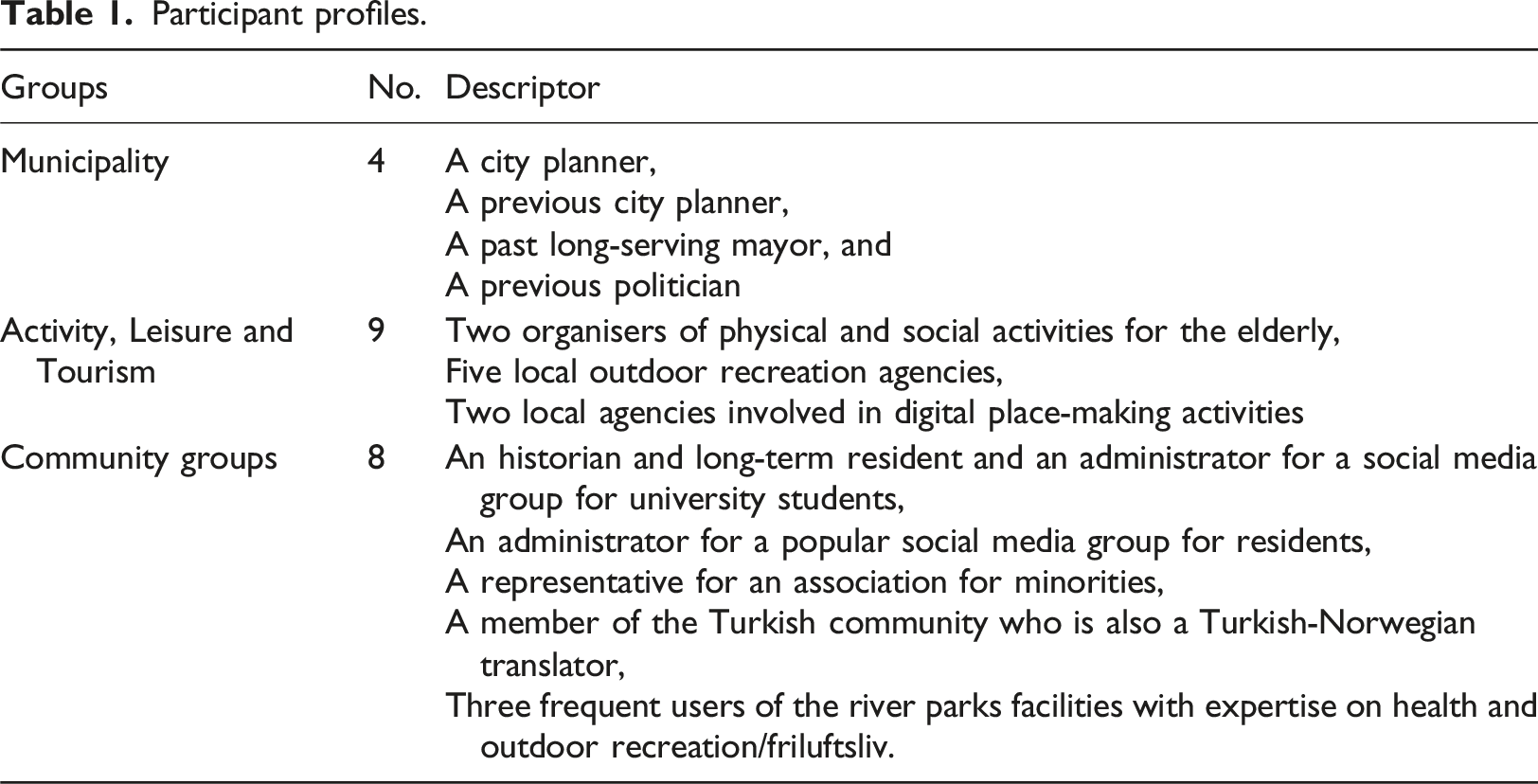
Responsive interview techniques were adopted to extend conversations with participants (Rubin and Rubin, 2005) and to generate rich insights into their lived experiences and viewpoints. Interviews were conducted online in English and Norwegian, typically lasting 45–60 min. Resulting data was professionally transcribed and translated and the data scripts were verified and checked by author 3 who is a native speaker. The data were analysed using reflexive thematic analysis that facilitated the identification and analysis of patterns and themes emerging from the data (Braun and Clarke, 2021). Through recursive and iterative phases of analysis, the data was coded, laddered and resulting themes were constructed producing a nexus between the theoretical framework of temporality of place and pertinent examples of the participants’ lived experiences. The coding process was verified through a process of inter-coder reliability wherein each member of the research team manually coded the data, and then refined/deleted codes were doubled checked until agreement amongst the team was achieved. Given the participants were residents of Drammen and some actively involved in the community, it was important that we ensured anonymity, therefore all gender pronouns (‘he/she’) were removed in the findings and replaced with non-gender representations (e.g. their).
Findings and discussion
Ricoeur’s (1984) threefold present provides a theoretical frame to show how place-making stems from the past, present and future in one’s memories, experiences and expectations of place. The findings demonstrate how place-making is understood in narrative form and how, over time, it is a continuous process of (re-) interpretation that has an inherent temporal logic.
Narratives of memories: past-in-the-present
The collective memories of Drammen are inherited over time and referred to in terms of a transition from ‘old Drammen’ to ‘forgotten Drammen’ to ‘new Drammen’. It represents a linear perspective of time ranging from the old to the new; however, the past continues to live in the present and evolves through the participants’ narratives of place. Here, place-making is a fluid process that is constantly evolving through various familiar yet altering and shifting perceptions of place (Shklovsky, 1917). Largely based on language and literature, the participants’ representations reflect experiences of defamiliarisation underpinned by a temporal logic. The evolving perception of place are grounded in the past but experienced in the present; it is seeing the ordinary of the olden days in new ways. For instance, participant 21 talks about their memories of old Drammen and how the city has transitioned over time: “I’ve lived in Drammen for many years. I was born here but then I moved away for a long period of time and then moved back. I have all the city history and I have lived in one of the oldest streets in Drammen. So, it’s a very nice place to be, but the river was very polluted and there was no access. There wasn’t access to the river for most people. I moved from Drammen I said I’m never moving back to this shitty city and then seven years later I moved back, and everything had changed. ... Because it was a shitty place, and it had a really bad reputation no-one wanted to live here. There was no culture. There was a polluted river and a lot of cars. I mean who would want to live here. Now, the theatre is rebuilt and there’s a lot of culture. They cleaned up the river and I think it’s brought life to the city.” [participant, 21]
Participant 21 describes place-making as one that emerges from a historical narrative that has evolved over time thus demonstrating a changing way of life (see Lefebvre, 1991). Here, place-making is fluid and stems from narratives based on altering perceptions of place over time (rather than in time). In doing so, it reflects a process of defamiliarisation as the participant talks about the history of the city as familiar and known, but also of a new city that, although is framed by both the past and the present, it reflects a renewed ontological perspective as they are seeing the city in new ways (see Cresswell, 2004). Defamiliarisation is represented in their perceptual ability to see and experience the city in new ways (new Drammen) both from an awareness of the city’s ugly history and associated memories (old Drammen) and of the participant’s implied sense of pride in its renewal by stating ‘I mean who wouldn’t want to live here’. Therefore, rather than defining the city by its ‘ugly’ past, the past lives in the present through a continual process of place-making as lived and experienced. The temporal nature of place-making is understood by the participants through their narratives of place, and although it is based on reflection and a collective memory, it shows how the past bleeds into the present as echoed in their lived experiences, recollections and memories (Ricoeur, 1984).
Contrasting understandings of the city’s history are offered by those who have grown up in Drammen versus those who moved to Drammen in later years. Participant 20 lived through the city’s changes and regards his memories as wedded not only to his perceptions of a new city as experienced in the present, but that its history and multifaceted nature should be appreciated by those who are not as familiar with its past. Participant 20 regards the past as the basis on which everyone (including their colleagues) should develop their understanding of place. “When I was little there was nothing at the river. It was a parking space. Dirty water. Cars in the river. Nothing. No restaurants or nothing at all. Then the development started and now you can walk by the river and a lot of people are using the area in a different way. … I think it’s important for people who have grown up and live here. I don’t think a lot of my colleagues know a lot about Drammen. The square area in Drammen, it’s the biggest square in Europe, and there was a fire here several years ago and the other city has all this history. If you have interest in the city history, you’ll seek it. But for me to work here and live here it’s [history] really important.” [participant 20]
Participant 15 did not grow up in Drammen and therefore has not lived through its ‘ugly past’. Their narrative presents their current experience of Drammen as somewhat determined by others’ memories of the past (see Ricoeur, 1984) but also the need for all to adopt a new way of seeing the city in the present: “Because I’m an outsider and I kind of noticed when the Norwegian people talked about Drammen as Drammen before the old Drammen. A lot of them have a perspective of when we they grew up and about the poisonous river. But now, they see the city with new eyes.” [participant 15]
The importance of Drammen’s history is evident in the collective inherited memory, which is core to its identity. Participant 19 refers to the perceptions of old Drammen as a shared collective memory that people have inherited as one that facilitates a narrative of meaning transformation from the old to the new, and with such change altering perceptions of the city ensue thereby giving rise to a greater sense of pride. “I am one of three admins of a Facebook page that celebrates Drammen before and now. You are reminded almost every day of the memory that we have inherited of being able to swim in the river or bath in it, you know, and using the river as something more than just transportation. So, there is kind of a collective memory that has been inherited and it is an important part of the identity and also the pride in having succeeded with the urban development project.” [participant 19]
Participant 06 moved to Drammen in 1987 in a time when the rejuvenation works were beginning. They talk about place-making as a slow and steady process that is defined by a temporal frame that promotes an important interweaving of the old with the new (the past in the present): “…there was nowhere you could go for a walk along the river. The first thing that struck me was that this was an incredible waste. I’ve been able to observe this development and watch the slow and steady regeneration. Initially, they got rid of the parking spaces, there were only small steps to begin with. Until it kind of culminated in the building of the Ypsilon bridge (see Figures 1 and 2 Ypsilon Bridge that connects the two sides of the city. The walk path over the Ypsilon Bridge.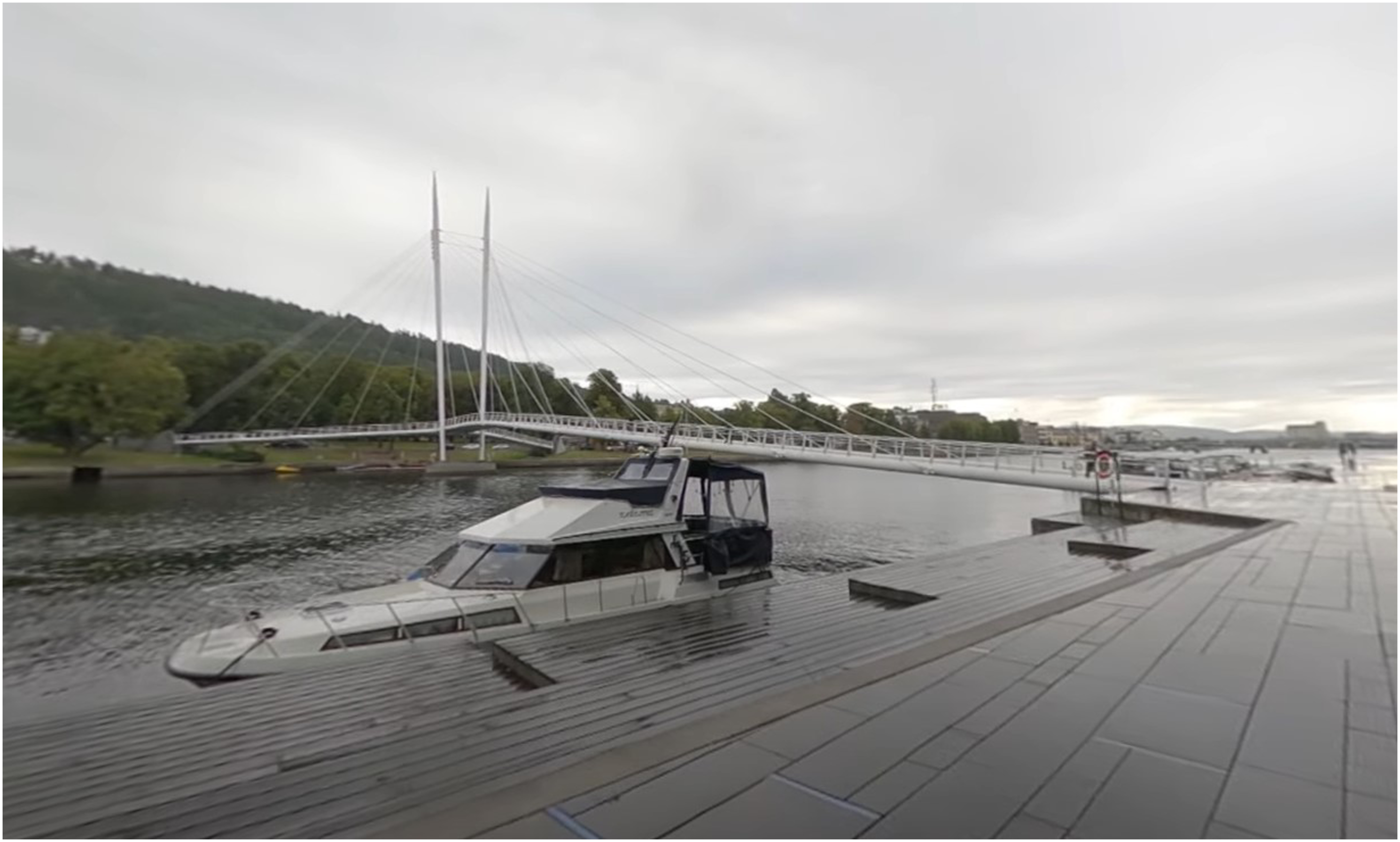
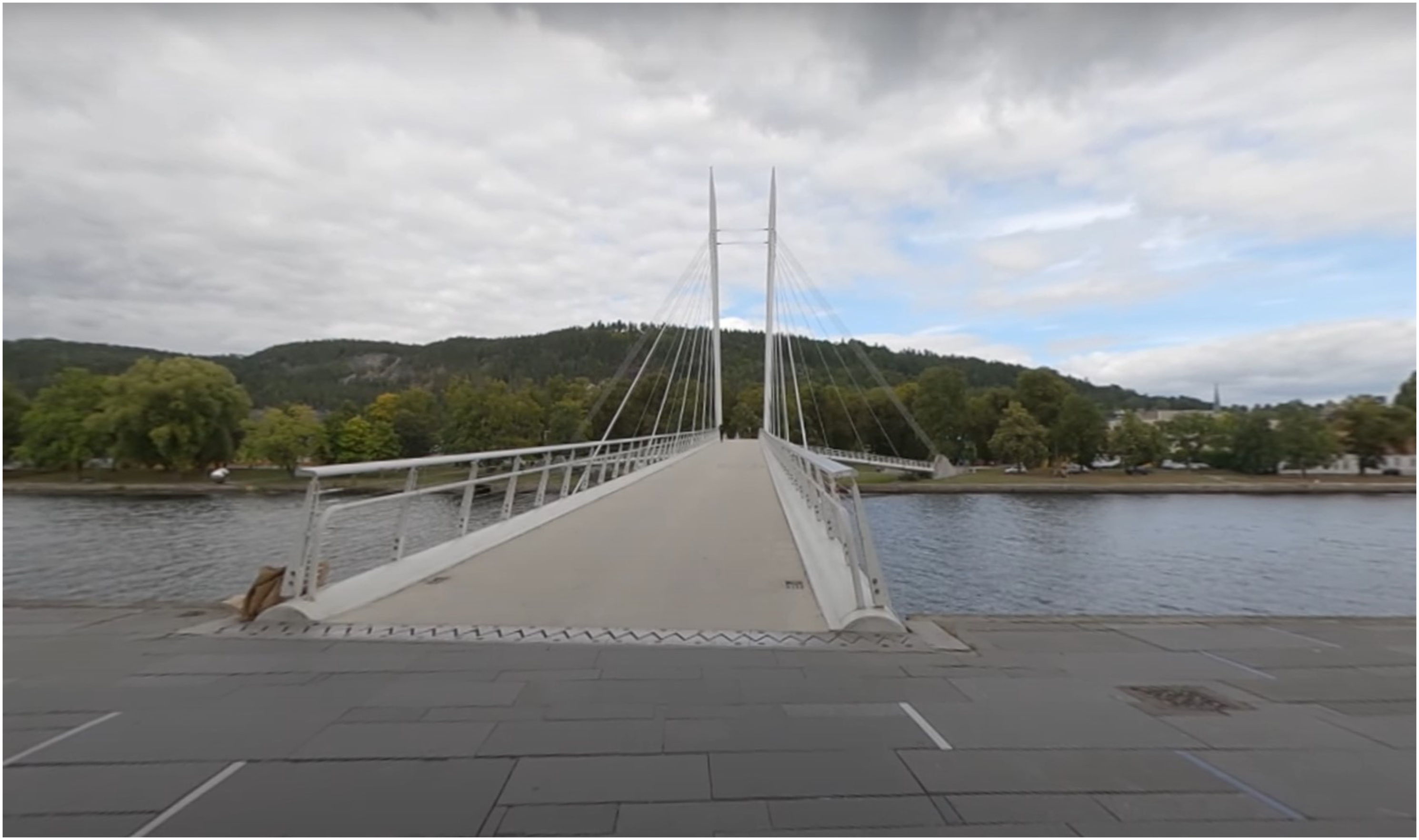
Participant 06’s narrative highlights the importance of time as bleeding from the past to the present, from memories to experiences (Ricoeur, 1984). The pedestrian (Ypsilon) bridge presents a symbolic representation of the marriage of the old and new in both physical and emblematic ways as it connects the once perceived ugly parts of the city with the new emerging contemporalities such as the University (Figure 3). As participant 06 talks about the old and the new merging in terms of the material/built environment, they continue to develop the historical narrative as one that has strengthened their connection with the place. In doing so, they allude to the malleable nature of place, that is, the importance of how place is created and recreated over time. The Ypsilon Bridge connecting the two sides of the city to the University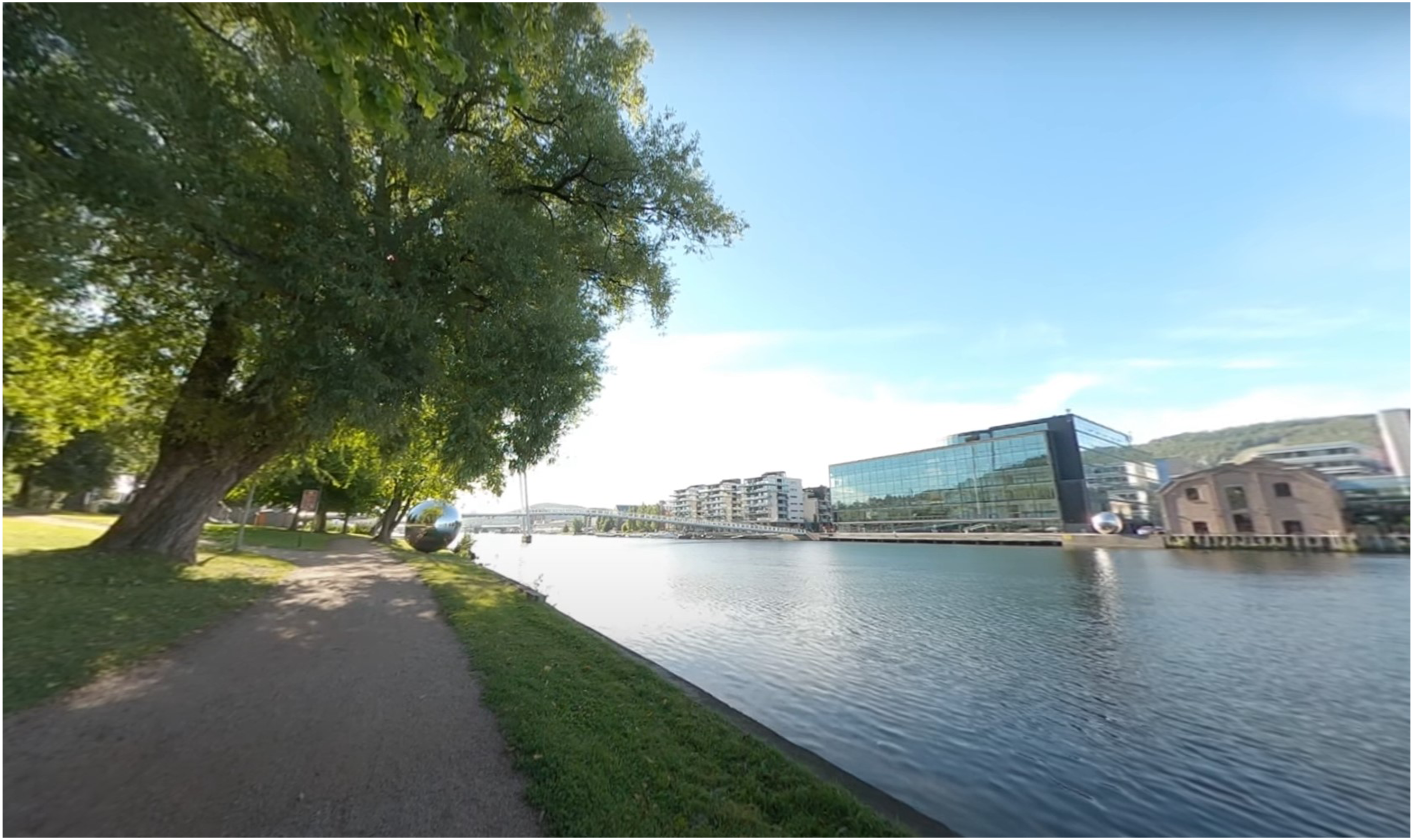
The historical narrative of the past-in-the-present is grounded in memories, but it also portrays the evolution of place as a process of defamiliarisation which gives space to wider interpretations of place and by extension, place-making. In this case, such interpretations are evolving and progressive and they ‘break with the taken-for-granted and set the familiar aside’ (Greene, 1995: 3). In this regard, defamiliarization supports the fluid, ever-evolving temporal nature of place (Cresswell, 2004) and celebrates the importance of Ricoeur’s (1984) positioning of meanings as unfolding through narratives based on the participants’ evolved interpretation that develop over time. The participants demonstrate defamiliarisation as central to place-making because it reflects new interpretations of the city, new ways of experiencing and living in the city and an acceptance of an old-to-new narrative as having both a familiar tone and an unfamiliar or new representation, a ‘circular interplay between the familiar and the strange’ (Kerdeman, 1998: 248). The concept of defamiliarisation resonates with Hoskins’s (2012) view of arrival, that is, our memories are not static or fixed but appear and are continually renewed in the present, memory as arrival.
Narratives of experience: present-in-the-present
The participants’ experiences of place are lived and expressed in everyday lived encounters. Such experiences emerge from embodied feeling that are often stored and retrieved. For instance, participant 15 talks about the river as a key part of their place-making process wherein they feel a greater sense of connection not only with the river and the city itself but also with their sense of self and being in the ‘here-and-now’ or present-in-the-present: “It [the river] makes me better connected with the area where I work and how I move myself in between those places. It adds a dimension to my living in Drammen. I would say it adds a different dimension than I had before. … I’m trying to think about how that makes me feel but maybe I take it so much for granted that I haven’t put it in words. But like this morning it was just connecting in the here-and-now. You go from dark to the daylight. You have the Ypsilon bridge and it’s like a huge window and you can see the day start. I don’t know. It’s kind of being in the here-and-now. It’s another dimension of being. … If you use the sauna on the river (see Figure 4 The floating sauna on the river.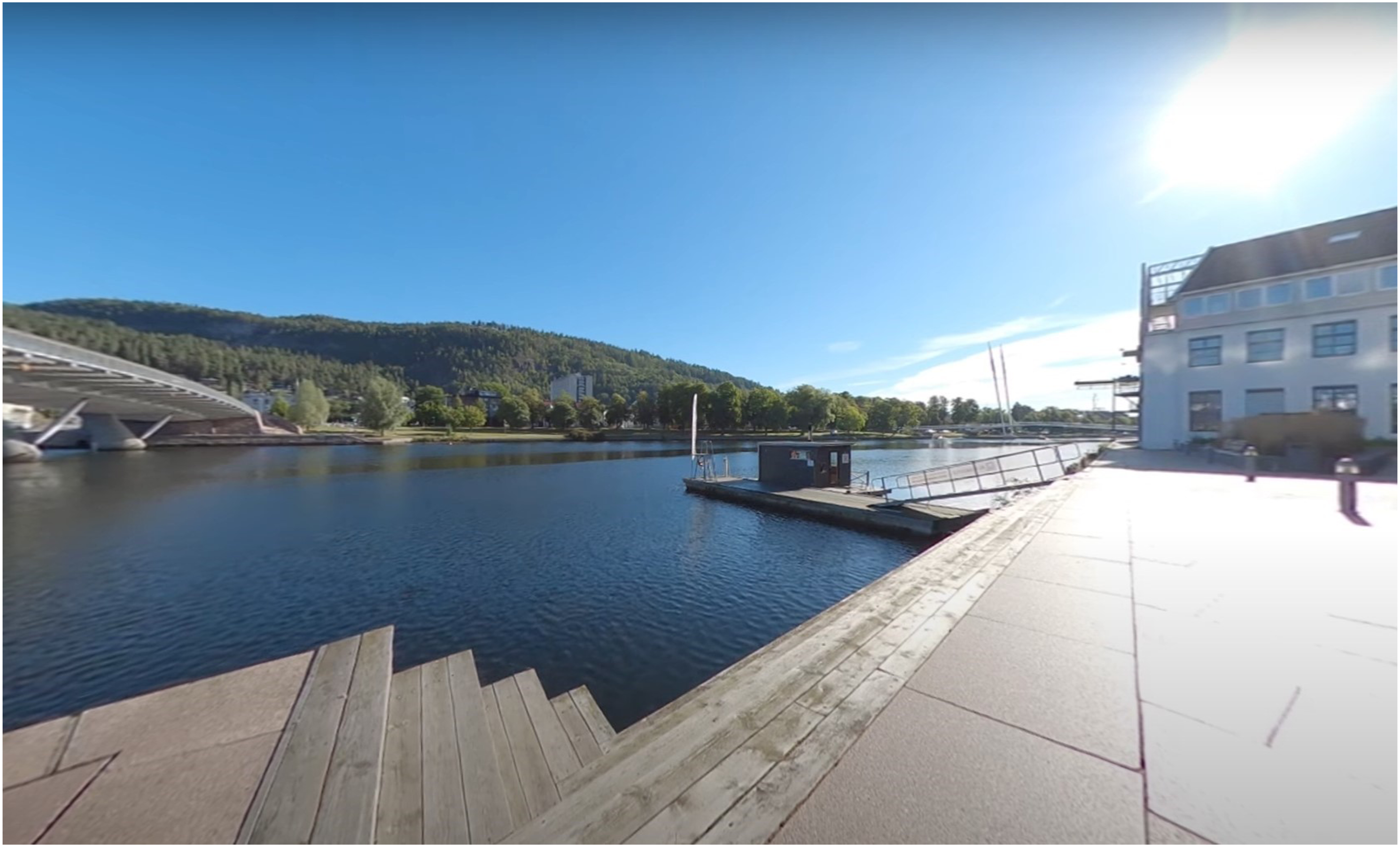
For others, the embodied nature of place-making is set in the immersive feelings that arise from being close to the river. For instance, participant 21 talks about walking to work and how the city reveals itself to them not only from a visual perspective but also in terms of their thoughts (somatically) and feelings (haptically): “I have a 5-minute walk and then I kind of turn right closer to the river and under a bridge and when I am under that bridge all of Drammen lies in front of me and every time when I turn that right it always makes me smile. It’s like I can look at my city. I think in every weather there’s something new and the light is different, and you have flowers along the riverbanks, and you can see the city waking up, so it makes me smile every day (see Figure 5 Walk paths along the riverbank and surrounding nature.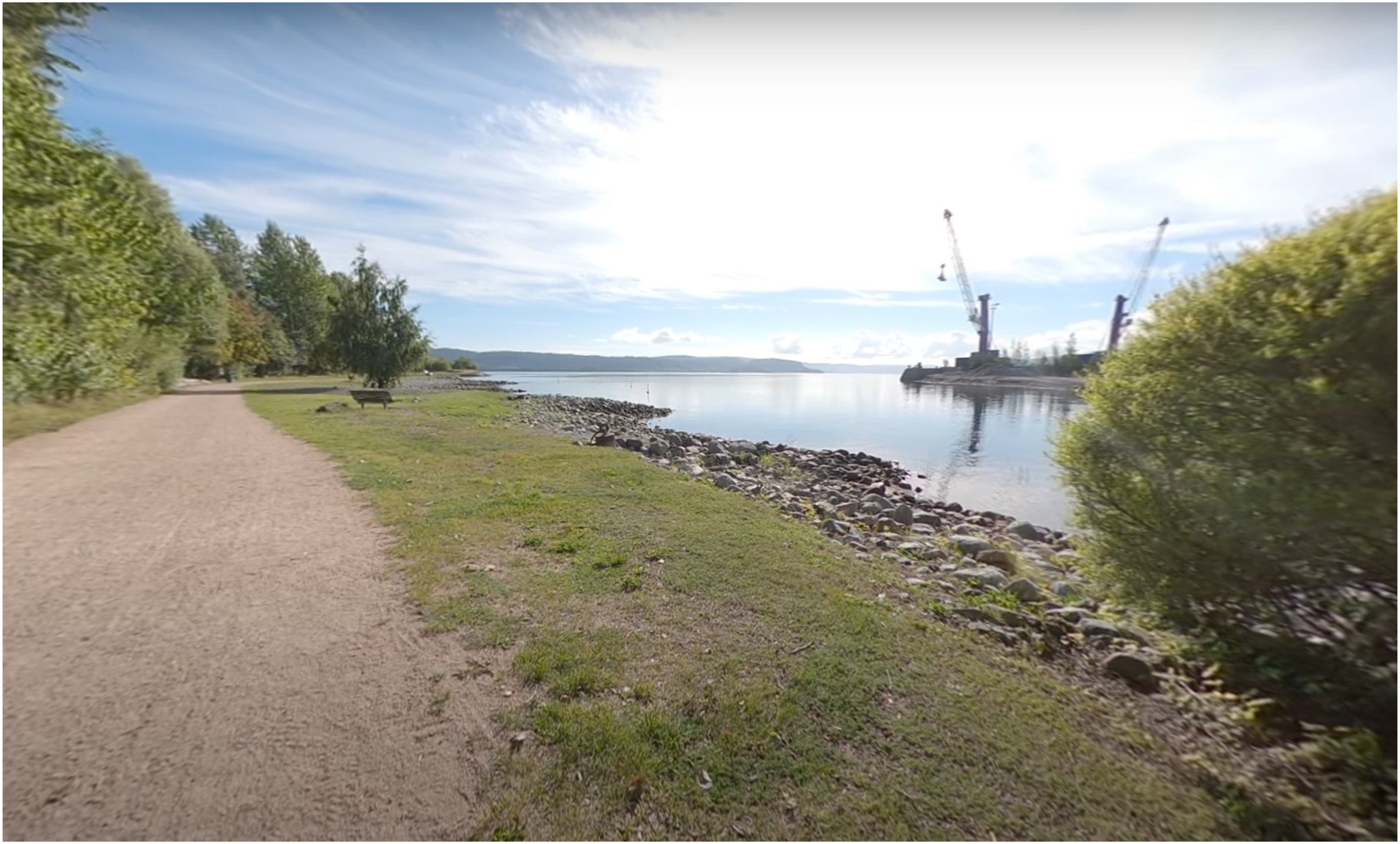
The embodied nature of place reflects the concept of place atmospheres (e.g. Steadman et al., 2021) through spatial and temporal aspects. It supports the participants’ subjective interpretations of the city as unique and personal thereby reflecting Casey’s (2001) concept of idiolocality wherein unique meanings stem from embodied experiences that are ‘in its very flesh’ (p. 689). It is a projection of being present-in-the-present (Ricoeur, 1984) and for many, place-making in this regard is not grounded in the physical structures of the city, but instead they are rooted in the immaterial aspects related to feelings of being present, and an awareness of sensory engagements and higher powers that exist. For instance, participant 06 talks about being grounded based on: “…two things, being near water and experiencing a lot of light, smells and movement. There is something about running water providing a kind of special mental relief. Sort of like blood pumping through your veins. It’s the same, just in a larger format. It’s as if its life is pumping and flowing. It’s a lifeline, and it’s a reminder that I am inclined towards pantheism; the divine is really part of nature, the sky, and the water, it’s the whole package” [participant 06].
For others, a sense of affiliation exists and a desire for sensory stimulation: “…you have the sensation of sight, and you have the sensation of touching sand and walking in sand and walking barefoot in the sand. You have the sensation of smell and of nice and beautiful flowers, etc. which we have around us, and which are close to it. So, it’s a matter of touch, sound and sight, oh my goodness, that's almost all of the senses. Not taste, though, and there must be taste and if there are restaurants, and there are. [participant 03]
The importance of being present-in-the-present is central to the participants’ narratives as demonstrating a way of life. Living in Drammen provides an opportunity to be immersed in a nature-based city and the connections between nature and wellbeing are well documented (Zhang et al., 2014). However, urban nature is often considered a constrained nature experience, that is, with limited or often potential negative impacts related to noise, pollution or artificial lights (see Macaulay et al., 2022). However, the participants’ narratives reflect the opposite stating: ‘I love this kind of combination of an urban feeling combined with the river and the freshness of the river and also the fjord. I think it’s the water itself. The water. Oh, it’s just you know the river’ (participant 18). The participants’ narratives of the river are the starting point for how they understand the city and it acts as a basis for their idiolocal representations of place-making in this regard. The importance of urban nature in providing a sensory production and consumption of place and the perspective of the city is defined in terms of land to water (the role of the river) and water to land (see also Steadman and Coffin, 2023). Here, the river provides a reappropriation of place for the city’s residents stemming from their experiences of the city, the present-in-the-present. It facilitates an experiential perspective of place-making and a ‘mode through which a person knows his world’ (Tuan, 1975: 151).
Narratives of expectations: present-in-the-future
Known as the river city, the surrounding environment plays an important role in representing the identity of the city. It reflects the Norwegian values and philosophy of ‘friluftsliv’ and embracing a way of life that is nature-based. Jacobs’ (1961) notion of understanding place based on ways of life promotes a greater connection between people and place. Ricoeur (1984) talks about the importance of the future for how we live in the present as defined by our expectations e.g., expectations of place (present-in-the-future). For instance, participant 05 states: ‘I personally, and many generations before me, we have all lived in some place or other along this river, you know. That makes it like a personal relationship with the river’. The environment plays a key role in the rejuvenation of Drammen based on its natural resources wherein: ‘The cleaning of the river catalysed the creation of public places. I would actually attribute that to the work that had to be done to clean the river … we built sandy beaches in the middle of the city centre and volleyball courts (see Figure 6) as part of the river par because people obviously love water’ (participant 10). Volleyball playing area and riverside beach.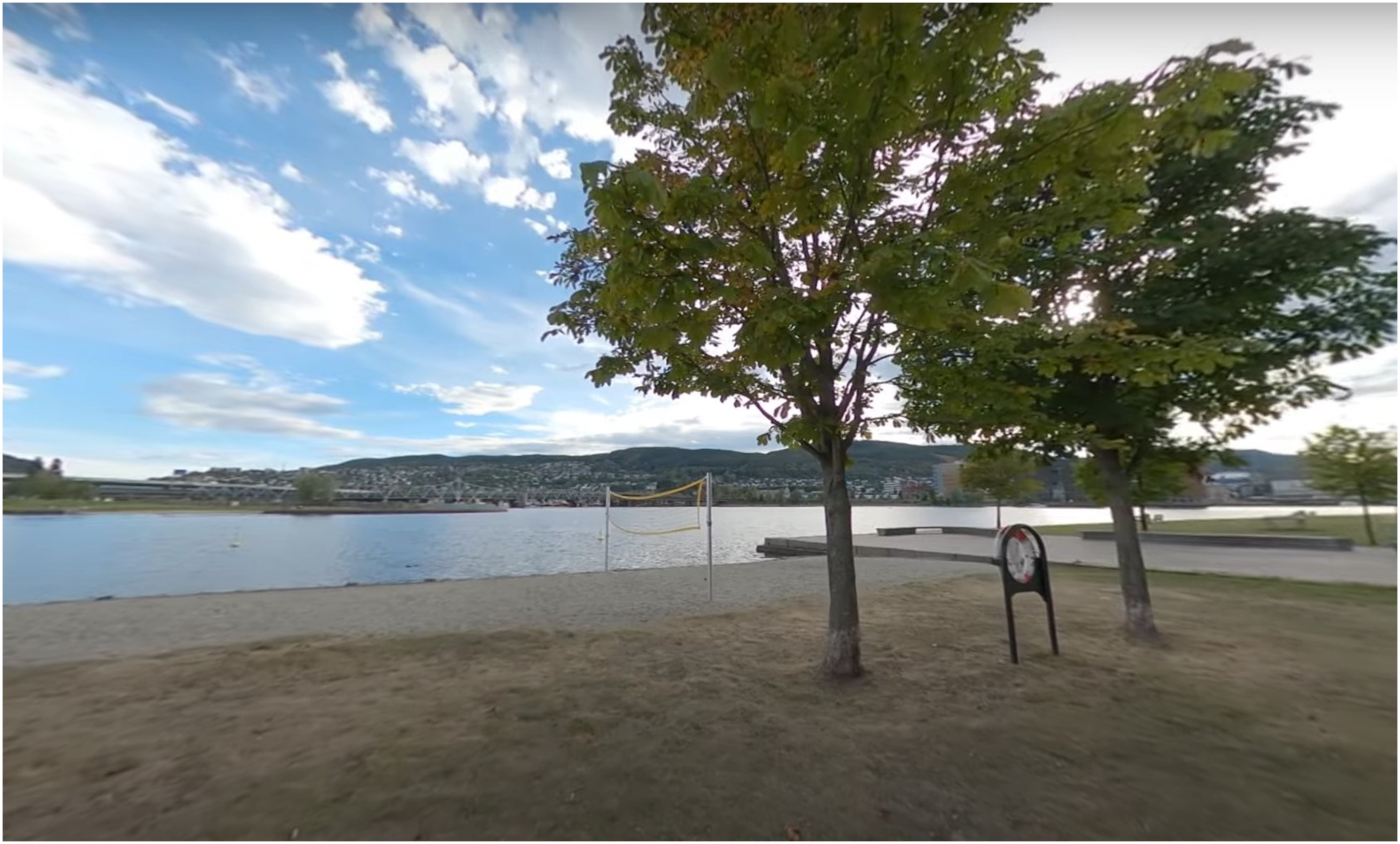
The participants narratives reflect their interpretations of future-in-the-present based on expectations of place, and although they are linked to the future of place, they are lived in the present. Such expectations are evidenced in the participants’ 1) representations of the city as environmentally focused and 2) how they engage with the surrounding environment and its affordances. For instance, the following participants highlight an environmental awareness related to the river water and the subsequent recreational facilities that this affords to younger generations (participant 06) as well as the importance of having not only access to blue spaces (i.e. the river) but also green spaces (e.g. nature) as a hallmark of investment in a future orientation. “The regeneration has been such that we feel we can trust the river once again. Many children swim from the Dragenes jetty. They swim in the river but previously there was no bathing in the river.” (participant 06) “I’ve grown up with, and I think most Norwegians have grown up with being proud of the fact that you can walk anywhere in the town centre and still see nature, still see the hills. That’s engrained in the people of Drammen, the pride and the possibility of never losing sight of the hills on each side [of the river] or wherever you are.” (participant 19).
Although participant 19 portrays feelings of pride as central to the place-making process, that is, as a reflection of their meaningful engagement with place, it has a future orientation. Pride is temporally set in a narrative of the past, but it is felt in the present. It has a relational basis in its implied importance as reflected by the participants’ expectations, which Ricoeur referred to such as a type of utopian thinking, and what this means for future generations in terms of connecting people and places. The participants demonstrate an expectation of place that is not only nature-based, but also one that affords a greater sense of being as exemplified by desired feelings of connection, belonging and a sense of community (also reflecting a sense place, Campelo et al., 2014; Relph, 1976). A place that instils a sense of community in its residents suggests that opportunities, ongoing relational supports from and with others, and prospects are possible for all (present-in-the-future). It reflects an understanding of living in the present that is future orientated: “We feel the sense of community even more when we’re on the river because you notice the activities run by the others there whether they are out on a kayak or canoe, rowers, fishermen, that kind of thing. And then, in a way, that’s that sense of community. Although some of our interests intersect with each other, it’s like being in a community because of it.” (participant 09).
For others, a wider interpretation of place and the future is set in the context of accessibility and the important of nature for all thus reflecting the Norwegian law of ‘Allemannsretten’, the right for all to access nature. The river park has become a source of social inclusion in terms of transnational inhabitants and the immigrant communities and in particular, the Asian community who have created a park culture and unveiled new perspectives of engagement with the river park. Dupre (2019) refers to the strategic importance of immigrants in place-making as often they are the source of change by introducing new ways of being in place and instigate change for the future in terms of how a place is, and will be experienced, appropriated and reappropriated over time. “Drammen has quite a large percentage of non-Norwegian inhabitants, Many from Turkey and Pakistan and so on and they were one of the first to use the river parks. I think they don’t have the same history with the Drammen River and these people are also more of an urban park culture. The immigrants have a more urban park culture of eating and making small family parties and so on (see Figure 7 Picnic areas and seating along the river. “It’s [the river] a meeting place, a multi-cultural place where there is room for outsiders to be. And you have festivals, you have concerts, you have theatre, and you have the nature close by. And you have a good opportunity to be healthy in a way of eating and exercising.” (participant 1)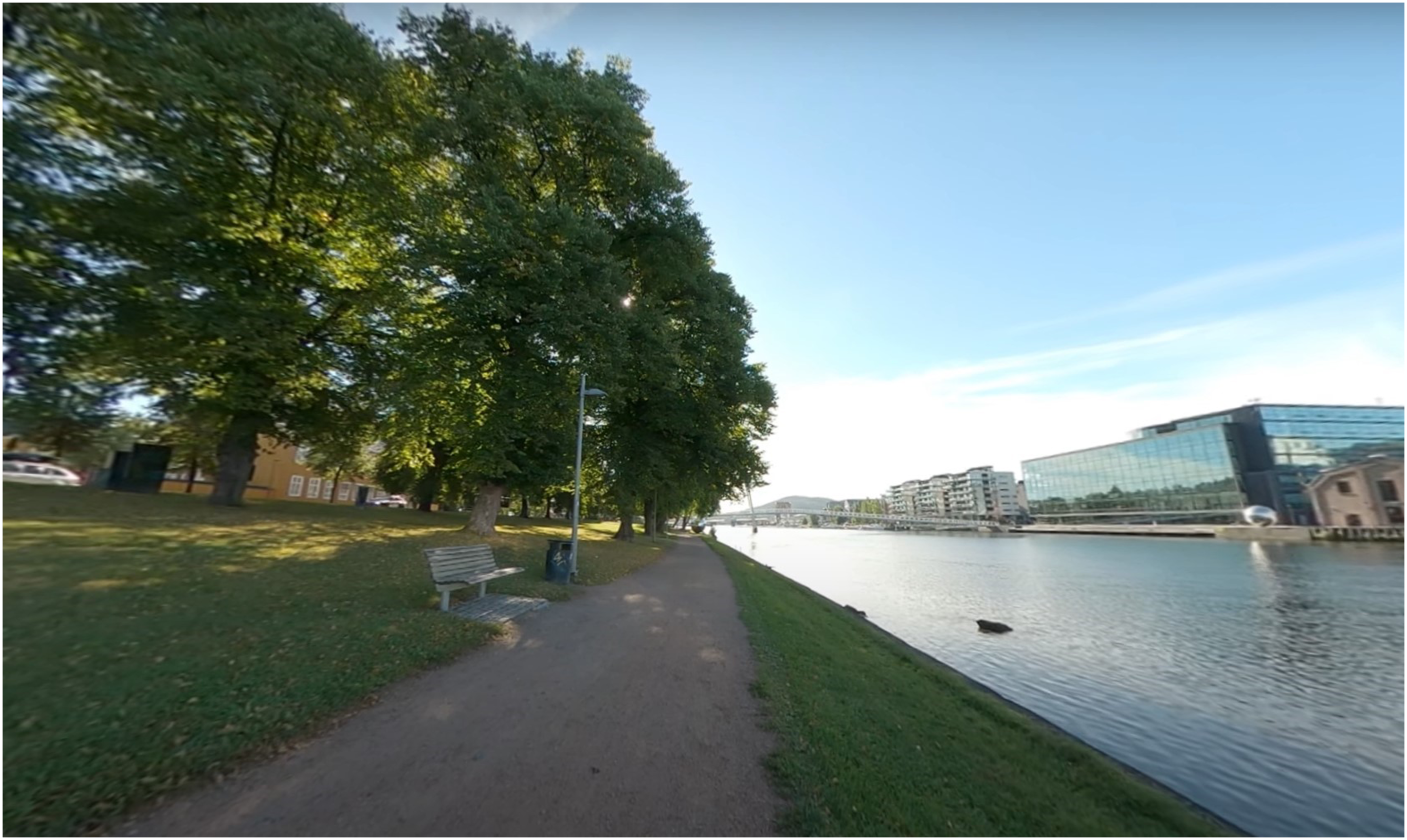
For others, the link between the city and nature contributes to a wider sense of wellbeing and its future orientation is premised on a good life. The benefits of a nature-based city are evident in how it affords a connection with nature (see McEwan et al., 2020) and this is especially poignant in an urban context where nature connectedness is sometimes lacking or retrofitted using nature-based interventions such as Greenways or planting trees in built up areas (Church, 2018). Although the link between nature and wellbeing is well documented (Korpela and Hartig, 1996), in the context of place-making it is an emerging area (see Sampson and Gifford, 2010). Place-making contributes not only to the participants’ physical wellbeing through exercise but also their mental and emotional wellbeing due to its nature-based and future orientated form: “In my view, one thing is the physical aspect, but another thing is what it does to you mentally and how it affects your quality of life. I believe that the parks, the river and what has happened here has boosted Drammen residents’ quality of life overall. I think that health, and you’re talking about physical health, but health also concerns psychological and mental health. And there’s something about walking beside moving water and seeing something beautiful. You see the river, and the river reflects the sky, the weather and the wind.” (participant 07)
Although the links with the environment and its importance for residents and future generations is based on an appreciation of the now, a heightened awareness of the future in terms of accessibility, new communities and wellbeing, the need for mindfulness and the preservation of the present is central to its future as demonstrated by participant 10: ‘to take care of the green spaces and take care of the land so we can hope that Drammen will be an attractive city in 50-, 100- or 200-years’ time’.
Conclusion
This paper investigates the temporal nature of place-making by focusing on a nature-centred urban regeneration project that has experienced significant change over time. Although some authors allude to a temporal dimension of place (Chatzidakis et al., 2018; Steadman et al., 2021), they tend to position time as tangential to other constructs (e.g. Borghini et al., 2021; Chatzidakis, 2020). As such, the temporal nature of place-making has been largely underexplored. This study addresses a call by others to advance this area of theory (see Reynolds et al., 2024; Warnaby, 2024) by presenting place-making as having an inherent temporal logic that is shaped by people’s every day and often mundane social practices and lived experiences of place. Ricoeur’s theory of threefold present provides a theoretical lens to investigate the temporal nature of place-making and through narratives of place, the distinctiveness of place as defined by those who experience it is understood. It therefore reveals a greater understanding of the place-making process and in doing so, we contribute to place marketing and experiential consumption theory in various ways.
The main contribution of this paper is a conceptualisation of place-making as temporally defined. Tuan (1975) premises place-making as a process of meaning transformation which is set in the context of people’s lived experiences of place (Cresswell, 2004); however, this account does not allow for a temporal logic where meanings, based on people’s experiences of place, evolve and change over and with time. The findings show how place-making is an iterative process that evolves with people’s critical engagements with place and where the transformation of meaning materialises through people’s narratives of place is evidenced in their memories (past-in-the-present), experiences (present-in-the-present) and expectations (present-in-the-future). Place-making is a social construct that embodies multiple narratives that are rich with meaning. Therefore, place-making is not only appropriated by professionals for the purposes of promoting places, but more importantly, it is defined by those who experience it. This viewpoint presents a wider interpretation of place that necessitates a temporal logic that celebrates idiolocality (Casey, 2001) and processes of defamilarisation (Shklovsky, 1917). Often subsumed within the guise of place marketing and place branding without consideration for its standalone importance, place-making is regularly considered a professional responsibility rather than something that stems from people’s everyday practices and experiences (Ghavampour and Vale, 2019). The findings of this study show an alternative and critical perspective of place-making that positions it firmly within the sphere of those who experience it over and with time, thus advancing our understanding of place marketing theory. It is therefore sensible that place-making can contribute to the detail and substance of place marketing and place branding activities.
We contribute to the experiential consumption literature by offering insight into a temporal logic that affects and shapes consumption processes. The findings support place-making as co-created, both a production and consumption process, grounded in the experiential aspects of consumption (e.g. memories, experiences and expectations). The findings reveal the nature-based elements of consumption as pertinent to such experiences. However, in the marketing literature, the temporal nature of consumption tends to be based on memories (Anderson and Hamilton, 2024) and nostalgia (Goulding, 2001) often reflecting time as fixed and stemming from staged events (e.g. the consumption of build heritage for tourism purposes), and therefore underpinned by a chronological perspective of time. Others link time and substance thus promoting a reconsideration of experiential consumption (Malone et al., 2023). However, key to this study was a multi-temporal understanding of place and how time, as a felt concept, evolved. Central to this contribution is the bleeding of time from the past, present and future. Anderson and Hamilton (2024) have begun to advance this area of work by providing new understandings in the marketing literature with respect to memorialisation and market-mediated efforts based on how the past is consumed in the present. However, by adopting Ricoeur’s (1984) threefold present we advance such conversations by showing how the past, present and future are consumed in the present.
Finally, place-making is a fluid and transient process therefore ‘to know a place is also to know the past: one’s own past preserved … the city’s past enshrined in its architectural landmarks … the communal past is not truly one's own past unless history extends without break into personal memories’ (Tuan, 1975: 164). Therefore, the qualitative aspects – how a place is experienced – and its origins within a community (Andres et al., 2021) have wider implications for place marketing, place branding and place-making activities. Warnaby and Medway (2013) stress that place marketing campaigns often lack distinctiveness and overlook the intrinsic qualities of place in favour of a ‘zero-sum game’. This view reflects the struggle between somewhat homogenous branding practices and the reality of people’s lived experiences and interpretations of place (see Clegg and Kornberger, 2010). In a fury for growth, progress, development and the principles of commercialisation, place can become stripped of its qualitative rarity and experiential qualities as expressed and understood by those who experience it. In this vein, it is important that we do not define the temporal nature of place-making based on chronological forms, but instead we must embrace its lived and experiential nature, and the coalescence of meanings that are wrapped up in the past, present and future (rather than a snapshot of the present alone, see Brighenti and Kärrholm, 2018). As such, the findings of this study have implications for experiential consumption and calls for a heightened awareness of the role time plays therein because of the protracted nature of consumption more generally.
The limitations of this study can provide the basis for areas of future research. First, the focus on a single case study presents challenges related to the transferability of findings; however, the basis for single case studies is to ascertain in-depth investigations of a phenomenon under investigation. Future studies can adopt a multiple case approach to compare findings across cases. Second, the sample size and representation of various groups can be developed to consider those who are non-resident of a place but who have an invested interest, for example, tourists or holiday homeowners. Third, longitudinal studies that track the transformation of meaning over periods of time and change can help to capture the liminal space when a place is transitioning from a space to a place. An opportunity also exists to develop the temporal nature of place-making in other experiential consumption contexts. Finally, an emerging area of investigation is to consider the impact of digital technology on the temporal nature of place-making and how this links to wellbeing (e.g. Fernandez-Osso Fuentes et al., 2024). We propose that future studies can consider the impact of digital technology on the temporal nature of place-making (as future facing) and how this links to wellbeing (e.g. our expectations of the future with regard to place-making). Another interesting area might be to view digital technology as continually impacting our modern-day interactions with place (e.g. social media and travel apps) where one might regard digital technologies as time-neutral and where the bleeding of time is skewed (no defined past, present or future), or the opposite, where technology presents a space in which multi-temporal understanding of place are possible.
Footnotes
Declaration of conflicting interests
The author(s) declared no potential conflicts of interest with respect to the research, authorship, and/or publication of this article.
Funding
The author(s) disclosed receipt of the following financial support for the research, authorship, and/or publication of this article: This project has received funding from the Horizon 2020 Research and Innovation Programme under grant agreement no. 101036519.
