




Abstract
In turning to the user-generated pornography market and its mainstreaming sexual violence against women, this paper looks to uncover why women are increasingly participating as self-producing content creators. Specifically, we ask how the institutional logics perspective can help uncover more disguised market dynamics encouraging and coercing women to (re)produce their own abuse through self-produced pornographic content creation. With an institutional logics analysis of archival data from five user-generated pornography websites, our findings uncover how social logics act to disguise market logics. We show that a logic of activism is mobilised through two prominent feminist, social justice imperatives of: (i) the representation of diversity and (ii) appeals to environmentalism, which function together to construct a compliant and duty-bound imperative for women’s content creation. In doing so, this paper introduces a concept of moral market compliance: a dark market dynamic that functions to fem wash and (re)produce market violence against women.
Keywords
Introduction
With the rise of digital technologies, there has been a considerable shift in the way pornography is produced, consumed and distributed. One outcome of this is that user-generated platforms are now the dominant business model for the pornography industry and their mainstreaming of sexual violence against women is an increasing point of concern (Bridges, 2019; DeKeseredy, 2018). This includes how sexually violent and racist content is being openly sold to consumers (DeKeseredy 2015; Dines and West 2020; Vera-Gray et al., 2021). Another key component to these user-generated platforms is their reliance on the production of women’s self-made content. This represents the conundrum at the centre of this paper: that despite the known (and widely marketed) sexual violence comprising the contemporary pornography market, women are increasingly participating as self-producing pornographic content creators.
In the marketing discipline, the gendered nature of inequality has gained prominence as a crucial area for ongoing research, signalled through a series of special issues and commentaries in recent years (c.f. Coleman et al., 2020a; Dobscha and Ostberg, 2021; Gurrieri et al., 2020; Prothero and Tadajewski, 2021). Within this, is a rich body of work looking at women’s participation in markets that traditionally profit from gendered and neoliberalised inequality. This includes the fashion market (Gurrieri and Cherrier, 2013; Scaraboto and Fischer, 2013), the beauty market (Rocha et al., 2020) and the reproductive market (Hartman and Coslor, 2019; Takhar and Pemberton, 2019) – and the increasing ways these markets are digitalised through online platforms and emerging technologies. Yet the role of the market in sexualised and racialised forms of woman abuse (Dekeseredy, 2015) and inequality remains under-examined.
Further, while women’s participation in markets of inequality has been a point of focus for critical marketers, there is a need to further attend to a particularly insidious form of market inequality, that is, ‘market violence’ (Fırat, 2018; McVey et al., 2021). Extending upon the definition offered in extant literature of ‘market violence’ as the structural subordination of people by markets (McVey et al., 2021: 41), this paper analyses aspects of the user-generated pornography market to specifically consider how women are encouraged by the market to (re)produce their own abuse through content creation. Despite an acknowledgement that the mainstreaming of pornography has thoroughly infused both online and offline consumer culture (Stevens, 2017), discussions on the pornography industry – as a multi-billion-dollar capitalist market – have been notably absent from the marketing discipline (Bettany et al., 2010; Maclaran, 2015; Rome and Lambert, 2020) (cf. Daskalopoulou and Zanette, 2020 for a discussion of women’s pornography consumption). This is a particularly fruitful site for examination given that the selling of women’s sexualised and racialised inequality, harm and abuse is central to the functioning of the pornography market.
In this paper, we employ an institutional logics analysis of an archival dataset originating from the uploading interfaces of five user-generated pornography websites. Specifically, we examine how this market sells itself to women to be self-producing content creators. The expansion of a market that profits from women’s self-produced or user-generated content is a newer cultural development. Yet, an enduring question asked of feminists critical of pornography is ‘but what about the women who choose…?’ (Whisnant, 2004: 22). Theoretically and empirically this paper takes the conversation on pornography and women’s content creation beyond a focus on individual choice to a more nuanced understanding of the structural forces that shape women’s participation in a market that (re)produces abuse. In doing so, this paper advances the work of critical marketers concerned with market inequalities and more macro approaches to market dynamics.
Specifically, we also contribute to the work of market system dynamics scholars interested in the (disguising) power of markets and the appropriating role of logics. Research in the field of institutional logics, particularly within market system dynamics (MSD) scholarship, has included looking to the way multiple social and market logics coexist in markets (Choi and Burnes, 2021; Coleman et al., 2020b; Dolbec and Fischer, 2015; Fortezza et al., 2022; Hartman and Coslor, 2019; Scaraboto and Fischer, 2013; Zanette and Scaraboto, 2019). Although scholars have found the coexistence of multiple logics can create a hybridity (Fortezza et al., 2022), there is also an understanding that logics can be appropriated to advance market agendas (Hartman and Coslor, 2019; Zanette and Scaraboto, 2019). Yet, widely under-applied is the suggestion put forth by Scaraboto (2015: 172) that marketers can assemble social logics to ‘disguise’ their dominant market logics. Moreover, social (even moral-based) logics are considered especially effective in creating a sense of obligation and duty (Middleton and Turnbull, 2021; Weinberger and Wallendorf, 2012). However, the ways in which markets appropriate social logics in the disguising of harm are underdeveloped. Accordingly, this paper extends emerging scholarship examining how markets and marketing appropriate social logics (Karlsson and Ramasar, 2020; Middleton and Turnbull, 2021; Ozdamar Ertekin et al., 2020; Sobande, 2020b) through unpacking the disguising role of logics, as manifest in the pornography market – a market of sexual and racialised violence against women.
This paper contributes to scholarship in the following ways. First, the central contribution of our work is introducing a nascent concept of moral market compliance. We offer moral market compliance as one way to understand how people are coerced to participate in market structures that (re)produce their (self)subordination and oppression. We define moral market compliance as a form of coercive compliance that functions through a moral duty to the market structure. As a broad concept that could be applied to various manifestations and markets of oppression, this is revealed through our data deriving from the ‘uploading’ interfaces of websites comprising the user-generated pornography market. With emergent scholarship beginning to identify the market as a structure of violence and oppression (see Fırat, 2018; McVey et al., 2021; Varman and Vijay, 2018), we argue that there remains a need to understand some of the specific mechanisms that function to coerce complicity within structures of domination.
Second, we put forward moral market compliance as an illustrative example of a ‘dark(er) dynamic’: a term we use to encapsulate the more hidden, disguised or insidious practices of market systems. Critical marketing scholars are calling for more work on the darker side of the sharing economy (Eckhardt et al., 2019), yet such concerns often relate to practices of surveillance, online trust and the excesses of neoliberal capitalism. While valid, there is a dearth of work looking to darker dynamics, especially in relation to disguising forms of market violence against people. Therefore, through locating market mechanisms of compliance and duty in the selling of self-produced content creation to women, this paper reveals a dark dynamic that is not only disguising market inequality and harm – through a particularly insidious form of market ‘washing’ – but also working to (re)produce women’s (self)subordination through content creation.
This paper is set out accordingly. We begin with an overview of the contemporary pornography market, and then we review the institutional logics perspective (ILP) as our theoretical framework. Next, we detail our method, followed by our findings on this market’s construction of a logic of activism, as mobilised through the representation of diversity and appeals to environmentalism, and how this functions to construct a compliant and duty-bound imperative for women’s content creation – moral market compliance. We finish by discussing the contributions of this paper and paths for further work.
The pornography market and women’s inequality
There has been a powerful shift in bringing visibility, credibility and energy to the global problem of violence against women in recent times (DeKeseredy, 2021; Hunnicutt, 2021). The rapidly expanding cultural conversation has been given considerable momentum by the silence breaking movement of #MeToo, and its focus on women’s experiences of sexual violence and harassment. This movement has also considerably altered the popular culture and media landscape, observable in the multitude of reports that have emerged implicating individuals, industries and institutions in forms of violence against women. Alongside #MeToo, countless movements, protests and marches around the world, such as those driven by TimesUp, Black Lives Matter and the Chilean feminist anthem ‘The Rapist Is You’, have continued to highlight the ongoing interest in solving the crisis of women’s sexual and racial inequality (Boyle, 2019; Coleman et al., 2020a; Maclaran et al., 2022).
Until very recently, one area in which women’s racialised and sexualised abuse was relatively untouched by these cultural reckonings was the pornography industry (Dines and West, 2020; Fry, 2020). The lack of discussion on pornography within these contemporary uprisings against women’s inequality is particularly stark in comparison to the history of feminist activism and research that centrally linked pornography to women’s sexual inequality (Dworkin and MacKinnon, 1988; Leidholdt and Raymond, 1990; Rowland and Klein, 1996). In the 1970s and 1980s, radical feminists were significant in their academic theorising and activist organising that highlighted the links between women’s oppression in pornography, the social construction of sexuality and women’s subordination as a sex class (Barry, 1994; MacKinnon, 1989). This activism is often noted for reaching its peak in the early-mid 1980s with the anti-pornography civil rights ordinances, in which Andrea Dworkin and Catharine MacKinnon used the testimonies of women harmed by pornography as an attempt to hold pornographers legally accountable for the harm done to women through the use (consumption) and making (production) of pornography (MacKinnon and Dworkin, 1997). As we have noted elsewhere (McVey et al., 2022), for critical radical feminists, harm has been an important way to understand and discuss women’s inequality in pornography because it offers a departure from more conservative oppositions that traditionally focus on ‘offense’ (Dines et al., 1998), foreground concerns of lewdness, obscenity or sin (Eaton, 2007) and rarely highlight concerns with women’s inequality and wellbeing.
Although both conservative and radical feminist oppositions did not go unchallenged – as evidenced by the so-called ‘sex wars’ (Daskalopoulou and Zanette, 2020; Duggan and Hunter, 2006) – pornography was a prominent part of public conversation and contest during this time. It was in the 1990s and 2000s that the approach to pornography put forth by mostly liberal feminists, as form of speech, free expression or even fantasy, emerged as the dominant paradigm and discussions and debates on pornography, both in and out of the academy, were mostly lost (Spector, 2006; Tyler, 2015). In the decades since, not only has pornography often evaded significant popular culture and academic critique but, at the same time, it has exploded in terms of content volume, impact on popular culture and integration into societal norms, becoming significantly more widespread in its consumption and more violent in its production.
To understand the contemporary pornography market, and its role in women’s harm and violation, it is important to first grasp the centrality of widespread consumption and of prolific violence common to this market. One way to understand these factors is to look to how the market has normalised the consumption of pornography for men (especially young men) while simultaneously mainstreaming violent and extreme content (DeKeseredy, 2015). Through online pornography there was a significant shift away from traditional pornography production, especially marked through the rise and dominance of ‘gonzo’ pornography. Gonzo pornography is marked by an absence of plot and is widely observed as ‘scene after scene’ of acts of violence, aggression and degradation against women (Dines, 2010; Saunders, 2018). This violence and abuse has become so embedded in mainstream pornography that some scholars are now calling this an era of ‘extreme post-gonzo’, defined not only by gonzo pornography’s violence, but now also, its normalisation – whereby women’s sexualised and racialised abuse and inequality is the selling point (emphasis in Saunders, 2020; Tyler, 2010). This includes the normalisation of acts such as painful anal penetration, choking, gagging women to the point of tears and vomiting, ‘ass-to-mouth’, spitting and urinating on women (DeKeseredy and Hall-Sanchez, 2017; Dines, 2010).
Further, one of the largest studies of online pornography recently found sexual violence to be a ‘normative sexual script’ on the most popular pornography websites today, including those driven by user-generated content (Vera-Gray et al., 2021), with criminal acts such as rape, coercion and incest sold to consumers in ways that mocked, minimised and belittled the possibility of harm. Examples of this includes video titles such as ‘Chubby Spanish Teen Needs the Cash’, ‘Teen Pussy Shared at Family Orgy’ and ‘Tight Daughter Ass Destroyed by Stepdad’ (Dines, 2010: xvii; Miles, 2021; Vera-Gray et al., 2021). Women’s dehumanisation and abuse is also evident in pornography titles that compare women to pigs, such as ‘Squealer’, the increasing popularity of farm settings, in videos such as ‘Rural Discipline’, as well as the treatment of women as animals including women being force-fed water, shocked with cattle prods, kept on dog chains and broken down, like horses (DeKeseredy, 2015; Hawthorne, 2014; Saunders, 2018). Crucially, while all women can be subjected to dehumanising practices, black women have been highlighted as targets of an especially brutal intertwining of racism and misogyny (Collins, 2002; McVey et al., 2021). Racialised abuse is part of the mainstreaming of market violence by websites in the contemporary pornography market. Not only are Black women traditionally constructed deviant, hypersexual and animal-like, but Latina women are portrayed as are ‘all-ass’ and always ready for public penetration, with Asian women more often passive, servile and childlike possessions for white colonial consumption. These racist stereotypes are blatantly sold to consumers via entire websites marketed under names such as GhettoGaggers.com and LatinaAbuse.com (Saunders, 2020). Titles commonly found on the consumption pages of the most popular pornography websites today include ‘Coco Gets Interracial Facial’, ‘My So Asian’ and ‘House Bitch Enjoyed by Her White Masters’ (DeKeseredy, 2015; Miles, 2021). There are also entire genres dedicated to ‘hijab pornography’ and ‘refugee porn’ (Mirzaei et al., 2021). This normalising of racialised abuse should also be considered within the widespread proliferation of pornography today.
The substantial rates of pornography consumption in much of the West, along with saturation in popular culture, also normalise women’s inequality in this market. In a US study of adults aged between 18 and 73 years, 91.5% of men surveyed had consumed pornography in the preceding month – a figure rising to 99% when measured across longer time frames (Solano et al., 2020). These pervasive levels of online consumption are largely driven by websites such as XVideos, Xnxx, Pornhub and Xhamster (owned by two conglomerates: MindGeek 1 and WGCZ Holdings), with all four websites consistently ranking in top 20 most visited websites in the world, and Xvideos (and often Xnxx) frequently in the top ten (SimilarWeb, 2022). With over 3.3 billion visitors every month, Xvideos records higher traffic levels than Netflix, Amazon, Reddit, TikTok, Zoom and WhatsApp (SimilarWeb, 2022).
Critically, these four pornography websites, and many others in the contemporary market, rely on the production and uploading of user-generated content: content sometimes referenced as ‘amateur’ (Daskalopoulou and Zanette, 2020). As Pornhub (2021) recently reported, their most viewed ‘verified’ ‘amateur’ model had over 330 million video views in 2021. It is not only that this market has become more mainstreamed through the mass consumption of these websites, but in the selling of violence to men as consumers, women’s dehumanisation has become so normalised that it has simultaneously become invisiblised (Saunders, 2020). This mainstreaming of violence against women has so thoroughly shaped the selling of pornography to consumers, we argue there is pressing need to now understand how this market sells itself to women as content creators. This is especially urgent given the market’s increasing reliance of women’s user-generated content and the lack of critical marketing analyses looking to this element of the pornography market. As we explain below, one fitting way to do so is through uncovering some of the ways in which logics are used to disguise market practices of violence, harm and inequality.
The institutional logics perspective
Critical marketers are increasingly well-versed in the value of the institutional logics perspective (ILP), as evident in the rich scholarship in market system dynamics (MSD) (Giesler and Fischer, 2017; Kjeldgaard et al., 2017; Middleton and Turnbull, 2021). Drawn from institutional theory, the ILP has been separately advanced in the theoretical work of MSD scholars. These distinct streams of work largely both apply the ILP understanding of society as an inter-institutional system driven by seven core institutional orders (Berg Johansen and Waldorff, 2017). These are the orders of the institutions of: (i) markets, (ii) corporations, (iii) professions, (iv) states, (v) families, (vi) religions and (vii) communities (Thornton et al., 2012). Institutional logics play a powerful role in this inter-institutional system because they subtly guide the orders of these seven institutions (Berg Johansen and Waldorff, 2017). Defined as the: [S]ocially constructed, historical patterns of material practices, assumptions, values, beliefs and rules by which individuals produce and reproduce their material subsistence, organize time and space and provide meaning to their social reality (Thornton and Ocasio, 1999: 804).
Logics are a useful tool to unpick the otherwise invisible, constraining dynamics of markets and institutions (Kravets et al., 2020), as well as the complexities and paradoxes that frequently appear in markets driven by user-generated content (Geissinger et al., 2019; Jay, 2013). They are also a valuable tool to understanding the selling of women’s self-made content in this market, because institutional logics provide a way to understand the links between institutional structure and individual/organisational action, as well as ideology and practice (Ertimur and Coskuner-Balli, 2015).
Logics also function to legitimate and give sense to market dynamics fields (Kjeldgaard et al., 2017). While there is no consensus in the literature in how logics, mechanisms and dynamics are interrelated, in this paper, we follow the suggestion that logics can be understood to exert systemic power, power-based mechanisms or dynamics, which are inherent in the assembly of logics as higher-order sources of ideas and beliefs (Hehenberger et al., 2019). More plainly, herein dynamics and mechanisms are the more visible ways in which logics play out in markets. It is when power is at play, that it is concealed and implicit in logics (Hehenberger et al., 2019).
The online pornography market is an especially useful site to understand the concealing power of logics, because it is a market both increasing in its extremity and normalising of violence, while also relying more dominantly on women’s self-production. Despite much about the pornography market system (including its dynamics related to production, consumption and distribution) evolving considerably in recent decades, the abuse of women in this market has endured as a key and normative pillar on which the market profits. To understand how this darker market dynamic has endured, we apply the ILP as an analytical tool to ‘unpick’ (Kravets et al., 2020) and ‘uncover’ (Coleman et al., 2020b; Middleton and Turnbull, 2021) more disguised market practices. In particular, we uncover how social logics function to insidiously disguise forms of market violence against women.
As institutional theorists raise, while the ILP has been well-applied and is useful as an analytical tool, there also remains a need to unpack the governing dynamics of logics – especially given the ‘lurking’ role of the market order and the rise of neoliberalism (Lounsbury et al., 2021: 271). The dominance of neoliberalism has only continued to exacerbate existing inequalities; however, increasingly there has become a new global formation in which intersectional injustice is recognised, but neoliberal marketisation is promoted as the solution (Curran-Troop et al., 2022). In this neoliberal justice narrative, social justice struggles are assimilated within, not against, neoliberal capitalism – so that social causes can become part of the market logics of profits and capitalist gain (Littler, 2017; Mukherjee and Banet-Weiser, 2012). Or as other reflect, the personal may still be political but brands have deemed the nexus of both as profitable (Rosa-Salas and Sobande, 2022). This neoliberal capitalist rationality has not only manifest in the entanglement of activist and marketing practices but now market logics under imperialist, white supremacist and capitalist patriarchy are propelled by both gendered racial capitalism and the commercialisation of identity politics (hooks, 2000; Rosa-Salas and Sobande, 2022).
As Middleton and Turnbull (2021) raise, with the ongoing dominance of neoliberal capitalism, ‘gender progressive’ market logics, such as those relating to empowered feminist images of women and the promotion of gender equality, may not always be to the advantage of women. To extend nascent work on the use of such gender progressive (Middleton and Turnbull, 2021) and social justice (Ozdamar Ertekin et al., 2020; Sobande, 2020b; Utami et al., 2021) logics in market inequalities and harm, we ask how the ILP can help uncover the more disguised market dynamics encouraging and coercing women to (re)produce their own abuse through self-produced pornographic content creation.
Method
For our qualitative enquiry, this study drew on the visual and textual archival data stemming from the market activities of five user-generated pornography websites. Archival sources are noted as especially useful in constructing an analytical narrative of a market and its logics (Ertimur and Coskuner-Balli, 2015). To select the websites, a comprehensive sampling frame was administered, resulting in five user-generated websites: two of which belong to pornography conglomerates, three of which are ‘independently’ owned. While we reject false demarcations between niche and mainstream pornography, for the purpose of clarity, these so-called independent websites are all a part of the mainstream contemporary pornography market (including some of those detailed in our literature review on the pornography market). We have chosen to reference these websites throughout the paper under the following acronyms: (i) GS, (ii) HP, (iii) IMS, (iv) LMNP and (v) MHD. This was a key ethical consideration for the author team, as a way to minimise any potential of directing further traffic to these websites: websites that profit from women’s violence and subordination. In addition to these scrambled acronyms, we have also marginally altered insignificant words in direct quotes, minimising easy traceability, while still maintaining the data’s essence and meaning (Markham, 2012).
An in-depth discussion of the ethical processes and practices is out of the scope of this paper; however, for scholars looking to research contexts of market violence, we suggest that tools to mitigate and minimise harm to researchers be central to a project’s design. In our case, one such tool was the use of an image-blocker browser extension during the data collection phases. This helped minimise unnecessary exposure to the violence common in the consumption pages of mainstream pornography websites. The paper’s first author, as the primary collecting researcher, also allocated specific timeframes for data collection to avoid long periods of viewing violent content. The intentional planning of data collection timing was also a key consideration in protecting others (such as colleagues, students, family or the public) from unintentional exposure to the Web site content, so allocated times were set outside standard work hours. Further, data collection and visual analysis was also strictly limited to within a private office space, where interruptions (and exposure of content) would not occur.
Data was collected by the paper’s first author between March 2019 and February 2022. The process of narrowing data collection began on the homepage, or landing page, of each Web site. As these landing pages are primarily based on pornography consumption, the author followed the Web site’s respective instructions to become an uploader of content, only for the purpose of viewing the market activities on these uploading interfaces, not to be a participant. While variously phrased (including e.g. ‘Become an amateur’ or ‘I want to be a model’), each Web site contained a clear link to redirect users to a separate Web site interface aimed towards the practice of creating and uploading self-made content. Critically, these interfaces are overwhelmingly marketed to women as self-producing content creators. Capturing data began on these uploading interfaces and was then extended to include the websites’ (often linked) extra promotional materials, such as blogs, social media accounts, live events, promotional videos and audio, interviews and corporate social responsibility (CSR) activities. All data was obtained from free, open access websites and social media accounts. At no point did the researcher team sign up to memberships, private groups or payment portals.
To narrow the large amount of data available, an inclusion/exclusion criterion was applied, with data that was both typical and exceptional of the market included (Bazeley and Jackson, 2013). With a primary focus on how the market sells the production of self-made content, data aimed primarily at consumers was excluded. However, this is often not a clear line in the user-generated market, meaning some data that could be relevant to both consumers and producers was included. Such pieces of data still speak to the marketing of the content creation process, as they reflect the broader ‘context of context’ (Askegaard and Linnet, 2011: 396) in which women’s self-produced content creation practices are situated. Data was sorted for repetition and relevance, both during and post collection. This resulted in 790 pieces of data uploaded to the software package QSR Nvivo. As typical of qualitative digital datasets (Ferreira and Scaraboto, 2022), the scope and scale of the dataset is highly varied with some pieces being a single visual image with a hashtag and/or a social media post with minimal text, whereas blogs and instructional guides are frequently lengthy, with visual and textual density. The audio-visual data includes short clips of under a minute in length, ranging up to podcasts and interviews that are over an hour in length. In keeping with the ethical and feminist approach of the author team, and to protect the privacy of content creators (who were not the focus of this structural market-level analysis), data was manually captured by screenshots, or where appropriate, with the aid of the software extension NCapture. When capturing faces or handles of users was unavoidable, identifying features were manually blurred for storing data.
Common to studies investigating market logics (Scaraboto, 2015), the qualitative analysis was an iterative process, moving between inductive and deductive reasoning (Fereday and Muir-Cochrane, 2006). In the first instance, this analytical approach was applied during the process of collection, through journaling and memo-ing initial observations and emergent theorising as collection was occurring. Later, analysis was performed in more intensive blocks with the aid of NVivo software. The visual and textual analysis of the market materials involved open coding, axial coding and theoretical coding (Saldaña, 2015), with each stage of coding performed in conjunction with analysing contextual information, returning to the literature and developing conceptual ideas. It was at the final stage of analysis where codes were grouped according to the seven institutional orders of the family, religion, community, corporations, professions, the market and the state. Analysis was also externally validated through ongoing sense checking and consultation with co-authors (Saldaña, 2015: 35), as well as through sharing emerging results with colleagues and peers, both privately and at conferences. Although some codes had relevance to multiple orders, this only speaks to the validity of findings, with certain logics often noted for being common to multiple institutional orders (Masood and Nisar, 2020; Zhao and Wry, 2016) – and especially valid given the market’s pervasiveness and capacity for shaping logics from other institutions, such as those of the family, religion and community (Gümüsay et al., 2020). Therefore, in asking how the ILP can help uncover the more disguised market dynamics encouraging and coercing women to (re)produce their own abuse through self-produced pornographic content creation, we found a dominant logic of activism being sold to women.
A logic of activism and the disguising of market violence
From our analysis of five websites in the user-generated pornography market, we found a dominant logic of activism. We set out the following finding section by tracing the way a logic of activism functions to disguise the user-generated pornography market’s abuse of women. We show that a logic of activism is mobilised through two prominent feminist, social justice imperatives of: (i) the representation of diversity and (ii) appeals to environmentalism. While we map our findings on these market mobilisations separately, as our findings show, these are highly interrelated, and at times overlapping, in disguising market violence against women. It is also pertinent to reflect that the data we collected is not a part of the consumer market, it is how the market sells itself to women to be self-producing content creators.
The representation of diversity
We begin with the way a logic of activism is mobilised through a feminist commitment to the representation of diversity – both bodily diversity and notions of intersectionality as diversity. As we show, these representations of diversity are mechanised to disguise women’s compliance to the market. That is, the (re)production of (self)subordination through content creation – women’s market compliance – is sold as women’s resistance.
First, bodily diversity appears as a recurrent theme of content creation, including being part of a defiance of puritanical or restrictive aesthetic norms for women. One of the websites (IMS) directs women to ‘subvert the paradigm’ in their self-made pornography; expanding in a Facebook post that being naked is the ‘most essential state of being…culture profits off insecurity, spends billions on making people feel inadequate and ashamed of themselves… [so] embrace your naked self…’. As the GS founder expresses regarding her motivation for starting the Web site: ‘There was either the stick-thin body type or the silicon-enhanced Pamela Anderson type…I wanted to give [women] a place …where they could be appreciated for their own beauty and uniqueness’. In selling themselves as antithetical to the aesthetic norms of other platforms, LMNP shares the article ‘TikTok Told Moderators: Suppress Posts by the “Ugly” and “Poor”’; adding to the post ‘…self-love comes from seeing people who are not aspirational. Indeed, we found numerous examples of women being encouraged to accept (and display) their natural, unmodified bodies – as a form of activism – with visuals of diverse body parts and text such as ‘body hair, don’t care’ [Figure 1]. Two separate LMNP Instagram posts.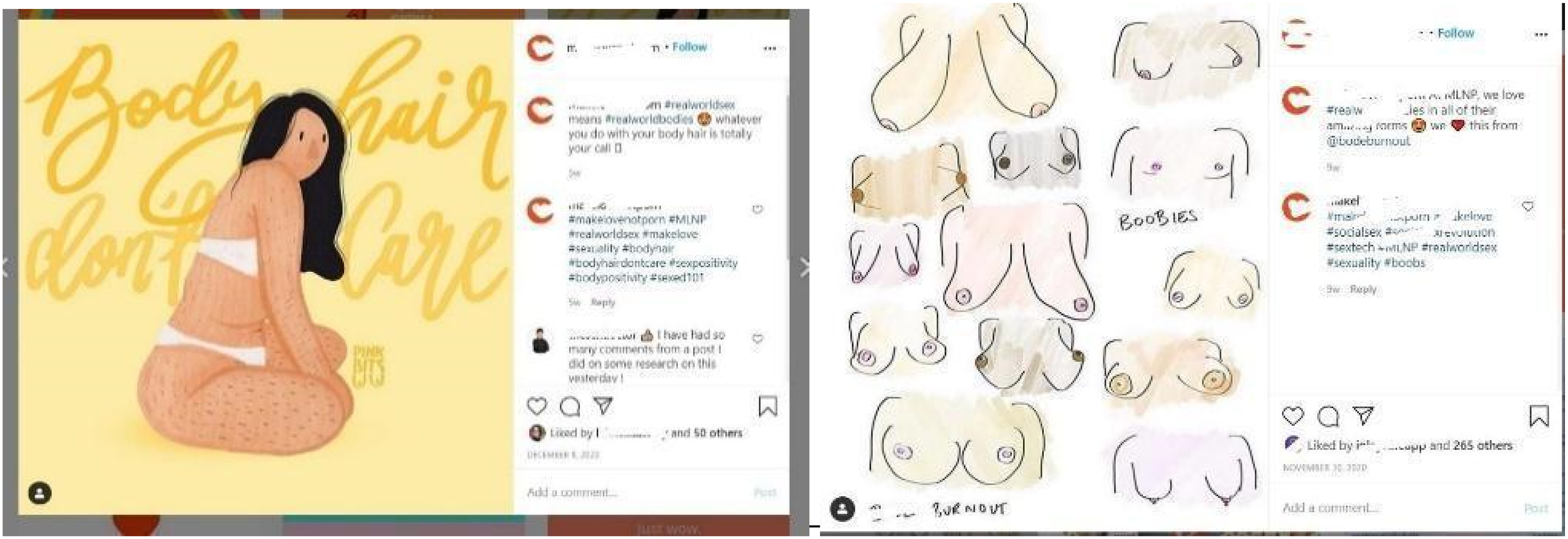
Women rejecting expectations and images of a perfect, pure body has been found to be part of their desire for liberation from patriarchal and marketplace norms; as well as central to their mindset as (environmental) feminist activists (Dobscha and Ozanne, 2000). So, through a logic of activism women displaying their diverse body parts, as content creators, becomes a part of their feminist imperative.
However, it is critical to note that far from a rejection of marketplace norms, this is a market that profits from women’s diverse body parts. As established in our literature review, women’s psychological and physical suffering is a key element of mainstream, contemporary pornography. By example, that women’s prolapsing anuses, once a consequence of their abuse, now has an industry term, rose-budding, and can be the very basis of a film’s attraction (Saunders, 2020; Sun, 2014). So, when comparing our study’s data from the user-gendered market to the literature looking to the consumer market, the logics of market violence sold to (predominantly men as) consumers are disguised through the logic of activism sold to women as content creators. This logic of activism, as a form of feminist embracing and celebrating of bodily diversity, disguises the very real bodily abuse women suffer in pornography.
In addition to practices of resistance through bodily diversity, we also found a logic of activism to sell (and celebrate) intersectional forms of diversity around race, age, disability and beauty norms. Such notions of intersectional diversity were a common trend in our data, both in text and visually (Figures 2 and 3). This included LMNP promoting a ‘Networked Bodies of Resistance’ event in one Facebook post. Elsewhere encouraging content featuring bodies that are ‘Desirably Different’ through ‘celebrating people with disabilities’. In this way, women’s intersectional diversity is framed as the site of resistance and a way for women to display their activism against restrictive market norms, for themselves and for all women. IMS Facebook post. LMNP Facebook post.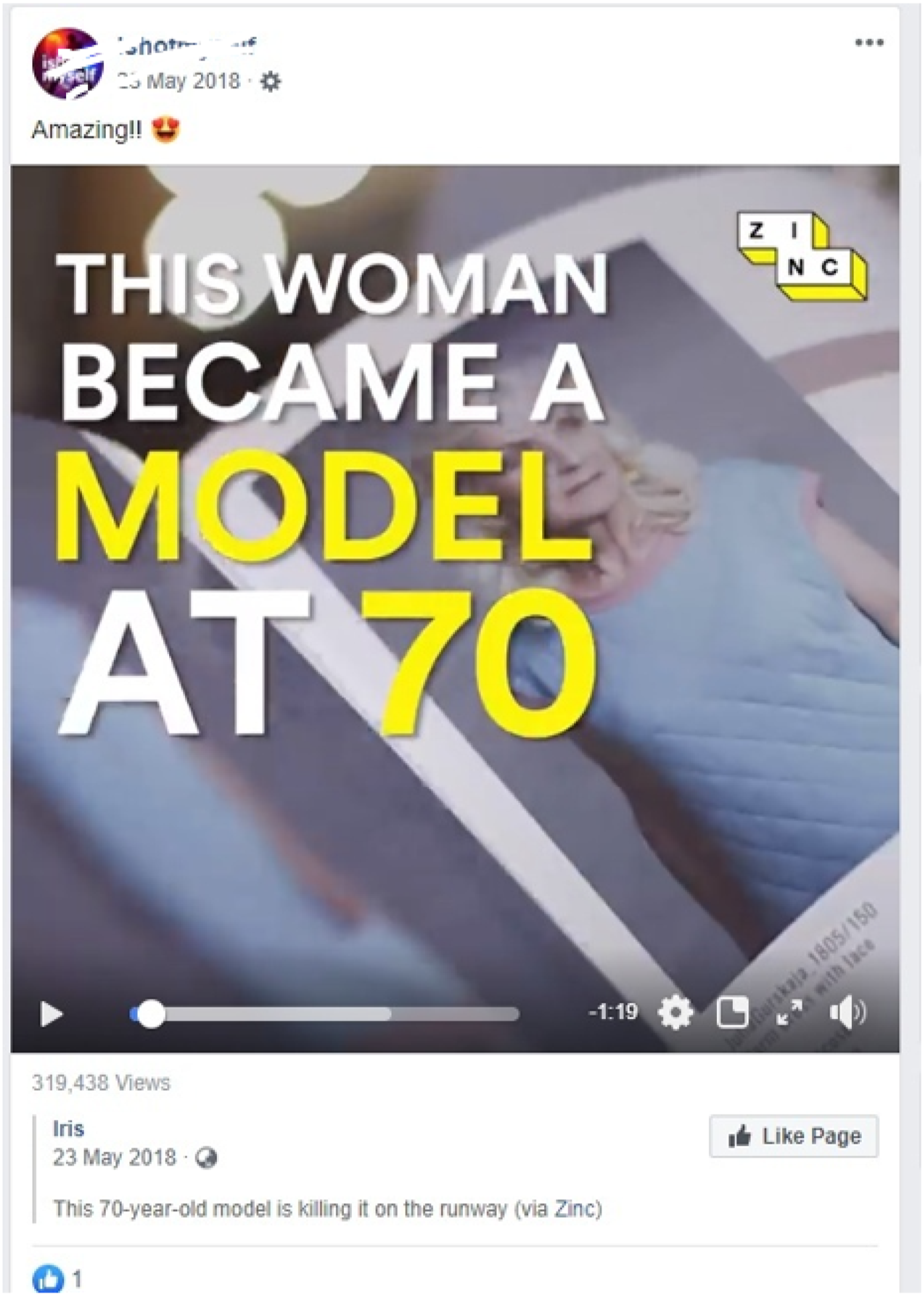
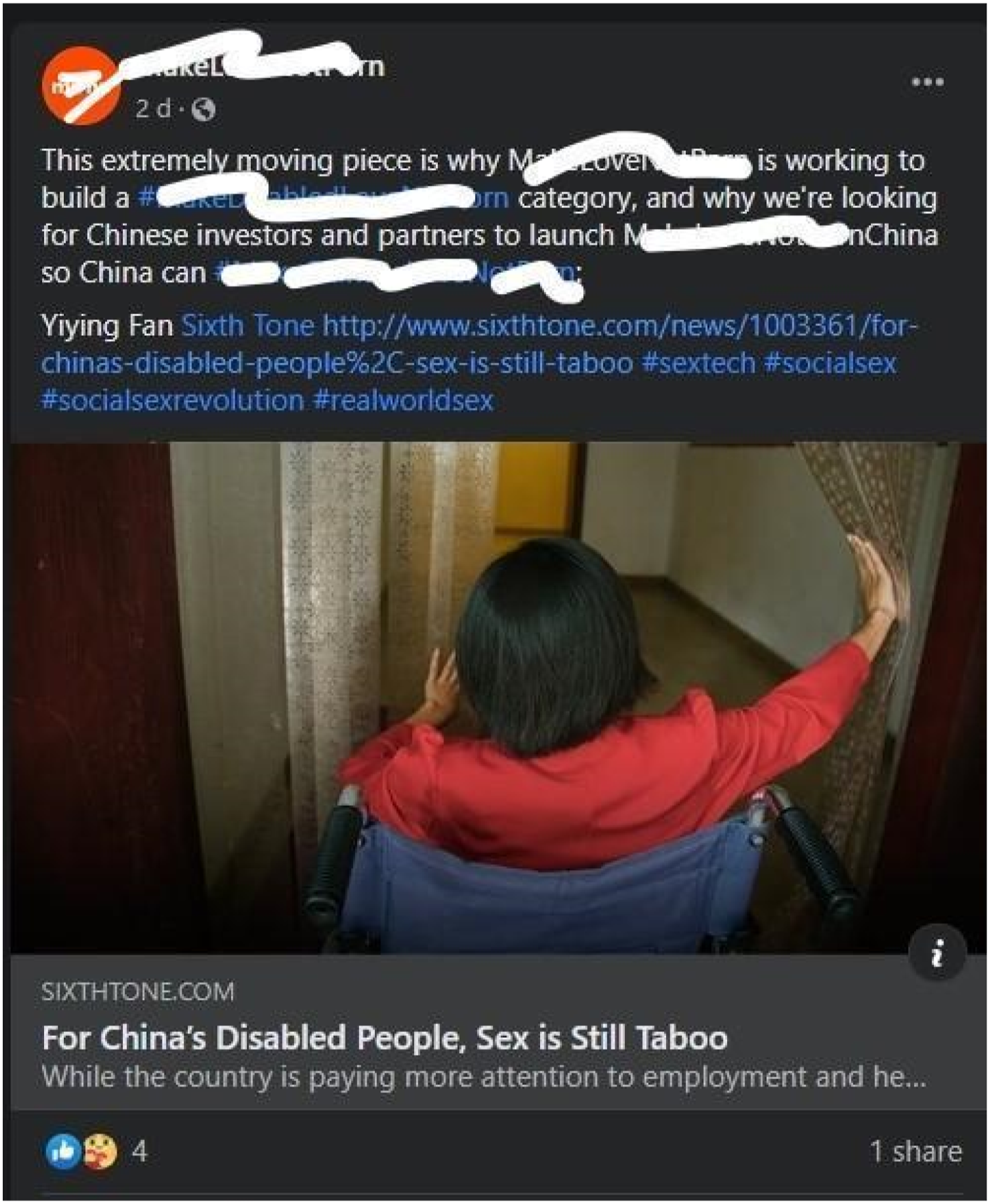
For IMS, their submission guidelines are used to detail their embracing of intersectional feminist ideals of the representation of diversity: Do I have to be good looking? You are, and we dig all kinds, ages (over 18), and races, natural, inked, hirsute, plus-sized, waifs, alt and queer, whatever. We have contributors up to age 78, at least one in a wheelchair, post-mastectomy and fashion models. From Tasmania to Tanzania…
As Middleton and Turnbull (2021) note of the value of gender progressive logics – there is a clear business incentive for markets to use egalitarian and counter-stereotypical depictions.
In this market, the deployment of a logic of activism towards one group of market actors – that is, women as content creators – functions as a part of their feminist incentive to be intersectional. This also disguises the pornography market’s business incentive for women to (re)produce their own highly stereotypical racist and sexist humiliation and degradation. As mapped in our literature review, this is a market that relies on the selling of highly racist, sexist and classist stereotypes. These racialized, sexualised and degrading descriptions of woman abuse lead to a key point about the market’s promotion of the representation of diversity: all women are welcome in pornography because key to how pornography is sold to consumers is that all women want – and deserve – abuse (Dines, 2010). In following calls for further theorising on how markets embed social projects at the intersection of gender, class, race, sexuality and ability (Kravets et al., 2020), we argue this market’s mobilising of activism, specifically through appeals to intersectional notions of diversity, disguises the racialised and sexualised abuse of women central to the consumer market.
Further to this, content creation as a form of intersectional activism, for all (oppressed) women, was also expressed in a promoted interview with a content creator. As the LMNP ‘star’ explains, her self-made pornography is an important part of her activism and especially critical for her as a woman of colour ‘…to be free in a world that wants us to not exist, and by “we” I mean people of colour, queer people of colour and trans people of colour’. This reflects what others have begun to recognise as the market’s illusion of intersectionality: the repacking and distorting of the work of Black women and feminists in extractive and self-serving ways (Rosa-Salas and Sobande, 2022). The appropriation of feminist-activist reforms to serve the interests of ruling (male) groups under imperialist, white supremacist, capitalist patriarchy is not a new form of oppression (hooks, 2000); but this is especially insidious in the contemporary pornography market. Specifically, in the selling of content creation to women, appeals to both the representation of diverse bodies and intersectionality do not solely serve the interests of the market structure, but these logics disguise women’s undiscriminating sexual and racial abuse as a form of feminist activism, for all women.
For critical marketers, appeals to diversity and acculturation are mechanisms that can work to ensure people are complicit in the self-production of their own commodification (Veresiu and Giesler, 2018). These ‘coaxing’ mechanisms and social orders are described as compliances often built into the very structure of online markets (Hakala et al., 2017). Marketing scholars have also put forward the concept of ‘complicit resistance’ to explain the limits of consumer resistance when women engage in subjectification practices within markets of power (Zanette et al., 2019). These concerns echo the theorising of feminists critical of the sex industry – that women’s inferior status under patriarchy requires women are socialised to eroticise and consent to their own subordination (Jeffreys, 1993). That is, through socialising women to feminisation processes and heterosexist imperatives from infancy, across all manner of consumer products and practices, media narratives, family traditions and systems of social approval and peer pressure, an obedient and compliant feminine subject is produced (Long, 2015). So, in bringing together the work of critical marketers and feminists critical of the sex industry, our findings on the representation of diversity reveals how a logic of activism functions as a social mechanism in women’s compliant (re)production of their (self)subordination through content creation. From this, we locate market compliance, disguised as resistance, as a structural mechanism in the creation of a compliant, feminist-activist subject.
Appeals to environmentalism
Another dominant market mobilisation we found linked content creation to activism through appeals to environmentalism. Specifically, through constructing content-creating women as ecofeminists and animal activists, a social and civil duty is sold to women. Together, these combine to construct a moral imperative for women (re)produce their abuse through content creation.
First, we found multiple examples of women’s connection to the environment through featuring them outdoors or in natural settings: in communion with nature (Figures 4, 5 and 6). Image still from HP YouTube video. Image from LMNP blog post. HP Web site image.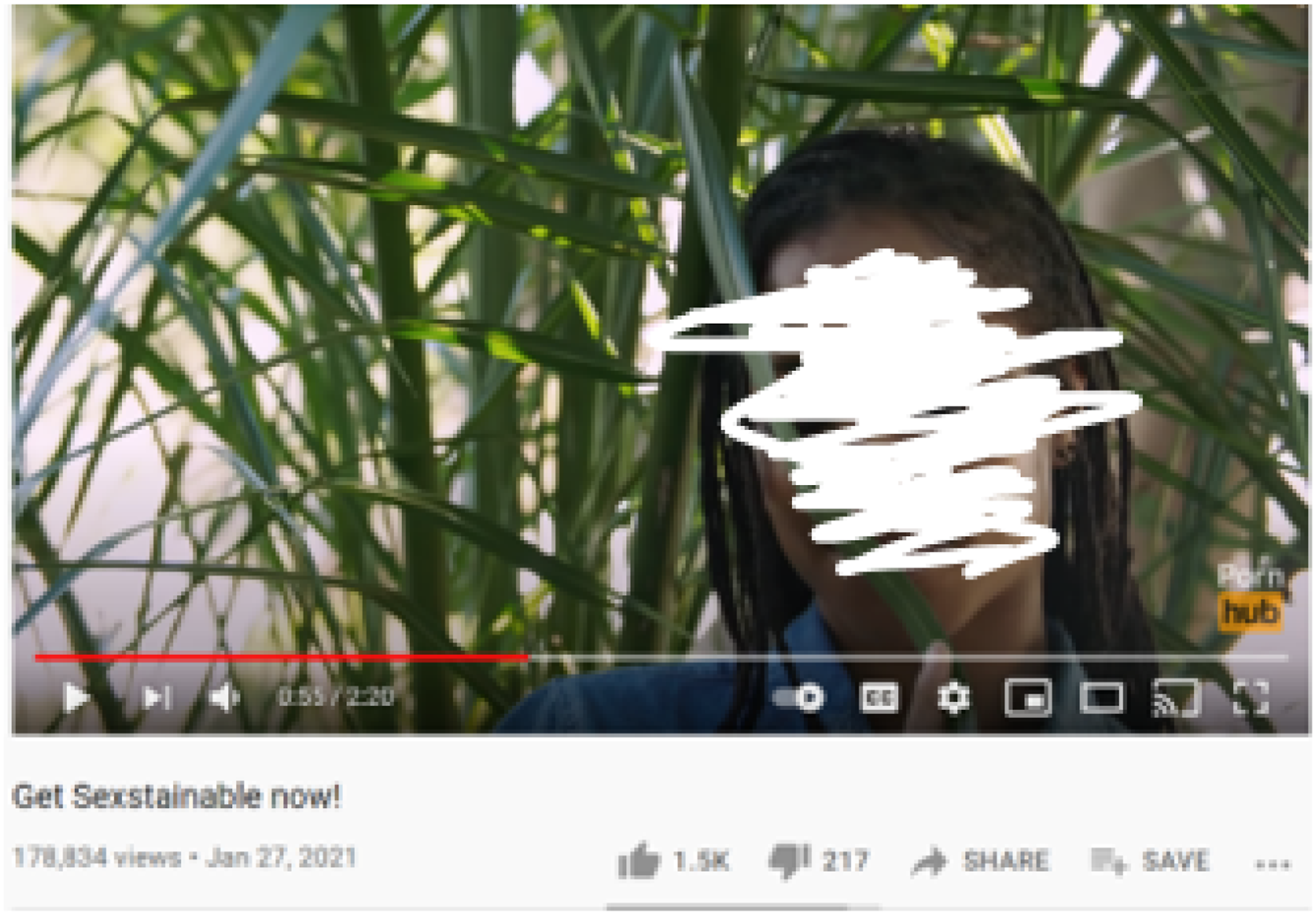


Not only are women positioned close to or connected with nature, but this is explicitly linked to their role as empowered, feminist content creators. As an IMS Instagram quote explains ‘…I see my body as something more entwined with art and nature…This experience was wonderfully liberating’. Or as LMNP content creators express (Figure 5), they were motivated to ‘spread the good word about conscious living’, and ‘…in the words of Maya Angelou, “Aint Nothing To It But To Do It”’. For IMS, the content women create is directly referenced as a way for women to express their activism, for the environment and feminism: …let’s talk about themes… want to make a political statement. That's great... want to demonstrate your convictions on feminism, the environment or really anything else, go for it.
In this way, women’s communion to nature and the environment becomes a part of their empowered mission as environmental activists: as ecofeminists. With ecofeminist ideals noted as offering women a way to overcome their distrust in markets (Dobscha and Ozanne, 2000), we suggest this construction of a logic of activism – as a tool for markets to disguise the broader context of market violence – requires urgent attention.
The construction of women as ecofeminist activists was also evident in a HP YouTube video, one of a number of the Web site’s CSR promotions, with the model expressing the importance of being ‘sex-stainable’ to ‘empower people to end the climate crisis’. As the model encourages in this video ‘…join us in our mission to create a more sex-stainable world and start fucking with the planet the right way. So, let’s come together for Mother Earth’. Here, the model promotes waste disposal practices (in this case, a suggestive bottle of hand lotion), as well as highlighting a series of harmful practices for the planet, such as driving cars and eating the wrong foods (Figure 7). image stills from HP video.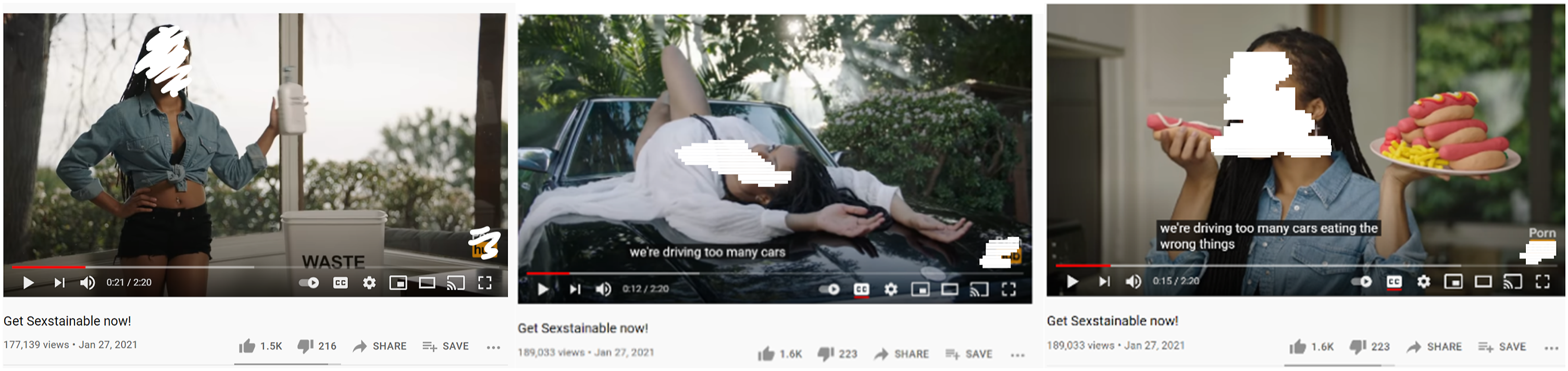
Through the feminisation of consumption women are often expected to behave more environmentally, and hence, markets frequently sell women the ‘green dream’ to disguise both marketplace harms to the environment, while washing over their exploitative labour practices (Karlsson and Ramasar, 2020). Yet, the user-generated pornography market’s dynamic of disguising, in this instance through a form of ‘greenwashing’, is not to exploit women as consumers, it is to exploit women as content creators and wash over the market’s requirements for content that (re)produces women’s subordination.
In addition to women as ecofeminists, another way in which appeals to environmentalism were mobilised through a logic of activism was in constructing content-creating women as animal activists. Sometimes this involved encouraging women to include their ‘furry friends’ in their self-made videos (Figure 8). IMS Facebook posts.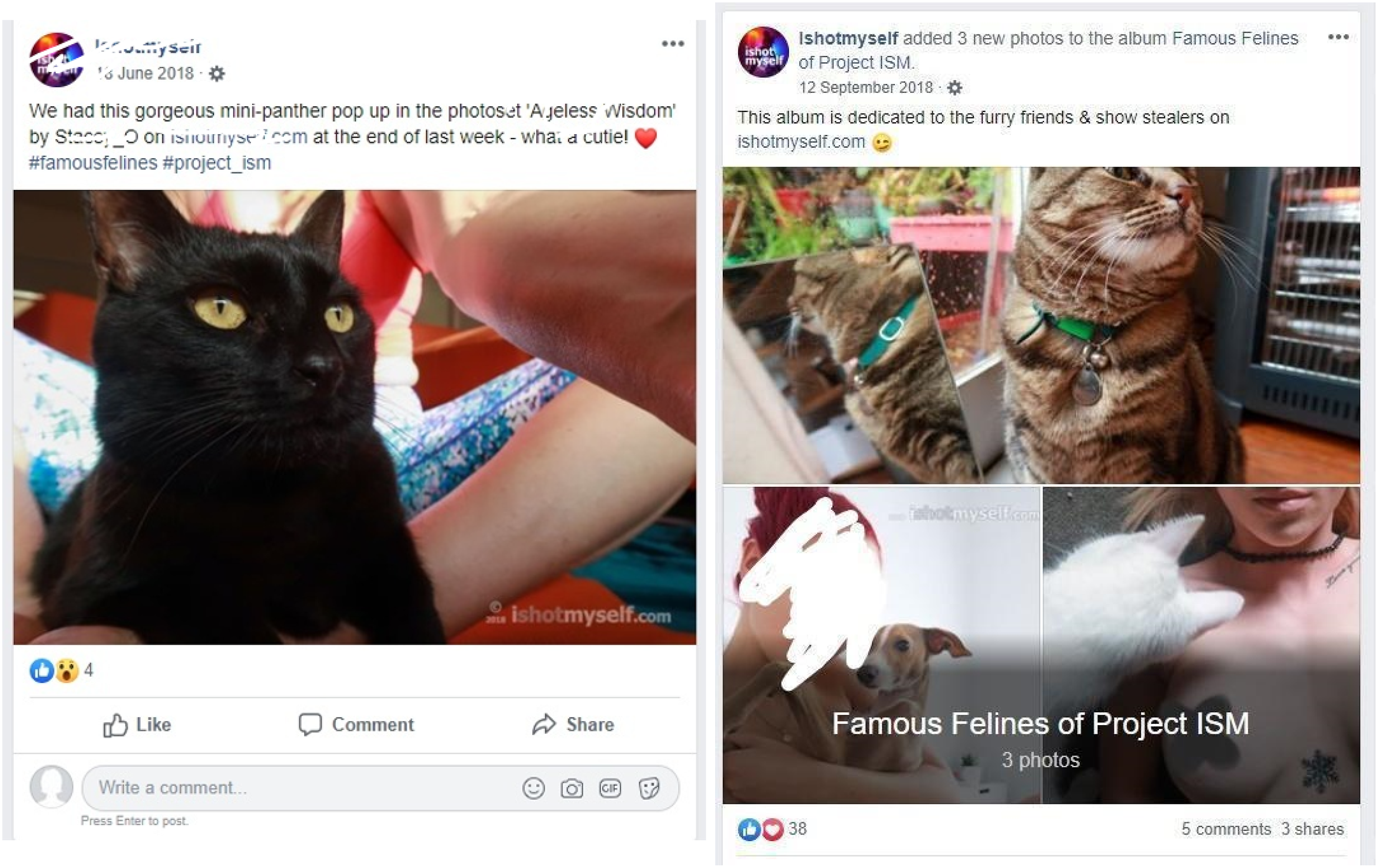
Whereas at other times, women were encouraged to be champions for an animal activist cause. As one site promotes with the help of their ‘campaign spokesperson’ (a professional pornography performer) ‘While a healthy sex life is an important part of human life, the sex drives of unaltered dogs and cats has created a massive overpopulation crisis’ (Figure 9). HP campaign stills from Web site.
With another HP campaign expressing on a different environment problem, ‘World Whale Day is February 13th…. Sperm whales, humpback whales, we love them all! So please help us save the ocean’s gentle giants…’ [Figure 9). Feminist marketing scholars have previously noted the darker side of gendered and feminised inequalities in the use of ‘playful’ and ‘innocuous’ references to animals in marketing (Ourahmoune et al., 2014; Stevens et al., 2013: 171). In the user-generated pornography market, these seemingly benign messages of animal activism, sold to women as content creators, function as a darker dynamic in disguising and washing an enduring harm of this market – its common dehumanising of women.
To understand the insidiously duplicitous nature of a logic of (animal) activism being sold to women, it is useful to turn to the work of those feminists concerned with pornography’s harm. As noted in our literature review, pornography profits from selling a view of women (and most often women of colour) as having animal-like status (Collins, 2002). Institutional analyses have revealed the role of animal activism in shifting the moral foundations of normalised and harmful market practices (Baker et al., 2019), and gender progressive logics related to feminism are observed for instilling a ‘duty-bound’ social justice responsibility to disrupt and transform harmful market norms (Middleton and Turnbull, 2021: 9). However, in this market, a feminised imperative to animal activism functions to sell a very different moral duty to women. As scholars concerned with pornography’s harm have raised, this is a market that relies on images that reproduce women’s status as second-class citizens (DeKeseredy, 2018). So, in uniting animal welfare and feminist activism, women’s recreation of their own subordinate, second-class status becomes a moralised feminist imperative, for women and the environment.
Thus, through both animal activism and ecofeminism, a logic of activism functions to elide the market violence against women at the core of how pornography is sold to content consumers, while also creating a social and civic duty for women to (re)produce their second-class citizen status. We argue, this social and civic duty speaks to what Karlsson and Ramasar (2020) describe as the ‘feminization’ of marketing – most evident in the market’s focus on women’s sexual and gendered empowerment. Yet, equally applicable to our findings is Stevens (2019) proposition that ‘feminization’ emphasises notions of relationality, participation and the non-hierarchical social aspects of women’s work. With this dual understanding of a ‘feminization’ of appeals to environmentalism, the moralised imperative for women’s content creation is revealed as two-fold. It is both women’s civic mission as empowered sexually liberated feminists, as well as their socialised obligation to care and to participate, that constructs a civic and social – that is, a moral – duty for women’s compliant (self)subordination through content creation.
Discussion
In concluding, this discussion section brings together our findings to offer an emerging conceptualisation of moral market compliance, as a dark dynamic, that is disguising and (re)producing women’s harm, inequality and violation. In developing the under-utilised suggestion of Scaraboto (2015: 172) that marketers can integrate social logics to ‘disguise’ their dominant market logics, we uncover how a logic of activism functions to insidiously mask forms of market violence against women. However, as our findings reveal, a logic of activism not only functions to disguise the market’s requirement for woman abuse, but it is also mechanised in selling content creation as a feminist and feminised imperative. This is achieved in two ways. Initially, we show – through the representation of diversity – how a logic of activism works to position women’s compliance to look like resistance. Then, through appeals to environmentalism, our findings point to the market’s construction of a social and civic duty for women’s (self)subordination through content creation. We now discuss each of these, starting with an elaboration on the way women’s (self)subordination is moralised as a civic and social duty, then how it is ensured through market compliance. In revealing these disguising and dark dynamics that construct a ‘social justice responsibility’ (Middleton and Turnbull, 2021: 13) for women to (re)produce their own abuse, we also uncover some of the market mechanisms and structures that ‘normally remain invisible in contemporary discourse on female empowerment’ (Catterall et al., 2005; Kravets et al., 2020: 455).
First, our emerging conceptualisation of a moral market compliance is significant in revealing the market’s construction of a moral – that is, social and civic – imperative for women to (paradoxically) (re)produce their second-class status. As traced in our findings on environmentalism, through appeals to ecofeminism and animal activism, a logic of activism constructs a ‘higher moral purpose’ (Middleton and Turnbull, 2021: 12) for women as content creators. This moral purpose, we argue, is the union of a social and civic duty for women as feminist activists. Themes related to activism can be so valuable for markets that forms of commodity activism are increasingly noted as creating a ‘civic duty’ to one’s community (Kuehn, 2017; Repo, 2020). While this civic duty to the collective and its communal struggles are seemingly at odds with the commodity activist’s neoliberal commitment to individual, personalised forms of self-empowerment (Kuehn, 2017), such a tension is now resolved through its union with feminism. In what Repo (2020) terms ‘feminist commodity activism’, commodity activism is united with commodity feminism and neoliberalism feminism to produce the marketing of a feminist activist. This feminist activist is tasked with attending to her civic social responsibility (and in turn, advancing the market), through fulfilling her duty to consume (Kuehn, 2017; Repo, 2020). In the user-generated pornography market, a logic of activism similarly functions as a form of feminist commodity activism. Yet here, rather than being duty-bound to consume commodities, pornography’s feminist activist is tasked with a duty to be consumed – as the commodity.
Then, in looking at the market’s appropriation of the representation of diversity, the second part of our conceptualisation relating to market compliance is uncovered. For MSD scholars, women’s resistance and challenging of pervasive market norms has revealed their power as agentic activists capable of shaping more diverse and inclusive market practices (Dolbec and Fischer, 2015; Scaraboto and Fischer, 2013). Yet, as institutional theorists highlight, in order to function, institutions often rely on social mechanisms that ensure compliance (Lawrence and Suddaby, 2006). We argue a logic of activism functions as a social mechanism in women’s compliant (re)production of their (self)subordination through content creation. Specifically, through selling content creation – that is, women’s market compliance – as a form of resistance.
Thus, our paper’s central contribution is in introducing a concept of moral market compliance. We offer moral market compliance as one way to understand how people are coerced to participate in market structures that (re)produce their (self)subordination and oppression. This is significant for the discipline in putting forward an understanding of market compliance, as opposed to resistance. Scholars concerned with market dynamics are increasingly well-versed in understanding how paradoxes and tensions around social and market logics are navigated and often even resisted by market actors. This has resulted in a rich body of work on practices of market resistance (Giesler, 2008; Ozdamar Ertekin et al., 2020; Scaraboto and Fischer, 2013; Thompson and Coskuner-Balli, 2007). Extending critical questioning on how market activism awakens people to the harms of remaining compliant (Cronin and Hopkinson, 2017), our findings show how market activism is mechanised to disguise the harms of compliance. Further, we argue through a logic of activism, this market sells itself – and content-creating women – as part of a feminist resistance: ‘leading societal change for the better’ (Middleton and Turnbull, 2021: 12).
The second part of our contribution is the way moral market compliance can be an illustrative example of a ‘dark(er) dynamic’: a term we use to encapsulate the more hidden, disguised or insidious practices of market systems. This part of the paper advances the work of scholars concerned with MSD and institutional logics through revealing the disguising role of logics as a dark market dynamic. We suggest this dark dynamic is especially insidious because it is being used to ‘fem wash’ market violence against women. Emerging scholarship examining how markets and marketing appropriate social justice logics (Karlsson and Ramasar, 2020; Middleton and Turnbull, 2021; Ozdamar Ertekin et al., 2020; Sobande, 2020b) has begun to focus on the use of appeals relating to female empowerment and feminism to ‘woke wash’ market practices of inequality and even harm (Middleton and Turnbull, 2021; Sobande, 2020b). This includes the harm and inequalities related to advertising’s perpetuation of gender stereotypes (Middleton and Turnbull, 2021), the fashion market’s degradation of the environment and its exploitation of workers (Karlsson and Ramasar, 2020; Ozdamar Ertekin et al., 2020) and even the (mis)use of ideas of intersectionality and Black social justice (Sobande, 2020b). This appropriation (Karlsson and Ramasar, 2020; Sobande, 2020b) of feminist ideas has produced what some scholars are now terming marketplace ‘fem washing’ (Karlsson and Ramasar, 2020; Sterbenk et al., 2022). While forms of market washing, such as ‘fem washing’ as well as ‘woke washing’ (Sobande, 2020b; Vredenburg et al., 2020), ‘care washing’ (Chatzidakis et al., 2020) and ‘CSR washing’ (Koleva and Meadows, 2021) have been applied to understanding inequalities and even harm, in this paper, we have attended to the disguising of a particularly insidious form of market inequality and harm, that is, market violence (Fırat, 2018; McVey et al., 2021).
Dark dynamics are also underexplored in relation to forms of market violence. With calls to hold markets to account for using socially progressive ideas to their advantage when they do little to address matters of injustice (Sobande, 2020b), as well as increasing concern on the weaponization of wokeness (Sobande, 2020a; Zavattaro and Bearfield, 2022), we have mapped the growing online pornography market as particularly useful for uncovering the fem washing of market violence against women. However, there is still much work to be done on dark dynamics, the washing of market violence and the appropriation of feminised activism.
Future work
Our conceptualisation of moral market compliance is broad – we hope to see future work apply it to revealing other forms and sites of market oppression and violation. Critical scholars are calling for further work on racism and sexism as defining forces in our culture, including how markets align with social justice logics to present themselves as being concerned with oppression, when they are in fact, in pursuit of profit (Sobande, 2020b). Following this, we encourage moral market compliance, and other dark market dynamics, be extended in considering the washing of market violence.
A focus on the intersectional inequality of markets could be further developed in bringing together more critical marketing perspectives on institutional logics and intersectionality, including the ways in which logics function at the nexus of neoliberalism and gendered racial capitalism (Rosa-Salas and Sobande, 2022). This could help unpack further reflections on how morality is gendered, raced and classed under imperialist, white supremacist, capitalist patriarchy (hooks, 2000). More intersectional logics analyses should also be applied to the newer phenomenon of user-generated content creation. Our paper has been significant in addressing this highly prevalent but largely underexplored market activity of selling user-generated content creation. With periodic interest from critical marketing scholars on self-production, prosumption and the role of the producer (Cova et al., 2011; Rocha et al., 2020), more macro analyses on the (moralised) logics coercing people’s self-subordination through content creation are overdue.
Future analyses of the pornography market should also be expanded to more centrally consider the racist abuse of women. As highlighted in our findings on the representation of diversity, there is an ‘equality of abuse’ in the market, in the way all women are promoted as deserving – and wanting – abuse. However, it must be emphasised, women’s racial abuse is not an afterthought in pornography. Rather, as Patricia Hill Collins (2002) argues, the degradation and fetishisation of women of colour is an especially foundational and enduring practice of women’s inequality in pornography. As feminists critical of pornography highlight, fundamental to pornography’s market system is its enduring racism – a racism that is not coded or subtle but explicit, violent and based on highly sexualised and racist stereotypes and a fetishising of women’s ethnicities (Benard, 2016; Collins, 2002). In this context and others, analyses on forms of racist and racialised market violence should also be centrally concerned with ethical considerations and tools for researchers when looking to sites of oppression and abuse – another area we hope to see developed by critical scholars in the marketing discipline.
A final avenue we offer for further critical analyses is the role of activist collectives (Chatzidakis et al., 2021; Lopes et al., 2021) and the co-optation of market resistance (Marion, 2006; Zanette and Scaraboto, 2019). Nascent scholarship is beginning to highlight that notions of solidarity are often highly gendered, targeted towards women and promoted through ideas of strength and sisterhood (Kouki and Chatzidakis, 2021; Sobande, 2020b). Coupled with this is an emergent concern on the use of solidarity and global equality to create a collective ‘we’, which can gloss over inequalities and be ‘nefariously weaponised’ for market gain (Sobande, 2020a: 1036). Accordingly, we suggest that the ways in which feminised notions of solidarity and activist collectives are ‘weaponised’ in the fem washing of market violence against women would be a valuable point for future analyses. Such a line of enquiry could also look to the ideological recruitment of women into market communities of violence (Thompson and Coskuner-Balli, 2007), including the how logics of feminism, rebellion, revolution and counter-culturalism can be ‘co-opted’ to advance market agendas (Dholakia and Reyes, 2018; Hartman and Coslor, 2019; Marion, 2006; Zanette and Scaraboto, 2019). Such enquiries could apply a radical feminist analysis to other markets of self-subordination and oppression, including the market for systems of prostitution (Farley, 2020), the reproductive technologies market (Hartman and Coslor, 2019; Takhar and Pemberton, 2019) or even the beauty and cosmetic surgeries market (Jeffreys, 2014; Rocha et al., 2020).
Conclusion
In closing, this paper has conceived a dark market dynamic in the fem washing of market violence against women: a dynamic we conceived as moral market compliance. Through this developing conceptualisation, this paper has been significant in showing how the appropriation of logics can do more than (re)produce market inequalities and harm, logics can be weaponised to disguise market compliance as resistance, as well as creating a moral (i.e. social and civic) duty for women to (re)produce their own subordination and violation through content creation. To address the original conundrum of how a market steeped in sexual violence against women sells itself to women to encourage their participation, this paper reveals how a logic of activism disguises the market’s requirement for woman abuse, while mechanising pornographic content creation as a feminist and feminised imperative for women.
We finish by urging critical marketers to continue to investigate institutions and structures perpetuating forms of market violence against women, because to be a ‘critical’ scholar it is no longer sufficient to acknowledge or engage issues of inequality, rather there is a need ‘to seek out and explain structures of oppression and domination’, including being driven by a radical agenda to liberate people from their enslavement to such structures (Munir, 2019: 5). Or as Dholakia and Firat (2016) raise, it is time to focus academic marketing attention on inequality, especially the more constructed marketing efforts that function to make inequality invisible, innocuous, acceptable or even celebrated.
Footnotes
Declaration of conflicting interests
The author(s) declared no potential conflicts of interest with respect to the research, authorship, and/or publication of this article.
Funding
The author(s) disclosed receipt of the following financial support for the research, authorship, and/or publication of this article: This work was supported by the Australian Government Research Training Program Scholarship.
