




Abstract
In this study, we theorise the pluri-temporality of market-mediated spaces. By taking the Finnish sauna as an empirical context, we analyse the sauna as a pluri-temporal space whose momentary existences are actualised by slow and fast spatio-temporal movements flowing simultaneously at different speeds. In so doing, we advance the concept of the saunascape as a tool to grasp the temporal and spatial dynamics that continuously reproduce the space. The empirical data include interviews conducted in sauna departments at five different hotels, focus group discussions generated at a commercial sauna restaurant, and online articles published in the Finnish Sauna-Magazine between 2018 and 2021. The findings show that slow spatio-temporal flows produce saunascapes that are characterised by rituals and authentic spirit. Fast spatio-temporal flows create saunascapes characterised by meaningful experiences and future envisioning. The momentary actualisation of a saunascape is always unique and ephemeral, varying according to whether the slow or fast flows are more pronounced. The study ends with a conceptual discussion of the potential of the concept of (sauna)scape to illustrate the pluri-temporal and multifaceted space.
Introduction
Scholars of marketing have acknowledged market-mediated spaces as constantly evolving dynamic constellations (Bjerrisgaard and Kjeldgaard, 2013; Castilhos and Dolbec, 2018; Castilhos et al., 2017; Chatzidakis et al., 2018; Coffin, 2019; Giovanardi and Lucarelli, 2018; Haanpää, 2022). The extant body of research is largely based on conceptual works that insightfully highlight spatio-temporal dynamics of market-mediated spaces, for example, conceptualising the transitions and relationships between different types of spatial entities in the markets (Castilhos and Dolbec, 2018) and addressing the circulation, movements, and translocationality to go beyond the divide between place-oriented and space-oriented thinking (Giovanardi and Lucarelli, 2018). This understanding is enriched by a few empirical analyses, such as Steadman et al.’s (2021) study on consumers’ past memories and anticipated futures constructing place atmosphere experiences in football matches and Bradford and Sherry’s (2023) ethnographic study on the football game tailgate showing how marketers and consumers synchronise temporal modes to cocreate ritual vitality.
Despite the extensive contributions to the marketing literature, we identify three research gaps in the extant knowledge on spatio-temporal transformations in market-mediated spaces. First, studies are needed that move beyond the traditional ‘place vs. space’ divide to approach market-mediated spaces as multifaceted entities in relation to temporal dimension. In this, we echo scholars (Castilhos et al., 2017; Giovanardi and Lucarelli, 2018) who call for more nuanced and holistic analyses to conceptualise spatiality. Second, little scholarly attention has been given to the pluri-temporal reproduction of space. Temporality has often been taken as an implicit starting point for studies instead of being given specific, empirical focus in its own right (Steadman et al., 2021). Chatzidakis et al. (2018: 150) have thus called for marketing research with a more overtly temporal perspective that links time and space in a ‘processual, co-productive and performative way’ (see also Gregory, 2009). Third, most previous investigations are conceptual (Castilhos and Dolbec, 2018; Castilhos et al., 2017; Chatzidakis et al., 2018; Coffin, 2022), which means that empirical investigations examining how pluri-temporal dynamics actually produce multifaceted spaces in real-life contexts are lacking. In particular, this applies to understanding of how simultaneous temporal movements flow at different speeds in multifaceted spaces.
Building on the previous insights and the identified gaps, this study takes an overtly temporal perspective on studying market-mediated spaces as multifaceted and pluri-temporal constellations. Our specific goal is to theorise how pluri-temporal spatial flows simultaneously reproduce the multifaceted space. We adopt a dynamic view on time-space relations, contending that time has different tempos, flows at multiple speeds, and lasts for various durations (Massey, 2005; Urry, 2001). Consequently, by pluri-temporal space, we mean a space whose momentary existences are actualised by a variety of spatio-temporal movements flowing at different speeds and within different time frames. Such pluri-temporal flows are particularly visible in market-mediated spaces such as tourist attractions and place-embedded festivals or sport events (Bradford and Sherry, 2023; Steadman, 2021).
While tourist attractions and festivals are connected to fixed locations, this study takes an empirical context which is multifaceted by nature, namely, the Finnish sauna. As there are over three million saunas in Finland, the sauna intrinsically constitutes a multifaceted space; it can be a meaningful place, a protecting territory, a localised scale, and/or a mobilising network (Castilhos et al., 2017). In Finland, saunas can be found in numerous locations and come in a variety form including apartment saunas, summer cottage saunas, hotel saunas, gym saunas, tourist destination saunas, rentable mobile saunas, and communal saunas. Further, as an empirical context, the sauna showcases the continuous state of ‘becoming’ (Chatzidakis et al., 2018; Coffin, 2019) by integrating slow and fast spatio-temporal movements in a unique way. While it has certain spatial elements that have remained similar over thousands of years, the sauna is continually reshaped by new trends and sauna-bathing practices. The repetitive practices of sauna bathing enable exploration of the endless variations of sauna situations that reflect the unique ways in which spatial and pluri-temporal flows merge. Thus, the sauna can be conceptualised as a process of production that illuminates the historical and ongoing relationships between people, things, and institutions (Massey, 2005).
To illuminate the pluri-temporal construction of the sauna, the study advances the concept of the ‘saunascape’. In this study, the saunascape is used as an analytical tool which helps to understand the temporal and spatial construction of the sauna within a set of global and local cultural and material flows (Downey and Sherry, 2022). Our empirical investigation builds on data triangulation through three qualitative datasets: (1) interview data (n = 39) collected in hotel sauna departments; (2) focus group data (n = 12) generated at löyly, a commercial sauna restaurant established in 2016 in Helsinki, Finland’s capital city; and (3) media data consisting of 16 Sauna magazine issues published by the Finnish Sauna Society from 2018 to 2021. Each dataset plays a crucial role in understanding how spatio-temporal flows, moving at different speeds across various time frames, create momentary saunascapes.
The study’s theoretical contribution is threefold. First, the study adds to market spatiality research by offering an empirical analysis that demonstrates how slow and fast temporal flows reproduce space, thereby elucidating the conceptual links between space and time (Bradford and Sherry, 2023; Chatzidakis et al., 2018; Haanpää, 2022; Hill et al., 2022; Steadman et al., 2021). Second, the study advances the concept of the (sauna)scape as an analytic tool to understand the different tempos of time-space relations. In particular, the study shows how the pluri-temporal nature of saunascape helps in unpacking the broader lifespan of a place (Coffin, 2019), thus linking temporal flows more explicitly to spatial flows. Third, we enrich Castilhos et al.’s (2017) spatial framework by analysing how space-based mechanisms (place, territory, scale, and network) enable us to valorise space as a pluri-temporal and multifaceted entity, thereby providing a more nuanced and holistic view of market-mediated spaces.
The paper proceeds as follows. We first discuss space as a pluri-temporal and multifaceted concept and elaborate on the concept of saunascape. We then shed light on our methodology and data. Our findings unpack saunascapes in relation to fast and slow spatio-temporal flows. In the discussion, we further theorise the concept of saunascape and specify the theoretical contributions. We conclude with insights for scholars and marketers and an encouragement of future ‘scape’-related conceptualisations.
Theoretical framework
In this section, we discuss space as a pluri-temporal constellation and as a multifaceted entity. We then show how the concept of saunascape offers an analytic tool to reveal the slow and fast spatio-temporal flows reproducing the sauna.
Pluri-temporal spaces in marketing literature
The current study adopts a dynamic, relational view of space and time, meaning that we agree with Massey (2003: 108), who states: ‘Space has time/times within it. This is not the static simultaneity of a closed system but a simultaneity of movements’. Massey’s notion of pluri-temporality has its origin in understanding places as a set of spaces where ranges of relational networks and flows coalesce, interconnect, and fragment (Urry, 2001). That is, time-space relations constitute slow and fast flows wherein some things last only briefly, others last longer, and some may seem everlasting. Consequently, we position our study within the marketing field and the ‘course of Conexus’ proposed by Giovanardi and Lucarelli (2018: 153), since we understand spatiality ‘not only as a single movement, but rather as a number of movements – whether in a series, parallel, reciprocal, or duplicative – and in the complex relations among individuals’.
Echoing this relational approach, the notion of temporality is deeply entwined with CCT-oriented discussions of market spatiality (e.g. Bjerrisgaard and Kjeldgaard, 2013; Chatzidakis et al., 2018; Coffin, 2022). This is addressed, for instance, by Coffin and Chatzidakis (2021) who note that researchers have started to advocate the concept of spatiality over the concept of space, as the first is more ‘active or processual term that theorises spatial dimensions as relational effects rather than objective antecedents’. To illustrate, Coffin (2019) examines slow and geographically dispersed movements and the momentary and situational flows connected to salient places. Haanpää (2022) uses the concept of choreography to capture the myriad simultaneous temporalities consumers navigate within and in relation to different spaces (i.e. moving physically and/or mentally from memories to future imaginaries). In these conceptual studies, the temporal dimension is approached as an essential, yet implicit, element of space. We add to these previous conceptual studies by explicitly and empirically examining the temporal dimension within the space.
When it comes to previous empirical studies, Vicdan and Hong (2018) explain how the spatial transformation of an ecovillage community influences over time sustainable practices by examining space as an actant in a network; Hill et al. (2022) use sociological interaction theory to conceptualise the mobility of ‘social atmospheres’ and the rapidly changing qualities of a place; Maciel and Wallendorf (2021) show how and why consumers use multiple spaces as resources in their politicised identity projects; and Bradford and Sherry (2017) conceptualise collegiate football tailgating as a consumer ritual that temporarily converts private space to public place. Other empirical investigations have likewise elaborated on how places change over time, yet without substantial analysis of temporality. For example, Cheetham et al.’s (2018) findings on urban green territories highlight how temporal, spatial, and affective dimensions participate in the boundary-making of places.
In conclusion, only a handful empirical marketing studies have explicitly focused on connections between space and time, and within such studies, the temporal dimension often constitutes an implicit starting point instead of a specific focus of investigation (Steadman et al., 2021). One significant exception is Steadman et al.’s (2021) study of place atmospheres in football matches, which shows that consumers’ past memories and anticipated futures emerge in a spatial consumption experience, emphasising that the boundaries of temporalities and consumption spaces are permeable. However, the study’s temporal frame largely concerns consumers’ personal histories, social memories, and anticipations (Steadman et al., 2021), thus leaving unexplored the simultaneous movements of diverse temporal flows. In contrast, Bradford and Sherry’s (2023) work on vitality in consumer rituals shows the importance of exploring the simultaneity of multiple temporal dimensions. Using the temporal dimensions of chronos (measurable, quantifiable, and profane time) and kairos (extraordinary, significant, and sacred moments), they observe that ritual vitality results from the entwining of both dimensions.
While these works are pioneering, the extant literature lacks studies of multiple temporal flows operating simultaneously and at different speeds to continuously reproduce market-mediated spaces (Massey 2005; Urry 2001). Thus, we turn to the sauna as an empirical context to analyse how pluri-temporal and spatial flows simultaneously reproduce a multifaceted space.
Multifaceted spaces in marketing literature
To valorise the sauna as a multifaceted space, we build on the four geographical dimensions characterised in Castilhos et al.’s (2017) spatial meta-analysis – place, territory, scale, and network – which stimulate different types of market system analyses through space-based mechanisms. We call these mechanisms spatial flows to highlight their openness to change and their capacity to reproduce the sauna at different tempos. Castilhos et al. (2017) first identify the dimension of place, defining it as a concrete and limited space loaded with meanings and values. Place has been the most common spatial dimension elaborated by marketing scholars and is a useful concept for emphasising the specific meaning of sauna to its users (Chatzidakis et al., 2018; Giovanardi and Lucarelli, 2018). As Castilhos et al. (2017) show, places can materialise the symbolic, discursive, normative, and regulative elements of market systems. Further, places frame market actors’ localised behaviours, embodied practices, and activities and create bonds between market actors, objects, and places.
The second dimension of space is a territory, which comprises a spatially bounded field of forces that protects specific groups of market actors, empowers certain actors, and constrains acceptable behaviours and cognitions of the space (Castilhos et al., 2017). Compared to places, territories have been less frequently explored in marketing research, but as an example, Cheetham et al. (2018) investigated the process of territorialisation in the context of urban green spaces.
The third dimension, scale, highlights the relations between different levels that vertically shape market elements and processes (Castilhos et al., 2017; Maciel and Wallendorf, 2021). According to Castilhos et al. (2017), imposing involves a process whereby large-scale geographic representations of markets are forged onto smaller-scale geographic ones – in the context of our study, by reproducing a prevailing view of ‘proper’ sauna culture. Opposing, meanwhile, is a contrary mechanism whereby new markets are created when small-scaled geographic entities resist larger-scaled entities. Finally, compromising takes place when market actors negotiate the tensions between spatial dimensions at different levels (Castilhos et al., 2017).
Finally, the network dimension highlights the interconnections among dispersed space entities in horizontal relations (Castilhos et al., 2017). Just as Castilhos and Dolbec’s (2018) analysis highlights the complexities of various types of actors in constituting different types of spaces, Castilhos et al.’s (2017) perspective allows us to analyse how networks align the actions of market actors to strengthen or weaken links between different spatial elements, transform and mobilise place-related market elements across geographical distance, and assemble different capacities of market and geographical elements.
As it appears, Castilhos et al.’s (2017) meta-analysis, for all its richness, lacks the explicit notion of temporality. Further, they encourage scholars to combine the four different spatial dimensions in future studies as ‘each concept brings a different lens to the analysis’ (Castilhos et al., 2017: 13). Giovanardi and Lucarelli (2018) likewise suggest overcoming the place and space dichotomy in market spatiality studies. Our study responds to these calls by empirically investigating the multifaceted dimensions of space in relation to pluri-temporality in the empirical context of the Finnish sauna.
Saunascape as an analytical tool
In this section, we advance the concept of saunascape as an analytical tool that exposes the slow and fast spatio-temporal flows reproducing a multifaceted space. Stemming from the idea of the spatiality of landscape, the suffix ‘scape’ has been applied in various contexts, including servicescapes (Bitner, 1992; Björk and Kauppinen-Räisänen 2019; Rosenbaum and Massiah, 2011) and foodscapes (Dolphijn, 2004; Mikkelsen, 2011). Much of the previous marketing literature on scapes, especially work on servicescapes, tends to approach them as ‘established and fixed spaces where the design and/or processes are established and static’ (Kuppelwieser et al., 2023: 372). In contrast, our conceptualisation of scape differs from the fixed views which Giovanardi and Lucarelli (2018: 152) describe with the metaphor of ‘Empiricus’ referring to spatiality ‘in terms of concrete, tangible and measurable aspects of locations’. Instead, we lean on Appadurai’s (1990: 296) notion of scape-suffixes as indicating ‘deeply perspectival constructs, inflected by the historical, linguistic, and political situatedness of different sorts of actors’ and not objectively given relations. A focal point in Appadurai’s (1990) approach is that scapes are flowing, under constant change, and dynamic by nature.
This dynamic approach is supported by the consumptionscape construct, developed to reflect consumers’ ever-changing worlds with consumptionscapes made of people, materiality, ideas, countries, and economies interconnected on a global scale (Askegaard and Eckhardt, 2012; Ger and Belk, 1996). Foodscapes are likewise regarded as continuously changing and as assembling when constituent elements meet, though they are often depicted as relating to a particular geographical location (Bradford and Sherry, 2017; Dolphijn, 2004; Syrjälä et al., 2017). Inspired by this dynamic view on foodscapes (Mikkelsen, 2011), we define saunascapes as pluri-temporal constellations of spatially arranged artefacts, social systems, environments, and humans. Thus, a saunascape emerges when spatio-material elements, cultural meaning structures and systems, and social processes come together in an environment where sauna bathing is practiced.
Not only is the saunascape dynamic (e.g. Kuppelwieser et al., 2023), but each saunascape is unique, indicating continuous simultaneous movements that reproduce the space. This idea is supported by Downey and Sherry (2022), who regard festivalscapes as particular and temporal events composed of a set of global and local material and cultural flows, wherein cultural, aesthetic, and political patterns and values come together. Dolphijn (2004: 29) likewise stresses the idea of continuous variation, pointing out that ‘spaces we inhabit have always already been through processes of materialisation before we arrive. Spaces have always been subjected to forces that organise and that open up’. Thus, just as Giovanardi and Lucarelli (2018: 151) argue that a space ‘may capture ideas of flows of different kinds (products, tourists, capitals, talents, infrastructure networks etc.), which as such are not confined somewhere but are produced, assembled and circulated across a variety of locations in relation to one another’, we argue that saunascapes stretch beyond their perceived material boundaries, encompassing various spatial and temporal aspects (see also Steadman et al., 2021).
Methodology
Given the multifaceted nature of the research phenomenon, our study builds on data triangulation through three qualitative datasets. First, we generated interview data with 39 Finnish sauna bathers in sauna departments at five different hotels in Finland. The interviews were carried out in two phases. The informants were initially asked a few general questions regarding their sauna-bathing practices and memories. The informants then bathed in the hotel sauna as they had planned. They were subsequently asked more specific place-related questions about their recent sauna experience. The informants were encouraged to freely discuss their lived experiences of sauna bathing, elements of the sauna environment, and physical objects related to sauna bathing. Thus, rather than this specific sauna visit constituting the sole focus of the interviews, the current experience served to elicit cultural talk (Moisander and Valtonen, 2006) on sauna bathing in general. Like most Finns, our interview informants went to the sauna approximately twice a week (see detailed information in Appendix 1) and were thus able to reflect on sauna-related meanings more broadly. The interviews lasted 30–40 min.
Second, to add to our understanding of modern forms of market-mediated saunascapes, we generated focus group discussions at a commercial sauna restaurant called löyly. Löyly is located in Helsinki, the capital of Finland, and promotes itself as an urban oasis that attracts both locals and tourists. These data (n = 12 in total) include two groups of regular customers and two groups of first-timers (see detailed information in Appendix 2). Informants were asked about their previous and current sauna experiences and what they regard as value-creating elements in the sauna. Discussions took place immediately following their sauna visit to encourage informants to discuss fresh memories and to connect discussions to tangible materials and things present in the sauna. The discussions lasted 1–1.5 h. Together, the interview and focus group datasets produced 169 pages of transcribed text.
Third, to make visible the public conversation about meanings and practices related to the sauna, we analysed online articles published in Sauna, the official quarterly magazine of the Finnish Sauna Society. The society’s ongoing mission is to support traditional and polite sauna-bathing habits and culture as well as to promote Finnish sauna and sauna-related research nationally and internationally. The magazine includes editorials, narratives on the association’s activities, interviews with members and ordinary sauna bathers, sauna-related travel reports and research, general articles on sauna culture, and sauna-related advertising. We analysed all 16 issues published from 2018 to 2021, totalling over 1100 pages.
Analysis of the three datasets proceeded through an iterative process moving between the data, theory, and the emerging concepts. We first coded the interview data. Two of the authors began the analysis by exploring what kinds of meanings and practices emerge in the data. We used a data-driven approach to gain an important preliminary understanding of how the sauna is discussed as a space and place. After familiarising ourselves with the data, we used elements of the scape (artefacts, social systems, environments, and humans) to form the initial categories of the saunascape. This understanding also served to provide empirically grounded meaning categories for the second phase of analysis, in which we immersed ourselves in the Sauna magazine articles in order to better valorise the cultural talk of saunas. After combining interview data and magazine data, two authors (one of whom participated in the interview data coding) coded the data again by looking at space-based mechanisms (Castilhos et al., 2017) and how they occur in the data. In the third phase, we connected the initial meaning categories and space-based mechanisms to grasp the fast and slow transformation of saunascapes. To arrive at a more pervasive understanding of contemporary sauna bathing, we included the focus group discussions in the analysis. These data were collected at the recently established sauna restaurant, enabling us to better focus on the pluri-temporality of saunas, that is, how saunascapes combine fast and slow spatio-temporal flows.
We thus applied triangulation of data with the overall aim of adding ‘rigour, breadth, complexity, richness, and depth to the inquiry’ (Denzin and Lincoln, 2003: 8), rather than seeking a more objective understanding of the matter (Moisander and Valtonen, 2006). Further, all the authors are native Finns who have been immersed in the Finnish sauna culture since early childhood. While this socialisation might make us better attuned to the multifarious sauna-related meanings and practices, we acknowledge that it can also produce blind spots. To avoid the most obvious ones, we implemented triangulation of researchers and cross-checked the interpretations by unpacking the meanings and practices associated with the emerging themes and categories.
Findings
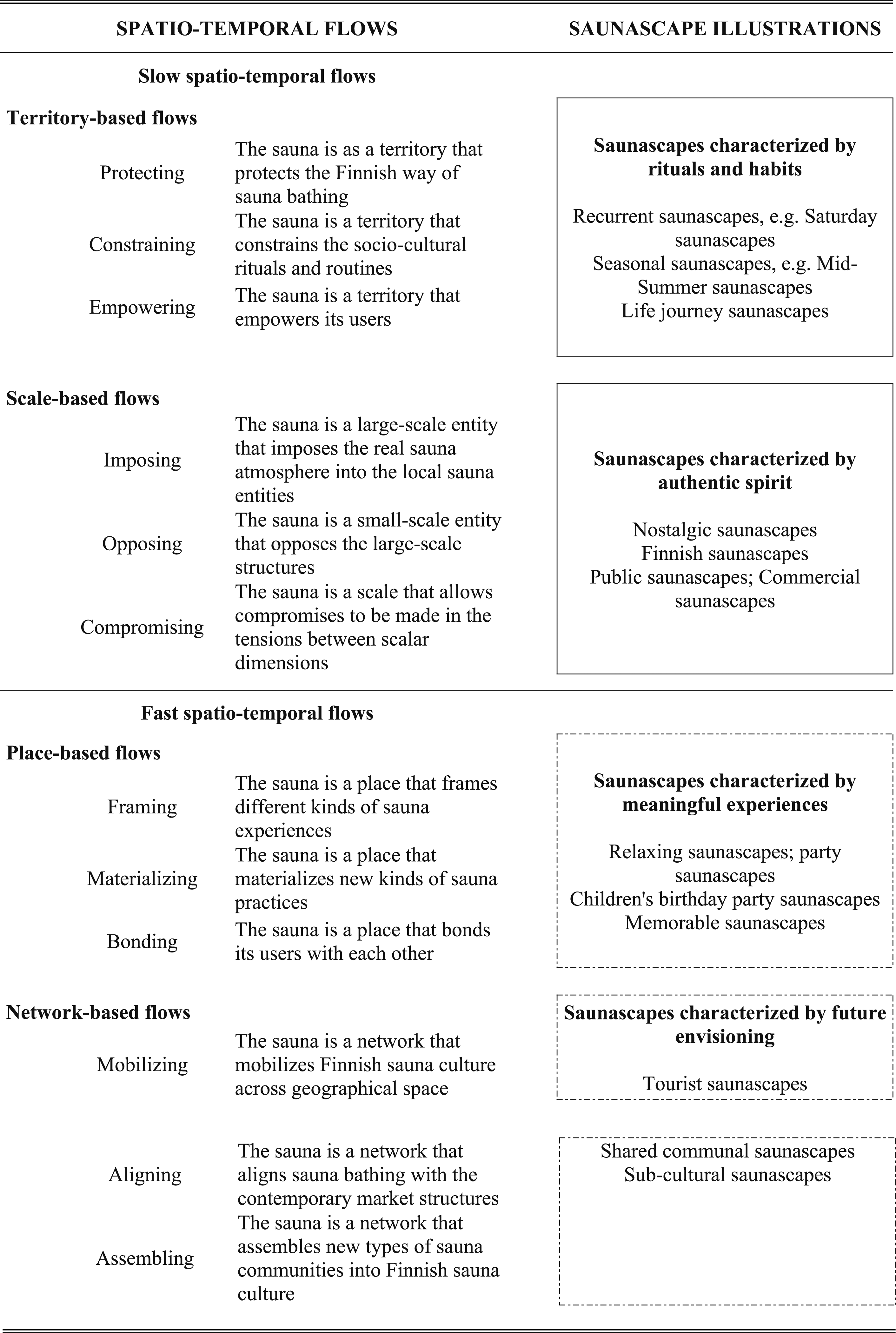
Saunascapes at the Nexus of Slow and Fast Spatio-Temporal Flows.
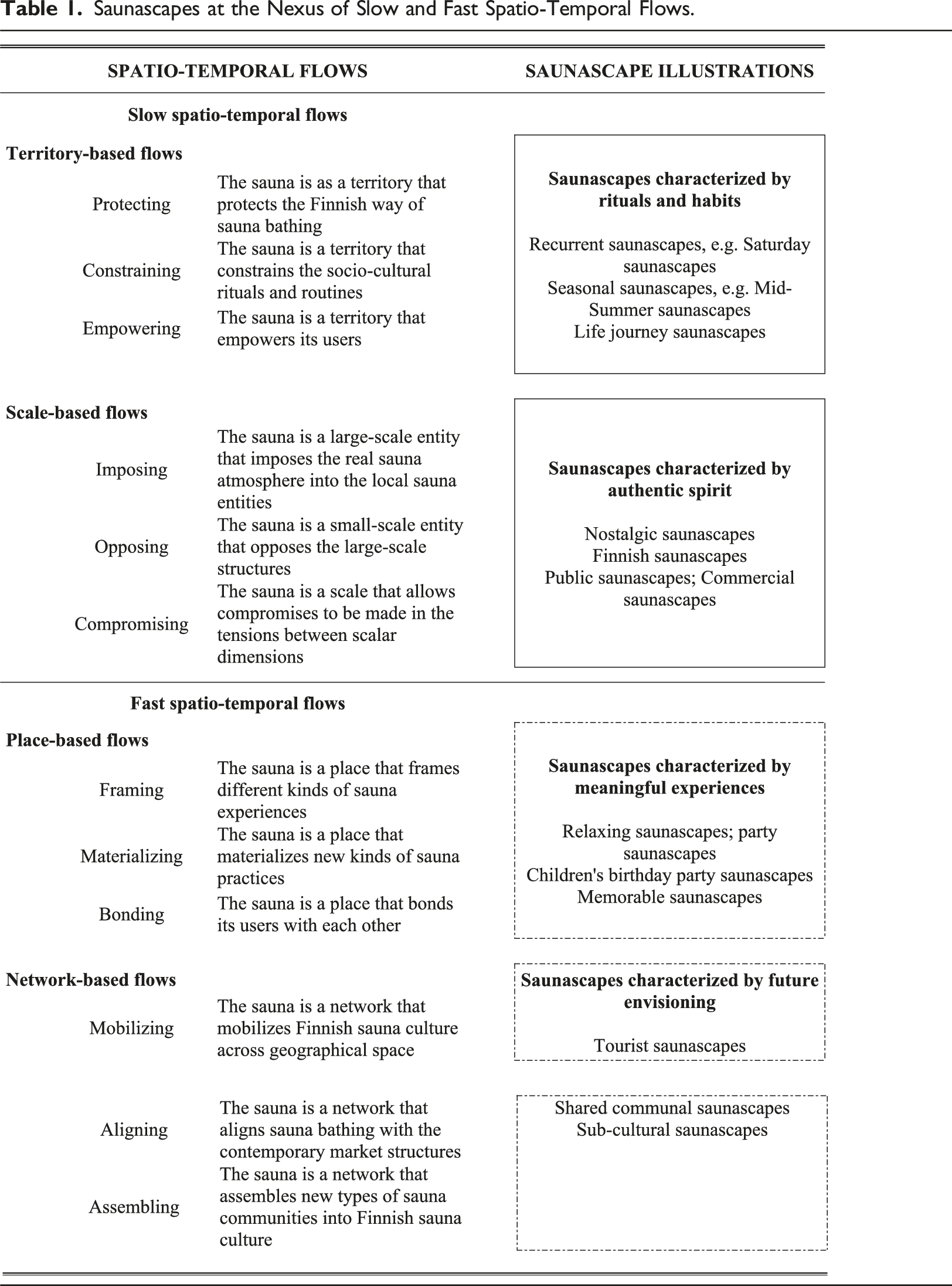
Slow spatio-temporal flows reproducing the sauna
Slow spatio-temporal flows change the sauna gradually. Indeed, these flows are so slow that they almost make the sauna an enduring space, decelerating its transformation in order to keep the space as it has been for thousands of years.
Rituals and habits
First, our analysis illustrates that slow spatio-temporal flows produce saunascapes characterised by long-lasting rituals and habits. The traditional ritual of sauna-bathing practices starts with cleaning and showering, followed by sauna bathing in the hot room, before continuing with showering again or – ideally – taking a dip in a lake or the sea (Tsonis, 2017). The resulting saunascapes are connected to habitual artefacts, social systems, and environments. They occur typically in private saunas that people regularly visit on a mundane basis: Well, I guess it’s a habit [to go to the sauna] if you go for a run or something to relax. It’s a habit. Maybe if you really think about it, it’s a habit. [...] It’s a habit that has come from childhood. [...] When I have been abroad, the first thing I do is to go to the sauna (Male 18).
The informant traces his sauna-bathing habit back to childhood memories, revealing how the sauna enables movement in and through time (Haanpää, 2022; Steadman et al., 2021). Sauna bathing occurs within a sequence of mundane practices, such as after exercising, which makes the momentary saunascapes unique and ephemeral each time, despite the long-lasting temporal flows working in the background. Further, when discussing recurrent sauna-bathing moments, the informant described the sauna as a territory he seeks when returning home after travelling because the sauna gives him the feeling of being at home. This aspect highlights the sauna’s capacity to organise the space (Cheetman et al., 2018; Coffin, 2019) and protect its users (Castilhos et al., 2017).
As territories, saunas also constrain cultural and social rituals; Finns still go to the sauna at Midsummer and on Christmas, as well as often going on Saturdays, which was the traditional sauna day in former times when saunas were heated only once a week (Tillotson et al., 2021). Moreover, certain transition rituals that have historically taken place in the sauna still exist today: for example, bachelor and bachelorette parties often include sauna-related traditions. The next quote reveals the sauna as a space where a group of friends maintains a tradition of celebrating pre-Christmas parties and announcing important news: ... let’s say, once a year we see each other with a group of friends at a pre-Christmas event and in the sauna. We have a tradition of sharing news whenever someone has a baby, and it’s always nice when someone has a story to tell for four or five consecutive years. It has become a tradition to share things there (Male 6B).
The quote above is a good example of how the sauna as a territory holds a great capacity to empower its users, and how repetition of ritual processes may create a particular spirit of place (Hill et al., 2022). Likewise, the following quote shows that the sauna accompanies bathers across their life journey and even allows them to go back in time: When I was a child, I remember that we often used to meet up and go to the sauna with my brother. Even if we mainly spent our time apart, we always met in the sauna. And now I’ve probably had my best conversations with my son in the sauna (Male 16).
The quote highlights that the roots of the ritualistic tradition of conducting deep conversations in the sauna lie in the past; the father used to do the same when he was younger, and he now takes the tradition with him into the present time with his son. Similar kind of temporal continuity is described in Meriläinen et al.’s (2022) autoethnographic study on vulnerable bodies, where the authors tell how the past time memories naturally come up in the sauna – the sauna encourages bathers to reflect the physical changes marked in their bodies in relation to one’s own history and lived life. This is how remembered pasts and anticipated futures may come into being in a present space (Steadman et al., 2021), and how the continuity of the performance is based on the recurring nature of rituals (Bradford and Sherry, 2023).
Authentic spirit
Second, our analysis shows that slow spatio-temporal flows add authentic spirit to saunascapes. Authentic spirit emerges in all elements of saunascapes – artefacts, social systems, environments, and humans – such that these elements highlight what is needed for a ‘perfect’ sauna-bathing experience. One essential artefact of the sauna is löyly, that is, the hot vapour created when water is thrown on the hot stones. Löyly constitutes a key sensory-material element that enables the bathers to experientially encounter the sauna in the right way; löyly makes the bathers simultaneously feel the heat, see the steam, and hear the hiss.
Our data show numerous examples of people evaluating the sauna based on the types of löyly available, through comments like, ‘The steam could have been more vigorous’, or, ‘The steam was not too dry’. Importantly, löyly is something users want to remain the same as it has always been. In Sauna magazine, for example, one expert describes his preference for traditional, material things in the sauna because they ensure that löyly is the way it should be: I’m concerned that the sauna culture is changing for the worse – the old ways aren’t accepted. People bring many things into the sauna that don’t belong there and leave many good old things behind. Knowledge disappears, too. The löyly is no longer a healing thing – it’s just vaporised water. The saying goes that bathing is good for your health – for that, old-school saunas are the best (Magazine 4/2018).
The quote highlights how the sauna ideally comprises an enduring and stable space. Within Castilhos et al.’s (2017) framework, the sauna appears as a scale that opposes changes that might take saunas in the wrong direction by endangering the traditional essence of sauna.
In addition to sensory elements like löyly, the authentic spirit of saunascapes is connected with certain social systems around the sauna. The most important of these is sauna etiquette, which is based on deep-rooted knowledge of the sauna as a sacred space with a set of tacit rules and codes of behaviour. Sauna etiquette is taught to Finns in their early childhood and continues to accompany sauna users as adults on an ongoing basis, showing how certain long-prevailing rules and norms – such as respecting other bathers and remaining calm and silent in the sauna – are imposed into authentic saunascapes. The following interview quote describes this deeply encoded etiquette: And then, well, for example in a hotel environment, anyone can go to the sauna. Well, usually, if there are Finnish people in the men’s sauna, it’s kind of slow, pretty quiet, like conversations formed with breaks, which I think suits the sauna environment. If the conversation is too loud or sometimes there are individuals who like to always be the centre of attention, it annoys me because I don’t really like those personalities, so then it also ruins the sauna atmosphere (Male 29).
This quote depicts the perfect sauna as a slow and easy-going space, with bathers’ conversations remaining quiet and being interspersed with silent breaks. It also highlights the discreet social codes of sauna bathing; one is not allowed to disturb others with strong arguments or too loud and continuous chatting. At its best, the sauna encourages to talk about personal and intimate matters (Meriläinen et al., 2022). Given these factors, certain sauna environments produce authentic spirit in saunascapes more than others. Correspondingly, the authentic spirit of a saunascape can be ruined by wrong behaviours and compromises are needed, especially when bathing with newcomers. This could be seen, for example, when discussing the differences between Finns and tourist visitors in the sauna restaurant Löyly: For tourists, this is just an amazing experience because they’re not as serious about saunas as we Finns are. They don’t understand what sauna culture is (Focus group, Female B2).
Historically, authentic saunas often were the so-called smoke saunas which had wood fires without chimneys. A visitor to the modern Löyly sauna restaurant describes his longing for more concrete sensory-material experiences, such as seeing and hearing the fire in the stove and smelling the smoke, because for him these aspects create a perfect sauna experience: I’d like to circle back to the important aspects of sauna bathing. The heating of the sauna and the flames and fireplaces should maybe be more visible, so it’s not just a hot room you enter. They have some of these elements here, but maybe they need more. The smell of smoke and things like that are really important to me when I go to the sauna (Focus group, Male C1).
These examples highlight how the scale-based spatio-temporal flows are so slow that they seem to require particular traditional aspects to remain the same, or at least almost the same, over decades. Next, we move to fast spatio-temporal flows that reproduce sauna.
Fast spatio-temporal flows reproducing the sauna
In contrast to the decelerating movements of slow spatio-temporal flows, fast spatio-temporal flows accelerate the transformation of the sauna. As these flows both emerge and vanish rapidly, they produce saunascapes that highlight the fast transformation of the sauna.
Meaningful experiences
Our analysis first shows that fast spatio-temporal flows induce saunascapes characterised by meaningful experiences. Such saunascapes represent sauna experiences that vary according to the situation, the sauna environment, and the people present, that is, bathers. Below, a mother of young children describes the sauna experience as different every time, depending on whether she goes to the sauna with her children, alone, or with friends: We teach children that you calm down in the sauna – but when you have a two-year-old and four-year-old, you can’t expect them to behave like an older kid. So, they play with water toys and throw lots of löyly, that’s how that goes. When you go into the sauna by yourself or with another adult, it’s an entirely different kind of pleasure. It’s total relaxation – you might not even speak at all. With a group of friends, it’s different, too. You chat and discuss things (Female 6A).
The quote emphasises the sauna as a place (Castilhos et al., 2017) that frames meaningful experiences which can range from educating children to enjoying a relaxing moment. In such cases, human actors and sauna environments act as resources that produce saunascapes. As an example of the latter, new types of sauna buildings may materialise totally new kinds of saunascapes. Sauna magazine includes numerous articles featuring interviews with people about their unique saunas: The sauna space of the childhood home underwent a complete transformation when the old sauna of the four-member family received a stylish and refined look during the renovation. The traditional sauna from the 80’s turned into a spa-like bathing area (Magazine 1/2021). Cottage owners are often very resourceful and plan the renovation of their cottage saunas themselves. They are often increasingly unique, even curious (Magazine 2/2021).
One particular example of a unique sauna combination is described in the article of a family who built an outdoor sauna next to their detached house with its own dressing room, a hot room with a wooden stove, and a veranda for chilling after the sauna bathing. The interiors were designed to be as minimalistic as possible to ensure a relaxing experience for the bathers. In the article, the mother states that their outdoor sauna has become very popular; it is a spatial resource that produces new types of sauna-bathing practices intertwined with different meaningful experiences. For example, the family’s son celebrated his 10th birthday as a sauna party, and the mother arranges Sunday morning sauna brunches for her female friends: ‘Paavo held a sauna-birthday party when he turned 10. The party time was 2.5 hours, but it wasn’t enough for the guests. We had to send a message to their parents asking if we could have another round of sauna’, Emmi laughs. [...]. Emmi had invited her own friends for a Sunday morning sauna and brunch, which has proven to be a good way to meet up with busy women with families. ‘I didn’t realise I had such sauna enthusiasts among my friends. Now I’ve already been asked to let them know as soon as the women’s sauna is reorganised’ (Magazine 2/2019).
Although the sauna materialises in the quote as a place for inventing new social gatherings, we can also see how the new experiences are tied with the historical roots of having an outdoor sauna. Yet fast flows dominate and make experiential saunascapes each time novel following the continuous processes of making, unmaking, and remaking spatial arrangements that emerge in social relations (Coffin, 2019, 2022; Coffin and Chatzidakis, 2021).
Indeed, our analysis demonstrates that the sauna has a great capacity to produce meaningful social bonds between bathers. Fast flows help the sauna bathers to create memorable saunascapes that activate memories and sensations related to a certain place (Steadman et al., 2021). Current data show that some of the strongest memories of social relations often relate to public saunas, as bathers cannot know who they might meet and what they might discuss. There were numerous examples of people describing memorable discussions in hotel saunas, for example: ‘But then, when it comes to the hotel saunas, I have had the most interesting discussions ever in the hotel saunas and with complete strangers’ (Male 20A). Seen from a temporal perspective, these moments are ephemeral, but they endure in memories (Haanpää, 2022; Steadman et al., 2021).
Future envisioning
Finally, our analysis reveals that fast spatio-temporal flows produce saunascapes characterised by future envisioning. These saunascapes emerge as networks leading saunas and sauna markets to spread to new geographical areas (Castilhos et al., 2017). Illustrating this point, sauna-related tourist attractions are typical environments that mobilise saunas to be spread all over the world. One informant visiting the löyly sauna restaurant in Helsinki discusses this kind of spatial mechanism: For me this is like a Finnish city experience for tourists. There are quite a lot of different possibilities here, but for me, if I would have a foreign friend or visitor, this would be a place where I could show them what a Finnish experience is like (Focus group, Male A2).
This informant regards the löyly sauna restaurant as an excellent place to familiarise a foreign visitor with Finnish ways of living. Beyond this mobilising capacity, fast spatio-temporal flows also produce new trends for sauna bathing. These trends align artefacts, such as the newest technology and modern architecture, with contemporary sauna-bathing practices. One example of emerging trends is found in the kinds of saunas now being constructed in apartment buildings. Today, sauna rooms are no longer built into homes by default, but this change does not imply that sauna culture is disappearing. On the contrary, private saunas are being replaced by shared saunas for condo residents. Such saunas are sometimes located on the roof of apartment buildings, ensuring the best views and use of space: It’s a time of change. Now, it’s less common to have an in-apartment sauna – while in new apartment buildings, the communal saunas for residents aren’t located in the dark basement like they used to be, but up on the highest floors. These are no longer just saunas, but sauna departments, complete with a terrace and lounging area. Sauna shifts have also become more communal – people are now having a sauna with their neighbours and friends and after jogging (Magazine 2/2019).
Current data also demonstrate that fast spatio-temporal processes result in innovative sauna communities. These transformations often reflect the subcultural processes which create consumption communities that modify large-scale markets and that assemble in this context as new heterogeneous, market-mediated sauna communities. This type of subcultural emergence can be seen when the incumbent sauna culture is divided into smaller entities that reproduce sauna-bathing practices. An article in Sauna magazine describes how female bathers decided to establish their own community of ‘sauna sisters’ as a reaction to the incumbent sauna society’s general rules: We women bathed first: we had löyly, swam, cooled off and then went back into the heat. Then someone knocked on the door and said it was the men’s turn. I snapped that we should have a sauna society for women only, so we’d never have to hurry [...] We don’t have membership fees, rules, directors, obligations, nitpicking or responsibilities, and we don’t use the words fat, too old, ugly, bad conscience … (Magazine 1/2019).
This quote shows how the broader social system produces the evolving saunascape that reflects the consumers’ ideological identities and gender roles, and it also provides a good example of how a saunascape stretches beyond its perceived material boundaries to encompass underlying values, rules, and norms. The informant tells how ‘sauna sisters’ find it important to operate without formal rules and obligations. In addition, and even more importantly, she describes that the members disclaim themselves from any judgemental language directed for their own bodies. The sauna represents thus a space where you are allowed to be like you are, without any self-discriminating. Rather surprisingly, gender has only rarely been discussed in previous sauna-related studies. One exception is provided by Meriläinen et al. (2022) whose feminist analysis about vulnerable relational knowing elaborates how the material nature of sauna-bathing practices strengthens the feeling of togetherness and nurtures supportive social atmosphere among the female bathers.
Discussion
In the discussion, we elaborate on the concept of saunascape and its potential to illustrate the pluri-temporal and multifaceted space. Then, we outline the major theoretical contributions of our study.
Saunascapes at the nexus of spatio-temporal flows
Figure 1 depicts our conceptual understanding of how saunascapes emerge at the nexus of spatio-temporal flows. The slow and fast temporal flows are illustrated as waves that either gradually or promptly participate in the continuous reproduction of saunascapes. Together with multifaceted spatial flows, which are illustrated by unending spirals, these slow and fast temporal flows create momentary saunascapes. Conceptual illustration of the saunascape.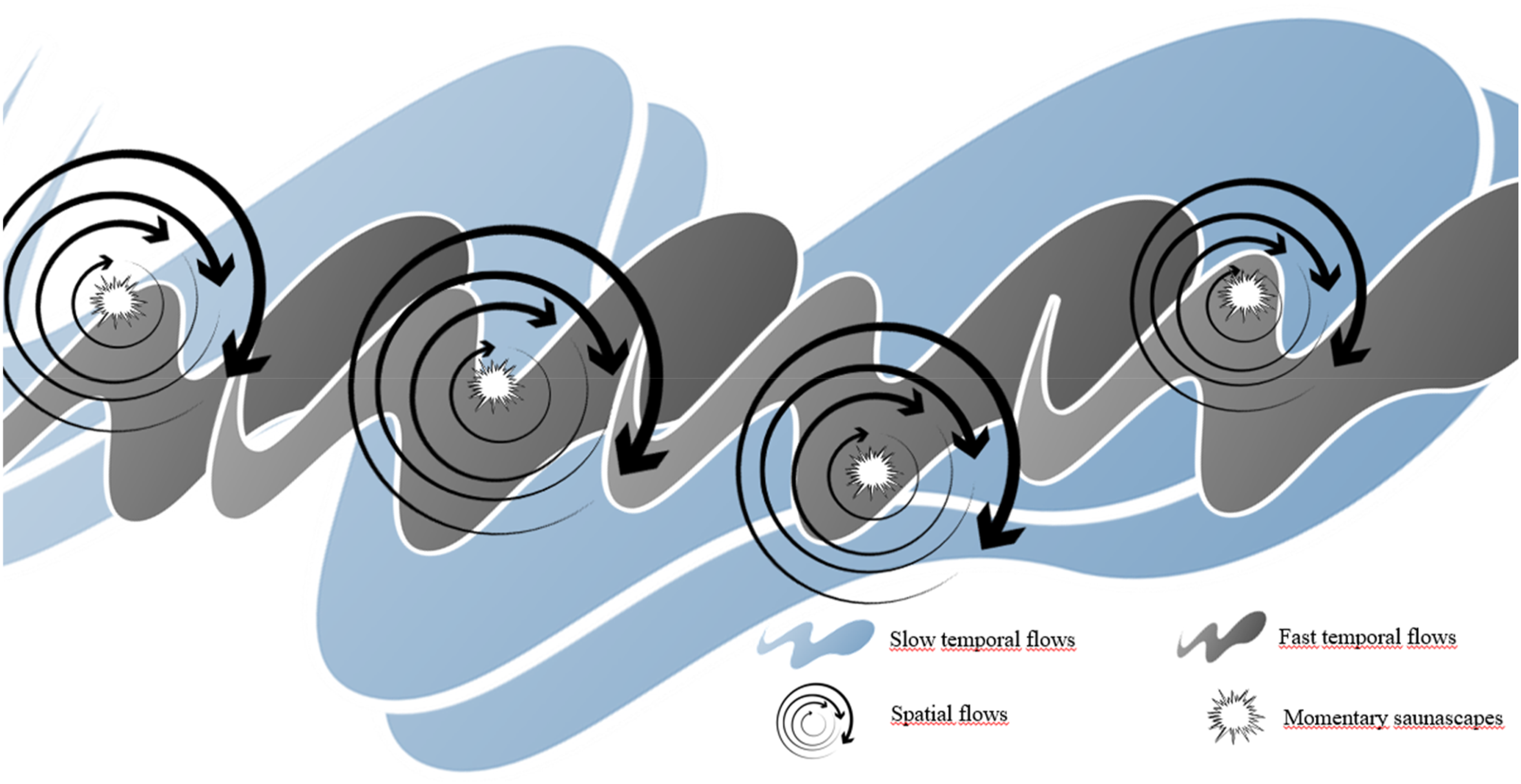
As Figure 1 reveals, the momentary actualisation of a saunascape is always unique, varying according to whether the slow or fast flows are more pronounced. Thus, our definition of momentary saunascapes means that saunascapes are ephemeral and transient. In each momentary saunascape, slow spatio-temporal flows act in the background – for example, through certain stable material and sensorial elements that create saunascapes characterised by authentic spirit, or through social elements, like sauna etiquette, that manifest when saunascapes are saturated with rituals. Fast spatio-temporal flows work in a more eclectic manner, introducing novel practices, new sauna-subcultures, or luxurious sauna environments to create saunascapes characterised by future envisioning and meaningful experiences.
This follows that the actualised saunascape is dependent on whether slow or fast flows dominate in a given time. Slow spatio-temporal flows dominate, for example, in saunascapes embedded with Saturday sauna bathing, a ritual rooted in the Finnish tradition of washing off the marks of the work week in the sauna. Such slow flows actualise each time the sauna bather follows long-lasting rituals and routines (Bradford and Sherry, 2023; Hill et al., 2022). Slow saunascapes are also connected to authentic sauna buildings, material arrangements, and landscapes, such as bathing in the summer cottage sauna by the lake. In contrast, fast spatio-temporal flows dominate when consumers create new sauna environments, which then modify sauna-bathing practices, produce meaningful experiences, and activate memories and sensations related to a certain place (Steadman et al., 2021). Current analysis exemplified these with modern outdoor sauna buildings and spa-like saunas built at homes. Moreover, we could find how consumers engage in forming new sauna subcultures that stretch beyond the sauna’s perceived material boundaries to encompass broader social system of values and norms. Sometimes they even resist the hegemonic trends and power structures, as when the ‘sauna sister’ community encourages members to engage with body positivity.
We propose that the saunascape provides a potential analytic tool to grasp the pluri-temporality of market-mediated spaces as it builds on the idea that each momentary, ephemeral saunascape consists of an imagined collection of spatial and pluri-temporal flows that reflect the immediate experience of sauna bathing. Even though the fast flows produce the instantaneous saunascapes, we can acknowledge that the slow flows act in the background and tie the ephemeral saunascapes to the deep-rooted traditions of Finnish sauna culture. Here, we agree with previous investigations that have highlighted how space-time relationships shift between past, present, and future (Haanpää, 2022) and how different temporal and spatial dimensions interrelate in spatial reproduction (Bradford and Sherry, 2023). At the same time, our study makes perceptible the different speeds of spatio-temporal flows and how they simultaneously reproduce the pluri-temporal space. Thus, besides the past–present–future timeline, our findings address that time has different tempos, it flows at multiple speeds, and it lasts for various durations (Massey, 2005; Urry, 2001) and these simultaneous movements reproduce the space in a dynamic manner.
As this discussion has shown, the sauna lends itself well to illustrate the multifaceted time-space relations from a relational viewpoint. Similar kinds of spatio-temporal dynamics can be traced into other market-mediates spaces too. For example, tourist attractions, nature destinations, and place-connected festivals exemplify other empirical contexts where the pluri-temporal flows, especially in relation to past–present–future time scale, come together to produce the space. However, because tourist attractions and festivals connect to fixed locations, their spatial reproduction is not so easily transformed into the eclectic and momentary production of a space. Therefore, we argue that other empirical contexts where these kinds of spatio-temporal dynamics are naturally embedded could be located in homes, for instance, home cinemas, man-caves, or home gardens. Like saunas, they are home-based territories but connect simultaneously to the broader scale-based and network-based spatial flows (Castilhos et al., 2017), as we can observe their emergence and evolution along with socio-cultural and market-level transformation. When it comes to more commercial spaces, or traditional servicescapes, the view of a pluri-temporal scape would induce more dynamic analyses of the continuous reproduction of a servicescape (Kuppelwieser et al., 2023).
Theoretical contributions
The current study makes three theoretical contributions. First, we contribute to market spatiality research by elucidating the conceptual links between space and time (Chatzidakis et al., 2018; Steadman et al., 2021) in a granular, empirical fashion. Specifically, we take a pluri-temporal perspective on space to demonstrate that spaces extend beyond everyday human experience (Bradford and Sherry, 2023; Coffin, 2019; Haanpää, 2022; Hill et al., 2022). Our empirical analysis makes the interaction of different temporal dimensions more visible and concrete, as it shows that sauna is an example of a space whose momentary existences are actualised by slow and fast spatio-temporal movements flowing simultaneously at different speeds.
Second, the study proposes the concept of (sauna)scape as an analytic tool to understand the different tempos of time-space relations. Our definition of the (sauna)scape as ‘a pluri-temporal constellation of spatially arranged artefacts, social systems, environments and humans’ allows researchers to see the endless variations of situated occurrences evolving dynamically through geographies and through time – that is, to grasp the multiple spatio-temporal flows of a given spatial context. The saunascape maintains a link with the past while remaining open to a multiplicity of meanings; it provides an analytic entry point to unveil how the sauna’s historical and geographical roots relate to consumption moments in the sauna. This pluri-temporal concept also helps to unpack the broader lifespan of a place (Coffin, 2019), thus linking temporal flows more explicitly to spatial flows. Similar to Askegaard and Eckhardt’s (2012; see also Bjerrisgaard and Kjeldgaard, 2013) description of two-way global and local cultural flows in yoga consumptionscapes, our study highlights the complexities of such flows. Momentary constructions of (sauna)scapes constantly, gradually, and promptly contest, shape, and recreate macro- and micro-level conceptions of ‘proper’ sauna culture, thereby creating new forms of saunascapes.
Third, we provide a more nuanced and holistic view on market-mediated spaces. In this, we answer calls (Castilhos et al., 2017; Giovanardi and Lucarelli, 2018) for studies that overcome the traditional space-place division and that combine different space-related conceptual levels. In particular, we enrich Castilhos et al.’s (2017) spatial framework through an empirical analysis that explicitly connects space-based mechanisms (place, territory, scale, and network) with temporal movements. We show that territory- and scale-based flows are more emphasised by slow temporal transformations while place- and network-based flows are more dominated by fast temporal movements. Together, these slow and fast flows help to valorise space as a multifaceted and temporally produced entity.
Conclusions
Our study shows how space actualises in movement by delineating the sauna as a pluri-temporal space. Taking an overtly temporal perspective on market-mediated spaces, we bolster market spatiality research by theorising how slow and fast spatio-temporal flows simultaneously reproduce a multifaceted space (Castilhos et al., 2017; Chatzidakis et al., 2018; Coffin, 2019; Coffin and Chatzidakis, 2021; Giovanardi and Lucarelli, 2018; Steadman, 2021).
On the basis of our analysis, we encourage marketers to identify spatio-temporal dynamics more carefully in order to facilitate the development and communication of resonant consumptionscapes to consumers. For example, bonds between consumers and spaces can be strengthened when communicating the temporal movement of spaces. Further, our analysis shows that marketers should pay particular attention to orchestrating the assemblages of places to ensure authentic place-related experiences. This is especially the case for places that embody opposing and compromising strategies for consumers because they often have a stressed shared focus that must be respected (Hill et al., 2022). In the current context, we observed that a saunascape sometimes suffered when locals and tourists both shared it. Moreover, we acknowledge that saunascape construction does not merely rest in the hands of marketing managers; rather, it emerges as a joint process between consumers and marketers involving heterogeneous material and semiotic arrangements (Bradford and Sherry, 2023).
We invite future studies to elaborate on and apply ‘scape’-related conceptualisations to other pluri-temporal market spaces, such as tourist attractions and festivals, but also to home-based territories, and to examine their spatio-temporal (re)production. Future research could also utilise space-based mechanisms when exploring how spatial experiences bring together different consumer groups, such as locals with tourists, or when examining larger socio-geographical transformations, such as multiculturalism, which unavoidably reproduce spaces and how they are experienced. Finally, we suggest that investigating the interplay between spatio-temporal flows and the social dynamics of saunas in Finland, or other countries, could be an intriguing research topic.
Footnotes
Declaration of conflicting interests
The author(s) declared no potential conflicts of interest with respect to the research, authorship, and/or publication of this article.
Funding
The author(s) received no financial support for the research, authorship, and/or publication of this article.

Appendix
Informant profiles.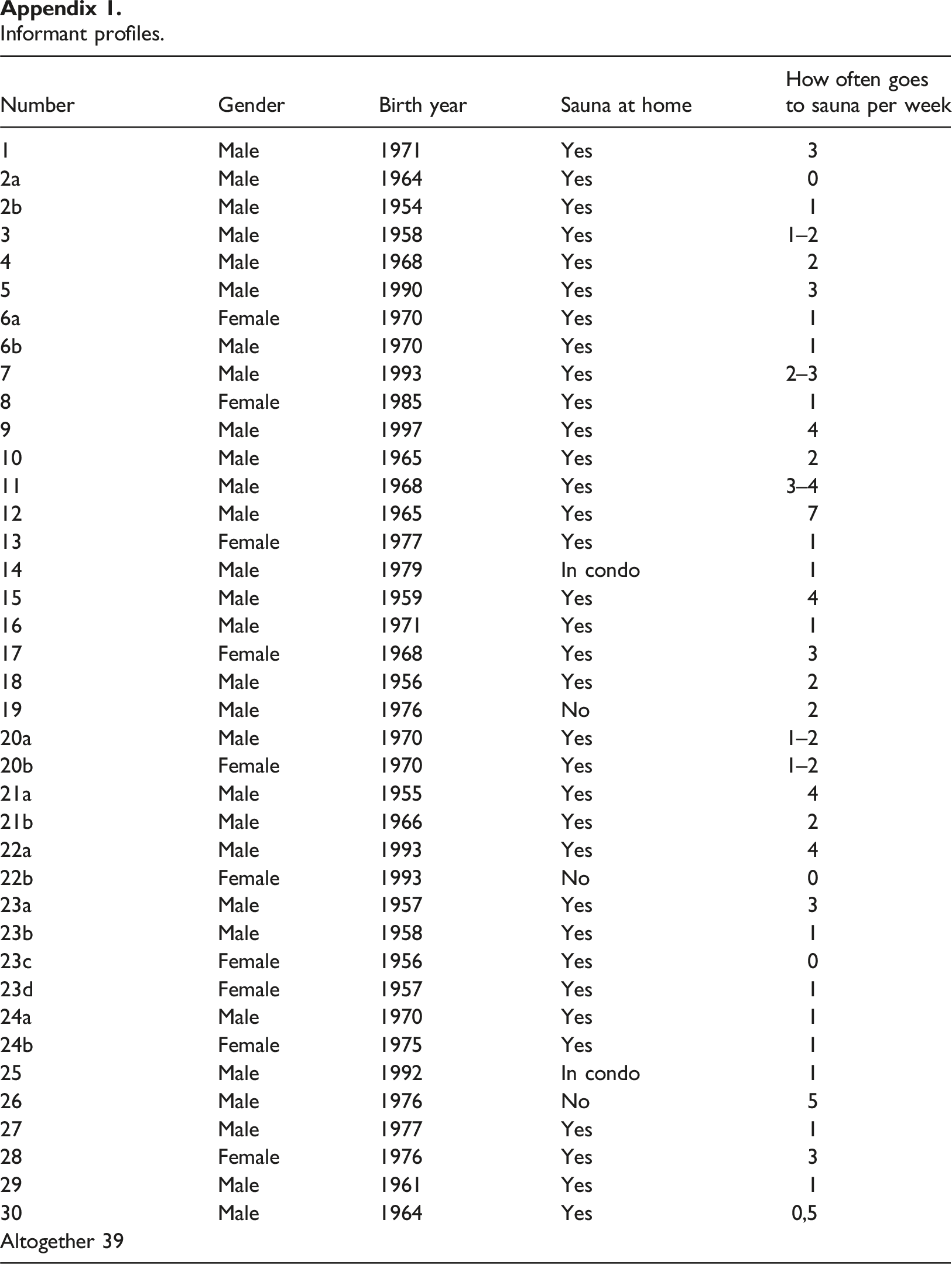
Number
Gender
Birth year
Sauna at home
How often goes to sauna per week
1
Male
1971
Yes
3
2a
Male
1964
Yes
0
2b
Male
1954
Yes
1
3
Male
1958
Yes
1–2
4
Male
1968
Yes
2
5
Male
1990
Yes
3
6a
Female
1970
Yes
1
6b
Male
1970
Yes
1
7
Male
1993
Yes
2–3
8
Female
1985
Yes
1
9
Male
1997
Yes
4
10
Male
1965
Yes
2
11
Male
1968
Yes
3–4
12
Male
1965
Yes
7
13
Female
1977
Yes
1
14
Male
1979
In condo
1
15
Male
1959
Yes
4
16
Male
1971
Yes
1
17
Female
1968
Yes
3
18
Male
1956
Yes
2
19
Male
1976
No
2
20a
Male
1970
Yes
1–2
20b
Female
1970
Yes
1–2
21a
Male
1955
Yes
4
21b
Male
1966
Yes
2
22a
Male
1993
Yes
4
22b
Female
1993
No
0
23a
Male
1957
Yes
3
23b
Male
1958
Yes
1
23c
Female
1956
Yes
0
23d
Female
1957
Yes
1
24a
Male
1970
Yes
1
24b
Female
1975
Yes
1
25
Male
1992
In condo
1
26
Male
1976
No
5
27
Male
1977
Yes
1
28
Female
1976
Yes
3
29
Male
1961
Yes
1
30
Male
1964
Yes
0,5
Altogether 39
Focus group informants.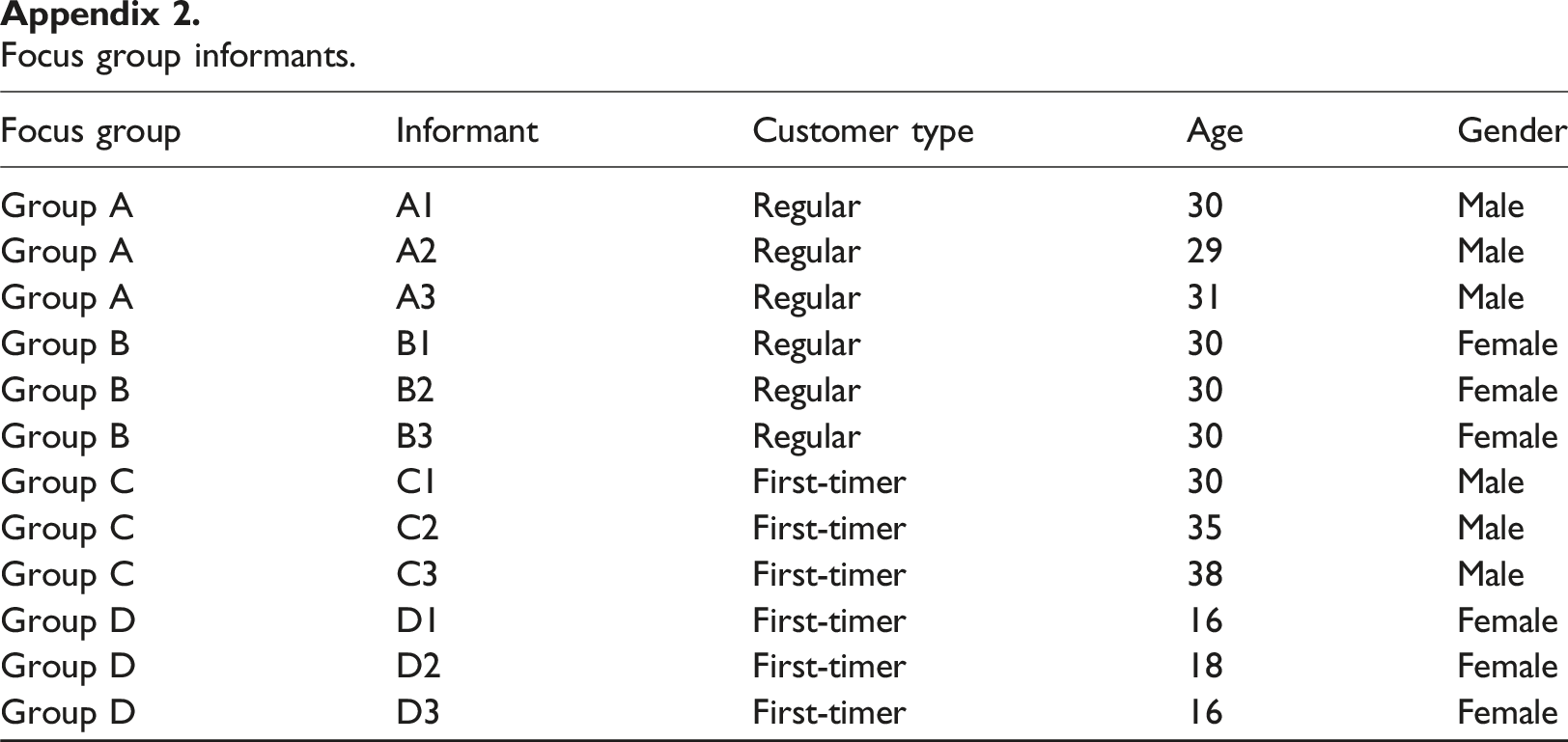
Focus group
Informant
Customer type
Age
Gender
Group A
A1
Regular
30
Male
Group A
A2
Regular
29
Male
Group A
A3
Regular
31
Male
Group B
B1
Regular
30
Female
Group B
B2
Regular
30
Female
Group B
B3
Regular
30
Female
Group C
C1
First-timer
30
Male
Group C
C2
First-timer
35
Male
Group C
C3
First-timer
38
Male
Group D
D1
First-timer
16
Female
Group D
D2
First-timer
18
Female
Group D
D3
First-timer
16
Female