




Abstract
This study draws upon the lived experience of Sharankumar Limbale, a Dalit, as depicted in his autobiographical memoir, ‘The Outcaste’. Through Limbale’s narratives, we aim to understand how religion morphs consumption into a site of humiliation for Dalits. We examine Limbale’s caste-based market interactions and consumption to illuminate the reduction of Dalits to negative beings, subjected to interpellation as polluted individuals and to degrading consumption of waste. These negative beings endure ontological wounds and exist as degraded appendages to dominant social groups. This study calls attention to the recognition of the category of negative being within consumer research, as without it, the extreme vulnerability faced by certain consumer groups remains incomprehensible. Ultimately, this research advances the theoretical understanding of how religion plays a role in perpetuating and reinforcing conditions of extreme consumer vulnerability.
On August 13, 2022, a nine-year-old Dalit boy tragically died at a local hospital, just 2 days before India celebrated its 75th year of independence from British colonial rule. The cause of his death was the brutal beating inflicted by his schoolteacher, triggered by the boy’s audacity in drinking water from a pot designated for upper-caste students (Chowdhury, 2022). This incident exemplifies the religious norms of caste-based consumption and the humiliating violence endured by Dalits simply for consuming water. Such reprehensible acts of violence and degradation find their legitimacy in religious orders that associate consumption with caste-based notions of purity and pollution (Douglas, 1966).
Dalits, as outcastes, find themselves ensnared in the lowest rung of India’s caste hierarchy by the upper castes, where their presence or touch is deemed as dangerously polluting and subversive (Cháirez-Garza, 2022). Unlike the class system, ‘upward mobility’ within the contemporary caste-based social order for Dalits is non-existent as it is ineluctably tied to birth and heredity (Lindridge, 2010). While the Indian caste system originated from Hinduism, overwhelming scholarly evidence points to its pervasiveness in other religions and even across international borders (e.g. Ahmed, 1991; Bapuji and Chrispal, 2020; Fuller, 1991). Despite the official abolition of untouchability in 1950 and the introduction of The Prevention of Atrocities Act in 1989, discrimination against Dalits remains deeply entrenched (Mayell, 2003). Although some Dalits have attained positions in politics, culture, education, and employment through anti-caste-based movements, political mobilisations, and affirmative policies, these opportunities are overshadowed by the onerous barriers imposed by caste-based discrimination (Guru, 2000). Thus, despite changes and resistance (Jodhka, 2018; Srinivas, 1952), the caste hierarchy continues to shape India’s social order, perpetuating humiliation in everyday consumption and market exchanges (Jaffrelot, 2003; Omvedt, 1995; Varman 2023; Vikas et al., 2015).
In the complex tapestry of consumer vulnerability, humiliation stands out, as it is ‘the forced ejection and/or exclusion of individuals or groups from social roles and/or categories conveying the message of their fundamental inadequacy to belong’ (Smith, 2001: 542). It demeans and degrades individuals, rendering them inferior beings (Lindner, 2007; Varman et al., 2023). Humiliation does not merely generate a feeling of inferiority, but it also creates a negative being as a mode of existence that is not only axiologically despicable but also ontologically wounded and dependent on the existence of another who is deemed to be axiologically good and ontologically self-sustaining (Geetha, 2009). Though research on consumer vulnerability and religiosity examines humiliating consumption experiences (e.g. Minton et al., 2017; Preece et al., 2022; Rodner and Preece, 2019), it does not theorise the religiously sanctioned consumer humiliation. By moving the compass to humiliation, we focus our attention on the category of negative being to shed light on extreme consumer vulnerability as part of the dark side of religion.
Several researchers have explored adverse consumer experiences and have called for systemic analyses of consumer vulnerability (e.g. Baker et al., 2005; De Vos et al., 2021; Gregory-Smith et al., 2013; Hill and Sharma, 2020; Khare and Jain, 2022; Liu et al., 2021). Consumer vulnerability is an umbrella term encompassing individuals susceptible to economic, physical, or social harm in diverse contexts (Baker et al., 2005). Moreover, religiosity has been identified as a potential driver of consumer mistreatment in the marketplace (Cabano and Minton, 2023), orchestrating emotional suffering (Higgins and Hamilton, 2019). Scholars studying the effects of the caste order have critically analysed how market processes silence, alienate, and make Dalit consumers susceptible to exploitation and oppression (e.g. Khare and Varman, 2016; Varman and Vijay, 2018; Vikas et al., 2015). Despite offering useful insights, previous studies have overlooked the humiliation inflicted through religious norms of consumption and market interactions and how it exacerbates consumer vulnerability. This gap highlights a notable neglect of the question we pose in this research ― how humiliation ingrained in religious norms shapes consumption and market exchanges. A focus on religion and humiliation is warranted as it unveils the dark side of religion that perpetuates extreme consumer vulnerability.
To address our research question, we draw primarily on Dalit writings (e.g. Ambedkar, 2014, 2019a, 2019b; Guru, 2009; Ilaiah, 2005), which offer incisive analyses of the role of religion in perpetuating caste-based vulnerability, to examine the autobiographical memoir by Sharankumar Limbale, ‘The Outcaste’. We integrate Dalit theorisation of caste with Limbale’s lived experience as a Dalit consumer. Our research significantly contributes to the expanding field of religiosity and markets by shedding light on the critical realm of humiliating consumer experiences and the resulting extreme vulnerability of oppressed groups. Such an exploration is indispensable to our understanding of negative beings subjected to religious codes of humiliation. These codes interpellate Dalits as polluted individuals and compel them to consume waste. The contributions help explain the making of negative being as a construction of extreme consumer vulnerability through humiliating religious codes of consumption and market exchanges.
Religion, consumer vulnerability, and caste-based humiliation
Religiosity is entwined with marketplace (McAlexander et al., 2014; Moufahim, 2013; Muñiz and Schau, 2005). Scholars focussing on the ‘sacred’ provide a rich account of the relationship between religion and markets (Appau et al., 2020; Rinallo et al., 2016, 2023), shedding light on how consumption practices distinguish the sacred from the profane (Belk et al., 1989; Karataş and Sandıkcı, 2013), and how a divine economic system involving gods, spirits, and saints is created (Appau, 2021). Researchers have pointed to hierocratic religious narratives for their intolerance towards consumer sub-groups, for example, Afro-Brazilian faiths (Rodner and Preece, 2019), the oppressive role of organised religion in stigmatising LGBTQ + communities (Minton et al., 2017), and discrimination faced by Dalit women (Meshram and Venkatraman, 2022). Attending to spirituality, consumption, and religiosity, scholars emphasise re-examining religion in marketing to uncover overlooked marginalised elements (Rinallo et al., 2023). As capitalism blurs the boundaries between religion and markets, religion has been marketised as a product and consumption is impelled by religious codes (Belk et al., 1989; Gauthier and Martikainen, 2018). Such a blurring, however, also creates consumer vulnerabilities through religious norms of humiliating consumption (Varman 2023; Vikas et al., 2015).
Consumer vulnerability refers to the ineluctable harm experienced by individuals with limited access to resources impeding their abilities to transact in a marketplace (Baker et al., 2005; Hill and Sharma, 2020). Taking inspiration from transformative consumer research (Ozanne, 2011), some scholars have drawn attention to stigmatised service encounters, unravelling the labyrinthine nature of consumer vulnerability (Hill and Sharma, 2020; Higgins and Hamilton, 2019; Parkinson et al., 2017; Rosenbaum et al., 2017; Voice Group, 2010). This line of enquiry has also foregrounded, as sources of vulnerability, racial exclusions (Preece et al., 2022) and institutional voids encountered by diverse groups, such as rural Bangladeshi women (Mair et al., 2012), fashionistas (Scaraboto and Fischer, 2013), and parent-carers (Higgins and O’Leary, 2022). Poverty also contributes to vulnerability (Khare and Varman, 2016; Varman et al., 2012). Scholars examining subsistence marketplaces emphasise the life circumstances wherein basic needs are chronically under threat (Viswanathan and Rosa, 2007). However, discourse of subsistence oversimplifies vulnerability, reducing it to a singular dimension of resource scarcity. Research within the subsistence framework under-examines abusive power dynamics of a capitalist political economy and religious structures like caste-based relations (Khare and Varman, 2016). Although Saatcioglu and Corus (2014) utilise intersectionality to analyse struggles exacerbating consumer exclusion, these existing accounts fail to explain how religious norms of consumption exclude certain consumer groups, limiting our comprehension of consumer vulnerability where religious norms shape discriminatory market exchanges.
There is a specific need to pay attention to vulnerability induced by religious norms because the exclusion of Dalits is not merely a lack of social interaction or physical absence from marketplaces. Instead, it signifies the forced exclusion of Dalits from consumption spaces through the ‘casteisation’ of Dalit bodies as impure or ‘untouchable’ (Cháirez-Garza, 2022; Varman et al., 2021). It has parallels with how Nazis inflicted humiliating exclusion on Jews to enforce a racial hierarchy in marketplace (Podoshen and Hunt, 2009). Therefore, existing research on consumer vulnerability and religiosity has not prioritised institutionalised humiliation of certain consumer groups, which is critical for understanding how the Indian caste system, as part of religious orders, perpetuates extreme consumer vulnerability. Further elaboration on caste-based humiliation follows in the next section.
Caste-based humiliation
Caste or jati originated from ancient Hindu chaturvarna, 1 a four-tier social order of graded purity and pollution, contradicting the principles of equality and liberty (Dumont, 1970; Hiwrale, 2020). Although the original chaturvarna system claimed to be grounded in human qualities rather than birth, Ambedkar (2020) correctly dismisses such claims and points out how caste became a system of privilege to separate the ‘touchable’ from the ‘untouchables’ (Dalits). While scholars have often paralleled caste with race and class (Jal, 2018), the uniqueness of caste lies in its religious roots, providing ‘sacred’ justification for seeing lower-caste members as other and as untouchable objects of fear and disgust (Chrispal et al., 2021). Unlike class, which is linked to the relations of production (Côté, 2022), caste is enduring with restricted social mobility even in the cases of economic enhancement and alterations in employer–employee relations.
Following India’s independence in 1947, various socio-political movements have challenged and subverted the caste hierarchy (Ilaiah, 2022; Jodhka, 2018) and have advocated socio-economic equity for lower castes and Dalits (Omvedt, 1995). Despite affirmative policies for political representation, employment, and education for Dalits (Jodhka, 2018), the caste system’s resilience persists, shaping contemporary India (Teltumbde, 2010; Varman et al., 2021; Vikas et al., 2015; Yengde, 2019). This endurance is rooted in religious norms that encode humiliations within the caste structure in the guise of purity and pollution (Teltumbde, 2010; Varman 2023; Varman et al., 2023).
Humiliation, deriving from the Latin word humus (earth), entails forcibly stripping individuals of dignity and self-respect (Lindner, 2001). The humiliation inflicted by some individuals upon others maintains hierarchical systems of control (Varman et al., 2023). When a person is ridiculed, scorned, or disparaged, they are devalued (Klein, 1991). Hartling et al. (2013: 61) describe humiliation as ‘undue, illegitimate, and coercive violation that should not be perpetrated’. Thus, a profound connection exists between violence, degradation, and humiliation (Varman et al., 2023). Schick (1997) differentiates between humiliation and injustice, suggesting that not every act of injustice necessarily involves humiliation. Humiliation, however, entails destroying and shaming individuals, making it clear that they have been abused and gloating over their suffering. Hence, as Honneth (2004) notes, humiliation distorts social recognition and leads to injustice. Therefore, to be humiliated is to be deliberately and destructively reduced to an inferior state (Palshikar, 2005), erasing one’s self-respect (Margalit, 1996). It makes humiliation a relational evil, with the humiliated being degraded while the humiliator assuming an exalted status (Donati and Archer, 2015). Indeed, humiliation should not be understood as an isolated element but as a central feature of the prevailing social order (Lindner, 2001) which fosters a moral climate where violence becomes possible and justifiable. For instance, Glover (2012) illustrates how ritual humiliation during colonial India contributed to British atrocities and reinforced the master-slave hierarchy. In examining the impact of humiliation, Hartling and Luchetta (1999) emphasised the fear instilled in its victims to the extent that the fear of humiliation can drive individuals to risk death to avoid degradation (Klein, 1991). In an insightful exploration of affective politics, Ahmed (2014) notes that fear reifies boundaries, creates distances between bodies, and limits their movements, thereby engendering vulnerabilities. Accordingly, fear anticipates hurt or injury based on past experiences and shapes social precarity. Given that religious practices use the fear of pollution to degrade Dalits, it is crucial to study how religious norms codify humiliation to exacerbate vulnerability within the domain of caste-regulated consumption and market exchanges.
Calling it a social disease, Ambedkar (2014: 63) contends, ‘there cannot be a more degrading system of social organization than the Chaturvarnya’. The Manusmriti, a Hindu text, foregrounds, as Lukes (1997) describes, ascriptive forms of humiliation in which statuses are pre-assigned, and discriminations are inherent. Occupying the top of the caste hierarchy are ‘Brahmins, Kshatriyas, and Vaishyas denoting the religious, warrior/military, and mercantile elite, respectively, while the Shudras or “untouchables” occupy the lowest rung of the social ladder’ (Ambedkar, 2014: 99). The social architecture of the four-tiered hierarchical (varna) system initially confined the lowest castes to the category of shudras only to further relegate Dalits to the fifth category of ati-shudras or the outcasted, who were viewed as the most ‘polluted’ and ‘unclean’ (Ambedkar, 2020). Accordingly, the caste system has two aspects: it segregates people into distinct social groups and places these groups in graded inequality. In this system, the higher the caste’s rank, the greater its rights, while the lower the rank, the fewer their entitlements. The Manusmriti 2 is replete with humiliating codes against the defenseless Shudras, cementing their status as negative beings (Ambedkar, 2019a).
Mary Douglas’ (1966) influential work ‘Purity and Danger’ describes how a caste-based order maintains a sense of purity by systematic segregation and degradation of those deemed dirty or polluting. This segregation of impure caste groups fosters a relational unity amongst the upper castes, coalescing around this notion. This degrading system of segregation is rooted in the characterisation of Dalits as abject. Drawing upon Douglas, Kristeva (1982) posits that abjection involves excluding and degrading what is considered distasteful, disgusting, and frightening, as part of constructing a secure and exalted subject position. Despite attempts to elide it, the abject is associated with the emotion of disgust (Ahmed, 2014), and continues to pose a threat to exalted identities, necessitating the continued policing of boundaries between the self and the abject. Abjection elucidates the perpetuation of religious norms that oppress those deemed polluted and disgusting.
Elsewhere, Guru, 2009 highlights how the humiliation inflicted on Dalits by the upper-castes serves as an important social mechanism, reinforcing the relational boundaries between the pure self and the polluted. Such acts of humiliation render Dalits as walking carrion, as the caste system commodifies their labour, forcing them to perform degrading work akin to those of slaves (Chrispal et al., 2021; Guru, 2009; Jodhka, 2016; Varman, 2023; Varman et al., 2021). Multiple forms of violence against Dalits persist in contemporary India, ensuring their perpetual humiliation (Judge, 2012; Noronha 2021; Teltumbde, 2010; Yengde, 2019). Geetha (2009: 97) further asserts that in the context of a caste society, humiliations inflict ontological wounds, causing ‘the outcaste body [to] becomes a stranger to itself, and [be] ever ready to fall off the edge, give into anomie and fragmentation’. Furthermore, the ontological injuries caused by humiliation generate a state of negative being, wherein Dalits possess a degraded identity entirely dependent on the upper castes. Indeed, these impressions of dependence are created through religious norms; in reality, it is the upper-castes who depend entirely on Dalits’ labour. Through institutionalised and routine acts of humiliation, the myth is materialised, and the untouchable is reminded that they exist as the refuse of the caste order (Geetha, 2009). Dalit humiliations mirror the features attributed to them, as they are expected to touch, clean, and dispose of what the body rejects, such as excrement, dirt, and cadavers. By performing these roles, Dalits contribute to upholding the mythical purity of the upper castes (Thorat et al., 2010). Just as Scott (2018) points to the role of nothingness in the production of something, the actions undertaken by Dalits as negative beings further elevate the upper-castes as exalted entities. The nothingness attributed to Dalits is rooted in what Scott (2018: 7) labels as a reflexive process of ‘dis-identification’ through which they are dehumanised.
In essence, the spectrum of caste-based humiliation encompasses a range of degrading experiences, from violence and shaming to denial of personhood, leading to the creation of negative beings. While several researchers have examined caste-based humiliation, our knowledge within marketing theory regarding how religion imposes codes of consumer humiliation remains deficient. To bridge this chasm, we turn to our analysis of Limbale’s autobiography, drawing on the aforementioned scholarship to comprehend how humiliating religious structures manifest and regulate the everyday consumption experiences and market exchanges of Dalit consumers to produce extreme vulnerability.
Methodology as thinking with theory
We adopted a biographical narrative approach to present the lived experiences of a Dalit consumer subjected to the Hindu religious social order. We analyse the autobiography of Sharankumar Limbale, titled ‘The Outcaste’ or Akkarmashi, originally published in Marathi in 1984 (a regional Indian language of Maharashtra state) and later translated into English by Santosh Bhoomkar in 2003. The Outcaste enlists the ethnographic lore of a Dalit subculture and an autobiography as a reproduction of self-in-text (Bose, 2021). Limbale, a Dalit writer, poet, and literacy critic, has authored over 40 books that offer a rich account of Dalit lives. As Hirschman and Hill (2000) demonstrate, victims’ testimonies contained in published reports or autobiographical accounts can be useful sources of theory-building in marketing.
Rather than proceeding from Limbale’s autobiography to coding in a purely inductive manner, our approach involved ‘thinking with theory’ (Jackson and Mazzei, 2012). We engaged with an assemblage of theories on caste-based humiliation, religion’s role in consumption and marketing, and consumer vulnerability, integrating them into our analysis. By analysing at the intersection of religion, vulnerability, and consumption, we aimed to generate a novel theoretical interpretation of consumer humiliation. During the analysis, both authors read Limbale’s autobiography through the theoretical lens of Dalit experiences drawing insights from various writings on caste and vice versa. Through a line-by-line analysis, we closely examined Limbale’s consumption and market experiences, reflections, and the philosophical questions he posed throughout the book seeking to explore the manifestation of religious encoding of a humiliating life.
Sharankumar Limbale’s autobiography offers insights into the exploitation and oppression endured by a Dalit within a casteist Hindu social order. The title, ‘The Outcaste’, symbolises Limbale’s position in modern Indian society, where he is deemed untouchable for being the illegitimate son of a higher caste landlord and a landless, poor untouchable mother belonging to the Mahar (Dalit) caste. Limbale wrote his life story at the age of 25, presenting a stark contrast to the prevailing Indian narrative of progress and modernity (Singh, 2013). The autobiography recounts varied instances of humiliation experienced by Limbale’s friends, family, and wider Dalit community within a caste-bound Hindu society. As various recent Dalit writings show (e.g. Dutt, 2019; Guru, 2009; Teltumbde, 2010; Valmiki, 2007; Yengde, 2019), Limbale’s life story is not an isolated occurrence from the past but rather a telling reflection of the everyday reality faced by Dalits in contemporary India.
This autobiography unfolds in Akkalkot, located in the Solapur district of Maharashtra, India. Limbale resided with his mother, 10 siblings, and grandparents at the outskirts of Akkalkot known as the maharawada – a segregated place for mahars (Dalits), where wada means dwelling. The Solapur district has a population of about 1.2 million, with Hinduism being the predominant religion (about 87.9%), followed by Islam (about 10.22%) (Solapur City Census, 2011). The city boasts a literacy rate of about 77.02%, surpassing the national average of 59.5% (Census of India, 2011). Solapur’s spatial landscape reinforces socio-economic disparities within the region. The Eastern half of the district thrives with prosperous residential and commercial developments, while the Western half, primarily occupied by informal workers (mostly lower castes and Dalits), faces economic challenges (Kamath et al., 2013).
Before delving into our analysis, it is necessary to acknowledge our positionality (Rodner and Preece, 2019). We are researchers of Indian origin, with one member identifying as a Dalit and another as an atheist. These positions offer diverse perspectives and insights into India’s caste-based social order. We firmly believe that the prevailing caste order in India is a source of humiliation, oppression, and exploitation, and we actively challenge its existence in our writings.
In thinking with theory, we elaborate upon two key themes: ‘interpellating as polluting consumers’ and ‘degrading consumption of waste’. Our approach to thematisation adhered to the principles of iterative analysis as recommended by Jackson and Mazzei (2012). This meant developing initial understandings of patterns and overarching narratives within Limbale’s biography, comparing them with the existing literature on caste, marketing studies on religiosity and vulnerability, and revisiting Limbale’s biography to support, challenge, or revise emerging interpretations. Intertextual interpretations were refined or refuted at each iterative turn through a mutual agreement between the authors, integrating explanatory concepts and ideas from relevant literature to construct conceptually woven codes and categories. The next stage of the interpretive process aimed to distil these codes and categories into broader themes. This involved exploring the theoretical significance of each emergent theme and its interconnections with others, culminating in a cohesive narrative about the ‘making of negative being’, forming the findings we will present next.
The making of negative being
In this section, we analyse Limbale’s articulations as a Dalit consumer across various domains of consumption and market interactions. We uncover the making of negative being at the intersection of the tropes of ‘interpellating as polluting consumer’ and ‘degrading consumption of waste’ (see Figure 1). Making of negative being.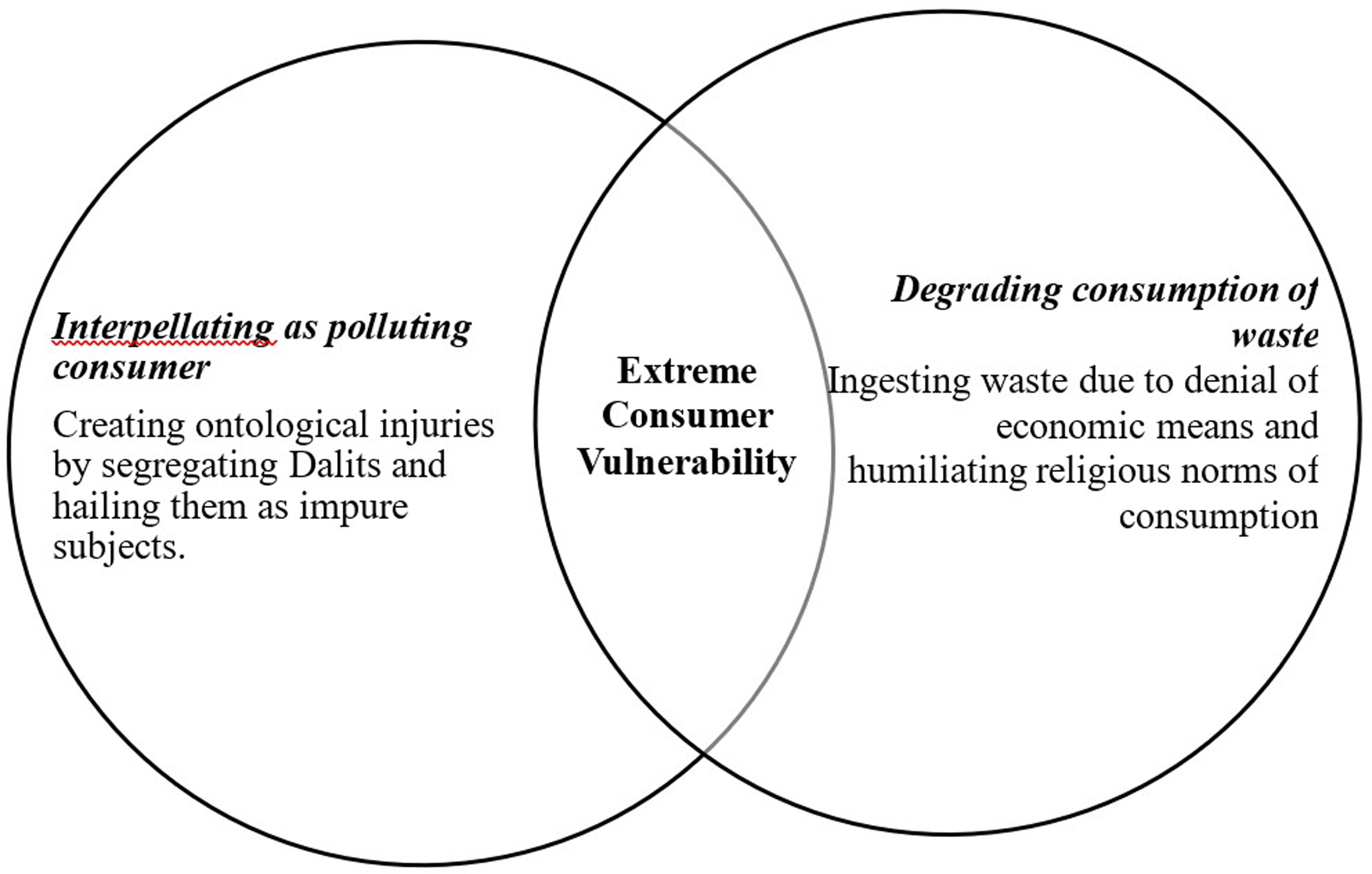
Interpellating as polluting consumer
The domain of consumption is a significant arena where Dalits are subjected to untouchability, thereby interpellating them as polluted consumers. This construction of a negative being stems from an ontological position of impurity (Geetha, 2009). Limbale explains how Dalits become objects of fear because their presence or touch can pollute objects that are meant for upper-caste consumption. Consider the following experience of consumption of water in Limbale (2003: 81), Even the water here was under the control of the high castes. As I touched the water, gathering in my cupped palms, ripples formed on the surface. The water inside the earth was shaken. We were lucky that no one saw us drinking water, otherwise we would have been badly beaten. What is so peculiar about our touch that it pollutes water, food, houses, clothes, graveyards, tea shops, God, religion, and even man?
There is, as Ahmed (2014) observes, a key affective register of fear associated with the religious interpellation of Dalits. The fear of pollution makes the upper-caste control the field of consumption in a manner that segregates and confines Dalits to the margins. In the above excerpt, Limbale also uncovers the other side of the affective register of fear expressed through the fear of consuming water designated for upper castes because such an act constitutes a transgression that provokes violence, if noticed.
In a comparative analysis of Dalit autobiographies, Veroneka and Vijayalakshmi (2022) highlight the shared significance of space and place in the lives of Dalit consumers through the examination of Limbale’s ‘The Outcaste’ and Yachica Dutt’s (2019) ‘Coming Out as Dalit’. Their analyses reveal how, from a young age, Dalits can discern the profound impact their social location has on their experiences, shaping distinctive lifestyle patterns marked by fear of the religious order. Amidst the persistent instances of fear and segregation documented in these Dalit autobiographies (see also, Valmiki, 2007), the production of Dalit consumers as negative beings extends beyond Scott’s (2018) conception of nothingness. A negative being is not solely characterised by the absence of certain qualities but rather embodies a harmful and polluting relationality that defiles and threatens privileged consumers. Limbale’s primary school experience stands out as another striking example of how the upper-caste employed humiliating segregation to uphold a fictional notion of purity. He recounts the practice of separate seating arrangements in which high-caste students sat on benches or raised platforms near the teacher. In contrast, Dalit students sat on the floor near the classroom exit, surrounded by footwear flung around them.
3
As a Dalit, Limbale was also assigned the weekly school cleaning duties by his upper-caste teacher of gathering cow dung and smearing it on the school floors and walls. Even in school games, segregation persisted: The Wani and Brahmin boys played kabbadi.
4
Being marked as Mahar (Dalit) we couldn’t join them. So, Mallya, Umbrya, Parshya, all from my caste, began to play touch and go. We played one kind of game while the high caste village boys played another. The two games were played separately like two separate whirlwinds (ibid., 2).
In interpellating Dalits as degraded subjects, there is, to borrow from Donati and Archer (2015), a relational establishment of exalted upper-caste subject positions. The humiliation of Dalits through such school arrangements ensured upper-caste exaltation.
Limbale (2003: 78) further recounts how the upper-castes inflicted ontological wounds on Dalits through humiliating violence: Whenever an animal in the village died, the villagers grew annoyed. They considered Maharwada (a segregated locality where Dalits lived) responsible for it. They tied us to a pole and beat us like animals. They accused us of having poisoned the animal. Our women and children cried and shrieked. All the men in the Maharwada were badly beaten. The village then ostracized the Maharwada for a few days. We wouldn’t get any work on the farms. We were denied any provision in the shops though we had the money and were ready to pay. We had reached a dead end. Such humiliations were agonizing.
The humiliation of untouchability was a common occurrence when visiting local shops. The caste hierarchy was visible in market transactions as Dalits were denied provisions even when they had the money to buy goods. As a teenager, Limbale (2003: 76) depicts the treatment of a Dalit customer, Rambaap, by a higher-caste shop owner Shivram, Rambaap would drink water and tea and he had to wash the tumblers, too before he puts them back in their place. When paying for the tea, he had to put the money for the tea on the ground or drop it from a height into the hands of the owner, as it is a sin for a Dalit or tribal customers to hand money directly to anyone. When Rambaap noticed me (Limbale) watching him do all this, he said, ‘we are low castes. What you have seen is a long tradition that has come down to us from our forefathers. How can we go against our customs?’
Such accounts of untouchability find resonance in various Dalit autobiographies (e.g. Valmiki, 2007) that point to the role of religion in exacerbating consumer vulnerability. Moreover, Limbale’s experience informs the writings on market exclusion (e.g. Mair et al., 2012; Scaraboto and Fischer 2013) by highlighting the elided issue of humiliation in fostering vulnerability. The degradation encoded in caste-based market practices is explicitly articulated by Limbale (2003: 76), ‘we loathed the low esteem that was imposed on us as our lot. The cup and saucer outside Shivam’s tea shop were an insult to our entire community’. Another instance of degradation narrated by Limbale (2003: 23) was when he visited a hairdresser, The barber first looked at me and then my head. He shouted, ‘don’t stand here. I’m not going to shave your head’. I showed him my money in order to convince him….At that the barber, Isunath, got wild, ‘He is a Mahar (Dalit). Let him go’.
Such accounts confirm that the interpellation of Dalits as polluted consumers was central to consumption and market situations (see also, Thorat et al., 2010; Valmiki, 2007; Varman et al., 2021, 2023). These findings serve as a poignant reminder of Wetherell’s (2012) observation of affect and emotions shaped within a sociocultural context. Limbale’s lived experiences of humiliation highlight the emotions of shame, fear, and anger that concretely emerge from the religious context in which he is located. The religious context imposes several restrictions on Dalits, such as wearing ragged and torn clothes, attaching brooms to their backs to sweep up the dust of their footprints, and tying pots on their necks to collect their spittle (Ambedkar, 2019b). These interpellating consumption practices distort the recognition accorded to Dalits and, as noted by Honneth (2004), create conditions of injustice. It also allows the upper-caste to govern caste hierarchies in market and consumption spaces, ensuring their material reproduction over time (Cháirez-Garza, 2022).
Degrading consumption of waste
The making of a negative being not only entails the ontological marking of a body as impure but also the fortification of this status through the consumption of waste, facilitating in Ahmed’s (2014) terms, the adhesion of upper-caste disgust. This consumption of waste, depicted by Kristeva (1982) as distasteful, disgusting, and frightening, reproduces Dalits as abject entities. As Ambedkar (1936) earlier and Yengde (2019) more recently reiterated, Dalit lives are marked by the denials of access to markets and consumer goods. This is evident in Limbale’s (2003: 81) narratives, where he details how the upper-caste ‘controlled everything, even water, food, houses, clothes, graveyards, tea shops, God, religion, and even man’. In their examination of consumer vulnerability, Varman and Vijay (2018) draw on Butler’s (2004) interpretation of ungrievable lives, referring to people who can be violated with impunity. Limbale’s description goes a step further, revealing how extreme consumer vulnerability metamorphoses into a state of wasted lives, as Dalits are treated as waste and forced to subsist on waste. Consider the following account of the consumption of water by Limbale (2003: 7), The high-caste villagers used the upstream part of the river to fill water in pots and wash their clothes. The middle-caste villagers used the downstream part of the river to collect water and bathed their animals. The water at the lowest end, was means for us the Mahars (Dalits). One day when collecting water in my cupped palm and drinking it some mother had washed her baby’s nappies that send a lump of shit floating from the upstream towards me. I felt sick.
Such experiences of consumption create two outcomes. On the one hand, they reinforce the Dalit marginalisation as they are forced to survive on waste. On the other hand, consumption of waste reinforces the upper-caste notion of polluting and disgusting lower-/out-castes. As Ahmed (2014: 97) notes, ‘through the disgust reaction, “belowness” and “beneathness” become properties of their bodies. They embody that which is lower than human or civil life’. As a result, degrading and disgusting consumption of waste contributes to the making of negative being.
Limbale’s degrading consumption experiences demonstrate a constant struggle with extreme poverty and starvation. For example, Limbale (2003: 21) remarks, ‘starvation was fated from the moment of our birth. Nobody woke us up for dinner because there was nothing to eat’. Instances abound in his autobiography where his family endured days on an empty stomach or resorted to consuming waste to survive. On one occasion, Limbale (2003: 78) recounts how if a Dalit came across a dead animal, they would, ‘tear the animal, skinned it, and distributed portions of meat to every house’. In another example, he describes how his grandmother Santamai made bhakari (bread) from the undigested Jowar (Sorghum) grain extracted out of cow dung. She would meticulously wash the dung to separate the grain, dry and grind them into flour, and make bread. Even then, the bread stank of dung and tasted pungent. Limbale (2003: 50–51) described his experience of eating this bread as ingesting waste, Man is only as big as a bhakari (bread), and only as big as his hunger. Hunger is more powerful than man. A single stomach is like the whole earth. Hunger seems no bigger than your open palm, but it can swallow the whole world and let out a belch. There would have been no wars if there was no hunger. This world is born from a stomach.
Material deficit is a source of vulnerability (Hill and Sharma, 2020). In this case, the hunger experienced by Dalits shows how in addition to material deficits, their vulnerability is exacerbated by the humiliation of ingesting waste. Limbale (2003, 78) admits that ‘such humiliations used to leave me angry’. However, there was no recourse, and this state resonates with Baker et al.’s (2005) understanding of vulnerability as a state of helplessness.
Consider the following episode in which Limbale (2003: 87) sharply foregrounds the consumption of waste along with his college friend Mallya, Mallya and I frequently visited Sonu, Mallya's grandmother, who was a sweeper. Sometimes she also went around begging. She always carried a basket full of stale food. Sometimes the food was fungus ridden and it stank. Whenever we visited her, she put the whole basket before us and asked us to eat whatever we liked and as much as we wanted. We were, of course, hungry. Mallya and I picked up the pieces of bhakari (bread), wiped off the fungus and ate them.
Limbale (2003: 24) also sheds light on the helplessness faced by Dalits when resorting to begging for food to survive, stating, ‘nobody gave us anything easily, but everybody became annoyed with us quickly’. Moreover, whatever little access they had to food was often rotten and unfit for human consumption. In other words, waste became their means of survival. Consider Limbale’s (2003: 3) account of a school picnic: The teachers asked the high-caste boys and girls to collect the leftovers on a piece of paper and give it to us. I and Parshya carried the bundle of leftover food on the way back….It contained crumbs of different kinds of food and their spicy smell filled the air. We had never tasted food like that before. We were all really gluttonous. Our stomachs were as greedy as a beggar’s sack.
Limited resource access is crucial to consumer vulnerability (Hill and Sharma, 2020). In addition, the degrading consumption of waste illustrates that Dalits have minimal control over accessing limited resources, as they are dependent on upper-castes to fill their ‘beggar’s sack’. Thus, humiliating dependence amplifies consumer vulnerability.
Limbale (2003: 45) further narrates the degrading consumption of waste in various aspects of Dalit lives: Gheneppa, the tea-stall owner at the bus stand, would throw the used tea powder behind the bus-stop after boiling and straining it. I went there gathered the discarded tea powder. We made black tea and drank the decoction, cup after cup.
Although Dalits may gain access to consumption sites as menial workers or service providers, they are denied access as consumers (Valmiki, 2007; Varman et al., 2021, 2023; Yengde, 2019). Limbale (2003: 5) describes several instances where Dalits were forbidden from entering places like temples and wedding venues yet were forced to clean such premises every day. They were prohibited from drinking or drawing water from public wells and taps to quench their thirst yet were contracted with the laborious jobs of digging the soil to source water for the wells and taps. The spades and shovels of Dalits were used to dig the well. The Dalits gave their sweat for it…they the Dalits, are the reason why there is water in the well. But now the same Dalits are not allowed to draw water from it, not even drinking water (ibid., 80-81).
As a result of humiliating religious norms, Dalits are forced to resort to crimes like stealing food. Limbale (2003: 21-22) provides a poignant account as he narrates a scene where his sister Vani steals a banana from a fruit vendor and endures a humiliating beating in return: [The fruit vendor beat her] with his chappal (shoes) in the crowded market….by evening the market dispersed. Vani had collected banana skins which people had discarded after eating the fruit. She sat by the street and ate the skins.
In another account, Limbale (2003: 83) questions the religious order that denies Dalits access to consumption. He highlights how Dalits were forced to commit petty crimes to make ends meet, questioning, ‘what is wrong if one who has been deprived of bread for thousands of years, steals bread? If one had enough, why would one steal?’ However, in such instances, and as in the case of his sister, Dalits as negative beings not only suffer from ontological injuries due to ascriptive humiliations but also live lives of dependence on dominant groups (Geetha, 2009).
Limbale’s autobiography highlights the forced insider–outsider, legitimate–illegitimate identity crises that Dalits face (Bose, 2021). These identity crises create a sense of incompleteness and discontinuous self within Dalits. As a result, Dalit consumers attempt to overcome these ontological wounds by disguising their identities and striving to appear like their oppressors. For example, Limbale recounts how in his later life he kept his Dalit identity a secret to rent a house from an upper-caste landlord. Subsequently, Limbale and his family formed relationships with high-caste neighbours, but to achieve this, they buried photographs and books of Ambedkar and stopped consuming meat because vegetarianism is associated with upper-castes. These consumption practices resonate with Srinivas’ (1955) concept of sankritisation, wherein individuals from lower-caste adopt upper-caste practices to overcome subordination. This phenomenon resembles what Baker et al. (2005) refer to as behavioural coping, which entails employing deception to hide indicators of consumer vulnerability. Despite his ‘upper-caste’ lifestyle, Limbale (2003) questions if his neighbours were to know his untouchable status, they would murder him and rape his sister and wife. He snivels, ‘I wore clean clothes, bathed every day, and washed myself clean with soap, and brushed by teeth with toothpaste. There was nothing unclean about me. Then, in what sense was I an untouchable? A high caste who is dirty was still considered touchable!’ Limbale knew that as an individual consumer, he could only mask vulnerability by pretending to be an upper-caste, without transforming the religious structures that fostered it. Thus, Limbale’s attempts to conceal his ontological wounds cast in sharp relief the extreme vulnerability of Dalit consumers, reflecting their dependence on their oppressors for validation.
In summary, our analysis of Limbale’s autobiography shows how religion encodes the humiliation of Dalits to produce negative beings. We locate the making of negative being at the intersection of humiliating interpellations and consumption of waste. Impelled by the religious notions of purity and pollution, upper-castes relationally construct their exalted identities by degrading Dalits in consumption and market interactions. These humiliations interpellate Dalits as polluted entities who are segregated and denied the basic necessities of life. In such a state of extreme vulnerability, with limited control over resources, Dalits are forced to consume waste, which deepens their ontological injuries.
Discussion and conclusion
This study aims to understand how religious codes of consumption and market interactions contribute to the extreme vulnerability of some consumers, rendering them as negative beings. Using Sharankumar Limbale’s autobiography ‘The Outcaste’, we address a theoretically under-examined issue of religiously sanctioned consumer humiliation. By attending to the humiliation of Dalits, we contribute to the understanding of how extreme consumer vulnerability is created, maintained, and legitimised through religious codes. In doing so, we deepen the comprehension of the dark side of religion in marketing theory.
The religion-consumption nexus is well-established in marketing literature (Appau et al., 2020; Belk et al., 1989; Rinallo et al., 2023). However, past studies do not pay adequate attention to how religion institutionalises and legitimises the degradation of consumers to make them into negative beings. Through Limbale’s autobiography, we address this lacuna by showing how the carefully crafted religious apparatus of caste as central to Hinduism works as a silent enterprise to cast aside a group of vulnerable consumers as unfit for marketplace participation. We find that the inhumanity of caste consecrated as the ‘act of god’ (Geetha, 2009: 105) permeates a market structure of graded inequality (Ambedkar 2014) and contributes to the oppression of Dalits. It helps understand how extreme consumer vulnerability is normalised. The religious normative view that subjects Dalits to humiliation enables oppression to be perceived as legitimate and even desirable. As Ahmed (2014) astutely identifies in her reading of affective politics, the fear of being polluted serves as the moral justification for upper castes to continuously injure an already vulnerable consumer group. Despite a law enacted to curb atrocities against Dalits, religion, with its appeal to higher moral principles, provides the justification for extreme consumer vulnerability and oppression to prevail.
Marketers equate consumer vulnerability to experience of powerlessness, dependence (Baker et al., 2005; Jafari et al., 2013), and resource-based exclusion (Hill and Sharma, 2020). However, a critical oversight persists in eliding how humiliating norms of consumption and market interactions contribute to extreme consumer vulnerability (cf. Khare and Jain, 2022). This is not an ordinary oversight because many ascriptive registers of humiliation, such as caste (Guru, 2009), race (Fanon 1952, 1963), and gender (Hartling et al., 2013), shape social and market relations. Our analysis of Limbale’s autobiography reveals that humiliation of Dalits is central to their dehumanisation, making them susceptible to extreme vulnerability. It creates degradation because of actions and institutions that make individuals feel inferior and demeaned (Lindner, 2007; Varman et al., 2023). Just as justice cannot be imagined without social honour and recognition (Honneth, 2004), we posit that vulnerability cannot be understood without adequately attending to humiliation and the deficit of dignity that it creates. Hence, our analysis moves beyond the issue of resource-based exclusion and sheds light on the deficit of honour or dignity as a contributor to vulnerability that is engendered through humiliations.
We further contribute to the writings on consumer vulnerability by showing how the upper-castes deem Dalit consumers as carriers of filth and pollution and forcibly push them down into a lower grade of existence whose axiological value is negative rather than just low. The category of negative beings helps dominant groups to construct their privileged positions. In foregrounding a relational perspective (Donati and Archer, 2015), we point to the politics of humiliation that turn consumers into negative beings whose raison d’être is to affirm and exalt the identities of the upper-castes. Moving the compass to negative relationality offers a richer understanding of the oppressor-oppressed subject positions that shape consumer vulnerability. The upper-castes either expel or exclude Dalit consumers to humiliate them in multiple ways while crafting exalted positions of wealth, prestige, and purity for themselves. This resonates with what Kristeva (1982) and Ahmed (2014) describe about abjection and disgust. In this reading, vulnerability becomes a relational evil in which the dominant position of a consumer group parasitically feeds on the vulnerability of another group.
In such politics of humiliation, a vulnerable consumer does not remain secure about their intrinsic identity while consuming at the margins (cf. Baker et al., 2005) or merely lacks control of resources (cf. Hill and Sharma, 2020). Instead, a negative being is destroyed to their core through humiliating experiences influenced by the affective registers of fear and disgust. The resulting degradation is not only in their role as consumers but also in their intimate sense of self, to the point where their existence becomes that of refuse and excrement (Guru, 2009). Thus, while past studies have posited social exclusion as a form of vulnerability (e.g. Hamilton et al., 2014), they have not examined how vulnerability is encoded through affective registers. Borrowing from Ahmed (2014), we correct this oversight by identifying fear and disgust as affective facets of negative being that contribute to extreme consumer vulnerability.
Our study also highlights the limitation of marketing studies that highlight the role of marketplace skills in curbing exclusion and consumer vulnerability (e.g. Viswanathan et al., 2010; Viswanathan and Rosa, 2007). Limbale’s experiences demonstrate that vulnerability does not result from the absence of marketplace literacy but rather from market exchanges moulded by prevailing power and religious norms of social oppression. These relations of domination cannot be undone by merely providing marketplace literacy. Moreover, contrary to Vikas et al. (2015), who propose that marketisation can displace caste-based social order, we show that markets do not offer an escape to those consumers who suffer from extreme vulnerability. Instead, violent expressions of power and religious sanctions make everyday consumption and markets, sites of ongoing humiliation. For negative beings, markets are not anonymous arenas of exchanges antithetical to religious hierarchies but spaces that further empower dominant religious groups, exacerbating the vulnerability of those who are already precarious.
We also explicate why consumers subjected to extreme vulnerability rarely protest and why their plight remains invisible in popular representations. In providing this understanding, we add to the writings on consumer vulnerability that have offered insights into how violence and oppression of vulnerable consumers are normalised (Saatcioglu and Corus, 2014; Varman and Vijay, 2018), by highlighting the significance of humiliation. Varman and Vijay (2018) emphasise how consumers whose lives are considered expendable, or those who are made ungrievable, can be violated with impunity. Our findings reveal that the matrix of grievability must be complemented with how religious codes of humiliating consumption shape violence. Humiliation, as Varman et al. (2023) highlight, instills fear and furthers docility. This fear makes the extreme vulnerability of negative beings illegible, inaudible, and unseen. Humiliation makes negative beings into subalterns, to borrow from Spivak (1988) in her essay on the problem of representation, who cannot speak. Such a state of silencing furthers greater atrocities and oppression against those who are already vulnerable. Thus, instead of reducing violence, docility produced by humiliation becomes the condition allowing greater violence to occur.
In conclusion, our study draws attention to the dark side of religion in markets by showing how religious codes humiliate a group of consumers. Such humiliation precipitates extreme vulnerability of these consumers and reduces them to negative beings. The making of negative being and fostering of extreme consumer vulnerability require greater attention in marketing theory. We interrogate how religions, while imparting codes of ethics, also foster conditions of expropriation and oppression in markets. Although we have focused on religious caste-based humiliations, there are similar configurations of racialised (Fanon, 1952), gendered (Lindner, 2010), and class-based (Torres and Bergner, 2010) humiliations. In order to ameliorate conditions of consumer vulnerability, there is a need to restrict humiliation and foster human dignity. Marketing theory in attending to consumer vulnerability has made a good beginning, but unless it starts dissecting and countervailing the conditions engendering the making of negative being, the task is still incomplete.
Footnotes
Declaration of conflicting interests
The author(s) declared no potential conflicts of interest with respect to the research, authorship, and/or publication of this article.
Funding
The author(s) received no financial support for the research, authorship, and/or publication of this article.
