




Abstract
This paper argues that a capacity to embrace ambiguity allows market actors to accommodate the symbolic, dialectical and dynamic nature of place brands. Using the Wild Atlantic Way as an illustration, the paper considers how this brand is appropriated by diverse actors to create value through place performances and experiences. Brands can embody tourism imaginaries and are part of the cultural media for creating and circulating place meanings. When brands are mobilised in ways that result in convergent or coherent meanings, the result is a living brand, accommodating an evolving sense of place. The paper contends that the ambiguity of place branding is manifest in the spaces in-between materiality and discourse, reality and imagination, object and experience, concept and performance.
Introduction
The Wild Atlantic Way is the world’s longest, and Ireland’s first, coastal drive tourism route, stretching along the Atlantic coast for 2500 km from Donegal to Cork (Hanrahan et al., 2017) Figure 1. Our interest here is that the Wild Atlantic Way is effectively conjured out of nothing by Fáilte Ireland (Ireland’s Tourism Development Authority) who stitched together pre-existing touring routes and incorporated spaces of heritage and natural beauty. Passing through nine counties and three provinces, there are one hundred and fifty-nine discovery points along its extensive landscape and seascape, each chosen for the potential to offer tourists an intimate experience of the natural and the wild. The route was officially launched in February 2014 and now incorporates more than 1000 attractions and 2500 activities. Map of the Wild Atlantic Way (source: https://www.wildatlanticway.com/explore-the-route/map/).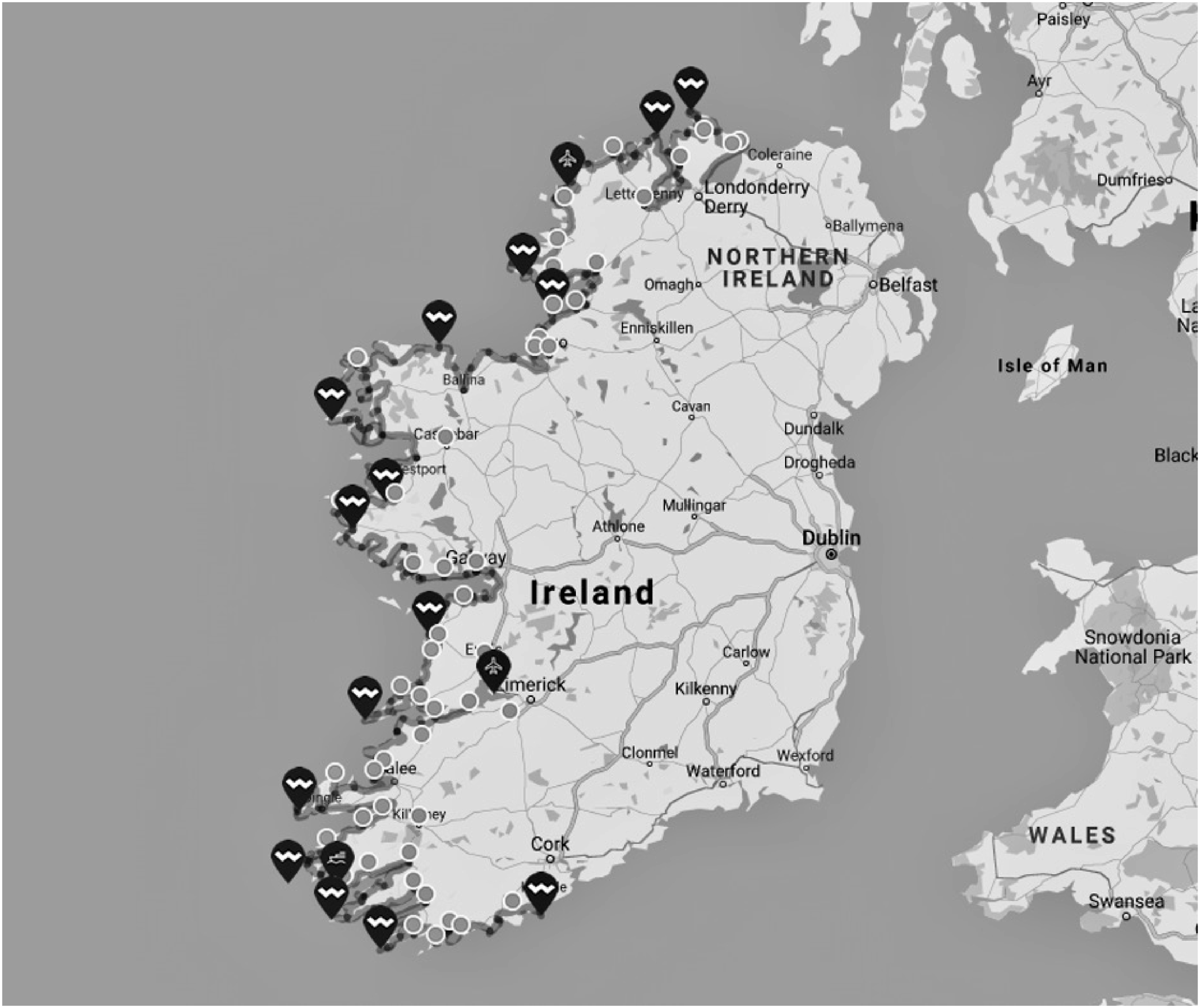
It is a phantasmal destination (Gao et al., 2012) that transforms what was once a preponderance of small coastal roads into a ‘wild’ tourism experience. This transformation is accomplished with little or no change to the material infrastructure of the region other than the provision of signs denoting that particular places are situated along the coordinates of the Wild Atlantic Way. Instead, Fáilte Ireland made substantive investments in branding resources and, in so doing, mobilised the myth of the wild to reimagine and indeed create place ex nihilo. Given a limited marketing budget, Failte Ireland’s strategy was largely predicated on the provision of a range of resources for businesses, event organisers and other local stakeholders (Fáilte Ireland, 2015), including signage, free marketing tools, helpful guides and curated images. These encouraged and supported the development of a palette of tourism offerings by various local actors. The brand was launched internationally via a powerful promotional video which invoked the spirit of the wild and outlined the material, symbolic and experiential elements [https://www.youtube.com/watch?v=PIzU6Vhpzyw], offering viewers the opportunity to ‘explore the Wild Atlantic Way of Life’ (Wild Atlantic Way, 2019). The longest defined coastal drive in the world, its wild and rugged natural beauty, unique ancient heritage, defiant settlements, creative locals and unique array of cultural events promise the visitor the journey of a lifetime (Fáilte Ireland, 2013).
Following the classic definition offered by Agnew (1987), places such as the Wild Atlantic Way may be said to incorporate location, locale and sense of place, connected simultaneously to points on a map, physical geographies and social and personal meanings. These places are assemblages of the material, symbolic and experiential. They provide a ‘material setting for social relations’ (Cresswell, 2004: 7), a physicality that imposes itself on both our understanding and experience of place. Casey goes further, articulating the relationship between place and self as mutually constitutive, ‘places come to be embedded in us; they become part of our very self, our enduring character, what we enact and carry forward’. Further, there are multiple discourses (historical, political, cultural etc.) that circulate around places, producing a polyphony of meanings and interpretations that are implicated in their social construction. Given that places are best understood as unfinished entities (Cresswell, 2004; Warnaby and Medway, 2013), traditional marketing approaches that attempt to control place brand meanings are highly problematic (Hanna and Rowley, 2015). Consequently, marketing approaches that acknowledge how place brands ‘play out in social actuality’ (Karavatzis and Hatch (2021: 8), their associated meanings developing in the performances of consumers and other stakeholders, offer potentially transformative insights for place marketers.
This paper draws upon the example of the Wild Atlantic Way brand to ask how a capacity to embrace ambiguity might allow market actors to accommodate the symbolic, dialectical and dynamic nature of place brands. Building on Karavatzis and Hatch (2021) who argue that elusive place brands accommodate the ongoing influence of conceived, perceived and lived spaces (Lefebvre, 1991), our work explores the co-creative processes that underpin this, particularly in terms of how place brands are appropriated (Lucarelli and Berg, 2011) and performed (Rabbiosi, 2016) by various actors. Specifically, we explore the role of ambiguity in facilitating value creation and the construction of living brands.
Our interrogation of the Wild Atlantic Way incorporates documentary evidence (Hodder, 2000) and first-hand participant observation (DeWalt and DeWalt, 2011). ‘[D]ocuments should not merely be regarded as containers for words, images, information, instructions, and so forth, but […] can influence episodes of social interaction, and schemes of social organisation’ (Prior, 2008: 822). As such, we consider how promotional materials are used to perform the myth of the Wild Atlantic Way. We take a context-analytic approach, seeking to understand the nature of material created about the Wild Atlantic Way as a form of action (Prior, 2008). We draw upon a range of sources including published material, academic articles and online materials that circulate the myth such that certain kinds of experience (adventure, culture and heritage) become more evident and so particular versions of place are performed. Observation periods incorporated a range of visits to the field that included family and individual trips, and journeys to various points on the Wild Atlantic Way and along stretches of the driving route with numerous stopping points. Participant observation was employed ‘as a way of engaging with the nuances and complexities of tourist practice’ (Thurnell-Read, 2012: 807).
Acknowledging ambiguity facilitates consideration of the tensions inherent in dealing with places and place brands, negotiating between being and becoming, essence and contingency, control and openness. By embracing ambiguity, attention shifts to the performative potentialities of the brand as an open resource for diverse actors in their (co)creation of value and experience. Ambiguity has the capacity to foster coherence and shared meaning, while simultaneously allowing for multiple interpretations in the experience and performance of place. This contributes to the wider discussion of ambiguity as a strategic resource (Eisenberg, 1984; Puntoni et al. 2010; Brown et al. 2013). Consequently, we argue that marketers should eschew efforts to erase ambiguity in branding and communication, and instead embrace its potential in value co-creation.
We organise the paper as follows. We review recent conceptualisations of place branding and the role of participation, meaning and performance within this. Drawing on the exemplar of the Wild Atlantic Way, we critically assess how brands may resonate culturally and offer different potentialities and we delineate how ambiguous place brands can operate as resources for market actors supporting value and experience co-creation. We demonstrate how embracing ambiguity can ultimately result in the actualisation of value and the creation of living brands. We conclude that ambiguity manifests in the spaces between materiality and discourse, reality and imagination, concept and performance.
Participation, meaning and performance in place branding
Places are multi-layered, contested and dynamic ‘spaces through which power, identity, meaning, and behaviour are constructed, negotiated and renegotiated according to sociocultural dynamics’ (Saraniemi and Kylänen, 2011: 138). The symbolic, dialectical and dynamic are foregrounded (Saraniemi and Kylänen, 2011), with contemporary place branding increasingly buttressed by changing heterogeneous processes (Kavaratzis and Hatch, 2021). Thus, flexible branding models are required that open up potential for multi-directional communication rather than close it off (Pasquinelli, 2010). Problems also arise for places due to the commodification that follows the discharge of marketing technologies (Pasquinelli, 2010). Any attempt to brand a place tends to be grounded in capitalist logics, highlighting saleable dimensions, and with ‘great potential to affect places and, by extrapolation, citizens, by making them understandable as (un)desirable in reference to market objectives’ (Andéhn et al., 2020: 329).
The irony is that this drive towards uniqueness effectively creates an abundance of similarly empty place brands (Warnaby and Medway, 2013). The forces of commodification often work in reductive ways, potentially eroding the sense of the place, inducing cultural impoverishment and marginalising some of those with interests in the place (see e.g. Pasquinelli, 2010; Warnaby and Medway, 2013; Lichrou et al. 2014; Kavaratzis et al. 2017). In any case, the drive to differentiation may necessitate a level of control over the place brand that is impossible. For Warnaby et al. (2010: 1379): [T]here is a danger of such complex places becoming defined by the lowest common denominator, arising from the need to achieve consensus between a multiplicity of place stakeholders. Thus, the kaleidoscopic and multifaceted nature of place may become hidden behind one-dimensional marketing approaches [...] In trying to make a place ‘something for everybody’, by including as many competing place narratives as possible, care must be taken that it does not become ‘nothing for nobody’.
Participatory approaches emerged in response to the fact that multiple actors, communities and interest groups have different and often contradictory claims to a place. Treated as an inconvenience at first, consideration of diverse stakeholder perspectives has gained popularity in place branding (Kavaratzis et al. 2017). Kavaratzis and Kalandides (2015) view place branding as a process of extracting and framing ideas already there to reveal the place brand. They note that ‘the constituents of place … [materiality, representations, institutions and practices] … are simultaneously the constituents of the place brand through the associations they cause, and the place brand comes together as a whole through the interactions between associations’ (Kavaratzis and Kalandides, 2015: 1369). The formation of place brands is affected through a reflexive process embedded in ongoing place identity formation (Kavaratzis and Hatch, 2021), with local people increasingly recognised as important stakeholders (e.g. Lichrou et al. 2014). Consultation with residents and others contributes to the creation of shared and multidimensional brand stories (Colomb and Kalandides, 2010).
Despite such levels of participation, these stories may still be open to diverse readings and interpretations as different actors mobilise their cultural capital to negotiate meaning and to legitimise their influence in the place branding process (Reynolds et al. 2022). Even beyond place banding, brands are ‘part of the fabric of popular culture and populate our modern mythology; they must be analysed as cultural forms, carriers of meaning, and devices structuring thought and experience’ (Cayla and Arnould, 2008: 105). While marketers attempt to infuse brands with desired identities, the cultural significance of brands is also shaped by the ‘active negotiation of brand meaning’ (Schroeder, 2009: 124-5) by others. Consequently, the brand can be thought of as an open-ended object (Lury, 2004), ‘a mediatic space that anticipates the agency of consumers and situates it within a number of more or less precise coordinates’ (Arvidsson, 2005: 245). Places, like brands, exist in a state of continuous performance (Cresswell, 2004), and control emerges in the place brand’s ability to keep performances within those coordinates (Arvidsson, 2005). To this end, place brands work to frame our understandings of and engagements with place (Andéhn et al. 2020) while always being available for renegotiation (Cayla and Arnould, 2008).
Conventional brand management discourse favours clarity, consistency and coherence (e.g. Cai, 2002) and often views ambiguity as problematic (Brown et al. 2013) or as a barrier to comprehension (Puntoni et al., 2010: 51). However, ambiguity may be important because it accommodates the complexity of places as socio-spatial constructs (Kavaratzis and Hatch, 2021) and aligns with contemporary understanding of brands as cultural resources (Holt, 2002; Cayla and Arnould, 2008). Myths contribute to the potentiality of brands (Cayla and Arnould, 2008; Brown et al. 2013) because of their capacity to incorporate ambiguity. Truth to tell, what is invested in the concept is less reality than a certain knowledge of reality; in passing from the meaning to the form, the image loses some knowledge: the better to receive the knowledge in the concept … [T]he knowledge contained in a mythical concept is confused, made of yielding, shapeless associations. One must firmly stress this open character of the concept; it is not at all an abstract, purified essence; it is a formless, unstable, nebulous condensation, whose unity and coherence are above all due to its function (Barthes, 1972:118).
Although ambiguity is defined ‘both in terms of message attributes […] and receiver interpretation’ (Eisenberg, 1984: 239), it is also an ambiguous concept, denoting ‘uncertainty or dubiousness on the one hand and a sign bearing multiple meanings on the other’ (Sennet, 2023: 1). For example, it can be used to obfuscate readings of a place’s contested identity, as in the case of Northern Ireland, which is marketed as ‘Irish’ in Irish-friendly markets and as ‘British’ in British-friendly markets (Gould and Skinner, 2007). It can also be used to accommodate ambivalent and complex meanings (Puntoni et al., 2010) and place performances (Hetherington, 1997). In the case of Verucchio, Italy, performative instances involving stories, communicative media and the interactions of retailers and tourists are implicated in the construction and enactment of the place’s multiple identities (Rabbiosi, 2016). It is this second meaning, an openness to multiple interpretations, that we employ in this paper to argue that embracing ambiguity is important both in participatory (Kavaratzis and Kalandides, 2015) and performative (Andehn et al. 2020) approaches to place branding.
Ambiguity, and especially myth-informed ambiguity, appears to be an influential factor in the development of iconic brands (Brown et al. 2013). Consumers appropriate brands and their mythologies as cultural resources (Holt, 2002), in the construction, maintenance and expression of identities (Elliott and Wattanasuwan, 1998) and in the deployment of cultural fantasies (Illouz, 2009). Consumers therefore produce immaterial use-values by incorporating brands into their everyday lives, values that take the form of ‘an experience, a shared emotion, a sense of community’ (Arvidson, 2005: 248).
Fantasy and reality are inextricably interwoven in the construction of places as tourism destinations (Chronis, 2012). Tourists interact physically and symbolically with places and create their personal dramas (Voase, 1999) in which metaphorical and allegorical resources are evident in reverie, dreaming and speculation (Rojek, 1997). Indeed, tourist mythmaking processes are so powerful that Shangri-La, originally a fictional place in Hilton’s (1933) novel, is now fully realised as a geographical location (Gao et al., 2012). Myths thus serve the touristic search for otherness because they embody the dichotomies between culture and nature, self and other, modern and primitive, centre and periphery, civilisation and wilderness. The ‘other’ is associated with ‘an imagined world which is variously pre-modern, pre-commoditised or part of a benign whole recaptured in the mind of a tourist’ (Selwyn, 1996:21).
Tourist myths construe certain places as ‘natural’ and ‘wild’ in contrast to the ‘civilised’ and ‘tamed’ places where tourists originate from. Arnould et al. (1998) also point towards understandings of nature that incorporate the wilderness as a transcendental force, the wilderness as a restorative healing power and the wilderness as a last refuge that must be preserved. Much of the mythology is Romantic in orientation, underlining associations with the isolated, pristine and natural (Canniford and Shankar, 2013). Urry (2005: 20), for example, explains how the Romantic movement transformed the English Lake District from a place of ‘inhospitable terror’ into a ‘landscape’, a place of beauty and desire. Here, the mythology works to reverse ‘the value assertion inherent in the dominant polarity between culture and nature, between centre and the “other.” In this value upheaval the previous “other,” with all its shades, comes to be viewed as a positive contrast to everything deemed negative in the dominant culture. Thus, everything “natural” becomes inherently positive’ (Haila, 1997: 133). Tourist experiences of the wilderness are thus characterised as extraordinary escapes from the monotony and tedium of everyday life in the city (Arnould and Price, 1993; Celsi et al. 1993; Canniford and Shankar, 2013).
Individual imagination intertwines with the ‘imaginaries that circulate within the meaning-making practices of visitors, tourism suppliers, and communities’ (Derrien and Stokowski, 2020: 3). Meanings about places are stitched together through exposure and interactions with media, popular culture, fiction and the stories of others (Santos, 2004). In this sense, place branding is part of the media landscape responsible for fostering and circulating place meanings. Because places are assemblages of the material, symbolic and experiential (Warnaby and Medway, 2013), place brands are re-enacted ‘through material, discursive and embodied performances that have the advantage of being susceptible to immediate reaction and reinterpretation’ (Rabbiosi, 2016: 157) from different kinds of audiences/performers.
The significance of a performative perspective is captured in the departure from essentialist accounts of identity as a given towards accounts of identity as a social process of enactment (Andèhn et al. 2020). ‘[I]dentity is performatively constituted by the very “expressions” that are said to be its results’ (Butler, 1990: 25; Adèhn et al. 2020). Giovanardi et al. (2014) show how tourism places are co-performed by tourists, residents and tourist workers in the context of the Pink Night Festival in the Romagna coastal region of Italy. Rabbiosi’s ethnography (2016) of a tourism town (also located in the coastal region of Emilia-Romagna) presents a compelling account of the performativity inherent in place branding, focussing on the hybrid place brand performances brought about by objects, shopkeepers and tourists. Indeed, the importance of performances is that they are subject to ‘continuous implementation and distortion’ (Rabbiosi, 2016: 165), rendering the brand script malleable and adaptable in different contexts.
Ultimately, however, it is not a case of participation versus performance, as clearly both approaches are integral to brand engagement and coherence. The participation of stakeholders in the place branding process can facilitate polyphonic narratives around the place and its brand development (Kavaratzis and Hatch, 2021). This discourse continues to evolve as diverse stakeholders interact with the brand, using it to create value for themselves and others. Brands can be open (or closed) on several aspects, including physical, textual, meaning and experience (Pitt et al. 2006). Because of their open-ended nature, ambiguous brands may be interpreted and re-interpreted, imagined and re-imagined, combined and re-combined by tourism actors in unlimited ways. While participatory place branding processes may engage diverse actors in the brand design process (Kavaratzis and Hatch, 2021), we turn our attention to the potentialities offered by brands as performative resources, particularly in the co-creation of value and experience.
Value and experience
While market actors appropriate place brands to create value (Brodie et al. 2006), value is also an elusive concept, loosely captured by ‘interrelations between economic, social, and semiotic values [that] form different context-dependent conceptualisations of value’ (Karababa and Kjeldgaard, 2014: 119). These three types of values are determined simultaneously and sequentially in exchange and use (Peñaloza and Venkatesh, 2006: 303): ‘constituted by marketers and consumers in their activities and discourses via an enacted process, a social construction that takes place prior to, during and after the actual exchange and use(s) take place’. For tourism this directs attention away from an organisation-centric view of producing and controlling value, towards an actor perspective where value is co-created through resource integration, including tourists’ own involvement and resources (Prebensen et al. 2013). This understanding of value is particularly prescient given the significance of the emotional and experiential elements in the consumption of tourism places (Uriely, 2005; Campos et al. 2018). Opportunities exist for engagements that offer ‘flow’ and ‘discovery’ experiences, ‘peak’ experiences, ‘extraordinary’ experiences (Arnould and Price, 1993; Sheldon, 2020) and ‘recovery’ experiences (Valtonen and Veijola, 2011). Indeed, some leisure experiences can be ‘enough to liberate considerable creativity, to release repression, to fulfil some sense of people’s hidden potential, to evoke self-expression, and to unleash the potential for self-transformation’ (Kozinets, 2002: 36).
Because value is a product of experience, it defies objective definition. Nonetheless, it does have a number of criteria (Holbrook, 1999; 2006a, 2006b). First, assessments of value are personal (they differ from one individual to another), situational (they vary from one evaluative context to another) and comparative (the relative merits of one thing over another are considered relevant at that point in time). In these regards, value is ‘an interactive relativistic preference experience’ (Holbrook, 1999: 5). Holbrook (1999; 2006a) also delimits three key dimensions of consumer value: (i) extrinsic versus intrinsic value; (ii) self-oriented versus other-oriented value; and (iii) active versus reactive value. Products or experiences with extrinsic value are viewed as utilitarian and appreciated as a means to some end. In contrast, intrinsic value emerges from experiences that are autotelic and appreciated for their own sake (Holbrook, 2006a; Komppula and Gartner, 2013). Intrinsic value is an outcome of experiences only, while extrinsic value is accessed through the objects (products/services) that contribute to those experiences. Next, products and experiences with self-oriented value are treasured because they are personal and inner-directed. Correspondingly, we acknowledge other-oriented offerings for what they do for others (Holbrook, 2006a). Finally, value is active when we act upon or with a product in the pursuit of an experience, and reactive when products act upon or with us as part of some consumption experience (Holbrook, 2006a; Komppula and Gartner, 2013). Significantly, interactions can result in different value outcomes or even multiple value outcomes at the same time (Holbrook, 2006a).
Tourism providers, then, act upon the materiality of place and interact with tourists and other actors to co-create value. In this regard, ‘the quality of the experience offered by a tourist destination is more than the sum of its parts; it depends in important ways on how the organisational parts are interconnected, the way they act and interact and the relations between the actors involved’ (March and Wilkinson, 2009: 455). For example, The Gathering, Ireland 2013 (Miley, 2013) was created as a platform to encourage every citizen to promote tourism, revive a sense of community spirit and promote a sense of pride in Ireland (elements that appeared to have been lost in the Celtic Tiger years). It assembled and engaged multiple groups and communities at the grassroots level, including citizens, entrepreneurs and other actors within Ireland and from the Irish diaspora, facilitating the co-creation of multiple experiences (Mottiar, 2016). The Gathering championed local ownership, interpretation and the manifestation of various, often idiosyncratic events. The success of The Gathering was that it fostered an idea, a brand and a set of resources that tourism actors could engage with, develop and make their own (Lichrou and O’Malley, 2021).
In a similar vein, we argue the Wild Atlantic Way accommodates the multifarious nature of offerings and experiences that become useful in the performance of place, instilling a degree of coherence that allows an ever-evolving sense of place. With a limited budget and the need to create a new and competitive tourism product, Fáilte Ireland continued its focus on experience development of which adventure, heritage and culture are key components (Wild Atlantic Way, 2019). These range from rather grand propositions such as the Cliffs of Moher Visitor Experience (Healy et al. 2016), to local food trails (Broadway, 2015; 2017) and relatively niche offerings (Hanrahan and Conaghan, 2014) such as seaweed baths and whale watching tours (see appendix 1). The diversity of focal points and the emphasis on ‘living’ the Wild Atlantic Way open up possibilities for a multitude of experiences.
However, unlike The Gathering, conceived of as a one-off event, the Wild Atlantic Way also incorporates a long-term orientation that reimagines and reconstitutes the Atlantic coast of Ireland. The Wild Atlantic Way defies clear jurisdictional definition and as such may be termed a ‘fuzzy place’, where ‘the realm of meaning may be the defining aspect of place identity’ (Warnaby et al., 2010: 1366). In this regard, the Wild Atlantic Way shares similarities with other places that incorporate different administrative areas, such as Greater Louisville and Old West Country (USA), Øresund and Cruise Baltic (Pasquinelli, 2013).
Although the brand appears to have been created out of nothing, it is important to acknowledge that the mythology of the wild and wilderness is inscribed along the Atlantic coastline. Moreover, Ireland has long been constructed as a wild place, as evident in medieval, colonial and travel discourse (Nash, 1994). Referring to medieval and early modern writings, Leerssen (1995: 30) highlights that: Ireland is placed beyond the pale of plausible reality and is placed in the distant regions of adventure, romance and speculation. Ireland was the outer limit of the Western world; beyond lay the emptiness of the world ocean and, quite literally, the end of the world.
The cultural invention of the wilderness (Arnould et al. 1998) has seen it connected with a variety of meanings over time that include danger, adventure and the sublime (Berleant, 1998). Through the Wild Atlantic Way brand, Fáilte Ireland reactivated the myth of the wild, thus making it available as a resource in the construction of the Wild Atlantic Way consumptionscape.
Co-creation of place and experience
Combining experience with landscape (O’Donovan et al., 2015) the Wild Atlantic Way attracts tourists searching for a wide variety of experiences. ‘Visitors are invited to purify and cleanse their bodies, minds and souls through the immersive cultural experiences which are on offer’ (Collinson, 2018: 41). These extend from accessing that ‘edge of the world’ feeling in the southern peninsulas of Cork and Kerry, to swimming, surfing or whale watching along the wild coastal waters. Tourists can learn to bake Irish soda bread, participate in tastings, workshops and seaweed tours (Dwyer, 2014), attend festivals, ride horses on the beach, enjoy the spectacle of Irish dancing or appreciate an impromptu session of Irish music in the pub. They are thus called upon to participate in unique, memorable and interactive experiences, limited only by their imagination and, perhaps, the Irish weather. Fill your lungs with its salty air, expand your mind with its creativity and culture, share a smile with its lively locals and open your heart to its incredible experiences. This is captivating coastal life from head to toe, northern reaches to southern corners. Soak up every drop. Embrace the Wild Atlantic Way of life (Wild Atlantic Way, 2019).
The pure and pristine nature of the environment along the Atlantic coast, the quality and freshness of ingredients and the tradition of artisan food production all combine to generate positive associations with the production and consumption of local Irish food. These factors foster a distinctive discourse that communicates culture, and through which culture becomes more accessible. For example, food experiences constitute a major part of what the Wild Atlantic Way provides (O’Donovan et al., 2015; Collinson, 2018). These help create, enhance and reinforce a sense of place for locals and tourists. ‘From grazing fields to fishing boats, it’s not uncommon for food to go from “farm to fork” or “tide to table” within hours, if not minutes’ (Wild Atlantic Way, 2019). Further, the traces of this discourse are ‘discernible in a myriad of different contexts, including on food packaging, restaurant menus and market stalls, and more obviously, in online and broadcast media advertising’ (Collinson, 2018: 41). This is no accident. Rather, codified in the promotional materials produced by various government agencies including Bord Bia (the Irish Food Board) and Fáilte Ireland, and tourism initiatives such as the ‘Place on a Plate’ programme (Broadway, 2017), these resources become available to local producers and tourism organisations for their own use (Broadway, 2015; Collinson, 2018).
While food and food offerings may represent a primary motivator in the destination selection for some visitors, for others, food remains a mundane necessity on the journey (O’Donovan et al., 2015). Moreover, co-creation opportunities are not limited to food offerings but are available to all of those who provide tourism services and experiences. The same is true of opportunities to participate in adventurous activities, appreciate heritage or experience Irish culture. Not every tourist will wish to scale mountains, explore lost valleys, learn Irish history, relive the horrors of the famine, visit the Titanic’s last port or appreciate the charm of the locals; but there is undoubtedly a rich palette of available opportunities from which to choose. It is everything and nothing in particular that calls tourists to the Wild Atlantic Way. Thus, while there is a physical reality of the western coast, these resources make adventure, culture and heritage manifest in ways that can be decontextualised and re-contextualised to express different kinds of opportunities for value creation depending on whether it is a region, a place, an offering or an experience. Possibilities abound in the interplay between materiality and discourse for those who choose to visit. Consequently, the Wild Atlantic Way discourse remains evocative, fluid and ambiguous, facilitating a multiplicity of meanings, interactions and experiences.
The concept, brand and experience are performed 365 days a year in a myriad of ways by diverse tourism actors. These experiences might (or might not) constitute value, depending on the individual assessing value, the situation in which they find themselves and the evaluative criteria they evoke (Holbrook, 2006a). Opportunities for value creation occur through the tourist’s interaction with the myriad experiences on offer, the choice of which is dependent upon their deployment of their own resources, their energy, physical endowment, imagination, knowledge, relationships and skills (Arnould et al., 2006), and their interaction with service providers, locals and other tourists (see Grönroos, 2000). As such, the tourist is not only the arbiter of value (for themselves) but is also implicated in how that value is established. Tourists interact with the Wild Atlantic Way (materially, culturally and socially) to jointly construct value with other actors. Thus, the Wild Atlantic Way can be thought of as an experience space, with which tourists and others engage and interact.
Thus, for tourists, there are infinite opportunities to participate in active and reactive value creation and to determine extrinsic and intrinsic values for self and others (Holbrook, 1999), but it is only through interaction with other actors, and with the material and symbolic resources of the place that these become possible. Tourist experiences are emplaced enactments (Chronis, 2012) of the brand, transforming the imaginary into lived reality. The Wild Atlantic Way accommodates tourists who may be actively seeking flow or peak experiences through deep engagement with offerings in which they are highly invested (from hiking to history, gastronomy to glamping) while others may look for the extraordinary. Still others may pursue simplicity, for example, taking a walk, sleeping or not doing anything in particular.
Value for tourists may not only involve participation facilitated by actors of this tourism network but may also incorporate moments where the absence of commercial activities and things prevails. Such absence ‘can be just as instrumental in the construction of experience’ (Goulding et al., 2018: 26). Indeed, the absence of roads, houses, people and commercial infrastructure along vast areas of the Wild Atlantic Way contributes to experience of the wild as a contrast, antidote and escape from civilised life (Arnould et al., 1998; Canniford and Shankar, 2013). An unruly wilderness, after all, is surely more reflective of an unruly Irish spirit. Ireland, and the West of Ireland in particular, has long been portrayed as primitive, wild and sublime (Nash, 1993), images which continue to feature in representations of Ireland in advertising (Foley and Fahy, 2004). The wild Atlantic with its unrestrained and untameable tides and storms has continuously been moulding the west coast of Ireland. With a constant meeting of water and land, a deeply indented and wild terrain has emerged with towering cliffs, spellbinding bays and beaches, mystical islands, always changing and never reaching the end (https://www.thewildatlanticway.com).
Opportunities for value creation can thus be thought of as fluid arrangements of actors, objects, services and experiences that can take on multiple forms depending on the infinite combination of the available resources at specific times. Although no single actor is in full control of these resources or of the value proposition, they leverage the ambiguity, imagining and communicating possibilities, ‘engaging and enabling customised links that induce an explosion of meanings’ (Arnould et al., 2006: 100). Thus, through interaction and integration, actors create and co-create value and experience, such that the Wild Atlantic Way remains elusive, dynamic and quintessentially wild. While the process is largely uncontrolled, meanings seem to cohere and reinforce the experience of the Wild Atlantic Way because the very concept of ‘wild’ is itself ambiguous; it fosters a shared understanding without limiting specific interpretations (Eisenberg, 1984: 238, Gorham, 1999). Consequently, creative deployments of the brand are possible without appearing to dilute it.
Myth, ambiguity and the construction of living brands
The performance of place myths (Hetherington, 1997) serves to make a space understandable to tourists and to shape their activities in that space in particular ways (Gao et al., 2012). These understandings and activities emerge because of what tourists and others consider to be ‘in place’ and ‘out of place’ (Cresswell, 1996) and, in their turn, they become routinised and embodied, constructing the place for the consumption of future generations (Diener and Hagen, 2022; Furia, 2022). In this way then ‘people and places script each other … [in] … conglomerations of communication’ (Amin and Thrift, 2019: 23). Place and self are mutually constitutive; ‘there is no place without self and no self without place’ (Casey, 2001: 684).
People actively experience places (Casey, 2001), and these experiences serve to shape both people and place. Place brands can accommodate such dynamic processes (Kavaratzis and Hatch, 2013, 2021) to allow engagement, appropriation and performance by multiple actors.
Place myths are compelling because they can incorporate complex and ambivalent meanings. Interestingly, the places produced by these effects can be ambiguous and shifting, underpinned and solidified by powerful myths but constantly reinterpreted through what Furia (2022: 545) calls ‘intersubjective practices of landscaping’. For example, the mythology of wilderness conjures ambiguous representations (Tuan, 1990 [1974]), evoking both the fearsome and the sublime (Lengkeek, 2002). According to Casey (1993: 190-191), wild places possess allure and complexity: The allure is such as to draw human beings across entire oceans and continents, leading them to posit the existence of a seductive wild paradise in the next farther region if they did not find it where it was first imagined to be. The complexity derives from the fact that the very notion of wilderness is an amalgam of the real and the imagined, the actual and the idealised; its types are manifold, ranging from Edenic to chaotic, the Paradisal to the perverse, not to mention the monotonous and uninspiring.
The mythology of the wild and wilderness is inscribed at the core of the Wild Atlantic Way; various actors are able to appropriate these mythical resources to signify a particular and ‘wild’ relation to culture, heritage and/or adventure as appropriate for their own endeavours.
Infused with material and cultural meanings, the Wild Atlantic Way defies definition and is ultimately and fleetingly captured in the phenomenological experiences of those who visit. The brand may be viewed as a relational and creative resource that can engage all tourism actors, used by them in their own value-creating efforts. While various actors are individually the arbiters of value for themselves, they are also an integral part of the processes through which value is created for other actors, and through which the wild is performed, and the place is experienced.
It is because of its quintessential ambiguity that the Wild Atlantic Way celebrates ‘what is’ through its focus on materiality, object and value-in-exchange while accommodating ‘what could be’ through capturing the potential of value-in-use, experience and discourse. The three pillars of adventure, heritage and culture, frame experience in ways that resonate with the mythology of the wild and materiality of the West of Ireland. The constant interplay between the experiential, the symbolic and the material encourages actors to engage with a myriad of creative possibilities which exist in the spaces-in-between ‘what is’ and ‘what could be’ (Figure 2) allowing new opportunities for meaning and performance. The Wild Atlantic Way is thus a malleable performative resource, used in the co-creation of value and experience by multiple actors. Spaces In-Between Which Place Brands are Performed.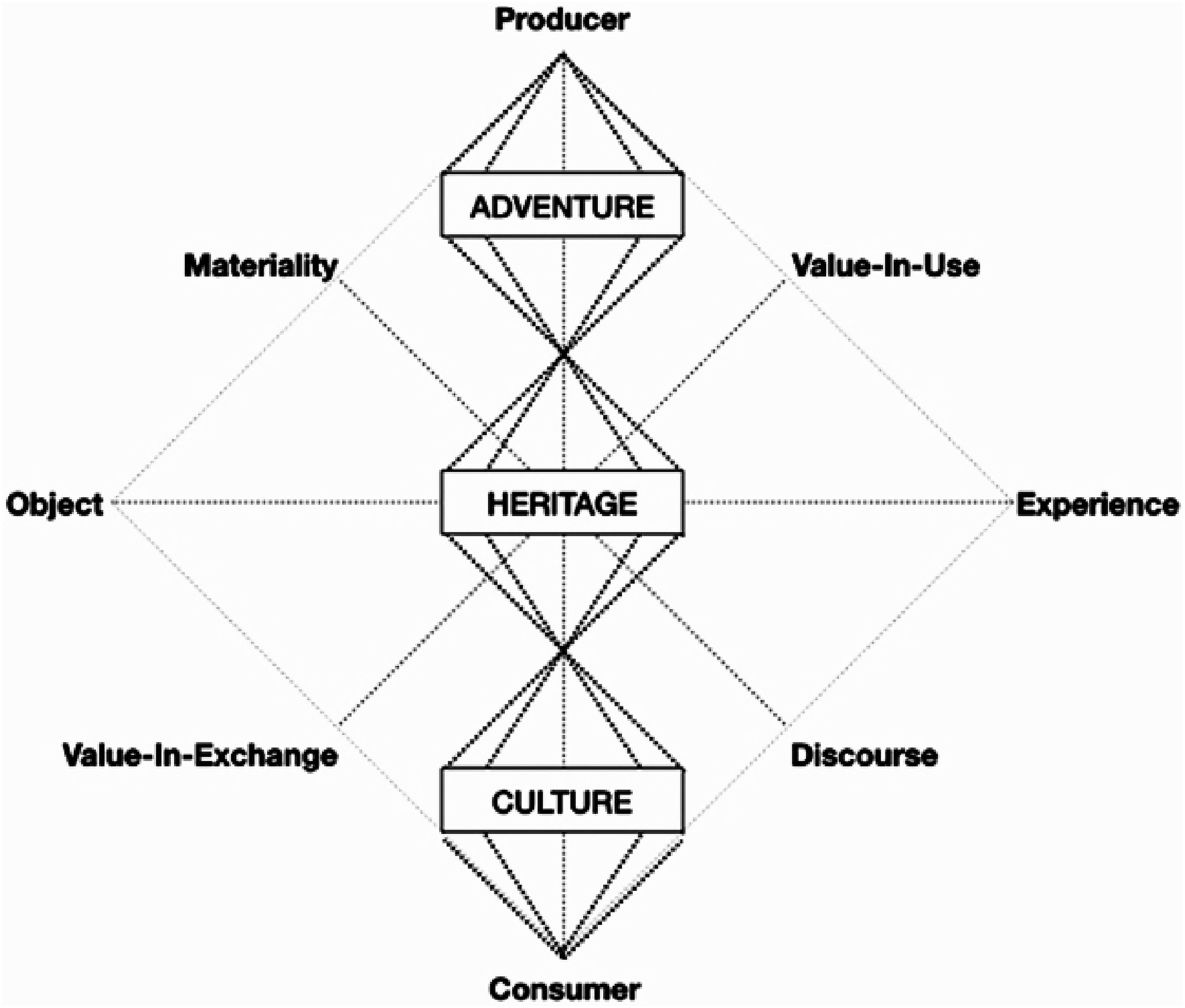
We thus see how this ambiguous brand captures and embodies the tourism imaginary conferring both certainty as to what the Wild Atlantic Way is, while at the same time allowing space for interpretation (Chronis, 2012). This demonstrates how the interplay between reality and imagination, concept and performance (Chronis, 2012), and also between materiality and discourse, object and experience, producer and consumer, value-in-exchange and value-in-use, produces the spaces-in-between. Actors negotiate these inherent tensions to create experiences and realise value for themselves and others.
The Wild Atlantic Way reflects a branding approach that is itself wild and untamed, capable of accommodating the shifting meaning(s) of place by multiple actors while simultaneously anchoring those meanings in an implicitly shared understanding of the wild. It cannot be made explicit – as the process of making meaning explicit eviscerates its essence which lies only in its elusive, ambiguous and amorphous articulation. Thus, ambiguity can be a strategic resource in situations where meaning is fluid rather than fixed (e.g. as with organisational culture [Eisenberg, 1984] and advertising [Puntoni et al., 2010]), and where control is shared as is the case with place brands (Warnaby et al., 2010). Because of their open-ended nature, ambiguous brands can be interpreted and re-interpreted, imagined and re-imagined, combined and re-combined by diverse actors in unlimited ways. The Wild Atlantic Way encourages actor engagement in the creation of value and experience; it not only facilitates polyphonic meanings but also leaves space for new meanings to emerge, such that it becomes simultaneously a place, an idea and a living brand.
The physical seascape and landscape of Ireland’s west coast appear largely untouched by the market, having existed in their current form for millennia. The area incorporates beaches and cliffs, mountains and rivers, wildlife habitats, the ruins of ancient civilisations and the remnants of more recent settlements. These spaces have been reconfigured into the Wild Atlantic Way. The material, symbolic and/or experiential aspects of the brand are integral to the value-creating activities of this complex, dynamic and diverse network of tourism and other actors. Interaction with the brand allows value to be created and re-created in unlimited ways constituting multifarious representations, applications and interpretations.
The Wild Atlantic Way is thus neither landscape nor discourse. It defies traditional dichotomies of material/immaterial, ordinary/extraordinary, production/consumption, object/experience, reality/imagination and concept/performance. It works as a palette of possibilities, some imagined and others yet to be imagined. This is possible because places are understood in terms of the social, the symbolic and the ritualistic, and are constructed through myth and image. Thus, the marketing and consumption of a place becomes a continuous social and economic process of interacting and collaborating with tourists and other actors. Opportunities to co-create value exist in the materiality of seascape and landscape, in the possibilities of discourse and in the imagination(s) of diverse tourism actors through various social, symbolic and ritualistic practices.
The realisation of value is ultimately to be found in the spaces in-between, and market actors benefit from being comfortable with ambiguity and fluidity. Marketers can facilitate co-creation by developing ambiguous brands, which are essentially relational and creative resources that enable actors to conjure up their own transformational engagements. Thus, the value of the place brand may be better considered as an open-ended object (Lury, 2004) or open-resource (Pitt et al., 2006), a malleable discourse rather than a single story. This requires that brand leaders appreciate context and relax control of the brand to accommodate the myriad possibilities in its ongoing formation (Kavaratzis and Hatch, 2021).
Conclusion
Places are unfinished entities (Cresswell, 2004; Warnaby and Medway, 2013) and subject to the ongoing influence of materiality, discourse and experience. As such places are dynamic and complex, posing significant challenges for branding approaches that attempt to fix meaning (Kavaratzis and Kalandides, 2015). Our discussion of the Wild Atlantic Way shows the benefits of a branding approach that acknowledges such fluidity in meaning. Reimagined as a creative resource in the value co-creation processes of diverse actors, the brand facilitates interaction, engagement and experience. Not only does this accommodate the evolving meaning of place, but also it becomes a living brand, with its meaning evolving through enactment and performance. In this case, the relationship between the place and the brand becomes truly dialectical, with both influencing and being influenced by each other.
We demonstrate the potential of the brand as a creative resource by foregrounding the role of ambiguity in accommodating these dynamic and dialectical processes. Ambiguity accommodates the tensions inherent in dealing with places and place brands, negotiating between being and becoming, essence and contingency, control and openness. The Wild Atlantic Way highlights the potential of embracing ambiguity, in communicating possibilities, in engaging with ideas even without full control of the resources on which their realisation relies. Ambiguity allows actors to engage in predictable and in creative ways, which ultimately result in the actualisation of value for them. Thus, although somewhat paradoxical, it is precisely because the Wild Atlantic Way is ambiguous, malleable and open to interpretation, that it offers opportunities for convergence and coherence in value creating activities. Actors interact with the Wild Atlantic Way, transforming it from a disparate collection of localities, attractions and businesses, into a living place; a wild, Atlantic way.
We contribute to the wider discussion of ambiguity as a strategic resource (Eisenberg, 1984; Puntoni et al. 2010; Brown et al. 2013) by illustrating how ambiguity fosters coherence and shared meaning, while simultaneously allowing for multiple interpretations in the experience and performance of place. In the case of the Wild Atlantic Way, the coordinates of the space are established by the physicality of the Irish coastline, by the myth of the wild and the pillars of culture, heritage and adventure. It is in the detailing of certain things, and the failure to detail others, that shared meaning is coherent even while individual performances diverge. Meaning is fixed by the coordinates, while creativity is encouraged via the spaces in-between. Thus, if ambiguity is to be a strategic resource, it does not mean that anything goes; rather it must be carefully constructed and meaningfully deployed.
Footnotes
Declaration of conflicting interests
The author(s) declared no potential conflicts of interest with respect to the research, authorship, and/or publication of this article.
Funding
The author(s) received no financial support for the research, authorship, and/or publication of this article.

Diversity of offerings along the Wild Atlantic Way