




Abstract
We explore the embodied nature of the customer experience. Engaging prior research, we suggest marketing literature is still coming to terms with how best to incorporate the body into its studies, noting manuscripts rarely attend to the bodies of customers moving in situ or analyse what customers do and achieve with their bodies. As a result, theoretical accounts remain quite disconnected from the de facto activities that comprise many marketing processes. Drawing on ethnomethodological study policies, and Wittgenstein’s notion of language games, our paper zooms-in on embodied conduct, analysing video recordings of consultations in hair salons. We analyse how customers embody thoughts about and emotional responses to the service provided. Rather than separating mind and body, we identify precise moments where customers draw service employees into their experience during live interaction. In so doing, the paper offers a vantage point from which to think anew about the customer experience as something that is public, shared, and thus accountable.
Keywords
Introduction
It has been argued that early literature on the customer experience relied too much on ‘an image of customers as disembodied agents, targeted by environmental inputs’ (Yakhlef, 2015: 554). In subsequent waves of qualitative research, the customers’ perspective was prioritised (Lemon and Verhoef, 2016). However, and noting the ‘disciplines’ tendency to privilege the mind over the body’ (Stevens et al., 2019: 807), this work often reduced the notion of experience to a private ‘subjective response’ (Helkkula and Kelleher, 2010). Taking a subtly different tack, we aim to contribute to recent studies that have considered how the customer experience is embodied (Echeverri and Salomonson, 2017; Kuuru and Närvänen, 2022; Stevens et al., 2019). It is hard to grasp the ‘sensuous, affective and emotional aspects of experience’, it is argued, without recourse to ‘the body’ which is after all the locus of experience (Yakhlef, 2015: 545). The turn to the body promises, but we argue is yet to fully deliver, an important reworking of key notions within marketing, including the customer experience.
Whilst recent research has attempted to understand how the customer experience is embodied (Joy and Sherry, 2003; Kuuru and Närvänen, 2019), we notice studies have stopped short of analysing embodied activity directly and consider this an important limitation. Moving beyond the idea that the customer experience is a private subjective response (Becker and Jaakkola, 2020), we analyse how customers exhibit their experience through the body. Rather than separating mind and body, we reveal the precise moments where customers embody what is ‘on their mind’. These processes are nuanced, artful, and game like. Interacting with service employees, customers might make subjective states very obvious, or they might more subtly guide others to see a hint of dissatisfaction behind an ostensibly positive response. For their part, service employees might search for problems in the fine details of a facial expression or sigh, or artfully overlook even grossly negative displays. We explore this intriguing language game (Wittgenstein, 1958) and the sometimes delicate and skilful ways customers incorporate others into their experience (Merleau-Ponty, 1962).
A video-based study is presented (Belk and Kozinets, 2005; Llewellyn, 2021; Oshima, 2014; Rokka et al., 2018; Vom Lehn, 2006). The empirical sites are US hairdressing salons, and we focus specifically on the moment towards the end of the encounter where stylists present the cut to the customer for them to consider and review. In the way they look at the cut, handle mirrors and capes, inspect their hair, etc., customers may embody delight, nervousness, uncertainty, or ambivalence, towards the cut. They do this towards practical ends. The delighted customer might leave the salon promptly; the uncertain customer might want reassurance; the ambivalent customer might want their hair re-cut. For their part, in the way they play the game, stylists may be attentive to these displays and pursue the precise meaning and implications of pauses and exhalations, or they may studiously overlook the practical ways customers embody their experience. We track the customer experience all the way down, into the way people breathe, cast their gaze, and touch objects. In these ways, ‘subjective responses’ that comprise the customer experience are made public and accountable and thus materially relevant for the activities at hand.
The study offers two central theoretical contributions. First, we extend the analysis of embodiment and customer experience in marketing, showing the customer experience is intersubjectively available through the body. Rather than private and reflective, the customer experience is shown to be public and socially accountable. Second, the study contributes to a better understanding of the dynamics of service interactions. We sketch the intricate interactional ‘architecture’ (Heritage, 1984a) of the practice of the salon, and show how it enables and constrains the actions of customers.
Theoretical context
Embodiment and the customer experience
Across the last 25 years marketing scholars have conducted extensive research to better understand the nature of customers’ bodily experience (Echeverri and Salomonson, 2017; Joy and Sherry, 2003; Llewellyn, 2021; Stevens et al., 2019; Valtonen and Närvänen 2016), how customer perceptions, emotions, and experiences can be said to be embodied, that is, practiced, learnt, known, and understood through the body (Yakhlef, 2015). Much of this work aims to develop a radical alternative to traditional theorising, which has dualistically separated the customer’s body from the cognitive processes through which subjective experience is evaluated and theorised (Thompson et al., 1989). The body has been placed centre stage in studies that explore dancing and ‘losing it’ in nightclubs (Goulding et al., 2008), feeling time ‘drag’ and ‘rush’ on the paintball battlefield (Woermann and Rokka, 2015), learning to move with passion on the salsa dance floor (Hewer and Hamilton, 2010), ‘living in the moment’ whilst surfing a wave (Canniford and Shankar, 2013), and ‘being someone else for a day’ at Cosplay conventions (Seregina and Weijo, 2017). Consumption practices that involve ‘shaping or modifying the body’ (Kuuru and Närvänen, 2019: 1242) have been brought into view. The body has been explored as a locus of identity construction in studies that analyse how people craft their body to ‘convey meanings that are intertwined with [their] story’ (Roux and Belk, 2019: 500), for example, through tattooing (Roux and Belk, 2019), plastic surgery (Schouten, 1991), and exercise (Pekkanen et al., 2017).
More specifically, and framing the present paper, an emerging body of work has explored the customer experience (Becker and Jaakkola, 2020) in service and retail settings (McColl-Kennedy et al., 2015; Stevens et al., 2019), considering how people participate in interactions across the customer journey and how these interactions are shaped by material and social dynamics. Yakhlef (2015) was amongst the first to frame the customer experience as a product of ‘skills’ sedimented in the customer’s body. An embodied perspective is now emerging (Kuuru and Närvänen, 2019, 2022; Manolis et al., 2001; Stevens et al., 2019). Kuuru and Närvänen (2022) consider how employees incorporate their bodies in service encounters: how bodies are used to connect and build trust with customers, gain important information, and elicit responses. Exploring the Hollister ‘brandscape’, Stevens et al. (2019) analyse brand materiality, sensory shocks, and how ‘bodily movements structure the retail experiences’ of consumers, that are ‘less about thought processes, and more about the unthought, the tacit, bodily skills’ that guide interaction (Yakhlef, 2015: 559 as cited in Stevens et al., 2019: 822). Llewellyn (2021) analyses how customers embody knowledge in the way they handle objects and gesture. Rather than a private psychological domain, knowledge is shown to be written across the body.
The turn to the body has the potential to unsettle fundamental concepts in marketing, but we think the field is still coming to terms with how best to incorporate the body into its studies. At present, for example, it is noticeable that actual bodies are still largely absent from literature on embodiment, both generally and in relation to studies of the customer experience. Talk about the body rather than bodily activity itself has been analysed. Published works are for the most part about the body and fail to draw actual bodily movements, activities, and experiences into analytic focus (but see Llewellyn, 2021; Vom Lehn, 2006; Vom Lehn and Heath, 2016). Whilst valuable, ‘for all the promise of this new scholarly interest in the body there is not much bodiliness in it’ (Casey, 2000: 58). As a result, we continue to know little about what customers do and achieve with their bodies when they interact with firms. Theoretically, enduring distinctions and dualisms have remained firmly in place through these studies, because they separate the body acting in the material environment and the reflective processes through which bodily experiences are understood.
So, despite engaging theoretical sources that aim to revive the body from its position as an object of scientific research, we think existing literature is yet to realise the radical possibilities on offer through the turn to the body. Therefore, this paper aims to show how a more thorough-going engagement with bodily conduct is possible, one that delivers a distinctive way of approaching marketing concepts. We analyse customers moving dynamically within the immediate environment to reveal what they do and achieve with their bodies. We present an analysis of rather than about embodied conduct (Hindmarsh and Pilnick, 2007). Rather than separating thought and action, mind and body, we recover how these are reflexively entwined, how customers embody what may be on their mind, and thereby draw others into their subjective experience. Rather than something private and removed from interaction, we show how subjective experience is public and socially accountable.
Language games
Surely there can be no general answer to the question of how people embody their experience. It must depend, for example, on what has just happened, the person in question, their background, their personality, or simply the kind of day they are having. In the hair salon at least, we show this is definitely not the case. Rather, customers embody their experience, showing they are happy, nervous, or somewhat ambivalent, by producing highly recurrent, tightly controlled, and closely monitored actions within a language game they neither create nor fully control. We analyse the social organisation of embodied activity drawing upon Wittgenstein’s (1958) notion of language games.
Wittgenstein (1958) lists the following as examples of language games: ‘giving orders, and obeying them’, ‘describing the appearance of an object, or giving its measurement’, ‘reporting an event and speculating about an event’, ‘guessing riddles’, and ‘making a joke’. This might seem an odd way of starting to articulate something as extraordinarily complicated as a philosophy of language. It contrasts sharply with theories of the time associated with Russell and later Chomsky, where mastery of language consists of the gradual tacit appreciation of its universal ‘depth grammar’ (Hacker, 2012). Wittgenstein (1958) turns from the idea of a ‘unitary theory of the functioning of language’ and finds instead ‘innumerable uses’ or ‘games’ (Ricoeur, 1976: 92), each delimiting a field of language-use in which ‘certain procedures are valid as long as one plays that game and not some other’ (Ricoeur, 1976: 93). We analyse a pervasive language game in contemporary society that we currently know little about, ‘assessing a service’.
The analogy with games informs how the meaning of embodied conduct should be understood, as moves that make relevant the procedures and rules of the game (Harris, 1990). Take one aspect of embodied conduct, namely talk, and the meaning of evaluative utterances, of the kind customers might use. For Wittgenstein (1958) these cannot be understood as signs of how people are thinking. The imperative is to understand what the utterance is doing within the sequence of activities that comprise the game. Suppose a guest at a dinner party is about to say ‘that was great’ to describe the meal they have eaten. But before they speak, another guest describes the meal as ‘the most incredible of his life’. At this point, just saying ‘it was great’ may be heard as a negative comment, a marked downgrading of the prior assessment (Pomerantz, 1984). This has nothing to do with the speaker’s thoughts or intentions. The effect and meaning of the utterance arise from within the language-game, because sequentially adjacent evaluations may be heard to inform one another (Pomerantz, 1984). The speaker may have to improvise to avoid being ‘seen as’ (Wittgenstein, 1958) an ungrateful guest.
People do not play language games only with words, but draw upon a range of other resources, such as the body and material objects. In an illuminating case, Charles Goodwin studied interactions with an aphasic man only able to say ‘yes’, ‘no’, and ‘and’, to understand what form of life a language game with these constraints can lead to (Goodwin, 1995). Drawing on more than spoken language, Goodwin found he was able to assemble and navigate the ‘rules’ and enact the ‘procedures’ (Ricoeur, 1976: 92) of a rudimentary language game and moreover play this with skill and finesse. So, in addition to spoken language, people play language games by drawing upon intonational and prosodic resources, gestures, facial expressions, sequential resources, and material objects (Goodwin, 1995).
Our interest is a language game we call ‘assessing a service’. We ask what this game comprises and how is it played? Wittgenstein (1958) argued that knowing how to ‘go on’ within a language game is not the same as simply knowing the relevant rules or procedures. Customers do not embody pleasure, displeasure, or uncertainty by simply following a rule, just as knowing the rules of chess, and being able to play chess well, are two different things. So, we do not attempt to abstract rules from the data, but identify regular ways that people play the game, recurrent trajectories of action. As an analogy, consider ‘telling a joke’ (Wittgenstein, 1958). This involves actors learning how to artfully instantiate and administer a complex social ‘organisation’ (Seligman, 1976: 209) that cues and controls the actions of others; comedians learn their craft over years. They do not simply follow rules, but animate the organisation, play with it, and improvise where necessary. In many institutional settings, language games play-out in similar ways to this. Doctors, lawyers, and teachers artfully instantiate and administer language games, often many times each day, seeking to cue and control the actions of patients, witnesses, and students, with varying degrees of success.
So, we approach customers’ responses as products of language games. It is important to note that the responses we consider have a ‘reflexive’ element (Garfinkel, 1967), in that they are an active part of the experiences they simultaneously reflect upon. If they want to appear delighted, the delighted and the ambivalent customer face the same problem; they must authentically embody a genuine emotion. Whether ‘what customers say’ corresponds with ‘what they think’ is thus not only a philosophical problem; it is simultaneously a practical and normative problem for the stylists and customers we analyse. Truth is endogenous to language games in this sense (Wittgenstein, 1958). The responses we consider are true only within the practice at hand, and not in relation to some ‘Archimedean point … outside of all language’ (Mauws and Phillips, 1995: 326).
Accessing the salon: The study
Overview of recorded encounters.
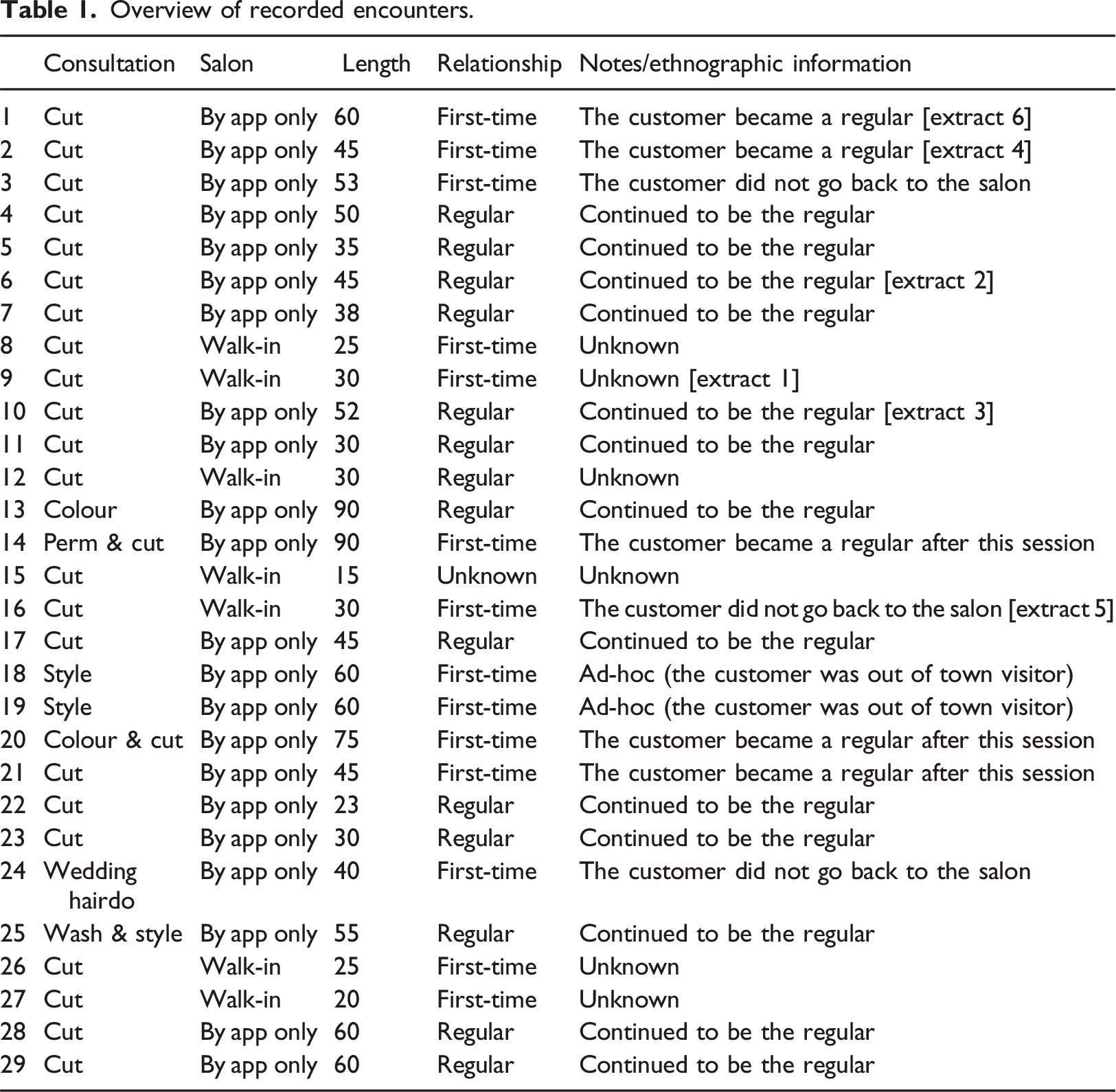
Beauty salons are busy and often noisy places full of commotion. Efforts were made to be unobtrusive. Tripods were used to generate steady images and to avoid becoming a moving obstacle. Remote microphones were used to record conversations. High-quality images were captured from a rear three-quarter view, recording participants through the large mirror they faced or directly from the side. Customers were not systematically interviewed following their consultations, but some voluntarily offered comments. They were not tracked over time, although many stayed in touch with the videographer which yielded additional insights (see Table 1).
The data were transcribed using the notation system developed by Gail Jefferson (2004) that captures intonation, prosody, speech timing, and overlap, and Goodwin’s (2000) method for documenting embodied actions. We analysed the transcripts by drawing on study policies developed within the allied fields of conversation analysis and ethnomethodology (Garfinkel, 1967; Sacks, 1992). The core policy we apply is simple enough. We only make claims about what some embodied activity might be doing where it can be empirically demonstrated that actors themselves are orienting to things that way (Sacks et al., 1974). Suppose a customer is asked what they think, and in response makes a particular facial expression. We would not interpret the expression ourselves, in relation to our knowledge. Rather, we analyse how actors themselves interpret and account for talk and embodied activity in what happens next. How embodied conduct exhibits subjective responses is first and foremost a practical and inferential problem for social actors. In response to the facial expression the stylist might orient to a customer that is not entirely happy, for instance, by simply asking ‘is everything okay’.
Our approach is granular. We consider each utterance and piece of embodied conduct and how problems of meaning and implication are resolved by actors second by second. In some cases, this can be relatively straightforward. Continuing the prior example, if the stylist responded by saying ‘is everything okay’ their interpretation of the customers expression would be relatively clear. The customer is seen to have a concern. Analysis becomes more complex where talk, embodied interaction, and material objects interact. In some cases we consider below, customers say they are happy, but are nevertheless taken to have concerns. In these cases, we try to recover the interplay between different modalities, to learn what can be achieved through prolonged gaze, or from the way objects are moved and handled. Exploring activity at this granular level is important. We show that stylists often orient to pauses of less than one second, and even inhalations, as signs that the customer may be unhappy. It is precisely in these quotidian details that customers make their experience intersubjectively available, to other customers, companions, and to stylists.
Findings
Embodying surprise and delight
We begin by addressing how customers embody surprise, and delight, and how stylists solicit, marshal, and organise these responses.
In Extract 1, the customer has walked into the salon without an appointment. Meeting them for the first time, the stylist spends half an hour cutting and styling their hair. The customer is then asked, ‘how’s that look’ (line 2). Embodying surprise and delight.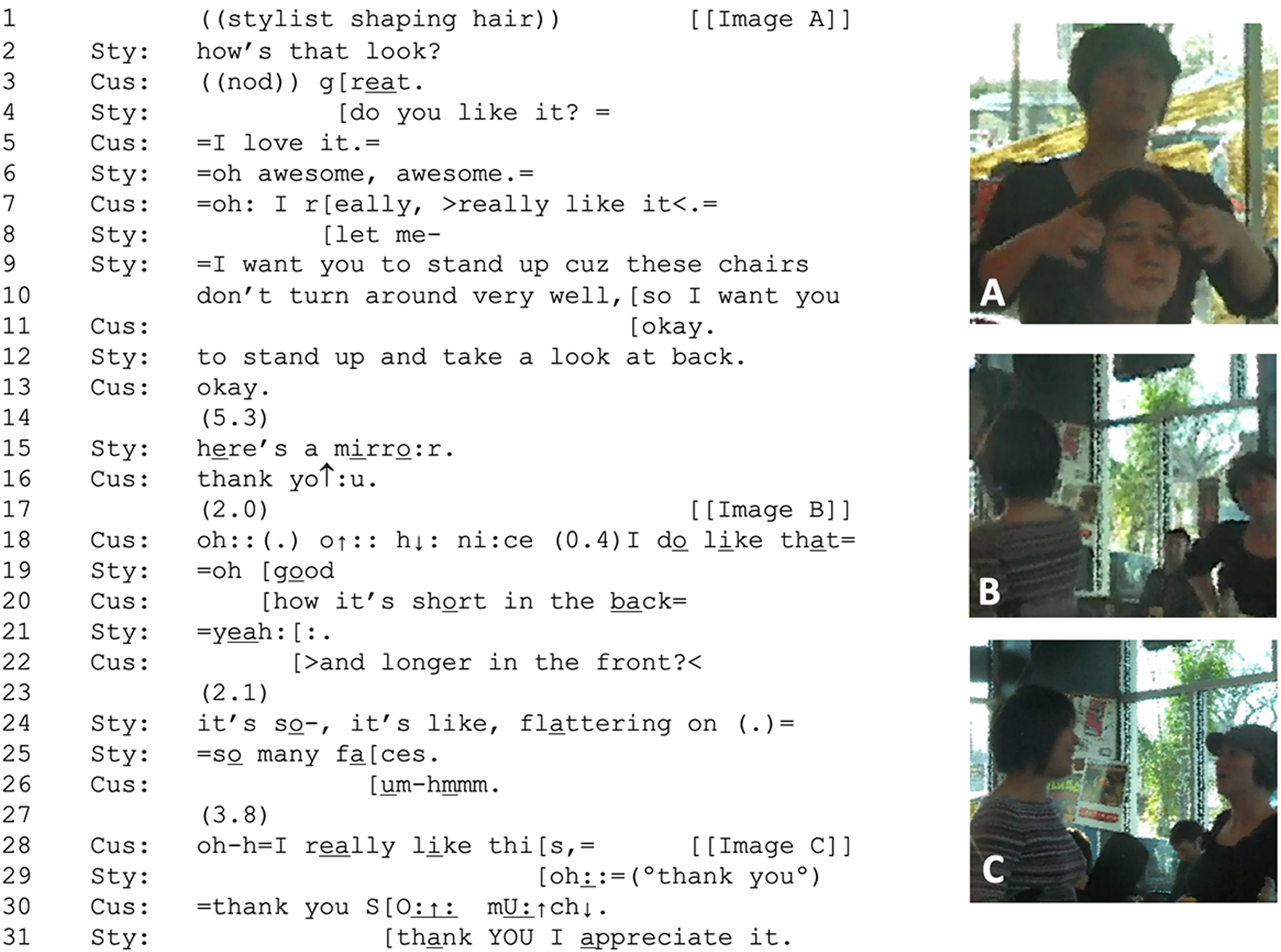
Before inviting the customer to respond, the stylist signals a shift into the evaluative phase through her embodied activity. She puts the drier down and spends time arranging the customer’s hair (image A). In each extract in the corpus, customers orient to the normative implications of this work. They never produce evaluations whilst this work is being performed, but wait. This work thus renders the service assess-able.
The stylist asks ‘how’s that look?’ (line 2) and seeing the customer’s nod, adds a further question (‘do you like it’, line 4) that has a distinctive relation to the first. The first question pursues an object-side assessment about the haircut (‘that’, line 2) whilst the second is a subject-side question (Edwards and Potter, 2017) that targets the customer’s feelings. It also mobilizes what conversation analysts call preference for agreement (Pomerantz, 1984). It makes agreeing interactionally easier than disagreeing by warrant of its positive grammar (‘like’, line 4). Finally, the question invites a second assessment and studies have noted these are routinely expected to upgrade the first, and that even repeating the grammar of the initial assessment can be problematic (Pomerantz, 1984). In this case, the customer responds on cue, producing an upgraded subject-side assessment (‘I love it’, line 5). The customer is not being coerced, but they are being manoeuvred through the game. Notice the second assessment is treated quite differently to the first. The stylist accepts the second upgraded evaluation as a genuine description of the customer’s subjective response (‘oh, awesome, awesome’, line 6).
By this point, the stylist would ordinarily have handed the customer a mirror and spun them around to inspect the cut from different angles. But this particular chair does not turn well. The stylist removes the cape and asks the customer to stand so she can ‘look at the back’ (line 12), passing the hand-held mirror. The customer looks markedly at the cut, producing further evaluative talk. The stylist involves herself in the customer’s activity by watching her responsive actions through two mirrors. Any potential sign of dissatisfaction will be immediately visible to her.
The second wave of evaluations are qualitatively different to the first. They mark new discoveries, and the customer’s surprise and delight. Her verbal responses (‘oh::, oh:: nice, I do like that’, line 18) are finely coordinated with the embodied inspection. The first ‘oh’ is produced as she turns her head to one side, the second comes as she turns to the other side (see image B). The evaluations are oh-prefaced to exhibit a ‘change of state’ (Heritage, 1984b) in light of newly discovered information.
Finally the customer produces a fifth evaluation (‘oh I really like this’, line 28). This is ‘oh-prefaced’ not in response to new information but as a ‘fugitive commentary’ exhibiting an emotion that cannot be suppressed (Heritage, 1984b: 300). She ends the inspection, shifts her gaze fully to the stylist (Image C), and they progress towards closure.
So, this is a straightforward example of a positive exchange. Through this case, we have started to map the twists and turns of the language game. We have seen customer accounts are occasioned and constrained by the stylist’s preparatory work, and that stylists may pursue initial assessments and encourage customers to upgrade them and add subjective elements. We have considered how stylists organise and participate in the visual inspection of cuts and how customer responses are somewhat manoeuvred by them. More subtly we have noted how the customer’s account is first treated as preliminary, and then as definitive evidence of her subjective experience. Whilst customer responses were clearly manoeuvred by stylists’ actions, in practice all parties worked to preserve the sense that customer responses were autonomous and context-free. They were locally built as free-standing reflections of the customer’s mental state.
Noticing and disavowing concerns
In the salon, customers only produce ostensibly positive responses. There are no instances of overt complaints in the dataset. Potential concerns were recoverable instead in half-hearted praise or from the customer’s bodily conduct. Stylists were typically highly attentive to these signs. In most cases, they responded by enabling customers to disavow potential concerns. We start with a simple example and the second main trajectory or route through the language game.
Here (Extract 2), the stylist has prepared the hair, removed the cape, put her scissors down, and is wiping the table. In these ways, she strongly indicates her view the cut is complete. Looking away from the customer she asks ‘how does that look?’ (line 1) and passes him a mirror (line 3). The customer breathes in markedly (line 5) before emitting a stretched and ponderous ‘hhh:::m’ (line 6) whilst looking quizzically into the mirror (line 6, image A). His response is classically dispreferred (Pomerantz, 1984), that is, it is hesitant, mitigated, and delayed, and can thus be heard to be prefacing a negative response. Through ways of breathing and looking, the customer has embodied an accountably negative subjective response. The stylist sees this, and immediately poses a question (‘is that okay?’, line 7) that orients to things not being okay. Noticing and disavowing concerns.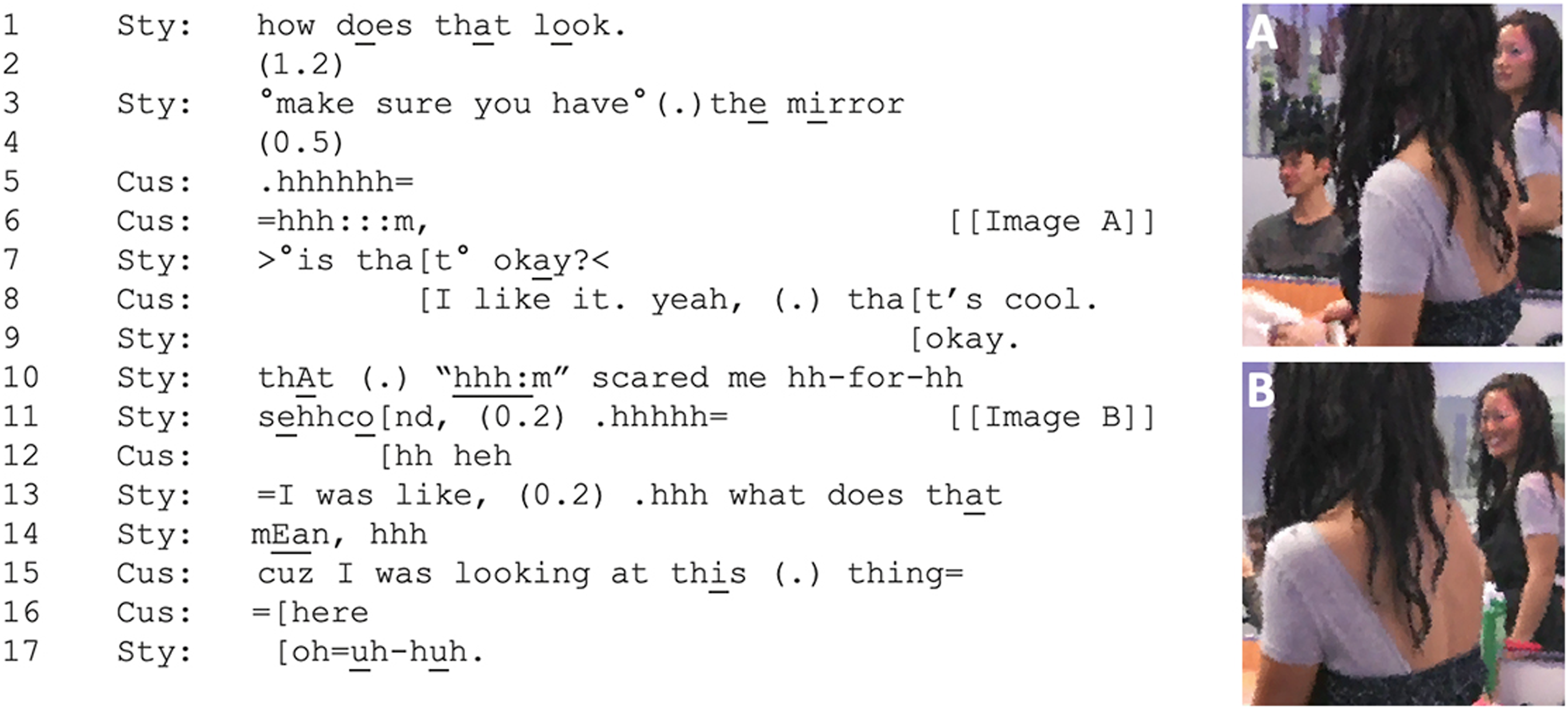
The troubles are dealt with swiftly. Before the stylist finishes her question (line 7), the customer produces a definitive positive assessment, disavowing any implicit complaint. The stylist’s ‘okay’ (line 7) is markedly upgraded by the customer through subject-side (‘I like it’, line 8) and then object-side assessments (‘that’s cool’, line 8). In this data then, we see what the stylist’s question does within the language game. It invites the customer to disavow and may even encourage him to be effusive because his earlier response has been ‘seen as’ (Wittgenstein, 1958) a sign of potential dissatisfaction. The stylist accepts the customer’s account with relief (‘okay’, line 9) treating it as a true description of his subjective experience.
Intriguingly, the stylist then produces a reflexive commentary on the action. She says his ‘hhh:m’ had ‘scared her for a second’ (lines 10–11). Whilst this is still part of the language game, it neatly reveals their shared attentiveness to the embodiment of experience and what is at stake at such points. Stylists may appear not to take much notice when customers inspect the cut, but theirs is a ‘studied indifference’ (Goffman, 1959).
We now consider a more complex case (Extract 3). This customer is ‘going short’ and calls her husband to prepare him. His lukewarm response becomes a topic of conversation in the salon with three stylists supporting her decision. Noticing and disavowing concerns.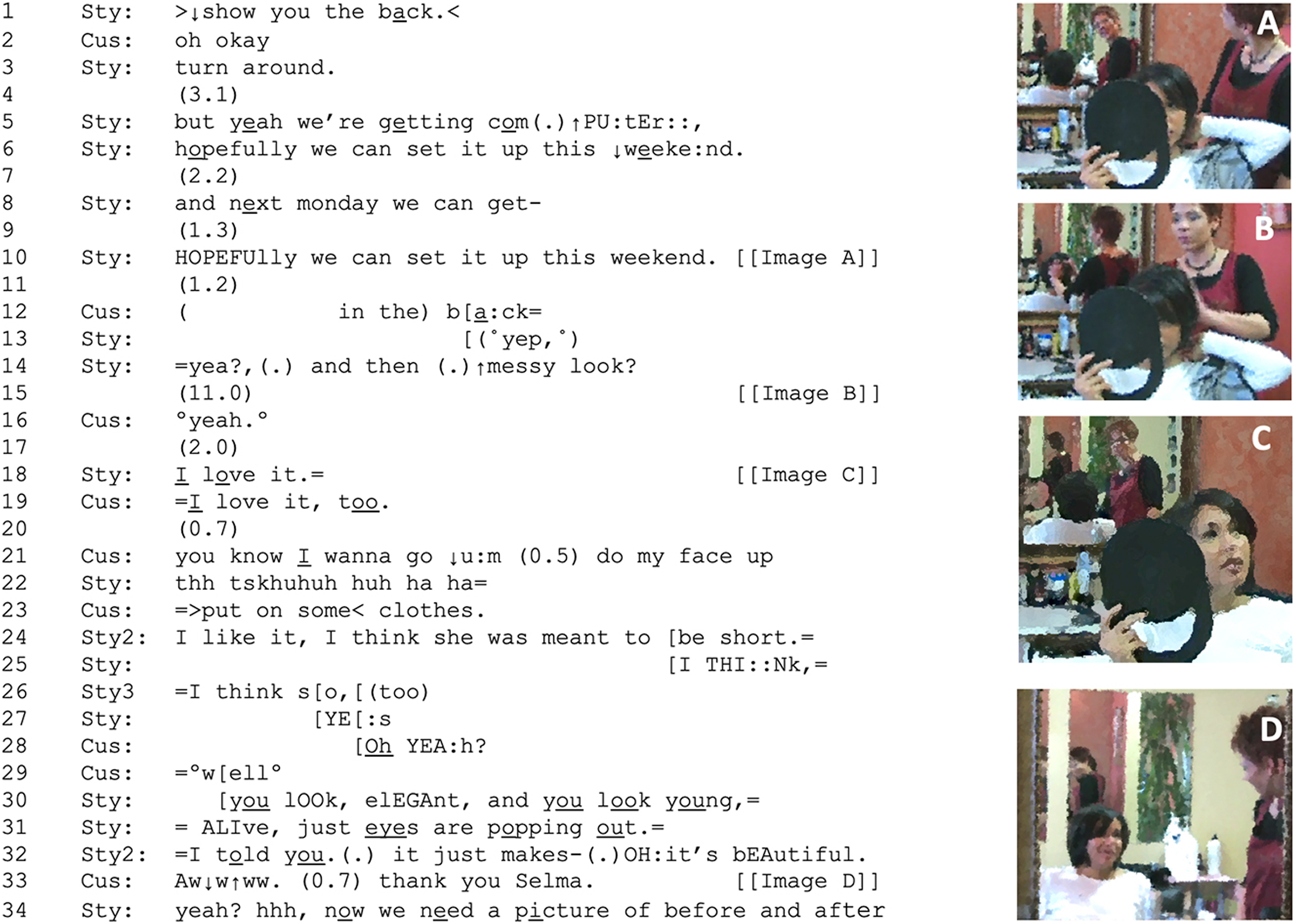
As we join the action, the chair has been turned and the customer is inspecting the cut whilst the stylist chats with colleagues (lines 5–10). The customer is being given space. She uses the hand-held mirror and touches the front of her hair. The stylist returns and illustrates how to produce a ‘messy look’ (line 14). Some 30 seconds have now elapsed.
The stylist finally moves to elicit a response through an action we have yet to observe. She turns to the customer, who catches her gaze, and elicits an evaluation by offering one herself. She says, ‘I love it’ (line 18, image C). The stylist’s action constrains the customer’s response because assessments make agreement or disagreement relevant as the next action (Pomerantz, 1984). The customer is free to respond negatively, but this would now take the form of a disagreement. The customer responds immediately, saying ‘I love it, too’ (line 19).
In isolation, this response might sound strongly positive. However, notice it merely repeats the stylist’s assessment term without any vocal or visual upgrading. It is heard as a ‘weak acceptance form’ (Houtkoop, 1987), and all parties work to upgrade the assessment.
The customer herself comes back to make a kind of joke. She says her clothes and make-up do not do justice to the cut (lines 21–23), thereby disavowing any negativity. Other stylists immediately join in, which suggests they had been monitoring the action, and produce a flurry of compliments (lines 24, 26, 30, 31, and 32). This occasions a warm expression of gratitude to the stylist (‘Selma’ in line 33, Image D) who suggests they need ‘before and after’ pictures (line 34), further building the sense of value.
In extracts two and three, customers that seem concerned or somewhat ambivalent were brought around fairly quickly. In Extract 4, this takes much more work, raising a new question: might this customer actually not like the cut? Noticing and disavowing concerns.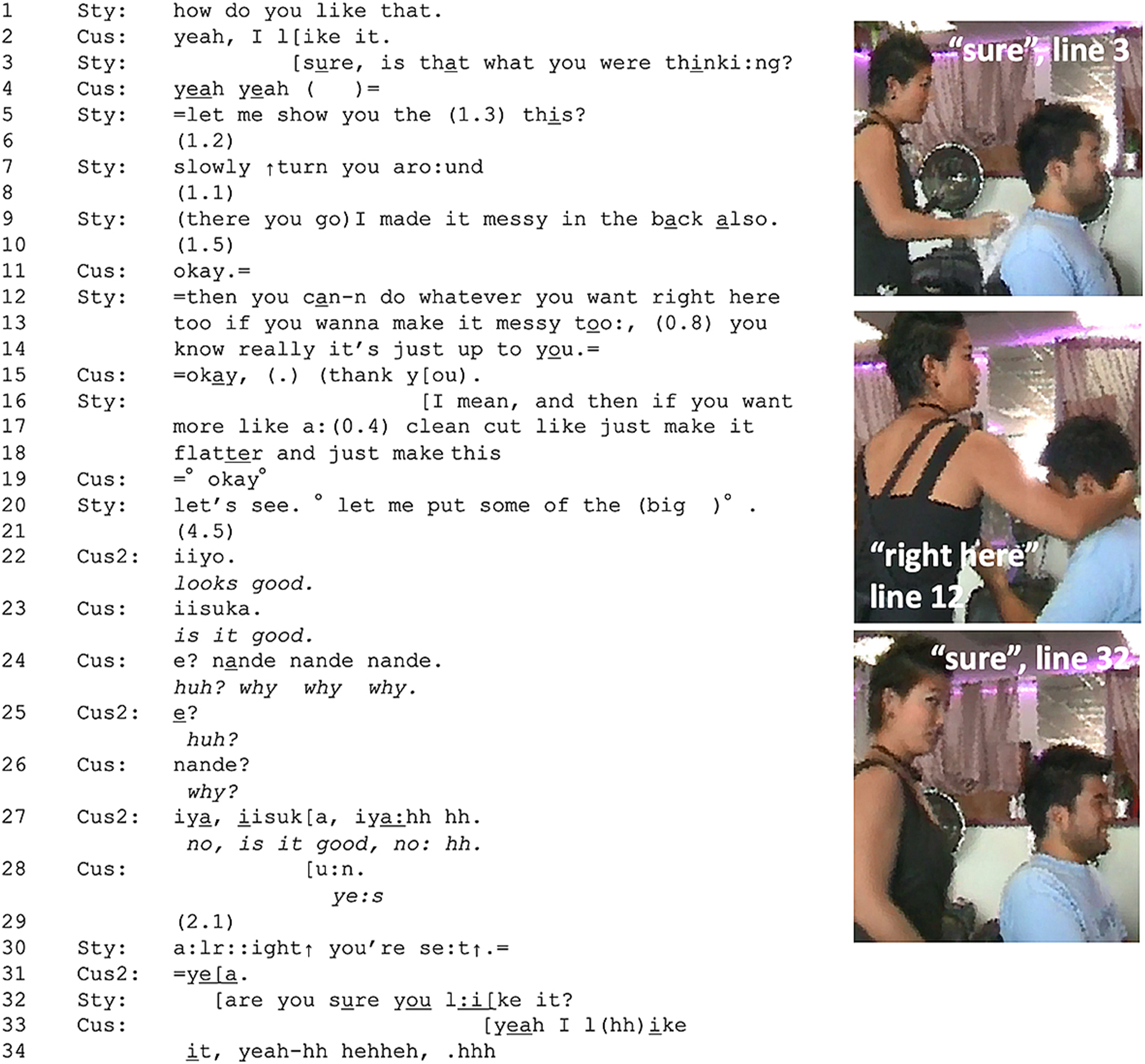
As we join the action, the stylist elicits an evaluation by asking ‘how do you like that?’ (line 1). Responding, the customer merely reproduces the stylist’s assessment term (‘yeah, I like it’, line 2). Whilst ostensibly positive, this is immediately treated as a problem. The stylist asks whether the customer is ‘sure, is that what you were thinking?’ (line 3). She presents a concerned facial expression, deploys questioning intonation, and ‘thinki:ng’ is produced cautiously. In response, the customer produces only a lukewarm disavowal merely saying ‘yeah yeah’ (line 4). His response does not satisfy the normative requirements of the language game, he is not happy enough.
The stylist turns the chair for the customer to view the cut from a new angle (line 7), inviting further evaluative talk. Will he now discover he really likes the cut? No. The customer merely acknowledges the new information (‘okay’, line 11). Pomerantz (1984: 92) distinguishes acknowledgement from agreement, suggesting that acknowledgements merely ‘acknowledge prior deliveries but make no claims of independent access’; only with agreements do ‘recipients of prior assessments claim access to the referents assessed’.
So, the customer has produced only a partial disavowal, and merely acknowledges the stylist’s description. Progression through the game has stalled. The stylist continues. She explains that he can wear his hair some other way (‘clean cut’ and ‘flatter’, lines 17–18). Again, this meets only with acknowledgement (‘okay’, line 19). The game grinds to a halt. A further instance of teamwork is then observed. The customer’s companion, who is seated to the left of the still images, starts up a conversation in Japanese, assuring him that the cut ‘looks good’ (line 22). She asks why he is questioning things (line 24).
The stylist engages the customer once more asking whether he is ‘sure’ (line 32) he likes the cut. Finally, he somewhat artfully allays her concerns by producing a more thorough disavowal (‘yeah I like it’, line 33), which is accepted as genuine. He laughs through his response orienting to her need for reassurance to be unnecessary, she is overly concerned.
In this language game then, customers need to embody a definitive positive response, about a potentially ambiguous subjective experience. Refusal or inability to comply is problematized until an adequate response is forthcoming. This relationship is monitored by stylists, customers, and peripheral actors who, displaying ‘domain-specific cultural competence’ (Maciel and Wallendorf, 2017: 727), participate in the action.
Embodying genuine concerns
How do stylists respond when customers don’t take their concerns off the table? One option is to be professionally inattentive to such signs and Extract 5 is a good example. Embodying genuine concerns.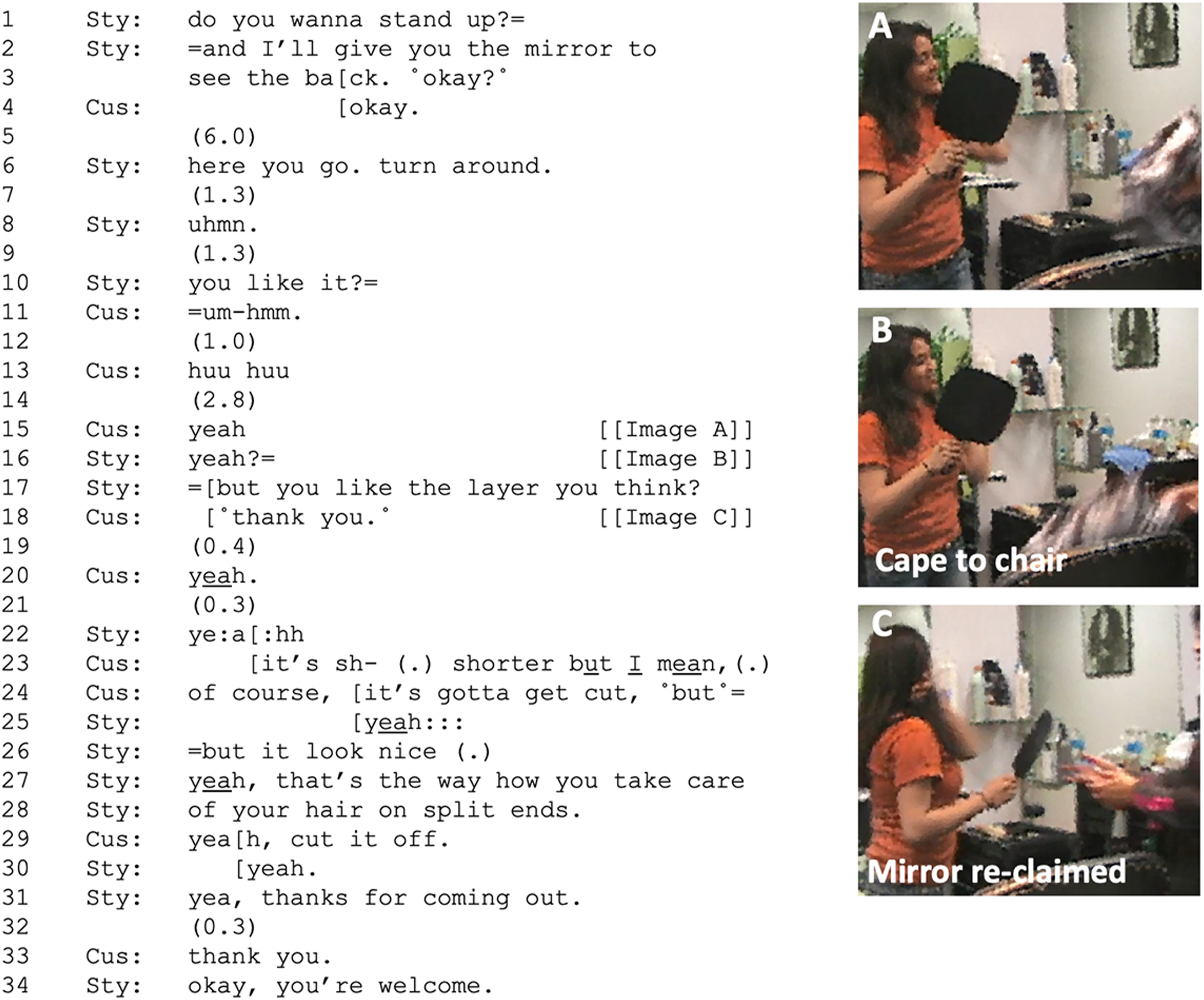
As the extract begins, a mirror has been passed to the customer who explores the layers that have been cut into her hair (lines 6–9). The stylist participates by touching her hair to animate the layering effect and then asks, ‘you like it’ (line 10).
The customer’s initial assessment (‘um-hmm’, line 11) is treated as preliminary by both parties, rather than a final description of a subjective response. The stylist does not seek to recover the mirror and the customer continues to inspect her hair. She agrees that she likes the cut (‘yeah’, line 15), and the stylist throws the cape onto the chair indicating neither are now considered relevant objects (images A and B).
But the customer is yet to fully assess the cut, and the stylist pursues a response by posing a question (‘you like the layers you think?’, line 17). As she does this, the stylist reclaims the mirror from the customer, even though it was still being used (image C). Subtly the customer resists. Whilst she passes the hand-held mirror and agrees (‘yeah’, line 20), she then turns and continues to inspect the cut in the large mirror. As we have seen, troubles are accountable in these moments of delay where customers seem to be pondering an ambiguous experience.
Rather than orienting to a problem, the customer’s cautious response (‘yeah’, line 20) is upgraded and modified by the stylist and treated as a cause of celebration (‘ye:a:hh’ like ‘yah’, line 22). In the midst of this come the early stages of a complaint (‘it’s shorter, but I mean, of course it’s got to get cut, but’, lines 23–24). This is not only side-stepped by the stylist but rearticulated within a positive frame of reference. Latching on to the end of the customer’s utterance (the word ‘but’ at line 24), the stylist transforms it into a positive assessment (‘but it looks nice’, line 26). Outside the salon the customer tells the videographer she hates the cut; she does not return. So, this is one route through the language game, in response to expressions of ‘genuine concern’.
An alternative is to orient to a genuinely negative experience and this will likely have material consequences. A case is now considered (Extract 6). As the action begins, the cape has been removed, the mirror passed to the customer, and the chair turned through 180°. The customer produces a positive though not effusive object-side assessment (‘it’s good’, line 5). Embodying genuine concerns.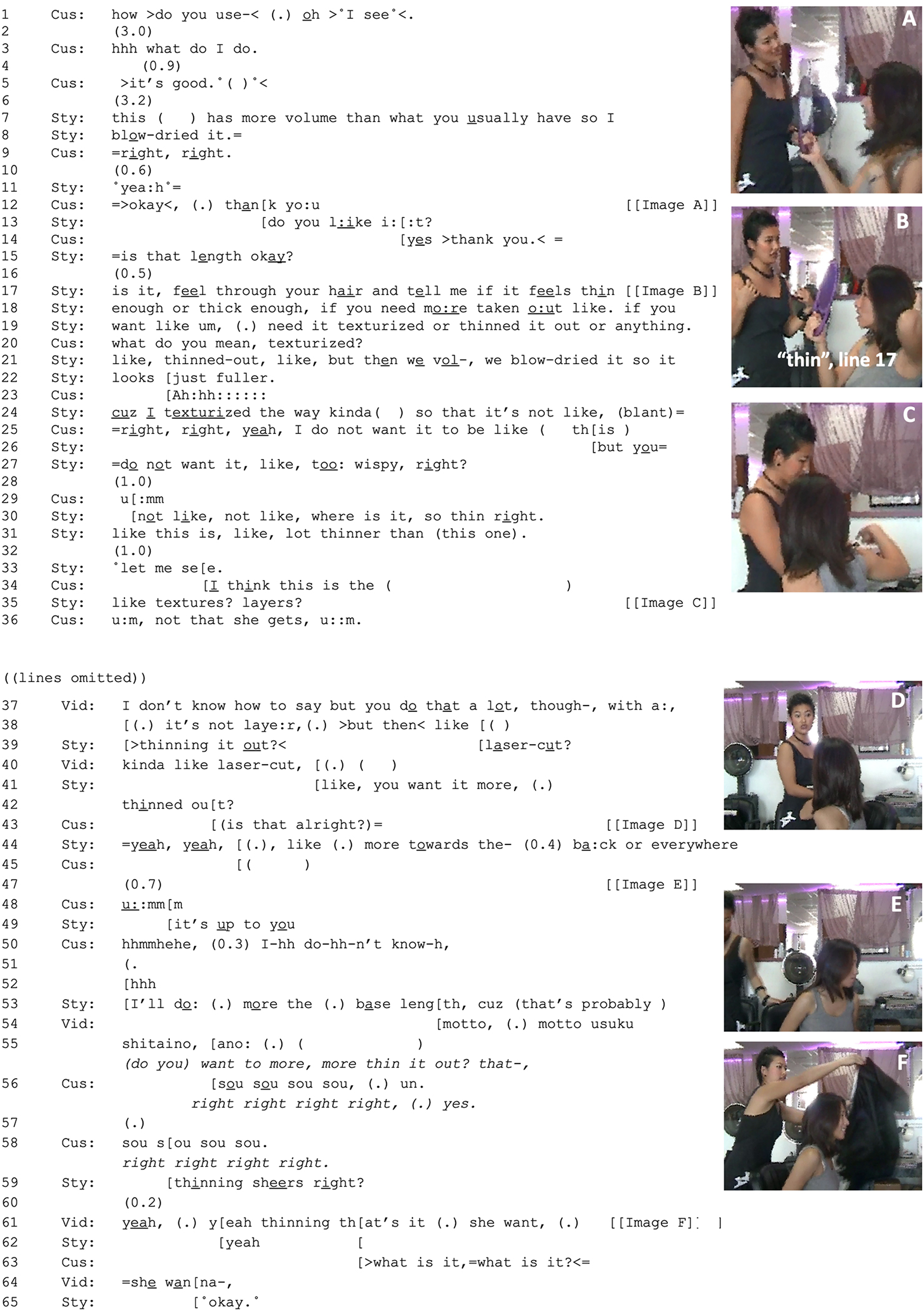
The stylist participates visually and by touching the customer’s hair (line 6), and a further positive response is produced (‘okay, thank you’, line 12) that implies closure. But rather than beginning to leave the customer shifts her gaze back to the portable mirror. The stylist poses a subject-side question (‘do you like it?’, line 13) that elicits only minimal agreement and gratitude (‘yes, thank you’, line 14). The customer continues to inspect her hair.
Searching for the source of the problem the stylist asks whether the hair is ‘thick or thin enough’ (lines 17–18) and whether she wants it more ‘texturized’ (line 19), raising the possibility of additional reparatory work (‘tell me…if you need more taken out’, lines 17–19). Rather than disavowing, the customer begins to explore the options with the stylist asking what she means by ‘texturized’ (line 20). The two struggle to find the right words. A magazine is consulted (lines 31–35, image C) which they both peruse.
The problem is resolved through a further example of teamwork. The customer enlists the videographer in Japanese to ask whether there is an English cosmetological term for thinning out the hair (omitted from the transcript). Having addressed the issue with the customer, the videographer turns to the stylist advising her that she has performed the cut before ‘which isn’t layered, but’ (lines 37–38).
The stylist offers to re-cut the customer’s hair through a supportive question that prefers an affiliative ‘yes’ response (‘you want it more thinned out?’, lines 41–42). Her embodied actions, namely nodding and widening her eyes (Image D), quickly abandoning the magazine, turning the chair back (Image E), and smiling as she puts the cape back on the customer (Image F), further mobilize this preference, framing the offer as genuine.
Solidarity in the salon is maintained. The re-cut has been interactionally achieved without the customer having to complain. She has embodied dissatisfaction in the most delicate ways through continued inspection and less than fulsome positive responses, agreements rather than assessments, and by not disavowing. The stylist offered the possibility of a re-cut through a question that prefers an affiliative ‘yes’ response. The videographer’s involvement was part of this too. Through her participation, the customer has been saved from voicing her own preferences. Without the stylist’s attentiveness to these embodied signs of troubles, this session might have ended prematurely. Instead, a loyal customer is produced who returns to the same stylist for the next few years until she moves away.
Discussion
We think studies of embodied conduct can occupy an intriguing and potentially radical theoretical position between objectivist research on the one hand, and qualitative studies of the customer’s subjective experience on the other. We have shown that subjective experience has an interesting and largely unexplored additional dimension. Rather than ‘private and internal’ (Lemon and Verhoef, 2016), the customer subjective experience is embodied and thus available to others. We have shown it is possible to locate the precise moments where, through a glance, expression, or utterance, customers reveal ‘thoughts’ about an experience, and we have seen stylists were somewhat expert at reading customers’ embodied conduct as potential evidence of a ‘psychological state’, expertise they used towards various local ends. More typically, marketing researchers have relied upon their own methodological expertise to access customers’ ‘thoughts’ and ‘experiences’. But the people we study already have their own ethno-methods for accomplishing precisely the same thing, that is, determining what someone may be ‘thinking’ from an immediate situated engagement with their talk and embodied activity. We encourage future research to better understand how customers exhibit, and service employees seek to access, subjective states during situated interaction. We believe this would significantly progress literature on embodiment in marketing (Kuuru and Närvänen, 2019, 2022; Yakhlef, 2015) where prior studies have rarely attended to what customers actually do and achieve with their bodies in interaction.
A critic might argue that during service interactions, customers are likely to be polite and hide their true feelings. The best way of knowing whether a customer is happy, delighted, or upset, is thus to ask them after the event. It might even be argued this view is supported by our data. After all, in one extract (Extract 5), a customer agrees with the stylist that she likes the cut, but later discloses her ‘true feelings’ to the videographer, that she hates it. Surely this suggests a frontstage arena where people manage appearances and a backstage where they describe their ‘real thoughts?’ Not at all, and in this case, the responses are hardly contradictory. Within the language game of the salon, the customer could have done little more to give the stylist access to her negative experience. She merely agrees she likes the cut, offers no positive assessments of the cut or her feelings, resists termination, and actually does start to voice concerns. Within the language game she is screaming ‘I hate it’. The challenge is to understand responses, not as literal descriptions of psychological states, but as moves in language games. Moreover, regardless of whether customers offer ‘honest’ and ‘true’ responses, there is a strong prima facie reason for prioritising their accounts. In contrast to all other accounts of the customer experience, those produced in situ are a material and constitutive part of the unfolding activities themselves. Within the salon customers embody their subjective experience within a social process relevant for determining whether the cut was complete, or whether more work was required (Extract 6).
In contrast to past marketing research that has often rendered the body static, a fixed signifier of meaning, our study has analysed bodies in motion. Through gestures, facial expressions, ways of looking, holding objects, etc., customers offer service employees a fleeting glimpse into what might be ‘on their mind’. We have drawn attention not only to bodies in motion, but how those bodies are seen (Goodwin, 2000). Many passages of Philosophical Investigations are given over to the problem of seeing and particularly how people see ambiguous objects such as a line that is suddenly ‘seen as’ a face (Wittgenstein, 1958: 206). Accessing the customer’s subjective experience involves service employees recognizing, not a static image, but a whole ‘organization’ (Seligman, 1976: 209) of moving parts, a picture that ‘go[es] together’ (Wittgenstein, 1958: 208). We observed that service employees can be quite canny in how they practice ‘seeing’. The stylist in Extract 5 may have privately seen the customer was unhappy, but she did not publicly orient to her that way. The customer left the salon unsure whether the stylist had seen her dissatisfaction; might the stylist have even thought she liked it? Surely a further reason not to return. This intricate language game, where customers embody subjective states to differing degrees, and service employees respond within limits, also provides a vantage point from which to think about the production of experience, and the creation of interactive value (Echeverri and Skålén, 2011). The customer in Extract 3, for example, was buoyed by the wave of compliments she received following her initially uncertain response. She received a narrative for understanding the value of the cut. Returning home to her sceptical husband she may have felt confident she made the right decision.
Ours is first and foremost a study of interaction and we end this section by considering how the paper may advance discussions about the interactive nature of services. Much prior literature has described the interactive nature of services, within and beyond the point of exchange (Schembri, 2006; McColl-Kennedy et al., 2015). Interaction is understood to be ‘a place for symbolic and experiential encounters’ (Manolis et al., 2001: 227) which dynamically shape service productivity (Manolis et al., 2001), service evaluation (Lloyd and Luk, 2011), service value (Penaloza and Venkatesh, 2006), and customer satisfaction (Maguire and Geiger, 2015). Yet, we wonder whether the literature is grounded in a compelling account of the ‘architecture’ of interactivity (Heritage, 1984a). Figure one (below) is our attempt to capture the interactional architecture (Heritage, 1984a) of the salon.
In this, customer responses were constrained and manoeuvred in recurrent and systematic ways in the pre-assessment phase (Phase 1, in Figure 1) by stylists removing the cape, cleaning the counter, and passing a mirror, all of which exhibited their sense the cut is done, and then in the assessment phase (Phase 2, in Figure 1) by producing first actions such as questions and assessments that prefer (Pomerantz, 1984) positive responses, and by visually participating in the inspection. Customer responses always aligned with the forms of preference established by stylists at these points. The language game: summary of three trajectories.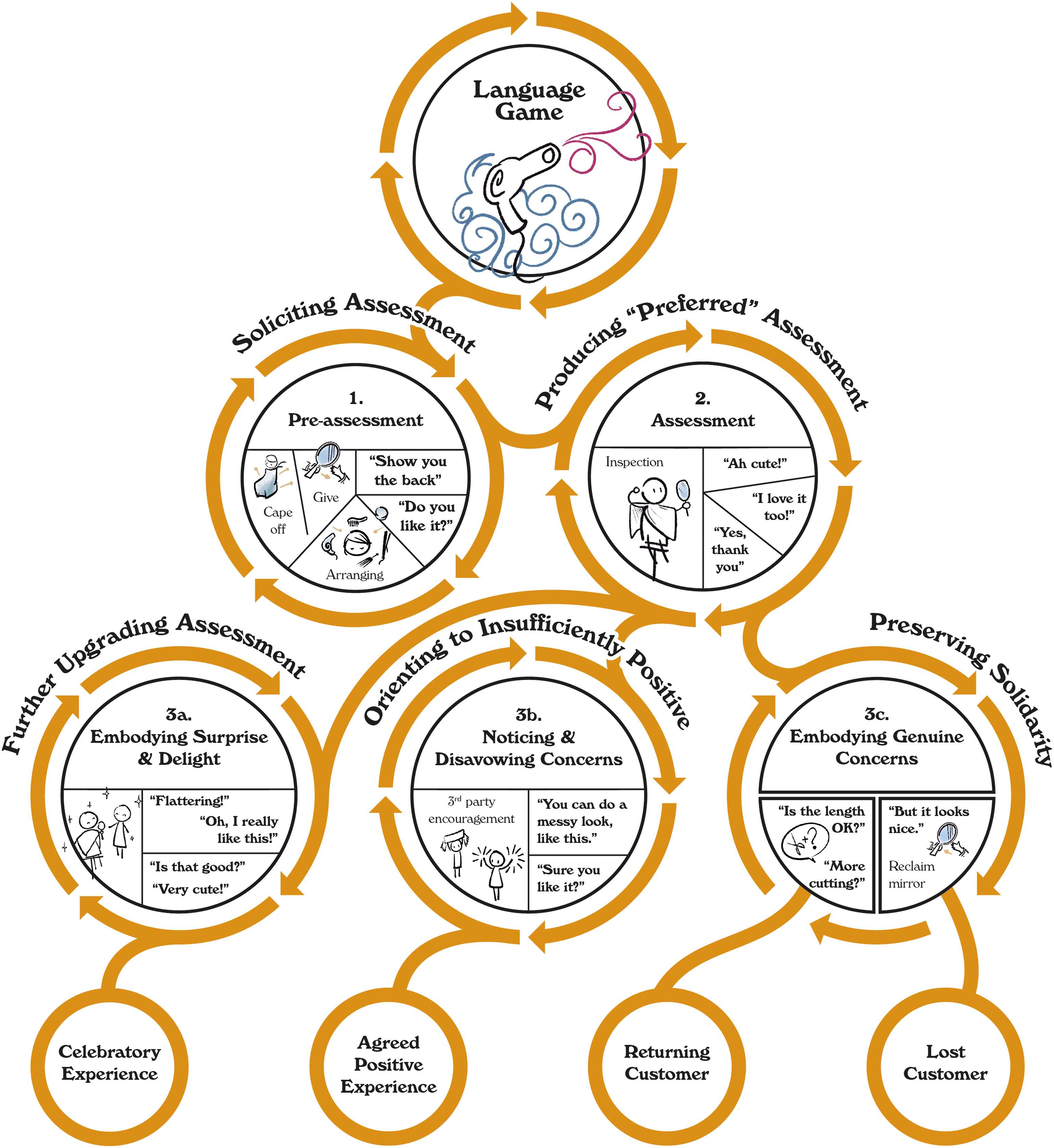
Three trajectories through the game were identified (labelled 3a, 3b, and 3C in Figure 1) Following positive responses (labelled 3a), stylists would solicit further up-graded assessments, by (1) using the mirror or (2) touch to reveal new features of the cut, by (3) posing subject-side or object-side questions, or by (4) producing their own assessments of the cut. Initial and subsequent assessments stand in a complex relation. The customer might say they ‘love’ the cut, not simply because they do, but because they have been invited to up-grade an initial object-side assessment.
In the dataset, customers never overtly complained; negative responses were recoverable in less than fulsome praise, and responses that (1) merely agree the cut is nice, (2) acknowledge rather than assess the cut, (3) reproduce rather than upgrade assessment terms, and (4) delay verbal responses and/or continue visual inspections. Confronted with such responses, stylists may invite the customer to disavow (labelled 3b). Customers may take the concerns off the table or withhold disavowal through prolonged inspection; other parties may enter the interaction and ‘discover’ the value added by the cut, building ‘intersubjective consensus’ (Maciel and Wallendorf, 2017: 728). Genuine concerns (labelled 3c) become apparent when the customer is invited to put the record straight but withholds. When this happens, stylists may hijack the response and hurry the customer out (Extract 5) or recognise a genuine concern and seek to make good (Extract 6).
So, whilst it seems there could be no general answer to the question of how people embody their subjective experience, we suggest this is not the case, at least in the salon. Customer responses are highly attentive to the architecture of this language game, which would seem to have clear social functions. The language game encourages customers to be highly effusive, to the point that even quite positive responses may be deemed to be insufficient, and it enables customers to embody concerns, to the point of having their hair re-cut, without them having to say anything negative.
Conclusion
We have analysed a pervasive activity, assessing a service, that we know surprisingly little about. People learn this game as children and play it often sometimes with charm other times with a degree of indignation. Customers might make subjective states plain for all to see, or subtly guide others to see a hint of dissatisfaction behind an ostensibly positive response. Service providers might pour over the fine details of a response searching for problems, or they might artfully overlook even grossly negative displays. Despite the centrality of the customer in contemporary society, and firm’s interest in the customer experience, this language game is not well understood. We have made a start, showing one way that researchers and firms might better understand how the customer experience is produced and embodied in situ.
Footnotes
Acknowledgments
We would like to thank Jon Hindmarsh and Hugh Wilson for their support and feedback on previous versions of this manuscript.
Author’s note
Sae Oshima, PhD, is Principal Academic of Corporate and Marketing Communications at Bournemouth University in the United Kingdom. Nick Llewellyn, PhD, is Professor of Organization Studies, and Dean of Faculty at Warwick Business School, the University of Warwick, in the United Kingdom.
Declaration of conflicting interests
The author(s) declared no potential conflicts of interest with respect to the research, authorship, and/or publication of this article.
Funding
The author(s) received no financial support for the research, authorship, and/or publication of this article.
