



Abstract
Our research study investigates how expressions and acts of kindness are leveraged through non-monetary value exchange practices to improve individual and community well-being when money was scarce. A qualitative netnographic study was conducted to examine the non-monetary value exchange practices amongst members of the Barter for Better Fiji platform. Data were collected through online observation and participation, conversational interviews, and archival and netnographic methods. The interpretation of the data revealed that Barter for Better Fiji members leveraged an ‘economy of kindness’ through three non-monetary value exchange practices (i.e. bartering, near-money exchange and donating) to improve individual and community well-being. The marketing theory and practice implications of leveraging expressions and acts of kindness through value exchange practices are discussed.
Introduction
Value exchange is a core research topic in the marketing discipline (Easton and Araujo, 1994; Giesler and Fischer, 2017; Layton, 2007, 2019). While research tends to focus on monetary exchange practices (i.e. exchanging money for items), many studies focus on non-monetary exchange practices within ‘alternative’ marketplaces (Campana et al., 2017). These include studies on marketplaces where bartering (Dalli and Fortezza, 2019), swapping (Matthews and Hodges, 2016), sharing (Belk, 2010), time banking (Papaoikonomou and Valor, 2017) and gift-giving (Weinberger and Wallendorf, 2012) take place. They also include studies on marketplaces in locations where there is no legally sanctioned monetary system, where contemporary money is deliberately rejected as a medium of exchange, or where there is a shortage of money during systemic crises (Seabright, 2000; Sredl et al., 2017).
In the marketing literature, it has been suggested that value exchange practices tend to emerge within specific ecological time frames to address particular needs or wants (Easton and Araujo, 1994) and shifting resource-control combinations (Hill and Sharma, 2020), and disappear when no longer needed or applicable (Lusch, 2017). However, it has also been suggested that some of these value exchange practices are path-dependent (Layton and Duffy, 2018) and so continue to rely on ‘old ways’ through ‘new means’ to exchange (Finua and Kant, 2022; Finau and Scobie, 2022). These suggestions are supported by many anthropological and ethnographic studies showing that traditional value exchange practices (e.g. bartering) persisted throughout history as valued social practices, even when it was thought that monetary exchange practices would replace them (Gell, 1992; Graeber, 2011). Easton and Araujo (1994: 75) offer some explanation as to why this is the case by remarking that ‘Exchange processes are embedded in the dense fabric of social relations and economic exchange is rarely able to rid itself of non-economic exchange baggage such as social exchange, kinship and friendship networks, altruism and gift-giving’. Social science scholars are also beginning to understand how expressions and acts of kindness may be leveraged to create ‘new value regimes’ that reflect more friendly, generous and considerate ‘human’ marketplaces to improve community well-being (Arvidsson and Peitersen, 2013; Hart et al., 2010).
However, despite these studies, the marketing literature offers little in the way of explanatory theories about how expressions and acts of kindness are leveraged. Consequently, explanatory theories relating to expressions and acts of kindness currently appear to be explicitly lacking in marketing conceptualisations. To build our explanatory theory, we investigated how expressions and acts of kindness are leveraged through non-monetary value exchange practices within an online collaborative network that emerged when money was scarce. We address two research questions: (1) What were the dominant non-monetary value exchange practices, processes and procedures within the online collaborative network? (2) How were expressions and acts of kindness leveraged through non-monetary value exchange logic to improve individual and community well-being?
To answer these questions, we conducted a qualitative netnographic study (Kozinets, 2019) investigating the value exchange practices amongst Barter for Better Fiji (BFBF) members during the COVID-19 lockdown. This lockdown presented an ideal time to conduct our research, as it allowed us to more closely investigate non-monetary value exchange practices that would ordinarily have occurred more privately. It also offered a specific time frame when non-monetary value exchange practices were more prevalent.
In this paper, we review how value exchange practices and kindness are theorised and conceptualised in the literature. Thereafter, we present our research context and method, followed by our research interpretations. We then discuss these interpretations and highlight our contribution to marketing theory and practice. Finally, we offer some direction for future research.
Value exchange practices and acts of kindness
Value exchange practices have been widely debated in social science disciplines, particularly in economics, sociology, anthropology, ethnography and marketing. The distinction between monetary and non-monetary value exchange practices is central to such debates. Monetary exchange practices occur when money equivalents are used as the medium of exchange (Vargo et al., 2017). An alternative to monetary exchange practices is non-monetary value exchange practices, such as bartering (Benmecheddal et al., 2017; Prendergast and Stole, 1996).
Bartering involves directly exchanging items without using money (Humphrey and Hugh-Jones, 1992) – for example, exchanging a T-shirt for a bag of rice. Bartering differs from sharing, as it involves the transfer of ownership between people or actors (Belk et al., 2019). Moreover, bartering differs from gifting as it involves the exchange of unlike items to obtain a direct benefit (Heady, 2005). Bartering is also inherently different to monetary exchange for four reasons. First, the exchange logic depends on a coincidence of needs (i.e. each person needs what the other person has). Second, the items exchanged need to be discernibly different or there would be no need to barter. Third, bartering involves a mutual payment that requires no further exchanges, unlike money, which necessitates further exchanges before consumer needs are met. Fourth, the items to be bartered are mainly under the direct control of institutions or actors who are present (Anderlini and Sabourian, 1992; Humphrey and Hugh-Jones, 1992).
Near-money exchange practices are a less clear alternative to monetary exchange practices (Kemp, 2005), which involve exchanging value items for equivalent near-money items. Near-money items may be traditional or cultural artefacts, such as whale teeth and shells (Gell, 1992), or modern-day items with nominal currency values, such as mobile data, gaming console cards, phone cards, iTunes gift cards, loyalty card credit and store vouchers. Near-money items differ from money, as their range of direct exchanges is relatively restricted. For example, a phone card can only be directly exchanged for phone credit. Modern-day near-money items also do not serve well as a long-term stable measure of value or numéraire because they often have expiry dates (Chan et al., 2016). For instance, airlines regularly change their loyalty card credit values by announcing changes to the terms and conditions or the range of applicable flights. While it is tempting to dismiss bartering and some forms of traditional or cultural near-money exchanging as socio-cultural relics or outdated institutional exchange practices, they are still widely accepted forms of exchange today.
Monetary exchange practices are thought to involve a ‘balanced’ exchange logic (exchanging an item for something else of comparable value), which does not necessarily require expressions and acts of kindness to complete the exchange. However, other non-monetary exchange practices, such as donating, are thought to involve a more ‘generalised’ exchange logic (Bagozzi, 1975; Sahlins, 1972), which ordinarily requires expressions and acts of kindness to complete the exchange. These expressions and acts of kindness are sometimes called ‘surplus’ or ‘incalculable’ values (Belk, 2010). Furthermore, the behaviours, norms and values inherent to these exchange practices often involve traditional expressions and acts of kindness included in social rituals and ceremonies (Kadirov and Varey, 2011; Kuruoğlu and Ger, 2015).
Being friendly, generous and considerate are all considered expressions and acts of kindness. Correspondingly, Abel et al. (2022: 1) found that expressions and acts of kindness can occur during value exchange practices in four ways: through feedback (i.e. providing information about a particular behaviour, emotion or thought in a friendly, generous and considerate way), advice (i.e. recommending a course of action in a friendly, generous and considerate way), compliments (i.e. stating something positive about a particular behaviour, emotion or thought) and gratitude (i.e. giving thanks).
Understanding how human expressions and acts of kindness are leveraged through value exchange practices to improve individual and community well-being is highlighted in the social sciences literature. For instance, Kumar and Epley (2023) found that being friendly, generous and considerate (i.e. being kind) through value exchange practices ‘goes an unexpectedly long way’ in improving individual happiness and community social support, connections and sense of belonging. However, they also point out that these expressions and acts of kindness are often systemically underestimated and undervalued resulting in missed opportunities to improve individual and community well-being (Kumar and Epley 2023). Similarly, Abel et al. (2022: 1) found that expressions and acts of kindness are ‘in short supply’ through value exchange practices, despite the ‘widespread evidence’ that it will ‘improve the well-being of both the giver and recipients’.
Abel et al. (2022: 1) offer some explanations of why expressions and acts of kindness are ‘in short supply’. First, during value exchange, people tend to undervalue the impact of their expressions and acts of kindness on individual and community well-being. Second, people fail to recognise the gratitude recipients feel when receiving expressions and acts of kindness. Third, people incorrectly believe that others ‘don’t want’ to receive expressions and acts of kindness during value exchange. Fourth, people tend to doubt the legitimacy of their expressions and acts of kindness in engendering well-being.
Background to value exchange and acts of kindness in Fiji
Before investigating how expressions and acts of kindness are leveraged through value exchange practices amongst BFBF members on Facebook, it is necessary to provide some historical background on the research setting. The Republic of Fiji is a small island nation in Melanesia in the South Pacific Ocean. Before European colonisation, the island nation was populated by people (i-Taukei) of the land. Each clan (vanua) was largely self-sufficient through its connection with the environment and the land (vuravura). Clan members would distribute and share (takitaki) the valuables of the land (solevu) amongst clan members to meet needs, and recognise and celebrate clan connections (Thomas, 1991) and a sense of belonging (Gell, 1992).
At times, clans would engage in traditional Fijian value exchange practices (veisa) with other clans and sometimes outside visitors (vulagi). The items that would typically be exchanged included whale teeth (tabua), root crops, meat, shells, cloth, mats, salt and kava (yaqona). While some anthropologists believe that these exchanges depended on a balanced exchange logic that included bartering or near-money exchanging, other anthropologists posit that they depended on a generalised exchange logic that included donating and gifting (Gell, 1992; Humphrey and Hugh-Jones, 1992). For instance, some anthropologists consider whale teeth to be traditionally used as a near-money artefact to obtain needed items. In contrast, others believe that clans were largely self-sufficient and only relied on whale teeth and other traditional artefacts for donating or gifting purposes to attain social status, build relationships, prevent hostility and war, and restore peace (Dalton, 1982).
What is not in dispute amongst anthropologists is that traditional Fijian value exchange practices always included an unwavering set of institutional manners, standards, customs (i-vakarau), and rituals and traditions (i tovo vakavanua). These practices almost always involved the ceremonial sharing (takitaki) of food (magiti) and the presentation (sevusevu) and drinking (gunu) of kava (yaqona). Central to these traditional Fijian value exchange practices was an unwavering concern for all clan (vanua) members, which was openly displayed through community expressions and acts of kindness (yalo loloma) (Gell, 1992).
With European colonisation (and later urbanisation), clans became more reliant on monetary value exchange practices, which did not appear to accommodate traditional expressions and acts of kindness (yalo loloma), and were seemingly only undertaken to meet particular needs (Gell, 1992). In 1867, the British introduced the Fijian dollar to facilitate monetary exchanges in Fiji. The Fiji Currency Board and Reserve Bank of Fiji were established in Suva City in 1914 and 1983, respectively, to issue and administer the Fijian dollar. Today, the Fijian dollar is the only legal tender or ordinary money in Fiji (Reserve Bank of Fiji, 2020). However, despite the widespread use of the Fijian dollar, traditional Fijian value exchange practices (veisa) still prevail outside monetary exchange practices (Finua and Scobie, 2022).
Method
A qualitative netnographic study of value exchange practices among BFBF members on Facebook was conducted (Kozinets, 2019). Netnography allowed us to unobtrusively observe value exchange practices in an online collaborative network. We collected data from the BFBF members on Facebook from 20 March 2020 to 30 March 2021. While it was impossible to observe all the daily posts and value exchange practices due to the large volume of posts and comments, we collected and archived a small convenience sample of the daily posts, which amounted to 67 pages, excluding photographs and reply comments. Additionally, we collected and archived all the announcement posts (12 pages) and all the event posts and replies (244 pages). We collated all the posts by visiting the Facebook page regularly and copying and pasting any new posts into a Word document. Moreover, we interacted periodically on the Facebook page by posting questions to seek clarification. To supplement the netnographic data, we also collected and archived online English-language newspaper articles. ‘Barter for Better Fiji’ was used as the search term on Google News to find the articles. The search produced 17 articles from eight publication outlets. In addition, we conducted a 40-min conversational interview (Turner, 2010) with the BFBF founder, which was audio-recorded. While most posts were written in English, a few were in Fijian. These posts were translated into English using Microsoft Bing Translator (www.bing.com).
We conducted an in-depth, socio-contextual analysis of the data (Saldana, 2009). The analysis entailed iteratively selecting all content related to ‘value exchange practices’, ‘expressions and acts of kindness’ and the research questions. The data were then organised and grouped into thematic categories to construct an understanding of how expressions and acts of kindness were taking place through the BFBF community on Facebook. The sustained observation of the community over a significant period and the iterative nature of the analysis meant that the research process was deemed credible, trustworthy and useful (Haenlein et al., 2022).
Guided by the non-monetary value exchange practices literature (Campana et al., 2017), throughout the data interpretation process, we identified that these expressions and acts of kindness were leveraged through three non-monetary value exchange practices, namely, bartering, near-money exchanging and donating. For clarity, we referred to BFBF members involved in bartering or near-money exchanging as ‘vendors’ and ‘vendees’, while BFBF members involved in donating were referred to as ‘donors’ and ‘beneficiaries’.
Leveraging expressions and acts of kindness through the BFBF platform
In mid-March 2020, the island nation of the Republic of Fiji was struck by the global COVID-19 pandemic. The country went into a national lockdown, and its international borders were closed (Ministry of Health and Medical Services, 2020). The lockdown’s economic and social impact was immediate, as most people in the country were not permitted to work and socialise outside of their homes. While people could leave their homes to purchase necessities, such as food and medicine, their inability to work meant that Fijian dollars needed to purchase basic provisions were scarce. As a BFBF member (2 July 2020) explained: ‘You guys can walk into any shop and ‘fish’ for your food with little or no difficulty. We don’t have that privilege’.
While the government, non-governmental organisations, private sector and various other institutions provided some support and assistance, many people in the community resorted to traditional Fijian non-monetary value exchange practices (veisa) to meet community needs (Koroiwasa, 2021). To support and facilitate these practices, a BFBF Facebook page was launched by a woman, Marlene Dutta, in Suva City, Fiji, on 20 March 2020 – a day after the first positive COVID-19 case was reported in Fiji. The BFBF page proved so popular in meeting community needs that by the end of the year, there were over 180 000 members (roughly a quarter of the Fijian population) and 1.3 million active online engagements per month.
According to Marlene Dutta, the words ‘Barter for Better Fiji’ pointed to a ‘Better’ ‘solution’ to achieve individual and community well-being: Well at the right time you came up with a “solution” to the problem, especially when all were distressed, confused and demotivated. Lockdown came as a result of COVID-19, business activities went down and many people faced job losses. While few were still complaining and finger-pointing, you gave them a “diversion”. All those negative energies were diverted towards this page into a positive solution to help people to carry on with their lives through barter. Money no longer decides who gets the food on their table. People resorted back to their traditional skills, using the same to earn a living. Necessity is the goal not fabricated. Helping each other is the new norm, not jealousy. Sharing will get us all through this…. (Marlene Dutta, 21 September 2020)
Accordingly, the BFBF’s stated purpose was to provide a ‘trading space’ where Fijians could initiate and participate in a ‘cashless’ exchange, where the ‘value of the exchange is decided between traders’ (21 March 2020) and ‘Money no longer decides who gets the food on their table’ (21 September, 2020). It also alluded to its ambitions of ‘nurturing a community of kindness through bartering’ and embracing traditional Fijian value exchange practices (veisa). As Marlene Dutta (20 March 2020) further remarked in the BFBF announcement post: ‘So, back in the day, when money was sooo tomorrow, our ancestors lived by exchanging what they had for what they needed. Easy eh? How about we do that again now? [sic]’.
The BFBF administrators also built and maintained the BFBF Facebook page following what Marlene Dutta called an ‘economy of kindness’, wherein members could participate in expressions and acts of kindness through leveraging non-monetary value exchange to improve community well-being by being friendly, generous and considerate. These expressions and acts were regularly celebrated and commemorated at significant dates and community membership milestones. For example, a BFBF administrator (22 October 2020) posted: Helllooooo Traders.. so we’re a little bit bera this week… completely forgot to post and celebrate our 6month birthday yesterday….. little bit Fiji time happening this side...but yay… We thank you all for continuing to shine light and sharing positivity, kindness to each other. So, where are we at 6 months?... Over 190,000 members, (conservative) estimate of over 30,000 successful trades, so much giving freely and so much love spread in this crazy year [sic].
Leveraging an ‘economy of kindness’ through BFBF.
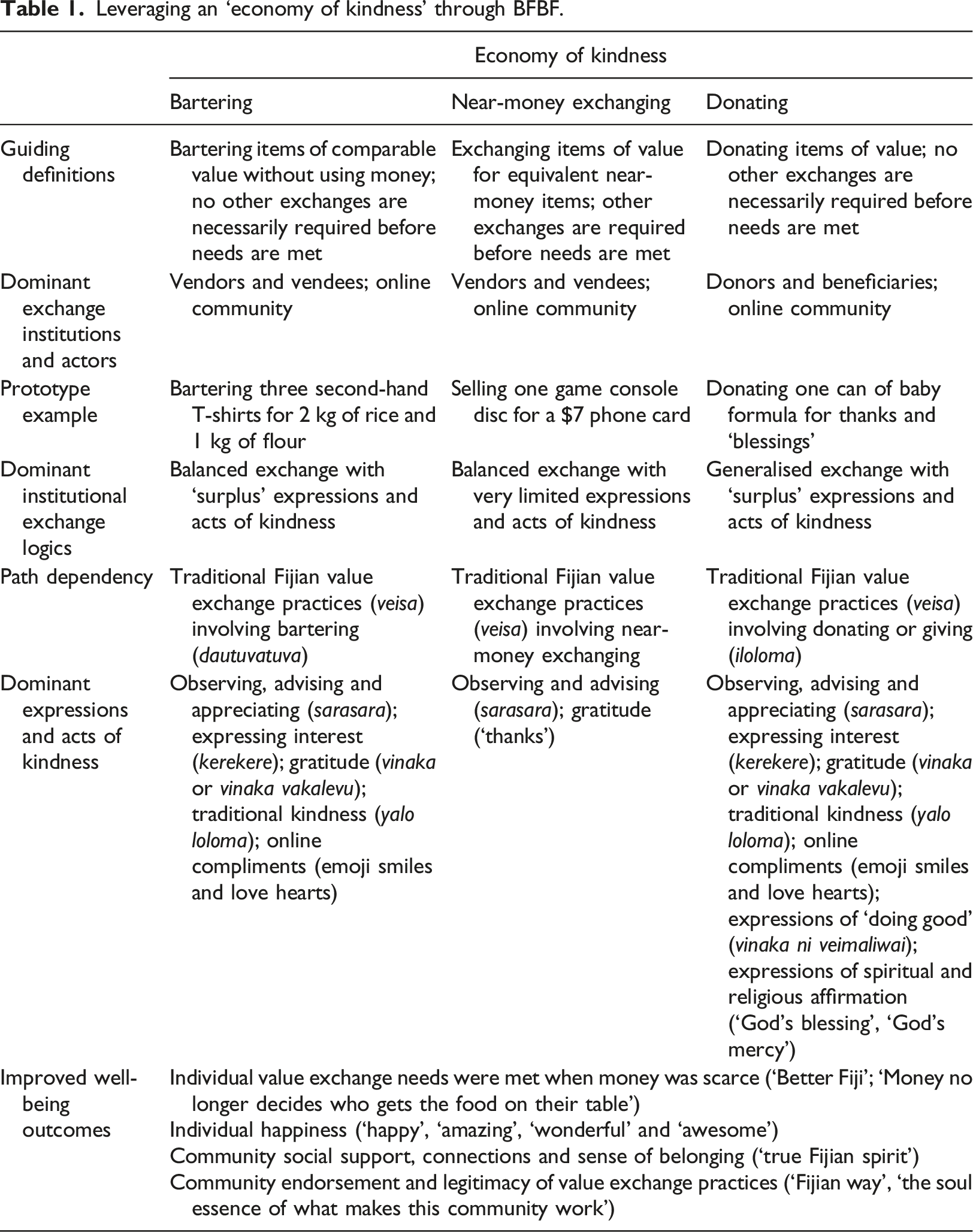
Expressions and acts of kindness were predominantly leveraged through bartering (dautuvatuva) exchange practices. This is not surprising as the founder established the platform as a marketplace for ‘nurturing a community of kindness through bartering’ (BFBF administrator post, 21 March 2020). The items on offer through bartering varied, but centred around basic essential items needed for immediate consumption or repairs. These included commercial food and hygiene staples, second-hand household furniture and appliances, second-hand clothing and shoes, vegetable plants and seedlings, fresh and natural produce, home-made meals, and compost and manure. It also included services involving manual labour and repairs.
The bartering value exchange practices followed a consistent sequence of processes and procedures similar to what has been observed in virtual brand communities (Hollebeek et al., 2017). First, the vendor would upload a post stating what was on offer through bartering and what was sought. For example, a BFBF vendor (23 October 2020) posted the following on the page: ‘I just want to trade all this shoes size 8, and the safety boot size 10, hair clip cutter for the boys ..in exchange of grocery. Location [name] .pliz if u interested inbox me .vinaka [sic]’. The culturally appropriate Fijian word for thank you (vinaka) was almost always used to express gratitude or thanks.
If a post did not comply with the BFBF rules and guidelines around acceptable bartering (dautuvatuva) and an ‘economy of kindness’, the administrators would ask the vendor to amend the post. If the vendor did not comply, the administrators would block the post. After the post appeared on the Facebook page, other members would kindly observe and provide comments of advice, support, understanding and solidarity (sarasara) to what was being sought by the vendor. Next, a potential vendee would publicly and kindly express interest in the items on offer. The vendees frequently used the kind and polite Fijian word kerekere when expressing interest. Kerekere has no English equivalent but roughly translates to ‘please’ and a request for something to be provided generously and without constraints. Then, the vendee would be invited to negotiate the terms and conditions of the barter with the vendor. The negotiation would occur via the post’s comments functionally (i.e. Facebook comments) or through direct inbox messaging (i.e. Facebook Messenger or SMS). These interactions were always complimentary in the ‘Fijian way’ and captured some of its subtle cultural nuances of providing kind advice, feedback, compliments and gratitude. A member remarked: Because you have built a community [referring to BFBF], and within this community, many of us have developed relationships. I doubt that an international provider will be able to capture and/or facilitate the way we Fijians relate to each other – the authenticity, the vakachi, the various levels of literacy, cultural nuances and most importantly – the soul essence of what makes this community work. (BFBF member, 22 October 2020)
Finally, the vendor and vendee would agree to meet at a convenient place and time to exchange the items. After the bartering, it was common for the vendor and vendee to post photographs of the final items exchanged and express their satisfaction and appreciation for the kindness shown on the BFBF Facebook page (i.e. gratitude). Once again the culturally appropriate Fijian word for thank you (vinaka) was almost always used to express gratitude. A young woman remarked: ‘Thank you [name removed] for the trade yesterday. Vinaka vakalevu my new friend’! (BFBF member, 2 September 2020).
In addition, it was common for other members to express their appreciation to the broader BFBF community and to endorse bartering (dautuvatuva) as a legitimate act. One member shared: I love this group so much...Reminds me of the way Fiji was and and should always be. It has been my daily go to for smiles [smiling emoji] which is something we all need, especially during these crazy/ uncertain times. Thank you for reviving the true Fiji spirit [sic]. (BFBF member, 24 September 2020)
To a limited extent expressions and acts of kindness were also leveraged through some permissible near-money exchange pratices. While the BFBF founder and administrators actively discouraged and blocked monetary value exchange practices on the BFBF Facebook page, they also prohibited the exchange of traditional near-money artefacts, such as whale teeth (tabua). The BFBF founder indicated that these artefacts were seen as too valuable and sacred (Belk and Wallendorf, 1990) to be exchanged through an online platform. Nevertheless, BFBF did permit the exchange of modern-day near-money items, such as mobile data cards, gaming console cards, phone cards, iTunes gift cards and store gift vouchers. Hence, near-money exchanging on the BFBF page typically involved exchanging items (e.g. T-shirts) for equivalent modern-day near-money items (e.g. $7 phone card). However, the founder explained that she only permitted near-money exchanging that explicitly demonstrated acts of kindness (and were not for ‘monetary gain’): We have been very transparent from the beginning and with our intentions – nothing that we do here is for any “monetary gain”. If there is anything that we have gained its the friendships formed, the learnings, the connections we have made and to see the “extension of kindness” manifesting in other spaces [near-money exchanging] – we do believe in the saying “we reap what we sow”. (BFBF founder, 2 July 2020)
For near-money exchange, the items mainly on offer were second-hand electronics, such as mobile phones, gaming consoles and games, TVs and DVDs. The vendor would request payment in the form of modern-day near-money items with a Fijian dollar value. A typical post included the following: ‘Anybody would like to barter with Me for a PS [PlayStation] game to a $7 vodafone recharge...please message me??? [sic]’ (BFBF member, 24 October 2020).
The near-money value exchange practices followed a similar logic to bartering, although there were some differences. First, the vendee and vendor interactions were shorter and seemed to lack the ‘Fijian way’. In addition, members who were observing and advising (sarasara) on these posts did not appear to provide expressions of appreciation. Some BFBF members even viewed these exchanges as contrary to the rules, and it would be better served on buy/sell platforms: ‘If you need any help with admin to ensure no barter posts are removed, just ask. Would hate it to turn into a rubbish buy/sell page as it has so much to offer [smiling emoji]’ (BFBF member, 23 September 2020).
The interaction and communication between vendees and vendors were conducted privately through direct inbox messaging (i.e. Facebook Messenger or SMS) rather than on the Facebook comments. After the near-money exchange had taken place, it was common for vendees to post very concise messages of gratitude via the public commentary functionality (i.e. Facebook comments) expressing satisfaction with the items (e.g. ‘Thanks, all working’). Interestingly, the English word for ‘thanks’ was used instead of the Fijian word vinaka. Unlike bartering, there were never any photographs of the items exchanged, less member interest in the items (kerekere) or commentary on traditional Fijian value exchange practices (veisa).
Expressions and acts of kindness were also leveraged through donating (iloloma) practices. This is also not surprising as the founder also established the platform for community groups, charities and others ‘doing good’ (vinaka ni veimaliwai) to engage in expressions and acts of kindness through donating or giving (iloloma) items to beneficiaries who were in need. While the BFBF founder and administrators did not explicitly mention donations in the formal BFBF rules, they actively supported and endorsed donations, often referring to donations (iloloma) as a natural extension of traditional Fijian value exchange practices (veisa) and an integral part of an ‘economy of kindness’. We really feel that the members here have taken all the elements of bartering and raised them another 10 levels. What we are seeing is the love, the care, the support and the resilience of everyone and the understanding that we all need to help each other out while things are so tough for so many. This is what we call – the economy of kindness. We are all together creating an economy based on sharing, caring, helping and lifting each other up and that is what the world needs more of today. (BFBF founder, 4 June 2020)
The items donated mainly included commercial food and hygiene staples (e.g. rice, flour, milk powder, baby formula, shampoo, sanitary pads and toothpaste) and other products and services urgently needed by single mothers, the disabled, the sick and the elderly. The donating practices followed a consistent sequence of practices similar to bartering. However, a post was initiated by the potential beneficiary seeking to engage in a kind act. In addition, unlike bartering, the post's wording would be somewhat vague or indirect. A post also generally indicated that the potential beneficiary was not in a financial position to engage in bartering and desperately needed acts of kindness. A typical post in this instance would read: ‘I just want to trade with anything from your generous heart’ (BFBF member, 22 September 2020).
A potential beneficiary would also frequently mention that any donations received would be reciprocated through thanks, appreciation and ‘blessings’. In response, potential donors recognised that the post was a call for donations and responded accordingly. This often involved raising collective donations through the Facebook page and personally delivering the items. It also indicated that the values of the donated items and the acts of kindness were incalculable (Belk, 2010) and could not be expressed solely in quantity values. Moreover, the value of these donated items was often attributed to the kindness of a ‘higher being’ and was referred to as ‘God-sent’ rather than donated. Spiritual and religious affirmations play a central guiding logic in these value exchange practices (cf. Scaraboto and Figueiredo, 2017). As a member remarked: Bula vinaka Friends, Before this day ends, I want to acknowledge and sincerely thank the [name] group for donating these groceries to be given to families in need at this time. Thank you so much for your continuing support [name] and donors. You're all amazing, thank yous [clap emoji] and God bless you all abundantly always [heart and praise emoji]...This is not a barter friends, just an overflow of kindness and light [smile and sun emoji] [sic]. (BFBF member, 20 October, 2020)
Like bartering, donating frequently saw vendors and vendees posting photographs of the dominant items exchanged on the BFBF page. The commentary provided by members on the photographs was overwhelmingly one of gratitude and praised the recipients and donors for being kind to each other, as per the ‘Fijian spirit’. For example: Thank yous to all the families that have pm’d for the groceries today. Will be delivered as promised. Thank you [name removed] and the BFBF Team [heart emoji] for this wonderful platform to do this charity work through. To all you kind hearted donors that continue to support this work,... vinaka vakalevu and much blessings [clapping, heart, praise and flower emoji] [sic]. (BFBF member, 22 October, 2020)
Often, the members would donate items beyond what was expected. In these instances, expressions of spiritual and religious affirmation (‘God's blessing’, ‘God’s mercy’) and kindness were prevalent in the commentaries: ‘Exchange Successful with [name]. [thumbs-up emoji]. I wasnt Expecting More Groceries, As I only listed Flour, Sugar and Rice..., Vinaka vakalevu [name] for the Blessing [heart, heart, heart emoji] [name] [sic]’ (BFBF member, 20 November, 2020).
Discussion
Through our qualitative netnographic study, we were able to investigate how an ‘economy of kindness’ was leveraged through non-monetary value exchange practices (i.e. bartering, near-money exchanging and donating) to improve the individual and community well-being of BFBF members. Central to the success of the ‘economy of kindness’ was not only its ability to meet community value exchange needs when money was scarce (‘Money no longer decides who gets the food on their table’) but in its ability to leverage expressions and acts of kindness to build community social support, connections and sense of belonging (‘the true Fijian spirit’) and allow the community to endorse and legitimise a more friendly, generous and considerate ‘human’ marketplace in a ‘Fijian way’.
We were able to contribute to marketing theory by providing further explanatory insights into how expressions and acts of kindness (i.e. being friendly, generous and considerate) leverage ‘old ways’ (traditional Fijian exchange practices) through ‘new means’ (online collaborative network) to improve individual and community well-being. These improved well-being outcomes were evident not only among individuals involved in ‘balanced’ value exchange practices (bartering and near-money exchanging) but also among individuals involved in ‘generalised’ value exchange practices (donating). Furthermore, these improved well-being outcomes were evident among the broader community who were not directly involved in value exchange but who were observing, advising and appreciating the value exchange process (‘sharing, caring, helping and lifting each other up’).
We acknowledge that the concept of an ‘economy of kindness’ may appear somewhat paradoxical. While ‘economy’ denotes a marketplace characterised by a ‘balanced exchange logic’ and ‘accounting and accountability’ (Finau and Scobie, 2022: 74), kindness implies a more ‘human’ marketplace (Arvidsson and Peitersen, 2013; Hart et al., 2010) that attaches importance to a ‘generalised exchange logic’ (Bagozzi, 1975), with ‘surplus’ or ‘incalculable’ values (Belk, 2010) of friendliness, generosity and consideration. Nevertheless, we believe this concept is unifying rather than divisive as Arvidsson and Peitersen (2013: 154) remarked, ‘rebuilding value after the crisis’ requires ‘strength and association of the passions that are common to all of us’. Likewise, Parsons (2014) contended that a good society is one where human kindness is most important and people are willing to serve the common good. In our study, these ideals manifested through expressions and acts of kindness, which appeared to reinforce and remind the community of the ‘true Fijian spirit’ to serve the common good.
Consequently, we theorised that expressions and acts of kindness are leveraged through both ‘balanced’ and ‘generalised’ exchange practices. On the one hand, this resulted in the exchange of items of comparable value, but on the other hand, this fostered a more friendly, generous and considerate ‘human’ marketplace wherein observing, advising and appreciating (sarasara), expressing interest (kerekere), gratitude (vinaka or vinaka vakalevu), expressions of traditional kindness (yalo loloma) and online compliments (emoji smiles and love hearts), and at times, even expressions of spiritual and religious affirmation (God's blessing, God's mercy) improved community well-being. Furthermore, how these expressions and acts improved community well-being was validated not only by the large number of members using the BFBF Facebook page (roughly a quarter of the Fijian population) but by the BFBF members who expressed how ‘happy’, ‘amazing’, ‘wonderful’ and ‘awesome’ the BFBF platform was. BFBF made them feel the ‘soul essence’ of what it means to ‘make this community work’.
We also acknowledge that the COVID-19 lockdown period gave the BFBF members an unexpected opportunity to reinvigorate ‘old ways’ that may have been forgotten over time. Nevertheless, this would not have been possible without the actions of the BFBF founder and administrators who enabled and facilitated these expressions and acts of kindness by (1) creating a platform conducive to being friendly, generous and considerate; (2) reminding the members of the kindness instilled in traditional exchange practices; (3) regulating and blocking posts that were not aligned to an ‘economy of kindness’; and (4) building trust and confidence that the ‘Fijian way’ of ‘embracing veisa’ and an ‘economy of kindness’ is a legitimate path-dependent exchange logic to achieving improved community well-being. Moreover, the social media platform functionalities also made it easier for members to communicate their expressions and acts of kindness through visual aids such as emojis smiles and love hearts.
The challenge then for practitioners, policymakers and communities is how to leverage expressions and acts of kindness in other contexts and settings where kind advice, feedback, compliments and gratitude are not necessarily considered part of the prevailing ‘balanced’ value exchange logic. While within an online collaborative environment, there is an obvious need to ensure that value exchange functionalities are accessible and convenient, there is also a need to develop collaborative technological features that are more conducive and supportive of simple expressions and acts of kindness. For instance, social media developers and their various marketing teams could: develop communication and pictographic tools to support how local communities would express kindness through emoticons and emojis, symbols and signs, or even ‘social handshake’ or ‘economy of kindness’ pictographs. Importantly, these tools must reflect the traditions and norms of how acts of kindness are expressed in a particular context or setting. From a policy perspective, policies and regulations can be formulated that endorse and legitimise an ‘economy of kindness’ as a valued exchange logic (Houston and Gassenheimer, 1987: 7) to improve community well-being. For example, in Fiji, the Consumer Council of Fiji is well placed to advocate for an ‘economy of kindness’ to be recognised as a legitimate value exchange practice as their mandate goes beyond only advocating for ‘fair’ value exchange outcomes (Consumer Council of Fiji, 2021).
Conclusion
As Marcel Mauss (2002: 42) commented in his classic 1925 essay The Gift: Forms and Functions of Exchange in Archaic Societies, the Fijian ‘has known how to and still does know how to, exchange things of great value, under different forms and for reasons different from those with which we are familiar’. While this study brings to the fore non-monetary value exchange practices in Fiji, its substantive theoretical contribution has been to introduce and investigate the concept of an ‘economy of kindness’, which refers to expressions and acts of kindness that are leveraged through non-monetary value exchange practices to improve individual and community well-being. We also identify three ubiquitous non-monetary value exchange practices – bartering, near-money exchanging and donating – wherein communities can leverage kindness. While many aspects of traditional Fijian exchange practices (veisa) may not be familiar to us, leveraging friendliness, generosity and consideration (i.e. being kind) through value exchange is certainly a universal ideal worth pursuing if the marketing discipline aims to support and enable not only ‘better’ marketing for a better world (Chandy et al. 2021), but a ‘better’, more friendly, generous and considerate ‘human’ marketplace.
The success of the BFBF Facebook platform in improving community well-being when money was scarce can also reassure other struggling communities that they possess the latent capabilities to leverage expressions and acts of kindness to improve individual and community well-being. These implications sit comfortably within the practical orientation of the critical transformative marketing research movement that supports communities with the ‘stimulus to rethink marketing, development and human well-being beyond a capitalist frame’ (Tadajewski et al., 2014).
Our research limitations need to be acknowledged. Although our research has investigated expressions and acts of kindness within non-monetary value exchange practices, our research context did not allow us to concurrently investigate bundled or mixed-form exchange practices (Prendergast and Stole, 1996), which may leverage alternative expressions and acts of kindness, more commonly associated with sharing (Belk, 2010) and gift-giving (Weinberger and Wallendorf, 2012). Future research could also investigate any path-dependent overlaps among these value exchange practices. It is also crucial for researchers to consider practice-based research approaches (Araujo et al., 2008) that are more suited to investigating how kindness may be leveraged through newer value exchange practices such as blockchains or cryptocurrencies. These investigations will enable researchers to recommend additional policies and practices that aim to realise the potential of leveraging an ‘economy of kindness’ through value exchange practices to improve individual and community well-being.
Footnotes
Declaration of conflicting interests
The author(s) declared no potential conflicts of interest with respect to the research, authorship, and/or publication of this article.
Funding
The author(s) received no financial support for the research, authorship, and/or publication of this article.
