



Abstract
Increasing attention has been paid to social media influencers and their self-branding strategies; yet, a perspective that specifically focuses on such practices in terms of social status has still to be fully developed. This paper analyses how Instagram micro-influencers use self-branding practices as ways to construct and display social status and, secondly, contributes to shed light on the contemporary changes in status gaining and signalling. Moving from Veblen’s theory of conspicuous consumption, I contend that conspicuousness represents the main cultural logic underpinning micro-influencers’ practises, and it's characterised by a productive display of consumption. Departing from Veblen’s theorisation, the display is not an expression of wastefulness, but a productive element in the construction of social status. Employing a methodological approach comprising digital methods and qualitative interviews, the research shows how the logic of conspicuousness unfolds and becomes productive through consumption practices characterised by accumulation, access, and circularity. Furthermore, the results highlight how micro-influencers follow the logic of conspicuousness to construct social status by seeking exclusivity or negotiating belongingness.
Introduction
Social media content creators have firmly established themselves as important points of reference in our everyday lives. They are highly appreciated for their ability to connect with the audience, which allows them to attain a celebrity-like status and gain significant influence in the public realm (Abidin, 2018). And yet, the ways in which they are perceived are often time ambivalent. On the one hand, they embody an ideal of success, influence, and prestige in an ever more precarious society (Duffy and Hund, 2015; Willment, 2022); on the other hand, they are blamed for showing off their possessions, living idle lifestyles, wasting their time posting to Instagram, and, more generally, deemed to be in need of finding “a real job” (Baah, 2020; Brewis, 2019).
In this context, the present paper aims to analyse how Instagram content creators use self-branding practices to gain, signal, and maintain social status, understood as the amount of prestige and esteem accorded to each individual (Marwick, 2013). Drawing on the concept of conspicuous consumption theorised by Thorstein Veblen (1899/2007) and adapting it to the context of the contemporary social media economy, this paper argues that conspicuousness represents the main cultural logic that orients content creators’ practices of status gaining and signalling. As a cultural logic, conspicuousness consists of a set of principles and values that emerge from the intersection of the attention economy, social media platforms, and the culture they foster. The logic of conspicuousness is characterised by the pivotal role assumed by the display of consumption in the dynamics of acquiring prestige – a display that, departing from Veblen’s theory, is not an expression of wastefulness but becomes in itself productive.
So far, existing research has paid attention to how content creators construct a promotional persona (Hearn, 2008) to get visibility (Abidin, 2016), gain Internet fame (Abidin, 2018), and reputation (Hearn and Schoenhoff, 2015). Yet, with the exception of a couple of studies (Christin and Lewis, 2021; Fiers, 2020), the ways in which content creators gain and display prestige in an increasingly saturated attention economy are still to be fully unpacked. Furthermore, there is a lack of research that specifically focuses on the concept of social status in terms of prestige, and how status is acquired through the display of consumption. By introducing the concept of conspicuousness and its productive nature, this paper aims at filling these gaps in the literature and providing a perspective that blends studies on content creators and self-branding with consumer research. The relevance of the processes of status gaining and signalling in the context of the attention economy, of which content creators are key players, is further justified by the ongoing changes in the dynamics of social status and distinction that the penetration of digital technologies has contributed to fostering (Eckhardt and Bardhi, 2019). The concept of conspicuousness is introduced to account for, and delve deeper into, these changes, with the purpose of answering broader questions about how social status and distinction deploy in contemporary society across online and offline domains.
Issues of social status are particularly relevant for a specific group of social media content producers, known as micro-influencers. The size of their public, typically under 100k followers, together with their perceived relatability, bring them closer to regular users and consumers than Internet celebrities (Ehlers, 2021). As such, they need to accumulate and display social status as a way to affirm and maintain their position in a precarious and competitive attention economy. The purpose of this paper is, therefore, twofold. First, it analyses how micro-influencers use self-branding practices to construct social status on Instagram, and second, it sheds light on contemporary changes in status gaining and signalling practices.
To meet these aims, the empirical research builds on a methodology comprising digital methods (Rogers, 2019) and qualitative interviews (Patton, 2014). The analysis of digital data related to Instagram Stories is triangulated with insights emerging from in-depth interviews conducted with micro-influencers in the Italian context – a still overlooked geographic area in the analysis of influencers’ practices and economies. The combination of these two research methods is deemed the most appropriate to examine content creators’ activities in both online and offline contexts, as well as to comprehend the meanings associated with those practices. The research focuses specifically on Instagram, one of the main platforms used by content creators (Leaver et al., 2020), and a venue suitable for examining how platform-specific self-branding practices unfold to accrue and signal social status.
The results highlight how micro-influencers’ self-branding practices are oriented by the logic of conspicuousness and show the ways in which displays of consumption become productive. These aspects emerge by looking at how the logic of conspicuousness unfolds through consumption practices characterised by: a) the accumulation of consumer goods and services necessary to fuel the economy of display (Yuran, 2016) in which content creators operate; b) the role of access as a facilitator in acquiring consumer products; and c) circularity processes aimed at draining the accumulation of consumer goods as well as mitigating the logic of conspicuousness with that of authenticity. These practices go hand in hand with two main strategies through which Instagram micro-influencers construct social status by following the logic of conspicuousness: seeking exclusivity, whereby content creators distance themselves through the display of exclusive products, services, or partnerships; and negotiating belongingness by showcasing those brands and consumer goods that signal membership to the micro-influencer category.
Theoretical framework
Self-branding and social status in the attention economy
Social media content creators are individuals who gain a prominent position and a large following on social media (Abidin, 2016) by skilfully crafting a curated and persuasive persona, a self-brand, to gain attention, visibility, and economic profit (Hearn, 2008). Although existing research has focused on influencers’ self-branding strategies in terms of micro-celebrity (Khamis et al., 2017), and as a means to gain Internet fame (Abidin, 2018) or reputation (Hearn and Schoenhoff, 2015), an analysis that focuses specifically on such practices as ways to accrue and signal social status is still missing. Issues of social status become relevant to investigate in the context of an increasingly saturated attention economy, where constructing and displaying prestige is pivotal to maintaining a position within the industry and gaining benefits that can spill from the domain of social media to content creators’ everyday lives. Gaining and maintaining social status is especially vital for a specific category of content creators, known as micro-influencers. Micro-influencers have a middle-sized audience (usually under 100,000 followers), which allows them to be relatable to their following and express authentic opinions about brands and products. In recent years, the significance of their role has grown exponentially. As per a recent study carried out in Italy, for example, 59% of the companies in the sample group preferred micro-influencers with less than 30,000 followers to endorse their brands (ONIM, 2019). Despite micro-influencers’ increasing importance, their position is highly precarious, as they are often willing to advertise products on social media in exchange for free goods or small commissions, and are, therefore, easily replaceable by one of many other aspirational content creators. For these reasons, micro-influencers’ practices represent a suitable venue for understanding the construction of social status.
Recently, there has been an emergence of studies that analyse social status in the influencer economy. These studies have focused on the contradictory performances of status-seeking (Fiers, 2020), and have highlighted the practices of YouTube Drama creators (Christin and Lewis, 2021). Nevertheless, there is still a lack of research that centres on social status as prestige and critically considers the role played by the display of consumption and its social significance, especially in relation to the influencer economy. The present research aims to address these gaps by focusing on the concept of social status, understood as the amount of prestige and esteem accorded to an individual (Marwick, 2013), which determines their place in the social hierarchy (Ridgeway and Walker, 1995). Moreover, central to the research is the emphasis on the performative practices through which social status is gained and signalled (Veblen, 1899/2007). Notably, the concept of social status is also examined in conjunction with the transformations in both accruing and signalling prestige that characterise our contemporary society (Eckhardt and Bardi, 2019). If, traditionally, social status has been associated with indicators such as social class, family history, level of education, or occupation, more recently attention has emerged as a key resource for gaining social status (Eckhardt and Bardi, 2019). Prestige and esteem have been progressively tightened to the management of a broad audience on social media (Marwick, 2013). Concurrently, social media metrics, as measurements that validate individuals’ self-branding performances and make attention quantifiable, have become a contemporary status symbol (Gandini, 2016; Marwick, 2013). Besides the accumulation of attention, social status has become more and more associated with the acquisition of knowledge and culture (Currid-Halkett, 2017), and the display of one’s capacity to grasp the minimal differences that characterise certain products or trends – a form of ‘marginal distinction’ which compensates for a disadvantageous economic position (Gandini, 2020).
In light of these complexities, it becomes pivotal to understand how content creators construct and signal social status on platforms such as Instagram, and what these processes tell us in terms of the broader dynamics of social status and distinction in contemporary society. To do so, this research puts at the forefront the role played by the display of consumption in the processes of status acquisition. So far, previous research has been focusing on visibility labour, understood as the work individuals do when they self-posture and curate their self-presentations to be noticeable on social media (Abidin, 2016). Furthermore, attention has been paid to how visibility labour is becoming more and more intertwined with algorithmic visibility (see, e.g., Bishop, 2019). In this paper, instead, I propose to integrate the concept of visibility with a perspective that centres around the display of consumption and its social and symbolic valence. The focus on the display adds another layer to the analysis of micro-influencers’ self-branding practices and allows us to understand how social status is constructed in a context where the presentation of the self and the display of material goods represent two useful self-branding techniques. In what follows, I will start unpacking the concept of display building from Veblen’s work on conspicuous consumption (1899/2007) and introduce the concept of conspicuousness.
From conspicuous consumption to conspicuousness
According to existing research, the overt display of consumer goods is an appealing practice for content creators, as it represents a means to attract attention by stimulating the aspirational consumption of their online personae (Abidin, 2018; Marwick, 2015). Such practices can be found among commercial lifestyle bloggers in Singapore, who curate their Instagram personae by displaying content congruent with upper-middle-class taste (Abidin, 2014). Similarly, Insta-famous personalities develop their self-presentations to emulate ‘the tropes and symbols of traditional celebrity culture, such as glamorous self-portraits, designer goods, or luxury cars’ (Marwick, 2015:139), and display material possessions unattainable for ordinary people to gain an aura of exclusivity (Abidin, 2018). Furthermore, a social media platform such as Instagram represents an ideal medium for the ostentatious display of consumer goods thanks to its affordances and visual vernaculars (Rokka and Canniford, 2016; Stoneman, 2015).
The conspicuous displays posted by content creators on Instagram present some similarities with the forms of conspicuous consumption theorised in The Theory of the Leisure Class (Veblen, 1899/2007). According to Veblen (1899/2007), conspicuous consumption refers to forms of ceremonial consumption aimed to attest to status and honour through the overt display of leisure activities and lavish expenditure of goods and services. From this perspective, social status is closely related to the ostentation of wealth, and consumption is performed for its social value, rather than exclusively for utility.
Arguably, however, processes of status acquisition, as well as practices of conspicuous consumption, have been largely changing from Veblen’s times onwards. From a consumer culture perspective, status signalling has become less and less conspicuous, leaning towards subtler and more refined ways of expressing social status. Scholars argue that a shift from conspicuous to inconspicuous consumption has taken place (Eckhardt et al., 2015), the latter being characterised by the reconfiguration of the visibility, size, and design of status symbols (Berger and Ward, 2010), an understanding of luxury as decoupled from wealth (Thomas, 2007), and the showcase of experiences, leisure time or cost-prohibitive immaterial services (e.g., education) (Currid-Halkett, 2017; Weinberger et al., 2017). Similarly, content creators’ self-branding practices have started to be more and more complex, thus challenging the valence of the mere display of wealth. Recent studies show that influencers tend to construct an authentic and relatable persona by downplaying social status and replacing costly symbols with lower-cost goods to maintain their relatability towards the imagined middle-class readers (Duffy, 2017; Fiers, 2020). Influencers’ practices are increasingly aimed at curating a self-brand that is at the same time aspirational and ordinary, and achieving what McRae (2017) calls “aspirational extra/ordinariness”.
Despite the critiques of Veblen’s Theory of the Leisure Class, 1 the analytical concept of conspicuous consumption, and specifically its dimension of display, still holds in a context where visibility and self-branding are dominant dynamics that orient individuals’ behaviours. Therefore, I contend that Veblen’s theory, partly redefined, represents a fruitful framework for the analysis of contemporary status-seeking practices in the social media influencer economy. In particular, I propose to integrate the Veblenian perspective with the ubiquitous tendency of self-branding to repurpose the notion of conspicuous consumption as a means through which to display and at the same time produce social status, by blending consumption and production practices. This entails a switch from conspicuous consumption to conspicuousness, understood as the main cultural logic that orients micro-influencers’ self-branding practices and status acquisition techniques.
The logic of conspicuousness
In this paper, I argue that conspicuousness represents the main cultural logic that orients content creators’ practices of status gaining and signalling. As a cultural logic, conspicuousness consists of a set of principles and values that emerge from the intersection of the attention economy, social media platforms, and the culture they foster. The distinguishing element of conspicuousness, as it is defined in this paper, is the concept of display and the productive valence it assumes. The notion of display represents the core of Veblen’s theory of conspicuous consumption, since, as he claims, ‘wealth or power must be put in evidence, for esteem is awarded only on evidence’ (Veblen, 1899/2007:30). Unlike Veblen’s theory, however, the display of consumption is understood and framed within the context of a broader economy of display, which is based on the concept of the costly symbol (Yuran, 2016). As Yuran (2016), building directly on Veblen’s work, explains, a costly symbol is a commodity that appears worthy in itself and upsets utilitarian calculation by embodying an aspect of waste. In an economy of display, the costly symbol maintains its intrinsic function as it points to social distinction, but, at the same time, is conceived as an economic entity valued in itself (Yuran, 2016). Building on the definition of costly symbol, the logic of conspicuousness suggests that displays of consumption can be considered both symbolic and productive activities. Therefore, according to this logic, displays of consumption can be repurposed as productive activities aimed at showcasing and, at the same time, constructing social status. In other words, the logic of conspicuousness orients practices of consumption displays which are enacted by micro-influencers as a means to build, boost, and maintain social status.
Therefore, one of the major differences from the Theory of the Leisure Class (1899/2007) lies in the fact that conspicuousness becomes productive rather than wasteful. Veblen’s theory of conspicuous consumption (1899/2007) acknowledges that status displays have a performative role, in that they construct social status as much as they attest to it, and, in so doing, they reinforce one’s position in the status hierarchy. However, according to the Theory of the Leisure Class, status displays are detached from production and utility. In this paper, instead, I contend that conspicuousness becomes inherently productive. Firstly, because, in line with the definition of costly symbol (Yuran, 2016), consumption displays maintain their symbolic and wasteful dimensions as expressions of status, but at the same time are converted into productive activities aimed at enhancing that same status. Furthermore, the productive dimension of conspicuousness is rooted in the strong interconnection between promotion, consumption, and production that characterises contemporary Western society. The neologism ‘prosumption’ has been coined to stress the extent to which production and consumption are intertwined, to the point that it becomes difficult, if not impossible, to clearly distinguish one another (Ritzer and Jurgenson, 2010). Following the logic of conspicuousness, content creators’ practices are characterised by a combination of consumption and production. As a result, their self-branding techniques are targeted towards repurposing displays of consumption as productive activities, while simultaneously stimulating the consumption of their persona by their audience to acquire social status.
To understand how micro-influencers construct social status it is important to analyse how the logic of conspicuousness unfolds in its productive dimension. This means considering the productive and symbolic valence of displays, as well as the intersections between production and consumption. Lastly, it is worth noticing that the logic of conspicuousness deploys in a context defined by social media platforms, such as Instagram, and their affordances, which orient who and what gets visibility. Hence, an analysis of social status in the influencer economy cannot be detached from an understanding of Instagram and its functions.
Methodology
To analyse how Instagram content creators construct and display social status, this research blends a digital methods approach with qualitative research, combining the analysis of Instagram Stories with semi-structured interviews. In this way, it is possible to understand users’ practices and how they are oriented by the medium, as well as the reasonings and narratives underpinning individuals’ choices and behaviours. The combination of the two methods is deemed particularly relevant to analyse content creators’ practices of status gaining and signalling across the online and offline domains, and, more broadly, could represent a fruitful methodology in the field of consumer research.
Unlike other approaches used to research digital environments, such as digital ethnography (Pink et al., 2016) or netnography (Kozinets, 2010), Digital Methods allow the researcher to analyse natively digital data by ‘following the medium’ (Rogers, 2019). To follow the medium means to consider the specific architectures and affordances of digital environments and analyse how they structure users’ interactions and practices. This research follows the medium by using one of its affordances, that is, the hashtag, as an entry point to collect digital data (i.e., Instagram Stories). The data gathered was then analysed following a qualitative-inspired approach to digital methods (Caliandro and Gandini, 2017). The analysis of Instagram Stories is useful to understand the dynamics through which micro-influencers construct social status by looking at how their self-branding practices and consumption displays are intertwined on Instagram. In the second step of the research, digital data is triangulated with insights from qualitative interviews conducted with Italian micro-influencers to delve deeper into the narratives underpinning content creators’ status-seeking practices.
Instagram Stories
The first step of the research consists of the analysis of how content creators construct social status through the study of Instagram Stories – ephemeral, short content which only lasts 24 hours. Instagram Stories, with the variety of audio and video content they offer, provide useful insights into how content creators present their branded personae and display consumption products, as well as how they share behind the scenes, spontaneous, content in an attempt to remain authentic to their public. Instagram Stories are suitable for analysing content creators’ status-seeking practices as they have now become more popular than static, polished Instagram posts (Constine, 2018). Furthermore, they represent a fundamental tool for content creators to maintain visibility and promote sponsored content, and for brands and advertisers to improve their promotional strategies (Georgiadis, 2022).
The methodological strategy adopted to study Instagram Stories consists of bypassing the Instagram API by using scraping techniques to collect data (Bainotti et al., 2020) and analyse it through an ethnographic coding approach (Altheide, 1987). Such a methodology is suitable to address some of the characteristics which make Instagram Stories a challenging digital object to research due to their ephemerality.
To gather Instagram Stories data, the data collection procedure started from a dataset of Instagram data collected in January 2019, which includes posts labelled with the hashtag ‘influencer’ and geolocated in Italy. Following a digital methods approach and building on existing research (Bainotti, 2021), the hashtag ‘influencer’ was repurposed to detect the profiles of those small and aspirational micro-influencers who mark their content with such a label to be recognised by the Instagram algorithm and increase their visibility. From this dataset, a list of Instagram profiles identified as micro-influencers and corresponding to potential case studies for the analysis of Instagram Stories was created. The criteria for identifying micro-influencers were the following: 1) users who posted regularly; 2) users involved in the display of sponsored content; and 3) users with a following between 10,000 and 100,000 followers, according to widely accepted definitions of micro-influencers (see, e.g., Abidin, 2021). This procedure is useful to provide a point of entry to the study of Instagram Stories by following the medium and avoiding collecting data in an overly random and subjective way (see also, Bainotti et al., 2020). From the list of potential case studies thus created a sample of 10 randomly selected users was extracted. Subsequently, each user in the sample was followed for 7 days (in May 2019), and their Stories were collected everyday at the same time with a freely available tool called StorySaver. 2 StorySaver allows the researcher to visualise the Stories posted on public Instagram profiles, which can then be manually downloaded in a .jpg or .mp4 format. The Stories collected were organised in an anonymous corpus containing an arbitrary id label for each Story, the date of extraction, an anonymised user id, and the transcription of the texts and audio content of each story, when needed. The final corpus consists of 765 Stories shared by 10 micro-influencers in a week.
The analysis of Instagram Stories follows an ethnographic coding approach, which blends non-intrusive participant observation and note-taking with coding practices from the content analysis tradition (Altheide, 1987). The codes used for the analysis account for the main themes emerging from both the visual and textual content of Instagram Stories and are informed by the theoretical concerns of the research, with some space for new themes to emerge directly from the data, in a grounded theory spirit (see, e.g., Charmaz, 2000).
Doing research with Instagram Stories requires addressing some ethical issues related to the use of scraping techniques and the preservation of users’ privacy (for a more extensive reflection on these topics, see Bainotti et al., 2020). Although scraping represents a contested research technique, it is here considered a ‘necessary evil’ for social media research in an age of API curtailing (Venturini and Rogers, 2019), and it was ethically and conscientiously implemented (for example, by collecting content shared exclusively on users’ public profiles). Furthermore, to protect users’ privacy, names and personal details are anonymised, and the results are presented in aggregated forms that do not allow for the identification of singular users. To further preserve users’ privacy, the outcomes of the analysis of Instagram Stories are presented by following the fabrication method (Markham, 2012). This method involves creatively reinterpreting the initial data into composite accounts that retain the original essence while modifying the specific details that could potentially identify individual users. Therefore, the Stories displayed in the Results sections were created by the author by replicating the content, style, and aesthetic of the original content.
Qualitative interviews
The second phase of the research consists of qualitative semi-structured interviews with Italian micro-influencers. This technique is apt to understand subjective and anecdotal narratives of content creators’ practices, shed light on the processes of status acquisition, and understand the social significance attributed to the displays of consumption.
Participants were recruited from the list of Instagram profiles identified as micro-influencers, which was elaborated starting from the collection and preliminary analysis of Instagram data (as explained in the previous section). The case selection followed a purposive sampling procedure (Patton, 2014), to privilege information-rich cases and account for the different nuances of the phenomenon under study. Particular attention was paid to ensuring a variegated sample in terms of gender, age, and field of interest (e.g., fashion, beauty, travel, etc…), and follower count. The final sample is composed of 35 Italian content creators, aged between 18 and 35 years old. However, despite the attempts, the sample is skewed towards white, cisgender and able women, mostly active in the fields of fashion and beauty. Despite this limitation, the sample offers relevant insights into how this “narrow culture of influencers” (Duffy and Hund, 2019:4988) might influence the process of status acquisition. To be noticed, there is no overlap between the content creators interviewed and the ones “followed” for the analysis of Instagram Stories.
The interviews were conducted between April and October 2019, face-to-face when possible or either via Skype or WhatsApp. Among the themes addressed, content creators were asked to describe their everyday experiences, the values that orient their promotional activities; their understanding of status and prestige; the importance of visibility vis-à-vis monetary income; as well as their aspirations for the future. Interviews were audio-recorded (upon request of consent) and then fully transcribed. The analysis proceeded by highlighting the recurrent themes emerging from the data and pinpointing them with the analytical concepts described in the theoretical framework. Interviewees often requested to be explicitly quoted in the research in an attempt to get visibility. However, the ethical standpoint adopted in this research is to preserve their anonymity by privileging their role as research informants, rather than their activities as content creators.
To understand how micro-influencers use self-branding practices to construct and display social status by following the logic of conspicuousness, the results are organised in two sections. First, I will present insights from Instagram Stories, which will consequently be enriched by outcomes from qualitative interviews. In this way, the presentation of the results moves from the domain of visual and textual representations offered by Instagram Stories to a more in-depth account of content creators’ perspectives and experiences gained through interviews.
Results
How conspicuousness becomes productive: Accumulation, access, and circularity
To begin with, the results provide relevant insights into how conspicuousness unfolds through consumption practices characterised by accumulation, access, and circularity. All these practices have one thing in common: they demonstrate how conspicuousness becomes productive, rather than wasteful. These observations are particularly evident in the examination of Instagram Stories, which will be the focus of this section.
Firstly, micro-influencers are involved in forms of accumulation, which emerge when they showcase their collections of fashion items, beauty products or experiences. Accumulation is functional to the logic of conspicuousness, which requires content creators to gain a large number of consumer goods and services to be showcased. For example, Anna uses Instagram Stories to display her collection of blazers, aesthetically sorted by colour, while, ironically, saying ‘I know, I have a thing with blazers’. Similarly, Emma, a 24-year-old beauty micro-influencer, displays a pile of boxes waiting to be unpacked and promoted to her audience. As Figure 1. shows, the visual representation of accumulation is accompanied by a text pointing to the number of gifts received and an Instagram Stories sticker asking, ‘Unboxing now?!’. Accumulation of consumption, an example.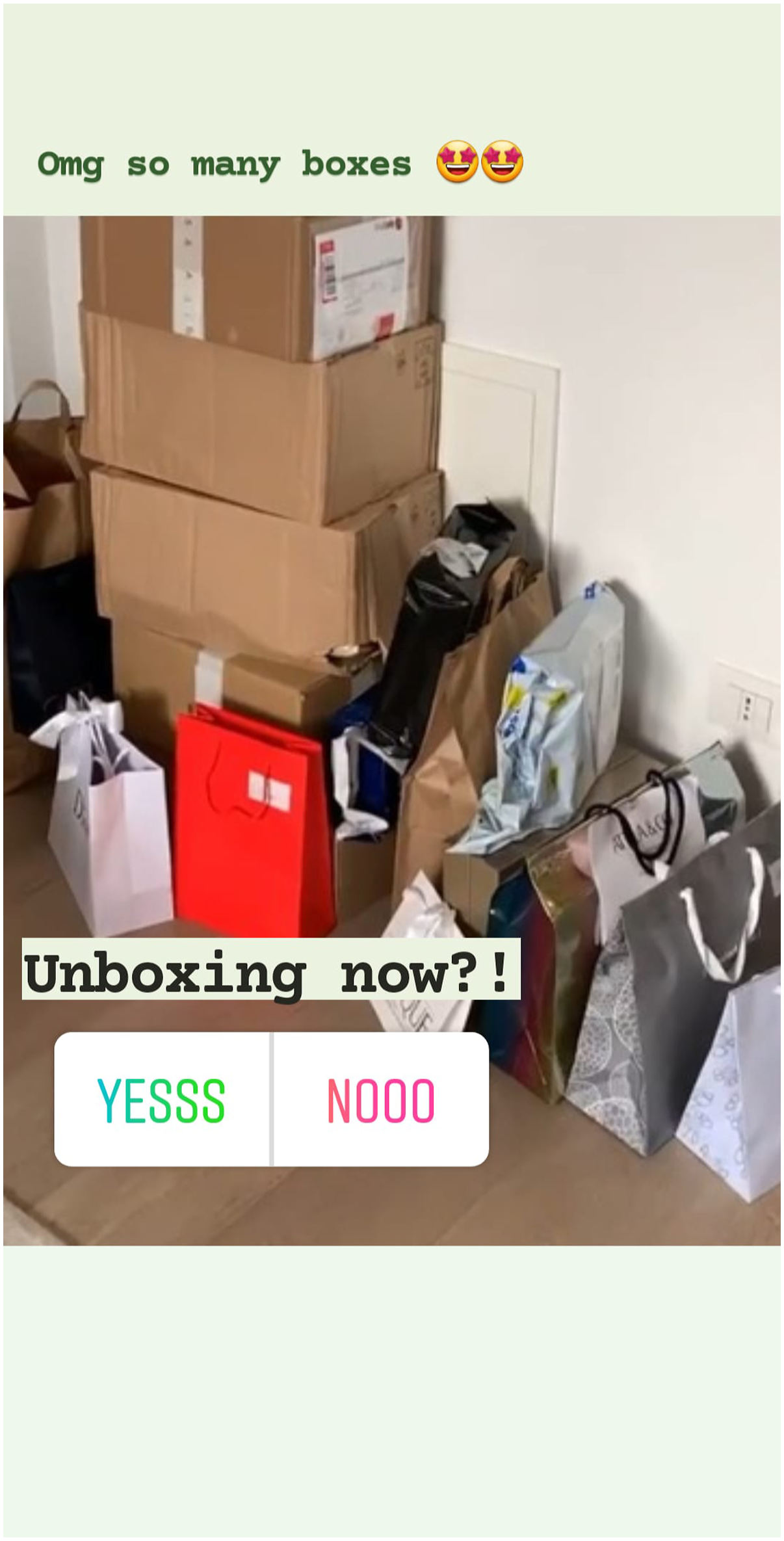
In these and other similar cases, consumer goods and services are accumulated and displayed beyond their mere and utilitarian necessity. Such an accumulation, however, is not wasteful, as in the original understanding of conspicuous consumption (Veblen, 1899/2007). On the contrary, it is functional to fuel the display of consumption and, therefore, content creators’ status-seeking activities, thus attesting to the productive dimension of conspicuousness. The productive dimension of conspicuousness is in line with the symbolic meaning and productive function undertaken by consumer goods and, in this specific case, by their accumulation (Yuran, 2016). The emphasis on the accumulation and display of consumer goods entails that consumption is mostly performed to be showcased, and becomes similar to a set of promotional practices and displays rather than consumption per se. The results show that the logic of conspicuousness entails a broader shift in the very nature of consumption, which takes on the form of ‘consumption without consumption’: a set of practices where the dimension of display, promotion, and access to consumer goods prevails over that of consumption and use.
Practices of accessing consumer goods and services become pivotal in content creators’ self-branding practices. To fuel the productive displays of consumption and sustain the accumulation of products and experiences, micro-influencers resort to forms of access-based consumption, a new modality of consumption whereby individuals pay for the use, rather than the ownership, of an object or service (Bardhi and Eckhardt, 2012). According to the empirical findings, content creators collect and accumulate consumer goods by means of different strategies, such as borrowing and renting items (mainly clothes and accessories) from friends and relatives, as well as from an emerging network of ad-hoc agencies, which allows them to access a variety of products and services under a fee and for a certain amount of time. As Cecilia explains in her Stories: Today I’m so sad! Do you remember that yellow dress I love? I must bring it back! Let me explain, some PR agencies lend you some clothes for a certain amount of time, then you have to return them! It’s super useful ’cause I can always have new clothes to show to you without buying them and without having my closet full of stuff! But it’s sad when you have to say goodbye to a dress you love!
From the results, it emerges that access-based consumption, with its alternative way of acquiring consumer goods, represents a response to the need for producing a branded self rooted in consumption. Access is a resource that fuels content creators’ displays and contributes to transforming these displays into productive activities aimed at gaining social status. Furthermore, access-based consumption allows content creators to display consumer goods or leisure activities otherwise cost-prohibitive and unattainable (Bardhi and Eckhardt, 2012), thus giving the impression of accessibility, ownership, and use regardless of their effective lifestyle and resources (Bernthal et al., 2005).
Thirdly, content creators’ activities are characterised by an element of circularity. These practices contribute to the construction of social status by draining the huge quantity of consumer goods micro-influencers own and balancing the conspicuousness of their displays. The circularity of consumption emerges through practices of recycling, gifting, or selling the items acquired and accumulated. Some micro-influencers, for example, gain in small groups and organise second-hand markets to sell their clothes and beauty products. This is the case of Alessia, a fashion content creator in her early 30s, who, together with other fellow micro-influencers, periodically holds what they call ‘The Girls’ Closet’. On these occasions, they sell their clothes, both the ones they bought and those they received as compensation for their promotional activities. Figure 2 shows how such events are advertised through Instagram Stories. Circularity of consumption, an example.
In these cases, the accumulation and draining of consumer goods propel the creation of a self-brand that is then ‘sold’ to followers and rerouted to generate social status - both in terms of visibility, captured in the platform’s metrics and used as attention capital, and monetary income. Furthermore, practices of circular consumption are aimed at mitigating the imperative of display which characterises the logic of conspicuousness. Micro-influencers are active in draining their consumer goods to construct their persona as relatable and authentic and to avoid being accused of wasteful behaviours. For content creators, social status is maintained only if they manage to find a balance between the display of consumption on the one hand, and their authenticity and accountability on the other. Interestingly, these practices are aimed at establishing a positive connection with the audience and generating extra income, rather than reflecting concerns about wastefulness or sustainability (Lacy and Rutqvist, 2015).
In sum, the analysis of Instagram Stories shows that micro-influencers construct social status by performing consumption practices characterised by accumulation, access, and circularity. Such practices are oriented by the logic of conspicuousness and by the concept of productive display that it entails. Notably, the logic of conspicuousness is fuelled by the peculiar features of Instagram Stories, which allow content creators to express themselves and showcase consumer goods and experiences in a rich, seemingly effortless, stream of content. Furthermore, the results highlight that conspicuousness unfolds through a cyclical relationship between consumption and production, which helps explain how content creators’ displays of consumption are repurposed as productive activities aimed at building and signalling social status.
Striving for conspicuousness: Seeking exclusivity, negotiating belongingness
By integrating Instagram data with insights from qualitative interviews, this section aims at adding another layer to the analysis and delving deeper into the strategies adopted by micro-influencers to gain and display social status. The results show that the accumulation, access, and circularity of consumption go hand in hand with two main strategies through which micro-influencers construct social status: seeking exclusivity vis-à-vis negotiating belongingness. These dynamics are not new in the processes of status acquisition; yet, they assume specific features when enacted by micro-influencers in the context of an economy of display. Although attention remains an important resource to accrue social status (Eckhardt and Bardhi, 2019) and metrics a relevant status symbol, content creators are increasingly relying on the display of knowledge and culture for status gaining purposes. Through the selection and display of specific brands and products that reflect their familiarity with the dynamics of the influencer industry, content creators become able to acquire attention capital. Attention capital can then be used to gain visibility, enhance algorithmic discoverability, improve the possibilities of gaining monetary income and, hence, construct social status.
More specifically, when micro-influencers seek exclusivity to accrue social status, their practices are oriented towards the display of a curated selection of products, brands, and experiences. In the interviews, exclusivity is described as the possibility of accessing scarce goods and working with brands that select only a few influencers to represent them. As Lara, a content creator who lives in Milan and works in the field of fashion, states: When the brand Coccinelle
3
contacted me, I was sooo flattered! They choose just a few influencers for their campaigns so, you know… and then, it’s a brand I really really love! [...] I was so WOW when later on they chose me to represent them at the Milan Fashion Week! (Lara, 27, F)
As this excerpt shows, micro-influencers value the aura of exclusiveness a company or brand has and, more importantly, confers to the content creator persona. Therefore, exclusivity is more related to brand literacy and access to exclusive products, rather than the display of luxury and wealth, in line with the recent shift towards inconspicuous forms of consumption (Eckhardt et al., 2015).
Moreover, seeking exclusivity orients content creators’ attempt at creating a coherent self-brand to accrue social status. Christian, a 30-year-old travel influencer, explains the constant labour underneath the creation and maintenance of exclusivity underpinning his choices as follows: When I have to choose whether to accept a partnership or not, the company’s prestige is one of the first elements I take into account. That’s because my position in the field is very much important. For example, if a supermarket asks me to advertise some biscuits for 50,000 euros, and the most refined pastry shop offers me 10 euros for the same biscuits, it’s better to choose the refined pastry shop. Such a choice can put in motion a chain of events that posit you up or down. […] In the past, I dismissed some offers from companies which didn’t have the same or higher level of prestige than the other companies I had worked with. Otherwise, I would have spoiled my Instagram feed, and in the end, my Instagram feed is my business card. (Christian, 30, M)
This excerpt highlights that exclusivity represents both a career achievement and a marker of status: once content creators start working with more prominent brands, they become very careful not to take a step back with less exclusive ones, as Christian states. Consequently, the choice of a brand or product is not only about credibility and authenticity (Duffy, 2017) but is also determined by strategic planning. In this sense, the logic of conspicuousness deploys through the management of exclusivity as a form of labour, which involves content creators in the constant curation of their self-brand and the evaluation of their careers, with the more or less explicit aim of boosting their status. As such, the maintenance of exclusivity becomes an important rule to follow, as it allows micro-influencers to go ‘up and down’ the status hierarchy, as Christian suggests. The results highlight content creators’ constant strive for conspicuousness, which represents the ultimate way of accruing social status.
Understood as a form of exclusivity, status is not only managed but also maintained by creating boundaries and claiming distinction from other groups. This aspect clearly emerges if confronting two different perspectives, exemplified by Emma and Alice: Some companies have gained, you know, kind of a lousy reputation. They send perks to almost everyone out there, I mean, even if you get 2k followers you can receive them, and today 2k followers are nothing! So, it doesn’t really mean anything if you get those products, it just means that they work with almost everyone, and you are just like anybody else out there! (Emma, 30, F) A collaboration I really hoped for is the one with the brand Pixi Beauty. All the creators I know, and who have more or less the same number of followers I have, received the Pixi Beauty Box. I sent the company my CV many times but never heard back from them. Then, the day I finally received the Beauty Box I was so happy I started jumping for joy, I was so glad that the brand had finally chosen me too. (Alice, 34, F)
Both creators are in their early 30s and consider themselves fashion micro-influencers. While, at the time of writing, Emma has more than 100,000 followers and works full-time as an influencer, Alice is at the beginning of her activity, which she considers a hobby, and has around 30,000 followers. Emma’s words suggest that content creators seek exclusivity by taking distance from low-value and inflated brands, in an attempt to not be assimilated with ‘wannabe’ influencers, who, in her opinion, contribute to inflating the market. This is especially evident in the Italian context, where the influencer industry is still in its nascent stages compared to other countries like the United States. Only in recent times businesses in Italy have started to embrace alternative advertising and marketing methods, such as relying on the work of content creators (Locatelli, 2020). As a consequence, the Italian influencer marketing sector is becoming increasingly saturated and the competition for already scarce resources is even more fierce, as the interview data testify.
For another group of micro-influencers, instead, negotiating belongingness prevails as a mechanism to gain and signal social status. In these cases, receiving a product previously displayed by other creators in the same category (in terms of field of activity and follower count) is a sign of being recognised as content creators, and hence one significant achievement in terms of status. Brands and products become badges of membership in a specific group, and this is why they work as status symbols (Berger and Ward, 2010). As Linda, a lifestyle content creator with around 25,000 followers points out: Another brand that I worked with is Daniel Wellington, and it was a real success for me because you see it in a lot of other content creators’ feeds. I talked with other girls, and we all agreed that working with this brand is kind of a rite of passage to really be considered an influencer. And if the brand doesn’t contact you, then you are all like: why don’t they choose me? Maybe I’m not good enough for their standards? (Linda, 23, F)
Like other interviewees in a similar position within the industry, she mentions that receiving some particular goods from aspirational brands means that the content creator is taking the right steps along the stairs of the influencer economy. Therefore, for content creators at the beginning of their activities, and with lower follower counts, to be recognised as part of the influencer category is a remarkable achievement and represents a chance to boost one’s status further.
In summary, the results show that content creators follow the logic of conspicuousness by means of two main strategies, seeking exclusivity and negotiating belongingness. Both strategies consist of the creation and maintenance of specific relationships with brands and consumer goods. Seeking exclusivity and negotiating belongingness make the processes of accumulation, access, and circularity more complex, indicating the presence of explicit or implicit criteria regarding what to display and how to do it. Notably, both exclusivity and belongingness insist on the symbolic meaning that the display of brands and products assumes in the context of Instagram’s regimes of visibility (Duffy and Hund, 2019). Therefore, these strategies complement micro-influencers’ attempts at being prominent on Instagram and go hand in hand with the curation of their self-brand and the attempts at outsmarting the algorithm to reach as many viewers as possible. According to the logic of conspicuousness, the display of a curated selection of consumer goods and brands generates attention capital, measured through the platform’s affordances, which can be leveraged to enhance content creators’ (algorithmic) visibility, prompt collaborations and monetisation opportunities, and, in turn, construct social status. The logic of conspicuousness, therefore, plays a pivotal role in the construction and reaffirmation of status hierarchies at the intersection of consumption displays, platform metrics, and algorithmic visibility.
Conclusion
The purpose of this paper is to understand how micro-influencers construct and display social status on Instagram, and how this sheds light on the wider transformations in status gaining and signalling. In the text, I argue that conspicuousness is a cultural logic that orients micro-influencers’ status-seeking practices - a logic based on the notion of the display and its productive valence. As the results show, conspicuousness is an expression of the economy of display, and it unfolds through consumption practices characterised by accumulation, access, and circularity. Such practices highlight that the display of consumption is a productive activity, aimed at the construction of social status, and not only a symbolic and wasteful one, as claimed in the theory of conspicuous consumption (Veblen, 1899/2007). Furthermore, micro-influencers’ self-branding practices are characterised by the emergence of two main dynamics that guide the construction of social status, seeking exclusivity and negotiating belongingness. These practices point out that micro-influencers are constantly striving for conspicuousness, as the ultimate way of accruing social status.
Taken together, the results highlight that social status is decoupled from the display of wealth or luxury and is instead related to brand literacy, exclusivity management, practices of distinction from “wannabe” influencers, or, alternatively, based on claims for belongingness to the category of content creators by means of the symbolic value associated to consumer products. These insights are in line with recent changes in the ways in which social status is signalled, which are oriented towards inconspicuous and subtle signals and based on the display of being “in the know” (Currid-Halkett, 2017). Notably, however, the relevance of the display remains a fundamental aspect of micro-influencers’ practices: even the subtlest signal of social status has to be put on display and repurposed to accrue prestige. The logic of conspicuousness is, therefore, ubiquitous and it constantly orients content creators’ self-branding strategies.
Not only the practices of status gaining and signalling are witnessing a change but also the very nature of consumption. Under the logic of conspicuousness, it is possible to witness forms of ‘consumption without consumption’, whereby consumption, often mediated by the role of access, becomes a matter of promotion and display, rather than use. Furthermore, consumption becomes increasingly entangled with production, in a cyclical process that can be called a ‘circle of prosumption’. Through this cyclical process, the display of consumption fuels content creators’ self-brands and is repurposed as a productive activity aimed at propelling the consumption of the influencer’s persona and gaining social status, in a virtuous circle. In sum, the logic of conspicuousness represents a fruitful concept to understand micro-influencers’ status-seeking practices, as well as the changes in the dynamics of social status and distinction in contemporary society at large.
The present research opens some directions for future research. A more extended reflection on the role of access and access-based consumption, for example, is crucial to understand how social status is constructed at the intersection of access as a lifestyle facilitator (Bernthal, Crockett and Rose) and individuals’ pre-existing resources. Furthermore, future research would benefit from a cross-platform perspective to analyse how social status is accrued, converted, and transposed across different social media platforms besides Instagram. Lastly, it would be relevant to further analyse the relationship between the display and accumulation of consumption and content creators’ accountability, especially in light of the aftermaths of the COVID-19 pandemic, and the current economic crisis.
In conclusion, this paper offers a theoretical and empirical contribution to the understanding of social status in a context characterised by the relevance of the display, the importance of attention as value, and the blurring distinction between consumption and production, and at the same time opens to an interdisciplinary understanding of status in the contemporary influencer economy and beyond.
Footnotes
Acknowledgements
I would like to deeply thank Alessandro Gandini, who saw this project coming into being and growing, and has been a great mentor and informal reviewer. I am grateful to Giana Eckhardt, Massimo Airoldi, and Ariadna Matamoros-Fernández for their insightful and valuable comments on my research. I would like to thank the anonymous reviewers and the editors of Marketing Theory for their helpful suggestions on how to improve this contribution.
Declaration of conflicting interests
The author(s) declared no potential conflicts of interest with respect to the research, authorship, and/or publication of this article.
Funding
The author(s) received no financial support for the research, authorship, and/or publication of this article.
