



Abstract
Calls for research contribution and demands for original theories have become visibly and audibly louder in review processes over the last two decades. In interpretivist marketing and consumer research, such calls have been accompanied by an emphasis on the importance of theory and on drawing on context when crafting impactful research contributions. By investigating the rhetorical claims made by authors in 45 highly cited articles, published between 2005 and 2019 in three representative marketing journals, this paper provides a kaleidoscopic, three-dimensional framework that maps out and explores the rhetorical devices employed in interpretivist scholarship. Based on the framework, the paper suggests different pathways that researchers can follow to navigate through the complex process of shaping and developing relevant and impactful research contributions.
Introduction
Researchers who wish to craft impactful and interesting research contributions (Smith, 2003), should not only master abstract and theoretical knowledge but also develop convincing writing skills (Palmatier, 2016). Each of these elements is important when writing academic articles and, together, they become the basis on which research contributions are judged worthy of publication, or not (Summers, 2001). In the last two decades, calls for research contributions have gotten louder, not only in this journal but in marketing and consumer research more widely. In positivist and post-positivist research traditions, this call has been translated into a need for replication (Hunter, 2001) and, more recently, calls for more advanced theory development (e.g., MacInnis, 2011; Moorman et al., 2019; Yadav, 2010). In interpretivist scholarship, this call has taken a different form and has focused on the theoretical nature of contribution (Belk and Sobh, 2019) and the meaning of theory (Bajde et al., 2021; Sandberg and Alvesson, 2021).
The call for a refined research contribution is common to every marketing and consumer research sub-discipline but, in interpretivist scholarship, research contributions are crafted in a particular way. In interpretivist scholarship, dominated by contextual relativism and researcher-inclusive perspectivism, the relationship between theorization and context is complex because scholars “do not study consumption contexts; they study in consumption contexts to generate new constructs and theoretical insights and to extend existing theoretical formulations” (Arnould and Thompson, 2005: 869). The diversity of investigative contexts has led to an increased focus on both theory and theorization (see Bajde et al., 2021; Belk et al., 2019), partly because interpretivist work is a place to “hatch […] embryonic theories” (Belk and Sobh, 2019: 500) but also because the socio-historical “context of context” (Askegaard and Linnet, 2011) is important when carving out research contributions. Interpretivist marketing and consumer studies are, therefore, more heteroglossic than other marketing and consumer studies due to their onto-epistemological nature (Thompson et al., 2013). Instead of hypothesis testing, interpretivist marketing and consumer researchers engage in more open-minded processes through which they unpack the interaction(s) between preexisting, adapted, or novel conceptualizations of research contexts to generate general understandings and explanations. In an interpretivist academic article, therefore, the research contribution is––or should be––constructed in a different way than it is in other kinds of articles. Yet, advice on how to construct a “good” research contribution offered in informal encounters (e.g., corridors and internal seminars) or more formal settings (e.g., reviews, articles and PhD education) can be different, inconsistent or even contradictory. Moreover, previous research on research contributions has framed contribution in various ways, sometimes focusing on positioning a study in relation to previous research (Alvesson and Sandberg, 2011; Sandberg and Alvesson, 2010; Nicholson et al., 2018) and sometimes as theory building (Bajde et al., 2021; Dolbec et al., 2021; Oswick et al., 2011). Hence, there is a need to flesh out the complexity of research contributions in interpretive marketing and consumer research by looking at different dimensions of those contributions.
This article builds on previous meta-studies on the crafting of research contributions from both marketing and management studies (see Alvesson and Sandberg, 2011; Johnson, 2003; Locke and Golden-Biddle, 1997; Nicholson et al., 2018; Oswick et al., 2011). It unpacks the ways in which “successful” research contributions are constituted by investigating the rhetorical claims (i.e., the representation of contribution) of 45 articles published between 2005 and 2019 in three leading marketing and consumer research journals. In doing so, this paper builds a framework which works both as a way to map out common rhetorical representations of contributions in interpretivist consumer and marketing studies, and as a resource to guide interpretivist researchers when they craft research contributions in their own manuscripts. Our study unpacks “the contribution conundrum” (Ladik and Stewart, 2008) by dissecting and fleshing out three dimensions of research contribution, namely: (1) the positioning of a research paper with respect to previous research; (2) the theoretical proposition generated to advance theoretical conversations; (3) the process of such theory building. The paper constructs a kaleidoscopic framework based on these three dimensions from the categories found within our corpus of interpretivist marketing and consumer research articles. Our aim is to provide interpretivist researchers, at any stage of their career, with a number of potential pathways—constituted by calibrating various patterns of categories within the kaleidoscope—that can be used to navigate through the complex process of shaping relevant and impactful research contributions. Our findings can be used as a conceptual toolbox to help early years scholars understand how to craft contributions, as a performative template to guide authors when writing about their research, and as a disruptive inspiration to encourage new, original, and disruptive approaches to advancing knowledge. By looking to the past and highlighting how scholars have previously constructed research contributions, this paper helps interpretive marketing and consumer researchers to construct the present and future of the field. This study expands our understanding of research contributions in interpretive marketing and consumer research and help us to answer calls for more novel and original theories in the discipline.
Existing meta-studies on research contribution
The foci of meta-studies on research contribution are multifaceted and variegated. Several in-depth studies question and unpack the assumptions behind the construction of research contributions in an empirical and systemic manner (Alvesson and Sandberg, 2011; Johnson, 2003; Locke and Golden-Biddle, 1997; Sandberg and Alvesson, 2010. Within management (Hällgren, 2012; Oswick et al., 2011) and marketing (Nicholson et al., 2018), the main scope has been to assess and evaluate research contributions in published articles.
These are good sources of inspiration and the present study builds on them. However, their frameworks do not consider the peculiarity of interpretative scholarship in consumption and marketing studies. Such peculiarity is characterized by: (1) a tendency to question the relationship between theorization and context rather than testing it (as in positivist research) because the “experiential and sociocultural dimensions of marketing and consumption […] are not plainly accessible through experiments, surveys, or database modelling” (Arnould and Thompson, 2005: 870); (2) the importance of socio-historical context for carving out research contributions; (3) a heteroglossic onto-epistemological (Thompson et al., 2013) approach to theorization that generates general understandings and explanations. Theory is used in a variety of different ways in interpretivist research. It can be a means to creating a research contribution but also an end in itself (Bajde et al., 2021). There are also specificities in the way the contribution is formatted (Bajde and Gopaldas, 2019; Fischer et al., 2017; Giesler and Thompson, 2016), structured and written (Arnould, 2006; Hogg and Maclaran, 2008; Fernandez, 2020).
In terms of produced materials (i.e., books, articles), interpretivist marketing and consumer scholarship also presents specific peculiarities. First, the contribution is presented in both the introduction and the discussion/analysis section of each article, which is different from articles in other fields (see Hällgren, 2012; Nicholson et al., 2018). Second, research contribution in interpretivist studies is, as pointed out by Alvesson and Gabriel (2013), often “non-formulaic” since the process of theorization is characterized by difference (Belk and Sobh, 2019) and inspired by a mix of anthropological, cultural, and sociological traditions. Previous meta-studies—which either focus on intertextual and narrative elements in the manuscripts (Alvesson and Sandberg, 2011; Locke and Golden-Biddle, 1997) or on making interesting theoretical contributions (see Johnson, 2003; Oswick et al., 2011)—have not synthesized the way in which a study is positioned in relation to previous theoretical concepts and literature with how it renders theoretical advancement for knowledge generation and how it builds a research contribution by using specific semantics. This threefold-relationship is rhetorically evocative in interpretive marketing and consumer research articles.
All in all, making a research contribution in interpretivist marketing and consumer research is as much about rhetorical framing as it is about theoretical and conceptual development (see MacInnis, 2011). For interpretivist scholars (and reviewers), a well-rounded research contribution is not only about choosing a theory or developing it (see Oswick et al., 2011) but is also, and perhaps most of all, a matter of rhetoric (Hogg and Maclaran, 2008), of structuring arguments, and of using language (Arnould, 2006; Fernandez, 2020). In other words, crafting a theoretical contribution relies heavily on the representation and purposeful communication of that contribution. What matters is how a research contribution is written, what is written, and why it is written. However, the multiplicity of these three dimensions in the construction of research contributions has been overlooked in previous meta-studies. There is, therefore, a need for a systematic analysis of what, in interpretivist scholarship, a research contribution is, how it is constituted, and why it is presented in the way it is.
Modifications to existing models were, therefore, necessary. They were also necessary because existing systematic meta-studies in marketing and business studies identify research contributions as merely “positioning” (see Ladik and Stewart, 2008) in relation to previous concepts, theories and literature. They do so by referring to the way in which a study approaches and renders theoretical advancement (Hällgren, 2012; Nicholson et al., 2018), or the way in which it builds contribution as a matter of knowledge generation (Oswick et al., 2011). But they do not do this conjointly, by focusing on the means of crafting an argument (Summers, 2001). In order to do this, we build a framework that recognizes the multiplicity, multifacetedness, and heterogeneity of interpretative scholarship in marketing and consumer research. The framework includes the different dimensions of research contribution in interpretivist consumer and marketing research articles. Before moving on to unpack the three-dimensional framework, we first delve into our research strategy, which is instrumental to the contribution of this article.
Research design
We began by constructing a corpus of the most impactful articles from interpretivist marketing and consumer research. We then analyzed each article meticulously to determine how its research contribution was rhetorically constructed. Finally, we created a kaleidoscopic framework based on the different kinds of research contributions identified. This three-step process is presented comprehensively below.
Step 1: Constructing the corpus
In order to construct our corpus of interpretivist marketing and consumer research articles, we used the historical development of interpretivist scholarship as our point of departure and followed the evolution of research communities with different labels—that is, postmodern marketing, ICR, CCT, critical marketing (see Cova and Elliott, 2008). After intense discussions among the research team and with other colleagues, we decided on three criteria. For an article to be deemed an interpretivist marketing or consumer research article (Belk and Sobh, 2019) and to be included in our corpus, it needed to: (1) employ an interpretivist approach, (2) use a qualitative methodology, and (3) analyze empirical material in order to make a theoretical contribution. The last point is important because interpretivist scholarship is characterized by the relationship between the research contribution and the empirical context of the study (see Askegaard and Linnet, 2011) as this is said to be pivotal in framing influential contributions (Cote et al., 1991).
Using the three criteria, we selected articles from three scientific journals—Journal of Consumer Research (JCR), Marketing Theory (MT), and Consumption, Markets & Culture (CMC)—from 2005 to 2019 1 . These journals were selected because of their role in the interpretivist research tradition and their rank (at least level two) in the Chartered Association of Business Schools (ABS) list of academic journals. There were additional reasons for choosing these specific journals. JCR is widely considered the A-list journal for interpretivist marketing and consumer research. CMC belongs to the Consumer Culture Theory Consortium community and is connected to the CCT and ICR conferences. Furthermore, it has historically been the main outlet for Postmodern marketing and Heretical Consumer Research (Levy, 2015). MT has historically been an outlet for critical and interpretivist research that focuses on marketing practices and phenomena and not only on consumers. Finally, all three journals contain different writing styles.
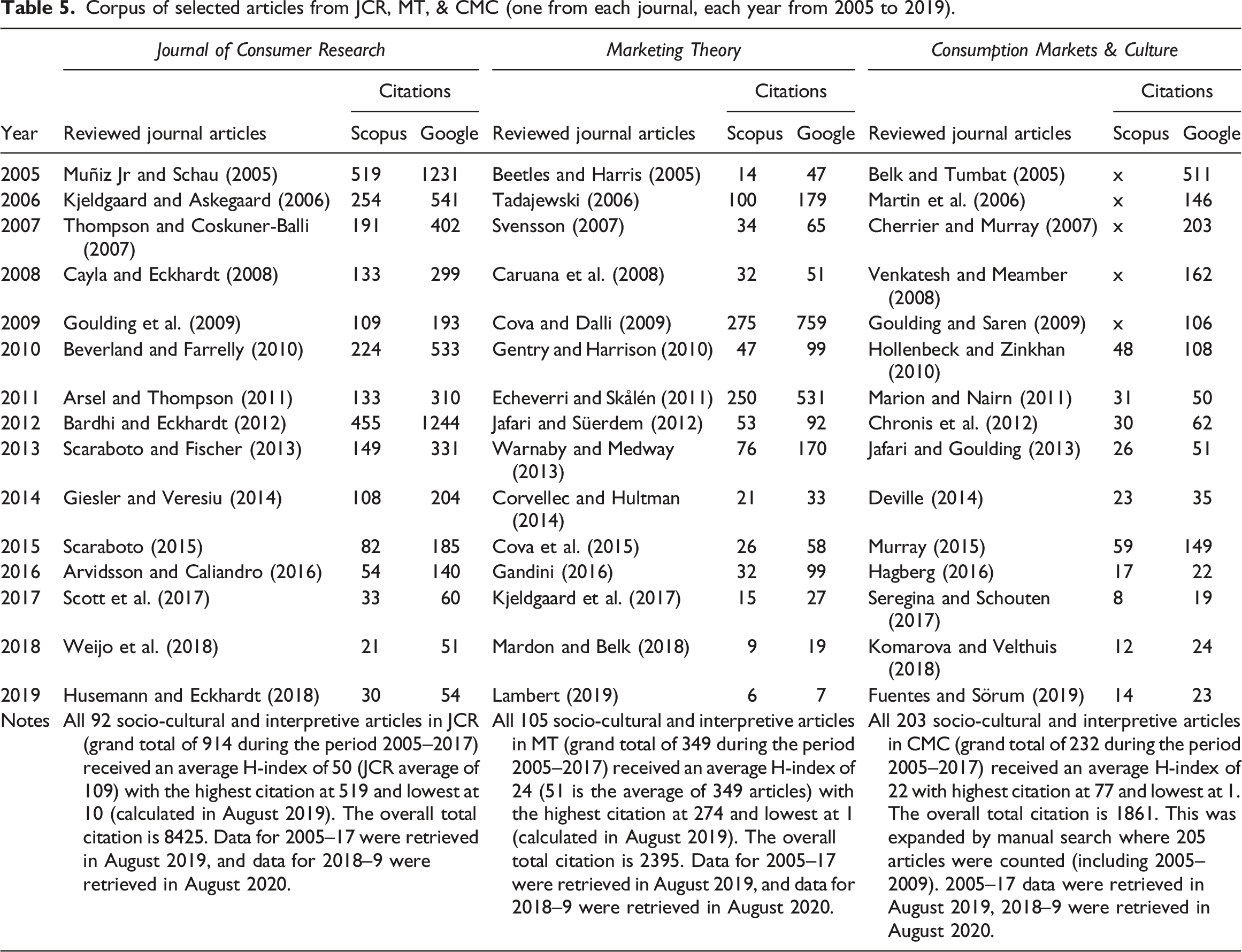
A total of 494 articles fulfilled our three criteria—104 from JCR, 142 from MT, and 248 from CMC. From these, we selected the most cited article in each journal for each of the 15 years based on a combination of citation data retrieved from Scopus and Google Scholar (see Table 5). Our rationale was straightforward. We wanted to analyze the articles that, according to the numeric criteria of citations, are most impactful (Cote et al., 1991; Leong, 1989; Stremersch et al., 2007; Wang et al., 2015) even if doing so means we missed out on other kinds of contributions—including strong, interesting, or disruptive contributions. We now had a corpus of the 45 most impactful articles from interpretivist marketing and consumer research.
Step 2: Developing categories abductively
In the next step, two researchers analyzed each of the 45 articles to classify the language used by authors when framing their contributions and to build categories of research contribution. This process underwent several repetitions to ensure sound coding. We also consulted previous literature on problematization and construction of theoretical contributions (Hällgren, 2012; Nicholson et al., 2018; Oswick et al., 2011; Sandberg and Alvesson, 2010).
After several rounds of analysis, we had 12 categories of research contribution. Some are etic, being drawn directly from previous meta-studies—for example, neglect spotting or new context spotting (Nicholson et al., 2018). Some are re-worked or combined from previous meta-studies—for example, alternative lens or theory extension (Oswick et al., 2011). And some are completely new, emergent categories, which we created when previous literature was inadequate to categorize the ways in which an article’s research contribution was rhetorically constructed—for example, new theorization.
Step 3: Assembling the framework
Step three involved the creation of a kaleidoscopic framework based on the categories developed in step two. The categories that emerged from the coding of each article were plotted on three coexisting dimensions reflecting: (1) positioning, (2) proposition, and (3) processing. Positioning implies the way in which a research article uses semantics and rhetorical claims to frame and problematize its own specific research in relation to other concepts, theoretical frameworks and theoretical conversation in the research stream. Proposition indicates the way in which a research article employs semantics and rhetorical claims to showcase and create connections between its own specific research and other theoretical concepts, theories, theoretical frameworks and theoretical conversations. Processing specifies the way in which a research article uses semantics and rhetorical claims to carve out and set the stage for contribution in terms of its own specific research outcome vis-á-vis previous or parallel attempts, whether these are conceptual, theoretical, or simply contextual. Put more simply, the dimensions show us: (1) why a research article aims at making its contribution (positioning); (2) what contribution it aims to make (proposition); and (3) how it does so (processing).
Generated abductively by pairing categorization from previous studies with new insights from the selected research domain, our framework is, therefore, a representation of “known” ways to make an impactful research contribution. It not only represents a way to map out categories of research contribution as they appear in our corpus but is also a resource. The eight pathways it creates can be used as a heuristic by researchers when reviewing and writing research contributions in interpretivist marketing and consumer studies.
A framework for interpretative scholarship in marketing and consumer research
In this section, we present the three dimensions of our kaleidoscopic framework, which together represent how interpretivist marketing and consumer researchers present research contributions in published articles. In the subsequent section, we draw on this framework to identify general pathways that interpretivist researchers can use when framing future research contributions.
Unpacking research contributions with a kaleidoscopic framework
In this sub-section, we employ the kaleidoscope as a heuristic device allowing us to map out the three dimensions that constitute a research contribution in its multifaceted entirety within a single manuscript. The kaleidoscopic framework serves as a means to recognize the complexity, multiplicity, and heterogeneity inherent in interpretivist marketing and consumer research. It also enables us to abductively assemble the three dimensions that emerged when we fine-tuned categories from existing meta-studies and coded new categories specific to interpretivist marketing and consumer research articles.
Heuristic tools offer a means to understand, relate and envision various types of contributions to help “resolve competing schools of thought” (Giovanardi and Lucarelli, 2018: 152; see also MacInnis 2011). Our kaleidoscope not only brings clarity and order to specific topics but also emboldens readers to evaluate current research and paves the way for future exploration. Importantly, it offers flexibility to be tailored to individual experiences and contexts. As a heuristic device, it holds emancipatory potential, encouraging researchers from all academic backgrounds and levels of expertise to craft research contributions that generate innovative and influential knowledge.
The kaleidoscopic framework encompasses three dimensions. Within each dimension are four categories that span two spectrums. In the remainder of this sub-section, we delve into each dimension—positioning, proposition, and processing—detailing its corresponding categories and spectrums. A visual representation, showcasing all twelve categories across the six spectrums within the three dimensions, can be found in Figure 2.
Positioning
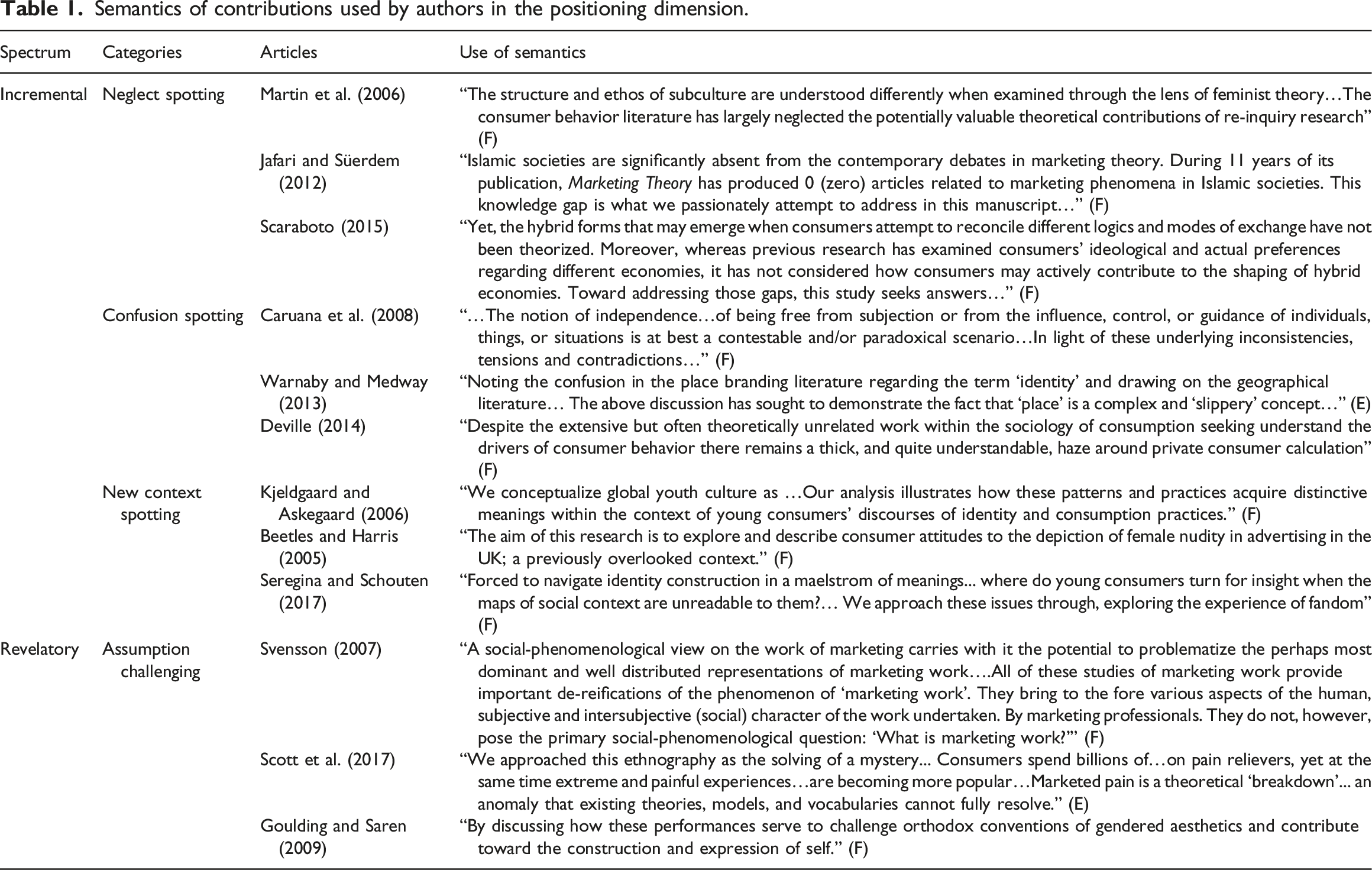
The first dimension reflects the “positioning of an article in relation to previous knowledge emerging from literature streams, conceptual debates or theories” (our definition). This is an important dimension in all marketing fields (see Ladik and Stewart, 2008; Palmatier, 2016) but is crucial in interpretivist scholarship because it helps not only to rhetorically structure arguments (Arnould, 2006) but also linguistically “engages with and/or contributes to ongoing conversations” (Fernandez, 2020). The ways of positioning a research contribution in this dimension fall into four categories: neglect spotting, confusion spotting, new context spotting, and assumption challenging. In line with Nicholson et al. (2018), we conceptualize these as either incremental contributions—neglect spotting, confusion spotting, and new context spotting—or revelatory contributions—assumption challenging—and list them on a spectrum in order from more incremental to more revelatory. Constructing a contribution in an incremental way entails “framing one’s own research as adding to, or building on, previous research as well as contributing to other (previous) theoretical attempts” (our definition). This can be done because there is either something that has been neglected or overlooked in previous contribution attempts—that is, neglect—or something which is conflicting, confusing, or unclear in previous contribution attempts—that is, confusion—or there is a newer object, idea or context, which could render a different or complementary understanding of previous contribution attempts—that is, new context. Many research articles in our corpus use the term “spotting'' (see Arsel and Thompson, 2011; Cova et al., 2015; Jafari and Süerdem, 2012; Jafari and Goulding, 2013). Therefore, we have modified the labels used by Nicholson et al. (2018) so they apply to interpretivist marketing and consumer research. We use the term incremental contribution, a combination of neglect spotting, confusion spotting, and new context spotting, to refer to the relationship an article claims to have with previous research streams or theoretical debates.
Semantics of contributions used by authors in the positioning dimension.
Proposition
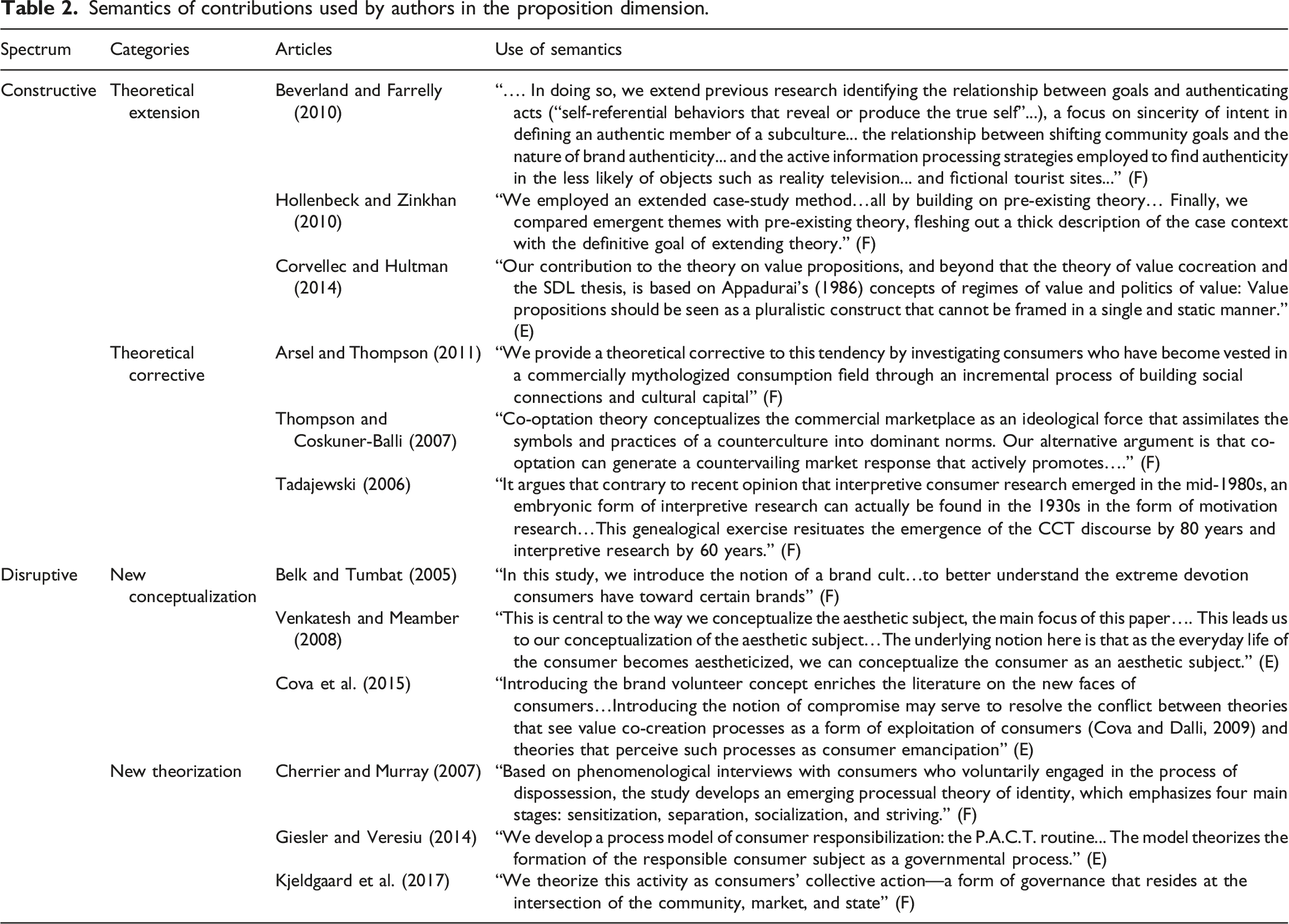
The second dimension expresses “the proposition an article presents in regard to a specific mode of knowledge production” (our definition). This is an important dimension in interpretivist marketing and consumer research because it helps to linguistically generate sound and convincing accounts for different (other field) audiences (Hogg and Maclaran, 2008). The proposition that an article presents in regards to a specific mode of knowledge production can fall into one of four categories: theoretical extension, theoretical corrective, new conceptualization, and new theorization. The categories in this dimension emerged emically from the specific semantics and rhetoric used in our corpus of articles as we could not find corresponding categories in previous meta-studies. The categories in this dimension represent different points on a continuum from a constructive to a disruptive relationship to knowledge creation, which here is understood as “the relationship one specific research article claims to have (highlights importance and builds links) with the theoretical apparatus, widely understood as concept, theory, set of theoretical relations or conceptual framework” (our definition).
The first two categories—theoretical extension and theoretical corrective—collectively referred to as constructive contributions, capture the most commonly used rhetoric and semantics. Theoretical extension and theoretical corrective are conservative, marginal, and self-effacing ways to rhetorically construct theoretical contributions. The former (extension) seeks to incrementally build on a specific theoretical element—a concept, specific theoretical debate or theoretical framework. The latter (corrective) seeks to redress, resolve, or rethink a specific theoretical element—a concept, specific theoretical debate, or theoretical framework (see Arsel and Thompson, 2011).
The remaining two categories—new conceptualization and new theorization—which we call disruptive contributions, were partly generated using other meta-studies about theoretical contribution (see Ladik and Stewart, 2008) and partly generated emically from the empirical corpus. New theorization reflects semantics and rhetoric that express a more disruptive impact on knowledge creation compared to new conceptualization, if we take the claims (emically) at face value, which we do. New conceptualization “introduces new concept(s), framework(s) or model(s), typically in a grounded manner or without building on outer theoretical frameworks or theories'' (our definition). New theorization includes rhetoric and semantics that “seek to systematically build up relationships between concept(s) and constructs in order to generate novel and (possibly) groundbreaking theoretical advancements” (our definition). Some examples of semantics from the proposition dimension and its associated categories are shown in Table 2.
Processing
The third dimension reflects the “process of theory-building or theorizing a specific mode of producing knowledge featured in a specific article” (our definition). This is important in marketing research in general (Summers, 2001) but represents an additional, interlinked dimension in interpretivist marketing and consumer research because it helps to linguistically present the mode of building theoretical insights (Bajde and Gopaldas, 2019; Fischer et al., 2017; Giesler and Thompson, 2016) and to linguistically highlight the process of developing a theoretical contribution. This is the process of theory-building (Bajde et al., 2021; Dolbec et al., 2021) or theorizing (Weick, 1995) rather than the outcome, which is itself called theory.
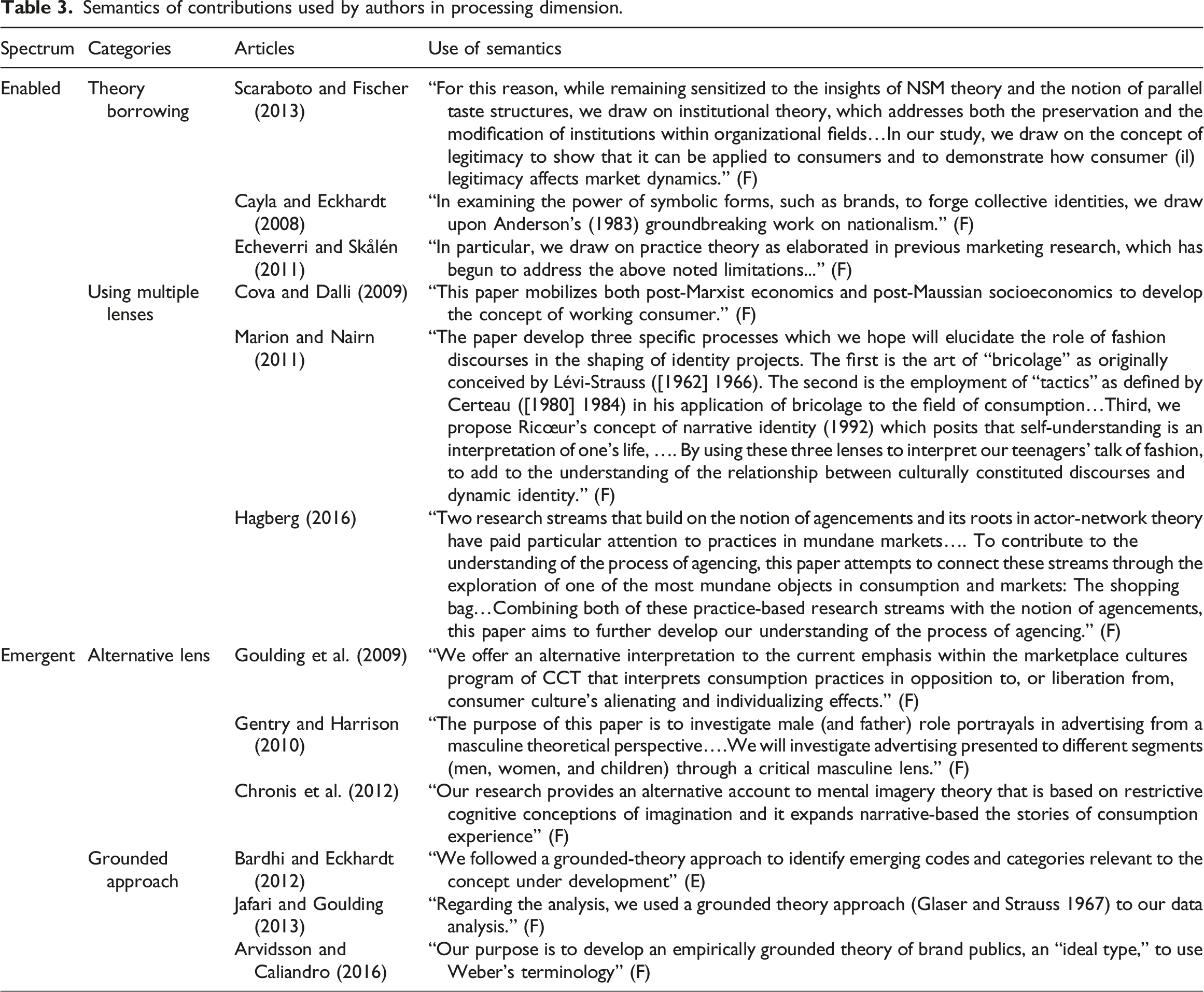
The categories in this dimension are theory borrowing, using multiple lenses, alternative lens and grounded approach. The latter two categories in this dimension were generated specifically for interpretivist marketing and consumer research but the first two were adapted from previous frameworks on the use of theory in business studies (Ladik and Stewart, 2008; Oswick et al., 2011). These categories are more heterogeneous than the categories in our other two dimensions. There is no clear hierarchy, as ranking their gravitas could prove problematic in interpretivist marketing and consumer research scholarship (see Belk and Sobh, 2019). The categories in this dimension range from what we call an enabled-theorizing to an emergent-theorizing approach to the process of rendering a contribution. This distinction has been created to nuance the semantic differences observed in our corpus while also recognizing that interpretivist scholarship in different business disciplines (Nordqvist et al., 2008; Lukka, 2014; Yanow and Ybema, 2009) has historically entailed an overall abductive reasoning process (see Holbrook and O'Shaughnessy, 1988; Tadajewski, 2014).
Semantics of contributions used by authors in the proposition dimension.
The category theory borrowing is, itself, borrowed from organization studies (Oswick et al., 2011; Whetten et al., 2009). It is relevant here because, like interpretivist marketing and consumer research, organization theory is a heterogeneous research domain (see Oswick et al., 2011) in which “promiscuous theory shopping” (Price, 2022)—that is, borrowing concepts and theories from other disciplines such as humanism and anthropology—is a common way of theorizing and making a contribution.
The categories using multiple lenses and alternative lens are modifications. It is evident that, in creating the first label, Nicholson et al. (2018) refer to Oswick et al.’s (2011) ideas of theory borrowing and theory blending but combine them with Johnson’s (2003) notion of creating interesting research. Thus, the label using multiple lenses stems from Oswick et al.’s (2011) distinction between the wholesale importation of theory from one discipline into another—theory borrowing—and theory blending. We have chosen to dovetail both as part of our category using multiple lenses because distinguishing whether theory is endogenous or exogenous to the interpretivist marketing and consumer research domain is problematic (see Belk and Sobh, 2019). In line with the core idea in this article—that interdisciplinarity is a way to create research contributions as well as a fundamental idiosyncrasy of interpretivist marketing and consumer research—using multiple lenses means embracing interdisciplinarity relationships in an inclusive way when theorizing. In this article, using multiple lenses denotes the way in which “a specific research stream, concept, or theoretical attempt is mobilized in an article that combines two or more theoretical lenses/perspectives to offer a modified understanding of a phenomena” (our definition).
Alternative lens encapsulates rhetoric and semantics that more or less explicitly seek to provide a “new(er), alternative understanding, perspective, look, concept or theory on a specific theoretical element, by digging into theoretical frameworks or theories that are claimed to be novel/mis-understood or mis-used in the research domain” (our definition). While still generalizable, alternative lens is more specifically related to interpretivist marketing and consumer research. In fact, during the categorizing process, we discovered how the rhetorical construction of alternative lens in interpretivist marketing and consumer research is not only based on end-results, for example, engaging foreign theory as biosocial theory to offer a nuanced understanding of subjective pleasure (see Goulding et al., 2009). It can also be a means to an end, for example, developing a situated approach to agencements by delving into actor-network theory (see Hagberg, 2016). In other words, the category of alternative lens reflects Oswick et al.’s (2011) interpretation scheme in terms of theoretical engagement. While the label alternative lens stems from our corpus, we also drew inspiration from Belk and Sobh’s (2019) idea about the potential of alternative theoretical explanations to generate original consumer theories.
Semantics of contributions used by authors in processing dimension.
Plotting research contributions in a kaleidoscopic framework
The three-dimensional kaleidoscopic framework not only allow us to map out the rhetorical claims of contribution in interpretivist scholarship but can also be used instrumentally to appraise other scholarly works or approach one’s own writing. The various layers within the kaleidoscope (see Figure 2) can be rotated to illuminate eight different combinations or pathways to contribution. Each pathway is determined by selecting one of the two possible spectra (aggregated from the four categories within each dimension) for each of the three dimensions: incremental or revelatory for the positioning dimension, constructive or disruptive for the proposition dimension and enabled or emergent for the processing dimension (see Figure 1 and Table 4). In this section, we will delve deeper into these combinations, providing examples from our corpus to demonstrate how authors have employed these pathways to craft their research contributions. A kaleidoscope of three-dimensional research contribution. Various Pathways to make Research Contribution. Prevalence of various pathways in our corpus of the most cited papers (2005–2019).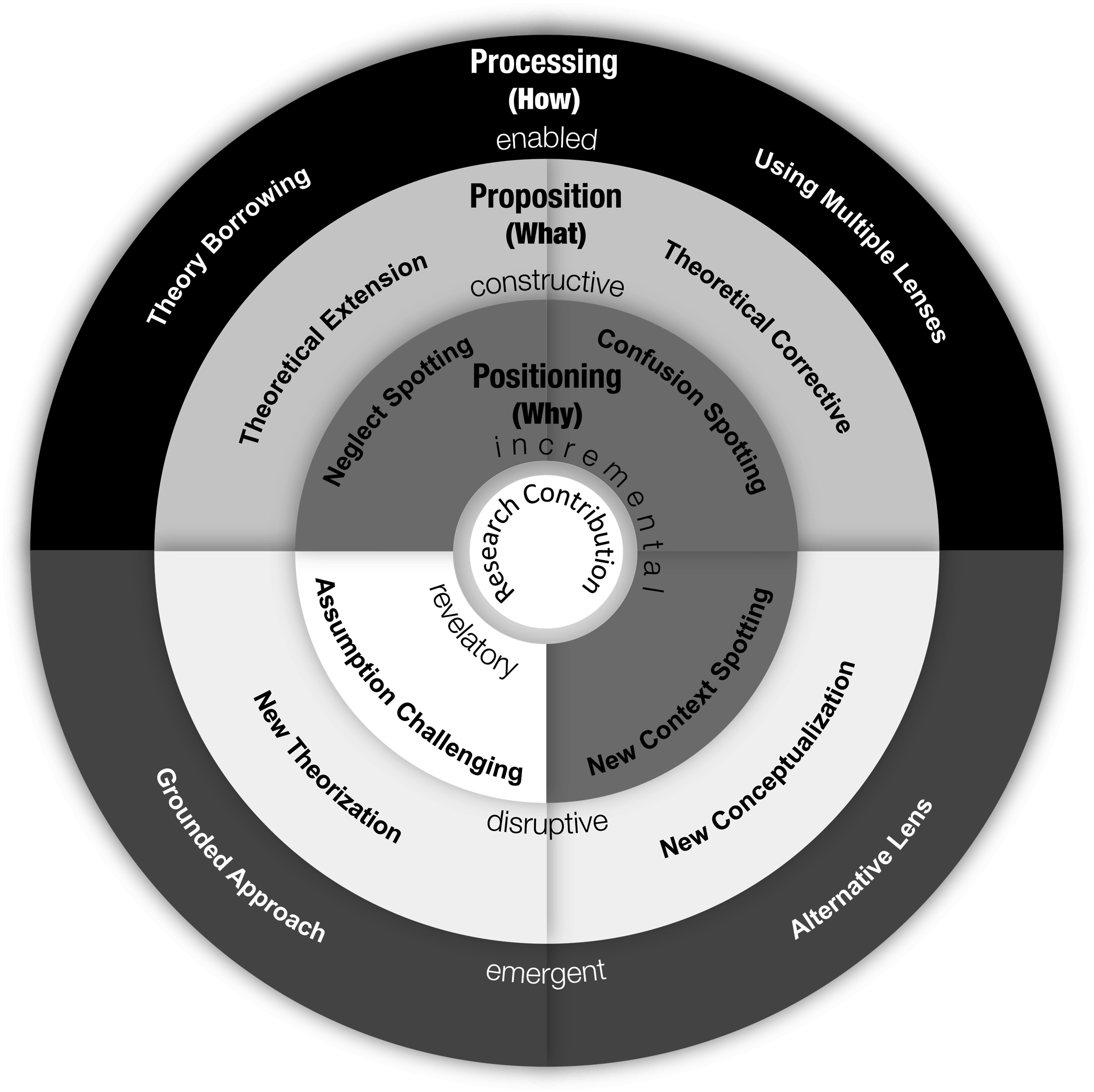
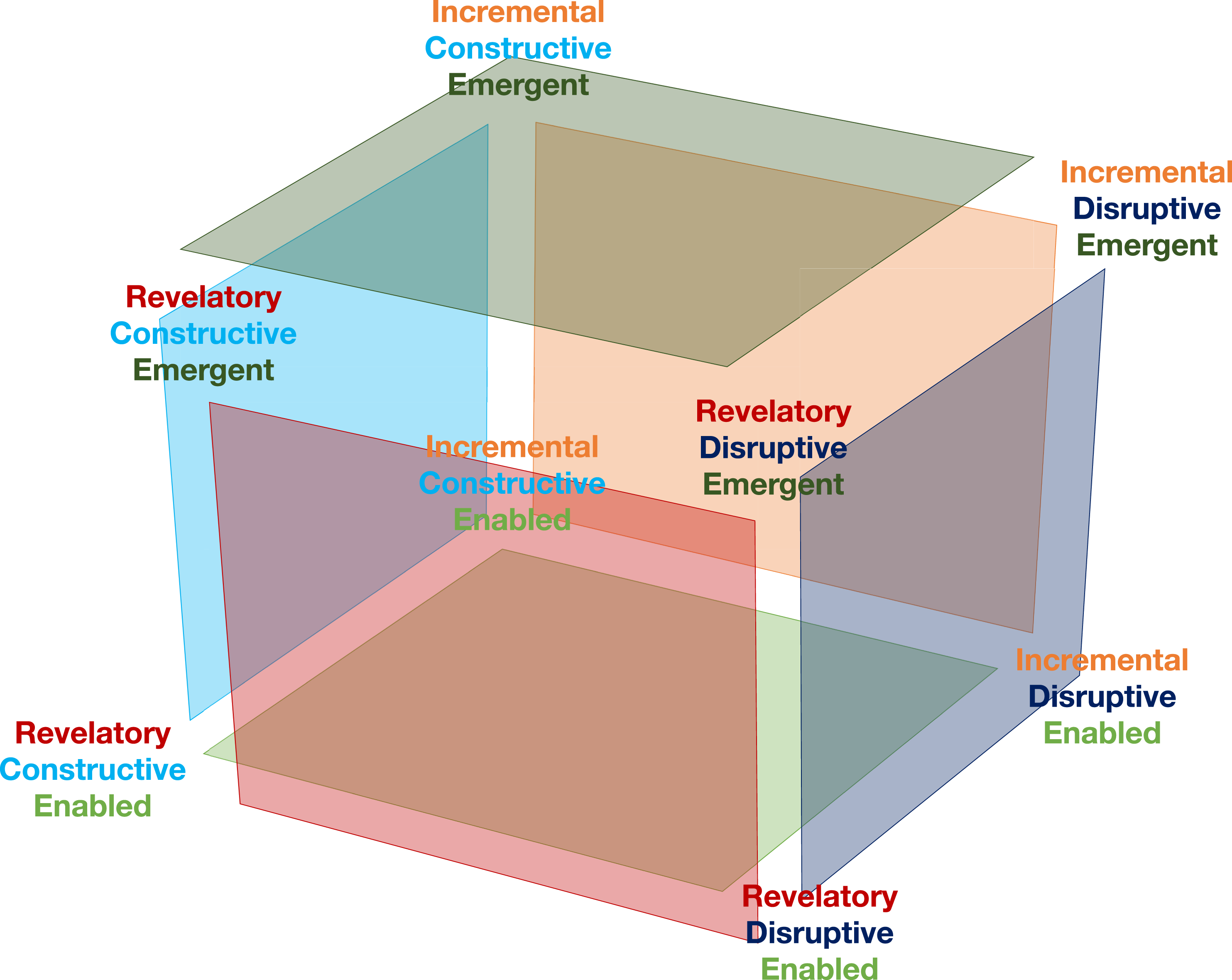
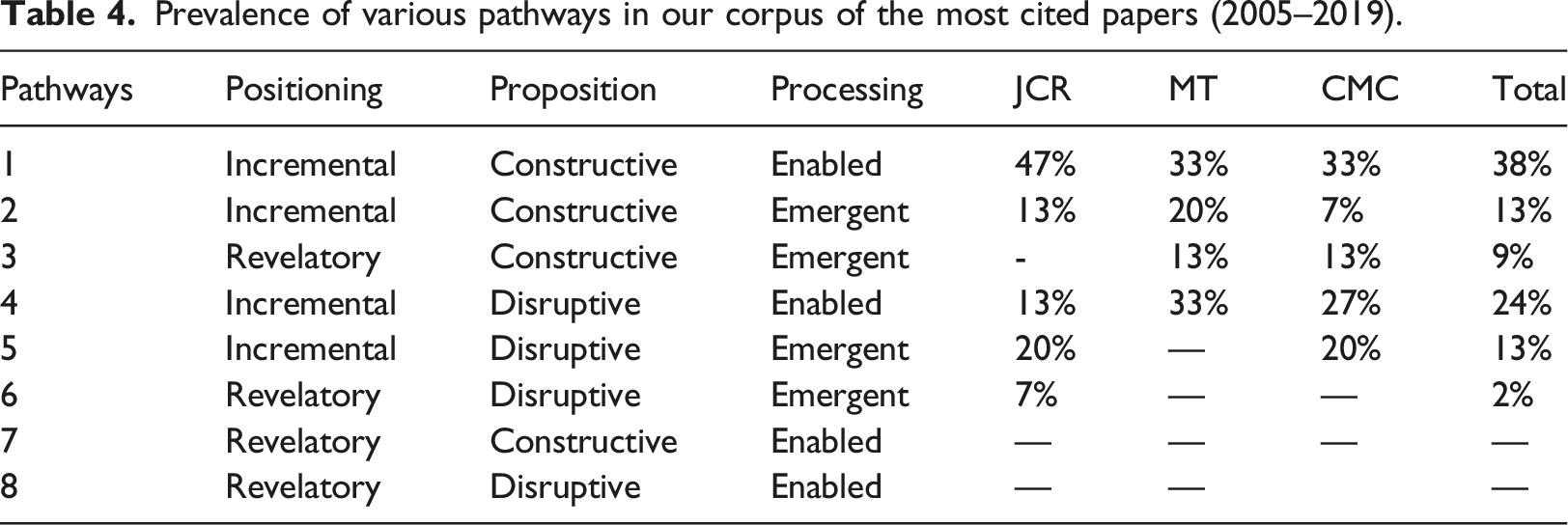
Pathway 1: Incremental positioning, constructive proposition, enabled processing
In our sample of impactful interpretivist marketing and consumer research articles, this is the most used pathway to rhetorically construct a research contribution. This pathway is used by Scaraboto (2015) in her study of hybrid economies.
Positioning
Scaraboto positions her study in relation to previous studies using incremental rhetoric when she describes addressing “gaps” in previous research that have not yet been considered (p. 154). She talks about bringing “to light a more nuanced relationship between economies” (Scaraboto, 2015: 154) than has been seen in previous literature and, hence, rhetorically claims that former studies have overlooked or neglected things. In doing so, Scaraboto positions her study as neglect spotting, an incremental positioning in our categorization.
Proposition
When describing her article’s relationship to the mode of knowledge production, Scaraboto (2015) is rhetorically constructive. When she describes “extend[ing existing theoretical] understanding of the shaping of economies by way of consumer activities” (p. 154), Scaraboto incrementally builds on previous theoretical understandings. In our categorization, this is classified as a theoretical extension, a constructive proposition.
Processing
In order to make her theoretical contribution, Scaraboto (2015) uses theory from outside marketing and consumer research; namely performativity theory, which “derives from the work of language philosopher[s]” (Scaraboto, 2015: 156). This theory borrowing represents, in our categorization, an enabled theorizing approach for producing knowledge.
Pathway 2: Incremental positioning, constructive proposition, emergent processing
This pathway is less common among the impactful papers in our corpus but it is used by Caruana et al. (2008) in their study of consumer independence.
Positioning
When Caruana et al. (2008) describe existing knowledge about the notion of independence as “contestable and/or paradoxical” and full of “underlying inconsistencies, tensions and contradictions” (p. 254), they are clearly suggesting that current theoretical knowledge is conflicting and confusing. They, hence, position their study as confusion spotting, an incremental positioning in our categorization.
Proposition
Regarding proposition, Caruana et al. describe their contribution as a theoretical extension when they argue that they extend theoretical positions “by illustrating how a specifically ‘independent’ discourse of consumption manages paradoxical tensions” (p. 267). This is a constructive proposition, according to our categorization.
Processing
Finally, when Caruana et al. (2008) talk about “examin[ing] independence as a socially constituted discourse” (p. 254), they indicate that they are theorizing using an alternative lens—Foucauldian discourse theory—to provide an alternative understanding of independence. Using an alternative lens is an emergent approach to theorizing knowledge, according to our classification.
Pathway 3: Revelatory positioning, constructive proposition, emergent processing
While it is not one of the most commonly used pathways in our corpus, it is possible to make a research contribution featuring a constructive proposition, revelatory positioning, and emergent processing. Svensson (2007) uses this pathway in his study of marketing work.
Positioning
Svensson (2007) questions assumptions about what marketing work is when he rhetorically challenges the “dominant and well distributed representations of marketing work” by asking “the fundamental question: what is marketing work?” (p. 272). He, hence, positions his study as assumption challenging, which is a revelatory positioning, according to our categorization.
Proposition
Regarding proposition, Svensson (2007) argues that previous literature fails to pose “primary social-phenomenological question[s]” (p. 275) about marketing work. By rhetorically rethinking the concept of marketing work, his article is, hence, constructed as a theoretical corrective, a constructive proposition in our categorization.
Processing
Svensson (2007) rhetorically illuminates the everyday work of marketing by “subjecting [it] to a social-phenomenological gaze” (p. 272). The social-phenomenological gaze can be understood as an alternative lens, applied to marketing work to produce new knowledge. Alternative lens is an emergent process of theorizing, according to our categorization.
Pathway 4: Incremental positioning, disruptive proposition, enabled processing
This pathway is the most popular pathway for impactful interpretivist marketing and consumer research articles in Marketing Theory. It is also the second most used pathway in our corpus. Marion and Nairn (2011) use it in their article on the ways French teenagers talk about fashion.
Positioning
When it comes to positioning, Marion and Nairn (2011) state explicitly that they want to add a new context to existing research, thus rendering a different, complementary, understanding to previous contribution attempts. “The purpose of our paper is […] to add a new social context to this stream of research” (p. 30). They, hence, rhetorically position their research contribution as incremental in relation to other literature.
Proposition
Marion and Nairn (2011) “develop three specific processes which [they] hope will elucidate the role of fashion discourses in the shaping of identity” (p. 30). Elucidating the role of discourses in a new way represents a theoretical proposition which we call new conceptualization. The knowledge their study produces is, therefore, disruptive in relation to existing theoretical knowledge about teenagers and fashion.
Processing
Finally, Marion and Nairn’s (2011) process of theorizing for producing knowledge is enabled since they use multiple lenses with which to make a research contribution that modifies existing understanding. In their article, they state specifically that they use “three lenses” through which to interpret “teenagers’ talk of fashion” (p. 30).
Pathway 5: Incremental positioning, disruptive proposition, emergent processing
A research contribution which features disruptive propositions to current knowledge and incremental positioning towards literature and theories can be an outcome of an emergent process of theorizing. This pathway is used relatively often by the authors of the impactful articles in our corpus. For example, Arvidsson and Caliandro (2016), use this pathway in their work on brand publics.
Positioning
Arvidsson and Caliandro position their study in relation to existing literature by arguing that brand publics represent a new context that “differ from brand communities in three crucial ways” (p. 728) and, therefore, represent a new understanding of how consumers create value around brands online. New context is an incremental positioning, according to our categorization, because it builds on previous research.
Proposition
Because the authors describe how they develop a new, “empirically grounded theory of brand publics” (p. 728), they rhetorically construct their proposition as new theorization, or “theory construction” (p. 728) in their own words. According to our categorization, this is a disruptive proposition, in which new conceptual relationships are built to generate new theories or concepts.
Processing
Since Arvidsson and Caliandro (2016) describe their research approach as “grounded” (p. 732), it is clear that the article can be classified as employing a grounded approach, which represents an emergent process of theorizing, according to our categorization.
Pathway 6: Revelatory positioning, disruptive proposition, emergent processing
This is one of the lesser used pathways to contribution in our corpus. It is, however, found in Scott et al.'s (2017) study of extraordinary consumption experiences.
Positioning
Scott et al. (2017) talk about solving the “mystery” of why “consumers pay for experiences that are deliberately marketed as painful” (pp. 24, 37). In doing so, they rhetorically construct a theoretical breakdown “that existing theories, models, and vocabularies cannot fully resolve” (p. 37). In order to solve the mystery, they must question underlying assumptions about consumer behavior. We naturally categorize this as assumption challenging, a revelatory positioning.
Proposition
Scott et al.’s (2017) research is rhetorically constructed as disruptive when they state that they seek to “reconstruct[...] theories of extraordinary experiences” (p. 28) which, they argue, were previously “understudied and under-theorized” (p. 22). We, hence, categorize this proposition as new theorization.
Processing
Finally, when Scott et al. (2017: 37-38) argue that their “research opens up new avenues of thinking” and “contributes new ways of thinking about extraordinary experiences,”' they are using an alternative lens—an emergent process to theorizing—to reconceptualize extraordinary consumption experiences through the concept of pain.
Pathways 7 and 8: Constructive OR disruptive proposition, revelatory positioning, enabled processing
A seventh and eighth pathway—featuring revelatory positioning, enabled processing, and either constructive or disruptive proposition—are possible but we did not find any articles employing these pathways in our (albeit limited) corpus. There may be different explanations for these lacunae. They could, simply, stem from our methodological choices. Since only highly-cited articles are included in our corpus, the pathways listed above could employ rhetoric that is not palatable for the readers (and citers) of the journals in our sample. A more plausible explanation could be that studies that use enabled processing for theorization (such as theory borrowing or multiple lenses) can seldom be “positioned” as producing a revelatory research contribution, regardless of whether this is rhetorically presented in a humble way or whether it takes a more disruptive tone. This has been suggested in adjacent fields, such as management and organization studies (see Alvesson and Sandberg, 2013; Tourish, 2020).
Discussion
This research contributes to meta-studies on the crafting of theoretical research contributions in marketing and management studies (Alvesson and Sandberg, 2011; Hällgren, 2012; Johnson, 2003; Locke and Golden-Biddle, 1997; Nicholson et al., 2018; Oswick et al., 2011). Within interpretivist marketing and consumer research, it contributes to discourses on theory and theorization (Bajde et al., 2021; Dolbec et al., 2021; Giesler and Thompson, 2016; Sandberg and Alvesson, 2021; Thompson et al., 2013), on theoretical contribution (Belk and Sobh, 2019; Fernandez, 2020; Ladik and Stewart, 2008; MacInnis, 2011), on the construction of research articles (Arnould, 2006; Bajde and Gopaldas, 2019; Figueiredo et al., 2017; Fischer et al., 2017; Summers, 2001), and on the rhetorical framing of research and research contribution (Hogg and Maclaran, 2008; Nicholson et al., 2018). Our framework may lessen the gravitas attached to problematization and theory development as well the current hegemony around theoretical development. We hope that learning to “see through the kaleidoscope” will entice novice and expert researchers to reconsider their modus operandi when embarking on the long, hard process of crafting contributions in interpretivist marketing and consumer research. Our research contribution can be theoretically framed in three different ways. This study: (1) adds a new dimension to existing meta-studies on theoretical contribution within the broader marketing and management disciplines; (2) expands our understanding of rhetorical claims for theoretical contribution, in particular humble and grand claims; and (3) provides an alternative perspective on what is “interesting” about theoretical contribution. Each of these points is explored, below.
First, this paper unpacks the complexity of research contributions within interpretive marketing and consumer research. Previous studies have separately conceptualized research contribution as problematization (Alvesson and Sandberg, 2011; Sandberg and Alvesson, 2010; Nicholson et al., 2018)—which we refer to as positioning—or as theory-building (Bajde et al., 2021; Dolbec et al., 2021; Oswick et al., 2011)—which we call processing. Scholars have described theory as the output of a research article and an article’s theoretical contribution—what we call proposition—as an extension of theory (Bajde et al., 2021; Sandberg and Alvesson, 2021). Although some meta-studies have categorized positioning, they have rarely categorized the proposition or processing aspects of research contributions. Sandberg and Alvesson (2021) explicated the importance of understanding the relationship between theory, theorizing, and theoretical contribution. However, previous research has not coalesced these three dimensions—positioning, proposition, processing—to unpack the complex construction of research contributions in our field. Our analysis of the different pathways used to construct research contributions distinguishes between the rhetorical processes of theory, theorizing, and positioning (see Alvesson and Sandberg, 2011; Nicholson et al., 2018; Oswick et al., 2011). More importantly, it synchronizes and complements previously meta-studies by adding a third dimension of theory development, which evaluates the way semantics are used to convince the reader about an article’s main proposition (or selling point). In previous meta-studies this has always been embedded within an article’s claims of contribution in regard to previous knowledge.
Second, our framework allows us to unpack the current hegemony around theoretical contribution, journal listing, citation and impact, and to question these problematic instruments that govern academia. Our framework offers arguments that can be used in review processes, by both authors and reviewers, to better understand each other and to avoid a forced theoretical or literature-based dogma. While challenging the reader’s assumptions is often argued to be the best way to make an article interesting, (e.g., Alvesson and Sandberg, 2011, 2013; Belk and Sobh, 2019; Davis, 1971; MacInnis, 2011; Weick, 1989), the demand for interestingness can become hegemonic and may not necessarily lead to higher readership. Furthermore, the quest for “interesting(ness)” (see Johnson, 2003) might lead researchers to write explicitly for people and groups who already have sociocultural and economic power, which does not necessarily lead to greater readership. Our framework arguably contributes to this situation because our sampling strategy relies on citation metrics, which are part of the powerful objectivist ideology of positivism, control, and quantitative performance (mea culpa). However, our framework also offers researchers and reviewers arguments for the acceptance of more eclectic and less normative research contributions that are equally surprising and, at least, inspire further exploration. It may, hence, prove a panacea to the hypernormative demand for theoretical contribution in researcher- and reviewer-culture.
Third, our framework supplements previous interpretivist marketing and consumer research by concentrating on the rhetorical construction of theoretical contributions per se, rather than entire theorizing storylines or the consequences for research questions (see Fischer et al., 2017). This choice has enabled us to emphasize, in more detail, how researchers that rhetorically seek to develop theory seem to either struggle or just about cope with the theoretical imperative in marketing research. This was evinced during coding, where we noted that the use of new theorization, new conceptualization, and alternative lens has increased over time—for example, in JCR articles from 2010 onwards—suggesting that the theoretical imperative has intensified. Our pathways highlight each article’s conceptual, methodological, contextual, and empirical entirety, rather than forcing an emphasis on theoretical contribution. They can, hence, help researchers to craft theoretical and/or descriptive research contributions. Furthermore, because it is based on highly cited articles in different journals, our framework highlights the normative tropes used by researchers. By emphasizing alternatives, we hope to show interpretive marketing and consumer researchers that the oft-demanded grandiose theoretical claims are only one way to make a theoretical contribution. It is also possible to frame research contributions in more humble ways, perhaps using a combination of incremental and constructive ways of rhetorically building space for theoretical contribution (Moorman et al., 2019; Yadav, 2010). By this, we do not mean that ambitions among interpretivist marketing and consumer researchers should be lowered, but we do mean that claims of theoretical development must not become perfunctory and without substance. Otherwise, there is a risk that the field loses credibility in the long run.
In addition to the afore-mentioned theoretical contributions, our kaleidoscopic framework can be used by researchers in at least three, more practical, ways at three different temporal levels. It can be used by scholars to analyze previous research, structure existing research, and forge future research directions. The framework works as a way to map the common rhetorical representations of contributions in interpretivist consumer and marketing studies, as a resource to guide interpretivist scholars when crafting their own research contributions, and as an inspiration to construct more innovative and, potentially, disruptive research contributions. Taken together they represent a blue-print to help novices, and more seasoned scholars, to better read, relate, and frame research contributions in a way that allows—at least rhetorically—a greater variety of contributions. These three uses are inextricably intertwined in their use by researchers. However, in the following sections, we present them individually to highlight their distinctiveness rather than to demonstrate their discreteness.
Conceptual toolbox
When analyzing previous research, our framework can be used as a pedagogical conceptual toolbox by early scholars and doctoral students, enabling them to peruse and dissect previous research. For instance, it could be used in doctoral courses, supervision meetings, doctoral seminars, and thesis proposal colloquiums to dissect the fundamental assumptions and elements of a manuscript, regarding how research contribution is presented. It could help novice doctoral students learn how to locate theoretical claims in a manuscript and understand the many ways in which they are constructed. Because it synchronizes different individuals’ understandings of research contributions in different studies (see e.g., Ladik and Stewart, 2008; Weick, 1995), our framework can be viewed as an encyclopedic toolbox that can be used as a whole or in parts—that is, by breaking out the individual (three) dimensions, (twelve) categories, or (eight) pathways. For example, by looking at the way we have analyzed and categorized the semantics used in research papers, early years scholars might better comprehend a conceptual conversation in a specific stream of literature and, hence, write a more informed literature review of their own. Or, by mimicking the formulation of a research problem, as illuminated by our framework, novice researchers may appreciate alternative ways of writing their own research contributions. The toolbox might help doctoral students become more reflexive (Jafari, 2022) and culturally sensitive (Rokka, 2021) by encouraging them to reflect on how they enacted their contribution. Having the right tools can, hence, foster the craft of contribution.
Performative template
At the level of structuring ongoing research, the framework could be used as a performative, guiding template to help scholars craft their research contributions. Here again, it could be used either in its kaleidoscopic entirety or broken out into its constitutive parts—namely categories and pathways. Doctoral or early career scholars can use the eight pathways to read the work of others and to plan the logical and rhetorical structure and content of their own writing. For example, they can use it to draft their text and frame their contributions to be adjudicated by their supervisors or other experienced researchers during paper presentations, doctoral courses, or paper development sessions. The template can, therefore, work as a planning instrument with iterative practices and experimentations. Enacting the template, in practice, requires adaptation to a researcher’s own research ideas or, in other words, a performative understanding of the framework that is malleable enough to be applied to different studies. Thus, while early career scholars might have more instrumental usage of the framework as a template, more experienced researchers could embrace various elements of the framework to find common grounds with their own research papers, or with doctoral theses they are assessing, opposing, or reviewing. For instance, reviewers of journal and conference papers, journal and book editors, and opponents in various seminars can adapt the framework and use it as a template to perform their scholarly work of dissecting, adjudicating, and challenging another text. Employing the rhetorical techniques and skills that correspond with the theoretical storyline and research contribution is necessary when writing a research paper (Hogg and Maclaran, 2008; Locke and Golden-Biddle, 1997). The framework can help researchers use rhetorical arguments to craft research contributions that will be understood, agreed upon, debated, and published and, therefore, might encourage more pluralistic and humble ways of framing research contributions.
Disruptive inspiration
Finally, at the level of creating future research directions, the framework can be used to inspire new research exploration, particularly through disruptive approaches to knowledge creation. We hope that our study can be an inspiration for experienced researchers to unpack the status quo of any research concept or entrenched assumptions within the field—in our case, for example, it was the “framing of research contributions.” Scholars at different stages of their careers can also take inspiration from previous research within our corpus to construct contributions that are disruptive in nature, for instance, with new conceptualizations and theorizations. Thus, they can use the framework to create more innovative and disruptive works. Some brave researchers may experiment with new ways to craft research contributions by turning the three kaleidoscope wheels in different directions prompting new combinations of dimensions and alternative scenarios. These new combinations will not always harmonize with existing ways of framing research contributions but when, they resonate, they may be disruptive enough to move the field forward. This can help theorists become more imaginative, create more original theories within the field, and disrupt the mainstream traditions and boundaries within the discipline (Belk and Sobh, 2019; Davis, 1971; Moorman et al., 2019; Oswick et al., 2011). Hence, the kaleidoscopic framework and its pathways can be seen as a departure point and inspiration, a “forma mentis” to motivate more groundbreaking and conceptually tuned research contributions.
Future research and limitations
Corpus of selected articles from JCR, MT, & CMC (one from each journal, each year from 2005 to 2019).
Arguments have been raised about the use of citations to assess an article’s impact (Stremersch et al., 2015) and our use of such a method may well have acted as an impediment to generating a wider gamut of categories, dimensions, or strategies for crafting research contributions. However, citation metrics have been argued to be a reflection of certain aspects of research quality, such as scientific impact and relevance (Aksnes et al., 2019), which was a key element in this study. And despite critiques about their inability to indicate the meaningfulness of a research work (Butler and Spoelstra, 2012, 2020) citation metrics are still considered arguably the best way to measure impact of a research work (Paul and Bhukya, 2021). Future research could use other, more creative criteria to sample impactful articles. Similarly, the decision to only analyze articles that use empirical material to make contributions, opens up for future researchers to explore the rhetorical components of conceptual contributions, which may be entirely different.
Finally, we encourage future research to explore how powerful virtues spread and are reproduced within academic fields, not least in review processes. As journal editors have the last word, and they often refer to the same virtues, it would be interesting to see how homogeneous or heterogeneous various reviews are in terms of such virtues in comparable journals. After all, intellectual quality also needs room to stretch.
Footnotes
Declaration of conflicting interests
The author(s) declared no potential conflicts of interest with respect to the research, authorship, and/or publication of this article.
Funding
The author(s) received no financial support for the research, authorship, and/or publication of this article.
