




Abstract
In this article, we focus on relational labour as a form of emotional labour associated with the use of platformised possessions, such as pins, messages, photos, videos and playlists hosted on digital platforms, to maintain relationships with friends and family. We argue that this ongoing effort is a type of consumer labour because it generates profitable engagements for digital platforms, which intentionally exploit negative emotions, namely, anxiety and guilt, associated with maintaining social connections. Drawing on 47 depth interviews with people living in the South of the UK, we identify the direct (communication via platforms) and indirect (information gathered via platforms to attain relational goals) relational work undertaken by consumers via their platformised possessions. We then consider the emotional experiences related to this work, demonstrating how such experiences differ from reports of possession work on material goods, while maintaining platform profits. Recognising that this work is the basis of much platform engagement, and hence profit, we further show how this effort becomes a form of unpaid labour. We thus contribute to the nascent literature on platformisation and emotion, to broader studies of possession work, and to critical marketing scholarship on consumer labour.
Keywords
Introduction
We are witnessing the growth of platformised possessions – digital objects like music, photos, videos, avatars, messages, in-game items and stories – that consumers consider ‘their own’ even when they are hosted on digital platforms like YouTube or Spotify. Such possessions may be thought of as commodity-possession hybrids because they are concurrently personally meaningful for consumers, and assets for the hosting platforms (Belk, 2013; Molesworth et al., 2016). Through platform mechanisms they are also frequently shared and accessed by several consumers at the same time (Mardon et al., 2022). We are only beginning to understand the implications of such characteristics for those that use them, and, in this paper, we explore how platformised possessions may structure and exploit our relationships with others. To do this, we draw on Hochschild’s (1983) idea of emotional labour, and Baym’s (2015a) extension of this as relational labour. Following Baym (2015a), we define relational labour as regular, ongoing communication with friends and family to maintain close relationships with them, while generating profits for online platforms but no remuneration for consumers. Relational labour is therefore associated with platform business models that aim to structure and encourage profitable emotional connections between people and so ‘interfere’ with routine forms of emotional work; the effort we all undertake to maintain connections to others, but that is outside the market and involves no commercial exchange or profit. Relational labour feeds into platform profitability via the ongoing production of emotional alignments, which circumscribe ‘the forms and possibilities of relationships between people’ (Boccia Artieri et al., 2021, p: 226) and perpetuate consumers’ platform dependency or fidelity. Given revelations that platforms can encourage and even structure specific discrete emotions to increase engagement and profitability (Boccia Artieri, 2021; Helmond, 2015; Illouz and Kotliar, 2022), understanding how this is experienced by consumers as they relate to each other is imperative.
Our limited understanding of how platformised possessions modulate consumers’ emotional connections to others to generate revenue is significant considering how central emotions are in the study of possessions. Possessions have long been understood as vessels to manage emotions (Belk, 1988; Klein et al., 1995), especially emotions towards others (Csikszentmihalyi and Rochberg-Halton, 1981; Grayson and Schulman, 2000; Miller, 2010). Additionally, given that much possession work – consumers’ efforts to create and preserve positive meaning, such as customisation, display and safekeeping – is absorbed by platforms themselves (Molesworth et al., 2016), this gestures towards a transformation in the emotional tonality and function of possessions, which is not well understood.
Depth interviews with 47 consumers in the South of the UK suggest that consumers use of platforms is not always, or only, to gain access to platformised possessions themselves, but also to help sustain relations with important others. In this sense, digitised, access-based consumption (see Atanasova and Eckhardt, 2021) is not just about access to consumption objects, but also access to friends and family. The specific relational labour we observe involves guilt over ongoing platform engagement to sustain platformised possessions, often in the absence of actual contact with others, as well as anxiety resulting from the obligation for ongoing relational efforts. An implication is that unlike prior studies of material possessions that recognises positive feelings like love (Kleine et al., 1995), platformised possessions may be suffused with negative emotions, that is, platforms produce and exploit negative emotions related to our desire to connect with others. Drawing from Hoang et al.’s (2022, p: 92) discussion of high-fidelity consumption – ‘that sits between autonomy and manipulation whereby consumers’ behaviours are anticipated and largely predetermined by market actors’ – we further argue that platforms create means of connecting people in order to maintain platform fidelity, thereby ensuring ongoing revenue. This is not to say that positive emotions related to platformised possessions do not also exist, but that the negative emotions we discuss in this study are not well accounted for in current theory.
Our contributions are threefold. First, we extend the recent ‘affective turn’ in platformisation studies (Boccia Artieri et al., 2021; Helmond, 2015; Illouz and Kotliar, 2022; Papacharissi, 2015) by identifying the direct (communication via platforms) and indirect (information gathered via platforms to attain relational goals) relational labour done by consumers via their platformised possessions, and the emotions associated with them. In doing so, we bring to the fore the means through which consumers’ platformised possessions operate as conduits for platform fidelity.
Second, although emotional labour is well-established in organisation theory (Fleming, 2017; Gandini, 2019) and recognised in consumer research in terms of the response to service work (i.e. the emotional labour of employees, Walsh and Bartikowski, 2013), there is little application of emotional labour, and no prior recognition of relational labour related to how consumers use platformised possessions. Specifically, we show how relational work undertaken by consumers is used by platforms to make money, that is, how it is structured by platforms into relational labour (work that consumers do for free in order to generate platform profit).
Third, we explain how platforms encourage relational labour, often through the generation and maintenance of negative emotions such as guilt and anxiety. This contributes to possession studies, where a dominant assumption that valuable possessions are so because they are imbued with positive emotions like love or pride (Kleine et al., 1995; Kleine and Baker 2004), is challenged. We show that the platformisation of possessions represents a potential transformation in consumers’ objectual relations with their valued possessions, in that emotions that suffuse them may be negatively valanced.
The paper is organised as follows. We start by explaining why possessions matter, then elaborate on the emergence of platformised possessions, before presenting the concepts of emotional and relational labour. Following an explanation of methods, we illustrate the sorts of relational labour undertaken through platformised possessions, highlighting the emotional experiences involved with such activity, before discussing the implications of consumers’ relational labour via platformised possessions.
Theoretical foundations
Why possessions matter
Platformised possessions matter because possessions matter to people. Although too much attention to acquiring material possessions has been presented as a threat to overall wellbeing (see Kasser, 2004), studies of meaningful possessions (Belk, 1988; Belk et al., 1989) have concluded that people tend to become attached to those objects imbued with personal meanings. Despite enduring complaints about excess materialism (Fromm, 1994), and recent observations of a move to liquid, access-based consumption (Bardhi et al., 2012; Bardhi and Eckhardt, 2017), possessions remain potentially meaningful and even life-enhancing.
How we possess, and how we come to possess, also matters and a way of understanding the significance of possessions is to know how they become separated from their commodity form. Possessions become meaningful when symbolically and physically singularised (Appadurai, 1986; Kopytoff, 1986). Such possessions are sacred, whereas commodities remain profane (Belk et al., 1989). They are valued for their personal meanings, rather than their exchangeability in relation to other commodities. A review of attachment literature (Kleine and Baker, 2004) identifies singularisation as a boundary condition for material possession attachment where a commodity is emptied of its profane associations with the market before it can be imbued with personal significance. This requires possession work: a form of self-investment (Molesworth et al., 2016), including work on meanings that attach an object to a time, place, or other people (Grayson and Schulman, 2000) and includes selecting, customising, appropriating, repairing, gifting, displaying and maintaining the preferential status of a meaningful possession (Belk et al., 1989). The outcome of possession work is attachment to a singular possession that means something, such as a vinyl record which accumulates its significance as indelible patina as it is repeatedly played, then lovingly kept, or passed on to others to be cherished. This is significant because, as Miller (2010) demonstrates, material things often enhance our lives not through their utility, but through their ability to represent and remind us of our connections with others.
In such established narratives, however, related emotions and their management remain largely implicit, with the focus instead on material objects, practices and resulting meanings and associations. However, possession work also includes moral emotional engagements with both items and other people, that is, judgements based on what is right or wrong, good, or bad. Our possessions, for example, are ‘good’ because they represent good people in our lives, or good times, and bring joy through these associations (Belk et al., 1989). We may feel pride in them, fear for them being stolen, or regret if they are lost (Belk, 1988). Possession work therefore includes working on the emotions we feel towards others, and as possessions become increasingly distant, or liquid through their digitisation, we may question the implications for the role of possessions in our emotional lives.
Platformising possessions
By digitising commodities and then providing access to them, access-based consumption presents an apparent solution to excess materialism (Atanasova and Eckhardt, 2021), appearing to solve consumers’ desire for more detached and fluid relationships to possessions that can accommodate the satisfaction of punctual consumption needs without having to own things (Bardhi et al., 2012; Bardhi and Ekhardt, 2017). Ironically, however, the proliferation of platformised possessions has raised new concerns over encroaching commodification. Not only is the potential universe of digital objects that we have access to so vast that it makes the ascription of special meaning challenging, but their platformisation provides a technological base to commodify new domains of life (Srnicek, 2017). This solution to excessive materialism therefore also risks the personal meanings that possession affords. Platformised possessions remain dependent on commercial platform infrastructures, and have come to commodify meaningful possessions themselves, creating possession-commodity hybrids (Molesworth et al., 2016) or quasi-possessions (Belk, 2013). A Spotify playlist or Kindle eBook deny singularisation by design as platformised possessions remain company assets (Mardon et al., 2022). Although photos on Instagram can be personally meaningful to the consumer who took, edited, and posted them, Instagram profits from advertising related to their use (Molesworth et al., 2016). This challenges assumptions that meaningful possessions are necessarily singular (Klein and Baker, 2004) because severing ties with the market is impossible. In the case of platformised possessions, possession processes are shaped and governed by hosting platforms be it SNS, operating systems, or videogames. Here, digital platforms can be understood as socio-technical structures (Caliandro and Gandini, 2017), that in a Latour (2005) sense distribute agency in possession processes by allowing, encouraging, suggesting, permitting, or rendering impossible certain actions. Related affordances do not merely invite possession processes, like customisation or display, but enable or constrain processes in a more literal sense (Mardon et al., 2022). A recent illustration is provided by a study of a Spotify software update in June 2019, which showed how platform affordances increased Spotify agency in music choice selection and curation, while limiting users’ capability to create, organise, navigate, and maintain their music libraries (Morreale and Eriksson, 2020).
The previous processes through which possessions are worked on to create personal meanings, especially those associated with others – that is, their ability to support relational work – are being replaced by processes governed by platforms in ways that ensure any activity related to meaningful possessions is now directed towards platform profitability.
Platformisation and relational labour
Possession work itself is a positive emotional experience (Belk et al., 1989). For example, in their study of rejuvenating a family heirloom, Türe and Ger (2016) describe how a participant experienced love when refreshing an old-fashioned necklace that had belonged to her mother. However, although the ways that platformisation affords possession processes is little understood, related studies suggest that platforms may deliberately encourage negative emotions as a means of ensuring engagement. For instance, negatively valanced online posts are more likely to prompt engagement, go viral and receive more likes and shares (Kramer et al., 2014), thereby generating profitable engagement for platforms. It has also been suggested that an agitation of emotions is a deliberate means to encourage continued online engagement (Helmond, 2015). Recently, it has been argued that platforms encourage and rely upon the production of mundane emotional expressions such as ‘liking’ or ‘sharing’, resulting in a standardisation of emotions which shapes relations between people through actions like joining a hastag, condemning or liking a post, or sharing memes and images (Boccia Artieri et al., 2021). For platforms, the general thesis is that commercial gains require ongoing engagement that are best sustained through systematised and standardised behaviours that can be sold off as data points (Van Dijk et al., 2013; Zuboff, 2019) and research suggests that these often lack the positive emotional intensity reported in studies of meaningful possessions. From such a standpoint, consumer-possession relationships are potentially transformed and possibly diminished when platformised.
To address how we might approach an understanding of the connections between the emotions generated by platformised possessions and platform profits, we employ the related ideas of emotional and relational labour. Hochschild (1983) theorised that the unpaid work we routinely do on our emotions has become an aspect of paid labour, that is, that employees are expected to work on their emotions as part of their job, and that doing so can generate profit. Although we must routinely work on our emotions based on an understanding of what is acceptable to feel in a social situation, when this supressing or conjuring up of emotions has exchange value, it becomes labour. Significant here is that how an employee spontaneously feels about a customer – for example, disgust at a sexist remark – must be supressed in favour of expressions of empathy as part of their job. How we feel about others is therefore maintained in problematic ways, as internal, moral feelings are replaced with managed external displays to please customers and so enhance profits (Hochschild, 1983). Profit may not always come from positive emotions, however. Indeed, Gerard (2020) notes how health workers, instead of acknowledging that their organisation fails to help those in need of care, experience the guilt of ‘compassion fatigue’ and a disrepair for the self, which benefits the organisation as they are driven to work harder by these feelings.
Emotional labour has been widely researched since Hochschild’s initial work. For example, recent studies reveal the forms of emotional labour undertaken by gig workers with Gandini (2019) arguing that gig economy platforms place emotional labour at the centre of the labour process, even as public communication emphasises functional exchange. This, Gandini (2019) argues, is enabled by platform feedback, rankings, and ratings that shape interactions between workers and customers, resulting in an ‘economy of feelings’. Emotional labour therefore becomes ‘visible’ through metrics and rankings available via the platforms, revealing ‘power asymmetries’ that softly control work performance and motivations, but where managerial and algorithmic control remains ‘hidden’ behind the screen (Gandini, 2019). Such studies also highlight that emotional labour can take place without explicit instructions by managers, but via the structures of platforms.
The connection between emotions and relationships has also been examined in a smaller body of work that recognises a related category of ‘relational labour’, described by Nancy Baym (2015a, p: 16) as ‘regular, ongoing communication with audiences over time to build social relationships that foster paid work’. Baym (2015a) therefore differentiates between relational and emotional labour, suggesting that relational labour refers to the emotional effort specifically required to maintain ongoing connections with others, as opposed to the single encounters documented by Hochschild (1983) and found in subsequent applications. Relational labour is also specifically recognised as a feature of online activity. For example, Baym (2012) notes how indie musicians use social media to connect to audiences, and by doing so musicians nudge people to buy their content or other merchandise. Similarly, Whitson et al. (2021) show how game developers undertake ‘relational labour’ as they must network with others, noting that social media invites ‘ongoing, persistent and ubiquitous’ relationships that must be constantly worked on. They further observe that unlike emotional labour, where managed emotions at work may differ from authentic emotions outside work, relational labour blurs the boundaries between these. For example, a client or colleague may be a friend, even though we are required to maintain a relationship with them by an employer. As a result, relational labour may be as rewarding as personal relationships, even as it serves an instrumental purpose.
This aligns with other studies that recognise the significance of how platforms (rather than employment) structure relationships. For example, Illouz and Kotliar (2022, p: 230) confirm that “emotions are the building blocks of social interactions […] They contain and enact the moral frameworks through which people understand and interpret their social environments”, and that the affective turn in critical consumer studies recognises that the market structures emotions to suit the purpose of capitalism (see Illouz, 2009). The Internet marks a new stage in this process (Illouz and Kotliar, 2022). Capitalism has long found ways to turn emotions into commodities, or ‘emodities’ – consumer goods that create emotional experiences (Illouz, 2017). The Internet creates techno-emodities that ‘disrupt’ basic emotional infrastructures. Illouz and Kotliar’s (2022) interpretation of the liquid, visual and superficial relationships enabled by Tinder reconfigure our relationships with others based on consumer logics of speed, abundance, and efficiency such that our emotional relationships with others are commodified through a transformation into something that is forever renewed via an app, and so lacks intersubjectivity or solidarity. Key to all of this is the algorithm that defines how we relate to others (Illouz and Kotliar, 2022). As we shall see, however, even relationships built on solidarity and recognition (intersubjectivity) may be commodified through platformised possessions.
Despite the recognition that online engagements are highly emotional and that consumers work for free (Arvidsson, 2005), consumers’ emotional labour, especially its relational forms, have been little explored in relation to platformised possessions because previous studies tend to neglect the affective dimensions of online artefacts, or the emotions felt in maintaining social networks around them. This is an oversight, because we might legitimately expect relational work to play a significant role in how customers experience digital possessions that they can only access via online platforms, and as that ongoing engagement is a key source of profit for platforms, we may recognise it as unpaid relational labour. One exception to this, is Mardon et al.’s (2018) netnographic study of YouTube Beauty Gurus in which the authors identify emotional strategies employed by influencers and tribe members in the spaces controlled by the influencer to ensure commercial success. The study illustrates how emotional labour is a key aspect of platform engagement (influencer profits rely on the ‘right’ emotions being generated by tribe members). However, the emphasis remains on the online influencers, and only indirectly on any relational labour of consumers.
For clarity, it is worth re-stating the distinction between relational work and relational labour. We refer to both in our interpretation of the data, noting that individuals routinely work on and put effort into relationships that are important to them. When this work generates profit for a corporation/platform, it becomes relational labour. Relational labour specifically refers to the structuring of our efforts to maintain relationships by platforms in ways that generate revenue for them. As platforms do not pay users, or share their profits, the labour they encourage is ‘free’.
Methods and data analysis
Three key questions emerge from our review of literature: (1) how is relational labour performed via platformised possessions? (2) what emotions are expressed by consumers when talking about how their platformised possessions connect them to others? And (3) what does this mean for platform fidelity?
Participant profile.
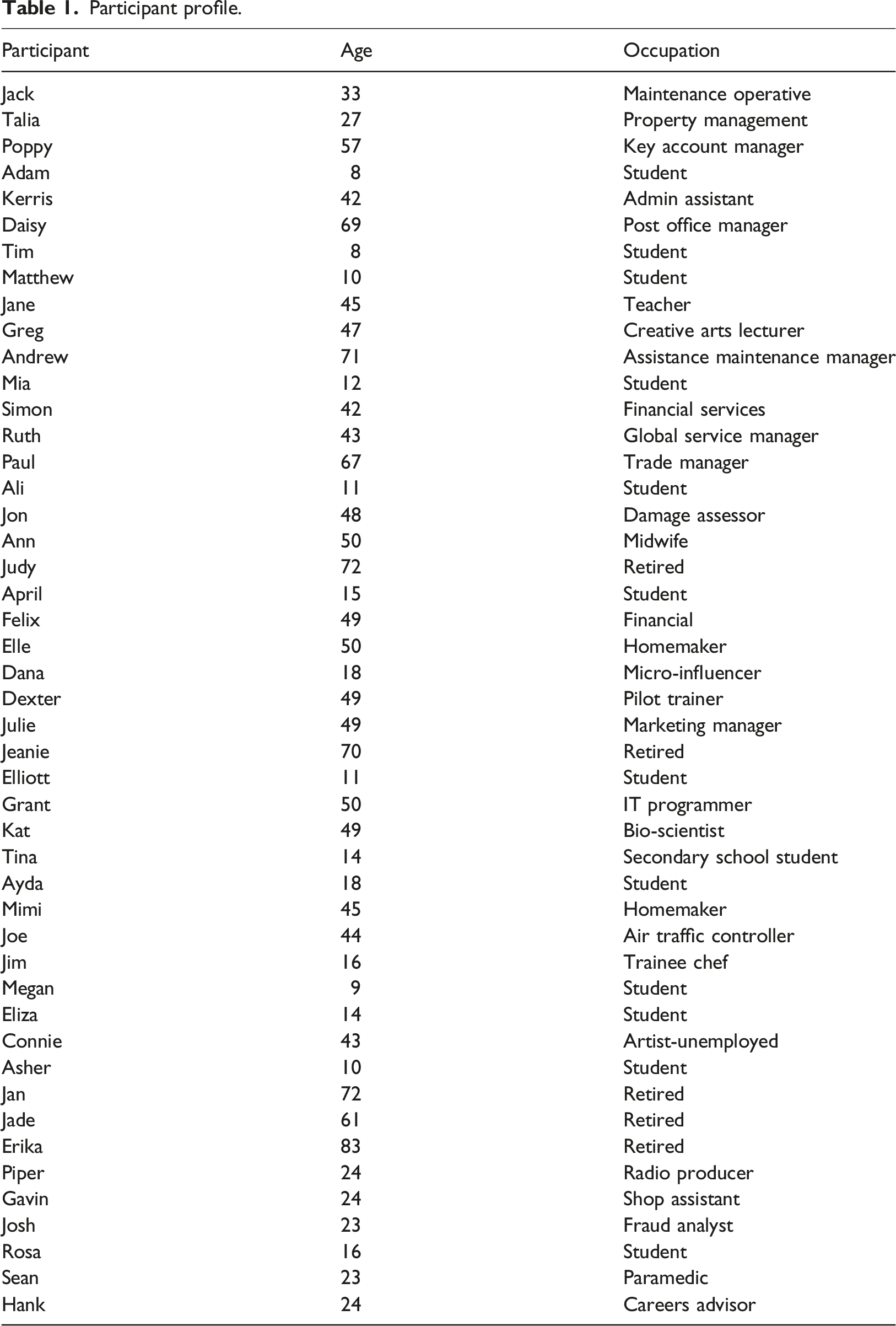
Interviews took place in-person and online between February 2019 and July 2021, averaging 2 h each, with approximately 83 h of data collected. In-person interviews were audio recorded and took place in the family home. Online interviews were conducted over Zoom during the COVID-19 restrictions. During these discussions, we documented participants’ reports about their digital things (e.g. specific eBooks, photographs, digital game characters and playlists), apps and platforms (e.g. WhatsApp, Pinterest, Instagram and YouTube), and the devices through which they managed their access. We encouraged accounts of emotional experiences related to the use, possession, ownership, and dispossession of digital objects. In the spirit of post-phenomenology, we sought to catch ‘insightful glimpses of [digital objects] in action, their everyday interactions with humans and non-humans’ (Adams and Thompson, 2011: p: 734). We focused on how digital possessions made the participants feel to elicit the emotions that are bound-up in their relationships with digital things, and how these shape their relations with others. Ethical approval was granted by the ethics committee at the lead authors’ institution. Children were interviewed in the presence of a parent and each family member provided individual informed consent.
We re-read the transcripts and selected accounts rich in emotionality on an idiographic basis before cross case analysis (Thompson et al., 1989: p: 142) to identify emerging global themes. In line with post-phenomenological approaches, we reflected on the data gathered and sought to ‘emulate human-technology-world entwinements through textual description’ (Adams and Turville, 2018: p: 12). Iteration between our existing data and literature on emotions, specifically Hochschild’s (1983) emotional labour and Baym’s (2015a) relational labour, facilitated a narrower analysis that focused on identifying the role of platformised possessions in participants’ accounts, and the emotions individuals experienced in relation to them, and how these possessions shape relationships with others. This enabled us to identify the ways that platformised possessions act in and on participants’ lived experience, and their relationships with others.
Findings
Our participants described experiences where their activity with platformised possessions involved direct and indirect relational labour. In its direct form, relational labour happens through specific use of platform features that facilitate connections with others. In its indirect form, the achievement of relational goals – such as parenting or friendship – are enabled via ongoing engagement with platformised possessions. As both forms are invited by platforms, and benefit their owners financially, they represent new types of unpaid consumer labour, or relational labour.
Platformised possessions, relational work and labour
Unlike and in addition to possession work explored in previous studies – the curation of content, personalisation, or gifting significance (Belk, 2013; Denegri-Knott et al., 2012) – we identified activity enabled by platformised possessions that encompassed ephemeral, yet frequent everyday actions, including messaging, sharing, content creation, surveillance, ‘liking’ and ‘following’, carried out directly to connect with others. To illustrate, Gavin is in his twenties and works at a vintage shop. When asked about his digital possessions, he mentioned how he routinely used his social media accounts to connect with others: Wanting to talk about something or just want to blow some steam and make a joke... I send a funny picture to other people and it’s just a nice way to connect people... Some people I only have on Facebook […] the only way I talk to them is through the Facebook messenger. So, same thing, it’s mostly just to stay connected to people that I value and that I care about.
For Gavin, platformised possessions, such as Facebook profiles and their various content, produce direct relational labour via the creation and sharing of things with others. Gavin seeks human connection and posts digital assets – pictures and memes – to his social media accounts to achieve this, indeed Facebook is the only way he connects with some friends. He therefore finds himself working on relationships by sharing these assets, and in some cases, this is sufficient to maintain a viable relationship with others. However, each post and comment create data points for Facebook that are monetised, for example, through both ads that are delivered alongside the content that is shared, and through the enhancement of profile data that may be used in later targeting. In this way, Gavin’s reliance on using the platform to connect to others results in him undertaking unpaid relational labour. Indeed, as the platform prompts him to stay in touch with others, reminding him of various connections including anniversaries, and of the relational labour of others as they similarly post to stay in touch, Facebook structures Gavin’s friendships as a commodity to sell to advertisers. Although this is similar to Illouz and Kotliar’s (2022) interpretation of Tinder’s use of algorithms to structure relationships, unlike Tinder, the algorithmic structuring of relational labour may be of closer, more enduring connections to others.
Other participants also spoke about how data was used as both proxy, and context for staying in touch. Grant, a 50-year-old software engineer, identifies his Strava profile as an important digital possession. He explains how his relationship with his brother – which he described as distant - was revitalised through relational effort undertaken through Strava. Shared data about their fitness is something they have bonded over: He’s about two and a half years older than me...[he] was mostly out of the house. I didn’t see him very much in my routine for ages. He was quite independent. We didn’t really have much of a relationship when we were home, and then this [fitness app profiles] is just something that we’ve got in common … I didn’t run before he pushed me into it. So, it’s more than just the competition. It’s also, it’s something for us to talk about …. that's kind of been established now, it’s the thing that we have a common interest in, so we can still talk about running.
This highlights another specific feature of platform relational labour: as with other forms of unpaid consumer labour (Fuchs, 2015), it is not necessarily experienced as such, that is, for users it may feel like they are using the platform for relational work, unaware of how the platform invites such effort and makes money from it.
Self-tracking has been said to instigate a feeling of incompleteness when presenting consumers with ever more challenging new goals to be achieved (Hoang et al., 2021), but Strava also invites consumers to experience novel ways of connecting with others. As Grant explains, self-tracking profiles are both a means of connecting with his brother by sharing personal times and achievements in the absence of them meeting or running together, and content that they may subsequently talk about. Grant’s continued use of Strava represents relational labour as the maintenance of ties to his brother is achieved through their ongoing subscriptions to a fitness app and continued sharing of data. That is, Strava makes money from the maintenance of relationships via the contents of the platform. To borrow from Molesworth et al. (2016), both brothers are digitally ensnared by the platform since unsubscribing would mean to lose an important point of connection and a respository of what they have recently shared together. In this case, it is not just the possession work that ensnares, but the relational work.
Alternatively, indirect relational labour included instances where participants used platformised possessions to gather information they considered necessary to be an effective parent or caring friend, that is, as resources for routine relational work. For example, Elle, a 50-year-old homemaker, talked about having to engage with certain platforms to support and encourage her daughter’s aspiration to be a dancer. Elle pays for a subscription to Dropbox because she needs storage space to save music, scripts, and videos posted by the dance teacher. Use of the platform enables Elle to realise her ongoing goal of being a supportive parent because the content saved is central to her daughter improving her dance, and for Elle to be heavily involved in her daughter’s ambition. Platformised possessions are used to maintain an ongoing and important familial relationship and the ordering, maintaining and sharing of such material requires an ongoing subscription to an online service. Unsubscribing would involve the loss of a significant archive of digital things that mother and daughter have bonded over – again, demonstrating how working on a relationship ensures ongoing platform profits.
For other participants, indirect relational work included use of platformised possessions to monitor and understand loved ones. For example, Ann, a 50-year-old mother to five children and grandmother to two, explains how she navigates complex family dynamics and is mindful of giving her grown-up children space to make their own decisions, while ‘keeping an eye on them’. She confesses she worries about one of her daughters who is going through a rough patch and drinking too much at weekends. Ann monitors this through geolocation tags on one her social media accounts. Here, a platformised possession – a social media profile – enables forms of surveillance not possible otherwise. This work is taxing as it demands ongoing monitoring even though Ann can remain physically distant and silent. However, in doing so, she becomes dependent on a platform and as with Gavin’s story above, routine, and ongoing engagement with profiles and posts on social media represent a form of free labour for the platform, that is, in monitoring at a distance, she generates profitable datapoints.
Often both direct and indirect forms of relational labour occurred concurrently. For example, Jeanie, a retired grandmother of three, told us about how she started using a YouTube channel to connect with her grandson. She recounted how when her grandson turned 13, he had created a YouTube channel on his favourite video game, Apex with a desire to get 'as many subscribers as he could have'. She recalled how during one of her visits ‘he was off writing Episode one of the Apex characters and that he said, you know what, we follow him. And so, I've been following him’. Initially, Jeanie had little interest or knowledge of what the video game was but understood that the game and his YouTube channel were important to her grandson. She follows the channel frequently to keep abreast of his progress and connect with him, noting how ‘with [her grandson] it’s [YouTube] becoming a sort of communication link’. She connects with him via her direct relational work - by liking and commenting on his videos, but also indirectly, by sharing his passion and building a shared understanding that can be nourished when they meet or talk on the phone. She reflected on what her endorsement may mean to him, noting how both his parents are very busy at work and how important is is to be able to talk to somebody about a topic of interest.
Jeanie’s grandson works to acquire content in a game and creates a related YouTube channel. Relational work involves Jeanie using these platforms to connect with her grandson in direct and indirect ways. She carries out relational gestures – writing notes, watching his channel, leaving comments, and liking his videos – to achieve this, and then also talks to him about it. Although Jeanie finds this to be hard work, she gains the connections with her grandson and family members experience relational outcomes as a result. Jeanie feels connected, the grandson collects followers and therefore points in online games, and his busy parents feel that their son is doing something ‘meaningful’ on social media while staying in touch with grandma. In maintaining these relationships, however, platforms get the family to create, share, and interact with content. The platform remains ‘invisible’ – a facilitator of the ‘connection’ – yet by encouraging the family to work on their various relationships in this specific way, it can extract profit, turning relational work into relational labour.
Together, these illustrations demonstrate that possession work done in creating, maintaining, and sharing platformised possessions is also relational labour that affords consumers experiences of connection, togetherness, and bonding with important others, even and often in the absence of direct communication, while maintaining platform profitability. This is like Illouz and Kotliar’s (2022) suggestion that Tinder may provide relational payoffs without users meeting, but in our case the focus is closer and more enduring bonds. It is not just in the liquid relationship form that algorithms commodify relationships, but also through the ongoing relational efforts of friends and family. As these relationships are enduring, such labour also contributes towards platform fidelity in ways that are consistent with Molesworth et al.’s (2016) claims that possession work keeps people on a platform. However, relationships may also be maintained and enacted via platforms to the detriment of other relational activities. Jeanie, for example, found that videogames and social media platforms were the only way she connected to her grandchild and Grant mainly interacted with his brother via Strava. We heard similar stories from other participants, for example, Simon, a 42-year-old father of one, talked about seeing people less because of social media apps, and April, a 15-year-old student talked about being physically with family less because they communicate via apps on their phones from separate parts of the house. Indeed, participants’ stories revealed further problems with such activity, which we discuss below.
Negative emotional outcomes of relational labour on platformised possessions
While the stories we have provided so far may not necessarily be considered as problematic – indeed, relationships and associated goals are potentially enhanced through engagement with platforms, potentially justifying any labour element involved – we now explore how such emotional labour may be maintained via negative emotions and related behavioural obligations.
Platformised relational work was experienced as something that was inevitable (see Hoang et al., 2022), impossible to live without, or even as a strained form of relational work that required not only attentional energy to connect with others, but also increased awareness that ongoing engagement supports platform profitability. For our participants, platformised possessions mattered because they could be called upon ‘to connect’ (Kerris, Julie), ‘to keep in touch’ (Judy), ‘to help my daughter’ (Elle). Some regarded them as a ‘lifeline’, helping to ‘provide for the family’ (Jack). It is therefore not only the case that platforms ensnare consumers in ongoing commercial relationships to access valued content they may have created (Molesworth et al., 2016; Mardon et al., 2018), but also as a necessary means to maintain relationships with important others, thus commoditising relational practices themselves, or in Illouz and Kotliar’s (2022) terms, creating new forms of ‘techno-emodities’. For some participants, this was experienced as obligated relational labour, endured and managed because it was experienced as the only means of connecting with others, such that attempts to curtail use were moderated by a need to maintain contact.
Gavin provides an illustration of this obligation, noting how it connects to issues of privacy and advertising targeting. He shared that he often felt he had ‘no choice’ but to use his Facebook, WhatsApp, or Telegram to stay connected with his friends, demonstrating a dependency on the platforms, despite awareness of ‘surveillance tracking’ and not liking ‘the fact that these companies are making billions of dollars from my data, and I get nothing’. Gavin recognises his self-generated content on social media accounts as significant platformised possessions, especially in his relational work of staying in touch with others. But in Gavin’s case, he is aware of, and resents, the relational labour that is embedded in these connections with friends who live abroad, and that platforms encourage ongoing engagement, creating a dependency that is concurrently singularising and commoditising. Platforms provide a means of ensuring unique connections to others, but also captures and contains them in order to generate profits for the platform. Gavin’s work on relationships is therefore contained within the market sphere and he feels that he has ‘no choice’ to communicate with others in another way. Gavin’s reflection causes him disquiet, as it reveals the means through which his relational work translates into revenue:
The worst thing probably is that sometimes if I talk about something too specific, I’ll start getting advertisements on Facebook, or Google, or any other Web page. Like me and my friends are talking about a new video game that’s going to come out, for example... when I’m browsing I’ll see an advertisement for that videogame. And it bothers me! I’m like, I mean, it just feels like someone’s always listening, or someone’s always trying to keep track of everything that people are talking about, which seems very creepy and annoying surveillance.
Here both the commodity that connects Gavin and his friends (a videogame) and how they relate to each other through that commodity (social media) are digital platforms. The concurrently commoditising and singularising functions underpinning relational labour operate as a direct means of commodifying domestic spheres, as they become entangled with the very means through which relationships are built and maintained. Gavin and his friends depend on Facebook to bond over private conversations about videogames, and then find themselves being targeted by social media advertising to play further online games. The profiles that are worked on to connect to others are subject to platform surveillance, and computational predictions, commoditising individual behavioural traces (Zuboff, 2019).
However, Gavin’s story also points to possible negative emotional outcomes. Although he values his platformised possessions and the connection with others that they afford, his engagement with them produces confusion (‘You have no idea what these people are doing’, ‘It doesn’t make sense to me’), anxiety over being monitored (‘it just feels like someone’s always listening’, ‘very creepy and annoying surveillance’) and even resentment. For example, he explains that: ‘I get nothing. That bothers me, it’s not worth giving away my private life’. This points to a shaping of relational labour when people connect through platformised possessions that is not always positive, and this is significant because it differs from how people are reported to feel about their material possessions (Klein and Baker, 2004). Meaningful material possessions generally bring joy, pleasure, and love, whereas platformised possessions may not always do so. Maintaining relationships via platforms may also involve managing anxiety and resentment towards them.
Ayda, an 18-year-old college student, explains the anxiety that can be associated with maintaining relationships via platformised possessions that unfold as complex datasets inviting continued engagements from which further data can be captured and monetised. Ayda routinely uses Spotify and Instagram to connect to others. Her narrative centred on how she routinely called upon her platformised possessions – her pins, boards, and playlists – to work on her emotions as she organises her music, shares it with others, and in turn engages with their shared playlists: I get overwhelmed when people have like over 20 playlists, it stresses me out. Well, I have like five, or six, or something, those like specific ones that they can’t be too closely related, otherwise I just merge them … I get stressed if too many are alike, so I like them to be kind of different as well, so there’s like a happy one, then like a sad one. And then what if, like a person I like their music, or something like that was like the songs from films I like. Um, well, having ones that sound the same. I just think what’s the point in both. I don’t know why it makes me anxious, but it just does. I just don’t like it. Sometimes because you can, like, follow your friends on Spotify, I see my friends, they all look at each other’s music, and they have like 50 playlists and they’re all very similar.
Ayda suffers when her platformised possessions are not organised, but this routinely happens when she is presented not only with her own music choices, but those of her friends, many of which are remarkably similar and so detract from her own curational efforts. But these digital things are also part of her work to stay connected to friends. She finds this frustrating, especially as the possibility to organise on the platform is almost never-ending. There will always be playlists to organise because the Spotify algorithm creates data points through the testing of new choices and related opportunities for engagement. This means Ayda keeps labouring for the platform to reduce her stress as she maintains both her playlists and her connections with friends via separate lists. Ayda also compares herself with what others are doing on the platform, and again, the stress is not the result of her playlists themselves, but from the fact that platforms encourage such comparisons. However, as platforms remain ‘invisible’ in participants’ accounts, they are unable to identify the source of their stress and anxiety. Indeed, Ayda confesses: ‘I don’t know why it makes me anxious….’
Julie, a 49-year-old marketing manager and mother of three, adds another negative emotion to the experience of relational labour via platformised possessions. She shares regular highlights on Facebook, and she carefully creates and manages her Facebook wall, and does so expecting responses from friends and families who she does not see often. Their relational work in response is initially experienced as positive, yet she then admits that although she is not ‘supposed to feel this way’, she likes it when ‘people I haven’t seen or heard of in a year…have taken the trouble to write’. She elaborates:
When I do put something on there, which, as I said, is about three times a year, it gets a reaction and I get pleasure from that reaction…I don’t like it because it feels wrong. I feel we should be talking to each other, but I’m also conscious that I am doing it, too.
Even though she is troubled by getting ‘pleasure from that reaction’, she continues to invest her relational efforts towards contributing to the platforms to benefit from likes and comments. While finding this enjoyable, Julie experienced feelings of guilt, a moral emotion indicative of a self-conscious realisation of a violation of moral rules (Haidt, 2003; Tangney et al., 2007). In this case, guilt relates to not taking the time to connect with others in ways that are more meaningful than those enabled by platforms, that is, forfeiting time together in favour of relational labour on the platform. In this case, substantial and meaningful relational work (taking the trouble to meet) is replaced by ‘easy’ relational labour on the platform, but with the consequence that the failure to undertake other forms of relational work leads to guilt.
Thinking alongside Hoang et al. (2021), we can see these actions as manifesting an excessive need to ‘connect with digital others’ which ends up producing disengagement with tangible and meaningful connections. Platformised relational labour replaces other relational work, even when those engaged in it are aware of the negative changes in the practices. For our participants, and as Julie expresses here, the realisation that ‘we should be talking to each other’ expresses her guilt. Our participants were aware of some transgression in the weakening of social bonds, where time together is being replaced by platformised relational labour. Ann admitted that her social media accounts save her children ‘having to visit her’, when she would ‘personally prefer the human contact’. Elle said regretfully that she sees less of her sister, conceding that the convenience of sending quick messages via social media platforms discourage her from visiting in-person.
The continued use of platforms (for ease, or because others are using them) supports platform profitability, and though this is occasionally acknowledged by individuals, and despite their occasional sense of frustration, or annoyance, they become obliged to continuously engage with platforms to achieve relational goals.
Discussion
Theorising relational labour on digital platforms
Whereas Baym (2012, 2015a) and Whitson et al. (2021) describe relational labour as associated with formal and informal workplace relationships, our study shows how it has also become an aspect of how consumers are ‘put to work’ (or labour on) digital platforms. In this sense, we build on Cova and Dalli’s (2009) ‘working consumers’ by exploring specific details of how the maintenance of interpersonal connections via platforms are a form of relational labour. As we have noted, we prefer the term labour because it better captures effort that results in profit and so is distinct from work, which describes the everyday effort we put into managing our emotions including as part of relationships. Unlike Illouz and Kotliar’s (2022) description of how algorithmic structuring of relationships creates liquid engagements (see Bardhi and Eckhardt, 2012; Bardhi et al., 2012; Bardhi and Eckhardt, 2017), however, here those relationships are close and/or familial, highlighting the potential for digital platforms to commodify all forms of relations with others. Connections between friends and families are now mobilised around platformised possessions, displacing other relational activity in favour of practices that maintain engagement and platforms’ profitability. Such consumer relational labour is paradoxically experienced as rewarding (as participants feel they can stay close to others) and as ‘hard-work’, anxiety inducing, even burdensome. Consumers feel obligated to continue with it, even when they are aware of its commercial imperatives. As our data entries show, engagement with platforms may not be just a form of digital consumption. Our participants use online platforms and their content to learn about each other and to ‘connect’. But beyond simply connecting with individuals, life stages, situations, and transitions evidently also play a role in our participants’ accounts of their relational work. For example, Jeanie’s grandson becoming a teenager, Grant’s brother moving away, Ann adopting new parenting approaches in the digital age. Digital technology may be praised for the solutions it offers in such situations especially related to how it enables communication, however, we suggest that this comes at a price as participants end up labouring for platforms, and so are unable to be free from the market, even in their personal relationships.
The act of maintaining a relationship builds the emotional content through which connecting is attempted. This emotionally expressive content provides valuable commercial insights which are routinely mined for profiling and targeting purposes (Fuchs, 2015; Illouz and Kotliar, 2002; Zuboff, 2019). It also compels users to stay longer on platforms, generating further value for them in that, the more time a user spends on a platform ‘the more profile, browsing, communication, behavioural, content data s/he generates that is offered as a commodity to advertising clients’ (Fuchs, 2015: p. 27). Beyond this, the outputs of relational labour – the platformised possessions themselves – becomes the very thing that is ‘consumed’ (Molesworth et al., 2016), where even ‘looking’ is a form of labour (Arvidsson, 2005).
While previous work identifies the category of relational labour (Baym, 2012, 2015a), when applying it to platformised possessions we see evidence of three interrelated dimensions of relational labour. First, we document the relational work done via platformised possessions as ‘staying in touch’, ‘bonding with others’, and ‘convenient contact’. This establishes affective connections through which platform fidelity is maintained and monetised. It also makes platformised relational labour problematic as it commodifies the ways we relate to each other, both directly (platformised possessions are how we relate to others) and indirectly (platformised possessions provide information i.e. subsequently used to achieve relational goals). In this respect, we recognise that it is not just influencers (Mardon et al., 2018), musicians (Baym 2012, 2015a) game developers (Whitson et al., 2021) or employees (Hochschild, 1983; Gerrard, 2020) who undertake emotional and relational labour, but also consumers themselves via their platformised possessions.
Second, we note ‘obligated contact’ where relational labour may be strained, consuming excess energy and time. Here, consumers may recognise that they are labouring for platforms – that their actions result in platform profit – but feel that they have no choice but to do so because use of the platform enables connection. Unlike the positive valanced emotions associated with possession work on material objects (Kleine et al., 1995; Kleine and Baker, 2004), relational labour via platformised possession can be negatively valanced, experienced as difficult, awkward, obligated, and saturated with feelings of guilt.
Third, we reveal the negative emotions associated with relational labour via platformised possessions. Specifically, the seemingly endless need to attend to platform content to stay in touch may be stressful and anxiety inducing, while realising that such relational labour is also somehow inferior to the sort of relational work that may happen away from such platforms produces guilt over what it takes from potentially meaningful relationships. The awareness of such trade-offs creates resentment towards platforms, yet our participants maintained that they felt they had no option but to keep on using them in attempts to forge and maintain relationships with others.
An implication is that our participants had grown indifferent to some platformised possessions they deemed valuable. A risk of indifference (Zuboff, 2019) has been raised as an outcome of platformisation and we suggest this could be seen as a numbness induced by the work involved in creating and maintaining platformised possessions as a way to connect to others. The very affordances sought to actualise all sorts of meaningful practices via personally valuable possessions – parenting, friendship, or self-development – become the means through which ongoing valorisation of relationships is possible, and the means through which platform fidelity (Hoang et al., 2021) or ensnarement (Molesworth et al., 2016) may happen.
This also provides a different perspective on more celebratory discourses of liquid, access-based consumption. For example, unlike Atanasova and Eckhardt’s (2021) interpretation of a waning in desire for possessions in favour of the liberation of access, some of our participants surrendered the efforts required to maintain relationships in favour of the relative ease of sustaining them via platforms. By shifting attention to platformised possessions, the relational work that has long been done via material possessions (Appadurai, 1986; Kopytoff, 1986) may be instead converted into relational labour that ensures platform profitability and fidelity. Consumers’ enduring desire for solid relationships, and recognition of consumption objects as a part of that, are therefore exploited by platforms such that their relationship with the platform starts to look like the most solid aspect of their relational work. The things that remain and must be maintained ‘at all costs’ are the profiles and contents of various platforms. A ‘solidity’, it turns out, that is sustained through more negative emotions such as anxiety and guilt.
Platformised possessions, guilt, and anxiety
For our participants, relational labour via their platformised possessions is characterised by feelings of guilt and anxiety that in turn, we argue, motivate platform fidelity. Just as feelings of dissent, as Hoang et al. (2022) argued, ensure rather than dissuade consumers’ reliance and participation in platform surveillance, guilt, and anxiety serve to lock consumers in.
As platforms encourage forms of emotional labour based on ‘feeling bad’, they are in effect exploiting consumers’ desire to maintain relationships with important others through the generation of negative emotions. Platform usage has been found to elicit guilt, given negative societal valuations of screen time as impeding engagement with more meaningful activity (Halfmann et al., 2021). In our case, we observe how participants felt guilty that their relational work on platforms was not always consistent or congruent with their identity or personal goals. While research in this area is not conclusive, it seems that guilt arises because platform engagement is a behaviour that is hedonically enjoyable, and this can counter primary goals like reading a book or playing an instrument (Halfman et al., 2021), or in our case talking and visiting with others, or even undertaking the sorts of possession work that can imbue objects with relational meanings. It may also be the case that guilt reduces as platform use is reduced (Halfman et al., 2021), and that its management can result in positive reparative actions where people, upon reflecting on their transgression, can adopt more positive moral actions (Tangney et al., 2007). However, in our data, we observed that calls to see people more, or become more active in the curation of platformised possessions, were short of inducing actions to support those intentions. Whitson et al. (2021) note that commercial relational labour may still produce actual friendship, but in our research, we note the potential risk that all relationships can be commodified.
Another salient experience for our participants was anxiety, which often resulted from consumers’ inability to direct attentional investments in ways that were goal-directed. Anxiety, which has been found to positively contribute to content virality (Berger and Milkman, 2010), may also bind consumers to platforms as they absorb possession processes, unburdening consumers from associated cognitive and affective strains in possession work, but also creating an angst-inducing sense that ever more effective means of curating a playlist or inspiration board may be possible. Our findings echo psychological studies around ongoing use of platforms and its effects on anxiety (Dhir et al., 2018), where users who exhibit greater fidelity towards the platforms also report higher levels of anxiety.
Such negative emotional experiences are not mere side effects of platform use, but deliberate mechanisms by which platforms can maintain consumers’ dependency. Indeed, this is consistent with Frances Haugen’s testimony that Facebook is programmed to stir up negative emotions, which get more views and advertising, and hence ensure the platform’s profitability (BBC, 2021). Our research therefore lends credence to concerns that platforms create an illusion of connection (Boccia Artieri, 2021) while ensuring fidelity to platforms (Hoang et al., 2021). On the one hand, we may be becoming more distant from those we may wish to connect with, on the other hand, we have convenient ways to stay in touch, and potentially thousands of people that we may relate to. This is consistent with Illouz and Kotliar’s (2022) analysis of Tinder, but broader as it applies even to attempts to maintain connections to friends and family. Platform algorithms ensure that both these problems (distance and excess in relationships) are experienced and then offers solutions, variously experienced as helpful and overwhelmingly and deliberately so. Simultaneously, platforms may also disable individuals from connecting in other ways, for example, in the way our participants felt that the use of platforms was obligatory and necessary.
By offering to solve problems of relational work that the platform itself brings to the fore, it can ensure ongoing, profitable engagement. Platforms make distant people seem close via the platformised possessions that consumers create on them (i.e. Jeanie and her grandson’s engagement with game activity and YouTube, Grant and his brother’s fitness profiles), requiring us to labour for the platforms. Here, we can see relational work being driven by the same kind of dynamics that underwrite epistemic objects of consumption (Zwick and Dholakia, 2006); they are incomplete and become progressively more complex and enthralling the more we interact with them, encouraging ongoing cycles of discovery. They insinuate ever more efficient and effective ways of connecting with others and are experienced as inevitable and necessary means of relating to others – all whilst generating platform profit.
The outcome often resulted in negative experiences for our participants because they lay bare the incompletion of goal-attainment, more things to want, better ways to connect, but also the very means to achieve these is incongruent with what is perceived as more meaningful ways of attaining them. The compulsion to engage with new tracks, pins, messages, games, or self-tracking data, causes anxiety, and this is met by using platforms more, which in turn produces guilt that other more meaningful forms of engagement have been forfeited. Paradoxically, the feeling of ‘incompletion’ which generates anxiety, is compounded by guilt, and together they bind consumers to platforms in ways that enrich platform owners and transform the emotional tonality of consumers relationships with their platformised possessions and others via such possessions. This mechanism parallels Gerard’s (2020) observation that health care workers internalise the deliberate failures of their organisation, feel guilty that those in need are not cared for, and so experience a compulsion to repair that benefits the organisation that is constituted through these mechanisms, that is, that exploit guilt and the compulsion to reduce it. Here, we see this applied to unpaid consumer labour.
We do not need to present platform owners as directly cynical in supporting such a system, however. As Bostrom (2017) notes, the injunctions given to machine learning can produce ‘perverse instantiations’. For example, where platform algorithms are coded to maximise engagement, they may find that the best path to doing so is to exploit human connections, and so guilt, anxiety, and distance emerge as unintended consequences. The negative experiences of our participants are therefore what Bauman, (2011) might refer to as the ‘collateral damage’ of algorithmic capitalist online platforms.
Conclusion
Platformised possessions change the way we relate to others and to our possessions. They are never singular, and cannot become the carriers of deep, personal meanings that many material possessions are. Yet they require ongoing work to sustain often superficial connections, while denying more meaningful ones. As these relationships are what makes money for platforms, this effort is also a change from relational work to relational labour. This extends ideas about consumer labour, recognising that consumer labour is not always physical, or intellectual, but it is also emotional and even relational. In addition, by getting us to relate to others and things in a way that makes them money, platforms change what it means to relate and associated emotions. Platformised possessions are less joyful, meaningful, or reflexive than our sacred, prized, and special material belongings. The obligation to connect via the things we have on platforms in comparison is often guilt or anxiety inducing, and more superficial, commodifying our relationships in ways that maximise profits. We have not exhausted the range of emotions that can be associated with relational work and how consumers deal with the often-ambivalent relationships they have with platforms they are faithful to and their own relational labour. Further work is needed to document a broader range of emotions, positive, negative, and neutral that may saturate (sometimes concurrently) consumers’ relational labour in different platforms. Mick and Fournier’s (1998) technology paradox framework could be productively integrated, to account for coping mechanisms which may be used to alleviate negative emotions.
The fidelity inducing, profit-making basis of platforms benefitting from the negative emotions and consumers’ experiences causes us to reflect on implications for consumers, platform business models and potential for policy. At a policy level, these issues speak to a wider concern regarding the ethics of social media that is damaging to individual and collective wellbeing (see, e.g. Williams, 2018). Beyond disrupting relationships and disabling users from imagining alternative ways of connecting, platforms also derail individuals from pursuing life goals as they get endlessly distracted by content designed to keep them on the platform to generate profit (Williams, 2018). While our data indicates that some consumers may have an awareness of platform motivations and tactics, this does not necessarily stop them from subscribing or using a platform because of their felt need to maintain connections in certain ways. Policy or at the very least improved, stricter self-regulation is necessary to ensure consumers are protected from the detrimental effects of digital platforms, especially those where the consumer is the product (Williams, 2018) so that they do not ‘disempower the people they claim to empower’ (Baym, 2015b: p. 1).
Footnotes
Acknowledgements
We would like to thank our research associates, Chira Tochia and Talya Disagciyan, for their contribution and assistance in helping collect data reported in this paper.
Declaration of conflicting interests
The author(s) declared no potential conflicts of interest with respect to the research, authorship, and/or publication of this article.
Funding
The author(s) disclosed receipt of the following financial support for the research, authorship, and/or publication of this article: This work was supported by the Leverhulme British Academy (SG180117).
