



Abstract
This paper fills a gap in the literature of platform economy in relation to consumers’ perceptions and actions regarding labour justice. It coins the term ‘platformised consumer activism’ and explores #cancel_efood to appraise how consumer activism is expressed through and against platforms. In September 2021, one of the most popular delivery service apps in Greece suddenly requested its workers who were on short-term expiring contracts to switch to freelance contracts. The instant uproar that followed included nation-wide mass mobilisations, as well as a trending topic on Greek Twitter #cancel_efood inviting consumers to uninstall the app and give it the lowest possible rating. Drawing on nascent literature regarding worker resistance in the platform economy, as well as digital consumer activism, we locate a gap in consumers’ perceptions and solidarities. We question power and resistance in the platform economy and argue that the tendency to celebrate digital media and consumer activism persists, despite evidence of growing awareness of the limitations of both in the platform economy. We showcase how the success of #cancel_efood cannot suggest that consumers are the new warriors of labour justice in the platform economy, but that their practices, enabled by connectivity and solidarity, can increase the visibility of workers’ struggles, and put pressure on specific platform players when they are about to violate workers’ rights.
Keywords
Are digital consumers the new warriors of labour justice?
Up until mid-September 2021, efood was one of the most popular delivery service apps in Greece. As one of the strongest platform economy players nationally, it enjoyed high earnings during the COVID-19 pandemic and continued to hire drivers (‘riders’) through fixed term, indefinite, and freelance contracts. On the evening of 16th September 2021, efood drivers whose fixed term contracts were expiring at the end of the month were asked to switch to freelance contracts or face unemployment. These riders, supported by trade unions, called for nation-wide mass mobilisations while #cancel_efood trended on Greek Twitter, urging consumers to act by deleting the app and lowering its rating. Within 24 h, efood app’s rating fell dramatically from 4.6 to 1 star. Within 48 h, growing discontent led the company to retract its decision and renew the contracts of those it threatened to turn into freelancers. What does this tell us about the possibilities of consumer activism in the platform economy?
This paper introduces the concept of platformised consumer activism which we define as consumer practices conveying resistance narratives as they are circulated, enabled, and impacted by the ever-growing power and control of social media platforms. Through the case of #cancel_efood we explore how social media users supported precarious platform workers by tweeting and engaging in practices such as deleting the app, attacking efood, and rating it negatively. In this context, platformised consumer activism is used to explore power and resistance in the platform economy through a specific case study in a country, where austerity measures have crippled labour rights. Combining the ways in which digital news media and Twitter users reacted to the #cancel_efood uproar, we chart the rise of platformised forms of social media solidarity and mobilisation and map the penetration of social media discourses into news media framings across the Greek mediascape.
Drawing on emergent approaches, we explore the impact of platformisation on consumer activism through the narratives of ecologies, publicities, and responsibilities on social media and digital news. Working against consumer solutionism, ‘the idea that consumer purchases (and politics) can be forwarded at the click of a button’ (Lekakis, 2022: 14), our analysis illustrates how #cancel_efood led to massive expressions of discontent against efood and labour injustice and discusses the implications of activism in the platform economy. Reflecting on representations of online consumer power, we argue that the tendency to celebrate social media and consumer activism persists, despite growing awareness of the limitations of both.
Platformised consumer activism: Platform economy meets consumer activism
The so-called ‘platform economy’, the new market created by platforms such as Meta (Facebook), Amazon, Apple, Netflix and Alphabet (Google), has combined cloud computing, big data applications, and algorithms to bring about radical changes in the ways we socialise, work, and create value for companies (Amoore, 2020; Cusumano et al., 2019). The resultant platformisation of the economy has impacted government, market, and cultural practices unilaterally (Poell et al., 2019), leading many to compare it to mediaeval feudalism or to the 19th century industrial revolution, during which power resided in the hands of factory owners as the economy is growingly reorganised around platform owners (Mazzucato, 2019). Yet, platforms are not a uniform operational force but powerful monopolistic forces which depend on the intersection of cultural, social, legal, and technological developments (Jordan, 2020; Vallas and Schor, 2020). Research has underlined that the ‘sharing economy’ platforms have bred, is a misleading label indicating the growing division between platforms and their workforce, rebutting assumptions that companies such as Facebook and Google are democratising spaces for universal communication or that companies such as Airbnb and Uber are entrepreneurial community-based successes (Rahman and Thelen, 2019; Sadowski, 2020). Srnicek (2017) and Zuboff (2019) have outlined how these platforms operate as intermediaries between businesses and consumers, profiting predominantly from surveilling and controlling their users, or by monetising and tracking platform workers through ‘techno-normative forms of control’ (Gandini, 2019: 1041). In their work on the myths of digitalisation, Marrone et al. (2021: 127) underline how “the idea of a dematerialized, automated, democratised and ecologically sustainable economy” not only overlooks the true magnitude of ongoing changes attributed to digitalisation but also serves to facilitate the greater exploitation of labour and nature. Under these circumstances, platformised consumer activism emerges through contentions against these forces which perhaps not unsurprisingly but paradoxically, source from the same platforms that give rise to precarious work and labour injustice.
In the sector of food delivery, platform workers are in precarious, underpaid, and algorithmically managed positions. Existing legal loopholes enable companies to evade labour laws, which are often based on collective negotiations between employers and employees, leaving workers without access to employment safeguards (De Stefano and Taes, 2023; Scholz, 2017). Academic research has primarily focused on the ever-demanding role of workers who are tied to platforms such as Uber and Deliveroo in the UK (Gregory and Maldonado, 2020), Foodora in Italy (Tassinari and Maccarrone, 2020), Didi Chuxing in China (Chen, 2018; Li, 2021) and more recently, in the unionising, solidarities, and worker resistance (Cant, 2020; Gregory, 2021; Però and Downey, 2022; Schradie, 2021) and the gendering of cooperative platforms (Salvagni et al., 2022). Admittedly, the rise of research on the platform economy may be signalling a positive impact on this form of work, already demonstrated by Gandini (2019) and Veen et al. (2020), who have attempted to theorise labour processes and indicate alternatives in this field. However, there is a gap in this literature regarding consumers’ perceptions of the platform economy and their response to gig workers’ collective action.
This paper fills this gap by the twofold disposition of what we coin here as platformised consumer activism. Firstly, is it contradictory to use a social media platform to contest a gig platform, since both belong to the same platform economy? Considering that the platform economy depends on the numbers of users that use each platform, a user is also identified as the consumer of the platform, who creates value through spreading ideas by writing, posting, liking, and rating other content. This is a fundamental ambivalence which characterises the revolutionary potential of social media platforms, as user agency is engendered by platform capitalism (Humphery et al., 2023; Srnicek, 2017). In other words, platformised consumer activism is driven by users (who are also consumers) who use one platform (in our case Twitter) to challenge the practices of another (in our case efood) and are thus producing value for the platform economy despite targeting a particular player within the same economy. Secondly, is there any credibility in the consumer reaction against workers’ suppressed rights and exploitative working conditions on platforms such as Twitter? And if so, to what extent does this reaction translate into activism and solidarity with the workers? The focus of current scholarship (Azzellini et al., 2022; Wood and Lehdonvirta, 2019; Yu et al., 2022) on the undisputable unfair and exploitative experiences of gig workers tends to side-line the reactions of the populations that consume the products these workers’ labour produces or sustains, although these populations are consumers of the same platforms they use to express their resistance. This bifold identity of platform users as consumers and activists is precisely how resistance to the platform economy has manifested through platformised consumer activism in Greece.
As a term, platformisation was coined by Helmond (2015) to describe the “extension of platforms into the rest of the Web and their drive to make external web data ‘platform ready.’” Helmond discusses the different ways platforms such as Facebook have developed tools such as a Like button, which logs external like activities within Facebook, to distribute its content to other sites. This paper broadens the concept of platformisation to include consumer resistance narratives by identifying the spread and penetration of Twitter content in online news articles, from hashtags to the themes of discussion and to the framing of the efood mobilisation. Aiming to strike ‘[t]he balance between paying attention to both the digital and the activism’ (Kaun and Uldam, 2018: 2104), we first turn our attention to technology. While acknowledging the socio-technical architecture of digital environments (Carah and Angus, 2018) for contemporary activism, we reject deterministic approaches that overlook the complexity, historicity, and multiplicity of the platform economy. The role of social media, and specifically Twitter as spaces for deliberation which allow citizens to hold people and companies accountable while promoting scrutiny and immediate reaction has been discussed extensively by many scholars (Poell and Van Dijck, 2015; Stephens et al., 2021; Vrikki, 2020). Yet, this discussion is often one-sided, with politicians and companies rarely responding or engaging with the issues raised (Bruns and Highfield, 2013). The paradox of using platforms to challenge other players in the platform economy remains.
Equally, by not assuming all social media users who react to efood’s practices also identify as activists, we critically appraise the role of consumers in social justice. Arvidsson and Caliandro (2016) outline how social media has transformed ‘brand communities’ to ‘brand publics’, moving from the notion of the value that consumers produce for a brand to a prolonged, affective relationship that functions as a publicity medium. Shifting beyond ‘brand communities’, ‘brand publics’, and ‘consumer tribes’ (Cova et al., 2007) platformised consumer activism centres the platforms through which it is expressed rather than the social relations it creates. Noting the lack of studies on consumer activism in the digital economy, this new term highlights the dynamics through which contention produces value for key economic players (platforms) while also celebrating individualised forms of consumer activism. Our empirical analysis of the term in the second part of this article also demonstrates how the rise of the platform economy and the increasing precarity it enables reproduces fallacies of consumer solutionism and technological determinism.
Consumer activism has increasingly attached itself to everyday politics, including labour justice struggles. From the Fashion Revolution movement which seeks to increase transparency in the fashion trade across nations to the example of #cancel_efood to safeguard the rights of the former across Greece, consumers are both given and claiming a say in both digital and consumer activism. Yet, digital consumer activism is a nascent field where digital technologies, typically belonging to powerful platform businesses, are mobilised for transnational labour justice (Heldman, 2017), against hate speech (Braun et al., 2019), or for the pursuit of individual and collective interests (Treré and Yu, 2021). This article thus contributes to the theoretical and empirical conceptualisation of platformised consumer activism and argues that the transformation of social activity by platforms weakens the possibilities for labour justice and increases the possibilities for control. Our paper advances an understanding of the social responses to the platformisation of the Greek economy, as well as the role of platformised consumer activism in relation to power and resistance.
Platform economy, labour struggles, and consumer activism in Greece
Greece has been historically known for its strong unions and welfare state but has been witnessing a decline in labour standards (Kretsos, 2014), with growing precariousness of employment and increasing dubious and weak labour regulations. The financial crisis of 2008 has had a staggering impact as Greek governments, under the supervision of Troika, have been pushed into structural and social welfare changes. Public expenditure budget cuts imposed by these changes have led to a swift but palpable transformation of the Greek society and economy that led to extensive privatisation of public services and a major dwindling of wages. Troika indeed financed the sovereign debt of Greece, but also imposed a series of reforms and structural adjustments in policy that weakened both economic growth and democratic deliberation (Lapavitsas et al., 2010). As Kanellopoulos and Kousis (2018) indicate, large protest events between 2010 and 2015 resisted austerity and neoliberal policies, but consecutive electoral rounds demobilised the anti-austerity campaign and increased political apathy, intensifying the loss of trust in national and EU political institutions (Zambarloukou, 2015).
While the platform economy in the USA, China, and the UK grew rapidly in the early 2000s, the rise of the platform economy in Greece took off since the first austerity measures were adopted in 2010. The online food delivery platform efood was created by five businessmen as a start-up company in 2012 and 3 years later it was acquired by Delivery Hero, a German multinational online food delivery group. At the time of writing, efood served more than a hundred cities across Greece and had partnered with over 20,000 food businesses. It is also notable that in a country in deep economic crisis and despite the COVID-19 pandemic aftermath, efood prevails as one of the few companies that have remained profitable.
The legal context supporting the rise of the platform economy in the country is emergent and ambiguous. A new labour law in 2021 (Law 4808/2021, Government Gazette A’ 101, 19.06.2021) (aka Hatzidakis law) introduced significant reforms to labour relations including some positive such as the establishment of a framework to protect work-family balance, as well as some controversial amendments such as the allowance of more sectors to offer work on Sundays (previously public holidays), its control of unionisation, and its expansion of flexible and freelance work. Many journalists, left-leaning political parties, and trade unions have correlated the latter with efood's attempt to switch permanent contracts into freelance contracts, while the Minister for Labour and Social Affairs, Kostis Hatzidakis, denies the connection between the law and the platform’s decision (Kathimerini, 2021).
While Greece is often trailing behind in surveys tracking ‘political consumerism’, presented in the form of ‘buycotting’ and boycotting, European countries have witnessed a rise in collective action involving consumer practices since the 2008 financial crisis (Lekakis and Forno, 2019). Traditional forms of consumer activism have typically appeared in the form of disparate boycotts, utilised as part of larger struggles for justice. Precedents to #cancel_efood include the Boycott Blood Strawberries campaign which erupted in 2013 after the owners of a strawberry farm hired gunmen to intimidate mostly undocumented migrant workers who had requested wages after 6 months of unpaid labour, as well as the Not a Drop of Coca Cola campaign, which was instigated by workers who became unemployed after the company’s plants were shut down in the early 2010s following the first waves of austerity policies. Democratically ambiguous campaigns have also appeared in response to hard-hitting austerity measures, such as the #BoycottGermany campaign in response to failed negotiations between the Syriza government and the Troika in 2015 (Lekakis, 2017). Despite these and in contrast to individualised consumer practices of political consumerism or democratically dubious campaigns, consumer activism in Greece tends to be practised collectively and often in connection to labour justice. The efood contention represents a poignant example for exploring the impact of platformised consumer activism for labour justice.
Notes on method
Following Airoldi (2021), we note two paths of researching consumer activism vis-a-vis social media platforms and digital news media; the first is to treat consumer activism as the research object, by focussing on platformised consumer activist practices as narratives shaped by online spaces, while the second is to treat it as a methodological tool, exploiting platform affordances and consumer activism datafication for research purposes. The first path was identified as the most fitting to our case study so as to allow us to explore the narratives of platformised consumer activism. This narrative approach deploys a bottom-up perspective on #cancel_efood by compiling narratives as they are discursively conveyed through tweets and news articles. Drawing from Snow’s and Benford’s (1992, p.136) belief in the significance of ‘the amplification and extension of extant meanings, the transformation of old meanings, and the generation of new meanings’ we focus on the discursive elements of our data to avoid discounting big data sourcing from tweets and news articles to just numbers. We instead refine the links between consumer culture and digital activism by qualitatively analysing them, considering the complexities of technologies, agents, and meanings. This approach took the form of a two-pronged analysis of digital news articles and Twitter posts, where most practices around #cancel_efood took place, and conducted a thematic analysis to explore how consumer activism is presented on Twitter and to what extent those same narratives were bleeding into news media and vice versa.
Firstly, we systematically collected news articles published online in the Greek language between 17 September and 5 October 2021 via Google news, using the search term ‘efood’, and then read them twice to create coding themes following intercoder reliability principles (O’Connor and Joffe, 2020). In the process, the data set (312 articles) was cleaned so that everything represented the efood contention, yielding 257 articles that clearly refer to the case study. The text of each article was qualitatively coded through NVivo based on four identified themes (voices, action against efood, commentary, and efood, in order of popularity) several of which appeared across a single news article.
Similarly, using the Academic Research Product Track by Twitter, we collected the full archive of (as-yet-undeleted) tweets published between 17 and 22 September 2021. We collected 27,114 tweets, which represent the total number of tweets under the #cancel_efood hashtag, excluding retweets and duplicate tweets. We also did not consider the media content of tweets (pictures or videos) since multimodal tweets require a different research design. To work with and code the dataset, we exported the data to Excel to read and thematically analyse the tweets twice. In the first reading of the tweets, we focused on determining broad frames and identifying tweets by bots, tweets that were irrelevant to the efood uproar, and tweets that were hijacking the hashtag for their own cause. This led us to exclude 2426 tweets which brought the final number of tweets we had to manually code to 24,688. For the second reading we thematically analysed the data based on the six broad themes we had identified during the first read: ‘support’ (n=6738), ‘derailment (n=4979)’, ‘media references (n=1141)’, ‘platform economy references (n=4149)’, ‘political dimensions (n=3632)’, and ‘efood call out’ (n=4049)’.
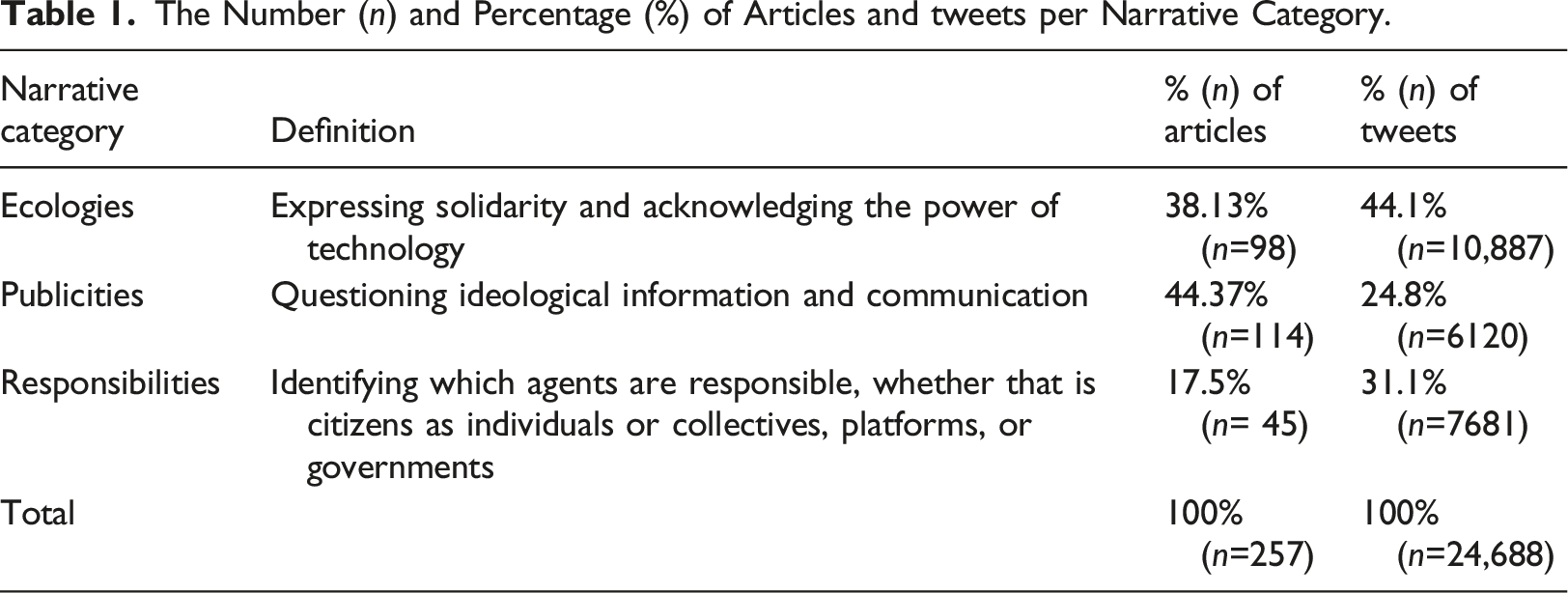
The Number (n) and Percentage (%) of Articles and tweets per Narrative Category.
Platformised consumer activism against the platform economy
Understanding platformised consumer activism through the narratives of ecologies, publicities, and responsibilities allows us to focus on the practices and promises of (platform) consumers in relation to labour justice in the platform economy. In the below, we showcase the ways in which technology and consumer power are represented (ecologies), the prominence of social change actors and their voices (publicities), and the location of responsibilities in the labour justice struggle connected to the platform economy in Greece (responsibilities). We take each narrative in turn, starting from ecologies, to explore what news articles reported and the ways in which Twitter users reacted to #cancel_efood.
Ecologies
As seen on Table 1, 44.1% of tweets rejected labels such as ‘keyboard’ and ‘armchair revolutionaries’, suggesting that this ‘online mobilisation is equivalent to 100 or more marches!’ and it may be the ‘beginning of similar mobilisations in favour of workers and against exploitation’. Such tweets counter the view that digital activism is ineffective. Instead, they conceptualise #cancel_efood as a manifestation of the ways in which consumers understand and resist the rampant social and economic inequalities across the country. Sticking to similar warfare references as in the digital news articles we will see next and addressing consumer power, users tweeted: ‘The battle through social media has been won’; ‘Get your coffee from somewhere else. Or make it at home. Don’t reinforce injustice’; ‘Anyone who is forced to go freelance is blackmailed. I don’t shop from such businesses. It’s my right to give my money wherever I choose to give it’; ‘It’s positive that the slogan “think as a worker and not as a customer” has taken over’. Likewise, many tweets mention their power as consumers using phrases such as ‘we established you, we will now bring you down’, ‘we are the drivers’, ‘1 now and forever’, ‘uninstalled and goodbye’.
Platformised consumer activism was expressed in the #cancel_efood hashtag articulating support towards efood workers and through references to efood’s impact on society. For instance, one tweet proclaimed ‘United we stand! For the delivery man of my neighbourhood and for every delivery man ❤ ’; another talked about how ‘deleting their [efood] account, apps, etc. and discrediting the company is self-evident’; a third said ‘they created fake needs for us and we forgot how we lived before these platforms’. These illustrate how Twitter finds ways to link people through shared commitment to a cause and solidarity while acknowledging its role as an intermediary platform. However, what is not certain is the extent to which these views brought about changes in daily consumer practices with delivery services.
The shift in recognising injustice was sometimes limited to the specific company and not to the wider platform economy. For instance, someone mentioned @efoodgr and said ‘I just unregistered and uninstalled. No one hurts the people who bring me food. Fortunately, there are other applications - and phone lines’. Some users recognised such delineated action, and through their tweets aimed to expose the hypocrisy of fighting against efood, but not against similar platforms such as Wolt and BOX: ‘It’s unbelievable seeing people saying “eat the rich” and then themselves promoting BOX’ ; ‘Folks, don’t just say #cancel_efood, but #cancel_wolt too. It’s the same exploitation, they’re on the same rowboat!’; ‘Neither efood nor Wolt! No orders on either. Let’s show them that employee exploitation is not tolerated’. The broader solidarity performed in these tweets highlights the limitations of #cancel_efood as platformised consumer activism in relation to wider, mostly hidden, labour injustices across the platform economy.
Similar to the ways in which Twitter presented platformised consumer activism, the majority of digital news articles produced celebratory accounts drawing on natural phenomena (‘wave’, ‘avalanche’, ‘flood’, ‘storm’, ‘tsunami’, ‘lightening’) and warfare (‘weapons’, ‘firing’, ‘stoning’, ‘demolition’) analogies. Social media platforms were particularly celebrated in relation to their power and capacity to empower in defence against critiques of ‘armchair activism’: “Some spoke disparagingly of ‘armchair revolutionaries’ and ‘lax internet activism’, but the truth is completely different. … Because a company that lives off the internet, the only thing it fears is the resentment and anger of internet users.” (Kontra News, 2021)
Internet users are primarily presented as consumers and the success of the particular struggle is attributed to the combination of platformised practices: “Production without consumption is not possible. There is no reason not to use, in parallel with the struggles in production, the power of consumers as a lever to put pressure on employers. This is especially true in a commercial (service delivery) environment where the company's brand name is the A to Z of its profitability - and so the power of shares, likes, and consumer ratings is enormous.” The Press Project, 2021
Consumer power is conceptualised in quantitative terms and seen as holding platform players accountable through practices such as sharing, liking, and rating companies. The success of platformised consumer activism in the case of efood is largely focused on the volume of tweets posted: for example, ‘The reaction escalated leading to the hashtag #cancel_efood having 31,000 tweets on Friday afternoon and a few hours later the number of relevant tweets reached 37,000’ (Insider, 2021). Similarly, there was speculation on the number of users deleting the app ranging from ‘hundreds’ (Proto Thema, 2021) to ‘tens of thousands (even 150,000!)’ (Eleftheria, 2021). Some articles gave voice to trade unions highlighted and celebrated solidarity: worker–worker solidarity, trade union–trade union solidarity, and to a lesser extent, consumer solidarity and class consciousness. Particularly regarding consumer solidarity, they wrote: ‘the good news is that online social justice movements have also shown that they have class reflexes’ (The Press Project, 2021); ‘The class maturity, self-knowledge and self-awareness are really impressive, as well as the militant spirit of the riders, but also the wider trade union support’ (SLPress, 2021). Overall, news media and social media ecology narrative enveloped a largely positivist approach to the role of technology and consumers in bringing about labour justice in the platform economy.
Publicities
24.8% of tweets (Table 1) shared media articles outlining the announcement of different unions, announced the time and place of marches and strikes by gig workers across Greece, and underlined the significance of ‘organising in unions and associations’. Twitterers congratulated the success of overturning efood’s decision, with some tweets highlighting how refreshing it is to see trade unions win: ‘Well done to them! They were one of the few examples of good trade union action, today they humbled us and sent their message: Workers united, never defeated. 24-h strike on Friday. Greetings to Hatzidakis’ and ‘Big congratulations to the workers and those who supported them who, in spite of the times, did not bow their heads to the orders of the bosses but got up and fought’.
In our findings, however, we also traced some dismissive voices, with people suggesting that the union actions and subsequent positive outcome would have led to people being fired and ‘raise unemployment rates’, claiming that ‘Anyone who works in this chain [efood] is happy’. While government officials declared that ‘The only change that the new labour law has brought to the freelancers is to give them *extra* rights: the right to trade union representation and the right to health and safety at work. Everything else is just a lie’, other users suggest that ‘trade unionism’ is part of leftist propaganda after which ‘workers always lose’. In the narrative of publicities, we witness attempts to impact the information and wider discourses that permeate Greek society, both through social media and news media.
Across news articles, the voices of various actors involved in the efood contention were prominent, nearly half of which were trade unions, and almost equally party or politicians’ voices, while there was some reproduction of efood employees’ and other individuals’ voices. The overwhelming majority of articles reported on the developments by naming the trade unions involved and listing their scheduled or undertaken actions. The demands of riders are reproduced word by word in several news articles: The Assembly of the Base of Workers for (Motor)Cycle Drivers, in the text that it uploaded on its website, requests, among other things: Immediate meeting with the company to solve the problems; Stop the imposition of freelancing under the threat of dismissal; To comply with the company’s commitments to convert fixed-term contracts into indefinite ones; To submit to strict institutional control (SEPE, Ministry of Labour) all internal parameters of the implementation that lead to discrimination; To stop the arbitrary and illegal, as they characterize them, evaluations that he adopts as a criterion of dismissal and the threats of deprivation of salary. (Ptolemais Post, 2021)
While this is often merely descriptive, there are also articles that accentuate the significance of the struggle and connect this to wider political contention: In the context of the escalation, the country’s labour centres are also included, as they sent an open letter to Kyriakos Mitsotakis, demanding from the prime minister to intervene in decision-making on specific measures to support the sector. … ‘The internet has sent a strong message not only to Delivery Hero, but also to you as the Prime Minister of the country. A message that was sealed in the streets, with thousands of riders flooding all major urban centres during yesterday’s mobilisation… Riders, thousands of internet users, workers and employees of the country, ask you to be more sensitive about labour relations both in this industry and in any other industry. Do not ignore or skip this message because ... the next ‘rating’ that will receive a negative rating, may be the Government ‘rating’” (Efimerida ton Syntakton, 2021a)
When it came to tweets, publicities were presented in two fairly different ways: firstly, by making positive references to the media articles that were published and mentioned the impact of the action and the success of the unions; and secondly, as a disbelief toward the overall force of #cancel_efood and its translation into labour justice. Similarly, the narrative of publicities in digital news articles appeared to prioritise the voices of trade unions in their labour struggle against the efood platform, while for tweets it had a conflicting role in which optimism faced a constant questioning from wary users.
Responsibilities
Tweets showed a heated debate against the government, specific political figures, efood as a company, and other individuals and corporate actors at a percentage of 31.1 (Table 1). Tweets refer specifically to the new labour law and the Mitsotakis-led conservative government of New Democracy and point out: ‘it’s the ND with Hatzidakis who gave the green light to these unacceptable behaviours’, ‘Every crisis has winners and losers. The 4808/21 Law (“Hatzidakis law”) laid the road for the new “economy champions”’. Notably, tweets call for the law to be banned or reverted, relaying responsibility to the government: ‘Don’t let us go back to the working conditions of the Middle Ages. Throw the Hatzidakis law in the trash’ and ‘Do we blame bad companies like #cancel_efood or the state that gives them the right to treat employees like this? Along with deleting the app, we must delete the law of #Hatzidakis, don't you think?’
Most of the blame and larger share of responsibility fell on the PM and his government, with disappointed Twitter users pointing out that ‘The “journey” promised by Kyriakos Mitsotakis is proving to be a nightmare of job insecurity, employer blackmail and the extinction of labour rights’, ‘An extreme right-wing regime (Mitsotakis’) can ban strikes, marches, it can launch armed police to terrorize (ONLY) the poor, to pass anti-labour laws, to buy silence in the media, parties, but for the social psyche, a jolt is enough’, insinuating that this case of consumer activism is just the start of a consumer activism movement in Greece.
In the meantime, information regarding the alleged involvement of the PM’s wife in the efood business began circulating on Twitter raising awareness about the lack of wider resistance to the platform economy that spread fast in Greece after the 2008 economic crisis. In the same framework, Twitterers turned to how consumers are not used to boycotting companies, stating: ‘Today we realised our strength. We define the success of any business, whether we are its employees or its customers. Today. TOGETHER’, ‘Today the drivers of @efoodgr tomorrow all of us, the rest of us. It will spread beyond the drivers. Let us be united against whoever, bosses and governments, who use blackmail to achieve any exploitation of employees’. Some went as far as to suggest that boycotting efood should also come from restaurants that collaborate with them: ‘I hope restaurants stop all cooperation with all the companies that act like this’, ‘I’m seriously thinking that whenever I’ll call to order food, I will also ask if the store I am ordering with works with @efoodgr & if the answer is positive to move on to the next store’.
Reflecting the nature of political debate on Twitter, three types of responsibilities appear in news articles: governmental, corporate (efood), and consumer. There is repeated mention of the 2021 labour law: ‘We live in the aftermath of the Hatzidakis law, if you look at article 69 it is a snapshot of that this company is trying to do now’ (Alfavita, 2021); ‘Hatzidakis’s bill contained an article that “trapped” delivery workers, paving the way for freelancing, the new model that employers want to expand into many industries, that is, a new field of large-scale exploitation to the detriment of employees’ (Avgi, 2021); ‘This abomination of a law of the New Democracy, which opened the appetites of the employer and freed her (sic) hands, will be broken in the workplace, in the sectors, on the streets’ (Tharros News, 2021). While the responsibility of the government is directly mentioned, in contrast to the tweets there is no appeal to change this, but it often manifests as a call to efood to revert its decision.
The specific demands of trade unions 1 reproduced shows how they are mostly addressed towards efood. These included indefinite renewal of all contracts ensuring all employment and insurance rights, abolishing the bonus evaluation system and arbitrary productivity criteria, banning distribution during hazardous weather, implementing a Collective Bargaining Agreement (CPA) that may ensure indefinite contracts with full employment rights (personal protection equipment, national insurance for hazardous occupations, mobile phone, and two-wheeler vehicle provided by platform), provision of spaces with changing rooms, toilet, and general use for the needs of delivery workers.
In addition to celebrations of consumer power mentioned above, there is also a reprimanding of consumers who have not previously flexed their purchasing muscles for political ends. Commentators note that this is novel in the context of Greece and how ‘as Americans say, [you should] “vote with your wallet”’ (TVXS, 2021a). Others note how in Greece consumers typically use their power for the opposite of boycotting (‘buycotting’) (Voria, 2021a). One article goes to lengths to criticise the lack of consumer movements in Greece, and to argue that #cancel_efood was an exception, demonstrating ‘to Greek consumers the power of the consumer’ (Voria, 2021b). In our datasets, platformised consumer activism manifested widely as consumer cries for governmental accountability. Despite the push for corporate responsibility demonstrated here, the demand for a clear political intervention is perhaps the most critical practice in the repertoire of platformised consumer activism, as it has the potential for long lasting outcomes, such as shaping the legal framework of the platform economy in countries where it is rapidly rising.
Discussion: Power and Resistance in the platform economy
The case of #cancel_efood illustrates the ways in which the concept of platformised consumer activism can be used to describe consumer practices and narratives that resist labour injustices and ambiguities of consumer culture. Our approach to platformised consumer activism, its goals, and the contradicting role of consumers as activists suggests an understanding of platforms and user practices that extends beyond fast celebration or criticism. To avoid this binary approach to platformised consumer activism as either techno-utopian or techno-dystopian, we have drawn on a framework that illustrates the ecologies, publicities, and responsibilities that emerge in media discourses and practices (Lekakis, 2022). This allowed us to unveil a new conceptualisation for understanding the penetration of consumer action in online discourses, from social media to news media and vice versa. Our theoretical framework and empirical analysis suggest that the hashtag #cancel_efood served to demonstrate consumer resistance against the decisions of the efood company and was used by online mainstream news to lament events and unions’ reactions across that crucial week. Despite the celebratory approach promoted by news media and Twitter, consumer activism could not have had an impact without the mobilisation of platform workers.
Our analysis illustrates ambivalence regarding the expressions of support and solidarity through digital media, as well as the broader context of platform economy in Greece. First, regarding ecologies, there is persistence in the reproduction discourses that present Twitter as the platform leading the workers’ revolution and the medium for serving consumer justice. Expressions of consumer activism that rejected critiques of ‘slacktivism’ and ‘armchair activism’ are particularly common in our findings and were essential to creating and maintaining a space that comprised almost a week’s worth of Twitter consumer activism, fuelling online news articles. Solidarity towards the workers and their resistance to precarity is measured through tweets referring to negatively rating the efood app and the celebration of its decline in the app store and Google Play, expressions of social outrage, interrogating the gig economy and centring their grievances against the platformisation of the Greek economy. Despite the compounded outrage present on Twitter under the #cancel_efood hashtag this narrative of platformised consumer activism is grounded in a specific historical, techno-political, and socio-cultural context. For the last decade, Greeks have witnessed their economy shrinking, their labour rights axed, and job prospects diminished. This has resulted in a broader mistrust in the ways politics are conducted on both sides of the spectrum (right or left) and caused a deeper rift between the middle and lower classes of the country. These frictions are visible on the streets but also in online spaces such as Twitter and Facebook, the main platforms citizens use to express their dismay and resistance to the status quo. All this to say that #cancel_efood is not an isolated or exceptional incident or platformised consumer activism; on the contrary, it is one of the many instances that have outraged Greek society and have been expressed on social media through trending topics. Mainstream media have a major role in the ways in which these discourses are communicated to the population that is not on social media and either share or disagree with the controversies. In our study, only a limited number of news articles commented on #cancel_efood in relation to class dimensions and labour in the platform economy (e.g. ‘this victory was like oxygen to the working class’ (Efimerida ton Syntakton, 2021b). Fundamentally, however, reception of platformised consumer activism across news articles largely reproduces consumer solutionism and a vision of a future where (Greek) consumers are driving social change.
Yet, while there is a celebration of digital technologies that echoes technological determinism, approaching the case of efood in the news by exploring publicities demonstrates how online news also gave (publicity) space to trade unions and supporting politicians. Rather than merely applauding consumers, our analysis illustrates the parallel promotion of platform workers struggles. For the tweets, the data shows that users shared media articles that outlined the uproar against the company and the role Twitter played in raising awareness about the action against efood. Here is where we see clear evidence of how platformised consumer activism facilitates the penetration of Twitter discourses into news articles and vice versa and how specifically the stories about the unions and their struggle are platformised between social media and news. The tendency to celebrate platforms and their impact on the publicity of the efood-workers dispute, however, perpetuates a consumer solutionism approach that negates the role of the user as a consumer of the platform. These contradictions are enveloped within platformised consumer activism, underlining the impasse of an ever-expanding platformised economy.
Regarding the broader context of platform economy in Greece, three types of responsibilities appear: an overwhelming focus on blame towards government, demands towards efood, and the responsibilisation of consumers through the #cancel_efood hashtag and actions. In the tweets we find users who question people’s motives in supporting cancelling efood, others who refuse to blame efood for the platformisation of the economy, referring to the broader techno-political and socio-cultural contexts we outlined in the ecologies narratives earlier. But while the government is blamed, there is little if any call for governmental intervention. However, efood is called to self-regulate and consumers are responsibilised in a process that echoes modernisation, that is, to exercise politics by flexing their purchasing muscles. Both news and tweets challenged the broader platform economy and the Greek government and its laws. The austerity measures enforced on and adopted in Greece have created a legal context where flexible work is not only encouraged but celebrated. In the words of a former Special Secretary of the Corps of Labour Inspectors, ‘You can easily delete an application, but the legal framework remains’ (TVXS, 2021b).
Overall, the local success of #cancel_efood illustrates pervasive ambivalence regarding the potential of platformised consumer activism for labour justice. The neoliberal and ambivalent legal context, as well as the aftermath for efood illustrate broader challenges that can be addressed through consumer practices of resistance. Furthermore, platformisation raises the question whether activism is meaningless due to its co-existence and dependence on the same digital processes. Both Twitter and efood operate as intermediaries between consumers and corporations; the latter has platformised labour for gig workers, while the former has platformised consumer activism. Indeed, using one platform to take down another is a rather trivial practice in which Twitter’s affordances become integral to making the voices of consumers heard. The technological affordance that underpins Twitter can raise awareness and create a sense of presence, solidarity, and resistance, but as our analysis of tweets illustrates, there is a lack of critique to the wider platform economy labour practices. At the same time, as online media news and tweets have shown, the focus on one company has the potential to distract citizens from other players, yet it can also result in raising expectations for other delivery platforms to comply with similar labour demands. The significance of this form of activism, however, does not lay on the aftermath or on whether it changed laws and gig practices; it was an action that shed immediate light of an injustice as soon as it happened and well before the workers were forced into freelance contracts.
Conclusion
Social media have been a valuable source for researching political, social, and consumer communication, notably in relation to social justice. #cancel_efood was one of the first public protests against labour conditions in the Greek platform economy. It is a case of local success which brought together collective worker mobilisation and consumer resistance through platformised activism. The company reverted its decision and instead of cornering 115 workers into freelance contracts, it employed 2000 workers on long-term contracts. Street mobilisations organised by platform (efood) workers were coupled with platform (Twitter) mobilisations which included different consumer activist strategies (joining the discussion on #cancel_efood on Twitter), such as deleting the app (actually ‘cancelling’ efood through boycott action) and rating the app negatively (further ‘cancelling’ efood through reputation damage).
Our analysis of #cancel_efood and its discursive construction and practises demonstrates problematic conventions in the conduct of platformised consumer activism such as the celebration of social media affordances and consumer power, which run in parallel with deeply rooted labour and financial struggles in the country. In other words, the success of #cancel_efood cannot suggest that consumers are the new warriors of labour justice in the platform economy, but that their practices, enabled by connectivity and solidarity, can increase the visibility of workers’ struggles, and put pressure on specific platform players when they are about to violate workers’ rights.
Ultimately, this paper illustrates how the platformisation of consumer resistance may be leading us to a different expression of activism which depends on the use of one platform to organise against another platform. Following concepts such as the ‘platformisation of the Web’ (Helmond, 2015), ‘platformisation of capitalism’ (Srnicek, 2017), and ‘platformisation of society’ (Van Dijck et al., 2018), the platformisation of consumer activism can be impactful to a certain degree – in this instance, by pressing efood to retract their decision to push a percentage of their workers into freelancing – but at the same time the platformisation of solidarity, resistance, and power limits the gravity of the action to the key areas of ecologies, publicities, and responsibilities. Platforms usher challenges to how we might conventionally think about consumer power and resistance against injustice, and indeed, about consumerism overall. Most importantly, our research highlights the ambiguities of consumer activism in a platformised world. Discounting resistance on digital platforms as ‘armchair activism’ or ‘slacktivism’ does not do justice to the ways in which activism on social media platforms has become unquestionably interwoven with the world around it. Yet, it is challenging to identify the exact impact of hashtags and trending topics.
Despite these challenges, we have demonstrated how social media are influenced by and influence mainstream media when it comes to the ways in which the power and resistance of the action is described and discussed. When it comes to publicities presented on mainstream media compared to Twitter, the spectrum is wide, but it centres on the voices of the representatives of the groups for which the action is happening; in our case, these are trade union leaders and announcements as well as celebrating the successes of the struggle. At the same time, illustrating how responsibilities are operationalised in platformised consumer activism, we have demonstrated how accountability is positioned in parliamentary politics and those politicians who allowed efood to attempt to exploit their workers by coercing them into freelance contracts, by passing anti-worker labour laws, and by sustaining cultures of suppression and austerity measures. However, responsibility is placed on the shoulders of Greek consumers for not organising against the growing unjust platform economy sooner, adding hopes for a better future. This is a fundamental ambiguity of platformised consumer activism whereby the focus shifts from politicians to citizens, and ultimately burdens the workers who need to mobilise in response to loosely regulated platform work.
Footnotes
Declaration of conflicting interests
The author(s) declared no potential conflicts of interest with respect to the research, authorship, and/or publication of this article.
Funding
The author(s) received no financial support for the research, authorship, and/or publication of this article.
