



Abstract
Despite increased interests in marketisation of philanthrocapitalism research worldwide, the arguments emphasise ‘what’ instead of 'how’ and ‘why’ philanthropic philosophy happens across Africa. To address this gap, 51 Tony Elumelu Foundation participants’ narratives are focused on to draw on an Africapitalism framework highlighting chasms within and between western neoliberalism frameworks and philanthrocapitalism’s marketisation. By framing this paper using philanthrocapitalism discourse, the authors critically examined the activities of African philanthropists and the effects of their neoliberal adoption on recipients. Semi-structured interview analysis produced three key ideologies demonstrating ‘what’, ‘how’ and ‘why’ philanthrocapitalism is marketised, namely, utopianism and the illusion of a better socioeconomic tomorrow; neoliberalism and a culture of dominance; social investment and marketisation of benevolence. These thematic paradoxes were used to create an additional four-aspect Africapitalism framework contributing to ‘what’, ‘how’ and ‘why’ philanthrocapitalism is marketised in Africa, its impacts, challenges and solutions. Contributions, limitations and implications for research are articulated.
Introduction
The ‘marketisation of philanthropy’ (Lai and Spires, 2021; Nickel and Eikenberry, 2009), supporting the implementation of philanthrocapitalism, is witnessing an explosion in academe (Harrow et al., 2021; Manning et al., 2020). While existing studies on the marketisation of philanthrocapitalism emphasise the ‘what’ (financialisation of philanthropy – Haydon et al., 2021; Idemudia et al., 2019; Carrick, 2018; Baltodano, 2017; Nicholls, 2010) over the ‘how’ and ‘why’, the current lacunae in the ‘how’ and ‘why’ of philanthrocapitalism, including frameworks for their understanding, is deserving of urgent attention particularly in Africa. First, while Saifer (2021) and Harrow et al. (2021) had noted the importance of examining ‘how’ philanthropy is organised, marketised, managed, and theoretically developed and Dholakia (2016) had earlier highlighted the importance of social entrepreneurs to boost socio-economic developments, such western-based assumptions of an unhindered, deregulated free-market society had not been empirically examined outside of western and North American scholarship. Second, existing studies on the marketisation of philanthrocapitalism have emphasised the financialisation and marketisation strategies (the ‘what - Lai and Spires, 2021; Nickel and Eikenberry, 2009) at the expense of the ‘how’ (i.e., via what ideological instruments/approaches) recipients’ perceptions of the philanthropic services being marketised to them are implemented, experienced, and possibly contested, understood, and resisted from an Africapitalism infused with individually centric, socio-cultural and political views. Third, the existing theoretical and ideological arguments on philanthropic giving have been framed via methods promoting utilitarianism, neoliberalism and social good thinking (Godbout and Caille, 1998; Barkan, 2013; Dholakia, 2016) without much attention paid onto ‘how’ such methods may have achieved the unintended consequences of inequality, socio-cultural destabilisation, and inequality and what other philanthrocapitalism framings may be available to further enrich the field. Fourth, by also investigating and surfacing the ‘why’ (via entrepreneurs’ ideologisation of philanthropic marketisation), this study examines combined aspects that existing scholarship (Duménil and Lévy, 2010) has missed, namely, individual and organisational objectives and societal value sets, their interrelationships with and impacts on recipients’ and givers’ identities, the extent, scale and effects of their commitment to benevolence and the overall complexity of the marketisation of philanthropy.
This study examines the ideological underpinnings informing the marketisation of philanthrocapitalism and the gap in ‘what’, ‘how’ and ‘why’ it is marketised in Africa via Africapitalism. In its broadest sense, philanthrocapitalism is the promotion of a combined set of market and business approaches, activities, and outcomes (Barkan, 2013; Marion, 2006). While research publications on philanthropic charities such as Bill Gates and Desmond Tutu (Bishop and Green, 2008) have generated policy interests on activities involved (Boodoo et al., 2021), the proffering increase in calls for market thinking and methods (Barkan, 2013; Edwards, 2010), have succeeded in recently producing thematic, cultural frames (Haydon et al., 2021) but left a theoretical framing void particularly in Africa (Idemudia and Amaeshi, 2019). Recent cultural thematic discoveries have added to Reis and Clohesy’s (2001) earlier three dominant philanthropic types (social, internet and venture - Moody, 2008; Dees, 2007).
To extend the theoretical and empirical landscape on the marketisation of philanthrocapitalism, the authors frame and position this study within emerging Africapitalism, to demonstrate ‘how’ marketisation is implemented, the influences that neoliberal discourse of utopianism and utilitarianism play and the extent of philanthropic professionals’ re-examination and realignment with western marketisation of philanthropy (Nicholls, 2010; Nickel and Eikenberry, 2009). Such framing and critical examination contribute to Dholakia’s (2016) neoliberal marketisation of ‘social entrepreneur’ concept and Haydon et al.’s (2021) three philanthrocapicalism cultural frames. This paper contributes to what Moody (2008) earlier saw as philanthropic’ s renaissance and the shifting discourses between utopian philanthropy (doing social good – Barkan, 2013; Venugopal and Viswanathan, 2017) and the utilitarian, financialisaton of philanthrocapitalism (Carrick, 2018; Nicholls, 2010), its impacts and nuances. Likewise, this study adds to the organisational and entrepreneurial landscape by addressing the lacunae in empirical studies looking at the significant theoretical gap on an innovative framework that seeks to resolve the ‘what’, ‘how’ and ‘why’ of philanthrocapitalism and its marketisation processes in Africa. By so doing, the authors extend earlier marketisation and neoliberal discourses in the context of philanthrocapitalism’s marketisation (Holt and Cameron, 2010; Kjeldgaard and Nielsen, 2010; Kozinets, 2008). This study uses the notion of Africapitalism to examine the ideological underpinnings of the marketisation of philanthrocapitalism by the Tony Elumelu Foundation, a well-known African philanthropic venture in Africa.
Africapitalism and the philosophy of the Tony Elumelu foundation
Africapitalism is an economic philosophy that uses the African private sector to transform the continent’s socio-economic investments (Idemudia and Amaeshi, 2019). Tony Elumelu, a Nigerian philanthropist coined the term ‘Africapitalism’ in 2011 (Elumelu, 2013), drawing comparisons with ‘conscious capitalism’ (Mackey and Sisodia, 2014), ‘inclusive capitalism’ (Ashford, 2018) and philanthrocapitalism (Bishop and Green, 2008). This study is positioned within the latter ideological discourse to critically examine how Tony Elumelu Foundation practices and activities using western philanthrocapitalism and neoliberalism discourse and the effects on people. Although there is no universal definition of ‘Africapitalism’, Idemudia et al. (2019) view the concept as having a ‘market’ function/a capitalist agent with the power to use ‘social entrepreneurship’ as a marketing brand. While this thinking is in line with Dholakia’s (2016), Heydon et al.’s (2019) and Saifer’s (2021) marketisation and financialisaton approach, Idemudia et al. (2019) believe that philanthrocapitalism could have a more positive decision-making aspect that contributes to resolving Africa’s socio-economic developmental challenges. Despite claims and counterclaims, Haydon et al.’s (2021) development of three ‘cultural frames’ have extended Harrow et al.’s (2021) call for additional theoretical development on philanthrocapitalism, while its full impacts (Reis and Clohesy, 2001) are yet to be reverberated beyond the western hemisphere. The authors develop theoretical appreciation of Tony Elumelu Foundation’s Africapitalism approach and the use of neoliberal ideology to resolve Africa’s philanthropic constraints (Amaeshi and Idemudia, 2015). Therefore, despite earlier assertions by Rivera-Santos et al. (2015) and Littlewood and Holt (2015) regarding Africa’s institutional, cultural, colonial, economic and social diversity, and Harrow et al.’s (2021) use of institutional philanthropic theory to highlight philanthropic approaches and differences in varying sectors, developing knowledge and understanding of ‘how’ and ‘why’ western ideologies are implemented across the African philanthropic landscape, their nuances, tensions and impacts is therefore long overdue. This study recognises/notes the multi-institutional cultural variances within and between African tribal, ideological, ethnic, and other rivalries within and across regional parts of Africa but seeks to critically analyse how these colour Africapitalism with the aim of producing a new framework highlighting the ‘what’, ‘how’ and ‘why’ of social entrepreneurship’s marketisation. Despite Thornton and Ocasio's (1999), culture characterisation as ‘the socially constructed… values, beliefs, and rules [to] organise time and space’ (p. 804), there still remains lack of critical engagement to better understand the uncertainty created in the wake of new theoretical clarifications on philanthrocapitalism, including those of Haydon et al. (2021), among others in the context of ‘how’ and ‘why’ Africapitalism is marketised as such.
Philanthropy, philanthrocapitalism and dominant ideologies
Traditionally, philanthropic discourse is ideologically framed and marketised through a dominant western neoliberalism philosophy (Marion, 2006; Holt and Cameron, 2010; Dholakia, 2016). This frame’s characteristics helps in understanding Africapitalism and how it is marketised (Idemudia et al., 2019). On the one hand, utopian neoliberalism centres on visionary and ideal assumptions about society (Pinder, 2013), whereas the more utilitarian version highlighting capitalist tendencies in marketing the benefits of philanthrocapitalism, the return-on-investments and profit maximisation (Carrick, 2018; Barkan, 2013). These two opposing discourses signal a conflict of interest/tension between utopianism (doing social/good/wellbeing) and utilitarianism principles used in marketing philanthropy – Langdridge (2006). This dual marketisation approach has given rise to a discourse – reality gap in neoliberal philanthropicapitalism, which has not been the focus of earlier research endeavour, particularly in Africa. The notion of productive entrepreneurship (Haydon et al., 2021) has further highlighted financialisaton strategies but inadvertently led to mystification and uncertainty around a more paradoxical notion of ‘social entrepreneurship’. These contentions have led to lack of conceptual agreement/clarity on the evolving frames around philanthropic capitalism and what additional strategies and aspects should be included in their marketisation (Dholakia, 2016). Such disagreements have led some to argue that sustained economic growth should be used as a marketisation tool to encourage individual responsibility in the process (Ganti, 2014) while others opine that marketplace exchanges should be the key marketising strategy particularly for poorer people (Venugopal and Viswanathan, 2017).
Another evolving marketisation strategy used in and for philanthrocapitalism purposes is neoliberal ideology (Pinder, 2013; Holt and Cameron, 2010). Given marketisation’s emphasis on a sustained healthy economic state and a free market, it is no wonder that its strategies promote a deregulated, privatised and minimalistic state intervention economic system (Venugopal and Viswanathan, 2017; Duménil and Lévy, 2010), as an ideology. However, such free-market advocacy is antithetical to the purported vision of philanthropic utopianism (Barkan, 2013; Dholakia, 2016) and the concept of social good (Godbout and Caille, 1998). The increasing dependence on marketisation strategies to sell the benefits of philanthrocapitalism and the lack of conceptual agreement among eminent western and North American scholars (Haydon et al., 2021; Dholakia, 2016) highlights additional theoretical and empirical contentions especially when such evolving debates are applied to Africapitalism. Examples of the Eli and Edythe Broad Foundation, the Bill and Melinda Gates Foundation and the Walton Family Foundation provide grounds where scholars have previously scrutinised the extent to which effective resource allocation and utilisation in the tradition of philanthrocapitalism and marketisation may have been realised (Liebersohn, 2011; Baltodano, 2017) and whether such a financialisaton of marketisation strategy (Haydon et al., 2021), ought to raise further questions regarding the violation of human liberty and dignity (McGoey and Thiel, 2018). Therefore, these marketisation of social giving strategies generally point to their framing around greater returns on investment, scalability of investment portfolios and performance (Barkan, 2013; Ravitch, 2011; Saltman, 2009; Scott, 2009). Despite the apparent benefits, they have left a void in terms of ‘how’ they could be operationalised in the context of Africa and any justification for doing so. To ascertain the power of marketisation as a tool to enhance philanthrocapitalism, the authors examine additional critical discourses on philanthropy to evaluate their utopian, capitalist, marketisation and/or utilitarian frame(s) (Pinder, 2013; Ganti, 2014) to shed light on how these evolving ideological discourses shape/drive the marketisation of Africapitalism.
Geertz (1973) argues that ideologies impactfully influence practices, experiences and their social construction (also see Dholakia’s 2016 ‘marketing of inequality’ concept) whereas Ricoeur (1991) emphasises on the social integration benefits of ideology [e.g., marketisation of philanthropy]. However, these postulations have still not clarified ‘how’ (via what ideological instruments/approaches) perceptions of inequitable relationships (Barkan, 2013; Marion, 2006; van Dijk, 1998), inequality is perpetuated and marketised in the context of entrepreneurial philanthropy in Africa. To investigate this lapse in a diverse continent, we draw on utopianism and neoliberalism frameworks partly because of the embedded ‘good’ they promise in such a context and how people depict their own and societal worldviews of their operationalisation (Dijk, 1998, p. 130) to shed light on the grey areas of not only ‘how’ philanthropy is marketised, managed, organised and theoretically developed (Saifer, 2021; Harrow et al., 2021) but additionally ‘why’ this may be so. This evolving state of philanthrocapitalism has even prompted the emergence of ‘counterculture’ discourses, leading to Sargent, 2010 proposition of common-sense view and the need to adopt a unifying utopian set of ideals that may socio-politically and economically benefit philanthrocapitalism and its framing around utopian marketisation ideology (Pinder, 2013). The state we are currently crystallises the conceptualisation of a western European and North American hegemonic discourse on utopian and neoliberal ideologies, which has caught scholars in a continuous loop (or spiral) of simultaneously attempting to integrate a shared identity and commonality of underpinning ‘truths’ regarding the benefits of marketing ideologisations on philanthropy, and by extension, philanthropicapitalism while implementation strategies and justification frameworks differ at best and lack in most cases. Ideology is defined in this paper’s context as a collection of socio-culturally held ideas that aid groups and individuals in organising and managing their knowledge and views regarding shared goals and values, social connections, and social identity. Tony Elumelu Foundation’s Africapitalism activities fit within such framing and is therefore used to advance understandings on ‘how’ social giving is experienced across Africa. These varying conceptual understandings of philanthrocapitalism, the marketisation strategies used and their philosophical underpinnings have stopped short of emphasising ‘how’ they are operationalised and understood across Africa’s social entrepreneurship landscape.
Marketisation of philanthropy through the lens of Africapitalism
Philanthropic grant-making is increasingly being framed using venture investment philosophy (Moody, 2008) and entrepreneurial principles (Nicholls, 2010). Such framing is referred to as the marketisation of philanthropic capitalism/philanthrocapitalism (Lai and Spires, 2021; Manning et al., 2020; Nickel and Eikenberry, 2009; Wirgau et al., 2010). Increasingly, the intensified use of such language (Saifer, 2021; Edwards, 2010), has led to philanthropy assuming greater utilitarian value/focus (Carrick, 2018; Reis and Clohesy, 2001; Woodruff, 2018) as highlighted in their application on social developmental issues (Edwards, 2010) to eradicate ‘social problems’ and relieve misery (Gross, 2003). This is the anglophone west version of an entrepreneurial philanthropic philosophy, whose basis on an individualistic, calculative utilitarian self-reliance model does not guarantee social equality (Barkan, 2013). This proposition is despite continuous calls for charitable giving motivated by a more social or religious obligation of a utopian society (Pinder, 2013). While Haydon et al.’s (2021) line of thought/argumentation and framing promotes philanthropy as social investment whereby high-net-worth individuals can maximise their returns, Harrow et al. (2021) also alludes that philanthropic actions should not be regarded as charitable, thereby critiquing Gross’s (2003) notion of utopian generosity. This spiralling of the current ideological and theoretical arguments around philanthropy, which frame(s) and framing methods are appropriate/relevant and whether utopianism, utilitarianism, neoliberalism ideologies should be used raise additional questions regarding ‘how’ they could be resolved and ‘why’ doing so will contribute to additional philanthrocapitalism framings.
In efforts to resolve this marketisation of philanthropy dilemma, Dholakia (2016) touched on the ‘how’ of the marketisation of philanthrocapitalism by suggesting that marketing practices and marketisation strategies can promote a neoliberal economic system. While seeking to demystify the uncertainty around the framing of social entrepreneurship and the role of marketisation, Dholakia assumes that social entrepreneurs can actually enhance social and economic development processes. However, such assumptions are largely based on a western, free-market society, where deregulation has become part of the generally accepted neoliberal and marketisation norm.
Eikenberry (2009) and Edwards (2010) examined the influences of market thinking and how it has framed arguments around market competition growth/scaling. Again, in line with western thinking, these scholars argue for quantitative accountable philanthropy to capture the financialisaton benefits of such an approach towards philanthropy’s social transformation goal. Despite such arguments, these scholars also critique the short-sightedness and nebulosity embedded in these claims and the extent to which they demonstrate effectiveness of resource utilisation. Therefore, these theoretical arguments highlight lack of independence, impersonality, rigidity, democratic tendencies, and the freedom for people to exercise their wishes on ‘what’ is being marketised and the impacts on them (Venugopal and Viswanathan, 2017; Gross, 2003). Berndt and Boeckler (2023) view such claims as one-sided and part of a post neoliberal agenda. Although other scholars have also used the anti-marketisation arguments (Omeje, 2021) by postulating individual responsibility and service to others, as an additional lens to the marketisation of philanthropy, Dholakia’s (2016) framing of philanthrocapitalism around culture frames continues to highlight that there is no one-size-fits-all approach towards marketising benevolence as a totally utopian act of selflessness (Klein, 2014; Lai and Spires, 2021; Gross, 2003). Despite these assertions, some scholars postulate about the benefits of philanthropic consumerism via the use of cause-related marketing strategies (CRM – Eikenberry, 2009; Edwards, 2010), and others evince the ‘devaluing [of philanthropic] idealism’ (Wirgau et al., 2010, p. 621). This additional set of financialisaton strategies serve to increase the range of social, economic and other permutations of the ‘what’ of marketising benevolent capitalism (Nicholls, 2010; Haydon et al., 2021). Despite such theoretical extensions, they raise questions/tensions about how tenable western dominant logics on philanthropy and its marketisation continue to be in contemporary philanthropic foundations outside western thinking. Such critique(s) will be examined in the context of Tony Elumelu Foundation and its reliance on Africapitalism to ascertain the struggle for entrepreneurial control via marketisation and the extent to which entrepreneurial organisations serve utopian, utilitarian and/or other neoliberal agendas beyond the western European and North American hemispheres.
In additional attempts to resolve the conceptual disagreements/tensions, Nicholls (2010) and Moody (2008) advocate for a more dynamic organisational and professional approach towards venture philanthropy. However, such a singular investment paradigm to charity grant-making is not enough in framing and conceptualising complex/multifaceted ideologies and practicalities arising from western lines of thought and how these may be adopted in the emerging significance of African social entrepreneurship. While some suggestions for deradicalisation strategies that could alter the utilitarian/marketisation lexicon of Haydon et al. (2021) and other adherents have been suggested, market concept of effectiveness in resource allocation and utilisation and the marketisation of western discourses still dominate the philanthropic landscape. ‘How’ these are managed and organised is dependent on additional, philanthrocapitalist ideological narratives, institutional logics, heroes, heroines’ and community storylines that have not been fully accounted for in western ideological framings and publications that this paper explores through Africapitalism and its marketisation. Therefore, by adopting a contextualisation approach to philanthropic ideology, the authors show how the conceptual debates on the topic have cemented a dominant, traditional marketisation of charity perspective/frame around the market, marketisation, philanthropic ideological branding (Haydon et al., 2021; Saifer, 2021) and projected a western-centric rhetoric of relational incompatibility within and among institutions (Zelizer, 2023). Second, it is critical to acknowledge that competing philanthropic ideologies are negotiated by social entrepreneurs, venture philanthropists and philanthropic (organisational) professionals as well as others outside of this western frame and framing of charitable giving (Edwards, 2010; Harrow et al., 2021). We surface how entrepreneurship ideologies are marketed and played out among a broader audience outside the west and ‘why’.
Methodology, data collection and analysis
Debates on entrepreneurial philanthropy are sometimes presented as individual entrepreneurs’ philanthropic acts and stories (Edwards, 2010) with little known about the coherence of such work narratives and their impacts on people. To better understand this process and its wider social impacts (McGoey and Thiel, 2018; Barkan, 2013), we examine the lived experiences of 51 African entrepreneurs, recipients of the Tony Elumelu Foundation award across Africa (Pinder, 2013). This methodical approach to research underscores an interpretivist philosophy whereby human reality (i.e., philanthrocapitalism) is socially constructed by relevant, informed social actors (Saunders et al., 2012; Lempiälä et al., 2019). Therefore, this is a qualitative investigation relying on collecting and analysing raw (and rich) data, through semi-structured interviews (Miles and Huberman, 1994; Creswell and Poth, 2018) to achieve the core objective.
Participants’ profiles.

Data analysis
Braun and Clarke's (2006) thematic and Riesman’s (2002) narrative analysis technique helped to draw nuanced meanings and synthesise narratives. This qualitative approach allowed the detection, reporting and analysis of thematic stories, allowing for alternating the datasets to extract deeper meanings. To systematically operationalise this, Pratt et al.'s (2006) procedure was used, namely, (1) creating first-order categories of codes, (2) theoretical categorisation and (3) building and consolidating new conceptual categories for theorisation/new conceptual framings in the tradition of Lempiälä et al.’s framing (2019).
In creating a new framing on Africapitalism, preliminary categories from the first-order codes, textual materials were analysed using words and phrases that are prominent, summative and essence-catching (Braun and Clarke, 2006; Pratt et al., 2006; Patton, 1990). Following Miles and Huberman's analysis (1994) tentative categories that emerged from the data extracts, relevant to our study’s objective, were captured. Initial accounts on issues such as the role of the private sector in entrepreneurial philanthropy, the support provided to emerging entrepreneurs, the limiting nature of governmental socio-economic inference, and the catalysing of Africa’s economic growth pointed towards the institutional contextual frame that are critical in highlighting the problems within and with African philanthrocapitalism. It includes variables such as social and economic (in)equality; African entrepreneurs’ empowerment, ideals of a better African tomorrow and how the notion of Africapitalism was enunciated and experienced. After naming the codes and creating the categories, a careful and detailed analysis of the data was conducted by each author to ensure that crucial narratives and accounts have been captured and fit well in their various category groupings. The theoretical categories were found by aggregating first-order interview codes from each category to allow theoretical abstraction (Pratt et al., 2006, p. 240) on people’s ideologies, activities and processes used (Bateman, 2010). Finally, the conceptual categories were consolidated for theoretical clarification and consolidation (Braun and Clarke, 2006; Pratt et al., 2006). This rigorous and systematic procedure enabled the discovery of three significant, new themes or theories on ‘what’, ‘how’ and ‘why’ utopian and neoliberal ideologies coalesce to drive emerging African entrepreneurial philanthropy or, if one wills, coherent narratives on the marketisation of philanthrocapitalism via Africapitalism in Africa. Repeated comparison and validation of the conceptual categories and framing process were done until no new categories emerged (Braun and Clarke, 2006).
Findings
Three key themes accounting for ‘how’ and ‘why’ philanthropic ideologies were marketised in Africa emerged namely, (1) the ideological discourse of utopianism and the reality of an elusive promise of a better tomorrow; (2) the ideological discourse of neoliberalism and the reality of a culture of dominance; and 3) the notion of socio-economic investment and the reality of marketisation of benevolence.
The ideological discourse of utopianism and the reality of an elusive promise of a better tomorrow
Tony Elumelu Foundation entrepreneurs tended to agree that their philanthropic involvement was primarily influenced by utopianism. Most saw philanthropy as ‘a medium via which a just [African] society can be created and sustained’ (Participant 2), ‘where a sustainable economic development can be propelled’ (Participant 5), and ‘the basis for social and economic equality’ (Participant 6). These utopian convictions were operationalised in the face of under-resourcing challenges ‘through philanthropic organisations’ with the utopian hope ‘that poor countries in Africa can turn the tide of social and economic woes’ (Participant 1), ‘Tony Elumelu Foundation …is a typical example of how a better tomorrow can be envisaged for…the African continent’ (Participant 13). Additional marketisation strategies reflected ‘the role the private sector must play in the socioeconomic transformation of the African continent’ as focus for ‘the economic philosophy of Africapitalism’ (Participant 15). Others narrated ‘how’ to achieve utopianism ‘through [a strategy of] financial support and grants to help achieve the ambition of achieving a promising and stable society in which everyone not only lives peacefully but also feels much more accomplished’ (Participant 21). Although such marketisation strategy was considered as ‘the epitome of philanthropic acts’ (Participant 20), this pervasive utopian acceptance of philanthrocapitalism ideals was conceptualised using western language of profitability while couching it within empowerment and wellbeing: …we launched Eco Plaster using the grant…we’ve been able to raise over $100,000. Tony Elumelu Foundation is a good example of entrepreneurial philanthropy (Participant 23). Empowering African entrepreneurs…will catalyse Africa’s economic growth (Participant 27). If more and more individuals are empowered…through funding for a start-up, there will be greater prospects for lasting economic and social wellbeing for the regions…leading to more contribution towards GDP, and profits go to charities…to instil social normalcy (Participant 31).
Additionally, participants articulated reasons ‘why’ they adopted such marketisation strategies to embed ‘social normalcy’, ‘stand up and be counted as social investors and active change-makers’ (Participant 14), and ‘tap into undiscovered business possibilities to create wealth and financial relief for the population’ (Participant 9). Justifying their actions using egalitarianism and social justice principles echo Barkan's (2013) social justice arguments around ‘creating an egalitarian society’, 'ameliorating poverty’ and ‘fostering a healthy social environment’ (Participant 42). These justificatory arguments align with Tony Elumelu Foundation’s philosophy and add to traditional philanthropic marketisation strategies and practices seeking to create utopian living (Pinder, 2013) by injecting the ‘why’. By infusing a range of ‘economic development’, ‘socio-economic transformation’, ‘stable society’, ‘economic growth’, ‘social wellbeing’, ‘social normalcy’, ‘relief for the population’ and ‘a better tomorrow’, participants were evincing ‘why’ marketisation strategies were being operationalised, thereby rebranding Edwards (2010) views as the degrading impact of handouts. By surfacing the ‘why’, participants were recasting marketisation of philanthropy strategies and ideologies as ‘dignified’ and ‘egalitarian’ (Baltodano, 2017) and therefore an improvement to Africa’s socio-economic conditions.
The ideological discourse of neoliberalism and the reality of a culture of dominance
Respondents overwhelmingly highlighted neoliberal ideological use in marketing philanthrocapitalism, paradoxically exuding a culture of dominance. This implementation was justified ‘[to] meet the economic needs of the country’ (Participant 3), to ‘achieve sustainable social justice’ (Participant 17), ‘[to] address social and environmental concerns’ and ‘[to] develop nations to make progress in microeconomic matters and the social wellbeing’ (Participant 10). However, the unintended consequence was that governments were expected to ‘take a backseat’ (Participant 4), as Africa’s new philanthrocapitalists ‘do business and address social and environmental concerns’ (Participant 10), thereby echoing the utilitarian value of philanthrocapitalism (Woodruff, 2018; Barkan, 2013). This minimalist state interference and deregulation is in line with authoritative western, neoliberal discourse (Baltodano, 2017; Mamman et al., 2018) but Tony Elumelu Foundation participants’ narratives that ‘African entrepreneurs should be at the forefront of solving Africa’s socioeconomic problems’ (Participant 12) highlight the nuanced, albeit softer Africanised version of resource utilisation such as: I have always believed in laissez-faire systems. When private individuals and entities are empowered to participate in a country’s affairs…is where I pitch my tent concerning Tony Elumelu Foundation’s empowerment to help support our entrepreneurial ventures, growth, and development (Participant 18). The importance of increasing private citizens’ involvement and limiting government’s dominance…can never be overemphasised. In Nigeria, federal corporations such as Nitel became more effective when they were handed over to private businesses to support the population (Participant 29).
Interestingly too, participants challenged the neoliberal discourse on individual responsibility in marketing philanthrocapitalism by highlighting the role of entire ‘populace’ and ‘entities’ in Africa’s socio-economic renaissance. Justificatory arguments included ‘self-sufficiency and prosperity’ (Participant 22) and ‘a liberated and equipped local private sector’ (Participant 50). Despite the justifications, other nuanced narratives around ‘vulnerable’ populations ran through participants’ accounts, including ‘when people think of Africa, they think of charity, not riches’ (Participant 33) and ‘Tony Elumelu Foundation …is helping to…provide handouts to the vulnerable in society (Participant 43).
Despite some of the challenges in operationalising marketing and neoliberal ideologies, narratives of reservations introduce the notion of manageability within marketisation of philanthropic discourse: ‘it can be risky to advocate a free-market system in some instances, such as in the delivery of healthcare and education, because these are, by default, public services’ (Participant 45) and ‘privatising education and healthcare, would not be an issue if…[it] avoids the concomitant increase in inequality and under-resourcing’ (Participant 37). Additionally, participants used notions of sustainability of education and healthcare, a rebalancing of wealth distribution, workers’ rights and capital deregulation as added justifications of their philanthropic ideology. Other additions to western theorising include the unanticipated reality of ‘limiting government’s dominance’, governments ‘taking a backseat’ (Participant 4) leading to ‘vulnerable’ populations’ exposition.
Notion of socio-economic investment and the reality of marketisation of benevolence
The datasets highlight the intensification of marketising benevolence. As a strategy of ‘focus[ing] our business…beyond profit maximisation’ and justifying it based on ‘social accountability and care for society’ (Participant 40) introduce interesting dynamics in philanthrocapitalism discourse. This is because participants’ claims ‘to make profit in our trade and also commit to charitable activities’ (Participant 46) and ‘the idea of Africapitalism is all about making profit not just for the organisation but also society were made by Tony Elumelu Foundation recipients, (Participant 36) are concomitant with Littlewood and Holt (2015), Mair et al. (2012), Doherty et al.'s (2014) philanthrocapitalism ideology but differ in their legitimisation. For example, participants noted how ‘profit-making is crucial in the business of benevolence (Participant 49), ‘Tony Elumelu…never suggested we should just use the funding and grants he facilitated as a handout; this is not social welfare’ (Participant 35), while another opined ‘Africapitalism means…Africans to undertake this role and responsibility’. Tony Elumelu Foundation and the funding propel you to embark on business models [to] generate sustainable income towards improving the community economically and socially (Participant 51). Therefore, Africapitalism/Tony Elumelu Foundation philosophy and the marketisation of philanthrocapitalism combines western profitability logic with charitable giving sensitivity ‘in a more balanced way (Participant 28).
Discussion
The ideological discourses on the marketisation of philanthrocapitalism and their framing through traditional, neoliberal underpinnings of utopianism (Barkan, 2013; Pinder, 2013), on the one hand, and utilitarianism (Lai and Spires, 2021), on the other, appear to agree on the socio-economic benefits of marketisation strategies and activities (the dominant western, financialisation approach to the philanthropic ‘what’ – Haydon et al., 2021; Marion, 2006). However, there continues to be lack of consensus in western scholarship on ‘how’ (i.e., via what framework) this can be done and ‘why’, especially when one investigates social giving outside western European and North American-based hegemonic philanthrocapitalism contexts. These conceptual, methodological and justification gaps are despite the growing global appeal for the topic. An Africapitalism framework is developed as this study’s second contribution to demonstrate how the ‘what’, ‘how’ and ‘why’ aspects of marketisation of philanthrocapitalism through Africapitalism is framed as a theoretical extension of the marketisation of philanthropic capitalism.
Africapitalism Framework
Aspect 1
Our theoretical framework’s first aspect centres on an Africa framed within socio-economic developmental constraints, to which entrepreneurial givers feel they have a responsibility to provide solutions. The underdevelopment challenges are generally conceptualised and attributed to Africa’s colonial past, the ineffectiveness of resource allocation and use, governments’ intervention, and reliance on ‘handouts’. Such a context provides entrepreneurial philanthropists opportunities to frame themselves as demi-godlike figures waving financial wands to ‘vulnerable’ Africans, with the unintended consequence of other developmental agents (e.g., governments, parastatals…) being side-lined in the process. Although the identification, use and justification of dominant, western marketisation ideology through financialisaton may echo returns on investments, resource utilisation and performance in the tradition of Nicholls (2010), Bishop (2013), Barkan (2013) and Baltodano (2017), they do show the significance of and acquiescence to non-financial contributors from a more expansive agential and societal mosaic (e.g., charity recipients, communities).
Aspect 2
Aspect two focuses on the perception of African philanthropy as a social hazard and characterised by an urgent need for African philanthrocapitalists to inject much-needed societal transformation to ‘stabilise’ and ‘better’ such society. While this conceptualisation echoes Haydon et al.’s (2021) idea that the marketisation of philanthropy should be financially productive, it extends and adds to Bajde’s (2013) notion of an ‘unproductive’ (non-performing) social entity by highlighting neoliberal ideals as ‘social [investment] returns’. This second aspect is what has been missing in Haydon et al.’s (2021) and Harrow et al.’s (2021) philanthropy frameworks and Pinder's (2013) utopian, neoliberal idealism of something better. It infuses apparently contradictory but complementary elements of ‘what’ – a contested African entrepreneurial space; ‘how’ – financial incentives, deregulation and ‘why’ – legitimisation of marketisation, profit making, private sector incentivisation, reduction of state intervention and societal normalcy. Such paradoxes highlight western utopian ideals connected with philanthropic productivity and empowerment and the need for conceptual bricolage in Africa’s marketisation of philanthropic discourse.
Aspect 3
Aspect three evinces how the continent’s conceptualisation as an environmental mosaic poses additional ‘what’, ‘how’ and ‘why’ questions for philanthrocapitalists. While this theorisation echoes the ‘better seeds’ analogy of Ignatova (2017) and highlights what is needed to resolve the challenge, the financial marketisation strategies recommended in previous scholarships (Lai and Spires, 2021; Woodruff, 2018) defeat the good intentions of such a proposition given the diversity of cultures and multitudes of socio-environmental and political systems across Africa. By highlighting the environmental challenge of our framework, we extend earlier medically infused theorisation on how marketplace exchanges should be perceived in the field of philanthrocapitalism (Venugopal and Viswanathan, 2017) by introducing ‘how’ – socio-environmental challenge awareness and ‘why’ entrepreneurs need to recognise the additional societal and environmental wellbeing of the citizenry for ‘normalcy’ and ‘a better tomorrow’ for all.
Aspect 4
Our theoretical framework’s fourth (final) area highlights ‘how’ the continent is philanthropically conceptualised as vulnerable. While such framing could be associated with an investment risky geographic landmass in line with western marketisation and philanthrocapitalism ideals on resource maximisation and financial returns (Woodruff, 2018; Baltodano, 2017), and a temptation to advocate for utopian living ideology and practice (Pinder, 2013), such contrasting evaluations are particularly relevant within Africa’s healthcare and education. Earlier philanthrocapitalism literature in the likes of (Jenkins, 2011) had highlighted the grey areas between quantification methods used in measuring potential marketisation of philanthrocapitalism returns and its societal benefits and the immeasurability of philanthropy given the evolving nature of such human phenomenon. The role of marketisation in such returning entrepreneurial investments has been previously emphasised (Dholakia, 2016) but introducing the notion of ‘vulnerability’ adds an additional layer onto the evolving nature (‘what’), the complex range of challenges and the level of justification needed in philanthrocapitalism and its marketisation in Africa. Suggestions of using ‘private-sector operators’ as a way (‘how’) of framing and demystifying the vulnerability aspects (lack of productivity, performance, financing, etc.) to achieve ‘social justice’ and ‘normalcy’ seem to provide justificatory arguments in situations that may appear insurmountable, or if one wills, a set of ‘wicked problems’. Such complexity in the range of possible theorisations raised in this final aspect point to the need for ‘cross-fertilisation’ between the [financial] gift (‘what’ is being marketised), the market [of philanthrocapitalism], marketeer [social entrepreneur], the marketed [‘why’: socio-economic benefits of philanthrocapitalism] and marketisation strategies [‘how’] as a further conceptual symbiotic addition of this paper that was able to unpick the nuances of applying dominant, authoritative neoliberal and marketisation of philanthropy ideological underpinnings/principles outside of western contexts where they were originally conceptualised. This fourth aspect recognises and brings together the complex range of perspectives (of the ‘what’) that Duménil and Lévy (2010) previously noted and adds individual and organisational objectives and societal values (‘why’ entrepreneurs marketise philanthrocapitalism ideology), connections (‘how’), and identities (Africapitalists, donors, recipients, marketisation and neoliberal ideologues).
Framework’s implications
Framework and context
This paper’s Africapitalism framework is drawn on and developed from the theoretical discourse of philanthrocapitalism and its neoliberal marketisation in a range of African socio-economic and cultural contexts. How successful the framework may be evaluated (i.e., its propensity to generate additional frameworks and framings) is dependent on the geographic context/study’s locality, its timeliness, how informed the participants have been on the topic (their contextual and cognitive legitimacy and credibility) and the appropriateness of the theoretical lenses used. All these fundamental framing aspects, as stipulated by Lempiälä et al. (2019) have been met and something special has been added. The latter is interestingly introducing Africapitalism and ‘how’ its believers (entrepreneurs and recipients’) combined western and African ideological and socio-economic and cultural orientations to alternatively market viewpoints and narratives on philanthrocapitalism outside of the western, capitalist world. Tony Elumelu Foundation provided such a tool and served to highlight ‘why’ this was important. Through its activities and processes, it was possible to reflect on the advances as well as the challenges faced by the application of neoliberal, marketisation of philanthropy tendencies in Africa and the extent to which these could practically ‘achieve sustainable social justice’ for Africans (entrepreneurs and recipient-beneficiaries alike). The framework evinces two legitimacy areas, namely, theoretical and practical.
Framing and theoretical legitimacy
This paper’s Africapitalism framework has surfaced four aspects highlighting varying perspectives/conceptualisations of philanthrocapitalism, challenges and potential solutions. Drawing from both African philanthropic entrepreneurs and recipients’ knowledge and their expansive networks in African contexts, varying sets of experiences demonstrated how people’s ideals of Africapitalism played out in pursuit of personal/self aggrandisement initiatives, as countereffects/challenges, as possible resolutions to Africa’s range of challenges and so on. By adopting such a complex, multifaceted approach as opposed to either a neoliberal, or a marketisation of philanthropic, utopianism approach in the dominant western tradition on the topic, it has been possible to demonstrate the utilitarian personal value-added aspects to entrepreneurs, but also how its characteristics of marketisation, liberalisation, individualisation and profitability can be theoretically enriched from a range of socio-economic, cultural and political contexts and the tensions, nuances and challenges they evince from Africa. This narrative provides a significant contribution to the discourse on the dominant, western and North American financialisation approach on philanthrocapitalism as a way of promoting social equality and lessening of mass suffering (Barkan, 2013; McGoey, 2012). Additionally, it has been possible to show the unintended consequences of societal, environmental and economic challenges in Africa. In essence, it is paradoxically in promoting traditional western ideals of neoliberalism and marketisation ideology as evinced by Wirgau et al. (2010), Nickel and Eikenberry (2009) and Lai and Spires (2021), among others, that the role of African governments’ development and environmental responsibilities have been projected in the forefront within the philanthrocapitalism and neoliberal utopianism discourses.
The proposed framework advances neoliberalism and Africapitalism theory by developing a much-needed frame theorising how an Africapitalism framework’s four aspects from a range of African contexts offer more nuanced versions of applying neoliberal ideology to the standardisation of Haydon et al.’s (2021) three cultural frames, Idemudia et al.’s (2019) concept of ‘charity man’ in Africa and McGoey and Thiel’s (2018) glamorisation of violence through the super rich’s entrepreneurial generosity. While the traditional philanthropic concept of benevolence (doing good for doing good sake) has evolved into a more marketable and marketised commodity (the ‘what’) in the hands of African philanthropists, the latter’s intention of doing good has been captured in their range of justifications as shown in our study’s framework’s four aspects. This is synonymous to an organisation’s commitment to doing good but subsumed within personal and entrepreneurial image promotion (the ‘how’ and ‘why’). The latter could be perceived as over the socio-economic ideals (ideological ‘what) as originally captured by Nickel and Eikenberry (2009) as they become more entrepreneurially individualised in their marketisation. As such, Dholakia’s (2016) framing on the mystification of marketing, partly because of lack of conceptual clarity, among others, has been demystified and the organisational, personal and societal benefits of the marketisation of philanthropy have become more nuanced in African settings. The demystification additionally accounts for our framework’s theoretical legitimacy as it highlights a variety of philanthropic entrepreneurs’ nuanced images/identities: as social investors, as financial beneficiaries, and recipients as social recipients, as resistors, as aspiring entrepreneurs within Tony Elumelu Foundation. Based on this theoretical mosaic, the authors can abstract that entrepreneur philanthropists’ benevolence has assumed marketable value and been marketised (i.e., to provide benefits for the philanthrocapitalists) but created unintended effects on recipients. Therefore, the authors’ framing of such a contribution complements/adds to Bajde (2013) not only by recognising the marketisation of philanthropy in African settings but also that Africapitalism is only partially ideologically and conceptually aligned with traditional, western neoliberal thinking (as opined by Mamman et al. (2018), and practically misaligned in ‘how’ and ‘why’ it is operationalised and experienced in different African contexts.
Practical legitimacy
In addition to the framework’s theoretical contributions, this paper presents practical implications for Africapitalism enthusiasts and practitioners and Marketing professionals especially in Africa. For example, the authors show how Africapitalism professionals can deploy neoliberal utilitarian principles via a marketisation approach to facilitate its operational returns on investment across a range of philanthropic ventures in Africa. Such an approach highlights its propensity to simultaneously replicate the benefits from previous entrepreneurial philanthropic experiments such as the Tony Elumelu Foundation in Nigeria and to better explain how nuanced complexities and country-wide interactions among different entrepreneurs enhance Africapitalism’s effectiveness. This practice was enhanced by promoting business as a tool that can reverse socio-economic harm and the promotion of a perfect [utopian] society through socio-economic/wealth creation for all (Woodruff, 2018; Amaeshi et al., 2016). On the other hand, such a practical contribution while being evinced through participants’ utilisation of authoritative neoliberal discourse on various types of values of profitability and socio-economic sustainability has also been shown to promote the rhetoric of empowerment and sustainability from a western, neoliberal discourse of mitigating poverty and misery. Therefore, the framework shows a theoretical and practice gap between utopianism promises enshrined in western neoliberal ideological diktats/discourse of societal justice and wellbeing (Barkan, 2013; Langdridge, 2006) and sustainable economic growth (Ganti, 2014; Venugopal and Viswanathan, 2017) and the reality of social vulnerabilities in various parts of the African geopolitical, entrepreneurial and cultural landscape. A closer examination of the fundamental ideological underpinning of neoliberalism and its use of marketing ideology may satisfy a set of financial objectives (Baltodano, 2017; Marion, 2006) but paradoxically surface unintended consequences, additional challenges and therefore, an unattainable socio-economic utopia. These are key practical dynamics of philanthropic ventures and their marketisation, and by extension, the authors’ contributions to the ‘how’ and ‘why’ they are marketised/operationalised via Africapitalism across Africa (see Figure 1 for the Africapitalism framework’s four aspects, implications, challenges and potential solutions). Africapitalism framework.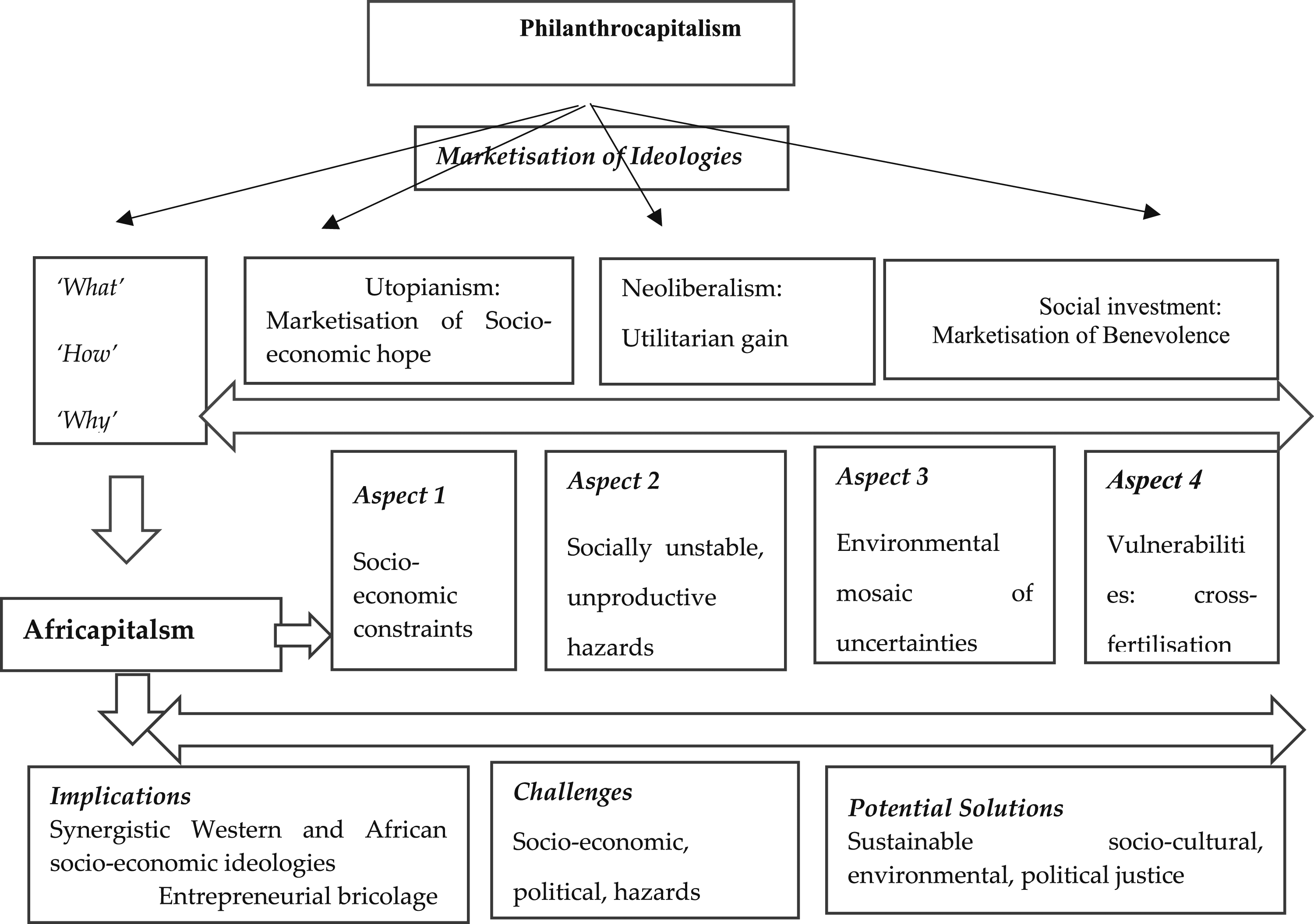
Therefore, this study’s framework implies that it is by investing in multiple human capital development projects that the social, environmental and economic challenges of Africa may stand a chance of being practically resolved.
Conclusion
By using the lenses of philanthrocapitalism and neoliberalism, as dominant western European ideological discourses, Tony Elumelu Foundation’s respondents’ narratives helped the authors to initially codify and categorise three key sets of narratives highlighting how philanthropic and neoliberal ideologies were conceptualised, practically applied, and justified through Africapitalism. Additionally, four aspects were surfaced from an innovative Africapitalism framework evincing the complex range of challenges and potential resolutions that filled the ‘what’, the ‘how’ and the ‘why’, elements that were either unclearly defined in western dominated philanthrocapitalism, marketisation and neoliberal discourses or totally missed altogether. Therefore, this study has contributed to a categorial set of three narratives showing the chasms between the dominant, traditional, western discourse of neoliberal marketisation of philanthropy based on financial returns and promises of a utopian society and the reality of ideological imposition and control and a theoretical Africapitalism framework to help deepen understanding on the nuances between western and African notions of the marketisation of philanthrocapitalism, its challenges and possible resolution mechanisms via Africapitalism in Africa. These narratives and framework constitute the study’s theoretical and empirical contributions to philanthrocapitalism and its marketisation in Africa.
Theoretically, this study supports the framing of philanthrocapitalism as not only a social but also an economic investment in the renowned traditions of Dholakia (2016), Haydon et al. (2021) and others. However, the study’s three thematic categorisations and the resultant conceptualisation through an Africapitalism framework evince the discord between the dominant western ideologies and their promise of a utopian socio-economic reality and the reality of neoliberal marketisation of inequality in African social entrepreneurship. Contrary to traditional western ideological doctrine, this study has demonstrated that there is no one-size-fits-all theoretical lens in philanthropical practices, their marketisation across different contexts, how they are perceived and experienced by individuals and communities.
Study’s contributions
Although many studies on philanthropy have featured the beneficial work of charities including the likes of Bill Gates and Desmond Tutu (Bishop and Green, 2008), triggered a boom in the development of policies on philanthropic activities (Boodoo et al., 2021), highlighted calls for more market thinking and methods on philanthropy (Barkan, 2013; Edwards, 2010) and recently produced thematic, cultural frames (Haydon et al., 2021), they have left a theoretical framing void in ‘how’ philanthropic giving is conducted in Africa (Idemudia and Amaeshi, 2019). This study has contributed a frame consisting of four aspects and articulated ‘how’ philanthrocapitalism is implemented and marketised outside of the dominant, western and North American financialisation and utilitarian discourse (Edwards, 2010; Eikenberry, 2009). This study’s framework therefore contributes a balanced depiction of not only ‘what’ aspects of philanthrocapitalism are marketised outside its original, geographical conceptualisation and implementation but also the paradoxes, the unintended effects and the nuances of its theorisation and practicalisation beyond those initially attempted by McGoey and Thiel (2018).
To further extend the theoretical and empirical landscape on the ‘what aspects of the marketisation of philanthrocapitalism, the authors endeavoured to also frame and position this study within a slowly blossoming area of Africapitalism, to demonstrate the novel ‘how’ of philanthrocapitalism’s marketisation and implementation. Captured within the study’s frame are four aspects not only ‘what’, ‘how’ and ‘why’ the marketisation of philanthrocapitalism has been conceptualised, operationalised and justified via the neoliberal discourse of utopianism and utilitarianism in Africa but also how these four aspects demonstrate the scholarly need to reexamine western marketisation of philanthropy discourse (Nicholls, 2010; Eikenberry, 2009) and its framing (Dholakia, 2016) around neoliberal marketisation of ‘social entrepreneurship’ (Heydon et al., 2021) beyond cultural frames. By using four aspects, this study contributes to the earlier marketisation of philanthrocapitalism theorisations and extends Moody’s (2008) idea of philanthropic renaissance by featuring not only a shift from the neoliberal utopian philanthropic ideology of Barkan (2013), Venugopal and Viswanathan (2017) to the utilitarian, financialisaton of philanthrocapitalism of Carrick (2018) and Nicholls (2010) to the impacts and nuances of such previous conceptualisation and operationalisation. By so doing, the authors, therefore, extend earlier marketisation and neoliberal conceptualised discourses of the marketisation of philanthrocapitalism (Kozinets, 2008; Holt and Cameron, 2010; Kjeldgaard and Nielsen, 2010).
The study does so and lays claims to valuable and significant contributions onto the field by developing a framework highlighting how to fill the ideological and practice-based lacunae that has been left by the dominant western and North American ‘marketisation of philanthropy’ (Lai and Spires, 2021; Nickel and Eikenberry, 2009), its underpinning ‘neoliberal marketing of ‘social entrepreneurs’ and Machiavellian principles (Dholakia, 2016) in the way they are recommended for implementation (Haydon et al., 2021; Harrow et al., 2021). By highlighting characteristics of ‘how’ the marketisation, liberalisation, individualisation and profitability of philanthrocapitalism has been implemented in Africa as part of this western discourse, this study has theoretically contributed and enriched the predominantly neoliberal, marketisation and utilitarian perspective of the topic by drawing on a multiplicity of socio-economic, political and cultural contexts in Africa to demonstrate challenges, tensions and nuances faced by philanthrocapitalists within Africa. This is a significant departure from and therefore, a contribution to the dominant North American and western discourse which emphasises the ‘what’ of philanthrocapitalism at the detriment of ‘how’ and ‘why’ this financialisation approach is so.
The first aspect of our framework highlights the challenges posed to Africa’s socio-political and cultural fabric but also evinces the opportunities provided and seized by demi-godlike African philanthrocapitalists and the unintended consequence experienced by ‘vulnerable’ Africans and others. These interlinked aspects were absent in previous western dominated scholarship and emerging studies on Africapitalism. Second, the socio-cultural ‘hazards’ of our framework not only serves as opposition to the dominant utilitarian value of western-based philanthrocapitalism, but the attendant empirical call to ‘stabilise’ the geo-politico-cultural African landscape has been added to by introducing ‘social investments’ as not only a ‘how’ but also a legitimisation and justification of ‘why’ the financialisation of philanthropic marketisation and productivity, as per western and North American discourse is not sufficient to capture the complexities of philanthropic giving (Aspect 2). Third, the ‘better seeds’ analogy of Ignatova (2017) to resolve philanthropic challenges via financialisation strategies (Lai and Spires, 2021; Woodruff, 2018), which sought to extend Venugopal and Viswanathan’s (2017) medical theorisation of philanthropy and marketisation has been extended from a socio-environmental awareness of ‘why’ African philanthrocapitalists and others should recognise the socio-environmental wellbeing needs of citizens’ quest for ‘normalcy’ and ‘a better tomorrow’ in an increasingly vulnerable philanthropic environment (Aspect 3). Fourth, our framework’s introduction of the concept of ‘vulnerability’ adds an additional layer onto the evolving nature of philanthrocapitalism’s marketisation (‘what’), the complexity of the range of challenges, levels of justification needed to capitalise, neoliberalise and marketise philanthropy (Duménil and Lévy, 2010) even in Africa but also how individual and organisational sets of objectives, societal values and how they are experienced via Africapitalism add to ‘why’ entrepreneurs marketise a philanthrocapitalism ideology, via which connections (‘how’) and the nature and extent of the emerging, mixed range of symbiotic, identities they could bring about, from Africapitalists, to neoliberal, utilitarian and utopian-centric donors and recipients to the socio-cultural and political redefining of the marketisation, ideologisation and implementation.
Study’s limitations and suggestions for future research
While this study has demonstrated some strengths, it is also crucial to highlight its limitations. We note the limiting nature of the sample size, which involves only respondents who are supporters and recipients of Tony Elumelu Foundation. Future studies on this topic should include a wider range of participants who are non-Tony Elumelu Foundation affiliated, to have a more highly nuanced set of understandings on philanthrocapitalism and its marketisation in more diversified African countries. This will help to expand the study’s theoretical framework, its thematic narratives and evince new methodological and practice-based approaches for future research on the marketisation of philanthropy. Additionally, the study is further limited in terms of its data collection method, which is interview technique. While it provides rich, narrative data, its results do not facilitate generalisation to other contexts. Hence further studies on this topic area will benefit from a mixture of both questionnaire survey and case study techniques. While this study has focused on the marketisation of philanthrocapitalism and its western dominated ideological underpinning of neoliberal marketisation and utilitarianism, future studies can examine the extent to which a combined theoretical realm of a demystification of neoliberal and Africapitalism ideologies could produce additional frameworks on the ‘what’, the ‘how’ and the ‘why’ of philanthrocapitalism in Africa, North and South America, Europe, Asia, Australia and Antarctica.
Footnotes
Declaration of conflicting interests
The author(s) declared no potential conflicts of interest with respect to the research, authorship, and/or publication of this article
Funding
The author(s) received no financial support for the research, authorship, and/or publication of this article.
