




Abstract
Brands are increasingly seen in light of collaborative, value creation activities of a firm and all of its stakeholders. This is strongly influenced by the emergence and dominant role that social media plays in societies globally. With challenges presented for brand management and marketing scholarship more generally, to understand and react to the social implications presented for brand value creation. Accordingly, this study builds on the principles of S-D logic to expand understanding of the co-creation of brand value on social media. We introduce social construction theories, focusing on structuration theory. A conceptual model and propositions apply a structuration perspective to provide new insights into how brand value is socially constructed by multiple stakeholders using social media. The focus is on how stakeholder-brand interactions play out across three dimensions of social structure: meaning; norms; and power. We consider how brand meaning (and thus value), emerges out of consensus and dissensus between various stakeholders—brand loyalists and brand rebels—using social media to interact with brands. And how norms of behavior and structures of power guide and legitimize their social media use to reinforce, or potentially transform, brand meaning. Importantly, we consider how brand management can recognize the interactive opportunities provided by different social media platforms and the positions and roles of stakeholders and their social context in considering the social construction of brand value.
Introduction
Brands and brand management form a crucial part of the marketing literature (Aaker, 1991; Keller, 1993; Harris and De Chernatony, 2001; Golob et al., 2020). At a fundamental level, a brand operates on two levels, as a distinguishing name or symbol identifying a product or service that is associated with a selling firm; a means of differentiating these products or services from competing brands (Aaker and Joachimsthaler, 2009). Effective management of brands by firms, requires proactive strategies to maintain, or enhance, brand equity (Keller, 1999). While brand equity is about customer perception of how well known a brand is (brand awareness) and what it represents (brand image), brand value is about customer perceptions of the brand use-value (experience) (Keller, 1993). Brand management attempt to attract new customers and maintain existing ones, through creating brand value that forms an emotional connection between the customer and the brand (Lemon et al., 2001).
The service-dominant (S-D) logic of marketing contends that firms cannot create value for the customer, rather they position themselves through value propositions (Lusch et al., 2008). S-D logic adopts a process orientation, which requires the involvement of customers with firms to co-create value through service exchange (Edvardsson et al., 2011). Vargo and Lusch (2004) note regarding S-D logic that resources do not “have” value per se; rather, value is co-created with customers when resources are used. S-D logic positions both firms and customers as resource integrators in the co-creation of value (Vargo and Lusch 2006; Vargo 2008). From this S-D logic perspective value co-creation is quite a neutral term, with value created for some individuals in the system while simultaneously destroying value for others. As Edvardsson et al. (2011) indicate in this regard, “value” represents an individualized (or even unique) perception. Value is therefore uniquely and phenomenologically determined by the beneficiary (Vargo and Lusch, 2008, 2016).
From a branding perspective, S-D logic suggests that the co-creation of brand value is inherently relational, shaped by various stakeholders who are, voluntarily and non-voluntarily, interacting with the brand. Despite this, research on brand value co-creation utilizing S-D logic and the implications for brand management remains limited (Ramaswamy and Ozcan, 2016; Merz et al., 2018). A possible explanation is a lack of understanding of brand value as a concept, when examined from the perspective of the S-D logic. Recent research by Merz et al. (2018) begins to address this while introducing a social dimension, defining brand value co-creation as the process of creating perceived use value through network relationships and social interactions. As Ramaswamy and Ozcan (2016: 97) highlight, “brands are now increasingly seen in light of collaborative, value creation activities of a firm and all of its stakeholders, and brand value as a collective measure of all stakeholders’ perceived values.” Social media use accentuates collaborative social interactions, shaping the social reality of multiple stakeholders in new ways and consequently having a major impact on the evolution of brand value co-creation. What Ramaswamy and Ozcan (2016) term a multi-stakeholder perspective of brand value co-creation. Or as Jones (2005: 10) define as a “multifarious construct that is affected by, or the sum of, a gamut of relationships,” involving brand management, customers, and other stakeholders in the development of a brand.
With diverse and empowered stakeholders having a more active role using social media, brand management must adapt to—and ideally pro-actively influence from a brand value proposition perspective—this new social reality to effectively be involved in the co-creation of brand value (Ramaswamy and Ozcan, 2016). This highlights brand managements’ role as shapers of brand value propositions using social media, providing value-in-use opportunities for various stakeholders (who may, or may not, be customers or loyal to a brand). Brand value co-creation is therefore shaped by social forces operating through social media use and reproduced in what can be termed techno-social systems. Therefore, social media consists of a technological system and a social subsystem that have a networked character (Fuchs, 2021). Referring to the structuration theory of Giddens (1984), the technological structure of social media is a network that produces and reproduces human actions and social networks and is itself produced and reproduced by such practices. Drawing out this social perspective can enhance understanding of brand value co-creation in a world increasingly influenced by social media, since it holds that all roles, positions, structures, systems and social interactions are dynamic in nature (Edvardsson et al., 2011). While S-D logic does consider the dynamics and development of complex social systems (Vargo and Lusch, 2004), and more recently how value creation takes place in complex social networks (Vargo and Lusch, 2016), elaboration can enhance our understanding of the mechanisms in brand value co-creation using social media and the implications for brand management.
To better understand how brand value co-creation takes place in social media environments and the brand management implications, we build on the principles of S-D logic using social construction theory. Providing new insights for brand management literature into how brand value is socially constructed by multiple stakeholders using social media. To achieve this, we introduce some fundamental concepts of social construction theories pertaining to social structures and social systems (Berger and Luckmann, 1967; Giddens, 1984). As well as drawing on the more recent work of Edvardsson et al. (2011), which broadens understanding of S-D logic by applying social construction theories. Specifically, we draw upon Giddens (1976, 1979, 1984) structuration theory to understand how stakeholder-brand interactions using social media play out across three dimensions of social structure: meaning (signification); norms (legitimation); and power (domination). Vargo and Lusch (2016) state that in structuration theory the establishment of relational and recursive nature of structures is both seminal and essential to a robust conception of levels of analysis, as used in S-D logic. Regarding meaning, we consider how functional, symbolic, or experiential brand meaning (and thus value), emerges out of consensus and dissensus between various stakeholders using social media to interact with brands. And how these carries norms of behavior and structures of power to guide and legitimize their social media use to reinforce, or potentially transform, brand meaning. Importantly, we consider how brand management can recognize the interactive opportunities of various social media platforms and the positions and roles of stakeholders and their social context in considering the social construction of brand value. To understand how brand management should respond to empowered stakeholders using social media, we assess their role, position and potential interventions in the social construction of brand value. Directions for further research are provided through a conceptual model and three propositions.
The paper proceeds by firstly developing the theoretical background, building on this to develop a novel model and propositions to provoke new thinking in brand management literature and further research. It concludes with a discussion of implications, as well as future research directions.
Theoretical background
This section is structured to reflect the theoretical development of the paper and how the authors approached the literature that underpins the study. The S-D logic of marketing formed the initial literature consideration, allowing us to fully understand the relationship between firms, customers and other stakeholders in value co-creation. Building on this, we considered brand value co-creation with respect to S-D logic literature and in the context of the irresistible rise of social media. This allowed us to build conceptually on S-D logic thinking by interpreting the role of social structures and systems with regards to multiple stakeholders’ use of social media to interact with brands. This clearly defined theoretical development is supported by four literature tables presented, which provide the reader with key literature and core themes informing theoretical development.
Value co-creation and branding
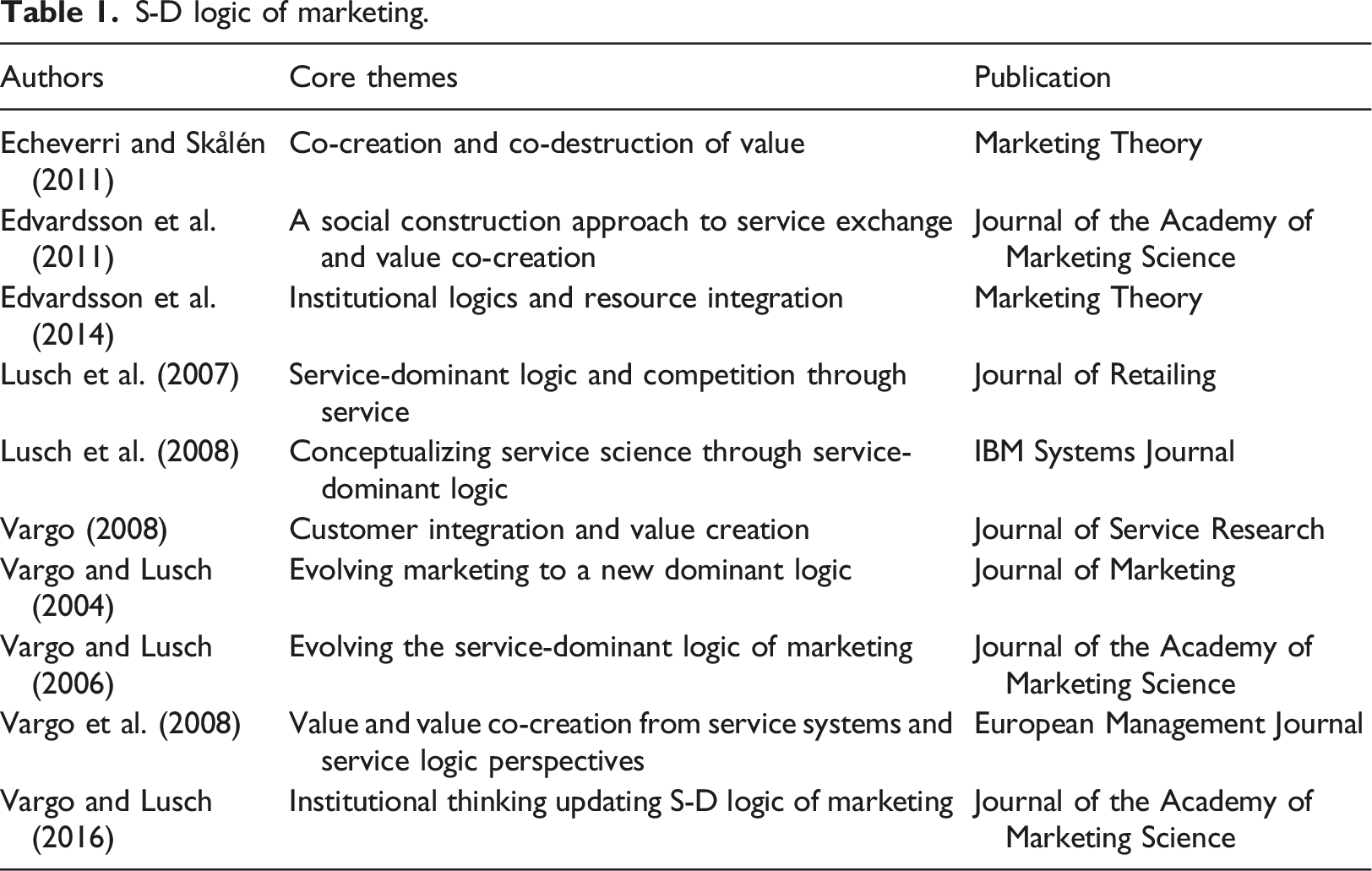
Value co-creation is a prominent concept in literature on the S-D logic of marketing (Vargo and Lusch, 2004). The S-D logic states that service (the application of resources linked to competence—knowledge and skills—for the benefit of a customer) is the basis of economic exchange. S-D logic indicates that value is always co-created with the customer during interaction with and activation of a set of resources (Vargo and Lusch 2004, 2008). Goods and services represent essential resources that are used in service provision, with customers evaluating the goods and services as value-in-context (Vargo and Lusch, 2006). Two broad categories of resources can be distinguished, operand resources (resources on which an operation or act is performed) and operant resources (resources capable of causing benefit by directly acting on other resources, either operand or operant, to create benefit) in the co-production of service with providing firms (Lusch et al., 2007). Competitive advantage is primarily created through operant resources, as knowledge and skills operate on resources to produce a favorable customer experience (Vargo and Lusch, 2004). This not only entails the innovation of offerings, but also human experiences, thereby transforming the value concept beyond mere exchange of goods and services to co-creational experiences (Ramaswamy and Ozcan, 2016). Further, S-D logic indicates that the beneficiary determines value through perceived value-in-use. Consequently, while customer value can be derived through interaction with the firm and its value propositions, it can also arise through the process of consumption (Ranjan and Read, 2016). Essentially, customers assess and determine value based on the specificity of their usage. Therefore, S-D logic frames reciprocal service provision in which value is dynamically co-created with customers as either “value-in-use” (Vargo and Lusch, 2004) or “value-in-context” (Vargo and Lusch, 2006). Authors such as Edvardsson et al. (2011) and Vargo and Lusch (2016) call for modification of S-D logic foundational premises, to reflect that value co-creation takes place in social networks, with resources used in service provision typically, at least in part, coming from other stakeholders. Key literature and core themes that informed our understanding of the S-D logic of marketing are presented in Table 1.
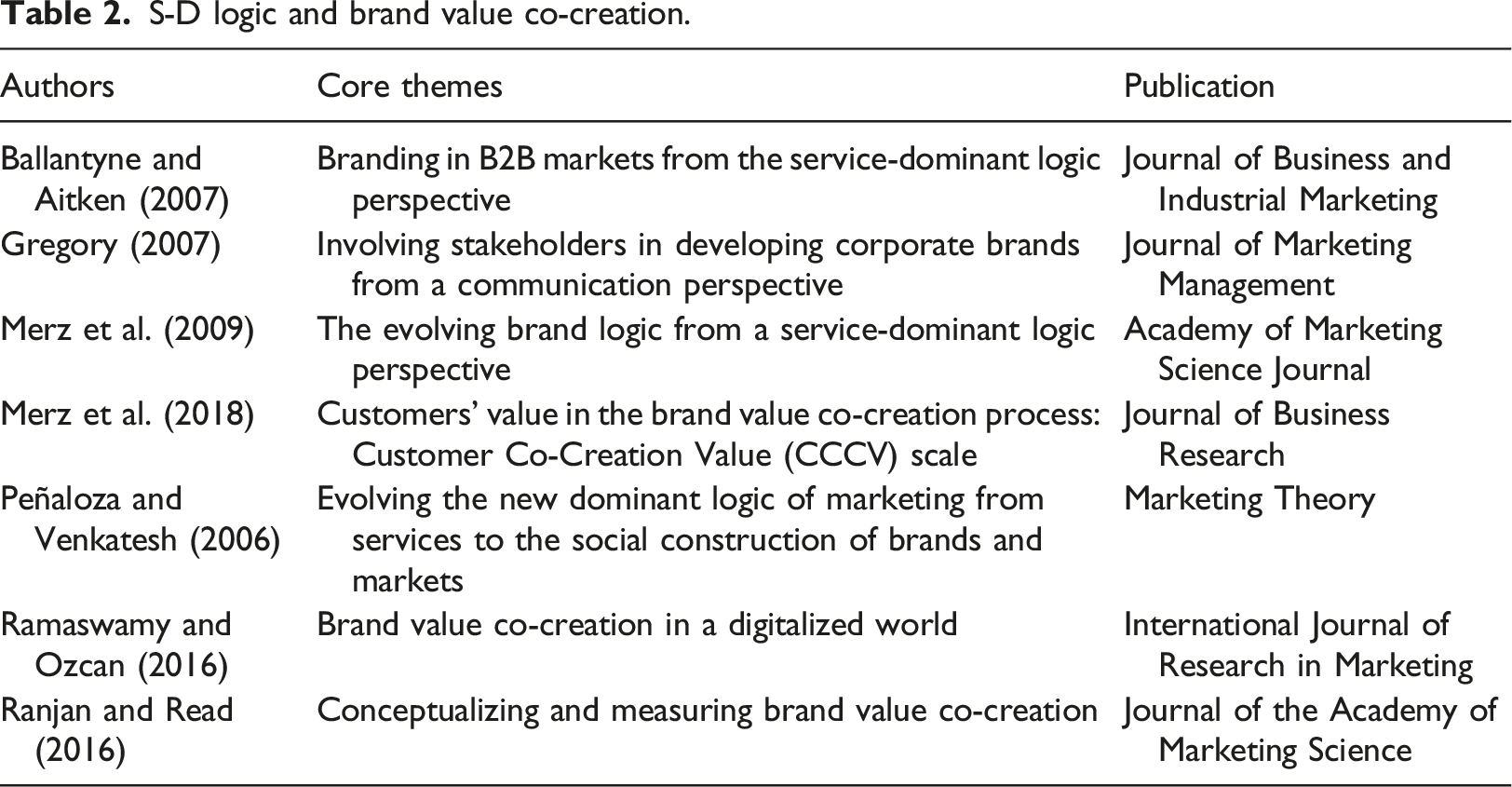
From the brand management perspective, research while limited has recently considered brand value from a co-creation perspective (Merz et al., 2018). Building on their earlier work that considered evolving brand logic from an S-D logic perspective (Merz et al., 2009). Merz et al. (2018) view value-in-use as customers’ experiential evaluation of a brand value proposition based on the specificity of their usage (e.g., Vargo and Lusch, 2006). In value-in-use, beneficiaries’ mental models have a specificity and uniqueness that offer personalization or an idiosyncratic use process (Ranjan and Read, 2016). This provides an explicit recognition of individual human beings as “experiencers” of brands, having conscious agential experiences in co-creating brand value; they are not just operant resources (Ramaswamy and Ozcan, 2016). Crucially, brands are increasingly viewed as collaborative, value creation activities of a firm and all of its stakeholders, and brand value as a collective measure of all stakeholders' perceived values (Merz et al., 2009; Vargo and Lusch, 2016). Therefore, while the continuation of the S-D logic perspective on brand value can provide interesting new insights and nuances into the brand management literature, there needs also to be cognizance of developments that have relevance when considering brand value co-creation within a wider social ecosystem. Edvardsson et al. (2011) state that S-D logic research implicitly regards “value” as an individualized (or even unique) perception, which is independent of the social context in which the reciprocal service provision takes place. While S-D logic emphasizes the primacy of operant resources as the fundamental source of competitive advantage (Lusch et al., 2007), such human resources are always embedded in socially constructed systems. It is within the boundaries of social systems that various stakeholders perceive value, taking positions and roles within those boundaries. This social context developed further in the next section, implies norms and values that exert a profound influence on the brand value co-creation process. Key literature and core themes that informed our understanding of brand value co-creation are presented in Table 2.
The rise of social media and influence on brand value co-creation
This social empowerment of multiple stakeholders has been turbo boosted by social media use, leading brand management to fear a loss of power in their control of the brand message (Dessart et al., 2015; Felix et al., 2017). Social media use has accentuated the power and capacity of multiple stakeholders to interact with brands on their terms and in new ways (Appel et al., 2020). Stakeholders have a stake in brand value creation through social media use, reorientating brand managements’ view of them as largely passive and docile recipients of brand value creation (Ramaswamy and Ozcan, 2016). Asmussen et al. (2013) assert that a “control logic” will not work for brand management in the context of engaging empowered users of social media. Despite these fears, brand management needs to embrace the opportunities presented by empowered stakeholders using social media to engage in new ways with their brands. To do so, requires understanding of a new role where they become an important stakeholder with other stakeholders using social media in the social construction of brand value.
Embracing multiple stakeholders, brand value co-creation may be understood in terms of “matches” (congruence-brand loyalists) or “mismatches” (incongruence-brand rebels) (Carù and Cova, 2015). Merz et al. (2018) view brand loyalists as having a passion for the brand. Brand passion leads to emotional attachment and influences relevant behavioral factors in social media use such as posting on brand fan pages (De Vries et al., 2012). Muniz and Schau (2009) view these loyalists as having brand trust, representing a confidence about the brand and belief that it keeps its promises. As well as brand commitment, which represents the extent to which loyalists are willing to work for the brand and its success. Importantly, stakeholders can also include those who are strongly determined to appropriate and manipulate brand value in ways that cut against the grain of brand loyalist and brand management interests. These brand rebels can be disgruntled customers that have the conscious desire and dominant motive to harm (sabotage) the brand using social media, through the impairment of the brand-related associations of other customers (Kähr et al., 2016). Further, Echeverri and Skålén (2011) discuss the co-destruction of brand value as the collaborative destruction, or diminishment, of value by providers and customers. This suggests that the interactive brand value formation process is not only a creative process but also a destructive one that has been boosted by social media’s interactive reach: value is both co-created and co-destroyed at the brand–stakeholder interface (Ple and Chumpitaz Caceres, 2010). Further, Quach and Thaichon (2017) note that social media use has led to brand value being co-created or co-destroyed with inputs and influence from not just brand management and customers but involving also other stakeholders who have an interest in supporting, or not supporting, a brand.
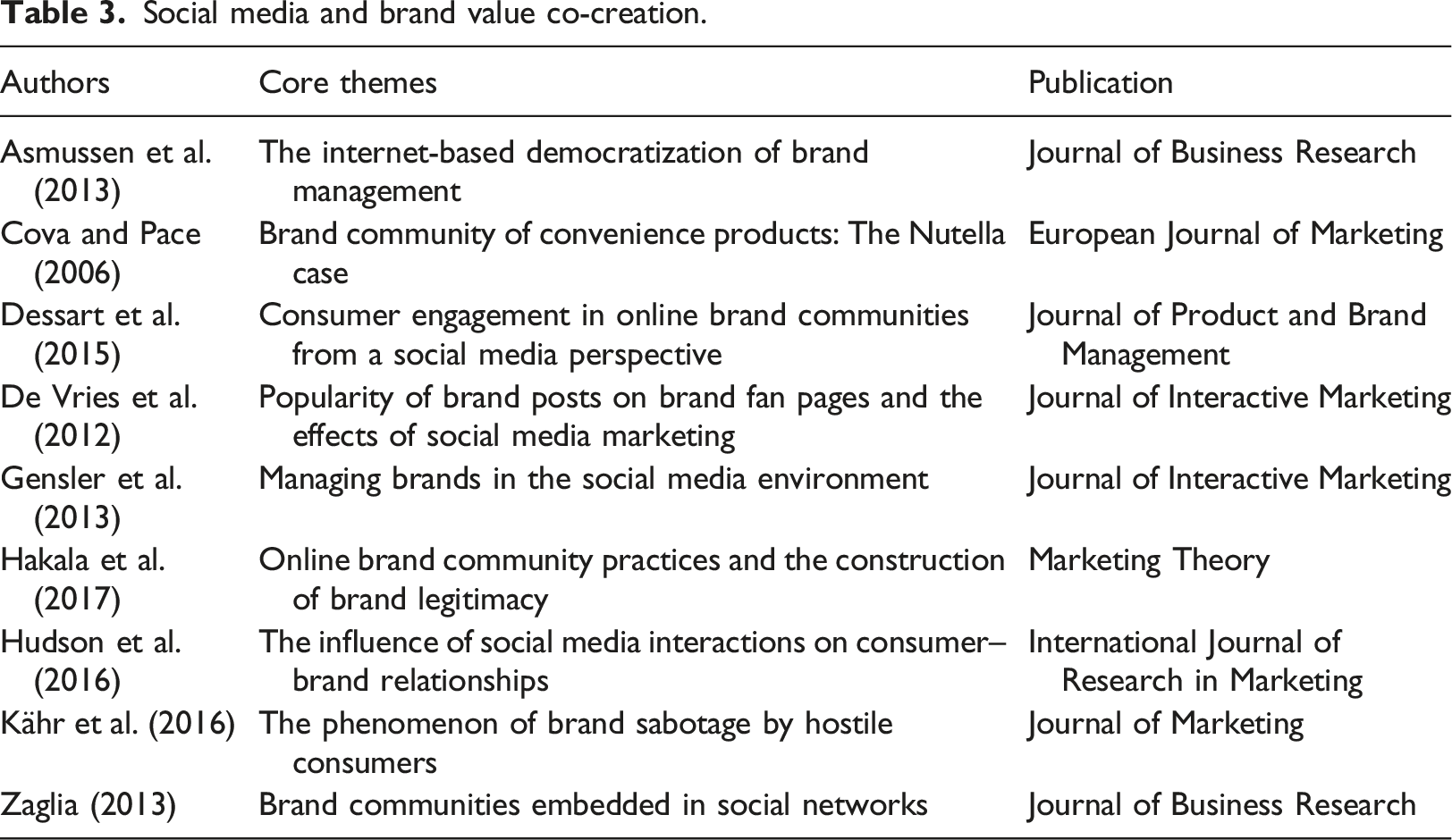
Of course, this suggests that brand loyalists and brand rebels have an intentionality, indicating that when using social media their brand interactions are purposeful towards an intended outcome. Given the inherent “messiness” of social interactions amplified through the reach and virtual nature of social media, there may be times when brand loyalists interact for their own benefit (which may or may not be in line with the intended brand value of other brand loyalists and brand management). As previously noted, from the perspective of S-D logic brand value is always uniquely and phenomenologically determined by the beneficiary (Vargo and Lusch, 2006, 2016). This points to a broader view of brand value based on brand experiences that are meaningful to different types of stake-holding individuals—brand loyalists and brand rebels located in a social system. Ramaswamy and Ozcan (2016) note, in brand value co-creation, stakeholders have a more active role, contributing through their differences in views of brand value expressed through their joint agency in co-creating brand value together. Echeverri and Skålén (2011) note such differences by identifying mixed cases, types of interactions between brands and customers informed by both dimensions of the practices of value co-creation and value co-destruction. Carù and Cova (2015) state that social media use empowers a range of stakeholders to interact with brands, challenging brand management’s capacity to control brand narratives as customers and other interested parties jostle to draw out their own brand value. Brand value may therefore be seen as “negotiated,” developing with multiple stakeholders’ input over time (Gregory, 2007). Brand value co-creation in this era of pervasive social media use is therefore shaped by complex social forces, which requires an understanding of the role of social structures and systems taken up in the following section. Key literature and core themes that informed our understanding of social media’s influence on brand value co-creation are presented in Table 3.
Social structures and systems
S-D logic considers reciprocal service provision in which value is dynamically co-created with customers as an individualized (or even unique) perception. Contrasting this, social construction theories consider all activities, including value co-creation, as taking place within social systems beyond the individual and subjective setting (Edvardsson et al., 2011). Social construction theories interpret the social world and enhance understanding of how stakeholders create, realize, and reproduce social situations and structures (Berger and Luckmann, 1967; Giddens, 1984). Social construction theories are therefore pertinent to extending S-D logic thinking on brand value co-creation to the social media context, helping to explain how shared understandings constitute a “social consensus” that shapes the brand perceptions and interactions of individuals (see for e.g., Deighton and Grayson, 1995). Social media in essence is not a technology, rather it can be defined as a techno-social system (Fuchs, 2021). Social media has a technological level of artefact that enables and constrains a social level of human activity, such as interaction with brands. Giddens’ (1984) work on structuration theory indicates that social media is based upon what he terms the duality of structure and agency. Presenting social media as a socio-technical system from a brand management perspective acknowledges that as an information and communication technology it enables and constrains stakeholders’ actions that socially construct brand value.
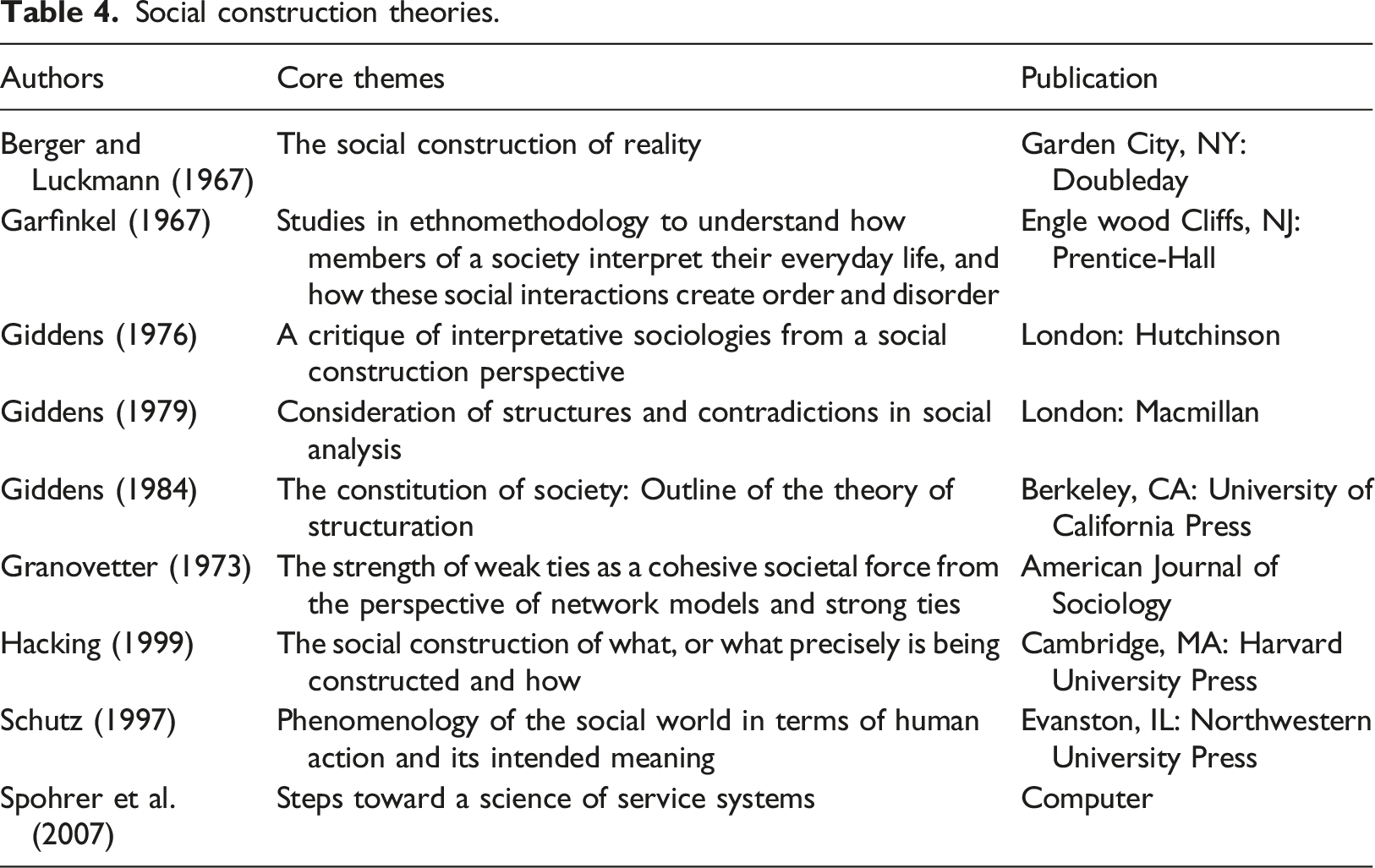
Giddens’ structuration theory, as a particular focus of this study, helps in considering how brand value becomes part of this system, uniquely and socially constructed by multiple stakeholders using social media. From this perspective, brand value as a social construction does not so much reside in its share of (individual) minds, as much as in the common framework of action in various stakeholders’ use of social media (Ranjan and Read, 2016). Giddens (1984) defines in his structuration theory structures as the rules and resources organized as properties of social systems. These systems consist of reproduced relationships between actors, organized as regular social practices (Berger and Luckmann, 1967). Key literature and core themes that informed our understanding of social construction theories are presented in Table 4.
Giddens (1984) distinguishes three interdependent dimensions in a social system, with structuring taking place across these dimensions: meaning (signification); norms (legitimation); and power (domination). Consumer culture theory (CCT) views brands as what Allen et al. (2008: 782) term a “repository of meanings for consumers to use in living their own lives”. As Cayla and Arnould (2008: 100) put it: “A brand’s meaning emerges out of consensus and dissensus, between the collective sharing of what the brand means to all its stakeholders and the active and often conflictual negotiation of such meanings.” The S-D logic literature views meaning as pertinent to value co-creation and brand management (Gregory, 2007; Vargo and Lusch, 2006). Brand meaning can be interpreted as functional (e.g., efficiency and ease of use of a Dyson vacuum cleaner), symbolic (e.g., Mercedes three-pronged star on a car enhances self and social esteem) and experiential (e.g., independence and freedom enshrined in Harley-Davidson motorbikes) (Park et al., 1986; Hatch and Rubin, 2006). The relevance of meaning to brand value co-creation and brand management can be developed by viewing it through the lens of social construction thinking. In sociology literature, meaning is a key term that is socially constructed through recurrent social interactions by knowledgeable stakeholders (Garfinkel, 1967; Schutz, 1997; Ricoeur, 1991). Categories of meanings are shared among meaning-making groups, representing an understanding about the way the world works and how people should live their lives (Holt, 2003; Arnould and Thompson, 2005). Social media use has exponentially increased the access to information about brands, allowing multiple stakeholders to engage in new and empowered ways as meaning-making groups. Brand value as a social construction imbued with meaning, is inextricably intertwined with the social media setting in which a brand is encountered by such social groupings (Peñaloza and Venkatesh, 2006). The constitution and communication of meaning embraces a phenomenological interpretation of brand value and a link to social interactions, roles and positions in the social media setting (Bairrada et al., 2018).
From an agency perspective, this carries norms of behavior that represent rules governing legitimate or “appropriate” ways to interact with a brand (Edvardsson et al., 2014). As various stakeholders share brand meaning using the reach of social media, norms consisting of rights and social obligations guide and affect how they use a specific platform such as Facebook to interact with brands (Arvidsson and Caliandro, 2016). Adherence to or violation of these norms, determines stakeholders’ appraisals of their own actions and the actions of others when interacting with a brand (Aggarwal and McGill, 2012). Hakala et al. (2017) notes that when knowledgeable stakeholders’ interactions are aligned with the existing norms, they strengthen and stabilize a brand’s legitimacy. By diverging from the existing norms, the collective norm can be challenged to what is assigned to be unacceptable behavior when interacting with a brand. From an agency perspective, Giddens (1979) refers to this as “transformative capacity”; the power of stakeholders’ use of social media to transform, and potentially transform, brand meaning (see Ramaswamy and Ozcan, 2016 on branding and agency). While power may be focused on strengthening or stabilizing brand meaning, there always remains the potential for stakeholders to use the reach and pervasiveness of social media to enact change. This represents a potentiality referred to as the dialectic of control (Giddens, 1984). The co-creation of brand value from an S-D logic perspective is premised on firms and customers reinforcing brand meaning. Nevertheless, as Merz et al. (2018) note stakeholders always retain the capacity to act otherwise. Thus, brand management, brand loyalists and brand rebels in the dialectical sense, each depend on the other for branding outcomes that may be viewed as favorable or unfavorable.
Edvardsson et al. (2011) note that in S-D logic literature the term “service system” appears frequently in the context of service exchange. Vargo et al. (2008: 146) state that “service systems engage in exchange with other service systems to enhance adaptability and survivability, thus co-creating value – for themselves and others.” Spohrer et al. (2007) define a service system as a value configuration space that includes people, technology, and shared information. Like social systems, service systems adapt and survive through interaction and the integration of resources that are mutually beneficial (Vargo et al., 2008). In this study, we emphasize the role of social media use as part of a service system termed a brand value configuration space. Edvardsson et al. (2011) state that stakeholders are increasingly interacting, innovating, and learning through the technologies and systems of social media such as Facebook and YouTube. This phenomenon was judged to have changed their social reality, having a major impact in turn on how brand value is co-created.
Stakeholders and brands interact using social media within the brand value configuration space, as part of wider social systems to socially construct brand value. These interactions, facilitated through social media use, are influenced by social structures. In this process, brand meaning (and thus value) is created by stakeholders through this social exchange using multimedia features of a social media platform such as Instagram. Norms as rights and social obligations, guide and affect how they use Instagram to interact with brands. Alignment with, or divergence from, existing norms of Instagram use also carries structures of power to reinforce, or potentially change, brand meaning. We develop this further in the following sections, presenting the conceptualization and propositions to interpret the key concepts and their relationships and as a guide for further research.
Applying structuration theory to conceptualize how multiple stakeholders socially construct brand value using social media
We build conceptually on the theoretical development presented using Edvardsson et al.’s (2011) model for guidance, which draws upon Giddens’ (1984) structuration theory to expand S-D logic thinking on service exchange and value co-creation by including social structures and systems. The conceptual model in Figure 1, adopts and adapts Edvardsson et al.’s (2011) model to interpret how multiple stakeholders socially construct brand value using social media. The model is centered on a brand value configuration space, where brand loyalists and brand rebels along with brand management interact with brands using various social media platforms. Reinforcing or transforming brand meaning across the social structure dimensions of meaning, norms and power. The configuration space resides within the wider social system.
Grönroos (1994) notes that all exchanges and social interactions create certain positions for stakeholders within a social system. These knowledgeable stakeholders include customers and brand loyalists as well as non-customers and brand rebels. Without the necessary knowledge and access to brand information for these stakeholders, which has increased significantly through social media use, the co-creation of brand value is not possible (Gregory, 2007). The dashed boxes indicate that interaction between stakeholders and brands is not separated from but embedded within the brand value configuration space. Stakeholders and brands interact using social media within this space as part of wider social systems to socially construct brand value. Fuchs (2021) indicates that social media can be defined as a techno-social system that enables and constrains various stakeholders’ actions in socially constructing brand value. For example, brand advocates and brand influencers take prominent social positions in their use of social media to reinforce or transform brand meaning. By taking note of brand management’s role and position in the brand value configuration space, we can consider how they can intervene to influence stakeholders’ use of social media to interact with brands. According to Lusch et al. (2007) marketers (brand management) have traditionally positioned themselves as being the key communicators and custodians of value (brand value) in their interactions with customers. However, S-D logic indicates that brand management cannot create brand value for the customer; rather, brand management position themselves to influence the social construction of brand value. The positioning of brand management in the model reflects this, showing that brand managers have a direct communication channel to stakeholder-brand interactions using social media. The empowerment of stakeholders through social media use however, means that brand management need to realize that they are not only passively using, but also actively creating and sharing, brand content. Therefore, they not only co-create but also co-produce brand value through their use of social media. The arrows emanating from the stakeholder-brand interactions within the brand value configuration space, indicate that the social construction of brand value takes place across three fundamental dimensions of social interaction: meaning; norms; and power (Giddens, 1984). Regarding brand meaning (functional, symbolic, experiential), knowledgeable stakeholders communicate during social exchange by drawing upon interpretive schemes and semantic rules in their use of specific social media platforms (e.g., Facebook, Instagram). In their use of specific features of Instagram, various stakeholders bring brand value to life through the collective sharing and conflictual negotiation of meaning (Hakala et al., 2017). Brand meaning is reinforced as structures of power are reaffirmed by stakeholders’ adherence to norms of behavior when using social media to interact with a brand. However, brand meaning can also be transformed as structures of power are challenged by stakeholders’ violation of norms of behavior when using social media to interact with a brand. Brand loyalists and brand rebels will have different purposes or ways in which they respond to or use features of social media, in seeking to reinforce or transform brand meaning.
Propositions and further research
The model promotes three propositions (mapped onto Figure 1), applying structuration theory to build upon and extend S-D logic thinking to understand how brand value is socially constructed by various stakeholders using social media. Practical examples are provided to illustrate and contextualize the points made. Social construction of brand value by multiple stakeholders’ using social media (adapted from Edvardsson et al., 2011).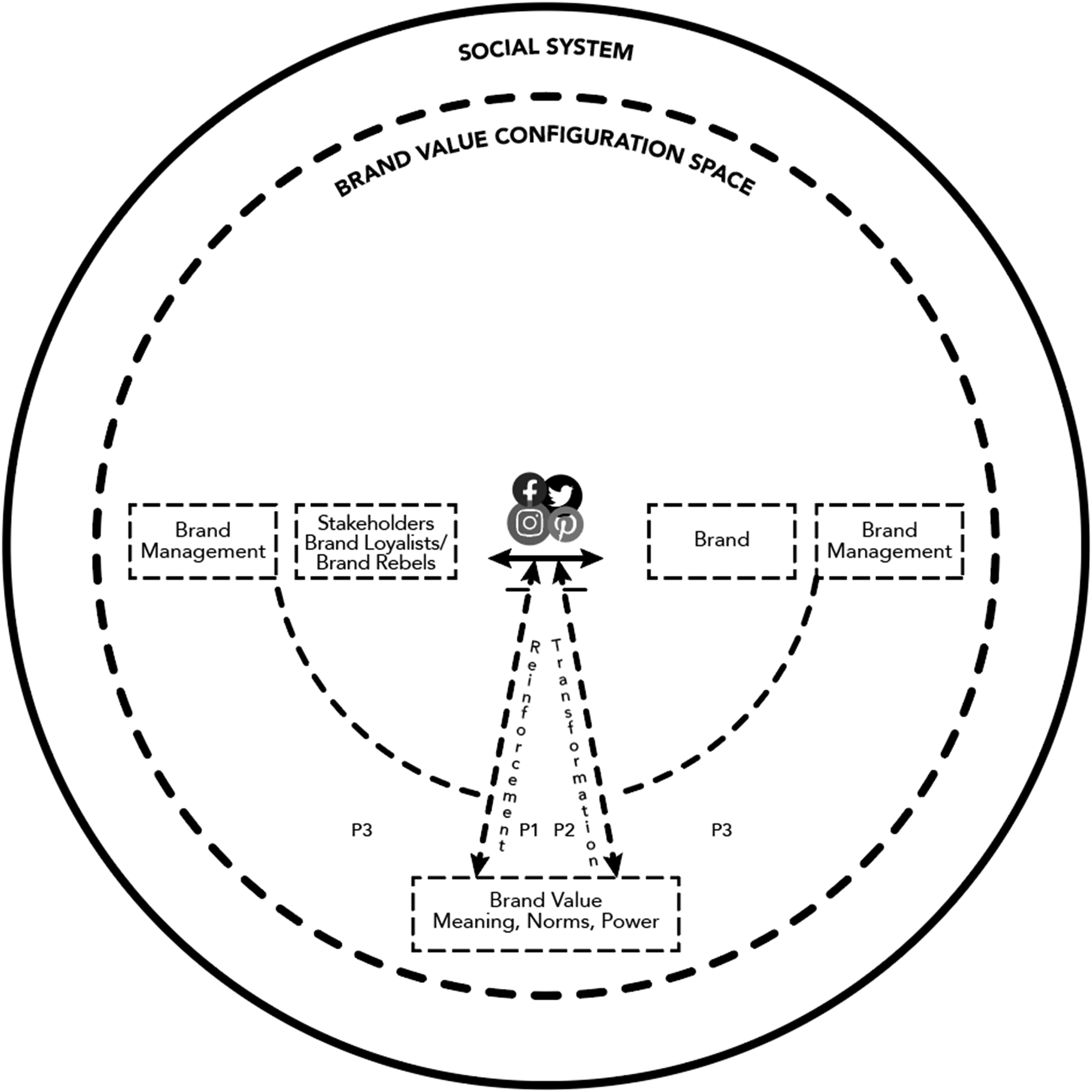
Proposition 1: Brand loyalists’ use social media to reinforce brand meaning with structures of power reaffirmed by adherence to norms of usage behavior
S-D logic literature states that the co-creation of value is inherently relational, with stakeholders’ using social media to interact through daily conversations and shared experiences. Vargo’s (2008) term “value-in-context”, suggests that brand loyalists involved in the social exchange (relational) process are active in creating brand meaning (and thus value). However, as Edvardsson et al. (2011) note research has often implicitly regarded such “value” as an individualized (or even unique) perception. According to social construction theories, all activities, including value co-creation, take place within social systems. Taking a social perspective through stakeholders’ use of social media, representing as noted a techno-social system, indicates that meaning, norms and power are prominent in the social construction of brand value. Brand loyalists’ adherence to norms of behavior and affirmation of structures of power when using social media, legitimizes over time a standardized pattern of actions to reinforce brand meaning (Algesheimer et al., 2005). Brand loyalists’ reflexively monitor adherence by themselves and other stakeholders to norms of behavior. These norms represent a legitimate use of social media to routinize stakeholder-brand interactions, through observation, imitations, and practice in a social group. From an agency perspective power is in play as structures of domination. Asymmetry of brand management and brand loyalists’ interpretation of brand meaning and adherence to norms of behavior when using social media reaffirms structures of power.
The Harley-Davidson Owners Group (HOG) are a social grouping, structured world-wide as district chapters, with a formally elected committee. Ownership of a Harley-Davidson and buyers of new bikes receive a complementary 1-year membership. Contrasting with the traditional outlaw image propagated by films such as the Wild One and Easy Rider, the HOG movement (established by Harley-Davidson in the United States in 1983) consists of predominantly law-abiding members best described as biker enthusiasts (Schembri, 2009). The Harley-Davidson HOG Facebook Group use Facebook Live feature to augment and refine their interactions with the brand, creating and sharing visual media in real time to deepen the brand experience. With Twitter use, this depth of brand experience is more limited to sharing relatively shallow information consisting of briefer conversations and interactions. The HOG community through live video feeds, often supported by brand management, use Facebook Live to follow riders on the open road and include interviews with prominent Harley community members on their love of the brand. Members reflexively monitor adherence by themselves and other individuals to norms of behavior when using Facebook Live to interact with the Harley brand. Taken with the situated nature of Facebook, they rationalize their interactions with a brand routinely; maintaining a continuing “theoretical” understanding of, for example, the acceptable or non-acceptable use of interactive features of Facebook Live to interact with the brand. Structures of power are reaffirmed as brand loyalists adhere to norms of behavior using Facebook Live to reinforce Harley brand meaning (independence, freedom, and passion for being on the open road).
This supports Edvardsson et al.’s (2011) notion of “value-in-social-context,” with an individual brand loyalist’s perceptions of brand meaning, at least in part, dependent on their relative position in the social media techno-social system. Colton (1987) indicates that certain individuals may take a prominent role to influence socially defined expectations of brand meaning through their use of social media. For example, brand advocates are true aficionados who are eager to support, promote and defend a brand often supported by brand management (Fournier and Lee, 2009; Aggarwal and McGill, 2012). Advocates’ interpretation of Harley-Davidson experiential brand meaning enacts a process of reinforcement through their use of Facebook. Facebook Live offers a Realtime means for advocates to convey the experience of riding a Harley on the open road to a global audience of brand loyalists. Emphasizing a rebellious nature and a love for the freedom experienced by riding a Harley on an open road. And using tag lines such as “Live Free, Ride Loud, Here I can share my passion for ridin’ a Harley and livin’ free.” For Harley-Davidson brand management, the veracity of the HOG community use of Facebook to reinforce experiential brand meaning would seem to be a brand manager nirvana. Indeed, Fournier and Lee (2009) state that central to the brand’s success, was Harley’s commitment to building a brand community: a group of ardent consumers organized around the lifestyle, activities, and ethos of the brand. Harley-Davidson changed every aspect of its organization to drive its community strategy. However, while such collective social forces may be dominant, Fournier and Lee (2009) also note that brand managers need to realize that community members are people, with many different needs, interests, and responsibilities. Individual HOG member needs, preferences, habits and values can, and do, create divergence from norms of behavior when using Facebook to interact with the Harley brand.
Roles and positions in the HOG community provide an individual with a complex set of identities, which become the source of individual interpretations of social situations (Edvardsson et al., 2011). While the stereotypical Harley biker has long hair and a bushy beard, new bikers are just as likely to be clean-shaven professionals (Schouten and McAlexander, 2007). Schembri (2009) state that taking on these non-traditional roles transcends Harley biker stereotypes, reminding brand managers that individual Harley brand loyalists often complicate and resist dominant brand narratives. Therefore, perceptions of brand meaning are dependent on how various stakeholders make sense of social interactions around the Harley brand within their own social contexts. For example, other stakeholders beyond the HOG community, while viewing themselves as loyal to the Harley brand, may use social media to interact with the brand in a manner not approved by other brand loyalists. Followers of what the US Justice Department refers to as OMGs (outlaw motorcycle gangs), are likely to have different perceptions of Harley brand meaning. Therefore, brand loyalists’ perceptions of brand meaning may deviate from the accepted norms and structures of power in mainstream communities such as HOG, with their use of social media reinforcing Harley brand meaning relevant to their social context. This may also be the case within what may be viewed as the homogenous setting of the HOG Facebook setting. Where brand interactions will involve what Gensler et al. (2013) term consensus and dissensus, with the active and often conflictual negotiation of brand meanings. Put another way, brand loyalists may act for their own benefit out of sync with the intended brand meaning of other brand loyalists or brand management. For brand management they need therefore to manage brands from the fundamental level of what a particular brand means to different members of different brand communities (Schembri, 2009).
Proposition 2: Brand rebels transform brand meaning with structures of power challenged by violation of norms of behavior when using social media to interact with a brand
The co-creation of brand value in the S-D logic literature is premised on reinforcing brand meaning as constituted by firms and customers. However, as noted, Merz et al. (2018) acknowledge that stakeholders always retain the capacity to act otherwise. Contrasting with proposition 1, this proposition considers stakeholders’ violating norms of behavior and challenging structures of power when using social media. In doing so, they delegitimize standardized patterns of social media use typically curated by brand loyalists and brand management, in seeking to transform brand meaning (Fournier and Avery, 2011; Appel et al., 2020).
Edvardsson et al. (2011) state that social structures and systems mean that individuals have much in common and are therefore guided by similar social forces. Thus, while brand loyalists and brand management may exert a significant collective social force using social media to reinforce their interpretation of brand meaning, other individuals’ needs, preferences, habits, and values can exert a strong influence to transform brand meaning. They diverge from accepted norms of behavior and challenge extant power structures reinforcing brand meaning. In so doing, these brand rebels move beyond S-D logic value-in-context to value-in-social-context. They may be disaffected current or former customers of the brand seeking the collaborative destruction, or diminishment, of brand value (Kähr et al., 2016). However, the brand management literature has overlooked what Quach and Thaichon (2017) describe as social media use to destroy brand value; from not just customers, but also other stakeholders that have an interest in diverging from the social consensus on brand meaning. Some stakeholders may actively challenge established standards of appropriate behavior, seeking to appropriate and manipulate brand meaning to express their own distinctive personal and social identity (Belk, 1988; Solomon and Rabolt, 2004). Therefore, reinforcing brand meaning is not only subject to the actions of brand management and brand loyalists but extends beyond them through interactions between various groups of stakeholders that may not be loyal to the brand or have ever been customers (Hakala et al., 2017). As noted by Hakala et al. (2017), the power of social media means that the legitimacy of brand meaning is not only reinforced but also challenged, contested, and potentially transformed by interested stakeholders every day.
Nutella, a hazelnut cocoa spread manufactured by the Italian company Ferrero, provides a case in point to illustrate. Functional brand meaning for the Nutella convenience food product, was defined by brand management as being the unique taste and quality of the product spread on bread as a breakfast treat. Cova and Pace (2006) found that brand rebels moved beyond the functional brand meaning of Nutella. Using social media applications such as YouTube, they purposively violated brand managements’ prescribed norms of behavior guiding interactions with the Nutella brand, overturning structures of power. Deploying legal means, Nutella brand management attempted to resist social media as an irresistible new form of sociality and empowerment for multiple stakeholders. Ultimately, brand rebels appropriated Nutella’s functional brand meaning and transformed it as symbolic. This could be viewed as the diminishment of Nutella brand value, which typically takes place when the customer uses the product. Under S-D logic and an interaction view of value formation, value is realized collaboratively during the interaction and value co-creation is the only possibility during this interaction (Vargo and Lusch, 2004). Concurring with Echeverri and Skålén (2011) interactions can take place outside the customer–provider interface prominent in S-D logic thinking. To include a diverse range of stakeholders, who see value in the Nutella brand as a means of extending their sense of self using social media. They also suggest that when brand management and stakeholders do not agree on which engagements should inform a specific brand interaction then value co-destruction ensues. Contrary to this, it was when Nutella brand management realized that non-congruence with their guidelines on brand engagement could provide positive outcomes and embraced brand rebels’ that brand value co-creation occurred.
We refer again to what Colton (1987) refers to as roles in social systems being socially defined expectations of individuals’ behaviors in particular social positions. Gensler et al. (2013) note that social media as a techno-social system has provided stakeholders with the empowerment to step outside social expectations to add new meaning to a brand that contests brand managements aspired social identity. Brand rebels use YouTube in creative ways to transform Nutella’s functional brand meaning into a symbolic construction. Certain brand rebels with larger followings on YouTube, take on an influencer role in this context when interacting with the Nutella brand. This becomes a guide and motivation for other brand rebels to create content that further promotes the symbolic brand meaning. This is an interesting angle, as most studies of social media influencers and brand advocates consider the mechanism through which they persuade consumers to adopt brands (see for e.g., Ki and Kim, 2019). For many millennials they may not be regular consumers of, or even have consumed, Nutella as a product. They do not gravitate then to the Nutella brand specifically due to taste or functional use as a food product. The symbolic brand meaning of the Nutella brand represents a marker for self and social expression using the viral reach of YouTube. A cursory search of YouTube reveals millennial brand rebels creating and sharing humorous videos showing them bathing in Nutella, eating a jar of Nutella in “literally” minutes and concocting “extreme” recipes. Nutella brand management belatedly attempted to embrace this young, active online audience appropriating the brand, through a campaign called “Say it with Nutella”—inviting visits to a curated website community where visitors could create personalized messages and see them placed on pictures of Nutella jars, which could then be shared using social media platforms such as YouTube. Sophisticated algorithms attempted to define what people could and could not “say.” Brand management were overwhelmed with a subversive response that was witty and pushed the boundaries of acceptability to the limit. In response using Twitter, brand management tweeted out a GIF (along with a call to “RT if you tried to get around the blocked words on #sayitwithnutella”) with a new message written on their jars: “Our imagination will never be as good as yours.”
The situated nature of YouTube is crucial in this case as a video upload platform based on follows and likes, encouraging millennials to creatively push the boundaries of use in purposively bending the Nutella brand to their interests and needs for self-expression. Features of YouTube video editing could be modified, or invented on the fly, rather than being embodied structures fixed in the platform. The challenge for Nutella’s brand management was, and is, taking the role of non-intrusive enabler, reducing their urge to control the empowered and idiosyncratic use of YouTube by brand rebels seeking to transform Nutella functional brand meaning creatively and playfully as symbolic. Recent research has found that brand management need to reconsider social media moderation policies, as actions typically perceived as negative and unwanted such as in the Nutella case, can have positive implications for the brand (Hakala et al., 2017). Indeed, Nutella have found that what they believed was losing control of the brand message to brand rebels, has led to exponential increases in sales of their spread over time. And progressively, reaching out to creative millennials, Nutella has designed a special Tumblr community for them to share and engage others with their own unique Nutella content.
Proposition 3: Brand management intervene in stakeholders’ use of social media to interact with brands in order to reinforce or transform brand meaning
S-D logic focused attention on mutual service provision and value co-creation for the benefit of the stakeholders such as customers and brand management involved (Vargo and Lusch, 2006). Brand management have traditionally sought to position brands optimally to address customer preferences, which are taken as a well-formed and stable basis on which to build brand equity (Aaker, 1991). Social media platforms such as Facebook and Twitter present a challenge as a techno-social system, empowering and sometimes constraining brand loyalists but also brand rebels who seek to diverge from accepted perceptions of brand meaning (Rezabakhsh et al., 2006; Poynter, 2008; Asmussen et al., 2013). Tightly controlled and strategically coordinated brand management, is therefore fundamentally challenged (Mangold and Faulds, 2009; Baird and Parasnis, 2011; Hudson et al., 2016; Kähr et al., 2016). S-D logic holds that brand management cannot create brand value for stakeholders, but they can position themselves through interventions to co-create value (Lusch et al., 2008). This is pertinent to the empowered state of stakeholders because it allows brand management to consider how they can seek to influence the use of specific features of a social media platform to interact with a brand.
To help understand this challenge and how brand management should respond, it is important to understand the role and position of brand management in the wider social system. Social positions represent a set of roles that define expected and actual behaviors of stakeholders within a social system (Schooler, 1996). In addition to the implied roles, a position determines who or what is connected to the stakeholder who occupies the position (Edvardsson et al., 2011). S-D logic suggests that for brand management achieve a desirable position in the value configuration space—as per the conceptual model—requires collaborative competence through absorbing knowledge from the environment and stakeholder engagement with brands (Lusch et al., 2007). For example, taking note of the previous propositions, brand management could seek to 1) interact with brand loyalists in their use of social media to reinforce brand meaning; and 2) interact with brand rebels in their use of social media to transform brand meaning. These two areas of brand management intervention are now considered in turn, developing them further through incorporating meaning, norms and power as the three dimensions in a social system.
First, to reinforce brand meaning requires brand management to understand how brand loyalists reaffirm structures of power, by adhering to norms of behavior when using social media to interact with the brand. Edvardsson et al. (2011) note that although S-D logic emphasizes the primacy of operant resources as the fundamental source of competitive advantage (see Lusch et al., 2007), these resources are always embedded in socially constructed systems, and different brand loyalists will not necessarily use and assess resources or configurations of resources in the same way. This requires brand managers’ being cognoscente, as noted, of times when brand loyalists interact for their own benefit in ways that diverge from the brand meaning espoused by other brand loyalists and brand management. From an S-D logic perspective, Edvardsson et al. (2011) state that the position, role and interactions of brand loyalists influences their operant resources, and their ability to use operand resources during value co-creation. This is a delicate balance, given brand management’s profit-seeking motives contrasted with the passion and commitment to the brand shown by brand loyalists. Brand management need to make interactions more transparent, accessible, and dialogic while also facilitating reflexivity; individuals being able to “feed back into” engagement loops through the social media platform (Ramaswamy and Ozcan, 2016). In doing so, brand management need to consider specific features of a platform, such as Facebook Live, in providing content for brand loyalists to actively create and share in a way that reinforces desired brand meaning. This could involve brand management promoting livestream events, performances and gatherings on Facebook. Or providing access to their network of social media influencers for brand loyalists to draw on. Brand management can seek to support brand advocates, the true aficionados, to reflexively monitor adherence by themselves and other stakeholders to norms of behavior when using Facebook Live to interact with the brand. This will encourage other brand loyalists to imitate and routinize norms of behavior when using Facebook Live, consolidating them in stakeholder-brand interactions. Structures of power are reaffirmed as stakeholders adhere to norms of behavior associated with Facebook Live use when interacting with the brand. When considering different social media platforms, brand management can think of how to appeal to brand loyalists’ real-time interests when interacting with the brand using a platform, displaying relatively shallow content with a short half-life (e.g., Twitter chat) or with richer depth and a longer half-life (e.g., Facebook live video streaming). Such decisions may require experimenting with variations in the use of platforms such as Twitter or Facebook, to assess how brand loyalists can creatively interact to reinforce brand meaning.
Second, to transform brand meaning requires brand management to understand how brand rebels challenge structures of power, by violating norms of behavior when using social media to interact with the brand. S-D logic places emphasis on mutual service provision and value co-creation for the benefit of stakeholders involved (Vargo and Lusch, 2008b). However, as Edvardsson et al. (2011) indicate these benefits are not at all times shared equally as the social consensus in the marketplace is always a compromise between what the customer wants, what the company wants, and what the institutionalized reality allows (see also Deighton and Grayson, 1995). Carù and Cova (2015) state that sociological aspects of value co-creation are based on practices that can be initiated by brand management, other interacting stakeholders, or both. Co-creational brand management actions therefore need to take a broader view of brand value in social systems, which includes engagement by stakeholders not aligned with either brand loyalist or brand management desires (Ramaswamy and Ozcan, 2016). The implication is that brand management should replace their efforts to control brand content with a mix of their initiated practices and stakeholder-initiated practices that may cut against the grain. S-D logic considers “adaptive competence” (Lusch et al., 2007; Vargo et al., 2008)—ability of an organization to adjust to changing circumstances in its environment—without drawing out the role of social systems and social structures in this adaptation. The Nutella case provides an illustrative example, with brand management slow to realize that embracing new demographics interacting with the brand on their terms using social media increased sales of the product. Structures of power were overturned as Nutella brand management encouraged brand rebels to violate norms of behavior using social media to transform brand meaning. Brand management realized that brand rebels sought desirable and meaningful experiences, requiring them to organize what Ramaswamy and Ozcan (2016) term principles of intentionality, creativity, integrability, and transformability using social media. When considering different social media platforms, brand management can think of how to appeal to brand rebels’ real-time interests when interacting with the brand using a platform, displaying relatively shallow content with a short half-life (e.g., Snapchat time-limited chat function) or with richer depth and a longer half-life (e.g., Tumblr video creation). Such decisions may require experimenting with variations in the use of platforms such as Snapchat or Tumblr, to assess how brand rebels can creatively interact, on their terms, to transform brand meaning.
Conclusions and further research
The empowerment of multiple stakeholders through their use of social media, presents a significant challenge to brand management thinking and practice in the 21st century. This study sought to build on the principles of S-D logic to expand understanding of the co-creation of brand value on social media. The social implications of S-D logic have not been fully explicated, due to research focusing on the central issue of value creation between firms and customers, rather than the social setting in which this co-creation occurs (Edvardsson et al., 2011). We introduce social construction theories, focusing on structuration theory to understand how brand value is socially constructed by various stakeholders using social media. Although this conceptual study presents no empirical analysis, illustrative examples are provided to demonstrate implications of the model and propositions presented. The study makes three contributions to the marketing and brand management literature.
First, the concepts of social structures and social systems are shown by this study to enhance understanding of brand value co-creation on social media. Recently, Vargo and Lusch (2016) called for the foundational premises of S-D logic of marketing to be revised. Specifically, zooming out to acknowledge that value creation takes place in social networks. Previously Edvardsson et al. (2011) called for research that expanded the co-creation of value to consider embeddedness within a social context; what they term a “social-dominant” logic of marketing. We emphasize stakeholders’ positions and roles using social media representing a techno-social system and how they are influenced by the dimensions of social structures: meaning (signification); norms (legitimation); and power (domination) (Giddens, 1984). Social media use is shown to empower stakeholders, in ways that either reinforce or transform brand meaning through these structures. Taking this wider social perspective emphasizes brand value as what Jones (2005) terms, a “multifarious construct that is affected by, or the sum of, a gamut of relationships”. These relationships involving various brand loyalists, brand rebels and brand management take place within what we term the brand value configuration space, where socially defined expectations of specific individuals’ behaviors and their particular social positions are important to the social construction of brand value.
Second, the study develops three propositions that apply structuration theory to build upon S-D logic thinking in understanding how brand value is socially constructed by various stakeholders using social media.
The first proposition seeks to understand how brand loyalists use social media to socially construct brand value. Building on S-D logic, Edvardsson et al. (2014) position brands as collaborative social interactions governed by institutional logics and associated shared meanings and norms. We develop this, showing that collaboration and sharing of meanings and norms between brand loyalists and brand management is nuanced in practice. Using the Harley-Davidson case, brand loyalists in the approved HOG community use Facebook Live to reinforce Harley’s experiential brand meaning. Reflexively monitoring adherence to norms of behavior when using Facebook to convey the Harley experiential brand meaning, with structures of power reaffirmed. Edvardsson et al. (2011) states that individuals’ brand value perceptions, at least in part, are dependent on their relative position within the wider social context. While the HOG is a dominant social force, brand loyalists are not a homogenous group. Brand loyalists from outlaw groups deviate from the accepted norms and power structures of mainstream communities such as HOG, using social media to reinforce Harley brand meaning relevant to their social context. Brand value perceptions of brand loyalists cannot therefore be fully understood unless due attention is paid to the positions and roles of stakeholders and their social context. Brand management need to consider the fundamental level of what a particular brand means to different members of different brand communities and not take a narrow approach focused on co-creating mutual value with established communities such as HOG.
The second proposition seeks to understand how brand rebels use social media to socially construct brand value. Studies have shown how hostile customers sabotage brands and destroy value through social media use (Echeverri and Skålén 2011; Carù and Cova 2015; Kähr et al., 2016; Quach and Thaichon 2017; Sakulsinlapakorn and Zhang 2019). While progressive, these studies focus on brand-customer interactions. In defining brand rebels, we emphasize that they may not be customers in the traditional sense. S-D logic emphasizes the integration of operand and operant resources in the co-creation of value, focusing on firms and customers as resource integrators (Vargo and Lusch 2006; Vargo 2008). However, mutual gain between customers and brand management is not a given and significant divergence can occur especially when stakeholders are not customers. Brand rebels may not be Nutella customers, using YouTube to transform functional brand meaning as symbolic in fulfilling a need to express their identity to relevant others. The symbolic value of creating content of oneself bathing in Nutella, appeals to millennials and Generation Z. These users prefer to experiment with different ways of shaping their identities, rather than defining themselves through stereotypes (Francis and Hoefel 2018). With the viral reach of YouTube allowing them to appropriate the Nutella brand as a creative marker for self and social expression that reaches a global audience. Brand management need to figure out how to assimilate brand rebels and their creativity so their brand can appeal to new audiences and gain new customers.
The third proposition seeks to understand the role and position of brand management in the social construction of brand value using social media. In line with S-D logic thinking, brand management cannot create brand value for stakeholders, but they can position themselves to influence the social construction of brand value. Brands are increasingly viewed through the lens of collaborative, value creation activities of a firm and all its stakeholders, with brand value as a collective measure of all stakeholders’ perceived values (Merz et al., 2009, 2018). From a social construction perspective, brand management need to achieve a desirable position in their interactions with brand loyalists and brand rebels. Attempting to gain a deeper understanding of the contexts of brand engagements, events that shape brand experiences through using a specific social media platform, and what is meaningful in brand interactions. This challenges traditional brand management orthodoxy as a process controlled by firms, as well as the brand manager-customer co-creation model. Moving towards a (more complex) multi-sided, multi-stakeholder social construction of brand value. To influence this, brand management need to tap into collective stakeholder knowledge and creative capacity of brand loyalists and brand rebels and understand how they can intervene with user generated brand content to be shared on relevant social media platforms.
Third, this study provides guidance for further study of how brand value is socially constructed by multiple stakeholders using social media. We employed structuration theory in this study and future studies could develop its use or employ other social construction theories. Further study of the nuanced nature of brand loyalism holds potential, to provide new insights into how different positions and social contexts use social media to reinforce brand meaning relevant to their context. Which may deviate from brand management and other brand community groups’ preferences. And on the notion of brand rebels, who may not be customers of a brand. Further study could consider how and why they use social media to transform brand meaning and the functional, symbolic or experiential realignment with specific needs and preferences. It should also be noted that the two main case examples provided in this study are for product brands. However, previous research suggests that the social construction of brand value might differ depending on whether the context is a service or product (Yi and Gong, 2013). Ramaswamy and Ozcan (2016) call for more research on how engagement platforms can be embedded in stakeholder experiences, and brand value co-creation capabilities. A potential area to develop is the situated nature of social media platforms such as Facebook Live, and how it facilitates action by knowledgeable stakeholders in their interactions with brands at the individual and collective level. Such studies could consider how a specific social media platform such as Twitter of Snapchat representing a techno-social system, constrains and enables action by stakeholders in their interactions with brands across the three dimensions of social interaction: meaning; norms; power.
S-D logic of marketing.
S-D logic and brand value co-creation.
Social media and brand value co-creation.
Social construction theories.
Footnotes
Declaration of conflicting interests
The author(s) declared no potential conflicts of interest with respect to the research, authorship, and/or publication of this article.
Funding
The author(s) received no financial support for the research, authorship, and/or publication of this article.
