




Abstract
Bourdieu’s interrelated concepts of habitus and field have been deployed to theorise the unreflexive consumption practices characterising much of consumers’ everyday lives. Less is known, however, about the disruptive experience when habitus and field suddenly misalign – which Bourdieu terms ‘hysteresis’. We address this lacuna by studying smalahove (sheep’s head) consumption involving participant observation at a Norwegian smalahove farm – an unsettling space within the food consumption field that may challenge many consumers’ habitual ways of seeing, smelling, hearing, touching, and tasting meat. Our core contribution lies in introducing a dynamic conceptualisation of hysteresis, demonstrating how it fluctuates in consumption environments; intensifying and diminishing in intensity as the gaps between habitus and field open and close.
Introduction
Bourdieu’s ‘thinking tools’ of habitus, field, and capital (Maton, 2012) have been mobilised to theorise habitual consumption practices, market dynamics, taste, and distinction within the music (Skandalis et al., 2018, 2020), fashion (Dolbec and Fischer, 2015), interior design (Arsel and Bean, 2013), independent goods (Arsel and Thompson, 2011), and food consumption fields (Cappellini et al., 2016; de Jong and Varley, 2017; de Morais Sato et al., 2016). Less is known, however, about what happens when habitus becomes destabilised due to a sudden disjuncture between habitus and field. We suggest Bourdieu’s (1977) notion of hysteresis can shed light on consumers’ experiences of habitus disruption when entering unfamiliar fields. However, despite being a ‘...versatile concept for volatile times’ (Graham, 2020: 450), hysteresis is neglected within Bourdieu’s oeuvre (Hanckel et al., 2021; Yang, 2014). As Strand and Lizardo (2017: 174) observe, it has ‘received little to no sustained critical engagement’.
Where hysteresis has been studied, reflecting Bourdieu’s original theorisation (Hardy, 2012) it has been conceptualised as occurring due to a significant and lasting change within a field, unsettling habitus from its anchoring logics. This includes changes in the political field (Jones et al., 2020), boxing field (Paradis, 2012), tourism field (Çakmak et al., 2021), education field (Hanckel et al., 2021), and employment field (Graham, 2020). Hysteresis has also been theorised as being induced through entering a new, unfamiliar field, such as working class (Lehmann, 2013) and rural (Chen, 2022) students entering university, moving to a new country for work (Chen and Zhu, 2022) and study (Matsunaga et al., 2021), or consumers embarking on a new vegan diet (Robinson and Lundahl, 2019). In some cases, hysteresis is considered to deliver relatively enduring effects, such as the disconnect between gendered habitus and societal expectations around masculinity for men living with an irreversible spinal cord injury (Barrett, 2018). Elsewhere, individuals’ habitus has been found to adjust over time to fit new field conditions (e.g. Chen, 2022; Chen and Zhu, 2022). Yet as this paper illustrates, hysteresis can fluctuate even more dynamically.
We disentangle our experiences of fluctuating hysteresis through the unsettling ‘flesh-to-food’ process of smalahove (sheep’s head) production and consumption. Opportunities for direct multi-sensory engagement with the processing of dead animals into food remains rare for many consumers in the industrialised Global North (Evans and Miele, 2012). The smalahove farm and restaurant we visited, is therefore a space in the food consumption field that might challenge many consumers’ habitual ways of seeing, smelling, hearing, touching, and tasting meat – including ours – rendering it a fruitful context for investigating hysteresis. Drawing on participant observation at the farm, our main research question is: how does hysteresis fluctuate for consumers entering an unfamiliar field?
Bourdieu’s concepts have been described as malleable thinking tools (Robbins, 2000), whereby ‘...an invitation to think with Bourdieu is of necessity an invitation to think beyond Bourdieu’ (Wacquant, 1992: xiv). As such, we contribute insights into how hysteresis can fluctuate through consumption environments, with the gaps between habitus and field opening and closing depending on the setting’s shifting sensory qualities and how distant these are from what consumers are used to. In doing so, we also elucidate how multiple senses interact to shape consumption experiences – not always favourably – to address the typical in-depth focus on singularised senses in marketing (Turley and Milliman, 2000).
The paper now turns to existing literature concerning habitus, field, and hysteresis to lay the theoretical groundwork for our research.
Theoretical underpinning
Habitus-field interrelations
To conceptualise hysteresis, we must first introduce two of Bourdieu’s main ‘thinking tools’ (Maton, 2012), ‘habitus’ and ‘field’, since hysteresis emerges through a disjuncture between the two (Hardy, 2012). For Bourdieu (1977, 1984, 1990), habitus denotes a collective array of durable dispositions which are the product of classed upbringing and provide a practical ‘feel for the game’ within everyday life. Habitus is therefore a historical construct bringing the past into the present to shape current practices (Maton, 2012). For Bourdieu (1977: 72), these dispositions are largely enacted unreflexively as practices are ‘...collectively orchestrated without being the product of the orchestrating action of a conductor’. Yet, Bourdieu recognised how in ‘crisis’ situations, or after sudden changes in field conditions, habitus can become unsettled and come into our awareness (Yang, 2014), whereby dispositions ‘...can be eroded, countered or even dismantled by exposure to novel external forces’ (Wacquant, 2016: 66), which is the conceptualisation of habitus taken in this paper.
Habitus is also a relational concept (Maton, 2012) which, together with ‘field’ and ‘capital’, shapes consumption practice (Bourdieu, 1984). For Bourdieu (1998: 40), a field is ‘a structured social space, a field of forces... It contains people who dominate and others who are dominated...’ Bourdieu thus theorises fields as dynamic and competitive sites of struggle, involving individuals grappling over social positions through economic, social, and cultural capital (Thomson, 2012). To illustrate, Cappellini et al. (2016) detail how the middle-class academic food consumers they studied sought to express the ‘right taste’ through attaining distinction from local working-class food cultures. Similarly, de Jong and Varley (2017) show how some Scottish policy-makers sought to disassociate Scotland’s iconic wild foods from notorious working-class foods such as the deep-fried Mars Bar.
Although Bourdieu employs the spatialised metaphor of the field, he originally had a more abstract idea of social space (Rocamora and Entwistle, 2006; Savage, 2011). In Bourdieu’s (1996, 2018) later work, he further recognised overlaps between social and physical spaces, as power struggles in the former can manifest in the latter (Hanquinet et al., 2012; Savage, 2011). Accordingly, Bourdieu (2018: 107) observes how, ‘social space tends to retranslate itself, in a more or less direct manner, into physical space’. For example, power relations in the field of fashion materialise during fashion shows through the seating plans and who is sitting in the front row (Rocamora and Entwistle, 2006). Similarly, taste and distinction in the music field can be expressed within festival venues, concert halls, and clubs (Skandalis et al., 2018, 2020), in the interior design field through people’s apartment design (Arsel and Bean, 2013), and in the food field through the restaurants frequented (Cappellini et al., 2016). This paper takes this more spatialised notion of fields as ‘embodied spaces of practice’ (Rocamora and Entwistle, 2006: 749) by recognising how power dynamics within social spaces – here the Norwegian food consumption field – can manifest through people’s embodied and affective responses in material spaces – namely, our research site of a Norwegian smalahove farm.
Habitus and field, however, do not always comfortably align, and Bourdieu deploys the concept ‘hysteresis’ or ‘hysteresis effect’ to denote this situation of habitus-field misalignment: As a result of the hysteresis effect necessarily implied in the logic of the constitution of habitus, practices are always liable to incur negative sanctions when the environment with which they are actually confronted is too distant from that to which they are objectively fitted (Bourdieu, 1977: 78).
Put more simply, each field has its own logic, rules, and normative practices (Arsel and Thompson, 2011), meaning individuals experience varying degrees of habitus ‘match’ or ‘clash’ (Maton, 2012). Habitus ‘match’ occurs when habitus aligns with the field’s logic, leading to the individual feeling at ease, like ‘a fish in water’ and typically not reflecting on practice (Maton, 2012). Alternatively, habitus ‘clash’ can arise owing to a change in field or entering an unfamiliar field, with a resultant misalignment between habitus and field and temporal lag in habitus adjusting to the field’s logic leading to an uneasy sense of being a ‘fish out of water’ (ibid), which Bourdieu terms hysteresis – to now be explored.
Conceptualising hysteresis
Bourdieu originally conceptualised hysteresis as occurring due a time lag in habitus adjusting to a significant and lasting change in field, for example, due to changes seen in the French academic field after the student revolts of 1968, with the habitus of established lecturers slow to adjust to field’s altered logics (Hardy, 2012). This understanding continues to inspire contemporary research. For instance, whilst understanding hysteresis is not their primary focus, Jones et al. (2020) demonstrate how due to changes in the political field during the Trump administration and following the UK’s Brexit vote, consumers of the television programme House of Cards (HoC) experienced ‘surrealist disruption’. A term used to describe how ‘moments of dislocation in the external environment’ (ibid: 475) (i.e. field changes) can disrupt consumers’ ‘common-sense frameworks’ (i.e. habitus), making it difficult to suspend their disbeliefs when engaging in escapist consumption due to enhanced reflexivity about the world. Such surrealist disruption, Jones et al. (2020: 468) explain, can be accompanied by ‘hysteretic angst’ whereby ‘...binge-watching HoC among a backdrop of surreal conditions trigger[s] anxiety about the reality they are escaping from’, with angst rather than pleasure punctuating escapist experiences. Moreover, Graham (2020) discusses lasting changes to the field of work (e.g. working from home) as a result of Covid-19, which elicited hysteresis for those whose habitus was not well-aligned to such disruptions.
Extending this understanding, research also demonstrates how hysteresis can occur owing to exposure to an unfamiliar field. To illustrate, Chen (2022) explains how hysteresis can emerge for rural Chinese students when entering an urban university. This is because their deeply embedded sense of ‘obedience’ learned in rural schools and embodied in their habitus, conflicts with the ‘diminishing recognition of meritocracy’ in the urban university field (ibid: 110). Furthermore, Matsunaga et al. (2021) explore how Japanese students moving to the Australian education field for university can encounter hysteresis, as making verbal contributions in class is not incorporated into their habitus. Likewise, Chen and Zhu (2022) reveal the ‘habitus-field disjunctures’ international academics can face when newly participating in the Chinese education field.
In some cases, hysteresis is more enduring. As Hardy (2008: 138) argues, ‘...the time lag between field change and the recognition of configurations of capital (habitus) that would support dominant field positions is always a long one...’. For men living with spinal cord injury, their gendered and embodied habitus is misaligned with longstanding ableist constructions of masculinity and self-reliance in the cultural field (Barrett, 2018). Yet, the field changes needed to realign their habitus is ‘a task of enormous magnitude’ (ibid: 49), with reductions in hysteresis likely to be slow. In other situations, individuals’ habitus adjusts to better fit new field conditions. Chen (2022) reveals how some rural Chinese students relax the intensity of their study to realign their habitus with the ambiguous logics of the urban university field. Likewise, Matsunaga et al. (2021: 766) demonstrate how Japanese students may ‘take action to readjust their habitus’ to the Australian education field by doing more preparatory work before tutorials and drawing on social support to become more vocal in class. Whilst, consumers experiencing surrealist disruption in Jones et al.’s (2020) research engage in group discussions about House of Cards to make sense of the disruptions to the political field and their ‘assumptive worlds’ to diminish ‘hysteretic angst’.
Subsequently, whilst we follow the notion that hysteresis arises due to a misalignment between habitus and field, and specifically due to entering a new, unfamiliar field, we introduce a more fluid theorisation. Specifically, we propose the gaps between habitus and field can open and close more dynamically, with hysteresis fluctuating in intensity as consumers encounter an unfamiliar consumption setting – in our case, a smalahove farm within the Norwegian food consumption field, to which we now turn.
Context: Smalahove (sheep’s head) consumption
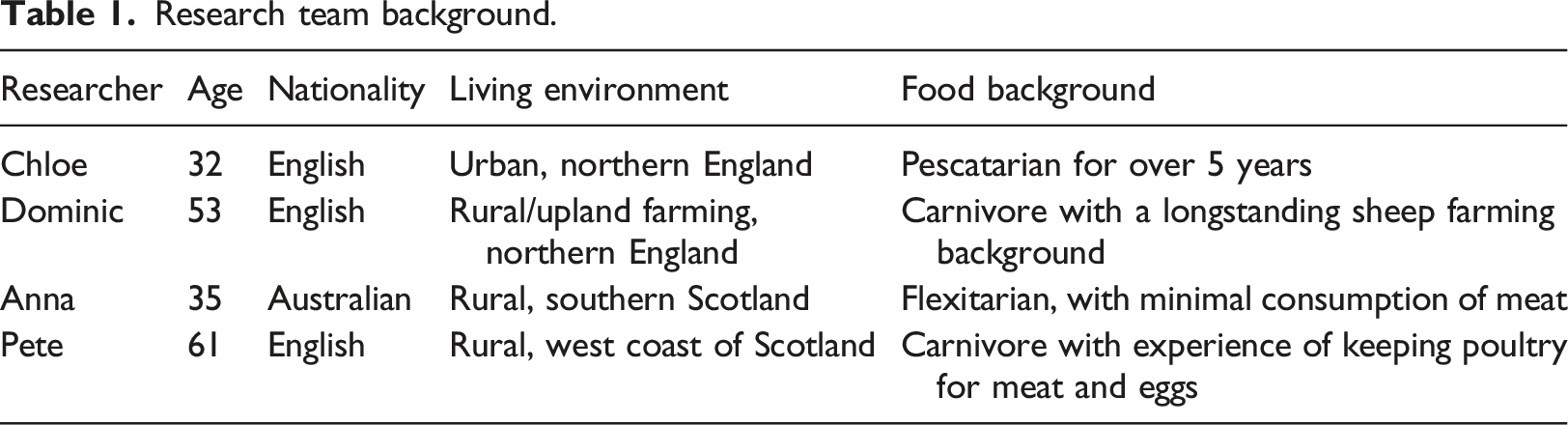
Research team background.
Smalahove is a smoked and boiled sheep’s head traditional in the west of Norway, usually made from the Dalasau sheep breed. Served from late Autumn to just before Christmas, the dish was originally eaten by farmers who sought to consume the whole sheep without wasting anything (ibid). Traditionally, all sheep’s heads would be consumed by the last Sunday of Advent, referred to as ‘Sheep’s Head Sunday’ or ‘Dirty Sunday’, as the meat would turn rancid after this time. However, amidst a bourgeoning gastro-tourism scene that offers consumers opportunities to engage with ‘extraordinary food experiences’ (Goolaup et al., 2017) through tasting the ‘Other’ (Hooks, 1992), smalahove is also considered a touristic trophy, reinforced by diners being presented with a certificate if they manage to eat it (Gyimóthy and Mykletun, 2009), given this can prove challenging for some.
As Edensor and Falconer (2015: 605) suggest, ‘eating can produce richly immersive visual, tactile, auditory, taste-full, and olfactory sensations’. Smalahove preparation and consumption is a multi-sensory process, involving burning the hair off a sheep’s head to leave its skin blackened and charred. The head is then split in two, producing two servings. The brain is removed, but the eyes and tongue remain and are prized parts of the dish. The head is then washed, soaked in brine for a week, before being smoked over rowan wood. Finally, the smoked head is boiled or steamed for several hours, producing a smoked yet moist meat.
Industrialised societies have seen a spatial and temporal reordering of food production and consumption as part of longstanding civilising processes (Canniford and Bradshaw, 2016), which has conceivably altered consumers’ sensory expectations of food. Sensory boundaries between food and dead animals are often maintained in discreet, specialised spaces such as abattoirs (Evans and Miele, 2012). During these processes, heads, blood, and bones are typically removed, with packaging, labelling, and marketing largely disconnecting meat-as-food from animals’ existence (ibid; Sexton, 2018). This means first-hand exposure to the typically backstage process of meat production can be shocking for some (Evans and Miele, 2012). Smalahove preparation and consumption thus disrupts the sensory boundaries many consumers are used to, as we will further reveal in our findings.
Methods
We visited a smalahove farm in Norway as part of a broader research trip trying other unfamiliar foods. Inspired by sensory ethnography, we conducted participant observation during our 1-day visit to the farm, since this method involves direct embodied engagement within a given context (Pink, 2015). Through our multi-sensory framing, we could identify moments during which habitus becomes disrupted and resulting fluctuations in hysteretic intensity. We observed each stage of smalahove production, except the slaughter and beheading of the sheep (not part of the experience offered), before eating the dish served to all but one of the research team (a non-meat-eater). In this sense, the Norwegian food consumption field overlaps with other consumption fields, whereby ‘when we handle dead animals to make their flesh consumable to us, we most often do not experience the “whole” animal… The animal has already been dismembered – we interact with “parts”’ (Yudina and Fennels, 2013: 61). Although we did not directly witness sheep slaughter, we were still afforded what we considered a disruptive experience, as we were exposed to the visceral process of smalahove preparation before consuming it. Usually, we were told, visitors are served the dish prior to encountering its preparation – a sequencing seemingly designed to render eating smalahove less disturbing. We also had informal conversations about the history, preparation process, and cultural meanings of smalahove with the farm owner during the tour and with our Norwegian host (Leif) – who acted as translator.
The duration spent at the farm was driven by both theory and pragmatics; first, we surmised a single visit would magnify the unfamiliarity of the consumption field to us, foregrounding its disruptive potential. This, in turn, proved to be valuable methodological territory for exploring hysteresis. As Falconer (2013) notes, foods once deemed unusual can become overly familiar over time, but with a one-off encounter our habituation to an unfamiliar field was always unlikely. Second, as none of the researchers live in Norway, we did not have the temporal nor financial resources to visit the farm multiple times. This short-term approach to fieldwork can be valuable in capturing the intensity of an experience, particularly when it involves ongoing theory-fieldwork dialogue and re-engagements with data about an encounter beyond its occurrence (Pink and Morgan, 2013). Each researcher took on-site fieldnotes, which were later expanded into more detailed narratives. We also took photographs and videos during our tour, which can capture and mediate multi-sensory and affective experience (Hill et al., 2014; Pink, 2015).
We first read and analysed the full set of fieldwork narratives independently, identifying initial patterns and themes. We then discussed emergent insights in an interpretive group, with fluctuations in hysteresis identified as a key theme. During analysis, we were also reflexive about how our contrasting biographies (Table 1) may have informed differing habitus-field (mis)alignments and experiences of hysteresis. Below, we have taken care to evoke the multi-sensoriality of our research encounters. Our inclusion of written narratives and photographs may seem rather visual. Yet, as Pink (2015) explains, the interlocking nature of our senses allows for the potential of one (in this case sight) to evoke another through ‘synaesthetic exchange’, as in the case of one’s mouth salivating (evoking taste) when viewing an image of appetising food (Korsmeyer and Sutton, 2011). Such sensory interrelationships are especially relevant for smell, taste, and touch, which are difficult to represent (Pink, 2015). Furthermore, we also include links to a particularly graphic fieldwork video to further evoke the multi-sensory nature of the smalahove experience, alongside multiple photographs. We would advise not viewing the video if you are likely to be disturbed by moving images involving animal body parts. Whilst we would not wish to upset or disturb any reader, the images presented below help to convey the visceral nature of our fieldwork encounters. We therefore encourage readers to engage with our multi-sensory descriptions and visual materials if they feel able to and, in doing so, become aware of their own emotional, embodied, and affective responses to it.
Finally, rather than presenting our data thematically, to more effectively stimulate the senses and demonstrate fluctuations in hysteresis, we take readers for a tour around the smalahove farm. Following Vannini's (2015: 318) claim that non-representational ethnography seeks to ‘... animate rather than simply mimic, to rupture rather than merely account, to evoke rather than just report’, we interweave multi-sensory narrative descriptions of each stage of the farm encountered, drawing from our combined fieldnotes, photographs, and embodied memories. Ultimately then, although our research is not fully non-representational, it aligns with Hill et al.'s (2014: 390) suggestion that research projects are ‘...hybrid objects, open to both representational and non-representational sensibilities’.
Findings: Unravelling hysteretic fluctuations
First encounters with hysteresis: Entering the farm
An unsettling sense of hysteresis arose for some as soon as we arrived at the farm. As we were drawn towards a small fire pit in the centre of the wintry landscape, with ice and snow crunching under foot with each step, we could see wooden pallets and bags of logs around us and sheep grazing in the snowy fields in the distance. Two collie dogs curled around our legs and provided a feeling of warmth as the farm owner rushed around to set up the smalahove preparation process. He was soon impaling a sheep’s head with a long wooden stick poked through its nostrils and holding the head over the fire pit, with the hot, roaring flames contrasting with the cold, snowy farmyard (Figure 1). He banged the head against the sides of the fire pit, making a rhythmic thumping noise, combining with sounds of crackling flames and his intermittent explanations (in Norwegian). A sheep’s head being charred over a fire pit.
For pescatarian Chloe, the shock of these unfamiliar sights and sounds was immediate as it jarred with her food consumption habitus. As Maton (2012: 51) explains, habitus ‘captures how we bring history into our present circumstances...’ The habitus conditioned by Chloe’s pescatarian practice, which usually shelters her from multi-sensory processes of meat production and consumption, was upended in this environment in the unfamiliar Norwegian food consumption field. Hysteresis therefore soon became elicited for Chloe due to a ‘temporal lag’ in her habitus adjusting to the new field (Hardy, 2012), which caused her body to unreflexively ‘cringe’: To my horror... the farm owner is holding a sheep’s head over the flames via a wooden stick poked into its nostrils. What the hell is happening!? I walk slowly towards the group, but ensure to stand just behind them, rather than up close and personal with the burning head... The farmer taps and scrapes the head against the sides of the fire pit, which makes a horrible hollow clunking sound. I cringe as he does this several times... (Chloe’s fieldnotes).
As the sheep’s head continued to be pushed into the flames we began to smell burning hair as the head started to char and turn to a charcoal black, and the farm owner sporadically rubbed off the burnt hair from the head with a rough steel brush making an unsettling scraping sound. Anna ‘watched, somewhat uncomfortably’, as hysteresis was evoked through her ‘false anticipations’ of the field (Bourdieu, 1990). As Bourdieu (1990: 62) notes, when one’s habitus is out of sync with a field, there can be a ‘false anticipation’ where uncertain expectations emerge, which can evoke hysteresis (Chen and Zhu, 2022). In Anna’s case, she had ‘...visualised eyes, insides, bone. Detached heads’ (Anna’s fieldnotes). Yet food experiences can be unexpectedly disrupting (Edensor and Falconer, 2015), and affects can ‘...take hold of bodies without an individual’s volition’ (Hill et al., 2014: 388). Anna soon realised, therefore, she was not prepared for the disruptive effects of a first-hand smalahove experience, given ‘preparation and origin are ideas I often read and think about, but don’t really enact’, meaning ‘...all my expectations were imagined’ (Anna’s fieldnotes).
Dominic was also unprepared for the full extent of the multi-sensory smalahove experience, observing how ‘when we arrived at the farm... I guess I was expecting some kind of talk about how it [smalahove] is prepared, not a full-on demonstration’ (Dominic’s fieldnotes). However, with first-hand experience of sheep farming practices, Dominic soon conveys a greater matter-of-factness to the opening performance. This signals the importance of situated embodiment in one’s habitus becoming attuned to a field, as Dominic’s habitus was able to re-adjust itself to the field conditions more quickly than Chloe’s and Anna’s: ...I am quietly transfixed by the visual impact... I’m not disgusted by it, or shocked – in fact I’m pretty immune to animal death... Sick sheep shot at point-blank range in front of me… Dead ewes with vaginal prolapses rotting and stinking on a hot April day before the knackerman
1
collects them... [Sheep’s] skins, horns and hooves in bins at the abattoir and the drains running with blood. So, a sheep’s head on a spike in a fire is no big deal (Dominic’s fieldnotes).
The contrasting intensities of hysteresis seen above were informed by our differing food biographies (Table 1) and degrees of habitus ‘match’ or ‘clash’ (Maton, 2012) to the Norwegian food consumption field. Chloe felt an acute sense of hysteresis due to experiencing a greater degree of habitus clash (Maton, 2012) as a pescatarian, with larger gaps formed between her habitus and the field leading to uneasy affects. Conversely, Dominic’s habitus soon adjusted to the new field owing to experiencing greater habitus match (ibid), as informed by his sheep farming background and the associated sights of dead sheep and smells of rotting flesh integrated into his habitus. Yet hysteresis is not static, as is revealed as we move to the next stage of our tour: the barn containing the disturbing sheep’s head ‘rotisserie’.
Intensifying hysteresis: the sheep’s head rotisserie
We next crunched across the snowy farmyard–with the sheep dogs in tow–to enter an industrial-looking production space with cold concrete floors, white walls, and bright, clinical strip lighting accompanied by the smell of watery, raw meat. Whilst not all of the researchers were equally disturbed by the head-on-a-stick arrival, hysteresis for all became intensified when encountering the mechanical sheep’s head rotisserie found in the centre of this room (Figure 2; also see video here). The farm owner placed two fresh sheep’s heads onto the imposing metal carousel. As he fired up the contraption, rotating steel spikes spun each head rapidly into fierce jets of orange and blue flames, which hissed loudly like flamethrowers, and then a spinning metal brush scraped the charred hair off the seared heads. We all appeared to experience greater habitus clash (Maton, 2012) within this unfamiliar space. The unsettling sights of ‘revolving spikes’, smells of ‘vaporising hair’, and sounds of the ‘mechanical whirr’ of chains greatly diverged from our usual ways of encountering meat. It thus became more difficult for any of us to find a sense of comfort when confronted by the otherworldly intensity of this machine designed for mass production of smalahove: ...The machine leaps into life, the spikes revolving around its circumference with a determined mechanical whirr of chain drives, each spike spinning independently to give its upturned head an ongoing 360-degree, dead-eyed tour of a concrete-floored, lifeless barn... A sheep’s head comes into direct contact with a fierce jet of orange and blue flames, vaporising hair in an instant... The same head is being stiffly brushed as it spins to remove burnt hair... The process seems like a never-ending chain of brutal inflictions (Dominic’s fieldnotes). The mechanical sheep’s head rotisserie.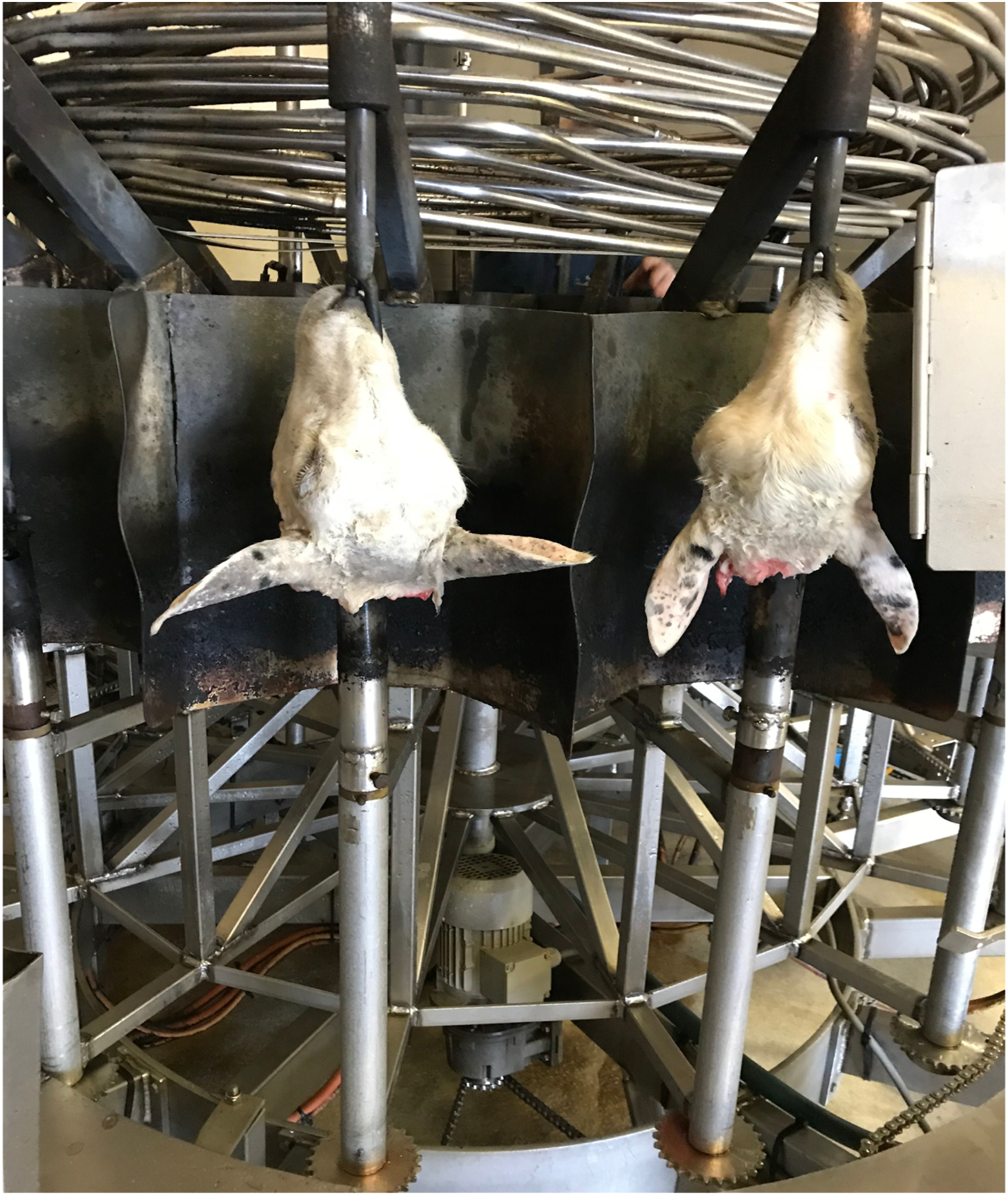
As the heads continued to twist and turn in the flames–becoming increasingly charred–the smell of burning flesh surfaced. Reflecting how smell can be powerfully evocative in consumption experiences (Canniford et al., 2018), this created a particularly emotional response in Anna, emphasising smell’s strong links to memory (ibid; Henshaw et al., 2016). Given the temporality of habitus, where the past irrupts into the present when navigating current situations (Maton, 2012), the echoes of a past provocative case of habitus-field disjuncture for a teenage girl previously unaware of the dangers of food restriction, layered onto her unsettled habitus at the farm to further intensify Anna’s hysteresis: What was that smell? ... Burnt hair? ... The smell took me right to a memory as a teenager, blow drying a close friend’s hair getting ready for a party. So quickly, her hair had just melted in my hand before I could turn the dryer off. Vividly, I remember standing in her parents’ bedroom, holding clumps of hair in my hand. It had just fallen away from her head. She suffered from anorexia... This, strangely, is what came to mind in this moment. Eroding bodies and clumps of hair (Anna’s fieldnotes).
Once the charcoaled heads were removed from the rotisserie, we were led to an adjacent room containing a machine used to cleave the heads in half. As the farmer held up one of the split heads so we could see the results, steam rises into the cold barn providing a feeling of warmth, along with the smell of half-cooked meat, whilst the brain is then scooped out by the farmer and fluids from the head visibly drip onto the concrete floor (Figure 3). As Wacquant (2016: 69) explains, in unfamiliar fields habitus can ‘misfire’ and have ‘critical moments of perplexity and discrepancy’. The disturbing mechanised contraption, coupled with sights of juices leaking from the now-seared and split sheep’s heads, unexpectedly disturbed the ‘bold hunter-gatherer attitude’ integrated into Pete’s habitus, with hysteresis exhibited through feeling ‘unsettled’ and ‘alarmed’ and his body ‘recoiling’: Roaring blue flames scorched the soft, white faces of the sheep, now jammed onto rotating steel spikes revolving around a motorised roundabout... But I was more alarmed because I realised that I WAS unsettled by it all. My bold hunter-gatherer attitude recoiled again as the straw-coloured head juices leaked from one of the burnt heads... Neither I nor the lamb looked particularly well by this point (Pete’s fieldnotes). Bodily fluids leaking from sheep’s head.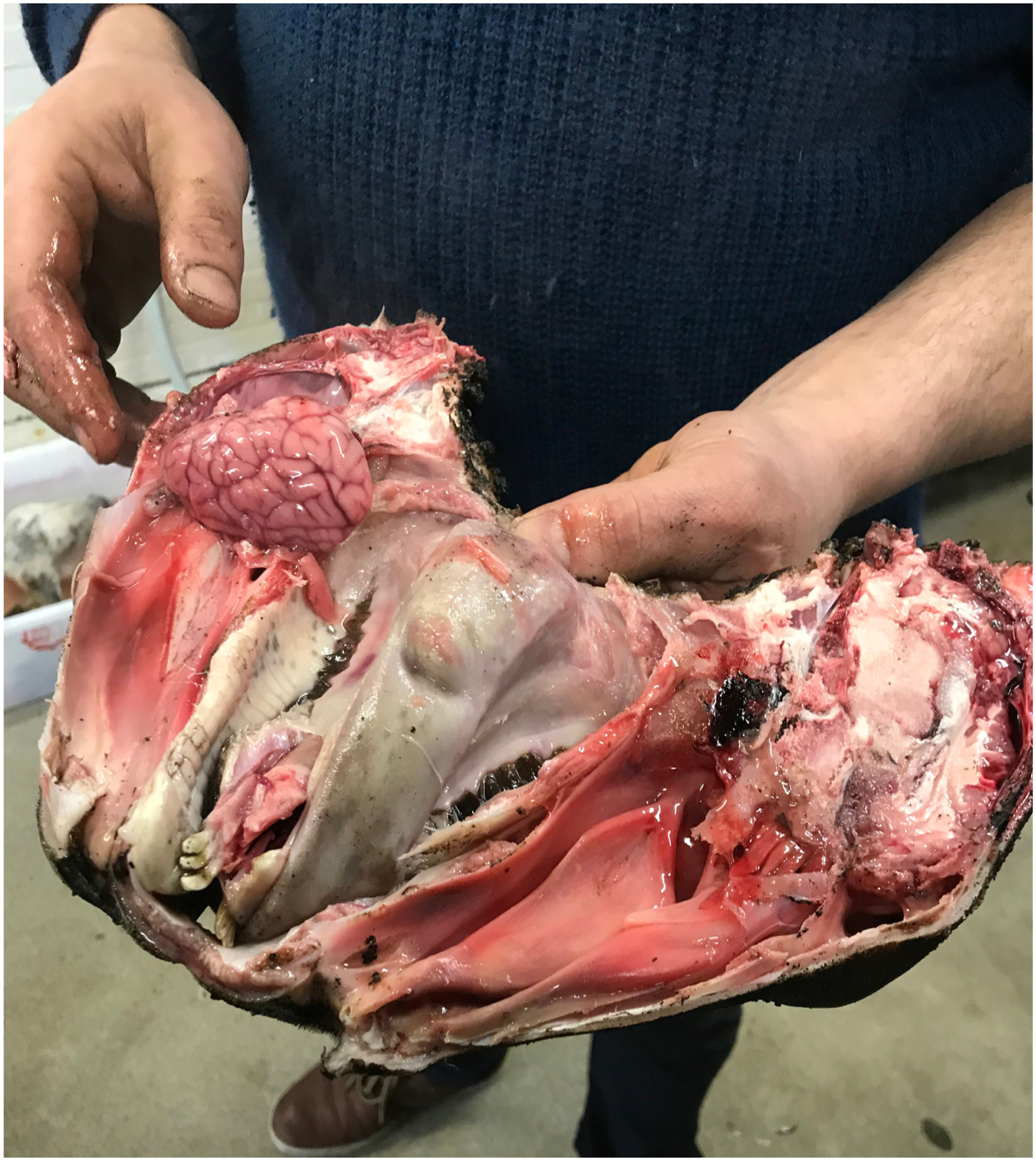
Meanwhile, as a non-meat-eater, Chloe did not possess the ‘proper habitus’ (Bourdieu, 2018) to feel in place in this setting. Feeling disturbed by the sheep’s head rotisserie, she exchanged text messages with her sister (a vegetarian) recounting her in-the-moment horror, reflecting how issues of belonging often arise in unequal field dynamics (Rocamora and Entwistle, 2006), and to reduce her feelings of hysteresis: I’m feeling like the odd one out in the group again. I decide to send my sister (a fellow non-meat-eater) some of the photos I’ve taken... I get the reassurance I am looking for... My sister’s thoughts on the sheep heads: ‘What the hell really??? Omfg. Omggggggg. Those pics!!!!!!!!!!! I’d literally have to leave...’ My thoughts exactly (Chloe’s fieldnotes).
This search for comfort echoes how backpacking food tourists can over time fail to perform their role as cosmopolitan eaters through craving more familiar foods back home (Falconer, 2013). Hence, whilst hysteresis can make it difficult for individuals to ‘hold together’ their dispositions (Yang, 2014), Chloe clings more tightly to the familiar, evidencing what Bourdieu refers to as ‘living the presence of past’ instead of habitus fully adapting to the new and unfamiliar field conditions (Çakmak et al., 2021: 9). However, the next stage of the smalahove farm tour provided the comforting sense of familiarity needed to temporarily reduce the hysteresis we were all now experiencing.
Diminishing hysteresis: The smokehouse and butchers
The relations between habitus and field are ‘ongoing, dynamic, and partial’ (Maton, 2012: 56), meaning the (mis)fit between the two oscillates with varying amplitude. Put otherwise, the intensity of hysteresis for the researchers fluctuated as each area of the farm tour offered different degrees of distance from our habitual ways of sensing meat. The dimly-lit wooden smokehouse we were next taken into provided a point of relief for us all, as we ducked down to avoid our own heads bumping into the smoked sheep’s heads hanging from the ceiling above (Figure 4). The heads now looked and smelled like charcuterie found in food settings we were all more used to. Anna observed how ‘the smokiness... served as a marker of familiarity to me, moving it both visually and by odour into a form of consumption’ (Anna’s fieldnotes). Likewise, for Pete ‘...smoked things are more than food in my head. They have become delicacies... This was going to be ok’ (Pete’s fieldnotes). Even for Chloe, the sensory qualities of this space helped to briefly reduce the gaps between her habitus and the field, diminishing her feelings of unease, as the heads ‘...look very dry and orangey and less like they were once living sheep now’ (Chloe’s fieldnotes). Hanging smoked sheep’s heads.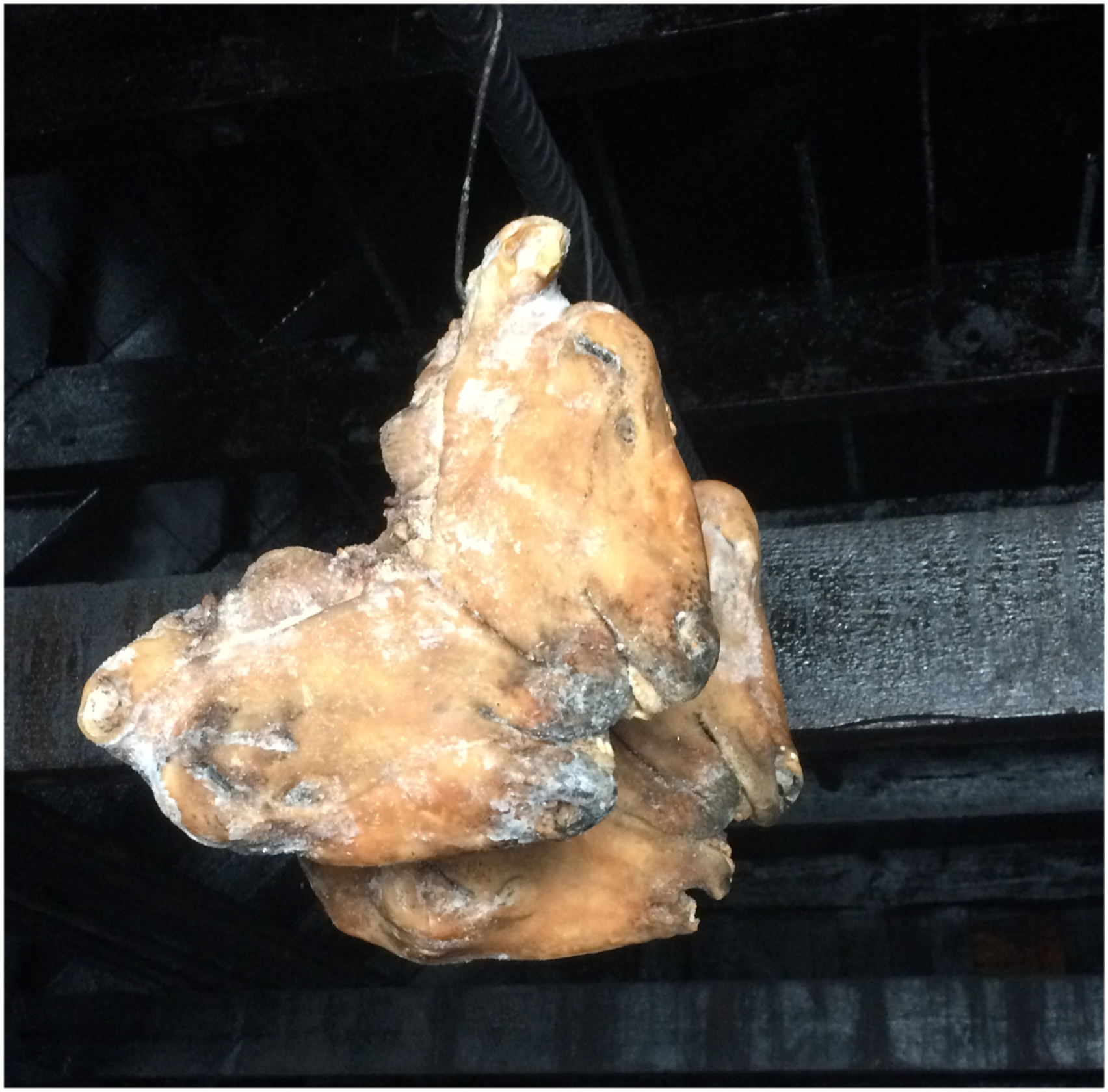
Consumers have learned habitual expectations about how food should look, smell, feel, and taste to ensure smooth consumption and edibility (Korsmeyer and Sutton, 2011), with raw meat too closely redolent of the living (or dead) animal often unsettling (Probyn, 2011). In consumer culture, the animal is typically made not to ‘matter’ within the materiality of the food and in a way that hides its vital origins (Evans and Miele, 2012). The smokehouse, therefore, marked a significant waypoint for the sheep’s heads in their transition from flesh to food, with the smoked meat smells and textures a ‘marker of familiarity’ and indicator of a consumable product. This space therefore helped to (temporarily) reduce any gaps formed between habitus and field, as the sensory qualities of the heads aligned better with our embedded and embodied understandings of food consumption.
The concrete butchery building we entered next also salved hysteresis due to further reducing the gaps between habitus and field. The space was clean and sanitised, brightly lit, and filled with fridges containing a selection of vacuum packed meats adorned with professional labels. Here, processes of refrigeration, packaging, and food hygiene preparation worked to progress the dead animal even further towards meat-as-consumable-product (Sexton, 2018), sensed by Dominic through a transition from ‘metallic’ smells and tastes of ‘blood and death’ to more familiar sights and smells of ‘a butchers’: ...We walk in and it’s a total contrast – bright strip lights, catering fridges and gleaming surfaces. Attractive artisanal lamb and mutton meat products in vacuum packs with smart printed labels. The contrast between this butchery and quasi-retail environment… and the blood and gore of what we have just seen is palpable... You can smell the transition... Taste it on the tip of your tongue. Outside there was metallic tang of blood and death... Inside here it has the odour of a butchers... (Dominic’s fieldnotes).
Dominic, like Anna and Pete, felt more at ease – like a ‘fish in water’ (Maton, 2012) – in this quasi-retail environment, as the space produced sensations more consistent with what many consumers in the industrialised Global North have come to expect from food settings (de Jong and Waitt, 2022). However, consumers sense food – and make sense of food – in different ways (Evans and Miele, 2012), whereby our past ‘...material conditions of existence give us more of a “feel” for some games than others...’ (Maton, 2012: 57). Thus, in contrast, Chloe did not feel ‘overly comfortable’ due to a greater gap between her habitus (informed by a lack of recent experiences buying meat) and this butchery environment: Somebody comments that this room is okay because this is what we’re used to... I’m still not feeling overly comfortable in this room as I don’t go into butchers or buy meat anymore. I’ve not even been in the meat aisle of a supermarket for a while (Chloe’s fieldnotes).
Hysteresis, having reduced in intensity in the smokehouse, was evidently now beginning to rear its head more palpably again for Chloe. However, although an immediate sense of hysteresis was at this point receding for the other researchers, this soon began to change as we reached the tour’s multi-sensory climax in the farmhouse restaurant.
Hysteretic crescendo: Eating (or not) sheep’s heads
We went to eat in a repurposed alpine-style barn designed to look traditional and hospitable through a long wooden table, wooden chairs and benches strewn with reindeer skins, stuffed animal heads and farm implements ornamenting the walls, and silver dinnerware in an agricultural theme adorned with sheep’s heads. Initially, therefore, the farm restaurant seemed to offer a degree of sensory familiarity, with its cosy warmth from the bitter cold outside. However, this comfort soon dissipated as a new wave of hysteresis washed over the research team. Whilst Chloe’s position as non-meat-eater shielded her from the tastes and textures of smalahove flesh and bone, hysteresis was intensified when the farm owner proudly brought the cooked sheep’s heads into the room and ‘a very pungent smell immediately fills the air and makes me feel a bit sick’ (Chloe’s fieldnotes), recalling how strong smells can become overwhelming (Canniford et al., 2018).
The haptic jarring of cutlery on the sheep’s skull and strong smoky taste was disturbing for the other researchers who attempted to eat a sheep’s head (Figure 5), which stretched the gaps between habitus and field to heighten hysteresis: The skin has been so processed it has a gelatinous feel as I peel it back with my knife and fork. This simple action reveals something that immediately changes the terms of engagement and how I feel about this ‘experience’ – teeth and a jaw bone... My appetite for the unusual has been unexpectedly blunted... The smoky taste is pretty overpowering... Texturally it feels rich and luxuriant, but also a bit sickly after a few mouthfuls... (Dominic’s fieldnotes). Dominic’s attempts at eating smalahove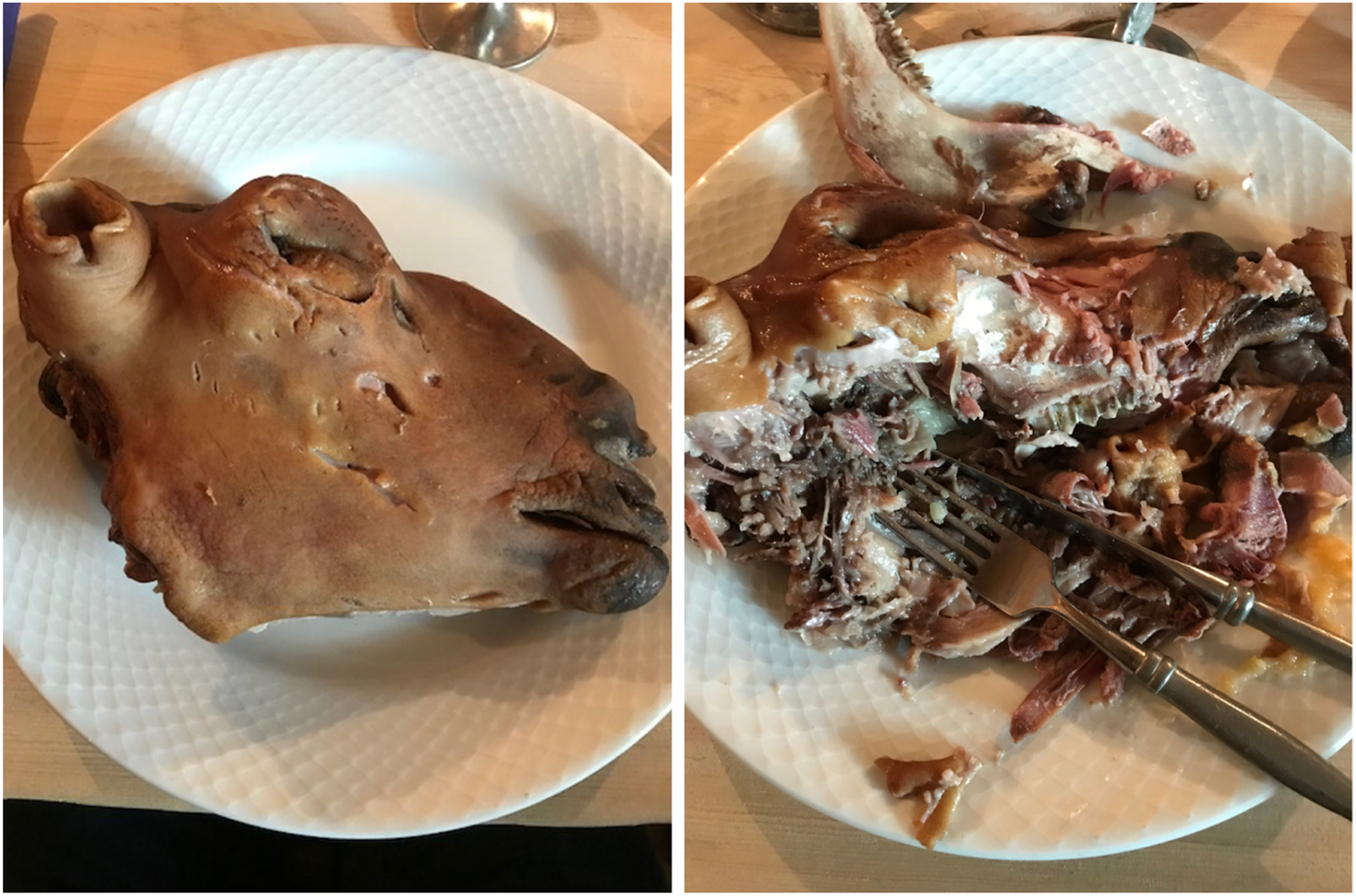
When habitus and field match, persons are able to enact practices smoothly and unreflexively (Yang, 2014). However, unfamiliar eating experiences can render the usually smooth mechanics of eating challenging (Edensor and Falconer, 2015). As Hill et al. (2014) explain, instances where everyday practice breaks down can reveal the affective realm, and above we can identify the moment when Dominic’s affective experience ‘immediately changes’ as his fork hits teeth and jaw bone, with unusual textures and ‘overpowering’ and ‘sickly’ tastes of smoked flesh combining to disrupt eating practice.
Anna’s prior experiences of preparing meat at a delicatessen informed her habitus and initial attempts to peel back the sheep’s skin, which seems ‘surprisingly familiar’. However, there is a temporal lag in her habitus adjusting to the new field (Hardy, 2012), as she is unable to form connections between the ‘very thin layer of fat’ and visible ‘contours of the face’, and her embodied experiences with other meats. We can subsequently identify the moment when Anna’s habitus misfires (Wacquant, 2016) due to unfamiliar sights of the sheep’s face combined with disturbing textures of teeth, with her body’s affective response to hysteretic discomfort causing her to pull the fork back without taking any meat: A sheep’s profile is placed before me... I peel back the thick, smoked skin. This is surprisingly familiar. My first job at 14, as ‘Deli Girl’, required preparing the smoked ham leg where daily I had to peel the skin away from the leg... The familiarity soon ended though, peeling the smoked skin revealed a very thin layer of fat... So thin I could make out the contours of the face... I tried my best to make connections to other forms of meat regularly consumed. I couldn’t quite connect it to anything specific... I stay close to the cheek for some time, until my fork accidentally hits teeth... This feels like an intrusion and I immediately pull my fork back... (Anna’s fieldnotes).
Our Norwegian host–Leif–was not so challenged by the eating experience. As previously mentioned, for Bourdieu (1998) fields are battle grounds, where agents grapple for social positions through the accumulation and expression of capital (Skandalis et al., 2020). Social hierarchies here were (re)produced through comparisons between how Leif happily ate the whole smalahove, tongue, eyeball, and all, and the fraught attempts of the research team who did not embody the same levels of cultural capital. Indeed, power dynamics within a social field – in this case, the Norwegian food consumption field – can become visible in material spaces through embodied performances (Rocamora and Entwhistle, 2006), such as eating. Pete observed how Leif ‘ploughed on and cleaned the head with gusto, apparently enjoying every last scrap...’ (Pete’s fieldnotes). Unequal power dynamics were exacerbated through the embodied gestures of the farm owner who ‘...seems very impressed by the way that Leif is clearing his sheep skull, but less enamoured with Dominic’s eating technique, as he puts his hand on his shoulder’ (Chloe’s fieldnotes). Due to being embedded in Norwegian eating practices, Leif enjoyed greater habitus-field alignment and met the embodied behaviours demanded by – and informing – the field (Rocamora and Entwhistle, 2006). Conversely, the research team’s difficulties with eating smalahove revealed how our habitus had not fully adapted to the field, thereby ramping up feelings of hysteresis for us all.
Conclusions
Through the case of smalahove consumption, we have explored our experiences of what Bourdieu (1977) termed hysteresis – or feeling like a ‘fish out of water’ (Maton, 2012) – when habitus and field misalign. Specifically, we highlight how fluctuations in hysteresis – elicited by the sights, smells, sounds, tastes, and textures we encountered – oscillated according to an alignment – or conflict – with our usual ways of consuming meat.
This paper’s main contribution lies in providing a more dynamic conceptualisation of hysteresis than is found in existing literature. We demonstrated how the intensity of hysteresis is not static, but fluctuates as consumers move through time and across consumption spaces within unfamiliar fields. This theorisation recognises how gaps between a consumer’s habitus and the field can dynamically open and close. As previously explained, Bourdieu (1977) originally theorised hysteresis as arising due to a significant and lasting change in field conditions, often followed by habitus lagging in adjustment to these changes, with the resultant feelings of hysteresis considered to be relatively enduring (Hardy, 2008). Contemporary research, however, has suggested that hysteresis may be more fleeting than Bourdieu initially posited, in some cases. For instance, although theorising hysteresis is neither’s primary focus, Jones et al. (2020) observe how consumers might discuss television programmes with others to reduce ‘hysteretic angst’, and Robinson and Arnould (2020) find consumers invest in battery packs to reduce ‘energy hysteresis’ when on-the-move – both relatively short-term concerns. Yet, until now, research has not shown how hysteresis fluctuates in intensity in any granular detail; nor has it revealed how the sensations produced by consumption environments may elicit hysteretic fluctuations.
Our account of fluctuating hysteresis introduced the terms ‘intensifying hysteresis’ and ‘diminishing hysteresis’, thereby illustrating how hysteresis might be considered like a volume dial. Hysteresis becomes ‘intensified’ – with the volume dial turned up – when consumers encounter sensory information far beyond what they are habitually used to, stretching the gap between their habitus and the field. In our case, hysteresis was intensified through the sights, smells, sounds, and textures of sheep’s heads spinning into flames on a mechanical sheep’s head rotisserie, which greatly jarred with our previous and usual encounters with animals and meat. When hysteresis is intensified, it is acutely felt through strong embodied affects of being out of place, uncomfortable, unsettled, alarmed, and disturbed, alongside practices experienced as disruptive and more consciously reflected on. And it is those consumers whose habitus is most distanced from field conditions who are likely to encounter the most intense feelings of hysteresis. Conversely, hysteresis can ‘diminish’ – with the volume dial turned down – when consumers encounter sensory information in a consumption environment more familiar to what they are used to, with the gaps between habitus and field closing. When hysteresis becomes diminished, consumers feel more in place, comfortable, and at ease, with practices enacted more smoothly and unreflexively. In our case, hysteresis became diminished in the smokehouse and butchers, as the sights, smells, and textures of the sheep’s heads were more closely aligned with our past food experiences. This idea of fluctuating hysteresis inevitably extends beyond the field of food, and future research might, for example, examine hysteresis within other consumption settings containing contrasting (micro)spaces and sensory qualities, such as the different floors of a nightclub, stages of a music festival, stalls of a market, experiential areas of a theme park, or different ‘zones’ within a shopping mall.
In unravelling how hysteresis fluctuates in response to sensory features, our paper also contributes to sensory consumption research. Much marketing literature focuses on only one sense in depth, such as how music, lighting, colour, or scent impacts consumer behaviour within retail and service settings (Turley and Milliman, 2000). Moreover, to re-balance a typical ‘sensory asymmetry’ (Canniford et al., 2018: 235) towards the visual, there have been recent in-depth studies into smell (ibid; Henshaw et al., 2016) and sound (Patterson and Larsen, 2019). Building on the above, we unpacked how multiple senses ‘operate in concert’ (Spence et al., 2014: 472) to shape consumption experiences. Hence, whilst marketing literature typically provides advice regarding how to create more positive sensory consumption experiences (Turley and Milliman, 2000), we contributed insights into how multiple senses also have the potential to combine to elicit an unsettling sense of hysteresis, especially when they stretch too far from habitual ways of sensing consumption.
Finally, marketers striving to change consumer behaviour may wish to intensify hysteresis to open up gaps between a consumer’s habitus and field, potentially provoking fruitful experimentation and in turn creating new market possibilities. In other cases, marketers might wish to protect consumers’ feelings of habitus and keep hysteresis at bay in pursuit of continued customer loyalty. This may be difficult to achieve though, as consumers increasingly enter unfamiliar environments and move between fields which can have ‘flaky borders’ (Bathmaker, 2015: 67), in the search for ‘extraordinary experiences’ (Goolaup et al., 2017) and ‘sensual alterity’ (Edensor and Falconer, 2015). Consumers are thus potentially experiencing such fleeting – but nevertheless unsettling – moments of hysteresis more frequently than before. In sum, by understanding the fluctuating notion of hysteresis introduced here, marketing researchers and practitioners can better grasp the ways in which the gaps between a consumer’s habitus and field can dynamically open and close, which is most likely witnessed in challenging and extraordinary, or familiar and routine, consumer experiences within the contemporary marketplace.
Footnotes
Acknowledgements
We would like to thank Leif for hosting us in Norway and for acting as our translator during the smalahove farm tour.
Declaration of conflicting interests
The author(s) declared no potential conflicts of interest with respect to the research, authorship, and/or publication of this article.
Funding
The author(s) received no financial support for the research, authorship, and/or publication of this article.
