



Abstract
This article tackles an underexplored topic in the Market Studies literature—the enactment of exchange practices in overlapping markets. Based on an ethnographic study, the article examines a contested market space in which sustainable and conventional coffee buyers compete to enact exchanges with farmers. At the center of this competition are farmers, whose subsistence challenges heavily influence the choice of market(s) they operate in. An Exchange Entanglements framework for analyzing overlapping exchanges is developed, which accounts for market concerns, calculative power asymmetries, and the (re)configuration of market entities. The article builds our understanding of how exchanges are enacted to account for concerns in overlapping markets, and develops a characterization of overlapping market exchanges. It questions the extent to which dominant market actors can address farmers’ subsistence challenges, and highlights the problematic challenge of enacting concerned markets that serve marginalized market actors.
Keywords
Introduction
This article explores an under-researched topic in the Market Studies literature—the enactment of exchange practices in overlapping markets. The organizing work that goes into shaping markets is of central interest in this literature, which is majorly influenced by Callon’s (1998a: 51) depiction of markets as “many-sided, diversified, evolving.” The multiplicity of markets and the efforts to shape markets (Kjellberg and Helgesson, 2006), alongside the confrontations and power struggles between actors (Callon, 2010), generate multiple and sometimes overlapping outcomes, for example, opposing prices or qualifications of goods.
The enactment of overlapping markets—a relatively new theme in the Market Studies literature—has made inroads into Marketing Theory. Extant research on overlapping markets investigates the construction of identities of objects and exchange interrelations (Kjellberg and Olson, 2017; Winroth et al., 2010), yet only a few studies (e.g., Geiger and Gross, 2018; Milyaeva and Neyland, 2016) focus on overlaps involving “concerned markets.” This article addresses this theoretical gap.
Concerned markets—a recent categorization of markets, involve multiple actors with competing values, expectations, and aims, who concern themselves with the market in question (Cochoy, 2014; Geiger et al., 2014)—in what the market does, what it should be and do, and/or how it can be transformed (Cochoy, 2014). Concerned markets shift matters taken-for-granted into disputed matters of concern (Cochoy, 2014; Latour, 2005). They constitute a confrontational market space in which actors’ goals, values, and interests compete (Geiger et al., 2014; Geiger and Gross, 2018: 1361).
This article examines a concerned market in which sustainable and conventional market actors compete for supplies from marginalized farmers. Sustainable markets promote social, environmental, and economic values (Kirwan et al., 2017), and redress conventional market failures (e.g., precarious human conditions and crises) (Campana et al., 2017). Fair Trade, for example, redresses “the injustices of conventional trade, which traditionally discriminates against the poorest, weakest producers” (Fairtrade Foundation). Conventional markets downplay sustainability values (Daviron and Vagneron, 2011), yet their increasing engagement in sustainability initiatives is recognized (Millard, 2017).
The fragmented coffee market presents a suitable context in which to examine overlapping sustainable/conventional markets. Numerous sustainable markets (e.g., Fair Trade, organic) exist alongside conventional markets (see Bacon, 2005), which are marked by stringent entry barriers for producing countries set by major roasters (e.g., Nestlé) and retailers (Lee et al., 2012; Ponte, 2002). Strong concerns have been voiced about the plight of millions of coffee farmers in developing countries, highlighting their vulnerability and capacity to respond to shocks (e.g., volatile prices) (Guido et al., 2020). Coffee farmers earn comparatively marginal gains from coffee production, particularly in the conventional market (Ponte, 2002). Constrained by unmatched demand and stringent production practices (Jones and Gibbon, 2011), sustainable farmers consider the option to also produce conventional coffee. Previous research has not explored how farmers navigate conventional and sustainable markets to address their subsistence challenges.
All actors are concerned in the overlapping market investigated. Yet, their “interests, values and agendas coincide and clash” (Geiger and Gross, 2018: 1361) and power dynamics underpin buyer-seller responses to market concerns. At the center of this confrontation are farmers, whose subsistence (or ability to meet basic needs) is at stake, and whose market/subsistence needs are enmeshed.
Based on an ethnographic study conducted in Uganda in 2010, this article examines overlapping exchange practices which started to unfold when an indigenous, sustainable firm entered a coffee market dominated by conventional intermediaries. It asks the question: How are exchange practices enacted in overlapping markets, and how do these practices address farmers’ subsistence challenges? Drawing on the market framing literature, the article examines the construction of an overlapping market permitting sellers (farmers), buyers (the sustainable firm and conventional intermediaries), and exchange objects (coffee) to enact conflicting market exchanges. Heterogeneous actors, both human (sellers and competing buyers) and non-human (e.g., quality standards and market rules and framings), collectively construct the diverse overlapping exchanges examined, and account for the dynamics in this concerned market.
This article builds our understanding of how exchanges are enacted to account for concerns in overlapping markets, and develops a characterization of overlapping market exchanges. An Exchange Entanglements framework is developed, providing a heuristic tool for analyzing overlapping exchanges. The framework accounts for market concerns, calculative power asymmetries, and the (re)configuration of market entities. It illuminates the inverse formation of interactive value in competing markets, and accounts for (mis)alignments in evaluative frameworks, which trigger movements across competing market frames. Empirically, the article elucidates how farmers purposefully navigate established exchange practices to creatively address their subsistence challenges.
The article is organized as follows. First, the literature on framing (competing) markets and overlapping markets is reviewed. Second, the ethnographic research methodology is outlined. Next, the findings are presented, illuminating the shifting exchange relations enacted in competing markets. Penultimately, the Exchange Entanglements framework for analyzing overlapping markets is expounded and discussed. The article concludes with contributions to theory and practice, along with limitations and areas of future research.
Framing (competing) markets
Substantial Market Studies research has focused on market framing—a practice permitting the enactment of market exchanges. Market framing denotes the processes entailed in constructing market spaces so that exchange can take place “more or less independently of their surrounding context” (Callon, 1998b: 249). This definition evokes two processes that establish markets—the bracketing of entities involved in exchange (Slater, 2002), and the (dis)entanglement of entities and relationships included/excluded from market frames.
The first process demarcates a somewhat stable and repetitive transactional space in which buyers, sellers, and goods interact, and neither actors nor objects cross the boundary (Callon, 1999). In reality, however, market frames are typically porous. Entities remain entangled with social relations in their respective worlds outside market frames (Callon, 2005). Hence, the second process of (dis)entanglement is evoked.
However, entanglements between entities and their respective worlds must be severed/disentangled, permitting the enactment of exchanges (Callon, 1999). Thus, disentangled entities can enmesh in new exchange relations free of entanglements that could potentially jeopardize the transaction (Callon, 2005). For example, to qualify as sellers of organic coffee, conventional farmers must dissever non-organic linkages. Free of these attachments, organic farmers/sellers and coffee/goods can momentarily entwine with buyers in organic market frames. New transactions/exchanges will require similar (dis)entanglement processes.
The understanding of (dis)entanglements as precursors of market exchange is foundational to the Exchange Entanglements framework developed in this study.
Framing and (dis)entanglement processes render market boundaries permanently “unstable, negotiable, sites of conflict” (Slater, 2002: 241). This cultivates an environment of “confrontation and power struggles,” which accentuates the competition between markets (Çalışkan and Callon, 2010: 3). Constituted by diverse actors representing conflicting interests, markets are configured in divergent ways and re-emerge in new forms (Araujo et al., 2008; Kjellberg and Helgesson, 2006). They are “configurations of interdependent elements,” whose dynamic changes trigger symbiotic reactions from actors (Storbacka and Nenonen, 2011: 255). Market actors engage in purposive actions to reconfigure exchanges and entities (Nenonen et al., 2019). Goods likewise participate in action. However, being incapable of making calculative judgments, their agency is pacified (Çalışkan and Callon, 2010).
Accordingly, agency is distributed and collective, being attributed to humans and non-humans (Callon and Muniesa, 2005). Agency, illustrated in the notion, agencement, denotes a composite constituted by heterogeneous elements, which adjust to one another to generate action (Çalışkan and Callon, 2010). In this article, the agencement acting to shape and enact overlapping exchanges is examined.
Qualification processes, which ascribe properties to goods, illuminate the competition in markets. The ascribed properties identify and permit the comparison of singularized versus substitutable goods in a space of “distinct yet connected categories” (Callon et al., 2002: 198). Most coffee, for example, is considered as substitutable, with the exception of specialized coffee—a highly singularized good.
Competing markets operate contradictory regimes, instigating calculations that redefine goods and enact cross-boundary exchanges (Slater, 2002). Calculation, also denoted as qualculation (after Cochoy, 2008), is understood as avoiding sharp distinctions between judgment and numerical operations (Callon and Muniesa, 2005). This permits the categorization and relationality of objects within market frames (Callon and Law, 2005). Encapsulated in the notion of “worth,” an understanding of actors’ evaluations (i.e., how actors arrive at judgments of value; Aspers and Beckert, 2011) and valuations is crucial. “Worth” fuses the concepts, “value” (the economic) and “values” (the moral), and draws attention to ongoing processes of valuation (Stark, 2009). In competing markets, actors draw on multiple evaluative frameworks; divergent conceptions of what is valuable, worthy and important (Stark, 2009). This often generates disagreements in the form of “criticisms, blames, and grievances” (Boltanski and Thévenot, 1999: 390; Stark, 2009).
Hence, this article investigates farmers’ calculations which enable them to compare goods, realize “practical solutions to [the] problems” encountered (Callon and Muniesa, 2005: 1229), and get the most out of competing market frames (Slater, 2002). Equally, actors’ judgments that establish the singularity/substitutability of goods, and conflicting evaluations triggering movements across market frames are explored.
Research on overlapping markets
Studies on overlapping markets are just emerging. This literature characterizes market exchanges (Winroth et al., 2010), establishes the complementarity and substitutability of exchanges in adjacent markets (Kjellberg and Olson, 2017), and explicates how market frames account for market concerns (Geiger and Gross, 2018; Milyaeva and Neyland, 2016).
Winroth et al. (2010) characterize (exchange vs investment) objects in overlapping financial markets. Shares as exchange objects are constructed by traders in momentary markets, typified by a continuous flow of events/information and blurry boundaries. Conversely, shares as investment objects are enacted in more stable markets. Momentary markets are constituted within the market for investments, and act as a mechanism enabling analysts to acquire investment objects.
Kjellberg and Olson (2017) distinguish continuously evolving exchanges in co-evolving adjacent markets as complementary versus substitutable. When barred by incompatible legislation restrictions (from accessing bank services), actors engaged in substitutable exchanges—switching bank trade for cash-based trade, and direct investment in cannabis trade for investments in complementary/ancillary markets.
The two studies illustrate the emerging efforts to characterize overlapping market exchanges—an undertaking that this study builds on.
The final category of overlapping market studies relates to the framing of concerned markets. It is worth pausing here to first explore the notion of concerned markets. “Concerned markets,” a term coined by Geiger et al. (2014), denotes markets “involving multiple actors with diverse values, expectations and aims [who] are concerned enough to ‘concern themselves’ with the market in question” (Geiger et al., 2014: 5). Three facets of concerned markets are stipulated: organizing direct transactions between market actors, orienting market transactions to handle externalities, and resolving controversies.
Concerned markets question the essence of markets—their identity, actions, aspirations, and potential for change (Cochoy, 2014). They shift matters of fact into highly uncertain, disputed matters of concern (Cochoy, 2014; Latour, 2005). This article will illuminate shifts in matters of fact (e.g., goods and buyers) to matters of concern to highlight if and how the exchanges enacted tackle farmers’ subsistence needs.
Consequently, concerned markets create a confrontational space in which “multiple interests, values and agendas coincide and clash” (Geiger et al., 2014; Geiger and Gross, 2018: 1361), permitting the formulation of “modalities of organization…relevant in the implementation of market exchanges” (Geiger et al., 2014: 3). But how do coincidences and clashes evolve in concerned markets? The Interactive Value Formation framework presents a useful lens for this analysis.
Interactive value formation is demonstrated in the (mis)alignments occurring within practices (between procedures, understandings, and engagements constituting practices) and in-between practices (the degree of fit between different practices) (Echeverri and Skålén, 2021). Thus, value is formed (co-created or co-destroyed) interactively. Value co-creation occurs when practices are aligned and resources are appropriately integrated. Inversely, value co-destruction results when practices are misaligned and resources are not appropriately integrated, and from divergent orientations and negative attitudes (Makkonen and Olkkonen, 2017). Yet, Laamanen and Skålén (2015: 384) describe value co-creation as “a contested space of various actors and practices.”
Interactive value formation in the concerned market will be explored in this article, to illustrate the co-evolving coincidences/alignments and clashes/misalignments.
We now return to the theme of framing concerned markets. Both Geiger and Gross’ (2018) and Milyaeva and Neyland’s (2016) studies focus on concerned markets that orient exchanges to handle externalities (Geiger et al., 2014). Both studies explore alternative approaches which shift and adapt market frames to incorporate market concerns. Geiger and Gross (2018) highlight the role of market devices in shifting market frames and altering practices in the pharmaceutical industry to account for market concerns (e.g., disease and access to medicines in middle-income countries) and address perceived market failings. Concerns herein permeate market frames and create possibilities enabling equal access to medicines, social justice and profits.
Milyaeva and Neyland (2016: 239) examine innovations enacted in the market for personal data, to address a market failure—individuals’ lack of control over personal data. Their study illuminates critiques “of who and what was included in the market” as bases for market reframing. Market reframing herein imposes data control and greater transparency in the pursuit to internalize/frame market concerns and address unfair data exchange practices.
Distinct from Geiger and Gross’ (2018) and Milyaeva and Neyland’s (2016) work, the present study investigates the enactment of exchanges to account for concerns in overlapping markets. It contributes to the literature on concerned markets, which organize direct transactions between market actors.
Research methodology
Overlapping coffee markets
Second to oil, coffee is the most highly traded commodity globally. In the early 2000s, alternative, sustainable coffee types emerged (e.g., Fair Trade, Organic) to compete with conventional coffee. Conventional coffee markets exacerbate social and environmental problems, and discriminate against “the poorest, weakest producers” (Fairtrade Foundation; Taylor et al., 2005). Counteractively, sustainable markets (e.g., Fair Trade) support producers and advocate for changes in conventional trading rules and practices (Fair Trade network/FINE, 2001). These markets emerged out of the failures of the conventional market (Johannessen and Wilhite, 2010) and offer benefits, for example, less volatile prices and direct producer-consumer links (Bacon, 2005; Ponte, 2002). Simultaneously, sustainable markets (just like conventional markets) cultivate power asymmetries favoring consuming countries over producing nations (Johannesen and Wilhite, 2010), and marginalize the extremely poor (Sidwell, 2008).
Examples of conventional/sustainable market overlaps include Fair Trade’s premium, which cushions farmers against volatile conventional coffee prices (Fair Trade Foundation), and farmers selling coffee in both conventional and sustainable markets (Bacon, 2005).
An ethnographic study of coffee markets in Uganda
This article reports on a 5-week ethnographic study conducted in Uganda, which investigated the market practices of farmers supplying coffee to an indigenous, sustainable Firm. The present study is part of a larger project that sought to establish how markets are performed along product trajectories.
Four research settings were investigated: the Firm’s headquarters (in Uganda’s capital, Kampala), the Firm’s field office, Homestead 1 (the focal homestead), and Homestead 2 (examined to give context to practices in Homestead 1).
This study examines the market practices enacted approximately 230 miles from the capital, at the two homesteads and at the field office. The fieldwork took place during pre-harvest and harvest periods in 2010.
Participant and event sampling.
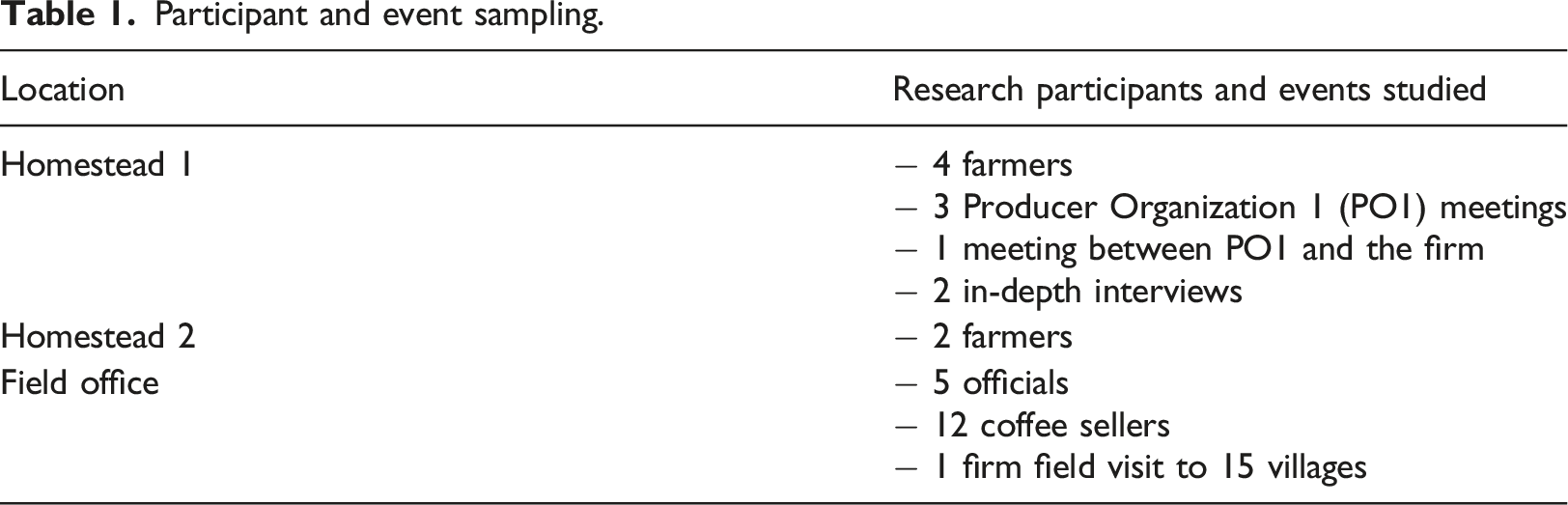
The farmers examined belonged to producer organizations (POs)—PO1 (Homestead 1 farmers) and PO2 (Homestead 2 farmers). Homestead 1 was selected purposively, given the farmers’ active engagement in sustainable coffee production/exchange practices. The homestead housed a central processing store, also a meeting point for PO1 farmers. Homestead 2 was selected because of its convenient location to the researcher.
In a typical visit to the homestead (8 a.m.–6:30 p.m.), the researcher “followed” a single farmer to observe, take note, and inquire about their coffee growing/harvesting/processing/exchange practices, as well as observe their family practices. The researcher attended four PO1 meetings, including one with the Firm. In following the farmers, the researcher simultaneously “followed” the coffee as it traversed its farm to sale trajectory.
Guided by the Market Studies approach, this study examines the actions of multiple actors and the co-existing versions of reality they generated (Mol, 1999). Markets necessitate continuous organization efforts to ensure their existence (Araujo et al., 2010). Hence, the study is attentive to highly specific and concrete everyday exchange practices (Kjellberg and Helgesson, 2006) enacted by human and non-human actors. Social reality here is considered as “produced and stabilized in interaction” (Law and Urry, 2004: 395). Co-existing markets, actors, and exchange objects are examined as outcomes of practice; thus, labels (for example, sustainable versus conventional farmers/coffee) are perceived as emergent.
This study captured: (1) The interactive actions of human actors—farmers (individuals and groups) and the Firm’s officials, alongside their interactions with non-human actors—quality standards, pulpers, buyers’ offseason calendars, and mortgage loans. (2) Observations of the market rules and framings orchestrating the enactment of overlapping exchanges. (3) The conflicting calculations/evaluations of market actors. (4) Interactive value formation in the overlapping markets.
The data gathered was analyzed iteratively; thus, themes were developed reflexively from data and theory (Srivastava and Hopwood, 2009). Large amounts of data were involved, therefore, Atlas.ti—a qualitative analysis software—was employed. Four datasets were produced for the larger project, based on the research settings examined. Codes were generated and merged into 12 descriptively named analytic themes: Quality Practices, Selling and Buying Practices, Price, Pulpers, POs, Government-Run Village Banks, Significance of Coffee, Savings (including Firm-supported Village Banks), Social Relations, Traders, Emergence of the Market, and The Organic Project. According to Terry, et al. (2017: 28), “themes are constructed or generated through a productive, iterative, reflective process of data-engagement.” To develop the analytic themes, patterns were identified across the datasets. Provisional themes were identified and reviewed to ensure alignment with the coded data, the dataset, and the research question.
The present study draws majorly from the analytic themes “Selling and Buying Practices” and “Traders” (or intermediaries), which highlight overlaps between the sustainable/conventional coffee market entities examined. Also relevant were the themes: Quality Practices, Price, Pulpers, POs, Significance of Coffee, Savings, and Emergence of the Market.
A deeper engagement with the data on “Selling and Buying Practices” and “Traders” generated three sub-themes—inevitable, reversible, and deliberate exchange entanglements, which were formulated by the researcher. The sub-themes form the basis for the findings presented in the Constructing an overlapping coffee market section. Remarkably, “Traders” emerged as a prominent theme, despite their non-participation in the study. Thus, the findings portray perceptions of intermediaries as seen through the eyes of farmers and the Firm.
Findings
A background on two overlapping coffee markets
Uganda is a leading exporter of green coffee globally (International Coffee Organization, 2019), grown mainly by smallholder farmers. Before 2003, in South West Uganda, the conventional coffee market dominated. 14,000 farmers produced and sold conventional dry processed 1 Arabica coffee to intermediaries, who in turn sold to large traders and exporters’ agents. In 2003, an indigenous, sustainable Firm introduced wet processing methods, which 30% of the farmers adopted. The Firm organized farmers into 50-member groups Producer Organizations/POs and equipped them with wet processing technology (i.e., pulpers, donated by an international agency) and knowledge on coffee agronomy. Farmers make joint savings in POs and in farmer-owned village banks that the Firm helped them form. By 2010, the Firm was facilitating 2,000 farmers in obtaining organic certification.
The second market, whose formation was orchestrated by the Firm, enrolled sustainable farmers and POs directly as suppliers of coffee to a single buyer—the Firm.
Consequently, two competing market frames emerged—. The sustainable market frame constituting farmers/POs (sellers), the Firm (the buyer), and sustainable, wet processed coffee (the exchange object). The conventional market frame constituted individual farmers (sellers), numerous intermediaries (buyers), and conventional coffee (the exchange object).
Contestations between the two markets arise from the conflicting spaces of calculation created, marked by divergent calendars of operation, qualification processes, and prices. The market oppositions affect farmers’ income flows, create conflicting production demands on farmers, and influence farmers’ calculations. Moreover, the buyers impose opposing market rules and framings (on goods, actors, prices, etc.), constraining farmers’ calculations and exchange practices.
The first opposition—calendars of operation—directly affects farmers’ income flows. The Firm buys coffee only during harvest time, providing a seasonal income to farmers, who face considerable subsistence challenges during the offseason. The firm aspires to equip farmers to self-finance initiatives through village bank savings and loans. Conversely, intermediaries buy coffee in all seasons and offer mortgage loans, providing farmers with a steady income flow. Intermediaries live among the farmers and can readily access them, unlike the Firm whose base is at the town center.
Second, the coffee markets institute divergent, globally enacted qualification regimes (wet vs dry coffee processing methods). Wet processed coffee is of superior quality and value vis-à-vis unwashed coffee (International Coffee Organization, 2020). To wet process coffee, farmers: (1) Selectively harvest ripe cherries by sorting and removing any spoiled cherries (floats). (2) Process clean, ripe cherries using pulpers to remove the outer skin and reveal the parchment coffee. (3) Ferment the parchment. (4) Wash the parchment and drip-dry it in a shed. (5) Sun dry the parchment. In contrast, dry processing simply involves drying cherries immediately after harvest. Farmers sell this coffee in any form—as unripe cherries, dried cherries and/or as hulled coffee.
The Firm requires farmers to produce high quality parchment, which strictly adheres to the Firm’s harvesting/production standards. Intermediaries, conversely, do not impose quality standards in the production of unwashed coffee.
Third, the Firm offers a price buffer to farmers, shielding them from highly volatile coffee prices. Instead, intermediaries’ prices fluctuate with global coffee prices.
Concurrently, conflicting evaluative frameworks operate in the overlapping markets. The Firm’s evaluative criteria, captured in its mission, include product quality and sustainability values (paying profitable prices to farmers, community empowerment, and investing in sustainable projects). Intermediaries’ evaluations are economic—they value maximum earnings from coffee trade. Official Okello commented that, “even if the parchment residues weigh only one kilo, farmers will not fail to find a market (from intermediaries) for it.” Farmers consider three evaluative criteria: incomes that meet their subsistence needs, higher parchment vis-à-vis unwashed coffee prices, and prices reflecting the arduous effort involved in producing parchment. Hence, a marginal (parchment vs unwashed coffee) price difference will not motivate farmers to wet process coffee. As Farmer Jonah (Homestead 1) stated, “Price determines whether or not people pulp coffee. If the price was good, most people would be motivated to pulp (coffee).”
Ultimately, sustainable farmers are torn between the two markets, mainly because of subsistence challenges. Exchanges in the sustainable market are enacted collectively by farmers, especially those belonging to PO1, which bulks parchment and sells to the Firm. Most POs are not as active in bulking parchment. In contrast, exchanges enacted by sustainable farmers in the conventional market are individual, regardless of which PO farmers belong to. Individual farmers’ evaluations establish the type (and quantities) of coffee they produce, which market(s) they operate in, and to what extent. The market oppositions generate (mis)alignments within practice elements (i.e., the goals and capabilities of actors) and in-between selling and buying practices that maximize (co-create) or diminish (co-destroy) value in either market frame.
Below, the findings detail how overlapping exchange practices evolve in the competing markets.
Constructing an overlapping coffee market
Largely, due to the seasonal income forthcoming from the Firm, the farmers find themselves in a dilemma—they are committed as sustainable farmers and yet the conventional market is offering a steady income, albeit with unfavorable conditions (lower prices and mortgage loans). Consequently, the farmers proactively enliven the intersecting market space to entangle competing buyers and two types of coffee. In performing this role, the farmers’ dual agency as sustainable-conventional farmers/sellers emerges.
Both the Firm and intermediaries are vying for this contested market space. The Firm aspires to have farmers produce sustainable coffee. The intermediaries are equally striving to entangle farmers to the conventional market frame. Herein, sustainable farmers variably entangle in exchange relations with the Firm and sustainable coffee (in the sustainable market frame) and with intermediaries and conventional coffee (in the conventional market frame).
“Inevitable,” “reversible,” and “deliberate” exchange entanglements result, enacted in the contested market space, but within the confines of the market rules and framings imposed by the buyers. Defined with the sustainable market frame as the point of reference: “Inevitable” entanglements occur when farmers have no choice but to entwine with intermediaries. They unfold distinctly or deliberately, depending on farmers’ motives. “Reversible” entanglements emerge when farmers fail to produce the exchange object and attach themselves to the conventional market frame. However, the factors preventing farmers from producing sustainable coffee can be remedied/reversed. “Deliberate” entanglements occur when farmers purposefully attach themselves to the conventional market frame.
Inevitable exchange entanglements
Postharvest, farmers separate unblemished ripe cherries from floats (spoiled cherries). Thus, distinct, inevitable entanglements start to unfold in the contested market space. Farmers mostly harvest whole cherries and only a small proportion of the harvest consists of floats. Image 1 shows a farmer separating floats from whole cherries. He places floats in the container at the foreground and whole cherries in the container at the background. A farmer separating floats from whole cherries.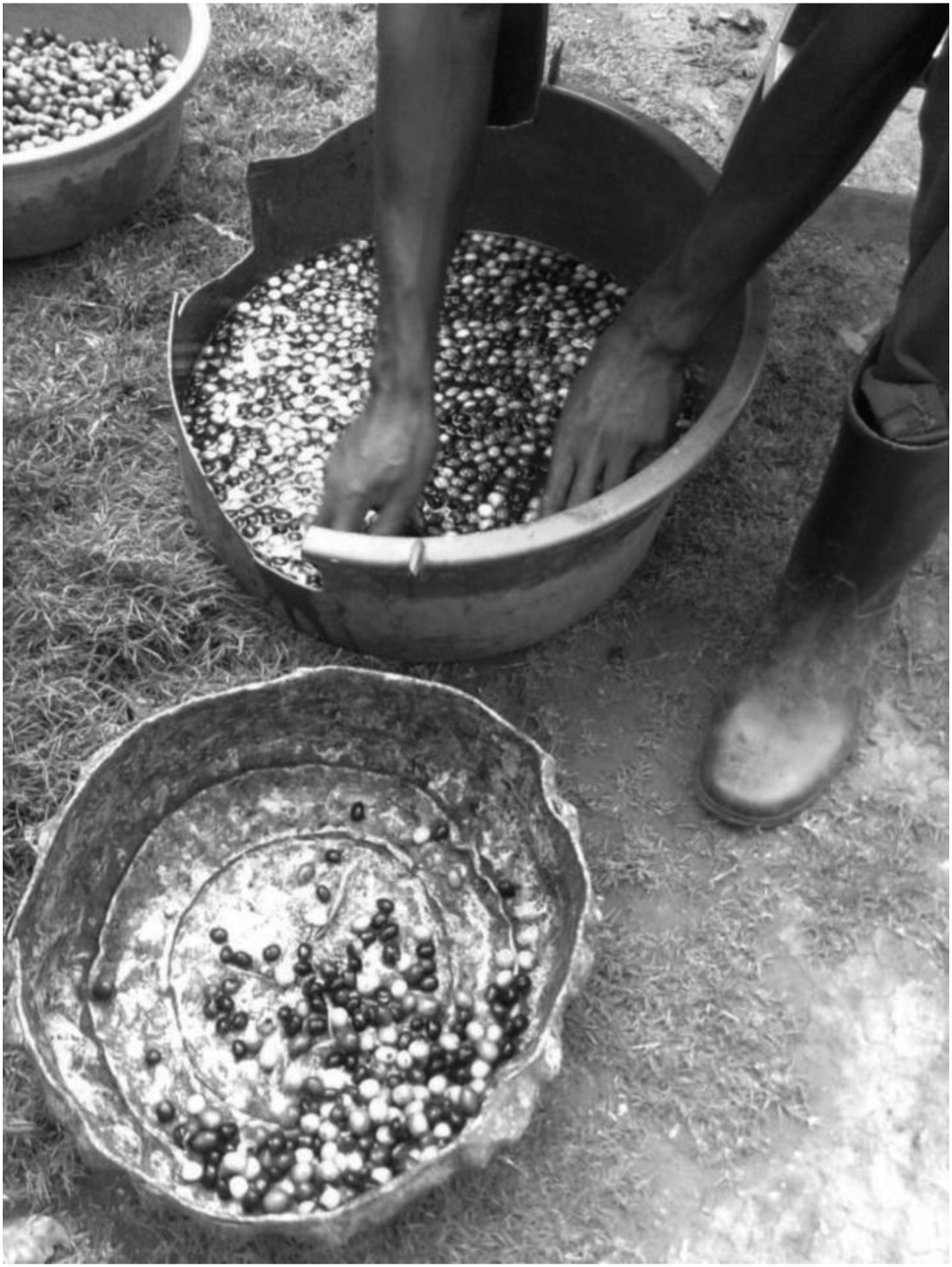
Floats qualify as exchange objects in the conventional market but not in the sustainable market. It is unavoidable that coffee harvests contain marred cherries. Thus, farmers calculate that they can sell spoiled coffee to intermediaries. This inevitably entangles farmers to the conventional market frame. Distinct, inevitable entanglements form the least involving category of farmer-intermediary connections. Farmers inevitably entangle with intermediaries to not miss the opportunity to make earnings from an otherwise wasted commodity.
Notwithstanding the buyers’ conflicting evaluations, the Firm encourages inevitable entanglements. Official Bob remarked once that he “educates farmers to sell floats to intermediaries.” Evidently, the Firm’s quality standards enact the translation of floats (a valueless object in the sustainable market) into an exchange object in the conventional market. Ongoing, inevitable connections between the competing markets result, despite the negligible quantities of floats involved.
Herein, farmers typically maintain a dominant “sustainable farmer” agency and almost exclusively operate in the sustainable market. They are more committed as sellers to the Firm than they are to intermediaries as Farmer Jonah explains: ‘The intermediaries cannot reach me. They know that 'Farmer Jonah…cannot supply his coffee at random…. Other neighbors around—they [intermediaries] do reach there…. They [the intermediaries] cannot reach here [to the homestead] because they know that these people are … well organized. They cannot reach here except to give them the floats—only that.’ (Field note. Homestead 1, Farmer Jonah’s farm).
The ideal sustainable farmer will only enact distinct, inevitable entanglements. The farmer-Firm goals align and value co-creation is interactively enacted primarily in the sustainable market.
Deliberate exchange entanglements
Sometimes farmers seek to increase the quantities of conventional coffee sold, which deepens their entanglement with intermediaries. On top of selling floats, these farmers start to enact deliberate exchange entanglements: Farmer Peter sent his son to an elderly woman, whose farm was across the valley from his…The lady sells only to intermediaries…She’s one of many who don't wet process coffee…Farmer Peter explained that he buys coffee from the elderly woman so he can sell a larger quantity to the intermediaries. The son brought back 2 cups of cherries, as the lady was still picking coffee. She said that she would give him the rest after she’d finished picking. Farmer Peter said he would mix her coffee with his floats. He explained that, by doing so, he gets a better deal from the intermediaries, as the elderly woman’s coffee contains both ripe and raw cherries; and yet his were simply floats/damaged coffee. (Field note. Homestead 1: Farmer Peter’s home).
Farmer Peter’s calculations enable him to increase earnings from intermediaries by upscaling the conventional coffee sold. The farmer seeks to maximize his subsistence income from both markets—a choice aligning Farmer Peter’s evaluations, separately, with those of the Firm and intermediaries. Misalignments in farmer-Firm practices begin to emerge, resulting in marginal interactive value co-destruction.
Reversible exchange entanglements
Deeper connections between farmers and intermediaries occur at this level, when at the point of sale, parchment fails to meet the Firm’s quality standards. Official Bob explains: ‘There are some parameters we check [for] before paying them (farmers): washing, moisture content, appearance of the [coffee] beans. Before weighing, we check [the parchment] so we that are sure of the product we are buying…we buy premium coffee; well-washed coffee—clean coffee without any stains’ (Interview excerpt, Official Bob).
Some farmers do not conform to the Firm’s quality standards. Hence, the agency of quality standards is amplified, effecting the rejection of poor quality parchment by the Firm. Parchment rejects and the involved sellers are instantly disentangled from their “sustainable coffee” configuration. The entities are simultaneously reconfigured as conventional coffee/sellers, permitting the enactment of conventional exchanges.
Official Richard explains that intermediaries “do not reject any type of coffee.” Unwashed coffee qualities are non-discriminatory; hence, parchment rejects qualify as exchange objects in the conventional market. Consequently, the reconfigured, conventional farmers end up rekindling ties (although provisionally) with intermediaries: A farmer selling coffee comes in with a small bag weighing between 2–5 kilos. His coffee was rejected because it was discolored and smelly. Official Bob told me to pick a sample of the “good coffee” [that the Firm had already bought and was in storage] to show this farmer the sensorial [smell and sight] differences. The seller left without much complaint...Official Jude, who was also present, said that the farmers sometimes deliberately bring poor quality coffee to test them (i.e., the Firm). “Farmers know what to do,” he said [i.e., they know all the processes involved in producing quality parchment]. I asked Official Jude if this was a new farmer, and he said that he wasn’t (Field note: The Firm’s field office).
The rejected parchment of the majority of sellers observed was in smaller quantities vis-à-vis the coffee they sold to the Firm. Thus, the farmers observed seemed to be more involved in the sustainable market than they were in the competing market. In Image 2, a farmer is sorting parchment to remove the smaller quantity of marred produce, which he places on the sack. A farmer sorting parchment.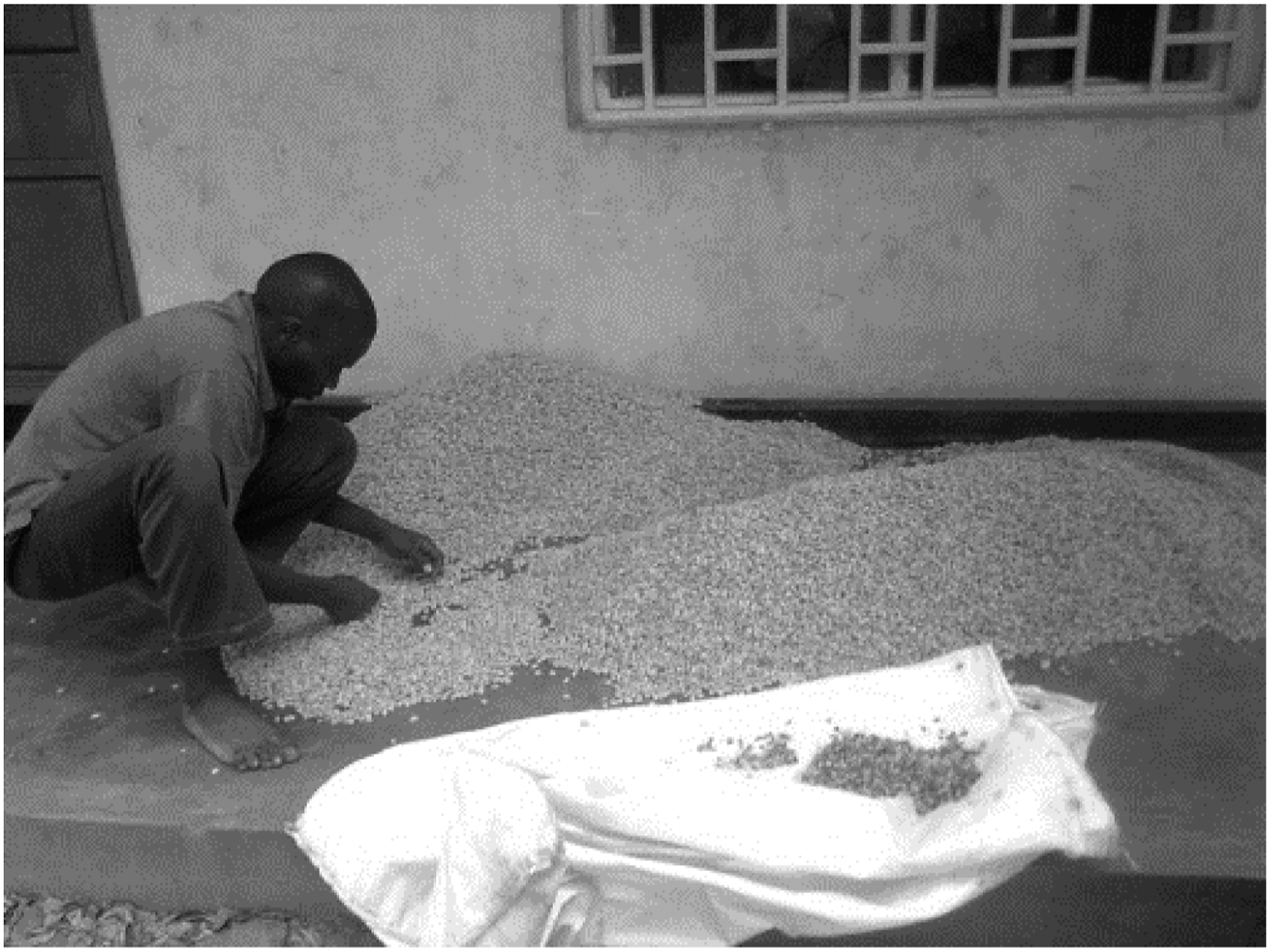
The Firm’s strict quality evaluations are not met and the farmers’ evaluation criteria of meeting subsistence needs (by selling parchment rejects) aligns with intermediaries’ evaluations. Misaligned farmer-Firm practices are also evidenced: the farmers’ production practices deviate from the Firm’s quality standards, resulting in value co-destruction. But, the exchange entanglements are reversible. Farmers can regain the dominant “sustainable farmer” agency by realigning farmer-Firm practices, that is, by conforming to the Firm’s quality standards when processing their subsequent consignment.
Reversible entanglements are sometimes calculative or deliberate, as Official Jude intimated in the field note immediately above, suggesting a degree of mistrust between the Firm and some farmers.
Inevitable/deliberate exchange entanglements
This final category of entanglements emanates from two sources: the scarcity of pulpers and the Firm’s trading hiatus during the offseason. The entanglements are deliberate. In both situations, the sustainable market cannot meet farmers’ substantial income demands. Thus, farmers have no choice but to inevitably engage in deliberate entanglements to meet their survival needs.
The pulper-related, inevitable/deliberate entanglements instigate entrenched relations with intermediaries, which inhibit farmers from producing parchment. Pulpers are a major concern to farmers, given their rarity—as 50 PO farmers share a single pulper, often enduring long queues and arduous walks to access the equipment. Although willing to produce sustainable coffee, farmers calculate that operating almost exclusively in the competing market is a viable option. Some farmers, however, rationalize that parchment production is not worth the effort, as Farmer John explains: ‘The farmers are willing to wet process coffee, but the pulpers are few. The distance [to the processing store] is also a problem. A farmer lives at the top of the mountain and the pulper is down [the mountain]. Carrying coffee from up the mountain and back is hectic…so other farmers said, ‘let those near the pulper “pulp”’ (Field note. Location, Homestead 1: Farmer John’s farm).
Thus, farmers’ evaluations prominently focus on the meeting of subsistence needs. They assess that it is not worth wet processing coffee, given the arduous effort involved in its production.
The Firm too recognizes the subsistence challenges of farmers: ‘Pulpers are very expensive and farmers wouldn’t buy them because they have to pay school fees. The farmers’ income is not enough […] even if one had a pulper, it would not be cost effective for them’ (Official Bob, Interview excerpt).
Hence, the agency of pulpers is illuminated. Scarce pulpers, like inevitable entanglements (although to a greater extent), sustain links between the competing markets. Substantial farmer-Firm practice misalignments (and value co-destruction) are evidenced. Extricating farmers from pulper-instigated entanglements and reversing these entanglements is difficult. It requires heavy financial investment in pulpers, which the Firm cannot afford. The investment in pulpers is a contentious issue, as the Firm urges farmers to purchase the equipment, yet farmers expect the Firm to donate additional pulpers to them (see Onyas and Ryan (2015) for a more detailed discussion).
The second source of inevitable/deliberate entanglements represents the deepest and most complex connection between farmers, intermediaries, and conventional coffee. During the offseason, most farmers obtain mortgage loans from intermediaries, secured against the expected coffee harvest. In the extreme case, the dual agency of intermediaries (alongside mortgage loans) is elevated; these actors tie up the entire coffee harvest so that farmers cannot sell at all to the Firm in the subsequent buying season.
The farmers’ calculations are subsistence-driven, enabling them to benefit from both markets. They mortgage their entire coffee harvest or apportion it between parchment and unwashed coffee, which strengthens their dual agency as sustainable-conventional farmers: The amount of coffee sold to the Firm depends on one’s situation. If children are at school and farmers need money, and there is no money in the village bank to buy coffee, they sell directly to [intermediaries in] town… Not all farmers sell to the Firm. Because of several demands, people mortgage a portion their farms for loans from intermediaries. E.g., UGX 100,000
2
for approximately 200 trees…’ Do farmers always mortgage their farms?’ I asked. ‘It depends on the individual farmer’s demands/ needs’, he replied. Farmers apportion their farms between the Firm and intermediaries. Farmer James mentioned that some farmers ‘habitually mortgage their farms’ (Field note. Homestead 2: Farmer James’ home).
Simultaneously, the farmers’ agency and calculative power is weakened. Farmer Musa (Homestead 1) highlights the challenges farmers face with paying school fees during the offseason: “Intermediaries are now picking the mortgaged coffee. The problem is in Term 2 when they [farmers] need money for kids’ fees and the office is closed, and [the Firm] is not buying [coffee].”
Once deliberately entangled with intermediaries, it is difficult to dislodge farmers from mortgage loan relations until intermediaries have recovered their loan’s worth during harvest time. Deliberate entanglements unavoidably detangle the coffee and the farmers involved from the sustainable market. These farmers can only recover their agency as sustainable farmers and re-entangle with the Firm in subsequent seasons, after settling the mortgage loans.
Hence, the sustainable market excludes the farmers because the farmer-Firm evaluative frameworks are misaligned. The farmers singly consider the evaluative criterion to earn incomes (from intermediaries) to meet their subsistence needs. Extreme farmer-Firm practice misalignments engender strict farmer-intermediary practice alignments, generating substantial interactive value co-creation in the conventional market.
Nevertheless, some farmers manage to maintain their dominant, nearly exclusive “sustainable farmer” agency and do not substantially entangle deliberately with intermediaries. For instance, Farmer Peter only bought a few cups of coffee from a conventional farmer to supplement his floats (see the Deliberate exchange entanglements section), and Farmer Jonah intimated that they sometimes mortgage coffee for as little as UGX 10,000: ‘These intermediaries have already started supplying money. With the coffee almost ripe, one can tell the intermediaries, ‘give me UGX 10,000 and I will give you coffee in the coming month’. He [the intermediary] gives you money and you sort out your problem’ (Field note. Homestead 1: Farmer Jonah’s farm).
As an afterword, the researcher observed a sense of obligation among farmers to maintain their “sustainable farmer” agency. During the PO1 Annual General Meeting, the farmers spent a considerable amount of time reprimanding members who deliberately dry processed coffee. In concluding the matter, the PO chairperson urged farmers to “vow to wet process coffee.” The researcher also observed that farmers were reticent about their deliberate entanglements with intermediaries, never openly acknowledging that they mortgaged their coffee. It was only by chance that the researcher discovered Farmer James’ (Homestead 2) deliberate entanglements with intermediaries: Farmer James [learnt from a farmer leader that the Firm had revealed the season’s parchment price and it was UGX 4,800]. He seemed very disappointed saying that they were going to make a loss, as they had not pulped coffee. I tactfully enquired if it would affect him as well, and he replied in the affirmative. (Field note. Homestead 2, during walk to Farmer James’ farm).
Interlinked exchange entanglements
Although delineated separately, inevitable, reversible, and deliberate exchange entanglements overlap; farmers frequently shift from one exchange entanglement category to another. All farmers in the deliberate and reversible categories enact distinct, inevitable entanglements. Reversible entanglements sometimes become deliberate, and inevitable/deliberate entanglements become reversible when farmers obtain village bank loans and can detach themselves from the conventional market. The ongoing farmer movements across market frames renders the sustainable/conventional market boundaries continuously unstable and indeterminate.
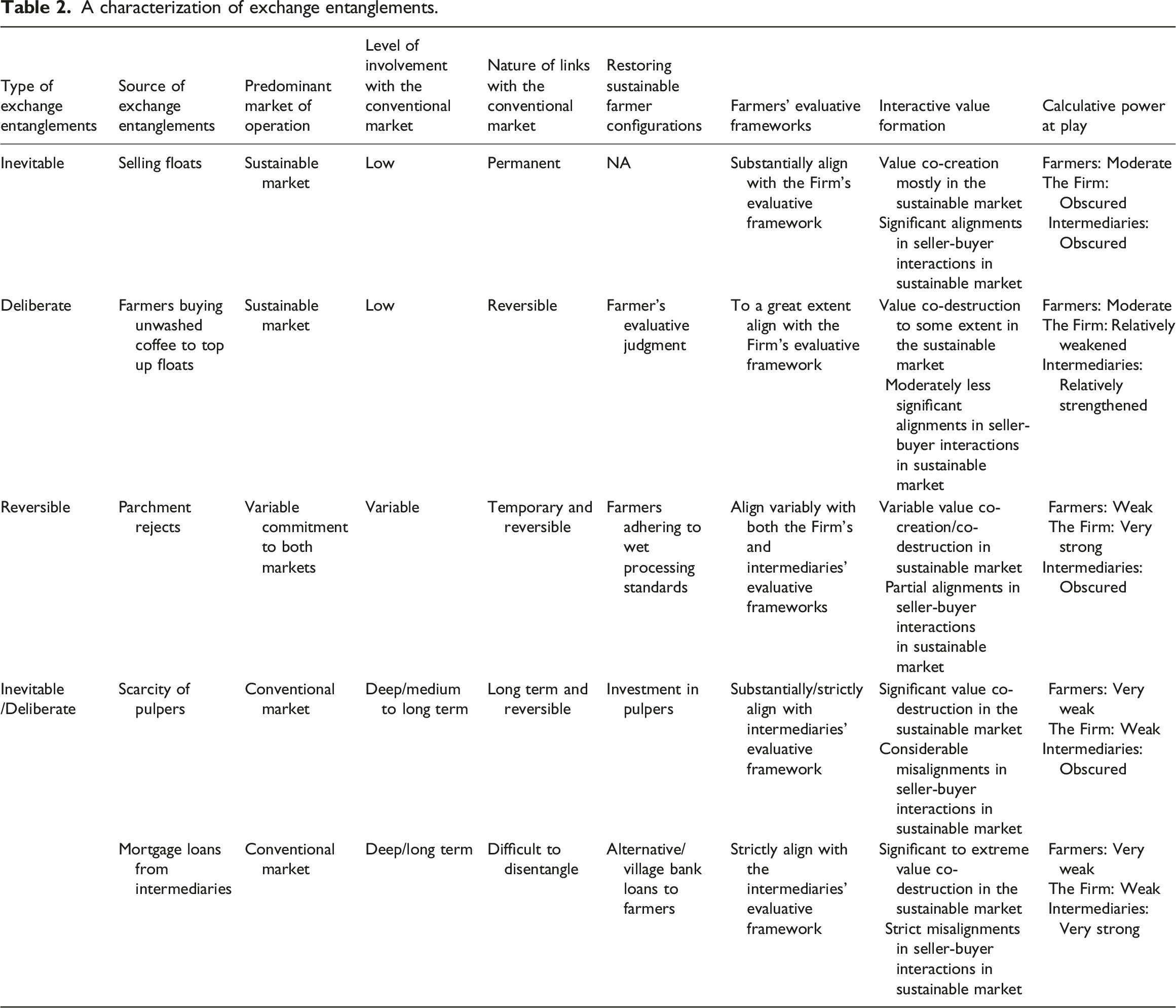
A characterization of exchange entanglements.
The exchange entanglements framework
From the findings, an Exchange Entanglements framework is expounded that forms the basis of the discussion. A heuristic framework is developed (Figure 1), which, in light of the competition to define the exchange object, is relevant in analyzing overlapping market exchanges. The framework is predicated on the case examined, in which the Firm’s market entrance led to the formation of two distinctive, yet overlapping sustainable and conventional market frames. Farmers were presented with a wider choice of market domains in which to operate, on a continuum permitting (nearly) exclusive parchment production/exchange and exclusive unwashed coffee production/exchange. The Firm’s market entrance: 1) instigated the (re)configuration of farmers/coffee into sustainable versus conventional categories, and the competition for sustainable farmers; 2) destabilized existing exchange practices; and 3) accentuated competing market boundaries. The Exchange entanglements framework.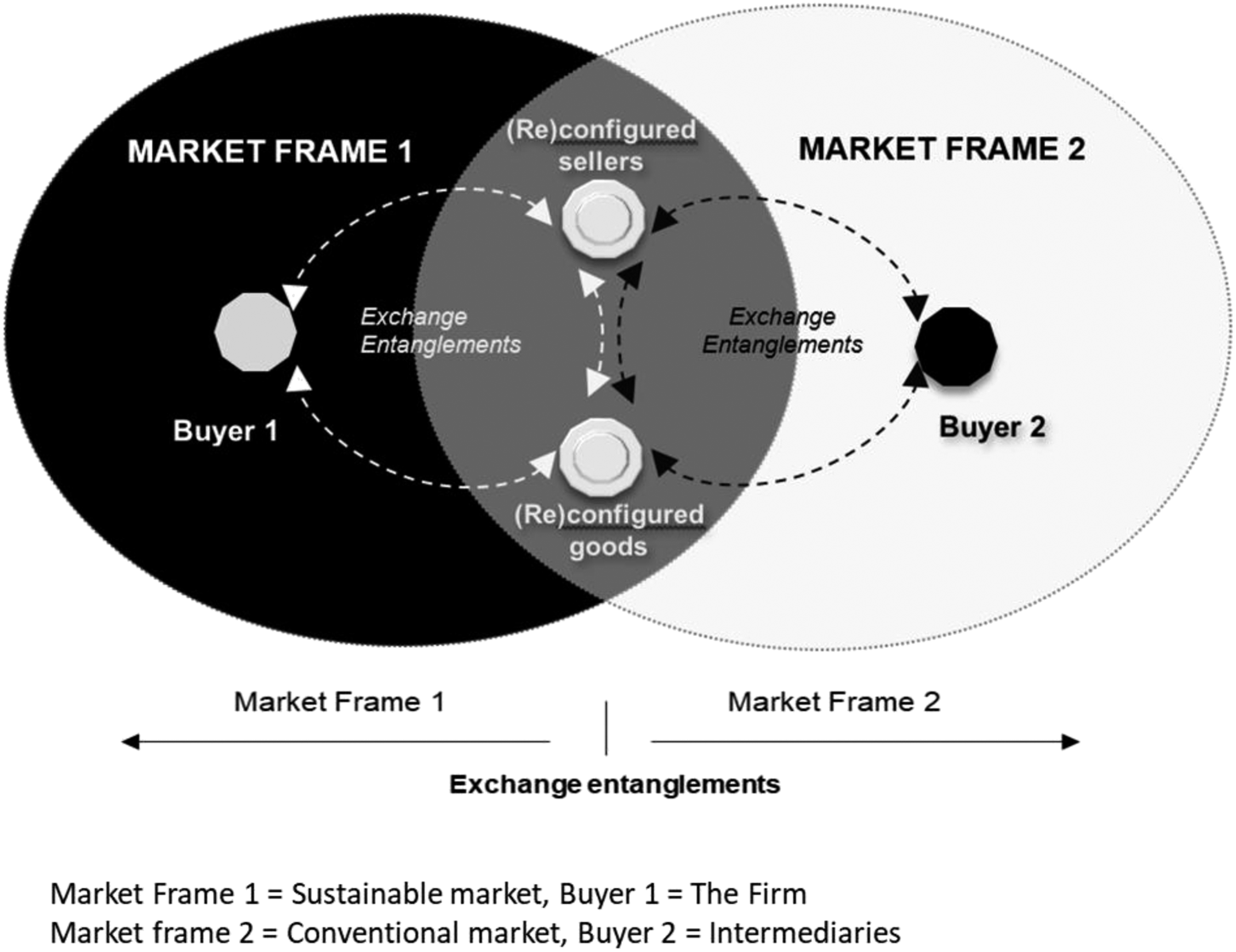
Buyers’ market rules/conditions for exchange constrain farmers’ calculations and actions, forcing them to navigate through both markets. The Firm’s stringent market rules create a narrower bracketing of farmers’ market concerns (particularly during the off-season), and restrict participation in the sustainable market frame. Thus, few farmers qualify to sell strictly qualified sustainable coffee. Conversely, intermediaries’ market rules are lax, creating a broader bracketing of farmers’ market concerns and unrestricted participation in the conventional market frame. Thus, substantially more farmers sell loosely qualified conventional coffee. During the offseason, however, intermediaries’ strict rules around mortgage repayment are created.
Figure 1 depicts exchange entanglements as substitutable (Kjellberg and Olson, 2017) between farmer-Firm and farmer-intermediaries exchanges. From the sellers’ standpoint, the competing exchange entanglements are mutually exclusive. A seller’s attachment to the conventional market simultaneously detaches them from the sustainable market. The framework further delineates three categories of overlapping exchange entanglements: inevitable, reversible, and deliberate, portraying variable levels of exchange relations among market entities (see Figures 2 and 3). The market dynamics at play. Competing seller-buyer coffee trajectories.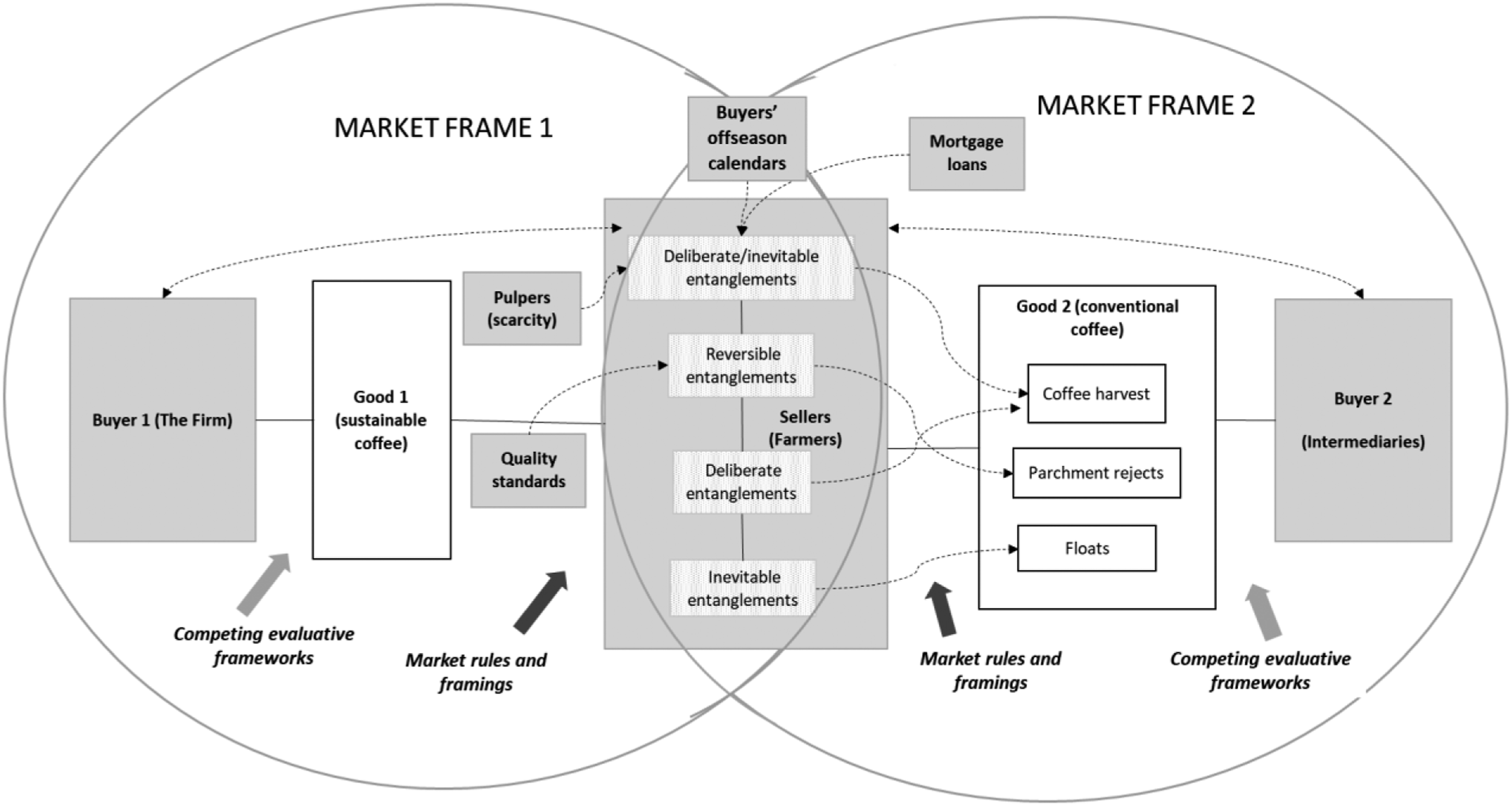
But, how do exchange practices enacted in overlapping concerned markets evolve? This is expounded in the following themes: The market dynamics at play. The unfolding, multiple seller-buyer coffee trajectories enacted, alongside the associated interactive value formed in the competing markets. The asymmetrical power at play, and the related agency (re)configurations enacted. The (mis)alignments evolving between competing evaluative frameworks and interactive practices.
In Figure 2, the market dynamics at play in the enactment of overlapping exchanges is depicted, revealing an agencement acting collectively in different ways, depending on the configuration of arrangements (Çalışkan and Callon, 2010). The distributed, heterogeneous actors—sellers and buyers (humans) alongside quality standards, pulpers, buyers’ offseason calendars and mortgage loans (non-humans)—collectively construct diverse overlapping exchange entanglements. Buyers’ market rules and framings alongside competing evaluative frameworks act behind the scenes to orchestrate the actions performed to enact exchange entanglements.
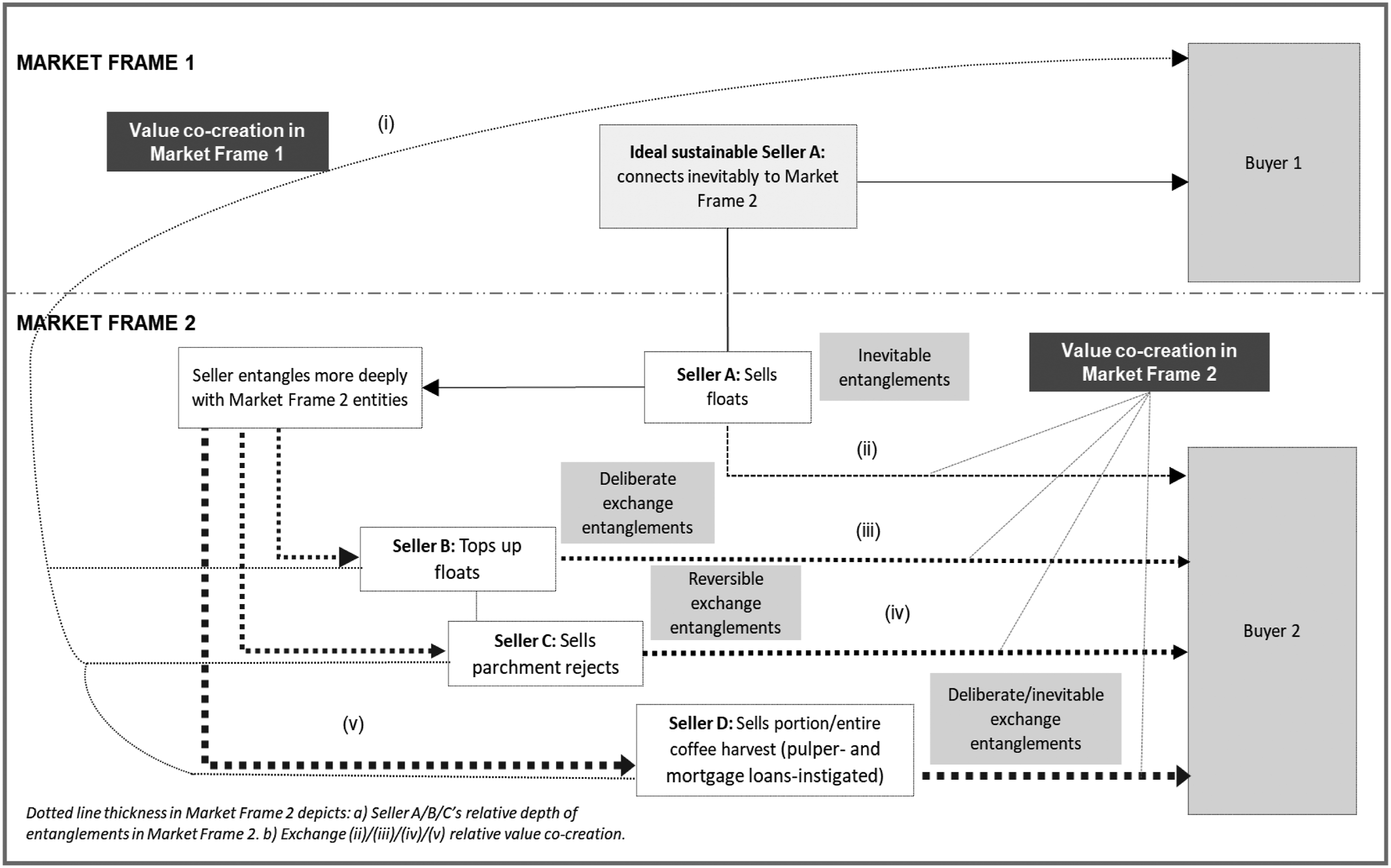
Figure 3 illustrates competing seller-buyer coffee trajectories, including the three forms of exchange entanglements enacted. Seller A displays the ideal “sustainable seller” configuration that only engages in distinct, inevitable entanglements. Sellers B, C, and D deviate more deeply into the conventional market space by engaging, respectively, in deliberate, reversible, and inevitable/deliberate entanglements. Seller B may sometimes assume Seller C’s configuration (and vice versa) by simultaneously topping up floats and selling parchment rejects.
Concurrently, Figure 3 illustrates interactive value formation in the overlapping markets. Value co-creation in the sustainable market occurs when farmers sell to Buyer 1 and engage in exchanges (arrow (i)), which simultaneously enact interactive value co-destruction in the conventional market. In the conventional market, value co-creation is enacted in varying degrees in exchanges (ii), (iii), (iv), and (v).
Dotted line thickness depicts: (a) Sellers B, C, and D’s progressive depth of entanglements in the conventional market. For example, Seller B’s entanglements with Buyer 2 are marginal whilst Seller D’s are significant. (b) The relative value co-created in exchanges (ii), (iii), (iv), and (v). For example, exchange (ii) represents the least value co-created, while exchange (v) represents the most value co-created between farmers and intermediaries.
Crucially, the Exchange Entanglements framework illustrates the possibilities open to actors, and the calculations motivating their choice of exchange object to produce and/or market frame of operation. But, the calculations of marginalized farmers are majorly influenced by the calculative spaces constructed by dominant market players. The dominant actors define and organize market entities, relations and calculation spaces which amplify power asymmetries in markets (Callon and Muniesa, 2005). Moreover, the market actors’ calculations and calculative power vary depending on the type of exchange entanglements involved (see Table 2).
With inevitable entanglements, the farmers’ calculative power is moderate. That of both buyers is obscured—in the background, the Firm’s market rules dictate the treatment of floats in both markets. The Firm’s calculative power is mitigated when farmers deliberately top up the floats sold, whilst simultaneously, that of intermediaries is relatively strengthened. With the inevitable/deliberate and reversible exchange entanglements, farmers’ calculative power varies from very weak to weak, while that of the Firm is very strong vis-à-vis the reversible exchange entanglements. The Firm’s weak calculative power is displayed in the inevitable/deliberate entanglements scenario, yet that of intermediaries is most powerful (but is obscured in all other exchange situations). The seemingly neutral power of buyers obscures the asymmetrical power dynamics operating behind the scenes, which dictate farmers’ calculations and actions. Ultimately, relationships of buyer-seller domination (Çalışkan and Callon, 2010) are brought to light in this study. Concurrently, this finding illustrates the symbiotic reactions from market entities (Storbacka and Nenonen, 2011); notably, the (re)configuration of interlinked identities (sellers and the exchange object). The buyers’ configuration in contrast remains stable despite the sellers’ wavering exchange decisions.
Furthermore, this study illustrates the coincidences and clashes (Geiger and Gross, 2018) evolving in overlapping, concerned markets, which take the form of (mis)aligned evaluative frameworks and interactive practices. Firstly, farmers’ evaluative frameworks align closely with the Firm’s in the distinct inevitable and deliberate categories, and with intermediaries’ in the inevitable/deliberate category (Table 2). With deliberate and reversible entanglements, farmers’ evaluations align with those of both buyers. The farmers’ evaluations in all entanglement categories relate to the meeting of subsistence needs and is especially pronounced (and singly considered) with the inevitable/deliberate entanglements pertaining to mortgage loans. Ultimately, aligned farmer-Firm evaluative frameworks trigger misaligned farmer-intermediary evaluative frameworks, and vice versa. The misaligned evaluative frameworks reflect disagreements regarding what actors consider as valuable (Stark, 2009), which trigger movements across competing market frames.
Secondly, the Firm’s ideal goal to create nearly exclusive “sustainable seller” agencies (and thereby co-create value) is not met. Whereas the Firm maintains a stable “sustainable buyer” agency, the most pressing goal for farmers, despite their motivation to maintain “sustainable seller” agencies, is to meet their subsistence needs. Hence, misaligned production/exchange practices ensue, evoking unstable (re)configurations of (sustainable/conventional) farmer/coffee agencies. Although capable of acquiring nearly exclusive “sustainable seller” agencies, resource constraints (e.g., scarce pulpers), negligent processing practices, and counter-offers from intermediaries inhibit farmer-Firm practice alignments. Misaligned farmer-Firm practices trigger diversions to the conventional market and diminish/co-destroy value in their interactions. Ultimately, (mis)alignments in the overlapping markets hinge on farmers’ subsistence-informed choices.
How then do overlapping exchanges address farmers’ subsistence challenges? Foremost, this study highlights the problematic challenge of enacting concerned markets that serve marginalized market actors. Attentive to the subsistence challenges of farmers, this study demonstrates that pressing survival needs override the rationalizations by farmers that sustainable markets are beneficial to them. Farmers’ concerns are largely addressed in the predominant market they operate in (Table 2): Market concerns pertaining to distinct inevitable and deliberate exchange entanglements are largely addressed in the sustainable market; those pertaining to inevitable/deliberate exchanges are addressed in the conventional market; and concerns regarding reversible exchange entanglements are variably addressed in both markets.
Accordingly, this study shows that the calculations of marginalized actors, mitigated by subsistence motives, instigate resourceful efforts by the actors to address market concerns. Actors leverage wider economic opportunities to get the most out of competing market frames (Slater, 2002), and thereby realize “practical solutions to problems” (Callon and Muniesa, 2005: 1229). Hence, this article argues that distinctions between sustainable and conventional markets cease to matter to marginalized actors facing subsistence challenges. The farmers investigated are still a long way from attaining economic sustainability. Are the overlapping exchanges enacted a lasting solution to their subsistence challenges? No. A lot more is needed as will be proposed in the conclusions.
Conclusions
This article tackles an underexplored topic in the market framing literature—the enactment of exchange practices in overlapping, concerned markets. Examined in the context of sustainable/conventional markets, the study investigates how exchange practices are enacted in overlapping markets to address farmers’ subsistence challenges. An Exchange Entanglements framework is developed, which contributes both to the literature on framing overlapping markets and that on concerned markets.
The article contributes to the dearth of studies on concerned markets which organize direct transactions between market actors (Geiger et al., 2014). Extant research focuses on the framing of concerned markets to handle externalities, and highlights how market frames are shifted/adapted to account for market concerns (Geiger and Gross, 2018; Milyaeva and Neyland, 2016). Absent in this literature are studies on the enactment of exchanges to account for concerns in overlapping markets. This study addresses this research gap. Herein, three areas of contribution are highlighted.
First, the Exchange Entanglements framework proposed presents a novel heuristic tool for analyzing overlapping exchanges to account for: market concerns, calculative power asymmetries, and the (re)configuration of market entities. The framework unveils the continuous (re)configuration of actors, which is tied to their weaker calculative agency vis-à-vis the stable configuration of dominant market actors depicting their asymmetrical capacity to withstand market vicissitudes.
Second, the framework extends our understanding of how coincidences and clashes (Geiger and Gross, 2018) unfold in concerned markets. It highlights the inverse formation of interactive value (Echeverri and Skålén, 2021) in competing markets, and demonstrates that (mis)aligned practices in one market trigger inverse responses in competing markets. Aligned evaluative frameworks foster the enactment of exchanges in competing markets, while misalignments trigger movements across competing market frames.
Third, the framework defines two levels at which overlapping exchanges are organized: 1) At the level of dominant market actors competing to serve marginalized market actors, who constrain the calculations and exchange practices of weaker market actors. 2) At the level of marginalized market actors navigating competing markets to address their subsistence challenges. The stark display of the asymmetrical calculative power at play in overlapping (sustainable and conventional) markets uncovers overlying spaces of (constrained vs dominant) calculation.
The second theoretical gap addressed pertains to the framing of overlapping markets; specifically, the nascent characterization of overlapping market exchanges. Existing studies characterize market exchanges as involving exchange objects which simultaneously assume different configurations (exchange vs investment objects) (Winroth et al., 2010), and establish the complementarity and substitutability of exchange interrelations (Kjellberg and Olson, 2017). The Exchange Entanglements framework introduces a new categorization of inevitable, reversible, and deliberate exchange entanglements, and a new dimension (i.e., the mutual exclusivity) of substitutable exchanges in competing markets.
This article provides deeper empirical insights on the simultaneous participation of farmers in conventional/sustainable markets, and on how farmers attempt to make markets work for them (Vorley et al., 2012). It illuminates how farmers purposefully navigate established exchange practices and seek solutions traversing conventional/sustainable market boundaries to creatively address their subsistence challenges. Hence, this article calls for practitioners to view market failures (both conventional and alternative) as counteractive between opposing markets, and as potentially opening up wider economic opportunities for farmers. It further calls on actors driving sustainability initiatives (e.g., the Organic movement or social enterprises) to take the subsistence-informed calculations of actors and their creative agency (see Venugopal and Viswanathan, 2017) into account when designing sustainable markets.
Ultimately, this article brings to light the limitations of commodity markets serving marginalized actors, whose subsistence is at stake. It questions the extent to which dominant market players can address farmers’ subsistence challenges, and calls for concerted efforts to strengthen the agency of marginalized market actors. This requires the commitment of vast resources, the participation of a wider range of actors (e.g., governments, development organizations, etc.), and a rethinking of mechanisms to build the capacity of the poor to construct and shape their own markets. Bottom-up approaches to designing subsistence markets to benefit marginalized actors (Chakrabarti and Mason, 2014) can be equally considered.
This study focused on a specific setting, and drew on the Firm’s and farmers’ perspectives to account for the enactment of overlapping market exchanges. Despite the rich ethnographic insights provided, the views of intermediaries (important actors in this account) are not represented, as were those of non-participating farmers/POs. Future research capturing the unrepresented perspectives will provide a more complete picture of the overlapping market enacted.
The article opens new questions on how overlapping markets can account for market concerns, and are organized. Further exploration of the Exchange Entanglements framework is needed, to establish its applicability in analyzing diverse overlapping market contexts. Insights from this study can be useful in exploring alternative facets of concerning, besides the one investigated in this article—organizing direct transactions between market actors (Geiger et al., 2014). The framework can be a starting point for researching binary or multiple market frames, for example, those occurring in apparel markets (ultra-fast, fast, sustainable, luxury, and traditional). Needless to say, market concerns are as diverse as they are distinctive; thus, the framework could apply or not in the suggested contexts. Equally, questions on how the poor can be equipped to address subsistence challenges/shape their own markets are crucial. Perspectives taking subsistence market actors “front and centre” of inquiry (Venugopal and Viswanathan, 2017: 9) can be considered in further exploring these issues.
Footnotes
Acknowledgements
The author would like to thank the Editor and the anonymous reviewers for their valuable and constructive comments.
Declaration of conflicting interests
The author declared no potential conflicts of interest with respect to the research, authorship, and/or publication of this article.
Funding
The author received no financial support for the research, authorship, and/or publication of this article.
