




Abstract
While social evaluations have gained prominence in the field of marketing, few studies have investigated how brands strategically mobilize their social evaluations. This study aims to further explore the potential of social evaluations to shed light on brand management processes. Through a qualitative content analysis of 420 unique magazine ads of 36 fine watchmaking brands over a four-year period, we show how brands strategically draw from the distinct repertoires of status, reputation, and legitimacy to signal their social position and increase their appeal to consumers. We find that brands mobilize and combine cues from the three repertoires in different ways and that these variations stem from differences in the brands’ strategic intent and extent of market embeddedness. We discuss the contributions of these findings to the marketing literatures on social evaluations and on the role of advertising in brand building and conclude by outlining avenues for future research.
Market system dynamics approaches (Giesler, 2003, 2008) have gained prominence in recent marketing research. In contrast with neoclassical economic conceptualizations of markets as predetermined entities, these approaches conceive markets as arenas of social interactions in which economic exchanges are embedded in and shaped by complex social dynamics (Coskuner-Balli and Ertimur, 2017; Giesler and Fischer, 2017; Humphreys, 2010; Kjeldgaard et al., 2017). Confronted with uncertainty and ambiguity, market actors thus rely on social structures to develop beliefs or knowledge about companies, thereby simplifying their decision-making and facilitating economic exchanges in situations in which they do not possess perfect information on the quality or value of the commodities exchanged (DiMaggio and Powell, 1983). While companies’ social standing within these structures constitutes cues that can be used to determine their quality and value (Philippe, 2009; Roulet, 2019), they also have the ability to shape markets and influence their social position (Baker et al., 2019).
Social evaluations, or collective and socially constructed perceptions of market actors’ social standing, have become the focus of an abundant stream of research on organizations and management (e.g., Piazza and Castellucci, 2014; Suddaby et al., 2017). In particular, organizational status, reputation, and legitimacy are three social evaluations that significantly influence actors’ perceptions of organizations and their willingness to interact and transact with them (Bitektine, 2011). Status, reputation, and legitimacy do not constitute objective intrinsic characteristics of an organization but are perceptional/perceptual constructs, built by multiple actors through evaluative and attributional processes. Research on organization theory and management has extensively investigated how organizations strategically mobilize, leverage, and deploy these social evaluations (e.g., Delmestri and Greenwood, 2016; Elsbach and Sutton, 1992; Philippe and Durand, 2011) to influence their range of market opportunities, such as their attractiveness to alliance partners or clients (Collet and Philippe, 2014; Jensen, 2006; Podolny, 1993), sustained financial performance, or market dominance (Roberts and Dowling, 2002; Shamsie, 2003).
Social evaluations have also gained prominence in the field of marketing. For example, marketing researchers have widely documented how consumers use goods to signal their status to external audiences (for a review, see Dubois and Ordabayeva, 2015) and, more recently, how brands can engage in status games to gain an enduring competitive advantage in their market (Humphreys and Carpenter, 2018) or reconfigure the social game that underlies service encounters (Dion and Borraz, 2017). Marketing research has examined the influence of brand reputation on the perception of products (e.g., Dawar and Parker, 1994), on the strength of the brand relationship (Veloutsou and Moutinho, 2009) or customer loyalty (Selnes, 1993), and on the brand’s ability to charge premium prices (Milgrom and Roberts, 1986). Regarding the concept of legitimacy, research has investigated it in the context of consumers’ responses to brand extension (Spiggle et al., 2012) or retailer promotions (Handelman and Arnold, 1999). Studies have also described how brand legitimacy can be co-constructed (Kates, 2004), add to the brand’s social power (Crosno et al., 2009), and influence shopping intentions (Chaney et al., 2016). A recent stream of market-based research has also begun investigating legitimation processes in new and mature markets (e.g., Coskuner-Balli and Ertimur, 2017; Debenedetti et al., 2021; Humphreys, 2010; Martin and Schouten, 2014).
Despite growing interest in social evaluations, marketing research has not fully explored the potential of social evaluations to shed light on how brands make sense of and give sense to their market embeddedness and trajectories, due to two main limitations of extant approaches. First, though by no means systematic, confusion exists on how these different social evaluations are defined and measured (see Humphreys and Carpenter [2018], who equate status with fame and recognition, or Crosno et al., [2009], who conflate legitimacy with reputation and status). Although social evaluations share commonalities, they are not substitutable and rest on different evaluation mechanisms. Second, and more importantly, little attention has been paid to how brands strategically mobilize and leverage different dimensions of their social standing to manage customers’ perceptions. Among the few notable exceptions (e.g., Debenedetti et al., 2021; Dion and Borraz, 2017; Humphreys and Carpenter, 2018) is Arnold et al.’s (2001) study on Walmart, which shows how the U.S. retailer strategically use advertising flyers to construct the image of a small, neighborly shopkeeper to legitimize itself in the eyes of customers. However, although these rare studies emphasize brands’ strategic use of social evaluations, none explore brands’ ability to influence perceptions of their social worth from an integrative perspective (i.e., by leveraging different dimensions) but, instead, tend to focus on one specific social evaluation, thus missing the opportunity to explore their contrasted or combined effects.
In this study, we build on the market system dynamics literature (Coskuner-Balli and Ertimur, 2017; Giesler and Fischer, 2017; Kjeldgaard et al., 2017) to argue that brands may strategically draw from the repertoires of social evaluations cues to signal their market position, build their symbolic power within the social dynamics in which they are embedded, and increase their appeal to their audiences. Rather than focusing on the benefits that can be derived from brand status, reputation, or legitimacy, we investigate how brands strategically mobilize and leverage different dimensions of their social standing in their communication to manage consumers’ perceptions. We explore this question in the context of the fine watchmaking market, which constitutes an interesting setting for two reasons: it is part of the luxury field, in which signaling one’s social position is particularly important (Dion and Borraz 2017; Gurzki and Woisetschläger, 2017); it is a rich and complex market populated with different types of actors or brands, which entered it at different stages (Donzé, 2009; Raffaelli, 2019). Our content analysis of the magazine ads of 36 watchmaking brands enables us to identify four ways of mobilizing and combining cues from the status, reputation, and legitimacy repertoires. We also find that these strategies are not merely left to brands’ discretion but are also dependent on their embeddedness in the market. Finally, our findings also suggest nuances in the way luxury brands communicate.
Theoretical background
Focused on the “context of context” (Askegaard and Linnet, 2011), market system dynamics research calls for a shift from a micro level to a macro level of analysis of market interactions (Giesler and Fischer, 2017) as well as a shift from an objective, detached, and deterministic view of markets to a conceptualization of markets as dynamic, subjective, and subject to multiple change efforts (Nenonen et al., 2014). In this context, social evaluations, as co-constructed positions of actors, represent central cues that market actors use to simplify market-based social interactions (Philippe, 2009). Consistent with market system dynamics (Baker et al., 2019), brands may try to influence their social position in the market by mobilizing resources at their disposal. In particular, brands can play on status, reputation, and legitimacy. In the following sections, we define and discuss the strategic value of these social evaluations for organizations and brands.
Status
Before its diffusion in organization and management research, status was extensively investigated in disciplines such as sociology and social psychology (Piazza and Castellucci, 2014). Status refers to the socially constructed, inter-subjectively, agreed-on position or rank that an actor occupies within a social structure (Washington and Zajac, 2005). It serves as an evaluation of this actor’s worth (Jasso, 2001) based on the possession of discriminating characteristics—that is, characteristics associated with general expectations for superior (or inferior) ability (Ridgeway and Berger, 1986). Status is fundamentally honorific (Deephouse and Suchman, 2008), as it elicits deference and tribute (Gould, 2002) and generates privilege (Washington and Zajac, 2005).
Higher-status actors benefit not only from easier conditions for producing output but also from greater rewards than their lower-status counterparts for producing a given level of quality (Gould, 2002). Extant research suggests, for example, that high-status organizations are more likely to enjoy lower transaction costs (Podolny, 1993), greater returns from quality investments (Benjamin and Podolny, 1999), and reduced pressures to conform to social norms and expectations (Phillips and Zuckerman, 2001).
Marketing literature has also begun investigating the status dynamics of markets from a brand perspective. In their study of the U.S. wine industry, Humphreys and Carpenter (2018) show that brands were engaged in a status game whose winners could set benchmarks and shape consumer preferences to the brands’ advantage. In a business-to-business context, Gould et al. (2016) similarly emphasize that the potential of foreign organizations to select high-status local partners in emerging markets helps them achieve positive relationship outcomes.
Reputation
The concept of reputation is inherited from game theory and refers to multiple audiences’ beliefs, constructed over time, about the likelihood that the organization will deliver value along specific dimensions (Fombrun and Shanley, 1990; Rindova et al., 2006). These beliefs are based on repeated observations of the quality of past products or characteristics, which serve as indicators of present and future quality (Shapiro, 1983). Reputation thus reflects the “underlying quality … differences among organizations” (Washington and Zajac, 2005: 283) and, as such, constitutes “a perceptual representation of a company’s past actions and future prospects” (Fombrun, 1996: 72).
Because reputation stands for how well a focal organization fares relative to its competitors, market participants rely on it for a wide range of decisions encompassing investment or career decisions as well as product choices (Fombrun and Shanley, 1990). Enjoying a favorable reputation is thus associated with benefits such as enhanced customer retention (Selnes, 1993), improved consumer–brand relationship (Veloutsou and Moutinho, 2009), greater ability to charge premium prices (Milgrom and Roberts, 1986), better perception of the brand’s products (Dawar and Parker, 1994), and increased sales, market share, and relative price (Chaudhuri, 2002).
Legitimacy
Since Weber’s (1947) landmark work, legitimacy has been a central theme in sociological studies. Legitimacy refers to a socially constructed sense of appropriateness (Suchman 1995) and “the endorsement of an organization by social actors” (Deephouse, 1996: 1025) based on the perception or assumption that this organization’s actions are desirable, proper, or appropriate. The concept has received much attention from scholars in institutional theory, who focus on processes of normative evaluation of organizations, organizational forms, or practices (e.g., Suchman, 1995). An organization is said to be legitimate when consumers perceive it as pursuing socially acceptable goals in a socially acceptable manner (Ashforth and Gibbs, 1990).
While being or appearing illegitimate imparts penalties (Zuckerman, 1999), being or appearing legitimate confers multiple advantages. Organizational research has shown how being legitimate enhances an organization’s ability to acquire resources (Lounsbury and Glynn, 2001) and ultimately its survival chances (DiMaggio and Powell, 1983), whereas marketing research has discussed how legitimacy can lead to stronger support from consumers (Handelman and Arnold, 1999), increased shopping intentions (Chaney et al., 2016), better gains from new products (Rao et al., 2008), and greater efficiency of marketing channels in international markets (Yang et al., 2012). As organizations seek legitimacy to ensure their stability and survival, they adopt structures and practices that can help them secure this social acceptance (DiMaggio and Powell, 1983).
The distinctive properties of these social evaluations
Status, reputation, and legitimacy all significantly influence market actors’ perceptions of a focal actor’s worth as well as their willingness to exchange resources with this actor (Bitektine, 2011). As such, they share a certain number of common characteristics. For instance, status and legitimacy both imply acts of social acceptance. Similarly, reputation and legitimacy are based on assessments of a focal actor’s fulfillment of expectations, and since they are both multi-dimensional constructs, the same organizational attributes or characteristics may be used to evaluate both reputation and legitimacy.
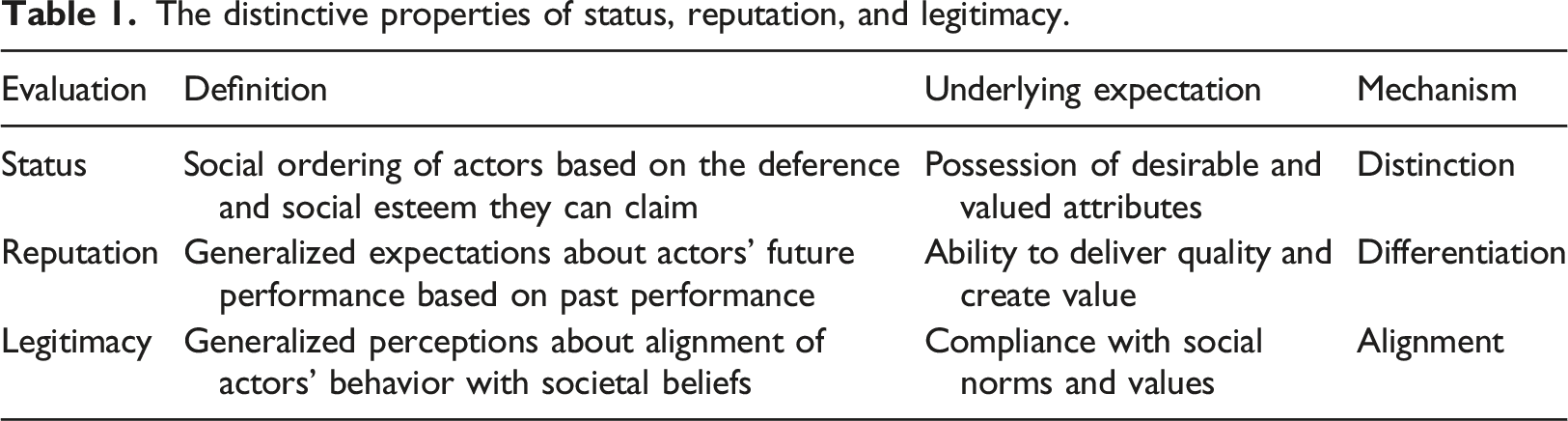
Although status, reputation, and legitimacy share common characteristics, they differ in their underlying mechanisms. Reputation judgments are grounded on the observation of an organization’s past quality and behavior and are driven by a differentiation mechanism. They focus on differences between organizations on specific characteristics and involve comparisons between organizations. Status judgments are grounded on the organization’s possession of desirable attributes or characteristics. They rely on social closure and are driven by a mechanism of distinction. This distinction mechanism is associated with the notions of exclusiveness, prestigious standing, and hierarchy, in contrast to the neutral differentiation mechanism underlying reputation judgments. As with reputation, status judgments thus involve comparisons, but the antecedents and mechanisms of evaluation are different. As for legitimacy judgments, they do not involve direct comparisons between organizations—in contrast to reputation and status judgments which focus on identifying differences between organizations—but rather seek to compare the organization’s behavior or characteristics with social expectations regarding what it should look like or how it should behave. As legitimacy judgments are grounded on the observation of the organization’s compliance with the norms and values deemed desirable, they are driven by an alignment mechanism. When reputation and status are about standing out, legitimacy relies on more inclusive mechanisms since compliance with expectations implies some degree of convergence of organizational behaviors. Table 1 below summarizes the distinctive properties of these social evaluations.
Few, if any, empirical studies have investigated how actors or brands jointly mobilize all three social evaluations. More importantly, marketing research has yet to fully explore the potential for a strategic use of these different evaluations in brand communication. This research thus aims at filling this gap by investigating how brands can strategically mobilize and deploy cues pertaining to the repertoires of these social evaluations in order to construct their image and increase their overall appeal.
Method
Context
We explore how brands use social evaluation cues in their communication strategies in the context of the luxury industry. The luxury industry is well suited for our investigations because it is an industry in which signaling one’s social position is particularly important (Gurzki and Woisetschläger, 2017). As Dion and Borraz (2017: 67) argue, “luxury brands are different from other types of brands because they follow a logic rooted in their sociological characteristics that is fundamentally different from that of mass-market brands.” As a market involving the “economics of singularity” (Karpik, 2007), goods and services are multidimensional, incommensurable, and valued based on highly subjective evaluations.
In the luxury industry, we elected to focus on the fine watchmaking (haute horlogerie) market, which provides an appealing setting in which to explore our research question. Fine watchmaking is characterized by a difficult-to-define perimeter, a wide array of technical characteristics, and a large range of product prices. There is no clear definition of fine watchmaking (in contrast with, for example, haute couture, which refers to a legally defined appellation). In a white paper, Fondation de la Haute Horlogerie (FHH, 2016: 14) (the Swiss official watchmaking organ, hereafter FHH) refers to fine watchmaking as the “excellence in watchmaking, the techniques of watchmaking in symbiosis with the applied arts,” a rather vague and subjective definition. Given such ambiguity, brands’ ability to signal their social position is essential to help consumers and other market actors navigate the market.
Today, the watchmaking market is largely dominated by Swiss brands, renowned for their watchmaking expertise. Watchmaking in Switzerland was born at the beginning of the 17th century in two regions: Geneva and the Arc Jurassien, which is located around the Neuchâtel Lake. Although Germany was the first nation to build miniaturized portable clocks (around 1530), and the Switzerland industry faced strong competition from the British, French, and Dutch markets, Swiss watchmakers were at the origin of many inventions during the 18th century (e.g., the perpetual watch or the tourbillon).
Switzerland had a unique production system, called établissage, which consisted of dividing up the production process into many independent entities held by different specialized craftsmen (often working from home), with the final product being assembled by the manufacturers at the end (Donzé, 2009). This system enabled the Swiss industry to maintain its hand-crafting and traditional characteristics, while developing its watches at a much faster pace than competitors. By 1850, Switzerland was producing 10 times more watches than Britain (2,000,000 vs 200,000). Although Switzerland had little interest in mass production, Swiss watchmakers were forced to modernize their production processes at the end of the 19th century (due to competition from the American market, which produced voluminous quantities of cheaper watches), shifting from their établissage process to a factory production mode (Donzé, 2009). The industrialization of the production with added mechanization led to higher levels of productivity, while maintaining the unique know-how of Swiss craftsmen.
The greatest challenge to Swiss supremacy came from the so-called Quartz revolution, which occurred between 1970 and 1980. The introduction of battery-powered quartz watches around the world, which largely rendered mechanical watches obsolete, caused a major crisis in the Swiss industry, which was unprepared for the rise of the new technology. The country rapidly lost its competitive edge and led many Swiss manufacturers to reposition the Swiss watchmaking industry toward the high-end luxury segment of the market (Donzé, 2009; Glasmeier, 2000) and re-start the production of mechanical watches, which had almost been abandoned (Raffaelli, 2019). By re-defining and combining values of craftsmanship, luxury, and precision, they were able to rebuild the community of mechanical watchmakers (Raffaelli, 2019) and create demand for “exceptional watches” (Jeannerat, 2013). By 2008, the Swiss mechanical watchmaking industry had reemerged to become the world’s leading exporter (in monetary value) of watches, thereby re-establishing its worldwide domination.
Data collection, coding process, and analysis
As our aim was to understand how fine watchmaking brands signal their social position in their customer-oriented communication, we collected and analyzed all the printed advertisements published by 36 watchmaking brands in French magazines between 2011 and 2014. According to Gurzki et al. (2019: 401), “advertising is one of the key instruments that luxury firms can leverage to confer their brands with meaning.” Magazines are an ideal vessel for communicating about high-end and technical products that may require detailed information, and France is well known for its rich magazine press actively highlighting luxury products, including watches. We collected data at the brand level, consistent with marketing communication practices at the customer level.
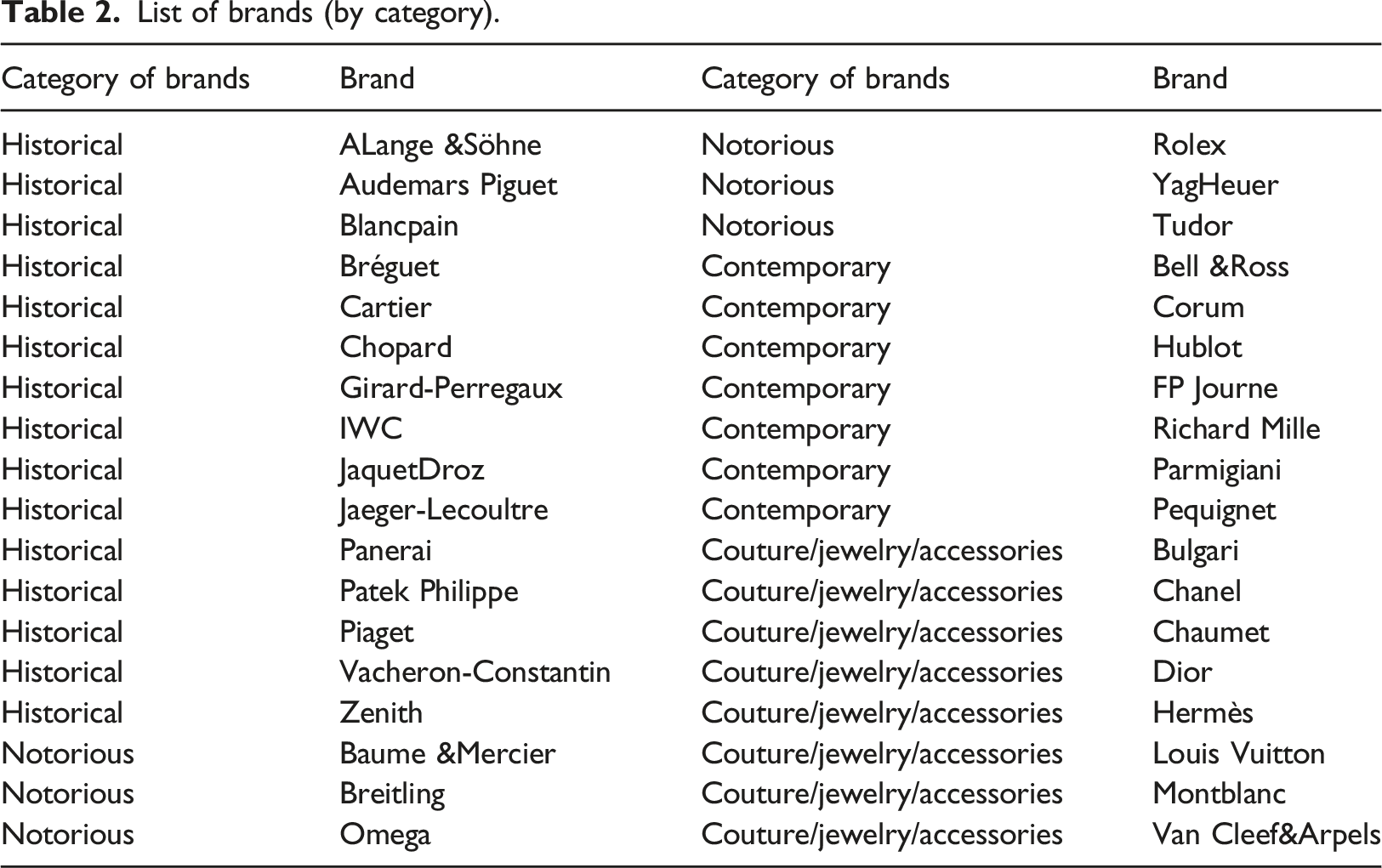
Data collection unfolded in several steps. First, we accessed an online platform that lists, illustrates, and categorizes all French market advertising campaigns. With the help of a senior media planner, we screened the 137 French magazines that published watch ads over the 2011–2014 period and identified 164 watch brands included in the database. Second, we narrowed down the data and built our final sample according to the following cumulative criteria: (1) presence of the brand on the lists provided by professional associations, such as the FHH; (2) presence of the brand in Parisian high-end retail stores (i.e., luxury watch area in main department stores, specialized high-end stores, and exclusive brand store); and (3) more than 20 ad insertions in the 137 French magazines within the selected period of observation. This step resulted in the selection of 36 Swiss and non-Swiss brands, a sample that captures a diversity of actors in terms of size, date of foundation, geographic origin, and ownership type (independent vs. part of a corporate group). Finally, we collected 8209 insertions for these 36 brands over the observation period, corresponding to a set of 420 unique units of communication (each unit being reproduced in several magazines at the same time and/or over extended periods).
The distinctive properties of status, reputation, and legitimacy.
The first stage of the coding process consisted in identifying the presence versus absence (i.e., counting) of legitimacy, status, and/or reputation cues for each ad, which provided initial insights into the number and type of cues mobilized by watchmakers. Although useful, this first stage was not sufficient to develop a thorough understanding of brands’ communication strategies. Ads are composed of many elements (e.g., images, brand names, slogans, texts, and subtexts) that have different visual impacts. It follows that cues will differ in their prominence and signaling power. For example, although Chanel’s 2011J12 ad comprises a legitimacy cue, which indicates that the watch’s movement is produced by Audemars Piguet, the information is located in an almost invisible footnote. In contrast, when Vacheron Constantin emphasizes how legitimate the brand is, it is through detailed storytelling that constitutes the core element of the ad. In the second stage of the coding process, we thus refined our analysis by considering the prominence of the different cues within each ad in order to provide a more nuanced and fine-grained analysis.
List of brands (by category).
Coding scheme.
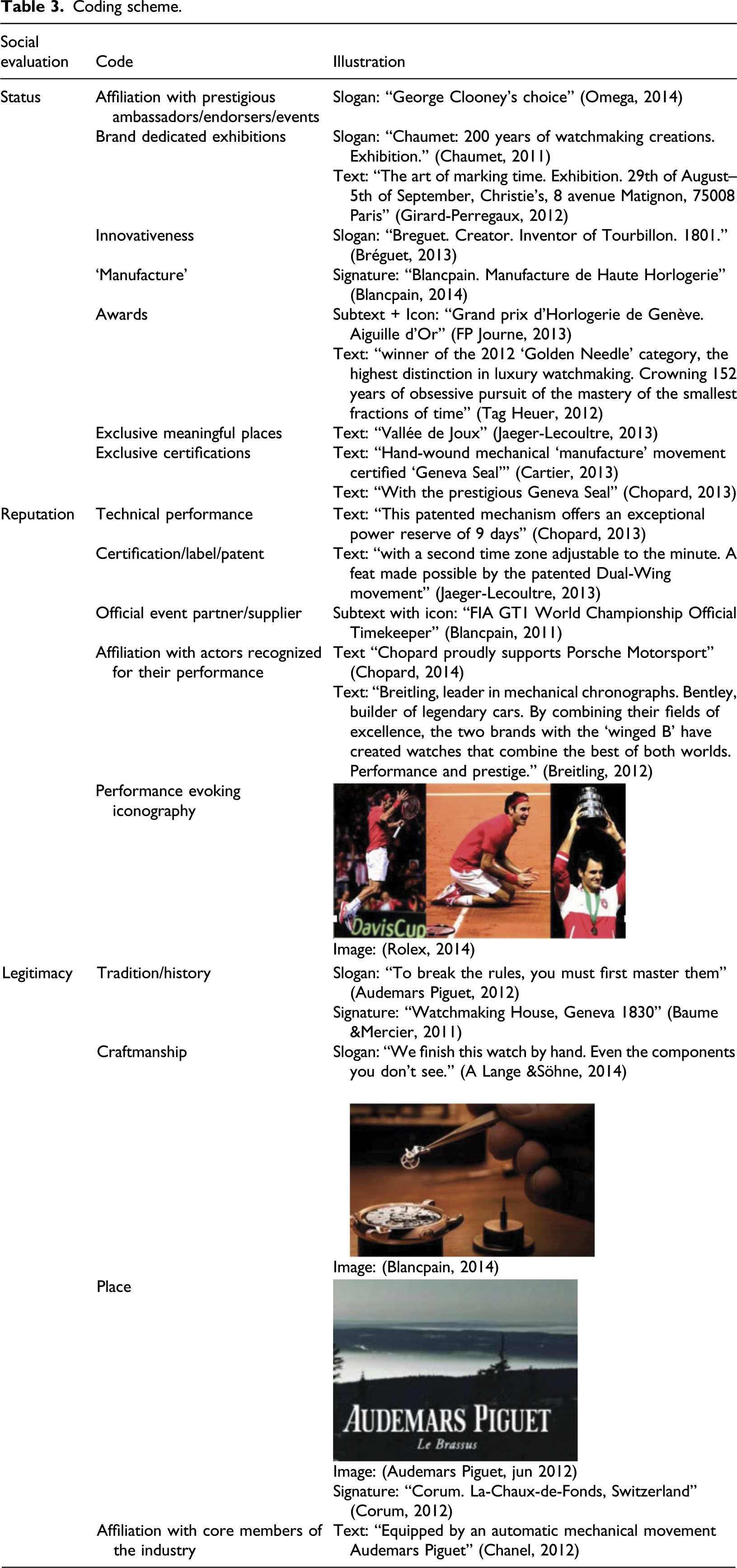
We ensured the internal validity of the coding process through a double-coding procedure. The codebook was developed by the first authors during the first coding stage. These two authors jointly coded the dataset. Then, two trained assistants independently coded the integrality of the dataset to identify the presence or absence of cues, using the provided codebook. We then compared the two sets of coding and obtained a 0.94 kappa statistic of interrater agreement, which indicates substantial agreement between the two coders (Landis and Koch, 1977). We collectively discussed each instance of discrepant coding until we reached an agreement. The second stage of the coding was handled by the two first authors.
Findings
Through our investigation of the fine watchmaking market dynamics (Giesler and Fischer, 2017), our analysis uncovered two main findings. First, we found evidence that brands use social evaluation cues as strategic resources (i.e., resources that can be leveraged to build and maintain a competitive advantage) to develop stories about the brands and their social standing in the fine watchmaking market. We identified four groups of brands, each carrying out distinct stories that mobilize and combine the three repertoires of status, reputation, and legitimacy in a different manner.
Second, we found that these strategic resources are not necessarily homogeneously available to every market actor, as some brands were more constrained than others in building their social positioning. Specifically, we found a pattern in the construction of these stories, such that the use of the three repertoires or their combination was not merely left to the discretion of the brand but was also dependent on the brand’s embeddedness in the market. Economic sociology posits that markets are socially embedded; that is, economic actors are embedded, to differing degrees, in social relations and affiliations that shape their opportunities for value creation (Granovetter, 1985). Actors’ embeddedness has been defined and operationalized in different ways since Granovetter’s (1985) seminal article. In this study, we examine how brands are spatially and temporally situated in the focal market of fine watchmaking. A brand’s spatial embeddedness is determined by the extent to which watchmaking represents a core (vs. peripheral) activity: the greater the importance of watchmaking than that of other activities (if any) in the brand’s portfolio, the greater is the spatial embeddedness. A brand’s temporal embeddedness is determined by the extent of the brand’s temporal presence in the market: the longer it has been active in the market, the greater is the temporal embeddedness.
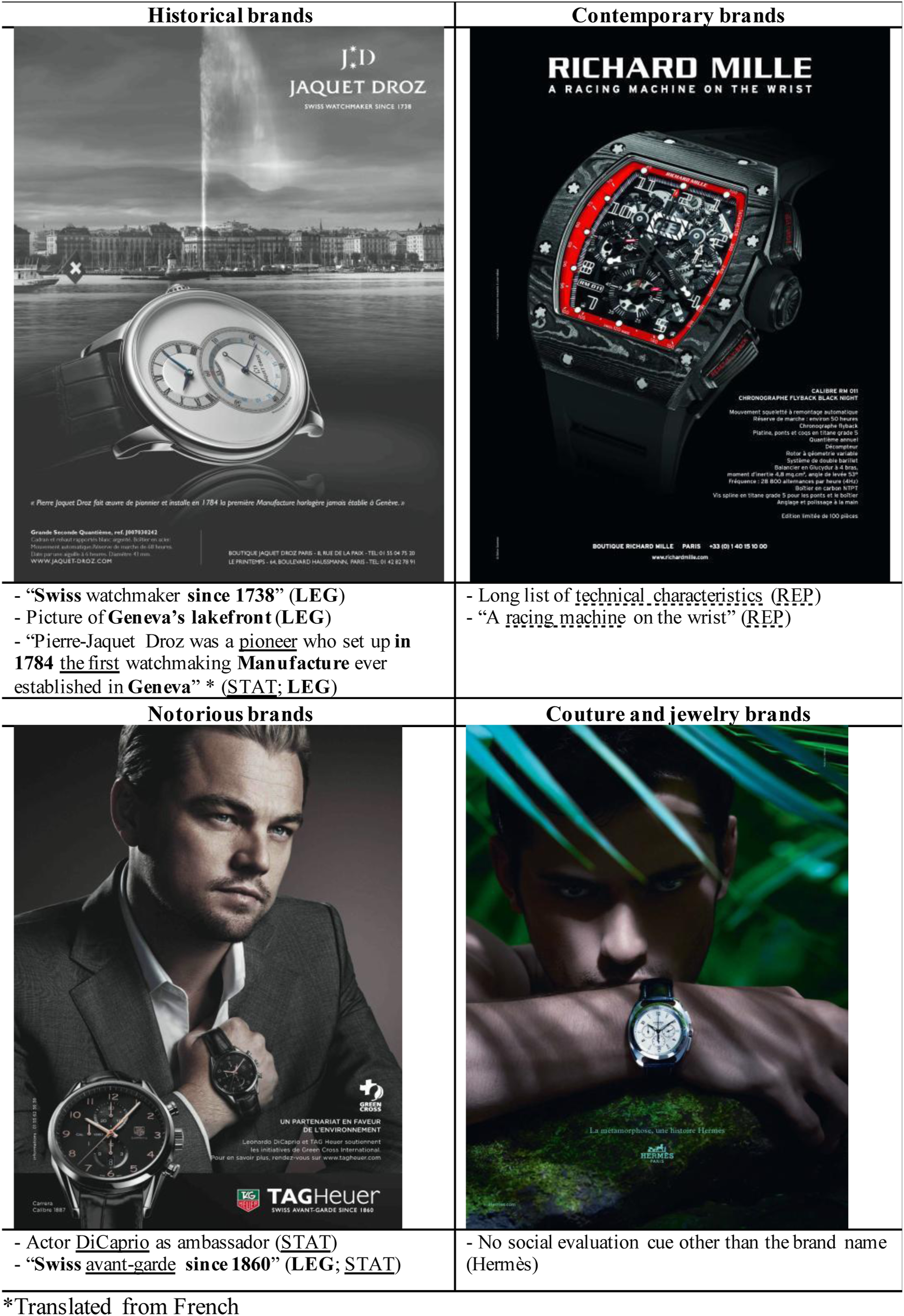
We find that the extent of these brands’ embeddedness shapes their ability to signal their social positions and access the related repertoires. We discuss these findings in detail in the following subsections. Figure 1 depicts the four groups by their market embeddedness and illustrates the differing uses of social evaluation cues, taking into account their visibility and recurrence (i.e., general prominence) within the brands’ ads. Figure 2 provides examples of the different types of stories conveyed in these ads. Representation of the four groups and their discursive strategies according to their market embeddedness. Illustrations of the different types of ads and their coding.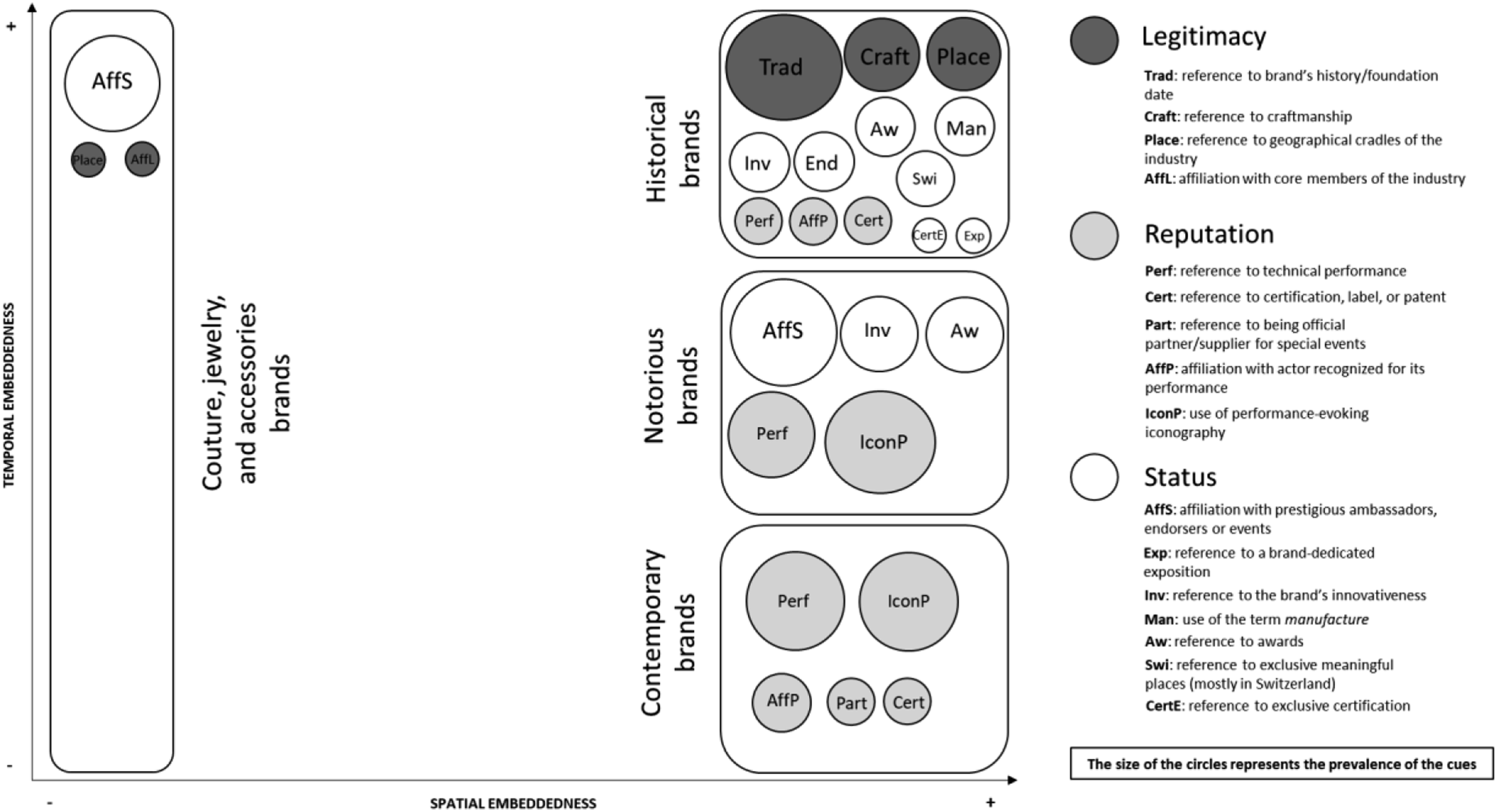
Historical brands: Guardians of the fine watchmaking heritage
The first and largest group of brands includes the historical market players. These brands’ communication is focused on showcasing the brand’s ability to manufacture traditional watches and emphasizes the brand’s heritage and know-how. They present themselves as the guardians of the watchmaking heritage. To do so, they construct a story that primarily rests on the abundant mobilization of cues from the repertoire of legitimacy, coupled with and reinforced by some cues from the status and reputation repertoires. Interestingly, most of the status cues are mobilized to interact with legitimacy cues (and the notion of tradition in particular) while asserting the brands’ uniqueness and desirability. Although present, the reputation repertoire largely remains in the background. Also notable within this group is the consistency of the textual and pictorial elements within each brand.
The tradition component of the story largely rests on the use of historical cues. The brand’s foundation date, often mentioned, systematically refers to the 18th and 19th centuries, such as “founded in 1755” (Vacheron-Constantin) or “since 1833” (Jaeger-Lecoultre), thereby emphasizing the brand’s longevity. Brands also use temporal cues to emphasize their continuity: “As a family-owned manufacturer, we are committed to restoring and maintaining all our watches. Including those made in 1839” (Patek Philippe, 2011); “Girard-Perregaux. Celebrating 220 years” (Girard-Perregaux, 2011).
Temporal cues are often accompanied by spatial cues. The brands’ anchoring in Switzerland shows prominently in the ads, which allows them to emphasize their membership to the group of legitimate Swiss core players. References to Switzerland, whether textual or iconographic, are often accompanied with and reinforced by status cues mentioning specific and exclusive places in the country: Geneva (Patek Philippe and Jacquet-Droz), with a picture of the lake and the water jet, a must-see attraction of the city; Vallée de Joux (Jaeger-Lecoultre); or even a neighborhood on the Geneva Lake, L’Ile (Vacheron-Constantin). This strategy is also used by A. Lange and Söhne, one of the rare non-Swiss brands in the group. Although the brand cannot claim a Swiss identity, it makes direct reference to Glashütte, the well-known cradle of the German watchmaking industry.
This combination of spatio-temporal cues is also completed by numerous references to craftmanship and authenticity (Athwal and Harris, 2018). Brands make abundant references to maître horloger (master watchmaker), a professional term that emphasizes the skills of the brand’s craftsmen and sends a strong legitimacy signal. They also frequently mention manufacture, a specific high-status French term that connotes the ability to master the confection of a watch from A to Z. This status cue helps reinforce the brand’s legitimacy with regard to its craftmanship. These prominent and industry-specific semantic elements are also accompanied by references to more general notions such as tradition, atelier, savoir-faire, or métier d’art (craftwork), suggesting that watchmaking is at the intersection of craftmanship and art. These discursive elements are supported by a specific iconography: Vacheron-Constantin illustrates the closeness of craftmanship and art with a picture showing the hand of the artisan working on a piece inspired by the Chagall fresco of the Paris Opera house; others present a picture of the mechanical parts of the watch to complement their discourse, such as Patek Philippe: “Our 175 years of expertise in Haute Horlogerie, at the heart of the heritage of our family business, allow us to design some of the most elegant and complicated timepieces ever made” (2014). All these cues which highlight the longevity and long-established know-how of historical brands are mobilized to convey a sense of authenticity and help audiences to distinguish “’the real thing’ from its copies” (Grayson and Martinec, 2004: p. 298).
To complement this abundance of legitimacy cues, some brands from this group also borrow from the status repertoire (in addition to the aforementioned status cues). Status cues help signal the prestige derived from both history and tradition, thereby reinforcing the brand’s legitimacy as a core and historical market player. The brands emphasize their active participation in the history of watchmaking through the display of their technical inventiveness or innovation, with expressions or signatures such as “Bréguet, creator. The first wristwatch” (Bréguet) or “Zenith, inventor of the high-frequency automatic chronograph” (Zenith). They also mention the brand’s relationship with prestigious historical characters, sometimes even using them as endorsers: Queen Marie-Antoinette (JaquetDroz), the Russian Tsar (Bréguet), or the pilot and writer Antoine de Saint-Exupéry (IWC). Status is also exhibited through the use of exclusive certifications, only accessible to a limited number of actors (e.g., Geneva Seal), prestigious awards, or the organization of retrospective exhibitions about the brand (e.g., Girard-Perregaux).
Reputation cues are also present, but to a much lesser extent as they are primarily included within footnotes and therefore remain in the background. However, a sub-group of manufacturers (Audemars Piguet, IWC, Cartier, and Chopard) explicitly emphasizes the product’s “technical performance,” while a few others mention patent registrations and affiliations with actors renowned for their performance. For example, Breitling and Chopard emphasize their collaboration with well-known sports car brands, such as Bentley or Porsche. Reputation cues are also combined with status cues: when performance is staged through symbolical affiliations, it is mostly through references to “noble” sports (e.g., golf, tennis, sailing, and polo) or “extreme” sports/practices (e.g., aviation, racing, and diving).
This group’s communication strategy is made possible by the brands’ deep spatio-temporal embeddedness in the market, which is relatively consistent across the group. Not only are these brands able to jointly mobilize all three repertoires, but they are also able to leverage these social evaluations through a rich and interrelated set of meaningful cues. The story built and endorsed by this group is that of a brand that participated in the creation of the market, which is representative of its core values and derives prestige from it. The omnipresent manufacture cue, for example, is both a signal of compliance with a central norm of fine watchmaking and a mark of distinction. All the cues of the legitimacy repertoire are heavily mobilized to show perfect alignment with the audience’s expectations of fine watchmaking and, as a side effect, to possibly minimize the legitimating efforts of less embedded (i.e., more recent and peripheral) actors.
Notorious brands: Celebrating success and stardom
The second group of actors comprises more known and accessible (price-wise) traditional brands. These brands’ communication is quite intensive and primarily focused on constructing the idea that wearing a fine watch confers status and success for consumers. The mastery of the codes of the fine watchmaking appears only in the background, in contrast with the former group, which primarily bases its communication on these elements. Their story is largely visually dominated by status cues and, to a lesser extent, reputation cues. Targeted consumers are those who are eager to benefit from these marks of prestige and performance through an affiliation with star brands that can be identified by everyone. In this group, ads are less consistent than those of the traditional brands, probably because they target a wider range of consumers.
As primary means to convey the idea of social distinction, this group relies heavily on the use of affiliations with high-status and successful endorsers, partners, or events. For example, Omega’s affiliation with George Clooney builds on the actor’s aura in his field. In many cases, the endorsers, depicted as heroes, are chosen to express both status and performance at their highest levels. In this story, performance is referred to more as a social achievement than a personal one. Rolex’s “live for greatness” 2014 campaign, for example, celebrates (mostly) sports celebrities who reached the highest position in their area of expertise. Beyond being endorsed by prestigious sports or movie stars, this group’s stardom also relies on partnerships with events or institutions to benefit from an aura in their domain: Tag Heuer is the “official partner” of Grand Prix de Monaco, one of the most prestigious F1 races; Rolex emphasizes its multiple official and non-official prestigious partners in sports areas, from the Evian Golf Tournament, to Wimbledon tennis championships, to Formula 1. The common point of these events is that they are systematically presented as the best/first/most exclusive events. For example, Rolex depicts the Oyster Perpetual Sky-Dweller with a visual of Wimbledon’s central court and the tagline: “This watch was the witness of historical matches on the central court and of one of the most prestigious tournaments of the world” (2014 campaign).
This use of highly successful endorsers is reinforced by semantic elements that aid in expressing the brands’ ability to be the best in their field, to have been the first to accomplish a feat, or to have witnessed historic moments. Breitling’s “Chronomat” advertisement in 2011 illustrates this particular use of status cues: “Breitling has shared all the great hours of the conquest of the skies.… In 1952, the legendary Navitimer was born, followed by many other chronographs for the aces of the sky. Today, the favorite brand of pilots and aviation enthusiasts perpetuates this authentic and privileged link by cooperating with the elite of aviators, directing several exceptional formations, and associating itself with the largest air shows on the planet” (emphasis added).
Another means of conveying social distinction is to demonstrate the brand’s position as a market leader through mentions of awards, innovation, and pioneering behaviors. Brands in this group largely communicate on receiving awards at the GPHP (Grand Prix d’Horlogerie de Genève), the Oscars of the watchmaking industry. Tag Heuer, for example, mentions receiving the 2010 “prix de la petite aiguille,” an award given to the best watch under 5000 euros. Watchmakers in this group also weave pioneering references into their communication, thereby adding a touch of historical cues in their social standing discourse. Breitling and Tag Heuer notably note their achievement as the first in an important watchmaking innovation: “The inventor of modern chronograph” (Breitling, 2011), and “The first mechanical counter accurate to 1/100th of a second” (Tag Heuer, 2011).
The reputation repertoire is mobilized to express performance in the context of a large variety of sports through a combination of semantic and specific pictorial elements that visually illustrate the idea of speed and precision, such as fighter planes (Breitling) or F1 (Tag Heuer). This group of brands shares a similar spatial embeddedness in the market to the first group but has a slightly lesser temporal embeddedness (on average, the brands are more recent). The breadth and depth of the repertoires’ mobilization are relatively similar to those of the first group, even if the repertoires are leveraged in a different way. In a fashion similar to the previous group of brands which used a single cue to signal different meanings, some members of this group use ambassadors and endorsers in multiple ways. For example, Rolex’s use of Roger Federer signals a connection with regular high performance (therefore emphasizing Rolex’s reputation), as the tennis icon broke all the records and was at the top of the tennis hierarchy for many years (thus conferring status to Rolex), and also with Switzerland, as Federer is native of the country (indirectly granting the brand legitimacy). However, in contrast with the first group, which largely emphasizes legitimacy in its communication, these brands rely heavily on stardom and success stories through the mobilization of the status and reputation repertoires.
Contemporary brands: The quest for performance
The third group consists of “newcomers,” or brands (essentially Swiss and French) founded after World War II. The stories these brands create focus on highlighting the product’s performance. They primarily mobilize the reputation repertoire through the depiction of mechanisms that integrate a variety of functionalities (thereby emphasizing the technological excellency of the brand) and through the use of images evoking performance (often in relation to sports or activities in which time measurement is crucial). Legitimacy cues are almost absent from these brands’ communication while status cues are scarce and barely visible. This focus on performance contributes to the ads’ consistency within each brand’s communication and is displayed through both technical arguments and high-performance-evoking images.
A central element of these brands’ communication is the prominent and multiple mentions of technical characteristics, such as the tourbillon, a watchmaking complication added to the escapement mechanism (Bell & Ross, Corum, and Hublot), or of a long power reserve for mechanical watches (Bell & Ross and Hublot). These technical elements are completed with performance indicators and associated evocative images. For example, Bell & Ross promotes its 500-meter waterproof watch, whereas Hublot notes that its LaFerrari model has a world-record 50-day power reserve. In addition to these relatively easy-to-understand technical terms (e.g., chronometer, water resistance), these brands tend to use complex terms that hint at the technicality of watchmaking mechanics but only fully make sense to experts. In the case of Richard Mille, these technical terms appear in the form of a long list (which reads like a sports car data sheet in a specialized magazine) and serve as the core of the ad’s message.
The ads’ imagery centers on evocations of mechanical sports and extreme activities, such as jet fighter flying, in which the watch is presented as a high-performance tool that accompanies an activity in which precision is vital and time measurement plays an essential role. Often, generic images used include a fighter plane (Bell & Ross), a racing car (Hublot), a motorcycle (Bell & Ross), a diver (Bell & Ross), or a sailboat (Corum). The ads also mention affiliations to sports events (Corum and the Trophée Jules Verne), partnerships with a motor sport brand (e.g., partnership between Hublot and Ferrari), and even partnerships with military institutions (Bell & Ross with RAID or GIGN).
Showcasing the performance of the watch also involves mentions of certifications and labels. Though present in many ads of this group, these cues are less visible in the communication, as they primarily are evoked through pictograms and/or short texts in small font. Some brands promote the COSC (ContrôleOfficiel Suisse des Chronomètres) label, which certifies a “high level of precision and uniqueness of timekeeping instruments,” as well as “a guarantee of extreme quality.” 1 Because only Swiss brands can receive this label, this cue indirectly signals the brand’s legitimate membership to the fine watchmaking market.
In contrast with the first two groups, these brands are only partially embedded in the market. They belong as core players (i.e., spatial embeddedness) but lack the temporal depth of the historical players’ embeddedness, which constrains their capacity to mobilize the three repertoires, particularly legitimacy. Overall, almost no legitimacy cues are present in these brands’ ads. Some brands, however, mention specific geographic locations (e.g., La Chaux de Fonds for Corum), as marks of distinction. As core players, however, they possess the necessary technical expertise to build a competitive advantage in the market, which allows them to extensively leverage the reputation repertoire through a rich array of cues extolling the watches’ technical complexity and performance. What they lack in repertoire breadth is somewhat compensated by the depth of use of the reputation repertoire.
Couture, jewelry, and accessories brands: Lost in social evaluations
The fourth group mostly comprises luxury brands, coming from the jewelry, fashion, or accessories markets. Whether limited (e.g., Dior) or successful (e.g., Chanel) in terms of watch sales, these brands stand out from the other three groups. Indeed, they are characterized by a rather simplistic, if not absent, discourse that marginally evokes the codes of fine watchmaking. Their communication fails to build a consistent story (at a group or a brand level, except for Louis Vuitton), but rather uses disseminated and mostly disconnected cues belonging to the status (primarily) and legitimacy repertoires, while not mobilizing the reputation repertoire in a visible manner. In most ads, the watch occupies the central part of (if not all) the ad page, with few, no text, or with the support of small font footnotes.
Brands make few or no references to the values and norms of fine watchmaking. For example, only Louis Vuitton indicates that its watches are produced in La Chaux de Fonds, one of the cradles of the Swiss watchmaking industry. Other brands such as Van Cleef & Arpels, which has been producing watches for more than a century and therefore could qualify as a legitimate market actor temporally speaking, curiously do not capitalize on this fact or make any mention of their historical expertise in watchmaking. In addition, there are no iconographic elements that could help anchor the couture and jewelry brands in the market and counterbalance the absence of legitimacy elements in the discourse.
The status repertoire is superficially mobilized through the use of prestigious ambassadors. In most cases, however, and contrary to the affiliation strategy of brands from the historical players' group, these endorsers have no connection with the watchmaking market, but rather seem to have been selected for their glamorous aura, such as Sophie Marceau for Chaumet and Charlize Theron for Dior. Furthermore, although all these brands benefit from a high-status position in their market of origin, they make no attempt to transfer some of this prestige to the fine watchmaking market. An exception is Van Cleef & Arpels, whose ads make direct references to the brand’s high status in high jewelry, its core market.
Some reputation cues are present but almost invisible, and the technical elements of the watches are, for the most part, not mentioned; if they are, it is only superficially. This is due in part to the over-representation of women’s watches in this group and the gender stereotypes of the watchmaking market, which tends to associate performance with men’s watches and glamor with women’s watches.
Overall, brands in this group make little use of the social evaluation repertoires, likely because of their limited embeddedness in the market. In contrast with the other groups, whose membership is relatively homogeneous, the brands falling in this group are highly heterogeneous in terms of their temporal embeddedness, with significantly higher levels of temporal embeddedness for jewelry brands. For example, while Chaumet began manufacturing fine watches at the beginning of the 19th century and Van Cleef & Arpels at the beginning of the 20th century, Chanel only began its watchmaking activity in 1987 and Louis Vuitton in 2002. The group’s extent of spatial embeddedness, however, is homogeneously low, as their identity as either jewelry or couture brands situates them as peripheral market actors. Their overall limited market embeddedness significantly constrains their ability to leverage the social evaluation repertoires. In particular, it prevents them almost entirely from mobilizing the legitimacy repertoire, all the more since the first group of brands is heavily showcasing it. As peripheral market players, they also lack the technical expertise that would allow them to mobilize the reputation repertoire. Finally, although they can easily access the status repertoire (given their high-status position in their core markets), only a limited number of brands do so and only superficially through a limited set of cues. In contrast with the first group, which uses several complementary cues to signal its status in the market, this group of brands evokes social distinction through the use of famous and glamorous endorsers, a strategy borrowed from their market of origin.
Discussion
Theoretical contributions
In this research, we build on the market system dynamics approach to conceptualizing status, reputation, and legitimacy as strategic resources that brands mobilize to signal their social position in the market (e.g., Giesler and Fischer, 2017; Humphreys, 2010; Kjeldgaard et al., 2017). As this approach suggests, markets are evolving complex systems, rather than pre-existing, stable structures (Baker et al., 2019). In line with this understanding of markets as dynamic systems, our research explores the dynamics underlying brands’ social position and shows how brands are both shaped by the complex social systems in which they are embedded and able to actively shape them. By providing insights into how brands mobilize and stage social evaluations cues to influence audiences’ perceptions of their social position, we add to the handful of studies that have assessed social evaluations from a strategic angle (e.g., Arnold et al., 2001; Debenedetti et al., 2021; Humphreys and Carpenter, 2018), a perspective that is otherwise scarcely adopted in marketing research on social evaluations, which tends to focus on the benefits that brands can derive from their status, reputation, or legitimacy. More specifically, our contribution to the marketing literature is threefold.
First, in contrast with prior empirical works that tend to focus on a single evaluation (e.g., Arnold et al., 2001; Debenedetti et al., 2021; Dion and Borraz, 2017) and/or sometimes conflate them (e.g., Crosno et al., 2009; Humphreys and Carpenter, 2018), we develop an integrative perspective that considers and operationalizes status, reputation, and legitimacy as distinct strategic resources that brands can deploy. In doing so, we shed light on these evaluations’ underlying mechanisms, which in turn allows us to identify distinct communication repertoires associated with status, reputation, and legitimacy.
These three repertoires differ in nature. For example, the legitimacy repertoire is mostly context-specific, as the norms and expectations are bound to the focal market (i.e., the notion of spatio-temporal heritage or craftmanship certainly matters in other markets of the luxury industry but not so much in other industries). The reputation repertoire is less specific: whatever the industry, building one’s reputation rests on signaling the product or service performance; the form that this performance takes, however, depends on the market under consideration. The status repertoire is the one that seems the least specific and the most fungible: although some cues are market-related, others can be derived from outside the focal market.
Second, we add to research that focuses on the strategic use of social evaluations (e.g., Arnold et al., 2001; Debenedetti et al., 2021; Humphreys and Carpenter, 2018) by providing insights into how different types of brands use these repertoires differently. Specifically, we uncover different patterns in the way brands deploy and combine these repertoires in their communication to gain a competitive advantage: some brands use all three repertoires, some concentrate on one, and others do not build on any. Of particular interest is the way these repertoires are sometimes used in combination, to reinforce some cues (e.g., status cues being used to strengthen the visibility of legitimacy-related elements such as tradition or authenticity). These differences are partly due to the brands’ strategic intent since there is some discretion in the way brands can use these resources to shape their market position (Baker et al., 2019), but are also constrained by a differentiated access to the repertoires. Specifically, we argue that a brand’s extent of market embeddedness affects both the breadth and depth of mobilization of these repertoires (Granovetter, 1985). Embedded actors can access all repertoires and operationalize them into a large set of rich, meaningful, and interconnected cues, while less embedded actors are more constrained in their access to repertoires and choices of cues, the latter being used more inconsistently and superficially.
In particular, we find that the legitimacy repertoire is difficult (if not impossible) to mobilize by brands with little market embeddedness, such as jewelry, couture, or accessories brands, and to a lesser extent by newcomers, which are more embedded in and master the codes of the market but still lack the temporal depth of the historical players’ embeddedness. While the lack of heritage or market embeddedness constitutes a significant obstacle for these brands to mobilize legitimacy cues, the communication strategy of the brands in the first group (historical players) clearly contributes to render these brands unable to make legitimacy claims. By over-emphasizing their compliance with the norms and values of the market, historical players mirror their competitors’ efforts to appear as legitimate fine watchmakers. This highlights a clear legitimacy struggle in the market, which constrains both the newcomers and the jewelry, couture, and accessories brands in deploying other repertoires to build their social standing. While newcomers heavily mobilize the reputation repertoire, showcasing the technical performance of their products, the jewelry, couture, and accessories brands mobilize superficial status cues that are barely connected with the market. Furthermore, our finding that historical players can access more repertoires and a richer set of cues than other categories of brands contributes to enriching recent discussions that suggest that brands that enjoy a significant brand heritage and include it in their value propositions and identities benefit from distinct branding possibilities and increased opportunities to foster consumer loyalty and satisfaction (e.g., Dion and Borraz, 2015; Rose et al., 2016). Their presence at the spatio-temporal origin of the market allows them to maintain and protect their heritage (Mencarelli et al., 2020), which, in the context of this study, takes the form of an over-emphasis on the market codes and values.
Third, our findings also contribute to the stream of research investigating the role of communication in brand building, in particular in the luxury field. In line with Gurzki et al.’s (2019: 401) claim that communication “is central to creating brand meaning by endowing brands with symbolic values and embedding them within their broader sociocultural context,” we show how fine watchmaking brands use their print advertising to construct and signal their different social position in the watchmaking market. These findings resonate with and complement Freire’s (2014) conclusions that luxury houses use their advertising campaigns not only to promote their products but also to convey the identity values of luxury, such as authenticity, beauty, and legacy.
What our data suggests, however, is that these values are not similarly mobilized or accessible to all brands. Previous research tends to consider that luxury brands adopt homogeneous communication strategies. Gurzki et al. (2019), for instance, suggest that luxury brand advertising systematically uses distancing techniques. Similarly, Beverland and Luxton (2005), who study the communication strategy of 26 prestige wineries across several countries, argue that all these actors tried to create powerful brand images by projecting an aura of authenticity and demonstrating it in product performance. We thus contribute to this literature by suggesting that even within a group of brands pertaining to the same sector (i.e., fine watchmaking), there are nuances, and sometimes important differences, in the way these luxury brands communicate. Our findings reveal that luxury brands, despite their high social standing, remain constrained by their embeddedness in the market. For example, our data shows that the notion of authenticity (Grayson and Martinec, 2004) can only be fully mobilized by historical brands, which can emphasize their expertise and creativity over time (Athwal and Harris, 2018) and thus become transgenerational references (Kessous et al., 2017). Similarly, we find differences in the way brands use celebrity endorsement, an important means to building brand equity (Muniz and Guzman, 2021). While historical brands use a variety of brand ambassadors, such as historical figures, recently deceased celebrities, or less famous individuals (e.g., founders or owners of the brands), the other players primarily mobilize “mainstream” contemporary celebrities. This finding echoes prior research on the heterogeneous use of ambassadors in brand communication (Philippe and Debenedetti, 2014).
Practical implications
This research also has implications for practice in terms of brands’ signaling of their social position in markets and, in particular, in their quest for or defense of their legitimacy. Being or appearing legitimate in one’s market is of paramount importance. As prior research demonstrates, legitimacy entails stronger consumer support (Handelman and Arnold, 1999), increased shopping intentions (Chaney et al., 2016), and better gains from new products (Rao et al., 2008). Our study suggests, however, that acquiring or maintaining legitimacy is a complex endeavor, as indicated in the following anecdote: when Montblanc, a German brand producing luxury writing instruments, announced in 1997 its entry in the wristwatch market, the CEO at the time was confronted with journalists’ questions such as “How do you fill it with ink?” in direct challenge to the legitimacy of the brand’s extension.
New brands, such as those belonging to the third group, suffer by definition from the liability of newness when launching their activities. As such, they cannot leverage any pre-existing brand capital and must build their positioning from scratch. One valid strategy, as our study illustrates, is investing in technical performance, as technical mastery was at the origin of the fine mechanical watchmaking market. Richard Mille, for example, which was founded in 2001, made a name for itself in the field with its innovative materials and technologies and the showcasing of its products’ technical performance. The brand’s strategy allowed it to gain status and a reputation that compensated for its original lack of legitimacy, up to the point at which the brand was recognized by the profession as a key player and invited to participate in exclusive, professional fine watchmaking shows.
Established brands that extend their activities into a new market, such as those belonging to the fourth group, also suffer from the liability of newness, as problem since brand extension strategies need to be perceived as legitimate to be successful (e.g., Spiggle et al., 2012; Veg-Sala and Roux, 2014). In contrast with newcomers, these brands often benefit from a strong brand capital in their market of origin. A valid strategy therefore may be to explicitly leverage this pre-existing brand capital through brand extensions. We observe, surprisingly, that the brands of our sample scarcely used this strategy, with the exception of van Cleef & Arpels, which makes explicit references to high jewelry, its core market. Other strategies include associating with or acquiring a legitimate actor. Montblanc, for example, acquired the Minerva manufacture in 2006 and successfully entered the fine watch market, heavily building on the long and recognized heritage of this Swiss manufacturer, which had been producing watches since 1858. The quest for legitimacy was so important that it even led Montblanc to engage in a highly ambiguous discourse about its involvement in watchmaking. On its website, the brand claims: “The Montblanc watchmaking tradition began 160 years ago, in 1858.” However, the brand’s first watch was actually produced in 1997, and the “tradition” referred to is that developed by the Minerva Manufacture.
Finally, although the highly embedded market players who master the values and norms they helped build benefit from established positions, there is always a risk that these positions will be challenged or threatened by newcomers with the intent to disrupt the rules of the game. For example, the emergence of smartwatches in 2015 has profoundly affected the fine watchmaking market by shifting its boundaries, with a direct impact on the fine watchmaking brands’ position in the market. Brands with low market embeddedness may use the opportunity of such a technological innovation to disrupt the established order, which is the case of Louis Vuitton and Montblanc, which launched their smartwatches in 2017. To defend against such threats, a successful strategy may be to strengthen the importance of the market core values and norms and their accompanying constellation of meanings. By influencing representations of what a typical fine watchmaking brand should look like, fine watchmaking brands can make it difficult for new or outsider brands to establish their position in this market.
Limitations and future research
This study has several limitations that open avenues for further research. First, while fine watchmaking is appropriate to evaluate the social positions of brands given this highly hierarchical luxury industry (Gurzki and Woisetschläger, 2017), future research could examine other industries to gain additional insights into how brands strategically use social evaluations. More specifically, research could assess both other luxury markets (e.g., haute couture, wines and spirits, and haute cuisine) and more mainstream industries (e.g., automobile or technological products).
Second, we assessed how brands in the same industry and at a given time mobilize status, reputation, and legitimacy cues in their communication. Future research could further explore this dynamic by adopting a historical perspective on brands’ use of social evaluation repertoires over time. Brands’ positions in a field are not static, and their evolution may grant them access to different repertoires. For example, over time, a brand that is a relatively new player in the market and mostly relies on the reputation repertoire may be able to mobilize the other two repertoires: status, if its performance becomes such that it provides the brand with higher social esteem than its competitors, and legitimacy, if the brand can demonstrate its belongingness to the market. The case of Audi in the automobile industry illustrates such a journey. Although Audi initially stood for robustness and reliability, over the years it became a direct competitor of high-status automobile brands and adapted its communication accordingly. Following the opposite path, Mauboussin, a jewelry house founded in 1827, moved from an elitist positioning to a positioning advocating accessibility and proximity.
Third, this research looks at advertising as an important medium for brands to influence their social position (Gurzki and Woisetschläger, 2017). Future research could further look at other communication tools and see if the way in which brands mobilize the status, legitimacy, and reputation repertoires is similar to their use in print advertising. For example, the store, which has been shown to be an important tool for signaling the social standing of a brand, particularly in the luxury sector (Dion and Borraz, 2017), the brand museum which helps the brand to highlight its heritage and authenticity (Mencarelli et al., 2020), or social networks (Voorveld et al., 2018) might be interesting to investigate.
Finally, this study adopts a brand perspective by examining how brands signal their social position through their communication. Future research could explore how consumers and other stakeholders (e.g., the media) perceive these strategies. For example, does brand communication relying on reputation generate more consumer confidence than communication focusing on status? Is consumers’ willingness to pay more important for brands that mobilize status than legitimacy? Moreover, it would be fruitful to investigate and measure the impact of mobilizing status, reputation, and legitimacy in different brand categories on consumers’ brand perceptions. For example, for traditional and historical brands, is a strategy focused on legitimacy more efficient than one emphasizing the quality of their products? For notorious brands, does a status-based communication generate more consumer trust and loyalty than communication oriented to reputation or legitimacy? These questions would help better clarify the role of social evaluations in brand strategies.
Footnotes
Declaration of Conflicting Interests
The author(s) declared no potential conflicts of interest with respect to the research, authorship, and/or publication of this article.
Funding
The author(s) received no financial support for the research, authorship, and/or publication of this article.
