




Abstract
Assemblage and actor-network theories explain how markets and consumption are constituted by heterogeneous resources that form part-whole relations at various scales. Marketing and consumer research studies that use these theories, however, often retain human-centred scales and units of analysis, such that objects and forces that exist at unfamiliar (time)scales are overlooked. This paper explains how Object-Oriented Ontology can help to guide ontological, methodological, and analytical considerations in studies of market and consumption assemblages. We offer a framework that helps researchers to consider how far researchers should unpack assemblages into component parts; to what extent studies should trace objects’ effects as part of wider contexts; how ‘objects’ may harbour qualities that are withdrawn from social contexts; and how these hidden features can be encountered through speculative methods. Finally, we critically discuss the place of objects and subjects in socio-material research.
Introduction
Marketing research has explained how markets and consumption are constituted from a variety of human and nonhuman components (Araujo 2007; Bajde 2013: Bettany & Daly, 2008; Epp & Price, 2010). Enabled by assemblage and actor-network theories in particular, consumption practices, brands, and market organisations have been theorised as assemblages: part-whole relations between material and expressive resources at a variety of scales (Roffe, 2015). Overall, this ‘ontological turn’ reconsiders the roles of humans and expands the range of objects seen to influence markets and consumption, enabling us to ask new kinds of research questions and to entertain new levels and units of analysis (Bajde, 2013; Hill et al., 2014).
Notwithstanding these advances, consumption and market assemblages tend to proceed according to familiar scales and units of analysis (Bettany 2018). Indeed, humans are often seen to be organising and benefiting from consumption and market assemblages (Canniford & Shankar, 2013; Epp et al., 2014; Hagberg and Fuentes, 2018; Kejllberg & Helgesson, 2006). Likewise, units of analysis and scale are represented in familiar terms, explaining markets using standard categories of actors, institutions, and timescales (Hill et al., 2014). In so doing, studies can overlook nonhuman objects and forces that exist at unfamiliar scales of space and time, as well as assemblages that are not (currently) affecting or affected by social relations (Campbell 2020). Consider subterranean fungal networks for instance. Despite their massive scale and age, the roles of fungi in global agriculture, forestry, and health have gone largely unnoticed until recently (Sheldrake 2020).
This paper critically evaluates how Object-Oriented Ontology (OOO) can help us to reconsider scale, and to think about strange units of analysis (objects) revealed by such considerations. Like assemblage and actor-network theories, OOO theorises objects as parts of contextual material and expressive arrangements (Campbell and McHugh, 2015; Hoffman and Novak, 2018). However, OOO defines objects quite differently. Specifically, Graham Harman (2009, 2016) argues that certain assemblages should be viewed as ‘objects’ in their own right, not least because they harbour qualities that are not reducible to part-whole relations or explained by their effects. This feature of OOO can help researchers to think through questions of scale and units of analysis, thereby revealing novel problems and research questions, as well as surprising explanations as to how consumption and markets are constituted and change.
Our paper begins by considering five commonalities between assemblage and actor-network thinking. In so doing, we reveal challenges of studying objects as constituted in part-whole assemblages. Following this, we explain how and why OOO theorises objects differently. We illustrate these divergent perspectives through theoretical considerations of a widespread consumption object – the household refrigerator. Our discussion considers how OOO may help researchers to make decisions about the scale of analysis, guiding research methods that seek to understand objects’ hidden facets, and how these can reveal surprising outcomes. We conclude with suggestions for research that ‘speculates’ about objects and subjects in market and consumption assemblages in socio-material research.
Thinking with assemblages
Deleuze and Guattari’s (1987) original concept of the assemblage has guided ontological turns in disciplines including sociology (Callon, 1986; Latour, 2005; Law, 2004), philosophy (DeLanda, 2006; Harman, 2018), geography (Allen, 2011; Thrift, 2008), political science (Bennett 2010; Sassen, 2008), history (Verran, 2009), feminist studies of science (Haraway, 1991), anthropology (Collier 2006; Rabinow, 2003) and organisational research (Duff and Sumartojo, 2017; Law and Hassard, 1999; Newton, 1996). In each case, assemblage-inspired thinking has encouraged questions as to the nature of reality and existence, as well as renewed understandings of how heterogeneous nonhuman things constitute social contexts.
Marketing and consumer research have utilised many of these sources such that actor-network theory, non-representational theory, and assemblage theories are now recognised features of our disciplinary landscape. Given the diverse disciplines in which they have developed, and the varied contexts to which they have been applied, differences between these theories are to be expected. Uniting these perspectives, however, are commonalities in respect of how material objects are treated as component parts of various organisations, cultures and experiences. We now describe five such commonalties through which we reveal questions around scale and units of analysis.
Objects are relationally constructed
Assemblage thinking understands markets and consumption as constructed from relational arrangements of heterogenous material and expressive components (Roffe, 2015). A common rhetorical move in assemblage and actor-network inspired studies is to reveal these material and semiotic ‘parts’ that construct contextual ‘wholes’ (Latour, 2005). Often, these parts are not obvious at first glance, and a key contribution of assemblage thinking has been to apply multi-site qualitative methods to reveal how often taken-for-granted entities, organisations and practices are achieved through the ‘work’ of bringing a variety of material and semiotic components together (see Araujo, 2007; Diaz Ruiz et al., 2020). For example, Kjellberg and Helgesson (2006) observe markets as composed of multiple parts that include regulatory bodies, statistics organisations, and marketplace platforms. Likewise, Bettany et al. (2014) trace material objects like baby monitors and strollers, which enable the market-mediated constitution of fatherhood. In each case, the topic of interest such as a market or a consumer are shown to be constituted by part-whole relations amongst heterogeneous material objects and expressive practices (Bettany and Daly, 2008; Cochoy, 2008; Denegri-Knott and Parsons, 2014; Epp and Price, 2010; Huff et al., 2021).
Objects affect each other in assemblages
Bajde (2013) recommends scholars discover the ways in which heterogeneous material objects change and are changed by their relational contexts. In addition to discovering the part-whole relations that construct market entities such as products and brands (Lury 2009; Preece et al., 2019), research has also traced how objects exert effects on other related resources in wider assemblages. This aspect of assemblage thinking enables explanations of how material objects affect individuals, as well as large-scale organisations (Latour, 2005). For example, Cochoy (2008) explains how shopping trolleys alter peoples’ buying habits. By showing how a material object changes the amount of food purchased, this work explains that objects can affect assemblages in ‘productive’ ways. Conversely, material objects can also disrupt the functionality of an assemblage. The wrong shoes on a dancefloor can ruin a salsa experience, for example, (Diaz Ruiz et al., 2020). Often, it is unexpected objects that disrupt particular outcomes and experiences (Bettany et al., 2014; Canniford and Shankar 2013). In short, this research views the qualities of material objects as constituted within unstable processes of forming and maintaining relations with other objects and people (Callon 1986; Law, 2004).
Objects are in process
Relatedly, the unstable nature of social contexts has led scholars to theorise assemblages as subject to constant processes of (re)generation (De Laet and Mol, 2000; DeLanda, 2006). This aspect of relational ontologies enables scholars to observe how the addition or removal of parts can change the character of the whole assemblage, as well as related parts (Epp et al., 2014; Parmentier and Fisher, 2015). For example, Epp and Price (2010) track developments associated with a family dinner table. At first, this material object is a hub for relations between family members, bodies, chairs, cutlery, homework, and the kitchen. However, during a house move the table is removed from its original context and placed within a different set of related objects. As a result, the table’s characteristics are altered. This processual aspect of assemblage thinking underpins studies of market change (Giesler, 2012; Huff et al., 2021; Martin and Schouten, 2014). It also means that assembled markets, organisations, products, and experiences are seen to be ‘at stake’, that is unstable and prone to falling apart (Araujo 2007; Canniford and Shankar, 2013; Parmentier and Fischer, 2015).
Assembled objects are multiple
Related to the possibility for material objects to exert effects on each other, and that these effects are processual, it follows that what we might think of as the same object can be constructed differently in multiple contexts. For example, Mol’s (2003) actor-network study of atherosclerosis treatment explains how a disease in the body of a patient is treated differently by various medical specialists, each entangled with their own unique set of specialised knowledge, practices, and equipment. Because each practitioner brings a different set of relational conditions to bear on the patient’s arteries, Mol observes that the unit of analysis – the patients’ condition – is changed in the process, much like the table considered above. Bettany and Daly (2008) also make this observation when showing how different dietary and grooming objects assemble Afghan hounds into multiple iterations of the same ‘breed’ (see also Finch and Acha, 2008; Molesworth et al., 2016).
Although objects can be simultaneously assembled into multiple manifestations, these multiple constructions can depart or converge relative to each other (Callon, 1991; Law, 2002). If constructions depart, such as when consumers disagree on meanings of a consumption object or brand, then conflicts can occur, and assemblages can disintegrate (Parmentier and Fischer, 2015). If they can converge, however, then the various constructions of an object can ‘translate’, moving a network or assemblage to a mutual iteration that parties agree on, at least until some new actor, event, or object disturbs this consensus (Callon, 1986; Huff et al., 2021).
For example, Giesler (2012) and Scaraboto and Fisher (2015) chart processes through which contested brand meanings are potentially translated into more or less coherent organisations. In this way, assemblage thinking helps researchers to consider objects such as products, markets and brands as ‘more than one, but less than many’ (Law, 2002: 6). Yet a key question for scholars applying assemblage thinking is to ask, ‘how many?’. In other words, what guides scholars’ interpretations of how multiple or coherent a product, brand, or organisation is? One important way to do this is to trace these multiple constructions at emic levels (Bettany and Daly, 2008; Latour, 1996; Law, 2002; Mol, 2003). Yet, as we argue below, there are other conceptual options.
Assemblages are scalar
Assemblages and actor-networks are also scalar concepts (Roffe, 2015). This observation follows from how these theories treat contexts as made of part-whole relations between smaller parts, as well as being parts of wider assemblages. For example, Latour (1993a) shows how Pasteur’s micro-scale laboratory experiments changed health practices at the meso-scale of hospital and military institutions. Moreover, these changes paved the way for ‘pasteurisation’ to become a practice that has changed global-scale food and health assemblages. Similarly, consumer research has examined how consumption objects are constructed from various smaller components as well as larger production and consumption assemblages (Huff et al., 2021; Martin and Schouten, 2014). It is at this juncture, however, that methodological and analytical questions arise in terms of how to theorise the scale of objects.
Scales can extend from the level of bacteria, parenting products, and animals (Bettany et al., 2014; Campbell and Deane, 2019; Smith, 2015), to cities and microbiomes (Campbell and Dean, 2019; Cheetham et al., 2018). Indeed, Roffe (2015) notes that there are no definitive starting or stopping points in the analysis of assemblages. If this is the case, then how far should researchers go in discovering smaller component ‘parts’ of brands, experiences, organisations, or products? And to what extent should these parts be situated in a ‘whole’ assemblage, such as ‘global capitalism’ (Collier 2006; Sassen 2008) or climate change (Campbell and McHugh, 2015; Morton, 2013)? Relatedly, given that processes can happen in seconds or eons, what timescales should studies of market assemblages attend to? Although it is tempting to demarcate studies according to the human-centred rhythms of social life, it is worth considering timescales that characterise natural events, or electronic processes (Newton 2007).
Treating our research contexts in this way could result in endless tracing; hence, key questions for researchers are: where does an assemblage or an object start or stop, and where and when should investigations begin and end?
Latour’s (1996) answer to this problem suggests that researchers ‘follow the actors’. This advice places responsibility on the researcher as well as respondents in terms of delimiting the scales and units of analysis (Canniford, 2005). It is for this reason that assemblages should be considered epistemological projects in which researchers are not passive observers of ‘facts’, but rather spokespeople who influence the creation of knowledge via material artefacts, and within political institutions (Latour 1993b; Latour and Woolgar, 1979; Mol, 1999). Yet in contrast to how actor-network and assemblage thinking handle these scalar questions, OOO offers different answers. Keeping in mind our questions around multiplicity and scale, we now explain Graham Harman’s criticisms of assemblages as part-whole relations.
OOO, objects, and scale
ANT and assemblage theories often conceptualise objects as the material parts of socio-material arrangements (Latour 2005; Roffe 2015). In contrast, Harman (2018: 43) defines objects as: ‘anything that cannot be entirely reduced either to the components of which it is made or to the effects that it has on other things’. In other words, things we may have previously thought of as material-semiotic actor-networks or part-whole assemblages, can be objects in their own right, according to Harman. More practically, where ANT and assemblage often explain the socio-material construction of organisations as nested ‘Russian Dolls’ (Bennett 2010), Harman views certain organisations as irreducible ‘objects’ that are not solely determined by relations to other material-expressive components. To justify his position, Harman explains two concepts, ‘undermining’ and ‘overmining’.
Undermining
We have explained that part-whole thinking enables researchers to theorise contexts by delving down into smaller-scale relations established between heterogeneous resources. Despite the benefits of observing the component parts of material objects and assemblages, Harman (2018) warns that breaking an assemblage down into relations between smaller parts risks ‘undermining' an object of study. Harman’s concept of undermining describes how analytical attention is diverted to the component parts of objects, rather than their emergent and even intrinsic features. By emergent features, we mean those characteristics of an object that its component parts do not express alone (Deleuze and Guattari, 1987). For instance, an emergent feature of a table is its ability to act as a surface for family dinners, but this feature is not expressed by its components: wood, screws, and varnish.
If an object’s emergent features are important to theorising a particular context, then it follows that at a certain point, going further down in scale has diminishing analytical relevance. For instance, unpacking a table and homing in on the wood it is made of, identifying the forest the wood came from, and tracing the capital interests in the forest, or the effects of climate change on the forest, could be interesting, but would probably not have helped Epp and Price (2010) explain family practices. In more abstract terms, Harman suggests that when thought of as ‘objects’, the scale of an assemblage is not determined by the researcher (cf. Latour 2005). Rather, objects possess their own scales, and these should guide and anchor analyses.
Overmining
Above, we highlighted how we can trace the effects felt and exerted by material objects in wider assemblages. For instance, Latour (1999: 122) registers material objects as ‘actants’ when they ‘modify, transform, perturb or create’ other things in an assemblage. However, the possibility to trace such effects registered by objects on related objects in wider assemblages reveals a second problem that Harman (2018) labels as 'overmining'. This label refers to the tendency to analyse and explain an object only in terms of its effects presently registered by other objects within broader assemblages. One problematic implication of overmining is that the researcher determines what an object is according to what it does in its relational context (Harman 2008, 2009).
Harman accuses Latour of overmining objects by only recognising their emergent properties if these features exert effects on other parts of a context (Harman, 2009: 158; Pierides and Woodman, 2012). In other words, for Latour (2005), if features of an object do not exert relational effects on other objects, then these features are not especially interesting points of investigation. In contrast, Harman (2009, 2016) declares that as much as we can investigate an object’s components or relations to other objects, important features of objects can be hidden from these immediate contexts. For this reason, researchers should reconsider objects as irreducible ‘things in their own right’, complete with intrinsic qualities and characteristics.
Harman’s justification for this move away from the perspectives shared by ANT and assemblage theories is that by considering objects or organisations only in terms of the relational effects they register on other related things, we leave too little conceptual room to understand how objects can hide (and sometimes reveal) unregistered (or yet to be registered) features. Practically, this means that tracing outward effects in a relational context will tell an incomplete story: ‘overmining’ risks missing qualities of things that lie outside the relations in which a particular object is contextualised. Harman advises that there is much to gain by investigating what an object may be hiding, a topic to which we now explore through the concepts of withdrawal (Harman 2002, 2018) and structural openness (Bryant, 2014).
Withdrawn objects
Harman (2018) offers the concept of withdrawal to describe how objects have qualities that are not necessarily constituted by contextual relations with other objects (Campbell and McHugh, 2015). In other words, although relations remain important to OOO, objects can also hold surplus features ‘within’ themselves that may not have been revealed in prior relational contexts. Harman (2002) likens withdrawal to the limitations of humans to sense the various existences and features of other objects. We cannot directly perceive certain features of flowers such as how they reflect UV light, for example, hence this aspect of flowers is ‘withdrawn’ from us.
Harman (2002) extends these insights on the potential for ‘withdrawn’ facets of objects to all objects and their interactions with each other. Pierides and Woodman (2012) work with this idea to explain how fire can exhibit ‘behaviours’ that have not been revealed in prior circumstances, leading to unforeseeable changes that come as a surprise to political and civil organisations. More specifically, although organisations have long measured, modelled and planned for fire, Australia’s colossal bushfires show how fire – as an object – can shock social organisations by revealing new facets hitherto unwitnessed. As such, withdrawal helps to explain why disasters catch organisations off guard, and why the word ‘unprecedented’ recurs in relation to disasters involving fire, flood, famine or plague. When treated as objects in Harman’s terms, all these examples should be understood as harbouring further facets that may not have been expressed in prior contexts.
Open objects
The idea that objects can reveal new features, previously hidden from us is menacing given problems such as climate change, pollution, social-media, and pandemics. Yet the logic of withdrawal is useful when we are attempting to figure emergent phenomena and surprising events. OOO can help scholars to consider these various ‘unknown unknowns’ through the concept of structural openness. Structural openness refers to how objects have particular and limited potentials to interact with features of other objects (Bryant, 2014). In comparison to how withdrawal describes what may lie beyond and before objects’ relations with each other, structural openness describes more general potentials and limitations for particular objects to relate to others.
Readers with a background in the physical sciences will be on familiar ground here. Consider how some elements such as potassium are very open to forming relations, reacting readily with a variety of other elements. Yet elements such as gold barely react at all. Structural openness helps researchers to similarly think about the limits and potentials for objects to form relations with other objects. For instance, a peach tree is structurally open to interact with many other things: people can prune it; soil can offer nutrients; bees collect and spread its pollen; birds eat its fruit. We can predict that only a subset of the peach tree’s qualities are available to each of these relational partners: qualities open to bees such as pollen, nectar and UV reflections of the flowers are withdrawn from people who tend to appreciate other qualities. As we will show next, this aspect of OOO thinking can help to think about withdrawn features of objects and how these can trigger change.
To explore the different conceptual tools provided by assemblage thinking and OOO, we now apply ideas of part-whole relationships, withdrawal, and structural openness to understand a widespread but often overlooked consumption object, the household refrigerator. The resulting analyses help us to tell different theoretical stories, offering complementary explanatory powers by analysing the same ‘thing’ with different conceptual tools (Bettany, 2015; Thompson et al., 1998).
Assembling the refrigerator
An analysis of any assemblage might begin by unpacking its part-whole relations (e.g. Preece et al., 2019). Methodologically, we might do so by looking into the fridge itself, to reveal the litany of material objects from which it is assembled: copper cables, electrical components, compressors, heat-exchange pipes, expansion valves, refrigerant gases, insulation, a clever little light, and so on. It goes without saying that the refrigeration characteristic of this object emerges from the sum of all these parts. In short, by tracing the refrigerator in this way, assemblage thinking unpacks the relational webs that surround objects which generate their emergent features of interest.
As an organisational achievement, it is by investigating these parts in detail and tracing their histories and movements that researchers begin to reveal more interesting ‘fridge stories’. For instance, the widespread adoption of refrigerators depended on the development of electric compressors as a replacement for previous components that routinely exploded (Cowan, 1985). In this case, if we have counted the litany of parts inside a fridge, we can then trace the history and manufacture of each of these parts. Doing so may reveal the divergent and/or convergent processes of failure and success handled by engineers, manufacturers, and businesses (Callon, 1986; Latour, 1996; Law, 2002). In attending to part-whole relations of the refrigerator, however, this mode of analysis illustrates an instance of ‘undermining’ the object.
Relatedly, assemblage thinking encourages researchers to look outwards by tracing how refrigerators have affected wider assemblages (Latour 1993a), be these food supply chains (Specht, 2019), or household consumption (Molesworth, 2020). An obvious starting point would be to trace the effects of refrigerators slowing the decay of foodstuffs in ways that changed food storage practices, and dietary habits (e.g. Rees, 2013). Equally however, we can trace how cultural meanings have been inscribed on fridges.
For example, Nickles (2002) explains that the typical white colour of fridges was decided by 1930s advertisers wishing to imprint domestic goods with gendered meanings related to hygiene and safety. Thinking more broadly, we can also consider the grand-scale assemblages that enabled the fridge to become such a widely adopted object. Nye (1990), for instance, explains the convergent standardisation of electricity grids necessary to connect homes to power supplies that made the widespread adoption of refrigerators possible.
By investigating objects as parts of wider contextual wholes that involve electricity grids, food storage, and fashion, researchers can register a range of relational effects exerted on and felt by objects within consumption and market assemblages (Canniford and Bajde, 2015; Cochoy, 2008). In so doing, the fridge is revealed as central to late-modern society. This brief example is not intended as an exhaustive account of refrigeration. On the contrary, there are ongoing and competing stories of refrigeration assemblages to be traced, for example, the role of refrigeration in enabling or thwarting recent vaccination programmes.
Notwithstanding the possibilities of such analysis, concentrating on the effects of refrigerators can be considered an instance of overmining this object. Other features of refrigerators may remain hidden if analyses consider only component parts that are obvious to humans, timescales familiar to humans, and effects on extant human practices and goals. Accordingly, in the next section we explain that OOO can help us tell further stories about refrigerators, especially if we think about withdrawn features, and structural openness.
The withdrawn and open refrigerator
To illustrate some of the analytical possibilities enabled by OOO, we consider refrigerators and CFC (chlorofluorocarbon) leaks. CFCs had been a component in refrigerators since the 1930s when they replaced earlier refrigerants such as ammonia and sulphur dioxide which had led to instances of explosion and poisoning (Cowan, 1985; Rees, 2013). Until the 1970s, however, it was not known that CFCs were accumulating in the stratosphere, where UV rays cause CFCs to release chlorine ‘free radicals’ that set off a chain reaction with ozone. Also unregistered was the result of this: a ‘hole’ through which UV rays could exert further harm on land and marine ecosystems, people, materials, and potentially climate (Mullin, 2002).
To be sure, an analysis of this context could proceed using assemblage and actor-network lenses. Summarily, a component part of refrigerators is shown to exert effects at a wider scale, drawing together a heterogeneous network that extends from homes to atmosphere. Various effects would be registered by a variety of scientific instruments and represented by institutions; in turn these effects could be traced in terms of how they enabled interventions such as Australia’s ‘Slip Slop Slap’ campaign, and environmental legislation such as the Montreal Protocol which regulated global CFC use (Mullin, 2002). In short, the refrigerator is a part of a hybrid social-technical-nature assemblage that spans scales: from the molecular level in the stratosphere, to global markets, domestic kitchens and political treaties.
In OOO terms, however, we would figure the problem differently. Recall that OOO explains objects as things that cannot be entirely explained by reference to component parts or by wider effects, for to do so would ignore their withdrawn features. In this sense, we should not figure the problem at the scale of individual refrigerators. To be sure, CFCs do not leak from well-maintained fridges. Rather, the potential of a refrigerator to destroy the upper atmosphere was withdrawn until large numbers of ageing fridges were dumped in landfill sites, alongside a variety of other objects such as aerosol cans (Lambert and Stoop 2001). From an OOO perspective, ‘landfill sites’ becomes an emergent object at a massive scale (Harman 2016, 17; Morton 2013). This is the case not least because landfill heralds the kind of problem that is neither reducible to the smaller components that constitute this thing, nor a problem that is determined only by its observable effects (Campbell and McHugh 2015; Harman 2018).
To put this another way, undermining this object by explaining it at the level of many smaller components seems rather irrelevant: who even knows what’s in a landfill? Moreover, overmining this object by considering its manifest effects (e.g. odours, seagull attraction, altered landscapes) fails to appreciate withdrawn features that extend from the fact that landfill is a global phenomenon that has been ignored for decades. Indeed, landfills harbour more mysteries and surprises than we can imagine. Thus, treating landfill as an object in its own right only takes us halfway, not least because thinking about withdrawn features is tricky. OOO suggests that withdrawn features can be glimpsed through speculations grounded in ‘scientific, technical or engineering sources’ (Hayles, 2014: 172). Returning to the example of chemical elements, researchers in the ‘hard sciences’ are used to theorising based on intrinsic properties of these ‘objects’ described in the periodic table.
Fittingly, the withdrawn effects of landfills were initially posed by chemists Molina and Rowland (1974). Their landmark paper in Nature made the theoretical speculation that recently detected accumulations of CFCs in the stratosphere were destroying ozone. These speculations on problems in the ozone layer were based on knowledge of chemical reactions between CFCs and ozone in lab conditions, and that abandoned fridges as well as aerosols could be implicated in these shifts. Political, scientific, industrial and household organisations caught up to these problems during the 1980s when it was confirmed that refrigerators (alongside aerosols and air-conditioners) were causing changes in the integrity of the ozone layer and associated effects (Farman et al., 1985). In turn, these findings helped inform cooperation between governments and firms via market regulation of CFCs (Mullin, 2002).
Meanwhile, landfill sites had given rise to further emergent objects: CFC accumulations; free radical reactions; a hole in the ozone layer. Each of these can be treated as a separate object with its own scale. Indeed, free radical reactions involve smaller component parts, but once set in motion this emergent object is irreversible, and self-perpetuating. Equally, the landfill sites of the world cannot be explained only through their effects, not least because withdrawn features of this object will reveal new surprises at local and global scales. Finally, objects such as the hole in the ozone layer may refuse socio-relational construction in some senses: as Soper (1995: 151) observes, ‘it is not language that has put a hole in the ozone layer’. For these reasons, treating certain things as ‘objects’ as defined by OOO offers useful points of departure in analysing problematic contexts and processes that cannot be entirely figured as ‘social’ (Newton 2007; Pierides and Woodman 2012). Likewise, Harman’s objects can guide choices as to units and scales of analysis that heighten our attention to strange and surprising events and processes.
Discussion
OOO offers challenging ideas for market and consumption studies, not least in how it asks us to reconsider novel and strange aspects of assemblages that may not even be apparent to people and social organisations. In other words, there are processes of assembling going on beyond human knowledge that may or may not be acknowledged as affecting us at some point in the future. We now summarise and explain key concepts in a framework that maps four ‘directions’ to think about market and consumption contexts (see Figure 1). Assemblage thinking and OOO offer different ways to think about objects in terms of smaller and larger scales. In terms of scale, assemblage thinking tends to direct analytical attention away from objects in their own right, by focussing on relations among parts (down) or wider wholes (outward). In contrast, OOO recommends grounding analyses on objects in their own right. This encourages researchers to speculate on qualities and features objects may be hiding (within), as well as objects’ particular possibilities to relate to other objects (toward). Four directions to think about objects.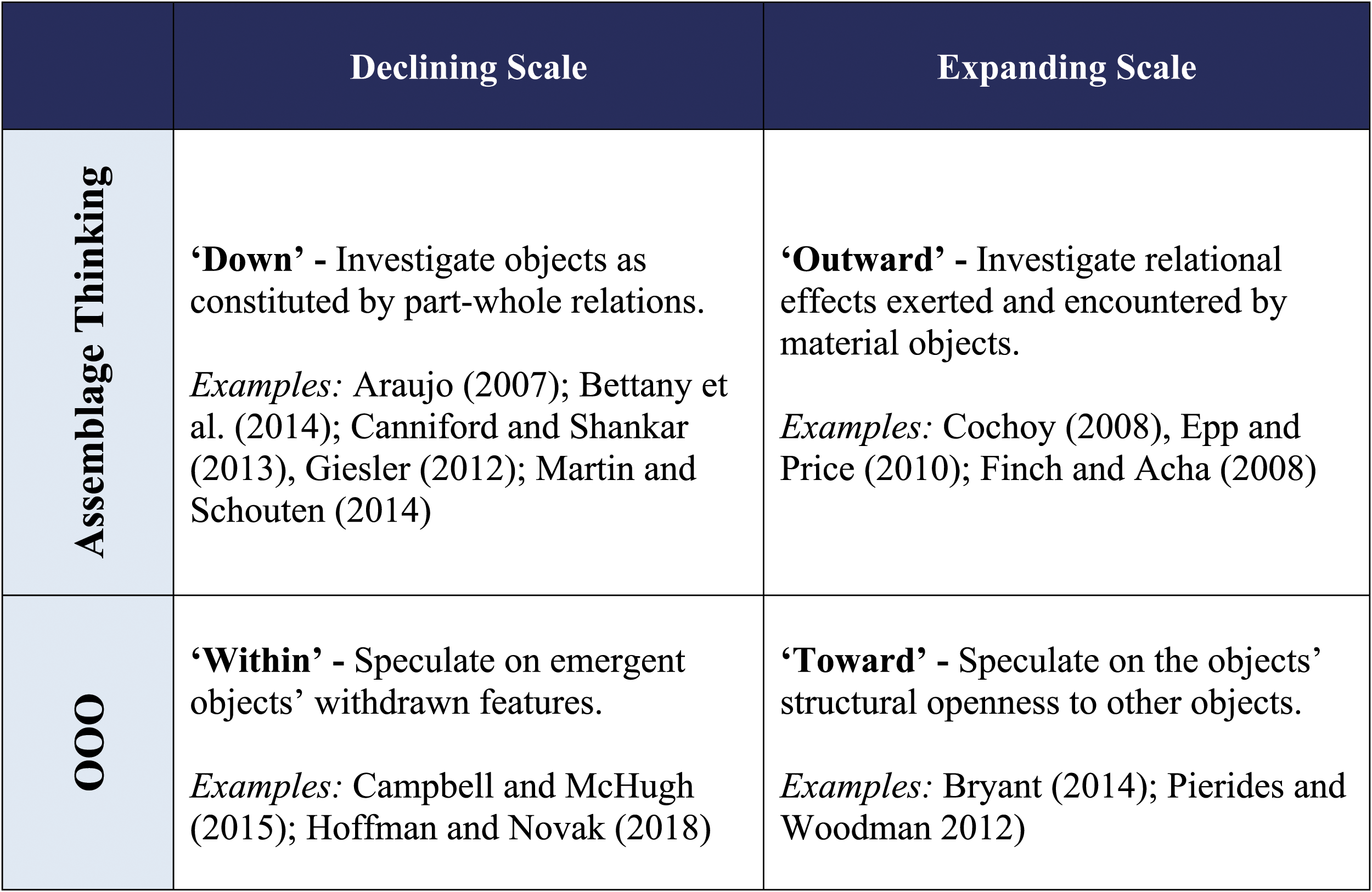
To explain how these directions can aid the development of marketing theory, we discuss how these tools might help researchers to: (1) (re)visit object multiplicity; (2) investigate withdrawn features of objects; (3) practice ‘speculative’ forms of research; (4) reconsider the scale of assemblages to reveal novel units of analysis and (5) critically consider the place of subjects and objects in analyses of market assemblages.
Revisiting object multiplicity
Our conceptual framework helps researchers to structure and organise the potentials to (re)construct contexts in different ways in research. This potential is influenced by Thompson et al. (1998), Mol (1999), and Law (2002) who all recommend researchers tell multiple stories about particular contexts. Their rationale is threefold: first, researchers benefit from acknowledging that objects are ‘more than one, but less than many’, as they can manifest in multiple ways within and across contexts (Law, 2002: 6). Second, because each researcher carries with them a worldview that shapes what they pay attention to and write about in relation to a context (Dolbec et al., 2021), research accounts are always partial, potentially marginalising voices, roles and multiple manifestations of people or objects, thereby limiting or distorting analysis and theory development (Bettany, 2015). Third, different orderings and descriptions of contexts can create different ways of enacting organisations and markets (Bettany 2018; Haraway 2007).
The four directions our framework offers (down/outward/within/toward) can help researchers discover and represent novel, contested, or marginalised aspects of contexts as part-whole relations, but also through considerations of emergent and intrinsic features of what Harman calls ‘objects’. To be sure, assemblage and actor-network theories harbour concepts that can handle comparable problematics around object multiplicity versus singularity: we might think of Latour’s (2012) ‘immutable mobiles’, or Deleuze and Guattari’s (1987) relationships of ‘interiority’ and ‘exteriority’, and ‘encounter’. Indeed, Roffe (2015: 45) explains that from Deleuze and Guattari’s perspective, ‘the assemblage is a new concept of an object’. Sadly, Harman is content to ignore such nuance. Yet despite this, OOO breaks useful territory by encouraging analyses that reveal objects’ withdrawn qualities.
Revealing withdrawn features
OOO can help researchers to focus analyses on the tendencies of objects to generate unforeseen change when new relations reveal their hitherto withdrawn facets (Pierides and Woodman 2012). The example of refrigerators and landfill releasing CFCs into the stratosphere is relevant to future marketing studies. These must consider the surprises that society will encounter in respect of technology, energy, and healthcare markets, as examples. By investigating assemblages as objects in their own right, researchers may reveal how certain ‘things’ in these contexts can harbour withdrawn features that surface in surprising ways.
This reorientation from studying part-whole assemblages to ‘objects’ in their own right encourages researchers to seek out novel and peculiar units of analysis that harbour withdrawn features due to their structural openness. Recent studies have moved in this direction by studying surprising relational interactions that emerge in the contexts of microbiology and nanotechnology (Campbell and Dean, 2019; Campbell et al., 2017). As with so many instances of material consumption, the functional aspects of particular objects are often balanced by withdrawn features. Like CFCs, materials such as asbestos or drugs such as thalidomide, initially fulfil functions for which they were designed, yet these objects later reveal withdrawn qualities. Further research could chart processes by which withdrawn features are detected, how these features reveal themselves, as well as effects of these revelations. Key questions in developing such agendas will ask, from whom and what are objects withdrawn?
One avenue to answer such questions could involve tracing emic experiences of withdrawal encountered by consumers. For instance, although the effects of shopping carts on consumers have been registered by Cochoy (2008), further research could reveal more about withdrawn features of these objects and how these are revealed in different contextual assemblages. Reinvestigating shopping carts in relation to gendered, ageing, or disabled bodies may reveal experiences of surprise and frustration ‘hidden’ in many consumption objects, which are not revealed in ‘normal’ or normative use (see Hauser, 2021). Research that is motivated by desires to reveal withdrawn features of objects might help to inform policy in respect of the accessibility of consumption spaces and experiences.
‘Speculating’ on markets and consumption
Our framework also encourages the development of speculation as a method in marketing and consumer research, not least because there is currently a dearth of research in this area. If objects hold hidden features, and limited ways of relating towards other objects, then these aspects of objects lie outside of what researchers can directly access through senses and prior experience. To access such withdrawn features requires speculative approaches to research methods. This is to say that where many ANT and assemblage-driven studies have relied on ethnographies of current- or post-event analyses, speculative methods involve researchers looking ahead (Hayles 2014).
To achieve this, we have explained that researchers can take inspiration from the ‘hard sciences’, which uncover hidden qualities of objects by thinking about their structural openness. As with characteristics of chemical elements, structural properties of an object can be known, and can help us to speculate how certain objects might connect to others. To be sure, the expertise necessary to carry out such investigations is often specialist; hence, we suggest researchers take inspiration from Science and Technology Studies (Latour and Woolgar, 1979) as well as market studies (Araujo 2007; Hagberg and Fuentes, 2018). That is, rather than researchers performing speculations, studies can investigate how speculation is practiced at the emic level (Hietanen et al., 2022). Witnessing how marketers, designers, scientists or brand managers speculate on the unknown potentials of communications, products and services may reveal how these groups handle problematics wrought by these various ‘objects’.
If marketing researchers wish to execute speculative methods themselves, Bogost (2012) suggests researchers build or use objects as part of research designs to glimpse at withdrawn features of objects. Archaeologists and anthropologists garner insights about long-vanished cultures by creating replica skeletons and ‘making’ experiments through which they can make further speculations on cultural practices. Latour and Leclercq’s (2016) volume Reset Modernity! showcases a variety of radical material methods through which researchers are thinking through prickly problematics such as pollution, climate change and digital cultures.
Marketing researchers have long experimented with object- and arts-based research methods, and these may be particularly apt to plug into speculative theorisations. Current examples of such object-based innovation include Figueiredo and Scaraboto (2016) using a GPS ‘geocaching travel bug’ to reveal movements of consumption objects that guide speculations on recreational activities. From an arts-based approach, Rojas-Gaviria and Canniford (2022) show how poetic meditation techniques can reveal researchers’ embodied capacities to detect phenomena that may have otherwise passed below sensory thresholds. Equally, Hietanen et al. (2022) show how videography can reveal withdrawn affects through ‘encounters’ between theory, context, and filmic presentations. Speculative explorations might also take advantage of devices like heat sensors, and heart monitors to ‘re-presence’ hidden facets of consumer embodiment (Hill et al., 2014). Moreover, such procedures could involve other species whose perceptive faculties can reveal features of spaces, products and experiences that may be withdrawn from humans (see Coffin 2021a).
Perhaps more critically, however, it is important to study how firms themselves are inventing methods to discover withdrawn features of consumers and consumption contexts. How and to what ends are marketers using data-tracking or bio-tracking devices to speculate on how consumers encounter retail spaces, media, and experiences? Recent revelations of ‘Pegasus’ spyware hiding in mobile telephones (Kirchgaessner et al., 2021) should provide food-for-thought in terms of investigating how withdrawn features of digital consumption impact consumers and society. Likewise future innovations in AI-brain linkages may provide fruitful territory for speculative investigations ahead of the inevitable surprises and ethical challenges that these technologies and associated firms will surely reveal (Wild 2021).
Scale and units of analysis
Iteratively going ‘down’ in scale by unpacking ‘whole’ assemblages into component parts can reveal a variety of effects (Hill et al., 2014). Likewise, placing micro-social situations in macro-social context can explain much about the social structures that enable particular markets and forms of consumption (Askegaard and Linnet, 2011; Huff et al., 2021; Nye, 1990). So how can researchers make decisions as to what constitutes ‘the whole’ and the ‘parts’ in analyses of consumption and market assemblages? How far ‘down’ or ‘outward’ should researchers trace assemblages? Who knows what unintended and withdrawn effects the James Bond brand assemblage (Preece et al., 2019) exerts on diverse global assemblages, for instance? Nevertheless, we explained how tracing an object’s effects ‘outward’ may also gloss over features interior to that object which may also be useful to register in our analyses. Harman (2018) points out that emergent features of an assemblage can be overlooked when analyses focus on part-whole relations, or wider effects.
Harman’s (2018) undermining and overmining concepts can help researchers to make decisions regarding units of analysis and the scale of research. To inform how far ‘down’ and ‘outward’ an investigation should go, OOO seeks to move scholarship beyond a perspective of objects as determined by contextual relations or manifest effects, and instead theorise certain assemblages as objects in their own right. In short, the advice is to ground assemblages according to their own scales by recognising them as ‘objects’ that are not solely determined by their relational contexts. In doing so, emergent and ‘withdrawn’ features of objects can be registered (Bogost, 2012; Harman 2009).
In this sense, OOO is difficult to resolve with actor-network perspectives (Campbell et al., 2019). Nevertheless, the problem of undermining is commensurate with assemblage thinking in general. The emergent properties of certain assemblages are core to both Deleuze and Guattari (1987) and DeLanda (2006). Moreover, all socio-material analyses make choices about what level at which to stop digging ‘down’ into component parts. Assemblage thinking routinely requires researchers make choices about categories of objects in analyses (Deleuze and Guattari, 1987). Actor-network studies often follow emic categorisations to make these choices. For example, in Latour’s (1996) analysis of an experimental public transport network, his discoveries lead him to grant Aramis a voice: the network speaks to the reader! One might interpret this representational strategy as Latour acknowledging this object in its own right, refusing to explain this particular ‘actor’ as an effect of smaller components (undermining) or wider goals and processes (overmining).
Likewise, concepts of assemblage are sensitive to the ‘speech acts’ that influence the operation and scale of organisational entities (Roffe 2015). Research is often guided by a desire to understand effects, flows, or processes. Any reflexive researcher should be aware that their choices in such matters will affect the analysis (Bettany 2015), and involve ontological choices that shape insights (Bettany, 2015; Dolbec et al., 2021; Kjellberg and Helgesson, 2006; Zwick and Dholakia, 2006). OOO reminds us that ontological considerations should inform epistemological projects (Campbell et al., 2019), yet the problem of overmining might also be considered a familiar aspect of research methods and practice for scholars using socio-material theories. For this reason, we suggest that Harman’s critique around overmining is tacitly acknowledged in much socio-material research practice.
Researchers are responsible in defining the scales and units of analysis (Canniford, 2005), and it is vital that researchers explain their choices (Bettany, 2015; Campbell et al., 2019; Mol, 1999). However, by arguing that objects should be granted their own scale, Harman potentially weakens actor-network theorists’ affirmations that humans act as spokespeople for material objects (Latour and Woolgar 1979), and that ontological choices are political acts (Latour 1993b; Mol 1999). Nevertheless, certain objects like bush fires or the hole in the ozone layer are worth acknowledging as unmoved by kinds of relations such as social representations (Newton 2007). Indeed, a meaningful difference between OOO and prior approaches is that Harman’s version of granting an object ontological/categorical status is less concerned with speech acts made by scientists or politicians and the like (cf. Latour 1999; Law 2002), and more levelled at the expressive potentials of all kinds of materiality.
OOO’s disappearing subject
Perhaps it is for these reasons that OOO appears to lose sight of ‘subjects’ in its analyses. To be sure, Campbell et al. (2019, 130) explain that in OOO ‘everything gets determined as an object (including subjects)’. They consider how Harman discusses the Dutch East India company as an ‘object’, an organisation that cannot be reduced to its component parts or explained as part of a broader scale of European colonialism (cf. Law 1987). What ANT might view as a network or assemblage of heterogeneous material and expressive components that include people, OOO treats all these entities as ‘objects’ by viewing them as having equal explanatory potentials in analysis and theorisation. Yet Harman’s flattening of the ‘subject’ requires consideration.
Labelling humans (and animals) as objects, often understood as entities that do not have agency can offend a sensibility held sacrosanct in much marketing research, namely that humans are agential (see Bettany 2015, 2018). Equally, however, recent marketing and organisational research makes a counter critique, that concepts of subjective intention are obsolete (Hietanen et al. 2020). Sociological analyses show how social contexts can thwart individual conceptions of the subject, such as when ‘individuals’ become part of a ‘crowd’ (Hill et al. 2021; Lopez et al. 2021). Equally, certain spaces can influence decision-making (Chatzidakis et al. 2012; Coffin 2021b). In each case, rather than simply seeing these contexts as individuals forming parts of a whole, analyses can instead inspect the possibility for consumption as driven by machinic systems in which effects emerge at levels of analysis in which choice is disconnected from prior relational circumstances (Coffin 2021b).
To be sure, OOO might help to investigate novel and emergent units of analysis to describe human conduct in markets. Nevertheless, Harman’s definition of ‘objects’ risks stripping away meaningful differences between subjects and objects. If subject/object distinctions are collapsed, then we may risk losing sight of the ‘special’ qualities of living entities that are worthy of protection, care and respect (Haraway 2007). Subject/object distinctions can draw attention to how subjects are made object-like, for instance animals entangled in factory-farming or laboratories, or people entangled in forms of media (Bettany 2018). So too do we risk losing sight of how these binary categories enact the world (Canniford & Shankar, 2015).
From an OOO perspective, it could be suggested that this emergent quality of living creatures establishes them (and us) as ‘special objects’. Yet OOO often appears agnostic vis-à-vis such concerns, and partly for this reason Campbell et al. (2019) suggest that political, ecological and ethical questions may be better handled with other forms of posthuman epistemology such as posthuman relationism (Bennett 2010; Tsing 2015). These perspectives utilise human/nonhuman distinctions to represent emergent objects such as ‘planetmates’, ‘naturecultures’ and ‘oddkins’ that cross human/nonhuman boundaries at a variety of scales while retaining sensitivity to the qualities of subjects in these systems (Campbell et al., 2019).
Conclusion
This paper contributes to the ontological turn in marketing by joining discussions of Object-Oriented Ontology (Campbell and McHugh 2015; Campbell et al., 2013; Hoffman and Novak, 2018). By explaining OOO’s approach to objects, and by introducing concepts of withdrawal and structural openness, we explain how marketing researchers can think about the scales at which analyses are carried out. To be sure, it may be objected that OOO’s approach to objects is incompatible with other relational ontologies. Nevertheless, at a pragmatic level, assemblage, actor-network and other relational approaches all offer opportunities for theoretical invention. In the spirit of Deleuze and Guattari (1994) themselves, theory must be re-constructed according to the contexts in which it is put to use. This is particularly the case where investigations cross natural and social domains, for in these instances concepts taken from various schools of thought are often required to handle complex and messy realities (Bettany, 2015; Campbell et al., 2019). It is particularly with current economic, health, social and environmental crises in mind that this paper encourages researchers to open our analyses to ‘objects’ at a variety of scales, and to speculate on how these objects may be gathering consequences that although unnoticed at present, will challenge markets, organizations and cultures in unprecedented ways.
Footnotes
Acknowledgements
The authors thank Tim Hill, Jack Coffin and Norah Campbell, as well as the editorial and review team for their generous comments on previous iterations of this manuscript.
Declaration of Conflicting Interests
The author(s) declared no potential conflicts of interest with respect to the research, authorship, and/or publication of this article.
Funding
The author(s) received no financial support for the research, authorship, and/or publication of this article.
