




Abstract
We explore the knowledge production experiences of marketing academics who currently work in countries that have previously colonized their home countries. Building on Bourdieu’s concepts of illusio and the field, we first demonstrate that participants are drawn to the appeal of the academic game which perpetuates itself as a toxic field of neo-colonial relations. Second, we illustrate that two dominant exploitative academic practices sustain this toxic field. Third, we demonstrate that there is a toxic illusio which prevents academics from developing a healthy sense of colonial relations in their knowledge production.
Introduction
Colonialism as a practical ideology has shaped the divide between the colonial powers and the places they have colonized, economically, socially, and culturally (Said, 1978; Spivak, 1988; Spivak, 1999). The power relations between the previous colonizers and the previously colonized extend to all fields of life, and academia is no exception (Bernal & Villalpando, 2002; Varman and Saha, 2009). COVID-19 pandemic hit the colonized territories (CT henceforth) harder (BBC, 2020), the neo-liberal transformation is felt more brutal, and the environmental damage is more extreme in these regions (Chang, 2010). People from all walks of life, including academia, leave their countries of birth in pursuit of better prospects in life in the colonizing countries (CC henceforth) (Acemoglu & Robinson, 2012). Thus, colonialism merely transformed into neo-colonialism, which encompasses “new practices of contemporary imperialism, which replace direct colonial occupation with an ever-expanding role for international institutions, in maintaining the economic and political dependence of countries of the South” (Yousfi, 2021: 83).
Building on Gopal (2019), we acknowledge that whiteness, imperialism, and colonization are not completely overlapping: there are voices of dissent among the (white) CC academics, and there are CT academics who may be complicit in sustaining the current neo-colonial hierarchy. We use the terms white and colonizer in their anticolonial senses as “regimes of power that normalize white dominance” (Dar et al., 2020: 2) and as individuals and institutions that normalize and sustain this order. Thus, we do not use these terms as descriptors of biological distinction (Al Ariss et al., 2014) or of research and political agendas (Gopal, 2019). We contend that whiteness, like colonialism, constitutes “a power structure of formal or informal rule, socioeconomic privilege, and differential distribution of material wealth and opportunities, benefits and burdens, rights and duties” (Mills, 1997: 3). We use the term West to denote the former imperial powers and in general to denote both Euro- and North America–centric theories, practices, and mindsets. We build on the premise that outside these Anglophone centers, others are relegated to semi-peripheries and peripheries where semi-peripheries comprise some of Europe as well as Canada and Australia (Alatas, 2000, 2003; Boussebaa and Tienari, 2019; Meriläinen et al., 2008; Üsdiken, 2014).
Theoretically, we draw on Bourdieusian concepts such as habitus, the field, and different forms of capitals to explore how CT academics experience the toxic illusio while they traverse neo-colonial academia. We define toxic illusio as the neo-colonial academic game the allure of which draws CT academics in and keeps them as participants of academia in CC countries, even when their ultimate stakes in the game are low and symbolically denigrated. Further, CT academics may experience levels of cognitive dissonance as a result of the duality of the toxic illusio which draws them in, which may provide them with different forms of capital, and yet which harms them at the same time. Bourdieusian theory has previously been used in exploring imperial domination and colonialism as a complex system that spans micro-level interactions in fields of structured relations, shaped by dispositions and social, cultural, economic, and symbolic resources of individuals (Go, 2008; Steinmetz, 2007). “Bourdieu articulated a systematic theory of colonialism that entailed insights on colonial social forms and cultural processes and contained the seeds for some of his later more well-known concepts and ideas like habitus, field, and reflexive sociology” (Go, 2013: 51). Building on this premise, we extend the dialogue between postcolonial theory and its tools of analysis with the Bourdieusian framework.
The inequalities in the dynamics of knowledge production and dissemination between the center (currently the USA) and the CTs have been previously studied. CT academics working in CT countries play a part in sustaining the hierarchies between the center and the CTs (Boussebaa and Brown, 2017; Kothiyal et al., 2018). North American marketing and consumer behavior frameworks are used in the Indian Institutes of Management (Varman and Saha, 2009). To complete this picture, we focus on the knowledge production hierarchies and on CT academics in the CCs that are outside North America. Our research question is: what are the knowledge production experiences and relationships of CT academics who work in the CCs? In asking this question, we aim to answer two sub-questions: (1) how do lived experiences of neo-colonialism manifest in marketing academia and (2) what practices in the knowledge production process sustain this neo-colonial order. To this end, we give voice to the experiences of marketing scholars from the CT who currently work in marketing departments and management schools in the CCs.
Literature review
In the contemporary hierarchy in management knowledge production, the USA and the UK hold the two top positions, followed by Northern Europe, Canada, Australia, and the rest of the world. The chasms in this hierarchy are exacerbated by the dominance of the US as the gold standard that is both emulated and challenged at the level of elite institutions across the world (Üsdiken, 2014). Boussebaa and Tienari (2019) show that Englishization of management research produces further inequalities yet knowledge producing localities outside the USA, UK, and Northern Europe too are forced into the Western elite publication system, using Western notions, theories, concepts, and frameworks (Connell 2017; Meriläinen et al., 2008; Murphy and Zhu, 2012; Varman and Saha, 2009). The implicit rule that academic knowledge production must be framed in “Western” terms, the persistence of Western concepts in the minds of CC academics, applies to knowledge production in the field of management (see Vijay and Varman, 2018), and to marketing (see Sreekumar and Varman, 2016; Varman and Saha, 2009; Varman and Sreekumar, 2015).
The marketing theories, concepts, and frameworks developed using Global North data are taught at the institutions in the Global South (see Varman and Saha, 2009). Varman and Sreekumar (2015) illustrate the shaping of marketing theory in India by Western knowledge and how it is disconnected from local history and particularities. The way that these symbolic hierarchies are created and sustained to the advantage of CCs greatly echo the concerns that CCs bind both themselves and the CTs in terms of how CTs are symbolically treated (Boussebaa and Brown, 2017; Kothiyal et al., 2018; Said, 1978; Spivak, 1988). For example, marketing scholars are asked to provide more elaborate and apologetic descriptions when their data come from the CT, which reproduce the symbolic order between the CC and the CT (cf. Humayun and Belk, 2020; Nguyen and Belk, 2013). Below, we first examine academia as a neo-colonial site, and then elaborate Bourdieusian theory as a frame for the study of toxic illusio in this neo-colonial academic field.
Neo-colonial academia
Early modern colonialism continued well into the 20th century with the same main working principles: uneven social and economic relations based on extraction and one-way flow of natural and human resources (Césaire, 2001; Loomba, 2015), diminishing existing local production industries to positions of dependence (Brooks, 2019). The effect of colonialism is deeply woven into the very fabric of contemporary economic, social, and cultural relations (Acemoglu and Robinson, 2012; Said, 1978; Spivak, 1988), constituting today’s neo-colonial hierarchical relations. Currently, although many CTs have political sovereignty, their economic, social, and political relations with the CCs remain uneven; and academic institutions remain key players in the colonialism debates (Mutua and Swadener, 2004; Prasad, 2015).
The term postcolonial refers to the so-called aftermath or the unraveling of colonialism (Bhabha, 1984; Said, 1978; Spivak, 1988) and “deploys diverse theoretical and political resources to interrogate, intervene in and transform the continued power asymmetries, imbalances and repressions, and effects of contemporary neo-colonialism, and other forms of imperialism” (Westwood and Jack, 2007: 247). There is not a particular point at which colonialism ‘ceased’. Colonialism is alive and well in academia (Connell, 2014; Heleta, 2016; Kothiyal et al., 2018; Nyoni, 2019) in its different neo-colonial forms (Boyce and Ndikumana, 2001; Murphy and Zhu, 2012) and the neo-liberal order refocuses attention away from historical injustice to new possibilities of social and economic relations (Adam, 2019; Taoua, 2003).
We suggest a dialogue between postcolonial theory and Bourdieu’s work. If we take academic knowledge production as a Bourdieusian game, academics are drawn to the illusio of the game as novice players and through their participation become entrenched in the game, which may ultimately harm them. Colonization has become invisible; it evades daily criticism and becomes a detrimental form of exploitation (Ndlovu-Gatsheni, 2013). Those who align their interests with the game may not prioritize or may give up altogether their critical engagement and struggles against neo-colonialism; rendering invisible the terrain on which academic knowledge production is played.
Habitus, field, social capital, and illusio
Bourdieu defines habitus as internalized and taken for granted assumptions in a particular field (Bourdieu, 1977). The notion of field denotes a web of relations, the participants of which have more shared assumptions in common than members of other fields (Bourdieu, 1984). Here, we focus on neo-colonial academia as a field. Bourdieu refers to struggles among fields for power and legitimacy, through which fields could retain a hold on orthodoxy, that is, the established view, or be relegated to heterodoxy, that is, the peripheral view. Individuals mobilize and transform their different forms of capitals such as social, cultural and economic capitals in order to craft their choices and chances in life. All forms of capital could be deployed and transposed into other forms and ultimately to symbolic capital, which denotes one’s standing and respectability. Symbolic capital is ephemeral as it changes across fields and gets subjected to symbolic violence or valorization.
Bourdieu and Wacquant (1992) define illusio as the way in which players in a game fail to develop a healthy view of the game, even when their stakes in the game do not serve themselves well. The allure of the game draws the players in and their entrenched interests in the game make the toxic outcomes of the game invisible. The toxic illusio of a game is most evident when the game harms but when such harm is tacitly condoned to a degree that it does not induce cognitive dissonance or moral dilemma for the participants (Mergen and Ozbilgin, 2021). The illusio of the game, due to its allure, draws the players in and prevents them from viewing the game through an emancipatory lens. Previously, Go (2008) used the field theory to compare the rules of the game and social capital in 18th century British and the 20th century American empires. Steinmetz (2007) utilized Bourdieu’s analytical framework and examined the arrangement of social practices and perceptions in patterned social fields to gain understanding of the relationship between representation and German colonial policy. Building on, we use Bourdieu’s concept of illusio as part of his other conceptual ideas in framing power relations in neo-colonial academia, and the agentic and resourceful roles that individuals play in shaping and reproducing these power hierarchies.
Method
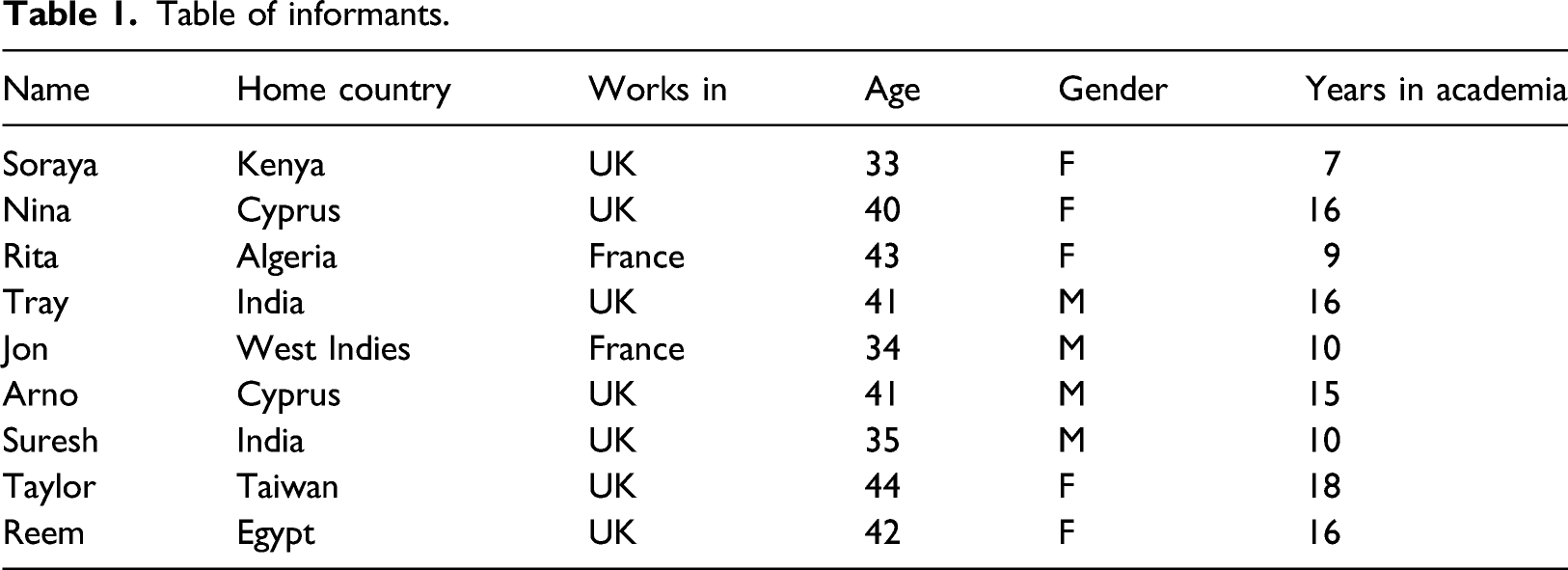
We utilized in-depth interviews to gain insight into life and career experiences of CT academics (Gubrium and Holstein, 2003) and we have also drawn on secondary data such as British Council booklets and previously published marketing theory papers. As the British Empire colonized a much larger geographical space than other European countries, we have more participants from the UK. English speaking academia has a dominant role in continuation of colonial relations (Boussebaa and Brown, 2017; Johansson and Śliwa, 2016), closely followed by French speaking academia (Yousfi, 2021). The selection of participants was done through academic networks. We identified and invited 30 CT scholars working in CCs and nine among them agreed to participate in our study (see Table 1 below).
Our sample consists of nine marketing academics from various countries that currently work in the UK and France. Except for two, all our informants work in the broad area of critical marketing. The in-depth interviews were conducted via Zoom and they lasted between 60 and 100 min. Like Johansson and Śliwa’s (2016) interviewing strategy, we intended to find out about our informants’ personal and career trajectories. We asked about their motivation to pursue PhD degrees and academic careers in the CCs, their everyday experiences as CT individuals, researchers, and as faculty in the CCs.
Table of informants.
We adopted a hermeneutic approach to critically interpret text. We treated the interview transcripts as texts which allowed us to identify common patterns and relevant insights to our research questions (see Thompson, 1987). We first read each transcript independently to identify emerging themes. We then discussed and scrutinized the emergent themes and allowed early interpretations to shape later ones (Spiggle, 1994). This process led to the emergence of the three themes that we present below.
Findings
Our analysis reveals that even semi-peripheries such as the UK and France (themselves CCs) may hegemonize those in the peripheries (CTs) and that the academic practices and institutions in these secondary centers (semi-peripheries) act to impose a further layer of hierarchies on the way knowledge is produced and shared. First, we illustrate that academia is a toxic field of neo-colonial relations. Second, we reveal the dominant exploitative practices which sustain the neo-colonial field. Third, we illustrate that toxic illusio sustains the CT academics’ participation in this toxic field.
Academia: a toxic field of neo-colonial relations
In the toxic environment literature, toxicity is defined as “violence, poverty, and other economic pressures…disruption of family relationships and other trauma, despair, depression, paranoia, nastiness, and alienation” (Garbarino, 1997: 12). In addition to lower salaries, denial of promotion, and denigration (Inside Higher Ed, 2021), the data point to the nature of academia as a toxic field of neo-colonial relations in which people from the CT operate. Most reported incidents of toxicity in our study manifested as subtle forms of symbolic denigration at the level of interpersonal experiences. One participant with elite education and high cultural capital explained her experiences of the academic knowledge production and dissemination process: “When I saw that the Third World Quarterly paper about the benefits of colonialism was published, and that the publication process was even kind of rigged, my heart really hurt. I expected rage, but I sat down and cried… A few days later, a male friend of mine, white and Christian of course, and an economist of the neo-liberal kind, told me that yes of course it was beneficial, that he could prove it… I did not speak to him again for about two years.” (Reem, 41, Egypt)
Reem, who has been working in the UK for a decade, is referring to the paper named “The Case for Colonialism” by Bruce Gilley, which was published in Third World Quarterly and argued that colonialism was ultimately beneficial for the CTs. The publication of this manuscript was followed by a heated public argument about whether the editor overrode the reviewers and whether it was injurious to even talk of the seeming economic benefits of colonialism (LSE, 2017). The manuscript was later withdrawn from the journal. As noted by the emphasis “male, white, and Christian of course” she reveals that she has experienced similar encounters previously and that they became a normative expectation. The dissent from the imperial center is still quite limited (see Gopal, 2019). Similarly, Nina, who has high levels of social, cultural and economic capital, had a toxic experience after which she was left traumatized by the claims of her English officemate: “My office mate… told me that the colonial project was good for us because they built us railroads and post offices and stuff…he referred to some history manuscripts and books that were written by the English of course… What is the point of telling him that the British took off those railroads after the Republic of Cyprus was established? Because they wanted to sell cars? …this is a man who studies the history of marketing, who is supposedly in critical marketing… so he oughta know better.” (Nina, 40, Cyprus)
Such negative experiences demonstrate that the extension of formal colonial ties constantly recurs, prevails, and causes trauma with detrimental symbolic, affective, and material consequences for the CT academics. This toxicity manifests in the academic field as lowly representation of CT academics in positions of power and authority in the UK and European universities (Guardian, 2018; Healy et al., 2005; Sang et al., 2013) and as epistemic injustice even among “critical” fields of social science. Another participant with considerable level of social and cultural capital recalls how she was represented by her English colleague, the undertones of which suggest a deficit of trust, credibility, and value that CT academics felt in the toxic field of academia: “after I spoke, he repeated what I had just said… he said ‘she is saying…’… everyone had understood me anyway, he did not have to translate my English to their English” (Soraya, 34, Kenya)
While Englishization of academia dominates the institutions in non-English speaking countries (Boussebaa and Brown, 2017), even in the UK, English poses yet another layer of domination. What remains often unaccounted for in the picture of such symbolic dominance and low levels of representation is the living and re-living in trauma, alienation, and possibly depression that some CT academics experience. Mergen and Ozbilgin (2021) explain that if the players in a toxic illusio experience a moral dilemma about the harm that the toxic context presents, this could lead to a cognitive dissonance that could alter their reflections. Tray, with elite education, experiences clear cognitive dissonance, maybe even trauma. Yet, such experiences are often left unreported or ignored. Tray explains how the CCs often lacked reflections on the impact of the academic processes which serve them well: “When I collected the award, the person who gave it to me said I was a prime example of what a white education could do for a brown man… so I guess the question is why am I doing this to myself?” (Tray, 41, India)
Such unreflexive approaches toward CT academics illustrate the extent to which the formerly colonized can “speak” (Spivak, 1988) is still decided by CC academics. Whether the various kinds of capital CT academics possess will translate into symbolic capital that is respected and has status in the CC academic field is still decided upon by the CC academics. More importantly, despite attempts to decolonize academia (see Kamasak et al., 2020a, 2020b), these unequal relations render and sustain marketing academia a toxic field.
Dominant exploitative practices that sustain the toxic field
First, the toxic field is sustained by relegating a data collector role to the academics from CT, and a theory generating role to the academics from CC. A recent report distributed by the British Council on the future of UK-Cyprus research collaboration post-Brexit presents an excellent example of this role distribution:
“Cyprus has good research infrastructure but due to its small size Cypriot organisations and universities need strong partners such as UK universities in order to be successful in very competitive research funding for larger projects. Individuals and faculties in Cypriot universities have developed relationships and consortia with UK academics...they depend on these to successfully co-write grant proposals.” (British Council, 2019: 1)
The designated role for the CT academic is to be in collaboration with other academics from the countries that matter, especially the UK. Such discourses feed the neo-colonial resource extraction that valorizes the CC institutions and processes of knowledge production and denigrates the ones in the CTs. We identify two types of brokering between CT and CC academics:
Data brokering
As noted by Ergin and Alkan (2019: 259), “A global academic division of labor plagues contemporary academic production. The epistemological implications assign southern knowledge to the status of ‘data’ for the use of northern ‘theory’.” Connell (2017) notes how ground-breaking theorists such as Charles Darwin and Alexander von Humboldt collected Southern data to examine and publish back home. Examining this more closely in contemporary marketing knowledge generation reveals specific co-authorship choices in which the CT scholars supply the data, and the CC scholars supply the “theory”—meaning, they broker the exotic, culturally different data into elite journals often with CC interpretation, reproducing deeply problematic representations (Said, 1978; Spivak, 1988). In this sense, there is a one-way flow of raw material from the CT to the imperial center, a hallmark of colonial economy (Chang, 2010). One participant explained how such colonial brokering happened in her case: “It is taken for granted… that if they take on a PhD student from elsewhere…this PhD student will collect data from his/her home country…of course that is what happened with my thesis. I collected the data, they told me which theory was emerging… I would have interpreted it differently probably. I know what certain things mean in that context, they don’t… no matter how many books you read, you cannot understand the lived experience of those people… A supervisor from Egypt would make a different paper out of it” (Reem, 41, Egypt)
Reem pinpoints that instead of cultivating a contextual understanding by taking part in collecting—especially observation and ethnographic—data, CC academics merely translate the emergent picture into existing theory. The politics of translation (Gal, 2015) also plays a part within these exploitative practices: translation of not just concepts or excerpts, but also what contexts mean or denote are often brushed under the carpet and reduced to their essence. As such, they are both reduced in richness and meaning, which Nina refers to as “sanitized”: “Those journals that every one of us little people from around the world yearn to get into just take run of the mill concepts and they sanitize it to meet the marketing or the general management readership, and suddenly it becomes a thing… Like, take a very critical theory such as the post-colonial theory… and just spray some sprinkle all over it… get rid of its provocativeness, get rid of everything about it that will disturb the white heterosexual man…and you will probably make into that journal… same goes for hegemony, inequality, poverty…they make a mockery of these words.” (Nina, 40, Cyprus)
The benefit CT academics may receive from such a one-way flow of resources is accrued through the systems of supervising, mentoring, or co-authorship (Evans and Cokley, 2008; Ku et al., 2008; Tansel et al., 2013). Whether this mentoring relationship happens in an equitable manner regardless of the origins of the junior academics is not clear. Academics from the CT may not question the neo-colonial nature of such collaborations. In most instances, the CT academics may become complicit in the data extraction and brokering themselves, acting voluntarily as native informants (Spivak 1988, 1999), ensuring that they progress their career in the CC. One participant explains how she observed her CT data translated into CC theory: “I had collected it back home, and my supervisor and my mentor were co-authors… but they did not even let me interpret it the way the data spoke to me… they had something in their mind, and boom… my data was categorized… I tried to bring in a local concept, and they were like “no, you are wrong, this cannot be X, this seems an extension of some (obscure) Western theory”… if it goes on like this, there will be no theory from any country in Africa that gets published in Western journals… they know how to play the ropes” (Soraya, 34, Kenya)
Soraya experienced the material and symbolic consequences of supervision: the essentialization of the data she collected and the erasure of her voice from the manuscript. Such relationships are where data extraction and sanitization most likely occur. Another participant explained how the CC actors operated in the toxic field, extracting and instrumentalizing academic connections, doctoral students, or data. Neo-colonialism operates in a predominantly unidirectional fashion serving predominantly the careers and ambitions of the CC academics, and thus never challenging their sanctioned ignorance (Spivak, 1988). One participant with exceptional economic and social capital has accepted this dominant practice as given: “I guess my supervisor was a bit out of sync with the whole American publication game at the time, although he did have...two publications in that infamous journal… He woke up quite late to the fact that you need this Eastern data to run your Western theory on…with my thesis, he thought if you don’t have British data, you will not be published. Then I guess he changed his mind, when he started blending with the big American boys, because he took on this PhD student from Thailand, and made her collect a bunch of data, and juxtaposed some sexy theory on it, and boom…it was a publication in a very good journal” (Suresh, 41, India)
Suresh is quite clear about the way hierarchies of knowledge are organized around the globe. “Big American Boys” denotes the highly active academics who regularly publish in the elite US journals. The British/English academics are second in this pecking order—they often need to build necessary networks with the scholars from North America and emulate their style to get into the top US journals. This style often involves recruiting PhD students from the CT and extracting data through them. Suresh openly discusses that his supervisor would have done the same with his data if the supervisor had realized beforehand that some elite scholars work in this fashion. Similarly, a CC professor recently posted on a critical consumer behavior group on Facebook that he is looking for “a cultural insight researcher… who is familiar with Kenyan market and culture” to collect data. He stipulates that the person should either be Kenyan or someone who has collected data from Kenya before (Consumer Culture Theory Facebook Group, 2021). In essence, the recruiter is looking for a native informant (see Spivak, 1988). As such, extracting CT data is a common and mostly unquestioned practice, and it often goes hand in hand with Spivak’s (1988) notion of sanctioned ignorance demonstrated by the CC academic in the above example. Alarmingly, the studies aligned with critical theory or consumer culture are not exempt from this practice. At times, this process which CC scholars usurp and engage with CT data and scholarly collaboration is veiled behind theoretical frameworks such as critical theory and postcolonial theory.
Technical skills brokering
While the above examples mostly pertain to qualitative studies, the fetish with quantitative studies in marketing on finding cross-cultural differences requires that CT data are supplied constantly. This also sustains a second form of exploitative practice: extracting the statistical expertise of CT researchers. Looking at both the make-up of the PhD students’ home countries and their supervisors’ home countries, it is possible to argue that certain spots in the CT are used as quantitative skills recruitment centers. While a part of this may be because of the population’s concentration in the said areas of the CT, the trend is hard to miss. One participant explained: “I worked hard to get a very good score on GMAT, although it is not a thing in the UK, it still shows people that you have data science capabilities… I am good at data science…” (Suresh, 41, India)
The division of academic labor that has existed for centuries with CC scholars at the core and the CT at the periphery renders CC academics as scholarly with theoretical and philosophical insights and the CT academics as technical assistants with statistical skills: “We all try to help each other… whoever is good at writing the model will write the model, whoever is good at analysis will do it… my other (white, British) co-author has the data collected, and he sends it to me, and I run it… it’s a matter of minutes for me” (Suresh, 41, from India)
That Suresh specified his co-author to be white and British signals that the co-author is a CC academic. That this co-author “has the data collected” further illustrates that this CC academic is highly skilled in extracting data and technical skills from CT academics. The pattern of stigmatizing certain regions for technical expertise is reproduced among scholars from CTs, once they are established in the academic system. One participant who has considerable social capital learned and played, rather than to contest, the rules of the neo-colonial academic game: “I get my amazing Chinese PhD student to do it… I can also run it myself, but I have done it so many times now, I feel like I should work on the theory and the framework.” (Taylor, 44, Taiwan)
Working on the theory and the model are held to a higher regard in the pecking order, something a CT academic may graduate into after supplying the data or the technical expertise for many years.
Finally, adding new categories and variables to quantitative models and experimental research only changes or adds to the core, widely used theory. It merely recirculates and further legitimizes the dominance of CC theories and the CC-designed labor division in marketing research. Cross-cultural research fetishizes the other, yearns to find significant differences between the CTs and the CCs, because this is a fruitful research stream with a consistent return. The long-challenged essentialist and uncritical Hofstedean (1984) assumptions about culture are not the only culprit: these dominant exploitative practices sustain both the material and the symbolic hierarchies in marketing knowledge.
Toxic illusio in the academic knowledge production
Toxic illusio manifests as the misguided allure and admiration that draws individuals from CT to remain participants of CC academic system, which continues to denigrate the CT and holds a self-espoused superior position, partly owing to its privilege accrued through its colonial past. Kamasak et al. (2020b) suggest that a toxic illusio is like a pyramid scheme, which draws people with the hope of high yield, when the outcome is that only the few at the top of the pyramid benefit. Toxic illusio is hard to shatter because individuals who join the game have already bought into the normative expectations of the game. As such, toxic illusio can sometimes exist alongside cognitive dissonance if players become aware that their yield from the game is less than those who were privileged to set the rules of the game. At other times, their lack of cognitive dissonance is often due to their passion to play the game: the passion may veil the often-invisible nature of the harm caused by the game and the implicit nature of the toxicity in which the game is played. Yet illusio becomes evident when the cognitive dissonance and moral dilemma of the neo-colonial toxicity is felt to a significant degree by the participants who nevertheless stay in the field. For many participants, illusio was lifted later in life, although this did not translate into abandoning the game. One participant with mainstream disposition, economic capital, and strong social capital explained their first academic encounter when they came to Britain and how they were unable to frame their experience of being symbolically devalued: “I never thought about it before I came to the UK… I was very upset with my masters’ thesis supervisor because he acted like he was the Englishman who knew everything and I was this little person from a small country…I thought it was because he thought Cyprus was very small...I did not think he meant it in a colonial way” (Arno, 41, Cyprus)
Arno (41) went on to explain his unease in framing his academic experience in colonial terms as this created a level of cognitive dissonance between the appreciation he felt for his supervisor and the neo-colonial nature of the academic experience in the UK, which led him to offer caveats soon after he recalled disparaging attitudes: “I know many nice British people… so I can’t generalize that attitude to everyone… like my PhD supervisor was an amazing woman… she was like my mother in the UK” (Arno, 41, Cyprus)
Offering these caveats helped Arno stay in the game and prevented his cognitive dissonance from translating into action. Similarly, although Nina is later disillusioned, she opts to stay in the game. Nina moves from a state of admiration, with little reflexivity, of the academic publishing system which is imbued with implicit colonial biases and only later develops a critical reflexivity about the toxic illusio and its initial allure: “When I first started, I was in awe of my supervisor… here was this person that published amazing things in amazing journals…it would take me another 5 years to realize neither the journal nor what he’d published were actually that amazing…but when I was younger and I guess largely more impressionable, I did think I need this man to look at my data to tell me what my data is telling me…to make it into a product that could go into one of those hotshot journals…looking back now, i feel so naive and stupid about it…” (Nina, 40, Cyprus)
At least initially, the desire to get published in elite marketing journals is one of the reasons why CT academics choose to work in these toxic CC academic institutions. The initial awe and excitement for some CT academics change over time as they reflect on the nature of their professional relations with the CC academics and as they examine the yield they receive from the game. Yet, this critical reflexivity is not sufficient for Nina and others to leave the CC academia altogether. It is important to note that the colonial status beliefs are not only evident in the CC. Such uneven status beliefs are also globally enforced as previously discussed by Varman and Saha (2009). For example, the top journals in marketing, although embedded in colonial relations, are revered globally and similarly in the CC and CT regions. Nina still publishes within roughly the same circle of CC co-authors and targets the said top journals. In this sense, she is conflicted, as are many others: she has been trained in CC academy, and sees the metropole as where her career is, but the grand strategies of imperial domination pose everyday symbolic and material conflicts for such CT academics.
Academic games are powerful. Their rules are taught through strong rituals of training, acculturation, tacit forms of learning in socialization and many other forms of symbolic and ceremonial experiences along the way. As Bourdieu explains, it is difficult for participants in the academic game, as in any game, to have a full set of reasons for their own participation or position in the game: “Participants have ultimately no answer to questions about the reasons for their membership in the game, their visceral commitment to it.” (Bourdieu, 2000: 102). Thus, the valorization of the colonizer and their academic systems above and beyond those of the CT is often presented as the rule of the game as demonstrated in the above section on the toxic field. Once located in such a toxic field, participants absorbed the rules of the game through the collective habitus of their social and academic environments which allowed them room for joining the game as conformers (Edmonds 2021; Padilla et al., 2007). This type of conformity is not one of pure complacency or non-reflexivity. It may have elements of cognitive dissonance but it does not actively challenge the game. One participant explains how she accepted that her mother’s study in the UK was more valuable than anything she could have at home, which suggests how the habitus with its internalized subjectivities serves to render neo-colonialism invisible: “I thought that is what you did in life…my parents grew up during the war, obviously caused by the Brits…and despite being a refugee, my mom won a scholarship to Imperial College, and I remember growing up I was in awe of her…going to study in the UK is what you did if you wanted to be your best self in life… so I strived to go there, and I did” (Nina, 40, Cyprus)
In the context of contemporary marketing academia which manifests itself as a toxic field, toxic illusio sustains the allure of the academic game despite its dark side. CT academics also often resigned to the toxic nature of the academic knowledge production game due to the entrenched nature of the toxic routines observed and internalized over the years, the radical transformation of which was beyond the possibilities of their power and influence. Toxic illusio serves as a shield which helps actors in academia to both recognize and yet persevere in colonial undertones of their work experiences and careers in academia.
There is a boundary condition in our sample. We only interviewed CT participants who continue their academic careers in the CCs. Even though our participants showed varied degrees of recognition of and reaction to the toxic aspects of neo-colonial knowledge hierarchies, they are the ones who remained in the game. The Bourdieusian concepts illusio, field, and habitus help us frame the way CT academics valorize and uphold the knowledge hierarchies which devalue their symbolic and scientific capital, by accepting their lowly stakes in exchange for recognition as outsiders within. The earlier the CT academic learns to make their home country and data appealing to the gaze of the CC, the earlier they may advance in their careers. This auto-orientalization is carried out by the CT academics, all the while being able to pinpoint instances of Orientalism in writing processes and in social relations. One participant explains how the CC theorization would caricature and transmorph CT concepts into its ontological position.
“But if you look closely…Guanxi has nothing to do with what Guanxi actually is…Ubuntu in western management journals has nothing to do with ubuntu…although they go on and on about how important the context is, they decontextualise these concepts from the Global South…and it ends up very blandly, if it is lucky in a qualitative paper, if it is unlucky, a quantitative paper”. (Soraya, 34, Kenya)
The continued participation in the game creates material consequences for itself: it manufactures its own consent and sees elite publications as the yield of the game. It is a prime example of symbolic domination in academic hierarchy—it illuminates how CT academics accept the reality of operating in hierarchies and naturalize the dominant and privileged position of the CC. For example, guanxi has been translated, auto-orientalized and brokered into a CC-centric concept (Chen et al., 2004; Luo, 1997), despite other Chinese scholars’ persistent warnings that the way that guanxi is brokered and understood in the USA- and Euro-centric management journals is deeply flawed (see Zhai, 2009). As such, translation, a seemingly innocent task, is not exempt from power asymmetries and reproduces different subjectivities, of which the CT academic subjectivity is one (Gal, 2015; Maranhāo and Streck, 2003).
Meriläinen et al. (2008) illustrated that in management, any context outside of the Anglophone core must be defended and it must be positioned as different from the core in a fundamental way to warrant interrogation. Similarly, the CT academics must justify their context, whereas data that originates from the CC is not questioned as closely in terms of the choice of context. The review process also enables this (Meriläinen et al., 2008)—reviewers do believe that they are expected to ask about justifying the context if the context is CT. Although indeed contexts are important, the CC contexts usually are not subjected to the same scrutiny, as seen by the sheer length of the justification of the context in some consumer research studies. For example, comparing the related sections in Humayun and Belk (2020, UK and Canada data), which is 32 words, and Nguyen and Belk (2013, Vietnam data), which is 172 words, reveals how lengthy the justification for the data from CT is in comparison to the data from CC.
A similar pattern can be observed in context specification sections in many other publications (see Thompson and Ustuner (2015) and Üstüner and Holt (2010) for comparison). When the context is the Global South, lengthy justifications are provided, as they are asked for. Through toxic illusio, the CT academics continue to engage in over-explaining their research contexts, as it is a naturalized requirement of the publication process, which in turn sustains the knowledge production hierarchy. Our study shows that in a toxic field of neo-colonial marketing knowledge production, key actors engage in a double bind with neo-colonial knowledge hierarchies: while joining them they also serve to reify and reproduce their illusio, which may blur the toxic nature of the neo-colonial academic game especially for outsiders. This blur makes it difficult for CT scholars to exert collective resistance against the system as they become entrenched it.
Discussion and conclusion
Adopting a qualitative approach, we describe the specific experiences of scholars from the CTs in the CCs and offer three novel contributions. First, our analysis and findings differ from studies of gendered and racialized epistemic practices (e.g., Dar et al., 2020; Sliwa and Johansson, 2015) and from the experiences of scholars writing from the CT (e.g., Kothiyal et al., 2018; Varman and Saha, 2009). We illustrate the existence of neo-colonial toxicity in knowledge production, dissemination, and careers in marketing. Second, we illustrate two extracting and brokering mechanisms with which the toxic field operates and how these manifest in CT academics’ careers. Third, using toxic illusio, we illustrate the continued participation of CT academics in this toxic field and highlight that both the allure of the game and the lack of similar opportunities, a longtail consequence of neo-colonialism in their home countries, render the CT academics complicit in the game.
Quasi-voluntary complicity sustains management and business schools as imperialist contexts (Boussebaa and Brown, 2017). CT academics who work in management and business schools in their home countries use mimicry and hybridity to forge their identities, which sustain the neo-colonial relations between business schools around the globe (Kothiyal et al., 2018; Varman and Saha, 2009). Our study contributes to the completion of this picture and furthers the understanding of neo-colonial relationships and role distribution in academia: we show which exploitative practices the CT academics who work in CCs perform, and how these practices sustain marketing knowledge production as a neo-colonial toxic field. We show that although mimicry and hybridity explain part of the picture in how CT academics conduct themselves in the periphery (see Kothiyal et al., 2018), illusio explains why CT academics continue to stay in the game in CC institutions. Thus, our study links postcolonial theory with Bourdieusian theory by exploring how CT academics even with high levels of social, cultural, and economic capital face demarcation of their symbolic capital and yet continue to remain as observers and participants of this illusio. In this way, we forge a link between postcolonial contexts and the notions of illusio, the field and capitals.
We show the complicity of even the critical marketing studies in sustaining the neo-colonial academic field. This complicity is partially embedded in a wider regime of excellence dictated by management and business studies (see Butler and Spoelstra, 2014). While postcolonial theory queries the representational practices forced on by Western knowledge systems (Spivak, 1988; Spivak, 1999; Westwood and Jack, 2007), we show that the roles given to and accepted by the CT academics in CC institutions perpetuate the current hierarchy of knowledge. We illustrate that it is not enough to do a particular type of research (i.e., qualitative vs quantitative, critical vs managerialist). What is necessary to survive in CC institutions is to supply data and/or supply the technical skills all the while working with the correct CC academic that can broker these research projects as publications into the elite journals.
CT academics bring exceptional endowments of cultural and scientific capital to the CC academic institutions. However, common to all their experience is a denigration of their symbolic capital, which is a toxic outcome of the neo-colonial field in which they must operate. CT academics who would like to advance their careers in CC institutions are given some seeming privileges as outsiders within—PhD scholarships, tenure-track jobs, mentoring, and co-authorship. These privileges are conditional upon their acceptance of certain roles which translate into exploitative practices within hierarchies of marketing knowledge generation. Complementary to Kothiyal et al.’s (2018) work which demonstrates how Indian scholars are rendered precarious in their relations with their Western collaborators, we illustrate that in the CC institutions, too, CT scholars remain in a position of precarity, as they are afforded low levels of autonomy and security.
Furthering the research on toxic illusio (Mergen and Ozbilgin, 2021), we illustrate that cognitive dissonance may be present, but this does not necessarily mean that the CT academics will leave the academic field. Our data also shows that the participants often resign to the entrenched nature of the neo-colonial toxic field in academia because the allure of the academic game weighs heavier than the demands of struggling against the neo-colonial knowledge hierarchies. Simultaneously, the toxic elements of the field are sustained through the participation of the CT academics because colonialism as a project has diminished or annulled alternative career paths in CT academics’ home countries. CT political institutions and their interplay with economic and cultural institutions also contribute to the CT academics’ continued participation in CC fields (e.g., Acemoglu & Robinson, 2012). As noted by Fanon (1963), some people in the CT are still enslaved, some have achieved a simulacrum of independence, and some continue to fight for sovereignty. The reflection of this in academia is similar: some academics from the CT are in a simulacrum of independence which is sustained by toxic illusio. This perpetuates the existing hierarchies and may even strengthen them.
Joining CC institutions also does not offer much room for agency and progress for CT academics unless they publish or collaborate with CC academics strategically. Moreover, the continued dominance of the CC academics and global institutions is also enforced by the political-economic institutions in the CTs. For example, many CT universities are striving to get into the global rankings (Brabet et al., 2021), directly catering to the rules stipulated by CC institutions. Working in an elite university in the CC may offer respectability and status to a CT scholar, and at the same time it may harm their self-interest and career progression prospects as the elite institutions are highly entrenched in the uneven power relations of the colonial system that denigrates CT scholars. Thus, the engagement of a CT scholar with toxic illusio presents a duality, which allows them status on the one hand (Srinivas, 2013), and yet strips them of agentic power and equal access on the other.
As quantitative methods and finding significant cross-cultural differences in marketing are still fetishized, the toxic field constantly requires that such data are both supplied and technically processed. The CC-centric treatment of cross-cultural differences is powered by data collected from the CT by the CT academics. The rules, the gatekeeping, and the checks and balances are all carried out by CC scholars despite the newly increasing existence of people from the CT on faculty rosters, editorial boards, and publication lists. The studies aligned with critical theory or consumer culture are not exempt from the hierarchies in knowledge production processes. It is highly possible for one academic to come from a position of privilege (being from the CC), to study postcolonialism in an academic capacity, and to still traverse the academic publishing field in the manner of a colonial agent. As such, the nuances drawn out by Gopal’s (2019) work in terms of some of the CC academics importing ideas of dissent, but in a sanitized manner, hold in neo-colonial marketing academia and help to sustain hierarchies of knowledge. Similarly, it is highly possible for an academic from the CT to internalize the very hierarchy s/he critiques.
The fact that some marketing academics who come from the CT are complicit in the continuation of the neo-colonial practice of knowledge generation, should be considered in the context of systemic discrimination, lack of representation, overt and covert racism in the neo-colonial academic field (Guardian, 2018; InsideHigherEd, 2016; LSE 2014). Although highly published scholars from both CT and CC do write about inequality, the consequences of colonization, and Eurocentric dominance, this does not necessarily translate into transformative struggles within the academic field. Their actions in the metropole are similar to Spivak’s (1988) discussion of the native informant and Varman and Saha’s (2009) work on comprador intellectuals. Amidst the spread of critical studies in marketing, we find the still persistent practice of looking for the ‘other’ data and applying Eurocentric theory to it. Lincoln (1993) notes the absolute necessity to include the voices of those that are and have been silenced. Thus, we sought to generate an understanding of how neo-colonialism is sustained in academia by listening to those scholars whose labor such neo-colonialism exploits via specific dominant practices in marketing theory generation. As such, this study is a meditation on neo-colonial experiences of scholars from the CTs in the CCs. In charting their experience, we also acknowledge the role of political-economic institutions in CTs that are also accountable for the continued domination of CC-centric knowledge production.
Future research is needed to explore how neo-colonial structures could be transformed with future facing institutional and collective interventions. Our study highlighted a level of awareness which does not yet connect with collective struggles or institutional interventions among marketing academics. Secondly, further research is needed to chart the lived experiences of other CT academics, such as those who now must strive to exist in an academic field dominated by settler colonialists. Illuminating what other practices shape and sustain their relationship to colonialists in terms of marketing knowledge production is necessary to complete the picture. Finally, further research is needed to disentangle how race and gender make a difference in the way these hierarchies are sustained. In what ways do CT academics’ experiences differ along gender, ethnicity, class, sexual orientation and disability lines?
Footnotes
Declaration of conflicting interests
The author(s) declared no potential conflicts of interest with respect to the research, authorship, and/or publication of this article.
Funding
The author(s) received no financial support for the research, authorship, and/or publication of this article.
