




Abstract
This paper invokes Redhead’s concept of claustropolitanism to critically explore the affective reality for consumers in today’s digital age. In the context of surveillance capitalism, we argue that consumer subjectivity revolves around the experience of fidelity rather than agency. Instead of experiencing genuine autonomy in their digital lives, consumers are confronted with a sense of confinement that reflects their tacit conformity to the behavioural predictions of surveillant market actors. By exploring how that confinement is lived and felt, we theorise the collective affects that constitute a claustropolitan structure of feeling: incompletion, saturation and alienation. These affective contours trace an oppressive atmosphere that infuses consumers’ lives as they attempt to seek fulfilment through digital market-located behaviours that are largely anticipated and coordinated by surveillant actors. Rather than motivate resistance, these affects ironically work to perpetuate consumers’ commitment to the digital world and their ongoing participation in the surveillant marketplace. Our theorisation continues the critical project of re-assessing the consumer subject by showing how subjectivity is produced at the point of intersection between ideological imperatives and affective consequences.
Introduction
‘The world feels […] as if it is on the brink of terminal disaster […] Living in the present feels like it is an opening scene from Danny Boyle’s 2002 zombie apocalypse film 28 Days Later where “the last man” finds himself surveying a totally empty deserted city as the “undead” Manchester metropolis beckons up the motorway’ (Redhead, 2017a: 34-35, original emphasis).
Fostered by the instabilities of economic crises, environmental degradation, climate change, political disenchantment and pandemics, commentators have alluded to a pervasive atmosphere of anxiety, precariousness and overall dread in contemporary consumer culture (Ahlberg et al., 2021; Hietanen and Andéhn, 2018; Lambert, 2019; Zwick and Denegri-Knott, 2018). In what Žižek (2015) has aptly termed the ‘new dark ages’, a litany of alarming events indicate the increasing strains and potential breaking points of global market-oriented capitalist hegemony. In almost parodic reflection of Frederic Jameson’s maxim ‘it is easier to imagine the end of the world than to imagine the end of capitalism’, modern forms of apocalyptic thinking pervade popular culture through omnipresent disaster genres in cinema, TV and videogames (Bradshaw and Zwick, 2016: 278). The spread of fake news and conspiratorial, radical views rapidly institute cultures of misinformation, group polarization, extremism and ‘post-truth’, suggesting a lack of trust in expert systems and a loss of faith in mainstream institutions (Kozinets et al., 2020).
Collectively these incidents coalesce under the suspicion that some ‘invisible power’ is eagerly reversing extant institutional orders and orthodoxies, altering our social relations and disturbing our ways of being in the world (Rome and Lambert, 2020; Šimůnková, 2019; Wickstrom et al., 2021). The impression that we are powerless to such traumatic change is usefully addressed by the seldom deployed concept of claustropolitanism introduced by sociologist Redhead (2016: 831) to denote ‘the feeling that we want to escape the planet because we are now so foreclosed’. In contradistinction to the forward-looking optimism of cosmopolitanism, claustropolitanism suggests a stifling anxiety towards liberalization, globalization, digitalization and narratives of progress (Redhead, 2009, 2017a, 2017b). Redhead’s concept functions as a collectively shared and largely unspoken cultural mood – what he considers to be a ‘structure of feeling’ (see Williams, 1965, 1977, 1979) – at this historical moment.
In this paper, we extend Redhead’s under-theorised claustropolitan structure of feeling to understand the experiences of consumers within their digital lives under ‘surveillance capitalism’ (Zuboff, 2019). As the latest development of global consumer capitalism, surveillance capitalism centres on the functioning of ‘behavioral futures markets’ that use predictions to better target consumers and direct their behaviour within preestablished parameters (Zuboff, 2019: 8). It hinges on data-driven intervention in and manipulation of individuals’ social relations, personal interests, preferences and choices at a scale that far exceeds previously known marketing information systems. The spread and influence of surveillance capitalism has been made possible by consumers’ dependence on internet-mediated ways of living and advances in networked information technologies which situate individuals in a particularly fidelitous subject position to the market. By invoking claustropolitanism as a dominant structure of feeling under surveillance capitalism, we flesh out the affective reality of the consumer subject whose experiences have been routinely acted upon and altered in ways that compromise some of the most basic assumptions of personal agency. We ask: How is consumer subjectivity affectively lived and felt within the context of surveillance capitalism?
This paper continues ‘the critical project of interrogating the consumer subject form’ (Lambert, 2019: 329; Rome and Lambert, 2020). Although previous studies have critically re-assessed conceptions of consumer freedom in the marketplace (Beckett and Nayak, 2008; Gabriel, 2015), we further problematise accounts of an agentic consumer subject by focussing on how consumers’ (increasingly limited) freedom is affectively experienced. We theorise the main affective contours of the claustropolitan structure of feeling that emerges from consumers’ self-originated experiences being supplanted by their anticipated conformity. Drawing upon insights from studies of technocultural consumption, we reveal how consumers’ commitment to the fantasy appeals of technology tends not to result in their unconditional fulfilment but instead works to keep them faithfully locked into predictable patterns of behaviour. Here, we show how consumer subjectivity is produced at the intersection between the ideological imperatives of surveillance capitalism and their affective consequences. We introduce the concept of high-fidelity consumption which is located within this point of intersection and is fundamental to the surveillant market project of seeking total certainty through securing consumers’ conformity.
This paper contributes to recent marketing scholarship that seeks ‘[t]o further theoretically ground the looming affective atmosphere of contemporary times’ (Ahlberg et al., 2021: 164) and considers ‘how “late capitalist” subjectivities have increasingly abandoned their optimism about [the] future’ (Hietanen and Andéhn, 2018: 546). By discussing the transindividual and non-representational dimensions of consumers’ experiences, we explore the sense of confinement and foreclosure that permeates the contemporary digital world and how fidelity rather than agency constitutes the lived experience of consumers under surveillance capitalism. In doing so, we show the role that affect plays in the structuring of consumer subjectivity.
In the following sections, we provide first a brief overview of affect, then a background to surveillance capitalism followed by Redhead’s concept of claustropolitanism. Next, we map out what we consider to be the three major affective contours of claustropolitan life under surveillance capitalism and close out with a conceptualisation of high-fidelity consumption.
Consumer subjectivity and the importance of affect
Subjectivity can be broadly understood as ‘human lived experience and the physical, political and historical context of that experience’ (Ellis and Flaherty, 1992: 1). Following non-representational approaches to understanding consumers, markets and consumption events (Hietanen and Andéhn, 2018; Hill et al., 2014), the concept of affect can help us to better understand how the subject position of ‘consumer’ continually emerges and is experienced at the level of pre-conscious feelings or moods. Affects are not the same as personal emotions – sadness, happiness, fear and so forth – which can be recognised, identified and articulated through language (Anderson, 2009; Hipfl, 2018). An affect is an embodied, transindividual tone, impulse or intensity that ‘comes before emotion’ (Hill et al., 2014: 387) and ‘only retrospectively can it be “owned” as the content of an individualized experience’ (Hipfl, 2018: 7). An affective reading of consumer subjectivity implies attending to sensations, moods or waves of sentiment which sit at the margins of people’s consciousness about their relationships to the market and their experiences of themselves within it as consumers. Hill et al. (2014: 388) clarify that ‘affect is often our first window through which we encounter the environments of consumption’. Affects are understood to be transindividual as they pass between individuals or members of groups (Massumi, 2015) and register as a vague atmosphere that infuses a particular situation or moment (Anderson, 2014).
It is here that Raymond Williams’ concept of ‘structure of feeling’ can provide some depth and texture to the atmospheric nature of affects. For Williams, a structure of feeling can best be likened to an emergent culture; a ‘not yet fully articulated’ (1977: 126) way of living and being that is sensed collectively ‘at the edge of semantic availability’ (1977: 134). His concept conveys ‘the culture of a period’ (1965: 64) as it is lived through ‘affective elements of consciousness and relationships’ (1977: 132) before those elements can be properly recognised and classified. Crucially, structures of feeling can inform, delimit and direct experience and action in parallel with the prevailing ideologies of the period. Accordingly, Williams (1977: 132) contrasts a structure of feeling with what he considers the ‘more formal concepts of “world-view” or “ideology”’. On this understanding, Thompson (2005: 238) suggests a structure of feeling can be thought of as ‘an ineffable, experiential residual that cannot be reduced to the rational aspects of ideological belief’. Here, we define a structure of feeling as the reservoir of collectively lived and shared feelings that exist in complex (and sometimes oppositional) relation to the articulated beliefs and ways of being, which structure and organise life but are not reducible to them. The shared feelings, what we call the affective contours of a structure of feeling, may materialise differently and to varying degrees depending on people’s circumstances but should be thought of as ‘pervasive’ (Anderson, 2014).
In relation to subjectivity formation, it should be recognised that pervasive affects that pre-consciously structure a person’s experiences and ways of being are a crucial predicate to how one interacts with and relates to the prevailing ideologies that interpellate and ultimately create subjects (Anderson, 2014; Lara et al., 2017). Affects ‘occur before and alongside the formation of subjectivity’ (Anderson, 2009: 78), constitute ‘non-conscious processes with relevance for the emergence of subjectivity’ (Lara et al., 2017: 36) and, as such, unpacking affective contours is important for understanding how a subject position emerges. In this paper, we understand consumer subjectivity as entangled in the affective contours of a particular structure of feeling that emerges in complex relation to surveillance capitalism. Before drawing upon Redhead’s claustropolitanism to help conceptualise that structure of feeling, we first provide some contextual background to surveillance capitalism.
Surveillance capitalism: No exit from ‘Big Other’
Zuboff (2019: v) defines surveillance capitalism as ‘a new economic order that claims human experience as free raw material for hidden commercial practices of extraction, prediction, and sales’. Extending the classic Marxist visualisation of capitalism as preying upon the surplus value of workers, Zuboff suggests that the surveillant logic of today’s technoculture audaciously lays claim to the surplus value of consumer experiences for the production of behavioural-prediction commodities. This is made possible by consumers’ zealous participation – whether through smartphones, wearables, social media, game consoles and other digitally mediated ways of living – in activities and experiences that are punctuated with market-coordinated behavioural monitoring and prediction (Ball, 2017; Belk et al., 2021; Kozinets et al., 2017). For Zuboff (2019), the accumulation of ‘behavioral surplus’ (p. 8) from consumers’ lives functions through the rise of ‘Big Other’ (p. 376), a ubiquitous networked computational system ‘that renders, monitors, computes and modifies human behaviour’ for more accurate data. The crucial point for Zuboff (2019: 378) is that the most certain way to predict human behaviour is to intervene in it and ultimately shape it towards ‘guaranteed outcomes’. Big Other’s reach across many spheres of life allows for a plethora of day-to-day human experiences to be reduced to observable, measurable, predictable and ultimately manipulable behaviours which are fashioned towards more accurate results. The prediction imperative (and its deliberate conflation with manipulation) is engineered through machine learning that forever improves at shaping and tightening the online and offline contexts in which consumers make choices (Darmody and Zwick, 2020).
The means of behavioural modification sought out does not function through impelling compliance with social norms or rationalities. In contrast to the governing-through-freedom logic of neoliberalism (Shankar et al., 2006), surveillance capitalism is much more deterministic and brutal in its production of subjectivity. For Zuboff, most artefacts of surveillance capitalism (e.g. search engines, social networking sites, self-tracking devices, online games) centre on automating consumers through continually tightening feedback loops and reward/punishment mechanisms not available for personal introspection or immediate evaluation (also Van Otterlo, 2014). Reflexivity, criticality, inner thoughts and capacity for balanced judgement are not required for surveillance capitalism to function, thus ‘human persons [are reduced] to the mere animal condition of behavior shorn of reflective meaning’ (Zuboff, 2019: 382). This, we argue, leads to the substitution of fidelity for agency whereby individual behaviours can be configured, rationalised, de-risked and herded towards market opportunities while consumers themselves remain none the wiser.
Consumers, by keeping to the behavioural parameters established by market actors, function according to a fidelitous subject position whereby their self-originated experiences are subordinated to market anticipation thus producing high levels of anticipated conformity. This subject is analogous to an automaton, confined to living in loops, purchasing, behaving and interacting in ways that confirm Big Other’s guaranteed commercial outcomes. Such fidelitous behaviour is made possible and, in many cases, acceptable (or even desirable) to consumers by the allure of ‘hyper-relevance’ (Darmody and Zwick, 2020: 1). The better surveillant market actors become at manipulating choice environments and decision-making, the more relevant, convenient and appropriate the end-result becomes for the consumer subject, ironically allowing him or her to perceive of oneself as empowered. ‘[I]n the age of surveillance marketing’, Darmody and Zwick, (2020: 2) suggest, market actors engineer ‘a fairytale vision of marketing where the algorithmic manipulation of consumers and consumer autonomy and empowerment become one and the same’. Consumers come to accept ever more updated computational interventions that can ‘know’ and ‘serve’ them better as an inevitable part of social progress. Under this ‘full-blown ideology of inevitabilism’ (Zuboff, 2019: 221), the latest technological conveniences – and the fidelity they require from users – are welcomed into consumers’ lives as ‘prophetic’ and celebrated along the coordinates of a kind of ‘fantasy foretelling’ of an inescapable future to come (Belk et al., 2021: 32).
While discussions around surveillance capitalism and its inevitabilism have centred mostly on ideological imperatives and the various systems and techniques used to maintain them (Ball, 2017; Zwick and Denegri-Knott, 2018), its effects must not be decoupled from lived experience and particularly, the affective dimensions of daily life. Zuboff’s analysis provides us with a useful apparatus for contextualising our digital present though it is largely bound to expert insights and representations from industry insiders; offering limited space for an account of how users actually experience their digital lives (Whitehead, 2019). This is where a closer reading of the affective and non-representational aspects of consumption – how our technoculture is affectively lived – would prove useful. As put aptly by Belk et al. (2021: 42), ‘culture has been notably absent’ in treatments of technology adoption and consumption. Behind arguments about surveillance, decision-guiding techniques, behavioural prediction and modification are streets, trains, parks, homes, restaurants, classrooms and offices in any given city brimming with people instant messaging, scrolling through newsfeeds, streaming music, playing games or immersing themselves in endless online content. Surveillance capitalism is not just a discrete economic order hinged on a regime of behavioural certainty but is a culture of radical digital dependency (Šimůnková, 2019; Zolfagharian and Yazdanparast, 2017).
Here, any discussion of consumers’ dependency on digital devices and media would appear incomplete without mentioning ‘semio-capitalism’ which has attracted attention in recent critical marketing and management scholarship (Hietanen and Andéhn, 2018; Hietanen et al., 2020). Like surveillance capitalism, semio-capitalism relates to a technologically mediated mode of global capitalism that channels desires and enables consumer subjectivities to emerge on a pre-cognitive level. Not limited to digital spaces, semio-capitalism encompasses how media in general has allowed for the unconscious exchange of signs (rather than material things) to pervade all spheres of human life. That ethos can be channelled in various ways not least through surveillance capital which is considered ‘the ultimate instantiation of the logico-mathematical trap of financial semio-capitalism’ (Berardi, 2021: 37). Although semio-capitalism provides the wider ecology within which surveillance capital is incubated, for the purposes of parsimony, we will restrict our commentary to Zuboff’s conceptualisation.
In a Zuboffian reading, surveillance capitalism has redefined and displaced many aspects of social life, locking free will down into carefully curated commodity forms whereby the consumer subject, (Darmody and Zwick, 2020: 10) suggest, ‘become[s] manufactured via incessant, iterative interactions with cybernetically intelligent systems’. Under surveillance capitalism, ‘[a] condition of no exit’ pervades almost all aspects of consumers’ digital lives (Zuboff, 2019: 471). With this ‘no exit’ condition in mind, we now present Redhead’s claustropolitanism as a useful lens to view consumers’ affective reality under surveillance capitalism.
Claustropolitanism
Redhead’s (2009, 2017a, 2017b) concept of claustropolitanism was developed from urban theorist Paul Virilio’s claim that our 21st century world is fast moving from ‘cosmopolis to claustropolis’ (Virilio and Lotringer, 2008: 211). Instead of accelerated globalization and liberalization opening the world up into a utopic cosmopolitan melting pot of ideas, styles and discourses, Virilio observed an opposite reaction based on the contraction and confinement of social life. Redhead, reflecting on the false intimacy of digitalization, advances Virilio’s observation in his formulation of claustropolitanism as ‘the structure of feeling of the modern world’ which he defines as a shared sense of confinement and compression, an inclination that ‘we are starting to feel “foreclosed”, almost claustrophobic, wanting to stop the planet so we can get off’ (Redhead, 2015: 1).
Although Redhead’s claustropolitanism lacks substantive application or expansion by others in extant critical theory, his invocation of a Williamsian structure of feeling allows us to ground the concept to a wider field of thought. Taking forward Williams’ (1977) conceptualisation of a structure of feeling as the collection of those affects which unfold often in complex or oppositional relations to the formal ideology or worldview of the period, a claustropolitan structure of feeling reflects the collectively shared feeling of confinement and foreclosure that people have about the prevailing social reality around them. For Williams (1977: 132), feeling is not divorced from thought, rather ‘thought as felt and feeling as thought’. Accordingly, Williams (1977: 130) identifies structure(s) of feeling as ‘practical consciousness’ (i.e. the practical, lived experience of a period) in response to the ‘official consciousness’ (i.e. the dominant subjectifying ideology of a period). Moving beyond the formally codified ideals, beliefs and fantasies of the official consciousness, a structure of feeling contends ‘not only with the public ideals but with their omissions and consequences, as lived’ (Williams, 1965: 80). A claustropolitan structure of feeling might thus be understood as the imbroglio of collective affects that emerge in addition or counter to the dominant ideological beliefs of a society that foreclose alternatives, restrict agency and shrink the space for critique.
Claustropolitanism might reasonably be deployed in helping to observe and understand the practical consciousness held by consumers in response to the dominant system of surveillance capitalism with its ideological creep of ‘no exit’ inevitabilism. Within critical marketing scholarship, a range of disquieting feelings associated with contemporary technoculture such as anxiety, fear, precarity and meaninglessness are reported (e.g. Lambert, 2019; Šimůnková, 2019; Zolfagharian and Yazdanparast, 2017; Hietanen and Andéhn, 2018), which potentially provide some of the affective texture and tones of claustropolitanism. Most explicitly, Ahlberg et al. (2021: 168) make a compelling case for our current affective horizons being ‘plagued by a slow ongoing cancellation of the future’ and ‘a contemporary lack of utopian thinking’.
Importantly, Redhead never had the opportunity to formally crystallise the key affective contours of his concept. As Brabazon (2021: 5) reports, Redhead died before a more complete scaffolding of claustropolitanism could be assembled, leaving us with a ‘shard of theory, an intellectual stub’. Nevertheless, that stub remains important to reach for and extend because of its potential to provide an appropriate, timely and affectively charged ‘theory for the end of the world’ (Brabazon, 2021: 6). From Redhead’s writings, the claustropolitan structure of feeling relates closely to the encroachment of human experiences by digitalisation and global capitalism. The possibility that claustropolitanism emerges in complex relation to the logic of surveillance capitalism is clearest in his following passage: ‘This structure of feeling I am alluding to is due not just [to] changes in the examples of new digital leisure we see all around us, brought about by global phenomena like Nintendo’s Pokémon GO, updating the analogue treasure hunt for the digital age. It is more of a conceptual change, riding the tectonic shifts brought about by globalisation, digitisation and neo-liberalism in the last 20 or 30 years, leaving us bereft of satisfactory resources to explain what is going on and where we are all heading’ (Redhead, 2017a: 226).
Redhead’s suggestion that we are left ‘bereft’ of answers elevates uncertainty to a master role in claustropolitanism. Uncertainty is also picked up in treatments of surveillance capitalism that emphasise how technologically enabled behavioural prediction and modification of consumers’ choices are now leaving them ‘dazed, uncertain and helpless’ (Zuboff, 2019: 406). At one end, surveillance capitalism and the hyper-relevant, largely hedonistic technoculture that it presides over, sweep consumers up in ‘chaotic vortices of desire, extreme images and outlandish acts’ (Kozinets et al., 2017: 678) that outpace their capacity to truly understand – let alone, resist – what is happening. At the other end, the radical behaviourism instituted by surveillance capitalism to engender predictable outcomes ensures that consumers are largely ignorant to the types and quantities of information they share, how it is used and what their own preferences are versus those that are the result of manipulation. Between both Redhead’s conceptual efforts and wider conceptualisations of technoculture, we can expect a level of interaction between surveillance capitalism and claustropolitanism that we shall now explore.
Mapping claustropolitanism: affective life under surveillance capitalism
In the following sections, we draw upon insights from studies of technocultural consumption to illustrate what we consider to be three dominant affective contours of claustropolitanism under surveillance capitalism. Much of the extant research emphasises consumers’ dynamic, ambivalent and nuanced relationships with their technocultural consumption (Eikey and Reddy, 2017; Kozinets et al., 2017; Kristensen and Ruckenstein, 2018). In each of the three affective contours, we outline how consumers’ reports of positive and negative experiences of technology nurture a state of limbo where the impact of surveillance is far from utopian but rarely perceived as problematic enough for them to reject their digital lives completely. Thus, consumers feel locked in to the surveillant market – neither completely fulfilled nor dissatisfied – simply foreclosed. The first contour – the feeling of incompletion – centres on a mood of obsessional and compulsive self-introspection under what Zuboff refers to as the behavioural surplus regime. Through the legitimacy of the ‘quantified self’ and everyday self-tracking practices, an affective excess of ‘incompletion’ is perpetuated which pushes consumers to never-ending loops of behavioural data production. The second contour – the feeling of saturation – focuses on the affective pressures attached to instrumentalism in today’s technoculture. Behind surveillance capitalism’s ‘instrumentarian’ appeals is a self that is overburdened with relentless competition, pressure and performance. The third contour – the feeling of alienation – centres on the pervasiveness of indifference, detachment and disconnection that stems from consumers’ estrangement from truths, from one another and from their authentic selves. These three affective contours provide the conceptual parameters for claustropolitanism as a structure that contextualises consumers’ lived experience in a digital age.
Ideological imperatives of surveillance capitalism come top-down from market actors whereas claustropolitan feelings emerge bottom-up as consumers’ lived consequences (Figure 1). At their point of intersection, we see the functioning of anticipated conformity through what we call high-fidelity consumption. This is a type of consumption that sits between autonomy and manipulation whereby consumers’ behaviours are anticipated and largely predetermined by market actors while experienced and lived out by consumers through their dissenting feelings. Ironically, those feelings of dissent often function to ensure, rather than dissuade, consumers’ reliance on digital technologies and their ongoing participation in the surveillant market, thus keeping them in a behavioural ‘loop’. Before elaborating more on the concept of high-fidelity consumption, we now map out each affective contour of claustropolitanism in more detail. The Shaping of High-fidelity Consumption.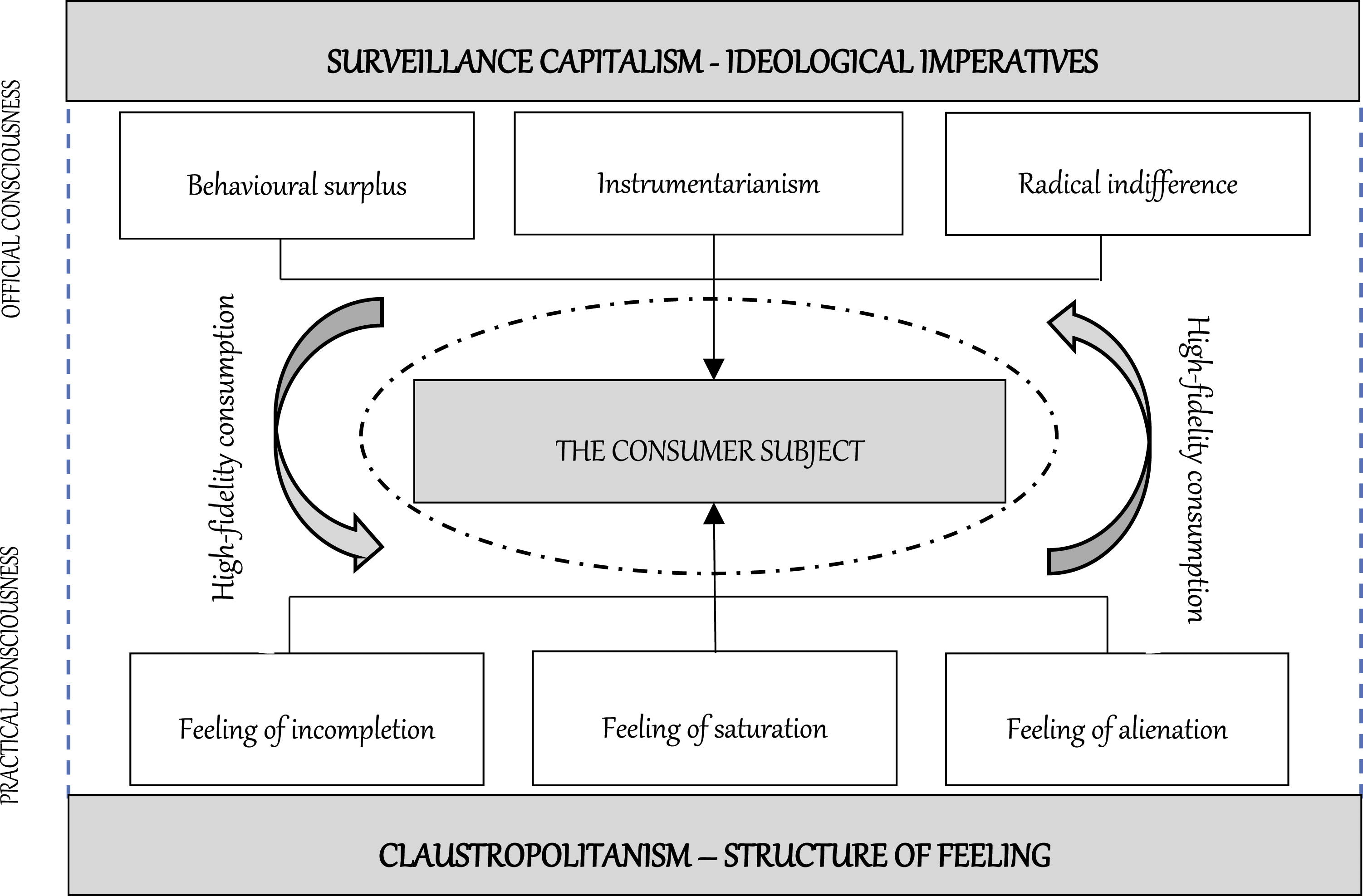
Behavioural surplus and the feeling of incompletion
A significant part of consumers’ affective reality under surveillance capitalism centres on a mood of perpetual incompletion provoked by the ideological imperative for consumers to seek more control through personal data generation. This is bound up in a behavioural surplus regime that drives consumers to obsessively record and examine their behaviours across their digital lives so as to produce commodifiable, predictive insights (Zuboff, 2019; Zwick and Denegri-Knott, 2018). In parallel with the official consciousness of datafication and the mainstream legitimacy of datapreneurial consumer identities, consumers are exposed to generalised feelings that their existence is forever incomplete, unfinished or ‘not just right’.
The mood of incompletion that the behavioural surplus project engenders is perhaps best evidenced by previous research that focuses on individuals or groups who self-elect to generate and curate data from their day-to-day activities – a phenomenon that has been referred to as ‘dataist’ lifestyles (DuFault and Schouten, 2020), ‘self-tracking’ (Charitsis et al., 2019), ‘everyday analytics’ (Pantzar and Ruckenstein, 2015), ‘lived informatics’ (Rooksby et al., 2014) or ‘lifelogging’ (Räikkönen and Grénman, 2020). For example, in prior ethnographic engagements with members of the Quantified Self (QS) community – an international collective that shares insights from personal data – we see how self-tracking technologies are welcomed into consumers’ lives to enhance self-knowledge and optimise the self, despite self-trackers’ recognition of surveillance capitalism’s privacy threats (Bode and Kristensen, 2015; Kristensen and Ruckenstein, 2018). By engineering their own voyages in self-discovery through advanced calculative metrics, the self-tracking consumer potentially forecloses on a free-thinking, naturalistic and adventitious life in favour of a ‘laboratory of the self’ (Kristensen and Ruckenstein 2018: 3624).
The metaphor of a laboratory is significant, affectively, because of its associated imagery of a sterilized, highly monitored and artificial space free from rogue emotion or occurrence. This suggests subjectivity of the self-tracking consumer is comparable to that of a clinician’s, who is more at ease with observing, testing and planning than natural, impromptu experience. The clinical self-tracking subject submits herself to ‘scientific’ experimentation, constantly evaluating and adjusting aspects of her life that deviate from her plans. Numbers, metrics, and patterns are relied upon to ensure symmetrical and accurate behavioural results. In trading off the aleatory for certainty, the consumer subject is ‘transforming life, in all its ambiguity and messiness, into controllable “life slices”’ (Kristensen and Ruckenstein, 2018: 3629).
Ideologically, the normalisation of strict monitoring and regulation of every aspect of life centres on a fantasy of ever more control achieved through symmetry, order and accuracy that consumers can curate for themselves through surveillant means (Bode and Kristensen, 2015). Affectively, however, the self-tracking lived reality for many consumers has been described as closer to experiences of obsessive compulsiveness, dysfunctional meticulosity and precarity (e.g. Eikey and Reddy, 2017) that we can surmise to be claustropolitan in tone. As the ideal self being pursued is ‘always in becoming’ (Bode and Kristensen, 2015: 123), the self-tracker constantly feels the urge to ‘work’ on the self to attain an improved existence. The feeling of being in control through digital technologies is impermanent, fleeting and perpetually incomplete (Bergroth, 2019). The need to obsessively take sedulous care and address nagging feelings of incompletion, which sits at the heart of obsessive thought and compulsive behaviour, is encapsulated below by an informant in one of Kristensen and her colleagues’ accounts: ‘What happens with your blood sugar after you have eaten, and when you are eating? Do you get tired? What is happening? Do you feel any tickling? Any coating on the tongue? Without the loop with the instrumentalization, those things would have never happened’ (‘Thomas’ in Kristensen and Ruckenstein, 2018: 3632).
Here, ‘Thomas’ is initially excited to welcome ‘the loop’ into his life as self-tracking urges him to constantly ask ever more specific, albeit perhaps obsessive questions about himself. By engaging in a dynamic process of self-tracking, individuals like Thomas are perpetually exposed to both positive and negative experiences. Because self-tracking can provide them with what they perceive to be life-changing benefits, there is justification in place to remain committed to surveilling themselves which can come with its own stresses and consequences (Eikey and Reddy, 2017). In claustropolitan terms, chasing the benefits of discovery and control can eventually suffocate one’s self-experience resulting in an atmosphere of discontent and foreclosure. After their initial eagerness had worn off, Kristensen and Ruckenstein (2018: 3633) discuss how self-trackers reported that ‘tracking restricted their lives’ or that ‘tracking feels burdensome and restricting’. The authors refer to such affects as ‘dead ends’ or ‘hitting the wall’. While these dead ends risk disturbing or terminating self-tracking for many consumers, for those who are particularly invested in their digital lives, feeling restricted serves only to ‘fuel a sense of agency, inspiration and creativity’ (Kristensen and Ruckenstein, 2018: 3633). Particularly, a sense of restriction can catalyse entrepreneurial efforts to circumvent or otherwise surpass the limits of their current digital devices and practices – what we can consider to be a deeper level of obsession. For some, facing their dead ends means embracing particular habits while dropping others. For others, it means consciously relaxing the regularity of one’s interactions with self-tracking devices yet continuing to collect data by other means. Though the rate of abandonment for particular devices can be high (Lazar et al., 2015), research suggests not all instances of abandonment are motivated by dissatisfaction or declining motivation to self-track but can be driven by consumers acquiring newer technological upgrades or opting for alternatives that better service one’s current needs or expectations (see Clawson et al., 2015). Clawson et al. (2015) emphasise how commitment to lifelogging must be understood in light of the complex interplay between the continuous development of self-tracking technologies themselves and the mercurial nature of consumer practices.
Elsewhere, Mende et al. (2016) observe a particularly depressive consequence of self-tracking: increased mortality salience. The increased awareness of one’s own vulnerability that comes with self-tracking devices reveals a distinctly claustropolitan tonality to what Zuboff (2019: 450) refers to as the ‘closed-loop architecture of obsession’. Compulsions at this level reflect consumers’ foreclosure to the most distressing and haunting artefact of life: death. Everyday statistics of heart rates, blood pressure, steps taken, calorie intake and so forth perpetuate the feeling that one’s efforts to bring the spectre of death under total control will always be incomplete.
In terms of understanding how feelings of incompletion contribute to high-fidelity consumption, we can surmise that consumers’ obsessive-compulsive urge to obtain a complete picture of themselves complements rather than contradicts the surveillance system. Rather than motivate wholesale resistance to their dataist lifestyles, feelings of incompletion can ironically drive some consumers deeper into their digital lives. Being trapped in a pathological loop of obsessive self-completion, consumers may remain fidelitous to the functioning of a surveillant market system that requires never-ending data flows from human experiences. Importantly, their fidelity may not equate with absolute faithfulness to the system but can include various ways that they resist the system at a kind of half-capacity while in-part remaining committed to it. Of significance here is the negotiation of ‘dead ends’ wherein the consumer subject attempts to limit his or her engagement with self-tracking technologies but in practice, still lives within and supports the logic of surveillance.
Instrumentarianism and the feeling of saturation
Another affective contour of claustropolitanism under surveillance capitalism is the feeling of saturation whereby the consumer subject feels overburdened by all of the opportunities, responsibilities and obligations of her existence. These opaque pressures are instituted predominantly through the ‘instrumentarianism’ imperative which centres on a culture of instrumentality and the normative instrumentalisation of consumers’ activities and lifetyles for the goals of behavioural prediction, modification and commodification (Zuboff, 2019: 376). Consumers are conditioned by a suite of ideological appeals to lead entrepreneurial lives, that is to be ever more productive, efficient and useful. With the omnipresence of digital tools, devices and platforms centred on measurable action – what Humayun and Belk (2020: 650) call ‘saturation of the digital’ – ever-increasing avenues are opened up for consumers to habitually engage in, datafy and communicate their enterprising patterns of behaviour.
The ideological injunction to partake in entrepreneurial, observable action is alluded to in consumer research that discusses the technocultural intensification of ‘instrumental rationality’ in which consumers’ lives are subject to the logic of producerly, value-creating and efficient enterprise (Bardhi and Eckhardt, 2017; Zolfagharian and Yazdanparast, 2017). Instrumental rationality, or instrumentality, is understood as ‘the mode of thought and action that identifies problems and works directly toward their most efficient or cost-effective solutions’ (Bardhi and Eckhardt, 2017: 583). The consumer subject feels that almost all activities and artefacts of life can and should be instrumentalized towards providing some purpose and function which could potentially reap them returns: ‘Manifestations of instrumentality can be seen in the commodification of the intimate space of the home, such as in renting one’s home to strangers on Airbnb; or in the dominance of the quantified self, where quantification systems hold people accountable for their professional, consumer, and personal performances, such as in online ranking and reputation systems and academic quantification systems’ (Bardhi and Eckhardt, 2017: 584).
Consumers’ attempts to extract value out of anything and everything exemplify a dominant culture of excessive busyness, productiveness and effectiveness. Individuals set up concrete objectives and targets, calculate solutions and consequences, and employ the most efficient apps, platforms and gadgets to achieve the best results (Zolfagharian and Yazdanparast, 2017). The official consciousness underpinning instrumental rationality centres on a vaguely demotic appeal of value and gain, that is an illusion that everyone can be one’s own surveillance capitalist. The ideological fantasy being that success is self-made: simply by making smart decisions with your digitally mediated life and opening those decisions up to surveillance by self and others, you too can extract value from your home, your body, your whatever. However, the practical consciousness, or consumers’ genuine experience of trying to live that fantasy, is marked by a claustropolitan character.
In contrast to the allure of an entrepreneurial life for everyone everywhere, consumer research reveals a subject paralysed with meritocratic pressures, doubts, opportunity costs and social comparisons (Lambert, 2019; Rome and Lambert, 2020). The ‘overcalculated life’ replete with multiple sources of value to exploit (Zolfagharian and Yazdanparast, 2017: 1322) points to what Gergen (1991) calls ‘the saturated self’, which denotes the dramatic growth in the range of relations within which the individual is immersed. In an era of digital ubiquity – with the expansion and complexification of relations, obligations, expectations and social roles – the self has become more saturated than ever before. Furthermore, it is not just the number of pressures that result in a state of saturation, it is also the instantaneity by which consumers are met with these pressures. For Redhead (2017a: 57), it is ‘an instant present which is catastrophic and claustropolitan’. In an internet-mediated society wherein ‘immediacy, instantaneity and ubiquity rule’ (Redhead, 2011: 96) and ‘everyone has to keep moving and accelerating’ (p. 135), consumers are saturated with opportunities to extract value but also time pressures to seize them instantaneously.
The expectation to extract value from consumption is alluded to by an informant’s statement presented in Kozinets and colleagues’ discussion of digital food image-sharing culture: ‘As an avid food-pornographer, I pretty much take pictures of all and any food I eat. But I guess the reasons differ – when I instagram my oatmeal I’m displaying a vastly different set of capitals (health, culture) than when I share albums of elaborate dinners at The Fat Duck or El Celler Can Roca (economic, and perhaps a bit of culture – especially regarding the latter). Mundane meals are mostly instagrammed, while the more coherent experiences get their own albums on Facebook’ (‘Rhianna’ in Kozinets et al., 2017: 668).
For this informant, a simple pleasure in life such as sitting down to a meal becomes saddled with a cacophony of value-creation considerations. In claustropolitan terms, value-creation becomes all-consuming, shrinking life down to instrumentally oriented activities and foreclosing opportunities for more contemplative time. Food is sublimated to fodder for social currency – virtual Instagram and Facebook ‘likes’ – and operationalised towards achieving specific goals. Kozinets et al. (2017) draw upon another informant, ‘Leonardo’, who wrestles with nagging pressures to retreat into image-sharing social networks. These pressures he feels ‘can distract [him] from real life’ (p.671) and take a toll on his relationships with those around him. Rather than go cold turkey, this consumer tries to curtail and rationalise his digital engagement by limiting it to dull days spent at home instead of when he is out with others. Success for him is found in the modest result that his smartphone ‘does go away more often than it used to’ (p.671). Arguably, restricting smartphone usage to justifiable occasions tacitly gives purpose and license to those occasions, thus further feeding the logic of instrumentality.
In terms of nurturing fidelity, feelings of saturation, we suggest, may function to tether consumers to the surveillant market system. For some, the nagging sense of saturation paradoxically does not drive them to leave technology completely behind and seek respite through non-digital areas of life. On occasion, the consumer subject becomes more entrenched in seeking purpose and value in the digital world even as he or she reduces their exposure to it. Imposing limits on social media use and sequestering it to justifiable occasions by extension renders social media justifiable. Instrumental circles of cost-benefit calculation, value creation and goal achievement potentially lock consumers into a fidelitous subject position that reacts predictably and faithfully to the instrumentarian project.
Radical indifference and the feeling of alienation
A third affective contour of claustropolitanism centres on the feeling of alienation, marked by the separation of consumers from one another, from the depths of their own selves and from reality itself. These points of separation are catalysed by the ethos of ‘radical indifference’ (Zuboff, 2019: 377) that characterises the nature and quality of relationships under surveillance capitalism. Surveillance capitalism being ‘a fundamentally asocial mode of knowledge’ (Zuboff, 2019: 505) means the value of all things and people are judged by volume, exposure and outcomes – ‘clicks’, ‘likes’, ‘shares’, ‘views’, ‘impressions’, ‘followers’ and ‘comments’ – requiring little interest in the more complex, moral and inherently human stories and contexts that underpin such things. As consumers become fidelitously tied to this ‘asocial’ culture of radical indifference, they increasingly experience a sense of disconnection and disengagement in many important spheres of life.
Radical indifference operates first and foremost through a normalised lack of concern or nonchalance consumers hold towards their personal information, which is perhaps best evidenced in contemporary technocultural practices of self-disclosure. Consumers, despite recognizing minimal privacy is afforded to them in online spaces, continually share, post, update, Tweet and stream almost every glimpse of their private lives for public consumption (e.g. Belk, 2013; Šimůnková, 2019; Ball, 2017). The official consciousness underpinning the willingness to lay oneself bare to strangers centres on a fantasy appeal of social connectedness: by increasingly participating in an internet-enabled world of strangers, one vaguely believes that she can offset her insignificance, expand her social connections and become part of wider communities (also Wickstrom et al., 2021). The felt experience that consumers have in response to this fantasy is, however, characterised by an atmosphere of estrangement, desocialisation and loneliness.
Commenting on the digital culture of sharing, Belk (2013: 484) observes: ‘For those active on Facebook, it is likely that their social media friends know more than their immediate families about their daily activities, connections, and thoughts’. Being swept up in sharing photos online, instant messaging, notification checking and so forth, consumers become excessively dependent on their connectedness with digital others and risk experiencing a claustropolitan sense of groundlessness and disengagement with tangible connections and meaningful relationships in the material world (Zolfagharian and Yazdanparast, 2017). ‘The accelerated communication of the twenty-first century (Twitter, iTunes, iPad, Facebook, Google, Snapchat, Pinterest)’, Redhead (2017a: 57–58) suggests, is ‘truly a world devoid of “solids”’. Importantly, the absence of ‘solids’ for Redhead does not equate with the entrepreneurial dematerialised fluidity of liquid consumption, but signals the loss of robust, more authentic and less market-coordinated social relations (also Hewer, 2020).
The weakening of social bonds and the sentiment of groundlessness is illustrated by Cronin and Cocker (2019: 292) in their analysis of a ‘postemotional’ YouTube fandom where consumers channel and adjust their online behaviours such that ‘all emotion is socially filtered and meticulously appraised before it is carefully communicated’. The tendency toward carefully calibrating emotional expressions according to online others’ expectations or responses blurs the distinction between rationality and sociality. In acts of cynical disavowal, online publics are fully aware of the weakened sincerity of their bonds but go along with their activities. Other-directed emotional management and the absence of solids are further evidenced in the realm of the self-presentation project whereby consumers pursue the fantasy of becoming online influencers or ‘micro-celebrities’ (e.g. McQuarrie et al., 2013). In seeking out ‘attentional capital’, the consumer subject engages in the manipulation of one’s self and others by adopting celebrity-like appearance, taste, fashion and lifestyle, increasingly at the expense of personal authenticity. McQuarrie et al. (2013: 140) in their study of ordinary consumers reaching mass audiences note that the persona of a fashion blogger on the internet is often ‘far removed from her “real” self, a persona she can rehearse and rewrite until she gets it right’ and one that ‘seems ill suited to the construction of an authentic self’.
The pervasive mood of alienation from one’s ‘real’ self is also evident in Pounders, Kowalczyk and Stowers’s (2016) analysis of the motivations for selfie-postings. Under real or imagined pressures of their audience’s expectations, consumers intentionally regulate and carefully craft their emotions in line with what is desirable, as captured in the below statement from one of the authors’ informants: ‘No one really posts sad stuff on social media; it’s all about only posting happy moments, and when you compile all these happy moments and people look at your Instagram, they think you’re happy all the time’ (‘Jane’ in Pounders et al., 2016: 1885).
By conforming to the ‘closed loop between the inclination toward the social mirror and its reinforcement’ (Zuboff, 2019: 464), consumers fidelitously curate a particular representation of self for online worlds while maintaining distance between it and their actual states of being. For some consumers like Pounder and colleagues’ informant ‘Jane’, a representation of self is achieved by presenting exclusively positive images. Contrarily, for others, their representations are marked by the very absence of positive imagery. For instance, Kozinets et al. (2017: 669) refer to ‘Zeynep’ who admits to sharing a ‘communal feeling’ that posting images of enjoying one’s life online is ‘something to be ashamed of’ because it ignores the plight of those who are less fortunate. Where newsfeeds are often punctuated with tragic stories and reports of death, pandemics and crises in our claustropolitan times, the choice to express one’s personal happiness can be marked by hesitancy, shame or even foreclosed altogether. Subjectivity as it is lived under surveillance capitalism requires the careful calibration of one’s self and relations with others which limits bandwidth for spontaneity and encapsulates Redhead’s (2017a) idea of feeling as though the world itself is closing in (or being foreclosed, in many conceivable ways).
Alongside the foreclosure that accompanies the imperative for impression management are feelings of detachment from reality as consumers grow ever more indifferent to the truthfulness of things (Brabazon, 2021; Kozinets et al., 2020). This shared sentiment is evidenced in consumers being affected by accelerated disinformation whereby lies, falsehoods, conspiracy theories and ‘alternative facts’ rapidly spread across digital environments. The proliferation of fake news is perpetuated by the ideological fantasy that, in the age of ‘post-truth’, truth can be whatever people decide for themselves, regardless of factual evidence, reasoned analysis, empirical verification or recourse to experts (Berthon and Pitt, 2018; Kozinets et al., 2020). Under this fantasy, personal opinion and beliefs can be and are conflated with truths and absorbed by others as reality, so long as such views can appeal to people’s emotions and ideology. Truths give way to what can gain popularity in the digital milieu, as Berthon and Pitt (2018) observe: ‘Search results from engines such as Google, DuckDuckGo and Yahoo do not prioritize knowledge in terms of accuracy, truth, quality or depth. Rather, search results are based on simple popularity […] On social media, where individuals select both the stories they read and the people they interact with, opinions and views are reinforced in an echo chamber driven by positive feedback loops […] Truth more and more becomes “my” truth’ (p. 221).
Information technology with its principle of neutrality towards the truthfulness of information has promoted the culture of ‘truth as my truth’ – truth as being judged and accepted by mostly whatever people like, vote, share – at the expense of verity. Being confined to echo chambers that distort and insulate the range, veracity and quality of knowledge available, consumers function as ‘Homo imitans’, predictably imitating one another’s views and attuning themselves to social pressures (Zuboff, 2019: 437). Critical here is the pervasive mood of confinement and alienation whereby consumers are ever more bound by their own epistemic worlds of knowledge; isolated and alienated from different viewpoints, voices, and even the shared reality around them.
Crucially, feelings of alienation function as a foundation upon which surveillance capitalism binds consumers to its closed loops and ethos of anticipated conformity. Rather than leading them to give up the digital in search of authentic truths, relationships and ways of being, the pervasive sense of groundlessness, foreclosure and separation from the material aspects of life potentially motivates consumers to further entrench themselves in the comfort of their echo chambers.
Discussion
By adapting and extending Redhead’s under-theorised concept of claustropolitanism as the overall affective backdrop to our digital age, we offer an image of the consumer subject as constituted by and experienced through a lattice of transindividual feelings characterised by a pervasive sense of being closed in. The result for consumers is the primacy of high-fidelity (hi-fi) consumption which we define as the suite of attitudes, intentions, acts and choices that reproduce, to almost a level of total conformity, the predictions determined within the behavioural futures markets of surveillance capitalism. In a living present where emergent experience sits in complex relation to the dominant system of surveillance, hi-fi consumption occurs at the juncture between the consumer subject’s fidelity to ideological imperatives for rationally-derived manipulable behaviours and the affective outcomes of such manipulation. In Williamsian terms, we have proposed a manner of consumption that exists at the intersection between ‘the official consciousness of an epoch’ and ‘the whole process of actually living its consequences’ (Williams, 1979: 159). Although consumers are perhaps attracted to the fantasy appeals of the official consciousness, they find themselves feeling disenfranchised and ‘closed in’ when attempting to live those fantasies. In many cases, the efforts that consumers undertake to overcome their disenfranchisement by further entrenching themselves in their digital lives, only play into the imperatives of surveillance capitalism, thus ensuring a closed loop between ideological structuration and the structure of feeling that emerges in relation to it. It is within consumers’ ambivalent and nuanced experiences with technology that the stock-still deadlock of claustropolitanism becomes apparent: digital lives are neither good enough to be fulfilling nor bad enough to be rejected. Because technology presents solutions as much as it introduces problems, consumers remain in the limbo of accepting the status quo without any impetus to imagine alternatives. In line with the ideological inevitabilism that Zuboff identifies, technology is cemented as an incontestable certainty in consumers’ futures, constraining thoughts and behaviour to ultimately secure their conformity.
Importantly, ensuring the fidelity of consumers does not represent a wholly new logic. Market actors have long sought consumers’ faithfulness through forms of customer relationship management, collaborative marketing and other techniques (Beckett and Nayak, 2008). However, what we see with the emergence of hi-fi consumption is the functioning of affects in securing the consumer subject’s anticipated conformity. In exploring how consumers’ fidelity to the market is (re)produced at a preconscious, transindividual level by a range of collective affects, we contribute to the critical project of ‘dismantling conceptions of an agentic consumer’ (Rome and Lambert, 2020: 19). Hi-fi consumption reveals to us how shared feelings of incompletion, saturation and alienation are an outcome of living predictably within behavioural parameters but also function to keep consumers faithfully locked into those parameters. Although dispiriting and discontenting, these collective affects do not seem to invite resistance from consumers but instead secure their submissiveness whereby it ‘feels’ impossible to even conceive of life outside of the digitally mediated marketplace. Hietanen and Andéhn (2018: 547) usefully liken this no-exit submissiveness to ‘the masochistic pleasure of a commodified Stockholm syndrome’ where the subject-as-hostage bonds with, relies upon and even perversely enjoys his or her relationship with market captors (see also Hietanen et al., 2020). Consumers’ digital lives under surveillance capitalism invoke fantasies of seeking more control over one’s self, achieving an entrepreneurial lifestyle and having more opportunities for social participation. But the pursuit of these fantasies promotes rather than reconciles burdens, anxieties and dependencies, thus keeping consumers forever reliant on digitally mediated ways of living and committed to prescribed courses of action, foreclosing all possible routes out and guaranteeing their fidelity.
Appreciating affective contours as enduring structural parameters to consumer subjectivity complicates our theoretical understanding of the autonomy and power that consumers hold within today’s technoculture. While Darmody and Zwick (2020) posit that consumers may perceive a sense of empowerment by participating in behavioural futures markets that better predict and cater to their desires, our view is perhaps more pessimistic. We highlight a consumer subject who might think of his or her life as ostensibly empowered but is enveloped in an atmosphere of obsessive compulsiveness, over-calculation and groundlessness. Though we have focused on three fairly interrelated affective contours of claustropolitanism, future research should consider alternative or contrary affective consequences of today’s technoculture. As digital consumption has both positive and negative results for consumers, it is entirely possible that life under surveillance capitalism lacks an affective unity and may be experienced more complexly and dynamically than what we have theorised here. Structures of feeling are never static and always in statu nascendi. Williams (1977: 132), in recognising structures of feeling as ‘practical consciousness of a present kind, in a living and interrelating continuity’, argues for the importance of an ostensibly open and fluid present to his concept. Future research might explore how a single broad-reaching structure of feeling such as claustropolitanism may be characterised by different feelings than those identified in this paper or how they may be incongruous across consumers, across circumstances, and over time.
A particular consideration for future research is how claustropolitanism can be diffused and lived with differently across diverse socioeconomic backgrounds. Class has been a notable absence in Zuboff’s treatment of surveillance capitalism (Fuchs, 2021; Morozov, 2019) and remains an area that is relatively underexplored in studies of technocultural consumption. For instance, Denegri-Knott et al. (2020: 951) acknowledge that accounts of social media usage are largely ‘de-coupled from wealth and class; consumers of any background can create online personas’. Nevertheless, we cannot ignore that divisions in wealth mean some consumers will have greater access to digital amenities and the lifestyle accoutrements that are fetishized on social media platforms. We also must not ignore the vulnerability of consumers with poor digital literacy skills to data-driven discriminatory classification and unfair forms of algorithmic exploitation (Cinnamon, 2017; Yeung, 2018). In a networked age where entrepreneurial marketplace engagements and digital savviness are valorised, ‘class inequality is reproduced’ rather than elided (Bardhi and Eckhardt, 2017: 592). Moreover, views and feelings towards surveillance and digitalization may vary depending on where people locate themselves in terms of the various forms of digital labour and ‘data-classes’ that have emerged (Cinnamon, 2017; Fuchs, 2021). Exploring how the affective aspects of surveillance capitalism might be experienced differently or to varying levels of intensity across diverse class groups should form the basis of a sustained and critical pathway in consumer research.
In conclusion, by answering calls for more theorisation of our consumer culture using ‘affectively charged concepts’ (Ahlberg et al., 2021: 169), we brought Redhead’s concept of claustropolitanism to marketing theory as a useful lens to view and deconstruct how ideological and affective forces are simultaneously at work in the co-constitution of consumer subjectivity. In theorising the affective make-up of the consumer subject, we emphasise the importance of transindividual feelings as inseparably bound up in the functioning of dominant systems and their consequences. In an increasingly post-normal world where theorists constantly grapple with conceptualising how consumers’ sense of time, space and self is disrupted and distorted in many ways (Humayun and Belk, 2020; Kozinets et al., 2017; Šimůnková, 2019), understanding the emergence of subjectivities beyond conscious and rational activity and being able to simply label a certain tone in the air become more important than ever. This is where we believe a claustropolitan frame is significant. To look at contemporary consumer culture through a claustropolitan lens is an effective way for us, in Redhead’s (2017a: 99) terms, to practice a kind of ‘post-theory’ – ‘a form of extreme thinking for an even more extreme world which we now somehow still manage to cling to as the desire to leave the planet becomes compulsive’ – which is, we must contend, all the more important in these new dark ages.
Footnotes
Acknowledgements
The authors would like to express their gratitude to Anthony Patterson for his helpful comments on an earlier version of this paper. The authors also thank Andreas Chatzidakis, and the three anonymous reviewers for their insightful comments that helped to inform and develop a stronger paper.
Declaration of conflicting interests
The author(s) declared no potential conflicts of interest with respect to the research, authorship, and/or publication of this article.
Funding
The author(s) received no financial support for the research, authorship, and/or publication of this article.
