



Abstract
The implications of waning desire for ownership on materialism are not well understood. This study examines the interface between materialism and consumption and asks, is materialism manifest in the absence of ownership centrality, and if so, how? Drawing from an interpretive investigation of digital nomads, it is suggested that materialism has broadened to adapt to non-ownership centrality, and we define it as a logic of consumption, which manifests as a preoccupation with the consumption of objects, access or experiences as a way to signal status, build image, pursue happiness, and attain a sense of self-worth. Three discrete but complementary ways through which materialism emerges in the absence of ownership centrality are identified: (1) preoccupation with strategic curation rather than accumulation, (2) intentional prioritization of experiential consumption over ownership as a means to fulfill materialistic aims, and (3) adoption of bricolages across spectrums of consumption (solid/liquid, budget/luxury, access/ownership).
Keywords
Introduction
In much of the marketing discipline, acquisitive consumption has been recognized as the bedrock of a contemporary consumer culture preoccupied with materialism and materialistic values, where ownership of things has come to be seen as a central means to the achievement of goals (Fournier and Richins, 1991; Richins, 2017). How consumers consume, however, has changed significantly in recent decades. Digitalization and dematerialization, as part of the growth of social acceleration and global mobility, are some of the contextual factors that have driven much of this change (Bardhi and Eckhardt, 2017). In light of this, it has been theorized that in today’s marketplace, solid consumption, which is enduring, ownership-based, and tangible, exists on a continuum with liquid consumption, which is ephemeral, access-based, and dematerialized (Bardhi and Eckhardt, 2017). This theoretical lens captures the notion that, for some consumers, the desire for solid consumption is fading and ownership is no longer a central concern (Lamberton and Goldsmith, 2020). As can be discerned by the proliferation of access-based (Bardhi and Eckhardt, 2012) and digital consumption (Belk, 2013; Mardon and Belk, 2018), however, waning desire to own does not necessarily translate into waning desire to consume (Lamberton and Goldsmith, 2020). The implications of this on consumers’ materialistic inclinations to place high value on acquisition are not well understood theoretically yet. Is materialism manifest in the absence of ownership centrality, and if so, how? In this article, we examine this interface between materialism and consumption as it unfolds on a solid–liquid continuum.
Materialism is a complex and multifaceted concept which has received much attention in the marketing literature. Ger and Belk (1999: 184) offer a cumulative definition suggesting that, whether for pleasure seeking, self or relationship definition/expression, or status claiming, it is an excessive reliance on consumer goods to achieve these ends, a consumption-based orientation to happiness-seeking, a high importance of material issues in life that is generally taken to be materialism.
In turn, at a broader cultural level, materialism is often considered the counterpart of consumer culture, where market-based capitalism produces unlimited desires and where acquisition and possessions are considered instrumental for identity building (Belk, 2015). Through this lens, materialism relates not to individual level variables but to social constructs such as cultural capital accumulation, social comparison, and status seeking through consumption. We follow in the tradition of this latter understanding of materialism. In today’s marketplace, however, when consumers adopt a less material perspective and prioritize access over acquisition (Bardhi and Eckhardt, 2017), the need to reexamine the link between materialism and ownership in light of the broader shifts in consumption from solid to liquid is amplified.
While research has begun to suggest that experiences can be acquired and used in materialistic ways (Shrum et al., 2013) and that when longing for unique products materialists can overcome their possessiveness and opt for access rather than ownership (Akbar et al., 2016), much remains to be theoretically and empirically substantiated about the interface between materialism and consumption in the absence of ownership centrality.
To investigate our research question, we turn to a rapidly growing cohort of consumers known as digital nomads––individuals who choose to let go of most of their possessions and property, reject the notion of a 9-to-5 work life, and travel the world from one exotic and inexpensive location to another, while working from their laptops. As a lifestyle, nomadism is not new; global nomads and cosmopolitans, for instance, are hypermobile cohorts whose sensibility toward issues of consumption has been explored (Bardhi et al., 2012; Thompson and Tambyah, 1999). What sets digital nomadism apart, however, is the increasing accessibility of this aspirational lifestyle: the internet has made it possible for anyone (from college dropouts and struggling professionals, to entrepreneurs and retirees) to work remotely without the suit-and-tie and seek cheaper living costs while indulging in lifestyle luxuries (Kale, 2020). We use this context as a lens through which to consider broader questions about materialism in contemporary consumer culture where ownership is not necessarily a priority.
Based on our analysis, we define materialism as a logic of consumption, which manifests as a preoccupation with the consumption of objects, access or experiences as a way to signal status, build image, pursue happiness, and attain a sense of self-worth. Within this definition, we advance that a materialistic logic to consumption need not necessarily involve material goods or prioritize acquisition of possessions but can also manifest in the absence of ownership centrality––through preoccupation with the affordances of liquid consumption. Specifically, we suggest that in less ownership-focused contexts, materialism can permeate consumption in three discrete ways: (1) preoccupation with strategic curation rather than accumulation, (2) intentional prioritization of experiential consumption over ownership as a means to fulfill materialistic aims, and (3) adoption of bricolages across spectrums of consumption (solid and liquid, budget and luxury, access and ownership).
We conceptualize these practices as independent but complementary to one another, such that in the absence of ownership centrality, materialism can emerge in one or several of these ways. That is, expressions of materialism can be idiosyncratic and contextually bound by the cultural, social, and economic factors that structure consumption in a given market and push consumers in and between the solid and liquid to varying degrees. We thus suggest that as a consumption-based orientation to happiness-seeking (Belk, 1985), materialism continues to be a prominent logic of consumption even when ownership is declining as a central concern––it can permeate beyond the boundaries of acquisition and possessiveness and emerge in access-based and experiential consumption alike. With this, we demonstrate that materialism is not only experienced by some consumers in a different way than past literature suggests, but that it can surface even in counterintuitive consumption phenomena such as minimalism and Marie Kondo-inspired reductionism, where the emphasis is on reducing material possessions and where minimalistic aesthetics and having “less” are broadcasted as conspicuous signals of status. That is, preoccupation with a lack of consumption and non-ownership can be just as materialistic as focusing on possessions and having “more.” Next, we review the theoretical foundations that inform our inquiry.
Conceptual foundations
Materialism
The leading conceptualizations of materialism have theorized the construct as an individual difference variable, where foregrounded is the belief in the importance of possessions in life (Belk, 2020). Belk’s seminal work sees materialism as a personality trait which manifests through the importance a consumer attaches to worldly possessions and the centrality these objects have as the greatest sources of satisfaction and dissatisfaction (Belk, 1985). For Richins and Dawson (1992), materialism is a personal value constituted by the belief that acquisition is necessary for happiness, the tendency to judge the success of one’s self and others by their possessions, and the centrality of acquisition and possessions in one’s life.
As such, materialism is understood not as a dichotomy (where consumers can be classified as materialist or non-materialist), but as existing on a continuum, ranging from low to high, depending on the degree to which one views material goods as the best way to achieve goals (Richins, 2017). These foundational works, and other research that has considered materialism at the individual level (e.g. Burroughs and Rindfleisch, 2002; Chang and Arkin, 2002; Kasser, 2016), have provided a micro psychological approach to understanding materialism which has been both complemented and challenged by expanding theorizations at the cultural rather than the individual level.
At the cultural level, materialism has emphasized the symbolic and signification qualities of goods, opening additional analytical avenues to consider materialism beyond acquisition and utility at the individual level (Belk, 2015). Research from this stream has generally taken a more qualitative, historical, and cultural perspective (Belk, 2015) and has suggested that expressions of materialism are contextually bound and subject to broad sociocultural, historical, and economic influences. Materialism can manifest itself differently in different countries and at different time periods, both within and between cultures, in affluent and less affluent societies alike (Belk, 2015; Ger and Belk, 1996, 1999) For instance, it has been demonstrated that what consumers in different cultural, economic, and political environments consider materialistic is negotiated through culturally grounded ethics and moral codes, such that seemingly materialistic behaviors can be justified and valorized as nonmaterialistic (Ger and Belk, 1999).
Alluding to the variability within the notion of materialism, prior literature has also called attention to the need to expand the construct beyond its focus on possessions (Holt, 1995, 1998; see also Belk, 2020; Shrum et al., 2013). As noted by Holt (1995: 14), “because materialism involves how one consumes, not what one consumes, it need not involve material goods—services and activities such as entertainment, vacations, and even education can be consumed in a materialist style.” These different expressions of materialism across material and experiential consumption have been viewed as social markers of class, education, and levels of cultural capital (Holt, 1998). It thus becomes important to consider the construct of materialism in relation to the broader contemporary social, cultural, and economic contexts within which consumption unfolds. To this end, empirical evidence suggests that heightened materialism can be linked to dynamic social conditions, cultural change, greater social mobility, and confusion in norms (Ger and Belk, 1996), characteristics which are consistent with the contemporary global context.
In particular, consumer culture theory scholars have demonstrated that materialism manifests itself as a mode in which social identities are constructed through interaction with the marketplace (Holt, 1998). Across different social groups, this may be based on different understandings of what is considered luxury or what signals status (Holt, 1998). For instance, for affluent consumers with high cultural capital, materialistic consumption might manifest as consumption of luxurious or scarce goods, while for those with lesser means and lower cultural capital, materialism could manifest as abundant consumption that seeks to signal distance from material needs (Holt, 1998). In turn, consumption activities that are often deemed non-materialist, for example, when objects are viewed as resources to be leveraged toward experiences rather than as terminal sources of value, may not be that different from those which privilege acquisition and possessiveness of objects (Holt, 1995). This can be particularly relevant in the contemporary context where established notions of status, luxury, and class are shifting and where digital, access-based, and inconspicuous consumption are becoming instrumental for achieving distinction (Eckhardt and Bardhi, 2020a). Our understanding, however, of how materialism at this broader aggregate level interacts with consumption in a contemporary marketplace where many eschew ownership and privilege experiences and access is scant.
Contemporary modernity and consumption
Scholars have already begun to map how contemporary modernity is changing the ways consumers enhance their self-constructions (Belk, 2013), collect digital objects in the age of dematerialization (Mardon and Belk, 2018), and seek ways to slow down and escape their accelerated lifestyles (Husemann and Eckhardt, 2019). At the social level, the dynamics of contemporary modernity are captured by Zygmunt Bauman’s (2000, 2007) term liquid modernity, denoting a passage from a “solid” to a “liquid” phase of modernity. This shift is characterized by reduction in long-term thinking and planning, weakening of established social structures, and fragmentation of identity and established class formations (Bauman 2000, 2007). Bardhi and Eckhardt (2017) suggest that these broader contextual dynamics have resulted in a new logic of consumption that directs consumption across a spectrum of solid to liquid: solid consumption is an enduring, ownership-based, and material form of consumption where consumer value resides in the centrality of ownership, while liquid consumption is ephemeral, access-based, and dematerialized. This theorization advances the idea that, in liquidity, some consumers no longer seek possessions as anchors to their identity projects, but instead can form flexible, detached relationships to possessions and can find value not necessarily in ownership, but in immateriality, situational instrumentality, ephemerality, lightness, and flexibility (Bardhi and Eckhardt, 2017). Eckhardt and Bardhi (2020b) emphasize that examining this liquid relationship to possessions can result in gainful new insights to marketing theory in a variety of domains.
On a macro level, the shift from solid to liquid is evidenced by the rapid emergence of access-based consumption where goods and services can be used temporarily for a fraction of the cost needed for ownership (Bardhi and Eckhardt, 2012). For many consumers, access-based consumption allows the enactment of affluence and enjoyment of experiences that may be otherwise unattainable through solid consumption: for instance, renting luxury fashion labels, sports cars or vacationing in high-end homes offered for temporary usage in marketplaces such as AirBnB Luxe (Bardhi and Eckhardt, 2012; Eckhardt and Bardhi 2020a). Recent evidence demonstrates that materialistic consumers who are typically focused on acquisition will engage in access-based consumption if the sharing system fulfills their desire for unique consumer products (Akbar et al., 2016). As such, it is possible that materialistic pursuits of achieving happiness and signaling status, image, and wealth can flourish via access-based consumption, where the symbolic value of consumption inheres in the process of accessing, not ownership (Bardhi and Eckhardt, 2017). Additionally, Lamberton and Goldsmith (2020) suggest that consumers can be more committed and territorial to accessed, rather than owned, goods. Finally, in the hurried “nowist” culture of liquid modernity (Bauman, 2007), hunger for instant gratification and fear of missing out emerge as new driving forces for consumption. To this end, access-based consumption can afford immediacy of consumption that is not always possible within an ownership-based approach, yielding quick, albeit temporary access to goods, services, locations, and experiences.
In parallel, the proliferation of the digital has not necessarily resulted in an absence of material consumption, but in a rapid turnover of what might be perfectly functional technology items in pursuit of the status cachet of having the latest iteration with which to acquire or access digital content (Belk, 2020). It has been shown that this digital keeping up with the Joneses (Belk, 2020) is not a phenomenon limited to the affluent world, as poorer consumers willingly sacrifice necessities in order to afford luxuries such as having the latest electronics or fashions (Belk, 1999). Yet, while the construct of materialism has been strongly associated with such overly emphasized status-signaling conspicuous consumption (Fournier and Richins, 1991), conspicuous displays of affluence are starting to lose their appeal for some (Eckhardt et al., 2015). Many consumers increasingly turn toward inconspicuous consumption to build status and distinction, following new symbolic codes (Eckhardt et al., 2015). This manifests itself as diverted attention from traditional displays of status and power, such as luxury goods, toward symbolic markers of authenticity, such as collecting desirable experiences and displaying knowledge (Eckhardt and Bardhi, 2020a). However, how the logic of materialism has adapted to these new shifts has not been theorized or investigated empirically yet. In this study, we therefore examine the interface between materialism and consumption as it unfolds on a solid–liquid continuum and we ask, is materialism manifest in the absence of ownership centrality, and if so, how?
Research context
To explore this, we turn to a growing phenomenon known as digital nomadism. In the academic literature, digital nomadism has been defined as a distinctive work-life culture of interwoven value systems which privileges creativity and individualism, aspirations for belonging to a collective of like-minded individuals, and striving toward boot-strapping financial success and independence (Schlagwein, 2018). Digital nomads are lifestyle migrants who renegotiate work-life balance, engage in strategies of reorientation toward alternative living, seek freedom from prior constraints, expectations, or changing circumstances, and pursue opportunities for self-realization (Benson and O’Reilly, 2016).
Along with other consumption phenomena such as minimalism, Mari-Kondo essentialism, and the tiny-house movement, digital nomadism is a movement in which the centrality of possessions in one’s life is questioned and often juxtaposed to attainment of happiness. With their continuous mobility, preference for lightness, detachment from traditional roles, and dependence on consuming the conveniences afforded by a globalized marketplace, digital nomads are thus particularly suited for this study. Unlike global nomads or cosmopolitans, who have significant financial capital and high-end professional profiles (Bardhi et al., 2012; Thompson and Tambyah, 1999), the digital nomad community consists of a demographically diverse spectrum of individuals with varying financial means, occupations, and age groups. We find that emerging flexible taxation and administrative havens (e.g. Estonia’s e-residency program) and proliferation of global freelancing platforms abundant with remote work (e.g. Upwork) make this way of living attainable for diverse cohorts. Digital nomads also focus on reducing their cost of living by choosing locales which are comparatively inexpensive to live in but have a developed tech infrastructure (e.g. Bali, Chiang Mai, Lisbon, and Budapest) (cf. Green, 2020; Mancinelli, 2020). As such, this lifestyle movement has evolved into an arena in which individuals embark on projects of hacking one’s life (Ferriss, 2009), where the goal is to escape 9-to-5 structures, live cheaply, work efficiently to generate sufficient income, and live a life where flexibility and lightness are the main priority.
Method
We conducted 16 semi-structured depth interviews with self-identified digital nomads. As our informants were located around the world, we conducted the interviews through videoconferencing platforms (Skype and Zoom). The interview guide was developed on the basis of our immersion in the literature on consumption in contemporary modernity, as well as our pre-understanding of the digital nomadic phenomenon (McCracken, 1988) which we built via engagement in a variety of digital platforms, blogs, and content forums for digital nomads (e.g. Nomad List, r/digitalnomad, Making it Anywhere). The interviews covered grand-tour questions such as life history and motivations for adopting the digital nomadic lifestyle, and further focused on daily life, work, and leisure practices and routines, consumption experiences, perceived benefits and drawbacks of nomadic living, and plans for the future. As a result of an iterative process of revisiting the literature during the period of data collection and engaging with preliminary iterative analysis of conducted interviews throughout the data collection process (Spiggle, 1994), the interview guide evolved and was modified to address topics of consumption practices and experiences in more detail. As we were not focused on exploring materialism at the individual level, we did not probe directly for informants’ beliefs or value orientations regarding materialism; instead, notions of materialistic orientations and materialistic styles of consumption emerged emically from informants’ narratives.
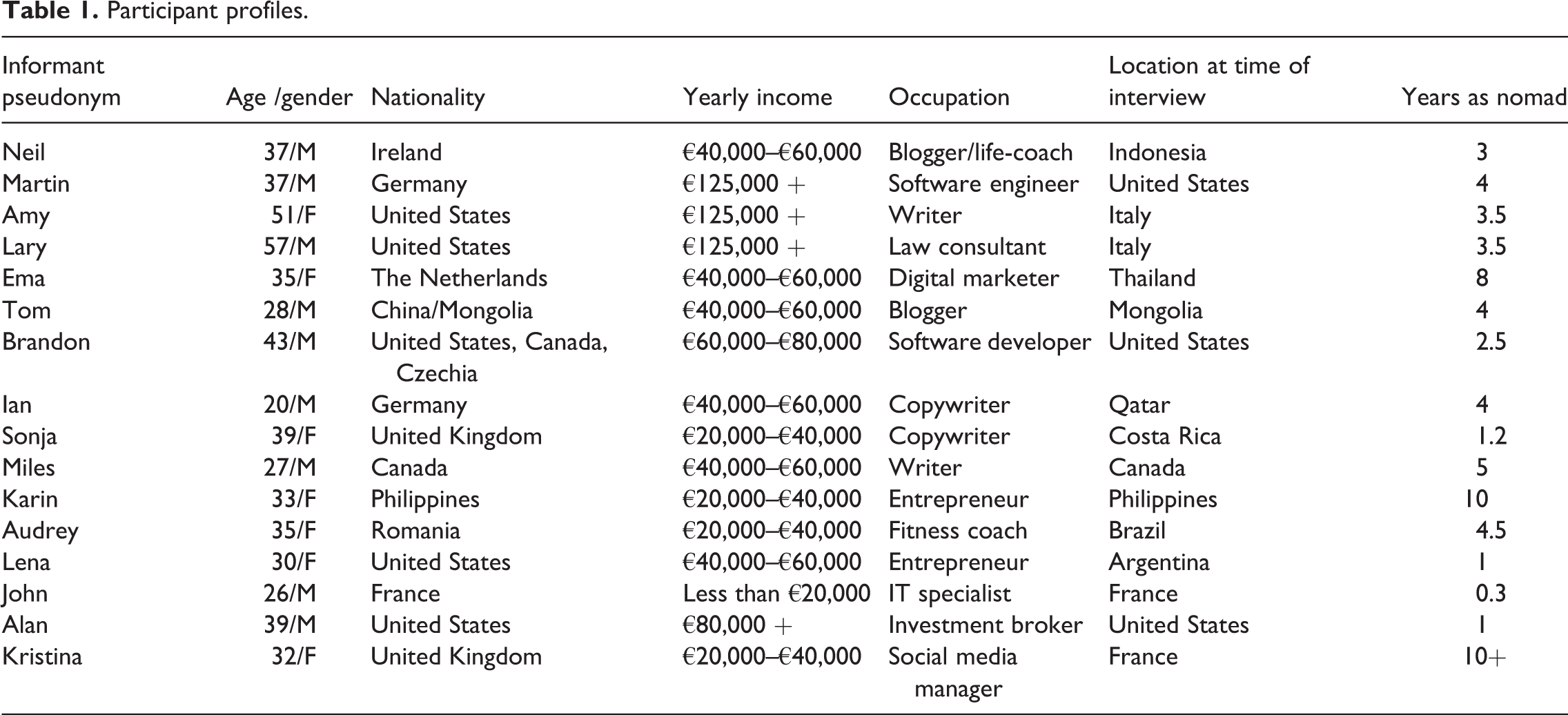
We used both purposive and snowball sampling (Miles and Huberman, 1994) when recruiting our informants. The majority of respondents were found in one of the largest Facebook groups for digital nomads, “Digital Nomads around the World,” and many of these participants referred us to other nomads. The final sample consisted of seven women and nine men aged between 20 and 57 years old, representing 13 nationalities and hailing from various professional backgrounds—from writers, students, and engineers to investment bankers—bringing demographic scope to our sample that is representative of the diversity within the digital nomadic community (see Table 1).
Participant profiles.
Throughout data collection, we engaged in an iterative process of preliminary data analysis after each interview, refining our interview guide to better tap into emergent themes, and proceeding with additional data collection until we reached sufficient theoretical saturation and convergence across interviews which rendered collecting more data unnecessary (Spiggle, 1994). The interview transcripts were subject to iterative part-to-whole analysis where the data set was interpreted within a hermeneutical framework with two main phases: impressionistic ideographic intratext readings and intertextual analysis of the texts (Thompson, 1997). Engaging in this hermeneutical movement between the analytic reduction of the empirical data and a resulting interpretive restructuration, we arrived at a theoretical explanation of a broadening logic of materialism, which is contextually anchored in both the phenomenon of digital nomadism and the wider context of contemporary modernity. In interpreting our data, we approached our theorization and the subsequent discussion of our findings through a lens of analytical generalization (Stake, 2005), drawing on the similarities between our context and related consumption phenomena to guide the transferability of our findings. We elaborate on these findings next.
The broadening boundaries of materialism
Based on our analysis, we define materialism as a logic of consumption, which manifests as a preoccupation with the consumption of objects, access, or experiences as a way to signal status, build image, pursue happiness, and attain a sense of self-worth. Our findings suggest that materialism can permeate beyond the boundaries of acquisition and emerge in the absence of ownership centrality through non-ownership forms of consumption such as access-based and experiential consumption. Specifically, we suggest that in less ownership-focused contexts materialism can permeate consumption in three ways: (1) preoccupation with strategic curation rather than accumulation, (2) intentional prioritization of experiential consumption over ownership as a means to fulfill materialistic aims, and (3) adoption of bricolages across spectrums of consumption (solid and liquid, budget and luxury, access and ownership). We suggest that these practices are independent but complementary to one another, such that consuming materialistically can manifest in one or several of these ways. At the aggregate, our data shows that when ownership centrality is de-emphasized, consumers’ materialistic goals for attaining happiness via resources in the marketplace are pursued with a pronounced strategic intentionality toward solid and liquid consumption alike, as solid consumption cannot be fully avoided. However, triggered by an overemphasized preoccupation with the outcomes of consumption, this strategic intentionality influences how consumers move along the solid–liquid continuum and mediates consumers’ materialistic orientations. Next, we outline the three ways in which materialism manifests in the absence of ownership centrality.
Strategic curation
Given the centrality of possessiveness and ownership in established definitions of materialism, it can be inferred that liquid consumption is a nonmaterialistic style of consumption (Bardhi and Eckhardt, 2017). Previous empirical evidence has already demonstrated that, in liquidity, consumers place less importance on their acquisitive behaviors and demonstrate a general lack of engagement with physical objects (Bardhi et al., 2012)––a notion further reinforcing the postulation that liquid consumers might be nonmaterialistic since acquisition is not a priority. Indeed, not surprisingly, in a context of continuous mobility, the need for lightness is foregrounded and preference is given to items which can easily fit in a carry-on suitcase (Bardhi et al., 2012). In contrast, however, our analysis reveals that while liquidity pushes digital nomads from solid to liquid consumption, consuming across the spectrum is transformed from an act of accumulation to a tactical practice of curation, largely driven by a materialistic preoccupation with the signaling utility of what is consumed.
Our data suggests that at the solid end of the consumption continuum, for digital nomads, acquisition and consumption of objects are acts laden with much importance, purpose, and effort. Buying objects is not entirely uncommon for digital nomads but is guided by a pronounced strategic intentionality which prioritizes both the instrumental and symbolic value of such consumption. As one of our respondents shares:
Digital nomads spend more time making conscious purchase decisions for all the stuff they have, and some of those are absurd. Like there is an entire Nomad Slack forum [for] what are the best pencils, you know? And people spend hours researching the best pencil! (Martin)
Martin’s narrative illustrates that digital nomads engage with material objects in a highly deliberate manner, where the focus is shifting from accumulation to a deliberate pursuit of the highest possible utility, both practical and status signaling. As illustrated by the Marie Kondo essentialist movement, when one owns very few solid possessions, their value and meaning becomes of much more central concern. Such curated minimalism emerges as a form of conspicuous consumption and a means for taste and status signaling. As also evidenced in our data, in the absence of ownership centrality, materialism surfaces as an extreme preoccupation with consumption as means to an end, and acquisition becomes an act of targeted curation. Even when consumers describe themselves as nonmaterialistic and unexcited by consumption, their focus on consumption is all-encompassing and fueled by a search for instrumentality. Kristina, a digital nomad with over 10 years of experience living that lifestyle, illuminates the essence of this:
Oh, it takes me ages to [decide what to buy]. I think, “Alright, do I really need this?” So, say for example if I wanted to buy a warm jacket now, it would just take me ages because I will be like: “Alright, what are the pockets like in it; can I put everything I need in there when I am hiking; is it waterproof; is it windproof; what’s the hood like; does it stay up in the wind.” All of the things! Okay I’d probably pick a nice color that would look good in an Instagram photo. So that would be another thing: would the color stand out in a blog photo. The practicality of something [is important] and I would think: “Can I wear this with everything, so I don’t need to buy another jacket?” So, this is kind of that—I want this to be my only jacket, if that makes sense. I would never just go into a shop, grab something and just walk out.
Kristina’s narrative echoes insight in the literature that liquidity evokes an intensified concern with the use value of the consumption object (Bardhi et al., 2012). Our study extends these findings in showing how this preoccupation with use-value can result in a heightened engagement with both the object and the act of consumption, rendering even low-involvement purchases objects of deliberate evaluation. As liquidity de-emphasizes the importance of material possessions overall, a materialistic logic to consumption drives a preoccupation with the consumption of the few solid objects that digital nomads do purchase and foregrounds their utility (instrumental, hedonic, and signaling). Miles, for instance, a Canadian writer who has been living as a digital nomad for the last 5 years, shares a typical shopping episode:
I had to buy a winter coat this year and it literally took me two months of visiting stores and looking at coats and going home and going to the same stores again and looking at coats and going home and doing this four or five times over, until I finally had to break down and buy a coat because it was -10F and I was really cold. But I have a really hard time buying things. Even things that I need.
We see a paradigmatic shift within materialism as a logic: a turn from excessive acquisition of possessions (see Belk, 2015) to strategic intentionality of consumption and careful curation of valued objects. In contexts where ownership centrality is de-emphasized, acquisition is a drawn-out process of effortful selectivity and demands detailed assessment of the specific desired ends which consumption can facilitate.
This preoccupation with utility and function can lead to consumers’ tendencies to strategically curate expensive, durable products that fulfill at once practical needs as well as concerns related to building a desired image and gaining attention––for example, a warm jacket that necessarily looks good on Instagram. Within this realm, in line with extant literature (Eckhardt and Bardhi, 2020a; Eckhardt et al., 2015), our data also points to some consumers’ preference to communicate and signal status and image inconspicuously. As Miles recalls, one of his primary purchase criteria was that his expensive new jacket does not “have a large logo or branding on it.” He continues:
I really hate that. There was one jacket I tried on that was a really nice, but it had DKNY written in big white letters across the ass. And I was like, why did they do this?! It looks terrible!
For Miles, conspicuous display of brand affiliations is unnecessary and counterproductive. The curation of valuable, yet inconspicuous items, is instead perceived as a more effective means for communicating the desired image of minimalism––an orientation which in turn opens new forms for materialism’s expressions.
Prioritization of experiential consumption
It has been suggested that materialists are less likely to make experiential consumption choices; moreover, experiential consumption is frequently positioned as a nonmaterialistic alternative to object consumption (Van Boven, 2005). Our data illustrates, however, that in liquid contexts, a materialistic preoccupation with attaining happiness via consumption primarily concerns experiential consumption. In contrast to previous micro-consumption level theorizations (Van Boven, 2005), we suggest that at the macro level, experiences can emerge not as an escape from materialism, but as an avenue for pursuing materialistic aims such as cultivating image and signaling status through consumption. Immaterial and inscribed with meanings that are easily moldable to various signaling goals, in liquid consumption, experiences hold better potential for delivering on materialistic aspirations than possessions do. As such, the focus of materialism as a logic to consumption shifts from that of ownership centrality to that of experience centrality. Experiences such as meditation retreats or travel to lesser known and hard to reach destinations that can signal achievement of important and admirable life goals (spiritual enlightenment, attainment of self-worth, emancipation from 9-to-5 structures, or cultural knowledge) are particularly sought after. Brandon’s narrative reflects these ideas as he describes how he transitioned from consuming material objects to experiences:
I chucked everything no matter what it was […] I just threw it all in the trash and I was able to never really look back on it. When you get rid of all of your possessions, it’s a reminder that you can reinvent yourself every day. Stuff no longer controls you. You don’t define yourself in terms of things that are around you or what you own, but you’ve got other ways of defining yourself, for you can create new approaches to defining yourself. […] I simply don’t buy anything for the sake of buying it anymore, […] the money’s all going to experiences. […] Before […] I spent so much of my life working, showing up to the same place all the time that I could look back at the entire year and feel like outside of work I had nothing to show for it. And it was terribly uninspiring really. And then afterwards, you know, in the last two years I’m truly living the best years of my life. I mean, I’ve been to Machu Picchu and to Angkor Wat, I’ve ridden a camel in the Sahara desert and I got back from a balloon ride in Turkey and I’ve just been able to do all these incredible, amazing things by taking charge and putting life first ahead of work.
The notion that in contemporary modernity consumers’ lives are permeated by existential anxieties and doubt about the value or appropriateness of their life choices (Thompson et al., 2018) alongside their consumption choices is evident in Brandon’s thoughts. We find that as digital nomads navigate between the experiential and the material, consumed experiences are reflexively reframed and mobilized to help alleviate the burdens which contemporary modernity imposes on self-actualization. With that, as preoccupation with material accumulation might wane, fixation on experiential consumption grows purposefully and intentionally. Kristina, for instance, sees experiential consumption as a means for defining herself differently from the rest
The sense of society in the UK stresses me out. People believe that you have to live such a regimented lifestyle and do the same thing every week…You are not experiencing […]. I find it pretty difficult to be at home because I always felt like I want to be free and be out there and experiencing as much as I can. Whereas a lot of the people I was surrounded with would just stress out for wanting to have a nice house, have a nice car, live in a certain way and so they were living in a routine thinking that they could get and achieve that in that way.
Kristina perceives lifestyles that prioritize accumulation of possessions to be enslaved to a pursuit of what she considers dull and unimpressive markers of success––for her, cars and houses are void of appeal or meaning. Experiential consumption, in contrast, emerges instead as a desirable alternative to solid consumption. This shifting focus to experiential consumption, however, is reinforced by a materialistic preoccupation with how one engages with such consumption. Experiences are more than just a fleeting relief from the mundanity of daily life; as Tom asserts, “Life, it’s just way bigger than going to work and getting your paid holiday.” Liquid living mobilizes reflexive reworkings of the meanings embedded in experiential consumption––experiences are most desired when they have high instrumental value for both conspicuous and inconspicuous signaling and for achieving a sense of self-worth. As Martin explains:
If you just live in one place for a long time, you might have nice experiences, but they are not going to be novel for very long. So this is, I think, how most people differentiate and strive for learning things, for feeling like I am growing as a person and for experiencing novel things; for living to tell the tale. […] It is a lifestyle that looks really good on pictures. […] [But] maybe it is not about showing off, maybe it is about showing to yourself that you are right there where you wanted to be so hard, you know. You have a lot of money and you know you can prove to yourself that you’ve got it. I don’t think that digital nomadism is different from any other kind of lifestyle trends that we have. Whether you post your workout photos from your gym or your travel photos…you know everybody has this one friend on Instagram who every Sunday posts a picture of a glass of rosé and a book…It’s just a way of saying, oh this is kind of the feeling and environment I want to create for myself and I am there, right now.
For digital nomads, experiential consumption is internalized as a path toward attaining happiness and self-actualization. Importantly however, it is also internalized as a signifier for success and a skillfully managed escape from the bland landscapes of everyday life––an escape which is impossible without hard-earned financial resources. Ian, a German entrepreneur, shares:
I just couldn’t see myself going anywhere. It was the same thing every day, even though I was meeting different clients and people, but it still was the same thing at the end. So, I tried to break out [and] my first destination was actually the furthest place I could go to. So I went all the way to New Zealand just to get away, I kind of tried to rescue myself. I couldn’t do this 9-to-5 anymore. I like to meet new people, I like to expand my knowledge. I try to evolve. I try to have some progress on a daily basis, even if it’s small sometimes. [N]ow I can do whatever I want basically. If I don’t want to work, I just stop working and try to delegate a little bit. I’m at a position where I can just hire people, let them do my job or I do it myself. […] [M]y friends that stayed, they might not understand what I’m doing. They might be a little bit jealous because this is working out perfectly well and they’re in different positions in their lives. They regret that they didn’t take the leap––just starting something new, getting involved with something totally different.
Ian’s narrative echoes how in contemporary modernity, taking charge of one’s life involves risk and discomfort, as it means accepting a break with the past and drawing the future into the present by means of reflexive organization and reorganization of knowledge and desires (Giddens, 1991). Here, the notion of self-construction takes the lead in guiding consumers’ actions and motivates a proactive undertaking of “lifestyle design”—a term introduced in the digital nomad bible “The 4-Hour Workweek” (Ferriss, 2009), which aptly illustrates the implications of liquidity on the construct of materialism. Ferriss (2009: 7–8) elaborates: The New Rich are those who abandon the deferred-life plan and create luxury lifestyles in the present using the currency of the New Rich: time and mobility. This is an art and a science we will refer to as Lifestyle Design. […] People don’t want to be millionaires––they want to experience what they believe only millions can buy.
Our findings build upon Holt’s (1998) theorization of materialism as a class practice by demonstrating that in liquidity, as markers of class and status shift (Eckhardt and Bardhi, 2020a), status claims that might emanate from experiential consumption are particularly amplified, but also increasingly blurred. In a world where struggling professionals, affluent entrepreneurs and eccentric artists can all work side by side in exotic and inexpensive locations, while sharing sights and experiences, signifiers of cultural capital are becoming unreliable signals of social standing. Thus, experiences have become a significant way to engage in materialism, but not with the same social class connotations as in the past.
Adoption of bricolages across spectrums of consumption
Our data suggests that as a logic which can manifest as a preoccupation with both solid and liquid consumption, materialism can influence how and why consumers move along the solid–liquid continuum. Bardhi and Eckhardt (2017) identify the conditions that affect the extent to which consumption is liquid or solid: relevance to the self, the nature of social relationships, accessibility to mobility networks, and the nature of precarity. We build upon this by demonstrating that consumers not only move along the continuum based on these four conditions but also based on the extent to which their consumption is directed by a materialistic logic. We show that when preoccupied with goals such as pursuing happiness, building image or signaling status, digital nomads intentionally and strategically polarize their consumption between budget and luxury, access and ownership, as well as ways of spending and accumulating wealth. Materialism can thus emerge via the adoption of such selective bricolages of consumption along continuums. With this, our findings extend previous conceptualizations suggesting that consumers shift between solid and liquid consumption (Bardhi and Eckhardt, 2017) by introducing the notion of consumption polarization and adoption of bricolages across spectrums as means to do so. That is, we provide insight into how consumers move along the continuum when guided by a materialistic logic of consumption.
Our data indicates that materialistic orientations can be optimized through polarization of consumption, irrespective of one’s financial means or status. Audrey’s narrative reflects her first experiences after she embraced digital nomadism:
We had our projects rolling but they were not generating as much money, [so] we needed to find an option in which we could travel with an affordable budget and also work on our online projects. And we started traveling using house sitting. We first went to Spain, near Malaga, into like this really amazing mansion with a pool and a view overlooking a valley with olive trees and it was just amazing. And we had the pool, we had the huge villa, we had a pool guy and a maid come and clean the house every day, and even a car, and in exchange we had to look after three dogs and it was so, so great. And this was our start.
Audrey’s testimony illustrates how strategic construction of consumption bricolages––as she secures the experience of high-end living on low-end budget––opens possibilities for a shift in how materialistic aspirations and pleasures manifest, irrespective of affluence. As Neil elaborates while he describes his life in Bali:
I often say that I am trapped in paradise. It is weird. Some months you earn good money and some months you don’t and a lot of it is trial and error. But at the end of the day, I am living in a beautiful villa, there is a pool outside, and you know if I wanted to go live in a city like Vancouver, I wouldn’t have that option. I mean I’d have to work a lot harder.
Digital nomads exist within a juxtaposition of lightness contrasted with indulgent living that does not necessarily require wealth but is dependent on mobility and access to markets. Tom illustrates this notion:
Most of my friends who graduated from the same college in Beijing also found jobs in Beijing. They get married and they get a like $1 million loan, a mortgage to buy an apartment. Then they’re locked for life! [Others] just decided to sell everything, get free and move out of China to somewhere that is way cheaper. So that’s part of the new digital nomad culture. You want to increase the value of your assets by moving somewhere that’s more cost effective. […] There’s no reason for you to pay $3,000 just for rent when you can pay $100–$200 for rent in Chiang Mai; that’s a no brainer. […] I mean, some people say: I like New York, I like Beijing—there are concerts and everything, but you can always fly back when there’s a concert. It still saves you a lot of money.
Materialism across the solid–liquid continuum here emerges in carefully planned asset-optimization practices that allow consumers to skillfully curate a lifestyle that maximizes the opportunities in a globalized world. Trading down so that more money can be allocated to things that matter more––also known as hybrid consumption––has been recognized in the literature as a style of consumption which allows consumers to explore fragmented marketplaces (Ehrnrooth and Gronroos, 2013). We further advance the idea that consumers in liquidity can legitimize consumption behaviors, which may be stigmatized as negatively materialistic, through selective polarization that allows them to balance their consumption across the spectrums of materialistic–nonmaterialistic. This echoes the notion of “justification” presented by Ger and Belk (1999), who demonstrate that consumers across cultures tend to admit their materialism, but either reconstruct it is a positive thing, or deny the label of materialist by redefining materialism itself. Here, the logic of materialism emerges through practices of consumption polarization and adoption of consumption bricolages, which allows for consuming abundance and luxury while at the same time de-prioritizing ownership. As Neil asserts
My values were more materialistic beforehand. And money is massively important––don’t get me wrong […] [but] all the s**t I wasted my money on…I’d get my paycheck and I’d spend hundreds of dollars on things I didn’t need…new clothes and all that. I just don’t care about that anymore. But it is easy not to care about that in Bali. […] Walking around in shorts and t-shirts all day, and having all that, I love the lifestyle and how it is affordable here.
Accumulation of economic capital, as alluded to in our data, is of high importance to digital nomads and is another domain where construction of strategic bricolages takes place. Building affluence is often done via practices for generating passive income, where an initial investment of effort or money pays off in time and delivers income without the need for active work being done daily or in the long run. Alan, while describing the few T-shirts and pairs of shorts that he owns, notes that he is “not really into consuming in the first place” and shares his vision for an ideal lifestyle setup
I am aiming for having my own places in different locations––that are mine, with just my things there. And so in Barcelona it’d be a few t-shirts there that are mine and I wouldn’t have to travel with them […] By extension, if you put it out on AirBnB it will always pay for itself because short term rentals are just more lucrative than long term rentals. It’s a cash flow positive thing which means that the place is now working for you.
Alan’s narrative illustrates how the logic of materialism can unfold and take shape in liquidity: consumption is approached with pronounced strategic intentionality, where carefully constructed portfolios of material objects and experiences frame the desired way of life, while strategies of polarization across and within spectrums enable indulgent living at optimized cost and cater to successful pursuits of lifestyle design projects.
To summarize our findings, we suggest that the logic of materialism need not involve material goods or centrality of ownership and accumulation of possessions. We demonstrate that when ownership is de-prioritized, materialism can manifest itself in three ways: (1) preoccupation with strategic curation rather than accumulation, (2) intentional prioritization of experiential consumption over ownership as a means to fulfill materialistic aims, and (3) adoption of bricolages across spectrums of consumption (solid and liquid, budget and luxury, access and ownership). We see these practices as independent but complementary to one another such that in the absence of ownership centrality, materialism can unfold through varying degrees in one or several of these ways. We discuss the implications of this next.
Discussion
In this article, we advance current understandings of materialism by examining it at the sociocultural level in the context of shifting consumption orientations from solid to liquid within a marketplace where ownership is not necessarily a central concern for many. Accounting for the rise of dematerialized, digital, and access-based consumption, we propose that some consumers can depart from materialistic orientations that prioritize acquisition and ownership as a way to attain happiness and signal status and can turn instead to more liquid forms of consumption toward the same ends. We thus suggest that the boundaries of materialism have expanded to encompass solid and liquid consumption alike. With that, we make contributions to scholarship on materialism, liquid consumption, minimalism, and status signaling, as well as digital nomadism as an emergent lifestyle.
First, to the literature on materialism, we contribute by illustrating how materialism is adapting to contemporary modernity, where global mobility and the rise of inconspicuous and access-based consumption have emerged as avenues for catering to consumers’ pursuits of the good life (Atanasova, 2021). While in the past, the construct of materialism has captured the importance consumers ascribe to material goods en route to achieving life goals (Belk, 1985), we propose a conceptualization that encompasses how materialism as a logic shifts alongside emergent contemporary consumption dynamics. We suggest that as consumers move back and forth along the solid–liquid continuum, materialism can emerge through preoccupation with material and nonmaterial (access and experiential) consumption, where consumption is closely scrutinized and strategically curated as means to advancing aims for gaining attention, designing a desired lifestyle, and building image. This conceptualization answers Richins’ (2017) call for research to explore materialistic consumption of experiences by detailing how, in place of preoccupation with having things, experiential consumption emerges as a viable and desirable alternative to fulfilling materialistic goals in non-ownership contexts.
While we detail how experiential consumption is internalized as an intentionally pursued path toward attaining happiness and signaling status or image, further research is needed to delineate the various contextual and individual level nuances of materialistic experiential consumption. Future research can revisit the measurement of materialism in light of the broadening boundaries of the construct. The most established scales for materialism (Richins and Dawson, 1992; cf. Richins, 2004; see also Belk, 1985) focus on the centrality of acquisition and possessions in one’s life, the importance of possessions in the pursuit of happiness, and the ways in which possessions are used to define success. Our findings suggest that measurements of materialism can adapt to capture the various emergent expressions of materialism in the absence of ownership; in particular, the three we have highlighted. In addition, Holt (1998) foregrounded a shift toward the prominence of experiences as a part of class and status signification, which we have built upon by showing that experiences can be used strategically to gain distinction, regardless of class. Holt (1998) articulates his understanding of materialism around how people consume, rather than what they consume. We extend this perspective by outlining the ways in which the logic of materialism pushes consumers to overemphasize the importance of consumption as a means to achieve goals along the consumption spectrum, while engaging with different forms of consumption, for example, material, access-based, experiential. Following up further on Holt’s (1998) ideas, future research can examine how the manifestations of materialism in the absence of ownership centrality which we have outlined here reflect and enable contemporary notions of low and high cultural capital individuals.
This work also extends Richins’ (2017) conception that materialism exists on a continuum from high to low depending on the degree to which one places importance on material goods by proposing that in today’s economy, materialism is better understood as a degree of preoccupation with consumption overall––both material and experiential. That is, if one views experiences or access as the best way to achieve life goals, that is just as materialistic as doing so with objects. As such, we expand the continuum that Richins (2017) introduces, upon which materialism unfolds, across a broader conceptual plane. This expansion re-charts the conceptual boundaries of materialism and illuminates how it emerges in counterintuitive places. Without bringing materialism to the context of solid–liquid consumption as we have done, it is easy to miss the various inconspicuous expressions of materialism specifically within the liquid end of the spectrum. This is evidenced in that, with few exceptions (Akbar et al., 2016), most research to date that acknowledges nonmaterial materialism (e.g. Holt, 1998; Shrum et al., 2013) accounts for experiential consumption, but not access or lifestyle trends such as minimalism, reductionism, and others which we discuss.
Second, we contribute to liquid consumption research by outlining how the logic of materialism can direct consumers’ movement from one end of the solid–liquid continuum to the other (Bardhi and Eckhardt, 2017). In response to Bardhi and Eckhardt’s (2017) call for examination of the relationship between liquid consumption and materialism, we illustrate that a decrease in ownership centrality can paradoxically result in an exaggerated preoccupation with consumption and its utility toward materialistic aims. We demonstrate how consumers not only weave-in strategic bricolages along the solid–liquid continuum, but also along spectrums of budget and luxury, and access and ownership. In our data, consumers tend to foreground the ends of these spectrums that align with lightness and disengagement with consumption (e.g. owning just a few possessions; being a savvy consumer), while de-emphasizing and reappropriating solid materialistic behaviors (e.g. purchasing property; maximizing property value through AirBnB). Future research can further explore how practices of polarization of consumption and adoption of bricolages across spectrums implicate consumers’ efforts to navigate the tensions which arise from transitioning between solid and liquid in their lifestyles and consumption orientations.
This article also answers Lamberton and Goldsmith’s (2020) call for research into the implications of consumers’ waning desire to own on established conceptions in consumer behavior. We expand upon their conceptual framework addressing ownership on a solid–liquid continuum by demonstrating how the logic of materialism emerges as an additional antecedent of the preference for solid versus liquid consumption, which they have not considered. Future research can build on this by exploring the underlying processes on individual and cultural levels that are associated with materialism along the solid–liquid continuum and its consequences.
Third, our work also suggests that as materialism adapts to the absence of ownership centrality, a more robust conceptual delineation between minimalism as a consumption orientation and non-material expressions of materialism to signal status is needed. We show that non-ownership and minimalist orientations need not stem from anti-consumption dispositions (cf. Chatzidakis and Lee, 2013) and that as long as consumption, not the absence of it, guides consumers' pursuit of happiness, materialistic orientations adapt to accommodate a shift away from acquisition and ownership. From a consumption point of view, as a lifestyle movement, digital nomadism resembles other emergent lifestyle trends such as minimalism, Marie Kondo essentialism, or the tiny house movement, which center around getting rid of objects and buying less. The transferability of our findings to these other contexts enables a theoretical understanding of why and how such aspirational lifestyles can emerge as aesthetic languages for affluence and luxury. As Tolentino (2020) asserts,
less is more attractive when money is not an issue, and minimalism is easily transformed from a philosophy of intentional restraint into an aesthetic language through which to assert a form of walled-off luxury—a self-centered and competitive impulse that is not so different from the acquisitive attitude that minimalism purports to reject.
The accounts of our informants suggest that de-prioritizing ownership is not a nonmaterialistic practice. We thus demonstrate that elective minimalism (vs. imposed minimalism such as in the case of poverty or homelessness), aesthetics of sparseness, reductionism, and conspicuous displays of “not-having” are emerging as potent symbolic signifiers of affluence, taste, and status. That is, preoccupation with having less and non-ownership can be just as materialistic as consuming to have “more” (Richins, 2017).
Finally, we contribute to an understanding of digital nomadism, a context which is ripe for exploring a variety of marketing issues. The wide demographic range within this growing cohort suggests opportunities for examining how notions of social class, precarity, and liminality affect various aspects of consumption as individuals negotiate tensions between reality and imagination, solidity and liquidity, and online and offline identity construction. Also, a critical reflection on the digital nomadic lifestyle and its impact on the planet and on host communities is needed to further illuminate how globalization affects consumers (cf. Sharifonnasabi et al., 2020). Digital nomads around the world are advancing toward establishing a Digital Nomad Nation (digitalnomadsnation.org), seeking to legitimize the lifestyle and circumvent taxation and visa issues. What are some of the consequences of these types of macro level shifts? Research outside of consumer behavior has already began to explore issues of identity, privilege, selfhood, and inequality (Aroles et al., 2020; Green, 2020; Mancinelli, 2020; Thompson, 2019)––there are many marketing related questions that arise from this important new form of living to be explored.
In sum, we propose that the boundaries of materialism have broadened in today’s marketplace, and that when ownership is de-prioritized, materialism can encompass strategic curation, experiential consumption, and adoption of bricolages across spectrums of solid–liquid, luxury–budget, and access–ownership. This conceptualization helps illuminate how materialism can emerge in new ways as ways of consuming change. In this way, materialism remains a robust construct, which continues to adapt to contemporary dynamics and can continue to be used to understand consumers’ engagement with consumption into the future.
Footnotes
Acknowledgement
The authors would like to thank Katharina Husemann for her insightful comments and the respondents for sharing their stories.
Declaration of conflicting interests
The author(s) declared no potential conflicts of interest with respect to the research, authorship, and/or publication of this article.
Funding
The author(s) received no financial support for the research, authorship, and/or publication of this article.
