



Abstract
This article explores the lone consumer experience in the context of speciality coffee, resulting in the conceptualisation of the lone consumer servicescape. The lone consumer is conceptualised as a consumption collective, with its own innate characteristics, behaviours and requirements that can be viewed through physical, social and symbolic aspects of servicescape. Through utilising freewriting, the research captures self-reported experiences of lone consumers of speciality coffee. Data derived from 54 respondents is analysed thematically to determine the dimensions of lone consumption. Findings reveal a lone consumption servicescape that combines spatiality, materiality and aesthetic, symbolic discourse and parasocial interactions, mediated by the lone consumer’s self-reflection. Lone consumption, in this context, is acknowledged as a sought after and fulfilling experience but one which requires both a conducive environment and self-awareness to utilise it.
Introduction
This article acknowledges and explores the lone consumer experience in speciality coffee,1 using servicescape as both a theoretical lens and practical context. We conceptualise the lone consumer as a consumer collective with a distinct set of characteristics and explore their consumption experiences in relation to speciality coffee, contextualised in third wave coffee shops. The practice of lone consumption has been observed within coffee shops (Broadway and Engelhardt, 2019; Broadway et al., 2018) but there is little explanation of the motives for and outcomes of such experiences. Lone consumption is highlighted in only a few contexts, mostly relating to travel and tourism (Bianchi, 2016; Jordan, 2008; Laesser et al., 2009; Lai et al., 2015; Wu et al., 2017) with the underpinning assumption that the ‘lone’ aspect is not by choice but a situation that the consumer must simply deal with. For example, as a solo business traveller (Wu et al., 2017), or from a gendered perspective (Jordan, 2008; Wilson and Little, 2005), rather than focusing on the experience of the lone consumer as a positive, enjoyable and intended activity.
Motives for lone consumption in coffee shops may include participation in individualistic consumption culture, as demonstrated in public urban cultures (Shaker and Rath, 2019; Shaker Ardekani and Rath, 2020), expression of self as connoisseur (Manzo, 2014; Quintão et al., 2017) or a reaction to sociocultural challenges (Higgins and Hamilton, 2019; Lalli, 1992). We situate our study in relation to speciality coffee shops, an environment in which the consumer both experiences and contributes to coffee sociality (Bookman, 2014; Manzo, 2010, 2014; Shaker and Rath, 2019); their presence means that they are part of a social construction – the coffee shop community – thus elevating and extending the experience from ‘having a coffee’ to that of enabling self-expression and connection through consumption, resulting in calm, pleasant and even rejuvenating experiences (Higgins and Hamilton, 2019; Walsh et al., 2011).
Coffee shops are a context of growing interest in terms of consumption behaviours and coffee sociality, specifically the tendency for customers to establish social links and community connections. Prior studies inform a range of collective behaviours, such as chatting and spending leisure time with friends (Nadiri and Gunay, 2013), talking with the barista to gain product knowledge (Manzo, 2014), coffee shops as workspaces (Broadway et al., 2018), self-expression (Shaker Ardekani, 2016; Shaker and Rath, 2019) and place attachment (Tumanan and Lansangan, 2012). Together, these uses of coffee shops create the potential for different socialities to emerge (Ferreira, 2017). However, the experience of the lone consumer is rarely acknowledged, which is possibly a reflection of assumptions about the social acceptance of being alone in public consumption spaces (Brown et al., 2020); and the notion that lone consumption makes a lesser economic contribution. Lai et al. (2015) identify the ‘abject single’ noting that businesses are orientated to the needs of groups rather than individuals, particularly in a service context. Perhaps for these reasons, few studies have explored the potential pleasures of lone consumption. We argue that speciality coffee shops enable lone consumption, which can be a desired and intended practice and that lone consumers are a collective, bound by a shared practice but may not be outwardly sociable in their expressive behaviour.
This research posits that while the lone consumer consumes ‘alone’, they function as a collective in terms of how they engage with the lone consumption servicescape within the speciality coffee context. Consumer collectives, like subcultures, are underpinned by strong interpersonal temporary, ephemeral experiences and activities (Cova and Dalli, 2009; Goulding et al., 2009; Kozinets, 2002; McAlexander et al., 2002; Närvänen and Goulding, 2016). The presumption is that these groups are sustained through interaction; that consumer collectives are underpinned by shared engagement as well as shared experience (Goulding et al., 2013), and a sense of shared-ness that is both tangible and observable. The focus of consumer collectives and indeed belonging is typically directed to the dynamics of community. Belonging to a collective or having shared characteristics in terms of behaviour and reaction has explicit connotations, such as social interaction, sharing (Goulding et al., 2013) and connoisseurship (Quintão et al., 2017).
We propose that lone consumption can be a preference and a practice, one worthy of further exploration. It is argued that the lone consumer group requires investigation and articulation beyond social engagement, service quality and from behaviours that can be observed. The speciality coffee context provides the opportunity to investigate lone consumption through servicescape and therefore contribute to a conceptualisation of the lone consumer servicescape. This study extends theory and understanding on standard collective practices by challenging the nature of collective bonds through investigating whether the sense of belonging can be affected by stimuli other than explicit social interaction, such as the servicescape within which the consumer locates (Diaz Ruiz et al., 2020). The traditional dimensions of servicescape are extended upon here and it is proposed that the lone consumer collective is bonded not through explicit social interactions, but potentially through a complex interplay between tangible and intangible aspects of servicescape including the physical spaces, the symbolism and values of speciality coffee and sociality associated with the context. We use servicescape literature to inform an empirical investigation using self-reflection – performed by lone consumers that narrates individual interpretations of the lone consumption experience.
Servicescape, space and place
Servicescape relates to the physical location in which a service is provided and experienced by the consumer (Bitner, 1992; Zeithaml et al., 1996). Through successive studies, the constituent elements of servicescape have evolved and expanded to incorporate virtualscapes and, more recently, natural spaces (Rosenbaum and Massiah, 2011), therapeutic servicescapes (Higgins and Hamilton, 2019) and cosmopolitan servicescapes (Figueiredo et al., 2021). There are challenges to the notion that servicescapes are wholly controlled by service providers (Hanks and Line, 2018), but extant servicescape literature is largely informed by the experiences of groups or consumer collectives, without explicit acknowledgement of individual experiences, in terms of their contribution to and consumption of the servicescape.
Environmental psychology stresses the importance of the individual’s understanding of their consumption of space, informing the creation of place, nature of place identity and potential for place attachment (Scannell and Gifford, 2010; 2017, Tumanan and Lansangan, 2012, Walsh et al., 2011). Indeed, Lalli (1992) identifies the significance of place related to a person’s relationship with that place and how they identify with it, the individual symbolic and evaluative interpretations thereof. From a phenomenological perspective, servicescape has a deterministic influence on a consumption experience; space transcends and augments the consumption experience (Johnstone, 2012) due to the subjective and emotional interpretations. The connection with environment is the product of an interaction between the person and the environment (Graumann, 1983; Holloway and Hubbard, 2001); the two form an indissoluble unit (Rosenbaum et al., 2007; Schneider, 1996) giving insight into emotional, cognitive or behavioural meanings of things, environment or persons.
Traditionally, the focus has been on the physicality of space and it’s use in terms of what the space comprises (Mazúr and Urbánek, 1983). However, place can be explored from a meaning-related perspective (Lalli, 1992; Lynch, 1960), concerned with functional, symbolic and evaluative aspects of the environment. Therefore, place identity is more associated with ‘whatness’, or what is actually done in the place (Scannell and Gifford, 2010), rather than ‘whereness’ in the physical sense. The symbolic and evaluative interpretation of an environment is informed by the meaning attributed by the consumer (Gieryn, 2000; Ingold, 2011). ‘Whatness’ incorporates product consumption and the cognitive and affective impact on self. This research explores ‘whatness’ in the context of the speciality coffee servicescape and how lone consumers engage with and then contribute to that servicescape.
Conceptualising the speciality coffee servicescape
Context has the potential to bond (Diaz Ruiz et al., 2020) and aspects of servicescape can potentially facilitate this bond. In exploring ‘whatness’, we explore servicescape in order to delineate the lone consumer experience. Guided by servicescape literature and prior studies of speciality coffee consumption, we consider physical, symbolic and social aspects of servicescape and how these can be combined to explore the lone consumer servicescape. We contend that the speciality coffee servicescape comprises physical, symbolic and social aspects and review each through related servicescape and coffee consumption literature in order to determine the how lone consumption can be viewed and informed.
Spatiality, materiality and aesthetic
Physical aspects of the servicescape act as consumption stimuli (Manthiou et al., 2017) potentially informing ‘where’ the consumer chooses to be. The physical consumption environment consists of tangible elements that can be experienced, observed and measured (Bitner, 1992); however, measurement is complicated in the sense that the consumer may express outcomes from food and drink experiences in sensory and emotional terms such as feelings of comfort or vibrancy (Kauppinen-Räisänen et al., 2013). Space and its components, such as the proximity to other consumers (Tombs and McColl-Kennedy, 2010), staff and the atmosphere can significantly contribute to the consumption experience in terms of their influence on the physical environment. Spatial, material and aesthetic aspects of the coffee shop servicescape includes: facilities, machinery and equipment of speciality coffee (Manzo, 2014), the positioning of furniture, lighting and sound, art, cups and saucers (Pilgrim, 2016). Collectively these act as indicators of belonging (Diaz Ruiz et al., 2020) in relation to the context within which the consumer is situated. Typically, speciality coffee shops demonstrate varied aesthetics (Newell, 2016), reflecting unique servicescapes and a sense of individualism that is mirrored by their patrons.
Symbolic discourse
Symbolic discourse is displayed through the coffee, beverages and food, menus, the way beverages are prepared and the sale of coffee home brewing equipment and beans (Morris, 2013). Speciality coffee and third wave coffee shops reflect Bourdieu’s notion of a field (Silva and Warde, 2010), in which practices, conventions and standards are shared that differentiate this sector from the corporate brandscape of national and global retail chains of the ‘second wave’ (Manzo, 2015). This distinction between different business models and consumption practices are reflected in both literature and market dynamics (Fantasia, 2010; Scott, 2006). Symbolic discourse and associated myths, rituals and vocabulary are fundamental aspects of consumption communities (Cova and Dalli, 2009) in the sense that they indicate belonging; creating the capacity for interaction, association and assimilation. Recognition of and attachment to such discourses can create a sense of belonging evident within consumer collectives (Mamali et al., 2018), while also enabling the fundamentally social and hedonic behaviours of the group to be expressed. Signs and expressions of values will generally be interpreted in the same way by (similar) consumers (Rosenbaum and Massiah, 2011).
Coffee shops are places for knowledge accumulation and exercising taste; the performance of consumption is learned through shared dialogue and observation (Elliott, 2006; Manzo, 2010). They are places of belonging that may also foster connoisseurship consumption communities (Quintão et al., 2017). How the consumer makes sense of the consumption experience will depend on their ability to ‘know’ speciality coffee and their knowledge derived from prior cultural experiences in coffee (Wang et al., 2019); customers may also share and utilise knowledge in developing their cultural capital. Knowing where to go, what to drink and how to behave are integral to the expression of self through the consumption experience. Speciality coffee also combines sentiments of environmental, social and economic values (Eiseman and Jonsson, 2019; Ferreira and Ferreira, 2018; Morland, 2018; Valkila et al., 2010). There is acknowledgement of producers and small independent businesses throughout the supply chain; a quest for fairness and an interpretation of quality that enhances an appreciation of origin (Carvalho et al., 2016), thereby creating a connectedness between third wave coffee shops and the speciality coffee producers.
Interaction and sociality
Social aspects of servicescape are concerned with the presence and dynamics of people in that space (Bitner, 1992; Line and Hanks, 2019; Sheng et al. 2016; Tombs and McColl-Kennedy, 2010). Interaction with baristas and service staff have an impact on the coffee sociality (Bookman, 2014; Broadway et al., 2018; Rosenbaum et al., 2007; Scott, 2006), specifically in terms of knowledge accumulation and in facilitating customers to make consumption choices. Coffee sociality within consumption spaces can be observed in terms of density, proximity and communication, the latter in relation to content, reach and frequency (Johnstone, 2012; Rosenbaum and Massiah, 2011). Consumers’ outward expressions may convey a sense of belonging to a consumption community (Hanks and Line, 2018; Shaker and Rath, 2019).
As reflected in connoisseurship communities (Quintão and Brito, 2016; Quintão et al., 2017), there is recognition that such consumers may adapt, adjust and learn in order to fit their environment; through cycles of reflexive consumption (Beckett and Nayak, 2008). Indeed, Goulding et al. (2013) posit that consumers transition in order to learn the dynamics and behaviours of a specific consumption context so that they can become part of that marketplace culture. Ultimately behaviour emerges through sustained and shared reoccurrence. Furthermore, that which bonds individuals within a consumption community is not solely based on individual characteristics but instead on a common, shared experience of reality (Goulding et al., 2013) comprised of an assemblage of specific aspects of servicescape which are unique to them.
In summary, extant literature tends to focus on collective behaviours and in doing so fails to fully capture the experience and requirements of the lone consumer and their response to the servicescape. We propose that servicescape is a meaningful lens as it enables lone consumption, but further investigation is required to determine how these different aspects are combined. Spatiality, symbolic discourse and sociality provide a thematic structure for the exploration of lone consumption, which allows investigation to understand how the lone consumer collective both articulate and consume servicescape and how this manifests as experience and outcomes.
Research design
The methodological approach reflects an abductive research design, relevant to the understanding of consumption in relation to context (Halkier, 2017; Yan and Hyman, 2018). The researchers observed the practice of lone consumption that contrasted with coffee consumption and sociality literature (which typically gives emphasis to collectives as determined by social interaction). This initial inductive phase was informed by immersion in the speciality coffee context and involved the researchers visiting coffee shops as lone consumers and recording thick descriptions (Geertz, 1993) of experiences, the presence of other lone consumers and informal consultation ‘backstage’ (Goffman, 1990) with coffee shop owners and baristas. These engagements confirmed both the practice and significance of lone consumption. The theoretical lens of servicescape was established through a process of revisiting literature related to coffee consumption and reviewing theoretical studies that combined the importance of context with the process of consumption and collectives. Servicescape presented the means to unifying these disparate literature and providing the themes for which to understand the relationship between the lone consumer and the speciality coffee context. Ongoing excursions to coffee shops and reflections on related literature informed what could be possible in terms of finding lone consumers and developing a data collection instrument to explore the lone experience. This emergent approach to research design embraces the researchers’ reflexivity (Cunliffe, 2003; Lewis and Russell, 2011) drawing on prior experiences in consumption and knowledge accumulation in the sector as well as historic work experience and continued informal consultation in the field (Takhar-Lail and Chitakunye, 2015).
From these initial experiences, further qualitative enquiry was designed to elicit the lone consumption experience. In terms of scope, there was no requirement to restrict how the consumer expressed their experiences, as both breadth and depth in description were sought. Prior ethnographic and ethnomethodological studies in coffee consumption have used behavioural analysis in seeking explanations of self-expression and coffee shop sociality (Broadway and Engelhardt, 2019; Broadway et al., 2018; Manzo, 2010, 2014; Nadiri and Gunay, 2013; Rosenbaum et al., 2007; Shaker and Rath, 2019), using data derived from participant observation as well as self-reporting through interview. We propose that the exploration of lone consumption requires an alternative methodology in order to gain an understanding of the experience, by inviting the participant to engage in self-reflection. Importantly, we determine the participant should be alone in the data collection process and for their reflections of lone consumption to be captured while they are in a lone situation.
Primary data collection took place at three food and drink festivals in the North of England over a 12-month period between November 2017 and November 2018; two were dedicated to speciality coffee, the other an independent food and drink event where speciality coffee was available. Locating the study at festivals was justified for two key reasons. Firstly, to orientate the participant’s attention towards self-reflection, as opposed to reviewing a specific coffee shop. To facilitate this, we located participants in spaces that were reminiscent of the coffee shop experience; noting the cultural value of epicurean festivals as spaces in which products are sold and served authentically (De Albuquerque Meneguel et al., 2019). Secondly, conducting research within coffee shops may unintentionally influence the behaviours of others in the space and be disruptive to the coffee shop sociality. Many independent coffee shops are small spaces that are not conducive to behavioural research. The practicalities of sampling, explaining consent and data collection are likely to influence those not taking part in the study and alter their behaviours (especially if other consumers feel they are in an observation space). Coffee festivals are also conducive to purposive sampling, whereby researchers as instruments (Josselson et al., 2003) use conversation and knowledge exchange to find participants. This sampling approach is aligned to the social dynamics of festivals as visitors interact with coffee people in order to acquire knowledge and sample products (De Albuquerque Meneguel et al., 2019).
During the events the researchers invited self-identified lone consumers to reflect on their experiences. Some visitors also approach the research space (see Figure 1), expressing an interest in taking part. At all events respondents were offered speciality coffee (free of charge), the consumption of which provided both incentive and catalyst for self-reflection.
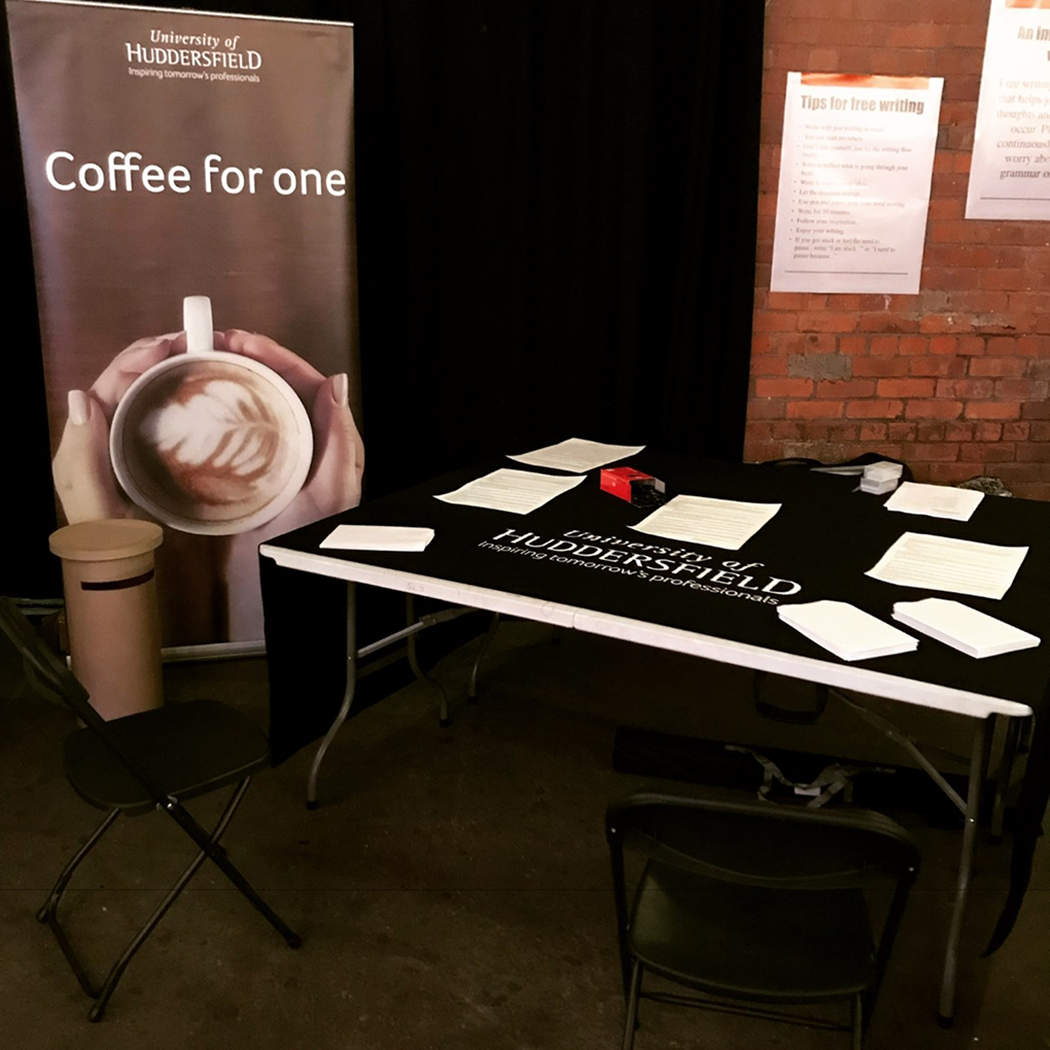
The research space at the coffee festival.
Participants were asked to produce written narratives (Gilboa and Vilnai-Yavetz, 2013) to provide in-depth explanations of experiences that might not otherwise be gained from interview (Kannaley et al., 2019; Tussyadiah et al., 2011). Participants exercised reflexivity, engaging in self-reflection and self-imagination, going deeper into their motives for consumption and writing. While the researchers were unable to probe specific points or seek clarification of explanations, the production of a written narrative is a lone participant experience – mirroring the lone consumption experience. Writing enables self-expression ‘to self’, in contrast to interviews that elicit performance and outward expressions ‘of self’ (Langer, 2016).
The participants were asked to produce ‘freewriting’ narratives (Elbow, 1999; 2000; Issues in Writing, 2008). Freewriting is widely used in education as a means of initiating written work; the writer focuses on getting words out by writing continuously within a time limit (Elbow, 2000). We applied two freewriting principles; firstly, that the participant strives to write without stopping for a specified time period (10 minutes) and, secondly, they withhold from self-editing. These instructions were displayed and identified by the researchers in obtaining consent. We consider this a novel application of freewriting. In order to secure response, the writing process must feel accessible (Issues in Writing, 2008) and assurances are given that voice and intent of the author can be discerned from un-polished writing. Each participant is introduced to the principles of freewriting and provided with writing materials and table space in order to engage with the process, alone. Each sheet of paper was headed with the prompt ‘now you have your coffee please write about how you feel…’, thereby guiding reflection to the self. The researchers did respond to requests for assistance or offer assurances, if required. In most instances, queries reflect a lack of familiarity with freewriting; in each case, the researchers gently encourage commitment to the freewriting process and refer to the instructions (displayed in the writing area), stressing that there is no expectation or judgement of what is appropriate. A benefit of freewriting is that the participant exercises freedom in what they write about and how; this freedom may be unexpected as writing is often performed with an audience in mind. However, it is acknowledged that in giving informed consent, participants are undertaking bounded reflection, aware that their writing is not entirely private (Elbow, 1999). Our approach is closer to combining ‘focused’ and ‘public’ freewriting (Elbow, 2000: 86). ‘Focus’ comes from the association with coffee, and ‘public’ reflects the participants’ agreement for researchers to analyse data.
When participants could no longer generate writing (or 10 minutes is reached), the narrative was sealed in an envelope and placed in a post box. A total of 54 responses were generated by self-identified lone consumers from three festivals. In additional to this, a very small number of submissions were discarded due to illegible writing, there being no written response or if a consent form had not been completed. While the narratives are not polished, they can be understood and offer a thematically rich resource for data analysis. The two researchers produced their first sweep allocation of data independently, taking an iterative hermeneutic approach (Arnold and Fischer, 1994). Broad categories relating to spatial, symbolic and social aspects of servicescape provided initial codes, with the expectation that there is crossover, specifically with reference to ‘self’ in the narration of the experience. Sub themes were identified independently by researchers and then discussed and interpreted until agreement was achieved. Given the flowing narrative data, we explored how the lone self is referenced and interrelates to the different aspects of servicescape.
Limitations of the methodological approach
This novel application of freewriting raises issues in data collection and analysis. Freewriting challenges conventions of what is ‘good writing’ and for this reason non-response can arise. While freewriting is accessible, it is also unconventional and potentially alien to the participant. Moreover, we note the research design brings the performance of private writing into a public space, and this may evoke feelings of self-consciousness. These issues are recorded in thick descriptions and help to inform the potential for freewriting in a research context.
In terms of analysis, we acknowledge the challenge of dissecting flowing narrative for the purpose of eliciting themes. Specifically, we note the poetic nature of the accounts and, for some respondents, the reflexivity that arises from written self-reflection (Beckett and Nayak, 2008; Hobbs, 2007). The subsequent desire to take the discussion towards self-questioning and the imagined self may extend beyond the intent of the research and this has implications for the categorisation and utilisation of data. Equally, freewriting embraces a mixture of reflection in real time and reference to memories of prior experiences. We acknowledge that these shifts in time are a product of the data collection instrument; however, we note that written narratives are sufficient to construct a conceptualisation of the lone experience. We are also clearer about the contributions and caveats of using freewriting, which is relatively untested in consumer research. In summary, we note the positive outcomes in terms of rich data and a technique that has appeal to this consumer community.
Finally, we recognise researcher reflexivity in terms of data analysis, that rich and varied qualitative data gives rise to betweenness (Cunliffe, 2003), notable space for interpretation, influenced by the researchers’ respective knowledge of the context and prior lone consumption experiences. This created a pattern of iteration and discussion in interpreting and categorising data. While this is not a limitation per se, we note the importance of taking time for consultation between researchers in making sense of data.
Findings
Given the narrative and highly personal nature of the data, the analysis is presented in word and form, including the grammar and spelling used. Findings draw on verbatim quotes to demonstrate key themes and to illustrate how the participant narrates the lone consumption experience. The subsections are informed by the general servicescape categories of physical, symbolic and social. Findings discuss and extend these categories in order to inform a conceptualisation of the lone consumer servicescape.
The physical servicescape: Acknowledging space and place
The construction of space, it’s spatial, material and aesthetic arrangements, can signal indicators of belonging to the lone consumer collective; such constructions attract the lone consumer, creating a sense of place and are thus integral components to the consumption experience (Broadway and Engelhardt, 2019; Manzo, 2014). Our analysis suggests that lone consumers, in this context, seek a space where they can have a specific type of experience; indicators of belonging for the lone consumer can be attributed to the physical attributes of the servicescape, recognised by this consumer collective. There are specific physical aspects which should be in place in order to feel a belonging to the space, and thus the ability to have a pleasant lone consumer experience. [As a lone consumer] My choice of location is, or should I say, my choice of destinations is limited. Great tasting coffee, an inspirational physical environment, friendly workers are all factors. (Participant 40) Sometimes I compromise quality in exchange for a pleasant environment – brick walls, classical music. (40) Sometimes I sit at an old mill in xxx, in a courtyard with a glass roof. It has a high ceiling…Metal beams and trees fill the area. With as much physical light as is possible indoors. A great space. And a great coffee for one environment. (40) I like sitting in cosy coffee shop decorated in warm colours and with low lighting. The actual coffee drinking is only part of the experience. (16a) I like seats that are on highchairs next to the window so I can look around and allow my mind to rest, to disconnect. (10) The seat is important – I like the window especially a stool and ‘shelf’ table facing out…I’m reminded of Tom’s Diner by Suzanne Vega – “I am looking out the window at somebody looking in.” I see people, imagine their lives, see cars and life pass by. All those lives not touching and untouched by mine. (56)
Symbolic discourse: Acknowledging associations between self and speciality coffee
Symbolic discourse and its associated myths, rituals, vocabulary and hierarchy are recognised fundamental aspects of consumption collectives (Cova and Dalli, 2009) in the sense that they indicate belonging; they enable the capacity for interaction, association and assimilation. The freewriting accounts displayed a shared discourse in relation to speciality coffee, demonstrating a symbolic interconnectivity within this consumer collective. Part of the ritual associated with coffee making is in the distinct sounds associated with grinding coffee, tamping, brewing and heating milk, while the general atmosphere expected in third wave coffee shops is also conducive to the experience. Soundscape (Kerrigan et al., 2014; Patterson and Larsson, 2019) is also considered both in terms of preference and the impact of sounds in term of the customer experience. I’m alone and I want to not have to sit down and listen to the screaming of the milk…I look for atmosphere where there is chilling music, but only faint, too loud and it takes away from the taste of my coffee. (7) I feel like the role of the environment of a good coffee shop contributes to this sense of reflection too. The atmosphere and sounds at a coffee (shop)…therapeutic and make drinking a coffee alone an even more reflective and relaxing experience. (41)
I like to hear some background noise, the murmur can actually sometimes make it easier to think or focus. (38A) I feel as if I might burn out of if I do not soon take some time to engage in self-care. Coffee produces a lovely ritual for this…as the small steps and known tastes to produce that lovely cup of ambrosia are grounded and familiar, an overall soothing experience much in the same way I imagine a Japanese tea ceremony to be. (14) Looking at the surface of the coffee in the china cup, smooth reflections, tiny bubbles along one edge. Steam rises. I inhale, the smell is arguably better even that the taste. The first sip is always the best. After the first draught I pause because I’m not just buying coffee, I’m buying time, space, sometimes wifi. I check my phone. 10 mins until my next appointment. (32) …a coffee made well allows a commonality born from shared passion and enthusiasm that, at times, hints a community but not one born from an authenticity. To an extent, in speciality coffee there is a seeking of authenticity which is forever unrequited and that sense of discovery. To find the authentic thing, drives the curiosity that provokes individuals to seek it out. (13)
Social and parasocial interaction: Acknowledging self in relation to others
Despite being alone in this context, the lone consumer experience is influenced by how other customers use the space to enhance their own experience (Hanks and Line, 2018; Rosenbaum and Massiah, 2011; Shaker and Rath, 2019). The proximity of other people, and their conversations were identified as providing comfort and distraction, also enabling the lone consumer to achieve focus, thus the physical servicescape enables and influences the dynamic of the social servicescape and the connectivity between lone and non-lone consumers. There is an emerging sense of being ‘together – alone’ through sensing and acknowledging the proximity of others. They want to feel belonging to the environment and this is achieved in part through the presence of others. In terms of experience – I’m looking for somewhere I can feel part of the shop. So, tables slightly spread out are nice, or large sharing tables. (14) I generally have my notebook to write thoughts coming to my mind. It is a really important time to reconnect to myself and my body, without being totally alone. The life around me actually allow me to focus better. I like feeling activities, talks, laughs, around me. People meeting, walking. It is very relaxing. (10) I generally like to have a corner or feel like I’m not in the way of other customers moving around the shop and also like to talk to the staff/other customers on occasion. (38B) I’m looking around at who else is in the café. Are there any others like me? What are they thinking? Are they looking around at others too? (31) …I’m looking at the other people and tuning into their conversations. Older people from different walks of life. Are they getting the same out of this as me? I look for things I might have in common with others. (31) I find a comfort in sitting alone with my thoughts, picking a seat, getting comfy. Sometimes coffee shops are places where I find silence with my thoughts and don’t feel any pressure to act for anybody or involve myself in a conversation that doesn’t interest me. (48) I use it as a space to reflect, plan, let my head free-wheel, process past thoughts and feelings. I also use it as a space to be energised and look forward – to reassess my priorities, set small goals. (20) I’m not sitting as part of a corporate image. I don’t blend in. I like to dress a little quirky and I like to be in places that reflect my own style and who I am. I take a good look around. I am with others like me. We’ve searched for places where we feel we fit. Others alone too, perhaps have a phone or a laptop, reading a newspaper or a book. And then there are perhaps those like me with a notebook and pen or the daydreamers. We are happy to smile at one another. We don’t need to chat to engage. We are happy on our own with a coffee. I am amongst my tribe. (62)
Discussion
From the novel application of freewriting in relation to the speciality coffee context, the lone consumer collective identified in this article enjoys being alone yet finds a sense of belonging in this particular servicescape. Several elements work together to construct the lone consumer servicescape, resulting in a complex interplay which enables a comforting albeit fleeting experience for the lone consumer collective. The sense of belonging is achieved through specific aspects of servicescape, such as the physical space, a shared and common discourse around speciality coffee and ultimately a desire to pause, reflect and unwind, all within an environment which welcomes a ‘loneness’ while paradoxically enabling connection. It is the inanimate and intangible which bond, a common and shared discourse and a desire to be alone.
This research recognises a form of consumer grouping which, despite being characterised by its lone context, is inherently bonded by its member’s interaction with space and the resulting consumption experience. Prior studies have identified the presence of lone customers (Broadway and Engelhardt, 2019; Broadway et al., 2018) and the pleasure of being alone in coffee shops (Shaker and Rath, 2019). This study addresses how this might be acknowledged and pursued through lone consumption. We note the nuanced importance of ambience and the subtle contribution of proximate people; we suggest that lone consumers are ‘lone not lonely’, acknowledging a sense of belonging, achieved through components of servicescape, that may not be demonstrated in outward expression and social behaviours, but known to the consumer through self-reflection.
This research identifies and explores a subculture of consumption – that of the lone consumer which in itself forms a distinct consumer collective. This collective is bonded by several things; behaviours, attitudes, knowledge and values, all reflected in the collective’s association with lone consumption of speciality coffee. Knowledge accumulation also extends to an interest in knowing self and self-awareness, through attentiveness to moods and emotions that occur from the experience. This collective is perhaps born in response to the stigmatisation of being ‘lone’ (Lai et al., 2015) but is pursuant of intended positive emotional experiences through the consumption of physical, symbolic and social aspects of servicescape. The nature of the bond is intangible (Cova et al., 2007) and intersubjective; through the consumption of servicescape, lone consumers develop subcultural elements, or shared appreciation of time and the invisible thread of self-reflection, which helps to sustain the temporary grouping through recognition of belonging.
The behavioural patterns detected in this research are neither hedonistic nor even explicitly pleasure seeking but essentially provides a mundane escapism. Pleasure and arousal are evident (Walsh et al., 2011) but so too are emotions related to calm and relaxation. There is a sense of shared identity and intersubjective expression; knowing is influenced and supported by the shared interpretation of physical, symbolic and parasocial servicescape. The group enjoys a silent intersubjectivity in what they get from this transient consumption experience; collective behaviours are underpinned by a shared experience of reality (Cova and Pace, 2006; Goulding et al., 2013; Mamali et al., 2018). ‘Coffee for One’ creates the opportunity for self-directed reflection that can create desired emotional states. Without the role of self-reflection, this experience may be compromised.
Conclusion
This research identifies and conceptualises the lone consumer as a contemporary self-elected consumer group, with their own set of characteristics and requirements. It extends understanding of lone consumer behaviour through the consumption of servicescape, indicating that this experience is mediated by self-awareness and the lone consumer’s emotions. The use of freewriting enabled deep and broad self-reflection; the participant had the freedom to explore any aspects of the lone experience. In doing so, we were able to learn of unobservable aspects of the lone consumption experience relating to intentions, decisions, evaluations and emotions. Through written reflection both researcher and participant gain a sense of self awareness and how this knowledge of self then mediates the experience.
Findings suggests that the lone consumer servicescape enables, encourages and enhances the experience. Known aspects of the servicescape can help neutralise a potentially awkward experience, reflecting a connoisseurship that extends to understanding emotions and intentions, thus elevating the experience beyond product consumption to incorporate the utilisation of space and the creation of place. Therefore, places of lone consumption are enabled by third wave coffee shops but orchestrated by the reflections and actions of the lone consumer.
By incorporating the perspective of servicescape through the concept of place, determined at the level of the individual consumer, we show how a specific consumer collective evaluates their situation and directs their experiences within a consumption environment. The context also reveals that the third wave coffee shop, speciality coffee, the barista, consumers and the lone consumer are all integral to the reflective process and outcomes. The consumer behaviour stimulated by this servicescape extends beyond mere customer satisfaction in terms of product and environment to a sense of self-contentment, wholeness and balance in places of meaning. The consumer is ‘active’ in this process, mediating a potentially awkward and unpleasant consumption experience through self-awareness and self-reflection, perhaps learned and perfected through a process of ‘self-connoisseurship’. This process is illustrated in Figure 2, which demonstrates the interplay between the various aspects of lone consumer servicescape and the resulting experience for the consumer.
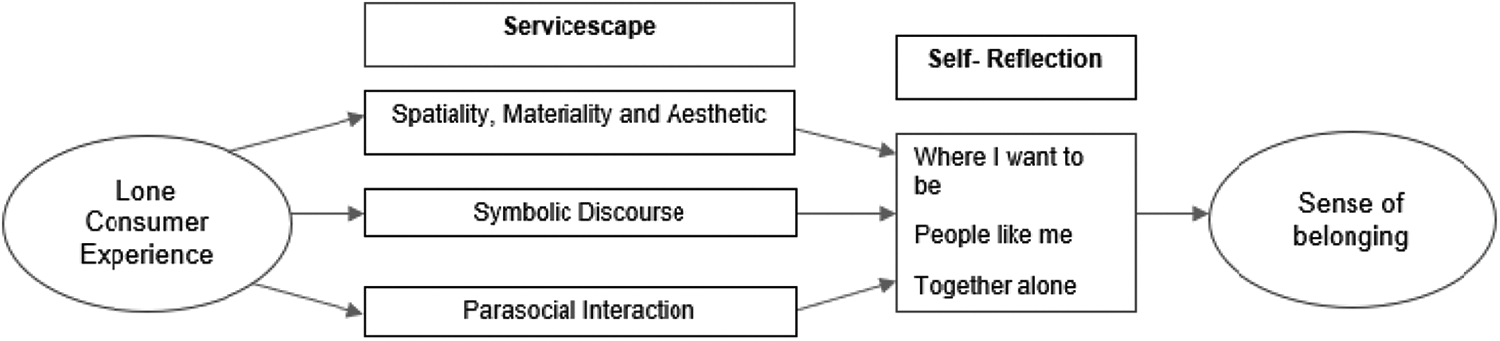
Conceptualising the lone consumer servicescape.
Reflecting on the contribution of this study, we note that lone consumption can be an intended practice, actively sought by consumers. It can be emotional, pleasurable and dynamic, depending on the self-reflective tendencies of the consumer. The lone consumption experience draws on and contributes to the servicescape, and we propose the lone consumer integral to this, in terms of self-location and building symbolic and social connections, in order to create a sense of belonging and a sense of ‘their place’. This belonging is nuanced and if not outwardly articulated or expressed is within the mind and imagination of the lone consumer. Their knowledge accumulation extends to knowledge formation, that the lone consumer formulates what they belong to and how this is constructed through their consumption experiences.
In terms of research approach, we gain new understanding of how freewriting captures the dynamics and thematic richness of lone consumption. We note the strong commitment and enjoyment gained from the writing experience (Elbow, 1999; 2000), as expressed by participants within their narratives. The participant may gain a sense of mastery or creative freedom in becoming their own audience, directing how they write and what they write about. In this sense, the act of being a research participant can be an emotive and emancipatory experience (Vickers, 2002); the narrative generated takes the researcher to where the participant wants to go in exploring the lone consumption experience.
We propose further research into the dynamics of the lone consumption experience, with greater attention given to identified emotional states over the duration of the experience. We also note that third wave coffee shops are recognised as third places (Oldenburg, 2009) and spaces for connectivity, offering a clear product/service proposition (based on a distinct set of values and associated business models). Does lone consumption manifest differently in other public consumption spaces? Given the recent impact of Covid-19 on the UK hospitality industries, there are further questions concerning the wider preference for lone consumption from both consumer and producer perspectives, and as a result, the impact on the sustainability of small service businesses (Romei and Strauss, 2021). During 2020, hospitality consumption has been altered by social distancing, the requirement of a substantive food offering, venue ventilation and limitations on mixing between households and social bubbles; all having a combined effect of altering physical and social aspects of servicescape. Businesses may well need to extend into adjacent outdoor spaces or increase take away provision. Lone consumption may be seen more as a requirement, from the business perspective, as well as a consumer preference that has been developed in pre-Covid-19 times. Finally, we note freewriting is empathetic to lone consumption and we propose this method for studies that seek to explore lone consumption experiences, across sectors and geographies.
Footnotes
Declaration of conflicting interests
The author(s) declared no potential conflicts of interest with respect to the research, authorship, and/or publication of this article.
Funding
The author(s) disclosed receipt of the following financial support for the research, authorship, and/or publication of this article: This work was supported by the Huddersfield Business School Research Fund.
