




Abstract
We argue for a more expansive conceptualization of the past’s relevance in, and for, marketing. Such a differentiated approach to the past is pregnant with possibilities in terms of advancing scholarship apropos temporal agency in marketing along with consumption practices. Symptomatic of this perspective is the increased mindfulness of the rich palate of past-related concepts. Significantly, the corporate heritage notion – because of its omnitemporal nature – represents a distinct and meaningful vector on the past by coalescing the past, present and future into a new type of temporality. As such, the authors reason this expansive conceptualization of ‘the past-in-marketing’ is both timely and efficacious. While sensitive of the importance of the historical method in marketing and the history of marketing scholarship and practice per se, this broader marketing approach to and of the past highlights the ideational and material manifestations of the past-in-the-present and an envisaged past-in-the-future.
Keywords
Introduction
‘The past is a foreign country: they do things differently there,’ (Hartley, 2004: 5). Taken from the celebrated opening lines of the novel, ‘The Go Between’, this quote exemplifies the traditional marketing approach to the past as ‘a foreign country’ (Tadajewski and Saren, 2008).
In this article, we argue the past in marketing should be reappraised; its central role in marketing theory and practice affirmed; and an appreciably broader, and more nuanced, phlegmatic perspective adopted. Our article continues by discussing marketing’s customary, and often uneasy, relationship with the past; details the diverse interpretations of the past in marketing; considers key past-related foundational concepts; and examines why growing attention is being accorded to corporate heritage as a new temporal concept within marketing.
The corporate heritage notion – because of its omnitemporal nature – represents a distinct and meaningful vector on the past by coalescing and transcending the past, present and prospective future (Balmer, 2011). As such, it connotes, and arguably denotes, a new and highly meaningful type of temporality.
By means of context, the centrality of the past – and its significance for the present and future – has exercised philosophical thought since antiquity (Augustine, 1961). It includes, for example, the deliberations of the Presocratic scholars such as Heraclitus, Parmenides and Zeno (Fraser, 1990; Kenny, 2000; Prigogine, 2003). It has also engaged the scholarship of academics in more recent times (Ankersmit, 2012; Hobsbawm and Ranger, 1983; Koselleck, 1989, 2010; Lowenthal, 1985, 1998, 2015; Ricoeur, 1990, 2006; White, 2010, 2014 [1973]; Zerubavel, 2004).
Within this broad canon, the importance of the past (and temporality) to human existence, and what it is to be human, is frequently emphasized. In an analogous fashion, marketing is also concerned with much of the same apropos human nature; albeit in a more instrumental and less foundational way. Given the above, therefore, the rationale for the past – and temporality – to be accorded greater importance within marketing would appear to be irrefutable.
Traditionally, marketing theory and practice exhibits a great deal of temporal myopia – and occasionally – ambivalence towards the past (Tadajewski and Saren, 2008). Habitually, most marketers abstain from making explicit references to the past in serious, sophisticated or substantiated ways. As such, marketing’s customary stance can often seem ahistorical and habitually displays considerable insouciance concerning the ‘historic turn’ which has informed recent debates in organization studies and other business disciplines (Clark and Rowlinson, 2004; Wadhwani and Bucheli, 2013). However, this is far from saying that marketing is atemporal; this is because a good deal of conventional marketing thought and practice privilege the time frames of the present and future while often exhibiting insolence towards the past.
From the outset, we note there can be multiple interpretations, representations and manifestations of the past by organizations, customers, stakeholders and scholars. Scrutinized via a marketing lens, the past can be the consequence of erstwhile marketing practices and can be socially constructed in the present. For us, the past is a heterogeneous notion and possesses varied genres and forms of manifestation. Organizations, customers and other stakeholders may actively appropriate the past in the present for some current or future-orientated concern or purpose.
However, we observe that while the past can be valuable it can also be malleable and exploitable by organizations. While a corporate past can be authenticated, it can, to a lesser or greater degree, also be fabricated, insinuated, simulated or augmented (or, indeed a combination of these).
For some institutions their past can be a valuable corporate and consumer resource which has veracity, vibrancy and vigour. Consequently, corporations frequently strive to uncover, or rediscover, a positive organizational provenance. This explains why many firms routinely commemorate, and celebrate, their past: corporate anniversaries, published company histories, organizational timelines and dates of incorporation and so on are instances in point. However, an undue institutional focus on the past, the phenomenon of ‘the dead hand of the past’, can, occasionally, be oppressive: potentially it can confer corporate toxicity, lethargy and impotency.
At a strategic level, a firm with a perceived negative past can bequeath an entity with a burden: an institutional impediment which managers might seek to forget, or circumvent, or supplement by fabricating an invented past, yet which might still be visited on them in the long term (e.g. corporate complicity in past human rights violations). For consumers and other stakeholders, a perceived negative organizational past may seriously undermine trust and may, in extremis, cause the corporation to be despised by them.
However, there can be a degree of complexity here since organizations, inescapably, have segmented pasts. Corporate pasts are rarely conceived as uniformly good or bad, injurious or beneficial, relevant, irrelevant or inconsequential. Moreover, perceptions of the past may vary among different stakeholders; consumers and shareholders, for instance. Furthermore, conceptualizations of an organization’s past can metamorphose over time; sometimes because of changing mores and precepts. What becomes apparent is there can be multiple interpretations, representations and manifestations of the past by organizations, customers, stakeholders and scholars. Given the above, and for all its value, a corporate past is sometimes contested. For instance, there can be disputes regarding the perceived past in terms of whether it is good or bad, or indeed, beneficial, injurious or inconsequential.
Within the corporate heritage canon scholars have spoken about the augmentation, valorization, reinterpretation and appropriation of the past. As such, the augmentation of the past can relate to the multitude of identity roles in the present which both substantively and/or symbolically links the past, present and future (Balmer, 2013). The valorization of the past relates to the selective investment of value in the past by organizations; by so doing the past can meaningfully have institutional value for the present and assumed worth for an entity in the prospective future. The reinterpretation of the past details the symbolic relevance of the past vis-à-vis an organization, product or service that is temporally extended and given a new/expanded meaning in the present and future which is different from the past or history per se (Balmer, 2011; Balmer and Burghausen, 2015a; Burghausen and Balmer, 2014a; Urde et al., 2007). Finally, the appropriation of the past equates to the active acceptance by managers, consumers and/or other stakeholders of the past being concurrently an inheritance in the present and a bequest to the future which affords opportunities and responsibilities (Balmer 2011, 2013; Burghausen and Balmer, 2014b, 2015).
What is manifest from the above is the past is too important to ignore. Hence, this article adds voice to the significance of the past in, and for, marketing (as a discipline and as a practice). It also adds weight to the growing chorus of execration in marketing vis-à-vis marketing’s habitual amnesia and ambivalence towards the past (e.g. Brown et al., 2001; Patterson et al., 2008; Tadajewski and Jones, 2016; Tadajewski and Saren, 2008; Wooliscroft, 2008, 2011). As noted by Mark Tadajewski (2006, 2008, 2014), marketing theory and practice is not only highly politicized and contextual but, significantly, can be temporally situated too.
Locating the past in the present: Beyond history and method
Considering the above, one significant, albeit tangential, constituent of contemporary marketing scholarship asserts the efficacy, and moreover indispensability, of the past. Significantly, the efficacy of ‘the historical method’ per se (Brown et al., 2001; Fullerton, 2011; Witkowski and Jones, 2006) is highlighted and the value of comprehending the history of marketing thought and practice is stressed (Tadajewski and Jones, 2014, 2016; Jones and Tadajewski, 2016). Within this perspective, temporal and historical lenses are de rigour in the exposition and comprehension of marketing – and marketing phenomena – in theoretical, empirical and instrumental terms. Importantly, a distinction can be made between the hegemonic perspective derived from history as a discipline and method (i.e. the ‘past-of-marketing’ perspective) and the wider standpoint advocated here focused on the past in the present per se (i.e. the ‘past-in-marketing’ perspective).
Thus, what we contend is the past’s relevance for marketing stretches beyond the lens of history and beyond the history of marketing thought and practice. For us, the past has substantive and symbolic relevance for the present and prospective future. Consequently, this broader, more panoptic, perspective of the past is pregnant with possibilities in terms of advancing scholarship apropos the temporal agency of marketing per se and, more especially, in further illuminating consumption practices as temporal phenomena too.
Elaborating the above point, key marketing concepts – and consumption practices – compel scholars to (implicitly) consider the past in the present: the corporate brand, corporate reputation and vintage consumption concepts are cases in point. Moreover, the past can invest marketing (at the product, services and corporate levels) with strategic benefits and capabilities (but may also constitute strategic obstacles and liabilities). For consumers, the past can be seen to burnish the patina of an organization’s offerings and can provide consumers, and other key stakeholders, with both identification and meaning (as well as emotional well-being).
More specifically, the exponential rise of past-related marketing constructs and interest in such phenomena indicates the past’s instrumental, symbolic and psychological significance as evidenced by scholarship elucidating the nomenclature of the past (Balmer, 2013; Burghausen and Balmer, 2014a). Conspicuous exemplars of the exponential growth in this area are represented by scholarly interest in consumer nostalgia (Hamilton and Wagner, 2014; Holbrook and Schindler, 2003; Merchant and Rose, 2013; Muehling and Sprott, 2004); corporate heritage brands/identities (Balmer, 2011; Urde et al., 2007); cultural heritage marketing and consumption (Goulding, 2000; McDonald, 2011); history marketing (Herbrand and Röhrig, 2006; Kühberger and Pudlat, 2012; Schug, 2003); and retro branding/marketing (Brown, 1999; Brown et al., 2003).
However, there is a paradox in the above. While marketing practice seems to embrace ‘yestermania’ as Stephen Brown (2013) puts it, mainstream marketing academia by and large seems to ignore the conceptual and instrumental implications of the past’s significance, and omnipresence, in marketing and consumption (and in popular culture per se; see de Groot, 2009).
Constituting the past in the present: Towards temporal agency
While acknowledging there can be a multiplicity of marketing standpoints concerning the past six perspectives can be discerned (see Figure 1):
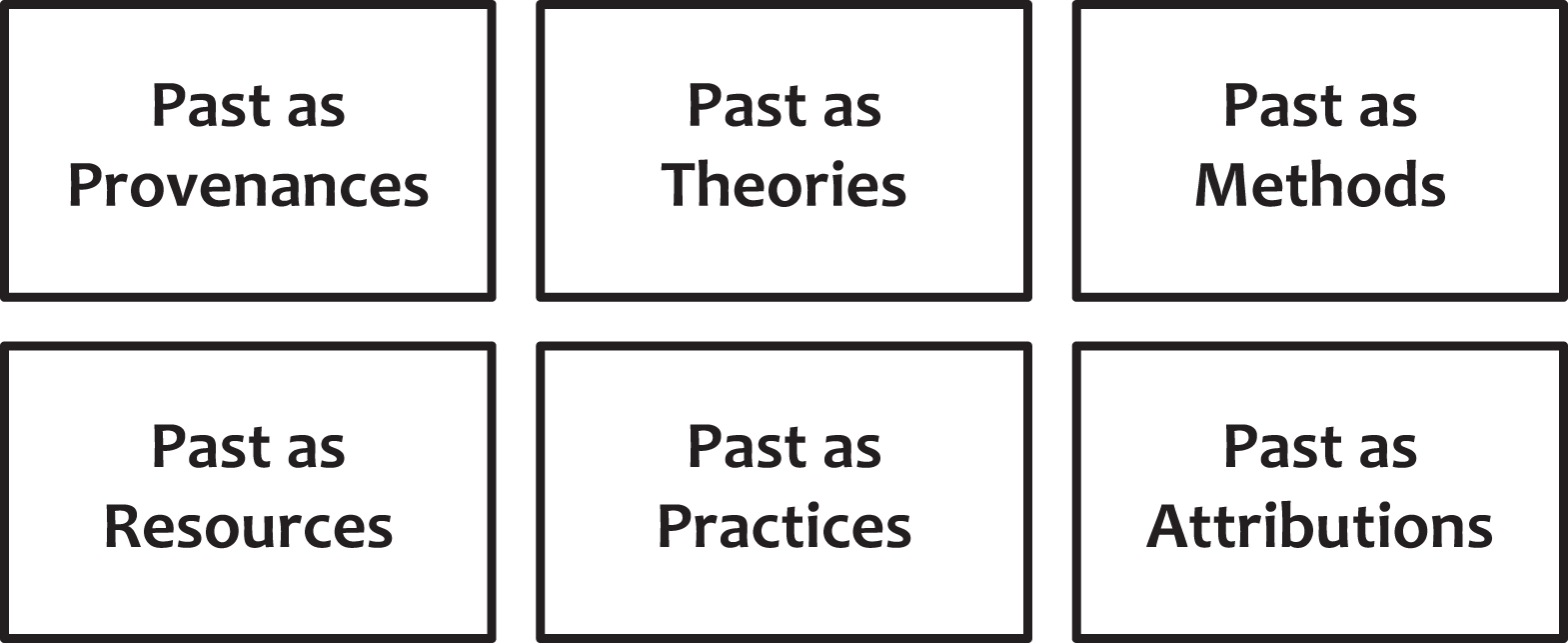
Six marketing perspectives on the past.
Significantly, many of the above perspectives coalesce. This is because the relevance of some aspect of the above for marketing is dependent on the specific socio-historic conditions/socio-cultural milieu at a specific point in time.
Also, the past is actively utilized and interpreted for specific contemporary purposes which meet both consumer and organizational requisites. Similarly, the history of marketing thought, and the relevance of past theories for instance, at a point in time can be temporally contingent, and may be predicated on scholarly, ideological and practical priorities in marketing at a given point in time.
In other words, marketers (as academics and practitioners), consumers and other stakeholders, deliberately or inadvertently, exercise temporal agency actively constituting the past in the present through marketing and consumption.
Multiplying the purpose of the past in the present: Towards temporal multiplicity
Clearly, the past in marketing not only has breadth and depth but also complexity. This is especially the case in epistemological and teleological terms. As such, the past can variously be characterized as serving different purposes in the present such as: Authentication: probing the veracity of the past Documentation: archiving/systematizing the remnants of the past Interpretation: understanding (the relevance of) the past Narration: disseminating (a version of) the past Manifestation: performing/(re)enacting the past (e.g. commemoration) Valorization: ratifying/ennobling the past Identification: defining the individual, collective or institutional ‘self’ vis-à-vis the past Contestation: addressing the inequities and injuries of the past
This multitude of purposes implies temporal multiplicity and puts into question a unified version and singular utility of the past in marketing. It also provides opportunities for a more nuanced and differentiated perspective vis-à-vis marketing and consumption as temporal phenomena per se.
Differentiating the past in the present: Towards temporal differentiation
One characteristic of the potential richness of the ‘past-in-marketing’ perspective is the emerging repertoire of different past-related marketing concepts (see Balmer, 2013; Burghausen and Balmer, 2014a for a more detailed exposition). In scrutinizing the taxonomy of past-related marketing concepts, they can be categorized in terms of their respective foci/functions as: (a) foundational, (b) instrumental and (c) performative concepts.
Foundational past-related marketing concepts (heritage, memory, history, tradition, nostalgia, etc.) provide the theoretical bedrock for instrumental and performative marketing categories and phenomena (see Figure 2). These concepts illustrate the manifold ways in which the past in marketing can be meaningfully comprehended. While informed by scholarship in the social sciences and humanities, these underpinning concepts invariably require adaptation, so they have a scholarly and or practical utility within marketing. In other words, there is a requisite for them to be marketing specific. To date, marketing theory has drawn on and adapted theoretical and scholarly insights from diverse disciplines, so they have a utility for theoretical and practical applications within marketing and in accordance with underlying marketing philosophical precepts.
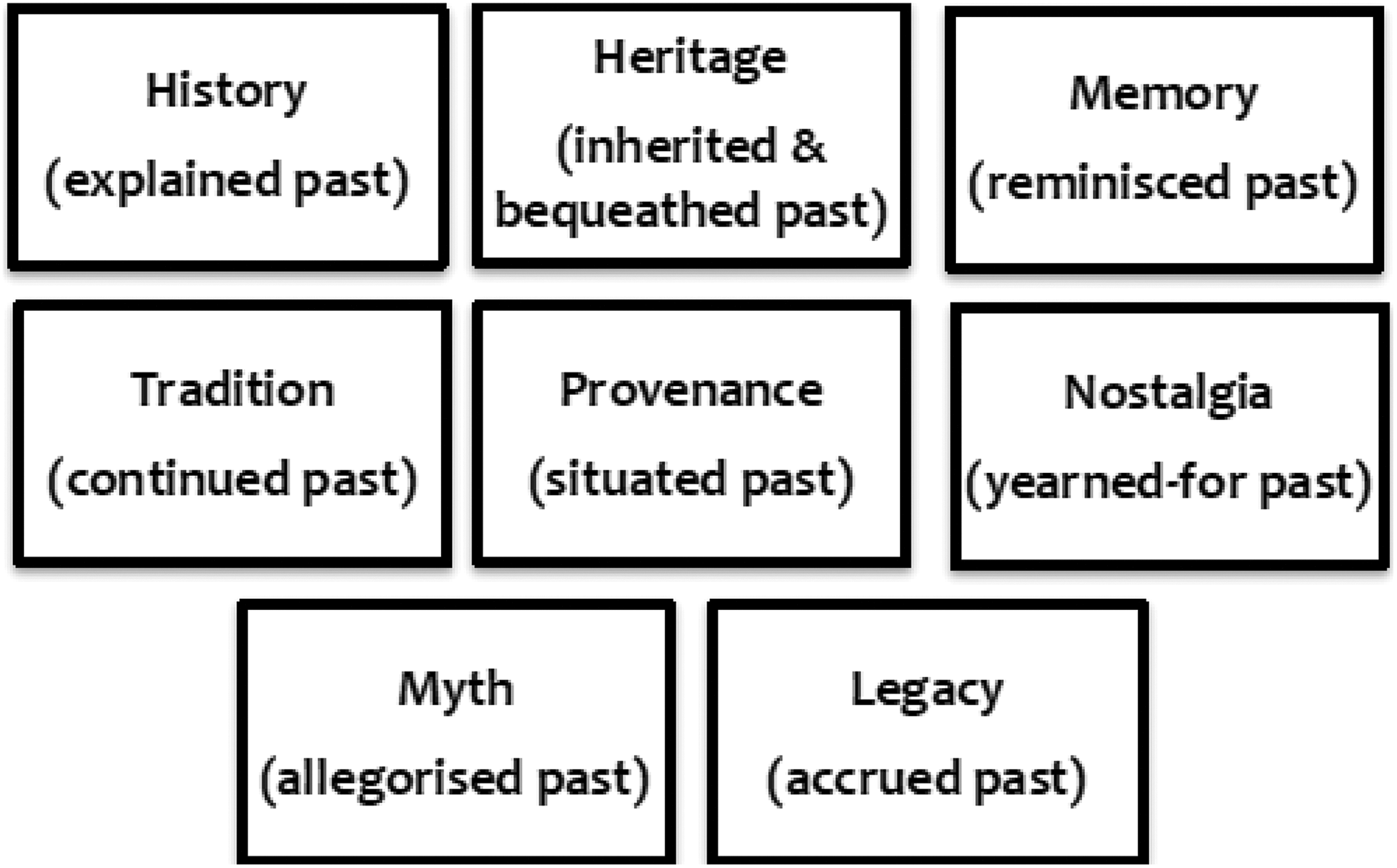
Foundational marketing concepts of the past.
Instrumental past-related marketing concepts (corporate heritage brands, heritage brands, retro branding, cultural heritage/museum marketing, corporate history marketing, nostalgic advertising, etc.) are primarily focused on marketing management actions and strategies which are past-related and can focus on, inter alia, the identities and brands of an organization itself as well as its services and products. In other words, these instrumental concepts are marketing-specific conceptualizations of past-related managerial marketing activities that serve organizational purposes (commercial, communal, social, public, etc.).
Performative past-related marketing concepts (cultural heritage/museum visiting, organizational heritage identification, vintage consumption, memorabilia and antiques collecting, etc.) relate to consumer/stakeholder engagements and practices which have, are predicated on, a material and/or symbolic link to the past. In other words, these concepts are marketing-specific conceptualizations of past-related consumer and stakeholder behaviours/activities which have marketing relevance.
The above categorizations imply/suggest the need for a more variegated temporal differentiation of marketing-relevant conceptualizations which question the dominant monadic and undifferentiated perspective on past-related concepts such as ‘the past’ or ‘the history’ within marketing.
Transcending the past in the present: Corporate heritage
Following on from the above, corporate heritage as a recent conceptual innovation in marketing scholarship (Balmer, 2017; Balmer and Burghausen, 2015b; Balmer et al., 2006; Urde et al., 2007) is seen to be broader than history or the past per se owing to its omnitemporal character (Balmer, 2013).
Corporate heritage is distinctive because of its defining characteristics (see Balmer, 2011, 2013; Burghausen and Balmer, 2014a; Balmer et al., 2006; Urde et al., 2007). Arguably, the most significant of these include omnitemporality, intergenerational continuity and augmented role identities (Balmer, 2013).
Omnitemporality relates to the concurrence of the three time frames of past, present and future that are all constituted simultaneously. Representing a distinctive vector on the past, corporate heritage coalesces the past with the present and future in a unique way: arguably, this represents a sui generis type of temporality (one which is different from history or the past per se).
Intergenerational continuity represents the substantive and/or symbolic exchange/inheritance of corporate heritage across/between generations of stakeholders which again coalesces the past, present and future.
Finally, relative invariance/trait constancy stresses the importance of authenticity apropos corporate heritage: a bona fide corporate heritage relates to an entity where there has been temporal constancy of key organizational traits, while also acknowledging the meaning attached to the above can alter over time (Balmer, 2011, 2013).
Within the corporate heritage canon scholars have noted, inter alia, how this new type of temporality (which assimilates the time frames of the past, present and prospective future) is meaningful. This can be seen in the work on corporate image heritage (Rindell, 2017); family businesses (Blombäck and Brunninge, 2013; Brunninge, 2017); strategic brand revival (Cooper et al., 2015; Hudson, 2011; Miller et al., 2017; Santos et al., 2016); consumer behaviour (Balmer and Chen, 2017; Hudson and Balmer, 2013; Wiedmann et al., 2011); spatial, material and multi-modal manifestations (Bargenda, 2015; Burghausen and Balmer, 2014b; Maier and Andersen, 2017; Santos et al., 2016); and relevance beyond the commercial realm (Balmer, 2009; Urde and Greyser, 2015).
Final reflection
We have argued for a more expansive conceptualization of the past’s relevance in, and for, marketing. This perspective fully recognizes the critical importance of the past-in-marketing (including the rich palate of past-related constructs), and compliments extant approaches which focus on marketing history and the historical method within marketing. Our broader marketing approach to, and of, the past highlights the ideational and material manifestations of the past-in-the-present and an envisaged past-in-the-future.
Significantly, the nascent corporate heritage notion heralds a new, distinct and meaningful vector on the past in marketing and beyond. This is because the concept coalesces the past, present and future into a new type of meaning and, arguably, a new kind of temporality. The omnitemporality aspect of corporate heritage is consequential since it can have multigenerational meaning and impact. As such, it transcends the established notion of time, history and the past. Consequently, corporate heritage is pregnant with possibilities in advancing marketing theory especially in relation to marketing/consumption practices.
Finally, we argue for the myopic perspective of the past in marketing as something anomalous and inconsequential (‘a foreign county’) to be countered with the broadened standpoint averred in this article which views the past as a meaningful and indispensable part of marketing’s hinterland.
Footnotes
Declaration of Conflicting Interests
The author(s) declared no potential conflicts of interest with respect to the research, authorship, and/or publication of this article.
Funding
The author(s) received no financial support for the research, authorship, and/or publication of this article.
