




Abstract
This article urges a reorientation in thinking about AI art (and AI more generally), shifting from the common focus on computational ‘intelligence’ to the embodied, metabolic processing that takes place in our encounters with (moving-image) artworks produced with machine-learning algorithms. Drawing on Merleau-Ponty’s corporeal phenomenology, the article argues that spectators’ bodies act as filters, distilling visual phenomena from a range of extraperceptual facets of these works; in particular, bodies react to invisible algorithmic infrastructures, which, in the case of machine learning algorithms, also operate as filters in their own right. The collision of metabolic and computational microtemporal operations calls forth a number of embodied affects, ranging from sublime awe to disorientation, cringe, and uncanny feelings of relational and environmental entanglement. These themes are explored through the work of four contemporary artists working with AI: Ian Cheng, Refik Anadol, Jon Rafman, and Yvette Granata. In conversation with these artists, the author explores our bodily responses to AI-generated imagery in an attempt to better understand the stakes, as well as the underlying mechanisms, of the new technology’s transformation of our visual culture.
Recent developments in what is colloquially known as ‘artificial intelligence’ (AI) have brought with them a great deal of utopian and dystopian speculation about the future. For some, AI promises to do everything from curing cancer to eliminating poverty and solving climate change; for others, AI threatens to outsmart its makers and usurp human agency, increasing risks of nuclear war or other extinction-level events. 1 Because of the extreme stakes associated with AI, especially when seen as a nascent ‘superintelligence’, the field of AI ethics takes center stage in deliberations over how (or even whether) to develop these new technologies. Meanwhile, critical voices increasingly challenge the ‘hype’ around AI and seek to deflate claims about its supposed intelligence, arguing that machine learning algorithms simply automate statistical correlations. Accordingly, AI reinforces correlational stereotypes around race and gender, among other things, with real-world political consequences – not in a distant future but already now. 2 Against the futurists, for whom AI changes everything, these critics see in AI merely more of the same: speculation about the future distracts from present-day inequalities, which AI underwrites and perpetuates, while to figure AI as a machinic intelligence obfuscates the agency of people – both those in power and those who are exploited in order to maintain that power.
In the context of these debates, framed in terms of the ethics and politics of AI, a turn to art and aesthetics might seem misguided – at best an interesting sideshow, at worst a massive red herring. Against this impression, I argue that AI aesthetics is essentially entangled with – even foundational to – questions of AI ethics and politics. I use the term aesthetics in both a broad and a narrow sense, encompassing the realm of sensation and perception generally (a sense implied in the ancient Greek αἴσθησις, or aesthesis) as well as the narrower realm of art and its appreciation (the modern sense of aesthetics that originates from around the time of the industrial revolution – when art and technology came to be seen in opposition to one another, in stark contrast to earlier conceptions of ars or techne). AI is changing aesthetics at both of these levels: on the one hand, generative AI technologies like DALL-E, Midjourney, Stable Diffusion, or GPT-4 are directly transforming artistic forms and practices (arguably dissolving, to a certain extent, the industrial-era wedge that was driven between art and tech); on the other hand, these same technologies are transforming the domain of sensation itself, opening up new objects of perceptual and cognitive experience, and changing the scope and parameters of embodied relation to the environment. Because these latter changes (changes in the broad field of aesthesis) pertain to a level of experience that is in many ways prior to and foundational for the domain of ethico-political deliberation, a new aesthetics is required for the age of AI. I suggest that AI aesthetics – in which the theory and practice of AI art stand in tandem with and as an indispensable lens for reflecting on the broader phenomenological impacts of AI – is therefore a necessary foundation for the field of AI ethics and the political questions discussed above. Art and aesthetics are the crux, not a distraction. 3
In this context, it is worth noting that AI’s speculative futures, and thus many of the ethical and political debates emanating from them, are underwritten by sci-fi images originating in visual media such as film and television, as well as in the new AI tools themselves. Indeed, the latter – tools like the DALL-E text-to-image generator and the images produced with it – serve as something of an emblem, if not advertisement, for the forward march of AI more generally; the refinements between successive iterations, and the great leaps forward in imaging capabilities that are touted whenever a new platform or model is introduced, provide the spectacular face of AI and its futural trajectory. It is thus no accident that vaguely science-fictional imagery is a staple of generative image production; witness, for example, the now famous horse-riding astronaut with which OpenAI announced the release of DALL-E 2 in April 2022 (see Figure 1). Serving as an illustration of the model’s superiority over its predecessor, the original DALL-E, the image itself was described as ‘a milestone on AI’s long road towards understanding’, marking nothing less than ‘a step towards more general-purpose intelligence’ (Heaven, 2022). Here the aesthetic dimension of the image is crucial to the construction of an imaginary in which AI asserts its autonomy and gets to work solving the world’s problems; in other words, the first step in getting people to believe in such a scenario is to make them feel awe in the face of the new technology – a sublime awe which the strikingly photorealistic but impossible image of a horseback astronaut among the stars was designed to provoke. ‘One way you can think about this neural network is transcendent beauty as a service’, according to OpenAI cofounder and chief scientist Ilya Sutskever. ‘Every now and then it generates something that just makes me gasp’ (quoted in Heaven, 2022). Clearly, though, such wonder can easily give way to fear, utopianism to dystopianism, if the image is truly taken as portending the advent of superhuman creative intelligence.
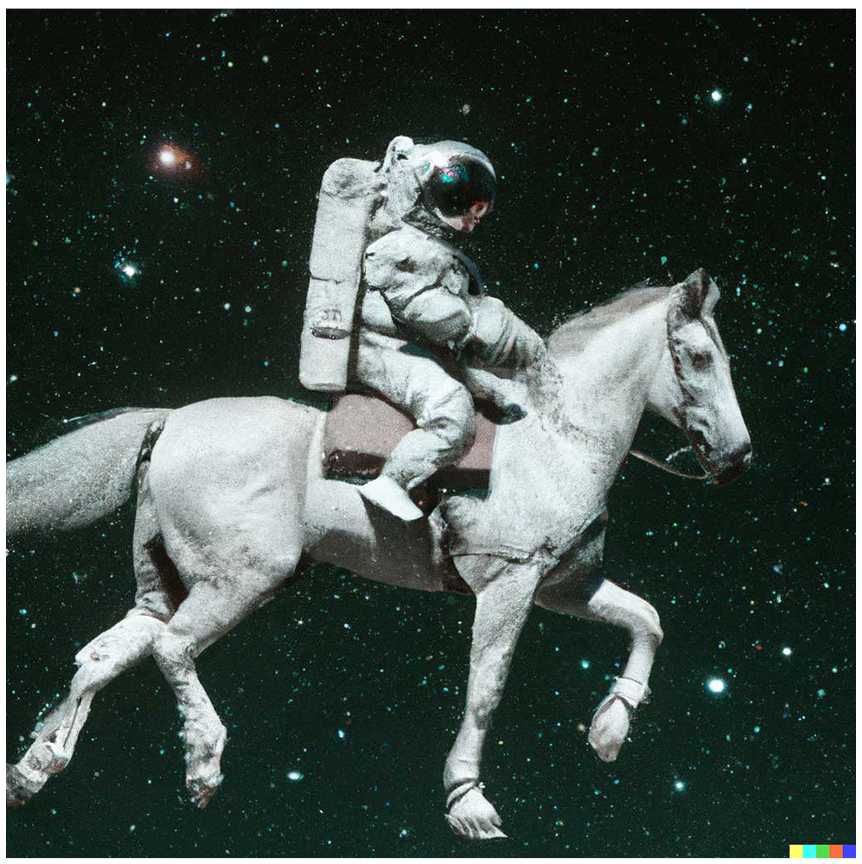
DALL-E 2 promotional image of an astronaut riding a horse in space (2022).
Suffice it to say that not everyone regards these images that way. Critics of AI hype will point out that such image generators, far from intelligent, are simply number-crunching machines, trained on millions of images that have been scraped from the internet and correlated with textual descriptions. Often the descriptions belie the biases of their human operators, thus reproducing stereotypes and social injustices of the past and present; far from creating something genuinely new, such models can at best combine elements from their training sets in a statistically probable arrangement of pixels. Hito Steyerl, who refers to the resulting images as ‘statistical renderings’, sees the rollout of these tools as ‘a great PR move by the big corporations’. That is, the companies use these tools to ‘onboard people into new technological environments’; the images are just ‘the sprinklings over the cake of technological dependency’ (see Brown, 2023).
Certainly, there is some truth in this. But I think it would be wrong to reduce the effects of AI’s vast transformation of our visual cultures to nothing more than false consciousness. Without falling prey to ideological fantasies of machinic intelligence, we can recognize a broadly aesthetic reconfiguration of agency taking place, a subtle shift in the relations between humans and machines that announces itself at the level of embodied experience. The sublime awe evoked by OpenAI – for obviously ideological and commercially motivated reasons – is first and foremost an embodied rather than a cognitive or intellectual reaction (it is ‘something that just makes me gasp’). And it is not only corporations; an artist like Refik Anadol, whose work with AI has lately garnered an astounding amount of critical attention, seems to understand well the centrality of viewers’ embodied reactions. As I detail below, Anadol’s works elicit and rework the sublime in accordance with the new relationality established between human bodies and AI’s computational processes.
But whereas OpenAI and Anadol tend to emphasize AI’s spectacular successes, the underlying algorithms are known equally (or perhaps more) for their oftentimes disastrous failures to generate convincing images. Early image-generating websites such as thispersondoesnotexist.com would often produce images of people described as ‘creepy’, evocative of the so-called ‘uncanny valley’, because of the way they combined photorealistic imagery with weird, sometimes anatomically improbable details: asymmetrical faces, misaligned or too many teeth, and other ‘defects’ that not incidentally belie the ableist assumptions that define a successfully rendered image. 4 The uncomfortable recognition, on the part of the viewers, that they are perhaps complicit in imposing such norms on the image, points to deep, seemingly ‘instinctive’ and in any case embodied sensations at work in visual perception, prior to higher-order judgment. While the tendency of today’s image generators to produce too many fingers on human hands has turned into something of a humorous meme, I suggest our tendency to laugh at these images responds to a similar bodily awareness – a preconscious feeling that something is not right, perhaps an instinctive recoil when our bodyminds project themselves tactilely into the images and register the difference, as if our mirror neurons were to reply: ‘no compute’ (see Figure 2). 5 In any case, there is a bodily discomfort, which can range from mild irritation to abjection and cringe. Later, I will turn to Jon Rafman’s recent work with AI to show how it diverts the bodily processing of the underlying algorithms and develops out of it a full-blown cringe aesthetics.
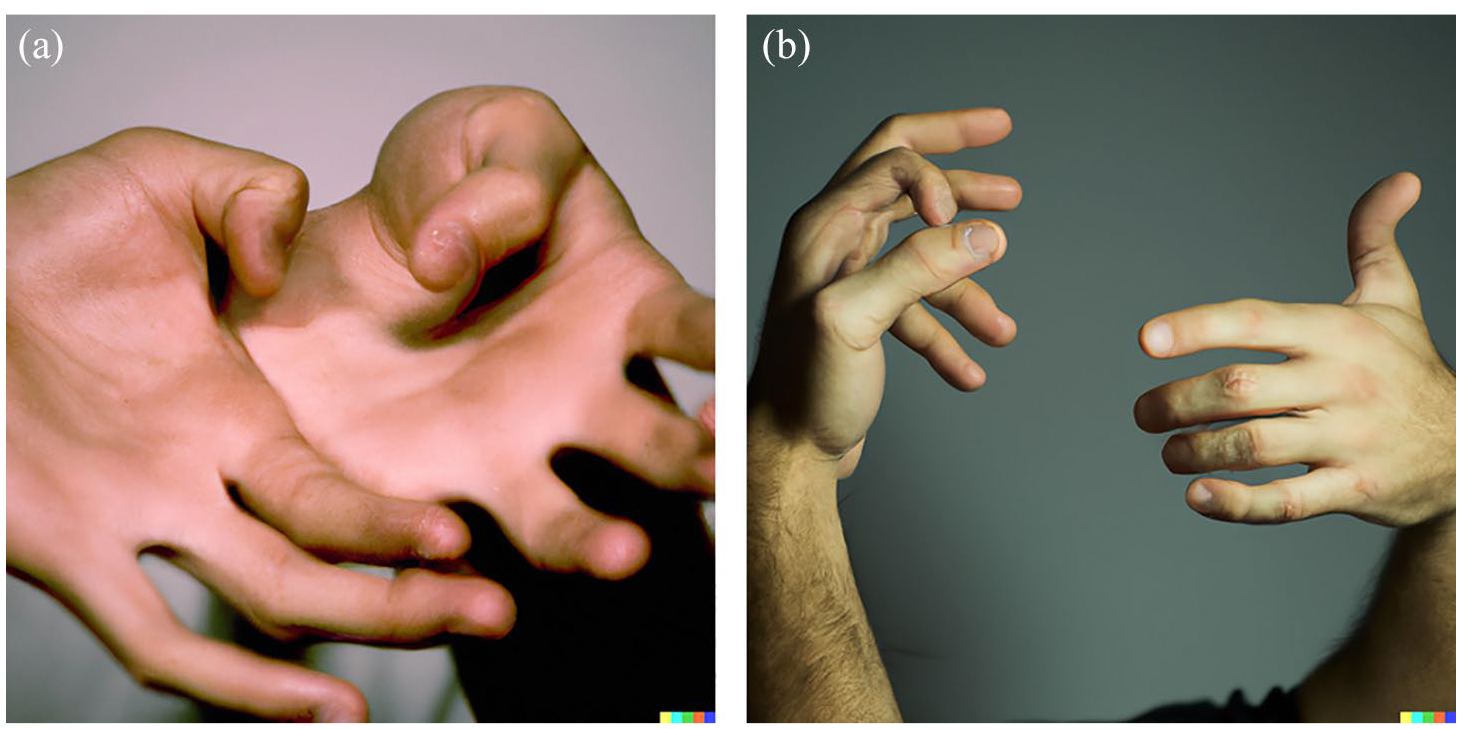
Images generated by DALL-E 2 following the author’s prompt: ‘a 35-mm picture, shot with a 50-mm lens at medium length, of a phenomenologist touching his right hand with his left hand and wondering which hand is touching and which hand is being touched’.
Sublime awe and abject cringe are just two aesthetic responses to AI’s transformation of our visual cultures, while many of our feelings and reactions to these changes remain hard to name and/or challenge established categories. AI-generated images are commonly called surreal; tellingly, DALL-E derives its name from a mashup of the robot WALL-E and the arch-Surrealist Salvador Dalí. But ‘surreal’ merely describes surface-level imagery – the strange visual phenomena (like astronauts on horseback) that AI is so good at producing, reflecting its underlying combinatory logics. Looking more closely at our encounters with those logics, however, we find bodily and conceptual disorientations that give rise to a variety of more ambiguous feelings. These disorientations are linked, I suggest, to a disconnect experienced between input/output mechanisms: AI’s black-box algorithms disrupt expected interface mechanics, or the relation between interface and infrastructure itself, as we will see in Ian Cheng’s AI-driven transformations of videogame logics and conventions. It is by tapping into such disorientation that artists like Refik Anadol can retune and refocus experiences of the sublime onto AI’s algorithmic infrastructures, which present themselves as powerful and opaque inhuman agencies (thus reorienting the sublime from the power of nature to that of artificiality in its computational form). Provoking confusions of the organic and the technical, the living and the nonliving, such perceived redistributions of power can also give rise to unsettling feelings of the uncanny; we will see this particularly in the work of Yvette Granata, who directs these feelings toward the strange environmental situations we find ourselves in today (and thereby shifts the uncanny itself from industrial to computational technics and their impacts on embodied existence). 6 Meanwhile, as we have seen, the weird or uncanny can shade into the abject, as AI’s invisible algorithms elude and unsettle subjective perception and objective capture alike, producing images with the power to shock or disgust; Jon Rafman harnesses these powers of abjection for an exploration of online life and its seemingly endless supply of cringe (thus transferring, via AI, the horrific bodily abjection described by Julia Kristeva into the low-key weirdness and horror that suffuses networked existence). 7 In conversation with these artists, I now explore our bodily responses to AI-generated imagery in an attempt to better understand the stakes, as well as the underlying mechanisms, of the new technology’s transformation of our visual culture. As we shall see, this transformation is registered in subtle modifications of aesthetic categories – such as the sublime, the uncanny, and the abject – but it is rooted deeper in our material encounters with images to which these categories respond. Coming to terms with these changes will therefore require turning from the surface of images to the infrastructures of their generation and processing – both the algorithmic operations of computers and the metabolic processes of bodies.
On the computational and metabolic infrastructures of AI images
Although works of AI art are often judged by their spectacular images, they need also to be regarded in terms of their materiality, their temporality, and their relations to embodied existence. 8 Towards this end, I suggest looking at AI art through the lens of corporeal phenomenology and the central role played by the tactile body in processing contemporary artworks that utilize machine learning algorithms to generate their images. Essentially, I contend, the viewer’s body serves as a kind of presubjective filter through which the generative/generated stimuli (often too many in number, their motion and calculation too fast or too minute for conscious perception) are strained: a filter by means of which the artworks’ extraperceptual dimensions are first felt, however indistinctly, before they are ‘reduced’ (somewhat in the sense of a culinary reduction) or ‘rendered’ (as fat is rendered) into an image-object. 9 It is these filtering processes that lead to uneasy feelings of disorientation, ecstatic feelings of reverence or awe, cringey feelings of embarrassment, or uncanny feelings of relational and environmental entwinement.
AI artworks involve ‘extraperceptual dimensions’, as I claimed above, both because they rely on invisible, complex computing to generate images and because the complexity of those images tends to exceed what viewers are able to survey or take in. If the body is a filter, it responds to and operates on both the overwhelming excess and the underlying processing. And the underlying algorithmic processing, from whence data is rendered image, is itself a kind of filtering. For example, diffusion models (such as those at work in the popular DALL-E 2, Midjourney, and Stable Diffusion image generators) filter images through layers of noise. First the model is trained to recognize the way images in a dataset decompose through incremental additions of Gaussian noise (the static-like signal noise or visual speckling that a photographer working in Photoshop might typically seek to remove from their digital images with a blur filter). Then, the model uses stochastically predictive algorithms called Markov chains to reverse the process, starting from a random noise image and denoising it by predicting a statistically likely arrangement of pixels according to a set of inputs (such as a textual prompt or an image to be upscaled, denoised, or inpainted) along with other parameters (see Croitorou et al., 2023; Sohl-Dickstein et al., 2015). As is already clear from this very cursory gloss, the generation and processing of images with machine learning involves multiple layers of filtering: inputs and outputs are filtered through a dataset that contains statistical correlations between pixel arrangements, object identifications, and textual descriptions; through recursive training processes involving the addition and subtraction of mathematically defined noise; through probabilistic operations taking place in a ‘subsymbolic’ or ‘latent’ space of variational inference; and through actual hardware devices (such as GPUs) that perform the operations. Each level of filtering conditions and constrains the output that is possible – which is to say, each level of filtering refines and restricts the range of visible image-objects that can be produced by the model. Crucially, however, none of this filtering pertains to visuality per se; all of it falls categorically outside the realm of perception.
Nevertheless, I suggest that this extraperceptual realm affects us, and affects us deeply, in our encounters with AI art. In these encounters, the viewer is implicated in a corporeal process that significantly mirrors the computational processes – that is, non- or preperceptual filtering is operative on both sides, both that of the machine and that of the human body. In looking at AI art, we often strain to see – and indeed ‘straining to see’ might serve more generally as a capsule description for this process: superficially, we sometimes have to squint and strain (i.e. exert perceptual or cognitive effort) in order to recognize and/or interpret glitchy, bizarre, or uncanny image outputs; but, even more fundamentally, our bodies strain (i.e. filter or sift like a sieve) the preperceptually apprehended phenomena out of which an image is subsequently composed and given to vision. Thus, humanly embodied and machinic filtering processes interface directly, if non-consciously and sub-symbolically, and interact with one another (perhaps antagonistically, in a sense recalling the antagonism at the heart of generative adversarial networks, or GANs) in the (co-)production of a visible spectacle (on GANs, see Goodfellow et al., 2014). In the process, we are opened up to transformations at a deep, embodied level – where subjectivity, and hence the entire domain of ethico-political deliberation, is still up for grabs. Broadly environmental relations between humans and technologies are renegotiated here, in the domain of aesthetic filtering.
Filters
What does it mean to say that the body subperceptually ‘filters’ the extraperceptual stimuli of AI art? Following the corporeal phenomenology of Maurice Merleau-Ponty, there is nothing novel about the body serving in this role; as the ground of perception and of action, corporeality is inherently a kind of filter – or ‘diaphragm’, as Merleau-Ponty puts it – through which the environment is processed as a necessary precondition for the stabilization of perceptual relations between a subject and the objects of its perception. If there is something novel in the encounter with AI and the artworks made with it, then it is in the encounter with an artificial form of processing that mirrors this active filtering function of the body. Anticipating his later ontology of the flesh, Merleau-Ponty (2002) writes in his magnum opus Phenomenology of Perception: Prior to stimuli and sensory contents, we must recognize a kind of inner diaphragm which determines, infinitely more than they do, what our reflexes and perceptions will be able to aim at in the world, the area of our possible operations, the scope of our life. (p. 92)
This presubjective, bodily ‘diaphragm’ serves, accordingly, like a filter or medium out of which stimulus and response, subject and object emerge in relation to one another. Interfacing with a perceptually indeterminate, diffuse, or noisy stratum of reality, Merleau-Ponty’s inner diaphragm corresponds closely to Henri Bergson’s (2007) conception of affect, which is similarly located prior to perception and action as ‘that part or aspect of the inside of our bodies which mix with the image of external bodies’ (p. 60). For Bergson too, the living body is a kind of filter, sifting impulses in a microtemporal interval prior to subjective awareness. And, as we shall see, it is the intermixture of internal and external images leveraged by this affective diaphragm that helps us to conceive of the tactile or bodily dimensions of AI art: here, metabolic and computational microtemporalities collide in a latent space inflected by AI’s own, distinctly machinic operationalization of perceptual indeterminacy, diffusion, and noise. It is this collision – and not primarily the images that result from it – that marks AI art as aesthetically novel.
In other words, the aesthetic innovation of AI art – which is nothing less than an innovation in the realm of aesthesis itself – is one that can only be recognized by bracketing the visual and foregrounding the tactile foundations of experience. It should be emphasized that this bracketing gesture goes well beyond the (necessary but as yet insufficient) critique of ocularcentrism. For what is at stake in the aesthetic revolution of AI art is a powerful activation and transformation of the embodied filtering process in response to an artificial analogue. 10 In his later work, Merleau-Ponty adds a further dimension to his account of corporeality via the idea of an écart or fission between tactility and specularity, between feeling and seeing, which likewise takes place prior to and as a condition of subjective experience, thus complexifying the subperceptual filtering operation of the body. With both an interiorizing function (tactility) and an exteriorizing one (specularity), the écart lays the groundwork for what I have elsewhere called the originary mediality of the flesh – and hence for a view of mediality itself which is always tactile in addition to any visual or image-oriented aspects. 11 This is especially important for visual art produced with AI, as the underlying algorithms operate in much the same way as the body’s internal diaphragm: namely, as a microtemporal filter that sifts inputs and outputs prior to and without regard for any integral conception of subjective or objective form. 12 At the level of its pre-imagistic processing, what might be called AI’s external diaphragm thus works on the body’s internal diaphragm and actively modulates the parameters of tactility–specularity, recoding the fleshly mediality from whence images arise as a secondary, precipitate form.
Importantly, though, this transformative encounter (which presupposes a plasticity of both body and brain, and hence of low-level sensory aesthesis itself) is only registered subjectively through those precipitate forms and as transformations of higher-order aesthetic categories. As I noted earlier, AI art’s extraperceptual dimensions inhere primarily in its underlying algorithmic processing, but the latter also issues secondarily in a sublime or uncanny excess according to which artworks resist objective capture or perceptual survey. This secondary realm, which arises in conjunction with the fission of the specular from primordial tactility, is nevertheless of utmost significance for any attempt to account for the aesthetic novelty and power of AI art, for it is here that we, as subjects, are able to catch a glimpse of changes taking place beyond the scale of subjectivity – changes that are at once organic and embodied as well as more broadly sociotechnical and historical. This is to say that AI art’s images, the specular and spectacular forms that we encounter first when we walk into a gallery, are important because: (a) conceptually, they raise higher-order questions regarding agency, embodiment, and aesthetics while (b) empirically, they remain the only sensory clues we have to extrasensory processes, and thus (c) sub-empirically, they translate or index the effects and operations of lower-level filtering processes that are reshaping sensory experience itself. 13
Following a brief detour on the interrelation of these levels, I therefore turn in the remainder of this article to the work of four artists using AI to produce new sensory experiences. These experiences, as we shall see, provoke subtle shifts in the contours of received aesthetic categories; the foundations of philosophical aesthetics itself are challenged in conjunction with machine learning operations, and it is these provocations that will serve as the guiding indicators that may uncover underlying corporeo-technical transformations. Tracking these shifts, we will strain to see the filtering processes that we are otherwise only able to feel diffusely and indistinctly.
Looking at images, feeling algorithms
How, then, can looking at artworks produced with AI help us to feel the deep and subperceptual/subsymbolic transformations that, ex hypothesi, those artworks occasion and embody? While my engagement here will primarily revolve around the empirically situated or sensory experience of encountering such works, it will be useful to frame these considerations with some of the larger conceptual questions – concerning agency, embodiment, and aesthetics – that they raise.
First, regarding agency, we can ask (and such works seemingly urge us to ask): Who, or what, is acting, or has the power to act? Does the agency of the machine, its apparent ability to act autonomously or at least independently of the artist’s or the viewer’s decision-making process, transform our own agency? Is the scope of human agency expanded or diminished by AI? 14 These questions about agency are usually asked in relation to a broadly cognitive or mental realm – after all, we are talking, according to accepted terminology, about artificial (as opposed to natural) intelligence; but against this ‘intellective’ bias, I suggest in light of the foregoing that it will be more useful to inquire instead about corporeal effects (and affects). 15 How, in other words, do artworks that use AI affect us materially, in relation to our embodied senses and our sense of having or being a body? It is in and through our bodies, more than our minds, I believe, that we are able to experience or feel the transformative effects of AI, and nowhere more so than in artworks that are driven by machine learning algorithms – for the work of these works of art is to provide sensory or aesthetic access to phenomena that would otherwise be absent from our experience.
And this brings me to the final consideration, that of aesthetics itself: for the past 200 years or so, since around the time of the industrial revolution, the term aesthetics has referred to (theories of) beauty and to (judgments about) the qualities deemed valuable in works of art; but before the late 18th century, the domain of objects to which such considerations were to apply was far from clear. More specifically, the distinction between art and technology was hardly as pronounced as it came to be thereafter. The Latin word ars and the Greek techne before it referred indistinctly to both art and technology, as well as to other techniques, skills, crafts, and practiced methods of being and acting in the world. 16 Before aesthetics referred to art as a separate realm, aesthesis referred to embodied sensory perception – to the ways we see, hear, feel, and experience the world. Only with the separation of art and technology did aesthetics come to refer to narrowly artistic modes of influencing and channeling our perception. But what happens to aesthetics today, when art and technology are again becoming less distinct, as we see in computational media arts and art that uses AI? What aesthetic modes, what types of sensation and its modulation, are made possible by AI? These are some of the questions I wish to explore through a phenomenological engagement with the work of four contemporary artists: Ian Cheng, Refik Anadol, Jon Rafman, and Yvette Granata.
Impossible interfaces and displaced agencies
On the screen in front of me, a yellow puddle floats weirdly above a mostly barren landscape, casting a shadow on the beige ground a few feet below it (see Figure 3). 17 To judge by the size of the humanoid figures scurrying around it, the puddle is about the size of a smallish backyard swimming pool. But then again, I can’t really be sure if the creatures I am comparing it to are the size of average human adults; beyond their general form and bipedal gait, they certainly don’t resemble any humans I know. With somewhat enlarged heads and vaguely animalistic faces, they tend to flock close to one another, their behavior quite erratic. Some of them run excitedly toward some activity off to the side of the visible space. Others just stand in place for a while, seemingly oblivious. Occasionally, a group of them will kneel around an object, as if worshipfully. It is hard to understand what they are doing or why.
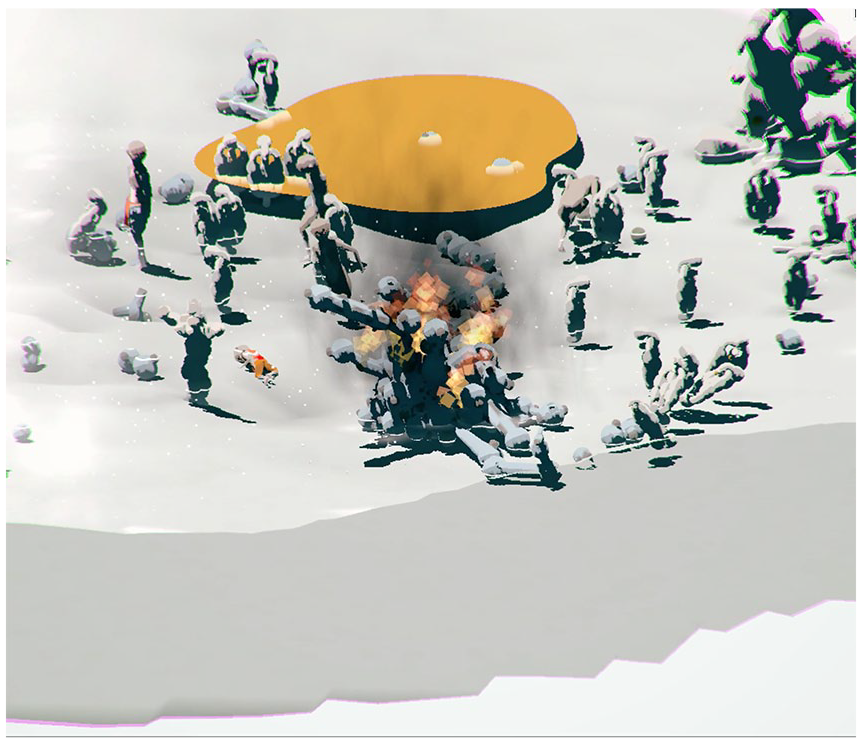
Ian Cheng, Emissary Sunsets the Self (2017). Screenshot by the author.
In any case, these humanoid figures (which I later learn are called ‘Oomen’) are rather peripheral figures, both narratively and optically. The shape-shifting yellow puddle is firmly at the center of things, driving both the story (if indeed there is one) and the virtual camera alike. A small bit of the digital puddle separates from the rest, and the camera tracks the liquid’s movement with pixel-perfect precision as it floats away and attaches itself to one of the grey pieces of organic matter strewn about the landscape. The latter, so-called Wormleaves, seem to come alive when the liquid comes into contact with them. Then ensues a rambunctious spectacle, accompanied by loud popping noises, whistles, and rustling sounds, as the symbiotic assemblage of yellow liquid and grey matter animatedly steers around the landscape like some kind of otherworldly jalopy or semi-sentient cyborg monster, accruing more grey pieces here and there, growing in size, and knocking things over left and right.
The camera follows closely, always keeping the liquid, now sitting at the helm of the growing grey creature, squarely at the center of the screen’s isometric view. The humanoid figures flail and squawk around the creature, apparently upset by it. They are hardly characters that I can ‘identify’ with, and neither is the leaf machine. In fact, there is nothing to identify with, and – more importantly – nowhere to identify from. The virtual camera’s POV floats strangely in its fixation on the moving creature, unsettling the viewer’s relation to the computer-generated images. The screen is accordingly not a neutral window onto a world, inviting me to peer into it unseen, as in certain types of filmic works; instead, it is an active interface, its isometric perspective reminiscent of a certain type of videogame – and that is precisely what the CGI graphics signal to me: I am watching a game, one that is perhaps still in beta testing, with somewhat clunky animations, crudely pixelated representations of fire, and apparently unfinished environmental elements provided by the game engine in which it was developed. To judge by the parallel projection method used in rendering the 3D environment, this is a somewhat older game – or more likely a somewhat nostalgic indie production – its camera’s perspective, looking down from a vantage fixed at roughly 30º above the horizontal plane, similar to a 1990s Sims game before the franchise switched over to a true 3D, quasi ‘Renaissance-style’ perspective projection. 18 Visually, then, I have a feel for the interface, even if the camera movement feels glitchy and alien.
Except that this game is not driven by a player; rather, it plays itself. We might say that the human is thereby taken out of the loop, but this isn’t wholly accurate. I am still here, looking. But where am I? Physically, I am seated in a gallery space, looking across the room at a large, almost square-shaped screen (extending 12 feet up from the floor and with an unusual aspect ratio of 7:6) at the other end, a little over 20 feet from where I sit. 19 But I am also suspended in some indeterminate relation to the images on the screen. I am not engrossed in the images of a prerecorded work of film or video art; instead I attend to the real-time generation of computational images – but my usual modes of interacting with such images, by way of a videogame controller, a keyboard, or a VR headset, have all been denied to me, foregrounding a kind of vertigo that has less to do with the sublime nature of the images (though I won’t deny an element of that) 20 and more to do with the unresolved place of my body, which is seemingly called upon to act, or interact, but cannot. The insistent centering of the yellow liquid suggests that this would be my point of interface, that my task would be to control its movement. But since I cannot, I feel more like it is controlling me, or at least controlling my visual access to the scene, giving the images and their motion a distinctly inhuman feel.
Indeed, the displacement of agency and the general disorientation I have been describing is not accidental. Media artist Ian Cheng’s Emissary Sunsets the Self (2017) is what he calls a ‘live simulation’ – an open-ended evolutionary system driven by AI agents interacting with environmental rules encoded in the physical properties of objects and their reactive potentials. 21 Produced in the popular Unity game engine (or game-authoring environment), the work is highly self-reflexive, framed in accompanying lore as an enigmatic story about a futuristic artificial intelligence, MotherAI, bored of its own disembodied existence and driven to experiment with taking on material form. 22 The yellow liquid is the AI’s emissary to the biotic realm, through which it is able to ‘drone’ or take possession of the Wormleaf fauna in ‘an attempt to feel the sensations of incarnated life’. 23 So a real AI plays a diegetic or simulated AI, and the videogame plays itself, thereby usurping the role of the human player now left feeling sidelined and strangely disembodied. The perspective of the viewing subject is thus defined by a virtual amputation of their interactive potential. My presence seems optional before a system that might go on forever, through endless cycles of virtual daylight and night-time, through all the seasons, the AI never tiring of sending out probes, the camera always following its adventures in vicarious embodiment before resetting its gaze – over and over again but never twice the same – on the big yellow puddle at the center of it all. Where do I stand in relation to this system? Cheng’s generative artwork poses this question forcefully, its ambiguous non/interactivity calling upon us to rethink our phenomenological relations to a variety of contemporary images. Above all, it asks us to reassess the place of the perceiving body today. 24
Aesthetically, then, Cheng’s piece conjures a weird sense of displacement. It does this in a couple of different ways: first, through retro and low-poly graphics that feel outdated, out of step with the forward march of technological progress and the spectacular, futuristic images we see on a PlayStation 5, for example. At the same time, by foregrounding my own inability to interact with the images, it heightens my sense of the role that embodiment, as it is channeled by game controllers and other input devices, plays in contemporary images. As a result, sensation, the realm of the aesthetic in its broad sense, is made to feel weirdly out of time and out of place, without foundation, free floating in a world transformed by the agency of artificial intelligence.
AI sublime
In contrast to Ian Cheng’s provocation and displacement of embodied agency, Refik Anadol uses AI to create a very different aesthetic experience. In his large-scale installations, Anadol tends toward spectacle and display – including the spectacle of cutting-edge display technologies themselves: bigger monitors with brighter images and higher pixel-densities are as much a part of the show as the colorful generative forms they disclose to the viewer. Against Cheng’s low-poly animations, Anadol’s high-res imagery and larger-than-life screens take on a slightly futuristic aspect – but only slightly futuristic, in the same way that bleeding-edge computer technologies typically position themselves just a few years, months, or even weeks ahead of the status quo, not the millennia envisioned by Cheng (after which time the futuristic might very well collapse with the prehistoric). The short-term futurism of Anadol’s work situates the experience much closer to the here and now, the horizon of which is regularly (even habitually) stretched but not broken by actually existing technologies, such as the AI applications (chatbots, writing tools, image generators, etc.) that are quickly becoming a mundane and ubiquitous presence in our lifeworld. Still, the sheer scale of Anadol’s visual interventions marks them off from the mundane background. Embedded architecturally into the built environment, the massive displays become visual environments of their own, transforming building exteriors and interiors into porous gateways to a less static, more dynamic and flexible world of incessant change and transformation (cf. Anadol, 2020). The images themselves are largely non-representational, though they often seem to mimic forms found in nature (flora, fauna, landscapes, etc.); they are characterized by formal dynamism and ceaseless motion. Given both their overall size and the plethora of minutely calculated details they contain, Anadol’s works overwhelm the senses, confounding the viewer’s ability to perceive the whole (moving) picture and all of its parts at once. Standing in front of such a display (see Figure 4), I experience visual wonder at the phenomenal flux I see on screen, but the more basic impact of the work is bodily and tactile: I am made to feel the power of generative AI, and I do so, significantly, in inverse relation to my ability to form a coherent image-object out of the visual flux.
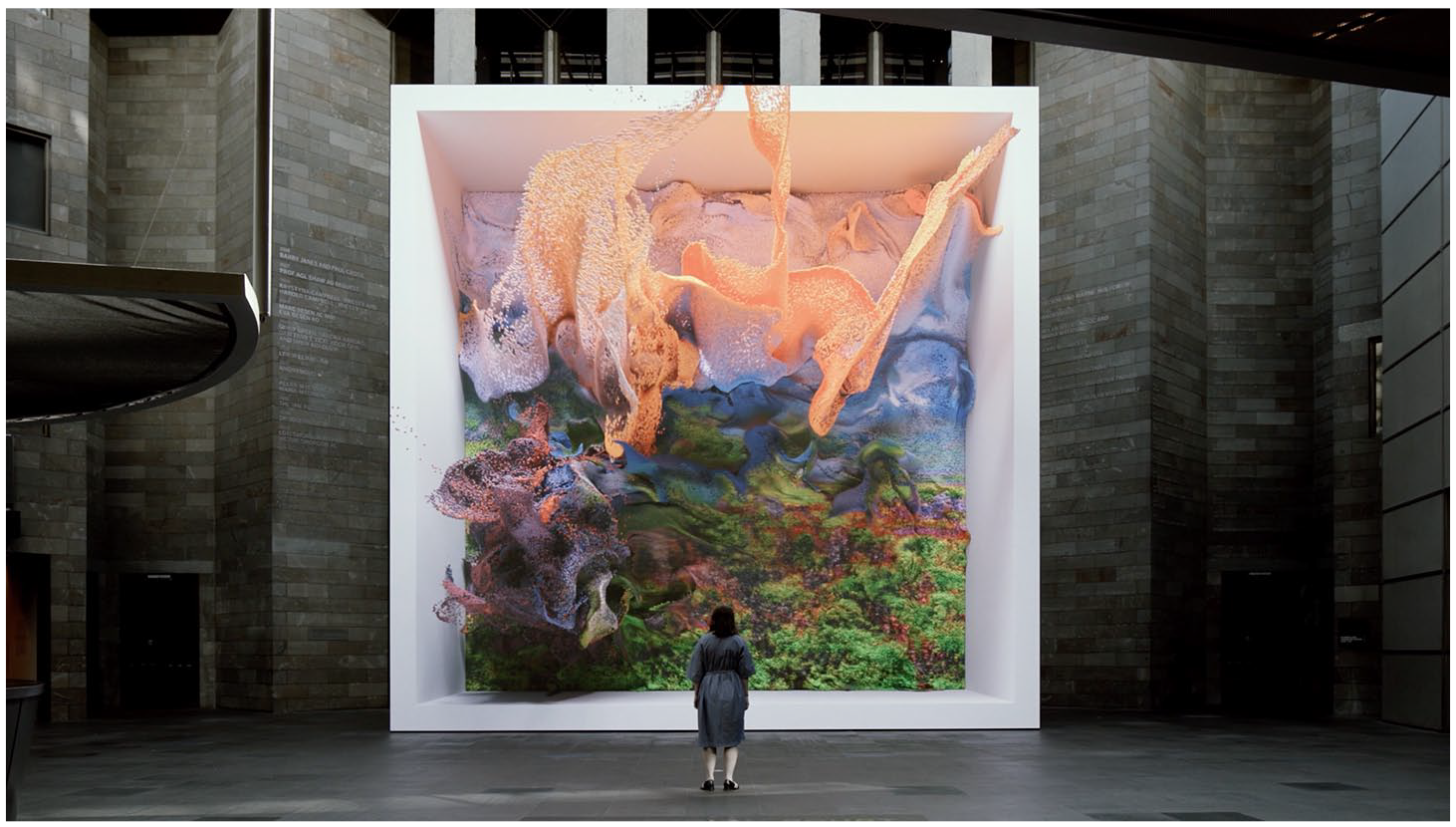
Refik Anadol, Quantum Memories (2020). Screenshot by the author.
Although this tactile power is best experienced in situ – in the flesh, so to speak – a more indirect approach will help us to theorize the experience (and here it should be recalled that the Greek theorein is connected with seeing, which we are straining to do on multiple levels). Specifically, the installation views (photos and especially videos) featured on Anadol’s website help to throw the visual and tactile stakes of these works more clearly into relief (see https://refikanadol.com). Many of these installation views show a solitary figure before one of Anadol’s giant displays, organic forms taking shape and as quickly dissolving in front of her, always apparently about to splash out and inundate the viewer. The spectacle depends on an illusion of depth: the digital screen presents itself as a kind of box extending back away from the viewer; this is a modern day trompe-l’oeil, where the trickery depends on shadows cast from above, apparently from an overhead light source within the exhibition space (but actually calculated computationally and emanating from the flat screen itself). Against this voluminous background, the liquid waves of colored pixels constantly threaten (or promise) to enter the physical space occupied by the lone viewer, who in the installation view stands as a proxy and role-model for my own spectatorial engagement. The sheer impassivity of the viewer, dwarfed by the gargantuan scale of the display, serves as a kind of visual foil to heighten the tension of the spectacle: surely she is not immune to the power before her; rather, it must be a case of paralysis, like a deer caught in the headlights. That nameless spectator thus provides the moorings for my own point of view, dynamizing my vision in stark contrast to her grounded stance. By way of such contrasts, these installation videos communicate a clear intention to overwhelm. While the viewers they depict might seem unmoved, it is precisely their immobility that sets me in motion and infects me with the power of the image-spectacle, giving me a clue regarding how it must feel to be physically present and in the thrall of this power of flux, mutation, and generation – where the tactile experience of creative force comes first, visual form second.
By such means, Anadol conjures a modified aesthetic of the sublime, reaching back to the early industrial-era origins of philosophical aesthetics and reworking one of its fundamental categories. The unstable visual Gestalts united in Anadol’s screen-as-box seem calculated to question the neat distinction between beauty and the sublime, the two major aesthetic modes outlined in Kant’s (2007[1790]) Critique of Judgment. For Kant, as is well known, the beautiful is defined by images and objects that seem purposeful but that do not in fact have any evident purpose. In other words, such objects present themselves as designed, but they are not instrumental; they are not tools or technologies, but things that are pleasing to behold. Whether natural or human-made, what makes them pleasing is their apparent harmony and design. As harmonious and non-instrumental, beautiful objects and artworks are self-contained, separate from any use-value or worldly interest, framed as free-standing and independent (pp. 35–74). By way of contrast, the sublime always threatens to overflow its frame, to exceed the boundaries of self-enclosed harmony. Let us recall that, for Kant, there are two types of the sublime. The first he calls the ‘dynamical sublime’, and it threatens to overwhelm us physically; we feel small and fragile before the giant waves crashing on the rocky shore, or the massive storm gathering overhead (pp. 90–96). The second form is called the ‘mathematical sublime’, and it is less about physical fragility and more about our mental capacities and limitations, for example our inability to survey all the stars in the sky: the sheer number overwhelms our imagination, again making us feel small, but more in terms of our place, as thinking beings, within the incalculable expanse of the cosmos (pp. 78–90).
Since the time of the Romantics, both of these conceptions of the sublime have maintained a strong presence in our visual cultures, devolving quickly into the stuff of kitsch and cliché. But the underlying questions about embodied sensation and phenomena that exceed our powers of vision are again highly germane in an age of post-industrial technologies like AI and CGI. A quick Google image search for ‘mathematical sublime’ returns not only paintings from around the turn of the 19th century, but also complex computer-generated topological models, as well as quite a few computer-aided and computer-enhanced images of the night sky (see Figure 5). Often these images feature the silhouette of a lone human figure to emphasize scale, mimicking Caspar David Friedrich’s Wanderer above the Sea of Fog (1818) – also included among the results of my search – which famously uses a human figure facing away from us, a so-called Rückenfigur, to evoke a sense of loneliness and wonder in the face of nonhuman nature. Note the similarity between Friedrich’s wanderer and the role of the human figure in the installation view of Anadol’s Quantum Memories, made approximately 200 years later. In both cases, the Rückenfigur highlights the sublime quality (or aspiration) of the work. In Friedrich’s case, it is nature that is sublime, that refuses to be tamed and framed by human thought and perception, but in Anadol’s work it is a completely artificial reality that overflows its frame and threatens to engulf the observer.
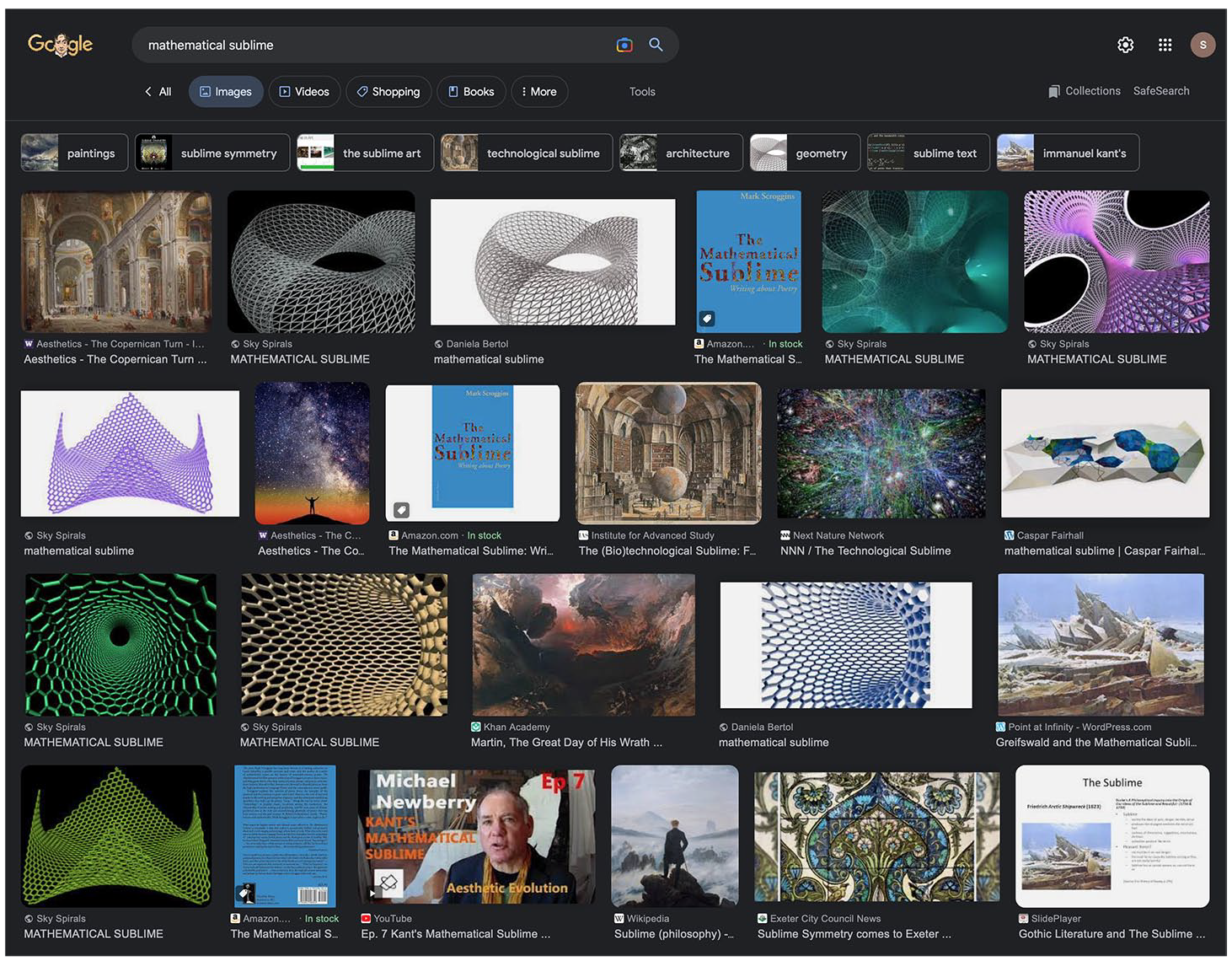
Google Image search results for ‘mathematical sublime’. Screenshot by the author.
Furthermore, Anadol’s work collapses Kant’s two types of the sublime: because of the scale of the screen and the ways that these dynamic forms emerge from it, the observer is physically overwhelmed, as in Kant’s dynamical sublime; but the mathematical sublime is also in play, as we are very well aware that these images are produced by the unfathomable operations of superfast algorithms – mathematics itself – which are processing giant data sets that, like the stars, we could never hope to survey with our limited imaginations and perceptual apparatuses. In the case of Anadol’s Quantum Memories, the images we see are produced by generative AI models, drawing on Google’s AI Quantum Supremacy experiments to synthesize new images on the basis, according to the artist’s website, of approximately 200 million nature and landscape images (see https://refikanadol.com/works/quantummemories/). The soundscape, too, is generated algorithmically, and an element of interactivity is introduced, as the piece reacts in real time to the movement of observers in the physical space – again reinforcing the piece’s ability to overflow or exceed containment within a frame. Thus, the sensory qualities of the work evoke a conceptual shift, connected at once to historical–technological developments and their transformation of aesthetic categories; but it would seem that the true object of sublime wonder has shifted to the infrastructural conditions of sensation, and in particular to the invisible filtering operations of AI.
Cringe aesthetics
In contrast to both Cheng’s aesthetics of weird sensory displacement and Anadol’s algorithmic sublime, Jon Rafman’s recent work uses AI to engage the body through a more vernacular, cringe type of aesthetics.
Rafman’s exhibition Counterfeit Poast (see Figure 6) revolves around a 28-minute video installation comprised of eight chapters or parts, each introduced by a title card that resembles a reddit-style social media post. With titles such as ‘I gaslit my girlfriend’, ‘Sigma Male Routine’, and ‘GOT REKT’, these are tales of born-digital, networked experience, filtered through platform protocols, anonymous exchange, and the ensuing toxicity. The video’s images – often grotesque, violent, and overstuffed with trash or some more general kind of messiness – reflect these conditions. Each of the tales is introduced by a narrator who recounts the events of their post; each narrator is depicted frontally, roughly in a medium close-up that reveals only their shoulders and head, before a static background. They address the viewer directly, and as they do so, the narrators’ movements are restricted awkwardly to their faces: their mouths move roughly in sync with the words they speak, but there is a limited range of facial expression (nodding, jaw and eye movement) that, because the rest of their body and head remains static, imposes unnatural distortions, for example stretching their heads and necks or smearing their facial features. As the narrators unfold their tales, these animated sequences are interspersed with bizarre static images that roughly correspond to the scenarios described in voiceover.
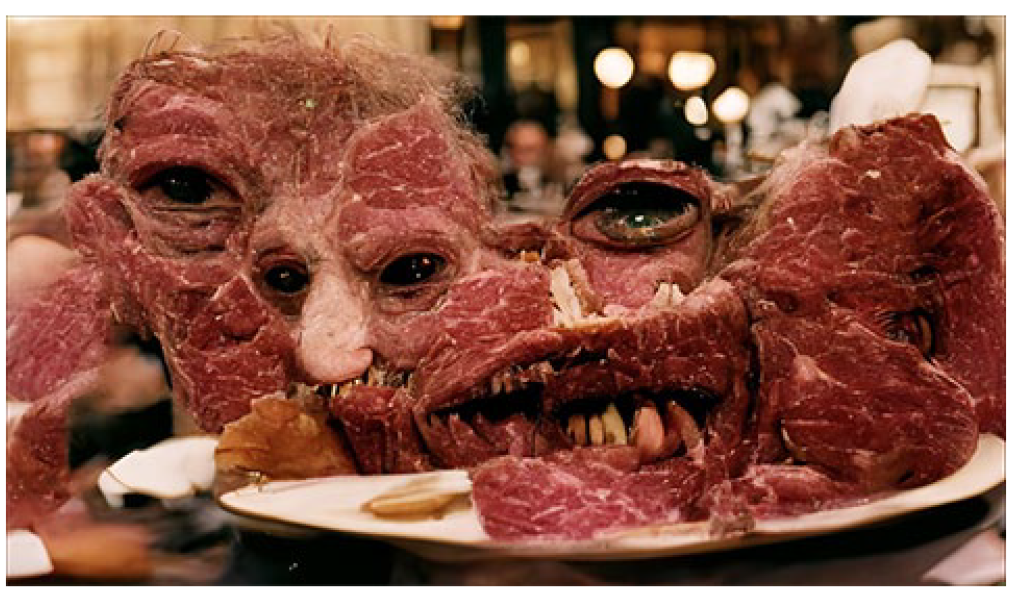
Jon Rafman, Counterfeit Poast (2022). Screenshot by the author.
Shown alongside paintings generated with text-to-image algorithms like Stable Diffusion or DALL-E 2, the video’s images are recognizably produced with the same diffusion techniques, while iPhone face filters are used to create the animations. Glitchy and nonsensical textual elements, impossible anatomies, misplaced hair, superfluous fingers and eyes, and haunting deformations (see Figure 7) – these are the by-now familiar signatures of the underlying algorithms and their statistical processing and filtering of visual information scraped en masse from the internet. Against the previously explored aesthetics of weird detachment and of the overwhelming sublime, Rafman’s images thus conjure a kind of gross-out aesthetic that underscores a material (and perversely spiritual) connection to the underside of online life today. In a press release, Sprüth Magers Gallery in Berlin, where the work was shown in 2022, emphasizes this connection between ‘applying the latest digital technologies and analyzing their impact on everyday life’. This especially concerns what they identify as ‘themes of nostalgia, youth, and false memories, as well as isolation and the alienation of individuals from society’. ‘The artist plunders the collective archives of our digital memory, altering ordinary, familiar images to create a nightmarish machine delirium’ (see https://spruethmagers.com/files/rafmanpr.pdf). Rafman himself says: ‘These technologies allow me to construct rich new virtual worlds’ that ‘combine the language of video games and pop culture with classical references to create my own “Boschian” 21st-century hellscape and purgatory’ (see https://spruethmagers.com/exhibitions/jon-rafman-counterfeit-poast-berlin/). Here Rafman invokes Hieronymus Bosch and his famous Garden of Earthly Delights, the right panel of which depicts Hell – a quite literal hellscape populated by strange and grotesque creatures. But whereas Bosch’s inspiration is theological, Rafman’s is very this-worldly. And rather than an aesthetic of the grotesque per se, it is more an aesthetic of the ‘cursed’ and the ‘cringe’ – categories native to online visuality.
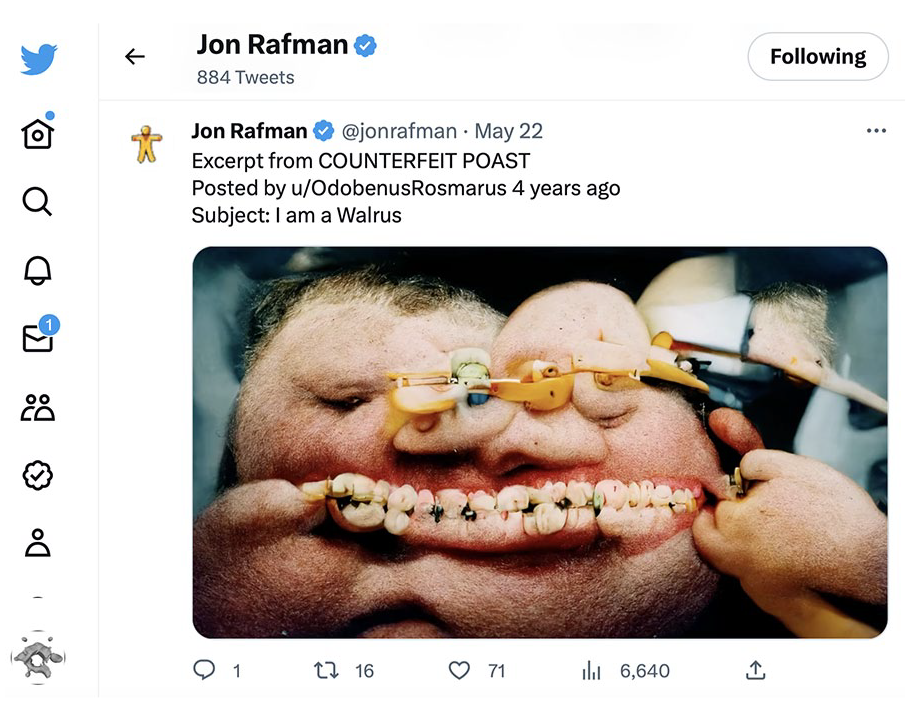
Jon Rafman, Counterfeit Poast (2022). Screenshot by the author.
The gallery suggests that Rafman’s character studies are based on ‘copypasta’, and that they engage the so-called Mandela Effect, according to which false memories are shared collectively and rumors of them circulate, meme-like, online. 25 For instance, the episode titled ‘The Traveling Salesman’ revolves around a woman’s false memory of a nonexistent movie from the 1990s, set in a post-apocalyptic US and starring Kevin Costner in the titular role. Listening to the woman recount her (in my opinion, quite believable) memory, I was genuinely confused and had to search the internet to make sure the film indeed never existed; apparently, the narrator and I had both confused it with a movie called The Postman. Perhaps the believability of this false memory is heightened by the countless online posts (or ‘poasts’) about similar misrememberings, such as the extremely widespread belief that, in Field of Dreams (1989), Kevin Costner (again!) hears a voice say, ‘If you build it, they will come’ (rather than ‘he will come’). Filtered through these common experiences of online life, as well as the visual record of the internet from which the images are synthesized, Rafman’s video invites confusion and merges synthetic memories of narrator and spectator alike, mimicking and perpetuating the process of online circulation. Interestingly, Rafman released several episodes from Counterfeit Poast through Twitter and Instagram, thus placing them back into the social-media environment that inspires them and to which they speak. Through this engagement with the internet and its underbelly, as mediated through synthetic digital technologies, Rafman’s engagement with AI shifts definitively from theological grotesquery to contemporary cringe. Here, cringe involves a recoiling from the ugly, unethical, or offensive. It involves a reassessment of individual agency in the face of mediated misinformation, the overwhelming scale of which might otherwise feel sublime but here just feels kind of gross. And the cringe is registered in the body, as the algorithmic filters show us a world not made to the measure of human sensation. 26
Confronted with these images, we quite literally have to strain to see: often it is impossible to delineate figure and ground or to parse coherent images. And, in straining to discern, we experience a shift from the domain of narrative and its illustrative visuality to a deeper sense of tactility – an activation of the embodied filter from whence perception (and memory) arises, now awkwardly encountering an artificial counterpart that perpetuates normative perceptions through its statistical renderings. A bodily discomfort creeps in to underline the more overt or reflective discomfort we might feel when viewing the work’s algorithmic treatments of race, gender, normative body size and shape, and other sensitive matters of embodied and social existence. The acne-faced narrator of ‘Sigma Male Routine’ recounts a story of the familial propagation of toxic masculinity, underscored by incoherent heaps of muscle. The stereotypical crypto-bros at the center of ‘GOT REKT’ conjure highly deformed but clearly sexualized images of women, synthesized from the objectifying depictions that populate cyberspace. The overweight boy at the heart of ‘I am a Walrus’ informs us of his belief that he is in fact a walrus, though he asks for donations to support his full medical transition; the disturbing images of human and animal bodies that illustrate his tale uncomfortably recycle normative standards while ambiguously broaching topics of fat-phobia and transphobia. And in ‘My Lost Somali Friend’, a white man with a Texan accent details a fantastical story of a past life as a gay Somalian man before being mysteriously snatched away from his love and his life along the Gulf of Aden and transplanted into his current body in west Texas; the distorted images of his new wife and son, both white like the narrator, contrast jarringly, and problematically, with the depiction of the equally distorted dark-skinned bodies of his past life. The lost love the man recounts, often tenderly, stands in awkward juxtaposition to images of Black and Brown bodies that are at once dehumanized, disfigured, exoticized, and mourned.
In all of these cases, problematic narrative and visual depictions provoke the alienation of cringe aesthetics, opening a space for embodied recoil where human and machine hallucinations are confronted with the embodied effects (and affects) of normative typification. Counterfeit Poast is a deeply troubling work, not merely because it draws on and reproduces racist, sexist, and other troubling tendencies of online life, but because it forces the viewer to intuit the latter not simply as ‘algorithmic bias’ but as material powers with direct, tactile force (see Denson, 2023). The subsymbolic filters of AI image generation are messily entangled with the subperceptual filters of the body’s inner diaphragm as ‘that part or aspect of the inside of our bodies which mix with the image of external bodies’ (Bergson, 2007: 60). The aesthetics of cringe, the iconic depiction of which is an emoji with gritted teeth, is at once a defense mechanism designed to keep these ugly feelings at arm’s length and an embodied recognition of the impossibility, in an age of predictive algorithms, of such protective and extricating measures.
Recursive filtering without end
Finally, Yvette Granata’s The Endless (2022) (see Figure 8) deepens our understanding of this new aesthetic entanglement through a more meditative but no less unsettling encounter, restaging the post-symbolic interface between human and machinic filtering via the relations of a seemingly post-human environment. The piece opens with a close-up view of a camouflage-green mask, waves lapping gently around it. Another view reveals its position at the edge of a shore, along with the fact that the mask is adorned with horns. Another such mask is perched atop a pole, its empty eyes set against the clouds moving slowly in the distance, the hilly shoreline descending sharply to the water on either side. A weathered 55-gallon drum punctuated with a bright red screw cap lies languidly on its side, sunken amidst foliage. Sounds of water and buzzing insects fill out the strange, seemingly desolate environment.
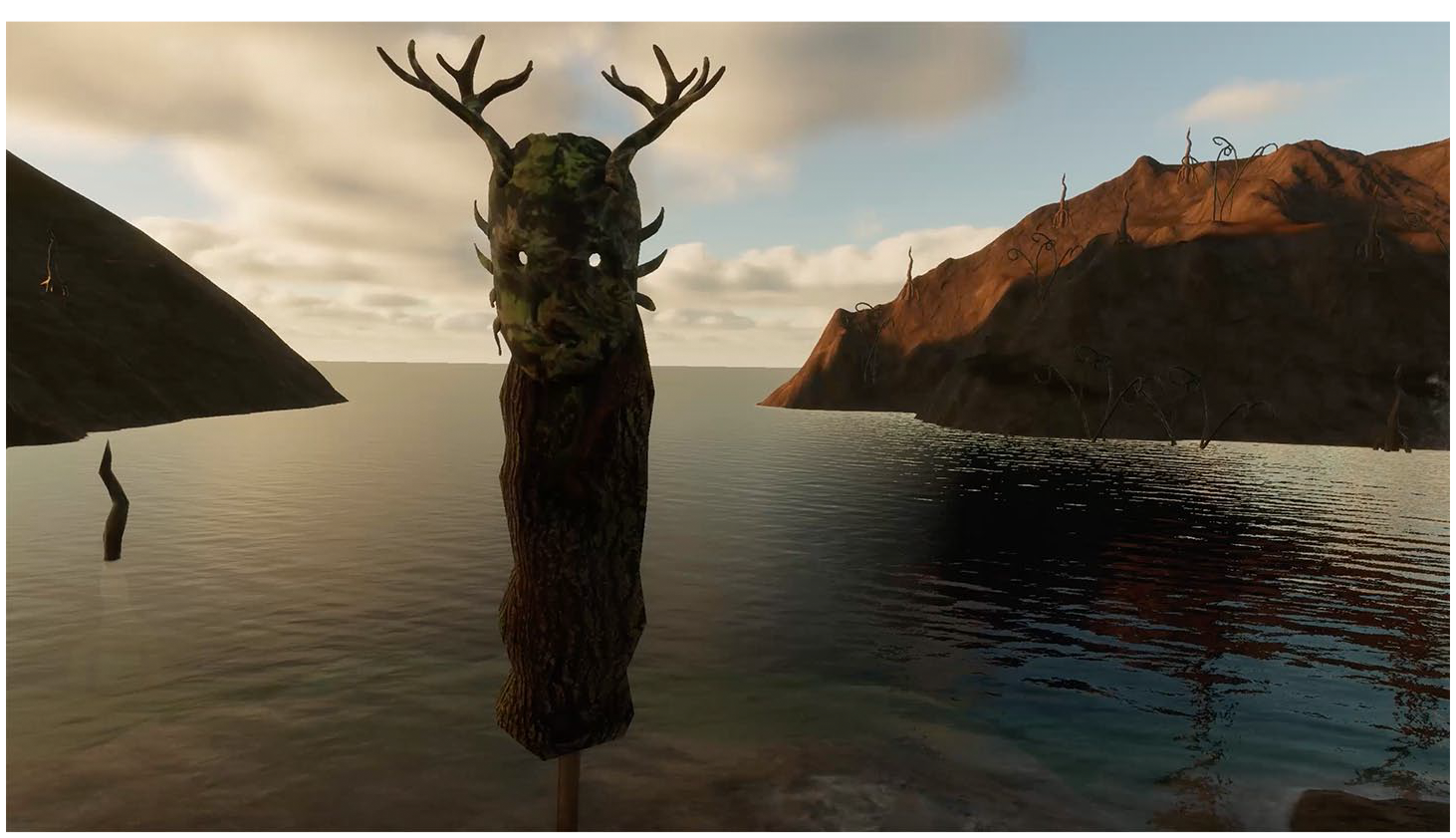
Yvette Granata, The Endless (2022). Reproduced with permission of the artist.
The computer-generated graphics, the pixelation and iteration of organic objects, and the evident polygons that approximate circular and other smooth forms – all of these suggest that this environment is that of a videogame. But unlike Cheng’s non-interactive videogame Emissary Sunsets the Self, which retains the operational framing of a game while withholding any operational interface, Granata’s The Endless strings together its views through quasi-cinematic cuts, however erratic they may be (see Figure 9). Thus, while the shots are not obviously motivated by the perspectives of diegetic characters, it is clear that their framing and sequencing are deliberate. They position us in relation to objects which evidence deliberate design, but whose meaning or utility is altogether inscrutable. We peer upward towards a giant chimeric statue, a muscular primate body crowned by a vaguely reptilian – or perhaps canine or even ursine – head full of sharp, exposed teeth. Outsize human hands extend outward from the stone behind the reclining figure. The leaves on the trees swaying gently in the wind behind the motionless statue further compound a feeling of desolation, as do the following shots of inexplicable pink electrical activity, an abandoned car with its wipers still on, repetitively and mechanically cycling, and ancient gas pumps floating mysteriously through the air.
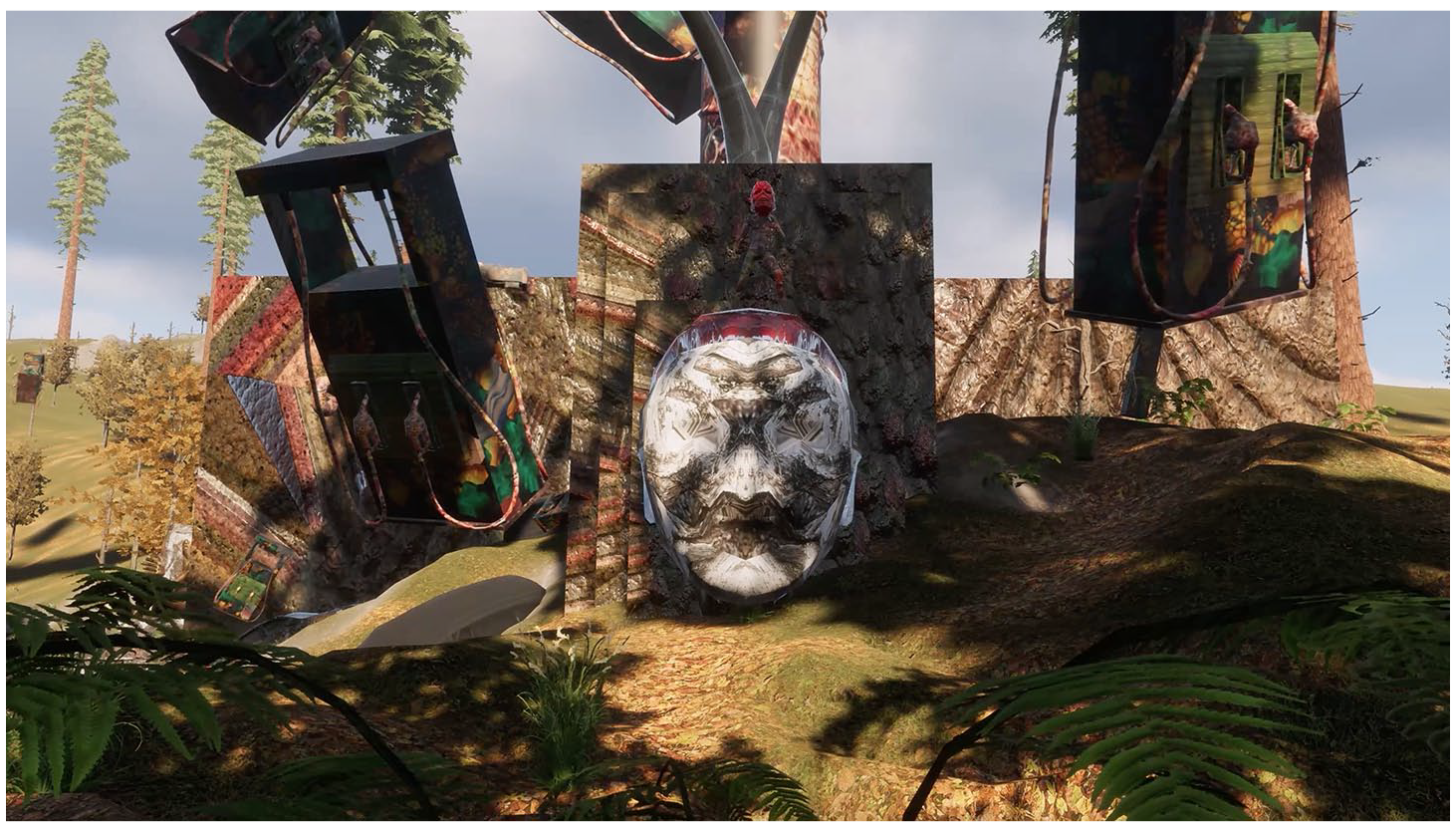
Yvette Granata, The Endless (2022). Reproduced with permission of the artist.
Not quite sublime in either the dynamical or the mathematical sense, this is a surreal and uncanny encounter with AI by way of what might be described as an ecological transduction. That is, the non-interactive environmentality of the piece speaks to a transformation not just of human subjects or of technological objects, but of their co-constitutive relationality itself. For it is precisely this relationality that is at stake in the opening of embodied aesthesis to AI’s artificial tactile–specular filter. The recursive or transductive relation between the powers of interiorization and exteriorization is opened to transformation with uncertain, because wholly nonconscious, effects. Granata’s audiovisual environment intimates something of these changes in the ways that it calls technological utility and aesthetic form radically into question through a recursive unsettling of human and nonhuman agencies. An official description of the project reads: The Endless is a speculative sensory ethnography film that observes AI models in the act of interpreting humans and vice versa. Alien landscapes and 3D models are constructed through the eyes of a machine that roams through a visual thought pattern. The film excavates the visual artifacts of interpolation of AI – the act of neural nets filling in missing visual information with surrounding environmental data. Simultaneously, it seemingly produces a new type of – or an alien form of – human culture. The 3D models and objects throughout the film were produced from a series of artistic experiments with AI neural networks and recognition bias from 2018–2022. The film explores the digital terrain as if filming a fly-on-the-wall encounter with an unknown world. In this way, The Endless is a recursive loop between humans interpreting AI-generated images and vice versa. The result is a digital sensory journey through an alien culture in a phantasmagoric landscape. (see https://filmfreeway.com/TheEndless656)
In what looks like a post–climate-collapse scenario, human artifacts, like the abandoned car, no longer have obvious utility, but the absence of human observers cannot strip masks and statues – or even cars, now strangely iridescent due to environmental reactions – wholly of their aesthetic qualities. In question is therefore not whether art and technics persist, but of their relations to one another in the wake of the encounter with AI.
In Granata’s envisioning of the scenario, the laws of physics themselves are out of whack, as evidenced by the floating gas pumps – pointing to the deep transformative effects of recursive filtering, or the human encounter with AI’s artificial metabolism of objects and environments. In personal communication, Granata explains that she used an early version of an image generator to interpret images of 3D extractions of my face and had the AI generate new images (which is now really common with the Dall-E stuff and Midjourney), but then humans made 3D models interpreting the AI images.
In the completed work, we see effects of this back-and-forth in the way that human actions persist even beyond their humanly defined significance. Humanoid figures repetitively iterate bodily motions; one of them seems to be mopping a floor, but its empty hands hold no mop. Another bangs its fist pointlessly against the base of the statue a short distance away from some reptilian and insectoid corpses left abandoned on a medical examination bed. Hybrid objects, like the chimeric statue, mix human and animal forms and fuse parts at varying scales, much like today’s image generators. Meanwhile, technical infrastructures exhibit purpose but not meaning or reason. An aerial view shows water being drained from one zone, left brown and decaying, and transported to another, now lush and green. The landscape is littered with strange contraptions, while living creatures move rhythmically, mimicking the movement of the computer-simulated natural elements.
On the screen of a laptop left open on a table (see Figure 10), we see an environment more or less identical to the one we see before us, but overlaid with glitchy scan lines. Cut to a group of metallic-headed figures swaying rhythmically beneath water raining down from above. And now a radically different scene: a human man stands nearby a giant seated figure whose head resembles a cartoonishly puffy, multi-colored industrial robot arm, at the end of which is a giant laptop – apparently this creature’s face – an onscreen eye peering curiously at the man with whom it is apparently engaged in a non-verbal conversation. Another figure, whose digital ‘skin’ has been replaced with a glassy green texture, seems to dance on the side of a white cube. Other figures dance in mid-air or traverse the sides of old shipping containers. A man peers at and probes a glowing green orb, his hand going right through it. As he attempts to pick it up or otherwise interact with it, radio frequencies and static ca n be heard; he is eventually engulfed by the orb, from which we see him emerge shortly afterward, his body now covered in its glowing texture. At the same time, the screen is partially obscured by a similar texture; our vision, like his, is apparently infected. The green man cowers and tries to rid himself of the electric glow. Finally, we see a composite head with eight faces, alternating blue and pink, slowly rotating, bodies floating nearby, as the glitchy multicolored scan lines we saw earlier on the laptop now begin to cover the screen on which we are viewing the work (see Figure 11). Computational sounds, vaguely akin to the sound of a hard drive accessing data, intensify, and the screen turns briefly white before fading to black. Visual reason itself awaits a recalibration with the new environmental transduction that ensues in our encounter with AI art as a tactile-specular filter.
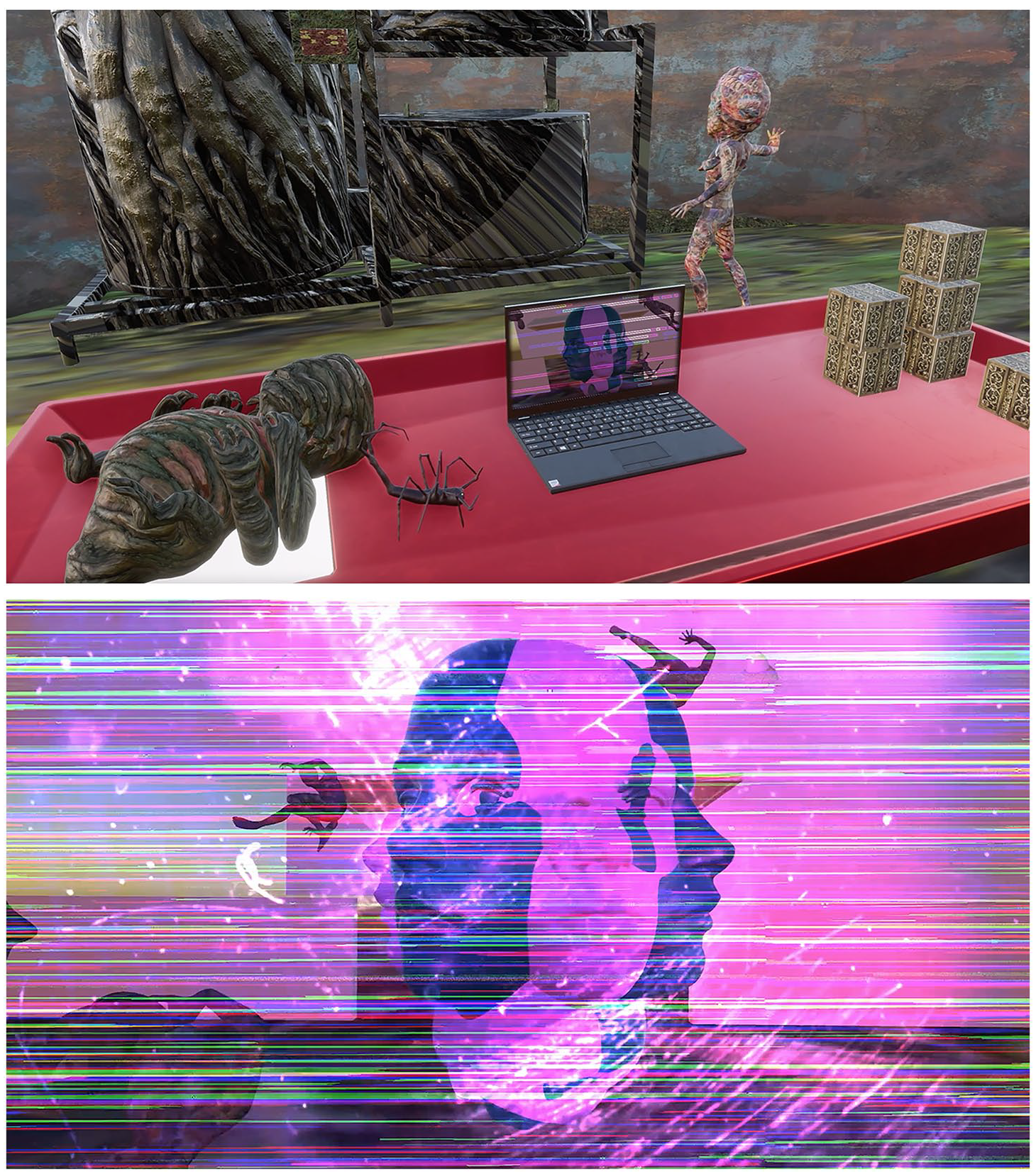
Yvette Granata, The Endless (2022). Used by permission of the artist.
Outlook
Throughout this article, I have argued that we register the impacts of AI primarily in our bodies, through preconscious and material encounters with invisible algorithms and processes. These computational processes mirror – and alter – the metabolic processes of embodied existence, uprooting habituated and taken-for-granted forms of subjectivity and challenging us to come to terms with new environmental conditions of being. At stake, therefore, in AI’s rapid and massive transformation of our visual cultures is something that cannot be seen at all, as it pertains to the existential ground of visuality itself. The artists discussed here push us to think these changes through challenges to inherited aesthetic categories – the sublime, the uncanny, and the abject. What they are showing us, however, is that such conceptual modifications and upheavals respond to experiences for which we do not, and perhaps cannot, have words – changes in the conditions of sensory experience itself. Accordingly, AI art is not just a new mode (or medium) of picture-making; rather, it provides sensory clues, indirect as they may be, to the fundamental impacts of the new technology. Pushing us to come to terms with these impacts – which, as I have argued, are pre-intellective and therefore have little to do with ‘intelligence’, artificial or otherwise – these artists show us that aesthetics is not and cannot be an afterthought in our response to AI. Rather, with the reconvergence of art and technology happening today, aesthetics asserts itself as a most urgent matter, as it concerns changes that condition embodied sensation, subjectivation, and any higher-order deliberations that might be conducted in the name of ‘AI ethics’. In the age of AI, aesthetics is and must be first philosophy.
Footnotes

Notes
References
