




Abstract
In light of increasing artificial intelligence and proliferating conspiracy, technofetishism and moral panics, faith in ubiquitous data capture and mistrust of public institutions, the ascendance of STEM and the ‘deplatforming’ of the arts and humanities, this article considers doubt as an epistemological condition, a political tool, an ethical force, a rhetorical register, and an aesthetic category. Adapted from the author’s May 2023 inaugural King’s Public Lecture in Digital Humanities at King’s College London, and structured in the form of a syllabus for a speculative class, it aims to identify where humanistic conceptions of doubt do, or could or should, reside within our digital systems: at the interface, within the code, or engineered into hardware and infrastructure.
As smart machines proliferate, doubt abounds: doubt about the long-term inhabitability of the planet; doubt about our commitment to protect the elms and elephants with whom we share it; doubt about the state of women’s rights and the state of human rights, particularly as they are weighed against the right to bear arms; doubt about the future of democracy; doubt about whether or not we ever really knew those neighbors and family members now proudly espousing fascist beliefs; doubt about our species’ capacity for equality and justice and peace. Perhaps we need a map, a guide, a syllabus to usher us through this period of shadowy uncertainty.
For now, we have an aggregate of autocrats – particularly in politics and public life – who purport to know the path to salvation. This cadre of decisive delegates is willing to make the tough calls; to tell it like it is; to boldly declare incontrovertible universal truths; to advance an agenda of moral positivism and purity. We’ve got men defining what it means to be a woman – ontologically, existentially, and pragmatically. We’ve got panels of religious fundamentalists and white supremacists rewriting syllabi and curricula, deciding what students are allowed to read, what they are allowed to know about their own minds and bodies, and about our societies’ complicated pasts. Meanwhile, we’ve got conspiracists in discussion forums drawing network diagrams linking George Soros to pedophile rings and space lasers, sucking believers into an alternate reality. On a slightly saner, but no less nefarious, plane, we’ve got national leaders and legislators brazenly rewriting laws and redrawing maps to determine who democracy serves. And working in cahoots with those officials are mobs of masked men – Proud Boys, morality police – performatively proclaiming who has a right to live peaceably in their communities. This world of abundant hubris provided the initial impetus for this project.
This political context – which is also cultural and economic, moral and ethical – constitutes the larger arena in which our more delimited focus, on technology and epistemology, functions. What is more, technology does not operate outside the political arena – or the ecological terrain. Consider engineers’, investors’, legislators’, and consumers’ varying degrees of confidence and doubt in the capacity of technology to fix or frustrate these wicked problems. Climate tech, we are told, will capture our carbon and make our buildings more energy efficient, while planetary computers will allow us to track all species of the earth and tweak the engineered systems through which we command them. ‘Digital twins’, or urban planning simulations, will permit us to model, monitor, and manage all urban operations. We were once told that the blockchain would revolutionize everything, but in recent months large language models (LLMs) have dampened crypto’s clamor. LLMs, like ChatGPT, purportedly bring us closer to artificial general intelligence, which will do everything we can do – that is, everything that’s profitable – but do it better. There has been some concern with the bias built into these models via their training data, but we can turn to Elon Musk’s TruthGPT to reveal the nonpartisan secrets of the universe. These hubristic plans and promises are often themselves entangled in conspiracy thinking – what Timnit Gebru (2023) and Émile Torres (2023) call TESCREAL, an acronym that encompasses transhumanism, extropianism, singularitarianism, cosmism, Rationalism, Effective Altruism, and longtermism. 1 I doubt I can explain each of those ideological platforms, but I am pretty sure they are all infused with immense narcissism, often developed atop a foundation of manufactured, dramatized doubt about humanity’s ability to persevere without bespoke technical solutions.
At a time of increasing artificial intelligence and proliferating conspiracy, technofetishism and moral panics, faith in ubiquitous data capture and mistrust of public institutions, the ascendance of STEM and the ‘deplatforming’ of the arts and humanities, we should wonder what kind of epistemological and ethical world we are creating. Prominent ways of knowing have tended to weaponize uncertainty or ambiguity, as we have observed in the ‘debates’ over COVID vaccines, elections, climate, immigration, and myriad political scandals. We have witnessed such phenomena before, as we will discuss later, but willful historical ignorance obscures this context. Silicon Valley disrupters’ self-mythologization depends upon doubt – or outright erasure – of precedent, while education ‘reformers’ must engage in egregious historical revisionism in order to whitewash colonial and white supremacist legacies that sully their self-regard.
In what follows, we will consider doubt as an epistemological condition, a political tool, an ethical force, a rhetorical register, and, drawing inspiration from Sianne Ngai’s (2015) work, an aesthetic category (see Figure 1). Doubt is a feeling that both compels necessary reflection and restraint and creates opportunity for principled and creative action. Because these thoughts were prompted by an invitation to address digital humanists at King’s College and the University of Pennsylvania, we will focus specifically on how humanistic conceptions of doubt do, or could or should, manifest in the digital realm. And, because I was asked to address connections between research and teaching – a translation that has shaped my work since the start of my career – I have chosen to structure this article in the form of a syllabus, not the sort of prescriptive document laid out by an autocrat or tech-brat, but, rather, a speculative map or menu open to collective development (Mattern, 2022).
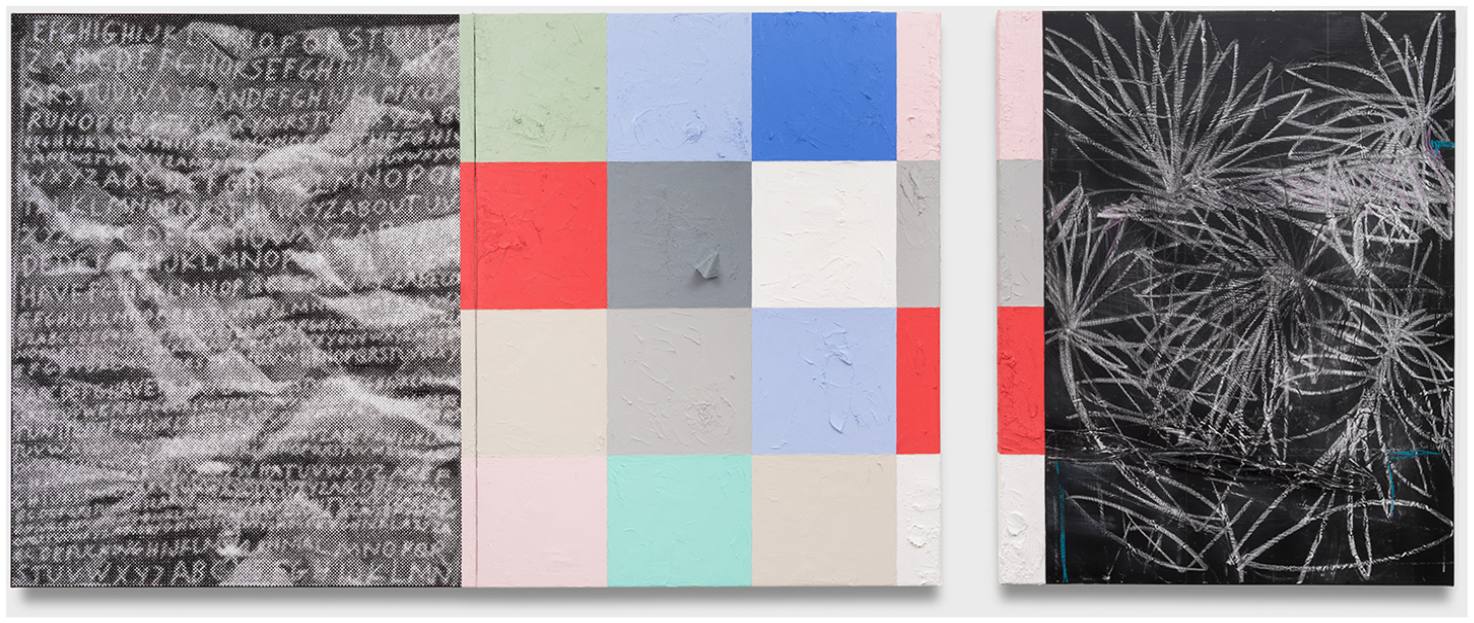
Dashiell Manley, letters III. H.H.A.R.Y.M.O.T.N.A.Y.T.A.H.D.W.B.W.L.M.A.Y.T.W.W.W.U.L.Y.M.B.A.Y.W.A.T.G.D. A.I.N.B.I.J.A.L.F.M., 2022; gouache, acrylic, graphite, chalk, pastel, newspaper, and oil stick on linen; overall: 39 x 100 inches; 99.1 x 254 cm (DAM.19646); Reproduced courtesy of the artist and Marianne Boesky Gallery, New York and Aspen. © Dashiell Manley. Photo by Jeff McLane. Manley’s work juxtaposes the modernist grid with free-form sketches and encompasses multiple modes of visualization, suggesting the complementarity of different ways of knowing.
About your instructor + learning goals
Doubt is certainly not a new experience for me, but it is indeed a new explicit research focus – one I do not pretend to have mastered, and one I most likely will not write about again. But it is certainly a topic that is of critical importance to my own research and pedagogical methods. I have retrospectively noticed a trend in my research projects over the past few years: while I have long written about the infrastructures we build to make sense of, to provide some semblance of order to, complex terrains – from libraries to field guides to urban communication systems – my more recent work examines how we embrace or embed uncertainty; how we, to borrow a now-hackneyed phrase from Donna Haraway, stay with the trouble. I have written pieces on ‘how to map nothing’, on mapping lost landscapes, on the green screen as a tool of erasure and imagination, and on redaction as a reparative practice (‘Green Screens in Eight Channels’, 2022; Mattern, 2021; ‘Redaction: Disappearing Data, from Nano to Stratosphere’, 2023; ’Reparative Redaction,’ 2023; ‘Terra Perdita: Mapping Lost Landscapes’, 2022). All imagine uncertainty – if not explicitly doubt – as a condition of possibility.
Now, to tackle doubt directly
Devising a syllabus is a perfect way to map out the contours of a new-to-me, or new-to-us, field. I try to model a healthy measure of self-doubt for my students, which invites them to do the same – and then allows all of us to explore together, humbly and bravely and un-self-consciously. Humility is particularly essential here because I do not consider myself a digital humanist. Still, I think – I hope – what is discussed here will prove relevant to the Digital Humanities, and, ideally, to scholars and practitioners in myriad fields (see Cole-Wright, 2019; ‘Intellectual Humility’ [course] University of Edinburgh (nd); Lees et al., 2023; Lynch, 2017; Porter, 2022; Porter et al., 2022; Rushing, 2020). I would like to think that doubt is an epistemological, methodological, aesthetic, and ethical concern that pertains to everything from science and engineering, to law and logic, to the fine arts and literature.
Eventually, I would like to teach a graduate class on doubt, to help students acknowledge their own intellectual positionality and ethical commitments, to recognize the kinds of knowledge they are producing, to think about the broader potential impacts of that knowledge, and to devise appropriate, generative ways of expressing uncertainty that might invite more thoughtful, reflective engagement with their professional and public audiences and interlocutors. My ulterior motives would include modeling and critically reflecting on the value of intellectual humility and who gets to exhibit it, and how those privileges are shaped by age, gender, race and class. In the process, I would want to discourage the combative, competitive, grand-standing, deconstructionist mode of grad-school critique; and to help marginalized and first-generation students grapple with their own self-doubt – in part by recognizing that impostor syndrome is a product not of personal deficiency, but of a system that wasn’t built for them/us and hasn’t caught up to them (Jamison, 2023).
(Un-)defining our terms
It is probably best to start by defining our key terms. (You’ve noticed my rhetorical hedges, which are themselves a means of conveying uncertainty? I have peppered them throughout!). We might draw from classic digital humanities methods, like text mining, to see how ‘doubt’ has been deployed and defined across various fields. I tried such a survey, on a small scale, and came to realize how frequently writers use ‘undoubtedly’ and ‘no doubt’ not as resolute epistemological claims – as in ‘this is 100% fact’ – but as a hyperbolic rhetorical device, an ethos shield. I also discovered that much has been written about religious doubt, specifically atheism, which is outside the purview of our discussion here (in no small part because I doubt my own ability to do it justice). Jennifer Michael Hecht (2004) offers a magisterial history of (mostly) religious doubt – which is really quite oxymoronic, if you think about it: an ambitiously virtuosic survey of not-knowing – that spans from ‘ancient Skepticism to modern scientific empiricism, from doubt in many gods to doubt in one God, to doubt that recreates and enlivens faith and doubt that is really disbelief’. Along the way, she addresses Socratic questioning, Zen koans, Marx’s ‘false consciousness’, Freud’s regard for religious belief as neurosis, and Nietzsche’s nihilism. Philosopher Vilém Flusser, in his book, On Doubt (2014), focuses specifically on Cartesian doubt, framing it as a successor to religious faith; he proposes that we regard the cogito in ‘cogito, ergo sum’ – that is, thinking, or intellectualization – as ‘the progress of doubt’, the ‘abandonment of original faith, of “good faith”, in favor of a better faith, a less naïve and innocent faith’. 2 Janet Broughton (2002: xi) similarly argues that, for Descartes, doubt can ‘yield knowledge by uncovering its own preconditions’.
Historian Peter Burke (2023) meanwhile traces the genealogy of a parallel condition, ignorance, which often intersects with doubt. Bullshit, which has likewise been historized and theorized, is implicated here too (see Frankfurt, 2005). We tend to doubt obvious bullshit. Evolutionary biologist Carl Bergstrom and information studies scholar Jevin West (2021) remind us that the nature of bullshit, as well as our strategies for managing it, depend upon the material form in which said shit arrives – analog or digital, broadcast or networked. The same, we will see, is true of doubt: the way we doubt a thing depends upon the form of that thing. Sociologists Peter Berger and Anton Zijderveld explain, in their In Praise of Doubt (2009), how modernization produced moral pluralities, which led to relativization or fundamentalism. The authors offer doubt as a moderate middle-path between the two extremes. Yet sociologist Ulrich Beck argues that doubt is not always something we have the choice to deploy strategically. Doubt is the product of a networked modernity that has compromised our state institutions – the law, democratic politics, social infrastructures – and rendered us vulnerable to ‘global manufactured uncertainties’ (see Mythen, 2020; see also Tooze, 2020).
Historians Naomi Oreskes and Erik M Conway, in their book, Merchants of Doubt (2010), explain how, across the latter half of the 20th century, a rogue group of well-connected scientists sowed confusion and doubt about the dangers of tobacco, acid rain, the ozone hole, global warming, and the insecticide DDT. Industry representatives, they argue, ‘realized that you could create the impression of controversy simply by asking questions, even if you actually knew the answers and they didn’t help your case. And so [these industries] began to transmogrify emerging scientific consensus into raging scientific “debate”,’ (pp. 18–19). They did so, in part, by enlisting prominent scientists whose expert opinions could be bought, and by exploiting media networks’ naïve commitment to journalistic ‘balance’ – that is, being ‘fair’ to ‘both sides’ without regard for the weight or seriousness of dissenting perspectives. Industry and the press also took advantage of general misunderstanding about what constitutes ‘causation’ in scientific research: what happens if I smoke and don’t get cancer, or if carbon emissions increase and temperatures drop? Plus, they exploited public presumptions that science is about ‘cold, hard, definite facts’ (p. 34). Uncertainty is presumably invalidating. Yet doubt, Oreskes and Conway explain, is ‘crucial to science – in the version we call curiosity or healthy skepticism, it drives science forward – but it also makes science vulnerable to misrepresentation, because it is easy to take uncertainties out of context and create the impression that everything is unresolved’ (p. 34).
As one tobacco executive wrote in an infamous (1969) memo: ‘Doubt is our product since it is the best means of competing with the “body of fact” that exists in the minds of the general public. It is also the means of establishing a controversy’ (see Michaels, 2008). Over 30 years later, a political strategist, Frank Luntz, warned the Republican party that the environment was their ‘single biggest vulnerability’: ‘Should the public come to believe that the scientific issues are settled, their views about global warming will change accordingly . . . Therefore you need to continue to make the lack of scientific certainty a primary issue’ (cited in Lee, 2003). It is this revelation that prompted Bruno Latour, in 2004, to wonder if his decades of work in science studies, which sought to ‘emancipate the public from prematurely naturalized objectified facts’, might instead have contributed to the cultivation of doubt – ‘excessive distrust of good matters of fact disguised as bad ideological biases’ (p. 227). The very same theories of social construction that prompt us to question the making of facts and truth and our own standpoints have been deformed and co-opted by conspiracists to ‘destroy hard-won evidence that could save our lives’ (see also Watlington, 2023).
Ulrich Beck warned us that a networked information society would amplify the scale and severity of doubt and risk. Latour’s article was published the same year Facebook launched. Since then, Islamic extremists and white nationalists, Russian hackers and QAnon devotees, incels and Proud Boys have deployed social media to spread doubt and dubious claims, which have in turn occasionally incited material mayhem and destruction. Conservative activist Christopher Rufo is, as we speak, updating Oreskes and Conway for the Truth Social era by using coordinated disinformation campaigns to manufacture doubt that is meant to upend public institutions. In 2021, he tweeted: ‘We have successfully frozen their brand – “critical race theory” – into the public conversation and are steadily driving up negative perception. We will eventually turn it toxic, as we put all of the various cultural insanities under the brand category’ (Rufo, 2021). He has done the same for the representation of LGBTQIA issues in schools by equating anything not heteronormative with ‘grooming’. ‘To sow and grow . . . distrust’, Rufo stated in a (2022) talk at conservative Hillsdale College, ‘you have to create your own narrative frame and have to be brutal and ruthless in pursuing it’ (Rufo, 2022). He ‘operate[s] from a premise of universal public school distrust’ in order to achieve his end goal: the institutionalization of universal school choice, which is a euphemism for the privatization of education.
The title of his Hillsdale talk unambiguously conveyed his intentions: ‘Laying Siege to the Institutions’. Rufo was recently appointed by Florida Governor Ron DeSantis to the board of trustees of New College of Florida, where he is serving to dismantle the liberal institution from within. Florida has also given rise to Moms for Liberty, an activist group that deploys similar techniques and uses similar digital tools to manufacture doubt about public libraries and advocate for book bans and defunding, and who coach far-Right candidates to commandeer library boards. Again, as Beck proposed, networked digital technologies have made it easier for misinformation to spread and doubt to fester. Consequently, public institutions suffer.
But new technologies also reframe the very nature of doubt in various institutional operations – in education and war, border control, policing, hiring, and banking (all, perhaps not coincidentally, realms that the Right charges with espousing ‘woke ideology’, and which, they propose, could be reformed through the integration of more ‘objective’ [read: white and Western] decision-making; automation ostensibly offers such objectivity). As geographer Louise Amoore explains, the algorithm transforms doubt – doubt about who will get arrested or admitted or audited – ‘into a malleable arrangement of weighted probabilities. Though this arrangement of probabilities contains within it a multiplicity of doubts in the model, the algorithm nonetheless condenses this multiplicity into a single output with a numeric value’: a risk score, a ranking, a target. The algorithm thus renders an actionable decision that is purportedly ‘beyond doubt’ (Amoore, 2019: 148–149).
But what if a security guard doubts the accuracy of his building’s facial recognition system, or if a mortgage or admissions officer doubts the fairness of her firm’s automated vetting process? What confidence does a researcher place in new chatbots that, according to an internal Microsoft document, are ‘built to be persuasive, not truthful?’ (cited in Weise and Metz, 2023). Where is the ‘human in the loop’? The algorithm, too, is continually recalibrated to determine how anomalies and uncertainties are flagged and tagged (Amoore, 2019: 153). Amoore proposes that we reimagine doubt as a distributed, posthuman concern. Doubtfulness, she writes, ‘expresses the many ways in which algorithms dwell within us, just as we too dwell as data and test subjects within their layers’ (p. 163).
And, just as theories of the extended mind or embodied cognition suppose that thinking is distributed beyond our individual brains, perhaps doubt, too, resides in-between our selves and our technologies and various other epistemological objects and decision-making protocols in our environments. Doubt about where I am lies somewhere between me and Google Maps and the orientation of the sun. Doubt about my bullshit job emerges through the triangulation of my brain and various externally imposed professional protocols and some crappy enterprise software whose data model dictates what is important.
Such a distributed, ecological conception of doubt also suggests a method of investigation that exceeds the frameworks that philosophy or psychology or theology can offer. Latour (2004: 246) proposed that, if social constructionist critique had ‘run out of steam’, perhaps we would be better served by framing inquiry as a ‘gathering’: ‘a multifarious inquiry launched with the tools of anthropology, philosophy, metaphysics, history, sociology to detect how many participants are gathered in a thing to make it exist and to maintain its existence’. If, say, that ‘thing’ were doubt, we might foster just such an interdisciplinary investigation, gathering together the various specialties Latour identifies, and adding engineers, data scientists, statisticians, ecologists, cartographers, risk managers, bioethicists, psychologists, neuroscientists, lawyers, poets, filmmakers, artists, and designers to consider the various modes of study and practice that not only grapple with doubt, that generate it and sustain it, but also productively deploy it, thoughtfully frame it, make it experiential, maybe even work to restrain it or transform it into trust and wisdom.
As digital humanists, we might wonder how to model doubt or code humility. But we should also consider when and where digital methods reach their limits – and when we, too, have to ‘gather’ together other approaches and pursue our work within a larger, distributed, interdisciplinary field. That is precisely where I have enjoyed working: in that gathering between media studies, information studies, anthropology, architecture, urban planning, art, and design. The diverse flora and fauna in that field inform the design of this syllabus – which, in future iterations, would include more scholarship and practical applications from statistics, law, accountancy, psychology, medicine and myriad other fields I simply have not yet had time to explore, and about which my knowledge is dubious (see, for instance, Hertwig et al., 2019).
Interfacing doubt
If the departmental context for our speculative syllabus were within a digital humanities, data science, or design program, I would probably start with the tools and skills students tend to regard as most relevant and marketable – and at the site where most of us meet our data or engage with technical systems: at the interface. While we would begin with some contemporary examples, to pique student interest, I would also make sure to reference the long history of ambiguous interfaces – especially cartographers’ experience with mapping dubious terrains. Medieval and Renaissance mapmakers famously demarcated the edges of the discovered world with mythical sea creatures that embodied the limits of exploration and knowledge (see Figure 2). As historian Chet van Duzer argues, those monsters represented a variety of epistemological orientations. They served as ‘interfaces between the known and unknown’, possible portals to new discovery; they were manifestations of a horror vacui, a fear of empty spaces; and their marginal position pushed threat out to a safe distance, perhaps even relegating those Freudian monsters to the subconscious (Mattern, 2021: embedded quotes from Van Duzer, 2013). 3 This precedent allows us to examine the psychoanalytic dimensions of doubt – fear, avoidance, or suppression of the geographical unknown – through cartography.
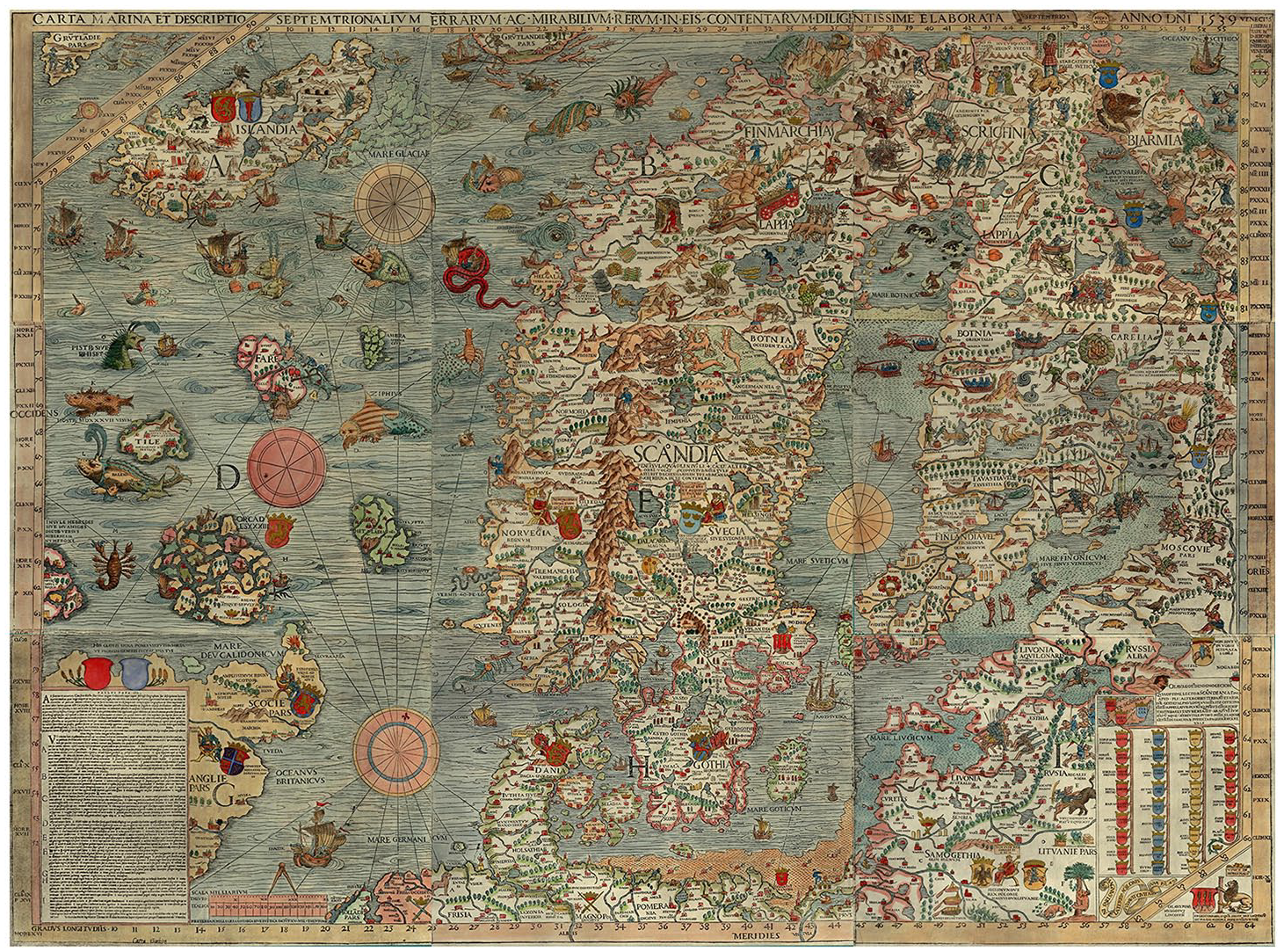
Olaus Magnus, Carta Marina, ca. 1539, via Wikimedia. Sea dragons depict oceanic realms of dubious knowledge.
We would also study the late 18-century geographer Jean-Baptiste Bourg-uignon d’Anville, who was known for deploying ‘vast blank spaces [that] marked what was not yet known’, while also serving as ‘proof of the exactitude of all that was filled in’ (De Caritat de Concorcet, 1785, cited in Blond and Haguet, 2020: 113).
There has also been a significant amount of recent research in the digital humanities and communication design about how we can represent ambiguity and uncertainty, with the intention of cultivating productive reflexivity and doubt (see Drucker, 2014). Because of the wealth of such resources, I would have to explore much more deeply and widely to determine which texts and examples belong on the syllabus – but a recent paper by Georgia Panagiotidou et al. (2022) is a good starting point. Panagiotidou worked with a team of colleagues to review 126 digital humanities publications to assess how their authors visualized ambiguity. The team identified myriad potential sources of ambiguity – including missing, imprecise, conflicting, or unverified data; and errors in digitization, coding, classification, or modeling – and a range of strategies for addressing these issues in data analysis: acknowledging and contextualizing it, excluding problematic data points, using computational methods to fill in the missing data and/or using manual methods to evaluate and correct doubtful data (Panagiotidou et al., 2022: 5–6). 4 Again our class could consider the methodological, epistemological, and ethical implications of these various strategies – and how they play out in contexts beyond the humanities.
Panagiotidou et al. found that most researchers addressed data ambiguities textually, through captions and caveats, rather than trying to signal doubt graphically (p. 8). We observed a similar strategy very recently, when Google’s Bard chatbot used text to acknowledge uncertainty and, perhaps, elicit some healthy skepticism. Priming its users to doubt the tool also, of course, serves to limit the company’s liability when Bard generates fabrications and falsehoods, which chatbots are wont to do. Bard introduces itself at the top of the page – ‘I’m Bard, your creative and helpful collaborator’ – and immediately acknowledges its flaws: ‘I have limitations and won’t always get it right, but your feedback will help me improve’ (Metz, 2023). Humanizing the bot – a positioning strategy made visual and interactive, too, through the UX designers’ choice to have these bots incrementally reveal their answers to us, as if they are thinking at 80 words-per-minute – certainly informs how we relate to it and hold it accountable. In our speculative class, we would consider these various linguistic and UX strategies and their implications for operationalizing doubt (Panagiotidou et al. (2022: 5–6). 5
Yet there has also been a great deal of experimentation around visually embodying ambiguity, and in this age of memes and Midjourney and deepfakes, it is particularly important to understand how graphics are made and how they are meant to function rhetorically. How can we learn to doubt the veracity of an image, and how can images embody clues to their own critique and prompt doubtful reception? Communication designer Valeria Burgio offers a glossary of ambiguity aesthetics – ‘from blurry borders to figures vanishing in the background; from color gradients that vary according to different degrees of probability . . . from oscillation to swarming in animated information visualization (Burgio, 2019: 165). Opacity and color saturation commonly operate on a gradient of certainty and doubt. We sometimes see these tactics deployed to create ambiguity and doubt in maps of vulnerable populations or high-security resources – from endangered species to top-secret government sites – because rendering such entities visible through precise geolocation could create vulnerability.
On a recent visit to the Center for Research Architecture, an agency that investigates human rights violations through spatial and architectural analysis, a team member told me that, when building 3D models, they often use abstraction – much like architectural massing studies – to convey their uncertainty about particular areas in a terrain. The team’s immersive reconstruction of the Grenfell Tower Fire depicts the building’s interior in all white, signaling the model’s status as a mnemonic device. When we turn corners or open doors, we sometimes encounter a faint haze that is meant to suggest smoke, but which also evokes doubt, reminding us of the epistemological ambiguity of this fabricated realm. 6 Finally, CRA’s VR model documenting the beating of a Palestinian man in Hebron (see Figure 3) reflects disparities in witnesses’ recollections of the scene by rendering their disparate renditions in different colors, evoking healthy skepticism in the veracity of each informant’s testimony. 7
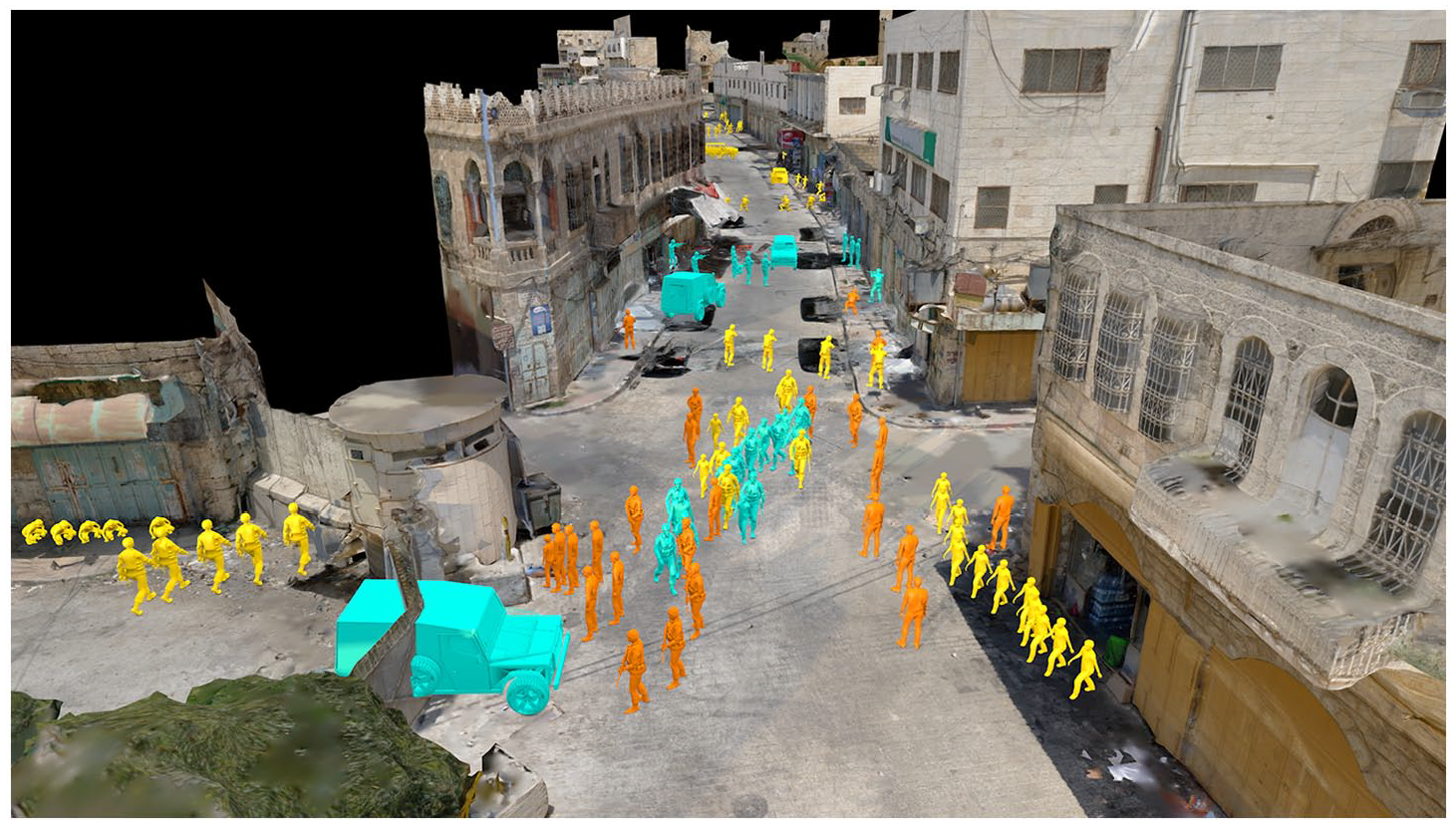
A still from the Center for Research Architecture’s VR reenactment of the Beating of Faisal Al-Natsheh (2014), depicting different witnesses’ disparate recollections in different colors. Project team: Eyal Weizman, Nathan Su, Christina Varvia, Ariel Caine, Shourideh C. Molavi, Ronni Winkler, Alican Aktürk, Sebastian Tiew, Sarah Nankivell, and Robert Trafford. Reproduced courtesy of the Center for Research Architecture.
Designers commonly use particular graphic forms – error bars, violin plots, quantile dotplots, or forecast tracks – to display data distributions and, we might say, preemptively manage doubt (see Bertin, 1983; Wainer, 2009). Three of my former New School colleagues – Aaron Hill, Clare Churchouse, and Michael Schober – discuss the limitations of these conventional techniques, particularly their incapacity to communicate the sources or kinds of uncertainty they represent, and propose instead that we look to fine art for ideas about how to use placement, shape, orientation color, texture, value, and size to convey uncertainty (Hill et al., 2018) (see Figure 4). 8 In our speculative class, we would build a toolkit (or consult those that already exist), we would try out various approaches, we would productively misuse them, we would consider how various graphic treatments make arguments and make ethos and pathos appeals.
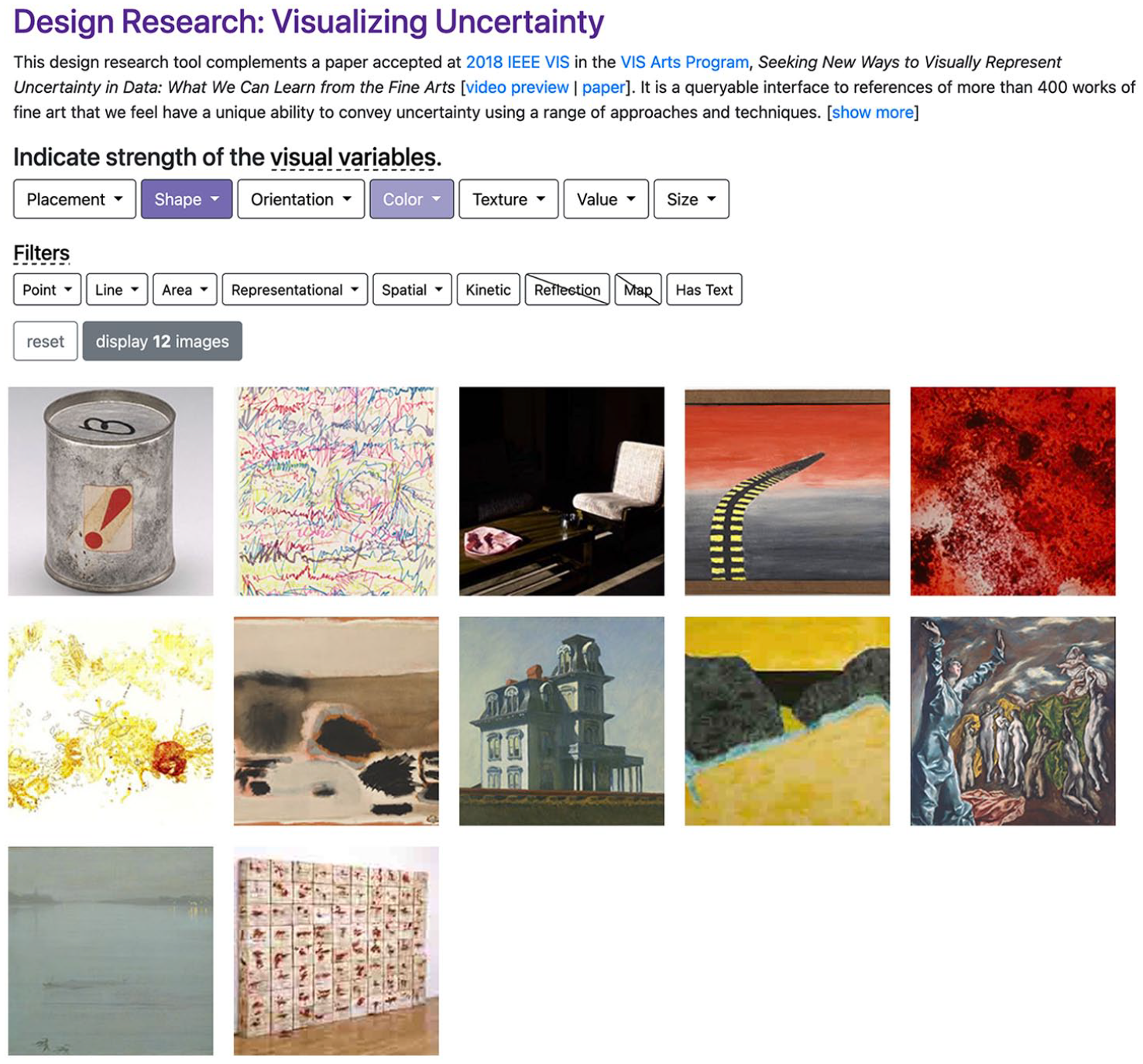
Screenshot of Aaron Hill’s Uncertainty.io (Hill and Schober, 2022), a tool that shares works of fine art that exemplify various aesthetic variables useful in depicting uncertainty. Reproduced courtesy of Aaron Hill and Michael Schober.
But graphics are not the only way to evoke doubt. Data scientists have also tried deploying sound to convey ambiguity. Andrea Ballatore, David Gordon, and Alexander Boone tested various qualities in data sonification – loudness, duration, location, pitch, register, attack, decay, rate of change, noise, timbre, clarity, order, and harmony – and found that loudness, clarity, and the order of tones (e.g. a chromatic scale vs disordered tones) most intuitively convey ambiguity to listeners (Ballatore et al., 2019: 385–400). Of course there is a long history of music conveying doubt: halting voices, bows scratched across strings, the existential doubt of a middle-school band concert. I am sure opera is full of doubt, but I don’t know enough about it to offer examples. I do know that second-wave emo, from the 1990s, was imploding with doubt: from the lyrics lamenting unrequited love, to the voices palpably doubting their own capacity to reach those wrenching high notes, to those jangly guitars locked in a spiral of woe. Here, doubt emerges not only through our ‘interface’ with the music, but also, occasionally, through the score and its instruments of execution. As one of relatively few women in the darkened rec rooms and basements where Sunny Day Real Estate, The Promise Ring, and Cap’n Jazz played, I found catharsis, and even joy, in this collective expression of doubt – about everything from traditional gender roles to engineered aesthetic tastes (Carrillo- Vincent, 2013: 35–55; Greenwald, 2003).
Coding/modeling doubt
If, as Amoore (2019) proposes, and as my emo show-going demonstrated, doubt is a distributed, embodied phenomenon, we also might want to consider how it extends beyond, behind, the interface – past the ‘content’ we consume through the screen or speakers. How might we code or model doubt? AI researcher Dmitry Muravyov studies activists’ engagement with the DTP Map, which tracks traffic accidents in Russia, but whose ‘official’ data is often erroneous and incomplete. Muravyov finds that users doubt the data but still actively participate in its improvement; they advocate for critical analysis that acknowledges the data’s limitations in order to maintain trust in the map and its larger civic function (Muravyov, 2022). He describes the epistemic virtue of ‘datafied doubt’, a ‘disposition towards data that is hopefully pessimistic, open-ended, and rooted in practice’ (Muravyov, 2023). When people are engaged in recognizing what counts as data, when they are involved in deciding what data sets can be layered or composited to understand a complex phenomenon, and when they are performing the labor of data production – cleaning, annotating, curating – they can better understand how to position, and possibly balance, doubt and trust within the whole technosocial assemblage.
Such a unit in our speculative class would integrate the principles of data feminism and indigenous data sovereignty, engage with theories of data colonialism and the ethical principles of community archiving, examine some data ethnographies, and perhaps even give us an opportunity to perform our own data walks, which encourage students to ‘observe data mediations in the space of the city’, or walk-throughs, wherein users walk you through their use of particular technology (see Data Walking: https://www.datawalking.uk/; Light et al., 2016).
We would consider how various digital tools – enterprise software, like Microsoft’s or Salesforce’s suites of soulless systems, is one of my favorite examples – require us to bend to their will, adapting our questions and methods to accommodate the tools’ demands or limitations, and then obligating us to perform particular forms of administrative labor that might not be aligned with the ethos of our own work (see Borgman, 2017; Edmond, 2016; Presner, 2016). Anthropologist Joe Dumit’s ‘implosion method’, which I use often in my teaching, could be useful here, too: the method invites students to consider how things come to be, how they exist in the world, how they shape that world, how we engage with them, and so forth, as a means of understanding how various forces ‘implode’ into and constitute these things (Dumit, 2014). We might start with a database or a data-rich environment, like a hospital or an air traffic control tower, and consider its design; what agents made what choices, with what specific interests, that informed its creation and operation; what ways of knowing converge within it; and how it embodies trust and doubt. These various methods can help us identify where doubt arises in the coding of digital technologies.
We could also imagine speculative data architectures that better match our epistemological and ethical values. Digital humanist Jennifer Edmond writes about the ways off-the-shelf tools and standards can facilitate connection and discovery but also often decontextualize and reduce the complexity of the material we are working with, which can cultivate distrust and doubt. Edmond (2016) encourages us to create tools that provide context and provenance, that allow for corroboration from other sources in other formats, and that offer additional features that either promote healthy skepticism or mitigate doubt when appropriate.
I will share two more examples. The first is my friend and colleague (and former student) Or Zubalsky’s Merge Conflicts, which uses Git, the version control system that tracks changes in computer files, as a textual analysis platform and an historiographic tool. They mis-use the platform to compare different versions of school textbooks – in this case, Israeli and Palestinian materials – to track changes and disparities, and, using the language of the software, to merge and ‘commit’ to particular framings. We thus codify our doubt of settler colonial pedagogy and, in the process, unlearn it (see Merge Conflicts: https://www.learngit.xyz/). Using the affordances of the software, Merge Conflicts denaturalizes received wisdom and demonstrates that history is something that has versions, something that warrants doubt and careful comparison.
My second example is a New York-based organization with whom I have collaborated over the years: the School for Poetic Computation focuses on artistic and critical uses of code and design (see https://sfpc.io/ and https://sfpc.study/participate). They encourage participants to doubt the affordances and ideologies built into our digital tools, and to use them instead to embody social justice-aligned values, to support different ways of being, and to make us think about our own intelligence. Recent classes have focused on solidary infrastructures, primitive hypertext, algorithmic botany, and digital love languages. Doubt, here, is a generative, poetic force – it is something we can intentionally build into our technologies in order to cultivate trust, wonder, and care in our social relations and our engagements with the natural world.
Dubious infrastructures
Yet, if we dig even deeper into the technical stack, or extend further into the network, we recognize that doubt can also take a more material form. It can manifest in processors and data centers, servers and satellites, and in all the people who ensure these infrastructures’ functionality: maintenance workers, service providers, the invisible people who perform the piecework and content moderation that makes AI seem automated. In this unit of our speculative course, we would draw on scholarship in critical infrastructure studies and disaster studies – particularly research that demonstrates how doubt and distrust are inherent in perpetually broken infrastructures – and we would explore a variety of critical technology projects that invite us to doubt our infrastructures’ realiability, functionality, and equitable deployment (see, for instance, Graham and Marvin, 2001; Sundaram, 2010). Such work encourages us to be more critically aware of these infrastructures’ existence, to think about the values they embody, to become more engaged consumers, and maybe even to agitate for new policy or new design and engineering that prioritizes accountability, justice, care, and sustainability above efficiency and profitability. And, in light of our conversation earlier about the challenges and dangers of using commercial, off-the-shelf software to do humanistic and artistic things, we might think again about our capacity to build our own tools – not only software, but also hardware and infrastructure.
We could consider global manifestations of mesh networks, which my friend and colleague Rory Solomon (see Solomon, 2020) has written about, and community digital networks, which my friend and colleague Greta Byrum has both written about and helped to build (see Byrum, 2019). These networks are sometimes unreliable – community members doubt their functionality in particular geographic terrains and weather conditions – but they embody the values central to those communities: privacy, sovereignty, equity, conviviality. We would survey the burgeoning activity around public digital infrastructure and open infrastructures (see, for instance, the Initiative for Digital Public Infrastructure: https://publicinfrastructure.org/; and Invest in Open Infrastucture: https://investinopen.org/). We could also look at creative technology projects, like Low<Tech Magazine’s solar-powered publication and Tega Brain’s ‘Being Radiotropic’, a set of environmentally sensitive routers – all of which generate illuminating doubt about our infrastructures’ ubiquity and constancy, and remind us that they are the products of human maintenance and environmental resources, and that their perpetual operation has social and ecological impacts (Low<Tech Magazine: https://solar.lowtechmagazine.com/ and Tega Brain, ‘Being Radiotropic’: https://www.tegabrain.com/Being-Radiotropic).
Shadow of a doubt
After moving through the technical stack and pulling us through the digital back into the material world, I would like to close with a conceptual case study: a thing, an idea, that promotes a ‘gathering’ of media forms and disciplinary knowledges. I would like to shed light on shadows, a timeless emblem of obfuscation and doubt. In Plato’s cave, shadows capture the limits of our perceptual knowledge. Painters have long been fascinated and stymied by them. As EM Gombrich (2014: 14) writes in his book on the subject, ‘some of the greatest observers of nature appear to have deliberately avoided the cast shadow.’ Leonardo da Vinci encouraged painters not to make figures appear to be illuminated by the sun but, instead, to cloak them in a ‘mist or transparent cloud’.
Caravaggio and De Chirico, meanwhile, relished in them, painting bodies and city squares in deeply raked light that creates heavy shadows. As we see in their work and elsewhere, shadows also illuminate and clarify. They are central to astronomy and the way we know the universe. Cognitive scientist Roberto Casati and psychologist Patrick Cavanaugh note that shadows help us discern ‘the three-dimensional structure of the environment. Studying shadow perception reveals a vast array of sophisticated, hidden mechanisms of the visual brain’ (2019: vii). Shadows reveal, obliquely, the presence, location, shape, and size of things. They are foundational in particular architectural traditions; in Lamp of Power, John Ruskin notes that a young architect’s first task should be to develop a habit of ‘thinking in shadow’ (see Kite, 2017). We might say the silhouette offers a portrait of doubt, capturing only the outline but not the substance of its subjects.
In his (2021) book, Black Paper: Writing in Dark Times, Teju Cole engages with Santu Mofokeng’s photographs in the townships of apartheid South Africa. Mofokeng ‘seems to test how many eccentricities a picture can tolerate before it breaks’: ‘he shoots in low light, nothing is ever quite level’, figures seem to be where they are by chance rather than intention – all of which might make us doubt Mofokeng’s skill as a photographer. Yet Mofokeng’s intention is to depict a ‘gossamer world’ that is often opaque, elusive to outsiders. ‘The energy’ of his photographs, according to Cole (2021: 81), resides ‘in waiting, in uncertainty, in deep shadow’. His images embody what is known in the Sesotho language as seriti, ‘a word whose senses include “shadow” as well as “aura,” “dignity,” “presence,” and “confidence”.’ Imagine building a controlled vocabulary, or teaching an LLM, to accommodate such a complexly coded term, a contranym that encompasses seemingly contradictory qualities.
Doubt is like seriti in that it is an epistemological shadow that manifests as a hazy presence on our maps and graphs, and whose adoption, in a world of artificially intelligent positivism, can constitute a form of dignity and confidence. It also serves as a tool for the confident conspiracist to cast a shadow on scientific consensus and public knowledge. Doubt encompasses intellectual skepticism, spiritual misgivings, and ethical conviction. Like the shadow, it resists clear, intuitive representation, yet it pervades – as an ethical and affective force – our systems and methods of knowledge production. Doubt is precisely the kind of bafflingly overdetermined, gloriously obfuscatory, and murkily revelatory subject that demands humanistic and artistic inquiry. And, for those same reasons, doubt should guide our creation, adoption, deployment, detournement, and refusal of digital tools as the world races to code itself into posthuman enlightenment.
Footnotes
Notes
