




Abstract
This article explores the Travesti Museum of Peru, a portable and conceptual artwork created by Giuseppe Campuzano that presents Peruvian history through queer, trans, and Indigenous perspectives. It argues that this project is reparative by way of bringing Andean genders and sexualities back into history as a form of anti-colonial and queer politics. This research uses Andean modes of analysis to describe the Travesti Museum as a trans-temporal archive and practice of travestismo in both its form and content. In this text, travesti performance is defined as a mnemonic strategy while situating the Travesti Museum within the contexts of Andean performance repertoires, discussions of class and race, as well as within the history of colonial refusal – arguing that Campuzano’s methods interrupt Western assumptions about the archive. It brings together the ideas of Campuzano and Bolivian sociologist Silvia Rivera Cusicanqui in an effort to highlight critical concepts from the Andes that are informed though embodied methods of thinking through history and resistance, resulting in a reading of radical Andean intimacy. The article concludes that the Travesti Museum can be used to analyze how the body relates to ideas of history, and as a tool to learn how we could write history starting with an embodiment of collective memory.
Between 2003 and 2013, the late Peruvian artist, philosopher, activist, and drag queen Giuseppe Campuzano created the Museo Travesti del Perú or Travesti Museum of Peru. It is an artwork, research project, and portable conceptual work that has been exhibited in museums, galleries, street corners, universities, markets, public parks, protests, and red light districts. The Travesti Museum is a political exercise and collective form of activism that calls for a reparative history of travestis. Together, the objects in its collection present history through the bodies of what Campuzano describes as the androgynous Indigenous and the mestizx 1 travesti. The archive has at its core a specific conceptualization of the travesti described by Campuzano as a fluid gender or as a continuous questioning of gender itself. The Spanish term ‘travesti’, which translates to ‘transvestite’, holds a different meaning than its English counterpart in this text. This meaning of ‘travesti’ is specific to Peru and the way Campuzano uses it within the Travesti Museum. Because of this, I do not translate this term into English. Campuzano reminds us to ‘keep in mind that in some parts of Latin America the term “transvestite” has been repurposed by its own addressees’ (Campuzano, 2015: 4).
Collective knowledge, shared goals, and a community-based ecosystem of travesti, queer/cuir, and trans folks shaped Campuzano and the formation of the Travesti Museum. I argue that the cultural continuity this project presents is reparative by way of bringing public awareness to Andean genders and sexualities as a form of anti-colonial politics. I also discuss the exciting developments of travesti and ch’ixi musealities shaped by Campuzano and her collaborators. 2 In a recent text discussing museums created by trans and queer artists, art historian Julia Bryan-Wilson (2021) notes that artists ‘landed on the charged term museum for a reason: its almost alchemical ability to transmute marginal narratives, particularly queer and trans narratives, into something that passes for official history’. She writes that the museum ‘possesses the capacity to make worlds out of fragments – a tactic queer and trans people have become adept at’, and describes Campuzano’s work as activating ‘the tension between repudiating the museum altogether and wielding it knowingly as a device of visibility’. While the Travesti Museum uses museological presentation as a political strategy to call for the inclusion of travestis in Peruvian history, at the same time it also appropriates and cannibalizes the museum – spitting out a contaminated and mutant history. By cross-dressing as a museum in order to travestir (make travesti, cross-dress) the museum, the Travesti Museum is ‘entering it not to belong by disappearing but to transform it from within . . . A transvestite in the museum, not as a mark of identity, but as visibility of the constant metamorphosis of bodies and knowledge; as living culture’ (Campuzano, 2015: 5).
My research uses Andean modes of analysis to describe the Travesti Museum as a trans-temporal archive and practice of travestismo in both its form and content. In this text, I try to define the travesti while situating the Travesti Museum within the contexts of Andean performance repertoires, discussions of class and race, as well as within the history of colonial refusal – arguing that Campuzano’s methods interrupt Western assumptions about the archive. I bring together the ideas of Campuzano and Bolivian sociologist Silvia Rivera Cusicanqui in an effort to highlight critical concepts from the Andes that are informed though embodied methods of thinking through history and resistance. Rivera Cusicanqui’s conceptualization of ch'ixi – an Aymara term she uses to describe an anti-colonial collective subjectivity located in the intermediate space of colonial confrontation – is presented alongside Campuzano’s ‘travesti’ as a reparative concept and way of being.
My main object of study is a performance piece created by Campuzano based on the popular practices of fiestas – festivities and rituals in the Andes that venerate saints or virgins, or that mark important changes in the agricultural and spiritual calendar. Campuzano (2007: 60) writes that ‘certain ancestral dances preserve one of their characteristic features: ritualistic travesti, whose mimesis of the unknown transforms the whole body. The dancer made into a centre that complements our aesthetics of opposites’ in the Andes. 3 Rivera Cusicanqui (2010: 5) theorizes on the nature of such performances, and claims that these festivities are part of a larger cultural collective subjectivity she calls ch’ixi. Ch’ixi describes a grey that is mottled, stained, or spotted. It describes two complementary colours coming together – for example, black and white – that create something that might look grey but, upon closer examination, is actually composed of black and white dots that are constantly moving but never mixing. For Rivera Cusicanqui, the idea of ch’ixi has the potential to decolonize what in Latin America we call mestizaje – a colonial term that describes a process of racial mixing that constructs a new identity (the mestizx) by committing an erasure of Indigeneity and Blackness. Rivera Cusicanqui (2021) describes mestizaje as an ‘official ideology of denial . . . a complacent and normative view of racial mixing’. In contrast, ch’ixi is a term that describes the decolonial version of a mixed-race subject through a radical reparative process of fighting and resisting internalized colonization. It describes a mixing where the assumption of whiteness as a dominant force is refused, and where Indigeneity purposely ‘contaminates’ and exerts power over it. Although this is how Rivera Cusicanqui pictures the concept today, the idea itself comes from an Andean pre-colonial complementary tradition of appropriation and incorporating the foreign as a method for survival.
Campuzano, or Giu as those close to him called him, was part of a community of travestis, sex workers, drag queens, artists, curators, academics, community organizers, and activists. He founded the Travesti Museum starting with his own body and by collecting personal objects related to his identity. In the course of 10 years, the project evolved into a mutating entity that explored history, travestismo, the nation state, museological processes, performance, ritual, embodied narratives, collective care, and much more. I argue that the travesti methodology and epistemology that Campuzano describes provides an important vocabulary and theory to discuss how dissident bodies and indiscernible subjects relate to history, to politics, and to each other. I am specifically interested in the Travesti Museum’s instances of performance and ritual, which are connected to the ways history, subjectivity, and resistance are practiced within the Andes. It is through performance that one can see how the Travesti Museum draws from Andean practices, tactics, and values. In this way, the Travesti Museum is not only a reparative project in terms of its content and the history it presents, but also in how it continues a practice of resistance from colonialization through its processes and methods of performance and embodied thinking.
By linking the past and the present through travesti bodies, the Travesti Museum embodies a cyclical understanding of the process of time and history. It is a method of survival where mutation and renewed embodiment are necessary for future existence. Since at least the early days of colonial conquest, processions, carnivals, and fiestas have been a site in which there is a suspension of established norms. Moments like this have the capacity to establish a collective catharsis of emotions that are usually forbidden, and it is these emotions that Campuzano brings into the gallery and the street through performance and dance. History, especially Andean history, must be created collectively and publicly, and the performances of the Travesti Museum act as a collective and public fulfillment of the identities and memories presented within this archive. If embodied culture is harder to control, as performance scholar Diana Taylor (2003: 17) suggests, then when creating a history of Peru, it would be most effective to do so from these historical embodiments.
Andean methods: autopoiesis as repair
I was born and raised in the high-altitude, mountainous region of the Ecuadorian Andes, but my practice as a curator, writer, and scholar is currently based in Canada. In my first year of researching the Travesti Museum, I felt a pressure to translate its ideas into terms that the North American or Western academy might understand. I thought of translating Campuzano’s ‘travesti’ into my North American knowledge of queer theory and feminist thought. I wanted to translate travesti into transgender, or transsexual, or non-binary, or Two Spirit. Although all of these terms have certain affinities to travesti, my understanding of this term is that it is drawing on at least centuries of local embodied knowledge, performance repertoires, contemporary communities, historical resistance, and mutation. Campuzano’s work really started to make sense to me when I stopped trying to translate it and instead made connections between the project and performances of travestismo in my home town – in Kichwa dances, celebrations, and rituals, as well as on New Year’s Eve when mostly mestizo men dress in drag and perform on the streets every year. In many ways, my research and my embodied connection to this work has been a form of self-repair and a strategy for tracing my own lineage.
In the years I have spent researching and connecting with the Travesti Museum, its popularity has grown impressively. When I first approached the project, it was already well known within Latin American queer and trans activist communities, as well as within certain circles of Latin American contemporary art and performance studies. Since then, it has gained momentum in Western academic and art contexts. It has been discussed in major English-language books and essays, popular art magazines and periodicals, journals, conferences and dissertations, and presented during talks at major museums in the United States and Europe. There are significant and useful connections to be made between Campuzano’s work and the work of well-known thinkers in the global north, especially if you are interested in building hemispheric or transcultural exchanges in performance studies, queer theory, the study of archives, museology, and critical theory. José Esteban Muñoz’s work comes to mind, or Jasbir Puar’s writing on queer assemblage, Sara Ahmed’s feminist citational practices, Cait McKinney’s research about community-based archives, Daniel Heath Justice’s theory of anomaly, what TL Cowan has called ‘transmedial drag’, Diana Taylor’s exploration of the archive and the repertoire, or Amelia Jones’s writing about performance documentation. Some of these connections are ripe for further study, others have already been made.
Found within the expansive possibilities for building networks and associations, I asked myself what kind of a reading does the Travesti Museum deserve? What kind of reading can I provide? And what kind of reading is lacking? Although the Andean origins of the project are clear – something Campuzano described at length – a focused and lengthy discussion of this project based on Andean thought and Andean perspectives has not been published until now. I decided that the Travesti Museum required a reading of radical Andean intimacy – a reading from the roots of earthly beings, a reading from high in the mountains where the air is cold and thin, and where the raging sun melts the ice of glaciers, water traveling down the pathways and chaquiñanes of the páramo to lakes and ravines, creating an archive of the land. This reading is a reading of/from Andean land, where llacta describes a material and spiritual territory made from the relational entanglements of everyone and everything that shares the space.
This reading is also about contextualizing the Travesti Museum within ongoing Andean practices of survival based on emotional and memory-based embodied strategies, and by appropriation. My training as an art historian was lacking for this analysis, as the distance between the observer and the observed is not part of an Andean approach. I had to feel my way through this archive alongside Campuzano and Rivera Cusicanqui as my theoretical companions. This kind of feeling is an important method to take up in this context. It follows the ideas of sentipensar, or ‘feel-think’, an epistemology within Latin American scholarship and activism that ‘suggests a way of knowing that does not separate thinking from feeling, reason from emotion, knowledge from caring’ (Escobar, 2020: xxxv). 4 Rivera Cusicanqui’s (2010: 153) use of the Aymara term amuyt’awi is also helpful to describe my approach, as it explains a way of ‘reasoning based on memory, an emotionally reflective form of thinking’. Presented by Rivera as one of multiple ways of thinking in the Andes, this is not only an emotional thinking, but a thinking that is embodied and trans-temporal.
Rivera Cusicanqui also continues to influence me through her approaches to curation and art historical research. Rivera and other Andean thinkers known as El Colectivo were invited to be curatorial collaborators for the art exhibition The Potosí Principle, which was presented in major museums in Berlin, La Paz, and Madrid between 2010 and 2011. However, they chose to quit after realizing that the European curators behind the project had a ‘fascination with the brutality of imperialism and even with academic criticism of it, but nevertheless deny that the daily practices of re-appropriation and resistance have something more than a merely folkloric value’ (Geidel, 2010: 58). El Colectivo member Eduardo Schwartzberg Arteaga (2010: 49, 52) describes this experience as a ‘discourse of “solidarity” and “radicality” that was no more than a euphemism to cover up the misunderstanding of the Andean curatorial proposal . . . They had downgraded us from curators to informants: a reissue of colonialist anthropology, but in terms of art history.’ After leaving the project, El Colectivo decided to create a dissident catalogue presented alongside the exhibition. Called Principio Potosí Reverso, the book takes on an Andean materiality: it starts in the middle and is divided in half by opposing colours. The white side discusses colonization and Andean survival strategies, and reflects on the failure of this curatorial collaboration, while the black side discusses fiestas and colonial painting as case studies that present examples of Andean ways of being. At the beginning of the book, which is where the text ends, there is a glossary of Aymara and Kichwa terms that become theoretical markers for the Andean methods described in the book, and which I also use in some parts of this article.
The reparative essence within the autopoiesis of the Andes – what the European curators of The Potosí Principle were accused of not understanding – is what I try to discuss in my analysis of the Travesti Museum. In Andean cosmology, time-space is not a linear progression, but a sequence of cycles, where at times aberrations can produce change (Strong, 2012: 5). The beginning of colonialism in the Andes during the 16th century marked a new pachakuti, or historical cycle, that introduced a new colonial force, and as Rivera Cusicanqui (2010: 8) describes, a new rootless subject with foreign gods, money, and symbols. She explains that Andeans then ‘deployed an immense hermeneutic labour, to domesticate and give roots to foreign’ ideas and values, using a ‘permanent autopoiesis’ that is at the heart of the Andean communal condition. Here, appropriation and syncretism are a reparative practice.
‘Autopoiesis’ was coined in the 1970s by Chilean biologists Humberto Maturana Romesín and Francisco J Varela García to describe a living system that can maintain and renew itself. Since then, this term has been taken up by multiple disciplines, and it is borrowed here by Rivera Cusicanqui to describe an Andean system of survival that has existed since before the colonial invasion. Later on, I discuss how this can be examined in Andean dances and fiestas and in the Travesti Museum, where the foreign or unknown is ritually incorporated. Rivera argues that this communal autopoiesis is what marks the Andean condition and what has allowed us to manage European colonization. She explains, we are talking about an autopoiesis that lives within its own contradictions: a dialectic without a synthesis, in permanent movement, that articulates itself with the foreign in subversive and mutually contaminating ways. The subjectivity of the ch’ixi collective subject is configured in and by displacement. (p. 9)
Repair is autopoietic in the Andes.
The many travesti museums: materiality, display, and the public
I first encountered Campuzano in a photographic portrait by artist Alejandro Gómez de Tuddo depicting her as the Virgin of the Huacas (see Figure 1). Standing on rocks in the shoreline of the Pacific Ocean and cross-dressed as the Virgin Mary, Campuzano is wearing a metal crown and a luxurious triangular costume whose shape mimics the outline of the mountains in the background. It was like seeing one of the wooden polychrome sculptures of the Virgin, that I often encountered in Catholic churches and domestic spaces growing up, embodied and in the flesh. In the Andes, there are countless stories of the sculptures of saints and virgins ‘coming to life’ and leaving the church or engaging in a myriad of activities, usually at night or when nobody is looking. In this image, I saw the Virgin as she escaped the church and joined the mountains and the sea. I was completely taken by this mischievous Virgin.
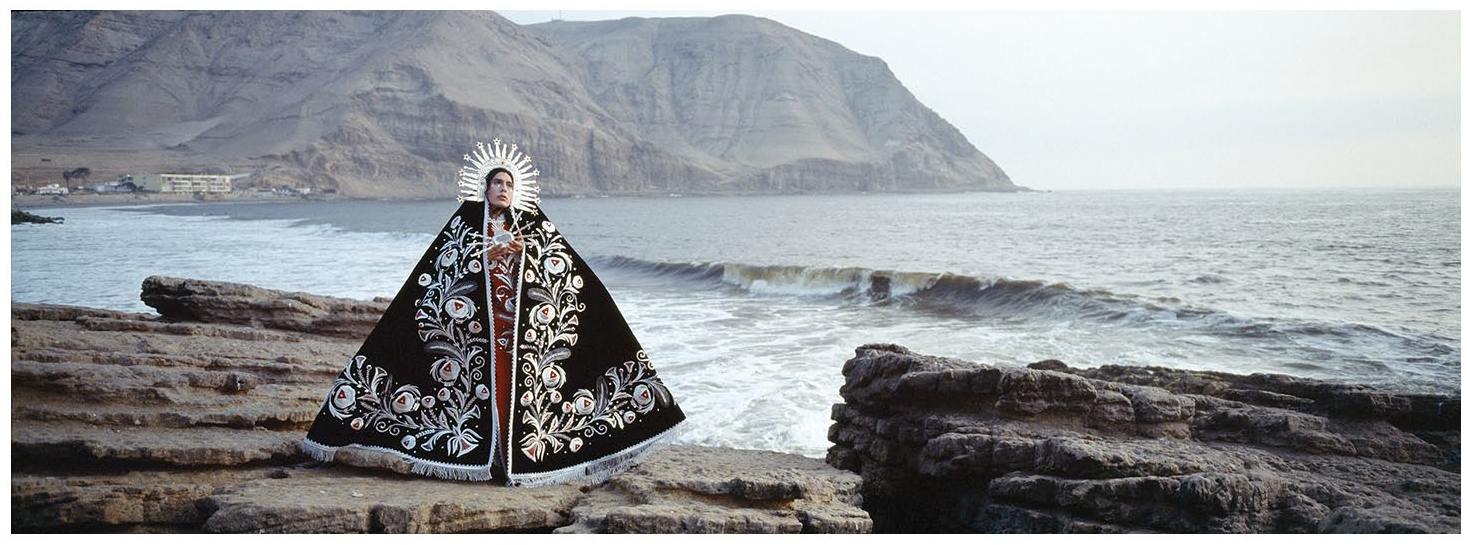
Alejandro Gómez de Tuddo, La Virgen de las Huacas (Retrato de Giuseppe Campuzano como Virgen Dolorosa), 2007. Chromogenic print, 70 x 194 cm. Reproduced with permission.
The nature of the Travesti Museum is very similar to the travesti subject that is at the centre of its founding – a mutant subject who is defined by change. The objects in its collection follow the history of Peru through representations of travesti bodies and include watercolour paintings, clothing, colonial ordinances outlawing same-sex relations, identification cards, colonial-era paintings from the Cusco school, Moche ceramics, Chavín and Wari stonework that depict androgynous shamans, drawings by the famed Andean chronicler Felipe Guáman Poma de Ayala, artworks by many contemporary artists including Christian Bendayán and Javi Vargas Sotomayor, 19th-century photographs, shoes, newspapers, and many other artefacts selected by Campuzano. The first iteration of the project was presented in 2004 as an intervention that addressed issues of the patriarchy and the nation state at a museum in Lima that commemorates the 19th-century War of the Pacific that was fought between Chile, Bolivia, and Peru (López, 2021). My favourite work from this exhibition – a work that comes up in future iterations of the project – is Campuzano’s DNI (De Natura Incertus) – a fake and enlarged version of Campuzano’s national Peruvian identification card. For ‘gender’, the card shows ‘T’ for travesti and it pictures Campuzano in full make-up with red hair. The title of the work further describes Campuzano’s conception of a travesti as a subject of an uncertain nature. Other iterations of the Travesti Museum in its first few years took place in public parks, street corners, and markets. In one instance (see Figure 2), documentation shows that the Travesti Museum was inside a display tent at the Parque de la Exposición and included DNI (De Natura Incertus), as well as historical images of travestis. It also housed three small tables with more documents and a replica of a Moche ceramic. Another photograph of a public intervention in 2006 shows enlarged spreads from the Travesti Museum’s four-decade press archive, called Identikit, that collected stories of discrimination and violence against travestis (see Figure 3). Shown on a DIY temporary wall on the sidewalk, this display is coupled with another wall covered in paper which members of the public are invited to write on.
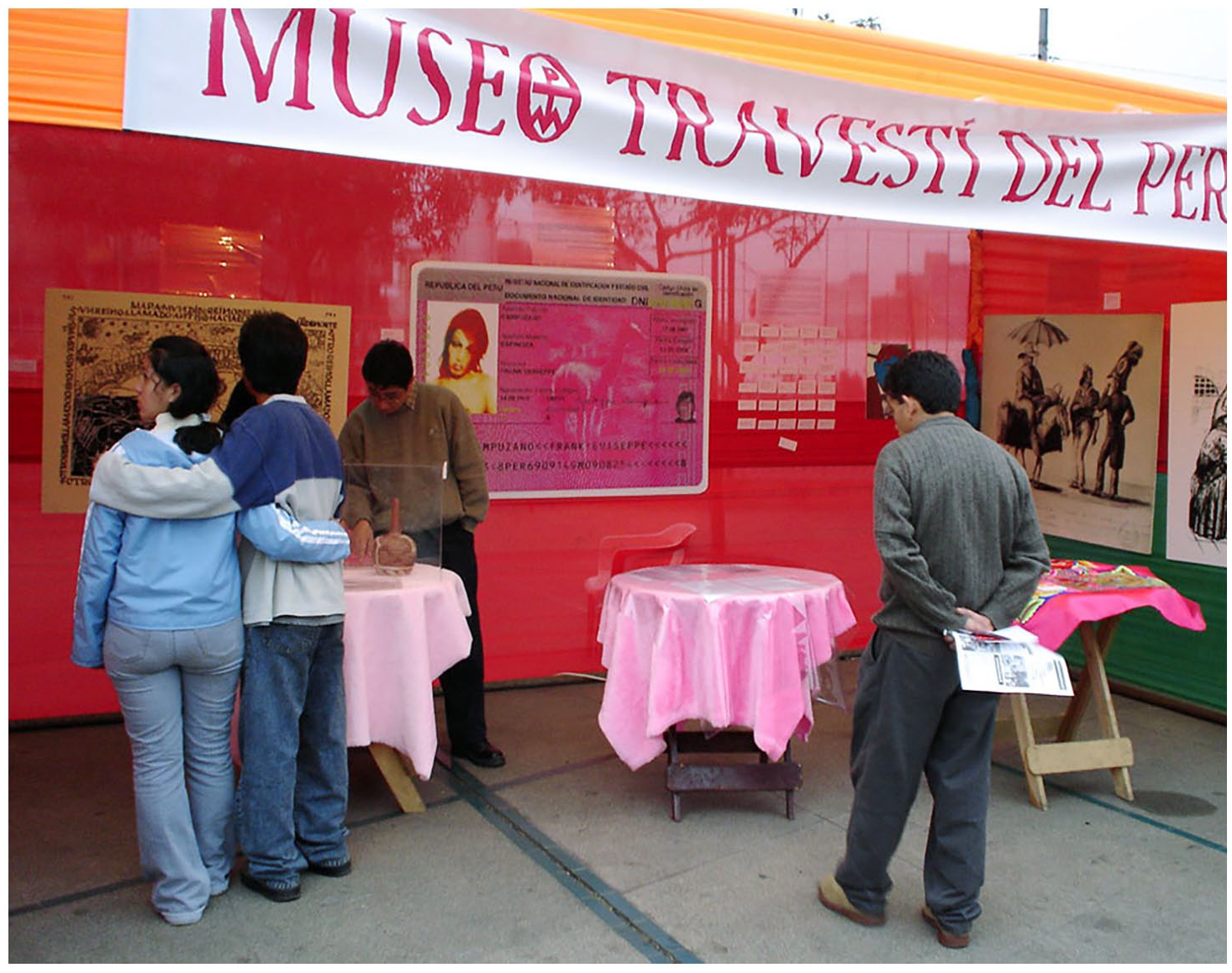
Giuseppe Campuzano, Travesti Museum of Peru: Intervention at the Parque de la Exposición, 2004, Lima. © Photograph: Claudia Alva. Reproduced with permission.
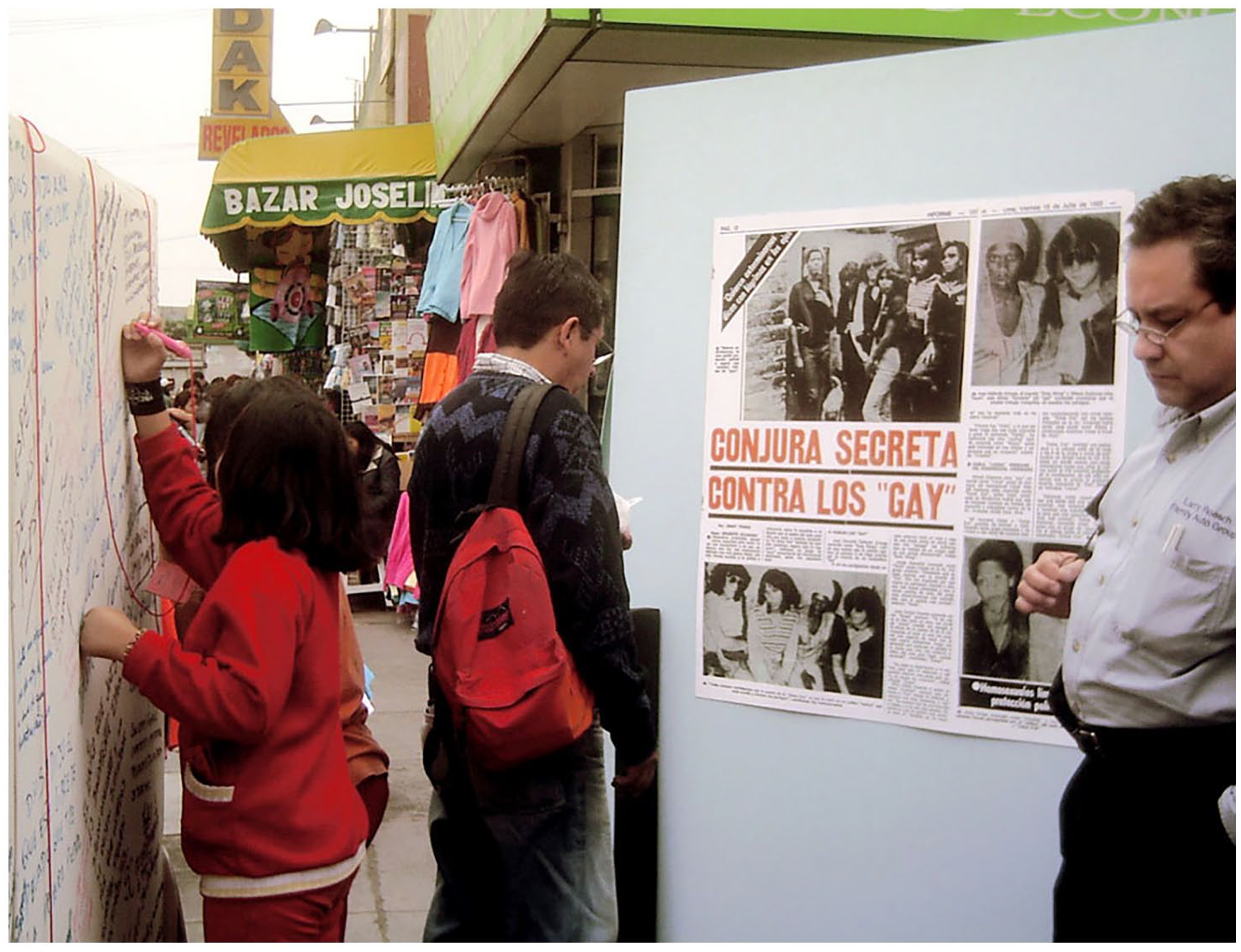
Giuseppe Campuzano, presentation of Identikit, 2006, Los Olivos district, Lima. Reproduced with permission.
As Campuzano (2008: 51) explains, these public interventions went beyond passive information-sharing and sought to encourage community participation and feedback on the project. This took the form of comment books, public panels for people to write on, and a private booth where the public could share their sensations after seeing the display (Campuzano, 2008: 51). Two days before the Peruvian presidential election in 2006, the Travesti Museum also took the form of a demonstration comprised of 24 large format prints from the press archive of the Travesti Museum. These posters were held up by participants in front of a wall that displayed photographs of female socialites (see Figure 4), including presidential candidate Lourdes Flores, ‘a neoliberal who promised to bring about change on the grounds of being a woman while opposing, for instance, abortion’ and whose running mate, ‘nationalist’ Ollanta Humala, had a mother who ‘proposed to shoot homosexuals’ (Campuzano, 2015: 7). The demonstration, which was comprised of a group of travesti activists and the Andean Parliament travesti candidate, as well as the Peruvian Parliament lesbian candidate, contained a powerful message regarding the diversity of Peruvian women, including travestis, who live in different circumstances than the (mostly) white women in Lima’s financial district of San Isidro (a former red-light district where many travestis worked) where the demonstration took place (Campuzano, 2009a: 83, 2013a: 71).
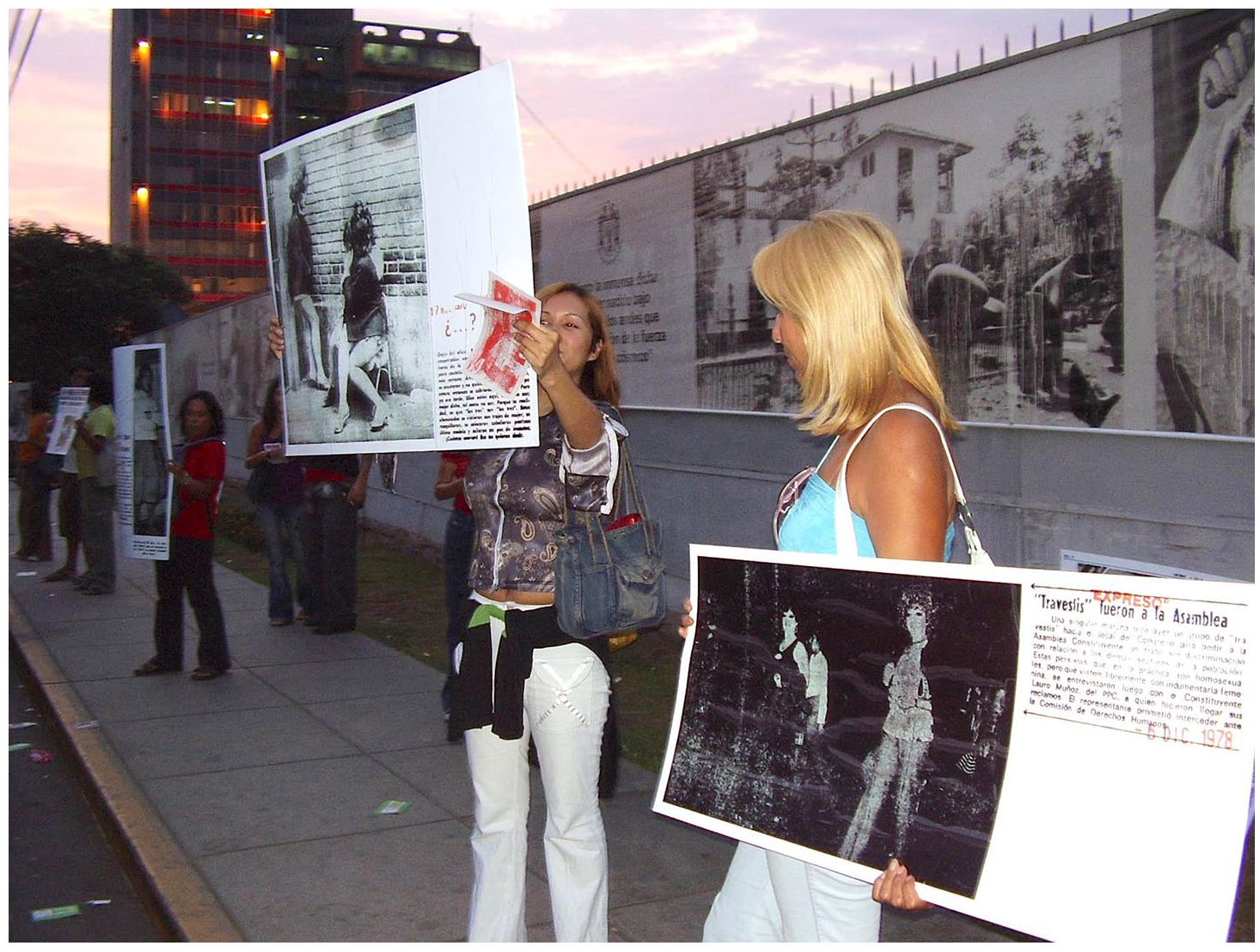
Giuseppe Campuzano, Cubrir Para Mostrar, 2006, Lima. Reproduced with permission.
The Travesti Museum then went on to be shown at galleries, museums, biennials, and the famed Encuentro event organized by New York University’s Hemispheric Institute of Performance and Politics. Campuzano also wrote essays and articles, and did many interviews about this project in journals, on TV, online, and in magazines. In 2007, the Travesti Museum took on the form of a catalogue, which includes essays by Campuzano as well as contributions by other writers who outline the intentions of the project. The catalogue also shows reproductions of most of the objects in the collection, and includes historical and contemporary excerpts from texts that contextualize the objects, as well as some reproductions of the press archive, and a glossary of terms. The publication launch for this book took place during an exhibition of the Travesti Museum in Lima, where a performance and activation of the archive occurred in the format of a fiesta. It is this performance that ultimately made me so interested in this project, conjuring up a habitus of Andean life in a travesti way, or rather, showing us just how travesti the Andes is.
Locating the travesti
Campuzano’s work starts from her own understanding of her travesti body. She states that a number of circumstances allowed her to re-invent her own travestismo, or her own way of being travesti. At the end of the 1990s, Campuzano took a critical distance from ‘the mass media promotion of the image of a domesticated transvestite’ (López, 2014). In an interview, she tells Marcela Fuentes that there used to be an aesthetic ceiling in her own travestismo that referenced Hollywood and femininity, but that afterwards there was also an unconscious knowledge of having other pasts that she considers her own (Campuzano, 2009b). This moment followed a trip she took in 2003 to her father’s town, Muquiyauyo, situated in the highlands of Peru, where she participated in local Andean ceremonies and dances (Campuzano, 2013b: 106). It is at this point that Campuzano started thinking about the history of her own travesti body. With a lack of this history present, Campuzano started collecting and archiving stories, pictures, and objects that insert her travesti body into the history of Peru.
In the 2007 catalogue, Campuzano outlines a genealogy of the travesti that starts with an idea and practice named chhullu. He describes chhullu as the ‘element of tension in between two halves in order to mediate the tinkuy – the meeting of the halves as simultaneous rupture and convergence, affirming the identity of each other while producing a new third entity’ (p. 84). He writes that, in this context, ‘androgynous totality is greater than the sum of its feminine and masculine parts’, with the androgynous as tinkuy navigating the dynamism between male and female, being the original reference point for gender – ‘thus, everything is man–woman – chachawarmi in Aymara and qhariwarmi in Quechua’. This genealogy then explores related terms used at different times throughout the modern/colonial period such as: encharido used in 16th-century Ecuador, wawsa, ipa, and q’iwsa used in the 16th and 17th century; berdache used throughout in the Americas and Europe to refer to Indigenous people who did not follow colonial conceptions of gender and sexual behavior; to ‘androgynous’, ‘sodomite’, ‘maricón’, and ‘drag queen’, concluding with the term ‘travesti’.
The term travesti gets defined in this glossary as ‘a person that assumes the characteristics of the “opposite sex” . . . resulting in a composite of male and female characteristics’ (p. 89). Campuzano explains that some gay people and trans people reject the travesti community, fearing that they would also be stereotyped with them to the detriment of their image and social approval. Malú Machuca Rose, a friend and collaborator of Campuzano, recently published an article reflecting on Campuzano’s death in 2013 and her afterlife, and the afterlife of the Travesti Museum using methods of care, critique, and radical resistance. Machuca reminds us that Campuzano’s conception of the travesti ‘is not without tension’: In Peru, an important part of the trans movement rejects the use of the word, reminding us of its history as a derogatory term that is used to delegitimize trans women as women. The investment in trans as an umbrella term for the multiple indigenous forms of gender and sexual dissidence stems, very clearly in my opinion, from the need to be seen, validated, and most important, funded by people in power from the Global North – those who have the power to make our government listen and obey under the threat of isolation from the globalized neoliberal capitalist order. In contrast to the supposed universality of trans, travesti is provincialized and particular, even where some form of this word exists in many languages. (Machuca Rose, 2019: 242)
In the years that I have been following and researching the Travesti Museum of Peru – as well as its increasing fame in academic circles and the art world of the global north – it has been most interesting to see how the presentation of Campuzano and this project evolves. From discussing the project in terms of queerness and transness, to which pronouns are used when referring to Campuzano, I observed how this project becomes translated as it is brought into western discourse. As shown above by Machuca, who is from Peru and currently doing their PhD at Northwestern University, the very way we discuss this project has various political, local, and international dimensions. Machuca also reminds us that the travesti is a racialized and classed subject, referring to the fact that most travestis are brown mestizxs or Indigenous folks that have few options for work and lack access to basic human rights, healthcare, and protection due to discrimination. They write that the travesti: Means you do not present femininely all of the time because you cannot afford to. It means the use of body technologies to transform one’s body does not come from a doctor’s office but from resourcefulness in the face of precarización, the act by which the matrix of domination makes our bodies and our lives precarious. ¿Más clarito? It means you get creative, you use pens for eyeliner, get your hormones and silicones from your friends underground, or use tinta instead of testosterona to transform your body. (pp. 242–243)
The stories brought together in this project by Campuzano and her many collaborators, including Malú Machuca Rose, Germain Machuca, Eduardo ‘La Duda’ Bermejo, and Susana Torres, show the danger and precarity that can come from being travesti. They also, however, show us many creative methods for resistance in the face of discrimination and criminalization.
One of the most important aspects of the Travesti Museum is that it tries to bring together the material lived experience of being travesti and the theory of being a dissident body or indiscernible subject. To me, travesti means a gender in transit with no desire to arrive anywhere permanently. One of Campuzano’s goal is to recover the pre-colonial origins of this term – that of a ‘fluidity of a primal gender, not an end but a means, devoid of present fixations, and offered to us as a new opportunity’ (Campuzano, 2007: 89). Campuzano’s texts give multiple definitions and complex uses of the travesti, which I will summarize in no particular order. Curator, friend, and collaborator of Campuzano, Miguel A López, explains that the Travesti Museum complicates the ‘white, Western transvestite that Anglo-Saxon Queer Theory has reclaimed’ with ‘features of the cuir from the South whose impurities [the Travesti Museum] excavates for all to see: the androgynous, the divine, its relationship with ancestral dances and rituals associated with harvest, or the proliferation of apocryphal saints and Andean traditions’ (López, 2015: 3). He defines cuir (as opposed to ‘queer’) as a sign of the commitment to a mestiza perspective with regards to the sexual–dissident struggles: transfronterizo (transborder) and promiscuous positionings invoked from the South to confront the epistemologies of the North, its modern/colonial systems of gender and sexuality, and the hegemony of the white Western subject.
Here, López presents how the Travesti Museum contributes to a conversation about queer theory, and Campuzano is clear in contextualizing the Travesti Museum within this critical discourse but is also aware of how the travesti subject stands apart by presenting a whole other history and legacy of dissident genders and sexualities.
The travesti is also used as the theoretical and conceptual heart for the development of the Travesti Museum. The travesti body that is placed at the centre is a body that is in transit. As something that is constantly moving, changing, connecting, and mediating, the travesti ‘is a bridge between image and text, between time and space, where, as heir to a lineage of mediators – shamans, gods, virgins and saints – he is to be found again’ (Campuzano, 2007: 8–9). Campuzano sees the role of the travesti as that of mediator, linking the activities of contemporary travestis to Indigenous and pre-colonial rituals: The Peruvian travesti remains as the hinge between pairs, previously connecting the pre-Hispanic worlds of gods and humans and the living and dead, and now, linking past to present. Travestis persist in performing mediating roles within society, then as shamans and now as beauticians or witches, therapists that listen and transform – by injecting liquid silicon into the bodies of their peers. (Campuzano, 2006: 36)
Furthermore, the travesti is used as a body strategy. It is ‘a useful analytical concept capable of visibilizing and philosophizing the processes of colonization, resistance, hybridization, and mestizaje’ (López, 2015: 2). As a mnemonic strategy, it understands and experiences history through Andean and travesti perspectives in a way that could potentially unlink this history from colonial perspectives. As both theory and praxis, Campuzano (2009d: 91) describes travestismo ‘as a memory of a fluid gender crossed by class, ethnicity and race, where the urban travesti and the [rural] travesti dancer of the fiesta oppose and complement each other to pose above all a historic attitude of resistance’.
Historical and contemporary contexts: performance, healing, and the museum
The Travesti Museum’s multiple definitions of the travesti not only discuss gender fluidity within an individual body, but also speak to ongoing communal practices of mutation, performance, and celebration specific to the Andes that enact a politics of anti-colonial resistance. This is most evident in the Travesti Museum’s performances, especially the one that took up the structure of a fiesta. One of the best examples of ch’ixi cultural practices – as discussed by Silvia Rivera Cusicanqui – is fiestas patronales, or patronage festivals. These festivities are common within Latin America and usually take the form of parades or parties to honour a patron saint, virgin, or god. In the case of the central Andes, these parties also tend to celebrate wak’as (spirits embodied in rocks, waterfalls, churches, and shrines) or apus (gods and mountain spirits). The fiestas are diverse in their presentation and function, and can take place inside churches, in public squares, on mountains and hilltops, or involve a kind of parade or pilgrimage and ritual performance. Colonial forces continuously tried to get rid of such practices by destroying musical instruments, masks, and costumes in large public bonfires ‘as part of Catholic ceremonies called autos de fe’ and by having ‘eradicators of idolatry and witch hunters . . . roam the country trying to stamp out ancient beliefs’ (Jiménez Borja, 1997: 61). Peruvian ethnologist Arturo Jiménez Borja writes that the Spanish, ‘struggled to get rid of this practice. They did not succeed and finally they decided to incorporate them into Christian devotion for the recently converted natives’ (p. 29). Despite centuries of suppression, these practices continue to flourish thanks to their use of Christianity as a veneer to provide shelter for the performances and the knowledge they contain. This includes tactics and gestures such as disjunction, described by American anthropologist Mary Strong (2012: 11) as ‘the process of depicting historical or nonmainstream imagery under the guise of acceptable or contemporary customs’; inversion, which ‘makes negatively valued aspects of society into positive ones’; and lastly, dual subjectivity, where Andean artists ‘produce art in multiple dimensions in ways that escape detection and thus avoid the destruction of their culture at the hands of outsiders’. In this way, controlling how foreigners experience Andean cultures became a way to resist colonial imposition.
The use of performance gestures from Andean fiestas within contemporary art is not a new development in Peru. The very nature of these performances has an influential role in the development of contemporary theatre in Peru, especially within Lima-based theatre collective Yuyachkani. Meaning, ‘I am thinking, I am remembering, I am your thought’ in Quechua, Yuyachkani is the name of a collective of nine individuals formed in 1971 who are known for creating political theater about collective memory, trauma, and history in Peru. Originally made up of mostly Limeños (natives of Lima), Yuyachkani later incorporated Quechuan members and also included characteristics of Andean fiestas in their performance repertoire. For Yuyachkani, this started a long process of learning and participating in cultural production with campesino communities in the Peruvian Andes. Campuzano was aware of Yuyachkani’s performative practice as he collaborated with Miguel Rubio, a founding member and director of Yuyachkani, to create one of the most elaborate performances of the Travesti Museum which I return to shortly.
Another project that contextualizes the material and conceptual nature of the Travesti Museum is the Micromuseum. Founded in 1983 by Gustavo Buntinx, it is a nomadic museum informed by radical politics that started as a response to the lack of a contemporary art museum in Lima. In its manifesto, the Micromuseum is described as a museutopia that uses the vacuum or lack of an arts space to share contemporary art strategically and productively, and to create creative frictions between the dominant culture and cultural expressions that exist in the periphery (Buntinx, 2013). It is interested in the gathering of objects not for the purpose of collection, but rather for the purpose of activating and circulating these objects. In a conversation with Silvia Rivera Cusicanqui about ch’ixi musealities, Buntinx (2010: 16) proposes ‘working not with identity, but with contradiction’. In this way, the Micromuseum ‘deliberately mixes cultures and contexts: the artistic, the artisanal, the (semi)industrial, design. The pre-hispanic and the modern, the colonial and the contemporary’ (Buntinx, 2013). ‘Micro’ refers to ‘the small buses that circulate chaotically [in Lima], predominantly used by middle- and low-income commuters’ which are seen by ‘the Peruvian academic world as the materialisation of popular culture’ (Borea, 2021: 101). The Micromuseum is interested in moving ‘away from the elite’s aspirations to the global by looking to empower the local’ and sets up exhibitions and projects in varied spaces, much like the Travesti Museum. The Micromuseum’s conception of a radical museology can be seen in the exhibition practices of the Travesti Museum as a portable museum that mutates and morphs depending on its needed function and setting, and in its critical and creative manipulations of museological practices that question the way we construct history.
Alternative ways of understanding the role of the curator are also present within Campuzano’s work. The Micromuseum acknowledges the primordial sense of the word ‘curator’ as one of healing in a political and spiritual sense (Buntinx, 2013). The term ‘curator’ translates to ‘curador’ in Spanish. This term is similar to the term for healer. A curanderx, more specifically, describes a healer who uses medicinal plant knowledge and ritual to heal. My great-grandfather was a well-known curandero. People would come and visit him from all over the country. He would heal them and, at times, I’ve been told, he would perform miracles. This practice has been passed on through my family by women, with my grandmother and my aunt still performing reparative rituals.
I have experienced the curator/curadora mis-translation myself, when back in 2019 while chatting with a group of artists and activists in Mexico City, I was mistaken for a healer rather than a curator – a confusion that lead to an interesting conversation about the role of curators within community-based art practices. How can curators support healing amongst their communities? How can curators facilitate the creative needs and desires of their community in order to instigate repair from systemic violence? Can curation be a reparative practice? These are questions I work through in my own curatorial work and that I imagine Campuzano also thought about. I suspect these language associations might emphasize an important aspect of Campuzano’s role as artist, director, and curator/curandero of the Travesti Museum. Given the history of travestis as shamans, healers, and mediators, one can argue that Campuzano’s museum tries to heal the rupture created by the removal of travestis from history through the process of colonization and the introduction of heteronormative and patriarchal values. She is the blessed Virgin Giuseppe Campuzano, after all.
The living Travesti Museum and ch’ixi subjectivity
A Peruvian friend of mine reminded me that some people with this kind of curative power do not use it for healing all of the time. Some can cause serious damage. Infection and contamination are just as much a conceptual and political strategy within the Travesti Museum as is healing. Campuzano (2010: 38–39) says that by ‘looting’ other collections, the [Travesti Museum] not only obtains a counterfeit work (the ‘mask’ of the mask, in this case), but also irreparably marks that attacked collection, altering its memory by intoxicating it from other senses. And like a retrovirus the [Travesti Museum] awaits its septicemia. Thus, mimesis becomes a performative act. That is my role as a curador–curandero.
We can see this contamination at work in some of the performances of the Travesti Museum. For example, the live activation of the Travesti Museum that occurred in Lima, Peru at the Centro Cultural de España or Spanish Cultural Centre between 3 and 13 April 2008. The press release by the Cultural Centre states that this exhibition of the Travesti Museum was co-curated by Campuzano, Susana Torres (artist and close friend who is involved in the Micromuseum), and Miguel Rubio (founder and director of Yuyachkani). The press release also highlights the extensive series of public programming scheduled during the exhibition. 5 One of the main events was the publication launch of the previously mentioned book, Museo Travesti del Perú (2007).
Alongside the book launch was the performance piece called Museo Travesti Viviente or Living Travesti Museum, ‘a gallery of travesti characters/concepts’ (Campuzano, 2013a: 73). In this performance, characters from travesti history come alive, including a number of travesti characters from the Travesti Museum’s collection such as the archangel from the 18th-century Cusco School painting owned by Peru’s National Museum of Anthropology, and a cross-dressing dancer from Baltasar Jaime Martínez Compañón’s 1780s watercolour painting found in Madrid’s Royal Library. By examining video and photo documentation of the Living Travesti Museum, one can see the characters participating in a performance very similar to local Andean fiestas that include parading and dancing alongside a brass and percussion band (see Figures 5 and 6). As a live activation of the ‘looted’ work in the collection of the Travesti Museum, I wonder what kinds of irrefutable damage and contamination are made to the ‘original’ objects in official museums when the artworks come out of their frames and vitrines and dance in this performance.
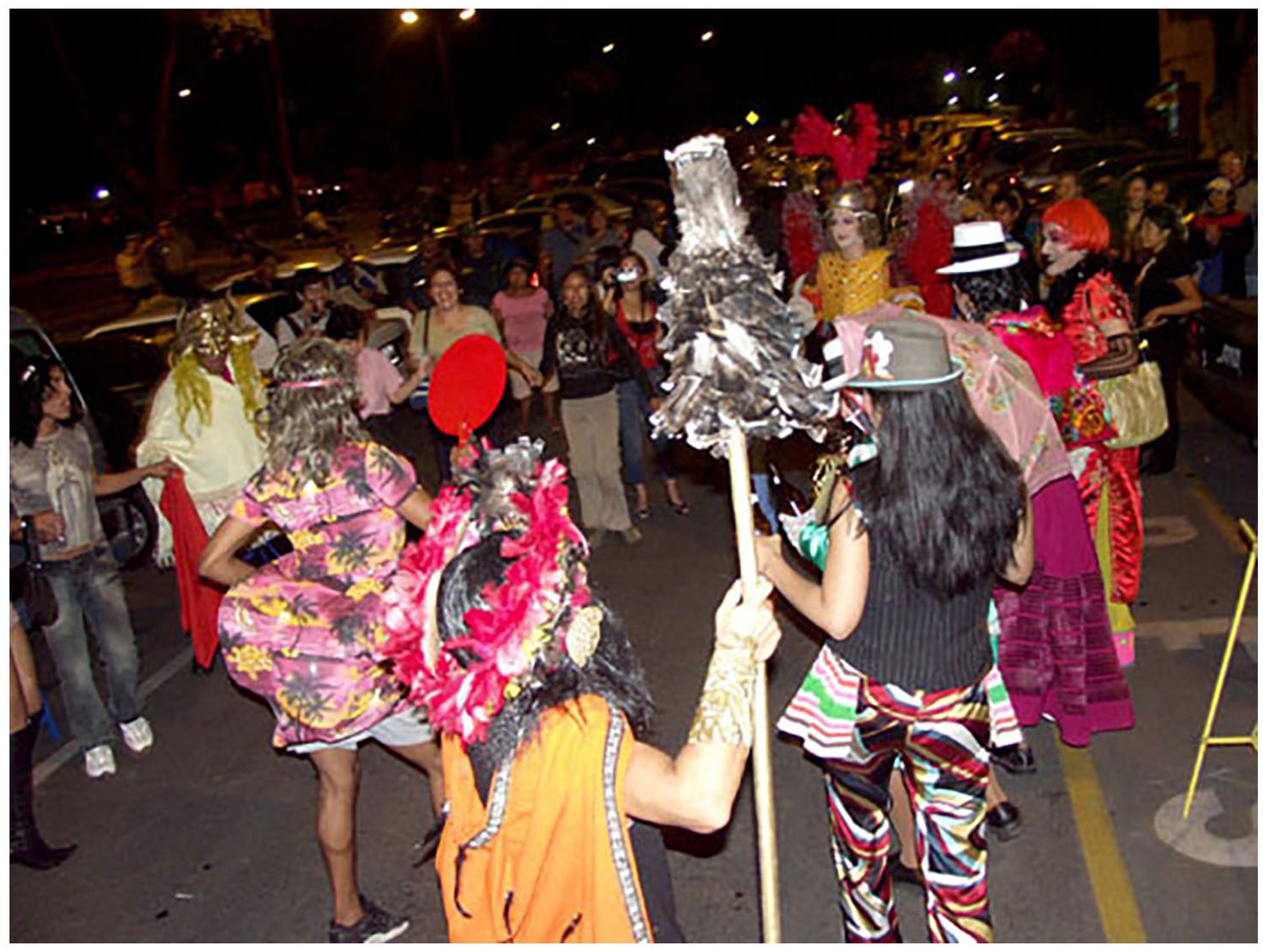
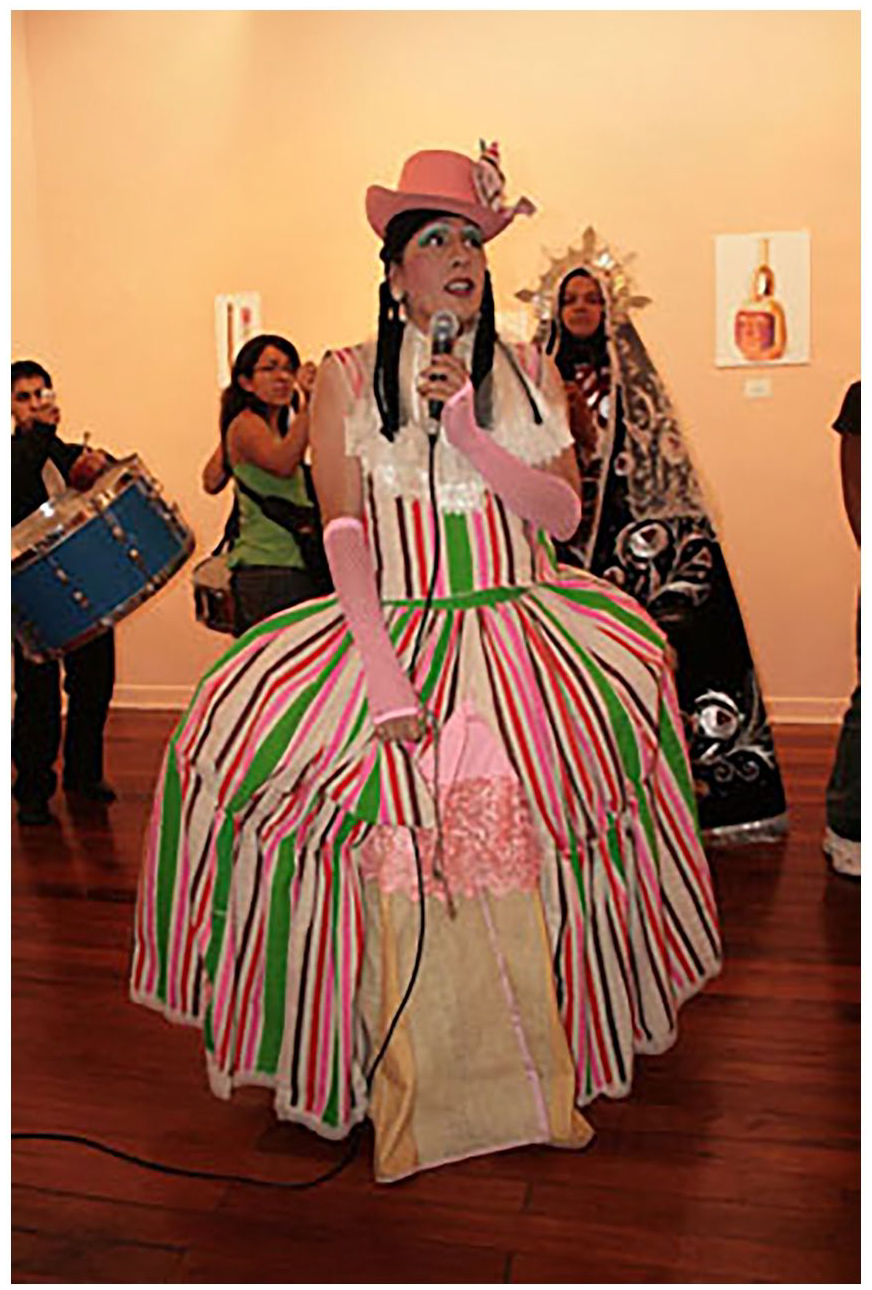
Giuseppe Campuzano, Living Travesti Museum, 2008, Lima. © Photography by the Spanish Cultural Centre. Reproduced with permission.
The materiality of the collection that makes up the Travesti Museum, like the collection itself, is always in flux. Some of its installations are very simple, and depict only photographic reproductions of the objects on the gallery wall. Other more recent versions like the one at the Galerie de l’erg (see Figure 7) in 2015 included a timeline of the archive as well as a display of physical objects. The earlier 2008 version shown in Lima’s Spanish Cultural Centre is one of the simpler installations. This installation is two dimensional in that the only objects present are photographic documentation and print reproductions of the objects in the collection accompanied by short texts that one can assume are object labels, as well as multiple paragraphs of writing installed using vinyl lettering throughout the walls of the gallery. While the exhibition was presented in two dimensions, the Living Travesti Museum was a personified and cyclical restitution of the histories and ways of being at the core of the project. The performance is a literal embodiment of the people found within the Travesti Museum archive.
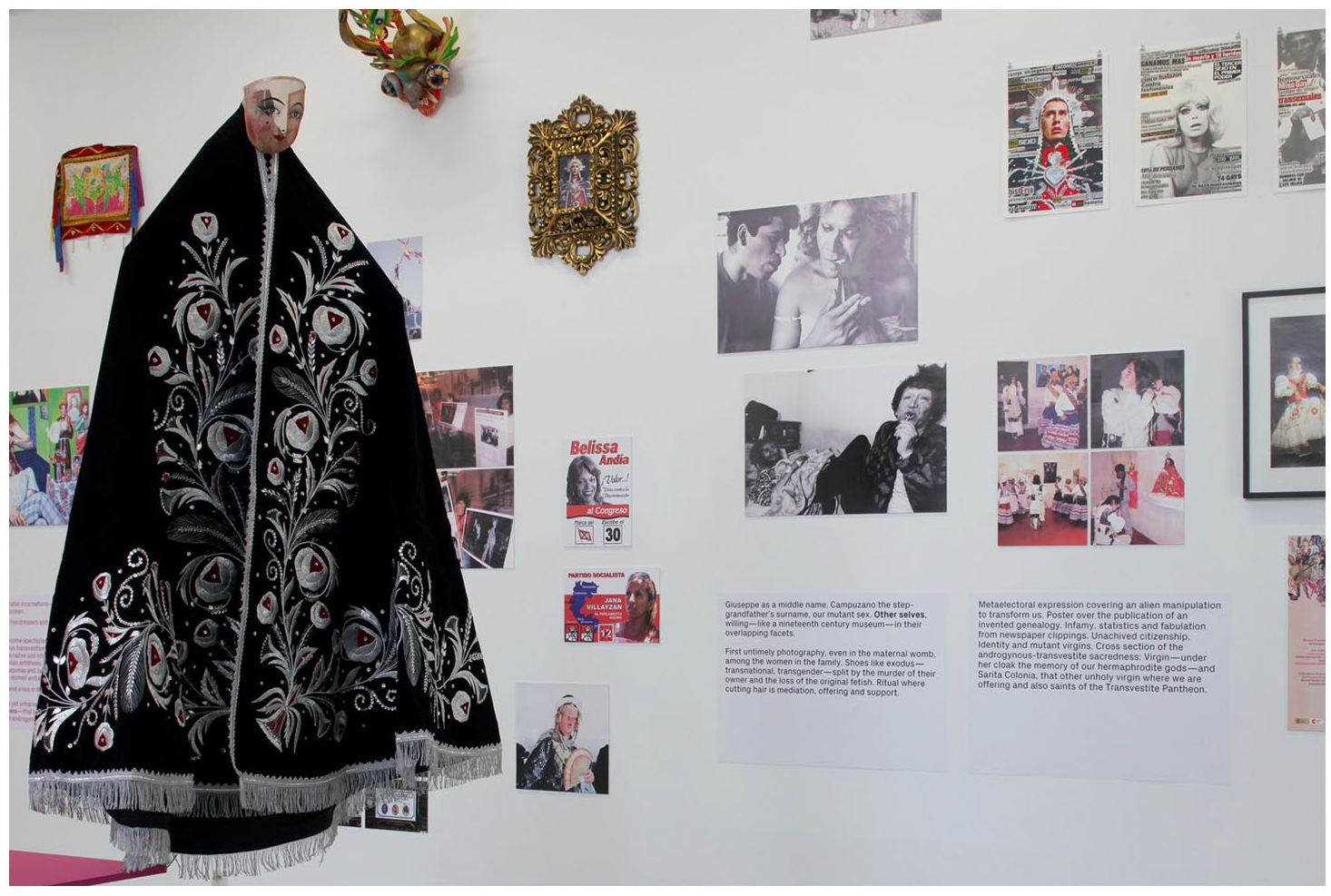
Giuseppe Campuzano, Linea de Vida – Museo Travesti del Peru, Galerie de l’erg, Brussels, 2015. © Photography by Maxime Delvaux. Reproduced with permission.
This performance started outside as a procession led by a travesti Virgin Mary. She was followed by a group of travesti performers including drag queens, the feathered travesti archangel from the Cuzco school painting, a handful of cross-dressers wearing polleras, a performer dressed in clothing that resembled Inca nobility, dancers wearing masks seen in rural fiestas and, as usual, a lively brass band. As they paraded into the community center and settled into an exhibition room, the viewers joined in the dancing. The procession, the music, the dancing, and many of the performers in their costumes would have been recognizable to viewers. Unlike performance art that attempts to exist outside of popular cultural practices, Campuzano uses popular performance – and the comfort and familiarity that comes from seeing, experiencing, and participating in such occurrences – as a way to make a statement about the travesti bodies and histories that have been and are part of such practices. Clearly articulating the travestismo inherent to this popular cultural tradition is one way that Campuzano highlights the ever-present roles of travestis in Andean cultures and history.
Cross-dressing has been a central part of Andean fiestas, and it has also been used as a strategy for resisting colonialism and its imposition of binary genders and constraining sexual behavior. One can go through each performer in the Living Travesti Museum and create a genealogy of cross-dressing or travestismo that relates back to the Travesti Museum collection and the history of Peru. Take the Virgin Mary as a brief example. The Living Travesti Museum performance, like most patronal festivities, has the central point of honouring and worshipping a patron saint or virgin. In this performance, a travesti Virgin is honoured as she leads the procession. Campuzano (2007: 84–85) writes that the Virgin represents not only a cultural syncretism but also the recovery of an androgynous entity through its iconography as both a wak’a (sacred mountain or volcano, masculine) and mallki (seed, feminine, as mother of Christ). As a way to not be seen as idolatrous by colonial forces, Indigenous artists sometimes depicted sacred mountains cross-dressed as the Virgin Mary, such as in The Virgin Mary and the Rich Mountain, 1740 (see Figure 8). Campuzano (2009c) writes: The Virgin is the transvestite par excellence with her magnificent trousseau and her performative apparitions . . . it was in 2007, in the context of the publication of the transvestite book, that I decided to exchange the image of the whore for that of the virgin.
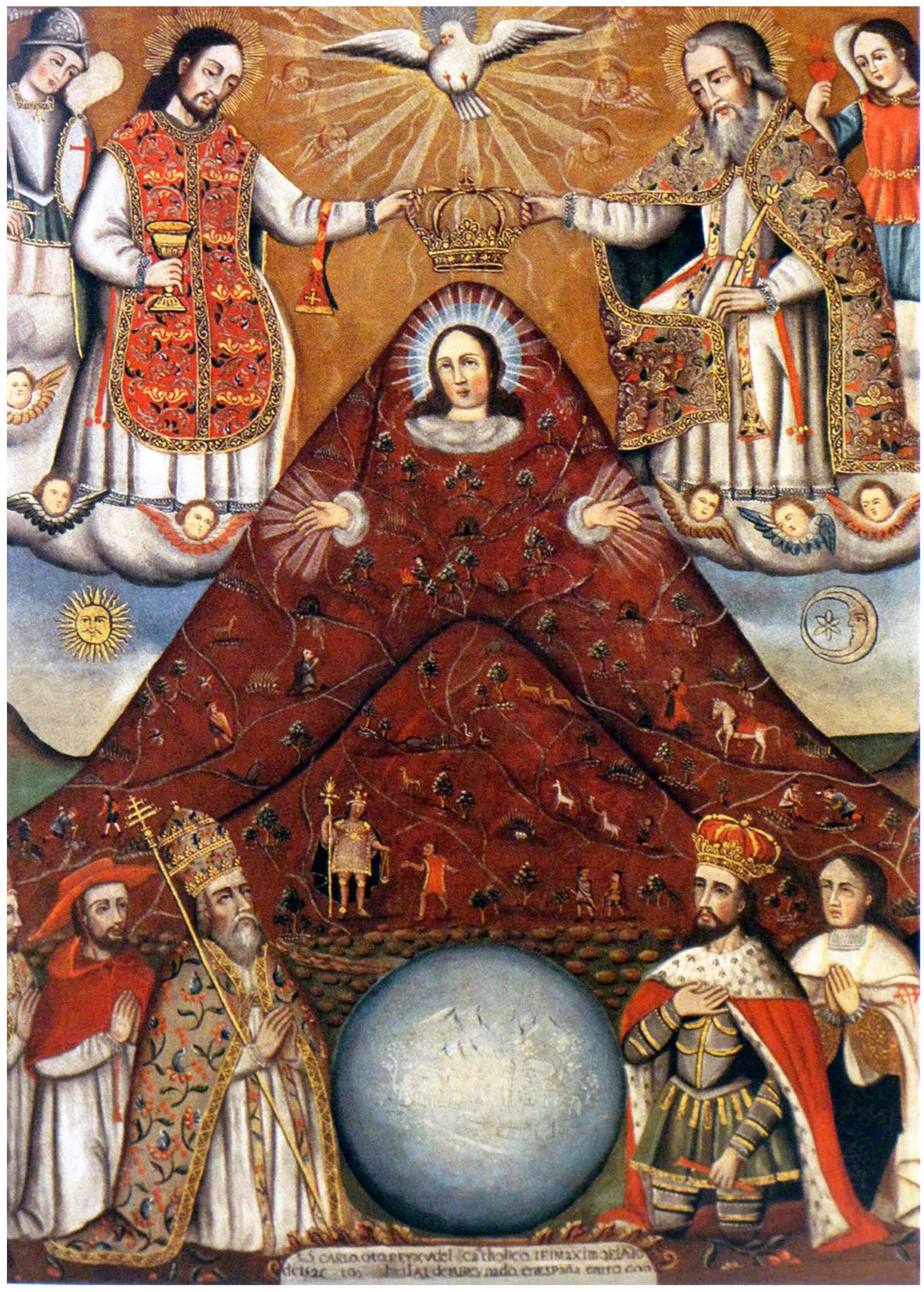
Unknown, The Virgin Mary and the Rich Mountain (Cerro Rico) of Potosí, c.1740. Museo de la Casa Nacional de Moneda, Bolivia. Reproduced with permission.
The travesti iconography of the Virgin Mary comes up throughout the Travesti Museum collection in its various depictions of different virgins, including in the photograph of Campuzano captured by Alejandro Gómez de Tuddo that was previously discussed, and the travesti virgin leading the Living Travesti Museum performance.
Earlier in this article, I quoted Campuzano (2007: 84) describing tinkuy as a space where the ‘simultaneous rupture and convergence’ of two halves occur. This term also comes up in Rivera Cusicanqui’s (2010: 155) work, defined as an ‘encounter or ritual combat between two opposed groups that unify’. Both ch’ixi and travesti exist in this space, and in my bringing together of two Andean thinkers – Campuzano and Rivera Cusicanqui – I argue that both terms have several similarities, with travesti performance in fiestas being an example of how they meet. They are both indiscernible subjects marked by movement and constant change – both subjects that ‘in their opposition, we can see alternatives and potentialities’ (p. 14). In a recent talk at Sur Gallery in 2021, a contemporary art space with a focus on Latin American artists in my home-base of Toronto, Rivera Cusicanqui said that ch’ixi are people that are stained, contaminated, impure . . . ch’ixi animals . . . that are both from above and below, at the same time bad and good . . . [and] female and male, such as snakes, spiders, ants, lizards, [and] toads. All of these liminal beings that are considered ch’ixi because they are physically stained – in essence they don’t belong to the world above or the world below, they belong to both. They are entities that are able to cross boundaries . . . entities that provide strength for resistance.
As a mediator between worlds, the travesti is very similar. Both terms, to borrow Rivera’s (2018: 134) words, emancipate themselves by ‘assuming contradiction as a creative force’. In relation to the Travesti Museum of Peru, and more specifically the Living Travesti Museum performance, how does ch’ixi relate to Andean patronal festivities and therefore to Campuzano’s use of it in the context of an art project? As a religious cultural practice, the fiesta has adopted Catholic saints and virgins. In its ch’ixi nature of appropriating the foreign, the fiesta has incorporated these religious idols into an Andean cosmology, where at times the Virgin Mary can traverstirse or cross-dress as a sacred volcano, or an Andean god can cross-dress as a patron saint. Cross-dressing, or travestismo, is part of ch’ixi subjectivity. The travesti, as a gender in transit, is also a dialectic that does not culminate in a synthesis but rather lives in constant displacement. Like ch’ixi, it also appropriates and mutates – from chhullu, to berdache, to drag queen, to travesti – in order to survive.
This network of ideas leads me to ask a series of questions about the museum, performance, and the archive as a space for restoration and repair. What is the significance or result of incorporating ch’ixi subjectivities and travesti strategies into an art project? What would a ch’ixi space look and feel like? What kind of temporalities could it present? What kinds of actions or gestures would it allow? What kind of histories does it welcome? This article hopes to lay the groundwork in order to start answering some of these questions. As an example of a ch’ixi occurrence, the fiesta portrays the conditions for a collective ch’ixi subjectivity. This is most apparent in the function of costumes, where the costume or mask becomes embodied by the performer. In this instance, a costume or mask does not hide you, but reveals you in multiple ways – something Campuzano borrows from Peruvian anthropologist Gisela Cánepa Koch (1998: 304) and repeats throughout his writing. By embodying a new character, and letting that character take a part of you, the dancers or participants are opening themselves up to other histories and other embodiments. It is through these kinds of experiences where Campuzano’s (2009b) comment of an unconscious knowledge of having other pasts that he considers his own makes sense. He is able to embody these histories through performance and ritual using mutation as a reparative practice of remembering.
Inhabiting bodies: performing travesti history
American anthropologist Deborah Poole, who has studied the incorporation of outsider figures in Peruvian fiestas, writes that outsiders being ‘danced by “insiders”’ promotes a mimicry that ‘plays on the juxtaposition of fluid dualities within the character of a single dancer’ (Poole, 1990: 117). Drawing from Poole, Cánepa Koch (1998: 43–44) claims that some of the most pertinent aspects of Andean performance are its ambiguous nature and the power of transformation, as well as an interest in representing the foreign, where the foreign is thought of as a source of power. Cánepa Koch writes that during times of change when cultural identity is strongly threatened, the mask is put in a privileged position to address the problem of cultural shock (p. 60). She claims that the mask represents in order to transform – it does not make clear oppositions between the bad and the good, and through representation, the mask becomes a mediator in order to manipulate bad or foreign powers (p. 48). Cánepa Koch writes: if it is recognized that the ambiguity of Andean dances is used as a resource to achieve certain ritual and social ends, then it is understood that this ambiguity allows, on the one hand, the transfer of power from the character represented to the dancer, and on the other, a realization of the past to transform the present. This means that dance also fulfills an intermediary function between two forces. (p. 44)
Through this research, and the work of Rivera Cusicanqui, it is clear that Andean fiestas continue to have strong social and political functions, and these functions get taken up by the Travesti Museum.
A ch’ixi space, like a fiesta, allows for thinking and experience in a amuyt’awi way. Rivera’s definition of this term can be helpful in trying to understand how the Travesti Museum is creating embodied histories. Instead of lup’iña, which describes a way of thinking using rationality, amuyt’awi describes thinking through the body. Rivera Cusicanqui (2018: 121) writes: we are talking about the thinking of the walk, the thinking of the ritual, the thinking of the song and of dancing. And that thinking has to do with memory, or better said, with the multiple memories that inhabit (post)colonial subjectivities in our zone of the Andes.
By staging or (re)creating a fiesta that has strategies of appropriation, embodied thinking, embodied histories, and cross-dressing, Campuzano creates a ch’ixi and travesti space where it is possible to actually embody the histories and memories of past travestis through ritual and performance.
Although the travesti is deeply tied to embodiment, it is not fixed to a single body, but rather represents a mutant characteristic or character that lends itself to become embodied by others. Furthermore, much as some Andean performances found in fiestas appropriate and derive power from the foreign, the Travesti Museum appropriates the power of the museum as a history-making machine, and uses it to present travesti history created from the travesti body. Within an Andean context, history is not made individually, but collectively (Cánepa Koch, 1998: 29) – with dance ‘as an embodied archive of collective remembering’ (Callaghan, 2012). The work found in the Travesti Museum can be used to further analyze how the body relates to ideas of history and memory, and perhaps be a tool to learn how we could write history starting with an embodiment of collective memory.
Campuzano presents a story of Peruvian history that not only has travesti protagonists but, through his methodologies of embodied memory within a ch’ixi context, he presents a history that is travesti. Campuzano was an important and active member of his community and, when he died in 2013, his friends fittingly mourned him through performance. Malú Machuca Rose (2013) describes how Campuzano’s friends and family paraded his coffin down the street while following a brass band and dancing, crying, and laughing. Campuzano’s friend and collaborator, and a healer and artist in his own right, Germain Machuca, cross-dressed as Campuzano with the clothing he wore during their last performance together and led the coffin (see Figure 9). Machuca Rose writes, ‘we buried his body letting him know that we would always lend him ours, so that he always returns, just as he lent his to so many divas, so many nights’. Through the Travesti Museum of Peru, Campuzano lent his body to travesti history. Upon his death, his friends did the same. Now that Campuzano is another travesti in the Travesti Museum archive, others can embody his memory just as he did for them.
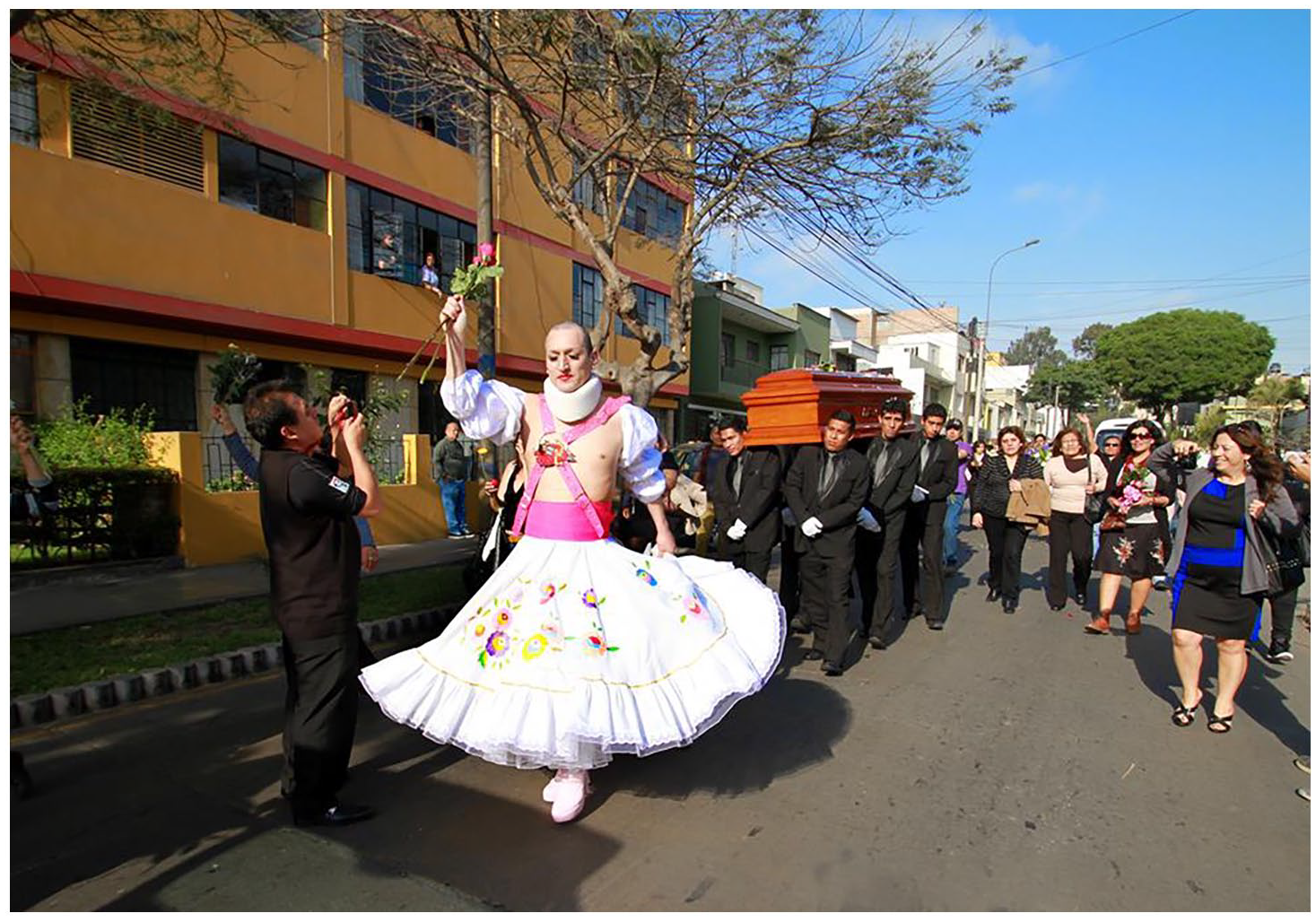
Germain Machuca during Giuseppe Campuzano’s funeral, Lima, Peru, 2013. © Photograph by Claudia Alva. Reproduced with permission.
Footnotes
Acknowledgements
Early drafts of this work were presented at the 2018 Decolonizing Conference at the University of Toronto and at the 2022 College Art Association’s Annual Conference. This research was also workshopped in the Exceeding Austerity: Performance, Neoliberalism, and the Conservative Turn working group at the 2019 ‘Encuentro’ in Mexico City organized by NYU’s Hemispheric Institute for Performance and Politics. I want to acknowledge with deep gratitude Julian Jason Haladyn, Dot Tuer, and Toronto’s Latin American Reading Group for their feedback and support, as well as Gabrielle Moser, Adrienne Huard, and the anonymous reviewers for their insight and help in shaping this research for publication.

Notes
Address: OCAD University, 100 McCaul, Toronto, ON M5T1W1, Canada. [email: