




Abstract
This article revisits the lynching photograph to consider the rhetorical and cultural practices that instructed the unseeing of white mobs for what it reveals about dematerializing representations of the state in social media imagery documenting anti-Black police brutality. To do this, the author draws on creative, curatorial, and architectural examples that bring the eye into confrontation with the state’s hidden hand – the rig that naturalizes the public’s first-person (shooter) perspective, the body-worn or (para)surveillance camera footage, obscuring contemporary lynching’s stately face from public view. The author reflects on the staging and circulation of lynching photography as well as the exhibition of representative artistic renderings; an example of transgressive spatial engagement at the recently opened National Memorial for Peace and Justice in Montgomery, Alabama; and then turning to Canada, the author offers a case study that considers the outer-national visual implications, concluding with example works by visual artists, Anique Jordan and Jalani Morgan, whose transgressive creative practices demonstrate disinvestments in repair.
If, as Ralph Ellison alerted us to in his Invisible Man, we see each other only through the ‘inner eyes’ with which we look with our physical eyes upon reality, the question we must confront in the wake of the Rodney King Event becomes: What is our responsibility for the making of those ‘inner eyes?’ Ones in which humanness and North Americanness are always already defined, not only in optimally White terms, but also in optimally middle-class . . . variants of these terms? (Sylvia Wynter, 1994) With whose blood were my eyes crafted? (Donna J Haraway, 1988)
David Hammons’ The Man Nobody Killed (1986) was exhibited at the Guggenheim Museum in New York as part of ‘Basquiat’s “Defacement”: The Untold Story’ (2019) curated by Basquiat scholar Chaédria LaBouvier. A bound page of Eye Magazine #14 “Cobalt Myth Mechanics” (1986), the 8.5-inch by 11-inch stencilled paint on cardboard honours the memory of Michael Stewart. Stewart, a 25-year-old artist killed by New York City Transit Police in September 1983, was allegedly caught tagging subway walls at First Avenue station when he was arrested and beaten into a coma by John Kostick, Anthony Piscola and Henry Boerner. The cut cardboard edges of Hammons’ frame set forward an image of Stewart’s face. Right below his eyes, in red text, reads: ‘THE MAN NOBODY KILLED’ (see Figure 1). The print clipping of his name and dates of life confirm that Stewart must be ‘the man’ compelling a reading of ‘nobody’ as indeed a somebody. Whether specifically referencing the officers acquitted in Stewart’s brutal beating or not, Hammons insists that there has been a disappearance of something from our perception. Hammons recognizes and reveals ‘nobody’ as somebody, presenting an opportunity for witnesses to interpret what they have been conditioned to both see and un-see.
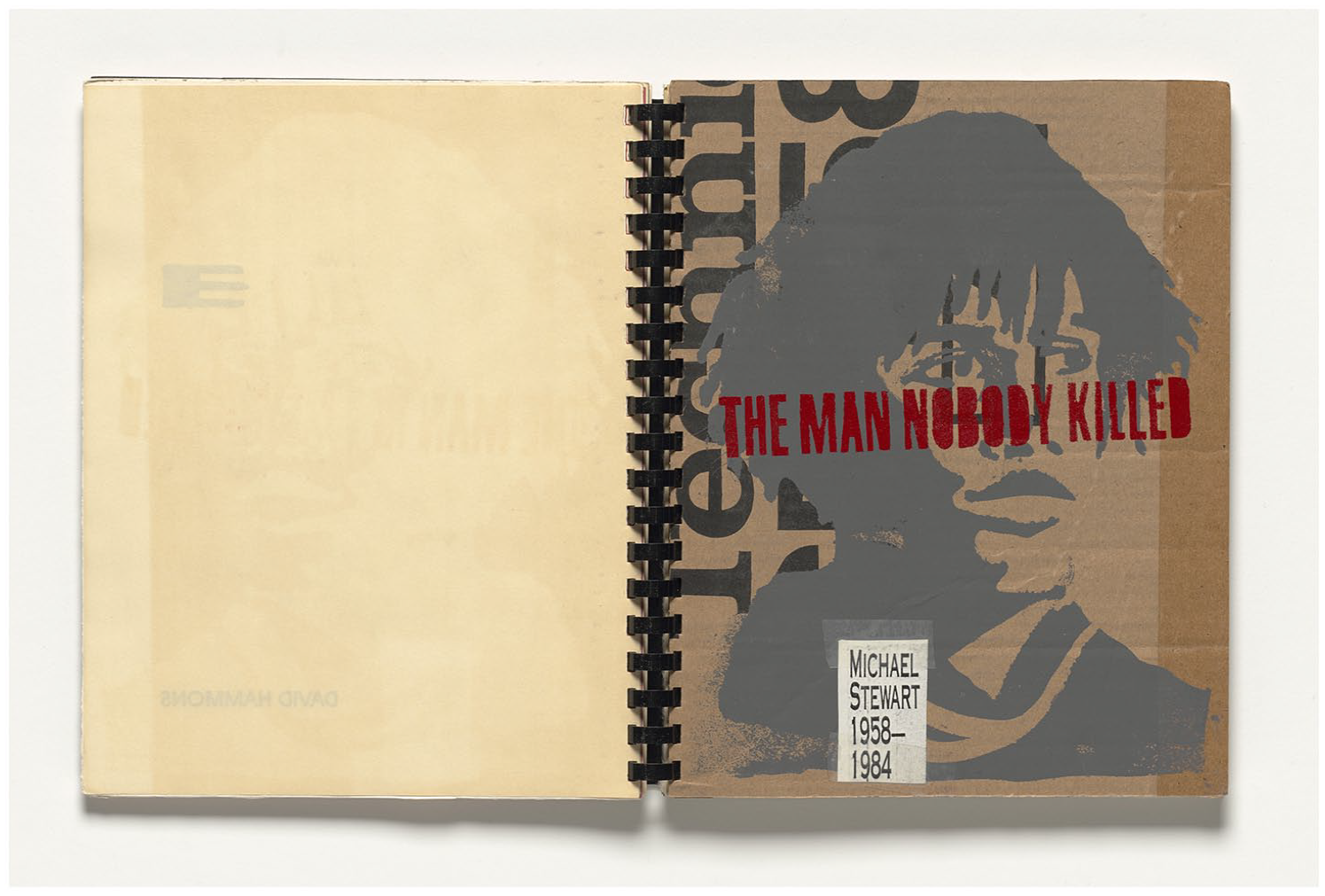
David Hammons, The Man Nobody Killed, 1986. Digital image. © The Museum of Modern Art/Licensed by SCALA/Art Resource, NY. Reproduced with permission.
I see the Jean-Michel Basquiat painting around which LaBouvier curated the show (‘The Death of Michael Stewart’, 1983) as putting forward a similar challenge. ‘¿DEFACEMENTO?’ is scrawled above two unmistakable renderings of cops mid-attack on a blacked-out figure. Could Basquiat be asking ‘[Do you see] defacement?’ while he, like Hammons, rearranges the visual discourse that casts policing, and its requisite violence, as legitimate ‘non-violence?’ Working against the authorized frame, 1 Basquiat installs Stewart’s killing along a continuum of anti-Black state violence in the Americas while refusing a gaze conditioned to reconcile the Euro-American tradition of visualizing Black death as spectacle.
The Man Nobody Killed (1986) and The Death of Michael Stewart (1983) initiate breaks in Euro-American regimes of vision (framing) intent on obscuring the violence endemic to the nation-state: policing. This article considers creative works, both expressive and artistic, that transgress reparation to the Euro-American ‘racially-saturated field of visibility’ (Butler, 1993: 15) wherein reparation restores the aesthetics of colonial domination that sustain the hegemonic presence of the nation and its body politic. These examples, through a range of visual strategies, redirect their observer’s attention to the absented presence of the state in discourses of state violence, refusing attendance to a visual logic that continually reinstalls the Black death spectacle as aesthetic. 2 The 21st-century iteration of spectacular Black death found its form through developments in network and surveillance technologies – the internet, the smartphone, the dash and body worn camera, social media – dramatically accelerating the circulation of this imagery and thus its availability for use by the nation and its sustaining body politic. Its visual proliferation exists within a broader historical present that emerges with Europe’s transatlantic ‘circulation’ of African captive persons as fungible commodities. Reparation, therein, must begin by attending to what Hortense Spillers (1987: 67) called ‘high crimes against the flesh’.
Shawn Michelle Smith (2007: 16) has written that American lynching photographs ‘make clear’ the understanding white mobs had of their power, adding they ‘were often protected from prosecution by cultural rhetoric and practice that simply refused to recognize them and proclaimed lynchings the actions of “persons unknown”’ (emphasis added). This socio-cultural occlusion to un-know and un-see the origins of harm is instructed through repetition: the repetition of acts of bodily violence, the repetition of its visual mediation, and the repetition of the spectatorial act of refusing to see violence and to acknowledge its perpetrators. Similarly today, with each Black life taken by the state comes yet another opportunity for state-corporate media and its attendant publics to practice debating the justifiability of Black life en masse. What follows here extends the work of Black Studies scholars and artists whose generous and generative texts have long attended to the multivalent visual registers of Black diasporic life and death, including: Dionne Brand, Simone Browne, Denise Ferreira da Silva, WEB Du Bois, Torkwase Dyson, Frantz Fanon, Saidiya Hartman, bell hooks, Kara Keeling, Audre Lorde, Katherine McKittrick, Toni Morrison, Fred Moten, Charmaine Nelson, M NourbeSe Philip, Leigh Raiford, Christina Sharpe, Rinaldo Walcott, and Sylvia Wynter. Below, I return to the lynching photograph to think about how ‘cultural rhetoric and practice’ instructed the unseeing of white lynch mobs for what it may reveal about the dematerializing representations of the state in social media imagery documenting anti-Black police brutality. To do this, I draw on creative, curatorial, and architectural examples that bring the eye into confrontation with the state’s hidden hand – the rig that naturalizes the public’s first-person (shooter) perspective, the body-worn or (para)surveillance camera footage obscuring contemporary lynching’s stately face from public view. I reflect on the staging and circulation of lynching photography as well as the exhibition of representative artistic renderings; an example of transgressive spatial engagement at the recently opened National Memorial for Peace and Justice in Montgomery, Alabama; and then, turning to Canada, I offer a case study that considers the outer-national implications of the proliferating and horrifically benign circulation of social media imagery documenting anti-Black state violence with works by visual artists, Anique Jordan and Jalani Morgan, whose transgressive practices demonstrate disinvestments in repair. Following Raiford (2011: 66), this article treats the imagery of anti-Black state violence as ‘the wound that will not heal’.
Souvenirs
In response to white perception of increased rights and freedoms for Black people after the US emancipation proclamation, white lynchers sought to cement the racial hierarchy of white supremacy practically and ideologically through the destruction of the Black captive’s body (Baker, 2015; Raiford, 2011). Lynching was designed to invoke an all-consuming sense of fear in Black people and its ideological aims were satisfied through spectacle. 3 By inviting hundreds (or thousands) of white spectators to eagerly witness torture and murder unfold, photographing that terror, and leaving the mutilated body on view for Black and white passersby to see, lynchers demonstrated great investments in the image and the work they intended those images to perform. To torture, to riddle with bullets, to maim, to kill, was not enough. Nor was it enough to further mutilate once death had arrived. For many among the mob, it warranted documenting in a most relivable manner.
Being both a document and blueprint of conquest, lynching photographs were sold as souvenirs, distributed publicly as postcards between kin, and passed on as heirlooms through generations. In their circulation, the lynching photograph generated cultural familiarity, ‘serving to normalize and make socially acceptable, even aesthetically acceptable, the utter brutality of a lynching’ (Wood, 2009: 75). Scholars of lynching photography have noted the calculated staging of bodies alive and dead, the righteous indignation of the white lynchers’ gaze back through the lens, the centralized framing of the mutilated body (Apel, 2007; Smith, 2007; Raiford, 2011; Wood, 2009). The sale and circulation of these photos, like the spectacle itself, used the dead Black body as a site for the fortification of whiteness. Lynching photographs became ‘a tool of the mob, used to determine how a lynching should be pursued, announced, remembered, and understood’ (Smith, 2007: 14). ‘More than an aid to memory’, David Marriott (2000: 9) writes, ‘the photograph is a part of the process, another form of racist slur which can travel through time to do its work.’ It became the task of anti-lynching activists like journalist Ida B Wells-Barnett to put forward a reorienting of the look that would come to behold these images – that of the spectator, witness, patron, audience – itself a process of reframing (Raiford, 2011: 29–66). As put by Courtney Baker (2015: 39), the anti-lynching movement would need ‘first to make the lynched black body signify not the inevitability of its inferiority and oppression but the untenable violation of black personhood’. Moreover, a temporal framework that corresponds to that of the lynching photograph traveling through time would be required, one that saw these images as evidence of violation, constitutive of a future historical narrative, and predictive of a present that would remain unless it could be completely unmade. With lynching photography becoming ‘almost entirely iconographic’ by the 1930s (Wood, 2009: 189), activists explored the curated art exhibition as an opportunity ‘to contain the instability of the look by fomenting looking relations that seek to guarantee appropriate outrage and humane insight’ (Baker, 2015: 36). 4
In 1935, Arthur U. Newton Galleries in New York City opened An Art Commentary on Lynching, a first of its kind exhibition commissioned by the National Association for the Advancement of Colored People (NAACP) as a part of their anti-lynching offensive which included the endorsement of the Costigan-Wagner Anti-Lynching Bill (see Apel, 2004; Baker, 2015; Vendryes, 1997; Wood, 2009). The exhibitions sought to enact, in the words of the NAACP’s then executive secretary Walter Francis White, ‘a union of art and propaganda’ (White, quoted in Baker, 2015: 42). Baker explains that critics of An Art Commentary could not compute White’s vision: Reviews of the exhibition reveal that the violation of black humanity was deemed too political to imbue the works with greater aesthetic value. In fact, reviewers encouraged looking away from the black body in order to appreciate the art for its artistic merit . . . Rather than imbue the artworks with valuable considerations of the human condition, the representation of the lynched black body confounded art reviewers at best and offended them at worst for its distraction from the universalist values of beauty and truth. (p. 44)
There is much at stake in the discomfort around these works of art, their unintelligibility, and in the insistence that the art world confront their aesthetic value. Their political significance cannot be separated from their aesthetic merit given that the images represented reflect objects of aesthetic use – objects meant to convey an aesthetic (‘right’) (Mirzoeff, 2011: 3) sense of dominance. In both its political motivations and subscription to aesthetic tropes, the lynching photograph captured an image of sovereignty, control, ascendancy, ritual and reverence. The lynch mob’s overriding aim was to consume the image of the Black body destroyed to circulate through white relation, a conditioning of aesthetic pleasure. To suggest a separation between aesthetics and the state-governed ordering of social life (what some call ‘politics’) in this context is to avoid the image entirely so as to ignore what it reveals about fundamental aesthetic questions such as perspective, gaze, audience, and the breed of sociality that conditions how that image is seen – its frame.
A more recent reanimation of lynching’s violent history includes the Equal Justice Initiative’s National Memorial for Peace and Justice in Montgomery, Alabama, otherwise known as the National Lynching Memorial. At the centre of the memorial’s cubic structure is a courtyard where a paved staircase cuts through precisely cut grass leading to the summit of a sloping hill. The person who walks to the top is put near eye-level with the monument’s roof. Again, it is the grass that determines where you stand. The single square concrete slab at the summit of the path was intended by its architects 5 to mark the absent presence of the many unaccounted and unrecognized white lynchers. Killed by persons unknown. ‘Nobody’ returns to the frame, to this square slab, to stand surrounded by 805 suspended weathering steel tombs representing their unnamed and unnameable Black victims. ‘Memorial Square’, as the courtyard is called, does not instruct all who encounter it to observe the space of the white lyncher represented by his single slab; rather, it instructs observers to confront an inverted optic: where the dead see the living. 6 It is they who make up the crowd and the lyncher’s reveal, marked by the slab to nobody, becomes the spectacle. To reflect on the scene staged in Memorial Square, one first must imagine this impossible figure of retributive justice, then map a representation of that image onto its material referent. In that process, what more is revealed than the impossibility of the scene being staged? It invokes the foreclosure of reparation – which is to say from the perspective of Euro-American visuality, the refusal to allow the lyncher to conceal their visibility through restaging the spectacle of Black death. The confrontation reorients the observer’s imagination (perspective), attending to the manner in which lynchings are understood and remembered across time, that is, a spatial instruction that white supremacy reconvenes by trafficking in Black death and no one will stand to account.
Eluding optics
Nobody reappears across time, re-emerging in the frame of the latest (state-corporate) technological advancements in mediation, each promising a more authoritative image-document (a manner of looking) rather than an end to the violence and its visual economy. The defence attorneys for the LAPD officers who attacked Rodney King took the all-white trial jury through a process of slow looking with a portion of George Holliday’s infamous and internationally circulated video recording of the assault. By slowing the footage, freezing select moments in time – stilling the frame – the defence sought to redact the inadvertent exposure of the state apparatus, one that mechanizes Black suffering to sustain the nation. US corporate broadcast media internationally staged the judicial theatre, re-presenting for the cultural empire’s imperial audience that ‘the body being beaten was itself the source of danger’ (Butler, 1993: 15). The Euro-American optic that figures Black being as always already criminal sustains the circulation of anti-Black state violence and instantiates – pre- and re-figures – the seeing of nobody but (Nobody and) the Black body in pain as justification for its own violation. Denise Ferreira da Silva’s (2017: 275) articulation of the ‘scene of nature’ similarly offers grammar to the phantasmic ethico-juridical condition that figures the Black person as ‘already dead’. 7
Thinking with the lynching photo as ‘part of the process’ (Marriott, 2000: 9) imparts lessons for recognizing the dis-appearance of state terror, domestic warfare, in the images of anti-Black state violence circulating online. There is one such lesson to be found in the ‘amnesty’ (Sutherland, 2017a, as quoted in Noble, 2018: 151, 155–157) granted to lynch mobs not only in practice (‘killed by persons unknown’) but also in lynching’s historical re-presentation. ‘Persons unknown’ whose faces are visible can, from a Euro-American optic, remain unknowable across time and space through their embodiment as the universal subject. So too can the institution of policing make itself disappear from the frame via the police report informing state and corporate media’s retelling of events. 8 The US juridical process presents yet another spectacular re-staging of events in which individual police officers stand in as embodied figures for the nation state itself. It becomes officer error, each aspect of the image dissected to reveal some additional excuse, and what somehow remains unseeable in the frame is the ongoing requisition of sociality to the tyranny of policing itself.
Safiya Umoja Noble (2018a) argued the need for a ‘critical surveillance literacy in social media’ to address what is obscured in the contemporary iteration of circulating Black death. In particular, Noble reveals how the discursive deference to these images as ‘evidence’ of violation – subsequently unmade in its memefication, through their repeated and spirited dissection, and ultimately in the sensationalized courtroom – disfigures the imagery itself as an instantiation of state-corporate surveillance that prescribes a way of seeing.
9
Noble explains: a critical surveillance literacy of dead bodies, and the images of such, have been used both in service of bolstering white supremacy and in the commodification of Black death, which has generated strategies of ‘reading’ and knowing about structures and practices of surveillance and control of Black people’s lives. (p. 155)
The state-murdered Black person’s body circulates and policing’s homicidal obligation to the nation is transposed to the (unlikely) errors of individual officers.
In elucidating the circulation of Black death imagery as state-corporate surveillance, Noble identifies its legacies by looking to the archive: If we revisit the notion of an official record using the critical archival lens and its source of legitimation: publicly generated records of Black death and dying . . . we can read these images as illegible in the convicting of those who harm or murder Black people. Indeed, the proximity of the recording practice, its legitimation by the record-maker, and the record keepers, is overdetermined by proximity to power and property rights. In the case of lynching records vis-à-vis commercial postcards and memorabilia . . . the faces and even names of White citizens can be fully documented yet never be used as evidence that would lead to conviction for their participation in the spectacle of [the] murdering of Black people. Indeed, [Tonia] Sutherland’s argument that archives grant clemency, might also extend to mass media and social media records that appear to be a backdrop for the spectacle: whether through the selling of commercial advertisements and for generating audiences, both online and off. (pp. 155–157)
10
The circulating image of anti-Black violation online extends both the political and visual economies of lynching photos, postcards, and souvenirs. However, it is in the generating of audiences through trafficking in Black death that the role of this imagery-at-large is revealed as rather an instruction in the norms of North American sociality. It is specifically this orienting optic that the civilian cop-watch video attempts to undermine – illuminating the view from below (Browne, 2015: 21) to reveal the illegitimacy of the aestheticized hegemonic state-corporate visualization.
In ‘Poor meme, rich meme’, Aria Dean (2016) is careful to disarticulate the circulation of social media imagery documenting anti-Black police brutality from the humour-driven ‘meme’ in its emergence as digital lingua franca. Dean writes, ‘these videos proliferate alongside memes, brushing up against each other on the same platforms’ but that ‘while these forms overlap in their mode of transmission and their involvement of black bodies, such violent clips are no longer thought of as “memes”’. That said, ‘memefication’ is useful for referencing similar characteristic elements that condition the visualization of imagery documenting anti-Black brutality online. Further still, it provides language to describe the depravity re-instated when Aurora, Colorado cops gleefully reenacted the killing of Elijah McClain. The meme is intended to generate a repeated looking as much as it is intent on repeated instantiation through manipulation in circulation. And the meme remains, in perpetuity, available to common use. The memefied police brutality video is an extension of the lynching photograph and the ocular relations (across time) that it bred.
Memes are characterized by a sense of collective access, ownership, use, fungibility and as Dean specifically points out, ‘#relatability’ explaining that ‘relatability helps memes sustain a kind of cohesion in “collective being”, a collective memory that can never be fully encompassed; one can never zoom out enough to see it in its entirety.’ Similarly, as it relates to both political and visual economies, one can never assess the total breadth of profits and value generated to state-corporate institutions whose business it is to circulate these images of anti-Black brutality . However, on sustaining ‘cohesion in “collective being”’, it feels urgent to return to Saidiya Hartman’s (1997: 34) articulation that ‘the elasticity of blackness enables its deployment as a vehicle for exploring the human condition.’ Though this remains the case within the US national frame, I want to consider the outer-national context, 11 specifically how the proliferating online circulation of anti-Black imagery emanating from the US is operationalized by the Canadian settler state, public and private broadcast media, and audiences to dis-appear the historical present of policing in Canada. There are important differences in the way both slavery and its afterlife have manifested in Canada when compared with the US, but cultural instruction through representative imagery recounting the spectacular violation of Black people has always travelled north 12 to co-mingle with home-grown anti-Blackness forming a distinct picture and narrative of the socially acceptable conditions for Black life in either place. 13 Below I put forward that the resulting racially saturated field of visibility (Butler, 1993: 15), extends its availability to Canadian publics conditioned to understand and perpetually remake themselves against the image of their US counterparts, which is to say, always under the pretence of being the more reconciled, or repaired, society.
Canada
On 8 June 2020, media critic Sandy Hudson (2018) published an account of her interactions with the Canadian Broadcasting Corporation (CBC), Canada’s national public broadcaster, in the midst of the international uprising against anti-Black state violence that followed the murder of George Floyd by Minneapolis Police officer Derrick Chauvin. Hudson explained: On May 28, I received a request via Twitter from a CBC producer to speak on ‘The Current’ [radio show] about the anti-Black police murder of George Floyd, and the anti-Black experience that Christian Cooper had in New York’s Central Park when Amy Cooper called police and feigned terror after he asked her to put her dog on a leash. When I asked if we’d talk about Canadian incidents of anti-Black policing – including the death of Regis Korchinski-Paquet in Toronto and the police killing of D’Andre Campbell in Brampton – I was told that there was no time to discuss those issues, and that the segment was focused on American racism.
The Canadian appraisal of ‘American racism’ has long been vital to structuring the country’s own national identity in the lead up to, and since, confederation in 1867. Establishing the Canadian national body politic played an essential role in helping to mask both its early envy of the lucrative neighboring settler-colonies to the south (Cooper, 2006: 73) and a later, bitter, violent, and widely resisted uniting of British and French colonial forces under the ‘Dominion of Canada’. This reflexive optical illusion that is the Canadian national identity – its own derivative Euro-American visuality – persists today in ahistorical retellings of the Underground Railroad, performative multiculturalism, ‘equity, diversity and inclusion’ policies, and even the odd police cruiser festively decorated for Black History Month (see Rosen, 2021). So too has the Canadian state adapted to operationalize the US death-stream to remake itself once again as socio-culturally superior.
On 27 May 2020, two days after Chauvin murdered Floyd, Toronto Police reported Regis Korchinski-Paquet had ‘fallen to her death’ from her apartment balcony after her mother called 911 to seek assistance for her daughter who was experiencing mental distress. ‘Fallen to her death’ as if death was in possession of her all along and only she bore agency over their eventual suturing in the frame to conceal any residue of genocidal state mechanisms. In other words, Korchinski-Paquet becomes the woman nobody killed. (Remember too that George Floyd’s murder was first reported as: ‘Man Dies After Medical Incident During Police Interaction’.) D’Andre Campbell was killed by Peel Police a month earlier, 6 April 2020, in his own backyard after the 26-year-old called 911 himself for assistance in the midst of a mental health crisis. Yet, on 28 May, the CBC was ‘focused on American racism’, to the explicit exclusion of Campbell and Korchinski-Paquet.
Under familiar circumstances almost 30 years ago, Elizabeth Alexander described a genealogy of publicly staged anti-Black violence in the US, pre- and post-video format, to demonstrate its structuring role within the nation’s image world
14
and reckon with the costs of witnessing for Black peoples: This history moves from public rapes, beatings and lynchings to the gladiatorial arenas of basketball and boxing. In the 1990s African American bodies on videotape have been the site on which national trauma – sexual harassment, date rape, drug abuse, AIDS, racial and economic urban conflict – has been dramatized. The cases I refer to here are, of course, former Washington, D.C. mayor Marion Barry’s videotaped crack-smoking and subsequent arrest; the Clarence Thomas Senate hearings; Mike Tyson’s rape trial; Magic Johnson and Arthur Ashe’s televised press conferences about their HIV and AIDS status; and, of course, the Rodney King beating. The cycle continues as the nation today sits transfixed before the O.J. Simpson case. (Alexander, 1994: 78–79)
One should be easily able to narrate a parallel history about Canada except that the national approach to Black life and its violation here has been erasure, feigned ignorance (continuous imaginative displacement), and systematized forgetting (Brand, 2001; McKittrick, 2006; Walcott, 2018). In The Hanging of Angélique: The Untold Story of Canadian Slavery and the Burning of Old Montreal, Afua Cooper (2006: 69) observes that ‘scholars have painted a pristine picture of Canada’s past.’ That picture is one that blurs the nation’s beginnings, sanitizing it to withstand neoliberal moral scrutiny so that it might provide the foundation from which citizens can claim access to a common imaginary. To forge a new world, relishing the freedoms intrinsic to the colony, English and French settlers sought a unified national identity amidst ongoing conflict between the two colonial nations fighting for domination (Bannerji, 2000: 91). With the British coming out on top, the French colony established itself as an embedded antagonist, invested in the nation but always ready to challenge English hegemony and ‘“Canadian” politics of “unity”’ (p. 92). This persistent dynamic casts the English and the French as ‘the protagonists who, to a great extent, shape the ideological parameters of Canadian constitutional debates, and whose “survival” and relations are continually deliberated’.
Slavery was an institutionalized practice in Canada from 1628 to 1833. Envious of the economic prosperity witnessed south in New England and New York, colonists in New France vied for more slaves (Cooper, 2006: 72–73) after which they went about enshrining the legality of slave ownership to address the frequency of slave escapes and revolts (p. 76). British rule, following the Conquest of Canada in 1760, only spelled a more intensified slave enterprise serving then, among other things, to further entrench Canadian colonists’ associations of Black being as property and Black life as criminal (pp. 83–84). Art historian Charmaine A Nelson argues print advertisements for fugitive slaves operate as textual portraits, and can reveal insights about slavery in Canada in the absence of a significant photographic record. Nelson (2016) explains, ‘such newspaper notices provide evidence of the ubiquity of resistance by the enslaved as well as the types of heightened and invasive scrutiny and surveillance under which they lived.’ Cooper (2006: 86–87) also points to slave escapes, revolts, and marronage to signal that Canadian slavery was no less harsh than its American counterpart. To attend to this record of history is to transgress the popular and hegemonic framing of Canada as a multicultural haven; one that requires ignoring the nation’s ongoing colonial project(s), history of enslavement, institutional white supremacy, active prison industrial complex, paramilitary policing and centuries-long dispossession of Black and Indigenous peoples the world over. These transgressions take place across Canada’s figurative and literal landscape, notably available in the works of Black diasporic contemporary artists. Notes from Anique Jordan’s Ban’ yuh belly series exhibited in Toronto during the 2019 CONTACT Photography Festival provides one such example.
Adopting the Trinidadian expression meaning ‘to hold onto something’, Ban’ yuh belly (2019) is intended to ‘disturb the normalcy through which Black lives are violently taken and interrupted’ (Jordan). Jordan – an artist, writer and curator – explains that the series centers ‘the grief, anger and mental health of loved ones who are mourning those they have lost due to violence – systemic or otherwise’. In Notes, the artist’s skillful use of scale, light, shade and composition draws attention to the white page – away from her body, what the Canadian national optic arranges to appear both hyper-visible and invisible (Walcott, 2018: 71) – and the accounts of violence written upon it. To envision and speak of tallied accounts of state violences against Black being, recorded in print ledgers intent on conditioning the frame of Jordan’s own re-presentation, is to witness what Hartman calls the ‘afterlife of property’. 15 However, the ‘notes’ are those of Jordan herself. Notes taken in an attempt by Jordan to ‘hold onto something’, to ‘contend with the survival strategies used to make sense of the senseless’, the brutally aesthetic illogic of Euro-American visuality.
On the white page, visible when you look close enough, is a collage of notable headlines, (‘Police in Schools’; ‘Raids – Corral Raid/- Malvern Raids/- Bay Mills/ -. . .’; ‘6 yr old hand cuffed’), social service speak to conceal the enactment of violence (‘Zero Tolerance Policy’; ‘Priority neighborhoods’; ‘TCHC-Infrastructure build w/ Blakness (sic) in mind/ - “cockroaches” – Giorgio Mammoliti’), and then there is an untethered voice citing ‘The Mothers,’ demanding in the final entry: ‘Afford us our madness’ (see Figure 2). Among the noted violences is ‘TAVIS’ – the ‘Toronto Anti-Violence Intervention Strategy’, a provincially-funded counterinsurgency-style division of the Toronto Police, assigned to operate in predominantly Black, low-income neighborhoods from 2006 to 2017. 16 The wanton aggression inflicted by TAVIS officers, in the name of ‘anti-violence,’ elicited overwhelming complaints from residents who felt they were living under siege of the ‘surge policing’ approach (Gillis, 2018; Winsa & Rankin, 2013b). TAVIS initiated dramatic increases in police presence throughout these neighborhoods, communities that were already long accustomed to strategies of municipal urbicide, ‘distinct processes of place annihilation’ (McKittrick, 2011: 952) – over-policing and systematic defunding while being affectionately called a ‘priority’ by policymakers. 17 In Notes, viewers are invited in – to hold on to – irreconciled visual geographic relations. Access is generously left up to the viewer.
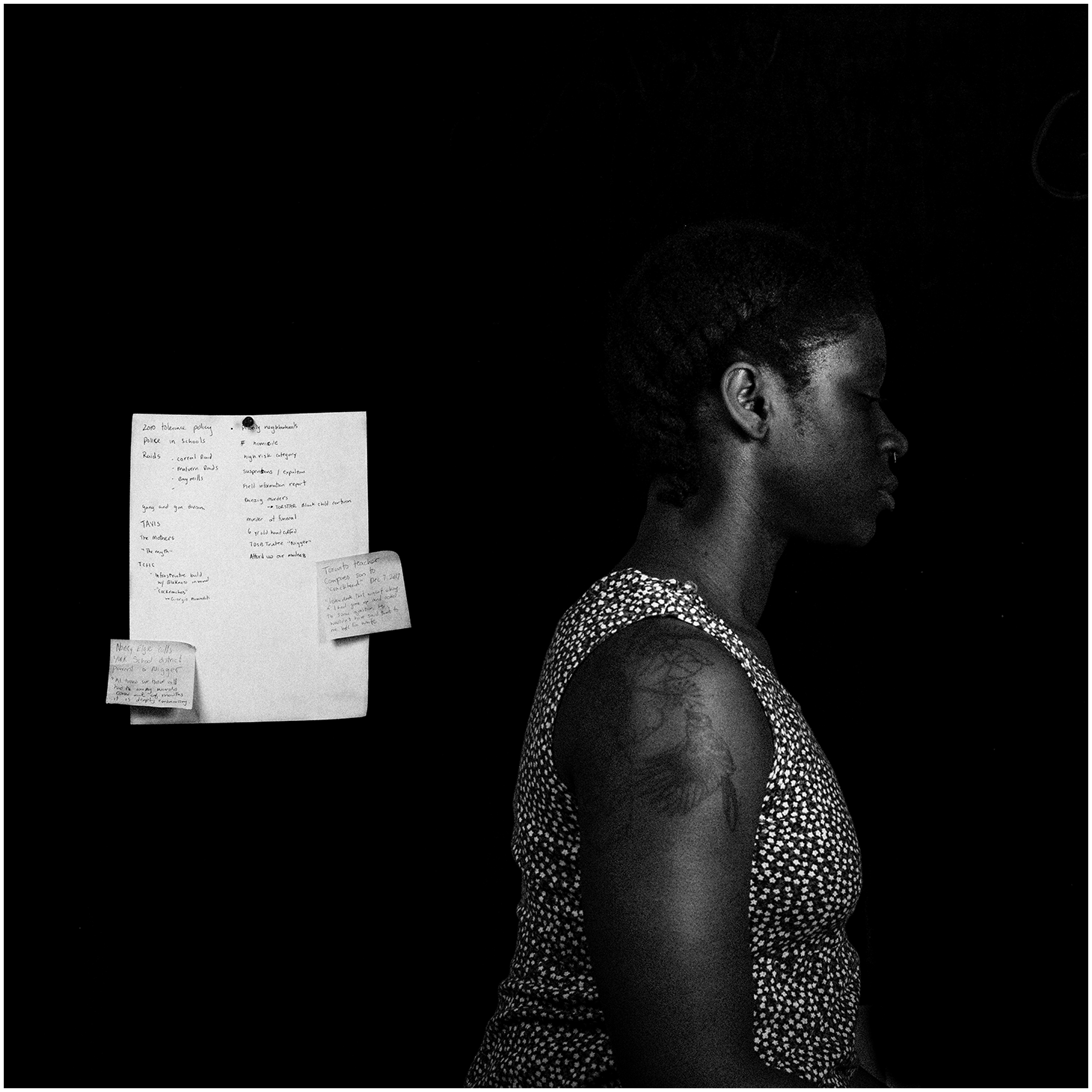
Anique Jordan, Notes (from the series Ban’ yuh belly, 2019), archival pigment on canson baryta paper, 32.75 x 32.75 in. © Anique Jordan. Reproduced courtesy of the artist.
Each of the nine images in Ban’ yuh belly (2019) presents its own distinct temporal collapse – past becomes present again as it is considered in relation to the trace left by the artist’s living body. It is this character of the performance-photo, the present history of a life being lived, that I find so intriguing about Jordan’s work. The nine photographs invite the viewer into an ongoing dispute with time and space, with history, that shape shifts environmentally as the series continues and the pinned objects change.
In A place that is no good, also from Ban’ yuh belly, the artist is positioned in profile facing two photocopied pages of the Toronto Star tacked to the images’ black surround (see Figure 3). The title echoes a headline on the longest page, presented under the image of Corina Saez seen grieving the murder of her son, Jose Hierro-Saez, to local gun violence. 18 The quoted passage, attributed to Saez, attempts to explain what the lede puts forward as obvious 19 – the inevitability of death in this place (the space of negation). Jordan’s return to the epistemic violence enacted in this headline – itself an attempt at foreclosed optics – is an annotation (Sharpe, 2016a) by retrieval. 20 The article, archived online under the headline ‘Mother regrets move to Jamestown’ (Cherry, 2007), discursively conceals a report on the murder of Hierro-Saez and the loss to his loved ones and community by using his grieving mother’s own words to suggest she is the one to blame. Jordan’s gesture locates and retrieves memories of Saez and her son, a countervisual act (Mirzoeff, 2011) revealing the national machinations of archival erasure. 21
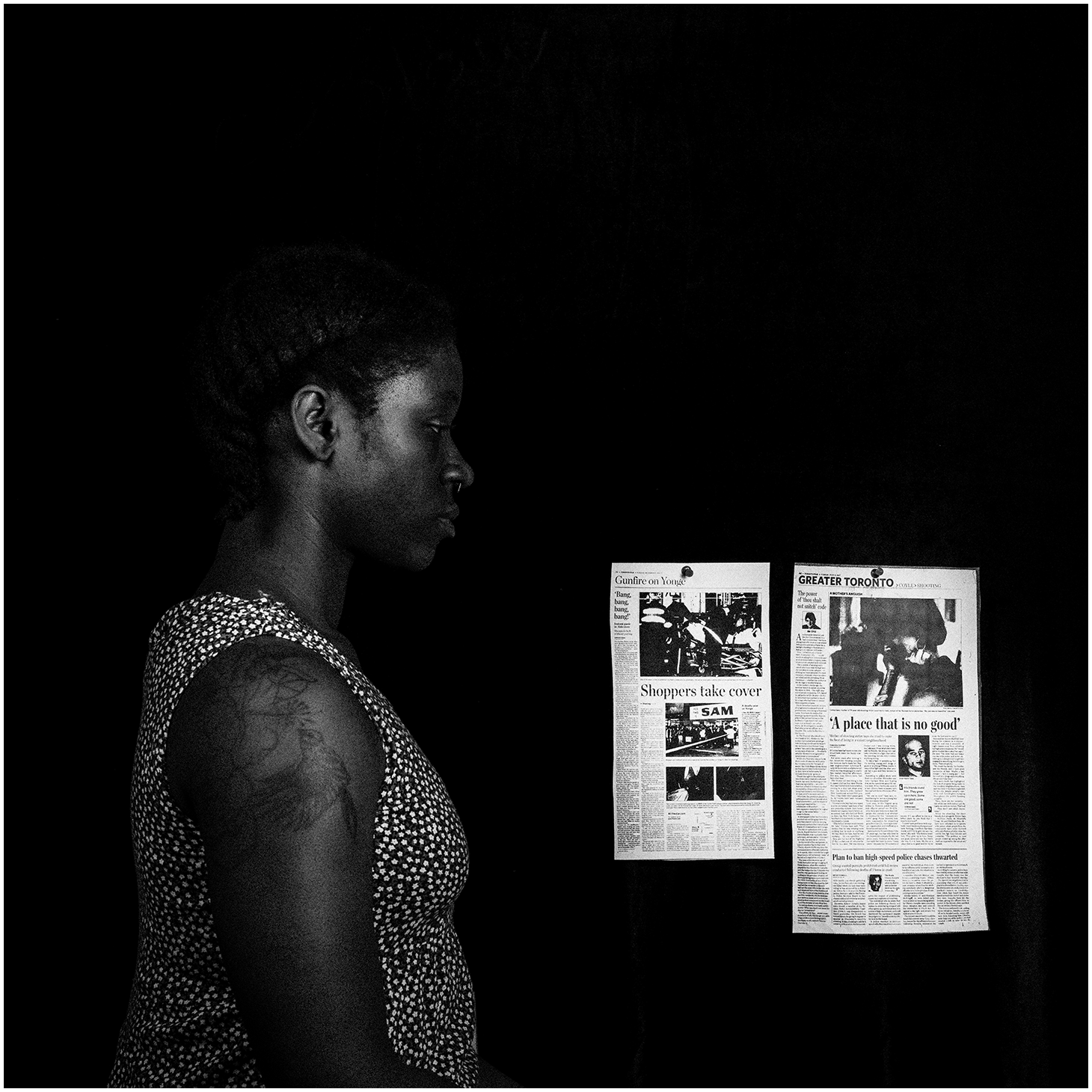
Anique Jordan, A place that is no good (from the series Ban’ yuh belly, 2019), archival pigment on canson baryta paper, 32.75 x 32.75 in. © Anique Jordan. Reproduced courtesy of the artist.
In a final example of transgressive artistic practice that presents a disinvestment in repair, I share the work of photographer Jalani Morgan whose public art series Sum of All Parts (2017) (see Figures 4, 5 and 6) was slashed while installed in front of Toronto’s former municipal headquarters, Metro Hall. The photo series captured striking, large-scale protest images and portraits marking the uprising for Black life then re-emerging in Toronto and across Canada. Collaborating with fellow artists, Morgan tightly stitched the torn vinyl together with bright red yarn leaving a woollen red scar that remains an apt visual, I think, for this meditation on countervisual reparation – transgressive frames. It is a mark that foregrounds what the Euro-American optic refuses, declining visual logics that would see the scar dis-appear, dissolve into aesthetic transparency. 22 It is, as each of these works are, a lesson in visual strategy – a lesson against making sense (cents) of the senseless. The red line lingers on the vinyl, asking – as if to echo the epigraph to this article, Donna Haraway’s reflexive optical awakening in ‘Situated Knowledges’ (1988) – ‘with whose blood were my eyes crafted?’
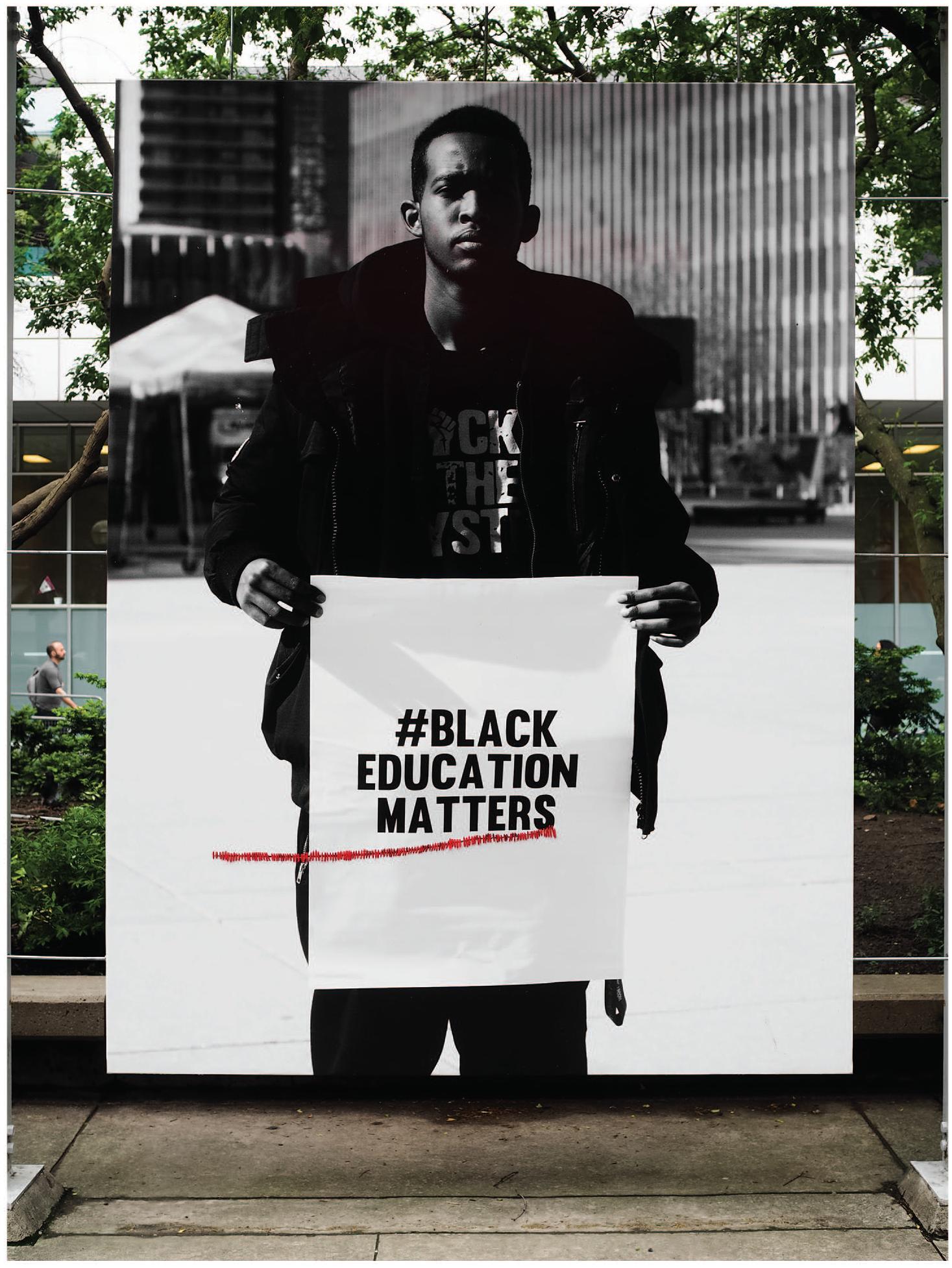
Jalani Morgan, Sum of All Parts (2017). © Jalani Morgan. Reproduced courtesy of the artist.
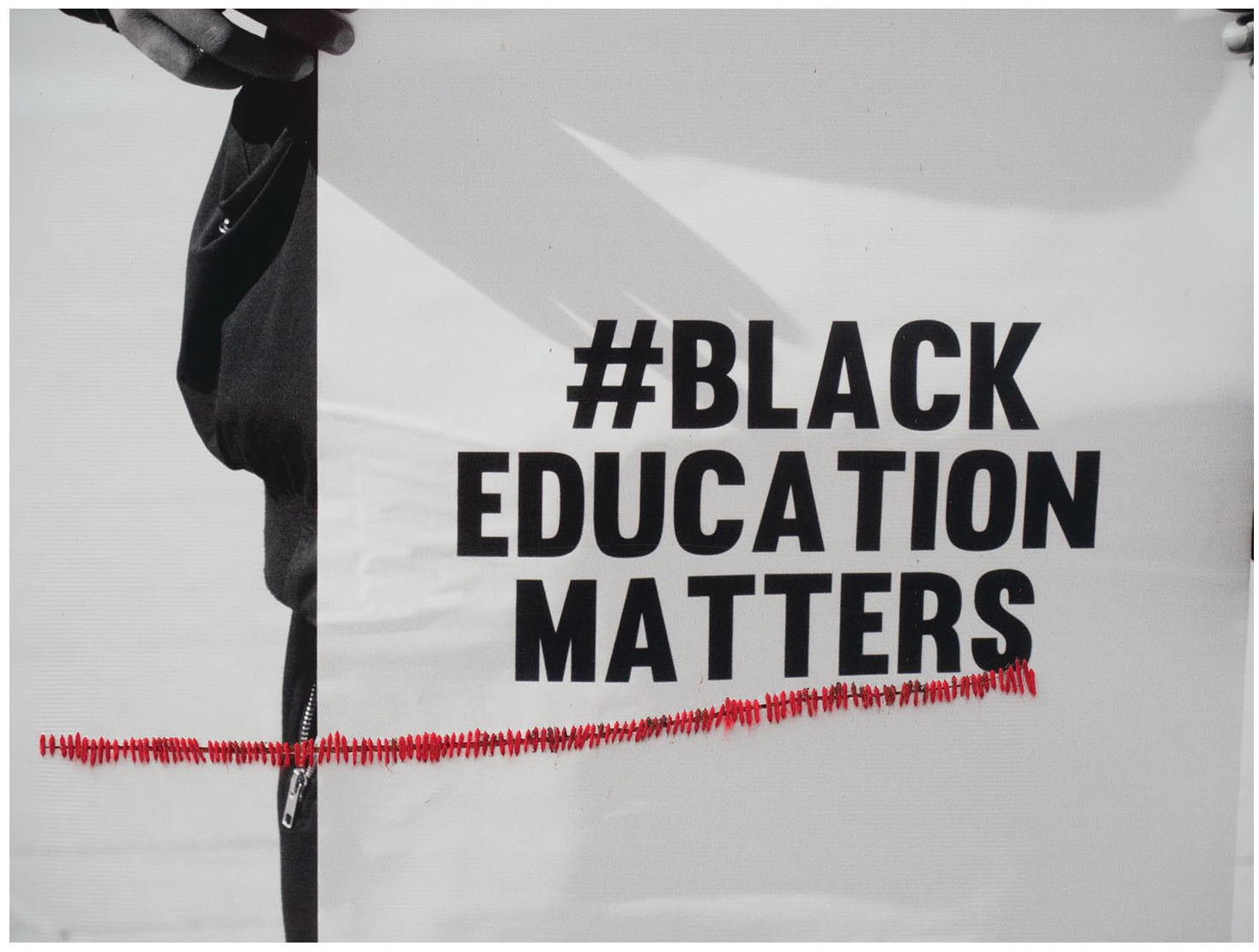
Close-up example of stitched vinyl from Jalani Morgan, Sum of All Parts (2017) © Jalani Morgan. Reproduced courtesy of the artist.
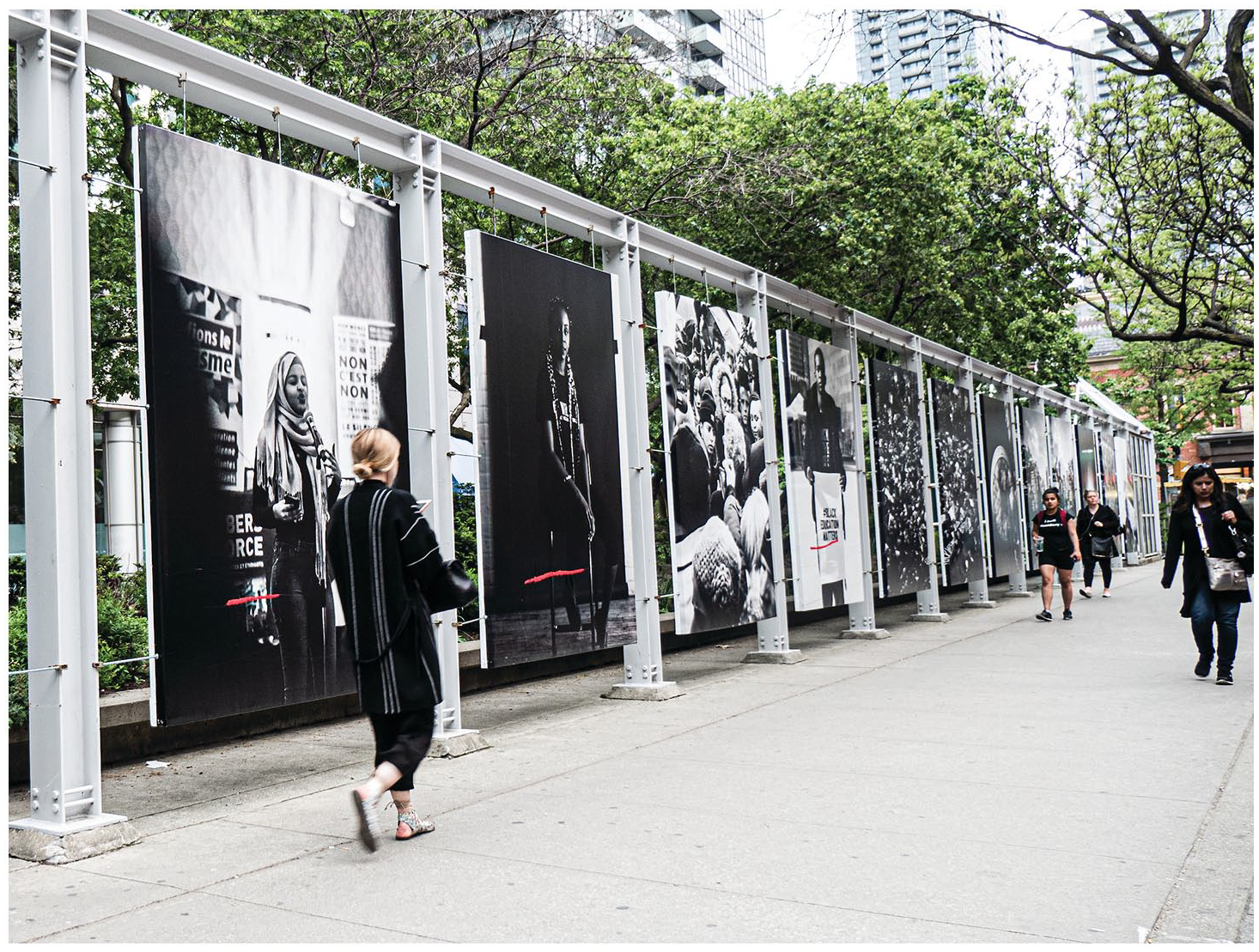
Jalani Morgan, Sum of All Parts (2017). © Jalani Morgan. Reproduced courtesy of the artist.
Contemporary social media imagery of police brutality circulates and proliferates within a visual field primed by a Euro-American legacy of mediated anti-Black violence. As today’s memeified images circulate, gaining and losing meaning with each new look, like or share, they dissolve into a sort of hegemonically aestheticized social life brought to you by corporate social media. In Michael Stewart’s case – as it is in so many other enactments of anti-Black state violence, recorded or not – the death-dealers were and are known but are unrecognizable as such under Euro-American visuality. This unrecognizable nature of violence is rather a structuring optic, concealing the state body politic in a familiar brutal aesthetic. Bringing together creative, curatorial, and architectural examples, this article holds onto varied approaches in reorienting the viewer’s perspective to reveal the hidden figure of the state – a countervisual (Mirzoeff, 2011) break that prompts confrontations with the Euro-American visual field. As Raiford (2011: 63–64) explains, ‘the lynching archive functions as a site of struggle over how to memorialize the dead, how to organize for the future, that also reveals the vagaries of an ossified memory.’ From here, one can imagine how the growing corporately owned and operated digital bank(s) of brutal anti-Black imagery, as they continue to reproduce visualities that un-see the violences endemic to the nation-state, will be cached and reopened for future use.
Footnotes
Acknowledgements
My sincere thanks to Gabrielle Moser, Adrienne Huard, Daniella Sanader and the article’s anonymous reviewers for their help in preparing this piece for publication. Earlier versions of this article were presented at the ‘Black Portraiture[s] V: Memory and the Archive. Past. Present. Future.’ conference in October 2019 hosted by New York University’s Tisch School of the Arts and the ‘Reparative Frames: Visual Culture after Reconciliation’ conference hosted by OCAD University and the Art Gallery of Ontario in December 2019. Thanks to those who offered question and comment to strengthen the work. Dedicated to a great teacher named Monique Tschofen.
Funding
This research was financially supported by the Social Science and Humanities Research Council (SSHRC) and the Pierre Elliott Trudeau Foundation.

Notes
Address: Yates School of Graduate Studies, Toronto Metropolitan University (formerly Ryerson), 1 Dundas St. West (11th floor), Toronto, ON M5B 2K3, Canada. [email: