




Abstract
Focusing on a one-minute ‘fashion film’ by the Dutch fashion designer Alexander van Slobbe for the retrospective exhibition on his work in Utrecht’s Centraal Museum in 2010, this article investigates the interconnectedness of film and fashion through their mutual concern with the processes of crafting and dressing. A close reading of Van Slobbe’s film highlights a current return to a minimal design aesthetic in both fashion and film that shows fashion as a process or as a ‘manual’ operation. This film goes beyond the portrait of a fashion designer, becoming a meditation on the material practice of designing, crafting and viewing. That practice involves an intimacy with materiality constituting the fashion garment as a material, crafted and dynamic sartorial object that requires an axial positionality stemming from horizontal closeness. Ultimately, this article presents horizontality as being part of the experience of both moving images and fashion as a material object. The aim is thus to reflect on what is termed ubiquitous ‘screenic fashion’ (as a peculiar affinity between fashion and screen) by considering an alignment of horizontality and materiality as related to a current and vivid concern in the field of fashion and clothes-making.
In many contemporary fashion and costume exhibitions, the presence of screens is ubiquitous. In museum and exhibition contexts, screens are used for multiple reasons: they inform, document and facilitate engagement, as well as producing audio-visual and spectatorial pleasure. Yet, beyond the illustrative and didactic function of screens, and beyond their pervasive interactive and immersive propensity in today’s digital culture, a more elemental motif could be explored by emphasizing the scenographic orientation of those screens.
In fashion exhibitions, the presence of screens on the wall usually recalls the cinema, while screens placed horizontally on the table or in an exhibition showcase often evoke the process, or ‘behind-the-scenes’, of designing and manufacturing clothes. 1 Rather than radically subverting the vertical axis that is traditionally associated with cinematic practices, I propose to reflect upon the sense of horizontality which is part of the experience of both moving images and fashion as material object. The aim is thus to offer a reflection on ‘screenic fashion’ – a peculiar affinity and dialogical closeness between fashion and screen – by considering an alignment of horizontality and materiality as related to a current and vivid concern in the field of fashion and clothes-making.
Reflecting specifically on a one-minute ‘fashion film’ by contemporary Dutch fashion designer Alexander van Slobbe (1959–) for his retrospective exhibition at Utrecht’s Centraal Museum in 2010 2 (see Figure 1), this article not only explores the digital and technological regime that fashion has entered into, but also investigates the interconnectedness of film and fashion through their mutual focus on the process of crafting and dressing. Further, a close ‘clothes-reading’ of Van Slobbe’s film will highlight a current tendency in both fashion and film to return to a minimal approach in design practices; that is, fashion as a process or as a ‘manual’ operation. This film goes beyond the portrait of a fashion designer, becoming a meditation on the material practice of designing, crafting and viewing. That practice involves an intimacy with materiality – what constitutes the fashion garment as a material, crafted and dynamic sartorial object – that requires an axial positionality and gesturality stemming from horizontal closeness.
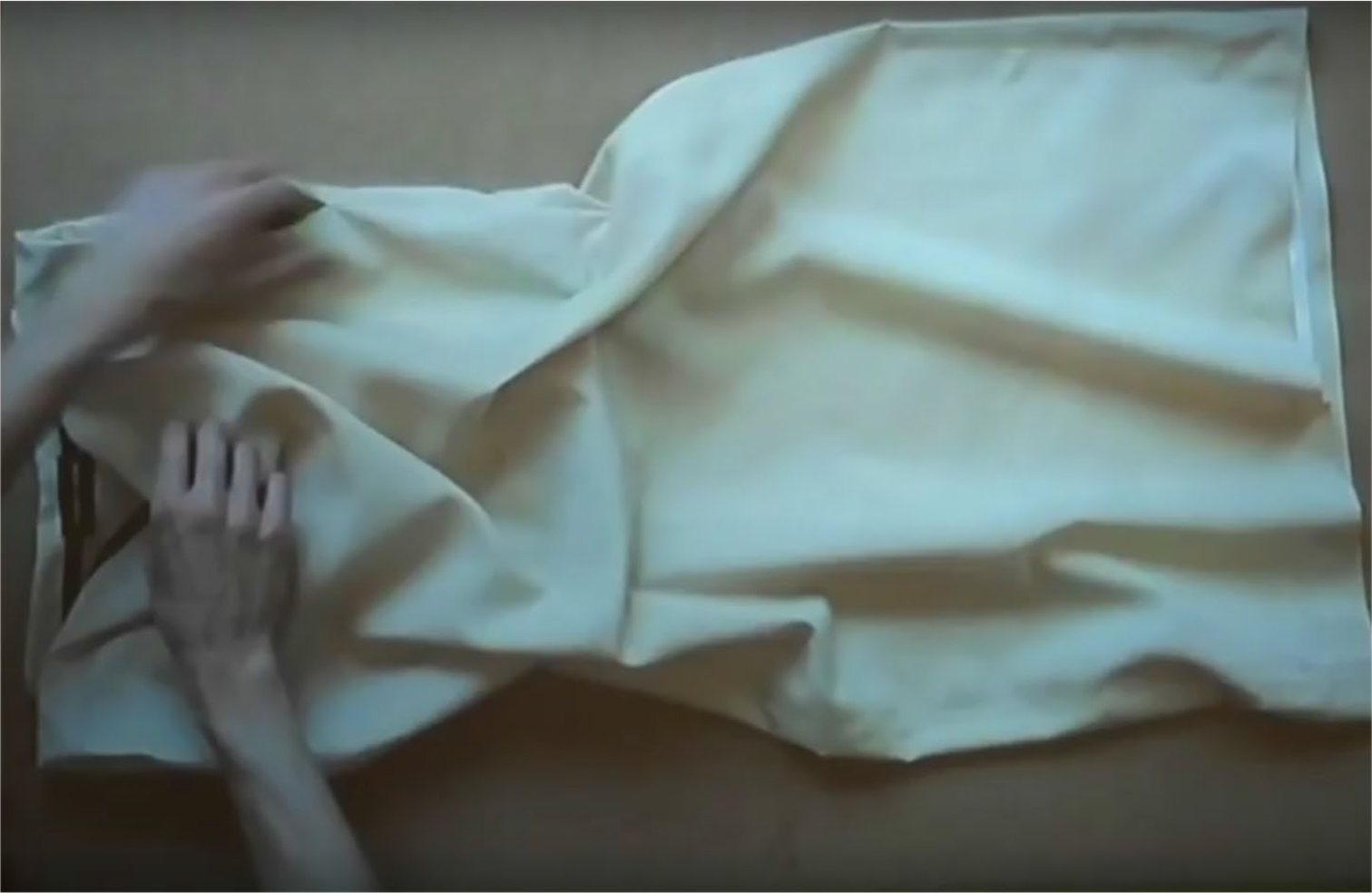
Film made for the retrospective exhibition on Alexander van Slobbe held at the Centraal Museum, Utrecht, 2010. Image reproduced courtesy of Alexander van Slobbe.
Horizontality
Following Caroline Evans, Jussi Parikka and Marketa Uhlirova’s flexible definition of the ‘fashion film’ as ‘a short, presentational, largely non-narrative film dedicated to the display and promotion of fashion’, 3 Van Slobbe’s film fits easily into this category. That said, the intention here is neither to evaluate nor to verify the definition of fashion film, but rather to investigate the conjunction between fashion and film. The two will not be regarded from the perspective of their historical simultaneity (Evans, 2011: 110–134), their common visual regime (Needham, 2013; Uhlirova, 2013a), or their shared language (D’Aloia et al., 2017). Rather, as suggested throughout this article, there is a focus on the question of horizontality as an axial mode to be in decisive dialogue with materiality.
From a scenographic viewpoint, Van Slobbe’s short film is presented within the exhibition as a ‘table dispositif’ and therefore could be called a ‘table installation’ (De Rosa and Strauven, 2000: 237, 239). In the film, we see four garments: a skirt, a top and two dresses, each representative of Van Slobbe’s style, that are filmed flat on a surface – presumably a working table – in close-up from directly above. The screen is horizontally oriented in the same way, mimicking how the camera films the garments, so the clothes can be viewed in their horizontal form and axis. The hands of a man sitting at the table (whose body and face remain unseen) pull, tie and adjust the ribbons laced inside the garments, before turning them right-side out to display the various shapes, folds, 4 volumes and effects that result from such gestures and handling. The inside-out motions coincide with a few jump cuts, which create parallels between the cutting of the sartorial object, the cutting of a clothed body and the cutting of film in the editing process. 5 Typically, the ribbons inside the clothes (a Van Slobbe signature) 6 enable various wearing possibilities, from tight to loose fit, creating not only different styles but also varied corporeal silhouettes. This design approach decentres fixed modes of ‘wearing’ in terms of clothing the body and, ultimately, in terms of looking at the clothed body, precisely because it does not include the anatomically visible presence of an identifiable body. Thus, by displaying plural shapes and contours, the garment does not acquire a static posture and function. The garments, made of light, silky fabrics, subtly move on the table thanks to the thin ribbons that are tied together in flexible ways. This enables the (de)construction, sculpting and modelling of the sartorial objects and, consequently, the crafting and assembling of the animated and imaginary bodies attached to it. Inside, outside, recto, verso, interior and exterior, up and down: these gestures present and set in motion the life of the garments. What is more, by using a single camera angle (and despite the fast editing of the video), movement is found and created in the very composition and function of the garment. It is as though the movement of the garment and those of the hands that manipulate it enable the filmic image to emerge.
The main actor and subject of the film is thus the sartorial object. 7 And even if it is all about seizing the garment ‘for its own sake’ (Bruzzi, 1997; Gaines, 2000: 150), Van Slobbe’s film does not address the question of how fashion items are depicted in film. This is not only because it is not a narrative film, which would imply that sartorial elements are meant to serve the narrative, but also because the film is not simply about showcasing dresses. The film captures the garment as the focal point: it draws attention to how the material object can be worn and looked at. This focus is encapsulated through the sense of horizontality that opens up, rather than encloses, the life of the dress.
While there is much to say about the museum scenography and axial orientation of the screen, the aim here is to explore horizontality at the nexus of film and fashion in order to investigate the dress as an inherently dynamic object and to interrogate the fashion silhouette in its functional and material modes. It is significant that horizontality originates, etymologically, from the Greek orizein, which means ‘to delineate’ or ‘to separate’. Also, broadly put, the concept of horizon in continental thinking refers to a limit imposed on experience or knowledge. Horizontality, then, involves and connotes the limits of vision and visibility. One could argue, however, for an almost reverse understanding of horizontality as it broadens rather than restricts our conception of both film and fashion.
8
By simultaneously taking into account the film’s graphic image and the way it is presented – the screen being horizontal and flat as if it was a table, at once mirroring a sewing table, a workshop table, a dressing table, and even an editing table – both clothing and screens converge into horizontality. Whereas fashion and cinema are most often perceived in their verticality – the vertical screening and watching mode of cinema, and the vertical clothed body/mannequin – I propose to borrow the sartorial notions of the ‘straight cut’ and ‘flat-pattern cutting’
9
in order to stress that the table as a horizontal dispositif concurrently becomes the anchor of dressmaking and filmmaking.
10
The horizontality of the table enables both fashion and film to materialize the acts of fabricating, wearing and viewing. The horizontal dress and the horizontal screen thus act in parallel, partaking in a process of dressmaking that is, ultimately, a preoccupation for many contemporary fashion designers who wish to make ‘wearable clothes’. Moreover, the flat-pattern cutting is extended to Van Slobbe’s two short dresses that lie on the table: one sleeveless and one short-sleeved, both are ivory, recalling the colour of paper patterns and calico toiles. As Winifred Aldrich (2007: 5) notes: It has been a tradition in workrooms to work on initial shapes in cream, white or beige fabrics. Working in this way the focus becomes clear; for many designers it reduces the distractions, and therefore the style lines or modification lines become apparent.
However, flatness and horizontality are not exactly the same. Horizontality enables the object to move and acquire its own dynamicity as it intersects at the seams of crafting and viewing, sewing and seeing. Horizontality creates space for both the object and the body as it produces a slightly different form of seeing and engaging with that object. Or, to put it differently, horizontality enables all bodies involved (the person onscreen handling the garment, the film viewer and the potential wearer) to conceive of the sartorial object in its bare closeness, forcing these bodies to not only touch the garment but also to view it from up close, from a specific fashion design perspective and from a specific filmic viewing experience. More concretely, the three dimensionality of the garment reverberates through the three dimensionality of the filmic medium.
In her reflections on post-cinematic practices, Wanda Strauven (2016: 144) discusses such table installations, ‘which are horizontal dispositifs inviting the user (or spectator, or museumgoer) to look down’. Although Strauven is particularly interested in challenging the relationship between the tactile and the visual (or between what she calls ‘the act of screenic touching and the act of screenic seeing’), I argue that this relationship is even more critical and tangible when it comes to the act of seeing and of touching sartorial objects. As she explicates: More generally, it seems that because of its horizontal disposition a table installation invites to engage in a tactile interaction, if not automatically at least in a much easier way than a vertically mounted screen would do. This might have to do with the fact that our hands are at the table height, that we tend to support our hands on a table when we are standing close to or around it, or even more simply that we are accustomed to use a table as a touchable surface (for working, dining, working, etc.). Another implication is that while touching the table installation our eyes are (almost) automatically directed downwards. The frontal viewing mode, typical for a museum visit, is interrupted or converted to this seemingly more engaging way of looking, which we could define as ‘hands-on looking’. (pp. 148–149)
Van Slobbe’s dresses subtly move on the table as the camera ‘moves’ above the table showing the material operations that stress the life of material objects through their close encounters. The garment being filmed from above, and then the film being presented as a table installation, undoubtedly reinforce the horizontality of both fashion and film practices. The dress on the table is at once augmented and relegated to the horizontal screen presented on a table. In De Rosa and Strauven’s (2020: 237) designation of ‘table dispositif’, the horizontal screen is considered ‘in its double entity of work surface and display surface’. As they further explain, ‘Table installations . . . allow instead for the concrete participation of the viewer’ (p. 257). One could say that, in the case of Van Slobbe’s film, it is the hands displayed in the film that extend onto the hands of the spectator. 11
By insisting on the hand, I am not referring to the haptic approach 12 in film or to the glorification of handmade clothes in fashion, and even less to the graphic depiction of hands in film. By exploring horizontality in screenic fashion, the hand becomes the meeting point for crafting film and dress, wherein designer, tailor, wearer and viewer co-exist in the process. Horizontality is thus not limiting and delineating; rather, it enables a detailed look at the crafted material object or, simply, at the matters that matter in fashion. By presenting a manual, clinical and minimal look, the film stresses the ‘making’ and the process behind the designing of clothes that no longer need to be hidden. ‘Behind the scenes’ becomes ‘behind the fabrics’, and ‘on the wall’ becomes ‘on the table’. The fashion object gets materially dissected. The object lies on an operating table, 13 which, in turn, becomes the screen of fashion.
One can see in such a ‘revival’ – in the unveiling of materiality as the materials that compose fashion – a wider interest in the ‘behind the scenes’ of designing and making clothing. This is evidenced in numerous recent documentaries that not only celebrate the genius of the designer and the glamorous world of fashion but also show the process of making clothes, focusing on the ateliers rather than the catwalks. Recent documentaries such as McQueen (Ian Bonhôte and Peter Ettedgui, 2018), Dries (Reiner Holzemer, 2017) and Dior and I (Frédéric Tcheng, 2015) reinforce such views by accentuating the creative process. A recent online article in British Vogue lists 19 documentaries released between 2007 and 2018 that evoke the ‘hidden’ work of designers, as well as of fashion journalists and influencers (Pike and O’Connor, 2018). These documentaries reveal the person behind the designs and the label, and have a strong emotional charge. Despite the obvious differences of genre and audience between these widely distributed documentary films and the more niche Van Slobbe film, the ‘behind the scenes’ nature of both takes us on a distinctive trajectory. His minimal film does not follow the same storytelling arc of the biographical documentaries, not only because it is not a documentary film with a scripted narrative structure, but also because the ‘behind the scenes’ does not have as much to conceal. Besides the fact that the shot from above implies that we are looking into the world of the designer, the short film literally zooms ‘behind’ the garment in order to be ‘in front’ of its materiality. The man behind the designs is, in Van Slobbe’s case, to be found inside-out the garment or passed on through the hands that collaboratively make up the garment. 14 Van Slobbe has indeed always insisted on the collaborative nature of fashion. Next to the hands that we see in the film are those of his assistant. Van Slobbe regularly credits some of his closest creative co-workers, such as curator and cultural theorist Guus Beumer, photographer Joke Robaard, fashion designers Pascale Gatzen and Francisco van Benthum, architect Herman Verkerk, and Marjon Beumer. Moreover, such co-authorship explains why there is no rigid distinction between backstage and front of house.
Van Slobbe’s film demystifies the garment while recovering its material and functional significance. It is the horizontal screen that permits us to see in concert what is often left aside; it orientates the viewer to connect the various layers of the process of fashion design. 15 By accentuating and playing with horizontality, the short film conceives of fashion as a dynamic (yet slow-paced) field of materials in motion. In other words, the flat, ‘straight-cut’ filmic screen generates not only another way of wearing and viewing fashion, but also an alternative, minimal and frontal way of understanding materiality through (and thanks to) horizontality.
Minimal materiality
Van Slobbe’s film does not privilege the ‘theatrical effect and entertainment over the “real thing” – the clothing itself’ (Uhlirova, 2013a: 126).
16
As Uhlirova explains: While early cinema mobilized costume (through dance or tricks, for example) in order to show what the moving image can do, the fashion industry has utilized movement (including that of the camera, editing or effects) in order to show what clothing can do. (p. 125)
And she adds: Fashion on the screen produces a unique, emotionally charged overlapping (layering) of two materials, the sartorial and the cinematic, what Giuliana Bruno (2011: 95) has called ‘the fashioning and wearing of the image’.
The film and the garments rely on the same aesthetic principles since the minimal aesthetic of the film is mirrored in the minimalism of the dresses. If there are historical and cultural parallels to be drawn with the artistic movement of Dutch Modernism, for which Van Slobbe has often acknowledged his inspiration (Baronian, 2017) and also, to some extent, with Japanese motifs (Bouissou, 2010: 151), nevertheless minimalism as an aesthetic does not solely re-orientate the focus of fashion design on the garment. Rather, it introduces the medium of film as an equal partner in crafting the moving life of that garment. Put differently, despite the minimal – yet sophisticated – aesthetics of the film and despite the minimal – yet sophisticated – style of the dresses, both fabrics and the body manifest themselves as moving and wearable entities. Thus, Van Slobbe’s film aesthetics match the aesthetic of the clothes; the ‘uncomplicated’ image and sartorial object rely, however, on a sophisticated (one could say ‘conceptual’) approach to the clothing. To be sure, Van Slobbe’s minimalism excludes the unnecessary, and is wary of any device or accessory that has no functionality. Such minimalism also refuses any strict representational codes, offering, instead, multiple wearing interventions.
If materiality is at the core of the film and a central concern for a wide range of contemporary fashion designers, it is not only because of the ‘post-human turn’, but also because it is at the very foundation of fashion design in terms of craft. 17 Parenthetically, the Van Slobbe retrospective exhibition is entitled Stof tot Nadenken (Fashion for Thought), and the Dutch title says it all. ‘Stof tot nadenken’ is an equivalent expression to the English ‘food for thought’. The additional, playful nuance, however, is that the Dutch word ‘stof’ means not only ‘material’ but also ‘fabric’, and thus condenses the designer’s ongoing interest in, and conceptual exploration of, materiality.
The film translates a series of preoccupations in fashion practices at large. It points to the revival of ‘raw’ materialities in fashion design – including attention to craftsmanship and collaboration, as well as the dynamicity of the sartorial object – in order to return to the object of fashion as always already a practice of making, sewing, wearing and viewing. Similarly, Van Slobbe insists on materiality that is at once embedded in a moment in time and a crafting gesture of any time. 18 Or, as Woodward and Fisher (2014: 3) phrase it, ‘in spite of being ephemeral, [fashion] is indexed in material forms.’ Even if the garments in the film are complete, and thus ready to be worn, the film is not so much about a finished product as about a garment that animates itself through the film’s perspectives (through very minimal and subtle means and gestures) to return to the elemental function of making and wearing garments. It is not frozen or short-lived, but lively. In doing so, the strict delineation between designing, dressmaking, manufacturing and wearing the clothes is rejected.
The absence of a (female) body in the film enables, on the one hand, a dissection of the garment and, on the other hand, welcomes a plurality of bodies. The minimalism of the designer’s aesthetic offers imaginary and material possibilities, as the clothes in the film move from no-body to any-body to every-body. In other words, the absence of a specific, classifiable, corporeal silhouette furnishes the very possibility of the varying and manifold presence of bodies. It is the horizontality as a point of contact between film and fashion that paves the way for a close examination of the very materiality of both media as relying on dressing and viewing bodies as any bodies. Multiple forms, gestures, movements and thoughts can be inferred from a single dress (the fourth and last one in the film), which, based on its neutral colour and simple shape, opens up the possibility of multiple bodies wearing it.
The film’s horizontality is materialized in various layers that reinforce one another. It is a coherent and mobile configuration of material objects: the flat screen placed on a horizontal display case depicts a flat dress lying on a working table that requires the viewer to look down, or to adopt a horizontal viewing axis. 19 That ‘sandwich-effect’ reminds us that screens also have a materiality of their own. After all, the horizontal screen meeting the horizontal dress is a process of materialization. Surely, screens as material objects ‘function analogously as “telescopes” . . . and also as mirrors. They are things that we see through and things that we look at, and things we see ourselves in’ (Woodward and Fisher, 2014: 11). But if screen-images materialize fashion through their own devices, fashion also materializes screens through its own ‘costumes’. If film and fashion hold their own process of materialization, Van Slobbe’s film tends to emulate a planar surface wherein the distinctions evaporate for the sake of understanding materiality as at once obvious and complicated, concrete and conceptual.
Manual operation
Van Slobbe’s film can be thought of as a manual because it evokes the hands behind the fashion object and its industry, as well as the tutorial nature of such a film. If ‘manual’ as an adjective refers to what pertains to the hand, as a noun it refers to a handbook. The film, by extension, is portable and wearable, conjuring the art of handling sartorial objects. The film suggests wearability because it handles fashion in a concise, minimal, and yet dynamic way. Furthermore, the tutorial turns into a manifesto as it discloses a specific design vision. Or, from a different perspective, the film acts as a fashion show without the show: it displays and reveals subtle movements in the garment. In a single moment, we see a succession of garments – a horizontal défilé – even as we observe a significant tension between the rapid jump cuts of the editing and the delicate, slow focus on the garments. Moreover, that manual operation is a practice of animation that could be defined in terms of the textile notion of défilage. 20 That is, it unweaves the material object and its archaeology.
The film is all about bringing hands ‘up’ and eyes ‘down’, returning to the process of making wearable clothes. Even if the film as film raises numerous questions about its genre and its scopic regime – it is all at once an experimental video, a document, a museum dispositif and a tutorial – it still testifies to a wide range of pressing preoccupations in fashion. To reflect on Van Slobbe’s (museum) fashion film is to propose some promising questions in the field of fashion. These are: the function of screens to define, to present, and to experience fashion (including the way fashion must sell itself); the desire of many designers to expose their vision of fashion and their way of working (evidenced in fashion documentaries); a certain, often ethically loaded, detour into craftsmanship; and the re-orientation of hands and eyes vis-à-vis the sartorial object. The gesture of revealing, which at first sight might seem nostalgic or archaic, does not deny the digital age, just as the work of the hand does not exclude industrial intervention. Notably, since the exhibition in which it was shown, the Van Slobbe film has migrated to other platforms, such as YouTube, where an amateur caption – vertical this time – offers a different viewing experience (https://www.youtube.com/watch?v=iUc0yWVg9c8). Such varying axial inclinations are analogous to the variable wearable inclinations of the dresses. There is, thus, a material and tailored reversibility between fashion and screen, converging and emerging from the horizontal shared surface. Beyond the aesthetic parti-prix, or communality, of the film and its museum context, and beyond the techno-media regime that fashion has turned to, the minimal – yet sophisticated and high-end – means of Van Slobbe’s film create the opportunity to address multiple ongoing issues in the field of fashion. In that sense, the fashion film is (and one could easily argue, has always been) more than a logical companion to fashion; it is its ‘alter ego’. This explains why fashion and film can only be scrutinized and considered together, through their very own and singular, yet dialogical, archaeologies.
Footnotes

Notes
Address: University of Amsterdam, Turfdraagsterpad 9, Amsterdam 1012 XT, The Netherlands. [email: