




Abstract
This article endeavors to describe the impact of ‘visual essentialism’ as an approach towards trans visual culture, including the violence it enacts and the mistrust it fosters towards self-defining language for gender identities. It borrows Susan Stryker’s insight in her introduction to her Transgender Studies Reader (2006, edited with Stephen Whittle) that trans phenomena move to the foreground when set against an ambient background consisting of gender normative conditions. It extrapolates this visual metaphor for understanding trans in contrast to non-trans into a method to analyze trans visual culture. The author argues that, by focusing on how the figure and ground relate in alignment, or not, the analyst can better examine how the components of visuality are working together to position one’s value-laden perspective on visible transgender and non/trans things. This elaboration along three proposed categories of value, namely political, symbolic and commercial, is offered to better understand and parse the noted problem of trans visibility increasing alongside transphobic violence.
Keywords
With this article I want to introduce a method for conducting visual analysis to counter the epistemic violence that Mieke Bal (2003: 6) has described in this journal as ‘visual essentialism’, or a ‘purity-assuming cut between what is visual and what is not’, that is particularly violent when it is enacted on trans bodily representations. Images circulating in visual culture that are considered transgender are primarily determined by how others register and place value on a person’s visual appearance. The event of looking sorts them into:
(A) successfully passing as non-trans (and then either lauded for their efforts or accused of deception), or
(B) as failing to pass and read as trans (and then either lauded for their bravery or accused of being pathetic).
This way of looking disregards a subject’s self-identification or self-determining use of language. Trans visual essentialism therefore incorporates a purity politics in seeking to determine which binary sex is visually available or hidden. It presumes that sex is empirically visible and that gender identity, expression or behavior is not to be trusted. This optical check carries the cisgender bias that judges a trans body favorably, or not, compared to a non-trans physical appearance.
The drive to shore up sex as an empirically verifiable visual phenomenon requires a knowledge paradigm in which the visual is extricated safely from textuality, from affect, from other sense modalities. In contradistinction to what might be termed the visual purity paradigm, Bal (2003: 8) understands that the act of looking is profoundly impure, turning instead to make visuality itself the object of analysis, and attend to the ‘social life of visible things’ (a phrase adapted from Arjun Appadurai, 1986). I argue that the social lives of what I am calling ‘visible transgender things’ also highlight and facilitate scrutiny of how ‘visible non-trans things’ typically recede from the analysis of transgender phenomena. This methodological move follows one of the founding aims of trans studies voiced by Susan Stryker (2006: 3): to critique ‘the conditions that cause transgender phenomena to stand out in the first place, and that allow gender [or sex] normativity to disappear into the unanalyzed, ambient background’. Like Bal, Stryker calls for the analysis of the social, epistemological, and visual conditions that structure the eye-popping visuality of trans aesthetics. For my purposes, Stryker offers a model for how to analyze the visuality of a specific instance of a trans figure vis-à-vis how it is set off from a normative soundscape, color field, and environmental setting. What transgender visual culture studies must analyze and critique then is this wavering line of foreground and background that outlines the categorical value of trans as it arrives into the domain of the visual.
In doing so, studies of trans visual cultures can lean on theories and perspectives across different artistic media and the debates about visuality such as Bal’s article generated in Journal of Visual Culture. To these ongoing discussions, an analysis of trans visual culture can ‘reveal the operations of systems and institutions that simultaneously produce various possibilities of viable personhood, and eliminate others’ (Stryker 2006: 3). Further, I wish to account for the violence of this imprinting motion in which a figure is pressed forward, thrust out from the inconspicuous, normative background. This involves attention to the vulnerability of ‘standing out’ as such – especially as trans figures are arriving in ever-greater numbers in visual cultures today. I am guided by the following two questions: Why are transgender bodies made valuable in the artistic and media spheres and not in the political and social spheres? What forces and factors are regulating this inverse relationship – the multipliying of transgender bodies standing out, and their ever-increasing vulnerability?
Let me begin then with the provocative observation, one that opens the 2017 edited collection entitled, Trap Door: Trans Cultural Production and the Politics of Visibility: ‘We are living in a time of trans visibility. Yet we are also living in a time of anti-trans violence’ (Tourmaline [Gossett] et al., 2007: xv). The experience of walking while trans, traveling while trans, using a public toilet while trans – living one’s life visibly trans – can entail becoming a target. Anti-trans violence involves daily experiences of microagressions, being arrested, harassed, and even killed. Recent high profile cases during the second Black Lives Matter uprising in May and June 2020 highlight the racial index of facing such violence. On 1 June, Black trans woman Iyanna Dior was attacked in a Minneapolis gas station by around 20 cisgender men, and Black trans man Tony McDade was shot and killed by police in Tallahassee on 27 May following an alleged knifing. In this period, multiple reports of extremely violent murders in Brazil and Puerto Rico, and more, have also circulated. This cautionary sentiment about living in a time of anti-trans violence would also be appropriate to the situation in 2009 when the organization Transgender Europe (TvT research project, 2016) began tracking all reported global incidences of lethal violence through their Transgender Murder Monitoring Project, particularly in response to epidemic-sized murders per capita in Brazil, the US, Colombia, and Turkey. As trans visual cultures grow and growing awareness spreads, visibility does seem to form a causal relationship to a spike in mental and physical harms. 1
Many voices in the trans movement question the rallying cry for more visibility in support of the advancement of social justice causes. Five such speakers who all identify as non-binary people of color assembled for a panel called, ‘The Transgender Tipping Point is Crushing Us’ held in New York City in the wake of Laverne Cox’s May 2014 cover of TIME magazine with an article on the ‘Trans Tipping Point’ and Caitlyn Jenner’s public coming out in April 2015. The 30 May 2015 panel described the prior 12 months in the US as a moment of heightened exposure and yet heightened erasure for the majority of Black, Indigenous, and other trans and gender non-conforming people of color. It critically asked, ‘What must we compromise for visibility?’ (unknown 2015, online). The compromise with having some figures visibly ‘sticking out’ in visual culture is chiefly one’s personal safety but also a concession to the complexity of trans experiences.
In pointing out the role of the ‘media machine’ in generating trans visibility, panelist Jamal T Lewis (2015, online) explains how its use of exceptional narratives, such as those of Jenner or Cox, excludes regular working class, poor folks who do not have access to white ‘it gets better’ narratives. Panelist Shaktii (2015, online) sees that ‘the transgender tipping point rehearses the colonial logic of discovery’ by making it seem like ‘transgender and gender non-conforming liberation is some contemporary phenomenon that just entered the mainstream’, which effectively erases the histories of political resistance by Indigenous people. ‘Trans people only matter in so much as our representation is more important than our reality’, Alok Vaid-Menon (2015, online) continues, emphatic that visibility harms Black and Brown people who are criminalized for being racially visible. Because the standard of gender norms is scaled to (settler) whiteness, to be racialized is already to be gender non-conforming. The ambient background of white-centered gender arrangements therefore thrusts forward racialized non-conformity into figurations of failed, deviant, or queer genders.
Clearly, heightened trans visibility is not experienced the same across the board: racialized (white-failing) trans and non-binary gender subjects bear the brunt of increased exposure while simultaneously becoming erased from trans liberation politics. Hence, let me rephrase my opening question into a statement: the increase in value of mediated (white) trans lives has a distinct proportional relation to the still low value given to actual racialized trans lives. I agree with the panelists and the editors of Trap Door that visibility is a political trap, but it needs to be noted that it seems predicated on an emotional trap set for image-makers. This hope that ‘good representation’ might midwife more liveable lives constitutes what Lauren Berlant (2011) calls ‘cruel optimism’. Her concept of cruel optimism explains how it is that we remain optimistically attached to ideas, behaviors, and material things that are not serving us. Cruelly then, our attachment to the idea of more and better images to remedy the acute social crisis of the loss of trans lives might inadvertently cause increased exposure of trans lives to violence.
And yet, all these panelists as well as the contributors to Trap Door create images through photography, film and video art, exhibitions, dance, performance, poetry and music. The answer to the threat and reality of violence is patently then not to stop making visual art or media that represents trans bodies, lives, and aesthetics. (To make such an argument would be to conflate the significant differences between visibility and visuality; and to miss the important distinction between the potential dangers of becoming visible in our visual culture and the critical potentialities of visuality.) Rather, the method of analyzing and critiquing the shifting line of ‘transgender’ foreground and ‘cis-normative’ background will enable tracking the conflicts and compromises that are occurring through the ever more visible arts of trans, gender diverse and two-spirit lives. Hence, we must look less to the representativeness of representations themselves to understand what trans is, and more to how the current value of transness regulates what passes for trans aesthetics in the differential spaces of visual culture (e.g. galleries, museums, and digital communities). This searchlight question of value, I venture, provides insight into why some figurations of ‘trans’ are pressed or punched out at certain moments and places.
I assert that these moments and places of trans figuration within visual culture manifest across three categories of value – political, symbolic, and commercial – that are structurally operative to either denigrate or raise the profile of transgender and gender variant art works and artists, in the context of their rising numbers and widening circulation. Trans cultural production is gaining traction inside the system we might call the arts industrial complex. This schematic overview of values I offer below is meant to help identify how the uptake of trans art into this capitalism-driven system is predicated on foregrounding certain versions of trans visuality. This analysis is meant to elaborate and also model the method of focusing on the wavering line of foreground and background by showing how the movement in the ‘waver’ is set off by particular valuations of trans and non-trans life.
Political value
One way that trans artists have become visible to a wider public is through the online listicle culture that collates this information and recognizes their value in being visible trans artists all queers should know. However, a disturbing trend is that many lists appear around Transgender Day of Remembrance, on 20 November, which links the importance of trans creativity to deadly violence. Such ‘round-ups’ and ‘Top 10s’ enhance the necropolitical value of trans bodies, that is, the way that vitality is extracted both from the already dead bodies, and the presumption that more or better artistic representation might stem the tide of further deaths. Due to the intense political value of ‘trans necropolitics’ that Jin Haritaworn and Riley C Snorton (2013) outline in their article of the same name, it seems unfathomable to analyze the political value of trans artistic production outside of how well it articulates the names of the dead. Trans art is presented in terms of its political value: for how it might become instrumentalized for organizing and raising funds, or a lesson for trans activists. Left to the side of the traffic in the political value of trans lives and deaths are the contexts of the actual people who are deceased, and the contexts in which trans artists produce beyond the threat of violence.
Symbolic value
As pointed out by Viviane Namaste (2000) and others, the representation of cross-dressing, cross-identification and androgyny has accrued huge symbolic cultural value in queer and feminist theory. This figurative body is also often reduced in the arts to an allegorical ‘transgression’ or sign of the times. The action of extracting value by opening trans bodies to the gaze of non-trans viewers – either in the medico-legal archive or in art spaces – in order to make a symbolic point about the plasticity of gender or fluidity of sexuality, prevents us from attending to the subjectivity and lived experience of trans persons. Further, this limited frame for experiencing trans bodies means that it feeds the expectation that trans artists should figure themselves physically in their work. 2 On this point, artist Geo Wyeth (2017: 193) asserts that ‘this kind of self-entrapment/self-determination [to mark oneself visibly as trans] needs to be levied by ways of being that are not reliant on the image as the sole definer of the self.’ Wyeth is not demeaning self-determining actions to become visibly trans, but he is challenging us to consider a selfhood that is not entirely ensnared in pressed out, imaged figural forms. What if we skipped asking what trans looks like, to consider what trans sounds like, or texturally feels like?
Commercial value
The pressure to become a trans artist in certain scripted ways is guided by the commercial values dictated by the whims of the art market. Here it is a question of who receives funding for trans themed projects, who is able to compete on US-based art circuits, who shows at Documenta and the Biennales, or is bought by museums. Very few openly trans-identified artists have achieved major commercial success in their lifetime. The commercially viable narrative for being trans must pass through the gatekeepers that determine their selling price, a situation that eerily shares similarities to the power set-up for accessing transition-related care in which a trans subject must adapt to the medical gatekeeper’s diagnostic framework. I contend that the administrative violence that Dean Spade (2011) has identified in state institutions has a contingent structure in art institutions. As artist and educator Elisha Lim (2015) explained to me in an interview, the political aim of trans art must be ‘about changing the faces of who’s in the gallery, not just the faces hanging on the wall’. Is it possible to take part in transforming inherently conservative and profit-driven institutions from the inside? This is not an idle question when the capital available through art making might be diverted to furthering resilient trans lives.
Across the political, symbolic, and commercial value system operating in trans visual culture and arts is what I identify as the complex issue of hierarchized art genres. With the commercial pressure to mark artwork with recognizable trans symbolism, it is unsurprising that trans art that falls outside the genre of portraiture is rarely legible as being trans. Transness seems to demand a body and a face to pronounce incongruence or transgressive ambiguity. Yet portraiture is low in the academic hierarchy of genres because it has limited room for the artist’s personal expression. Trans portraits, then, are one of the few ways trans art is legible as trans and, at the same time, is a devalued genre of art. 3 Nevertheless, portraiture that foregrounds figuration can be pressured into being meaningful for trans aesthetics and activism.
To further reflect on how to analyze and critique the wavering line of foreground and background that outlines the categorical value of trans as it arrives into the domain of the visual, I want to work through two examples that speak to different value categories. In the remainder of this article, I will briefly examine the social life of two cases of a ‘lead image’ that was selected to advertise an exhibition, each featuring a trans (self-)portrait that serves to foreground the problem of figuration/being figured as trans. I have decided to analyze the lead promotional images because even if you do not visit the exhibition site, the print and digital access of the advertising materials makes it one of those ‘visible transgender things’ with an accumulated social life. Furthermore, both shows were launched in the second half of 2015 to wide acclaim at what seems now to have been the height of the most recent cycle of Euro-american embracing of trans visual culture.
Curated by Stamatina Gregory and Jeanne Vaccaro, ‘Bring Your Own Body: Transgender Between Archives and Aesthetics’ (2015) scrutinizes values historically cathected to transgender figurations. 4 The programming of works focused on contesting existing narratives and taxonomies. Their catalog rephrases Linda Nochlin’s intervention, ‘Why have there been no great transgender [women] artists?’, to invoke her warning about the sexist and racist assumptions invested into the concept of greatness. With Nochlin’s insight, we learn that our aesthetic and political value-laden categories need to be reimagined to appreciate trans art. The lead image ‘Una nueva artista necesita usar el baño (A new artist needs to use the bathroom)’ (2011), from Argentinian–Israeli artist Elizabeth ‘Effy’ Mia Chorubczyck (1989–2014) sets the tone by capturing a biographically and politically meaningful action of becoming a ‘new artist’. She is shown carrying into her trans latinx practice, literally on her back, the names of many heavyweight feminist artists who interrogate the racialized female body (see Figure 1).
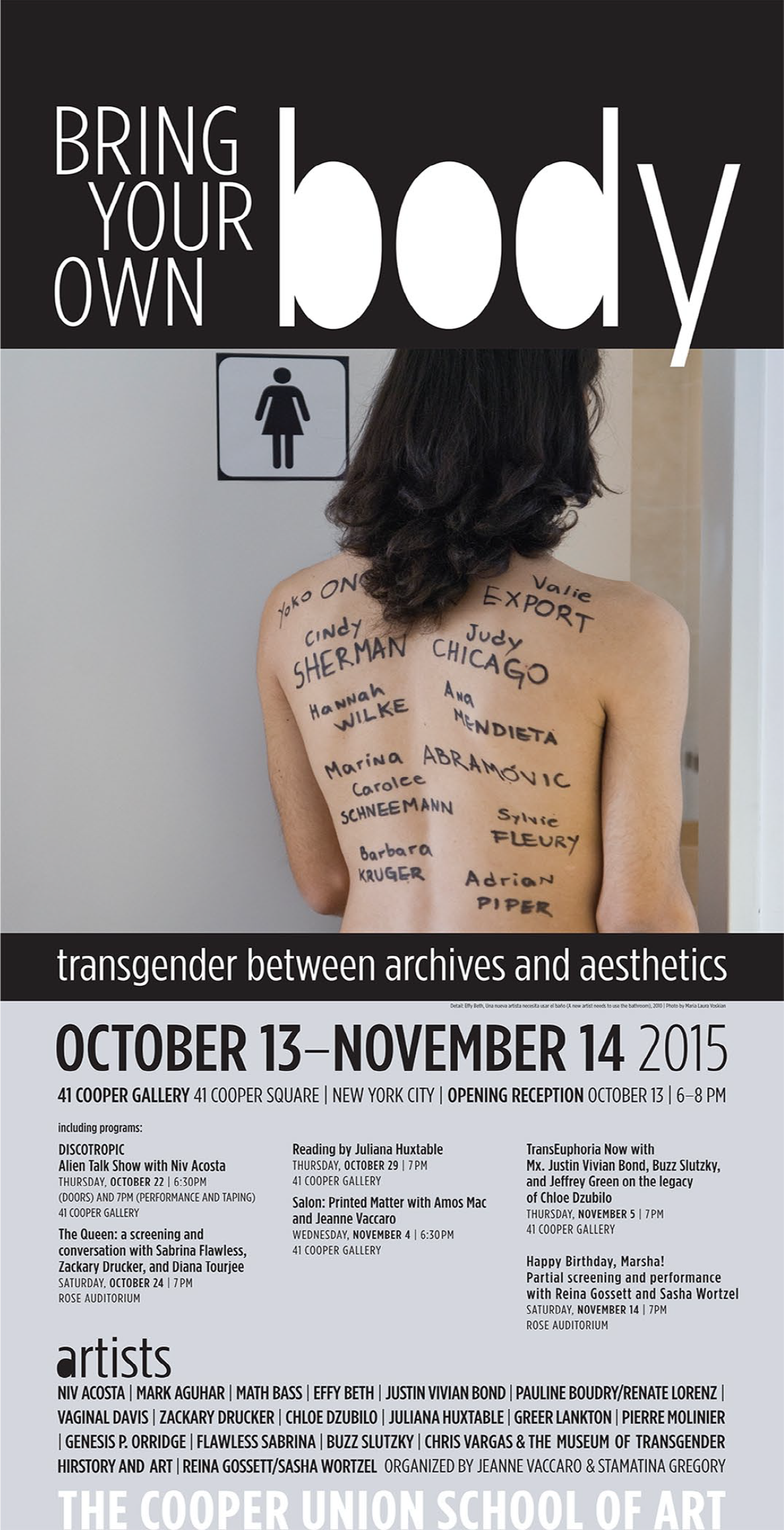
Poster advertisement for the exhibition “Bring Your Own Body: Transgender between Archives and Aesthetics.” Detail: Elizabeth ‘Effy’ Mia Chorubczyck, Una nueva artista necesita usar el baño (A new artist needs to use the bathroom), 2011. © Photo: Maria Laura Voskian. Reproduced with permission.
The mid-range color photograph depicts the artist from behind as she crosses from the foreground into a background emitting a warm light through a cracked door with a woman’s sign on it. On her slim nude back, written in thick black marker, are the names Yoko ONO, Valie EXPORT, Cindy SHERMAN, Judy CHICAGO, Hannah WILKE, Marina ABRAMOVIC [sic], Carolee SCHNEEMAN, Sylvie FLEURY, Barbara KRUGER, Adrian PIPER, Meret OPPENHEIM, Tracey EMIN. The capitalized last names draw attention to their canonized status, emphasize their greatness for art publics, and yet are accompanied by the feminine first names that symbolize rightful, authorized entry into the women’s private lavatory. The image thus manages to be a trans self-portrait without pandering to the politics of visual purity that requires evidence of incongruence or the political value of direct commentary on the dead. The violence of gender segregation is invoked by her trans-feminist investigation of structures (public toilets) and disciplinary norms (art history canons). The catalog describes the curatorial ‘effort to assign value to where it has been withheld’, but Chorubczyck’s self-determining action also interrogates the values assigned to performing explicit trans femininity in the face of social exclusion from women’s spaces.
Chorubczyck’s image raises questions about how the mechanisms of in- and exclusion present in social spaces are absorbed in the arts world. In the arts industrial complex, value arbiters might be human, a policy document, or affective atmospheres. This interrogation of the role of such value arbiters is proximate to that of Susan Cahan (2016) in Mounting Frustration: The Museum in the Age of Black Power with regards to their focus on managing the inclusion of black artists in elite US art shows during the 60s and 70s. Any given individual within an institution might not feel personally responsible for discrimination, but they enable and defend policies and conditions that carry out what Cahan calls ‘segregation in the guise of integration’ that echo social forms of racial segregation (p. 37).
A potential case of trans segregation in the guise of queer integration is the catalog from the German Historical Museum and Berlin’s Schwules/Gay Museum’s 2015 exhibition with the English title ‘Homosexuality_ies’. The lead image for all promotional materials was by the non-binary trans identified North American artist Cassils, who made Advertisement: Homage to Benglis with photographer Robin Black (2011) that displays their red-lipped contoured face, muscular torso, and a full jockstrap (see Figure 2). It references Linda Benglis’ (1974) photographic nude with a double-ended dildo printed as an advertisement for her show in Artforum. On posters and the cover of the catalog, bold red typeface reading ‘Homo’ wraps around their shoulders while ‘Sexualität_en’ hovers above their crotch and runs right across their bulging pecs above their pierced nipples. The clean white studio background of the photograph could be read as referencing the white, cisgender, gay culture that both yearns for this kind of cut body and (mis)recognizes it as its own, which was how the advertisement originally circulated in gay male image cultures online (personal website for Cassils).
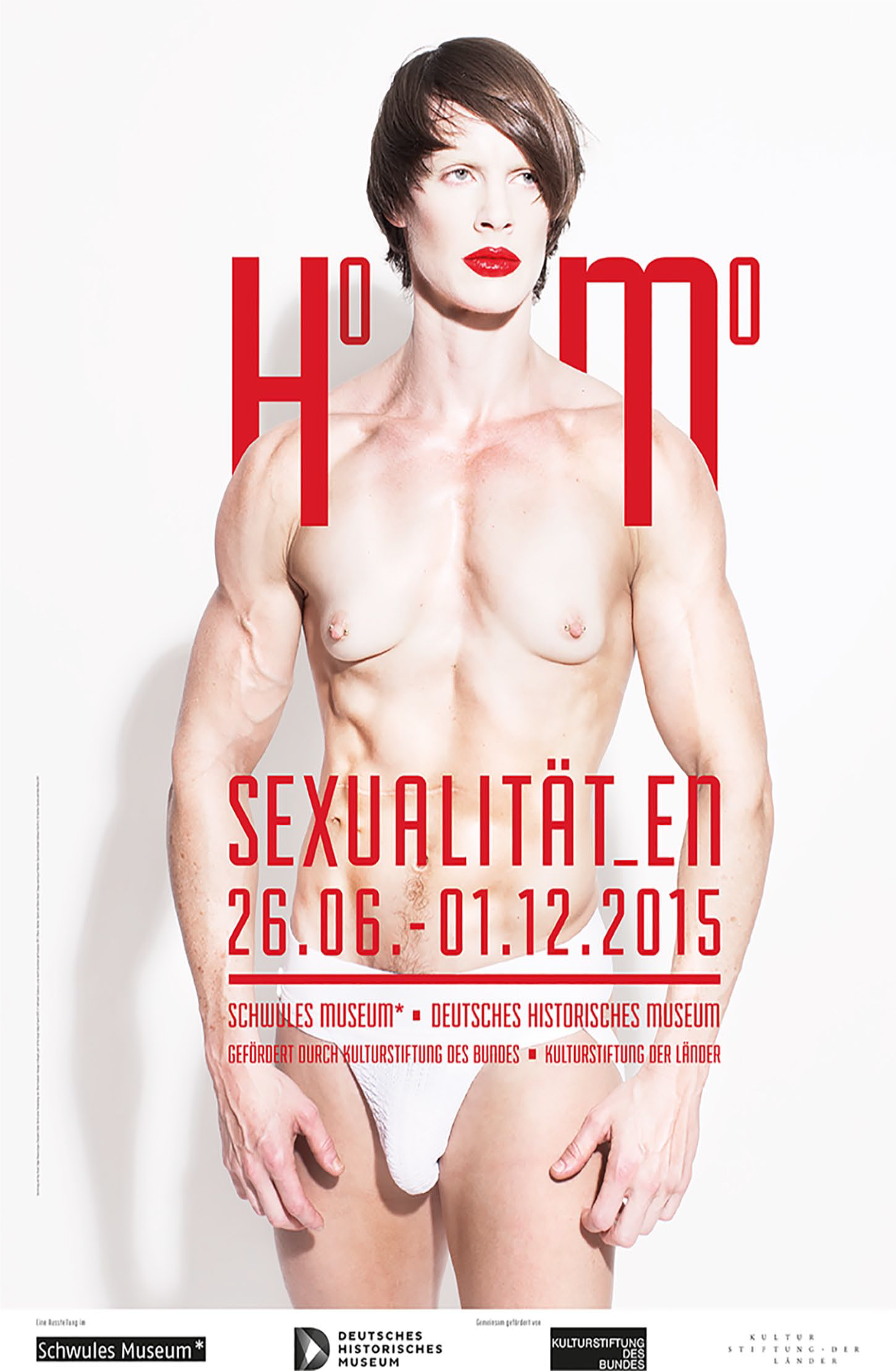
Credit Poster HMSX. Homosexuality_ies. Exhibition Poster Schwules Museum with Deutsches Historische Museum, Berlin 2015, LWL Museum für Kunst und Kultur, Munster 2016. Design: chezweitz GmbH, urbane und museale szenographie, Berlin using. Advertisement: Homage to Benglis, part of the larger body of work CUTS: A Traditional Sculpture, a 6 month durational performance, 2011. Photo credit: Heather Cassils and Robin Black. Image courtesy of Heather Cassils and Ronald Feldman Fine Arts. © Heather Cassils and Robin Black 2011.
As a trans artist, Cassils is invoked in the exhibition catalog’s introductory words in terms of how the exhibition hoped to represent the turbulent space of a ‘third gender’ (Völckers et al., 2015: 2, 5), language dating back to Magnus Hirschfeld’s (1901) pamphlet meant to enlighten and make male homosexuality public. Collapsing Cassils’ transness into the visual and verbal grammar of male homosexuality amounts to a limited inclusion of gender nonconforming minorities. The inclusion seems violent in the sense that it is organized by the hegemonic powers represented by these museums, but also since on the whole a very limited number of trans images or artists were included. The exhibition as a whole would seem to extract value from the hypervisibility of gender turbulence that advertised the show while denying trans persons representational equivalency to the cisgender or gay standard of (art) historical representation.
Having said that, the homage carried forward in Cassils’ Advertisement: Homage to Benglis was to mimic dominant male posturing. Benglis’ work exposed how cisgender male artists promote their work without fanfare while cisgender female artists are chastised for doing so. Similarly, Cassils’s Advertisement as designed for the Homosexuality_ies exhibition only seems to promote gay male homosexuality while covertly promoting trans-masculine eroticism. As well, in this context the image that was worked on by a design agency to include the exhibition title and details may serve as a critique of the genealogy of sexology by way of reappropriating Hirschfeld’s rhetoric of a ‘third gender’ and insisting on foregrounding trans embodiment. Interestingly, the public misread the imaged body as being a woman and certain groups campaigned against it on the basis of it being sexist because Cassils was too sexy!
Both advertisements generated major discussions in their reception communities. While in Berlin when the show was on, I saw many ‘Cassils/Homosexuality_ies’ posters defaced by being torn, cut into, and with strongly worded graffiti. Pushing the trans body of Cassils out into the foreground of ‘Sexuality_ites’, while allowing the cisgender queers respite in the ambient background of ‘Homo’, meant that Cassils’ body functioned as a site both of extracting symbolic and commercial value, and for enacting political violence. In this permutation of being circulated, Advertisement continued to expose dominant cisgender homosexual male perspectives as well as cisgender heterosexual ones that typically compose the white ‘ground’ of its figuration.
One of the commendable aims of this issue is to broaden the material and visual archives of trans cultural production by introducing specific image sources and producers who have not had the attention they deserve. In other words, they have not been valued by scholarly knowledge systems as an extension of cultural knowledge systems. In this article, I have sought to explain how, through analysis of the values that structure the wavering line of foregrounding a trans figure against the typically unanalyzed non-trans normative background, the field of trans visual culture studies might critique and reassign value. My hope is that, as trans art works amass social lives within the arts industrial complex, the study of the traps in which they might be ensnared might help avoid getting stuck in and even dismantle these mechanisms.
Footnotes
Acknowledgements
The author wishes to thank the participants of the ‘Arts of Trans, Gender Diverse, and Two-Spirit Lives’ Conference (April 2018) for their feedback, and especially Alanna Thain for the invitation to present. My gratitude also goes to Cyle and Kirstin for including an early version of this article for their panel at College Art Association on Trans Art Histories, and their many supportive editorial comments. Jin Haritaworn first suggested the phrase ‘arts industrial complex’ to me in an email exchange, for which I am grateful. I want to thank Riley C Snorton, who had an important conversation with me about trans studies and media where I began to first articulate my thoughts about the notion of being pressed into visuality. Thanks also to the anonymous reviewers for their extremely helpful additions and suggestions.
Notes
 They is currently writing on contemporary transgender (self) portraiture in the wider field of activism in Toronto, Berlin, and Cape Town/Johannesburg.