



Abstract
#EndSARS, an instance of social activism in Nigeria, was a reaction to police brutality and misgovernance. This study examines how users of Nigerian Twitter (now known as X) draw on various discourses to challenge police brutality and (re)construct their ascribed identities while simultaneously evaluating the actions of the Nigeria Police Force and those of the Nigerian government. Gunther Kress and Theo van Leeuwen’s Multimodal Critical Discourse Analysis (2001), as well as James Martin and Peter White’s Appraisal Framework (2005), served as the theoretical framework. The findings revealed the (re)construction of four identity categories, namely paroxysmic, solidaristic, non-violent resistance and violent resistance. Paroxysmic identity mirrored deep-seated anger among the protesters. Solidaristic identity concerned empathy towards victims of police brutality. Non-violent resistance identity revealed the resilience, courage and audacity to challenge the dominant group, while violent resistance identity involved violent attitudes in reaction to police brutality. The study concludes that social media is a veritable tool for holding dominant groups to account and is a force for change in 21st-century society.
Keywords
Introduction
#EndSARS is a collective demand for the disbandment of a unit within the Nigeria Police Force known as the Special Anti-Robbery Squad (SARS). The term ‘#EndSARS’ was first used on Twitter (now X) in 2017 by Nigerian social activists to raise awareness about the brutality and exploitation by SARS officials (Al Jazeera, 2020). The SARS unit was established in Nigeria in 1992 to combat crimes, such as armed robbery, kidnapping and related offences. However, widespread allegations of human rights abuses by members of the unit, particularly targeting youth, emerged over time. In 2020, the #EndSARS media space was inundated with comments following disturbing videos and images of police brutality shared by #EndSARS followers, which sparked massive public outcry. This outcry gave rise to the EndSARS movement, fundamentally reflecting deep-seated anger and a lack of trust in the Nigerian government (Lukman, 2021). A key factor that influenced this activism campaign was access to social media and the availability of affordable mobile multimedia devices (Flores Borjabad and Ruiz, 2021).
The use of social media to address social injustice and inequality is increasingly gaining ground in many countries around the world (Akinrinlola and Sunday, 2024; Olson, 2016). Social media users in many African countries have successfully utilized hashtags to alter the socio-political status quo and reconstruct their ascribed identities (Adegoju and Oyebode, 2015). For example, #Nigeriadecides played a crucial role in online political participation that led to political change in the 2015 general election. This election was not only referred to as a social media election but also marked a period in which social media reawakened Nigerian youth to full political consciousness (Yeku, 2018). Similarly, #OccupyNigeria was used as a collective social movement in Nigeria in response to the removal of petroleum subsidies (Olabode, 2018).
While hashtag activism has attracted attention from political and social perspectives (Dambo et al., 2022; Lukman, 2021), previous linguistic studies have primarily focused on discourse features and strategies (Igwebuike et al., 2017; John and Agbara, 2021; Owoaje and Sofola, 2021), with limited attention given to how the identities of activists are multimodally (re)constructed. Studying identity in social media activism, like #EndSARS, is crucial to understanding how individuals and groups redefine themselves in response to socio-political events. The #EndSARS protests were not just a reaction to police brutality but also a redefinition of Nigerian youth identity.
The significance of studying identity lies in its social and psychological implications. In social contexts, identity shapes how individuals engage with society, including how they participate in social and political actions. Psychological theories of identity (Hornsey, 2008) explain how individuals form a sense of belonging and collective identity in opposition to perceived threats or injustice. In the EndSARS movement, this manifested as Nigerian youth who were previously marginalized reclaimed agency and voice through the online discourse surrounding police brutality. This shift in identity (from passive victims to active participants in the political process) has powerful implications for democracy, resistance and social change. From a practical perspective, understanding how identities are reconstructed in digital spaces provides insights into the mechanisms of mobilization in online activism. By framing their identity as victims, survivors or fighters for justice, protesters can attract empathy, solidarity and support, which are crucial to sustaining collective movements. Moreover, the study of identity (re)construction could influence the strategies of future social movements as it would help activists navigate and direct public discourse.
Identity (re)construction
Identities are in a constant and dynamic process of reconstruction and deconstruction. Quan-zhi (2015) views identity (re)construction as the adjustment, modification, affirmation or alignment of one’s beliefs to achieve communicative purposes. Therefore, identity (re)construction can be seen as a process of change or adjustment driven by the demands and complexities of human interaction (Davidson et al., 2005). To put this into perspective, the identities of Nigerians, especially the youth, are being (re)constructed via social media. Events and actions that were once taken for granted by Nigerians are now being critically re-examined. There is an adjustment in the attitudes of average Nigerians in response to the actions of governmental authorities.
The concept of identity (re)construction is illustrated by Woods and Jeffrey’s (2018) study of English primary school teachers’ identity reconstruction in response to educational reforms in England. Before these reforms, primary school teachers viewed teaching as a vocation, where they were not only interested in teaching content but also in shaping the emotions, social life and physical development of children, fostering a strong bond between teachers and pupils. However, the ‘marketization’ of schooling forced teachers to abandon child-centredness and adopt a more business-oriented approach to classroom teaching. Although this study does not employ a critical discourse analytical approach, it demonstrates that identities are not (re)constructed in a vacuum; they are influenced by and enacted around external factors. In this context, identity is understood as a fluid and ongoing process rather than a fixed state. This fluidity is further enhanced by the affordances of social media platforms, such as self-presentation, narrative construction, visibility and interactivity.
Social media and identity (re)construction
Social media plays a crucial role in identity (re)construction by providing a platform where individuals can express, explore and refine their identities. It allows users to curate their online personas through selective self-presentation. Individuals can control the information they share, the images they post and the interactions they engage in, which enables them to construct a desired identity. This curation often involves highlighting positive aspects of oneself and omitting negative ones, which can impact both self and public perception.
This is evident in Mooney and Price’s (2022) study of the media propaganda of the Islamic State of Iraq and Syria (ISIS). The study examines how ISIS, a militant Islamist organization, consciously created an image of itself as a legitimate state through diverse multimodal discourses as part of an asymmetric conflict strategy. The aim was to counter Western media’s depictions of the group as brutal. Adopting a multimodal critical discourse analytical approach, the study reveals that ISIS used discourses of utopia, war and justice to justify its rhetoric on benevolence, control over violence, protection of its citizens, the rule of law and legality as a legitimate state.
Social media platforms also provide tools for storytelling, enabling users to construct and share personal narratives. These narratives help people make sense of their experiences and (re)shape their identities. The ability to continuously rewrite these narratives reflects the dynamic nature of identity (re)construction. For instance, Marshall and Pienaar (2008) investigate the linguistic resources employed in Oprah Winfrey’s television talk show to (re)construct the identities of her guests. The study examines how Oprah Winfrey uses discourses around her show to transform the identities of her guests and viewers from victims of tragedy to empowered and resilient survivors. Using Martin and Rose’s (2003) Appraisal Framework as the interpretive source, the study shows that strategic use of evaluative language, such as positive tenacity (e.g. praiseworthy) and negative capacity (e.g. legitimizing the victim’s actions), is employed to (re)construct the identities of those involved.
Similarly, Colwell and Johnson (2020) examine social media’s role in changing attitudes and encouraging ‘transformative empathy’ through the exposure of sexual predators. Transformative empathy refers to the ability of individuals to change their perspectives and behaviours by understanding and sharing the feelings of others, particularly those who have experienced trauma. In the context of the #MeToo movement, transformative empathy plays a crucial role in the identity (re)construction of survivors of sexual abuse. By sharing their stories on social media, survivors receive empathy and support from a wider audience, which helps validate their experiences. This public validation is essential in (re)constructing their identities from victims to empowered survivors. The study implies that social media not only provides marginalized members of society with easy access to challenge dominant groups but also allows survivors to take control of their narratives. This is a critical aspect of identity (re)construction. By telling their own stories, they can counteract negative narratives imposed by societal stigmas and stereotypes.
Social media facilitates the dynamic and collective (re)construction of identity, with users curating their selves through digital scrapbooks, a phenomenon described by Zhao and Zappavigna (2018) in visual blogging, where the self is constantly negotiated in relation to others. Zappavigna’s (2016) analysis of Instagram’s #motherhood tag further illustrates how social media fosters interpersonal connections, creating a shared ‘intimate public’ where images serve as ‘mediated portraits’. These images invite engagement with the photographer’s experience, transforming everyday life into a collective identity. This continuous process of self-construction and interaction reflects how social media shapes identity as a dynamic and collective experience. In line with Van Leeuwen (2021), this process underscores the importance of multimodality in identity formation, as images, texts and other semiotic resources work together to construct and communicate complex layers of identity in the digital space. Through these multimodal interactions, users participate in an ever-evolving process of self-presentation and collective identity-building.
The above studies offer useful insights for the present work by highlighting the communicative fluidity of social media, which enables users to effectively represent themselves and tell their stories. While there is extensive literature on social media’s role in activism and identity formation, most of the studies focus on Western and Arabian contexts (e.g. #MeToo and ISIS). There is a dearth of studies examining identity (re)construction in sub-Saharan African contexts, particularly in Nigeria. Moreover, while previous studies on social media and activism often concentrate on discourse and text, they usually overlook the multimodal aspect of social media discourse, as seen in the EndSARS movement. There is also insufficient attention to the power dynamics at play in how marginalized or dominated groups represent themselves through social media, such as how Nigerian youth deploy social media for political mobilization and identity (re)construction in response to state violence.
Although, Mooney and Price (2022) provide insights into identity (re)construction, their findings do not apply to sub-Saharan African contexts, where unique socio-political factors influence identity (re)construction. #EndSARS represents a specific cultural and political context that involves Nigerian youth, police brutality and misgovernance, and the ways in which social media has enabled a unique form of resistance. This study addresses these gaps by examining how Nigerian youth used images, videos and texts to (re)construct and negotiate their identities in the context of the EndSARS movement. This offers new insights into identity (re)construction in digital activism and power dynamics in African socio-political contexts.
Theoretical framework
Kress and Van Leeuwen’s (2021) Multimodal Critical Discourse Analysis (MCDA) and Martin and White’s (2005) Appraisal Framework serve as the theoretical bases for this study. Kress and Van Leeuwen’s MCDA was chosen for this study because it offers a comprehensive framework for understanding how multiple modes of communication interact to shape identities. In the context of the EndSARS movement, MCDA allows for an analysis of how protesters’ identities are (re)constructed through a variety of media, which provides a nuanced view of how power, ideologies and resistance are expressed. Martin and White’s (2005) Appraisal Framework was integrated to complement MCDA by focusing on evaluative language, which analyses how emotions, judgments and attitudes towards police brutality and misgovernance are enacted. This approach is particularly suited to studying social media activism as it examines not only the linguistic and visual elements but also how these modes work together to communicate identity and challenge power structures, thereby offering valuable insights into identity formation and collective action in the digital age.
Kress and Van Leeuwen’s MCDA expands traditional Critical Discourse Analysis by incorporating multiple modes of communication into the study of identity (re)construction. It investigates how various modes work together to (re)construct social identities and how power and ideology are embedded in visual and other semiotic resources to challenge power structures. By doing so, it recognizes that meaning is not simply conveyed just through words but also through a dynamic interaction of multiple modes working together (Bateman, 2014; Jewitt, 2014). This approach is particularly valuable for analysing the EndSARS movement, where protesters use multimodal resources to challenge power structures and (re)construct their identities.
One of the key contributions of MCDA lies in examining how power and ideology are embedded not only in language but also in visual and auditory modes of communication. Kress and Van Leeuwen (2001) challenge traditional discourse analysis that often overlooks the power of visual elements in shaping meaning. They argue that images are not passive representations but active participants in the construction of meaning. Visual elements, such as colour, framing and composition, are deliberate semiotic choices that can either reinforce or challenge power structures. According to Kress and Van Leeuwen, modes are semiotic resources that allow the simultaneous manifestation of discourses and styles of interaction (p. 20). In this sense, the framework goes beyond simply identifying the interactive, representational and compositional aspects of visual elements; it enhances understanding of how these modes interact with textual and auditory modes to create complex, layered meanings. This interaction is particularly relevant in the EndSARS movement, where social media posts strategically combine text (tweets and hashtags) with images and videos to convey the anger, resilience and resistance of protesters. The interplay between these modes challenges traditional power structures as it empowers marginalized voices to reshape their identities and challenge state-sanctioned violence.
However, while Kress and Van Leeuwen’s framework explores how different modes work together, it does not fully address the influence of social media dynamics, such as interactivity and virality, in real-time activism. This study extends the framework by exploring how digital media affordances enable marginalized groups to engage in multimodal resistance, allowing for (re)construction of identities and challenging dominant narratives.
Martin and White’s (2005) Appraisal Framework complements MCDA in exploring discourse features that focus on the language of evaluation. It analyses how speakers or writers express feelings, make judgments and invoke emotions through their language choices. This framework helps understand nuanced evaluations within the text, such as anger, empathy, resilience and resistance expressed by language users. In all appraisal instances, the appraiser and the subject of the appraisal are the two main players. Three key factors – attitude, engagement and graduation – are critical to the evaluation of these actors within the appraisal theoretical framework. This research employs attitude to evaluate positive and negative expressions of emotional reactions and feelings (affect) and people’s character and behaviour (judgement) (Sunday and Akinrinlola, 2017).
In addition to MCDA and the Appraisal Framework, this study integrates Castells’ (2010) and Brubaker and Cooper’s (2000) conceptualizations of identity to deepen understanding of identity (re)construction in the EndSARS movement. Castells (2010) argues that identity is formed through social actions that can bring about social and political change. He identifies three types of identities: legitimizing identity, resistance identity and project identity. While legitimizing identity serves to justify the dominance of established power structures, resistance identity is constructed by marginalized groups in opposition to these structures. Project identity is formed when resistance identity is at the advanced stage such that the social actors are pushing for a total transformation or overhaul of the socio-political structure. This study aligns with Castells’ resistance and project identities, as #EndSARS protesters challenge the police force and the Nigerian government, ultimately pushing for broader societal transformation.
Brubaker and Cooper (2000) critique traditional understandings of identity by emphasizing its multivalent nature. They propose identity as an activity performed by social actors, shaped by processes of identification, self-understanding and groupness. This perspective highlights the relational and contextual nature of identity, which is shaped by interactions with others. For #EndSARS, the protesters’ identities are fluid and situational, constructed through both self-identification and perceptions of others (e.g. the state, the Nigeria Police Force and the general public). The concepts of commonality and connectedness resonate with social dynamics in the movement, where shared experiences of police brutality and a collective desire for justice bind the protesters together into a cohesive group, despite the diversity of ethnic and social backgrounds.
By integrating these theories into the theoretical framework, this study offers a comprehensive view of identity (re)construction in the EndSARS movement, emphasizing how social media serves as both a tool for resistance and a platform for identity transformation. Multimodal Critical Discourse Analysis and Appraisal Theory provide the necessary tools to explore the multimodal nature of evaluative social media discourse, while Castells’ and Brubaker and Cooper’s theories deepen the understanding of social dynamics, collective identity and the fluidity of identity (re)construction in the context of global protest movements. This study extends the theoretical frameworks to highlight the role of digital multimodality in social change and offers new insights into how identity, social dynamics and social media discourse intersect in the context of global protest movements.
Methodology
This study adopted a descriptive design to examine the (re)construction of identity through the use of multimodal resources in the #EndSARS discourse on X. 1 The data comprised tweets, retweets and comments extracted from the #EndSARS microblogging site. The preference for X was informed by its support for multimodal content and its user-friendly interface, which makes it accessible to a wide range of people and perspectives. Additionally, its influence and role in the current socio-political dynamics in Nigeria dictated its selection as a data source. The study period covered August 2020 to March 2021, the peak of activities surrounding the protest and the ensuing reactions from protesters.
The general search term for extracting data from the X hashtag was #EndSARS . Because it was difficult to collect data instantaneously as the events unfolded, digital discourses containing and responding to the hashtag #EndSARS were retrospectively extracted. An initial dataset of 600 posts tagged with #EndSARS was collected by the researchers to ensure comprehensive capture of the discourse surrounding the movement. After a preliminary screening, 195 posts were retained following data clean-up, which involved removing posts that did not directly address the research objectives (#EndSARS protest, evaluative language and (re)constructed identities), as well as posts with repeated information or no new insights. The categorization process was conducted by the researchers to ensure that only relevant posts that contributed to the research objectives were included in the final dataset. Given the scope and depth required for qualitative analysis, it was not feasible to analyse all 195 posts in detail. Therefore, a further selection was made to focus on 13 posts that best represented the narratives identified in the larger sample. The selection process was based on relevance to research objectives, representativeness of key themes, multimodal variety, impact and engagement, and diversity of perspectives.
The data were analysed to determine the recurring dominant themes that capture the emotions of the protesting Nigerians, their evaluative language and their identity (re)construction. These dominant themes were identified by the keywords, phrases, images and videos used by the protesting Nigerians on #EndSARS. For example, phrases such as bad roads, lack of electricity and careless minimum wage were coded for the theme of social justice, while criminal squad and rogue officers were coded for police brutality. Subsequently, the data were analysed using insights from MCDA to examine the evaluative language and identities (re)constructed.
Analysis
Identity as used in the context of this study aligns with Castells’ (2010) conceptualization of identities from the point of view of social movements and Brubaker and Cooper’s (2000) perception of identity as action by social actors . In the evaluation of the SARS personnel and those of the Nigerian government, the protesting Nigerians (re)constructed the following identities: paroxysmic identity, resistance identity, violent resistance and solidaristic identity. The above-mentioned analytical categories emerged (during the data coding and categorization) based on the emotional responses, narratives and ideological positions expressed by the protesting Nigerians in relation to the actions of the SARS personnel and the Nigerian government.
Paroxysmic identity
Paroxysm, in the context of the #EndSARS protest, is simply an expression of strong emotion or an outburst of anger. The outburst of anger is usually based on two reasons – perceived injustices and experienced injustices. The majority of the #EndSARS protesters showed their anger through posts, tweets, retweets and comments based on what they saw or read on social media. For example, the viral videos of the 19 September 2020 killing of an unarmed young musician in Port Harcourt and the 3 October 2020 killing and vehicle snatching of an unarmed young man in Delta State, Nigeria, triggered a strong feeling of injustice among Nigerians, which resulted in mass online protests. The anger identity is central in most of the evaluative posts and comments made by protesting Nigerians on #EndSARS.
Figure 1 is a video posted by Amnesty International to raise awareness of human rights violations in Nigeria. The post employs affect (an emotionally charged display of anger) to express outrage at police brutality in Nigeria. Before the posting of this video on #EndSARS, the Nigerian government had disbanded SARS after it was accused of indiscriminate killings. However, instead of ensuring accountability and justice for the victims of police brutality, the Nigerian government announced that members of SARS would be redeployed. This led to more anger towards the Nigeria Police Force and the government for their failure to ensure justice on the part of the accused officers and justice for the victims of police brutality. In the video, the protester can be heard saying, ‘I’m tired, I’m tired’. The articulation of the words through a high-pitched and intense vocalization mirrors the level of dissatisfaction and disappointment towards the Nigerian authority.
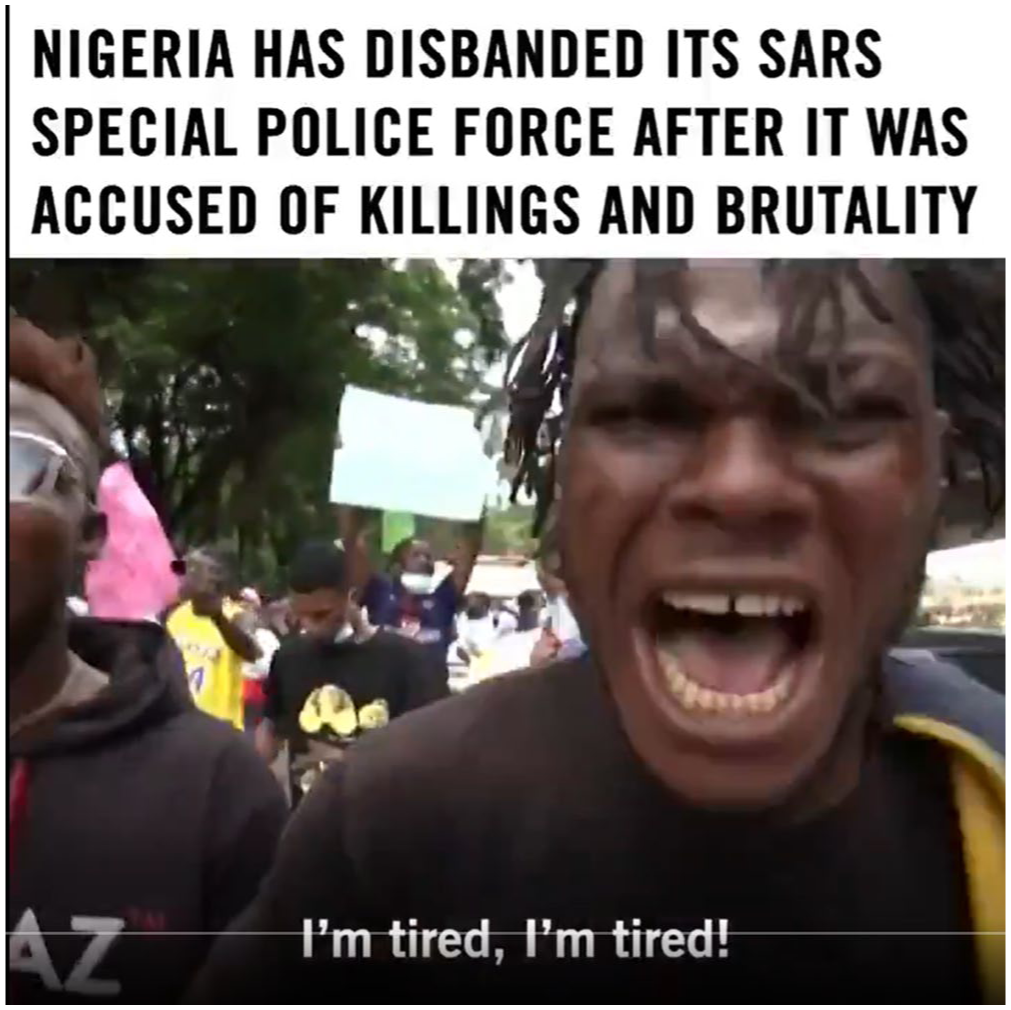
Outburst of anger and frustration (Twitter, 27 October 2020). Reproduced with permission.
The protester’s intense anger is evident in his look and facial expression. The image shows a non-transactional reaction, with the protester shouting and gazing at someone unseen, conveying strong emotions of anger and a demand for human rights and justice. His unkempt dress and hair, along with his emotional expression, humanize the struggle, making it relatable. The unkempt appearance suggests poverty, distress and victimization. The expression ‘I’m tired, I’m tired’ signifies socio-economic frustration caused by police brutality. At the time, universities were closed due to a lecturers’ strike, and a COVID-19 lockdown led to job losses and income decline, with unevenly distributed palliative measures. This triggered anger among the protesters. The image of the shouting protester symbolizes the intensity of the struggle against police brutality, contributing to his identity as an activist.
Social media offers marginalized groups a platform to share stories ignored by mainstream media. By posting videos, protesters amplify their voices to reach a global audience. The video in Figure 2 captures a 2020 #EndSARS protest moment, with an angry mob blocking a political officeholder’s convoy. This visual documentation illustrates widespread dissent and anger towards political figures seen as complicit in systemic injustices and police brutality. The emotionally charged scene provides critical insights into the dynamics of the protest, showcasing the protesters’ unyielding demand for accountability and reform.
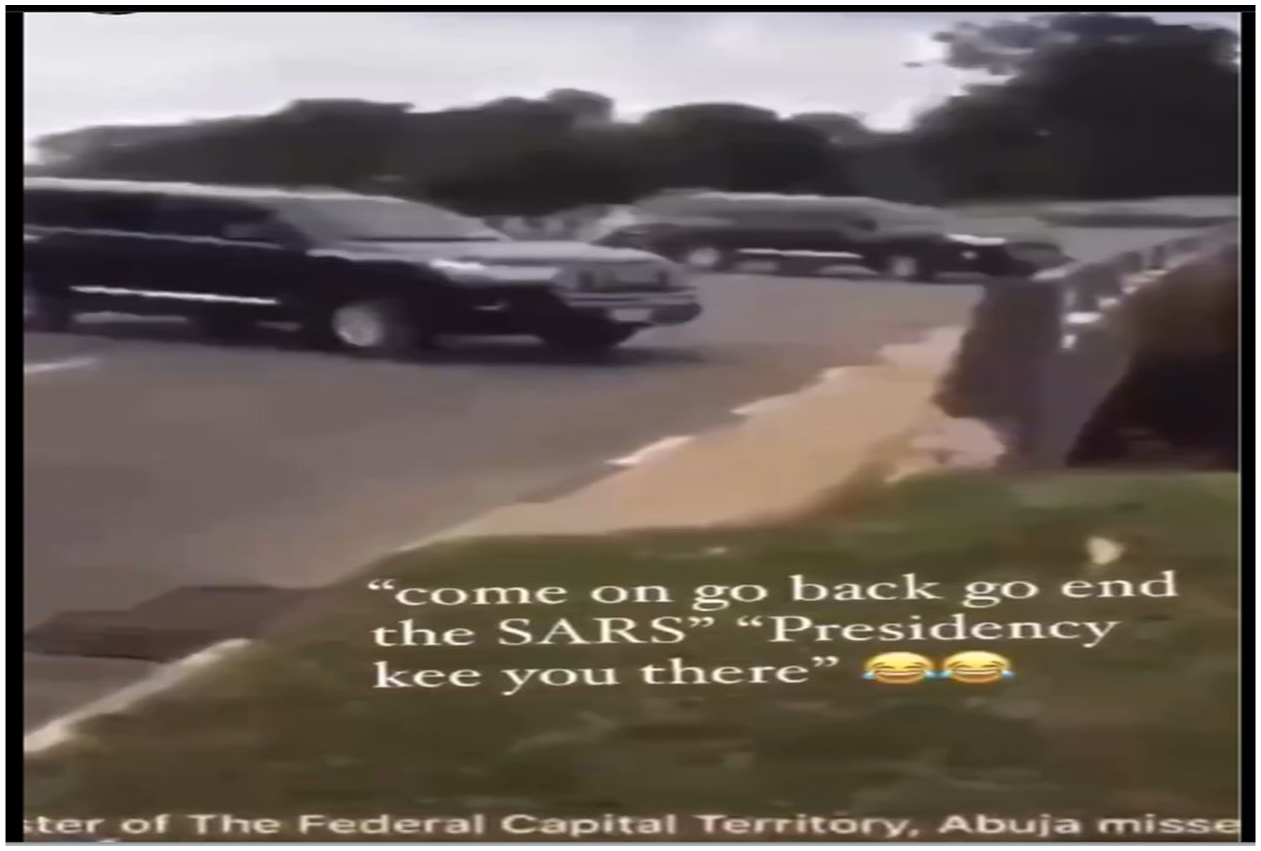
An angry mob blocking a convoy of a political officeholder (Twitter, 15 October 2020). Reproduced with permission.
This figure is not just an illustration of protest activity; it is central to understanding how resistance identity was multimodally constructed during the EndSARS movement. The protesters’ physical obstruction of a political convoy represents an explicit disruption of the established hierarchy between citizens and political elites. Linguistically, the chants (‘come on go back, Presidency kee you there!’) combine anger with defiance while, visually, the mob’s collective posture communicates agency, solidarity and empowerment. The image encapsulates the transformation of ordinary Nigerians from passive subjects into visible challengers of political authority. Thus, Figure 2 provides direct evidence of how multimodal practices reconfigure power relations and (re)construct protesters’ identities as active agents of accountability.
In the context of the EndSARS movement, social media provided unprecedented access to individuals and groups who were often marginalized or silenced in offline contexts. It diminished traditional barriers and hierarchies, enabling more open and equal interactions, and played a crucial role in (re)constructing how Nigerians connected, collaborated and advocated justice and reform, particularly in relation to police brutality and governmental accountability. For example, during the #EndSARS protest, activists had direct access to policymakers and government officials via social media, which enabled them to amplify their voices and demands. Figure 3 shows protesting Nigerians directly venting their anger (affect) on both the president and the vice president and negatively evaluating their (in)action towards police brutality (judgement).
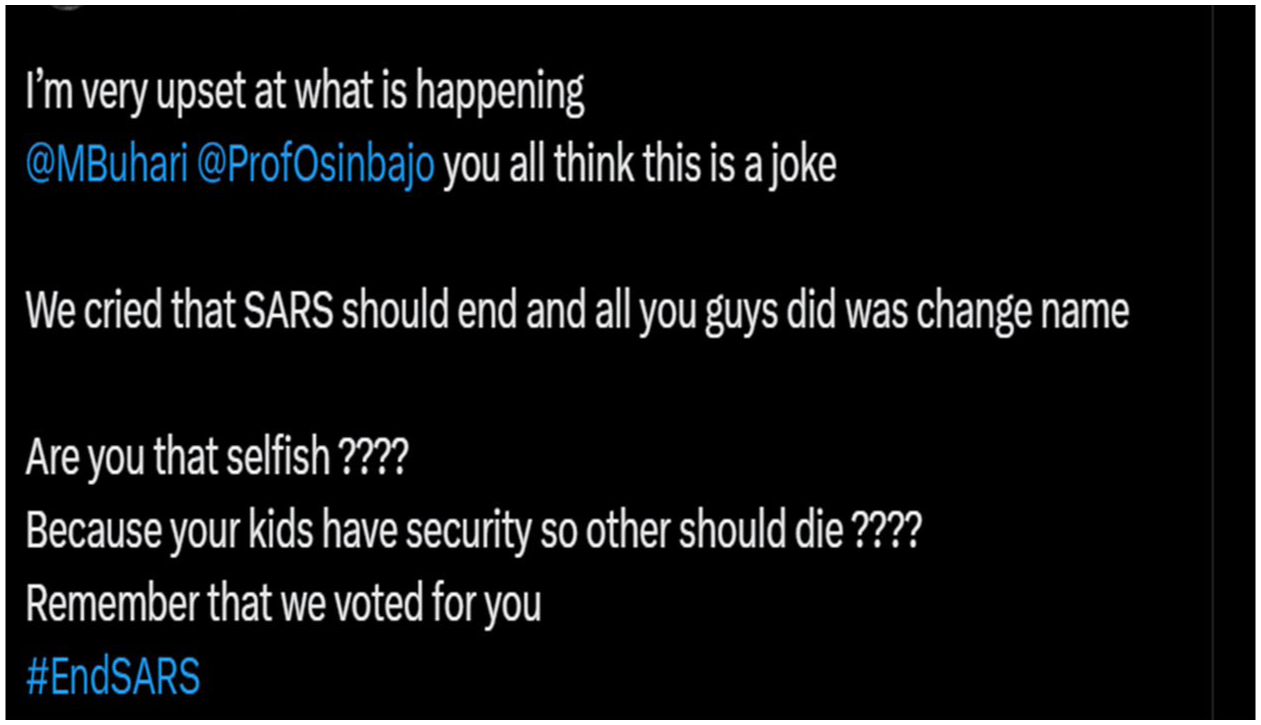
Protester upset with the Nigerian government over police brutality (Twitter, 17 October 2020).
The protester in Figure 3 engages affect to convey their anger towards the Nigerian government over police brutality. The adjective ‘upset’ is an expression of a strong negative emotion. It is a direct expression of anger towards the government represented by the president and the vice president for not being able to meet the yearnings of Nigerians, such as adequate security of life, and promptly meeting the demands of the #EndSARS protests instead of changing the name from SARS to SWAT. The protester angrily reprimands the president and the vice president for not taking the required steps to fast-track the process of reforming the Nigeria Police Force. The question ‘Are you that selfish ????’ suggests a negative evaluation of an action. The use of rhetorical questions ‘Because your kids have security so others should die????’ and the use of serial question marks ‘????’ by the protester suggests a greater emphasis on the need to respond to the demands of the protesting Nigerians. By using language to enforce moral standards with the help of social media, the protester influences the power dynamics and (re)constructs his identities.
The above account implies that social media redistributes power by enabling citizens to bypass traditional channels and gatekeepers in order to directly hold public officials accountable for their actions. It also facilitates the (re)construction of active citizenship. The ability to directly engage with public officials empowers citizens, transforming them from passive recipients of policy to active participants in the political process. In traditional contexts, identity is often shaped by the limited and mediated representations of political engagement. However, social media platforms like X allow for a more fluid and participatory construction of identity, where individuals actively shape and negotiate their political selves. This enables citizens to present themselves not just as subjects of political decisions but also as agents of change, capable of holding power to account. As such, social media redefines active citizenship by offering citizens the tools to assert their political agency and influence governance directly, challenging the conventional boundaries of political participation.
This aligns with Castells’ (2010) notion of project identity, where social movements, like #EndSARS, facilitate a redefinition of collective identities, shifting from resistance to a proactive (re)construction of political, social and cultural norms. Moreover, this process supports the idea that social media provides a platform for identity fluidity, which enables individuals to adopt and express new empowered political identities that disrupt traditional political hierarchies. This finding reaffirms existing theories of social media as a tool for identity construction and extends the understanding of how social media activism reshapes identity and political engagement in the digital age, particularly in the context of resistance movements like #EndSARS.
Resistance identity
Resistance in the context of this study refers to the identity constructed by individuals or groups in response to oppression, marginalization or domination by more powerful social structures. This type of identity is formed as a means of resisting and challenging the prevailing power dynamics and asserting an alternative identity against the dominant cultural, political or social norms. The act of resistance usually emanates from a dominated group, who are stigmatized by the power of the dominant group (Castells, 2010). Resistance identity in the EndSARS movement uses building materials from collective memories of police brutality and lack of social justice. The #EndSARS protesters employ resistance to challenge the socio-political domination of the SARS operatives and that of the Nigerian government, and to maintain their focus in the face of danger.
The image in Figure 4 features Folarin Falana (Falz), a prominent #EndSARS advocate. Following the Lekki shooting of unarmed protesters, which shifted his activism online, Falz’s resolve to fight police brutality grew stronger. His speech includes clauses like ‘nobody is ever going to break my spirit’, ‘it’s not possible’ and ‘we are ready to keep it going’, highlighting resilience and determination. His expression ‘I swear on my life I will do everything within my power to make sure that justice is served’ conveys fortitude and courage, appealing to comrades to persist until victory is achieved.
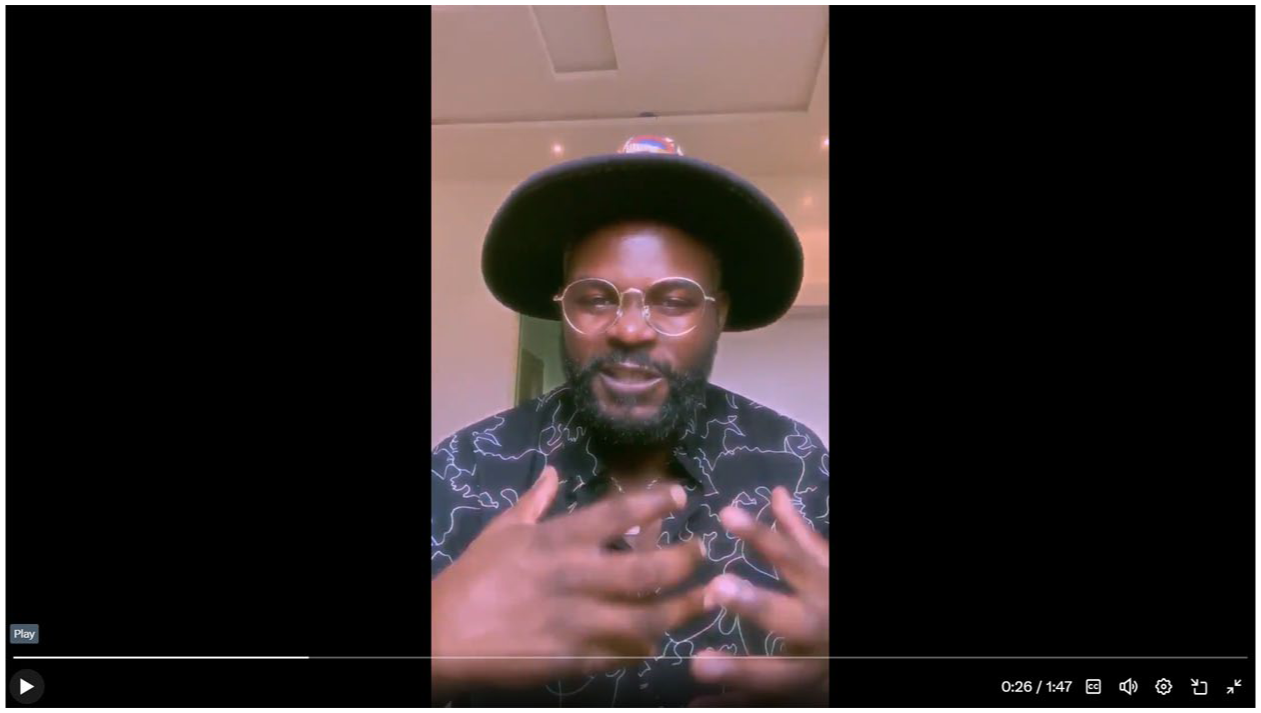
Message of resistance from Falz to protesting Nigerians (Twitter, 27 October 2020).
This figure demonstrates the performative role of influential cultural figures in shaping resistance identity. Falz’s language functions not only as a personal declaration but also as a call to collective endurance. The textual discourse aligns with visual presence to mobilize solidarity and resilience among protesters. By foregrounding this figure, the analysis highlights how celebrity voices contribute to identity formation within protest movements – showing that resistance is not just enacted on the streets but also amplified through mediated, multimodal performances. Therefore, Figure 4 is indispensable for understanding how the EndSARS movement strategically deployed symbolic leaders to inspire and sustain collective identity.
Poetic messages of resistance on social media significantly impact identity (re)construction by providing a platform for personal expression. It enables people to creatively resist oppression, build a community of resistance and reshape their self-identity and public discourse. This is evident in Figure 5, where the protester metaphorically conceptualizes #EndSARS protesters as a flood.
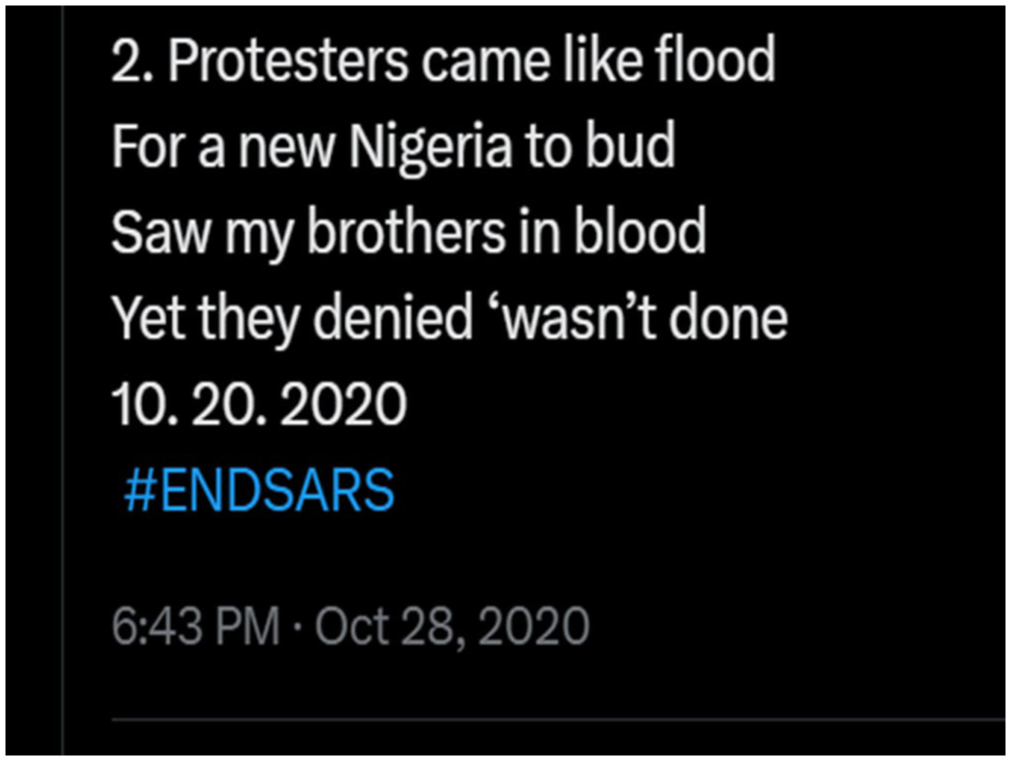
Poetic message of resistance (Twitter, 28 October 2020).
The noun ‘flood’ evokes a stream of resistance as Nigerians protested in major cities against police brutality. It connotes purification and rebirth, akin to the biblical flood that reset the earth for new growth. The protesters sought to cleanse the country of undesirable elements, aiming for a new Nigeria to bud. The flood metaphor also implies change. Just like a flood reshapes the land, the protests aimed to transform Nigeria’s sociopolitical landscape.
Flood is also used in this context to connote the idea of a threat or fearsome disposition. Nigerian youth, through organized street protests across major cities in Nigeria, surprisingly posed a threat to the Nigerian government and demonstrated a fearsome disposition by engaging in street protests to drive home their demands, an identity that has never been shown in the history of Nigerian youth. Rhyme, in Flood, Bud and Blood, is creatively employed for artistic effect and to express the emotions of the protesters as well as to stir the emotions of the readers to have the same mental disposition as the creator of the post.
The represented participants in Figure 6 are a flood of protesters at various protest locations. The intimidating number of protesters can be likened to a havoc-wreaking natural disaster, which naturally calls for urgent attention by the Nigerian government. This is corroborated by such headlines as ‘Protesters Flood Ikorodu, Ketu, Lagos’ (https://www.youtube.com/watch?v=ie1d1S0k404) and ‘#EndSARS Protesters, Campaign Vehicles Flood Lekki TollGate Amid Heavy Police Presence, Arrests’ (https://saharareporters.com/2021/10/20/endsars-protesters-campaign-vehicles-flood-lekki-tollgate-amid-heavy-police-presence). A closer look at the background pictures shows that the mass protests were done at night, which points to the willpower of the protesters to endure short-term inconveniences to meet their long-term goal of a better Nigeria. This form of protest foregrounds tenacity and support for the EndSARS protest. The high angle from which the image of the protesters is taken implies that the protesters are the dominated group, showing the level of power imbalance. However, the phone’s flashlight used by the protesters symbolizes visibility and resistance. The flashlights draw attention to the issues being protested, making them visible in the public consciousness. The lights also symbolize the protesters’ determination to be seen and heard despite attempts to silence or marginalize them. The act of shining a light, especially at night-time protests, demonstrates the protesters’ persistence and refusal to back down despite intimidation.
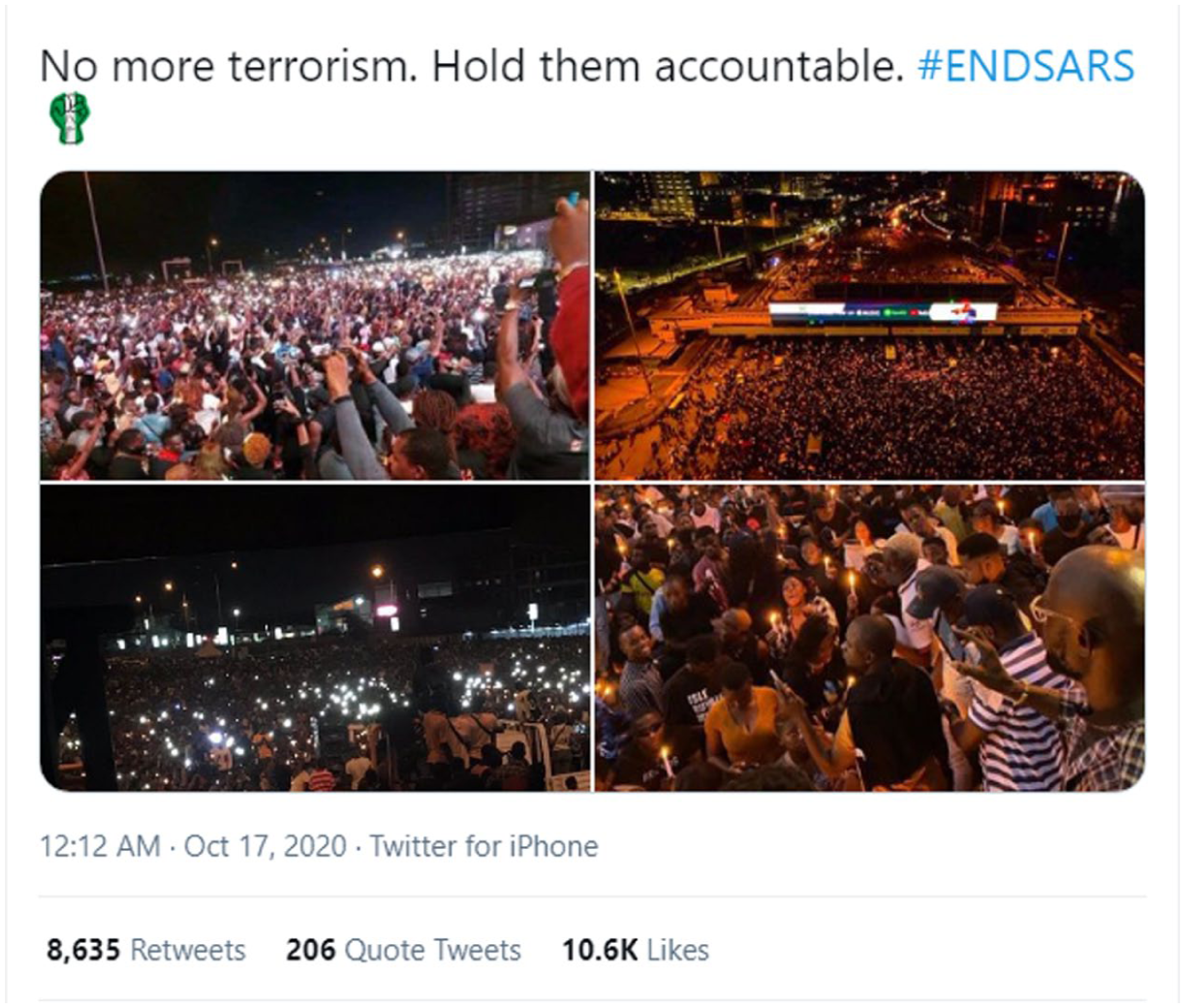
Crowd of protesters at various protest locations (Twitter, 17 October 2020).
Figure 7 is an instance of a transactional action process featuring the Actor (the Nigerian soldiers) and a transactional reaction from the Goal (the unarmed protesters at the Lekki Tollgate, Lagos). It captures audio-visual coverage of the confrontation between unarmed protesters and the Nigerian security forces. This video was made and posted by a popular Nigerian musician, Obianuju Catherine Udeh, also known as DJ Switch, about the shootings at the Lekki Tollgate on 20 October 2020. In addition to the extracted verbal discourse from the video, one can hear a series of gunshots amidst anti-government chants by the protesters. While the action emanates from the soldiers through the shooting of unarmed protesters, the reaction is evident in the expressions ‘We go die here’, ‘we are peaceful protesters’ and ‘They are killing us’. The action of soldiers was executed using the gun vector, as they are heard shooting the peaceful protesters.
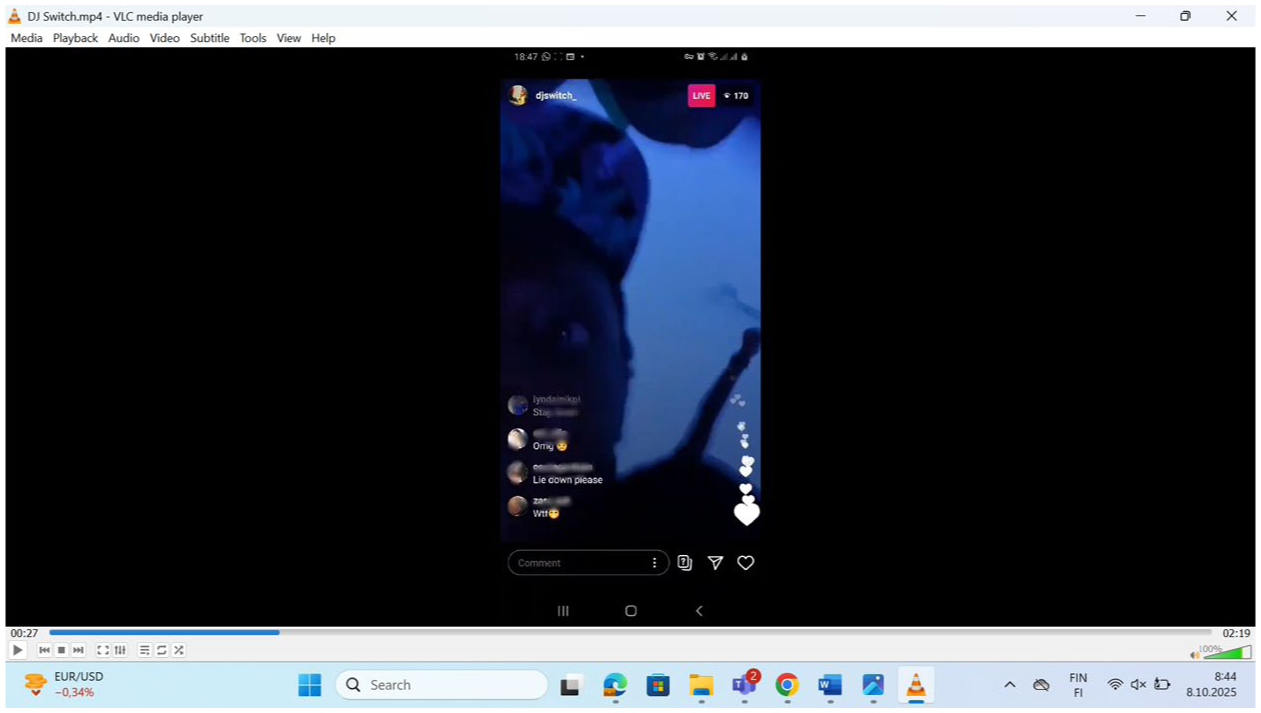
Confrontation between unarmed protesters and the Nigerian security forces (Twitter, 20 October 2020).
Figure 7 provides essential empirical evidence of how resistance and solidarity identities were constituted in real time. This is crucial to the study as it captures the defining multimodal moment of #EndSARS: the Lekki Toll Gate shootings. The semiotic layering – gunfire as auditory mode, chants (‘We go die here’) as linguistic mode and visual imagery of unarmed youths singing the national anthem – powerfully enacts project identity. The protesters’ willingness to risk death while asserting national belonging reveals how multimodal resources converge to (re)construct Nigerians as resilient citizens demanding accountability. Peaceful protesters chanting solidarity songs and singing the national anthem while being shot by soldiers highlights the stark power imbalances and the brutality of the authorities. However, the patriotic performance in the face of violence delegitimizes the use of force and foregrounds protesters’ resilience.
Violent resistance identity
Violent resistance identity is a form of social identity that emerges among individuals or groups who adopt violent methods as a means of resisting oppression or addressing perceived injustices. Some of the protesting Nigerian youth resorted to violence to show their anger against police brutality, in particular, and the government, in general, as shown in Figure 8.
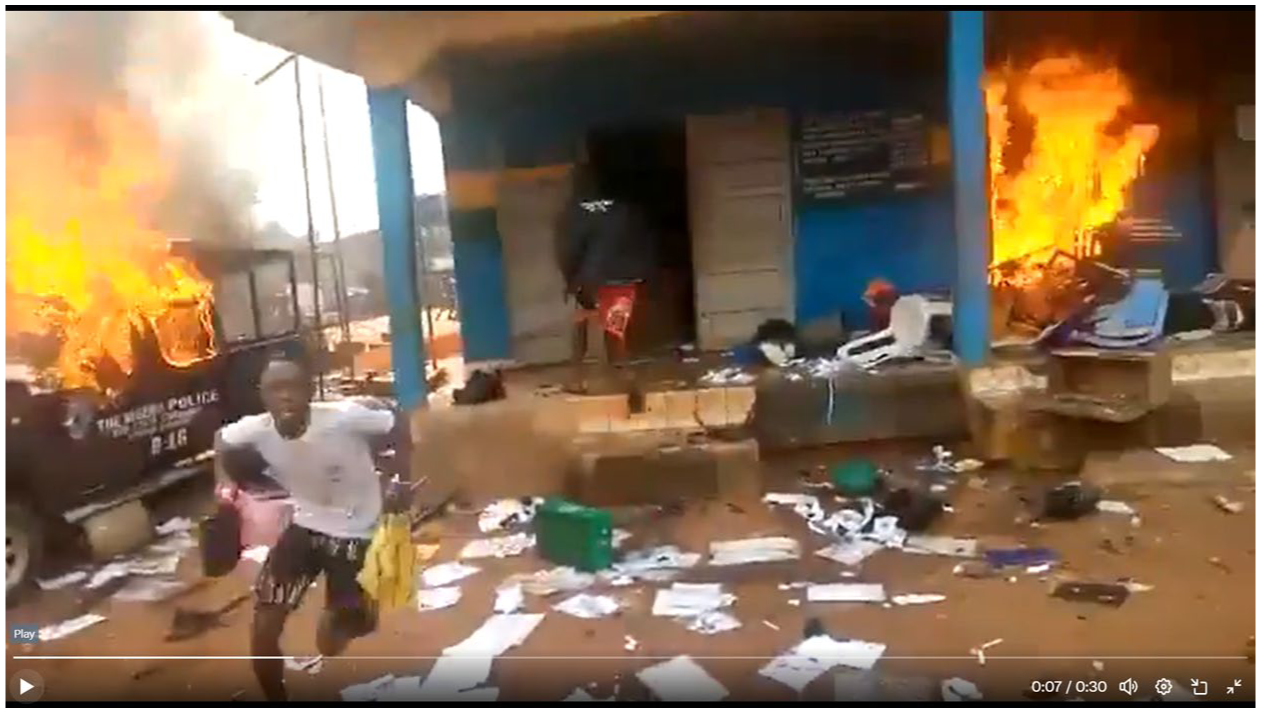
Burning of police station (Twitter, 13 November 2020).
Figure 8 captures the use of force by the protesting Nigerians to express their anger against police brutality. The video footage shows some protesters setting a police station and a police van ablaze. The location of this action is Benin City, Edo State, South-South Nigeria. This is an instance of a transactional process, as the action of the protesters is aimed at the police station. The vector is represented by the fire used in their destructive acts. The fire vector of the protesters is used to foreground the violent disposition of the protesters. This is in contrast with the peaceful protesters earlier discussed in Figure 7. While the peaceful protesting Nigerians are unarmed, the protesters in Figure 8 are armed with sticks and other dangerous materials to destroy. Destroying government property highlights deep systemic grievances and connotes defiance. It signifies deep-seated anger and frustration among the protesters towards the government (Sunday and Chukwu, 2024). However, it also signals feelings of powerlessness among protesters.
The image in Figure 9 is a depiction of a Goal without an Actor. Kress and Van Leeuwen (2006) describe it as an Event. This suggests that something is happening without an observable Actor that is responsible for the incident. It is an extract of the destructive actions of the #EndSARS protesters. It shows the destruction of cars as a result of the violent protest. This kind of action is compared to that of miscreants and hooligans who take advantage of a supposedly legitimate situation to perpetrate crimes. The destruction of lives and property as a way of protest against police brutality portrays violent demonstrations, hence violent resistance. The image of destruction foregrounds the absurdity and irrationality of the actions of the protesters and (re)constructs the unobserved Actor as violent. Violent acts distract from the protest’s original goals and shift attention away from the issues being protested. This usually provokes repressive consequences, such as the arrest and killing of protesters.
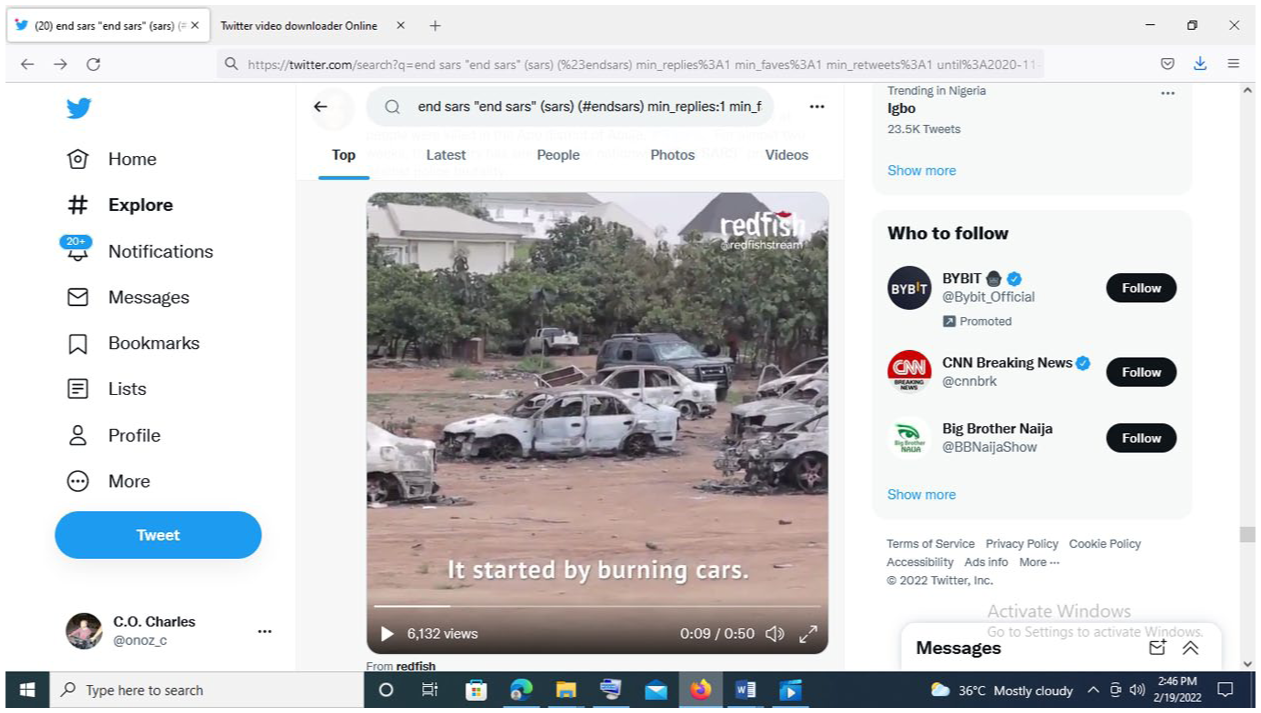
Burning of cars (Twitter, 21 October 2020).
Solidaristic identity
In addition to resisting police brutality, the #EndSARS protesters in Nigeria and across the diaspora demonstrate empathy and fellow feelings towards their compatriots, who are the immediate victims of SARS’s action. Solidaristic identity in this context refers to a bond of union and mutual support among a group of people who are either pursuing a common goal or are fighting a common enemy. The protesting Nigerians (re)constructed this identity through their posts and tweets, as they project the fundamental issues they are fighting against, namely social injustice, misgovernance and corruption.
Figure 10 is a tribute to young Nigerians who lost their lives during the #EndSARS protest. The expression they fought so hard for a better Nigeria supports the idea that the #EndSARS protest was used as a metaphor for good governance in Nigeria. The lexical item mourning in the expression ‘We are also mourning those who gave their lives to end the SARS protest’ implies empathy and fellow feelings with the victims of police brutality. There is a Demand gaze from the Reacters (the represented participants) as they directly set their gaze towards someone not shown in the image. The use of gaze as a demand portrays the represented participants as asking for help, having been brutalized by members of SARS. Also, the angle from which their picture was taken suggests the unequal power relations between the protesting Nigerians (the dominated group) and the SARS personnel as well as the government officials (the dominant group). Looking up to the angle of the camera shows how lowly and oppressed the protesters are.
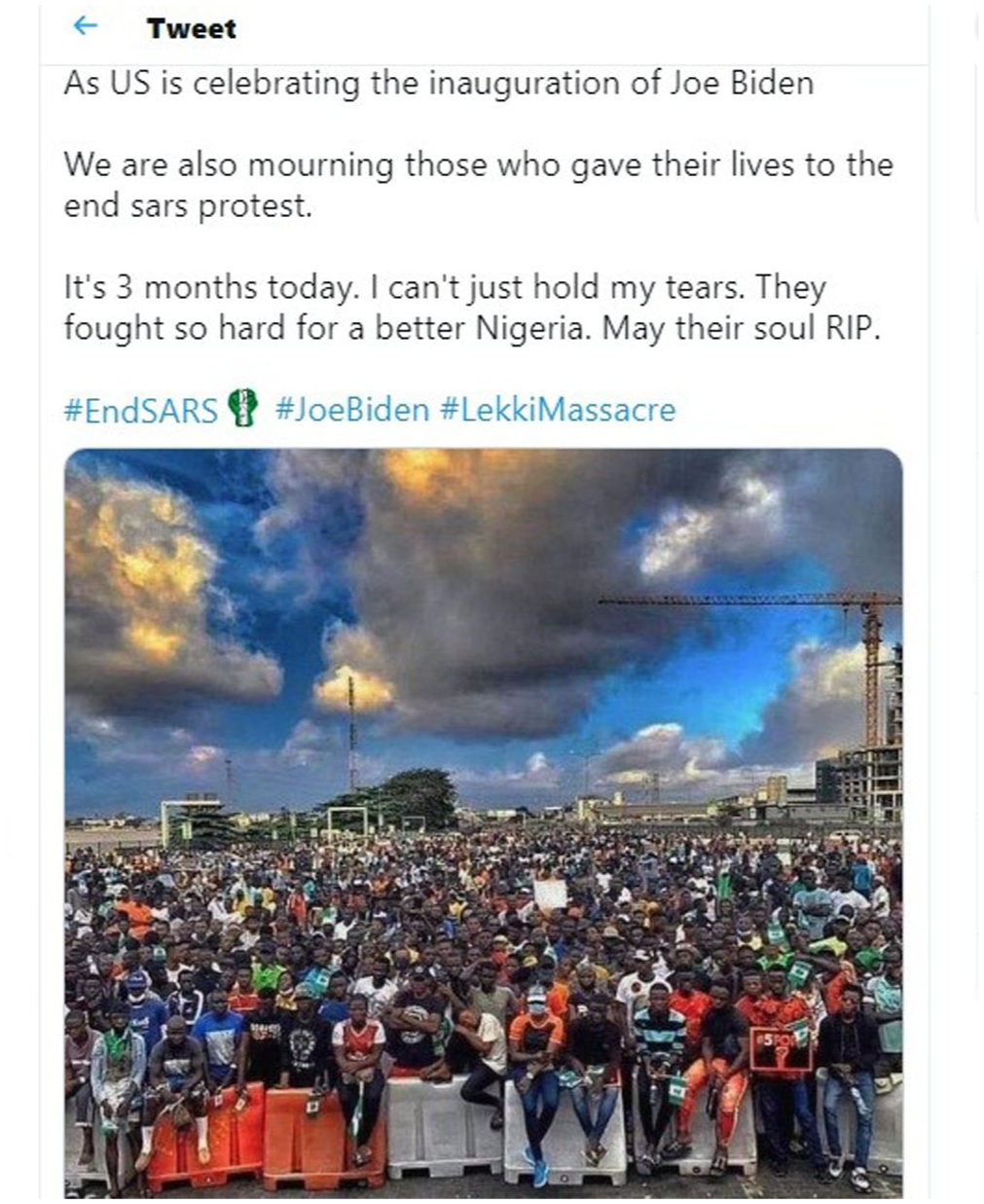
#EndSARS sympathizer paying tribute to protesting young Nigerians (Twitter, 20 January 2021).
Crucially, this figure is not merely illustrative but central to understanding how solidaristic identity was multimodally constructed in the #EndSARS discourse. The textual articulation of mourning reconstructs the deceased protesters as martyrs whose sacrifice legitimizes the movement, while the visual semiotics – gaze, positioning and composition – work together to symbolize vulnerability, collective empathy and an appeal for justice. By foregrounding grief as a shared social resource, the figure demonstrates how solidarity was publicly performed and circulated online, binding Nigerians together across ethnic and social divides. Thus, Figure 10 provides indispensable evidence of solidaristic identity, showing how loss was transformed into collective strength and how public mourning sustained the moral legitimacy of the protest.
Figure 11 is a post by Wilfred Ndidi, a popular Nigerian and Leicester City Football Club player, in support of the EndSARS movement. The gestural sign as shown in the image involves a hand raised with the palm facing outward, mimicking the traditional stop gesture used by traffic wardens to halt vehicles. This gesture is widely recognized as a universal signal for stopping or pausing, often associated with authority and control. Wilfred Ndidi’s use of this sign conveys the need to stop killing innocent young Nigerians and stop police brutality, in solidarity with the EndSARS movement. The image also shows a darker raised-fist emoji, which suggests support for black lives. The specific black life was evident in the image of the Nigerian flag beside the darker raised fist emoji, which implies support for the life and protection of Nigerians.
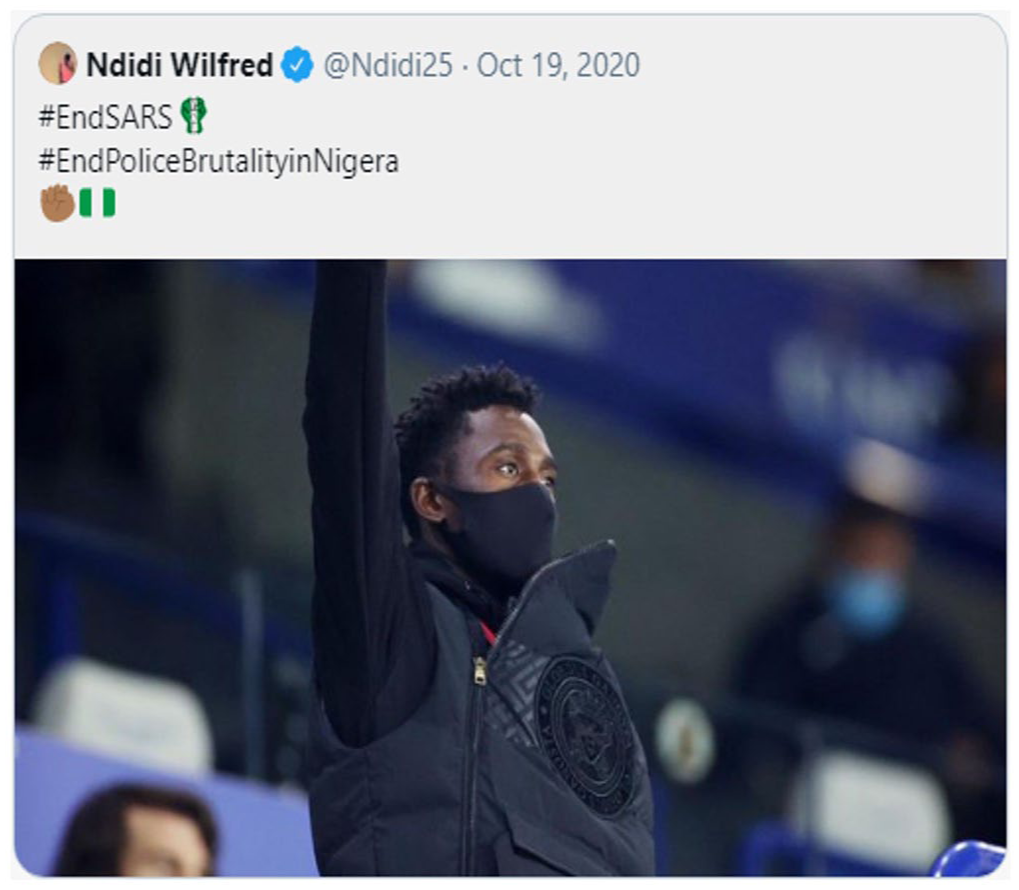
#EndSARS sympathiser gesturing his support for #EndSARS protest (Twitter, 19 October 2021).
The image also depicts a non-transactional reaction, as the Reacter (Wilfred Ndidi) is seen raising his hands in response to police brutality in Nigeria. This indicates that he is not happy with the person(s) responsible for his reaction (that is, raising of hands). The represented participant is seen not looking at the viewer directly. This type of gaze implies an offer as he is not directly looking at the viewer. By inference, Wilfred Ndidi’s gaze (offer) points to a strong statement of condemnation of police brutality to the general public. In essence, he is using his body posture to offer a strong statement against police brutality. With 237,000 followers on his X account, the protester must have believed that his visual message could reach as many people as possible.
The adaptation of the stop gesture into a symbol used on #EndSARS reinforces collective identity by creating a shared visual language, which helps to unite protesting Nigerians under a common symbol. By modifying the traditional use of the gesture, Wilfred Ndidi contributes to the movement’s cohesion, making it a powerful tool for communicating a common goal.
The expression of support is audio-visually shown in Figure 12. Firstly, it describes the use of a live raised-fist emoji by a protesting Nigerian to reinforce his support for the EndSARS movement and the slain #EndSARS protesters. The image indicates that the protester is adopting a non-verbal mode of communication in listing the names of victims of police brutality, aided by the use of a face mask. Since the expression of emotions is heavily dependent on the mobile facial regions, the act of listing the names of the victims of police brutality while wearing a face mask suggests a hidden emotion of anger from the protesting Nigerian youth.
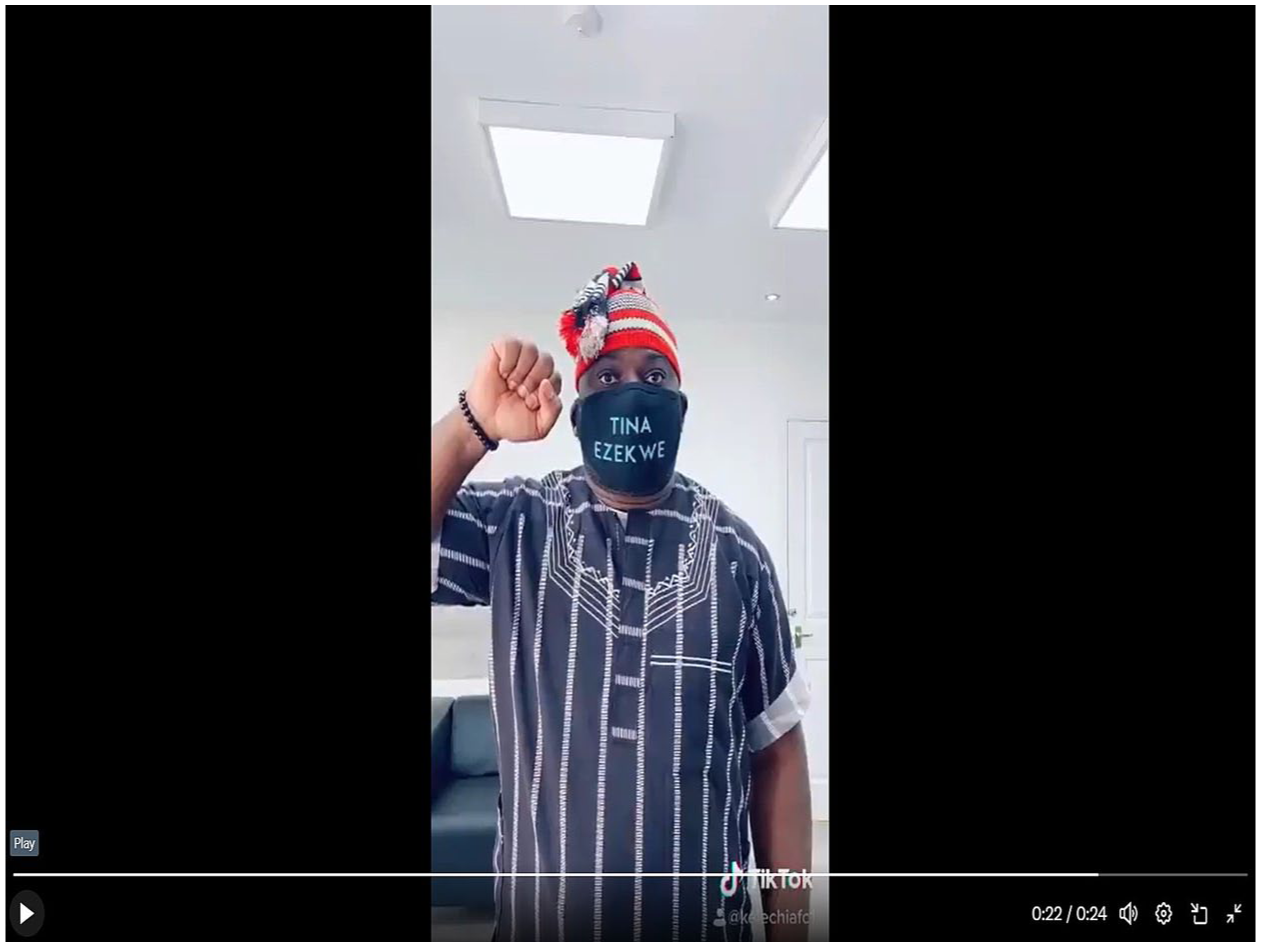
#EndSARS sympathizer showing support for slain protesters (Twitter, 20 October 2021).
The protester’s facial expression of putting on a straight face portrays him as being unhappy with the killing of unarmed protesters during the #EndSARS protest. This sad reaction of the Reacter foregrounds his sympathy and empathy towards fellow protesters. The gaze from the represented participant is one of Demand, as it is directed to the viewer. In essence, the protester is demanding justice on behalf of the slain protesters and accountability from the Nigeria Police Force and the Nigerian government concerning the circumstances that surrounded the death of the protesters.
Figure 13 is a solidarity statement from a popular Nigerian activist, Aisha Yesufu, who was prominently involved in the EndSARS movement. The expression ‘provide therapy for our brutalised, tortured, abused, and traumatized citizens’ is employed to (re)construct her solidaristic identity and to foreground her as a sympathetic and empathetic Nigerian citizen. She shows her gender sensitivity by comparing domestic and sexual violence against women to SARS and police brutality against men. The expression ‘we focused on women . . . and paid no heed to men’ brings to the fore her gender sensitivity. This statement portrays the protester as showing sympathy to the brutalized male Nigerian citizens and suggests emotion of fellow feeling concerning police brutality against the male citizens of Nigeria. The phenomenon that the protester is reacting to is represented by the male victims of police brutality, especially those brutalized and killed during the #EndSARS protest.
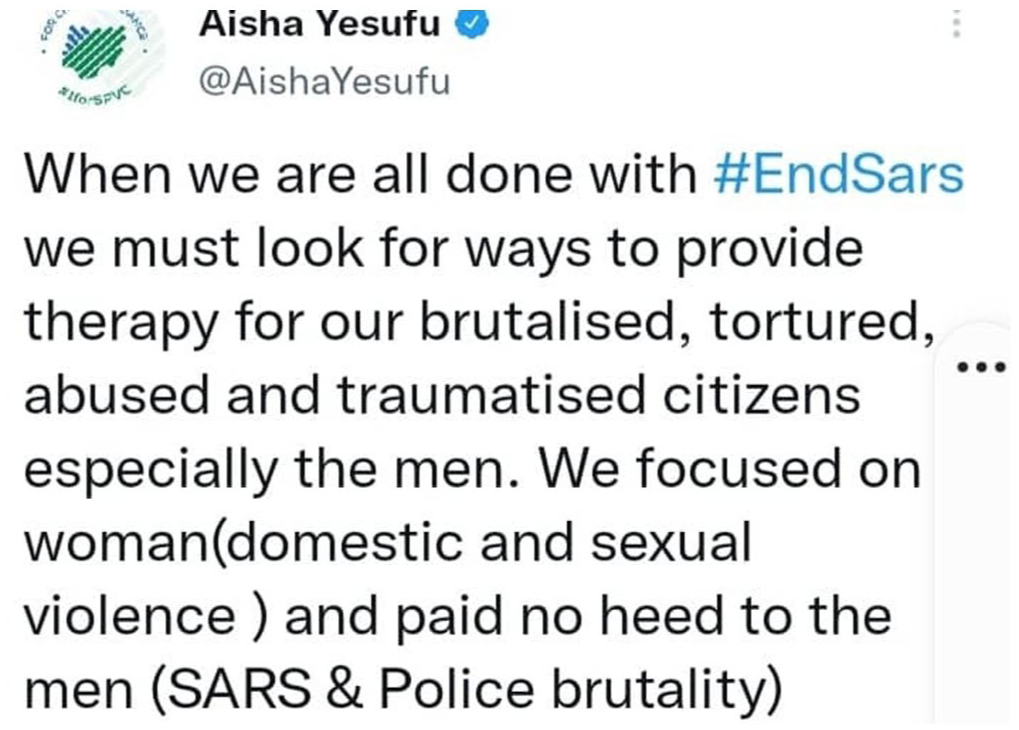
#EndSARS sympathizer showing support for brutalized male protesters (Twitter, 21 October 2021).
The use of ‘we’ is significant here. It emphasizes shared experience and collective suffering. It also fosters a sense of belonging among individuals who might otherwise feel isolated in their experiences with police brutality. ‘We’ conveys the spirit of togetherness in opposition to police brutality, which fosters emotional connections between individuals and the movement. By emphasizing unity and shared purpose, ‘we’ (re)constructs individual grievances into a collective force for social change.
Discussion and conclusion
This study investigates identity (re)construction in the #EndSARS discourse on X. The identities (re)constructed by protesting Nigerians offer crucial insights into Nigeria’s sociopolitical context and power dynamics, which are uniquely shaped by the intersection of identity, sociopolitical dynamics and social media. Through social media posts, tweets and comments, protesters (re)constructed paroxysmic identity, resistance identity, violent resistance, and solidaristic identity.
In the Nigerian context, the #EndSARS protest served as a turning point for many Nigerians, particularly the youth, who redefined their roles from passive victims of political oppression to active participants in political discourse. The paroxysmic identity reflected a shift from passive suffering to an open public expression of frustration and anger. The non-violent resistance identity emphasized moral legitimacy and unity, whereas the violent resistance identity highlighted the emotional volatility and impulsiveness in some segments of the protest, which contributed to negative governmental responses and repression. The solidaristic identity emphasized empathy and unity, transcending Nigeria’s ethnic and religious divides to demand justice. These identities were not only expressed through linguistic modes but also embodied in multimodal forms, such as images, videos and hashtags, facilitating a collective narrative of anger, resistance and solidarity.
From the sub-Saharan African perspective, the EndSARS movement resonates with broader regional trends of resistance against state violence and misgovernance (Nyamweya, 2024; Sebeelo, 2021). Social media platforms have increasingly become tools for marginalized groups on the sub-continent to challenge dominant power structures, particularly in countries with histories of authoritarian governance and systemic oppression. The #EndSARS protest is part of a larger regional shift where social media is used to mobilize collective action against systemic injustices, as seen in movements like #ThisFlag (Zimbabwe), #OccupyNigeria, #BringBackOurGirls (Nigeria), #RejectFinanceBill, #OccupyParliament, #Rutomustgo (Kenya) and #RhodesMustFall (South Africa). The findings from this study contribute to understanding how African youth leverage digital spaces to express dissatisfaction, reclaim agency and push for reforms within highly controlled and repressive political environments. This regional lens provides a richer understanding of how identity (re)construction is influenced by both local contexts and shared socio-political struggles across sub-Saharan Africa.
Comparison of these findings with the European and Arabian contexts (such as the #MeToo movement and ISIS media propaganda) underscores significant differences. While movements in the West often focus on individual empowerment and human rights, the EndSARS movement uniquely emphasized collective action and redistribution of power through multimodal communication. The #EndSARS discourse on social media foregrounds shared grievances, particularly around police brutality and misgovernance, whereas movements like ISIS employed multimodal resources to justify their ideologies and challenge the West. #EndSARS went beyond resistance to propose a reconstruction of political and social norms, offering a project identity that pushes for systemic change, similar to Castells’ (2010) notion of project identity.
Moreover, while Kress and Van Leeuwen’s (2021) visual grammar resonates with the Western perspective, with a focus on visual elements and power dynamics in individualistic societies, this study provides insights into how African protest movements like #EndSARS employ multimodal resources within digital environment to challenge authoritarian regimes and systemic injustices. This aligns with recent multimodal analyses of Nigerian political communication (Ononiwu, 2024), which similarly highlight how visual and textual resources function as tools for democratic participation and resistance. This study further demonstrates that the technological affordances of digital platforms, such as interactivity, virality, and multimodal expressivity, play a crucial role in mediating affective engagement and shaping collective identity formation within contemporary social movements. Thus, it expands the framework to include perspectives that are often marginalized in the discourse around identity (re)construction.
In view of these findings, this study contributes new perspectives on the multimodal (re)construction of identity, not just as an individual phenomenon but also as a collective process that was shaped by the socio-political realities of specific regions. The study suggests that social media platforms in Africa offer more than just a space for personal expression – they are powerful tools for social change that allow individuals to reconstruct their identities in opposition to institutionalized oppression. The findings of the study help to challenge Western-centric perspectives of identity construction and offer a more inclusive understanding of how digital activism can reshape political landscapes in the Global South.
The relationship between identity, sociopolitical dynamics and social media is significant in understanding the transformative role of digital media platforms like X in the EndSARS movement. Social media allows for the dynamic and participatory (re)construction of identities, where individuals can present themselves and their experiences in ways that challenge traditional, hierarchical media structures. This identity (re)construction is influenced by both social and political dynamics (social injustices, corruption and political oppression).
Social media platforms significantly shape how identities are expressed and (re)constructed. The protesters in the EndSARS movement, for instance, used social media as a tool to express individual emotions and to collectively reshape their ascribed identities. For example, while resistance identity, along with metaphors like ‘flood’, helped transform protesters from victims into agents of social change, the solidaristic identity underscored empathy across Nigeria’s ethnic divides. By using multimodal resources, the protesters were able to articulate and negotiate their identities in ways that transcended traditional media gatekeepers. This process of identity (re)construction was not limited to self-presentation but was deeply embedded in social and political contexts, where marginalized groups sought to challenge oppressive structures of power.
Social media also plays a significant role in shaping public perception. Through hashtag activism, #EndSARS was able to reframe the narrative around police brutality and government inaction, gaining both national and global attention. As Bonilla and Rosa (2015) argue, hashtags act as ‘discursive markers’, aggregating public discourse and fostering engagement around key issues. The narratives around which #EndSARS was propagated support the argument that identities are not (re)constructed in a vacuum, as the protesting Nigerians drew on various discourse issues to challenge police brutality and maladministration, and to (re)construct their identities. This mobilization of collective action was pivotal to uniting diverse groups, amplifying their grievances and drawing global attention to the injustices they faced. By facilitating real-time communication and organizing protests, social media platforms allowed the protesters to bypass traditional barriers and engage with both local and international audiences, thereby enhancing the visibility and impact of their messages.
However, social media also has the potential to reinforce political polarization. While it can democratize access to political engagement and amplify marginalized voices, it also has the capacity to create echo chambers, where people are exposed primarily to viewpoints that align with their own beliefs while dismissing opposing views. This can potentially deepen divisions, as contrasting narratives (e.g. government supporters versus protesters) are amplified and reinforced by the same platforms that enable activism. For example, as the #EndSARS was gaining momentum, there were coordinated counter-protest campaigns, such as #OneNigeria, #LeadWithLove and #EndViolence, by pro-government to promote the government’s narrative and delegitimize the #EndSARS protest (@DFRLab, 2020). This shows that social media can not only empower people to act but also create fragmented, opposing political narratives.
By focusing on #EndSARS, this study underscores the role of multimodal resources in identity formation and social movements, offering a broader theoretical and practical framework for understanding how digital media can be a force for political mobilization, particularly in regions with histories of authoritarian rule. However, further research is needed to explore the underlying ideologies driving these movements, which could provide a more comprehensive understanding of the socio-political values shaping global resistance movements and their impact on institutional power structures.
Footnotes

Data Availability Statement
Data sharing not applicable to this article as no datasets were generated or analysed during the current study.
Notes
Biographical Notes
CHARLES ONONIWU is a researcher at the University of Jyväskylä, Finland. His work examines multimodal discourse, media, and conflict studies, with particular attention to digital activism and the (re)construction of identity. His recent publications appear in Media, War & Conflict (2024) and the African Journal of Democracy and Election Research (2024).
Address: University of Jyväskylä, Department of Language and Communication Studies, P.O. Box 35, FI–40014 University of Jyväskylä, Finland. [ email:
ADESINA B SUNDAY is a professor in the Department of English, University of Ibadan, Nigeria. His research specializations include neurolinguistics, English phonology and phonetics, and pragmatics. He has published widely in reputable journals such as the Journal of Pragmatics, Pragmatics and Society, English Today, HUMOR: International Journal of Humor Research, The European Journal of Humour Research, Studies in African Languages and Cultures, Discourse & Communication, Language Matters, and Muziki.
Address: University of Ibadan, Oyo, Nigeria. [ email:
ALBERT LEKAN OYELEYE is Professor Emeritus of English at the University of Ibadan, Nigeria. His research focuses on phonology, pragmatics, and discourse analysis. He has published in leading journals, including the Journal of Pragmatics, Pragmatics and Society, English Today, and Discourse & Communication.
Address: University of Ibadan Faculty of Arts, Oyo, Nigeria. [ email: