



Abstract
While many models attempt to explain the aesthetic experience, most limit themselves to art as their focal point and only a few look into why we arrive at a certain response to a visual aesthetic object. This article attempts to offer an extension to the current models by focusing on the mechanisms that induce emotions in relation to visual aesthetic objects. It takes Juslin’s (2013) BRECVEM mechanisms – developed for the domain of music – as its basis. In this article, Juslin’s mechanisms are adapted to the visual domain, resulting in six different emotion-evoking mechanisms: startle reflex, evaluative conditioning, emotional contagion, mental imagery, syntactic expectancy and external appraisal. The authors give an overview of frameworks and empirical studies, demonstrating each of these mechanisms in relation to visual aesthetic objects (visual art as well as advertising and product design). The article’s focus on emotion-inducing mechanisms and existing empirical research provides a basis for improving empirical testing of emotional responses to a broad range of visual aesthetic objects.
Keywords
Introduction
When exposed to an advertisement such as the Absolut Perfection advertisement in Figure 1, people may experience a whole range of emotions. They may feel surprised because of the unexpected halo above the bottle, they may feel relaxed because of the harmonious black-and-white image, or happy because they have seen Absolut advertisements in the company of friends in a bar. How such emotions are evoked is a key topic within the field of empirical aesthetics (Palmer et al., 2013; Vartanian and Nadal, 2019).

Absolut Perfection advertisement (1981).
This article focuses on how emotions are evoked by visual aesthetic artefacts, including visual art but also commercial visual artefacts of aesthetic interest such as product designs and aesthetic images in advertising (Barthes, 1973; Patrick, 2016; Patrick and Peracchio, 2010). The primary focus of this article is on intentionally designed artefacts instead of natural aesthetic objects. We also focus on the overlap between visual art and commercial visual aesthetic artefacts (Gerger et al., 2014; Goldstein, 2009; Levinson, 1996; Silvia and Cotter, 2020). Significant, in this respect, are the cases in which artists cooperate with advertisers. In 1986, the Absolut advertising team met up with artist Andy Warhol who was ‘enthralled by the artfulness of the Absolut bottle’ and painted his own interpretation of the bottle, which was featured in the 1986 campaign (Lewis, 1996). Note that we do acknowledge the quantitative and qualitative differences between the emotional responses triggered by these two domains (e.g. Cheung et al., 2019; Frijda, 2007) but leave this for the discussion and future work.
Evoking emotions through visual aesthetic artefacts is part of the aesthetic experience, a subject of study in the field of empirical aesthetics. There are many frameworks in existence that aim to explain the aesthetic experience of visual aesthetic artefacts, divided into single-component and multi-component frameworks. Single-component frameworks, such as Berlyne’s (1960) arousal theory and Silvia’s (2005a, 2005b; Silvia and Brown, 2007) appraisal theory attempt to explain a general aesthetic judgement by highlighting one property. According to appraisal theory, emotions are not caused by events directly but by our subjective appraisals, i.e. evaluations of these events. Each emotion has a distinct set of evaluations, that is, appraisal structure (Silvia, 2005a, 2005b; Silvia and Brown, 2007). The frameworks of Leder et al. (2004; Leder and Nadal, 2014) and Pelowski et al. (2017) are front-runners in the field of multi-component frameworks. These frameworks take stock of all the different aspects that play a role in the aesthetic experience, top-down (e.g. memory, personality, context) as well as bottom-up (aesthetic object-derived processes) (Vartanian and Nadal, 2007). Most of the current frameworks focus on a general aesthetic judgement as the main consequence of processing the artefacts and are therefore not suited to fully explaining why we arrive at a certain aesthetic response (e.g. Leder, 2013; Leder and Nadal, 2014; Palmer et al., 2013; Pelowski et al., 2016; Silvia, 2005a, 2005b). Recently, several scholars have expressed the importance of moving beyond this general aesthetic judgement and focusing more on how emotions are evoked by aesthetic artefacts to get a fuller understanding of the aesthetic experience (e.g. Chatterjee and Vartanian, 2016; Leder and Nadal, 2014; Pelowski et al., 2017; Silvia, 2005a). This is done to some extent in Pelowski et al.’s (2017) VIMAP, with its processing checks and their emotional outcomes, in line with Silvia’s appraisal theory. These processing checks can be seen as a subset of a broader set of emotion-causing mechanisms.
The current article is an attempt to enrich the current frameworks by proposing a broad set of specific emotion-evoking mechanisms in response to visual aesthetic artefacts: Startle reflex, Evaluative conditioning, emotional Contagion, Mental imagery, syntactic Expectancy, and external Appraisal (SECMEA). By focusing on these mechanisms, we can elucidate how people arrive at emotional responses to visual aesthetic artefacts (art as well as commercial visual aesthetic design). This provides a basis for improving empirical testing of these emotional responses. More specifically, it enables empirical research to target more discrete aspects of the aesthetic experience and facilitates the formation of concrete hypotheses.
In the following sections, we will address the BRECVEMA framework (Juslin, 2013; Juslin and Västfjäll, 2008) from which the SECMEA mechanisms originate. We will then discuss the SECMEA mechanisms together with empirical studies demonstrating how these mechanisms operate in relation to visual aesthetic artefacts. Finally, limitations and suggestions for empirical testing are discussed, and concluding remarks are given.
1. Juslin’s Brecvem Mechanisms
Our SECMEA mechanisms stem from Juslin’s (Juslin, 2013; Juslin and Västfjäll, 2008) BRECVEM mechanisms applied to the domain of music. The original BRECVEM mechanisms were postulated by synthesizing theory and empirical results from various domains (Juslin and Västfjäll, 2008). The presence of these mechanisms when listening to music was subsequently investigated in an experimental study by Juslin et al. (2008) where participants were asked which mechanisms were responsible for their evoked emotions when listening to music. The authors found that all the BRECVEM mechanisms were experienced in their study, and that participants very rarely chose the options ‘other’ and ‘I don’t know’ when asked which mechanisms were responsible for their emotions.
We will argue that these mechanisms – albeit with some modifications – can be applied to the visual domain as well, which we will demonstrate based on previous theories and empirical studies similar to Juslin and Västfjäll (2008). Above this, Zeki et al. (2014) argue and demonstrate that the aesthetic experience correlates with a specific part of the emotional brain independent from the specific domain (visual, musical, mathematical, etc.) (see also Chatterjee and Vartanian, 2016; Mastandrea et al., 2019).
First, we will give a quick overview of the whole BRECVEMA framework (see Figure 2). Juslin’s (2013) framework can be seen as a process framework of aesthetic experience, which describes how an aesthetic artefact can be perceived, interpreted and evaluated, with aesthetic judgement and liking plus emotion as outcomes.
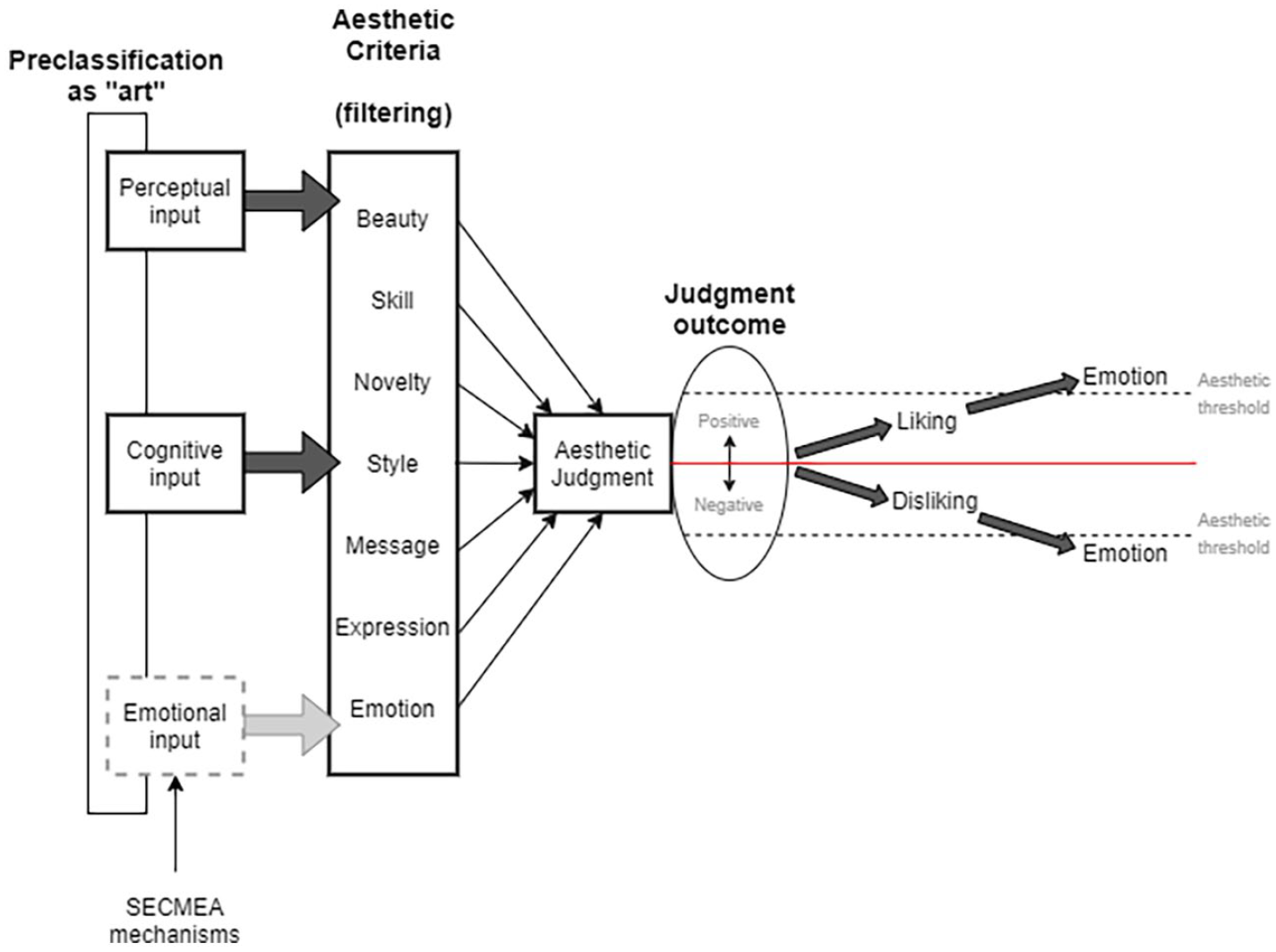
The BRECVEMA framework.
Similar to Leder et al. (Leder, 2004; Leder and Nadal, 2014), Juslin (2013) proposes that receivers have three kinds of input at their disposal: perceptual input, cognitive input and emotional input as a result of the emotion-eliciting mechanisms on which we focus in the bulk of this article. Perceptual inputs are low-level visual features such as shape, symmetry, order, proportion and contrast. Information based on these features is received early on in the judgement process. Cognitive inputs are higher-order concepts that are more knowledge-based compared to perceptual inputs and contain information about, for instance, style, content, creator and history.
While it may seem that these input types exist in isolation from each other, in fact they often interact. Firstly, the subjective criteria of the viewer determine which input, or combination of inputs, has an effect on the overall aesthetic judgement (Juslin, 2013: 249) with regard to the artefact’s beauty, skill, novelty, style, message, expression and emotion (Juslin and Isaksson, 2014). Secondly, it could be that the interaction between inputs determines what these inputs yield. For instance, perceptual input could precede and affect cognitive inputs: the dark, depressing colours and rough sleek shapes (perceptual input) in a Charley Toorop painting indicate that it is part of the Bergen School (cognitive input). Or cognition and emotion can interact via emotion regulation, where one’s cognition affects the intensity of the experienced emotion. This interaction between cognition and emotion is also seen more explicitly in the external appraisal mechanism, which is discussed in more detail later (see section 3). For instance, the source appraisal, which could be directly linked to cognitive input (‘who or what is the creator?’), has been found to affect people’s emotional response to artefacts. It should therefore be noted that the mechanisms that are described in section 3 focus on the emotional input type, but they can originate from, be affected by and be compensated by the perceptual and cognitive inputs.
The resulting aesthetic judgement feeds into liking (i.e. preference) potentially accompanied by emotion, dependent on the extremity of the aesthetic judgement. An artefact judged as ‘really good’ or ‘really bad’ crosses an aesthetic threshold (Fechner, 1867), which enables the experience of pronounced emotions related to the artefact. A less extreme judgement would remain under the aesthetic threshold and would result in mere (dis)liking, a more fleeting experience.
Note that Juslin (2013: 257) makes a difference between emotions as a result of the emotion-evoking mechanisms and emotions as a potential result of an aesthetic judgement. These emotions can enhance or interfere with one another. In the latter case, people can experience mixed or conflicting emotions. A negative emotion caused by one of the SECMEA mechanisms (e.g. scared by big staring eyes) can for instance go together with or be overruled by a positive emotion (e.g. interest, pleasure) based on a positive aesthetic judgement (see also Menninghaus et al., 2017).
The following section focuses on the emotion-evoking mechanisms, shifting from Juslin’s BRECVEM mechanisms in the musical domain to our SECMEA mechanisms applied to the visual domain.
2. Exploring Emotion-Evoking Mechanisms: From Brecvem to Secmea
The BRECVEM/SECMEA mechanisms are psychological mechanisms that lie at the basis of an emotional response to aesthetic stimuli. ‘Psychological mechanisms’ are defined very broadly in that they concern every type of information processing that leads to the elicitation of emotions through aesthetically processing a stimulus (Juslin, 2013). In the current work, they are the processes that convert stimulus perception into a response. The processes that are categorized as psychological mechanisms could be very different. They could be simple, complex, conscious, or unconscious, but what they have in common is that they are activated when an object is processed aesthetically (Juslin and Västfjäll, 2008: 560). Every letter in ‘BRECVEM’ represents one psychological mechanism: Brainstem reflex, Rhythmic entrainment, Evaluative conditioning, emotional Contagion, Visual imagery, Episodic memory and Musical expectancy.
In the rest of this article, the adaptation of these mechanisms to the visual domain will be discussed. While there is support for the existence of similar psychological mechanisms for the visual domain (which we will discuss below), there are some intrinsic differences between the auditory and visual domain that made modifications to the framework necessary. The brainstem reflex was renamed to startle reflex, to highlight the focus on emotions instead of the underlying neural correlates. The rhythmic entrainment mechanism, with its focus on the alignment between rhythms in music and, for example, heart rate (Juslin, 2013: 241) is less relevant for the visual domain and was therefore excluded from the adjusted framework. Musical expectancy was adapted into syntactic expectancy to make it applicable for the visual domain. The mechanism of external appraisal (Scherer, 1999) was added since this mechanism can be held accountable for inducing emotions in the visual domain, as opposed to in the auditory domain (Juslin, 2013). Furthermore, based on previous research, visual imagery and episodic memory were combined to form a single psychological mechanism: mental imagery. This resulted in our SECMEA mechanisms, which are discussed in the rest of this article together with empirical research on visual aesthetic artefacts.
3. Emotion-Evoking Mechanisms in Relation to Visual Aesthetic Artefacts: The Secmea Mechanisms
Startle reflex
The startle reflex (see Juslin et al., 2014: 601: brainstem reflex) is an immediate, simple ‘hard-wired attention response’ to an unexpected stimulus feature such as novelty (e.g. the sudden appearance of an object). This reflex occurs when being confronted with auditory, visual or tactile stimuli that are intense and abrupt (Ramirez-Moreno and Sejnowski, 2012). We may, for example, be startled and surprised when we unexpectedly encounter the unsettling big, staring eyes in Charley Toorop’s paintings.
In the visual domain, this startle response has mainly been investigated in the context of aversive stimuli or trauma-relevant stimuli. For example, previous studies found that startle responses were evoked when viewing visual stimuli depicting aggression or a direct threat to the viewer or to others (e.g. Balaban and Taussig, 1994; Bernat et al., 2006; Vaidyanathan et al., 2009), or when viewing pictures that evoked traumatic experiences (e.g. Elsesser et al., 2004; Hamm et al., 1997; Vrana et al., 1992).
Furthermore, Mneimne et al. (2008) investigated startle responses to photographs depicting various scenes and found that, when these pictures were novel, the startle response was significantly more severe compared to the response when the picture was previously viewed, highlighting the novelty aspect of this mechanism.
Evaluative conditioning
Evaluative conditioning is an (unconscious) psychological mechanism where an emotion is evoked by a stimulus because this stimulus has often been associated with other positive or negative stimuli (Juslin, 2013). For instance, when a particular visual stimulus has been repeatedly observed during an event that evokes happiness (e.g. seeing a painting in your grandmother’s house or the Absolut ad when surrounded by friends in a bar), the painting and the advertisement will eventually, through repeated pairings, come to evoke happiness even when you are at home alone seeing the painting or the advertisement in a magazine. Evaluative conditioning is a type of classic conditioning that involves pairing an initially neutral stimulus with an unconditioned stimulus with a positive or negative affective valence. After the conditioned and unconditioned stimuli are repeatedly paired, people will start to contribute the same affective feelings of the unconditioned stimulus to the conditioned stimulus.
There is a fair amount of evidence for this mechanism in the visual domain. An evaluative conditioning effect was found when pairing neutral and emotionally valenced pictures of fountains and sculptures (e.g. Hammerl and Grabitz, 1993), Kanji characters (Landwehr et al., 2017) or paintings (e.g. Havermans and Jansen, 2007). In the commercial domain, support for this mechanism was found by Hasford et al. (2015) who carried out an experiment in which they exposed participants to a film poster with positively or negatively valenced celebrities, after which an initially neutrally evaluated advertisement for a shoe company was presented. The shoe brand was evaluated more positively (or negatively) when it was preceded by the positively (or negatively) valenced celebrity.
Emotional contagion
Emotional contagion refers to an uncontrollable process where an emotion is induced by an object because the viewer perceives an emotional expression in the stimulus and mirrors this emotional expression internally (Juslin, 2013). Emotional contagion can evoke all types of emotions. For instance, a person might perceive a painting to have a sad expression, which the person then mirrors, thus inducing sadness in the viewer. Also, advertising excels in showing happy people consuming the advertised product. Viewers can mirror this happiness and then experience this happiness themselves.
Gerger et al. (2018) presented representational and abstract visual art to participants, which was either positively or negatively valenced. Participants who were found to be more disposed to emotional contagion perceived negatively valenced art more negatively and positively valenced art more positively (see also Stavrova and Meckel, 2017). Emotional contagion effects have also been investigated in the commercial domain, in the context of human-need fundraising. Charity advertisements, often showing victims expressing emotions of sadness, aim to trigger sympathy and solicit donations. Small and Verrochi (2009)’s study showed that participants felt sadder when viewing a sad-faced victim. Their study also demonstrated that participants’ own sadness mediated the effect of emotion expression on sympathy for the victim.
Mental imagery
Mental imagery is a catch-all term for all types of imagery (e.g. auditory, visual, olfactory) and describes a process where people ‘perceive’ a stimulus, but do so without the relevant sensory stimulus actually being present. Imagery is distinct from perception, which is the registration of physically present stimuli (Kosslyn et al., 1995: 1335). The BRECVEMA framework (Juslin, 2013; Juslin and Västfjäll, 2008) only included visual imagery, although studies have found support for other types of imagery as well (e.g. Hubbard, 2010, for auditory imagery). In regard to the visual domain, Damasio (1994) argues that visual stimuli are able to trigger all sensory modalities (i.e. auditory, olfactory, gustatory and tactile). A painting showing a still life of fresh fruit can trigger tactile imagery (imagining picking up the fruit) as well as gustatory imagery (imagining tasting the fruit). An advertisement picturing a spring scene can induce olfactory imagery (smelling the freshly mowed grass). Therefore, the current framework will have a broader focus on imagery compared to the works by Juslin.
Furthermore, Juslin (2013) distinguished the processes of evoking fantasies (visual imagery) and evoking memories (episodic memories) as two separate psychological mechanisms. However, they do not provide any support for this difference in mental processes. In both cases, the mind conjures up sensory experiences that do not occur at that moment. Plus, neuroimaging studies have found that imagining future emotional events, as well as recalling past emotional events, activate the same brain areas (for a review, see Schacter et al., 2007). Furthermore, the assumption of a difference between mental imagery and episodic memory does not account for occasions where we misattribute the source of our memory (e.g. thinking you experienced the event but, in reality, read about it in a novel), or the occasions where we create false memories (e.g. Ceci and Loftus, 1994; Lindsay and Read, 1994). Therefore, a clear distinction between mental imagery and episodic memory is virtually impossible, which is why we merged Juslin’s visual imagery and episodic memory into one overlapping mechanism: mental imagery.
Neural studies have found that visual aesthetic stimuli can induce mental imagery processes (Elder and Krishna, 2012; Fairhall and Ishai, 2008). However, the mere existence of a relationship between visual aesthetic stimuli and mental imagery does not necessarily mean that mental imagery affects the emotional response to visual stimuli. Wang et al. (2015) included emotional responses in their comparison between realistic oil landscape paintings and Chinese landscape paintings. They assumed that the latter engenders mental imagery more than realistic oil landscape paintings. When viewing traditional Chinese landscape paintings, people were indeed more prone to mind wandering (fantasizing about the depicted landscape), which subsequently resulted in greater levels of relaxation. Furthermore, in an experiment by Holmes et al. (2008), participants were shown either neutral or fear-inducing pictures (e.g. the view from a high bridge) together with a caption (e.g. ‘leap’) and were asked to combine the picture–caption pairs using mental imagery or a verbal statement. Participants were also asked to rate the pictures before and after the combination task. The researchers found that, after seeing a block of negatively valenced pictures, people in the mental imagery condition reported higher anxiety scores, more so than people in the verbal statement condition. In addition, mental imagery caused lower liking of the negatively valenced pictures. In the advertising domain, Walters et al. (2012) found that pictures in travel advertisements with concrete words evoked more mental imagery elaboration of the travel destination than the same travel advertisements without pictures. Mental imagery was positively linked to emotional response and, mediated by this emotional response, to product interest and purchase willingness. These two latter studies not only show that mental imagery has an emotional effect, but that this effect can transfer to the evaluation and effectiveness of the associated stimuli as well.
Syntactic expectancy
Syntactic expectancy (in the BRECVEMA framework labelled ‘musical expectancy’) refers to a process where an emotion is evoked because a specific feature of the visual stimulus violates or confirms one’s predictions based on other elements in the stimulus. It concerns visual grammar, the syntactical relationship between different properties of the stimulus. This mechanism differs from startle reflexes because startle reflexes are involuntary and caused by an intense, sudden form of unexpectedness, whereas syntactic expectancy involves the voluntary appraisal of visual grammar as expected or unexpected. The Absolut advertisement at the beginning of this article serves as an example: this advertisement has the potential to evoke surprise because of the unexpected halo above the bottle.
Fluency theory (Reber et al., 2004: 365) connects syntactic expectancy and emotion induction: ‘The more fluently the perceiver can process an object, the more positive is his or her aesthetic response.’ Easy-to-process stimuli (i.e. stimuli that confirm the expectations) result in positive emotions and hard-to-process stimuli (stimuli that violate expectations) yield negative emotions.
Ample empirical evidence is found for a positive correlation between fluent processing of visual aesthetic artefacts with a high syntactic expectancy and evoked pleasure, e.g. for art (Belke et al., 2010; Leder, 2003; Silvia, 2005a), brand logos (Nordhielm, 2002), advertisements (Graf and Landwehr, 2017; Van Enschot et al., 2008) and interior service environments (Orth and Wirtz, 2014). Graf and Landwehr (2017), for example, placed products in an advertising context that did or did not match (e.g. placing a chair in a living room versus a garden). The easy-to-process match (i.e. chair in living room) evoked more pleasure than the harder-to-process mismatch (i.e. chair in garden).
However, it is often the case that visual aesthetic artefacts violate expectations (as is the case for visual incongruities: Schilperoord, 2018) but yet are evaluated positively (Belke et al., 2015; Van de Cruys and Wagemans, 2011). Van de Cruys and Wagemans (2011) hypothesize that this violation of expectations primarily results in negative affect because of the negatively valenced obstruction. Then, another problem-solving process is triggered searching for a new predictable pattern. When such a predictable pattern is found, this transition from a feeling of uncertainty to increased predictability yields positive affect (see also Graf and Landwehr, 2015; Juslin and Västfjäll, 2008). This is also known as the ‘Aha’ experience, a ‘sudden appearance of a solution through insight’ (Topolinski and Reber, 2010: 402). The Absolut advertisement at the beginning of this article may cause tension because of the visual incongruity: the unexpected halo above the Absolut bottle. This tension triggers an attempt to explain the presence of the halo. When the explanation is found (helped by the anchoring headline ‘Absolut perfection’: Absolut vodka is perfect), an Aha experience may be experienced, the tension is resolved and pleasurable emotions arise, having been able to ‘solve the puzzle’.
Support for the positive affective response as a result of the Aha experience is found by Muth and Carbon (2013) who demonstrated that liking of Mooney faces (original photographed faces blurred and presented in black-and-white) increased directly after recognizing the face. Canestrari et al. (2018) presented participants with humorous cartoons, finding that surprise and being able to understand the joke are essential for elicitation of positive emotions. The importance of being able to solve the puzzle, that is, to get to the Aha experience, has been confirmed in several advertising studies on visual and verbal rhetorical figures (e.g. Lee and Mason, 1999; McQuarrie and Mick, 2003; Phillips, 2000; Van Enschot and Hoeken, 2015; Van Mulken et al., 2005). Van Mulken et al. (2010) showed their participants advertisements varying in complexity. They found a positive correlation between comprehension and appreciation of the visual metaphors, providing indirect evidence for positive emotions as a result of the Aha experience when comprehending a visual metaphor. Lee and Mason (1999) demonstrated the frustration of not being able to arrive at an Aha experience. They presented different advertising images accompanying the claim ‘Product X is a high-speed computer’. An image with a computer screen passing by at high speed (unexpected–relevant) was appreciated more than an image with just a computer screen (expected–relevant). However, an image with a broken computer screen (unexpected–irrelevant; no Aha experience possible) was appreciated the least of these stimuli.
External appraisal
So far, the mechanisms discussed were mostly driven by perceptual stimulus information, such as a syntactic (in)congruency in the case of syntactic expectancy or a sad emotional expression in a painting in the case of emotional contagion. The external appraisal mechanism does not have intrinsic stimulus features as a starting point but external types of information instead (Moors, 2017). We borrow our definition of external appraisal from Juslin and Västfjäll (2008: 561): ‘an individual’s subjective evaluation of an object or event on a number of dimensions in relation to the goals, motives, needs, and values of the individual’. Note that Juslin and Västfjäll label this mechanism with the broader term ‘cognitive appraisal’. As it can be argued that this term also fits the previous mechanism of syntactic expectancy – a stimulus feature being appraised as unexpected – we have renamed the last mechanism ‘external appraisal’, referring to external inputs as drivers of the emotions evoked: goals, motives, needs and values.
External appraisal (called ‘cognitive appraisal’ by Juslin, 2013) is deliberately absent in the BRECVEMA framework. Juslin states that this mechanism ‘is rarely the cause of musical emotions in everyday life’ (p. 239). However, in the visual domain, external appraisal can be held accountable for inducing emotions and is therefore included in our framework. This has also been corroborated by Pelowski et al. (2017) who include self-relevance as a processing check in their VIMAP framework, where a question such as ‘Does [the artefact’s] meaning match my ideals?’ is being deliberated. For example, a painting can induce anger or disgust because it is appraised as contrary to one’s norms and values. Think about Warhol’s ‘Atomic Bomb’ (1965) silkscreen on canvas from his ‘Death and Disaster’ series. Furthermore, the clothing brand United Colors of Benetton is famous for its shocking advertising campaigns featuring kissing religious leaders, a black woman breastfeeding a white child, and so on. External appraisal shows some resemblance with the startle reflex mechanism, which can also be triggered by shocking (trauma-related) images. The difference lies in the voluntariness of the response: the startle reflex is an automatic, hard-wired, involuntary response whereas the external appraisal is a voluntary response based on personal goals, values, etc.
The mechanism of external appraisal consists of multiple distinctive elements or appraisals: compatibility with norms and values, goal congruence, agency and concern relevance (Brosch and Sander, 2013). In our discussion, we leave concern relevance aside as it is not part of an emotion-evoking mechanism (see Bartsch et al., 2008, for a more extensive explanation of concern relevance). Furthermore, we adjust the appraisal of agency to an appraisal of source to account for the specific mechanisms concerning visual artefacts.
Compatibility with norms and values concerns whether an event corresponds to one’s moral standards. Brosch et al. (2011: 198) describe values as ‘broad motivational constructs that determine what we consider important and which goals we choose to pursue’. Desmet et al. (2003) found that people’s emotional responses to automotive designs were correlated with personal life values (such as security, challenge and family life). The ambitious participants, for example, were more positive about designs of prestigious cars than the light-hearted participants, and were more bored when being exposed to family cars. Polegato and Bjerke (2006) focused on three Benetton print advertisements and found that advertising in which the communicated values (e.g. broad-minded, social justice, equality) were most congruent with the participant’s personal values were liked best. Silvia and Brown (2007) found similar results when investigating anger and disgust connected to controversial – value-contradictory – paintings and photographs.
The goal congruence appraisal serves to evaluate whether an event facilitates or hampers progress towards the achievement of a goal. ‘Events that are appraised as facilitating goal attainment elicit positive emotions, such as satisfaction and happiness, whereas those that are appraised as frustrating goal attainment evoke negative emotions, such as frustration and anger’ (Desmet and Hekkert, 2007: 7; Scherer and Moors, 2019). This goal congruence appraisal can affect emotions when, for example, viewing Warhol’s ‘Coca-Cola’ portrait while you are trying to lose weight, which would evoke negative emotions. The goal congruence appraisal is widely used in appraisal theories. For instance, Frijda (2007), Roseman et al. (1990) and Scherer (1993) discuss this appraisal in some form, also applying it to the visual domain. To our knowledge, however, this appraisal has yet to be empirically investigated in the visual domain.
The source appraisal concerns the attribution of the artefact’s creator. This appraisal is in line with Brosch and Sander’s (2013) agency appraisal but does not focus on the differentiation between oneself, someone else, or the circumstances (e.g. Roseman, 2013; Scherer and Moors, 2019). Instead, sources other than oneself are differentiated, for example actual artists, on the one hand, and forgers or computers, on the other hand, or profit versus non-profit organizations in the case of advertising. The link between the source appraisal and the viewer’s goals, needs, values, etc. is more indirect than is the case for the two appraisals above. People may prefer original Johannes Vermeer paintings to Han van Meegeren’s Vermeer forgeries when they know who made the painting, valuing the authenticity of the original. Such an effect was indeed found by Wolz and Carbon (2014): when artworks were labelled as forgeries, they were perceived more negatively compared to identical paintings labelled as originals. Chamberlain et al. (2018) also found a difference when comparing human-made and computer-generated art. Participants had to categorize (forced choice between ‘human-made’ and ‘computer-generated’) and rate the attractiveness of 60 artworks, equally divided into computer-generated and human-made artworks. Participants had difficulty discerning the human-made from computer-generated artworks: the mean accuracy was 52 percent. In addition, participants showed a negative bias towards the computer-generated artworks: they found an artwork less attractive when they thought it was computer-generated than when they thought it was human-made. Yan and Shapa (2020) found no differences in attitudes towards shocking advertisements between profit and non-profit organizations but they did find that attitudes towards the related brand were higher for non-profit than for profit organizations. Interestingly, in line with the compatibility with norms and values appraisal above, the attitude towards the brand was higher for non-shock advertisements than for shock advertisements, regardless of the type of organization.
4. Discussion
This article presents six different emotion-evoking mechanisms for the visual domain together with empirical evidence for the existence of these mechanisms. More neurophysiological and other studies are needed to determine the viability of the separate mechanisms with regard to visual aesthetic artefacts. Much research has already been done for the startle reflex, syntactic expectancy and evaluative conditioning mechanisms, for instance. However, for the goal congruence appraisal (one of the external appraisals), empirical evidence with regard to visual aesthetic artefacts is lacking. A study of these and the other mechanisms, either in isolation or in interaction, could resemble a study by Juslin et al. (2014). They examined four emotion-evoking mechanisms by exposing participants to, in their case, manipulated musical excerpts and measuring emotion (using scale questions but also pulse rate, skin conductance and facial expressions). Visual artefacts can be equally manipulated to examine the occurrence of the SECMEX mechanisms in the visual domain, as many of the studies reported above already show. For syntactic expectancy, for instance, many experiments studying visual incongruities have manipulated artefacts to create versions with different levels of incongruity (e.g. Arts and Schilperoord, 2016; Graf and Landwehr, 2017; Van Mulken et al., 2014). For emotional contagion, visual artefacts with valenced emotional expressions can be compared with neutral emotional expressions. The occurrence of the startle reflex, for instance, can be examined by either presenting or not presenting participants with sudden, unexpected visual input, e.g. a picture of a trauma-related image shown very suddenly (e.g. mutilation, violence, or other cruelty). Similarly, an experience sampling study such as the one described in Juslin et al. (2008) would yield valuable insights. In this kind of study, people are asked to fill out a questionnaire related to the visual artefacts they encountered, the emotions these artefacts evoked and the mechanisms responsible for these emotions at random intervals during an extended time period. Such a study can be used to explore which emotions and emotional mechanisms related to visual artefacts are present as they naturally occur in real life. Such studies are needed to shed more light on the relative importance of the mechanisms and to find out whether additional mechanisms need to be included.
Juslin’s (2013) BRECVEM mechanisms are part of his BRECVEMA framework of the aesthetic experience of music. In this framework, the emotions evoked by these BRECVEM mechanisms serve as inputs for an aesthetic judgement, next to perceptual and cognitive inputs. A next step would be to test to what extent this connection between emotion-evoking mechanisms and aesthetic judgement applies to the visual domain, and to what extent it can be integrated with the leading frameworks explaining the aesthetic experience of visual aesthetic artefacts (Leder and Nadal, 2014; Leder et al., 2004; Pelowski et al., 2017). This would help us to better understand why people arrive at a certain aesthetic response to a visual aesthetic object, which is currently underrepresented in the mentioned frameworks (e.g. Leder, 2013; Leder and Nadal, 2014; Palmer et al., 2013; Pelowski et al., 2016; Silvia, 2005a, 2005b).
Another issue is concerned with the difference between auditory and visual aesthetic artefacts. We reason that Juslin’s BRECVEM mechanisms, with some adaptations, apply to the visual domain, supported by empirical evidence. However, the two modalities need a systematic comparison to be able to determine their overlap and differences in terms of occurrence of the mechanisms and intensity of the evoked emotions. A starting point is the study by Miu et al. (2016) who found in a self-report study that paintings evoked different emotions than music.
In addition, we stress the applicability of the psychological mechanisms not only to visual art but to commercial visual aesthetic artefacts as well, such as advertising and product design. We have presented studies focusing on either art or commercial visual aesthetic artefacts. It would be interesting for future studies to compare the different domains to see if there are any systematic quantitative or qualitative differences (e.g. Frijda, 2007). For instance, we anticipate different emotions for the syntactic expectancy mechanism. Modern art is known for its visual incongruities; people may expect irregularities, more so than in the commercial domain. In addition, commercial artefacts need to be understood (‘Aha’) in order to be effective, which is often not a prerequisite for art. It would be interesting to investigate how people appraise the expectancy of visual elements in art versus commercial artefacts and which emotions arise linked to these different appraisals. Another differentiation can be found for the external appraisal mechanism. Wagner et al. (2014) presented disgusting artefacts, framed as either artistic photographs or educational documentary materials. Viewers of these artefacts tended to enjoy disgusting artefacts more if they were framed as artworks. This may suggest differences in external appraisal between the two domains; viewers may hold different norms and values when it comes to art versus commercial artefacts, yielding different or more or less extreme emotions. In addition, Markey et al. (2019) found that photos triggered different brain activation than paintings. Cheung et al. (2019) demonstrated that paintings yielded positive emotional responses overall; commercial stimuli needed to be regarded as beautiful in order to evoke positive emotions. In summary, these studies suggest differences in aesthetic processing across domains, which warrant further empirical studies.
5. Conclusion
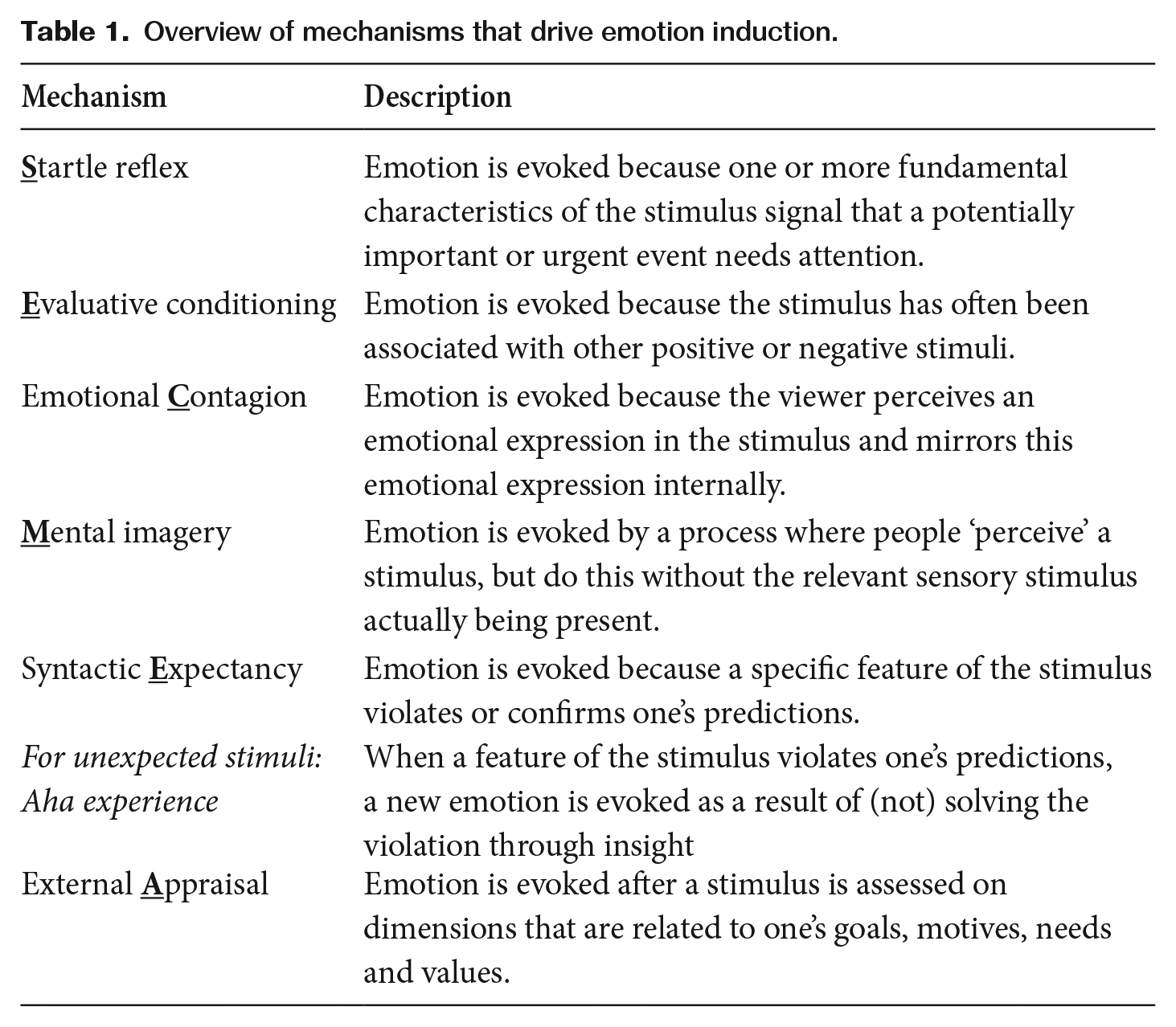
This article has demonstrated how the emotion-evoking BRECVEM mechanisms in Juslin’s (2013) BRECVEMA framework can be adjusted to account for visual aesthetic artefacts, resulting in the SECMEA mechanisms (see Table 1). We have also argued for the inclusion of visual aesthetic artefacts other than art, such as product design and aesthetic images in advertising. This article provides initial evidence for the SECMEA mechanisms with regard to this broader set of visual aesthetic artefacts. We hope that the current insights inspire further empirical testing and help to increase the understanding of emotion induction, in particular, and the aesthetic experience, as a whole.
Overview of mechanisms that drive emotion induction.
Footnotes
Funding
The authors received no financial support for the research, authorship and publication of this article, and there is no conflict of interest.

Biographical Notes
CHRIS VAN DER LEE is a PhD student at the Tilburg Center for Cognition and Communication in the Department of Communication and Cognition at Tilburg University. His research mainly focuses on data-to-text generation, dialogue systems, automated journalism and text classification. He has a background in visual aesthetics and linguistics.
Address: Tilburg University, Warandelaan 2, Tilburg 5037 AB, The Netherlands. [ email:
RENSKE VAN ENSCHOT is Assistant Professor in the track New Media Design in the Department of Communication and Cognition at Tilburg University. Her research interests lie in the fields of empirical aesthetics, visual metaphor and interactive digital narratives. She is co-editor of the handbook ‘Tekstanalyse’.
Address: as Chris Van der Lee. [ email: