




Abstract
Meaning making in science is supported by different modes, such as spoken and written language, images and gestures, all of which have different affordances. The epistemological commitments of modes are affordances that cannot be avoided. This article investigates how the epistemological commitments of modes affect possibilities for learning. Video data was collected from a learning activity where upper secondary students drew and explained an experiment representing the greenhouse effect. The analysis uses the variation theory of learning, which assumes that students learn when they notice new aspects of objects of learning by experiencing variation against an invariant background. Such variation can be created through the representations used. Findings show that, in the learning activity, variation was created in a range of modes. Some of the variation, particularly with regards to radiation, was due to the epistemological commitments of drawing. However, these aspects of radiation went unnoticed by the students, possibly because several aspects varied simultaneously. The teacher then helped the students to become aware of certain variation. Implications for the teaching and learning of science when taking the epistemological commitment of different modes into consideration include both challenges, such as when unintended variation is created, and opportunities, such as when spontaneously occurring variation can be taken up for discussion.
Keywords
Introduction
Different modes, such as spoken and written language, images and gestures, have different affordances and offer different possibilities for making meaning (Jewitt et al., 2001; Kress and van Leeuwen, 2006; Waldrip et al., 2013). For example, while speech is appropriate for naming and classifying things, images show and locate them (Kress, 2010). Science teachers and students produce and interpret representations in a range of modes whose joint affordances enable, for example, the representation of phenomena and concepts, empirical and theoretical development, and argumentation (Airey and Linder, 2009; Lemke, 1998; Tytler et al., 2013). Some affordances of modes cannot, however, be avoided (Bezemer and Kress, 2008; Kress, 2003, 2010). Rather, they commit a person to make selections. Bezemer and Kress exemplify such affordances by comparing a spoken and a drawn description of two persons sitting on a bench. In speech, one is not required to specify the distance between the two. In drawing, by contrast, a decision needs to be made regarding how far apart they are. Such unavoidable affordances are called epistemological commitments (Bezemer and Kress, 2008; Kress, 2003, 2010) and have implications for science learning. For example, as students draw onion cells seen in a microscope, they need to decide how to draw the shapes, which entities to include and the locations of those entities (Jewitt et al., 2001; Kress, 2010). These challenges follow from the epistemological commitments of the mode of drawing (Kress, 2010). In this article, we investigate how the epistemological commitments of modes in science teaching and learning can affect students’ possibilities for learning. We apply the variation theory of learning (VTL) as an analytical lens in describing the learning possibilities available.
VTL focuses on noticing new aspects of an object of learning – the content to be taught and learned – as a necessary condition for learning (Marton, 2015; Marton and Booth, 1997; Marton and Tsui, 2004). This noticing is made possible by experiencing variation in those aspects. Student understanding can thus be enhanced if teachers create variation in new aspects, first varying one aspect at a time and later several aspects simultaneously (Linder et al., 2006). For example, understanding ‘price’ requires noticing the effects of supply and demand (Pang et al., 2006). The students in Pang et al.’s study experienced variation in these aspects by participating in auction-like activities, using auction money and recording the results in spreadsheets. However, many aspects of science knowledge can only be accessed through representations in modes such as drawings, diagrams, graphs or equations. A teacher who wants to create variation in some aspect of a science concept, such as a property of an atom or the wavelength of light, needs to select appropriate representations allowing relevant variation to take place (Fredlund et al., 2015a).
We applied VTL to investigate the variation created in the representations produced and interpreted by a group of students and their teacher working with the greenhouse effect, and how the epistemological commitments of modes offer opportunities and challenges for students’ learning. Our research question is: Using the greenhouse effect as an object of learning, how do the epistemological commitments of modes affect possibilities for learning in terms of the variation created in the representations produced by students and their teacher?
The research question is addressed by analysing video data from a drawing activity where students interacted with each other and their teacher. To our knowledge, the role of epistemological commitments of modes provided in the teaching and learning of the greenhouse effect has not been explored through VTL before. Details of the theoretical framework are described in the next section.
Epistemological commitments
The term ‘epistemological commitment’ originates in science education, where it has been used since the 1980s for describing students’ ‘fundamental assumptions’ regarding ‘the character of knowledge’ (Posner et al., 1982: 215–218). The term is sometimes still used in this sense (see, for example, Eriksson et al., 2020). In this article, however, we use epistemological commitment in Bezemer and Kress’s (2008: 176) transferred sense of the term as an ‘unavoidable affordance’ of modes, as described earlier (see also Sunderland and McGlashan, 2013). Kress (2010) uses the epistemological commitment of modes as an analytical tool to explore the teaching and learning of science, and argues, for example, that using gesture may sometimes be better than using speech or drawing when teaching the circulatory system (see also Kress et al., 2001). This is because the epistemological commitments of modes demand certain undesirable selections to be made in speech (such as classifying cells) and in drawing (such as locating what is to be drawn), leaving gesture, with its temporal and non-persistent character, as the most appropriate mode in the situation. In order to capture how the epistemological commitments of modes can affect students’ possibilities for learning, we needed an analytical lens that could help us pinpoint the possibilities created in different modes. Hence, VTL was chosen.
The variation theory of learning
As described earlier, VTL maintains that the experience of variation in critical aspects makes learning possible (Marton, 2015; Marton and Booth, 1997; Marton and Tsui, 2004). In VTL, what the teacher intends the students to learn is called the intended object of learning. This intention transforms into an enacted object of learning through the events in the actual teaching and learning situation. What is enacted in the classroom is central to what can be learned (Marton and Booth, 1997) since: ‘New meanings are acquired from experiencing differences against a background of sameness, rather than experiencing sameness against a background of difference’ (Pang and Marton, 2013: 1066, original emphasis; Marton and Pang, 2013). To achieve this ‘background of sameness’, variation should be given in one aspect at a time, before varying several aspects simultaneously.
Studies using VTL are often learning studies (Pang and Ling, 2012; Pang and Marton, 2003) where teachers try to determine what the students already know about an object of learning and to identify its critical aspects with respect to the students’ current ways of knowing (see Pang and Ki, 2016, for further discussion on critical aspects). Furthermore, the teachers determine how to create variation in the critical aspects to make learning possible. However, not all studies using VTL are learning studies. In Ingerman et al.’s (2009b) study, for example, VTL functioned as the analytical framework for analysing students’ work with a computer simulation of the Bohr model of an atom without the guidance of a teacher. The simulation was constituted by a number of different modes and created variation in different aspects of the Bohr model. This also illustrates how objects of learning are often composed by multiple objects of learning 1 (Ingerman et al., 2009a; cf. Tang, 2013).
Whereas other VTL studies emphasize planned opportunities for teaching and learning (through designing opportunities for students to experience variation), this article, similarly to Ingerman et al. (2009b), illustrates the value of opportunities for teaching and learning that occur more spontaneously in the classroom (see also Haug, 2014). We use VTL to explore the role of the epistemological commitments of modes in the teaching and learning of the greenhouse effect. This extends previous work drawing on both VTL and social semiotic multimodality (Eriksson et al., 2020; Fredlund et al., 2015b), which points out several connections between the two theoretical perspectives. For example, multimodal analysis opens up for a more fine-grained analysis of the object of learning enacted in unfolding discourse. Before presenting the analysis, we introduce the object of learning further.
The object of learning: the greenhouse effect
In this study, the greenhouse effect was chosen as the intended object of learning. Research has shown that students often find this topic difficult to learn (Niebert and Gropengießer, 2014). The greenhouse effect depends on light of different wavelengths 2 interacting differently with greenhouse gas molecules in the atmosphere (see Figure 1 for an illustration of wavelength). Much of the visible light from the sun (which has shorter wavelengths) is able to cross the atmosphere 3 and heat the Earth’s surface without being absorbed by greenhouse gases in the atmosphere (such as carbon dioxide). The heated surface emits infrared light (which has longer wavelengths) into the atmosphere where most of it is absorbed by the greenhouse gases. A greenhouse gas molecule holds the energy taken up from infrared light for a short moment before sending it out in a random direction, again in the form of infrared light, which in turn can be absorbed by another greenhouse gas molecule, and so on. Eventually the infrared light may exit the atmosphere. Because of this delayed exit, the atmosphere’s temperature increases until the radiation output from the atmosphere balances the input from the sun.
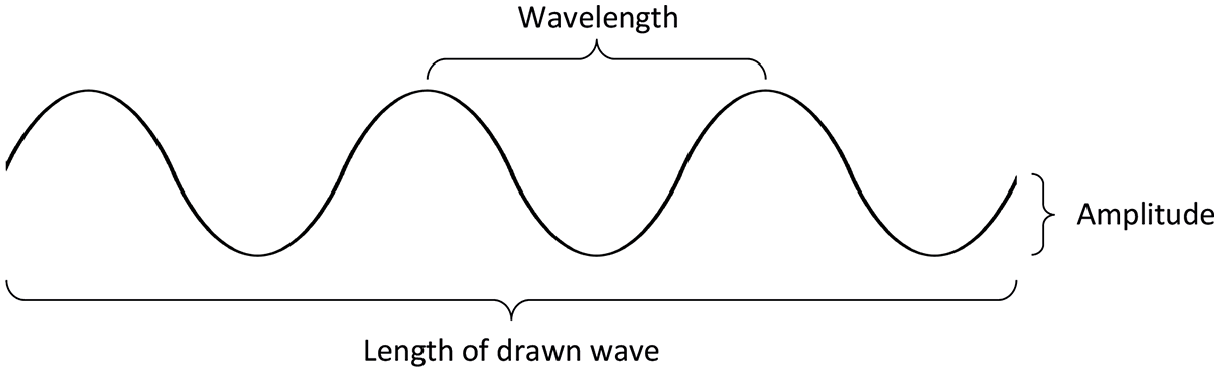
An illustration of wavelength as the distance between two wave crests, the length of the drawn wave as the full length of the waveshape and the amplitude as the half height of the wave.
In the present study, we focus on the possibilities for learning created in a teaching and learning situation dealing with the greenhouse effect in order to discuss how they were affected by the epistemological commitment of modes. Next, the data collection and analysis are described.
Methods
Within a larger research project in Norway, REDE (Representation and Participation in School Science), focusing on the use of representations in science education (Knain et al., 2017), video data was collected at an upper secondary school where the students (around 16 years old) took a mandatory course in general science. The teaching design was developed by the school teachers together with the researchers and was based on design principles proposed by Tytler et al. (2013):
students construct their own representations (e.g. drawings) to engage with science and its representations;
the teaching focuses on the relevant concepts and theories for a given topic and on creating meaningful activities where the students express, extend and integrate their ideas about the topic by producing representations; and
the teacher supports the students in their production of representations, and both student-produced and more authoritative representations are discussed in order for the students to develop a meta-perspective on representations.
The idea of creating variation was not part of the initial design, partly because the study was not framed as a learning study. Instead, the students were asked to interact with each other and the teacher in a guided inquiry approach to make sense of the greenhouse effect by drawing and explaining it. The teaching design was implemented by one teacher who also participated in the design process. The project was approved by the Norwegian Centre for Research Data by the time of data collection, which means that all students and the teacher gave their informed consent to participate in the study. The participants were informed that they could withdraw their consent at any time, and that anonymization in research publication is ensured. For example, anonymization is ensured by using pseudonyms and by not including any images of faces in the presentation of results. The researchers were present in the classroom to take photos and field notes.
The students were divided into groups of four. One student in each of the three groups wore a head-mounted GoPro camera collecting video data (Frøyland et al., 2015), and thus the students determined what was being recorded (cf. Aarsand and Sparrman, 2021). The students were asked to draw and explain what was taking place in a demonstration experiment that simulated the greenhouse effect. They could use their textbook, which presents an explanation of the greenhouse effect (Figure 2), 4 as a resource. First, the students drew in pairs, then all four students in the group worked together to produce a new joint explanatory drawing. To illustrate the difference between having more or less greenhouse gases in the atmosphere, the experiment setup included two identical plastic bottles 5 (Figure 3), one containing more gaseous carbon dioxide than the other. A strong working lamp was arranged to shine onto the bottles (see Niebert and Gropengießer, 2014). A black cardboard sheet was placed behind the bottles to function as the Earth’s surface by absorbing visible light from the lamp and emitting infrared radiation back into the bottles. The temperatures in the bottles were measured with digital thermometers and the thermometer readings were projected onto a whiteboard, showing that the bottle with more carbon dioxide became warmer than the other by 2.6 degrees.
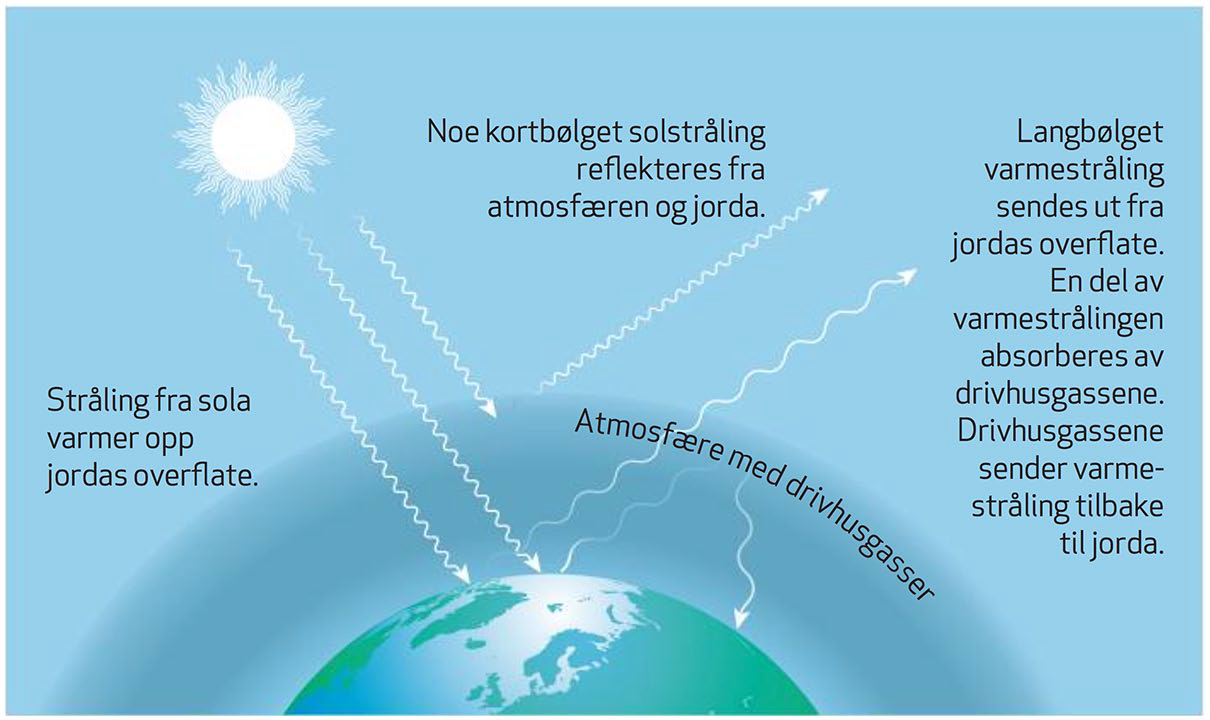
An image that the students consulted in their textbook (Van Marion et al. 2013: 112). Reproduced with permission from the publisher.
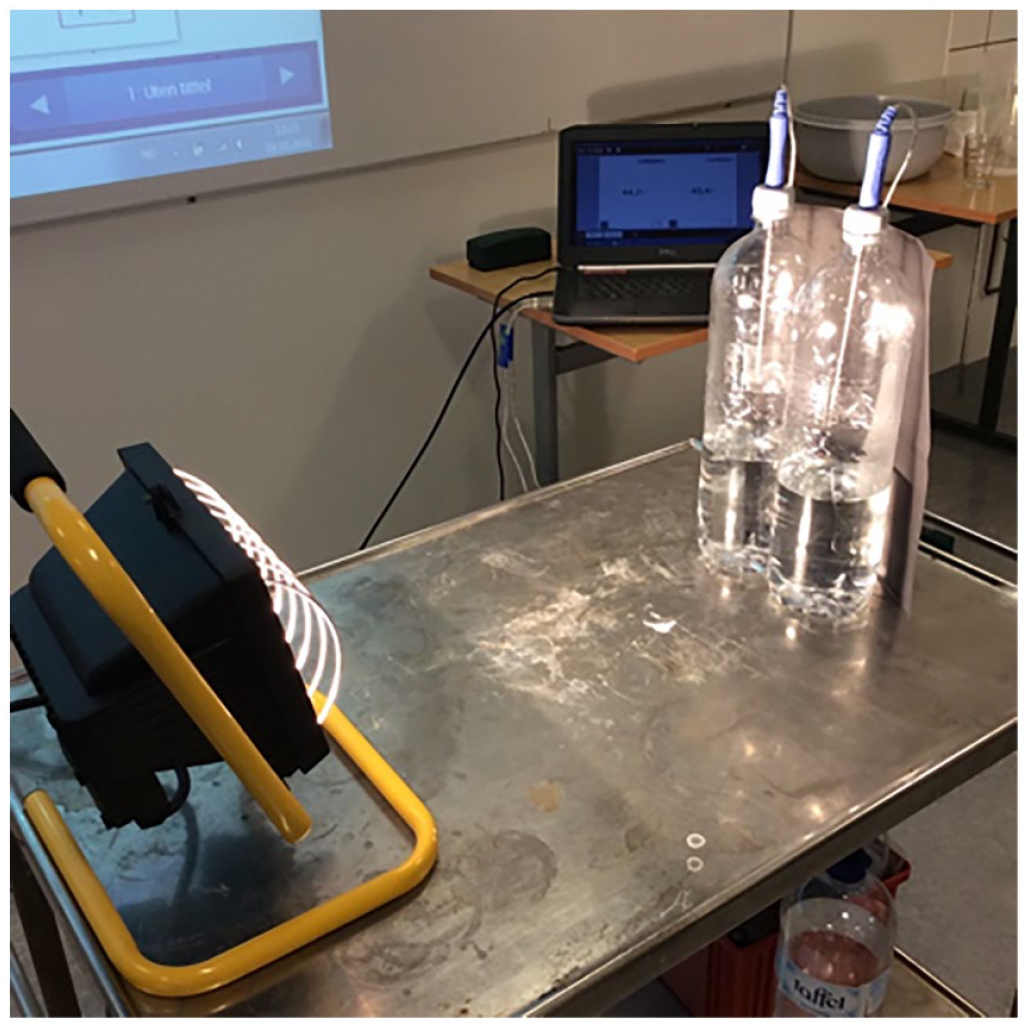
The demonstration experiment set-up.
Our initial analysis included viewing all the video data (Jordan and Henderson, 1995). It showed that all student groups worked actively to explain what was going on in the demonstration experiment and to produce and discuss drawings. All groups built their explanation around the textbook figure (Figure 2) and used it as a resource in their meaning making. All groups also struggled with their explanations, leading to discussions with the teacher. In terms of route of inquiry and the division in ‘semiotic labour’ (Matthiessen, 2007: 37) between different modes, there were some differences across the groups. For this article, we chose to focus on a group of students that was particularly interactive in drawing and producing a detailed explanation, thus illustrating key aspects of how the students construed and represented the object of learning. This group was considered the best choice for addressing our research question and our aim of discussing the possibilities for teaching and learning offered by the epistemological commitments of modes.
The video footage was viewed repeatedly to ensure that as many details in the students’ work as possible were noticed and interpreted. This enabled us to identify the variation that was created in the representations produced by the students and the teacher. According to our theoretical lens of VTL, the variation can be understood as providing possibilities for learning. We use the identified variation to discuss how the epistemological commitments of the modes involved affected those possibilities.
In what follows, we present our analysis of three selected episodes that are central to the students’ explanatory work in the drawing activity. In all three episodes, the interaction is centred around the students’ drawing.
Results
In the following episodes, two students, Olaf and Tom (pseudonyms), first work in pairs and then join Tina and Fiona (pseudonyms). Transcripts of spoken language and other modes are presented separately from frames of the video footage. The turns have been numbered to increase readability.
Episode 1: Setting the scene
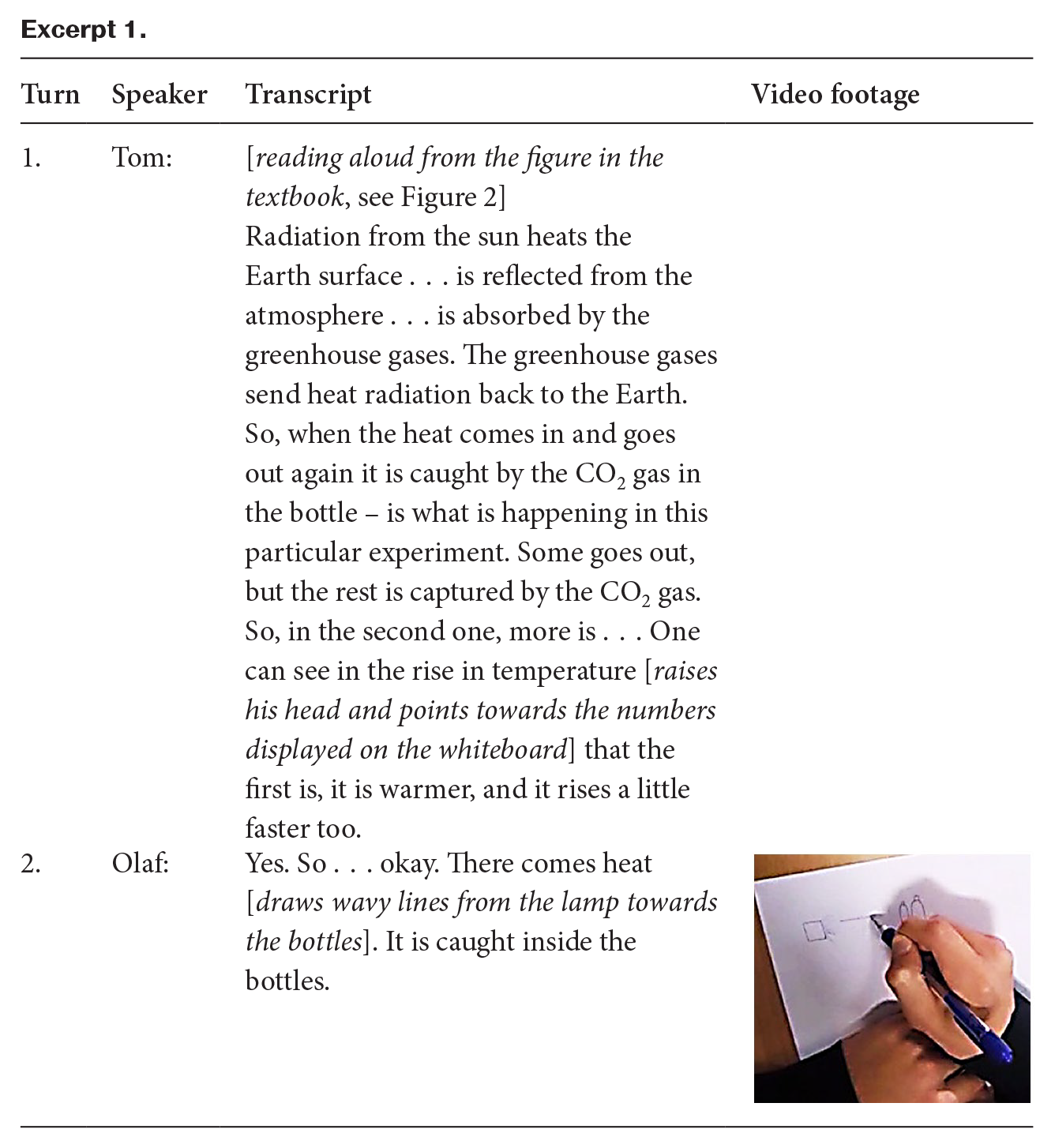
In Episode 1, Olaf and Tom try to explain what is happening in the demonstration experiment using both spoken language and drawing (see Excerpt 1). Figure 4 shows Olaf’s initial sketch of the demonstration experiment.
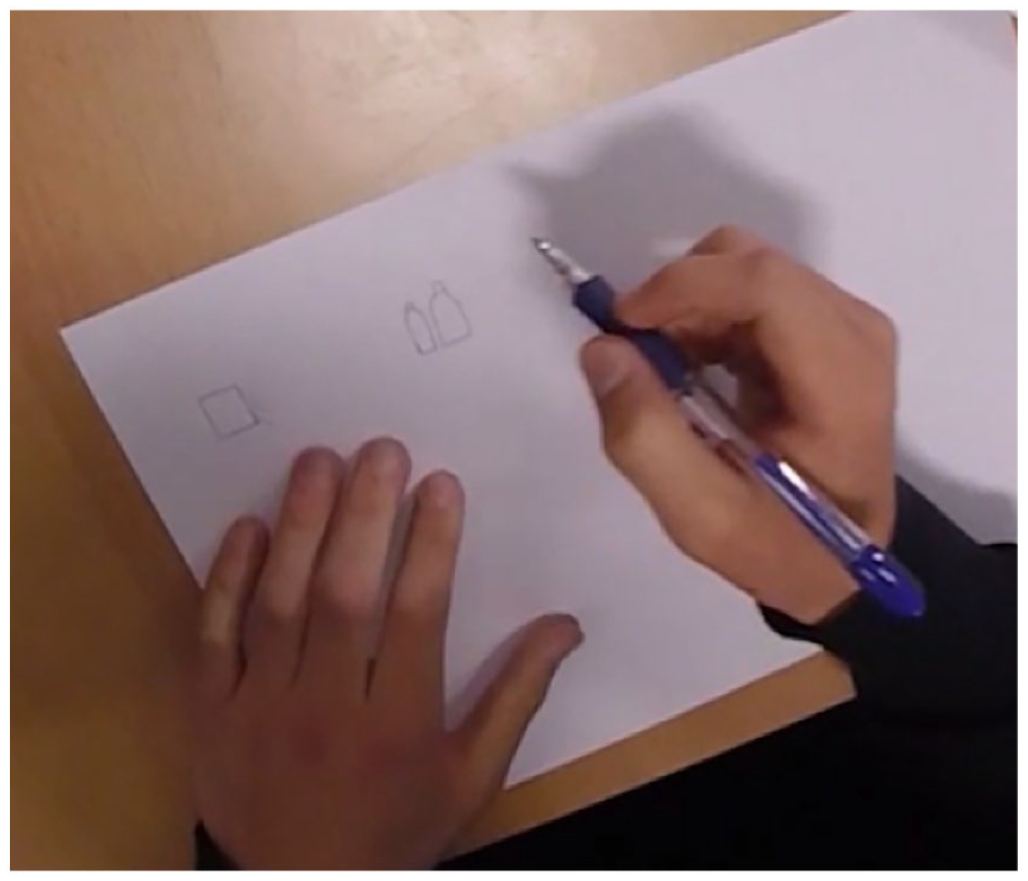
Olaf’s initial sketch of the demonstration experiment.
In this episode, Tom reads the textbook figure’s explanation of the greenhouse effect and translates it into the situation in the demonstration experiment, as shown in Excerpt 1. He maps the greenhouse gases in the Earth’s atmosphere described in the textbook onto the ‘CO2-gas in the bottle’ (Turn 1).
Variation is created using spoken language when Tom points out the difference in the amount of ‘heat’ entering and exiting the CO2-bottle and the contrasts in temperature and temperature rise (i.e. the rate of change of the temperature) between the two bottles in the experiment. He uses these contrasts to support his explanation. Olaf then draws a wavy line from the lamp towards the bottles (Turn 2), possibly, as suggested by the closeness in time, to translate what Tom had just said into the mode of drawing. The variation that Tom observes in the experiment appears to align with the variation he observes in the textbook explanation, namely, a difference between the amount of radiation that goes into the bottle versus the amount that goes out of it, and a correlation between the amount of CO2 in the different bottles and their temperatures.
To summarize, the analysis of Episode 1 reveals that the variation in temperature in the experiment appears to confirm the students’ interpretation of the textbook explanation.
Episode 2: Explaining the experiment
After Episode 1, Olaf draws a larger drawing. As Olaf and Tom make meaning together during the drawing process in Episode 2, they also create variation in different ways (see Excerpt 2).
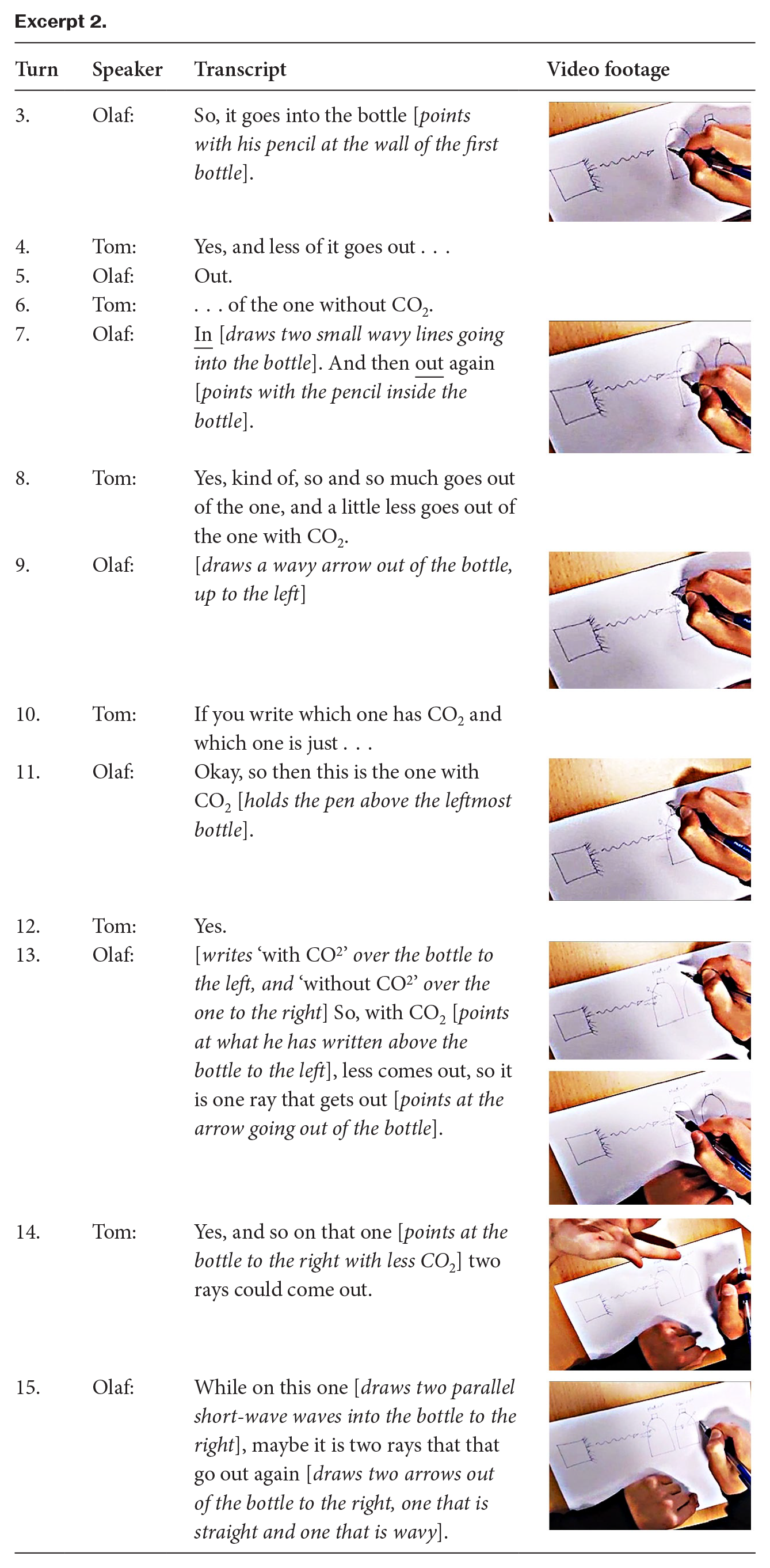
In this episode, the students refine their initial translation of the textbook explanation into the drawing mode, as shown in Excerpt 2. Their meaning making focuses on the numbers of wavy arrows (or ‘rays’, also referred to as ‘it’ in Turns 3 and 4 and left out by ellipses 6 in Turns 8 and 13) that enter and leave the different bottles.
Variation is created through classification of the different bottles in Turn 10. First, a tentative naming is made using spoken language (Turn 11), and then it is made more permanent in writing as the bottles are labelled ‘with CO2’ (Turn 13) and ‘without CO2’, respectively. The students also create variation in the number of rays that are sent out from the bottles. One arrow (‘ray’) is drawn to exit the ‘with CO2’ bottle (Turn 9), and two arrows to exit the ‘without CO2’ bottle (Turn 15). Another contrast is simultaneously created – that between the number of rays that is drawn entering the ‘with CO2’ bottle (Turn 7) and the number exiting it (Turn 9), suggesting an imbalance between the incoming and outgoing energy. A further contrast that Olaf creates in the drawing is between the different sizes of the waveshaped arrows – between that of the arrow drawn from the lamp towards the bottles and that of the arrows drawn to enter and exit the bottles: the arrows have different lengths, the waves have different wavelengths and amplitudes, and one of the arrows drawn to exit the CO2 bottle in Turn 15 is not wavy at all, but straight (see Figure 1 for an illustration of wavelength and amplitude). Finally, the arrows are drawn in different directions. This variation is not commented on in any mode.
The students appear to notice a pattern among these varied aspects – between bottles, temperatures and incoming/outgoing radiation in the bottles. A short while after the dialogue in Excerpt 2, Tom said he could not understand why they ‘got so much time [to complete the task]’, which suggests that the two students consider their drawn explanation to be complete at this point.
To summarize, Episode 2 demonstrates that the students introduced a number of instances of variation as they drew a more detailed drawing to explain what happened in the experiment: a separation of bottles, a contrast in the number of rays exiting the different bottles, a contrast between the number of rays entering and exiting the bottle with more CO2, and contrasts in the sizes and directions of the different wavy arrows.
The teacher intervenes
After Episode 2, the students continued to make small changes to their drawing by, for example, naming different parts of the drawing and drawing another wavy line from the lamp towards the bottles. Then the teacher arrived at the boys’ table to discuss the drawing with them. She pointed out a variation she noticed in the students’ drawing – wavelength – and attempted to find out what they meant by it. In this way, she drew on an aspect being varied in the students’ drawing as a potential resource for learning. Notably, it is not clear if the students understood what the teacher meant by wavelength as she said: ‘This one seems to have a little longer wavelength than that one’ and pointed at two of the different wavy lines they had drawn. The students appeared not to assign any particular meaning to this variation: ‘it was not on purpose’. However, there was some variation created in terminology as the teacher asked about the word ‘heat’ written above the waves drawn from the lamp towards the bottles in the students’ drawing, and the students said it was ‘energy’. The teacher neither emphasized this variation nor any variation created in other aspects, such as the lengths of the drawn waves or the number of waves entering or exiting the different bottles.
Episode 3: the teacher intervenes again
After the teacher’s intervention, Tina and Fiona joined the boys, and the four students drew a new joint drawing. First Tina and Fiona drew the set-up of the demonstration experiment, then Olaf and Tom continued to draw. In Episode 3, the teacher examines the student group’s final drawing (see Figure 5), and follows up on the discussion about differences in wavelength that occurred in her first discussion with the students. (see Excerpt 3).
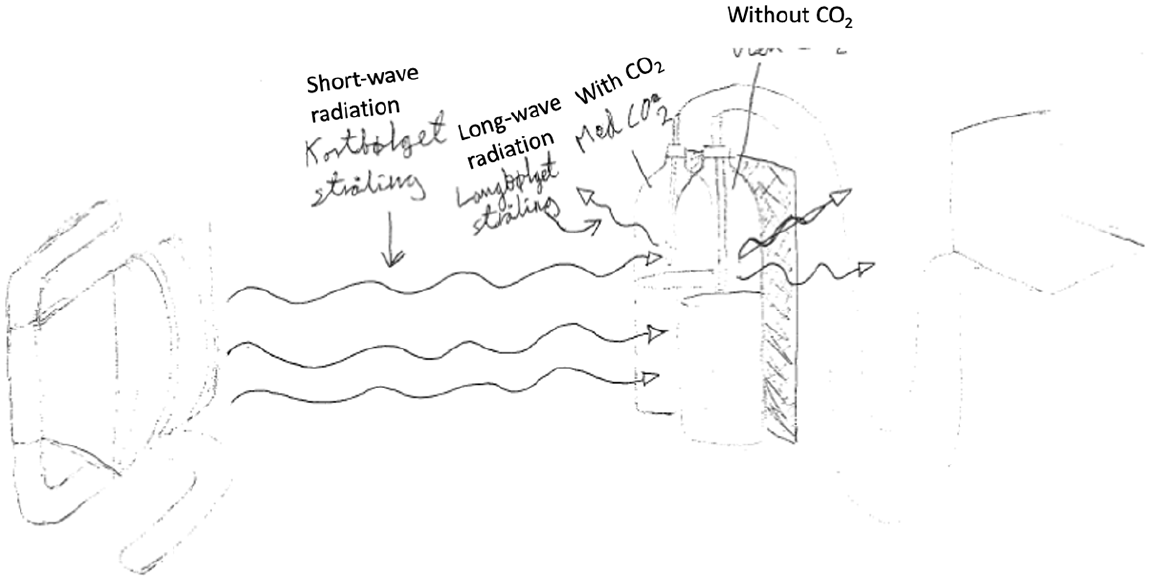
A copy of the students’ final joint drawing showing the demonstration experiment including the lamp, the bottles, the cardboard sheet and, faintly to the right, the connection to a computer (see Figure 3). The students’ explanatory written text has been excluded from this drawing. The authors have added English translations of the labels the students wrote following Excerpt 3.
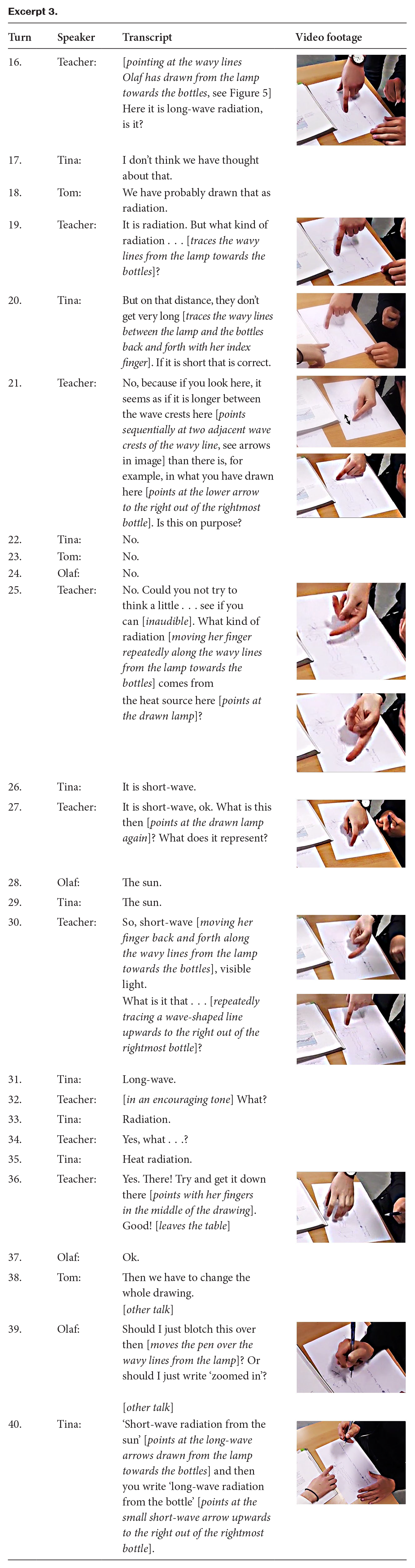
In this episode, the teacher asks the students if the radiation propagating from the lamp towards the bottles is ‘longwave radiation’. Tina responds that they have not ‘thought about that’ (Turn 17), and Tom remarks that they have ‘probably drawn that as radiation’ (Turn 18), which suggests that the previous discussion between the teacher and the students did not influence how the students drew wavelengths in their final drawing (Figure 5). The students only used the wave shape to draw ‘radiation’ (Turn 33).
In Turn 20, Tina says, ‘But on that distance, they don’t get very long . . . if it is short that is correct’, which suggests that she does not quite know which aspect of the drawing the teacher refers to by the word ‘wavelength’ – whether it is actually wavelength or the total length of the wavy arrow. The teacher clarifies the meaning of ‘wavelength’ by alternately pointing at two adjacent wave crests and talking about the distance between them. She contrasts longer and shorter wavelengths of the waves that the students have drawn (Turn 21), using the modes of drawing, gesture and speech in ‘semantic convergence’ (Lim, 2021: 48). Tina then seems to understand what the teacher means and says that the radiation from the sun is ‘short-wave’ (Turn 26) and the radiation out of the bottles is ‘long-wave’ (Turn 31). She also names this radiation ‘heat radiation’ (Turn 35). When the teacher affirms this, the students decide to include this distinction in their drawing by relabelling those wavelengths they have accidentally, but inaccurately, drawn longer as ‘short-wave’, and those they have drawn shorter as ‘long-wave’ (Turn 40). The students’ selection of the mode of writing for this task saves them from having to redraw parts of the drawing, and thus they use the classificatory affordance of written language to trump the meaning made in drawing. In our analysis, this suggests that the teacher’s noticing variation in wavelength in the students’ drawing helped Tina to notice a new aspect of wavelength. While the students initially did not see differences in drawn wavelength as having any meaning, they then became aware of some of the affordances of the wave shape – in terms of affording access to wavelength. By the teacher’s speech and gesture, the number of varying aspects potentially in focus in the drawing (see Figure 1) was narrowed to only one: wavelength. The role that wavelength plays for the greenhouse effect – that certain wavelengths are trapped by atmospheric gases while others are not – was, however, not mentioned.
To summarize, in Episode 3, the students initially do not assign any meaning to the variation in wavelength that exists in their group drawing. As the teacher elicits this variation by using gestures and speech, the students realize how wavelength can be expressed in the mode of drawing. However, it is unclear if the students see wavelength as part of a coherent explanation of the greenhouse effect.
Summary of the results
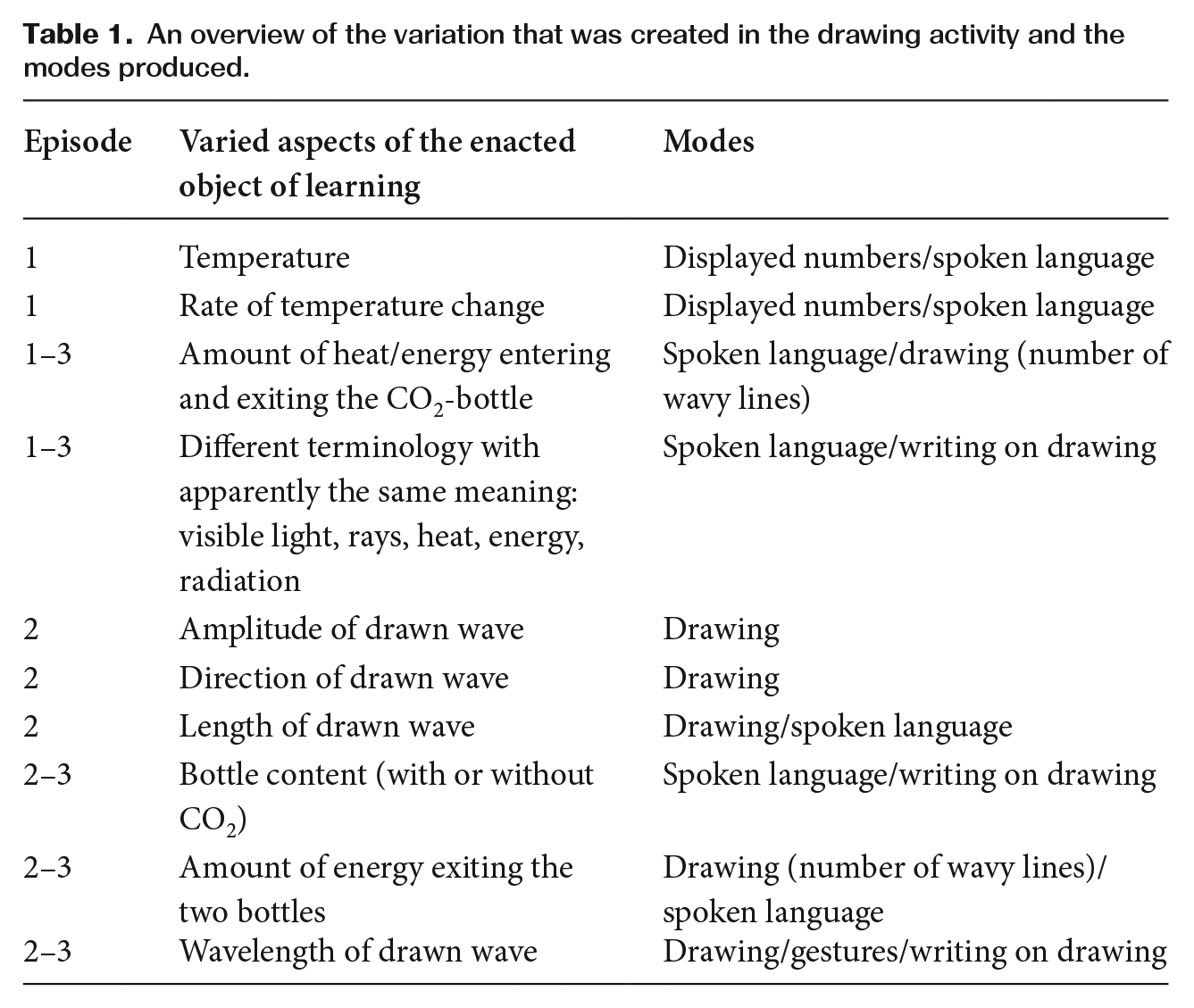
Our analysis of the enacted object of learning was made in terms of the variation created in different modes in the student–student and student–teacher interactions presented and is summarized in Table 1 together with the different modes in which meaning has been made. In Episode 1, the students see the variation available in the demonstration experiment as confirming their interpretation of the textbook explanation. Their more detailed explanation in Episode 2 serves to cement this interpretation, and the students find their explanation to be complete. The teacher pays attention to the variation in wavelength she notices in the students’ drawing, but the students say they did not draw this variation on purpose. In Episode 3, the teacher points out the variation in the students’ drawing using spoken language and gesture. Although this helps the students to understand how wavelength can be drawn, they decide to use the affordance of written language and write ‘short-wave radiation’ and ‘long-wave radiation’ on their drawing, rather than to redraw it. Notably, neither the students nor the teacher mention ‘waves’, although they talk about wavelength. Rather, they say ‘ray’, ‘heat’, ‘energy’ and ‘radiation’. The role of wavelength in the greenhouse effect is never sufficiently addressed.
An overview of the variation that was created in the drawing activity and the modes produced.
Discussion and Implications
Our analysis shows that several possibilities for learning were provided in terms of the variation created in the different representations that the students produced. The students noticed disciplinary-relevant patterns of meaning among many of the varied aspects. But, given our research question – how the epistemological commitments of modes affect the possibilities for learning in terms of the variation created – further discussion is needed.
Although a range of variation appeared in the students’ drawing (Table 1), the teacher focused on the variation in wavelength. This variation was not, however, intended by the students – it was due to an inherent affordance of the wave shape in the mode of drawing that we identify as an epistemological commitment of that mode (Bezemer and Kress, 2008). In this mode, selections of wavelength, amplitude, length of the wave and direction of propagation of the wave were required. Despite not attending to variation in wavelength, the students found their explanation to be complete. This discrepancy in the aspects that the students and the teacher focused on suggests that the objects of learning they enacted were constituted differently as they focused on different parts of a larger whole (Ingerman et al., 2009a). While the teacher focused on a more sophisticated explanation of the greenhouse effect – one including wavelength – the students produced a partial explanation focusing on the different amounts of energy held back in the different bottles. Although they created variation in wavelength, drawing waves similarly to how it was done in their textbook, they neither noticed this aspect nor saw it as relevant for their explanation. A possible reason for this is that there was too much simultaneous variation (Marton and Pang, 2013): the drawn waves varied in the aspects where selections were required. Our analysis suggests that, as the students mimicked the textbook, this variation was created by chance when they made choices demanded by the epistemological commitment of the mode of drawing. But the resulting variation was not assigned any particular meaning.
Another challenge for the students’ learning was caused by the epistemological commitment of spoken language, although none of the selections required in drawing would need to be made there: it would suffice to say ‘wave’. But neither the students nor the teacher said ‘wave’ in the episodes above. Instead, since the epistemological commitments of spoken and written language demanded that the students name what they drew, they used different terminology to do so (visible light, rays, etc., see Table 1). However, none of these labels helped the students to understand how to appropriately draw wavelength.
The challenges for learning caused by the epistemological commitments of modes suggest that the teacher has a key role in helping the students to identify the variation relevant to the situation at hand. From a teaching perspective, the variation created by chance in student drawings may create opportunities for teaching. This aligns with Haug’s (2014) spontaneous teachable moments, because aspects that are relevant from a scientific point of view may vary in the student drawings. This variation could be pointed out and discussed with the students. In our study, it is possible that the teacher thought the students had misunderstood what ‘wavelength’ is, but our analysis suggests they did not consider wavelength at all. In the teacher’s interventions, the differences in wavelength were used as resources for teaching and provided an opportunity for the students to intentionally draw on the affordance of the waveshape to make more sophisticated meaning. The affordances of drawing, gesture and speech contributed to the students’ noticing of this variation. It may be easier for teachers to notice instances of variation created by chance in the students’ representations if they contrast with a disciplinary understanding, such as the wrong wavelength in the wrong place. Otherwise, the variation may easily be overlooked, such as the variation in the lengths of the wavy lines or in amplitude in our study. Since inappropriate variation may actually be intended by the students (Pang and Ki, 2016), asking them about seemingly irrelevant variation in their drawings may also be important.
To conclude, VTL enabled a sophisticated analysis of the epistemological commitments of modes and their challenges and opportunities for the teaching and learning of science. Our study illustrates the importance of teachers exploring student-generated representations, asking clarifying questions and trying to find out if students appreciate the affordances of the modes they produce. The variation in the representations that the students produce may be intended or created only by chance due to the epistemological commitment of modes. This variation may include irrelevant variation, variation that contrasts with a disciplinary way of knowing, and variation that aligns with a disciplinary point of view. Thus, teacher awareness of the importance of variation and how epistemological commitments of modes may affect possibilities for learning can create new opportunities for teaching and learning – both planned and spontaneous – through the production of representations in different modes.
Footnotes
Acknowledgements and Funding
The authors gratefully acknowledge funding from The Research Council of Norway, grant 249872.
Declaration of conflicting interests
The authors declare that they have no conflicts of interest.
Compliance with Ethical Standards
The teacher and the participating students have given their informed consent.

Notes
Biographical Notes
TOBIAS FREDLUND is Senior Lecturer in Curriculum Studies at the Faculty of Education and Business Studies, Department of Curriculum Studies, University of Gävle, Sweden. Previously he was a postdoctoral fellow at the Department of Teacher Education and School Research, University of Oslo, Norway. His research interests include the teaching and learning of science, and include topics such as representations, interactive engagement and the variation theory of learning.
Address: University of Gävle, Gävle, SE-80176, Sweden. [email:
KARI BEATE REMMEN is Associate Professor in the Department of Teacher Education and School Research, University of Oslo, Norway. She has experience from several research-and-development projects focusing on teaching and learning science outdoors in secondary schools, aiming to make science education more relevant and interesting to students.
Address: University of Oslo, Norway. [email:
ERIK KNAIN is Professor in the Department of Teacher Education and School Research, University of Oslo, Norway. His research interests include inquiry-based learning, multimodal language in education for sustainable development and socio-scientific issues.
Address: University of Oslo, Norway. [email: