




Abstract
This article synthesizes modes of representation in documentary films with strategies of legitimation. It develops a framework of documentary legitimation, where each of the six modes recognized by Bill Nichols in Representing Reality: Issues and Concepts in Documentary (1991) and Introduction to Documentary (2017) – expository, participatory, observational, performative, reflexive and poetic modes – tends to highlight certain legitimating strategies. For instance, the expository mode mainly legitimates through voice-of-God commentary, expert speeches and expository intertitles, the participatory mode legitimates through witness testimony and the observational mode legitimates through audience observation, and so on. The proposed framework is applied to a case study of a documentary entitled The Lockdown: One Month in Wuhan produced by China Global Television Network (CGTN). Analysis demonstrates how legitimation of the Wuhan lockdown during the early outbreak of COVID-19 is realized by adopting different representation modes and legitimating strategies. The article illustrates how an interdisciplinary approach may lead to a more comprehensive understanding of legitimation and its realization.
Introduction
Legitimation 1 refers to ways in which ‘speakers explain why they did or do something and why such an action is reasonable or, in general, socially acceptable’ (Van Dijk, 1998: 256). While previous research mainly concerns how language is used to legitimate (e.g. Martín Rojo and Van Dijk, 1997; Van Leeuwen, 1996, 2007, 2008; Van Leeuwen and Wodak, 1999), attention has been paid to legitimation in multimodal discourses such as school history books (Peled-Elhanan, 2010), political advertisements (Mackay, 2013) and picture books (Liang and Bowcher, 2019). Studies on multimodal legitimation are important because legitimation is realized not just linguistically, but also visually and musically (Van Leeuwen, 2018). What is more important, as proposed in this article, is exploration of multimodal legitimation with insight from existing scholarly works on the multimodal genre under consideration.
For this purpose, the article investigates legitimation in documentary. It synthesizes studies on modes of representation in documentary with the concept of legitimation. Documentaries are ‘films that sought to educate and persuade through a creative treatment of actuality’ (Grierson, 1966: 13). They have been a tool of political propaganda since the beginning of the moving picture medium (Friedmann, 2010). Ways in which documentaries represent the world and disseminate ideas have been studied by Nichols (1991, 2017), who develops a taxonomy of modes: the expository, participatory, observational, performative, reflexive and poetic modes of representation. This article proposes that each mode highlights certain legitimating strategies, which constitute a framework of documentary legitimation that is related to yet distinct from the linguistic frameworks proposed in previous studies. In doing so, the article illustrates how an interdisciplinary approach may lead to a more comprehensive understanding of legitimation and its realization.
The framework of documentary legitimation is applied to a case study of The Lockdown: One Month in Wuhan produced by China Global Television Network (CGTN). Issued in February 2020, the documentary functions to legitimate the strict lockdown on Wuhan and its 11 million residents during the early outbreak of COVID-19. The film is selected to promote understanding of legitimation in the Chinese political context (Wang, 2020), where documentary has been considered a visual means of mass education and public propaganda since the 1920s.
The Lockdown: One Month in Wuhan
The Lockdown: One Month in Wuhan (hereafter The Lockdown) is a 33-minute documentary issued by CGTN on 28 February 2020. It relates what happened in Wuhan, the Chinese metropolis in the first month (23 January – 24 February) of its lockdown. It is the first documentary concerning people’s lives during COVID-19, with an English voiceover and English and Chinese subtitles.
The Lockdown functions to justify and legitimate the Chinese government’s decision to close Wuhan. Ever since its abrupt declaration of the lockdown, the Chinese government was overwhelmed with criticism. The decision to impose severe quarantine on 11 million people, on an unprecedented scale in history, was decried as draconian and a violation of human rights (Bequelin, 2020), and an ineffective way to control the virus (Bernstein and Craig, 2020). As the lockdown went on, there were reports of the dire conditions in Wuhan (Fang et al., 2020), and the government was accused of irresponsibility and incompetence (Buckley and Hernández, 2020).
As usual, such reports were dismissed as fake and misleading by the Chinese authorities, and mainstream Chinese media were called upon to take the lead in telling the truth to the world. Against such a background, CGTN promptly issued The Lockdown. One of the purposes in producing the documentary, according to its director, was to resist the ‘demonizing’ of the Chinese government by some biased international media (Yu, 2020).
Although, strictly speaking, there is no documentary representation that is without ideological presuppositions (Nichols, 2016), Chinese documentaries are particularly criticized for being a tool of political propaganda (Chu, 2007). Compared with the dogmatic documentaries produced earlier in history or exclusively targeted at domestic audience, The Lockdown adopts a ‘softer’ tone and pays attention to expectations of the international audience. This contributes to its relative popularity, with more than 18 million views on YouTube alone. The Lockdown is therefore acclaimed by Chinese media as one of the most successful documentaries produced in recent years. In this article, The Lockdown will be studied from the perspective of legitimation, which is to be reviewed in the following section.
Legitimation in Critical Discourse Analysis and Social Semiotics
Research on legitimation in the fields of Critical Discourse Analysis (CDA) and Social Semiotics was initiated by Van Leeuwen (1996). Van Leeuwen and Wodak (1999) identified four categories of legitimation: authorization (reference to authority), rationalization (reference to the utility of the social practice), moral evaluation (reference to discourse of values) and mythopoesis (the telling of stories). These legitimating strategies were revisited and re-discussed later in works by Van Leeuwen (2007, 2008), who demonstrates that the different strategies can be used separately or in combination.
Van Leeuwen’s linguistic framework of legitimation has inspired other researchers, who adopt it for the analysis of linguistic and multimodal discourses. For instance, Martín Rojo and Van Dijk (1997) show how the parliamentary speech of the Spanish Secretary of the Interior fits into the categories of legitimation put forward by Van Leeuwen. Peled-Elhanan (2010) demonstrates how massacres and their outcomes are legitimated in Israeli secondary school history books, and Liang and Bowcher (2019) faithfully apply Van Leeuwen’s legitimation framework to the analysis of two Chinese sex education picture books for children.
Meanwhile, Van Leeuwen’s framework has been revised by Reyes (2011), Wang (2020) and Mackay (2013), who recognize the culture and genre dependency of legitimation. Reyes (2011) identifies five strategies of legitimation in the US presidential speeches: emotions, a hypothetical future, rationality, voices of expertise and altruism. Wang (2020) further studies how China’s official media legitimate the ruling party through highlighting positive governmental actions, emotions, rationality, hypothetical futures and quoting elites. From a multimodal perspective, Mackay (2013) investigates how traditionally recognized legitimating strategies can be successfully adapted to political advertisements that exhibit distinctive generic features.
Another approach to legitimation that is relevant here is the proximization theory proposed in a series of works by Cap (e.g. 2013, 2017). Proximization is ‘a discursive strategy of presenting physically and temporally distant events . . . as increasingly and negatively consequential to the speaker and her [sic] addressee’ (Cap, 2017: 16). It is frequently used to legitimate. For instance, picturing disease as an aggressive enemy which is to ‘invade’ the patient is a kind of threat-proximization often used to legitimate a certain course of treatment. Taking these previous studies into consideration, the next section will investigate legitimation in documentary.
Legitimation in Documentary: Modes of Representation and Legitimating Strategies
A pioneer scholar in film studies, Bill Nichols is the first one to apply modern film theory to the study of documentary. Nichols (1991, 2017) identifies six modes of representation in documentary films. They are the expository, participatory, observational, performative, reflexive and poetic modes. The definitions are as follows.
Expository mode: emphasizes verbal commentary and an argumentative logic. This is the mode that most people associate with documentary.
Participatory mode: emphasizes the interaction between filmmaker and subject. Filming takes place by means of interviews or other forms of even more direct involvement from conversations to provocations.
Observational mode: emphasizes a direct engagement with the everyday life of subjects as observed by an unobtrusive camera.
Performative mode: emphasizes the subjective or expressive aspect of the filmmaker’s own involvement with a subject.
Reflexive mode: calls attention to the assumptions and conventions that govern documentary filmmaking.
Poetic mode: emphasizes visual associations, tonal or rhythmic qualities, descriptive passages and formal organization (Nichols, 2017: 31–32).
From the expository to the poetic mode, such a typology starts from an emphasis on firm audience guidance towards a gradual loosening of the constraint (see Chu, 2015). 2 Moreover, these modes differ in their ways of multimodal argumentation (Wildfeuer and Pollaroli, 2018). The expository mode mainly argues through an authoritative voiceover, the participatory mode argues through interviews, the observational mode argues by letting the audience watch the activities (which have been selected by the filmmaker), and so on.
Despite some criticism (Bruzzi, 2002; Ward, 2005), Nichols’s mode taxonomy is influential in documentary studies (Cagle, 2012). It is generally used in two ways: to describe the predominant mode throughout a film at a macro level, or to analyse a film scene by scene to see how different modes are combined to absorb the audience in its argument (Natusch and Hawkins, 2014). Given the hybridity of modes in contemporary documentary, the second approach is taken here to see how each mode contributes to legitimation.
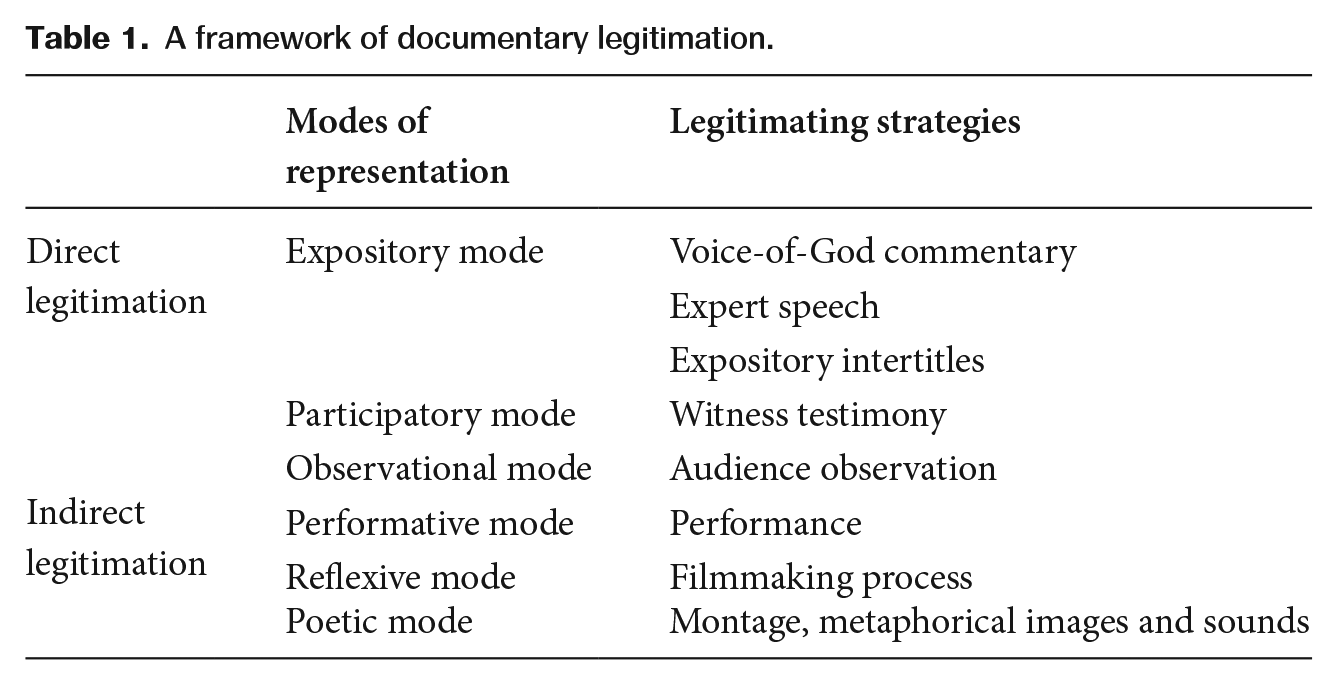
In this article, a framework of documentary legitimation is proposed that identifies dominant legitimating strategies in each mode of representation (Table 1). The framework recognizes two kinds of legitimation, direct and indirect legitimation. Direct legitimation is legitimation through direct and unambiguous argument. Each of the direct legitimating strategies can function independently. Indirect legitimation does not make straightforward arguments. It is used to affectively influence the audience and to support direct legitimation. In the following, direct legitimation in the expository, participatory and observational modes will be discussed in more detail than indirect legitimation in the performative, reflexive and poetic modes.
A framework of documentary legitimation.
Legitimation in the expository mode
Voice-of-God commentary
The voice-of-God commentary achieves its authoritative status through the quality of the voice and the way the voice is presented. The voice is usually a professionally trained, richly toned male voice (Roe, 2019). Moreover, the voice is usually presented as coming from nowhere, as the speaker is heard but not seen. It is ‘not localizable’, and therefore ‘a guarantee of knowledge’ (Doane, 1980: 42). In the words of Wolfe, such a disembodied voice is ‘construed as fundamentally unrepresentable in human form, connoting a position of absolute mastery and knowledge outside the spatial and temporal boundaries of the social world the film depicts’ (Wolfe, 1997: 149).
Expert speech
Archival and news footage is an important element in the expository mode (Natusch and Hawkins, 2014), where talking experts give their opinions on the issue at hand. The expert might have been interviewed by someone else for purposes other than making the documentary, or she or he might have given a talk during a lecture, speech, television news report, etc. The images and words of the expert are then used for the purpose of legitimation in the documentary. Although the images are captured from another screen, techniques such as close shot are used to create an impression that the expert is directly addressing the audience. The expertise and social status (visually indicated through clothing, verbally indicated trough names and titles) of the expert lends authority to her or his words.
Expository intertitles
An intertitle is a piece of printed text inserted into the shots of a film. Intertitles are classified into dialogue and expository intertitles. Dialogue intertitles enunciate within the diegesis and expository intertitles enunciate outside the diegesis. Expository intertitles address the audience: they help to foreground what the filmmaker expects the audience to pay attention to (Jackson, 2017). They can also help to trigger certain emotional responses. For instance, in documentaries of human suffering, an intertitle with words reading ‘More than 10,000 people died in the disaster’ may strike the hearts of the audience apart from showing the number of victims. The effect is frequently enhanced through colours as well, such as the commonly used pure black background with words written in white or red.
Legitimation in the participatory mode: witness testimony
Although an expert also can be interviewed by the filmmaker, the participatory mode often revolves around interviews with ordinary social actors. This signifies a ‘shift of emphasis from an author-centred voice of authority to a witness-centred voice of testimony’ (Nichols, 1991: 48). Techniques such as close shot are utilized to place the viewer in direct relation to the interviewee, achieving an immediate sense of being addressed. Compared with the disembodied voice-of-God commentary, the oral testimony of the witnesses presents individual perspectives and personal recollections. The images and voices of the interviewees achieve legitimating power because of the audience’s ‘(excessive) faith in witnesses’ (p. 138). The fact that the witnesses are ‘there’ makes their personal experience an instrument of legitimation. In cases where more than one witnesses are interviewed, the variety of voices further enhances the film’s credibility.
Legitimation in the observational mode: audience observation
In the observational mode, the filmmaker retires and relinquishes control. The silent camera turns into a ‘fly on the wall’ and becomes the eyes and the ears of the audience. An impression of unmediated observation is created and anything that happens in the observational scenes is considered objective reality. The legitimating power of observation mainly comes from the belief that the camera cannot lie (Chu, 2015). Moreover, the audience is called upon to take a more active role, to ‘see for yourself’ and to interpret what is said and done. The fact that the scenes are the result of careful selection, however, functions to ensure a desirable interpretation.
Legitimation in the performative, reflexive and poetic modes
The performative, reflexive and poetic modes legitimate in an indirect way. The realization of their legitimating function usually presupposes a combination with the expository, participatory or observational mode.
In the performative mode, performed acts of the filmmaker or other social actors are displayed. The performance usually draws heavily on the tradition of acting and has rich connotation (Nichols, 2017). It seeks to move the audience into subjective alignment with a specific perspective, whereby legitimation is achieved. The reflexive mode mainly addresses how the historical world is represented. It focuses on the act of filming (Natusch and Hawkins, 2014). Revealing how the documentary was made, paradoxically, can help to convince the audience of the authenticity of the representation, which indirectly contributes to legitimation. The poetic mode crosses the dividing line of documentary and fiction films. It involves montage, metaphorical images and sounds to create meaning and a certain mood. This mode legitimates through feeling rather than fact.
In summary, each mode of representation tends to highlight certain legitimating strategies. While voice-of-God commentary, expert speech and witness testimony may bear some similarities with the strategy of ‘authorization’ identified in previous studies, other strategies are more specific to the genre of documentary. How the different modes and strategies function to legitimate will be illustrated in the case study of The Lockdown.
Legitimating the Lockdown: Analysis and Discussion
Analysis results of the modes of representation and legitimating strategies in The Lockdown are presented in Table 2.
Modes of representation and legitimating strategies in the documentary (%).
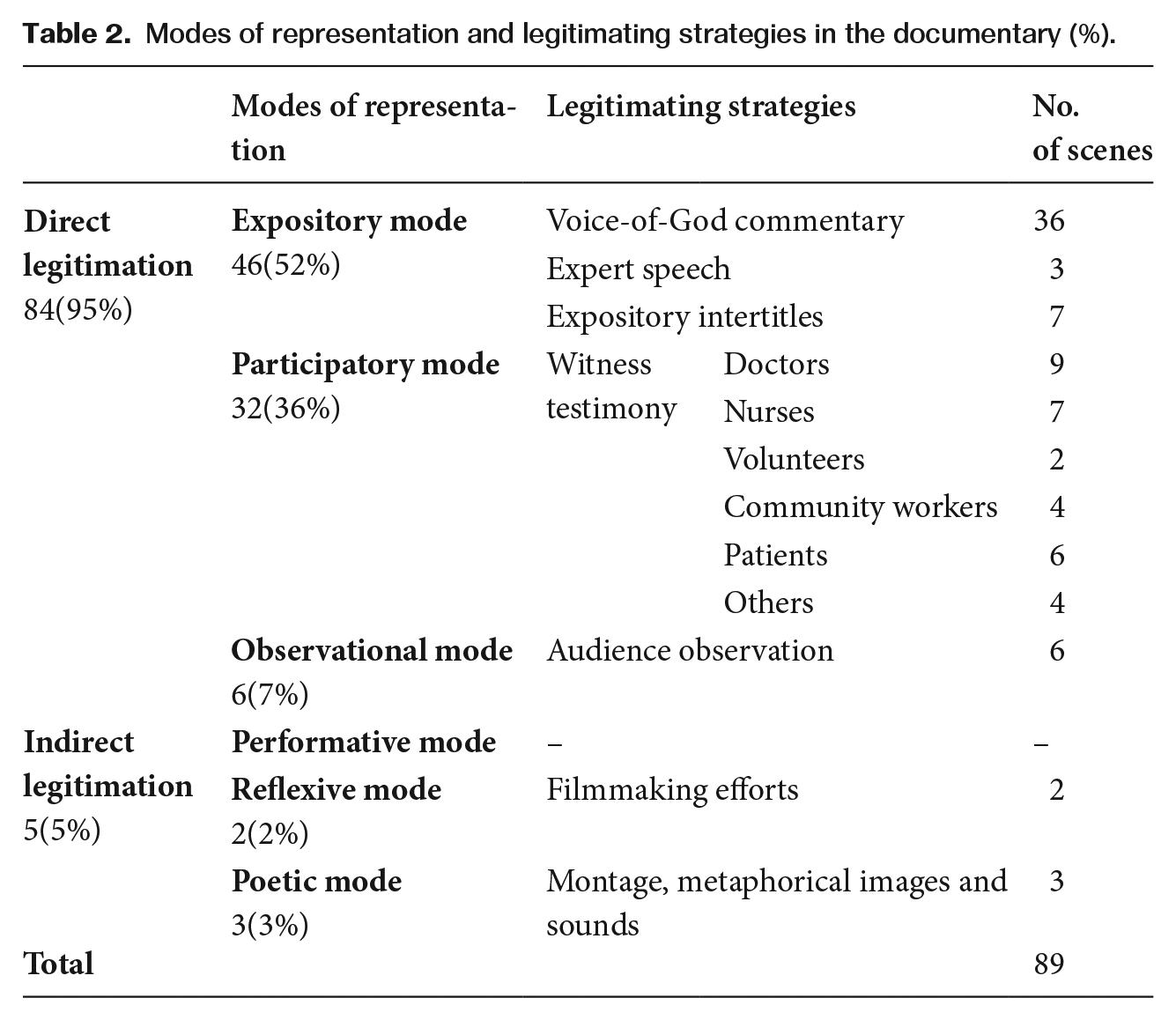
Table 2 shows that direct legitimation dominates the documentary, with the expository mode taking up more than half of the representation and the most frequently adopted legitimating strategy is voice-of-God commentary. This indicates a tendency towards didacticism. Witness testimony in the participatory mode mainly comes from doctors, nurses, volunteers, community workers and patients, i.e. people possessing first-hand information concerning the virus and life in Wuhan. Audience observation in the observational mode is also used, although to a lesser degree. Indirect legitimation is achieved through reflexive and poetic modes, and there is no use of performative mode where performance of social actors is highlighted. How the modes of representation and legitimating strategies function in The Lockdown will be discussed in the following.
The expository mode
More than half of the scenes in the documentary are presented through the expository mode. This mode directly addresses the audience, with voices and intertitles to advance the argument. The voices come from both the unseen commentator and the talking experts, and the intertitles are presented to highlight statistics suggesting the effectiveness and legitimacy of the lockdown.
Voice-of-God commentary
The commentator of The Lockdown is Bill Neenan, a British actor professionally trained in speech and drama. Neenan’s commentary runs throughout the documentary, explaining why the lockdown is necessary, what efforts have been made to save lives and how effective the lockdown is.
At the start of the documentary, Neenan’s omniscient voice states the seriousness of the situation in Wuhan and the necessity of the lockdown. Some of the sentences are presented in the following.
(1) 10 am, 23 January, Wuhan goes into lockdown, an effort to stop a deadly virus from spreading further through the nation.
(2) . . . evidence already pointed to human-to-human transmission.
(3) . . . demobilizing people in Wuhan is key to cutting off paths for the virus to spread.
The first sentence realizes several functions simultaneously: (1) to present the lockdown as something happening by itself (‘Wuhan goes into lockdown’ rather than ‘the government imposes a lockdown on Wuhan’ or ‘a lockdown is imposed on Wuhan’, see Yu and Wu, 2018): (2) to point out the nature of the coronavirus as being ‘deadly’; and (3) to legitimate the lockdown by means of the purpose (to stop the virus from spreading). Sentence 2 states that the virus could transmit from human to human and sentence 3 points to the importance of the lockdown: it is key to cutting off the spread. These commentaries are accompanied with fast ticking sounds of a clock, sounds traditionally used to indicate emergency.
Soon, the commentary shifts to measures taken by the government during the lockdown. The recounting is generally organized in a ‘problem–solution’ structure: a problem or difficulty caused by the lockdown is recognized, which is quickly solved through certain actions. Altogether, five such ‘problem–solution’ structures are identified in the data, as shown in Table 3.
‘Problem–solution’ structures in the commentary.
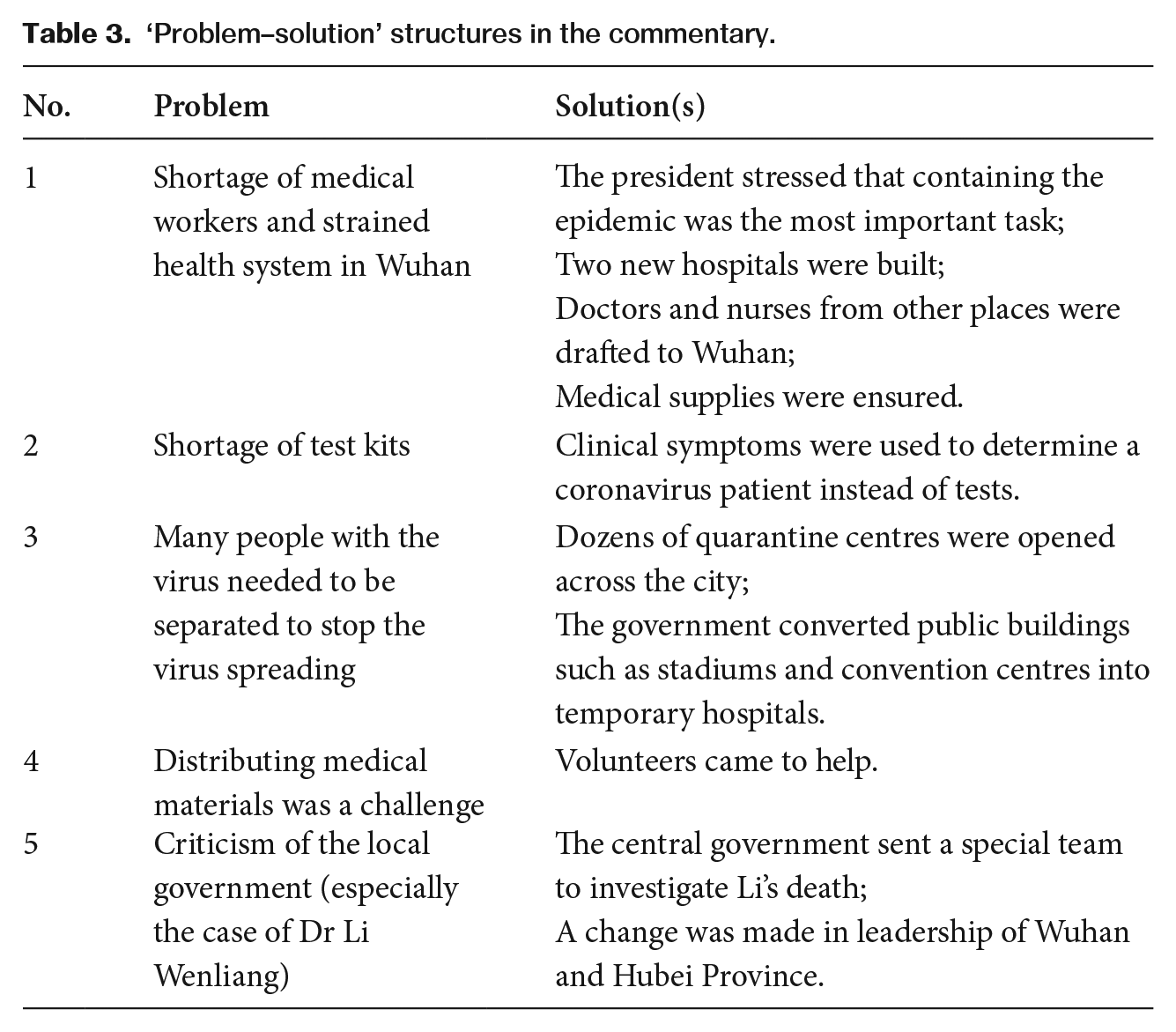
Let us take the first ‘problem–solution’ structure as an example to demonstrate how the commentary legitimates. Firstly, the problem of personnel and hospital bed shortage is identified.
(4) Wuhan’s 38,000 licensed medical workers were stretched thin as the virus progressed. As people turned up at fever clinics, the city’s health system was buckling under the strain.
This is illustrated with images of patients crowded in the corridor of a hospital. A nurse says in front of the camera that ‘I’ve never seen anything like this . . . Just looking at it makes me despair.’ The moment the nurse finishes her words, the scene shifts to archival footage of a construction site in fast motion, with the voiceover explaining that new hospitals were quickly built.
(5) On the second day of the lockdown, work began on a new hospital. The new Huoshenshan Hospital would have 1,000 beds specially designed to treat coronavirus patients . . . A second emergency hospital promising another 1,600 beds was planned . . .
As for the shortage of medical workers, the audience are told that the problem was being solved.
(6) On Chinese New Year’s Eve . . . more than 1,200 medical workers across China were drafted to aid Wuhan . . . By early February, over 10,000 medical workers from the rest of China had gone to help . . . Another 1,400 military medics were sent to Wuhan on 13 February . . . By now, more than 30,000 medical workers had been sent to Wuhan from 29 provinces and regions.
Medical supplies were also ensured, as is indicated in the following commentary.
(7) Cities across China started to put medical supply factories back to work . . . Hubei province can now get over 300,000 N95 masks per day up from 35,000 per day in late January.
Each time the voiceover recounts what measures have been taken to solve the problem, images from archival footage are used to illustrate and lend credibility to the statements.
Concerning the question of why these measures were able to be taken promptly, the audience are explicitly told that this was because of the leading role of the president and the central government of China.
On New Year’s Day, President Xi Jinping chaired a meeting of the Politburo Standing Committee, stressing that safety and health were the top priority and containing the epidemic was the most important task.
While these words are spoken, the screen shows a photo of the president on the left and his words on the right (see Figure 2a). Such a mise-en-scène presents the president as the given information, a person whose authority is presumed without questioning. His words stressing the priority of people’s safety and health are the new information, something that the viewer is expected to pay attention to (Kress and Van Leeuwen, 2006).
At the end of the documentary, the voiceover comments on the positive effect of the lockdown.
(9) But the next day, newly confirmed patients started to slow down . . . A sign that the lockdown on Wuhan might have started to work.
(10) One month after the lockdown, it seems like an end is approaching. More and more provinces start to see no increase in confirmed cases . . . The number of daily new cases is on the verge of dropping into a double digit.
Although absolute certainty is avoided by using words such as ‘might’ and ‘seems’, the commentary aims to convince the audience of the effectiveness of the lockdown. As pointed out by Van Leeuwen (2007), expressions like ‘it is useful’ and ‘it is effective’ themselves create legitimacy. Here, the effectiveness of the lockdown is used to legitimate the original decision to isolate Wuhan and its residents.
Expert speeches
Three experts, the Chinese epidemiologist Zhong Nanshan, WHO Director-General Tedros Ghebreyesus and Assistant Director-General Bruce Alward, are presented in the documentary as authoritative sources of information.
Zhong Nanshan is introduced as ‘the 83-year-old epidemiologist, a national hero during the 2002–2003 SARS outbreak’. The audience see images of Zhong attending press conferences and TV interviews before the camera moves closer to present him at the centre of the screen, speaking the following words:
(11) Evidence shows there is definitely human-to-human transmission. Now, most patients are from Wuhan or have been to Wuhan. In my opinion, people should stay away from Wuhan.
Zhong’s identity as an experienced epidemiologist adds to the authority of his advice for people to stay away from Wuhan. This in turn legitimates the government’s decision to prohibit public travel to Wuhan.
Another expert, Tedros Ghebreyesus, is shown attending a press conference with a title card ‘WHO Director-General’. Amid the sounds of camera shutters, Ghebreyesus declares the outbreak of the COVID-19 a Public Health Emergency of International Concern.
(12) The main reason for this declaration is not because of what is happening in China. Our greatest concern is the potential for the virus to spread to countries with weaker health systems.
The possibility of the virus to spread to other countries is recognized. For the international audience, this brings the threat of the virus closer (Cap, 2013, 2017) and legitimates China’s lockdown of Wuhan: it is not just about one country but to benefit the whole world.
The words of Zhong and Ghebreyesus emphasize the necessity of the lockdown. A third expert, Bruce Alward, is presented at the end of the documentary to comment on the appropriateness and effectiveness of the measures taken by the Chinese government.
(13) The opinion of the joint mission after looking at this very closely in different ways is that there is no question that China’s bold approach to the rapid spread of this new respiratory pathogen has changed the course of what was a rapidly escalating and continues to be deadly epidemic.
Alward does not state his personal evaluation. Rather, the opinion is ‘of the joint mission’ and is only given ‘after looking at this very closely in different ways’. Such recognition from the WHO has much legitimating power to show that the lockdown was the right decision.
Expository intertitles
Altogether there are seven intertitles scattered throughout the documentary, five with numbers of infections on days 7, 14, 21, 28 and 33 of the lockdown, and two line graphs. Some of the intertitles are shown in Figure 1.
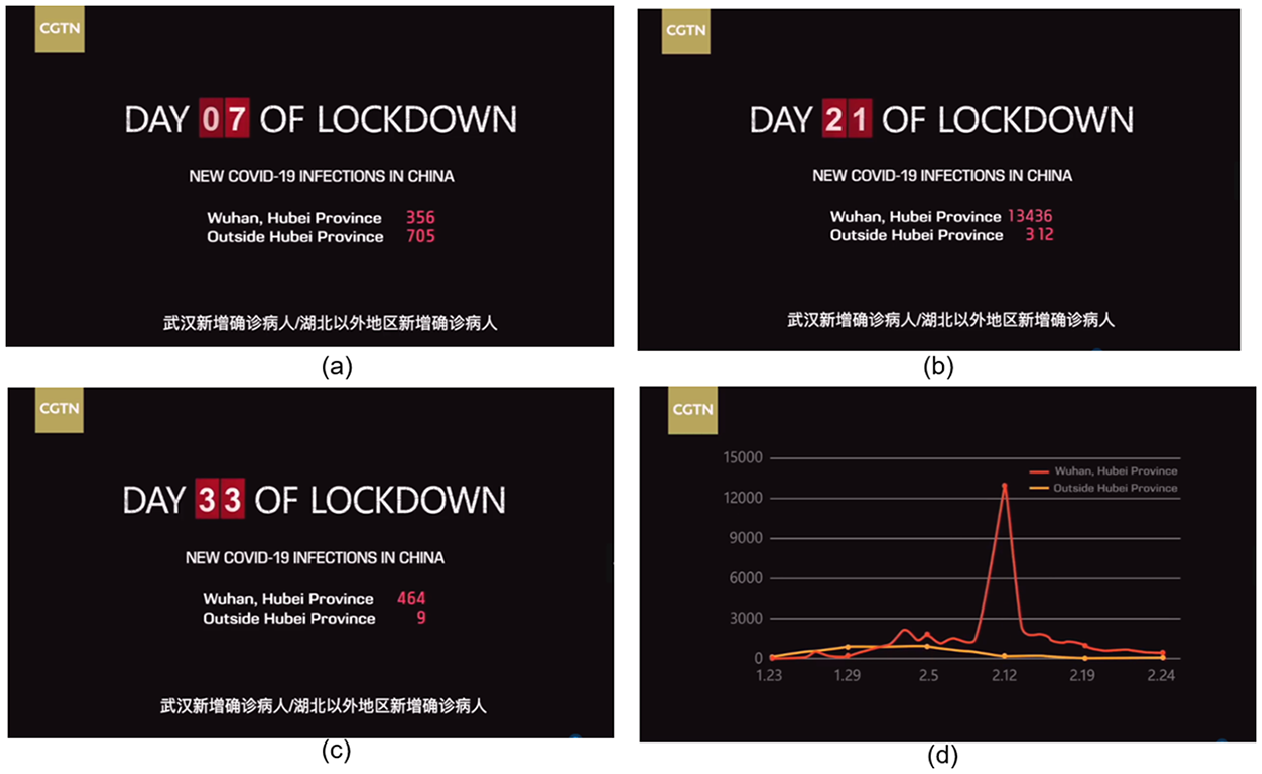
Intertitles in the documentary. © CGTN. Reproduced with permission.
As shown in Figure 1, the intertitles function to highlight the numbers of confirmed cases and to demonstrate that there was a continuous dropping-off after 12 February. No commentary is made when the intertitles are displayed. This enhances the objectivity and authenticity of the information although there is no mention of the source of the statistics. The use of colours on the intertitles – pure black background with white letters and red numbers – draws immediate attention to the information each time the intertitles appear.
The participatory mode
In the participatory mode, various witnesses, i.e. people who have personally experienced the lockdown in Wuhan, are presented onscreen and given a voice of their own. They talk about what they saw, did and felt during the lockdown. The images of witnesses in close shots and their identities as doctors, nurses, volunteers, community workers and patients enhance the legitimating power of their words, which convey the idea that efforts were made to ensure people’s health and safety during the lockdown.
Interviews with doctors and nurses
In the documentary, Dr Tang Xin and Dr Zhao Zhigang are presented as two representatives of doctors risking their own lives to save others. Dr Zhao, who was infected with the virus while treating a patient, recovered and returned to work. Explaining why he decided to do so, he says:
(14) I cannot desert all the patients who need me. I have to go back to the frontline and keep on fighting.
Containing the epidemic is discursively framed as a military battle and doctors are now soldiers fighting in the frontline to protect others. Another doctor, Dr Tang Xin appears on the screen with the voiceover telling the audience that he ‘hasn’t been home for two weeks’ and he ‘has a rash all over his body’ from wearing the protecting gear. The close-ups of red spots on Dr Tang’s neck, chest, arms and legs, and his explanation that they take ‘six to eight hours’ to go away, serve as an embodiment of the selfless sacrifice of medical workers.
Nurses are presented in similar ways. Some of them have wounds on their faces from wearing the face masks for too long and others say that they wore diapers to avoid going to the toilet. The inner feelings of the medical workers are also expressed through the words of a nurse named Xie Jingjing, who is asked whether she is scared in such a situation.
(15) I’d be lying if I say I’m not scared. I think of my child and my parents all the time. I’m their only child and if anything happens to me, how could my parents handle that? And my kid is still very young, what might happen to him?
These words help to present doctors and nurses as real people instead of simply singing praises of dauntless courage. Doctors and nurses are like anyone sitting in front of the screen: they are someone’s son/daughter and/or parent, and they also have fears. This may strike a chord with the audience and make them emotionally engaged.
Interviews with volunteers and community workers
Apart from medical workers, volunteers and community workers are also interviewed to talk about their work and life. The underlying idea is that ordinary people in Wuhan also stood up and made their contribution.
The audience are told that when all the public transport had been closed and people stayed at home to keep safe, volunteers in Wuhan used their own vehicles to help deliver medical supplies. Some of them are presented onscreen to explain why they stood up and how they felt about their work.
(16)
(17)
These words, together with images showing the volunteers busy working, inform the audience that, apart from the medical workers saving lives in hospitals, there are also people who are doing their part to contribute to the fight against the virus.
Another group of people, community workers, also play an important role in people’s lives during the lockdown. There are scenes of community workers knocking on the doors of residents to check their temperature and ask if they need any help. A female community worker introduces their daily routine in the following words.
(18) We have to knock on each door in this entire building today. Yesterday my colleague’s knuckles were red and swollen . . .
These words, though smilingly said, give a glimpse of how demanding the work is and function to arouse respect from the audience. With so many medical workers, volunteers and community workers working hard to ensure people’s health and safety, life in the lockdown seems smooth and orderly.
Interviews with patients
Although both medical workers and patients are interviewed, the interviews are conducted in different ways. In most of the interviews with medical workers, the interviewer is offscreen, and his or her voice not heard. The doctors and nurses talk in the form of ‘pseudomonologue’, directly addressing the audience. Interviews with patients, however, all involve the interviewer as part of the mise-en-scène and the interview is presented in a form of ‘question–answer’.
(19)
(20)
(21)
It can be seen from these examples that the interviewer may use questions to elicit certain answers. Although the identity of the patients and the questions vary, the key idea is that the patients were taken good care of and they appreciated the work of the government. Special care for the minorities is shown by involving a Muslim patient, even though Wuhan is not a city with many Muslims.
The observational mode
The observational mode is used in the documentary to afford the viewer an opportunity to watch and hear, and make their own interpretations. As pointed out by Nichols (1991), observation in a documentary takes shape around the representation of typicality: the social actors and activities that are considered typical in a specific context. In The Lockdown, the typical activities presented include doctors putting on and taking off layers of protective suits, nurses rushing to attend to patients, volunteers making and receiving calls to arrange the delivery of medical equipment, and community workers patiently consoling stressful elderly residents who are confined to their apartments. Without any commentary, the observational representation provides unmediated access to the happenings. The viewer seems to have first-hand information of what is going on in the locked-down city of Wuhan. What they see and hear in the observational mode corresponds to the message provided in the expository and participatory modes. A desirable interpretation is thus ensured and observation becomes a way of legitimation.
The reflexive and poetic modes
Indirect legitimating strategies are adopted less to argue than to make the arguments more acceptable. These involve the reflexive and poetic modes in The Lockdown, which create legitimacy by revealing the filmmaking process and using montage and metaphorical images. In the reflexive mode, a scene shows the filmmakers negotiating with doctors to bring a camera into the wards. In another scene, a filmmaker trying to interview a volunteer courier is refused because the latter has no time to talk. Such scenes provide the audience with an opportunity to learn about the filmmaking process, which may lead to their belief in the authenticity of the documentary.
Meanwhile, three poetic representations are evenly distributed in the prologue, the middle and the epilogue of the film. The prologue uses montage images and sounds to create a combination of feelings of emergency, worry and determination in order to set the tone. Scenes in the middle and at the end of the documentary both use the metaphorical images of the rising sun to indicate hope. As can be seen in Figure 2, the first image of the sun (Figure 2b) appears immediately after the photo of the Chinese president and his instructions, indicating the hope that the president and his words bring to people in Wuhan. The second image of the sun (Figure 2d) is shown when Dr Tang Xin finishes his analogy between the outbreak of the coronavirus and the opening of Pandora’s box, where hope is still left after disasters and fear. The images and their connotational meanings function to engage the audience emotionally in line with the message already conveyed through voiceover commentary and interviews, and to provide indirect legitimacy.
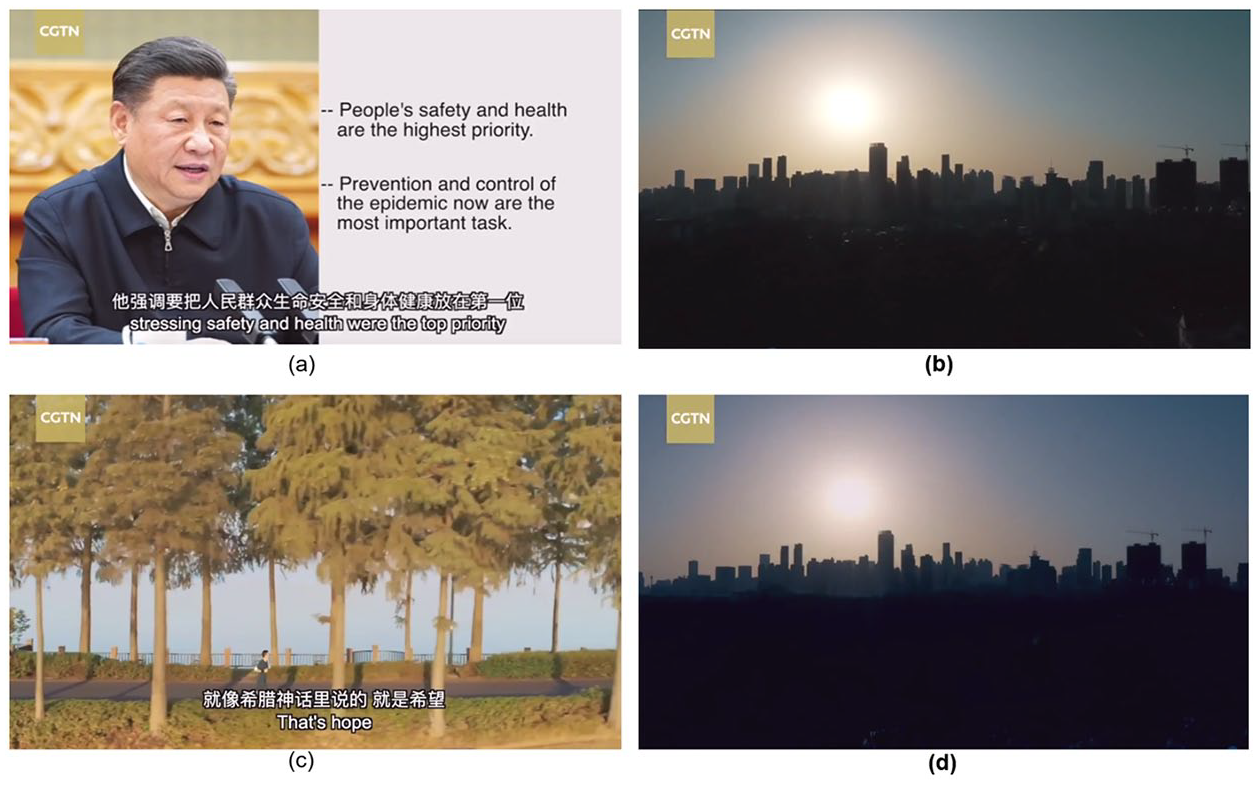
Metaphorical images of the sun indicating ‘hope’ (b) and (d). © CGTN. Reproduced with permission.
Conclusion
With insight from previous studies on legitimation in CDA and Social Semiotics, this article develops a framework of documentary legitimation. It demonstrates how each of the six modes recognized by Bill Nichols (1991, 2017) – expository, participatory, observational, performative, reflexive and poetic modes – tends to highlight certain legitimating strategies. The expository mode mainly legitimates through voice-of-God commentary, expert speeches and expository intertitles; the participatory mode legitimates through witness testimony; the observational mode legitimates through audience observation; the performative mode legitimates through performing acts; the reflexive mode legitimates by revealing the filmmaking process; and the poetic mode legitimates by using montage and metaphorical images and sounds. The proposed framework is applied to the case study of The Lockdown, where different modes and strategies are adopted to legitimate the lockdown of Wuhan and its 11 million residents during the early outbreak of COVID-19.
Disasters challenge the legitimacy of governments. On the other hand, however, a disaster also provides opportunities for a government to bolster its legitimacy if it properly manages the crisis. This can be seen in the ongoing coronavirus pandemic all over the world. Just like so many deadly disasters in modern history, the pandemic is no longer just a disaster that claims human lives and leads to economic loss. It has quickly turned into political events through discursive presentation and representation in different parts of the world. How such an unfortunate event has been and is still used by political actors to create legitimacy and to delegitimate deserves further exploration.
Footnotes
Acknowledgements
Our thanks to CGTN for their permission to reproduce images in this article.
Funding
This research was funded by National Planning Office for Philosophy and Social Sciences, China (grant number 20VYJ012).

Notes
Biographical Notes
HAILING YU is Professor in the School of Foreign Languages, Hunan University, China. Her research interests cover multimodal discourse analysis, social semiotic theory, translation studies and the relationship between discourses and culture and society. Her publications appear in journals such as Target, Lingua, Text and Talk, Social Semiotics and Visual Communication.
Address: Hailing Yu, School of Foreign Languages, Hunan University, 2 South Lushan Road, Changsha 410082, China. [email:
YE YAN is a postgraduate candidate in the School of Foreign Languages, Hunan University, China. Her research interest is critical discourse analysis.
Address: Ye Yan, School of Foreign Languages, Hunan University, 2 South Lushan Road, Changsha, 410082, China. [email: