




Abstract
Visual rhetoric is more often than not identified with the search for patterns of visual form and content which convey meaning in ways that resemble the meaning construed by known rhetorical figures. Despite the numerous proposals for the classification of figures construed verbally or visually, there has been no systematic attempt to account for the different ways in which these may contribute to the argumentative structure of persuasive messages. In this article, the author studies comparatively the figures of metaphor, antithesis and allusion, cued visually or verbo–visually in the multimodal genre of front covers. He starts from the assumption that the front cover constitutes a multimodal argument in the sense that it invites the reader to buy the specific issue on the grounds of the featured story and the stance that the editors express over it. The goal is to identify the semiotic configurations that distinguish one figure from the other, and to establish conditions under which these figures can be shown to contribute meaning that serves the argument conveyed by the front cover.
Keywords
1. Introduction
When scholars in the fields of consumer research, visual communication and cognitive linguistics refer to (visual) rhetoric, they tend to focus on the search for patterns of (visual) form and content which can be shown to convey meaning in ways that resemble the meaning construed by known rhetorical figures. Various typologies of visual rhetorical figures have thus been proposed (see Bonsiepe, 1965; Durand, 1970; Phillips and McQuarrie, 2004, among others). The authors of these typologies, however, are not interested in the different ways in which rhetorical figures help to construct the persuasive message of the advertisement (for critical assessments of the proposed typologies, see Huhmann and Albinsson, 2019; Maes and Schilperoord, 2008). Van Leeuwen (2017), reflecting on the intricate relationships between rhetoric and semiotics, acknowledges that the focus has been mainly on the elocutio and dispositio canons, overlooking other interesting contributions that rhetorical categories can make to the study of multimodal communication. Such categories and distinctions may prove useful for the analysis of multimodal discourse since they concern a level of analysis that seeks to relate the semiotic properties of the text with concrete communicative functions and effects in a specific situation.
In this article, I study rhetorical figures not merely as deviations in content or form but as distinct meaningful patterns for structuring form and content that have rhetorical and argumentative relevance which can be best explained when these are embedded in an argumentation structure. In doing so, I seek to combine a contextualist perspective to the study of visual and multimodal argumentation with a cognitivist one. The former assumes that a certain multimodal text conveys an argument because it belongs to a genre that is argumentative. The latter seeks to show that there are certain characteristics intrinsic to a particular pattern of form and content that invite an argumentative interpretation. When this combined perspective is applied to rhetorical figures, it postulates that, while the use of a figure always has a certain rhetorical relevance (attracts attention, addresses emotions, frames the situation, etc.), it has argumentative relevance under certain conditions. These conditions have to do both with the meaning potential that characterizes each figure and the way this is exploited and embedded in a specific text that conveys an argument. A pattern of form and content that can be described as a visual or multimodal metaphor, antithesis or allusion, for example, cannot be said to invariably constitute an attempt at arguing for a claim. For that to be the case, the identification of the genre and of the communicative and interactional intentions of the maker of the multimodal text is also necessary. That is why I study rhetorical figures in a concrete genre, that of the news magazine front cover, which I consider to constitute a multimodal argument in the sense that it invites the reader to buy the specific issue on the grounds of the featured story and the stance that it expresses over it (Tseronis, 2015, 2017).
In section 2, I briefly discuss studies regarding rhetorical figures and explain the distinction between the rhetorical and argumentative relevance thereof. In section 3, I account for the front cover as a multimodal argumentative genre and present the generic argumentation structure that characterizes it. In section 4, I present the combinations of image and text that may help to distinguish metaphor, antithesis and allusion from each other. If a rhetorical figure establishes some kind of a conceptual relationship between domains, it can be expected that these different relationships will be cued by different combinations of the available semiotic resources. This would be easier to answer when comparing figures that differ in some significant aspect, hence the choice of the three figures. While all three convey some relation between two domains, metaphor emphasizes similarity, antithesis emphasizes contrast and allusion emphasizes contiguity. In section 5, I discuss the conditions under which a figure can be shown to have argumentative relevance in addition to its rhetorical relevance. The assumption is that not all verbal–visual interplay constitutes an attempt at arguing and that rhetorical figures do not invariably construe an argument.
The proposed distinctions and the discussion in sections 4 and 5 are based on the analysis of a sample from the front covers of The Economist published from 2009 until 2019. Of the total 563 covers available on the online archive from that period, I have found that about 14 percent of the items contain a metaphor, another 13 percent contain an allusion, and about 5 percent contain an antithesis. 1 A total of 184 covers were thus collected that contain any of the three figures under study, from which the examples discussed in the following sections were selected.
2. Rhetorical and argumentative relevance of figures
There is a paradox when comparing how scholars in visual and multimodal communication, on the one hand, and scholars within argumentation and rhetoric studies, on the other, understand (visual) rhetoric. In the former research areas (Bateman, 2014; Rossolatos, 2013; Taboada and Habel, 2013, among others), scholars refer to rhetoric mainly when discussing questions regarding arrangement and style, the two canons of classical rhetoric’s dispositio and elocutio, respectively (see Corbett and Connors, 1999). 2 In the latter research areas (see Foss, 2005; Hill and Helmers, 2004; Kenney and Scott, 2003; Olson, 2007, among others), rhetoric and visual rhetoric are understood as dealing with questions that go beyond figuration, overlapping with questions asked in fields such as discourse analysis, cultural and media studies. 3 A third understanding of rhetoric, which has attracted the attention of researchers in communication and advertising, in particular, focuses on persuasion and the effects of the design of a message on the audience (see Huhmann and Albinsson, 2019; McQuarrie and Mick, 1996; Phillips and McQuarrie, 2004; Van Eschot et al., 2008, for example).
Following Barthes (1964), Bonsiepe (1965) and Durand (1970), among others, have sought to find the visual analogues of verbal figures, focusing on the advertising image in particular. One fundamental question that arose with such endeavours, however, was ‘whether new rhetorical tropes should be defined in the context of the visual modality or existing tropes redefined’ as Rossolatos (2013: 20) remarks. 4 While recourse to figures opened up a way to study the patterns of form and function in texts beyond the verbal ones, scepticism was raised as to whether such a move was inevitably endorsing the hegemony of the verbal code. Within argumentation and rhetoric studies, the focus has been on verbal figures and has mainly concerned their function, namely whether they are ornamental or argumentative (see Plantin, 2009). According to Perelman and Olbrechts-Tyteca (1969: 169), argumentative figures bring about a change of perspective, while stylistic figures may excite admiration but do not bring about the adherence of the hearer.
In her influential study, Fahnestock (1999) treats figures as epitomes of argument, that is as pairings of form and function that capture a line of reasoning that can be related to rhetorical topoi. According to her, figures such as parallelism, antithesis or antimetabole are not merely adding rhythm and vividness to the argument conveyed in a text but are epitomes of an argument from comparison, argument from opposites, or argument from inversion, respectively. Kjeldsen (2012: 239) makes a similar point with regard to visual figures in advertisements, namely that figures ‘are not only ornamental, but also support the creation of arguments’, by delimiting the possible interpretations of the pictures used, and thereby evoking the intended arguments. The assumption that rhetorical figures may present moves in argumentative discourse which can be related to specific argumentation structures has also opened a productive line of research in computational argumentation and argument mining studies (see Harris et al., 2018; Lawrence et al., 2017).
While it is clear that rhetorical figures play a more complex role than merely accompanying argumentative messages and attracting an audience’s attention, it is not entirely clear whether all may contribute to constructing an argument (a complex of reasons in support of a claim) and under which conditions. Plantin (2018: 292–293), for example, distinguishes figures that correspond to well-identified argument schemes (such as antanaclasis, analogy and interpretation), next to figures that play a role in the construction of argumentation structures (such as parallelism, which by itself can provide the base for an argument from comparison or an argument from opposites), and figures that co-occur in the presentation of different forms of arguments but do not necessarily constitute a type of argument (see figures of repetition, for example).
When the interest lies in the semiotic means by which rhetorical figures may be construed as well as in the communicative goals for which they are used, Perelman and Olbrechts-Tyteca’s (1969) proposal not to be bound by the classical list of tropes and schemes may show the way. They propose to group figures under three effects, which they suggest illustrate their argumentativity, namely: to impose or to suggest a choice, to increase the impression of presence, or to bring about communion with the audience. In this article, I take figures to constitute a minimal unit of meaning consisting of the combination of a certain form with specific content, which can be realized in a variety of modes or combinations thereof. Figures have first and foremost rhetorical relevance, in the sense that they convey meaning which helps to frame the message for a particular audience and a particular situation. Their rhetorical relevance can be described with reference to the three effects that Perelman and Olbrechts-Tyteca distinguish. Additionally, rhetorical figures may have argumentative relevance when the meaning conveyed by the figure contributes content that is somehow part of the argument (the claim and/or reasons) that may be recovered from the (multimodal) text. Distinguishing between rhetorical and argumentative relevance helps account for the fact that the presence of a rhetorical figure is not a guarantee for the presence of an argument.
3. Figures and arguments on the front cover
In order to study the rhetorical and argumentative relevance of a figure, one needs to take into account the specific genre and the constraints of the communicative activity in which it appears. This is necessary if one is interested in the ways in which the meanings conveyed by a figure make a contribution to the argument that can be reconstructed from the semiotic text, not merely in how the figure comes to mean something.
The front cover of news magazines constitutes a well-defined media genre (Held, 2005). As Spiker (2015: 377) puts it, its function is to ‘send a message about the personality and voice of the magazine’ and to ‘sell issues’. In this sense, the front cover (be it of a lifestyle magazine, a news magazine or of any other type) functions like an advertisement (Held, 2005; McLoughlin, 2000). At the same time, the cover art of news magazines, in particular, as Page (2020) remarks, shares characteristics with the political cartoon in that it provides a social and political commentary on the news. Despite these observations about the communicative functions of the front cover, no systematic reference to argumentation studies or rhetoric has been made to help account for either its promotional or its critical function. 5 In a series of publications, I have proposed accounting for the argumentative nature of the front cover of news magazines by identifying its generic argumentative structure (Tseronis, 2015, 2017, 2018). Two interrelated levels of argumentation put forward by a front cover are thus distinguished: the primary level concerning the argumentation of the cover, and the secondary level concerning the argumentation in the cover (see Figure 1). Distinguishing between the two levels helps to account for the fact that, while it is possible to extract content from a front cover that presents the stance of the editors over the main story, it is not always possible to extract further propositions as reasons in support of that stance. Compare the covers in Figure 2.
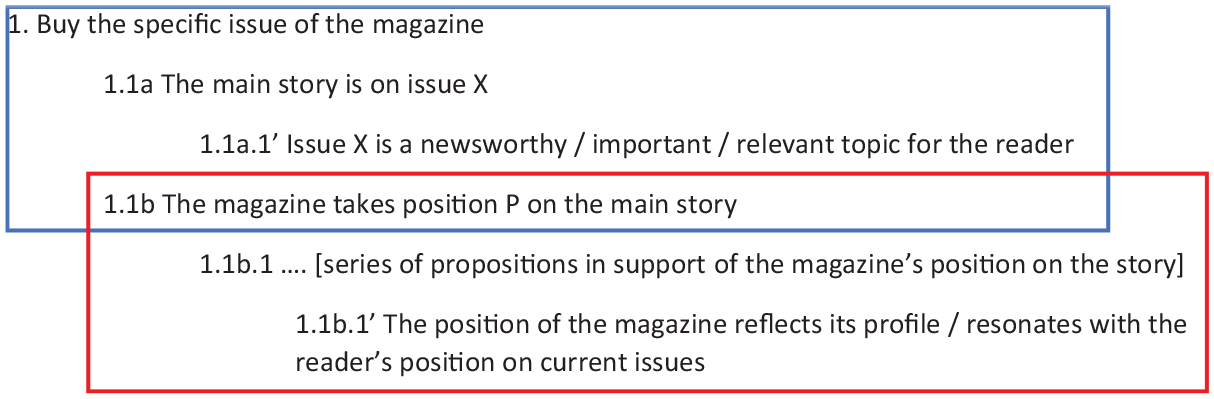
Argumentation structure of the front cover: the primary level of the argument (in the blue frame) captures its promotional goal, namely to invite the readers to buy the current issue by featuring a story that appeals to their interests and by taking a stance over it. The secondary level of the argument (in the red frame) captures the critical character of the front cover and is constituted by propositions that support the stance that the editors take over the cover story.
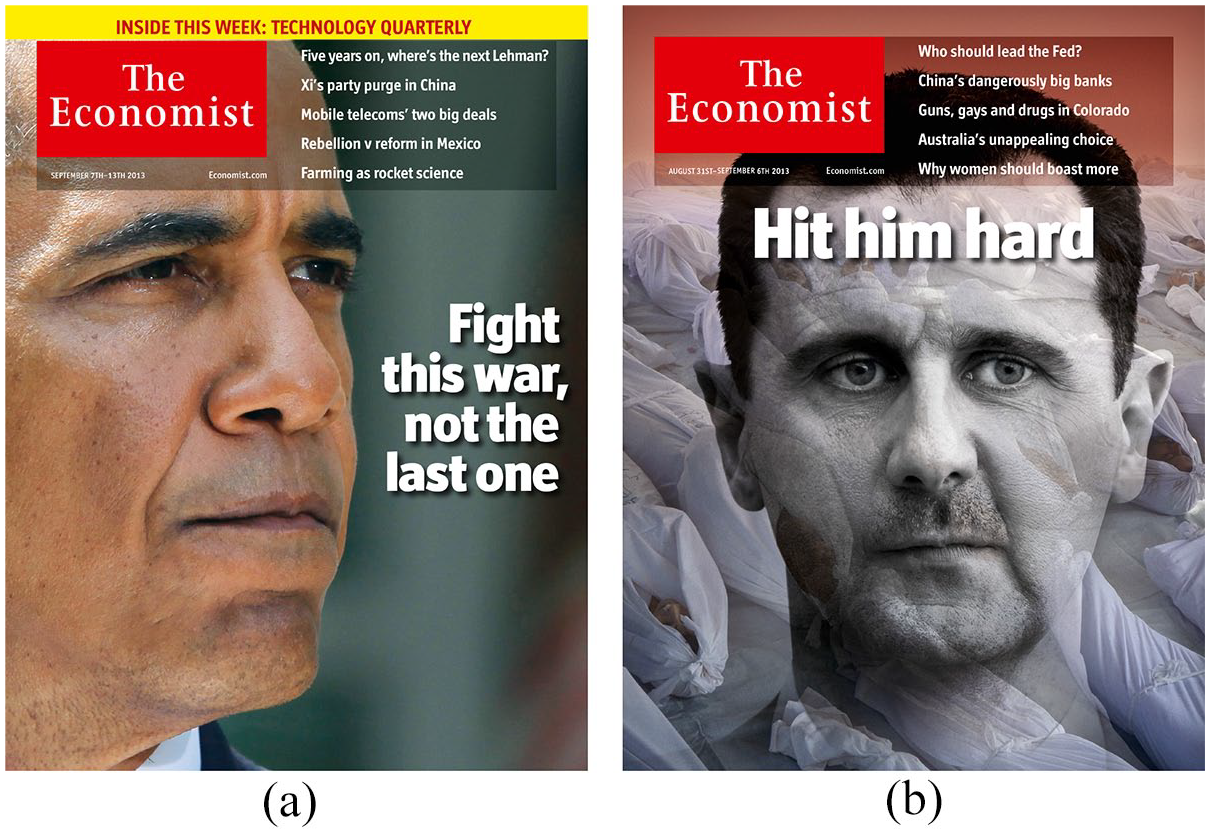
Argument at the primary level. © The Economist Newspaper Limited, London (7 September 2013). Reproduced with permission.
From the cover in Figure 2(a), only an argument at the primary level can be reconstructed, asking the readers to buy the specific issue on the grounds that it features a story about US President Obama’s decision to attack Iran and the position that the editors take to dictate what the President should do. There is no content that can be extracted either from the text or the image which could provide further support for why the editors take such a position. From the cover in Figure 2(b), however, besides the generic argument, there is an argument at the secondary level that can be reconstructed, which provides support for the position that the editors take. Their stance that Syrian President Assad should be hit hard receives support from the images of dead bodies shown in the background.
The different interpretative paths described above can be explained in cognitivist terms following Van den Hoven and Schilperoord’s (2017) account of the argumentative interpretation of editorial cartoons. The authors propose certain conditions that need to be fulfilled for a cartoon to constitute a fully-fledged claim–reason complex, that is to multimodally communicate propositions that function as claims as well as propositions that function as reasons in support of these claims. As mentioned above, the front cover (at least of the news magazine under study here) functions like an editorial cartoon that makes a point about the political and social events featured on it. Applying Van den Hoven and Schilperoord’s account to the front covers may help distinguish cases where the statement regarding the editors’ stance does not receive support, from cases where it does, and which thereby count as a fully-fledged argument (compare the two covers in Figure 2).
According to the authors, text and image in cartoons help establish reference to a so-called ‘topical domain’ which allows readers access to the topic in question: the world economy, the war in the Middle East, diplomatic relations with China, presidential elections, etc. In addition to that, cartoons offer a perspective, that is an evaluation with regard to their topic. The evaluative perspective on the topic is recovered by an incongruity that the cartoonist creates between what is depicted or said and what the viewer knows about how things should be. In some cases, what the authors call ‘mono-domain cartoons’, the text suggests at best an evaluative opinion over the topic, but there is no fully-fledged argument. In other cases, what the authors call ‘multi-domain cartoons’, the cartoonist conveys the incongruity by using visual or verbal means to establish reference to an auxiliary domain besides the topical domain, for example when making associations between politics and cooking, or financial crises and natural phenomena. When the relation between the topical and the auxiliary domain is one of disanalogy (e.g. a politician is presented with attributes or in an action that under normal circumstances do not cohere with his or her political role), a fully-fledged argument is conveyed. When the relation between the two domains is that of analogy (e.g. comparing politics to cooking or to running), an evaluative perspective is suggested but no other propositions can be extracted as reasons in support of it, without making the argument circular (e.g. politician X is incompetent because he or she is an incompetent cook or a slow runner).
Van den Hoven and Schilperoord’s account is a promising one for explaining in cognitivist terms when a front cover can be said to express a fully-fledged argument, where reasons are provided for the stance that the editors take over the cover story (what I have identified above as the secondary level of argumentation in the cover). The authors, however, discuss mainly examples that involve cases where a metaphor is construed. In this article, I study front covers that the authors would classify as ‘multi-domain’, where not only metaphor but also antithesis and allusion are visually construed. In my discussion, I suggest how the incongruous perspective in the case of antithesis and allusion may lead to the recovery of a fully-fledged argument, but it is beyond the scope of this article to provide a full cognitive account of these processes. Moreover, unlike Van den Hoven and Schilperoord, I am interested in combining a cognitivist perspective with a contextualist perspective to the study of visual and multimodal argumentation. This means that knowledge of the context plays a decisive role whether a fully-fledged argument can be recovered or not, even when the cover would technically be of the multi-domain type and the relation between the topical and the auxiliary domain a disanalogous one.
Take, for example, the two covers in Figure 3. Both are cases of multi-domain covers where the topical domain, the World Trade Organization in Figure 3(a), and the World Economy in Figure 3(b), are associated with the auxiliary domain of a sinking ship. The relation between the two domains is disanalogous in the sense that it could be expected from a trade institution or from economy in general to sail but not to sink. While, in both cases, the incongruous perspective gives rise to some evaluative statement about the topic on the cover, it is only in the second one where a fully-fledged argument can be recovered. In Figure 3(a), the combination of the cover line with the image of a sinking ship may at best lead one to recover an evaluative statement such as ‘It is ironic that the WTO is in need of saving’ or ‘The plan to save the WTO is not working’ but no further support for it, unless one is familiar with the situation that the main article describes concerning the challenges that the WTO is facing and the risks involved in the plans to reform it. In Figure 3(b), however, a fully-fledged argument can be reconstructed in which support for the editors’ position, that Chancellor Merkel’s reluctance to take a firm decision on the euro crisis is dangerous for the world economy, can be recovered from the interplay of the text and the image, namely that ‘Merkel’s reluctance makes the world economy sink’.
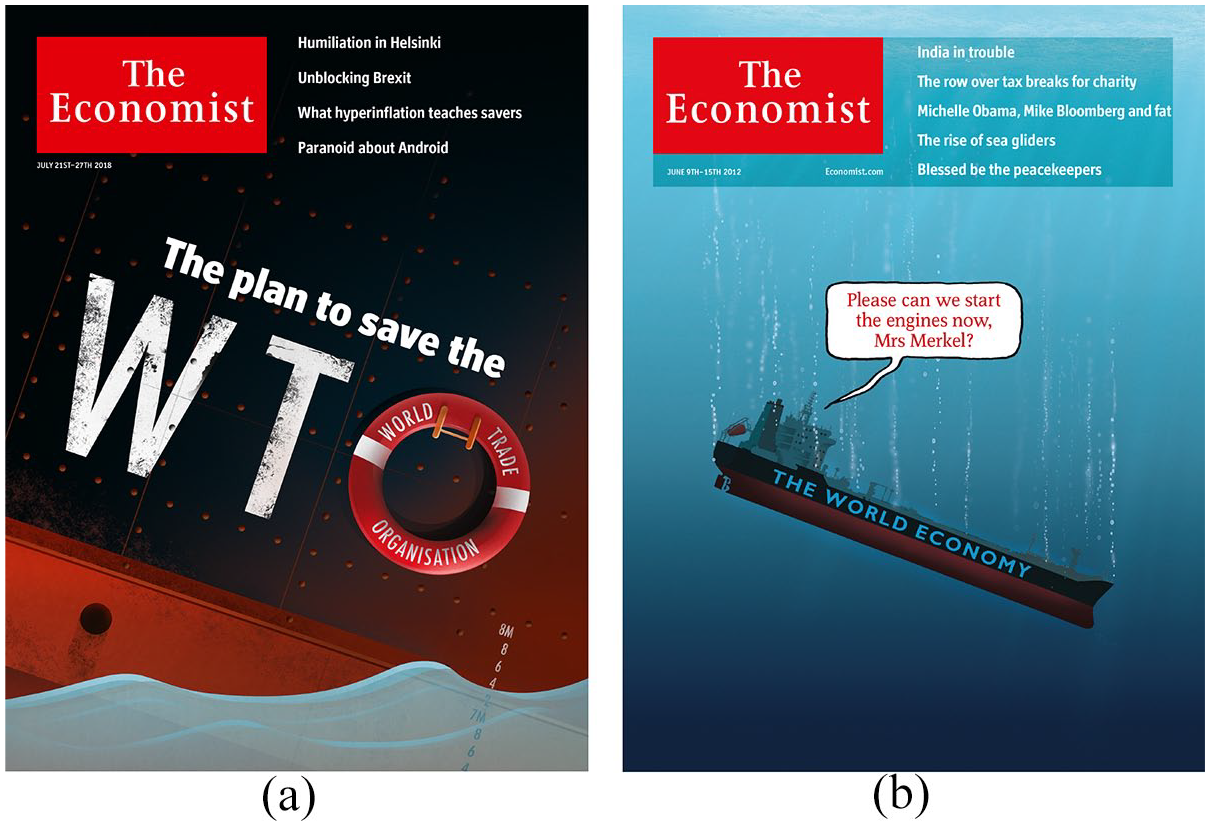
Argument at the primary level. © The Economist Newspaper Limited, London (21 July 2018). Reproduced with permission.
Before comparatively discussing the rhetorical and argumentative relevance of the three figures under study, I present the semiotic configurations that can be said to characterize each one.
4. Semiotic configurations for construing metaphor, antithesis and allusion
Starting from the conceptual differences among the three rhetorical figures under study, in this section, I describe the configurations of semiotic resources (image and text combinations) that may characterize each one. The semiotic resources that may be exploited or combined on the front cover include the text in the cover line, the image or the graphic illustration, the various typographic elements and the choices in the colouring and framing schemes.
Of the three figures under study,
The incongruity may arise from what is depicted in the image or from comparing what the image shows with what the text says. I refer to the former case as ‘visually conveyed metaphor’ and to the latter as ‘verbo–visually conveyed metaphor’. In cases of a visually conveyed metaphor, the text, in the form of a headline or tagline, is not essential for identifying the target or the source of the metaphor (Figure 4a). When the verbal text is needed in order to identify one of the two domains, one has a case of ‘verbo–visually conveyed metaphor’ (Figure 4b). The metaphor may also be doubly coded, in the sense that the verbal text and the image independently of each other convey the same metaphor, for example when the cover line ‘Brazil takes off’ accompanies an image showing the statue of Christ the Redeemer from Rio de Janeiro lifting off as a rocket.
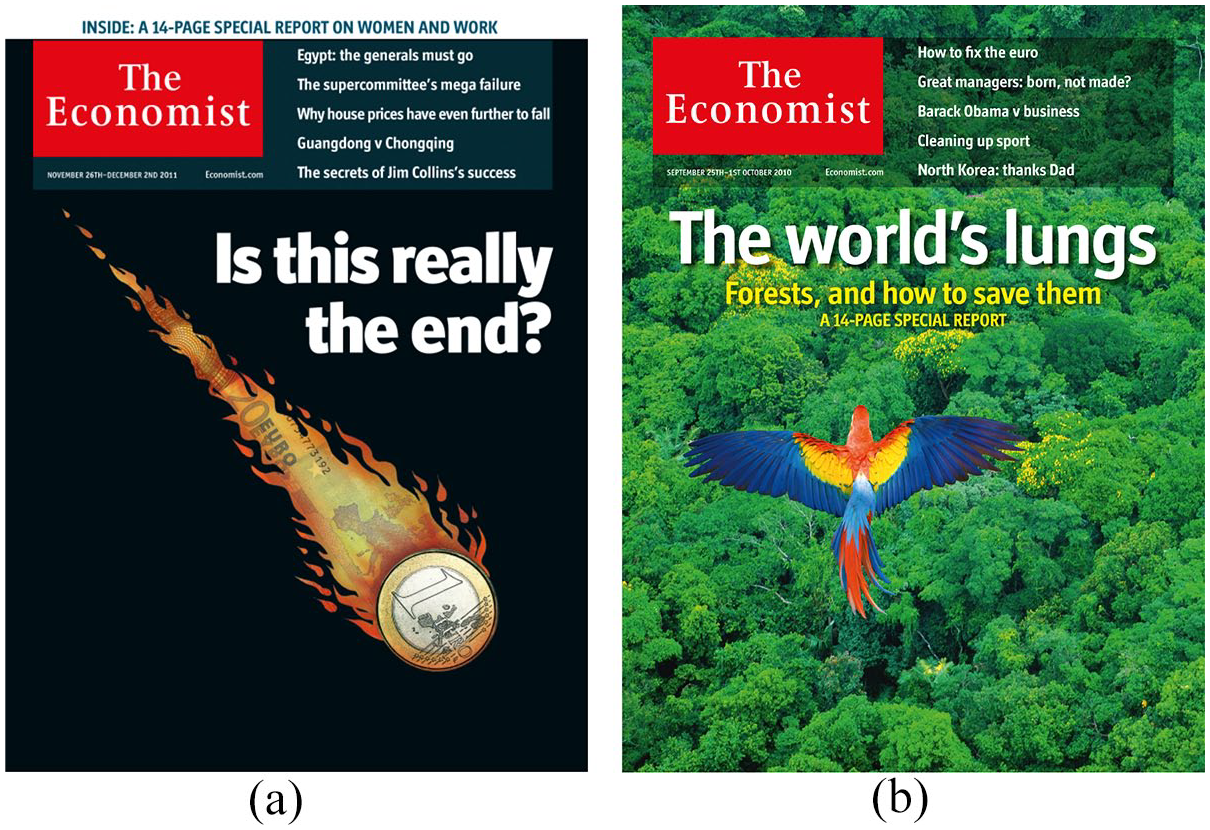
Visually conveyed metaphor. © The Economist Newspaper Limited, London (26 November 2011). Reproduced with permission.
In Figure 4(a), the image associates events in the domain of finances with events studied in astronomy and thereby construes a metaphor that can be glossed as ‘The euro currency is a falling star’. In Figure 4(b), the aerial photo of a forest establishes the reference to the target domain, while the cover line establishes the reference to the source domain, thus construing the metaphor ‘Forests are the world’s lungs’.
While metaphor relies on establishing a relation between two incongruous elements or domains in order to define an object,
On the front cover, antithesis can be construed either visually or through the combination of the verbal and the visual elements. In the case of visually conveyed antithesis, the opposition is made salient in what is being depicted (the content of the image) or how (the formal aspects of the image). In Figure 5(a), the domain of nature, cued by the view of the mountainous landscape, is contrasted with the domain of city, cued by the view of the urban landscape with the skyscrapers, which appears as the reflection of the former on the water, thus showing two contrasting sides of modern China. In Figure 5(b), it is the arrangement of the profiles of the two presidential candidates as well as their colouring in blue and red, respectively, that makes salient the contrast between the domain of the Democratic and that of the Republican political views.
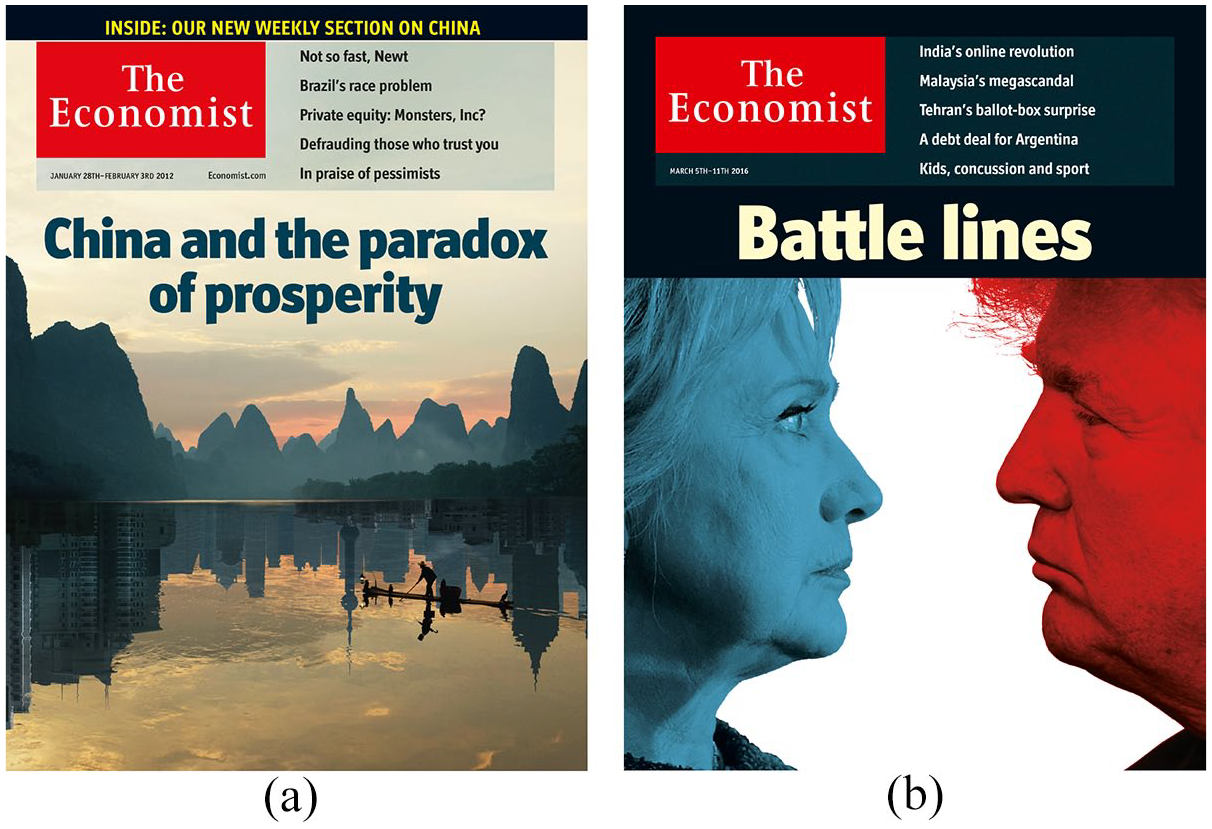
Visually conveyed antithesis concerning what is depicted. © The Economist Newspaper Limited, London (28 January 2012). Reproduced with permission.
In the case of verbo–visually conveyed antithesis, the opposition is made salient by the discrepancy between what is depicted and what is said (Figure 6a). A third possibility exists, namely that both the image and the text, independently of each other, convey an antithesis (Figure 6b). 6 In Figure 6(a), the contrast between the image of adult British people hiding their faces in the sand and the cover line ‘Facing up to Brexit’ cues the antithesis between the domain of confronting and the domain of hiding from a situation. In Figure 6(b), the cover line constitutes a double antithesis, repeated in the image of the contrasting face expressions of US President Trump and the elephant (standing in for the Republican party) that he rides, conveying an opposition between the domain of positive feelings and the domain of negative feelings.
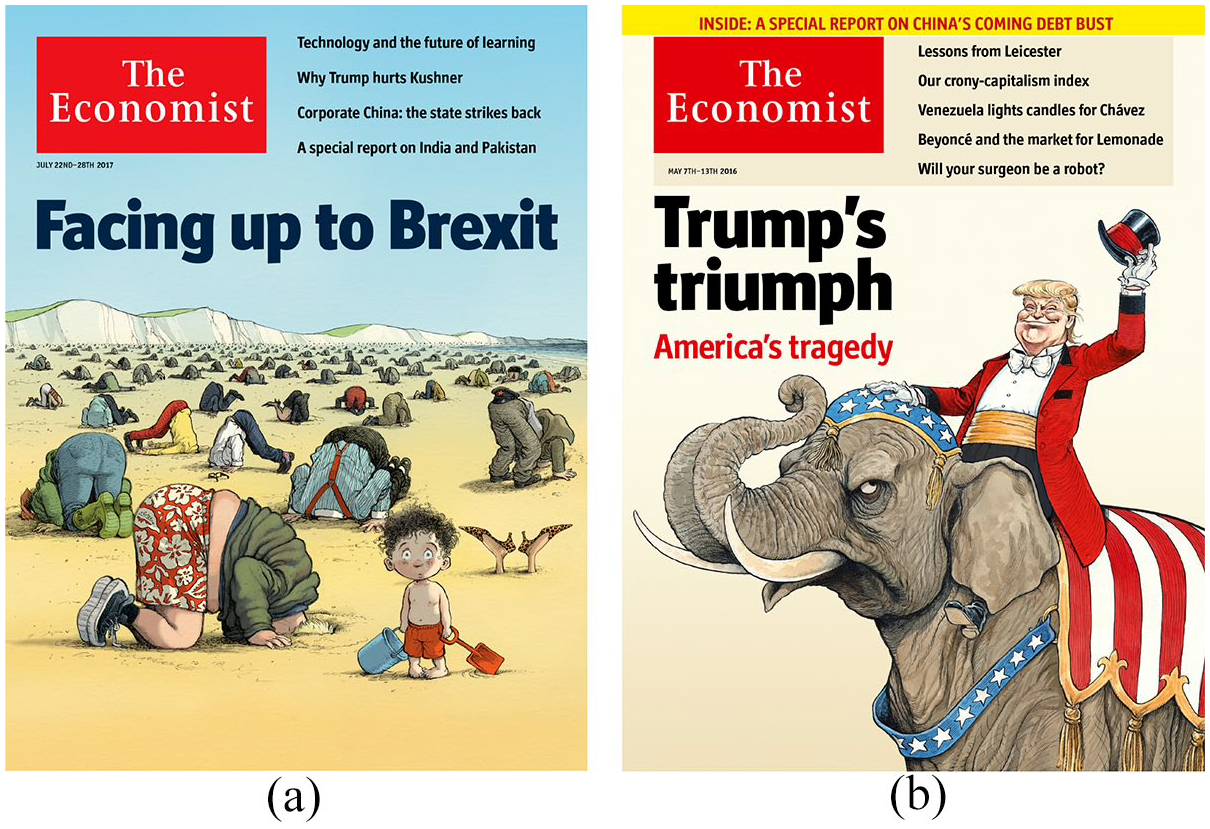
Verbo–visually conveyed antithesis. © The Economist Newspaper Limited, London (22 July 2017). Reproduced with permission.
While metaphor establishes a relation of similarity between two domains in order to define one of them and antithesis makes the differences between two domains salient,
Unlike metaphor and antithesis, which could be understood as being construed semiotically on the surface of the multimodal text, allusion is triggered by the semiotic properties of the text but is actually construed in the mind of the viewer–reader. On the front cover, the allusive reference to the original domain may be triggered through the manipulation of the image (Figure 7a), or through the manipulation of both the text and the image (Figure 7b). 7
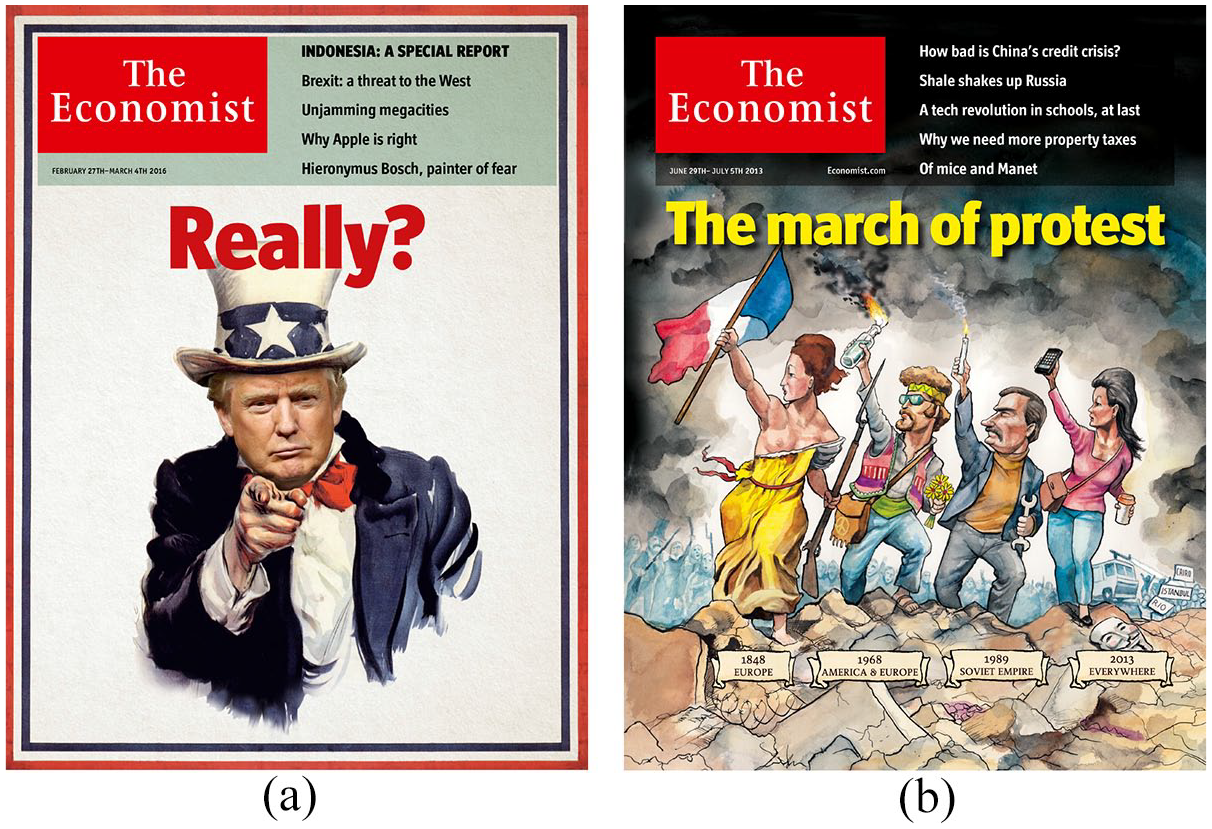
Visually triggered allusion. © The Economist Newspaper Limited, London (27 February 2016). Reproduced with permission.
In Figure 7(a), the image of President Trump pointing his finger at the viewer is an allusion to the recruiting poster of Uncle Sam painted by James Montgomery Flagg in order to invite Americans to enlist during WWI. In Figure 7(b), both the cover line and the image make an allusion to the iconic illustration of the The Road to Homo Sapiens (aka The March of Progress) by Rudolph Zallinger.
Summarizing the semiotic configurations that characterize the three rhetorical figures under study, one may draw from Phillips and McQuarrie’s (2004) three dimensions regarding the complexity in the visual structure of advertisements. One may thus say that metaphor is characterized by fusion, in the sense that the two domains are most of the time conveyed in one visual gestalt, while antithesis is characterized by juxtaposition, in the sense that the two domains are conveyed as occupying different parts of the page or as having differences that are made visually salient. Allusion is characterized by replacement, in the sense that elements are adjusted or replaced in order to both establish reference to the original domain and to match the new domain.
5. Rhetorical and argumentative relevance of metaphor, antithesis and allusion on the front cover
So far, I have presented the different ways in which the three figures under study can be construed visually or verbo–visually and their semiotic configurations. In this section, I compare cases where a fully-fledged argument may be reconstructed from the cover with cases where it cannot. While the figure has rhetorical relevance in both, it is only in the former that it has argumentative relevance. I thus do not take for granted that the presence of a figure (construed verbally, visually, or multimodally) always entails the presence of an argument, contrary to what Fahnestock (1999) and Kjeldsen (2012, 2018) suggest. In other words, I do not start from the presence of a rhetorical figure and seek to reconstruct the reasoning process that its use triggers. Instead, I study the conditions under which an argument can be reconstructed from a text where a figure is used. I thereby focus on the genre and the communicative goal first before asking what role the figure plays in the argument.
Of the three rhetorical effects that Perelman and Olbrechts-Tyteca (1969) distinguish,
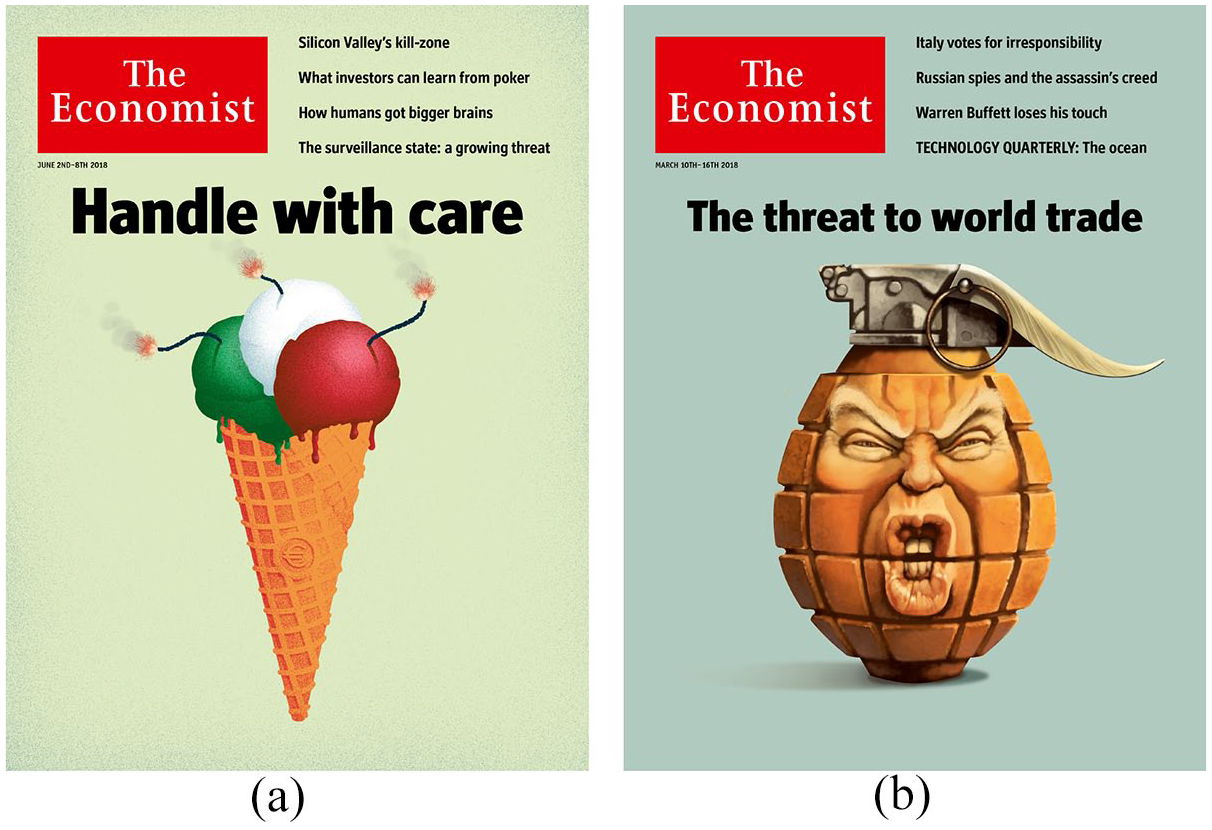
The inciting claim ‘Handle (Italy) with care’ in the cover line receives support from the visual metaphor, which can be glossed as ‘Italian (economy) is a ticking bomb for the euro zone’. © The Economist Newspaper Limited, London (2 June 2018). Reproduced with permission.
In those covers where a metaphor is construed verbo–visually, an argument may be reconstructed when some evaluative or inciting claim can be extracted from the cover (the image and/or the text) for which the associations suggested by the metaphor provide support. In Figure 3(b) presented earlier, the following argument was recovered: Chancellor Merkel’s reluctance to take a firm decision on the euro crisis is dangerous for the world economy because it makes the world economy sink. No argument can be reconstructed when the metaphor (construed visually or verbo–visually) simply illustrates or extends one term included already in the verbal text (see the cover line ‘Is this really the end?’ accompanying an image of a falling euro coin in Figure 4a), or when the verbal text provides a cue for identifying one element of the metaphor but no proposition for an argument (compare Figure 4b with Figure 3b).
Of the three rhetorical effects that Perelman and Olbrechts-Tyteca (1969) distinguish, the rhetorical relevance of
In those covers where the antithesis is construed visually, an argument may be reconstructed when an evaluative or descriptive statement can be extracted from the text which receives support from what the visual antithesis states or implies (Figure 9a). In those cases where the visually conveyed antithesis merely extends or illustrates the meaning of the verbal text (see Figures 5a and 5b), the antithesis has rhetorical but no argumentative relevance.
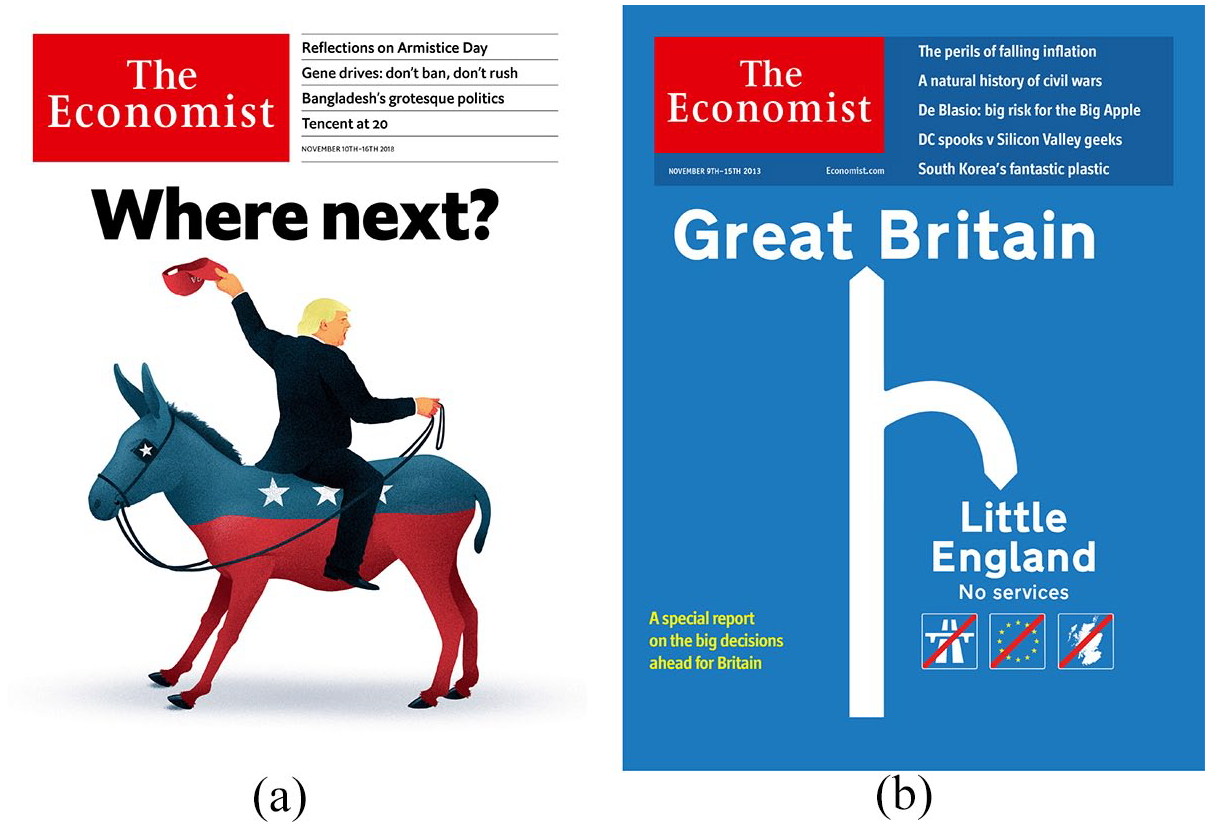
The rhetorical question in the cover line combined with information extracted from the image suggests a claim that may be glossed as ‘The US Government is at a standstill’. The visual antithesis provides support that may be glossed as ‘A Republican President tries to stir a Senate led by Democrats’. © The Economist Newspaper Limited, London (10 November 2018). Reproduced with permission.
In those covers where an antithesis is construed verbo–visually, an argument may be reconstructed when a (negative) evaluative statement can be extracted from the cover (the image and/or the text) which receives support from what the antithesis conveys. In Figure 9(b), for example, an antithesis is construed verbally by the words ‘Great’ and ‘Little’ which appear as destinations on a road sign. The antithesis is also visually conveyed by the contrast between the straight line leading to Great Britain and the bent line, almost like a U-turn, leading to Little England, as well as by the negation of icons standing in for benefits and services that Britain will lose after leaving the EU. In those cases where what is being depicted merely illustrates the opposite of what is said in the text, the figure does not have argumentative relevance (see Figure 6a above).
When discussing the rhetorical effect of creating communion, Perelman and Olbrechts-Tyteca (1969) give
In the more straightforward cases, the claim may be reconstructed from the text of the cover line, and the support for it from the propositions recovered from the visually conveyed allusion. Another possibility is that the associations triggered by the visually conveyed allusion, together with the meaning of the verbal text, help to reconstruct a claim and the support for it (Figure 10a). Finally, when the allusion is triggered, both through the text and the image, the reconstruction of a fully-fledged argument depends on the extent to which the interplay between what is said in the cover line and what is shown in the image can help recover propositions in a claim–reasons relation (Figure 10b).
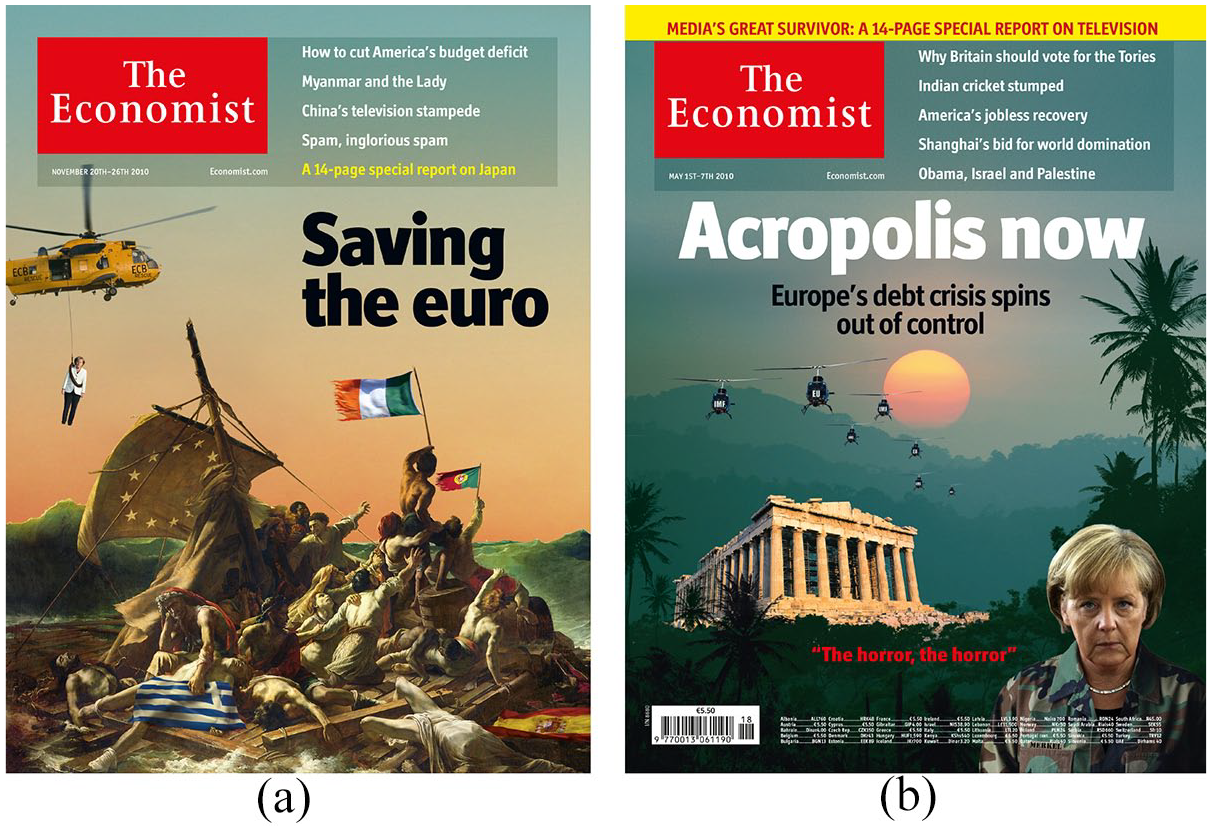
Visually triggered allusion. © The Economist Newspaper Limited, London (20 November 2010). Reproduced with permission.
In Figure 10(a), the interplay between the cover line and the visual allusion to Géricault’s painting The Raft of the Medusa helps to reconstruct an inciting claim, that the ECB and Germany should act fast in order to save Portugal, Ireland, Greece and Spain. The support for this claim can be reconstructed from how desperate the shipwrecked people on the raft look and from the knowledge of how dramatic the actual event that inspired the original painting was.
In Figure 10(b), the allusion to Francis Ford Coppola’s film Apocalypse Now proposes a frame of interpretation for the current situation, namely the crisis in the euro-zone. The argument that may be recovered can be glossed as follows: European political and financial agents should take action about the Greek economic crisis before it is too late because any delayed action will have serious repercussions for the rest of Europe, as was the case with the Vietnam war criticized in Coppola’s film.
6. Concluding remarks
In his ‘position paper on argumentation and multimodality’, Bateman (2018: 307) describes the division of tasks between these two areas as follows ‘multimodality can help explain how and in what ways diverse modalities can bring about meanings relevant for argumentation; argumentation theory then has the task of explaining how that information operates in the service of argumentation.’ In this article, I have argued how the study of rhetorical figures may prove useful for both of these tasks. Regarding the explanation of how intersemiosis creates meaning, rhetorical figures constitute a minimum unit of analysis where the meaning conveyed visually or multimodally can be considered as coded, to a certain extent, by the logic of the specific figure (metaphor: analogy, antithesis: contrast, allusion: contiguity). Regarding the task of explaining how multimodal meaning-making may serve argumentative purposes, the distinction between rhetorical and argumentative relevance helps to show that the meaning of a figure (construed verbally, visually or multimodally) is exploited differently, depending on whether and how it contributes to the argument that may be recovered from the multimodal text.
I have started with the assumption that, because figures have their distinct conceptual structure, there should be different semiotic configurations (image–text interplay) that help to distinguish one figure from another. Metaphor is characterized by the depiction of an incongruous image that presents a fusion of two domains and suggests that certain aspects of the one are mapped onto the other. Antithesis is characterized by juxtaposition in the arrangement of the elements or in the way these are depicted, which makes the contrast in what is depicted salient. Allusion is characterized by a manipulation of content and form that triggers an association with some source outside the text.
Furthermore, I have argued that it is not the figure on its own that can be said to construe a fully-fledged argument but the embedding of its meaning to an argument that can be reconstructed from the combination of the verbal and the visual elements on the front cover. There are basically two ways in which an argument can be recovered from the interplay of image and text on the front cover: (a) the text provides content for the reconstruction of the claim while the image provides content for the reconstruction of the reasons in support of it; (b) it is the interplay between the visual and the verbal elements in combination with background knowledge that provides content for the reconstruction of the claim and the reasons in support of it. The figure has argumentative relevance when its meaning helps to recover the content needed for the reconstruction of the claim and/or the reasons in support of that claim. In all cases, the figure has rhetorical relevance as follows: metaphor creates presence about the topic under discussion, antithesis exposes the choices pertaining to the topic under discussion and allusion facilitates communion with the readership regarding the topic under discussion. An additional rhetorical effect of the use of any of the three figures is that it provides an evaluative framing of the topic, which helps construe the perspective (evaluative opinion but not the argument) over the featured story.
When presenting the semiotic configurations and discussing the rhetorical and argumentative relevance of the figures found in the selected covers, I have not commented on the cases where more than one figure can be identified, and what the cumulative effect of such a combination may be. While recent studies have paid attention to the co-presence of figures or their cumulative use in verbal communication (see Harris et al., 2018, about figural collocations and Burgers et al., 2018, about figurative frames), to my knowledge, the phenomenon has not yet received attention when it comes to visual and multimodal communication. Metaphor and allusion, for example, rely sometimes on metonymy (see Figures 4a, 8a and 7b, 10a, respectively) and antithesis usually requires parallelism (see Figures 5a and 5b). For this study, I have focused on the figure that can be said to carry the main message, but more remains to be said about the co-construction of the main message by the combination of rhetorical figures and its consequences for recovering an argument. There is more to be said also about those cases where the image appears to contain two different figures, depending on which elements or parts of it one focuses on. Related to this point, a closer study of how patterns of form and content are construed both semantically and perceptually is needed. A combination of an empirical reception study with a corpus study based on multiple annotation layers would prove useful to this end. While there exist long and varied lists of rhetorical figures as well as different classifications thereof, a smaller list of distinct patterns may prove more useful for accounting for meaning-making processes in multimodal texts.
Footnotes
Acknowledgements
I wish to thank the two anonymous reviewers for their insightful comments and constructive suggestions, as well as the editors of this issue for their thorough feedback and much needed support. I am also grateful for the comments I received from Professor Emerita Brigitte Mral and the colleagues attending the research seminars at Örebro University and Södertörn University, where I presented earlier drafts of this article.
Funding
The author received no financial support for the research, authorship and publication of this article, and there is no conflict of interest.

Notes
Biographical Note
ASSIMAKIS TSERONIS is Senior Lecturer in the section of Rhetoric at the School of Humanities, Education and Social Sciences of Örebro University in Sweden. Previously, he held research and teaching positions in The Netherlands and in France. He teaches courses on rhetoric and argumentation as well as on visual and multimodal communication. His research interests fall under the areas of discourse analysis, multimodal rhetorical argumentation and pragmatics. He has published on printed advertisements, magazine covers and documentary films. Among his publications are a volume published by John Benjamins on multimodal argumentation and rhetoric in media genres, co-edited with Charles Forceville (2017), and a special issue, co-edited with Chiara Pollaroli, on the pragmatics of multimodal argumentation that appeared in International Review of Pragmatics (2018).
Address: School of Humanities, Education and Social Sciences, Örebro University, Godsmottagning F, Fakultetsgatan 1, Örebro 70182, Sweden. [ email: