




Abstract
Media professionals make use of various production techniques in the visual portrayal of politicians on television. A large body of literature indicates that these techniques exert varying influence on, for example, the evaluation of these actors, leading to the question of whether politicians are depicted in an equal way. Focusing on televised debates, this content analysis of five German debates aims to determine if there is a visual bias in the portrayal of candidates, depending on party affiliation, gender and role. Among other forms of bias, the authors find a difference in the use of camera movements and angle depending on the candidate’s gender and party affiliation.
Introduction
There is ample evidence that visual aspects matter in political communication. For instance, research on attractiveness indicates that good-looking politicians are perceived as, for example, more competent (e.g. Olivola and Todorov, 2010) and attract higher media attention (e.g. Tsfati et al., 2010) than less attractive candidates. Candidates’ facial expressions and gestures provide important opportunities for disseminating cues about politicians’ emotional state (e.g. Stewart and Ford Dowe, 2013) or their personality (e.g. Koppensteiner and Grammar, 2010). Hence, there is evidence for the effects of visuals on the perception of politicians (Boomgaarden et al., 2016; Druckman, 2003) and on behaviour (Powell et al., 2015), for example, voting (Todorov et al., 2005).
Since the public perceives politicians mainly through media reporting, their representation on photos and footage is one reason for the importance of visuals in political communication: by choosing a specific camera angle, shot, or movement, the media can evoke particular impressions on the side of recipients (e.g. Grittmann and Lobinger, 2018; Kraft, 1987; Mutz, 2015). However, studies primarily conducted in the context of US politics indicate that not all politicians get depicted equally. Rather, there is a visual bias in the media’s coverage of candidates, depending, for example, on party affiliation, gender, or role of the politicians (e.g. Coleman and Banning, 2006; Grabe, 1996; Kepplinger, 1982). Although probably less deliberately done, this can even be the case in exceptional campaign events like presidential debates. Several studies indicate that visual bias – a concept that has been originally developed for the analysis of imbalances in coverage of political actors in the press and in television – is also at play in televised debates, i.e. a format that attaches great importance to the fair and impartial representation of the participating candidates (Merritt, 1986; Morello, 1988, 1992; Tiemens, 1978; but also see Hellweg and Phillips, 1981; Tiemens et al., 1985).
Unfortunately, outside the US, there is hardly any research on visual differences in the portrayal of candidates in televised debates. Therefore, the aim of this study is to describe and compare the media’s visual portrayal of politicians in German debates in order to shed more light on the relevance of potential imbalances for this important campaign format from a non-US perspective.
This study is based on two rationales. First, there is some evidence within experimental designs on visual communication effects (Druckman, 2003; Mutz, 2007, 2015). However, these findings are only partly relevant for televised debates because the analysed camera shots are not always present in real televised debates. For instance, Mutz (2007, 2015) reported detrimental effects for extreme close-up shots – a camera shot which is usually not used in televised debates. Hence, a crucial task is to describe how candidates are portrayed in televised debates in order to estimate potential visual effects of those formats. Second, mediated depiction of politicians is particularly important to voters with little political knowledge, interest and party identification. They are more likely to rely on visuals as heuristic cues when making judgements about politicians (e.g. Lenz and Lawson, 2011; Stockemer and Praino, 2019). In times of declining party identification (Dalton, 2019), it is therefore crucial to determine if all candidates get the chance to be perceived equally – independent of their gender or party affiliation.
Germany is a particularly interesting case for this analysis. Restrictions for broadcasters are low since there is (different from in the US, e.g. Kraus, 2011) usually no – or at least no detailed – Memorandum of Understanding regulating the rules for the presentation of debates (Maier and Faas, 2019: 33); therefore, the room for manoeuvre for television broadcasters to present debates according to their own ideas is considerably larger than in the US and there is a chance of producing visual imbalances. Furthermore, in contrast to the US, we can to some extent study the impact of gender on the visual presentation of candidates. Chancellor Angela Merkel has participated in every debate since 2005 – one time as challenger and three times as incumbent.
To answer our research question, we analyse the visual representation of candidates in five out of six German televised debates that have been aired in the run-up to federal elections (i.e. since 2002). To be precise, we ask whether or not candidates in the German televised debates are portrayed in a visually different manner depending on gender, party affiliation and political role.
Visual Portrayal of Politicians in the Media
Visual media coverage of politicians is not only about what the recipients see in the picture, for example, if they are wearing a blue dress, if they smile when shaking hands, or if they roll their eyes when listening to their opponents. This also holds true for televised debates that ‘can be viewed as complex psychological stimuli that simultaneously present verbal and non-verbal information’ (Cho, 2009: 385). Moreover, by means of pre-editing techniques, such as camera shots and movements, and post-editing techniques, such as cuts, televised debates offer their audience not only content but also visual structural information (Lang, 2000).
Empirical research indicates that journalists, in general, and camera operators, in particular, are aware of the particularities of visual structural information – and about the potential impact of these techniques on the audience (e.g. Kepplinger, 1982; Messaris et al., 1979). By choosing a certain camera angle or applying fast cuts, TV journalists and technical personnel such as cutters can add a further layer to the depiction of politicians. Kepplinger (1982) calls this ‘visual commentary’.
Imbalances in visual commentary occur in most cases unconsciously as well as unintentionally and can happen throughout the entire process of multi-staged television productions (Kepplinger, 1982); however, various aspects might reveal that not all politicians are portrayed equally. First, journalists are taught to think about the intended audience effects of the visual portrayal of an object, a person, or a situation before choosing an appropriate production technique to achieve the desired impact (‘effect-to-cause-model’; see Zettl, 2012: 5). Second, a significant proportion of (political) journalists believe that it is important to express their own points of view and to influence decision-making processes (e.g. Hanitzsch et al., 2019; Weischenberg et al., 2006: 284–285). In this context, the way politicians are portrayed visually can help achieve the desired impact. Third, media competition is becoming harder and harder. Therefore, presentation styles that ‘involve the viewers emotionally’ (Hallin and Mancini, 1984: 839) and ‘enhance viewer arousal and attention should become increasingly common in such a competitive environment’ (Mutz, 2015: 181). In sum, the application of visual commentary is to some extent unconscious and to some extent learned behaviour based on potential effects of visual elements on the audience. The aim of this article is to investigate whether this leads to visual imbalances or not.
Based on these considerations, we distinguish two broader categories of visual commentary: on the one hand, techniques that help journalists to grab recipients’ attention and, on the other hand, techniques that indicate an evaluation of the subject in focus.
Attention-grabbing camera techniques
By employing specific camera techniques, journalists can increase viewers’ interest and attention. Textbooks on video journalism suggest that at least three techniques can be used to increase audience attention:
(1) Type of camera shot: Grabe (1996: 156) argues that the relative size of people on a TV screen serves as an indicator of distance between the person in focus and the recipient. Close-ups can be used to ‘reveal people’s reactions or emotions, or dramatize the event’ (Owens and Millerson, 2012: 155) and ‘create a sense of spatial intimacy’ (Mutz, 2007: 623). A medium shot ‘provides a safe, uncritical, general purpose viewpoint. It offers the audience a useful amount of detailed information and so can sustain interest for a relatively long time’ (Millerson, 2001: 74). Grabe (1996: 156) claims that medium shots establish ‘a comfortable personal relationship between object/person and viewer’. Long shots are used to ‘establish mood’ (Owens and Millerson, 2012: 155) but also indicate that there is a distance between the person in focus and the viewer (Grabe, 1996).
(2) Duration of camera shot: With the duration of a camera shot, video journalists can control tension. A fast cut ‘gives the scene a sense of urgency’ (Joyce, 2012: 457) and leads to a series of ‘orienting responses’ of the recipient (Lang et al., 2000: 96).
(3) Camera and camera lens movement: By using camera moves, journalists can add ‘visual interest, plus influence certain audience reactions’ (Owens and Millerson, 2012: 166). The dynamic of pans and rotations ‘creates a participatory effect for the audience’ and ‘can even provide subjective influence on the action itself’ (p. 167). By using a dolly (i.e. a forward and backward movement of the camera) or a zoom, the camera focuses ‘to a relevant point of the scene’ (‘zoom in’) and sets the exposure (Mayne, 2016). In contrast, zooming out relaxes the focus on an object previously at the centre of attention; hence, it appears less relevant. Whereas zooming in the camera lens increases audience involvement and information processing, zooming out has the opposite effect (Grabe, 1996).
In sum, research on the impact of attention-grabbing techniques supports the assumptions of video journalists that close-ups, short cuts and camera movements in political programmes increase viewers’ arousal, attention, excitement and involvement (e.g. Lang et al., 2000; Lombard et al., 2000; Mutz, 2015: 37). However, beyond the stimulation of cognitive and emotional processes, these techniques also have considerable consequences for the perception of portrayed politicians. First, some attention-grabbing strategies (close-ups, short cuts) suggest conflict (Messaris et al., 1979). Second, whereas the use of cuts improves the evaluation of candidates (Reeves and Nass, 1996: 233), close-ups reinforce already existing attitudes. Hence, close-ups fuel political polarization (Mutz, 2007). Third, when close-ups emphasize the face (‘face-ism’), the depicted person is perceived as more intelligent and ambitious (e.g. Archer et al., 1989).
Evaluative camera techniques
In addition, specific camera techniques provide an opportunity for inducing positive or negative evaluations of the object in focus. Textbooks on video journalism suggest that specific vertical and horizontal camera angles can cast objects in a favourable or unfavourable light.
(1) Vertical camera angle: The use of high angle shots makes portrayed individuals appear as ‘small, weak, subservient, diminutive, or . . . currently in a less powerful or compromised position’. In contrast, persons portrayed in low angle appear as ‘larger, more looming, more significant, and more powerful’ (Thompson and Bowen, 2009: 42). Eye-level shots suggest ‘parity between the audience and portrayed objects or people’ (Grabe, 1996: 157) or ‘a sense of normalcy’ (Owens and Millerson, 2012: 163). Whether low or high angle shots cause favourable or unfavourable impressions is, however, disputed. Some studies report effects for both low and high angle shots that are in line with journalism textbooks (e.g. Kappas et al., 1994; Tiemens, 1978; Tiemens et al., 1985). In contrast, McCain et al. (1977) find the exact opposite effects. Kepplinger and Donsbach (1990) demonstrate that, for both high and low angles, the speaker always appears negative, i.e. more aggressive and obtrusive, when the angle is extreme.
(2) Horizontal camera angle: With the horizontal camera angle, journalists determine the visibility of a person’s facial expression and his or her degree of turning to an audience. Particularly in the case of profile shots, it is difficult for the audience to gather any information from the person’s face. In addition, a profile shot of a person signals that he or she has turned away from the audience. Furthermore, ‘in a profile shot . . . the camera seems to be scrutinizing the guest, and the effect is not particularly attractive, although admittedly, it can be dramatic in a strong aggressive interview’ (Millerson, 2001: 226). However, empirical findings on the impact of horizontal camera angles suggest that they only have an effect when viewers are able to see facial expressions (e.g. Baggaley et al., 1980; Mendolia and Kleck, 1991).
In sum, evaluative camera perspectives can have a significant impact on candidate judgments. However, the potential consequences are less clear-cut than for attention-grabbing camera techniques. With respect to vertical camera angles, the least common denominator is probably that any deviation of eye-level shots can induce evaluations of the portrayed person (Kepplinger and Donsbach, 1990). The more extreme the angle, the stronger the impact on candidate evaluation (Grabe, 1996; Kraft, 1987). For horizontal camera angles, a rule of thumb is that they only trigger evaluations when facial expressions are accessible to recipients.
Visual Bias in Visual Commentary
The question about the potential effects triggers the question of whether the techniques of visual commentary are used to an equal extent in the depiction of politicians. Grabe and Bucy (2009) differentiate two types of visual bias: (1) a visual bias can occur in terms of the visual weight, i.e. visual importance that is, among others, given by the position of the news item in the show; and (2) – relevant for our purposes – a visual bias can be created by applying different camera and editing techniques as discussed above. 1
Research that mostly stems from a US context focuses mainly on the second type of visual biases and on differences in the visual depiction – due to a two-party-system – of candidates of the main parties. In other words, determining the influence of party affiliation on visual commentary is the aim of such studies which provide us, so far, with mixed results. Analysing US TV news between 1992 and 2004, Grabe and Bucy (2009: 205) found, on the one hand, that Democrats are filmed significantly longer using high-angle shots than their Republican opponents. On the other hand, the authors did not find any differences with respect to the type of camera shots (i.e. the duration of close-ups, medium shots and long shots) and camera movement. No differences in camera angle, shot and movement in, again, TV news coverage were described for the 2000 US election between George W Bush and Al Gore (Coleman and Banning, 2006). Results for Germany do not yield major differences between the Chancellor candidates of the two major parties (Boomgaarden and Semetko, 2007).
When focusing on televised debates, Tiemens (1978) found that the media used close-ups more often to portray Jimmy Carter than Gerald Ford. However, there were no differences in camera movement. Focusing on recent German televised debates, we will investigate the visual depiction of debate candidates and ask:
RQ1: Are there differences in camera shots (length and size), movement, and angle between the candidates in German televised debates based on their party affiliation?
Not just party affiliation but also the role of political actors can influence their visual representation in the media. In this context, research focuses on the so-called incumbency bonus. Indeed, Sülflow and Esser (2014) found for German TV news that incumbents were portrayed longer than leading politicians from the opposition. Similar results have been found for the German federal elections in 1998, 2002 and 2009 (Maurer and Kepplinger, 2003; Schulz and Zeh, 2010). Older studies, however, show the opposite (Kepplinger, 1982). Analysing camera angles, Kepplinger demonstrates that the chancellor was portrayed more frequently in mid-shot, while the challenger was more often portrayed from a high angle or low angle.
For televised debates, Tiemens (1978: 365) reports that challenger Jimmy Carter was portrayed with a higher amount of ‘tighter (more close-up)’ shots than incumbent Gerald Ford. However, there were no differences in camera movement.
RQ2: Is there an incumbency bonus in the German televised debates in terms of camera shots (length and size), movement and angle?
Finally, differences in visual depiction can occur between politicians of different gender. Although results on TV debates are lacking, conclusions can be drawn from general research on visual gender stereotypes/bias. Especially in contexts where intellectual competences are relevant, such as politics (Konrath et al., 2012), men are represented with higher facial prominence, whereas the focus on female politicians is less on the face and more on the body (Konrath et al., 2012; Konrath and Schwartz, 2007; but see Jansen et al., 2010). Therefore, it seems reasonable to assume differences regarding shot type.
RQ3: Are there differences in camera shots (length and size), movement and angle between the candidates in German televised debates based on their gender?
Method
To answer our research questions, we conducted a quantitative content analysis of the visual presentation of candidates in five German televised debates covering a time span of 15 years (see Table 1). In the US, televised debates are the most important single campaign event in Germany always attracting a significant audience. Setting and (officially made) rules of debate remained very constant over times. Participants were the chancellor candidates of the two major political parties, the Christian Democrats (CDU/CSU) and the Social Democrats (SPD). Debates ran between 75 and 90 minutes. Candidates took turns in answering the questions of two to four journalists (each representing one broadcaster). At the end of the debate, candidates were allowed to make a short closing statement without interruptions (for details on German debates, see, e.g., Maier and Faas, 2019). Debates show, however, some variations in party affiliation and gender for both the incumbent and the challenger. This variation enables us to analyse whether there is a visual imbalance depending on incumbency, party attachment and gender.
Analysed debates.
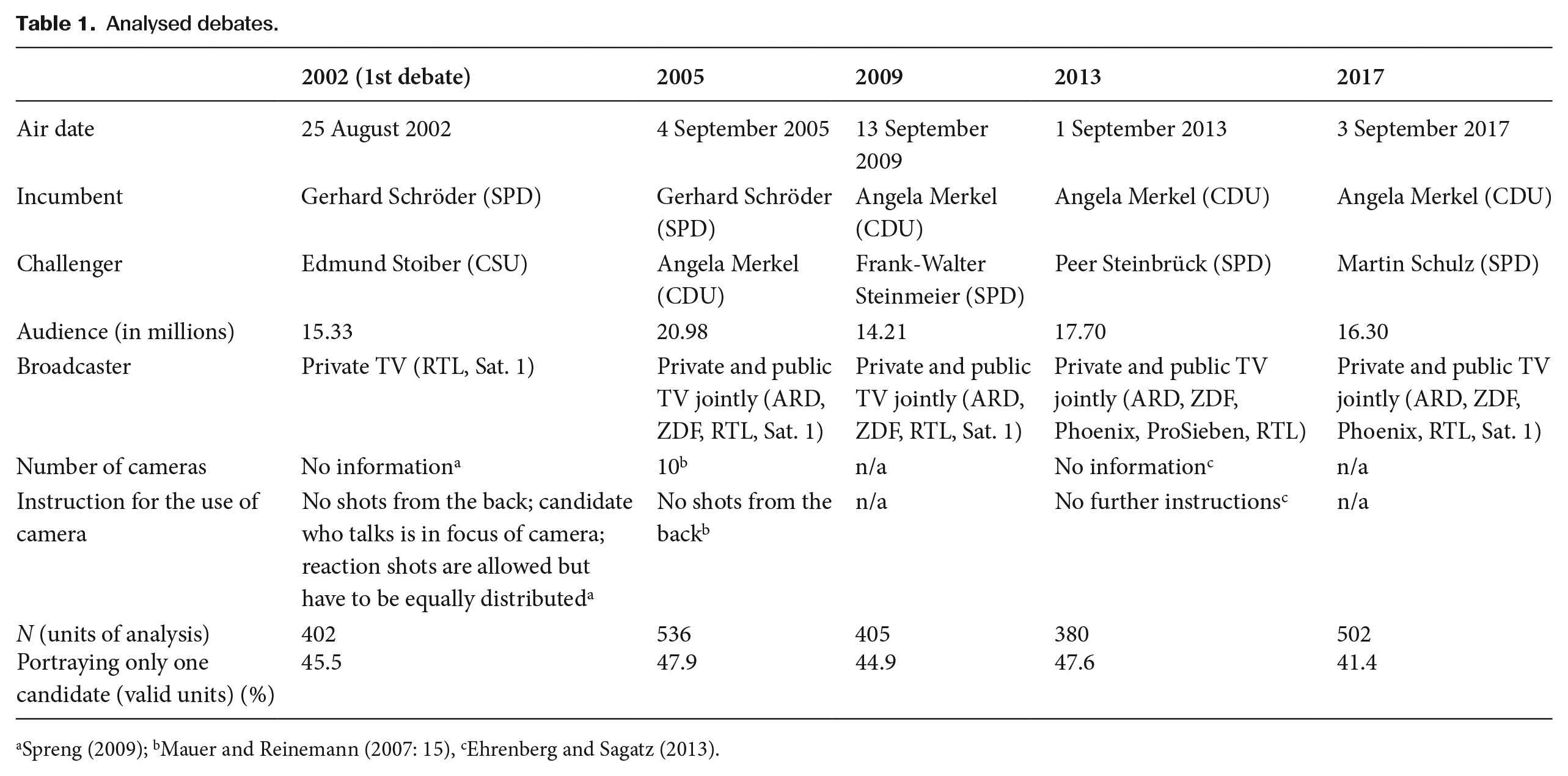
For our analyses, we define our units of analysis as those segments of the debates that were given through the live editing of the filming of the debates, i.e. by cuts, zooms and pans. With every use of a new editing technique, the unit of analysis changed. Two trained student coders first segmented the televised debates into units of analysis, also coding the start and the end time. We identified N = 2,225 visual units. 2
The same coders then content analysed the visual material for our variables of interest using the video annotation tool Anvil. 3 Anvil allows for adding annotations to the segmented videos of the debates, based on a user-defined coding scheme (Kipp, 2001). To assess the use of attention-grabbing techniques for each unit of analysis, we coded the type of a camera shot (long shot, full shot, American/medium full shot, medium shot, loose close-up, close-up, extreme close-up). 4 In addition, we coded movements of the camera or the camera lens. For units that comprised a movement, the type of camera movement was coded. Here, we distinguished between zoom (and here between zoom in and zoom out) and pan. Finally, based on the information on the start and the end time for each unit of analysis, we calculated the duration of the camera shots. To assess evaluative camera techniques, we coded the horizontal angle of the camera setting, distinguishing between frontal view, semi-profile and other views of the portrayed candidates. 5 We do not analyse vertical camera angles since candidates were shot only at eye-level with very rare exceptions at the beginning of a debate (when the music is still playing).
Furthermore, we counted the number of individuals captured by a shot, which included candidates and moderators, and the type of constellation (one or two candidates, one or more moderators, candidates and moderators). We consider visual bias as differences in the visual portrayal of the candidates. Sequences in which both candidates are visible, however, do not allow a distinction in this respect. In other words, sequences in which both candidates are visible cannot, by definition, differentiate between candidates in terms of camera angle, shot length, etc. We therefore exclude all units from the analysis that contain both candidates and analyse only those units in which a candidate appears without his or her competitor on the screen. In addition, visual bias is not an issue when only moderators (but no candidates) are portrayed; hence, we also exclude all units without candidates from our analysis. This leaves us with N = 1,011 valid units of analysis. 6
For all units, we assessed who was portrayed by coding the party (CDU/CSU vs SPD), the political role (incumbent vs challenger), and gender of the candidate in the focus of the camera.
Results
Attention-grabbing camera techniques
The vast majority of the camera shots used in German televised debates to portray single candidates are close-ups (92%), followed by medium and full shots (respectively, 5% and 3%) (see Table 2). 7 In 2005, 2013 and 2017, cameramen almost always used (loose) close-ups (i.e. shots from the chest to the head) to portray the candidates. In 2002, medium shots were used above average. In 2009, full shots were used quite frequently. There is no indication that incumbents and challengers are portrayed differently. However, our data yield a significant difference for party affiliation. Whereas filming of candidates of the CDU/CSU is more likely to be done with medium shots and close-ups, videos of SPD candidates are more likely to be done with full shots. Furthermore, the only female candidate in our sample, Angela Merkel, is generally filmed more often using close-ups than her male rivals; they are covered much more often by medium and full shots.
Use of attention-grabbing and evaluative camera techniques in German televised debates by year, political role, party and gender (column percentages).
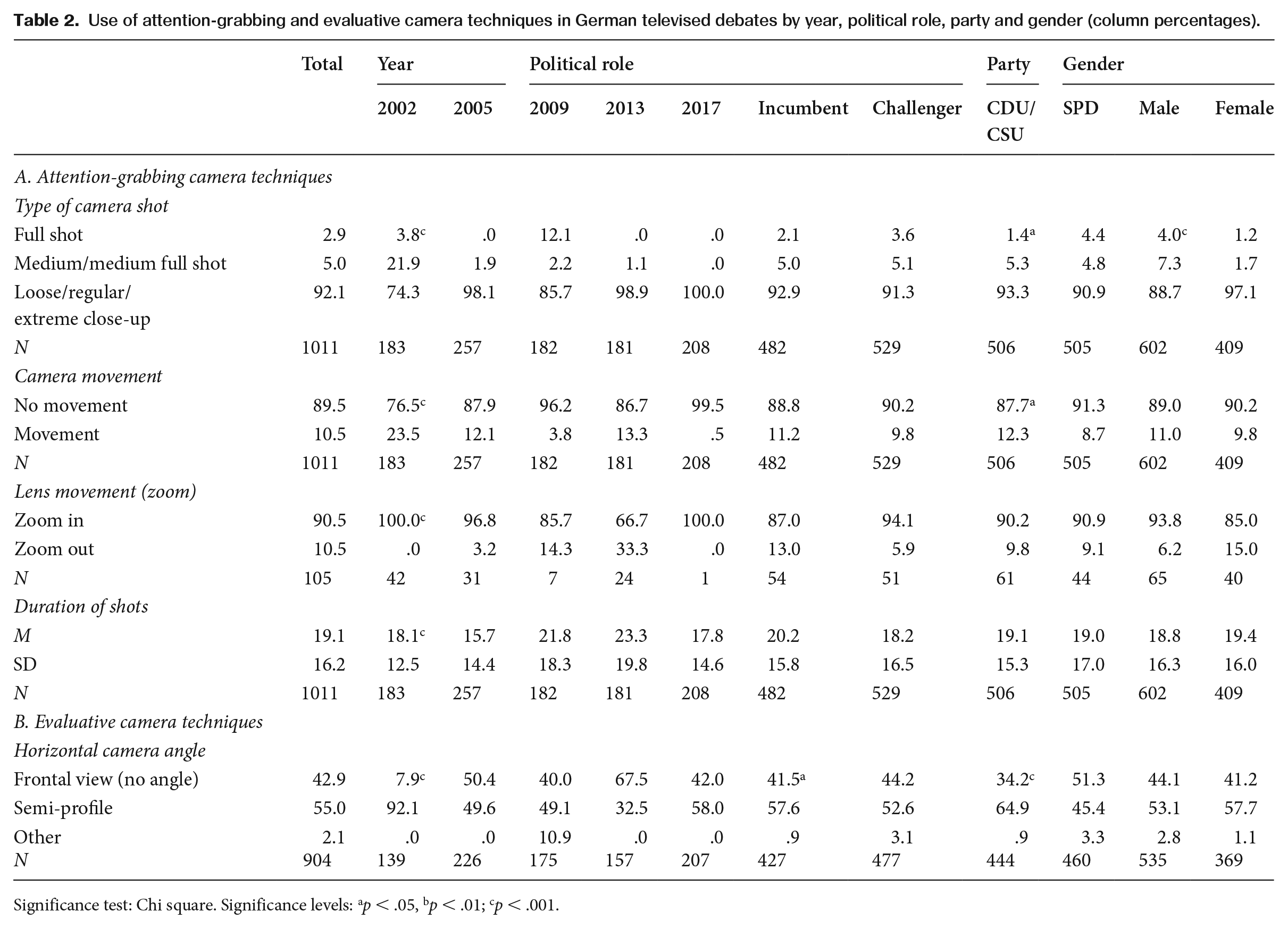
Significance test: Chi square. Significance levels: ap < .05, bp < .01; cp < .001.
When candidates appear alone (or with a moderator) on the screen, the portrayals usually do not contain any movement –neither of the camera itself, nor of the lens (90%) (see Table 2). Candidate depictions were dynamic in only one out of ten camera settings. Movements were most frequent in 2002. In 2009, and particularly in 2017, the audience rarely experienced any movement in presentations of the competitors. Furthermore, there are no differences in the use of camera movements depending on the political role or gender of the candidates. However, we find differences in the portrayal by party. Candidates of CDU/CSU are significantly more often presented in a dynamic manner than SPD candidates.
When camera movements are observed, it is because of zooming (99%) and not because of pans (1%). Our results indicate that, in most cases, changes of the lens are due to zooming in (91%) rather than to zooming out (11%) (see Table 2). Zooming in was extremely popular in 2002 and 2005. For 2017, zooming was only used in a single sequence; in this case, it was a zooming in. In 2009, and particularly in 2013, the share of zooming out was much greater. The use of the zoom type does not differ by candidates’ political role, party and gender.
The average duration of a shot is 19.1 seconds (see Table 2). Shots were particularly short in 2005. In 2009 and 2013, the duration of the shots was quite long. There are no significant differences in candidate portrayal with respect to political role, party and gender.
A breakdown of the analyses by year indicates that the reported differences for the full sample are not usually applicable to the single debates. Of course, this is, first and foremost, a consequence of the much smaller number of observations. However, we find some significant differences for the type of camera shot in 2009 (p < .1), for camera movement in 2013 (p < .05), and for duration of shots in 2017 (p < .05). In these debates Angela Merkel, the female incumbent running for the CDU/CSU, was significantly more often portrayed in close-ups, with a moving camera, and with lower cutting rates than her male challengers from the SPD.
Evaluative camera techniques
If candidates appear without their rival on the screen, they are mainly presented in semi-profile (55%, see Table 2). In 43 percent of the debates, cameramen decided to portray candidates using a frontal view. Other angles were used in 2 percent of the camera settings. Frontal views were used more often in 2005 and 2013. The use of semi-profiles was particularly strong in 2002. Our data also yield significant differences for the candidate’s political role. Whereas incumbents were more likely to be portrayed in semi-profile, challengers were more often depicted from the front and using other angles. Furthermore, candidates running for the CDU/CSU appear significantly more often in semi-profile on the screen than SPD candidates. In contrast, we do not find any differences for gender.
A breakdown of the analyses by year indicates that the reported differences for the full sample are also applicable to all single debates. We always find that Social Democrats and male candidates are significantly more often portrayed using a frontal view. In 2002 and 2005, this was also the case for the incumbent and in 2009, 2013 and 2017 for the challenger.
Multivariate analyses
While the bivariate analysis presented above can be seen as a first indication of differences in the visual presentation of candidates, we are also able to test candidate characteristics simultaneously and analyse which of these factors has an impact on the visual depiction of the candidates. Therefore, we set up a (logistic) regression analysis, controlling for the simultaneous impact of the political role, party and gender on the use of camera techniques. Furthermore, we accounted for the fact that candidates are nested in debates by calculating robust clustered standard errors.
Results demonstrate that when candidates appear on the screen without their competitors, broadcasters generally treat them equally, independent of their political role. We do not observe significant differences for either attention-grabbing techniques or the evaluative camera setting under investigation (see Table 3). Things are different with respect to party. Our results indicate that dynamic shots (i.e. movements of the lens) are used much more often when depicting candidates running for the CDU/CSU. In addition, cameramen zoomed in much more on CDU/CSU candidates than on SPD candidates. Furthermore, candidates of the CDU/CSU are depicted more often in semi-profile. Moreover, we also find evidence that male and female candidates are treated differently by the broadcasters. First, male participants are more often portrayed in loose, regular, or extreme close-ups than females (i.e. Angela Merkel). Second, the camera zooms in on male candidates more often than on Angela Merkel. Third, males are presented more often in semi-profile.
Impact of political role, party and gender on the use of attention-grabbing and evaluative camera techniques in German televised debates.
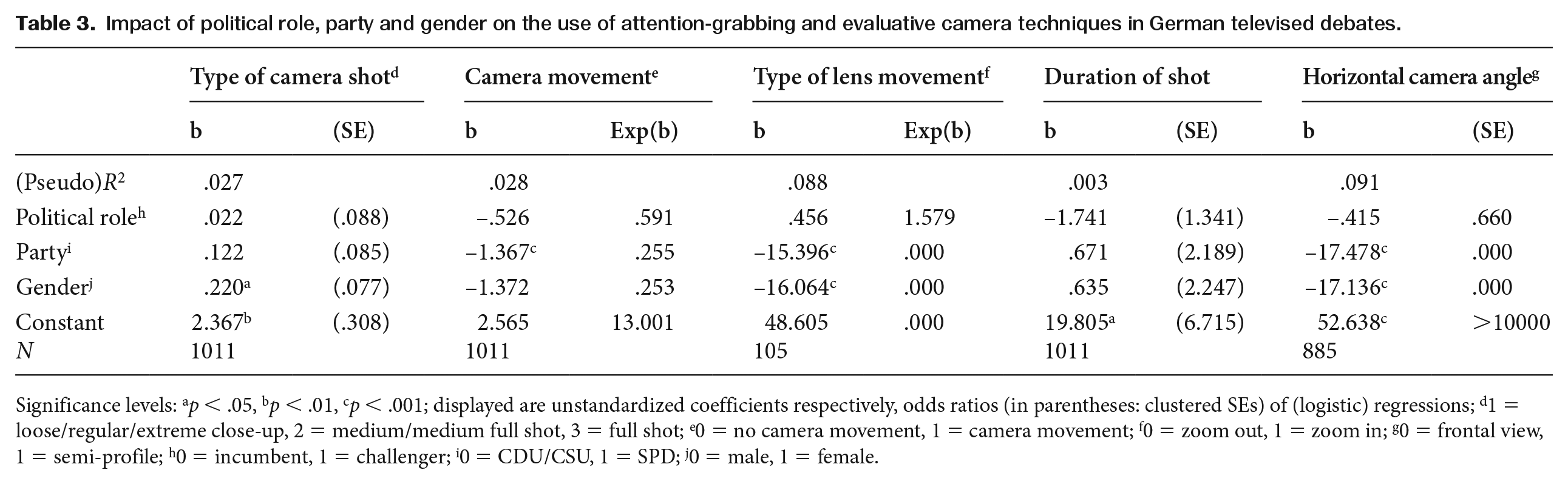
Significance levels: ap < .05, bp < .01, cp < .001; displayed are unstandardized coefficients respectively, odds ratios (in parentheses: clustered SEs) of (logistic) regressions; d1 = loose/regular/extreme close-up, 2 = medium/medium full shot, 3 = full shot; e0 = no camera movement, 1 = camera movement; f0 = zoom out, 1 = zoom in; g0 = frontal view, 1 = semi-profile; h0 = incumbent, 1 = challenger; i0 = CDU/CSU, 1 = SPD; j0 = male, 1 = female.
Discussion
Research on televised debates has, so far, mostly focused on verbal content and the effects of this content on the audience. Visual aspects have only recently gained scholarly attention. Against this backdrop, we map the visual presentation of candidates for Chancellor in German televised debates and focus on whether candidates get portrayed equally, independent of their party affiliation, gender and role.
Our results provide some evidence for a visual imbalance with respect to attention-grabbing camera techniques and the use of evaluative camera techniques. Multivariate models demonstrate that candidates running for the CDU/CSU tend to be presented more favourably than SPD candidates as the shots used are more dynamic (moving cameras, zoom in) and suggest a higher credibility (semi-profile shots) (RQ1). In addition, males might benefit as their facial expressions can be better observed (close-ups), they appear more dynamic (zoom in) and more credible (semi-profile perspective) than the only female in our sample (i.e. Angela Merkel) (RQ3). There are no differences with respect to the candidates’ political role (RQ2). It is important to note that the results of bi- and multivariate analyses sometimes contradict each other. This indicates that the variables analysed here – political role, party affiliation and gender – are correlated and their true effects turn out only when estimated simultaneously. 8 Hence, bivariate analysis should not be the last method in visual bias analysis; rather, we recommend relying on multivariate models.
In addition, we find variations in the use of different camera techniques over time. Although there no indications of particular trends, our results suggest that the visual portrayal of candidates can contribute to a specific evaluation of those events. In particular, there is evidence for our argument in the 2009 debate, which was considered very boring. We demonstrate the usage of various filming techniques reducing attention and involvement (e.g. full shots, zoom out, low cutting rates). This might have reinforced the perception of a rather lifeless debate. In a similar vein, the 2005 debate was embedded in a highly controversial campaign in the run-up to a snap election. The broadcasters opted for a high number of close-ups, used a lot of zoom in and provided an all-time record for the fastest cutting rate. Of course, it needs to be noted that these are only potential reasons for differences in the perceived tension and excitement during these debates.
At first glance, television broadcasters make great efforts to ward off any suspicion of favouring a specific candidate. For this purpose, the speaking time allocated to the candidates is displayed several times during a debate to demonstrate that they are being treated equally; moderators make every effort to compensate for differences in the remaining time. Our findings suggest that, if broadcasters take the issue of impartial candidate presentation seriously, they must account for visual aspects too. A first step could be to set up publicly accessible agreements that also include regulations on the use of cameras. Furthermore, television broadcasters must be aware that their visual presentation of candidates can help to establish or reinforce a particular impression on the value of leader debates.
Our research, of course, comes with limitations. First, our data base encompasses only five debates. Therefore, the variation of some candidate characteristics is very limited (e.g. our data set includes only one female candidate). Second, our data provide no information on the journalistic influence on visual imbalances. Visual commentary is assumed to be – next to technical affordances – caused by journalistic routines, attitudes and organizational factors (Kepplinger, 1982). None of those can be assessed with our study design. Third, we also cannot make a statement about when in the production process the observed visual imbalance comes into play and why. Is there a bias because it is decided at the stage of programme planning to present candidates as vividly as possible, is it because the director decides to present candidates differently, or is there distortion because the cameramen have their own responsibilities for deciding on the basis of their professional experience how the candidates can best be presented? On top of these reasons, differences can also occur because some candidates provide more important statements or display more emotions than others. Linking camera techniques and debate content might be a promising direction for investigating this. Fourth, as information on the rules of the debates and the briefing of the cameramen is usually not available, we are unfortunately not able to explain variations between the debates. Fifth, based on our data we cannot estimate whether the detected visual bias matters. Do candidates benefit (or suffer) from the applied camera techniques and, if so, which are most important? How relevant are the effects of camera techniques compared to other verbal, paraverbal and nonverbal signals the candidates send? However, this comprehensive content analysis sets the scene for experimental and non-experimental effect research as well as studies on visual commentary from a journalistic point of view; hence, it can serve as a launchpad for future analyses in this field.
Supplemental Material
sj-docx-1-vcj-10.1177_1470357220974068 – Supplemental material for Is there a visual bias in televised debates? Evidence from Germany, 2002–2017
Supplemental material, sj-docx-1-vcj-10.1177_1470357220974068 for Is there a visual bias in televised debates? Evidence from Germany, 2002–2017 by Jürgen Maier, Isabella Glogger, Lukas P Otto and Jennifer Bast in Visual Communication
Footnotes
Funding
Jürgen Maier and Lukas Otto received financial support from the Research Network ‘Communication, Media, and Politics’ at the University of Koblenz-Landau for their research. There is no conflict of interest.

Notes
Biographical Notes
JÜRGEN MAIER is a Professor of Political Communication at the University of Koblenz-Landau. His research focuses on media coverage of politics and its effects, political attitudes, electoral behavior, and on quantitative methods. Within these fields he specializes on televised debates, political scandals, negative campaign communication, experimental designs, and real-time response measurement.
Address: University of Koblenz-Landau, Department of Political Science, Kaufhausgasse 9, 76829 Landau, Germany. [email:
ISABELLA GLOGGER is a post-doctoral researcher at the Department of Journalism, Media and Communication at the University of Gothenburg. In her research, she focuses on political communication and journalism, studying characteristics of media content and their effects on recipients’ beliefs.
Address: Göteborgs Universitet, Institutionen för journalistik, medier och kommunikation (JMG), Box 710, 405 30 Göteborg, Sweden. [email:
LUKAS P OTTO is an Assistant Professor for Political Communication and Journalism at the Amsterdam School of Communication Research (ASCoR), University of Amsterdam. His research interests include political communication effects, especially the effects of political debates and discussions (online), emotions in politics as well as political communication and trust. He is employing innovative methods like mobile experience sampling, factorial survey experiments, or real-time-response measurement.
Address: University of Amsterdam, The Amsterdam School of Communication Research (ASCoR), Nieuwe Achtergracht 166, 1018 WV Amsterdam The Netherlands. [email:
JENNIFER BAST is a PhD student and research assistant at the Department of Political Science, University of Koblenz-Landau, Germany. Her research interests include political communication, visual communication, and gender studies. For her doctoral thesis she investigates the visual communication of right-wing populists on Instagram.
Address: University of Koblenz-Landau, Department of Political Science, Kaufhausgasse 9, 76829 Landau, Germany. [email: