




Abstract
Introduction:
C-type natriuretic peptide (CNP) selectively binds to the guanylyl cyclase coupled natriuretic peptide receptor (NPR)-B and exerts more potent antihypertrophic and antifibrotic properties. Elimination of CNP occurs mainly by neutral endopeptidase (NEP) and NPR-C.
Methods:
We established a rat model of unilateral ureteral obstruction (UUO) to examine the continuous change of the CNP expression and to assess the correlations of NPR-B, NPR-C, NEP with CNP in the obstructed kidneys.
Results:
The expressions of CNP mRNA and protein in the obstructed kidneys tended to be higher immediately after ligation and declined at later time points compared to sham-operated rats, measured by real-time polymerase chain reaction (PCR) and western blot analysis. Subsequent correlation analysis indicated that CNP mRNA was positively correlated with NPR-B mRNA (r=+0.673, p<0.05). In addition, the increased expression of NPR-C (r=−0.943 and −0.837 for mRNA and protein respectively, p<0.05) and NEP (r=−0.687 and −0.823 for mRNA and protein respectively, p<0.05) were accompanied by a significant decline in CNP.
Conclusions:
A high level of CNP may contribute to the elevated expression of NPR-B in the early phase of UUO. More interestingly, paradoxical expressions of NPR-C and NEP may account for the decline of CNP in the obstructed kidneys.
Keywords
Introduction
In 1990, Sudoh and his colleagues primarily isolated C-type natriuretic peptide (CNP) from porcine brain. 1 It is now known that endothelium has been identified as the most major site of CNP synthesis. CNP comprises a ring structure of 17 amino acids linked by a cysteine disulphide bridge, which is essential for receptor binding and bioactivity (Figure 1). Distinct from the other members of natriuretic peptide family, CNP selectively binds to guanylyl cyclase coupled natriuretic peptide receptor (NPR)-B and results subsequently in the highest elevation in intracellular cyclic guanosine monophosphate (cGMP). 2 In addition, CNP exerts more potent antihypertrophic and antifibrotic properties, but has little effect on water and salt excretion, partly due to the deficiency of carboxy-terminal extension. 3 On the other hand, there are two pathways involved in the catabolism of CNP: removal by the clearance receptor (NPR-C) and hydrolysis by neutral endopeptidase (NEP). 4

Amino acid sequence of the human C-type natriuretic peptide (CNP). CNP comprises a ring structure of 17 amino acids linked by a cysteine (Cys) disulphide bridge, and conserved sequences of natriuretic peptide family are labeled in black.
Currently, CNP is believed to be produced locally in normal kidneys. Cataliotti et al., 5 by immunohistochemical method, showed that CNP was predominantly present in tubular epithelial cells, including proximal, distal, and medullary collecting duct cells. CNP immunoreactivity was also observed in the glomeruli. Renal tissue expression of CNP is often up-regulated in several pathological conditions, such as nephrotic syndrome, function renal failure in cirrhosis and diabetic nephropathy.5–7 Our latest study published in Molecular Biology Reports revealed that CNP expression was markedly increased in the obstructed kidneys as early as three days post-ligation. 8 An expansion of extracellular fluid volume may contribute to the locally synthesized CNP. However, it should be noted that our previous study was not carried out for long enough to examine the continuous change of CNP during the entire time course of experimental obstructive nephropathy and, to date, the association of CNP expression with its receptors and NEP in the obstructed kidneys is poorly defined.
Materials and methods
Animals and treatment
Male Wistar rats weighing 190–250 g were housed at an ambient temperature of 23±1°C and exposed to a daily 12-h light-dark cycle (light on 07:00–19:00) with free access to tap water and a pellet diet. Animals were treated humanely using approved procedures in accordance with the guidelines of the Institutional Animal Use and Care Committee of Anhui Medical University. A total of 96 rats were separated into 16 experimental groups: eight groups undergoing left proximal unilateral ureteral obstruction (UUO) (n=6) and eight groups with sham-operated rats (SORs) (n=6). The fasted animals were operated under intraperitoneal pentobarbital anesthesia (60 mg/kg body weight) and sterile conditions. UUO rats underwent left proximal ureteral ligation with 4-0 silk at the junction of the upper with the lower two-thirds of its length. The ureter was cut between the ligatures to prevent retrograde urinary tract infection. SORs underwent a sham laparotomy with ureteric manipulation through a midline incision. No antibiotics were given. Animals were anesthetized by intraperitoneal pentobarbital injection and sacrificed by heart puncture at 24 h, 72 h, one week, two weeks, three weeks, one month, two months and three months post-ligation, respectively. The obstructed kidneys of UUO rats and the left kidneys of SORs were harvested for real-time PCR and western blot analysis (see below).
Real-time PCR
Total RNA was extracted from renal tissue using TRIzol reagent (Invitrogen Co. Ltd, USA). Use of an ultraviolet spectrophotometer measuring absorbance, agarose gel electrophoresis confirmed that there had been no degradation of RNA. Specific primers were synthesized according to the published sequences. The sequences of oligonucleotides and sizes of PCR products were, for CNP, sense: 5’-AACATCCCAGACCGCTCATG-3’, antisense: 5’-CAA GAA GGG CTT GTC CAA AGG-3’(73 bp) 9 for NPR-B, sense: 5’-AAC GGG CGC ATT GTG TAT ATC TGC GGC-3’, antisense: 5’-TTA TCA CAG GAT GGG TCG TCC AAG TCA-3’ (692 bp) 10 for NPR-C, sense: 5’-ATA GTG CGC TAC ATC CAG GGC AGT-3’, antisense: 5’-TCC AAA GTA ATC ACC AAT GAC CTC CTG GGT ACC TGC-3’ (573 bp) 10 for NEP, sense: 5’-CCC CGC CGG CAT TT-3’, antisense: 5’-GCC CCC ATA GTT CAA TGA GTT G-3’ (66 bp) 11 for glyceraldehyde-3-phosphate dehydrogenase (GAPDH), sense: 5’-TGT GAG GGA GAT GCT CAG TG-3’, antisense: 5’-GGC ATT GCT CTC AAT GAC AA-3’ (229 bp). 12 One microgram total RNA from the renal tissue of each rat was reverse transcribed into cDNA with an ExScript RT reagent kit (Takara Biotechnology Co. Ltd, Dalian, China). CNP, NPR-B, NPR-C and NEP were amplified with SYBR Premix Ex Taq (Takara Biotechnology Co. Ltd). Gene expression of GAPDH was also measured in each sample and used as an internal control for loading and reverse transcription efficiency. Each sample analysis was repeated three times. The average threshold cycle (Ct, the cycles of template amplification to the threshold) was worked out as the value of each sample. Relatively quantitative 2−ΔΔCt was used to compare the mRNA expression. 13
Protein extraction and western blot analysis
Renal tissues were homogenized in ice-cold buffer (40 mM KCl, 10 mM Hepes, pH 7.9, 3 mM MgCl2, 5% glycerol, 0.5 µg/ml leupeptin, 0.1 µg/ml aprotinin, 1.5 µg/ml pepstatin and 100 µg/ml phenylmethylsulphonyl fluoride) with a Polytron homogenizer for 15–20 s. The homogenates were centrifuged at 500 g for 10 min at 4°C and the supernatants were recentrifuged at 12000 g for 60 min at 4°C. The pellets were resuspended in 0.5 ml homogenizing buffer containing 0.5% Nonidet P-40 (Boster, Wuhan, China) and total protein concentration of the supernatant was determined by the dye-binding method using bovine serum albumin as the standard. Aliquots of the solubilized membranes (40 µg) were dried in speed-vac and resuspended in 20 µl sodium dodecyl sulfate (SDS) loading buffer. The protein samples were heated to 70°C for 15 min and loaded on SDS polyacrylamide gels (Bio-Rad, Beijing, China) and SDS-PAGE separated at 70 V over a 90 min period. The protein bands were electrophoretically transferred to nitrocellulose membranes (Bio-Rad, Beijing, China) and the non-specific binding sites were blocked with buffer A (20 mM Tris-HCl, pH 7.5, 0.5 mM NaCl, 0.1% (v/v) Tween-20) containing 10% skimmed milk for 12 h at 4°C. The membranes were incubated for 60 min at room temperature in buffer A containing 5% skimmed milk with anti-CNP, NPR-B, NPR-C and NEP rabbit antibodies (1:500 dilution). Membranes were washed three times (10 min each) with buffer A, followed by incubation with horseradish peroxidase-conjugated anti-rabbit IgG antibodies (1:1000 dilution) (Boster, Wuhan, China) in buffer A containing 5% skimmed milk for 60 min, followed by a further three washes with buffer A as described previously. The immunoreactive bands were visualized using the enhanced chemiluminescence kit (Amersham, Buckinghamshire, UK) and exposed on radiographic films for variable periods.
Statistical analyses
All values are expressed as mean±standard error of the mean (SEM). Comparison of mean values between groups was made using one way analysis of variance (ANOVA), and post-hoc analysis was calculated using the Student-Newman-Keuls test. The correlations of NPR-B, NPR-C, NEP with CNP were assessed by linear regression. A value of p<0.05 was considered significant. Statistical analysis was performed using the statistical package SPSS version 11.5.
Results
Renal expression of CNP, NPR-B, NPR-C and NEP mRNA at the time of sacrifice are shown in Figure 2. The relative quantities of CNP transcript were significantly higher throughout the obstructed kidneys compared to the corresponding SORs at each time point (p<0.05), and moreover, progressively decreased in the obstructed kidneys over time and initially reached significance at one week after UUO (p<0.05). Thus, the levels of CNP mRNA tended to be higher immediately after ligation and declined at later time points (Figure 2(a)). At all time points, NPR-B mRNA expression was significantly higher in the obstructed kidneys in comparison to the left kidneys of SORs (p<0.05; Figure 2(b)). The relative quantities of NPR-C and NEP transcripts were raised mildly, but significantly, in UUO rats from 72 h to three months post-ligation when comparing with the corresponding SORs (p<0.05; Figure 2(c) and 2(d)).

Real-time polymerase chain reaction (PCR) analysis of (a) C-type natriuretic peptide (CNP), (b) natriuretic peptide receptor (NPR)-B, (c) NPR-C, (d) neutral endopeptidase (NEP), and collagen IV (Col-IV) mRNA. *p<0.05, significantly different from the corresponding sham-operated rats (SORs) group. ⊠p<0.05 compared with rats at 24 h after unilateral ureteral obstruction (UUO).
Renal expression of CNP, NPR-B, NPR-C and NEP protein at time of sacrifice are shown in Figure 3. By western blot analysis, an elevated protein expression of CNP was also observed in UUO rats as early as 24 h post-ligation (a 47% increase, p<0.05) and persistent to one month post-ligation (a 37% increase, p<0.05). Similarly, western blot analysis for NPR-B protein also confirmed a pronounced upregulation of NPR-B transcript in the obstructed kidneys (a 42% increase at 24 h post-ligation, a 71% increase at 72 h post-ligation, a 57% increase at one week post-ligation, a 44% increase at two weeks post-ligation, a 71% increase at three weeks post-ligation, a 79% increase at one month post-ligation, a 76% increase at two months post-ligation, and a 70% increase at three months post-ligation, respectively, p<0.05). However, the elevated expression of NPR-C protein was smaller than NPR-C mRNA expression in the obstructed kidneys, they augmented in a time-dependent manner and initially reached significance from three weeks post-ligation (a 41% increase at three weeks post-ligation, a 69% increase at one month post-ligation, a 87% increase at two months post-ligation, and a 95% increase at three months post-ligation, respectively, p<0.05). The trend of NEP transcript was confirmed by its protein expression based on western blot (a 31% increase at 72 h post-ligation, a 27% increase at one week post-ligation, a 36% increase at two weeks post-ligation, a 33% increase at three weeks post-ligation, a 69% increase at one month post-ligation, a 83% increase at two months post-ligation, and a 85% increase at three months post-ligation, respectively, p<0.05).

Western blot identification of C-type natriuretic peptide (CNP), natriuretic peptide receptor (NPR)-B, NPR-C, neutral endopeptidase (NEP), and glyceraldehyde-3-phosphate dehydrogenase (GAPDH) protein. SOR: sham-operated rat; UUO: unilateral ureteral obstruction.
The correlations of NPR-B, NPR-C, NEP with CNP in the obstructed kidneys are shown in Figure 4. CNP mRNA was positively correlated with NPR-B mRNA (r=+0.673, p<0.05), but no correlation of CNP with NPR-B was determined in protein expression (r=+0.272, p>0.05; Figure 4(a)). In addition, the increased expression of NPR-C (r=−0.943 and −0.837 for mRNA and protein respectively, p<0.05) and NEP (r=−0.687 and −0.823 for mRNA and protein respectively, p<0.05) were accompanied by a significant decline in CNP (Figure 4(b) and 4(c)).
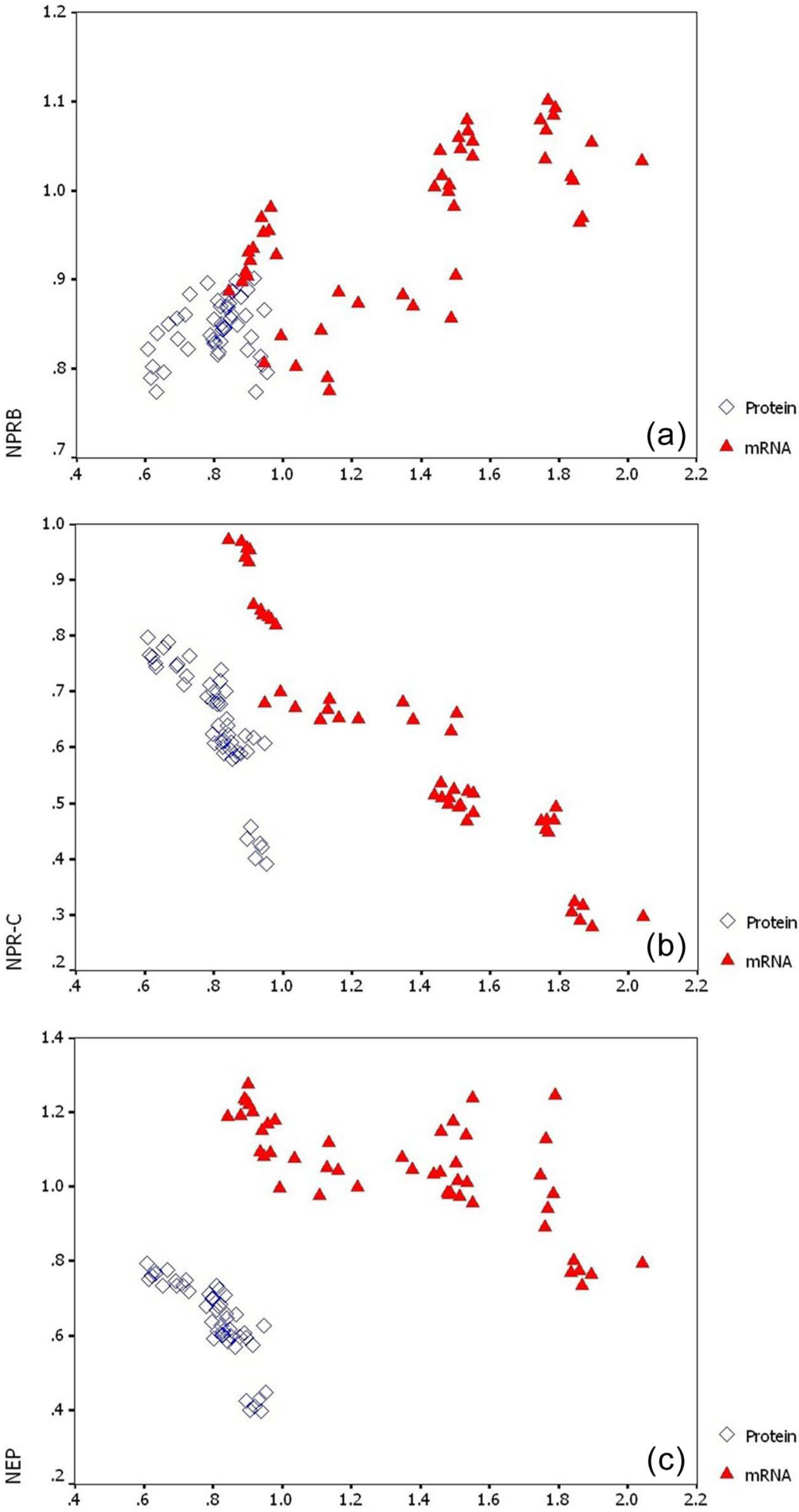
The correlations of (a) natriuretic peptide receptor (NPR)-B, (b) NPR-C, (c) neutral endopeptidase (NEP),with C-type natriuretic peptide (CNP) in the obstructed kidneys.
Discussion
During the last two decades, there has been a substantial increase in our knowledge of CNP, especially in the area of renal pathophysiology. It is clear that CNP expression is elevated in the obstructed kidneys. Our latest study published in Peptides demonstrated that urinary CNP excretion was significantly enhanced in UUO rats: to identify the origin of increased urinary CNP excretion in UUO rats, we also simultaneously determined CNP concentrations in the abdominal aorta and the renal vein, and found that urinary CNP excretion was markedly higher than CNP concentrations both in the abdominal aorta and in the renal vein, and almost identical concentrations in these two vessels excluded major renal extraction of circulating CNP of systemic origin. 14 The results of our previous study indirectly support the view that the increased urinary CNP excretion in UUO rats mainly comes from the up-regulated renal expression. More persuasively, in the present study, we directly observed that the expressions of CNP mRNA and protein in the obstructed kidneys tended to be higher immediately after ligation and declined at later time points compared to SORs, measured by real-time PCR and western blot analysis. An increased CNP level in renal tissues may not only be the result of enhanced synthesis, but also due to the diminished clearance. 15 Therefore, the principal aims of the present study were twofold: (a) to identify the endogenous production of NPR-B, NPR-C and NEP; and (b) to assess the correlations of NPR-B, NPR-C, NEP with CNP in the obstructed kidneys.
NPR-B, a single-span transmembrane protein, possesses a particulate guanylyl cyclase domain and is thought to specifically mediate the biological actions of CNP through the intracellular accumulation of cGMP. 16 Several prior studies have attempted to determined the location of NPR-B in the kidney. According to the report of Lohe et al., 17 using real-time PCR of mRNA for NPR-B from microdissected sections of nephron, NPR-B mRNA was noted in the rat distal convoluted tubule, and cortical, outer medullary, and inner medullary tubule. Millul and coworkers revealed that NPR-B was expressed in a human cortical collecting duct cell line. 18 Similarly, CNP mRNA was also predominantly expressed in tubular epithelial cells. The presence of NPR-B and CNP in rat kidney confirms a role for CNP as an autocrine or paracrine factor. In the present study, our results demonstrated that NPR-B expression was significantly higher in the obstructed kidneys, compared to the left kidneys of SORs; subsequent correlation analysis indicated that CNP mRNA was positively correlated with NPR-B mRNA (r=+0.673, p<0.05). Therefore, a high level of CNP may contribute to the elevated expression of NPR-B. Doi et al. 19 studied vascular smooth muscle cells treated with CNP, and found that NPR-B mRNA was significantly expressed after 48 h exposure to CNP in a concentration-dependent manner. On the contrary, the upregulated NPR-B may play a synergetic role with CNP. When vascular smooth muscle cells were transfected with the NPR-B cDNA in vitro, cGMP elevation was significantly dependent on CNP levels. 20 More persuasively, NPR-B could activate a particular guanylyl cyclase that resulted in suppression of intracellular calcium release from the sarcoplasmatic or endoplasmatic reticulum, and eventually accelerate renal vascular smooth muscle relaxation. 21
NPR-C does not possess the guanylyl cyclase domain and is thought to be engaged in the receptor-mediated degradation of CNP. 22 An earlier study conducted by Zhao et al. has demonstrated that NPR-C mRNA was mainly detected in glomerular mesangial and epithelial cells. 23 In the current study, our results indicated that UUO could increase NPR-C expression, which was accompanied by a significant decline in CNP (r=−0.943 and −0.837 for mRNA and protein respectively, p<0.05). Several lines of evidence support the view that NPR-C has a major role in the removal of its ligand. A previous study carried out by Woodard et al. 24 indicated that NPR-C expression was significantly increased in renal glomeruli under hypertrophy and growth situations, and negatively correlated with CNP expression. Of course, both our study and the above-mentioned literature do not mean there is a direct effect of NPR-C on CNP metabolism. Further investigation, such as the establishment of NPR-C knockout animals and elucidation of the intracellular signaling pathway of NPR-C, will be necessary to provide more detailed insight into the possible involvement of NPR-C.
NEP is a 90–110 kD zinc-dependent metallopeptidase, identical to the common acute lymphoblastic leukemia antigen. 25 It is expressed in brain tissue, on polymorphonuclear leukocytes and lymphoid progenitor cells, and on epithelial cells within nonlymphoid organs, such as the kidneys, the liver, the breasts and the lungs. 26 As the first human podocytic antigen, NEP has been documented to induce the onset of proteinuria in membranous nephropathy. 27 In our previous report, NEP was not only involved in the disarrangement of CNP catabolism, but also produced the enhanced glomerular permeability to protein in membranous nephropathy. 28 The current study focused on the expressive features of CNP and NEP in the obstructed kidneys for the first time, and found that NEP expression was markedly augmented in UUO rats during the period from 72 h to three months post-ligation, negatively correlated with CNP expression (r=−0.687 and −0.823 for mRNA and protein respectively, p<0.05). In the rat kidney, NEP is abundant in the proximal tubule brush border. CNP is inactivated by NEP, and therefore local CNP may be degraded before arrival in the lumen of the collecting duct, offering a plausible explanation for its weak natriuretic effect. 29
In summary, we demonstrated that CNP expression tends to be higher immediately after ligation and declined at later time points. A high level of CNP may contribute to the elevated expression of NPR-B in the early phase of UUO. More interestingly, the sustained upregulation of NPR-C and NEP observed throughout the study period (that is up to three months) helps to, at least partly, explain the subsequent decline of CNP.
Footnotes
Conflicts of interest
None declared.
Funding
This study was supported by the National Natural Science Foundation of China (No. 81000306) and the Post-Doctoral Foundation of Anhui Medical University (No. 2009KJ02).