




Abstract
Student-centred, active learning approaches such as project-based learning (PBL) are considered more authentic and motivating than traditional passive teacher-centred learning approaches. This study investigates student experiences and evaluations of accredited PBL (otherwise termed as Work-Integrated Learning) in the business discipline. Students were provided with project briefs from industry, and over the course of 3 months worked in teams to address the brief. This study examines how PBL impacts on development of authentic learning, and the impact of motivation and expected value perceptions, through the lens of the self-determination and expectancy value motivation theories. Interviews were conducted with students (n = 6), and qualitative data analysis revealed three themes: (1) Real life context as facilitating deeper and more authentic learning, (2) Influence of others, enjoyment and perceived value as impacting positively on motivation and affect related to achievement and (3) Unmet expectations, lack of clarity and communication as impacting negatively on motivation and affect related to achievement. Findings are presented under respective themes and sub-themes and related teaching and learning implications are discussed with regards to PBL design and implementation, authentic skills development and the influence of motivation. Findings can inform appraisal and design of PBL approaches.
Keywords
Introduction
There has been a general recommended movement from traditional teacher-centred passive learning approaches (lectures) to active, student-centred, constructive approaches, which are considered more authentic and more motivating for students (Cooper et al., 2017; Geertshuis et al., 2022; Newmann et al., 1996; Tremblay-Wragg et al., 2019). Project Based Learning (PBL) is an example of an authentic, active learning approach, typically involving students working on a collaborative project with industry and thus facilitating learning and skills development in a real-life context (Parsons et al., 2021). The aim of this project is to evaluate a PBL approach to identify related learnings for teaching practice, specifically evaluating (1) How does PBL impact on development of authentic learning goals and (2) How does student motivation impact on achievement during PBL? A conceptual framework of the relationship between motivation, achievement and implications for Teaching and Learning in a PBL experience was developed, informed by the literature review and interviews with students who had participated in PBL were conducted to collect data related to the aspects in the framework.
Literature Review
Constructivist learning theory (Dewey, 1958) and concepts regarding the construction of knowledge (Newmann, 1996) rationale a more student-centred, constructivist approach. The constructivist orientation with regards to teaching challenges the traditional learning process where students passively receive information (Newmann et al., 1996). Considering the nature of student learning as a ‘complex, active mental process’ (Newmann et al., 1996, p. 285), there is general consensus that in order for effective, deep learning and related achievement, students should be developing knowledge and constructing meaning grounded in active experiences where they are required to work on, process and interpret information rather than simply passively receiving knowledge (Newmann et al., 1996; Parsons et al., 2021; Riley & Ward, 2017).
Some active learning experiences are situated in an authentic context, providing students with opportunity to apply knowledge to a real-life scenario to develop and practice skills and competencies needed in the workplace (Villarroel et al., 2017). PBL, where students work on live industry projects, is one such example of an authentic learning approach, which is authentic not only in providing insight to how knowledge is applied in real-life, but also in requiring complex collaboration among students (Herrington et al., 2010; Ornellas et al., 2019; Parsons et al., 2021). In PBL, the role of the educator is generally advisory, and students typically work in teams over a time-bound period, to solve a problem or complete a task which requires various activities that drive multimodal learning (Palmer & Hall, 2011; Parsons et al., 2021).
PBL accords with the increased demand for ‘skill-based learning’ and ‘career-orientated education’ (Alamri, 2021) and can be considered an example of Work-Integrated Learning (WIL; Lasrado et al., 2023; Nhat Lu et al., 2018). WIL ‘connects students with community and industry partners through working on authentic tasks and projects to develop their professional capabilities’ (Jackson et al., 2020, p. 2). Offering skills-based learning on university programme curricula is useful considering demands from students themselves and parents for courses which provide skills-based learning (Alamri, 2021) that equips students for future employability, and also considering demand from industry for work-ready graduates, and the industry trend towards skills-based hiring where a greater emphasis is placed on student capability with regards to relevant skills than academic achievement (DeMark & Kozyrev, 2021; Kokai, 2022).
Previous research has found PBL to have various academic and non-academic benefits, for example: development of research skills, teamwork skills and time management, critical thinking, problem solving and metacognitive skills (Belwal et al., 2020; Childers et al., 2020; Cummins & Johnson, 2021; Thomas, 2000). PBL also has been found to have benefits for peer learning in that it facilitates students learning practical and interpersonal skills from others in their group (Belwal et al., 2020). It is also considered to be useful for employability and preparing students for future careers (Lasrado et al., 2023; Nhat Lu et al., 2018).
Research on student perspectives of PBL has however identified some challenges with this approach, for example: increased time pressures and workload (and related stress), uncertainty in the project assignment and challenges related to collaboration between students, such as conflict resolution, different time schedules and frustrations with differences in team member contributions (Hall et al., 2012; Hussein, 2021; Lee et al., 2017; Nhat Lu et al., 2018).
Theoretical Framework
Gulikers et al.’s (2004) five-dimensional model for authentic instruction summarises ‘authentic learning goals’ as knowledge, skills and attitudes (KSA’s), integration and coordination of KSA’s and (cognitive) flexibility/applying in new realistic situations. It is of interest in this study to examine how PBL contributes towards development of the authentic learning goals specified in the model, that is how does PBL develop or modify knowledge, skills and attitudes and how do students integrate these KSA’s and apply them in new situations.
Motivation has a significant impact on students learning and achievement (Berweger et al., 2022) as motivation effectively incentivises individuals to take action to achieve goals or fulfil needs or expectations (Gopalan et al., 2017). Self-determination theory (SDT) is a motivation theory which presents motivation as a multidimensional construct (Taylor et al., 2014) and relies on the premise that humans are motivated intrinsically if they value an activity (e.g. if they find it interesting or enjoyable), or extrinsically if there is external coercion or reward or consequences for completing or not completing a certain behaviour (Karimi & Sotoodeh, 2019; Leenknecht et al., 2020; Ryan & Deci, 2000). Many learning activities provide extrinsic motivation as they are linked to grades, and students recognise that there are rewards and consequences for conformance or non-conformance with particular behaviours (such as the requirement to submit an assignment to pass the module; Taylor et al., 2014). The anticipated or perceived value of the activity or behaviour (e.g. benefits for future employment) has also been found to provide extrinsic motivation in the educational context (McCartan et al., 2023). However, the literature generally finds that those who are intrinsically motivated have greater engagement and interest in the activity, and therefore have better performance outcomes on the activity, in comparison with those who are externally motivated/controlled to complete an action (Karimi & Sotoodeh, 2019; Ryan & Deci, 2000). Educators typically aim to design learning experiences which stimulate interest and enjoyment in students, considering that the more intrinsically motivated they are, the more likely they are to engage and to have positive outcomes with regards to achievement. Therefore, it is of interest to examine how student motivations and achievement varies in a PBL learning experience.
Another theory of interest with regards to PBL is the (Situated) Expectancy Value Theory (Eccles et al., 1983; Eccles & Wigfield, 2020). The Expectancy value model of achievement choices conceptualises the impact of Expectation of Success and Subjective Task Value on Achievement-Related Choices and Performance. Subjective Task Value incorporates four aspects in the latest model (interest (enjoyment) value, attainment value, utility value, relative cost; Eccles & Wigfield, 2020). Therefore expectancy value theory (and achievement outcome) is essentially based on three elements: expectancy, value and cost, premising that students will be more engaged in an activity if they perceive it to be valuable to them, if they expect to succeed at the activity and that their engagement will be mediated by the perceived cost they associate with participating in the activity (Wigfield & Eccles, 2000). These elements of motivation are interesting to examine alongside the extrinsic/intrinsic (SDT) viewpoint, as they provide a framework and nomenclature which is useful when considering influences on extrinsic and intrinsic motivation. In the literature, expectancy-value is typically considered using quantitative item measures and scales (e.g. Berweger et al., 2022; Dietrich et al., 2017; Harter, 1981; Wigfield & Eccles, 2000), it is therefore of interest to examine qualitatively how students discuss these constructs related to expectancy value theory, specifically in a PBL context.
Conceptual Framework
A conceptual framework related to the aim and research questions, and informed by aforementioned frameworks and theories has been identified (Figure 1), and is presented and discussed below.
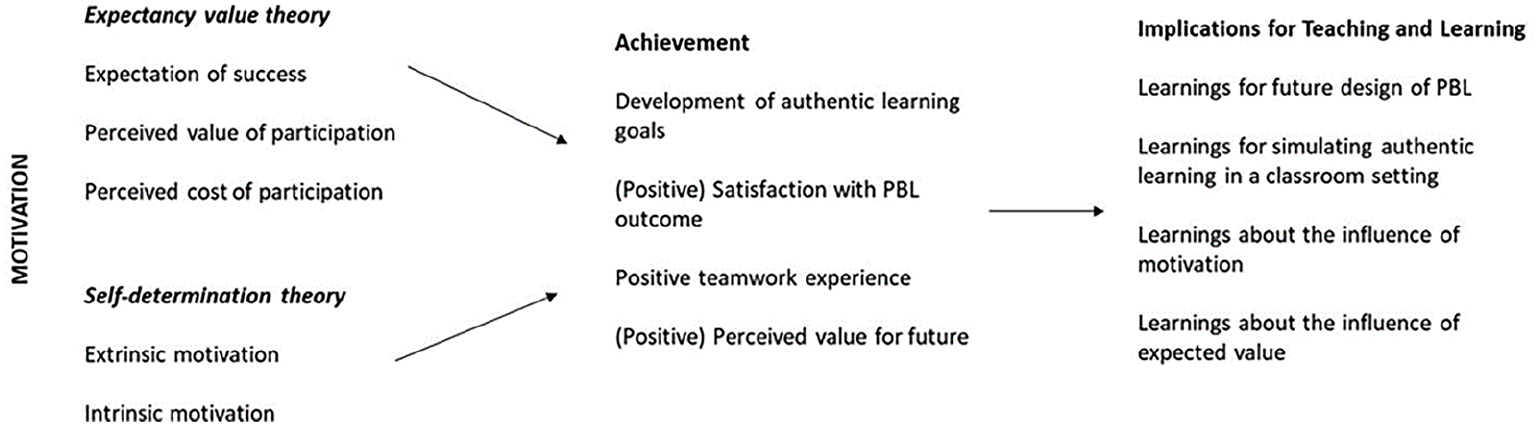
A conceptual framework of the relationship between motivation, achievement and implications for Teaching and Learning in a PBL experience.
This framework hypothesises that investigating how authentic learning goals developed during project tasks and the overall PBL experience has potential to not only inform learnings for future implementation of PBL, but also to inform how these learning goals can be developed or simulated in the classroom in a non-PBL context. Learning context can impact on student motivation and achievement (Gopalan et al., 2017). This study considers specifically the learning context of PBL, examining how students’ motivation and value expectations impact on achievement. As outlined in the model, achievement is defined as positive affect related to PBL outcomes, the teamwork experience and perceived value for the future and with development of authentic learning goals. When assessing achievement, negative and positive emotions will be probed for and considered at both the data collection and analysis stages.
Methods
One-to-one interviews were used to collect qualitative data from Cork University Business School (Ireland) students who had completed a module (Food Business Sustainability) which involved PBL as a mandatory assessed component.
At the beginning of the module, students were allocated into groups (approximately five to six students per group) and each group was provided with a project brief from industry. Briefs had previously been submitted by company representatives following advertisement, and briefs were discussed and agreed by the company representative and the module lecturer, to ensure the tasks were suitable for the students and achievable within the timeframe of the module. The module was delivered over 12 weeks in one semester, and students were actively working on the projects for approximately 8 to 10 weeks, accounting for time to meet the company at the beginning of semester to discuss the brief, and time to write up the report at the end of the semester. The learning outcome related to the PBL task was ‘ . . . [to] apply knowledge of food marketing and sustainability considerations in a real-life context’. Each brief had approximately three objectives or tasks for the students to complete, and tasks set by each company varied. Examples of tasks included developing website and/or social media content for the brand, conducting desk research on a new market or product category the company was considering entering, conducting primary research with consumers relating to new or existing products and developing new product concepts and related marketing strategy. Each of the companies partnered with had a sustainability accreditation, and each project involved an element related to further promoting their sustainability activity and/or further developing their adherence to sustainability principles. Students were first introduced to their company project brief by the module lecturer, who explained the brief and any other relevant information from prior discussion with the company representative. The following week students (and the module lecturer) met with the company to discuss the brief and intended outcomes. Approximately 3 weeks later the students, company and lecturer met again for an update presentation where the students outlined work to date and their action plan moving forward to complete the tasks. Prior to, and following this presentation, students interacted with the company independently via email and online meetings to further discuss tasks and update on progress as required. At the conclusion of the semester, the students submitted a report and any accompanying artefacts (e.g. images created for social media) to the company and to the lecturer.
Using a qualitative method for this study was considered most appropriate to explore the research questions and allow for in-depth conversations with participants, and one-on-one interviews were chosen to allow for exploration of individual experiences and to reduce issues of impression management and bias that may occur in group interview/focus group settings (Grimm, 2010).
An interview topic guide (Supplemental Appendix 1) was developed considering the research objectives and related framework and Gulikers et al.’s (2004) framework and above discussed motivation theories. The topic guide consisted of three sections relevant to all participants: (1) Project details and responsibilities, attitudes, expected value and motivations, (2) Development of skills and knowledge, (3) Cognitive flexibility/applying in new realistic situations and attitudes and a fourth section (4) Accredited versus non-accredited PBL experience, which was asked only to students who had previous experience with an extra-curricular PBL initiative (which students in this programme had opportunity to get involved with in the previous and current year).
This study received ethical approval from University College Cork Social Research Ethics Committee. An invitation to participate in the interviews was disseminated via email to all students (n = 39) who completed the module in the 2022/2023 academic calendar year, once they had completed all examinations for the module. An information sheet with details of what participation would involve, and a consent form were disseminated, and those who were interested in participating were asked to indicate this via return email to the researcher, and to return the completed consent form. A €25 incentive was offered for participants. Interviews took place virtually via Microsoft Teams, and lasted for approximately 20 to 30 min. Interviews were recorded and transcribed to facilitate data analysis.
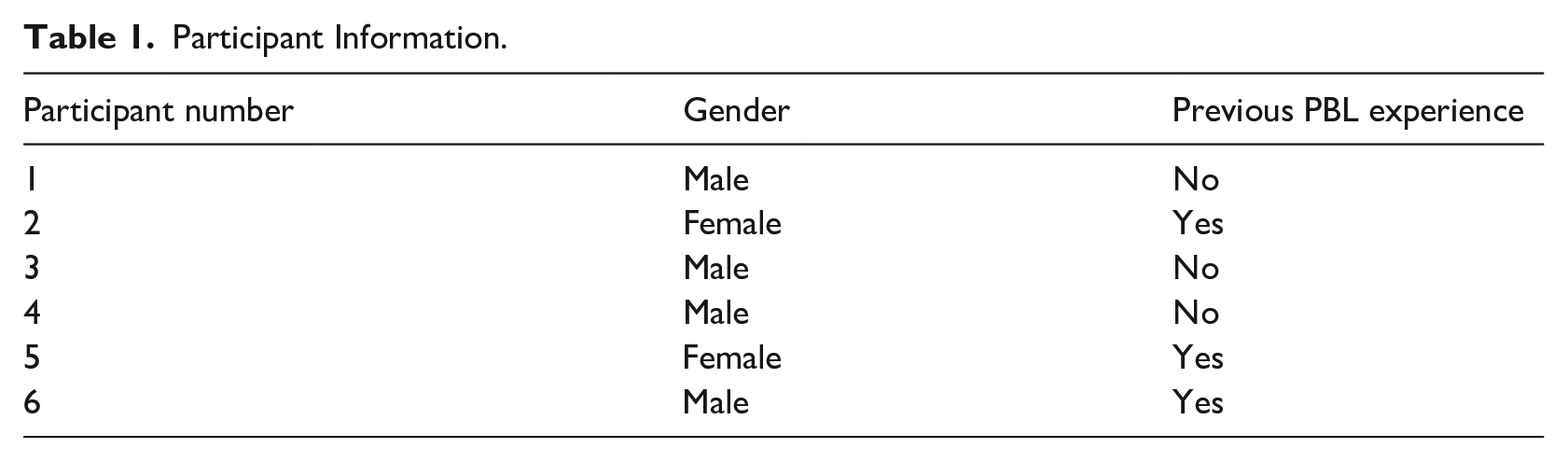
Six students elected to participate (four males and two females), and of these two had prior experience with extra-curricular PBL, and another had previous experience working on an accredited PBL experience (Table 1). The students represented four different project groups.
Participant Information.
Following the interviews, data was transcribed and anonymised to ensure that no details were included which would identify either the student, or others who may have been mentioned in the interview (e.g. lecturers, names of businesses or business owners/employees worked with).
Transcripts were then uploaded to NVivo to facilitate coding, and identification of categories and themes. Prior to beginning coding, some predetermined categories to organise codes into were identified (e.g. ‘skill development’, ‘knowledge gained’, ‘challenges’, ‘motivation’ and ‘expectation’), and during coding further categories and codes inductively emerged (e.g. categories such as ‘Future improvements’ and ‘Positive outcomes/affect’, and codes such as ‘Benefit for future’, ‘Desire for more contact’ and ‘Delegation of tasks’). Codes and categories were re-read and considered, consolidating and/or updating code/category names as relevant. Data was then reviewed to identify if there were any clear themes emerging, and consideration was given as to whether an inductive or deductive approach would be more appropriate for identification of themes and sub-themes. An inductive approach (e.g. Braun & Clarke, 2006), involves identifying themes which emanate from the data, even if the ‘themes’ may not necessarily align with the prior identified research objectives, while a deductive content analysis approach (e.g. Hsieh & Shannon, 2005) involves deductively organising data into categories (and sub-categories) according to the research objectives and conceptual framework. Alternatively, a blend of both inductive and deductive methods, can be used, whereby data is first deductively analysed into categories according to a conceptual framework or research objectives, and then data is inductively analysed to identify themes across or within categories (Beacom et al., 2022). Prior to analysis, it was anticipated that a deductive approach would be used, organising all data under categories/themes aligned with the framework constructs. However, considering that the sample size was smaller than anticipated, it was decided that an inductive thematic analysis would be more suitable, identifying key emanating themes which were well supported by the data, rather than trying to make generalisations (e.g. level of agreement or conclusions) about each construct and the relationship between them. Supporting this, Braun and Clarke (2006) discuss how there is no minimum amount of data that is needed for a theme, and how a theme could even be based on data from one research participant, should the content be rich and/or significant enough. Codes, categories and themes were discussed and reviewed by the research team to ensure inter-rater reliability. See Supplemental Appendices 2 and 3 for full overview of categories, codes and themes.
Results
Three themes were identified: (1) Real life context as facilitating deeper and more authentic learning, (2) Influence of others, enjoyment and perceived value as impacting positively on motivation and affect related to achievement and (3) Unmet expectations, lack of clarity and communication as impacting negatively on motivation and affect related to achievement.
Theme 1: Real Life Context as Facilitating Deeper and More Authentic Learning
Practical Tasks as Increasing Engagement, Ease of Learning and Flexible Application
PBL was discussed by students as being a beneficial mode of learning. Students indicated that the nature of the projects required them to engage more with content than they may otherwise have: ‘I feel like I apply myself much more during the projects [than in the classroom]’ (P1), and therefore provided them with a deeper learning experience: ‘ . . . because learning stuff in real life, you can't forget it because it’s just ingrained in from the experience’ (P6). As well as providing deeper learning, it was indicated that this ‘practical’ mode of learning was ‘easier’: ‘ . . . when you’re in [a] real life project, you’re more into it . . . it’s much more practical a way so that you will learn easier’ (P5). Exposure to the need to ‘think on the spot’ and flexibly apply learning while engaging with industry was mentioned: . . . when you’re working in class, you can take down your notes . . . but [when dealing with industry] you need to take in information straight away and be able to spew out what you know or what you can do for them like on the spot (P6).
Exposure to Idea Negotiation and Real-Life Decision Making
An interesting aspect discussed by students (n = 3) was the way in which the real-life project provided the students with insight into negotiating ideas, that is the back and forth process of idea generation and all of the factors that go into actioning ideas in a real-life context, and experience of coming up with ideas which were not taken any further or which in the companies context would not work: . . . we’re used to like going ahead with all the ideas that we’ve ever come across. Then this project kind of put us back in our place when people were like, actually, no, I don’t think that will work, but this might, and that definitely gave us an insight into what marketing probably will be like, you know, like not every idea you come up with will be liked by others or will continue on (P2), I remember when we were doing the logo, we kind of all imagined that oh the logo you can change it quickly, but then he came back and said listen we can’t change them over straightaway we’ve packaging we’ve all that stuff we’ve other people in the business as well who will have a say in it . . . we didn’t really see how complicated these small changes might be (P4).
Professional Communication as a Key Authentic Learning
In terms of skills developed, the primary benefit discussed by participants was the opportunity to develop communication skills, through general communications with industry representatives, through presenting to industry and while negotiating with team members on task decisions. Communication skills with team members and industry were a key requirement for success in this project, and these skills were discussed by all participants as being well developed during the project. It was indicated that PBL enabled these skills to be developed in a deeper way than a classroom setting would have facilitated: ‘all the skills related to human interactions . . . you cannot really have that in class’ (P5). Communicating with industry was considered daunting, particularly for those who did not have previous experience with this from a previous PBL project. It was however suggested by one student that it would be useful for further guidelines to be provided with regards to professional communication.
Theme 2: Influence of Others, Enjoyment and Perceived Value as Impacting Positively on Motivation and Affect Related to Achievement
With regards to value expectancy, all participants discussed the perceived value of participation but did not discuss the perceived cost (likely as it was mandatory for marks). Students were extrinsically motivated by grades but also indicated that they were more intrinsically motivated related to the unique context of PBL.
Extrinsic Motivation From Grades, Industry and Peers
PBL provided extrinsic motivation from grades, industry and peers. The grade associated with the project was indicated to be a primary motivator for two students, ‘you didn’t have the choice to do it . . . I did want the good grade’ (P4).
Aside from grades, students (n = 2) indicated strong external motivation from industry: . . . [owner name] . . . was waiting on the work as well. So we kind of put more urgency in this. And also because they’ve using it in real life you kind of wanted [it] to be near perfect for him to use (P4), It was what the company expected us to do . . . that was like what motivated me and to be able to help them to achieve like the export of their products which was very important (P5).
It was further indicated by one student that working within the context of a team with others provided motivation: ‘ . . . as you’re working a part of a team, you have to pull your own way’ (P3).
Half of the participants had prior experience working on extra-curricular PBL and opinions were mixed with regards to whether they were more motivated during the previous extra-curricular PBL experience ‘just the fact I signed up for it I feel like I could have been a little bit more motivated’ (P2), or during this PBL experience for credit ‘I put a lot more time into it because we had to do it [rather than the extra-curricular PBL initiative]’ (P6).
Another participant indicated how in the extra-curricular context people were more likely to disengage: ‘Whereas I think in this module project that can’t happen because you have to do it’ (P2).
All participants discussed how their group had delegated tasks and there was also evidence in some groups of one student taking the lead in delegating tasks, creating file sharing sites or communicating with industry. Delegation was indicated to impact positively on achievement, and student discussion related to delegation indicated that it provided both intrinsic and extrinsic motivation. Students being allocated tasks by other group members that they were expected to complete, either individually or in smaller groups within the team provided extrinsic motivation, and being able to decide on individual tasks according to interest and experience provided intrinsic motivation and will likely also have increased students feelings of self-efficacy and expectations of success in the task(s). There were no negative comments about the groupwork experience, apart from one student noting that they would have preferred an individually assessed component of the assignment, considering the scope for less engaged members to benefit from others efforts.
Intrinsic Motivations – Interest and Perceived Benefit
Most students (n = 4) expressed positive expectations about the project based on their perception of how enjoyable and useful they would find it: I was quite excited to work with a company because I feel like modules like this give us a better understanding of what we could be doing in the future (P1), I was looking forward to it because . . . it was working with businesses so it’s a lot more hands on. And it’s different from the normal exams or normal coursework (P4).
Most respondents (n = 4) referred to PBL as being more motivating than, or preferable to other forms of assessment as they perceived it to be more interesting and more valuable: I’d be a lot more motivated to do the kind of project work rather than an assessment like a proper written exam because I find it much more interesting and beneficial (P1).
Expectations of outcomes with regards to the satisfaction of seeing companies use their work was also discussed by one student as an intrinsic motivator.
Perceived Value for the Future
Perceived value of the project centred around benefits for the future which regards to takeaway learnings which will be useful for future job roles and applications. Two students mentioned aspects related to future career decisions, with one noting that they were now considering starting their own food business, and the other saying the experience had motivated them more to keep in their family business as they were inspired by the success of the company they worked with which had started as a small family business.
Students (n = 3) also considered the random allocation into groups as valuable for getting to know classmates and for preparing them for future work experiences: I think it’s absolutely essential [to be allocated groups] . . . me and my friends in my course we’re not all going to be working in the same places when we leave college. . . you have to keep your future career interests in mind so that’s what you need (P6).
Theme 3: Unmet Expectations, Lack of Clarity and Communication as Impacting Negatively on Motivation and Affect Related to Achievement
Previous Experience as Impacting on Expectations and Achievement Evaluations
Half of the participants had prior experience working on a PBL project (either extra-curricular or for credit). This appears to have had a significant impact on student expectations regarding this project experience. Prior experiences with PBL were very positive, therefore aspects of this project which differed from former experiences (e.g. less contact with industry, work not being used) appeared to be considered negatively in comparison to their previous experience.
The previous PBL experience followed a different format with regards to communication with industry, and based on this more communication and collaboration with the company was expected during this project. One student discussed how previous PBL experience where they had seen work being used during the project was a motivator for this project, but when this was not realised it created some negative affect related to achievement. However, despite unmet expectations, overall affect related to achievement in terms of outcomes was positive: ‘I felt like we did all the tasks they asked us to do’ (P5), ‘I was really happy with what we did . . . I definitely felt like we achieved a lot’ (P2).
Desire for Structured Communications and Reporting to Increase Motivation and Achievement
There was some indication (n = 4) that students would have benefited from further structure around the project with regards to further clarity around expected outputs ‘[a challenge] was to understand what the company really wanted us to do’ (P5) and more regular meetings with and/or reporting to the companies: [regarding having more regular meetings] I prefer that because it keeps it a routine and it keeps everyone up to date on what we’re doing every single week. So I think you can probably be more productive (P6).
A shorter time frame was also suggested by one participant as being potentially beneficial with regards to motivating them to work consistently on the project: Sometimes if it’s too long, it can kind of drag on and people . . . just kind of forget to do it for a while . . . [if the deadline was moved forward] that would maybe motivate people to do it earlier rather than later (P1).
Discussion
The Real-Life Context Provided by PBL Facilitates Deeper, More Authentic Learning
Findings accord with the literature in further rationalising the usefulness of active learning and collaboration and interaction among students, to facilitate deeper, more authentic learning (Herrington et al., 2010; Parsons et al., 2021; Preus, 2012; Riley & Ward, 2017). Students perceived the real-life context as making learning easier and indicated that the requirement for interaction with knowledge (as opposed to passively receiving it) facilitated deeper, longer-term learning (Newmann et al., 1996; Parsons et al., 2021).
Students discussed authentic learnings provided by the authentic context, such as how to communicate professionally with those in industry (formally and informally), and insight into how learning gained in the classroom is practically applied in real-life scenarios.
An interesting learning discussed was how the real-life context provided students with insight into real-life decision making, that is, how ideas and their feasibility are negotiated and the different actors involved in decision making. Idea feasibility is something that students may have limited insight into when completing typical learning tasks/assessment (i.e. those without real life context/feedback from industry), as without this external influence, they are more likely to decide on an idea either individually or in teams and move it forward, without fully debating or considering the actual feasibility of their idea. Further, depending on the nature of the assessment (and perhaps too the size of the class) they may also not have opportunity to discuss the idea with the educator and get feedback from them prior to submitting and receiving summative feedback.
Formative Feedback in the Classroom Can Simulate Learning on Feasibility in a Real-Life Context
From a teaching and learning perspective this discussed aspect of insight into idea negotiation and feasibility in a real-life context is interesting and indicates scope for educators to more consciously provide formative feedback where possible, and to consider designing assignments with an integrated element of feasibility testing or feedback, rather than students developing ideas (e.g. for in class projects, case study responses, etc.) which in practice may not be feasible or appropriate in the context. Students may tend to consider ideas from one perspective related to their programme/course of study or the module they are studying, therefore for degree programmes where students have some interdisciplinary knowledge it would be useful to encourage students to think about and debate ideas from different perspectives when decision making while completing assessments. One way of doing this may be by implementing a Process Oriented Guided Inquiry Learning (POGIL) approach – a teaching approach where students work in small groups on specially designed inquiry materials which aim to develop transferable process skills such as critical thinking, teamwork and problem solving. POGIL is a student-centred approach, with the instructor acting as a facilitator rather than as the source of information (POGIL, 2023; Walker & Warfa, 2017).
Importance of Integrating Tasks to Develop Professional Communication Skills Into Modules
Regarding the importance of communication skills, it is important that students are advised on, and have experience with, professional communication via different formats, for example oral presentations (both in-person and online), written documents and email communications. Requirements for development of communication skills can be integrated at a programme level (e.g. requiring that each semester students are required to complete at least one presentation in at least one module), and diversity of assessments and practical tasks in a class setting within modules can also be planned to incorporate opportunities to address communication skills development through various formats.
Knowledge, Skills and Attitudes Developed Through PBL Can be Transferred to Future Learning and Workplace Experiences
Inquiry related to the learning goal concepts in Gulikers et al.’s (2004) model provided insight as to how knowledge, skills and attitudes were developed and evolved, and there was some evidence of how students who had worked on previous PBL transferred KSAs from previous experience to this PBL experience, and students indicated how KSAs from this experience would inform future work experiences. Although previous research has identified various additional benefits from PBL with regards to knowledge and skills development (Belwal et al., 2020; Childers et al., 2020; Cummins & Johnson, 2021; Thomas, 2000), considering the small sample size, the presentation of results focussed on the most prominent ones.
Practical Considerations for Educators to Overcome Identified PBL Challenges
As challenges were not prominently discussed by participants, they were not addressed as a specific theme, however challenges are noted within themes, with key challenges relating to lack of communication with industry, lack of clarity related to the project brief and expected outcomes and unmet expectations. These challenges align with those previously identified by Hussein (2021) during evaluation of PBL.
To address these challenges, it is important in PBL that project briefs and expected outcomes are clear and at a level appropriate to the students’ knowledge and experience to avoid frustration and disengagement. It is advisable for the lecturer to meet with each company in advance to discuss the brief and make any related amendments before presenting it to the students. However, in this study the finding that uncertainties remained related to the briefs despite them being pre-amended, indicates need for more direct communication between the company and students to discuss what is expected.
Hussein (2021) recommends a structured approach to checking progress regularly and obtaining feedback from stakeholders during PBL. Therefore, in response to the discussed challenges of uncertainty around the project brief and of lack of communication, it may be useful to have a pre-arranged agreement with the companies regarding their involvement and communication with the students, for example, prior arranged weekly or fortnightly meetings. For this project, over the 12-week period, the lecturer had prior arranged two meetings with the company (one introductory meeting 1 week after the students had been introduced to the brief, and one meeting 3 weeks later to present an overview to the company of how the students planned to address the project objectives, and to discuss next steps). Outside of these two meetings it was the student’s responsibility to arrange and maintain contact with the companies, via meetings and via email. It was considered that this flexible approach in allowing students to co-ordinate meeting times themselves would be most time effective, as meetings could be arranged when suits both and as needed according to project tasks. However, as outlined in the findings, there was some indication that students would have preferred a routine of pre-arranged meetings to keep them accountable and on track, while others considered the approach of two pre-arranged meetings and co-ordinating own meetings to be adequate. Some students had prior experience working on an extra-curricular PBL experience with pre-arranged weekly meetings, and preferred this approach. The approach of structured meetings is also supported in the literature as being preferred (Hussein, 2021).
One student comment that they would have preferred an individually marked component raises questions for designing PBL assessments – previous study has also found that students (particularly high achievers) believe PBL where all team members receive the same mark is unfair as all team members may not contribute equitably (Lee et al., 2017). Therefore it would be useful to consider the merits of having an individually marked component, or perhaps more accountability regarding group member contributions, and using this as a means to alter individual marks should there be an issue with reduced contributions from one or more members. This individual reward/accountability could impact positively on motivation and achievement. It would be interesting to further explore student perspectives regarding how marks are allocated for group assignments and related implications for these assessments.
Theoretical Implications
Findings accorded with previous literature with regards to students being more motivated by an active mode of learning such as PBL as opposed to traditional lecture learning (Tremblay-Wragg et al., 2019). PBL provided strong extrinsic motivation as it was assessed, and as it involved working for and reporting back to a real company. There was also the additional extrinsic motivation of working in a peer group. These extrinsic motivations were however discussed as positive, as they encouraged students to work on the project.
Regarding intrinsic motivation, students enjoyed this mode of assessment and recognised the benefits of gaining real-life experience. The satisfaction related to helping companies and seeing them implement their work were also discussed as intrinsic motivations.
Findings related to aspects of the project that were motivating indicate that to motivate students it is important that tasks and expectations for outputs (related both to the project and to the assessment) are clear, and structure around the project including regular meetings/check-ins/communications is preferred.
The role of the timeframe in motivating students was also discussed, and it was considered that a narrower timeframe has potential to motivate students to work consistently on the project or to begin working on it earlier.
Regarding value expectancy, students appeared to positively perceive their self-efficacy regarding completion of tasks. This expectation was influenced by previous experience with project work, and by the group situation, where delegation of tasks was a key aspect of the teamwork experience discussed by all participants as the most efficient way to achieve the project outcomes. From a learning perspective, delegating tasks is useful as it replicates the real-life environment where team members have different roles, but it is important to emphasise to students the usefulness of collaboration and of discussing all aspects of the project together so that all team members have oversight and insight into different aspects, rather than students working independently and producing work that is not coherent.
Considering the value component of the construct, students had positive expectations regarding enjoyment and usefulness of the project. Students positively appraised working in teams they had not selected themselves as this was considered beneficial to get to know classmates better, and to prepare them for real-life working relationships. They also evaluated the experience as being useful for the future with regards to the experience, knowledge and skills provided and attitudes towards working in business.
There was no clear indication of students associating the project work with any particular cost (e.g. on time) and rather, as it was a compulsory part of the module, they accepted the need to complete the work, and were more likely to sacrifice on other tasks to complete it, for example one student noted how he had withdrawn from an extra-curricular PBL, to focus on this one.
Implications for Teaching and Learning
Educators should consider how learnings discussed by students as unique to the PBL experience could be simulated in a classroom environment, for example designing assignments and providing formative feedback in a manner which requires students to critique and adapt their decisions and thinking processes, in a manner similar to what a real life context would require, that is making decisions as a team and/or in consideration of the task or project being situated within the wider goals and context of the organisation. Further, as communication with industry was considered daunting by some, there is rationale for educators to seek to further integrate opportunities for students to learn about and have experience with various forms of professional communications, that is oral presentations to groups, written reports, email communications and spoken interactions with industry. Therefore considering these findings, the following is recommended for educators with regards to teaching and learning in PBL approaches: ensure the objectives and outcomes desired by the company are communicated clearly in the project brief and that tasks are at a level appropriate to student skills and knowledge, ensure clear guidelines in terms of outcomes required for the assessment component, prior arrange/agree a regular communication schedule between industry and students (e.g. weekly/fortnightly meetings for the duration of the project), discuss strategies for a successful teamwork and project management experience including the role both of delegation of tasks and whole team decision making, and seek to motivate students and set expectations by outlining the benefits of PBL to their own individual skills and knowledge development.
Limitations and Further Research
It is acknowledged that this study was based on a small sample size and that further data collection is needed to increase the reliability of the findings. It is interesting to observe that despite an incentive being offered, the response rate (15%) was relatively low. Although this is positive in one respect in that it does not indicate that students were biased or influenced to participate, ethical constraints related to timing of recruitment (at the end of the academic year, following completion of the module and release of marks, rather than during the module) may have impacted on the response rate. Ethical constraints around data collection with students are therefore important for educators to consider when designing pedagogy research, and constraints may vary depending on the institution/relevant ethical board and depending on the nature of the study. It could be considered that students who elected to participate were those who had a particularly positive experience, however offering an incentive mediates this bias as it adds an extrinsic motivation to participate. Offering a higher incentive may be useful in further study to encourage participation. Despite the acknowledged limitation of sample size, findings largely accord with previous literature, indicating reliability. Findings provide useful considerations for implementation of PBL and insight into the role of motivation and expected value, which can inform educators design and appraisal of current and future PBL approaches. Findings further provide rationale for using PBL, considering the positive effects of PBL on achievement related variables. Further research could quantitively explore the constructs of motivation, expected value and achievement to provide more conclusive findings regarding the impact of motivation and expected value on achievement, and to identify more specifically unique knowledge and skills developed through PBL. Further qualitative study with a larger sample and in other contexts and disciplines would also be useful to gain further insight on the constructs to further inform recommendations for design and implementation of PBL, and to examine if there are discipline specific considerations for PBL, or variations in its appropriateness and success across disciplines.
Conclusion
This study examined student perceptions with regards to how PBL helps develop skills and knowledge, and their motivations and value expectations related to PBL. Findings indicate that the authentic, real-life learning context provided by PBL provides useful learning that may not otherwise happen in a classroom setting, for example exposure to decision making processes within organisations, and experience interacting professionally with those in industry. Regarding the impact of motivation, PBL provided strong extrinsic motivations, but this extrinsic motivation was viewed positively by students who indicated preference for a structured PBL approach with regular communication and reporting and a reasonable timeline, to maintain motivation to complete project tasks. PBL also provided intrinsic motivation for students, related to their enjoyment and to recognising the usefulness of it for the future and participants indicated preference for this style of assessment finding it more motivating than other traditional forms of assessment. The teamwork experience was viewed positively, and a key aspect of team achievement appeared to be delegation of tasks. There was no evident relationship between how differences in motivation impacted on achievement, but this is something that could be further examined in a larger study.
Supplemental Material
sj-docx-1-alh-10.1177_14697874251365613 – Supplemental material for Student-Industry Partnerships and Project-Based Learning: Motivations, Achievement and Implications for Teaching and Learning
Supplemental material, sj-docx-1-alh-10.1177_14697874251365613 for Student-Industry Partnerships and Project-Based Learning: Motivations, Achievement and Implications for Teaching and Learning by Emma Beacom in Active Learning in Higher Education
Footnotes
Acknowledgements
Thank you to Dr. Anna Santucci and Professor Mary O’Shaughnessy for input on earlier phases of the work.
Declaration of Conflicting Interests
The author declared no potential conflicts of interest with respect to the research, authorship, and/or publication of this article.
Funding
The author disclosed receipt of the following financial support for the research, authorship, and/or publication of this article: This research was supported by the National Forum for the Enhancement of Teaching and Learning in Higher Education Strategic Alignment of Teaching and Learning Enhancement Funding in Higher Education 2022 fund supported by Centre for the Integration of Research, Teaching and Learning & Office of the Vice President for Learning and Teaching (UCC).

Supplemental Material
Supplemental material for this article is available online.
Author biography
References
Supplementary Material
Please find the following supplemental material available below.
For Open Access articles published under a Creative Commons License, all supplemental material carries the same license as the article it is associated with.
For non-Open Access articles published, all supplemental material carries a non-exclusive license, and permission requests for re-use of supplemental material or any part of supplemental material shall be sent directly to the copyright owner as specified in the copyright notice associated with the article.
