




Abstract
Relationships between landscape and motifs have featured in ‘rock art’ research worldwide. Yet there has been comparatively little exploration of rock art’s significance in constructing maritime lifeways. This paper uses a dataset of 3183 images from 65 island and coastal rock art sites in Yanyuwa Sea Country in northern Australia’s Gulf of Carpentaria to investigate how marine-centric concepts linked to rock art are applied to inscribe a seascape. To do this, we integrate a formal, style-based spatial analysis with knowledge shared by the Yanyuwa community over a 45+ year period. Yanyuwa understandings demonstrate how maritime imagery is implicated in a web of connections involving kinship, ceremony, spiritual beings, and the ancestral realm. Integrating western scientific and Indigenous approaches to rock art interpretation highlights how characterizing maritime-themed motifs goes beyond a consideration of iconographic content. This archaeological engagement with Yanyuwa rock art provides a framework for how deeper interpretations of Indigenous seascapes can be realised.
Keywords
Introduction
A core feature of ‘rock art’ 1 research worldwide has been the relationship between motifs and landscape. This approach has yielded insights into themes such as spatial and temporal patterning, style-based provinces, and individual and group identity (e.g., Domingo Sanz and Fiore, 2014; McDonald, 2017; Taçon, 2013). Research integrating Indigenous knowledge in the interpretation of rock art has been developing steadily (e.g., Abadía and Porr, 2021). The ‘braiding knowledge’ approach, combining western science with Indigenous knowledge, has featured in decolonizing archaeological practice more broadly (e.g., Atalay, 2020; Roberts et al., 2023). However, rock art in maritime archaeological spaces is rarely investigated from socially-informed perspectives, making archaeological studies bridging science and Indigenous knowledge to understand maritime-themed imagery infrequent (e.g., Fowler, 2015; McNiven and Brady, 2012).
In this article, western science and Indigenous knowledges are integrated to discuss how maritime specialists, known as Saltwater People, use rock art to convey connection to the aquatic environment. We develop a case study involving the rock art of the Yanyuwa Aboriginal community in northern Australia’s southwest Gulf of Carpentaria region. The study uses a dataset of 3183 motifs documented between 1980 and 2019 by a team of anthropologists and archaeologists in collaboration with Yanyuwa families. Critical to this endeavour are ethnographic insights shared over 45 years. The ways people perceive the sea and use their maritime knowledge to construct a societal worldview are highlighted – in this case, Yanyuwangala, the essence of being Yanyuwa.
Our study archaeologically classifies and determines the proportion of maritime imagery within the entire sample of Yanyuwa rock art. Maritime attributes including marine flora and fauna, marine-centric cosmological iconography, maritime hunting implements, and watercraft are identified. Both cultural and biological aspects of marine interaction are presented as ‘maritime’ due to the links between Yanyuwa lifeways and the sea with its creatures, via cosmology. We interpret the distribution of maritime imagery across clan-based and geographic perspectives. This exercise renders Yanyuwa cultural heritage through the lens of maritime archaeology.
Our research into maritime influences on Yanyuwa society applies the seascape framework, an anthropological perspective that understands the human spatial relationship to the sea as socially and spiritually modified (McNiven et al., 2008). We consider how Yanyuwa ontologies of rock art creation might coexist with the anthropological concept of the seascape and the archaeological classification impulse (Brady, 2020; Kearney et al., 2021). Here we combine archaeological methods, which rely on observed characteristics of motifs, and ethnographic methods, which rely on information from the community. Many maritime subjects are non-representational, in which case meaning is not self-evident and Yanyuwa social and cosmological revelations are essential for interpretation. Patterns within the assemblage of maritime imagery are contextualised using Yanyuwa insights to investigate the ways maritime lifeways are inscribed in stone on Country.
Approaches to maritime rock art
Since the mid-20th century, aspects of Aboriginal archaeology that relate to the ‘maritime cultural landscape’, integrating history, ethnography, and land-based residues of maritime culture with spatial understandings, have come to the forefront of research (McNiven, 2004). Relevant themes include the peopling of Sahul, Macassan contact, timescales for offshore island use, and potential submerged landscapes (e.g., Benjamin et al., 2020; MacKnight, 2011; Nunn and Reid, 2016; Sim and Wallis, 2008). Relatedly, the ‘seascape’ framework has discussed socio-environmental mind-maps that allow seagoers to understand their place in the world beyond land (e.g., Kearney et al., 2023; McNiven et al., 2008). However, critics still find the integration of theoretically and culturally situated approaches in coastal and maritime archaeology lacking (e.g., Fowler, 2015). In Australia, despite pictographs and petroglyphs being distributed across mainland, coastal and island contexts, connections between Saltwater People and maritime-themed rock art are less investigated than terrestrial themes (e.g., Bigourdan, 2013; McNiven and Brady, 2012). This paper builds on and adds nuance to pre-existing research by integrating maritime archaeological perspectives with anthropological ideas of the seascape and Aboriginal epistemology.
To many Aboriginal Australian groups today, marks on rock are ontologically distinct from western notions of ‘art’, and are closer to spatial embodiments of ancestors (Kearney et al., 2021). In Yanyuwa language, there is no word for ‘art’, and images found on rock are not considered the creation of humans, rather they are the work of Ancestral Beings, spirits of deceased kin and other entities who are continual presences in Country (Bradley and Yanyuwa Families, 2016). For Yanyuwa, the sea is not separate from the land as both are parts of Country that are named, known, spoken for, held, and cared for by human kin (li-Yanyuwa li-Wirdiwalangu Yanuwa Elders et al., 2023: 25). It may be tempting to rationalise cosmological aspects of rock art as merely Yanyuwa beliefs about reality (Alberti, 2016). However, circumventing Yanyuwa ways of thinking would prevent plural western and Aboriginal knowledges from meeting. Therefore, rock markings are not static relics of the past. They are closely entwined with kinship, songlines (see below) and people’s relationships with Country. While we adopt the term ‘rock art’, it is recognised that this archaeological perspective can braid with Yanyuwa perspectives to create meaning. This project examines how combining Yanyuwa knowledge with an archaeological approach to maritime-themed rock art reveals fundamental complexities in the ways people categorize and conceptualise their world.
Although the Northern Territory is renowned for its rock art, archaeological fieldwork on Yanyuwa Country (Figure 1) is far from extensive. Archaeological documentation in the Pellew Islands began in the early 1980s (Baker, 1984). In 1999, the Sir Edward Pellew Island Archaeological Project (SEPIAP) investigated regional habitation in response to rising sea levels and islandisation (Sim, 1999, 2005). Excavations on Vanderlin and Centre Islands revealed three discrete phases of Holocene-era occupation beginning c. 8000 BP (Sim and Wallis, 2008). Anthropological research into Yanyuwa culture and traditions began in the early 20th century (Spencer and Gillen, 1912). Later research documented Yanyuwa kinship patterns (Avery, 1985; Kirton and Timothy, 1977), the endangered Yanyuwa language (Bradley, 2017) and relationships with Country (Bradley and Yanyuwa Families, 2010). Location of Yanyuwa country in northern Australia (image: Fiona Holley).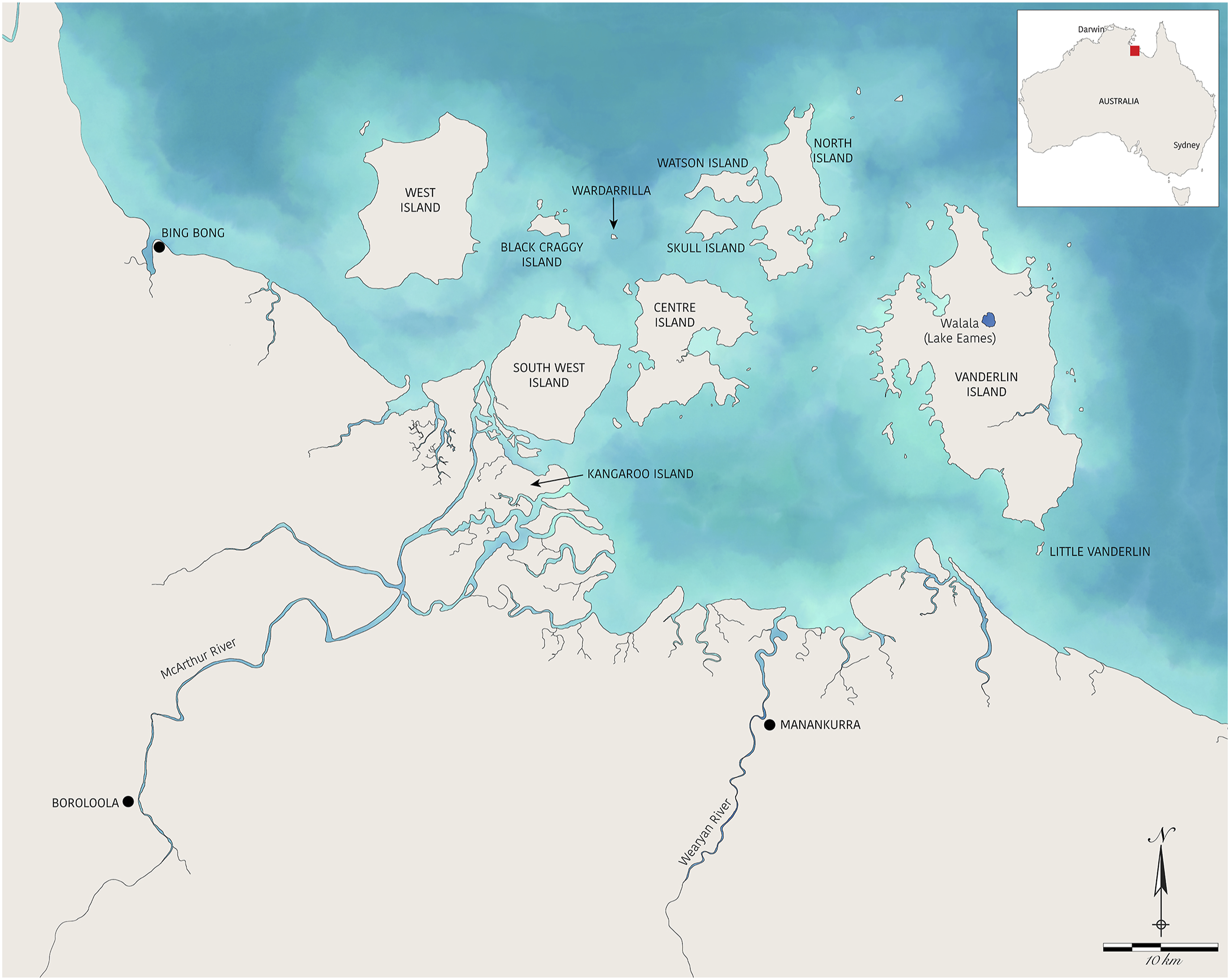
Rock art in Yanyuwa Country was first documented by anthropologist Marie Reay (1965) at Vanderlin Island. Geologist Dehne McLaughlin (1975) later documented and sought interpretation of rock art sites around Borroloola, South West Island and Black Craggy Island. As part of SEPIAP, Ken Mulvaney and Chris Crassweller recorded 18 rock art sites on Vanderlin Island (Sim and Wallis, 2008). John Bradley (e.g. 1991, 1997) developed longstanding relationships with Yanyuwa families beginning in 1980 and has been documenting the significance and local perceptions of motifs across Yanyuwa Country. The most recent phase of rock art recording began in 2010 with the Yanyuwa Rock Art Project (YRAP) involving Liam Brady, John Bradley, Amanda Kearney and Yanyuwa families. The data resulting from YRAP as well as preceding work is analysed throughout this paper.
Yanyuwa knowledge and relationships to sea country
‘Meaning’ in Yanyuwa rock art is found in Yanyuwa people’s connection to the coastal and marine environment. Yanyuwa Country extends across the land and sea of the southwestern Gulf of Carpentaria region in Australia’s Northern Territory. As Saltwater People this includes the Sir Edward Pellew Islands and extends 13 km inland to incorporate brackish waters, including the McArthur River Delta, estuaries of the Wearyan River and the mouth of the Robinson River (li-Yanyuwa li-Wirdiwalangu et al., 2023: 46). Yanyuwa lifeways are attuned to mangrove and alhibi (saltwater) environments. The Pellew Islands contain freshwater wells and soaks in proximity to sandstone formations where rock art is often found. Landforms reflect historical resource use and the spiritual imprints of Yanyuwa ancestors on the terrain (Bradley, 1997). The geography, geology and ecology of the region are intimately connected with Yanyuwa lifeways, culture, history, language and cosmology. Due to these relationships, Yanyuwa refer to themselves as li-Anthawirriyarra, ‘people whose spiritual and cultural heritage is associated with the sea and coastal Country’ (Bradley, 1997: 12).
The foundation of Yanyuwa relationships to kin and Country is yijan. Yijan refers to an ancestral time of world creation (also known as ‘Dreamtime’) where Ancestral Beings (‘Dreamings’) created the landscape and seascape and all it contains, including many instances of rock art. Ancestral Beings are affiliated with specific clans and gave the laws, rituals and ceremonies which govern Yanyuwa society. Ancestral Beings sing kujika (songlines), epic song texts which map their travels and actions and give meaning to Yanyuwa Country. As discussed below, the activities of Ancestral Beings such as the Tiger Shark, Groper and Dugong Hunters play a key role in understanding the relationship between rock art and the maritime realm.
Contextualizing Yanyuwa society
Understanding Yanyuwa history, society and continuity also helps the appreciation of the context of rock art as it exists today. Six Aboriginal language groups (Yanyuwa, Garrwa, Gudanji, Marra, Binbingka and Wilangarra) once lived in the southwest Gulf of Carpentaria (Bradley, 1997). Interactions with trepang hunters from Makassar in southeast Asia from the 17th century until 1907 resulted in expanded trade networks, introducing new technologies and kin-based relationships (MacKnight, 2011). Later, European settlement disrupted Indigenous ways of life. Frontier violence and massacres eradicated the Binbingka and Wilangarra peoples by the early 1900s (Roberts, 2005). Afterwards, Yanyuwa assumed responsibility for Binbingka and Wilangarra lands due to close kinship relationships (Baker, 1999). The 1953 Northern Territory Welfare Ordinance Act and flour ration depots induced Yanyuwa families to settle inland along the McArthur River in Borroloola township. Although now largely based at Borroloola, many Yanyuwa families continue to visit the islands as part of their relationship to Country.
Yanyuwa society has two patrilineal moieties subdivided into four clans: Mambaliya-Wawukarriya, Rrumburriya, Wurdaliya and Wuyaliya (Bradley, 1997; Figure 2). The social system considers kinship between people as well as plants, animals and environmental phenomena. Land and sea management practices, designs, rituals and material culture are designated on a clan basis, with each group responsible for specific obligations and rites. Relationships with one’s mother’s Country are also significant in distributing rights and authority. Jungkayi (‘guardians’ for their mother’s Country and associated Ancestral Beings) and ngimirringki (‘owners’ of specific areas of land, sea and associated Ancestral Beings) have obligations to look after Country, ensuring the correct songs are sung and practices including visitation and hunting are conducted appropriately. These responsibilities to each other and to Ancestral Beings through clan-based organisation shape how Yanyuwa people have related to maritime-themed rock art throughout the past and present. ‘Rock art’ site distribution across Yanyuwa country with clan boundaries superimposed (image: Fiona Holley).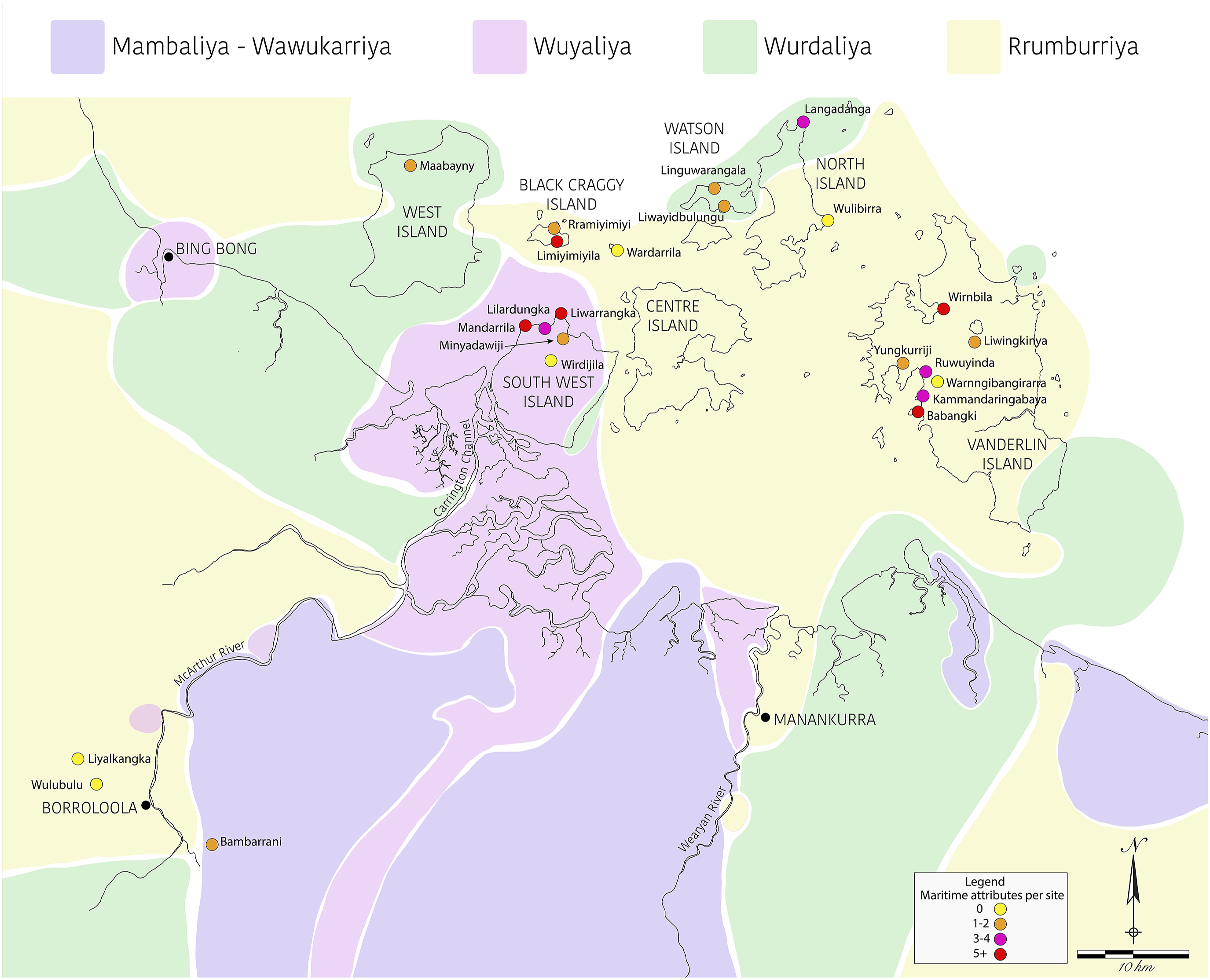
Analyzing Yanyuwa rock art
Fieldwork was conducted in collaboration with the Yanyuwa Aboriginal community starting in 1980 as part of John Bradley’s research. In 2010, the Yanyuwa Rock Art Project was established involving Bradley, Liam Brady, Amanda Kearney, the li-Anthawirrayarra Sea Rangers, and Yanyuwa ngimirringki and jungkayi. Going beyond documentation, this ongoing collaboration between Traditional Owners and social scientists aims to document knowledge to support cross-generational knowledge exchange, and harness archaeological perspectives to comprehend rock art creation (Brady and Bradley, 2014; Brady and Kearney, 2016; Brady et al., 2016).
A total of 3183 photographs were used to identify rock art motifs in paintings and engravings from Yanyuwa Country. The photograph assemblage comes from 65 archaeologically and ethnographically documented sites, defined as spatially distinct aggregations of motifs. For this study, motifs are defined as images that visually represent a particular subject. Rock art sites are found mostly in sandstone cave or rockshelter environments, the vast majority in proximity to coastal areas (Figure 2). Vanderlin Island contains the largest number of sites (n = 19), followed by South West Island (n = 15), and smaller concentrations at Black Craggy Island, White Craggy Island, West Island, North Island and Watson Island. A total of 14 sites are located on the mainland within 15 km of Borroloola. Rumburriya clan Country contains 43 sites, Wuyaliya clan Country holds 15 sites and Wurdaliya clan Country has seven sites. There is no known rock art on Mambaliya-Wawukarriya clan Country, which may relate to the fewer rocky escarpments in that area, yet Mambaliya-Wawukarriya people are still linked to Yanyuwa rock art through kinship. Only one sample of Yanyuwa rock art has been radiocarbon dated, to around 400 years ago. Although there is currently a lack of comprehensive sampling, Yanyuwa Country’s setting in a harsh coastal climate, susceptible to cyclones and other intense wet-season rain and wind events, suggests an antiquity of less than 1000 years for the dataset.
Methods: braiding formal observations with ethnographic perspectives
Our approach to working with Yanyuwa rock art sought to blend archaeological ideas of style and typology with Yanyuwa relationships to Sea Country. We began by classifying motifs according to their form. A tiered schematic creates ‘building blocks’ to highlight motif choices and discern patterns across space. This approach renders Yanyuwa images into a ‘dataset’ first. However, this order was not imposed to privilege archaeological ontologies as first in a hierarchy of knowledge. Instead, this order reflects the archaeologically-trained researcher initially applying a lens of comparison and systematization, and through the learning process, appreciating and integrating concepts that are specific to the descendant community and intrinsic to understanding. In this way, Tier 1 – Tier 4 involve increasingly closely-observed etic categories (Figure 3). Tier 5, maritime characterisation, differentiates between terrestrial and maritime-themed motifs and is informed by Yanyuwa perspectives. In Tier 6, all motifs are reconsidered in the context of Yanyuwa cosmology and culture. Rock art categorization (see Roos Jacobs, 2024 for further details).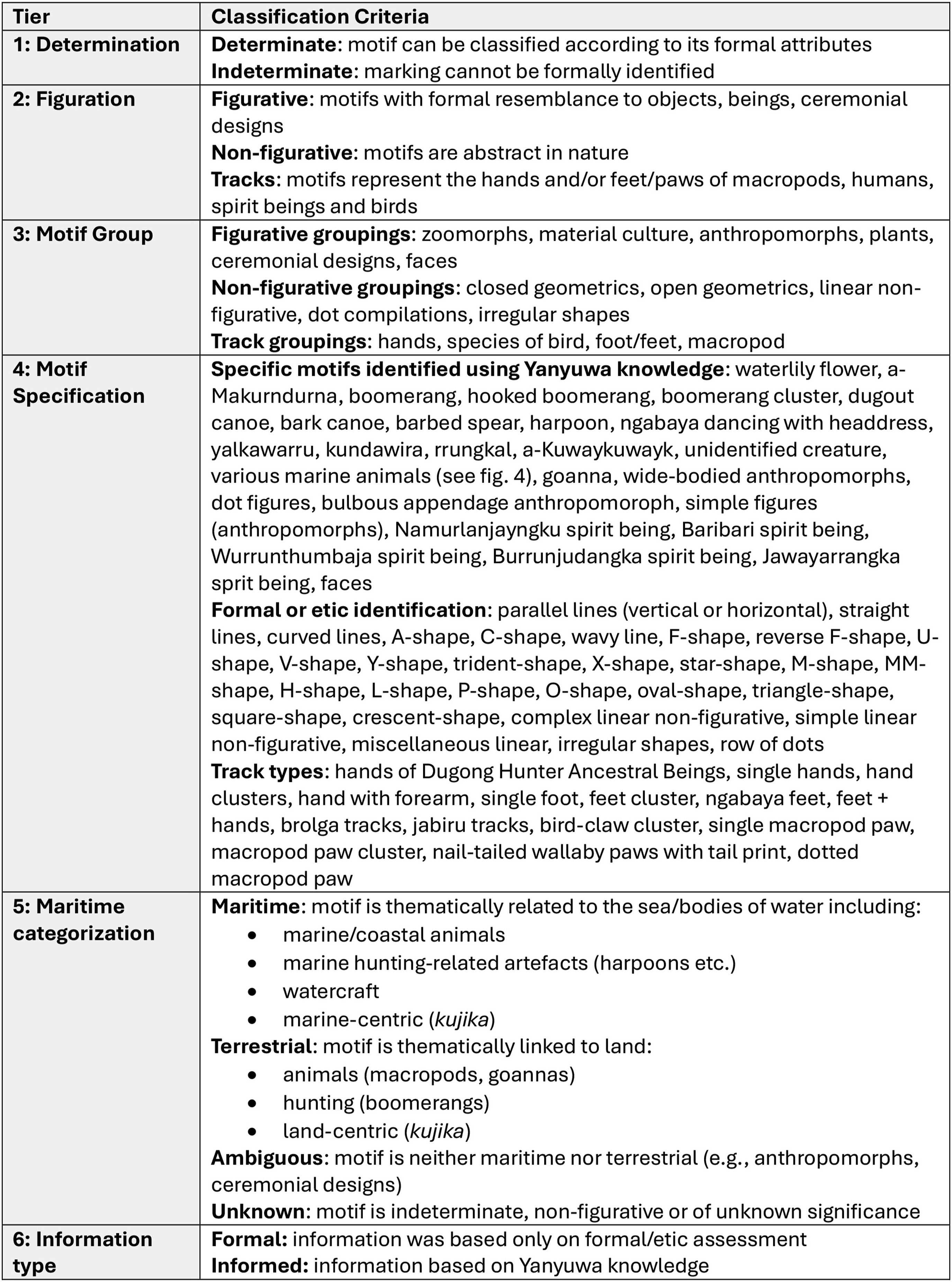
The assemblage consists of paintings, stencils, prints, engravings and cupules. Motif colours, listed from most to least frequent, include monochrome (red, white, yellow, mulberry and black), and bichrome examples (red with white, white and yellow with red, white with yellow, red and yellow with mulberry and white with black). Indistinct images, that could not be discerned using the naked eye, were processed using DStretch, a rock art analysis plugin to the scientific image processing platform ImageJ. DStretch applies an enhancement technique from remote sensing of multispectral astronomical images, called Decorrelation Stretch, to enhance faint pigment-based imagery (Harman, 2016). An individual motif may contain several components. For instance, a group of seven kangaroo tracks on one wall of a cave could be interpreted as one ‘track cluster’ motif, or each individual track might be perceived separately depending on the spatial discernment of the observer (for further discussion, see Roos Jacobs, 2024). Specific motifs were identified by applying Yanyuwa knowledge shared by ngimirringki and jungkayi during surveys. In total, we identified 956 motifs from Yanyuwa Country.
Findings: categorizing the Yanyuwa rock art assemblage
Tier 1 of formal categorization divided the dataset into Indeterminate, Cupule, and Determinate motifs (see Figure 3 and Roos Jacobs, 2024). Overall, 18% of the dataset was classified as Indeterminate due to indistinct or deteriorated images, and excluded from further analysis. Cupule clusters (cup-shaped marks made using hand-held hammerstones) accounted for 1% of the dataset however were excluded from the analyses because they may have a culturally distinct role when compared to pigment-based and engraved motifs. Overall, 81% of the dataset was identified as Determinate because motifs could be further classified by their formal attributes.
Tier 2 focused on Determinate motifs: 17% of the dataset was categorized as Figurative (people, flora/fauna, natural phenomena, ceremonial icons and objects); 36% as Non-figurative (geometric and abstract designs); and 27% as Tracks (macropod, bird and human). A western perspective might hypothesize that frequencies of certain figurative motifs relate to spatial patterns of both maritime and non-maritime food procurement, maritime trade, Ancestral Being paths, kujika and seasonal influences. More sophisticated statistical and geospatial analysis may help parse those relationships and is a focus of ongoing inquiry. It is important to note that these parameters come from a non-Yanyuwa perspective, as the values that western cultures place on ‘representation’ may differ from Yanyuwa impressions. This does not imply that investigating geospatial relationships between motifs and archaeologically defined patterns is inherently uninteresting to Yanyuwa people. Rather, Yanyuwa Law yields insights into the worldview that shapes the motifs themselves.
Tier 3 subdivides the Figurative, Non-Figurative and Track images. This tier is comprised of zoomorphs (e.g., dugongs and sharks, 7.3%); material culture (boomerangs, a-Makurndurna (crescent-shaped percussion instruments), spears, 4.3%); ceremonial designs (3.7%); anthropomorphs (1.9%); and plants (1.1%). Many Figurative classifications were visually apparent to a trained eye such as boomerang stencils and fish. Zoomorphs (n = 70), especially sea turtle motifs (n = 15), were the most represented type of figurative motif in the dataset. This is unsurprising considering the significance of sea turtles as a food resource and Wundanyuka (Sea Turtle) as an Ancestral Being (Bradley, 1997). We identified ceremonial designs as figurative because many, such as the Rrungkal, powerful designs representing Ancestral Beings, are visually distinctive and representational. Yalkawarru, a post-funerary ceremonial design belonging to the Wuyaliya and Wurdaliya clans (n = 32), and various configurations of boomerangs (n = 32), were also well-represented.
Non-figurative imagery consisted of: open geometrics (12.8%); closed geometrics (8.2%); linear non-figuratives (12.8%); dot compilations (1.2%); and irregular shapes (2.4%). Descriptors were chosen based on continuity with previous work on Yanyuwa rock art (Brady and Bradley, 2014).
Of the Tracks, the dataset consisted of human hands and hand-clusters (17.9%), human foot or feet-clusters (0.8%), bird tracks (6.6%), and macropod tracks (1.9%). Hands and feet were mostly stencilled and printed, while bird and macropod tracks were painted. Although the likeness of these motifs to bird and macropod tracks was visually apparent, it was nearly impossible to infer specific species based on observation alone. Handprints were frequent, with only four of 20 island rock art complexes (Babangki, Maabayny, Warnngibarngirarra and Wirnbila) not featuring hands. The mainland sites of Bambarrani and Liyalkangka notably did not feature handprints. However, the mainland site of Wulubulu featured two hand stencil clusters.
Tier 4 consists of the specific descriptors for each individual motif, making the dataset more granular.
Classification of maritime motifs
Tier 5 was created to explore the maritime-terrestrial nature of the assemblage. Overall, 9% of the entire Yanyuwa motif dataset was Maritime, while 6% was Terrestrial (i.e. land-specific plants, zoomorphs, material culture and ceremonial representations). The remaining 85% of the dataset was either Unknown (57%), that is, motifs without notable reference to the land or seascape through formal observations or Yanyuwa knowledge, or Ambiguous (28%), motifs that were associated with neither exclusively land-based or sea-based cultural activities. Determining that 9% of the dataset is Maritime brings little insight, however, without the comparative context of other maritime rock art assemblages, both in the Gulf of Carpentaria region and among Saltwater People more broadly. Preliminary discussion of this cross-cultural comparison can be seen in Roos Jacobs (2024) while research into the maritime characterisation of rock art assemblages more broadly is an area for future investigation.
To explore the maritime aspects of the assemblage, we undertook further classification of the 88 maritime-themed motifs (Figure 4), using an approach integrating formal and visual characteristics with Yanyuwa cosmology. Figurative maritime motifs consisted of aquatic plants, seafaring-specific material culture such as canoes and harpoons, ceremonial designs related to marine activities, and aquatic zoomorphs. Maritime track motifs consisted of hands associated with seafaring Ancestral Beings such as the Dugong Hunters of Excellence and seabirds like the Brolga and Jabiru. Hierarchical classification of maritime-specific motifs from Yanyuwa country.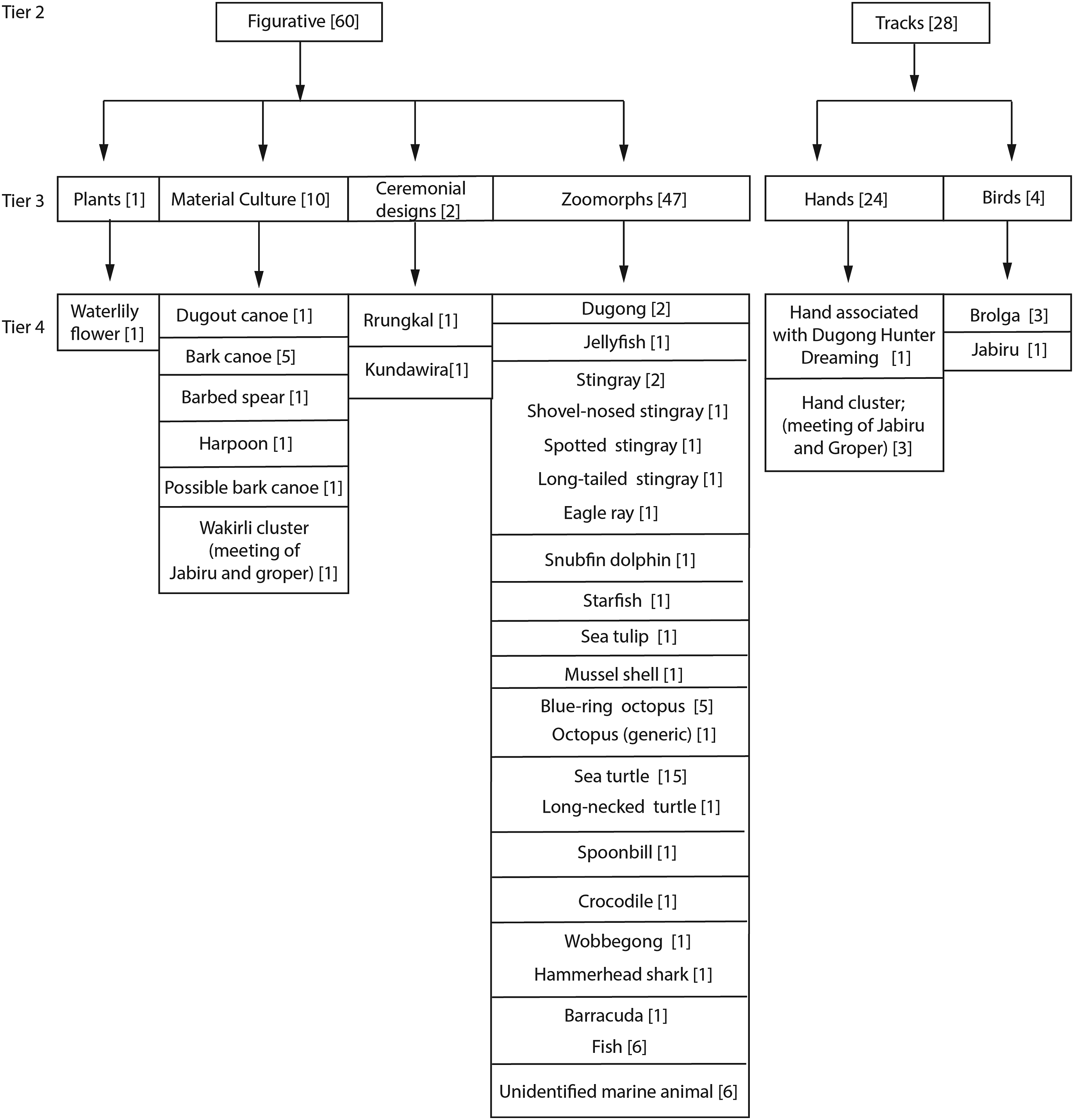
The proportion of maritime attributes was also assessed across clans. Notably, Rrumburriya clan had the highest proportion of maritime rock art, with 48 motifs comprising 5% of the overall dataset. However, it should not be assumed that higher percentages of Maritime motifs indicate higher affinity to Saltwater Peoples’ culture. The Wuyaliya clan has a greater proportion of maritime-themed imagery (n = 29, 3%) than the Wurdaliya clan (n = 11, 1.1%), which is unexpected as Wurdaliya has larger coastal and island territories. The Mambaliya-Wawukarriya clan, with mostly inland and freshwater holdings, were not found to have maritime imagery on their Country (li-Yanyuwa li-Wirdiwalangu et al., 2023: 144). Black Craggy Island, the western shore of Vanderlin Island, and the northern shore of South West Island have the highest concentration of maritime imagery. Interestingly, although Centre Island is also on Rrumburriya clan Country, no rock art was detected or recorded. This may be due to differences in terrain, sampling bias, or perhaps lesser association with the Ancestral Beings involved in pictograph or petroglyph creation. This suggests a priority for future research into correlation between maritime imagery placement and its geographic relationship with saltwater and freshwater sources.
Understandings: maritime attributes in Yanyuwa cosmology
The significance of Yanyuwa rock art goes beyond the sum of its formal characteristics. When described by Yanyuwa people, much of what researchers see as rock art is intimately connected to Country, spirituality and kinship (Bradley et al., 2021). It is therefore important to understand the nature of kin-based relationships that underpin Yanyuwa society. For example, Rrumburriya clan people are likilinganji-Wurralhibi, kin to saltwater from the depths of the sea, and likilinganji-Jamarndarrka, kin to the White-Bellied Sea Eagle (li-Yanyuwa li-Wirdiwalangu et al., 2023: 173). Wuyaliya clan people are likilinganji-Kirlakanku, kin to the Grey Mangrove, and are associated with numerous other ‘maritime Ancestral Beings’ including Groper, Barracuda, Jabiru, Black Bream, and Mangrove Jack (li-Yanyuwa li-Wirdiwalangu et al., 2023: 75). Wurdaliya clan includes people who are likilinganji-ngangkurrurru, kin to places of marine turtle hatching, and likilinganji-murrmurrwarra, kin to vast windswept beaches, and are associated with Osprey and Sea Turtle. Mambaliya-Wawukarriya clan people are likili-nganji kumbarikanyajulaki, kin to the Brolga, and likili-nganji yurrungkurru, kin to sand ridge and messmate forest Country (li-Yanyuwa li-Wirdiwalangu et al., 2023: 243). Knowledge shared by Yanyuwa families demonstrate how material culture, in this case rock art, goes beyond the quantitative and allows connection with Country through a complex net of interwoven stories.
The correspondence of the spatial positioning of rock art across the Pellew Islands, with the paths of Ancestral Beings and kin-based relationships, illuminates the way Yanyuwa people have used visual symbolism to inscribe Sea Country. The following examples attempt to bridge the dichotomy of Yanyuwa/Indigenous epistemes and western viewpoints by harnessing knowledge around Ancestral Beings, kujika, kin and cosmology to interpret the archaeological concept of ‘maritime imagery’. We reflect on archaeological viewpoints within the complex cosmology surrounding marine concepts expressed in rock art.
Groper kujika ties together land, sky and sea
The a-Kuridi (Groper) kujika is an integral thread in the southwest Gulf Country as expressed through rock art. Her kujika starts east in Ganggalida Country, travels through Yanyuwa Country, then moves west to Marra and Warndarrang Country, thus linking people from all these areas who have a clan affiliation with a-Kuridi (li-Yanyuwa li-Wirdiwalangu et al., 2023: 156). In these travels, a-Kuridi demonstrates the creative power of yijan as she was responsible for creating rockshelters and the paintings contained within them. The trajectory of the Groper imbues her surroundings with interlocking marine, terrestrial and celestial themes, reinforcing the fabric of Yanyuwa cosmology.
For example, a-Kuridi’s songline ties together several seagoing Ancestral Beings, which can be seen in rock art at Liwarrangka, Wirdijila, Lilardungka, Mandarrila and Minyadawiji. The Groper sang of the bones of deceased kin and emplaced Law that they be left resting in rockshelters, like Liwarrangka, presenting a linkage to the spirit realm (li-Yanyuwa li-Wirdiwalangu et al., 2023: 79). She passed through the Wirdijila rock art site and associated with the Diamond-Scaled Mullet Ancestral Being, which takes the form of a sandbar. In so doing, a-Kuridi created the rock art site Lilardungka, which contains the only plant painting in the dataset, the waterlily. The waterlily is a kinship-related food source (li-Yanyuwa li-Wirdiwalangu et al., 2023: 97).
At Lilardungka, the Barracuda Ancestral Being is pictured. It belongs to the Wuyaliya clan, because its members are its ngimirringki. The Jabiru Ancestral Being, also described in the Groper kujika, nests at the rock art site Minyadawiji on South West Island. There are no jabiru tracks at Minyadawiji, so without knowledge of Yanyuwa cosmology it would be difficult to link such a site to an Ancestral Being. The Wambuyungu ceremony carried by the Barracuda linked the Groper with other maritime Ancestral Beings such as Jabiru, Black Bream (an offshore sea stack near Mandarrila), Beach-Stone Curlew, Osprey, Green Turtle, and Pelican. Another connective motif is the a-dirranja, referring to deep sea elements which wash onshore after storms, at Mandarrila. In 1981, senior Yanyuwa men suggested to Bradley the a-dirranja could represent sea tulips (Pyura sp.). Sea tulips are found around New South Wales and Tasmania. However, Yanyuwa clarify that the motifs ‘came from another Country’ as the li-wankala (spirits of deceased kin) ‘saw things that [present-day Yanyuwa] never saw’ (li-Yanyuwa li-Wirdiwalangu et al., 2023: 118).
Motifs at Mandarrila: li-Jakarrambirri, rrungkal, Wundumarlamarla and a-Kuwaykuwayk
The linkage between Island, Sea and Sky Country in areas of rock art connected by the Groper’s kujika also demonstrates the extensive maritime cultural landscape that shapes and defines Wuyaliya rock art.
The Groper breathed life into the Mandarrila rock art site, a significant location where she ‘put down the Law into the land and sea’ (li-Yanyuwa li-Wirdiwalangu et al., 2023: 127; Figure 5). Among the brightest and most highly visible images is the Wundumarlamarla (Snubfin Dolphin), with its prominence highlighting the importance of saltwater creatures in Yanyuwa culture (li-Yanyuwa li-Wirdiwalangu et al., 2023: 125). The Groper created the Rrungkal, which is a powerful symbol associated with the Grey Mangrove Ancestral Being and Wuyaliya clan, at the Mandarrila rockshelter. Eight human shapes are also pictured near the Rrungkal, with one composed entirely of red dots, another with round circular hands and feet, a wide-bodied figure, several stick figures and a ngabaya spiritual entity dancing with a headdress. These paintings are known to Wuyaliya clan members; they emphasize the theme of the spiritual realm and the role of ngabaya in creating and taking away paintings. Maritime motifs at Mandarrila, clockwise from top left: Blue-ringed Octopus and Snubfin Dolphin; anthropomorph and Sea Turtle; Rrungkal; Sea Tulip; fish (photographs: Liam M. Brady).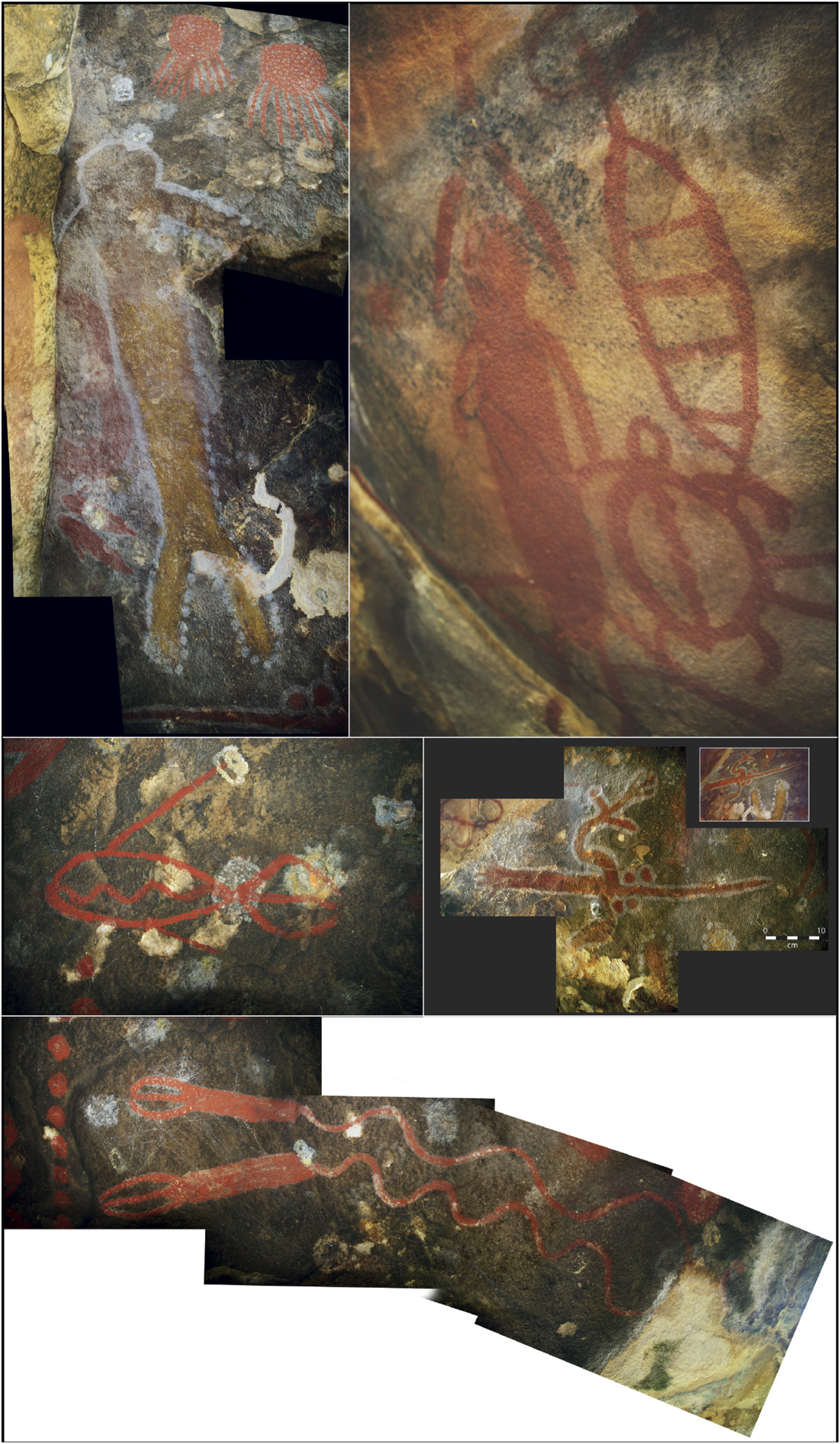
Notably, li-Jakarambirri (Pleiades/Blue-Ringed Octopus) is also painted at Mandarrila rockshelter (li-Yanyuwa li-Wirdiwalangu et al., 2023: 128). The li-Jakarrambirri comprises both the Pleiades or Seven Sisters Constellations and Blue-Ringed Octopus in one ‘Dreaming’. During the day, the Pleiades sinks into the sea to hunt fish as the Blue-Ringed Octopus, the stars becoming glowing blue rings on the octopus. The li-Jakarambirri is a powerful entity that benefits all living things, linking the sea and sky. The Pleiades also marks time and is associated with the new growth of grass and trees. The dense coastal fog in the dry cold season is tied to the Pleiades, giving strength to the land and sea (li-Yanyuwa li-Wirdiwalangu et al., 2023: 128).
The presences and absences of Wundanyuka (Sea Turtle)
Another motif present at Mandarrila rockshelter and elsewhere, which exemplifies the complexities of Yanyuwa relationships to Sea Country, is the Wundanyuka Ancestral Being. The Wundanyuka shapes Wurdaliya Country through its travels and its relationship with its ferocious predator, Jujuju (Osprey). After a protracted and eventful chase, Jujuju eats the Wundanyuka, forming a sandstone sea-stack at the location of rock art site Langadanga on North Island. Wurdaliya Sea Country is home to turtle-hunting seabeds and sea turtle egg-rookeries on the beach in front of Maabayny rock art site (li-Yanyuwa li-Wirdiwalangu et al., 2023: 151).
In the present day, relationships between Wurdaliya clan and Wundanyuka are reinvigorated by the Turtle Camp run by the li-Anthawirriyarra Sea Rangers near Maabayny rock art site. Scientific monitoring of turtle populations near Maabayny and cultural activities are organised on a yearly basis (li-Yanyuwa li-Wirdiwalangu et al., 2023: 147). Yet interestingly, no turtles are depicted at Maabayny, despite their heavy presence in the physical and cultural seascape. At Maabayny, fish, Yalkawarru and the Arribarri (Wobbegong Shark) are depicted, but no turtle motifs were recorded. The Arribarri is a Rrumburriya Ancestral Being, which appears incongruous because it is found in Wurdaliya clan Country. Yet Yanyuwa people take no issue with these motif placements as the actions of Ancestral Beings are ‘not to be second guessed’ (li-Yanyuwa li-Wirdiwalangu et al., 2023: 180). Turtles are featured in rock art at Mandarrila, Linguwarangala, Bambarrani, Liwarrangka, Kammandaringabaya, Ruwuyinda and Wirnbila. The absence of Wundanyuka motifs where an uninitiated viewer might expect them, and their presence where one might not, highlights how maritime relationships on Yanyuwa Country are related to the paths of Ancestral Beings and imbued with nuances that go beyond representations on rock walls.
Freshwater ancestral beings and links between land and sea
Four figures, a-Janngu (Spotted Stingray), a-Mirrbundu (Shovel-nosed Stingray), Murndangu (Long-necked Freshwater Turtle) and Jiyamirama (Lone Male Dugong) at Liwarrangka on South West Island stand out visually as having maritime significance, linking the site to a broader marine navigational landscape. The large, fresh-looking a-Janngu is linked to other aspects of yijan, as from its mouth comes a-wurrarumu (North Wind) which is located on the southwestern coast of Vanderlin Island (Bradley, 1997: 128). Knowledge about numerous types of storm winds is integral to Yanyuwa navigation (li-Yanyuwa li-Wirdiwalangu et al., 2023: 59). These creatures are not just representations but are present as living forces that affect how Yanyuwa people traverse the seascape.
With the inclusion of Murndangu, mixing of species positions maritime heritage as a continuity from fresh to brackish to saltwater connections. Freshwater soaks are valued and scarce along the coastal flats of the mainland and are associated with the activities of Spirit Beings. The Brolga waterbird is an Ancestral Being that is kin to the Mambaliya-Wawukarriya clan. Brolga tracks are found at Lilardungka on Wuyaliya Country and Kammandaringabaya on Rrumburriya Country. The Brolga is associated with lagoon features, tying into the freshwater and estuarine connection of Mambaliya-Wawukarriya people. The sand spit at Milrila and a nearby beach and foredunes hold the a-Warrabawarraba (Fish Net) Ancestral Being. The a-Warrabawarraba follows the coast and connects Yanyuwa Country to Marra Country, and provides a geographic touchpoint for oceanic Mambaliya-Wawukarriya Ancestral Beings such as the Limarrwurrirri (Loggerhead Turtle) or Liwurrujarra/Wulwujarra (Spanish Mackerel) and coastal, brackish species leading to riverine Ancestral Beings like Wangkuwa (Rock Cod), a-Nyana (Brahminy Kite) and a Mardumbarra (Saltwater Crocodile). These brackish water connections continue as Arlkujarra/Walkuwalkulangu (Milkfish) landed at Milrila, leaving its eye as a freshwater well (li-Yanyuwa li-Wirdiwalangu et al., 2023: 252). These examples demonstrate the expansion of Yanyuwa cosmology beyond a seascape to a ‘waterscape’ of concepts where freshwater sources are also regarded as relationally significant.
Dugong hunters and connections to watercraft in rock art
The li-Maramaranja (Dugong Hunters of Excellence) kujika is foundational to the rock art and seafaring culture of Yanyuwa Country. The li-Maramaranja are Ancestral Beings that belong to the Rrumburriya clan. They arose from the depths of the sea and travelled in skilfully manufactured bark canoes, with strong gunwales, high prows, internal bracing, and watertight stitching (Figure 6). The li-Maramaranja traversed the seascape as Yanyuwa men would during hunts, but marked their surroundings in ways humans never could, creating reefs and islets as they trailed their harpoon ropes behind. These ropes can also be seen in the sky as a constellation, creating a relational network that binds together Rrumburriya Country. Watercraft in Yanyuwa rock art; top, left-right: dugout canoe at Langadanga; bark canoes at Ruwuyinda; bottom: inventory of watercraft diagnostic features (photographs: John Bradley (left), Liam M. Brady (right)).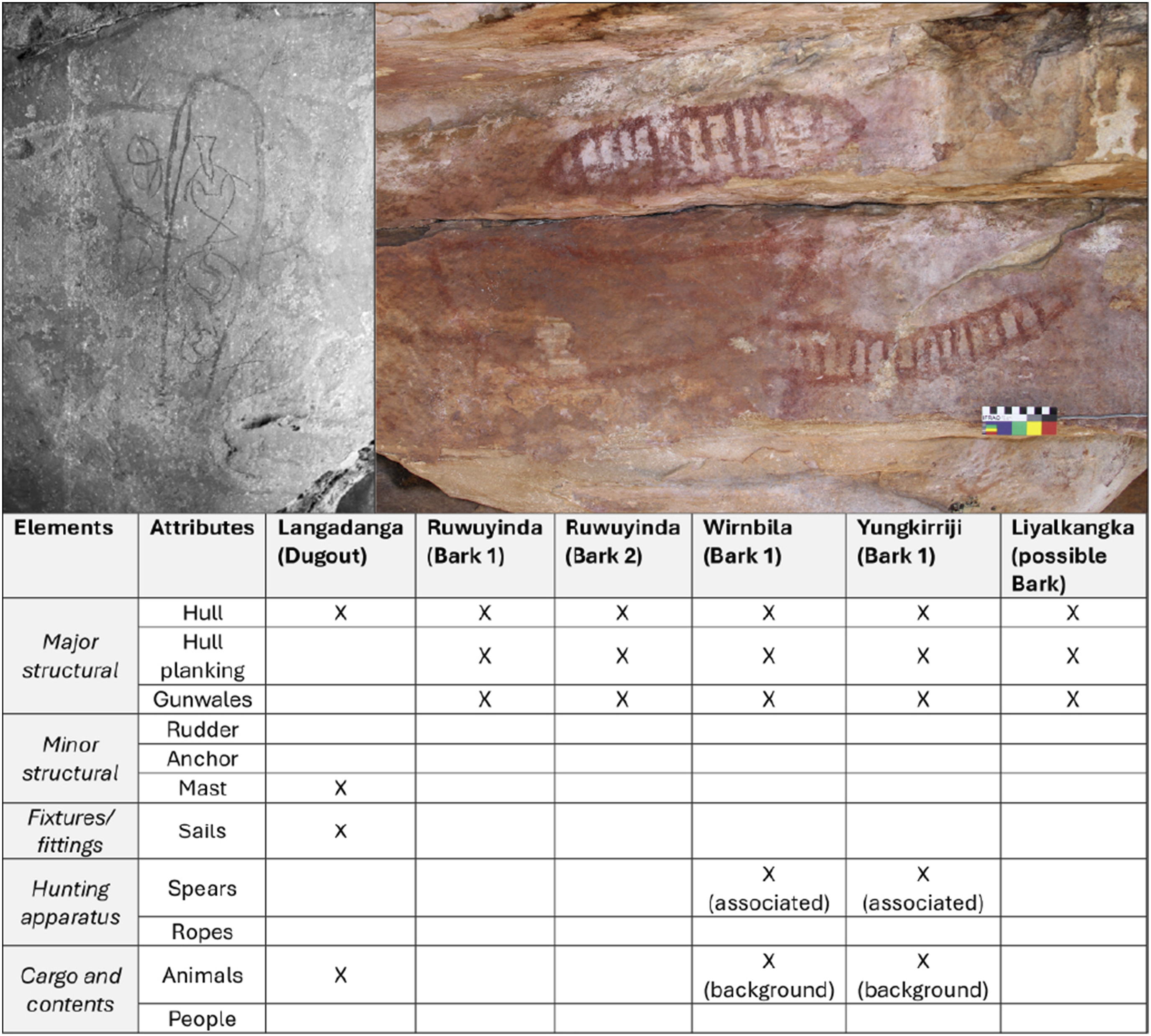
In assessing physical representations of dugong hunters’ canoes, both human and Ancestral Being, five paintings from Vanderlin Island and one dugout canoe from Langadanga on North Island were identified by their technological attributes (Figure 6). The Langadanga dugout image was an outlier as it featured a mat and sails, and was a dry charcoal drawing while most images in the dataset were painted. Linear patterns on the painted watercrafts are interpreted as ‘hull planking’, although they can also be interpreted as infill or patterning not meant to represent a specific technology. The overall shape is interpreted as ‘hull structure’, with bold lines being gunwales. This terminology is appropriated from larger watercraft with European and Asian origins and raises questions of how smaller watercraft fit into these schematics (Wesley et al., 2012). It also raises questions of how technological elements of watercraft are perceived cross-culturally, as we cannot assume that masts or hull structures have the same significance in Yanyuwa perception as in western seafaring cultures, although they may serve the same purpose (Bradley, 1991). The two bark canoes at Wirnbila on Vanderlin Island were associated with spears or harpoons and turtles; the hull of the dugout canoe at Langadanga contained two outlined turtles and a dugong displayed in ‘X-ray style’, suggesting that these watercrafts represented hunting vessels. The ‘possible’ bark canoe from Liyalkangka was less distinct than the others and not identified from Yanyuwa knowledge. It is unclear whether the bark canoes represented sea-going craft, na-riyarrku, or simpler constructions made from a single large sheet of folded bark, na-wulka (Kearney and Bradley, 2015).
The li-Maramaranja also created imagery, especially hand and footprints, inside the rockshelters on Black and White Craggy Islands, Rramiyimi, Limiyimiyila and Wardarrila (li-Yanyuwa li-Wirdiwalangu et al., 2023: 41). Senior woman Dinah Norman a-Marrngawi emphasizes that handprints and stencils at Limiyimiyila on West Black Craggy Island were created by the li-Maramaranja (li-Yanyuwa li-Wirdiwalangu et al., 2023: 5). One panel showed evidence of layering, indicating at least two painting events. The li-Maramaranja also left their eyes as freshwater wells at Limiyimiyila (Bradley and Yanyuwa Families, 2016: 432) and continued to Wardarrila on White Craggy Island where they left more red hand stencils. These hand stencils were visible in 1980 but have since deteriorated and are no longer visible (li-Yanyuwa li-Wirdiwalangu et al., 2023: 231). Their voyages are recorded in a songline which has over 300 verses. This kujika enlivens the sea and islands, providing a metaphysical road to follow and ‘lift the Country up’ (li-Yanyuwa li-Wirdiwalangu et al., 2023: 109). Six bark canoes, whether interpreted as from the li-Maramaranja or historical Yanyuwa (Old People), appear in the rock art inventory, as well as a harpoon (Figure 4). To Yanyuwa, this narrative is ‘like real history’ (Bradley, 1997: 227) due to linkage between the li-Maramaranja and present-day dugong and sea turtle hunters.
The li-Maramaranja interact with other Spirit Beings and ceremonies in kujika, forging maritime connections across Country. The voyages of sharks and stingrays in Yanyuwa narratives are associated with the li-Maramaranja kujika, physical canoes and marine-themed rock art. The Warriyangalayawu (Hammerhead Shark) navigated westwards with two Nguku (Long-Tailed Stingrays) in the Dugong Hunter kujika (Bradley and Yanyuwa Families, 2016: 441). At Limiyimiyila on Black Craggy Island, a Warriyangalayawu and Nguku are depicted. However, the presence of these Ancestral Beings in rock art at Limiyimila does not necessarily imply that the connections described between figures in that kujika are localised to this area. That said, the distinctive paintings of the Warriyangalayawu and Nguku (Long-Tailed Stingray) reveal important connections between clans, language groups, and Ancestral Beings from both sea and land (li-Yanyuwa li-Wirdiwalangu et al., 2023: 239). Minyminyi (Eagle Ray) also is seen in rock art at Limiyimiyila and met with the li-Maramaranja on the east coast of Vanderlin Island (Bradley, 1997: 506). The Rrumburriya ancestor Tiger Shark joined the Warriyangalayawu yijan at Vanderlin Rocks as a travel companion (Bradley and Yanyuwa Families, 2016: 441). Although rock art may appear motionless, the Tiger Shark Ancestral Being is dynamic, as its kujika contains an urgent ‘moving verse’ (Bradley and Yanyuwa Families, 2021: 159) to maintain trajectory. The Warriyangalayawu and Tiger Shark link the sea to the estuarine area, as they traverse brackish and mangrove-lined areas along with saltwater crocodiles (Bradley, 1997: 70). The transit-oriented nature of the Warriyangalayawu and Tiger Shark is also noted in material culture as they are the namesake of several dugout canoes (Bradley, 1997: 297). The dynamism and interconnectivity of Yanyuwa seafaring traditions are highlighted by these intersecting Ancestral Beings.
Kundawira and a-Karnkarnka (Sea Eagle) link sea, sky and spiritscapes
The a-Karnkarnka (White-Bellied Sea Eagle) yijan explains spiritual relationships behind rock art at Wulibirra as well as the Kundawira, a ritual with strong maritime themes. The a-Karnkarnka crosses- paths with the li-Maramaranja, tying together Rrumburriya and Mambaliya-Wawukarriya clans (li-Yanyuwa li-Wirdiwalangu et al., 2023: 155). She originated on the east bank of the Wearyan River mouth, travelled to a place called Muluwa, then continued her journey. The a-Karnkarnka made her nest at the rock art site Wulibirra on North Island. She remains at Wulibirra to this day as she found her true home in this place. During her travels, the a-Karnkarnka carried out the powerful saltwater Kundawira ceremony of the Rrumburriya clan (li-Yanyuwa li-Wirdiwalangu et al., 2023: 187). The Kundawira ceremony honours the ancestral presence of people whose bodies were lost at sea due to shark and crocodile attacks, as well as drownings from canoes capsizing mid-journey. A Kundawira motif is found at Rramiyimi, North Black Craggy Island on Rrumburriya Country. The anthropomorphic spiritual entities Wurrunthurnambaja, Burrunjurdangka and Jawajbarrangka are associated with Kundawira, and they ‘put themselves into the rock’ at Wulibirra (li-Yanyuwa li-Wirdiwalangu et al., 2023: 225). The a-Karnkarnka made her nest at the rock art site Wulibirra on North Island. Here, maritime rock art production becomes a ‘spiritscape’, allowing for connection with the sea to be ritually conveyed (McNiven and Brady, 2012). This demonstrates connectivity and meaning-making between the sometimes-perilous Yanyuwa lifeway of hunting in canoes and the superimposition of that seascape and spiritscape on stone.
Discussion and conclusions
While images painted, stencilled, drawn or printed on rocky surfaces may appear two-dimensional using descriptive explanations, their meanings are plural, culturally nuanced and enveloped in a web of relationships involving Ancestral Beings, fauna, flora, non-human kin, social protocols and every conceivable aspect of Yanyuwa life. The narratives and kujika songlines behind these relationships reflect Yanyuwa logic and demonstrate how kinship and the ancestral world are integral to the existence of rock art. Yanyuwa imagery expresses a maritime identity inland from the coastline, drawing on expertise in marine-based subsistence and technology. Their deep relationship with the marine environment is expressed through a knowledge system referencing the sea and its contents biological, geological, and cosmological. The production of marine-themed rock art expresses Saltwater identities and kinship with beings within the marine and coastal environment. The significance of these images is linked to the changing status of the wellbeing of people and Country, as well as the present-day interpretation of yijan.
Yanyuwa people are the ‘living experts of their own thought worlds' (Adgemis, 2017: 54) therefore interpretation of rock art is not static. Rapid social and cultural change has reconfigured the Yanyuwa seascape and interactions with visual media. Ethnography that has informed the interpretation of rock art here is derived from an older generation of Yanyuwa intellectuals. Framings and markers of identity have shifted over time within the Yanyuwa community at Borroloola (Adgemis, 2017). Learning to navigate Sea Country has gone from an obligation in a subsistence economy to a culturally significant choice. This has created an environment where all generations of Yanyuwa people take the initiative to adapt traditional knowledge into new forms. The adoption of contemporary initiatives that integrate rock art and visual imagery into education and conservation efforts indicates that the significance of rock art images is continuously adapting to present-day relationships with Country. Presenting motifs in this multifaceted way highlights how the relational dynamics of rock art are not relics of the past and continue to be impacted by the evolutions of colonial power dynamics. There may not be one authoritative or definitive meaning for the assemblage of Yanyuwa rock art, as interpretation depends on factors including generation, clan identity, ceremonial experience, gender, experiences of living on Country and broader kinship connections. Whether or not the ‘original’ meaning of this rock art can be revealed by formal analysis or ethnographic accounts, people’s engagement and interaction with these images provides another layer of understanding.
Yanyuwa rock art has agency in the ritual contexts of creation and cosmological engagement, symbolizing active and specific engagements with the sea (McNiven and Brady, 2012: 76). Marine themed rock art can be interpreted as a visual means of community integration and communication, transforming terrestrial lived spaces into part of the seascape. For instance, hand stencils and prints at Limiyimila are credited to the li-Maramaranja, while others are attributed to Namurlanjanyngku and ngabaya Spirit Beings or li-wankala spirits of deceased kin, creating tangible symbols of Yanyuwa engagement with their spiritual world and their maritime identity (Bradley, 1997: 185). Yanyuwa rock art reaffirms significant and interconnected marine cosmologies, particularly the continuity of the a-Kuridi, Wundanyukaa, a-Karnkarnka and li-Maramaranja kujikas. These perspectives highlight the need to establish a more integrative understanding of how past peoples conceived of coastal landscapes and seascapes through rock art, an understanding that appreciates not only formal but also relational aspects.
Scoping the depth of Sea Country from a Saltwater person’s perspective cannot be achieved through archaeological modes exclusively. Yanyuwa ontological categories diverge from archaeological explanations; for example, the definition of the coastal area extends onto the margins of inshore saltpans and mudflats that receive saltwater infrequently during king tides and storm surges (Bradley, 1997). Further, freshwater and brackish Ancestral Beings expand the sense of the ‘waterscape’ beyond the sea. This complicates geographical and archaeological understandings of the land-sea interface and associated relationships of rock art to land/sea contexts. Exploring and sometimes challenging the binary of western versus Indigenous in this way has allowed Yanyuwa and archaeological narratives to relate to one another through a process of learning and reconsidering.
This research has integrated archaeological analysis of this dataset with the seascape framework and incorporated the archive of Yanyuwa ethnographically recorded viewpoints to provide a multifaceted picture of the maritime influences on Yanyuwa society. As a result, the information presented here does not fit neatly into one way of seeing the sea but rather, draws on plural visions of the world. As senior Yanyuwa woman Eileen McDinny said of the creatures, items and entities existing on Yanyuwa Country, ‘everything has a song. No matter how little, it’s in the song, all got a meaning, everything has to be there’ (Bradley and Yanyuwa Families, 2021: 207). The meaning of this rock art will continue to be linked to the relational context of past, present and future events within the Yanyuwa maritime cultural landscape.
Footnotes
Declaration of conflicting interests
The author(s) declared no potential conflicts of interest with respect to the research, authorship, and/or publication of this article.
Funding
The author(s) disclosed receipt of the following financial support for the research, authorship, and/or publication of this article: This work was supported by Australian Research Council (grant nos. DP1093341, DP170101083, FT180100038 and LP220100143).
