




Abstract
In the 19th–20th centuries, following Peruvian independence, the postcolonial nation-state saw the formation of the gamonal, a local landlord who exploited indigenous people to perpetuate a servile labor force and appropriate land. While the community of Andagua in the Southern Peruvian Andes was subject to Spanish colonial state violence, residents identify their greatest forms of subjugation as occurring under the Peruvian nation-state. Drawing from ethnographic, archaeological, and historical evidence, this article bridges historical archaeology and archaeologies of the contemporary to write inclusive histories that incorporate residents’ perspectives to frame past experiences. Beyond the history of the gamonal, this article discusses how families organized to rehabilitate pre-Contact agricultural infrastructure from the 1960s to the present. Some people subject to the harsh hand of the gamonal have reclaimed their lands, while for others there is a lingering sense that justice will never be served.
We are all equal … Well, I would like to believe …
No, we are not equal …
Competing narratives expressed by residents in Andagua
How and why histories matter
Don Guillermo walked to his fields to tend to his cattle in Hochopampa in the hills above and to the west of the contemporary town of Andagua. He walked against a stream descending from Coropuna, a regional volcano and wak’a, heading out of the formal urban grid, a product of the Spanish colonial program of reducciones, and into the volcanic hillside, following intermittent stone paths. Passing a large earthen retention pond near his property, Don Guillermo noted that one side of the reservoir was cleaned by members of Hanansaya while the other side was the responsibility of Hurinsaya, dual moieties that stretch back to Inka antiquity (see e.g., D’Altroy, 2015). He pointed to his recently rehabilitated field house with an aluminum roof and led me to the stone foundations of a kiln, built by the gamonal to produce bricks for his properties. While we walked, he picked up fragments of brick that dotted the landscape, identical to those we had excavated on the gamonal’s former property.
Along the way, Don Guillermo recounted the histories of the gamonal family and the continued subjugation indigenous people suffered at the hands of the gamonal despite claims of an independent Peruvian Republic composed of equal citizens. Don Guillermo emphasized how such independence and equality was only granted to the criollo community—people born in the Americas to parents from the Old World. He identified indigenous liberation as marked by the Peruvian agrarian reforms set in motion by Juan Velasco Alvarado in the late 1960s, with the dissolution of large landholders and lands distributed to local community members.
We continued along an irrigation canal, with water from Coropuna, the large volcanic peak, and Misahuana (a highland spring or puquio), eventually arriving at several abandoned stone gabled field houses that belong(ed) to Don Guillermo’s family. He traced the property and structures from prominent indigenous lineages that appear in an 18th-century court case featuring one of the latest known cases of mummy worship and ancestor veneration (Menaker, 2019a, 2019b; Salomon, 1987; Takahashi, 2012). He also shared how his family is a blend of lineages from Andagua and the neighboring Colca Valley. Don Guillermo and his family are some of the indigenous residents who bought and reclaimed property from the gamonal family through the “hatun queja” (“big grievance”) (de la Cadena, 2015), as well as under the agrarian reform. In the face of these historical struggles—which reflect discontinuities of landholding patterns made possible through colonial legacies of the contemporary nation-state—residents of Andagua continue to make and remake Andagua under the uneven influence of the contemporary state.
The presence of recent pasts
This article juxtaposes ethnographic and archaeological research to write inclusive histories that incorporate residents’ perspectives to frame past experiences (Oland et al., 2012; Platt, 1987; Salomon, 2002). While members of the community of farmers (comunidades campesinas) in Andagua recounted a range of oral histories and local knowledges, such as a battle between regional volcanoes serving Coropuna and an interloping Inka, people identify the sharpest era of subjugation as being in the recent past, during the contemporary Peruvian state, taking on the form of what is known as gamonalismo (Menaker 2019a, 2019b). Gamonalismo has been identified across the Southern Peruvian Andes and Latin America more broadly, but it had not been academically documented in Andagua prior to this current research (Christie, 1979; Contreras Hernandez, 1981; de la Cadena, 2015; Gose, 1994; Hartigan and Menaker, 2022; La Serna, 2013; Mariategui, 1995 [1928]; Poole, 1987, 2004). In addition to indigenous residents’ struggles against the gamonal, this article discusses land and water management in the 20th century as the community continued to maintain livelihoods and rehabilitate pre-Contact material infrastructure. In doing so, this work offers an archaeology of gamonalismo, bridging fields such as Andean studies, historical archaeology, and archaeology of the recent past, with implications beyond Andagua, demonstrating the postcolonial contradictions of the Peruvian nation-state (de la Cadena, 2015; García, 2005; Hall and Silliman, 2006; Jamieson, 2005, 2014; Mendez, 2005; Poole, 1987, 2004; Thurner, 1997; Van Buren, 2010; VanValkenburgh et al., 2016; Weaver, 2020).
This community-engaged project in Andagua began in 2013 and was formalized in 2015 through the multidisciplinary Proyecto Arqueológico del Valle de Andagua (with the author as scientific director). The project was the first systematic archaeological research in the valley, including across the contemporary town of Andagua, and involved full-coverage archaeological survey, excavations, site mapping, ethnography, the collection of oral histories, and historical research (Menaker, 2019a; see Figure 1 for study area). Interviews of Andagua residents, all of whom are referred to by pseudonyms in this work, were conducted between 2013 and 2019.
1
The project shares the disciplinary shifts of the archaeological turn in anthropology while embracing the tensions in the archaeological lens, viewing the landscape as a palimpsest and most importantly incorporating local residents and stakeholders’ knowledge into the research design (Colwell, 2016; Dawdy, 2010; Fabian, 1983; Herrera, 2010; Lucas, 2005; Menaker et al., 2023). The project’s dedication to collecting oral histories while conducting archaeological investigations allowed opportunities for conversation and listening to residents’ perspectives on the local landscape and history. When walking through town, we were approached by residents and listened to them tell stories of continued subjugation and unjust treatment at the hands of the gamonal. Regional map of Arequipa and Andagua, Southern Peruvian Andes.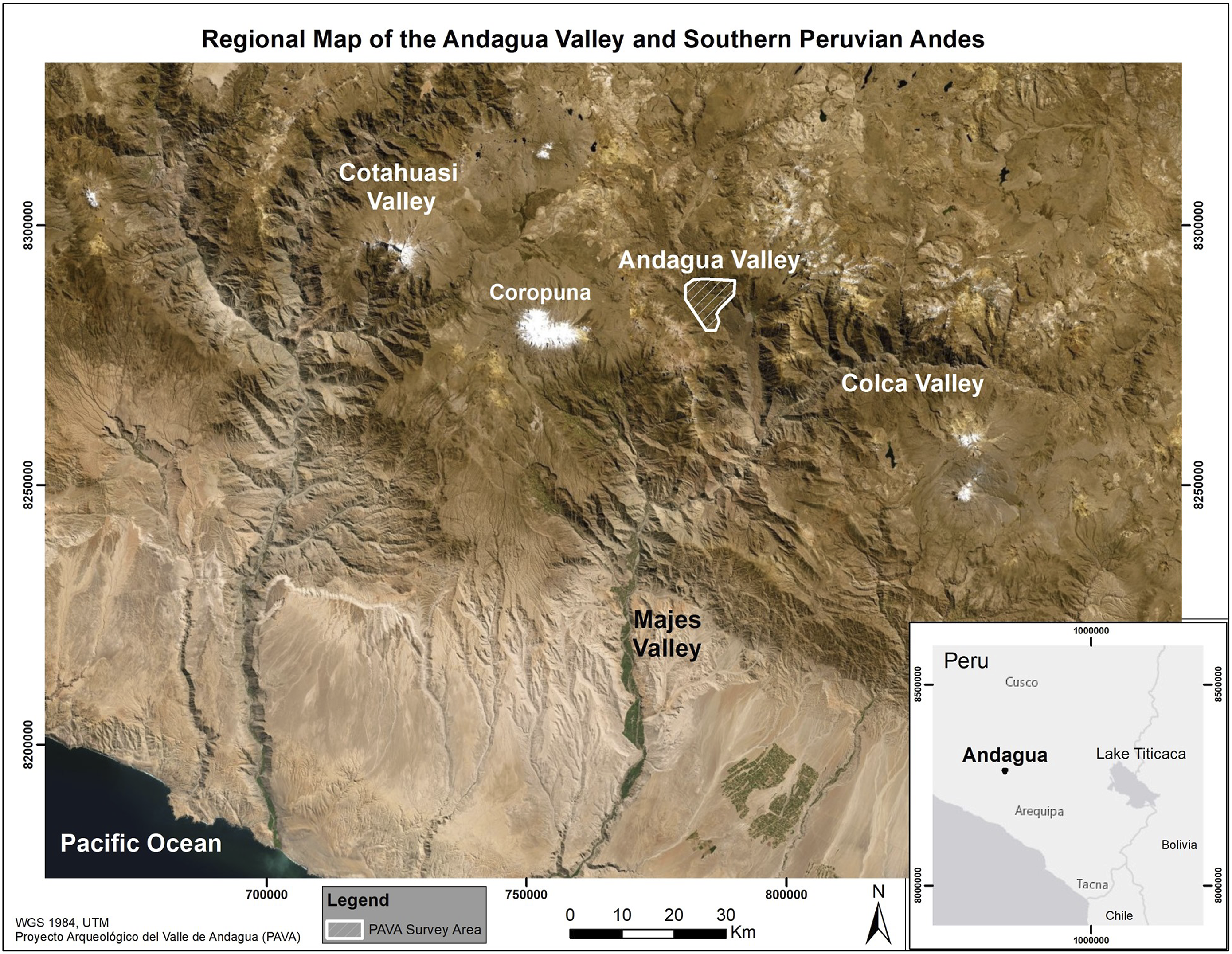
The gamonal was a local landlord who operated at the margins of the state and the intersections of the colonial products of race and class to exploit local populations and perpetuate a servile labor order. The gamonal had regional and social similarities and differences to the hacienda system, and the term gamonal is occasionally interchanged with hacienda/hacendado. Gamonalismo is distinguished from other postcolonial exploitative landscapes by its differentially lower rate/volume of capital production than, for example, coastal haciendas, which were often dedicated to large, centralized agricultural production (Burga, 2019 [1976]; Christie, 1979; Contreras Hernandez, 1981; de la Cadena, 2015; Gose, 1994; La Serna, 2013; Mayer, 2009; Matos Mar, 1976; Poole, 1987, 2004; Weaver, 2020). Gamonales exploited community labor and existing social organizations, imposing taxes for personal projects or other socio-economic gain. Gamonales exercised power in multiple forms, using intimidation, coercion, and explicit violence to appropriate property, wealth, and privilege at the expense of local indigenous citizens (Contreras Hernandez, 1981; de la Cadena, 2015; Gose, 1994; La Serna, 2013; Poole, 1987, 2004). Often carrying this out through extrajudicial means, the gamonal worked in concert with the state and, eventually, represented the state in the view of local indigenous communities (e.g., Julluyje, 2004). At the same time, gamonales performed across socio-racial, moral hierarchies and are associated with rugged individualism and cattle-rustling (Poole, 1987, 2004). Archaeologically, in addition to exploiting the postcolonial landscape by accumulating property across the town of Andagua, gamonalismo is marked by a regional bohemian, local/non-local aesthetic that includes horseshoes and horse tack, local portable material culture, such as green-glazed ware, and non-local European imported transfer-print. The gamonal is no longer present in Andagua but the material landscape of and historical trauma from the gamonal remains.
The gamonal family household remains infamous, with mention of their name leading to strong emotional evocations and memories. These memories are both visceral and economic, with a great deal of resentment directed towards the gamonal and the broader political system in which he flourished. Ranging from written history to chance encounters with community members, this history is a defining chapter of their local experience. The second chapter of local intellectual Victor Lázaro Julluyje’s book of history and legends from the valley begins by describing the injustices and suffering indigenous residents faced at the hand of the local gamonal in Andagua, writing how the land was once ruled by “terratenientes” (“landlords”; Julluyje, 2004). Woven through this history is the story of the miraculous bull Tarazona, named for the cruel policeman who carried out the bidding of the gamonal, offering insight beyond anthropocentric narratives (Hartigan and Menaker, 2022). The story recounts with pride the initial arrival of the “Guardia Civil and Policia,” with their first year marked by “excellent work”; however, soon after, the police were “absorbed by the landlords” (Julluyje, 2004: 18) Under the cruel hand of the police and gamonal, those who spoke Spanish were treated favorably, while “native Indians” were always “guilty” (Julluyje, 2004: 18).
Community members in Andagua told us stories of the physical violence and coercion carried out by the gamonal to appropriate property and instill an “aura of violence” (Gose, 1994: 19). Such spectacles of violence were legitimized by claims of paternalism and racism (Contreras Hernandez, 1981; de la Cadena, 2015; La Serna, 2013; Poole, 1987; Thurner, 1997). We heard many accounts of family members being forced to sell property under threat of, or after suffering from, extreme violence. The gamonal would hang those who resisted from an iron bar (barra de hierro), whipping and beating them until they acquiesced to his demands. Recounting painful memories, punctuated by soft whimpers, a local shop-owner told us of her grandmother’s suffering at the turn of the 19th century. To emphasize the paternalism of the gamonal, she recalled how he would promenade around the plaza on horseback and ensure that residents would kiss his ring finger. Indigenous residents would continue to work the land—though now it was no longer their own, but appropriated by the gamonal.
Additional accounts tell us of how residents struggled against the gamonal through litigation and as actors in state courts, carrying out the hatun queja (big grievance). In their efforts to claim their rights over land and property in Andagua, people would have to travel over the mountain pass at Coropuna to the town of Aplao and the other locations of colonial and national archives and the seats of state power, exemplifying what ethnographer Marisol de la Cadena’s collaborator, Mariano, labeled “as queja purichiy, which can be translated as ‘to walk the grievance’ or ‘to make the grievance work’” (de la Cadena, 2015: 72). Before the construction of a road over Coropuna, it was a two-to-three-day hike over the high mountain pass to Aplao in the Majes Valley. The highland pass of Coropuna was and is a liminal space that is conceived as a perilous place. In one case, a local farmer and herder told me about the cruel hand of power his grandparents and family suffered under the gamonal, while we walked along a road cut into the terraced hillside rising from the valley floor, returning to town in the late dusk through the cloud of dust kicked up by a herd of sheep. He shared histories of violence carried out in the highland pass near Coropuna before people could arrive at the Majes to air their grievances to the regional authorities—even the walk to the grievance was a dangerous and risky undertaking. There is a lingering sense of pain that, in some cases, justice will never be delivered.
The accounts from Andagua echo anthropological and historical research in the Southern Peruvian Andes (Contreras Hernandez, 1981; de la Cadena, 2015; Flores Galindo, 2010; Gose, 1994; La Serna, 2013; Poole, 1987, 2004). In striking similarity to Andagua, Marisol de la Cadena’s research in Cusco—based on conversations with collaborator Mariano—recounts the physical violence imposed: “those who disobeyed the hacendado [were] hung from a pole in the center of the casa hacienda. They would tie you to the pole by the waist and they would whip you while you were hanging” (de la Cadena, 2015: 70). Despite the violence and myriad forms of exploitation, indigenous residents in Andagua continued to struggle for self-determination and justice by both appealing to state institutions and engaging in local collaborative projects and initiatives.
Examining the recent past in consideration of long-term historical processes underscores the fundamental claims of contemporary nation-states regarding issues of representation, equal rights, market access, and justice. National independence did not liberate indigenous Peruvians but rather entrenched rural hierarchies. Despite colonial independence and the birth of the contemporary Peruvian Republic, an assemblage of narratives and structures of practice would perpetuate racial and socio-economic discrimination and shape local populations’ experiences of the transformation from “two republics to one divided” (Thurner, 1997). In Latin America, the nation-state embraced the mantle of an inevitable human march of progress embodied by the “creole pioneers” (Thurner, 1997). Indigenous people entered the nation-state as “a problem,” at the margins of state authority and grounded in the historical processes of Spanish colonialism; they were a holdover from the past, simultaneously denied history and treated as objects of the past with no future (Mariátegui, 1995 [1928]; Thurner, 1997). At the same time, indigenous people were always on the cusp of history, waiting to be folded into the “modern world,” beginning with writing and speaking Spanish (de la Cadena, 2015; García, 2005; Mannheim, 1991; Mignolo, 1995; Salomon and Niño-Murcia, 2011). As the Peruvian nation-state took form, postcolonial contradictions would take root from the spectrum of socio-cultural differences wrought from history.
Liberated colony, republic divided, and (market) freedom deferred
Encountering the cultural and historical differences of indigenous people was a fundamental tension of European imperial projects (Flores Galindo, 2010; Gose, 2008; Mignolo, 1995; Trouillot, 2003). Colonial (state) projects are filled with confusion, negotiation, and contestation, with resistance and survival taking on many forms and unfolding over multiple scales. Early Spanish colonialism, termed the “primera evangelización,” was characterized by improvisation and experimentation, years of civil wars, and debates over the rule of indigenous populations and archaeologically manifest in newly established church (doctrinal) settlements overlapping with the pre-Contact landscape along with assemblages of familiar and unfamiliar material culture (Estenssoro, 2003; Lamana, 2008; Liebmann and Murphy, 2011; Mumford, 2012; Wernke, 2013). 2 During the 1570s, under Viceroy Francisco de Toledo, there was a formalization of administrative institutions, including a republic of indios separate from the republic of españoles, and Corregidor de indios, along with the implementation of sweeping reforms. At the same time, Spanish colonial institutions built on and co-opted Inka institutions, such as the mit’a—labor tribute to the state. Although, the two republics were a limited juridical artifice embodying the tensions of state projects administrating difference, Toledo’s programs would have varied yet irrevocable impacts (Abercrombie, 1998; Mumford, 2012; Spalding, 1984; VanValkenburgh 2021; Wernke 2013).
The program of reducciones, an enduring remnant of Toledo’s reforms visible in the contemporary town of Andagua, involved the forced relocation of Andean people into nucleated settlements based on an urban grid, centered around a plaza, church, and municipal building (Menaker, 2019a, 2019b). The program of reducciones, in concert with extensive campaigns to destroy Andean religion (referred to as the extirpation of idolatry), constituted part of overlapping Spanish colonial strategies of evangelization to transform indigenous lives (Gose, 2008; Mills, 1997; Mumford, 2012; Ramos, 2010; VanValkenburgh, 2021; Wernke, 2013). Historically, throughout the highland Andes and Andagua, indigenous communities lived in llaqta (village settlements) shaped by ayllu, which are social groups organized through an idiom of kinship that share a common, venerated (mythical or actual) ancestor. While the ayllu transformed through time, they claimed descent from a hierarchy of sacred features (wak’a) grounded in the landscape (Chase, 2015; Goldstein, 2015; Isbell, 1997; Menaker, 2019a, 2019b; Menaker and Rademaker, 2023; Wernke, 2013; Salomon, 1991). Despite varied colonial state efforts, including extensive extirpation campaigns continuing during the 17th century, indigenous populations maintained and transformed cultural practices and relations with the surrounding landscape and wak’a (Gose, 2008; Mills, 1997).
The historical record of the 18th century of Peru is marked by a range of rebellions set in motion through a complex colonial panorama after years of state efforts and social transformations under the Bourbon reforms as the Spanish colonial state sought to re-exert its regional and direct influence (O’Phelan Godoy, 2012; Serulnikov, 2013; Walker, 2014). In Andagua, a 600-page court case recounts how in 1751 the regional Spanish colonial Corregidor, General Joseph de Arana, traveled to Andagua, claiming years of unpaid tribute were due to the crown. There, informed by an interim local leader (kuraka), the Corregidor confronted local merchant, church patron, and reputed leader of ancestral shrines Gregorio Taco, who had supposedly renewed anti-tribute agitations. Taco claimed that while he was a subject of the King of Spain, the regional Corregidor had no authority in Andagua. During a multi-year proceeding, the Corregidor encountered continued ancestor veneration among a range of community members. Ancestor veneration and worship of wak’a were practices supposedly destroyed through colonial conversion over the previous 200 years, with local clergy claiming ignorance of the continued practices (Menaker, 2019a, 2019b; Salomon, 1987; Takahashi, 2012). While some acts of resistance throughout the Americas centered on abstract categories of individual human rights, or a call for a neo-Inka or indigenous state, for example, the case in Andagua anchored around ancestor cults is an example of an “endogenous form of rebellion” (Salomon, 1987). Andagua residents attributed their health and prosperity to the reciprocal relations with ancestors (not necessarily genealogically related), continuing to reckon multiple origins for human descent and serving as an animating principle for social organization, cosmological order, and authority. Wielding state violence, the Corregidor imprisoned and tortured Taco during the process and, through a force of 150 armed men, destroyed the ancestral remains, causing great pain to indigenous residents. The court case loses its thread, and by the late 18th century, as rebellions roil the landscape, Andagua recedes from the colonial gaze (Salomon, 1987; Takahashi, 2012).
In 1813, on the eve of independence, Clemente Almonte began writing his colonial visita of Andagua, declaring that “the population of this doctrina is divided by people, these are españoles americanos, indios and mestizos”; he subsequently states in line two, “no one knows the origin of the indios of this doctrina” (my translation, in Millones, 1975: 54). Amidst a survey of local cultural practices and beliefs and shaped by colonial prejudices, the visita notes there are no longer local kurakas (caciques), which instead were replaced by Spanish tax collectors. The visita alludes to how exchanges of goods or labor could be made in kind or money, often guided by social relations and labor exchange characterized by ayni, where labor and food are exchanged in kind for agricultural fieldwork, exemplifying the foundations of contemporary Andean egalitarian social organizations (and informing notions of lo andino, idealized notions of Andean culture; Millones, 1975: 59–62; Gose, 2008; Jamieson, 2005; Salomon, 2002). Indigenous people were without history (and “agency”) as the violence of Spanish colonialism went unrecognized (Thurner, 1997; Wolf, 1982). Less than a decade later, the Spanish empire would cede authority to a suite of republican colonies.
Ravaged by political instability amidst the “crisis of independence,” there were varying motivations and subjectivities during the early 19th century in Peru (Klaren, 2000; Mendez, 2005; Thurner, 1997). The founding “creole pioneers” of the contemporary nation-state imagined a new body politic of individual citizens whose expression was the territorial state, a collective sovereignty “unencumbered by history and above ethnicity” (Thurner, 1997: 6). At the same time, indigenous people were (and continue to be) held outside the “logos” of the state, treated as backwards in the progress of modern civilization; this is also perpetuated by contemporary discourses (de la Cadena, 2015). Such historical erasure belies the complex subjectivities that shaped the late colonial and early republic landscape. These ranged from continued allegiance to the king through monarchist rebellions, with indigenous populations taking up arms to resist colonial independence, to serving and identifying under the nascent nation-state (Mendez, 2005). This transformative ability followed generations of varied state powers claiming universal rule from beyond the mountains. Indigenous populations would continue to adapt under the contemporary nation-state; however, the transformation from subjects of the king to Peruvian citizens would not quite be realized.
Andean residents were ideally encompassed in a universal project yet remained subject to an unjust system that was local and palpable. Residents in the Andagua Valley, from local ceramic artisans to agro-pastoral laborers, marked national sovereignty and citizenry. This is exemplified in a locally produced green-glazed pitcher which declares the maker’s national identification, stating “Peru” and marking the date of independence along with the coat of significant cultural items (see Figure 7, discussed below). 3 The postcolonial nation-state would create a set of new tensions and struggles over management of land and property. With declarations of equal citizenship in newly formed republican body politics, land was made alienable, available for purchase and sale, and was no longer property of the crown, distinct from encomiendas granted by the king (Poole, 1987; Thurner, 1997).
Gamonalismo in the Southern Peruvian Andes exemplifies the historical production of race and class that resulted in a socio-racial moral hierarchy, which the gamonal and state further reproduced (and exploited) (de la Cadena, 2015; García, 2005). The gamonal system was bound to the contemporary nation-state project, with the gamonal considered the “owner of the will” (munayniyuq) (de la Cadena, 2015: 69). According to de la Cadena, the notion of munayniyuq is a critique of how the modern state does not recognize runakuna (indigenous people) as political subjects. Indigenous people are acutely aware of how they are held outside the order of the state, viewed as illiterate objects embroiled in “a quest for translation into modern, literate subjects of the state,” and have been actively underrepresented for the possibility of self (or collective) determination (de la Cadena, 2015: 246-247). “Indigenous” eventually replaced the colonial category of “indio,” but ultimately the modern state perpetuated narratives to delegitimize and marginalize native Andean cultural practices and bodies (see Salomon, 2002, for local interpretations navigating these postcolonial contradictions). The indigenous Other continued as a static, essential subject--an empty category on which to project utopian and nightmarish possibilities--and in any case, unable to determine their own future in the eyes of the state (Flores Galindo, 2010).
While acknowledging the impact of the gamonal, indigenous residents in Andagua also proudly emphasize their continued labor and inhabitation of the landscape. Indigenous residents in Andagua continued to participate in regional economies as muleteers and llama herders (Millones, 1975). In addition, the valley terraces continued to be important markers of familial and historical territory and livelihoods, with local farmers constructing field houses in the surrounding terraces away from the reducción (Menaker, 2019a, 2019b). Examining Andagua and the historical production of “margins” offers insight into the tensions of fundamental claims of the contemporary state articulated through centralized and decentralized forms of (state) power.
Gamonalismo and the production of margins
In the Southern Peruvian Andes during the 19th century (and continuing through to the present), the uneven footprint of the contemporary nation-state resulted in differential access to the cash economy and state institutions, despite the intention of creating an “equal economic man” (Poole, 1987: 370-371). Gamonalismo critically exemplifies the socio-historical emergence and limits of “liberal” claims of “equality for all” as “in the market place” (Poole, 1987: 370-371). The extents of the state and market were limited, allowing the gamonal to operate in place of state institutions and market forces. The gamonal contradictorily represented both “the state and the forms of private, extrajudicial and criminal power that the state purportedly seeks to displace through law, citizenship and public administration” (Poole, 2004: 45). Andagua was the site of “frontiers and margins” where despite claims of universal reach, state authority (the market and justice) was illusory, perpetuated by colonial discourses of backwardness and “a theater of violence” to uphold colonial power structures exploiting indigenous people (Poole, 1987: 389). Margins are not a place but a relationship that is historically produced. Andagua became “marginalized” through the erasure of local institutions, authorities, and social memories that further subjugated cultural and historical difference to the encompassing state.
As demonstrated above, the gamonal emerged through the interstices of the Peruvian state and its enduring colonial legacies. While similar and different postcolonial processes disenfranchised indigenous people across the Americas and postcolonial states (Jamieson, 2005, 2014), the gamonal is particularly identified in the Southern Peruvian Andes (de la Cadena, 2015; Gose, 1994; Poole, 1987). The gamonal was discussed and debated through the 19th and 20th century, exemplified by early-20th-century intellectual Jose Carlos Mariátegui addressing the tensions of (de)centralization of state power and capital that gave form to gamonalismo (Mariategui, 1995 [1928]). In contrast to Spanish colonial encomenderos, the gamonal was not an absentee landowner. He was, however, still dedicated to upholding a servile agrarian labor order, often characterized as a “feudal” relationship (Flores Galindo, 2010; Gose, 1994; Poole, 1987).
The gamonal lived in the community as a misti, or a criollo, and was intimately familiar with “Indian culture” while systematically separating himself from it in order to subjugate indigenous residents (Arguedas 2007 [1968]; Gose, 1994; Poole, 1987, 2004). In the case of the Southern Peruvian Andes, criollo identity overlapped with mistis and was embodied through a performance of material culture and practices characterized as “non-Indian,” such as bullfighting, speaking Spanish, and displaying artifacts associated with non-local or European provenience (majolica and whiteware). The gamonal wielded forms of charismatic power based upon individual authority and the threat of violence, embodying an ethos of rugged individualism and masculinity associated with “livestock, houses and a regional bohemian aesthetic” (Poole, 2004: 43). In this way, the socio-racial hierarchy that made the gamonal possible extended to a class aesthetic (“regional bohemian”).
This class aesthetic was based upon central assumptions of identity and material culture, re-inscribing enduring and new claims about the proper relations of humans and things. This combination of regional bohemian aesthetic and familiarity with Andean cultural practices is evident in the material culture and commercial activities of the gamonal family in Andagua and is manifest in the town and throughout the valley. In Andagua, I was told how the gamonal family came from Cusco and specialized in commerce throughout the region (transporting metal, commodities, and livestock). The regional bohemian aesthetic both anticipated and was echoed by international explorers and scientists of the 20th century.
These accounts often relegated the contemporary residents to the fossilized remains of “ancient Andean tribes” dwelling in the “forgotten valleys of Peru,” as Robert Shippee wrote while reflecting on his pioneering aerial expedition (Shippee, 1932, 1934). Juxtaposing the expedition’s airplane with the difficult mountain trails, Shippee exemplifies a dominant modern mode of thought reinforced by material culture as he describes an “outpost of civilization” in the nearby Colca Valley, consisting of “tin roofing, a miniature gasoline-electric plant, an ancient photograph, a typewriter, and bottled beer—all brought from Arequipa on muleback” (Shippee, 1932: 111). Here one’s belonging to the modern contemporary world is inherently tied to and representative (isomorphic) of material culture occupying a linear teleology (echoing racist phases of savagery, barbarism, and civilization). Historical relationships and practices became naturalized as particular value-laden interpretations took on universal authority associated with “modernity” and “civilization” based upon a socio-racial moral hierarchy with local consequences (Lamana, 2008).
The gamonal family of Andagua
According to the remaining descendant of the gamonal family living in Andagua, Raul, the family moved from Cusco in the 19th century and throughout the years established themselves as the dominant local merchants.
4
There was extensive late Spanish colonial and early Republican migration into and around Peru with the construction of transportation infrastructure creating new ways of articulating status in the Andes. Similar to other accounts describing the gamonal economy, the family specialized in commercial trade, transporting materials (including aluminum and livestock) from Orcopampa to Majes and throughout the region, relying on Old World pack animals. In addition to taking ownership of properties throughout the valley, the patriarch of the family owned several properties in the reducción, including two large blocks adjacent to the plaza. In the late 20th century, they converted their large “Casa Grande” (“Big House”) on the plaza into a hotel (Figure 2). Today, while a large sign marked “Casa Grande” remains, the building currently stands shuttered through neglect, with the family living in Arequipa and elsewhere. Many of the parcels of the property were sold and repurposed but others remain under their ownership, receiving limited maintenance. Along with the main church on the plaza, the Casa Grande is distinguished by its aluminum roof, which has often been remarked as one of the first in town, added more than a century ago. The circulation of and discourses about material culture in the recent past, such as the roof construction and other building materials, highlight the hegemony of such material-semiotic ideologies within Andagua and shared by the visiting explorers who wrote with confidence about the material markers of progress on an arbitrary teleological timeline. Casa Grande of the gamonal on the plaza.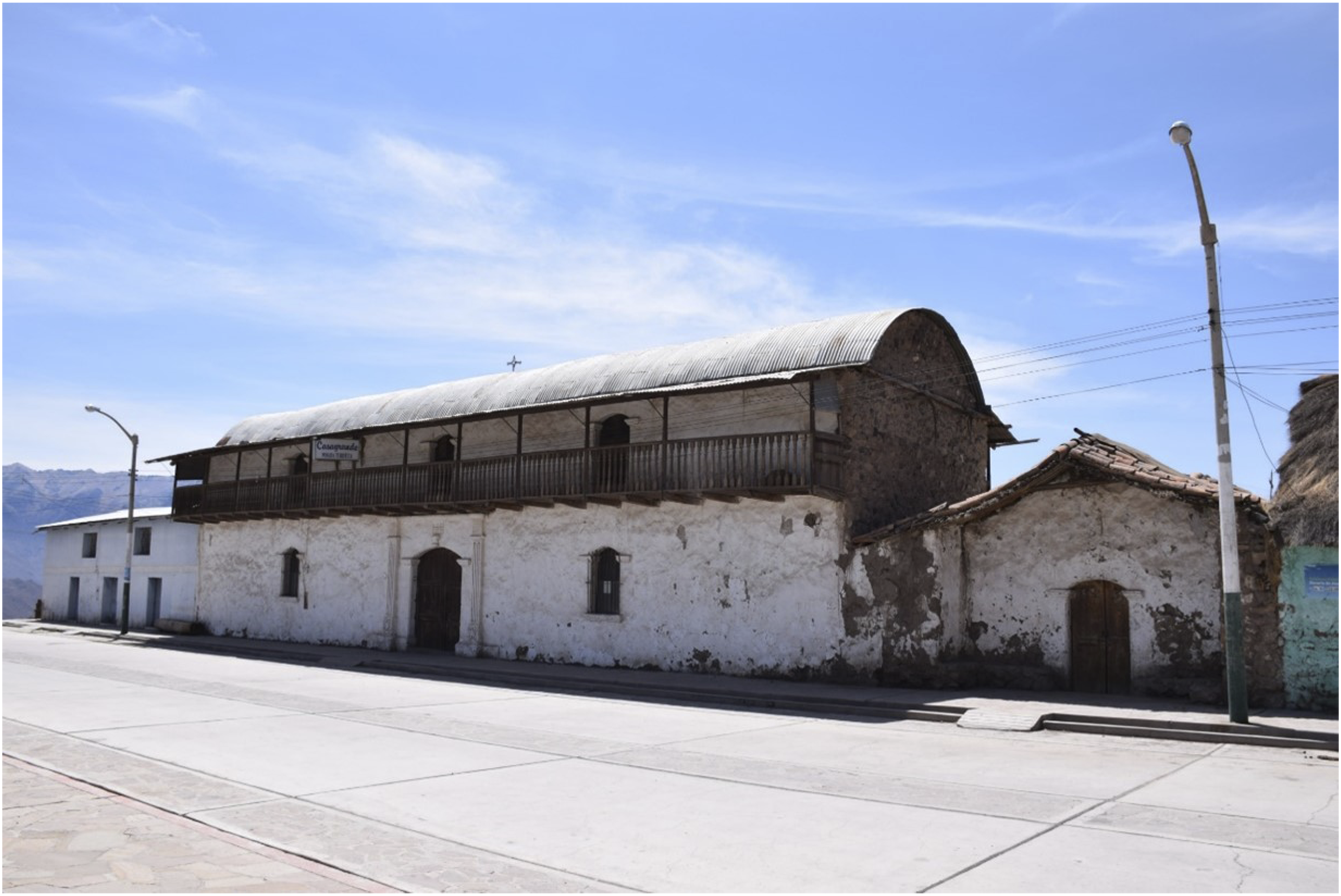
We interviewed Raul in the courtyard of the remaining property across the plaza from the Casa Grande. The compound consists of structures with decaying thatched roofs and painted plaster walls from the early 20th century, exemplifying the regional bohemian aesthetic (Figures 3 and 4). The property has received little modification in the past half-century. A stone canal runs through the property and was most likely used for running water and sewage. The addition of a metal spigot tied to the local source of drinking water (a spring in the mountains above town) is one of the few modifications in recent years. Raul visits the property occasionally to purchase items in town and use the running water. Raul let us walk around and photograph his property, including the interior of his room, which is decorated with paintings. He also shared with us another collection of regional ceramics made in Chilcaymarca and Chapacoco. Historic property of the gamonal and location of excavation units. View inside historic property of the gamonal with hand-painted walls, exemplifying the regional bohemian aesthetic, and decaying roof.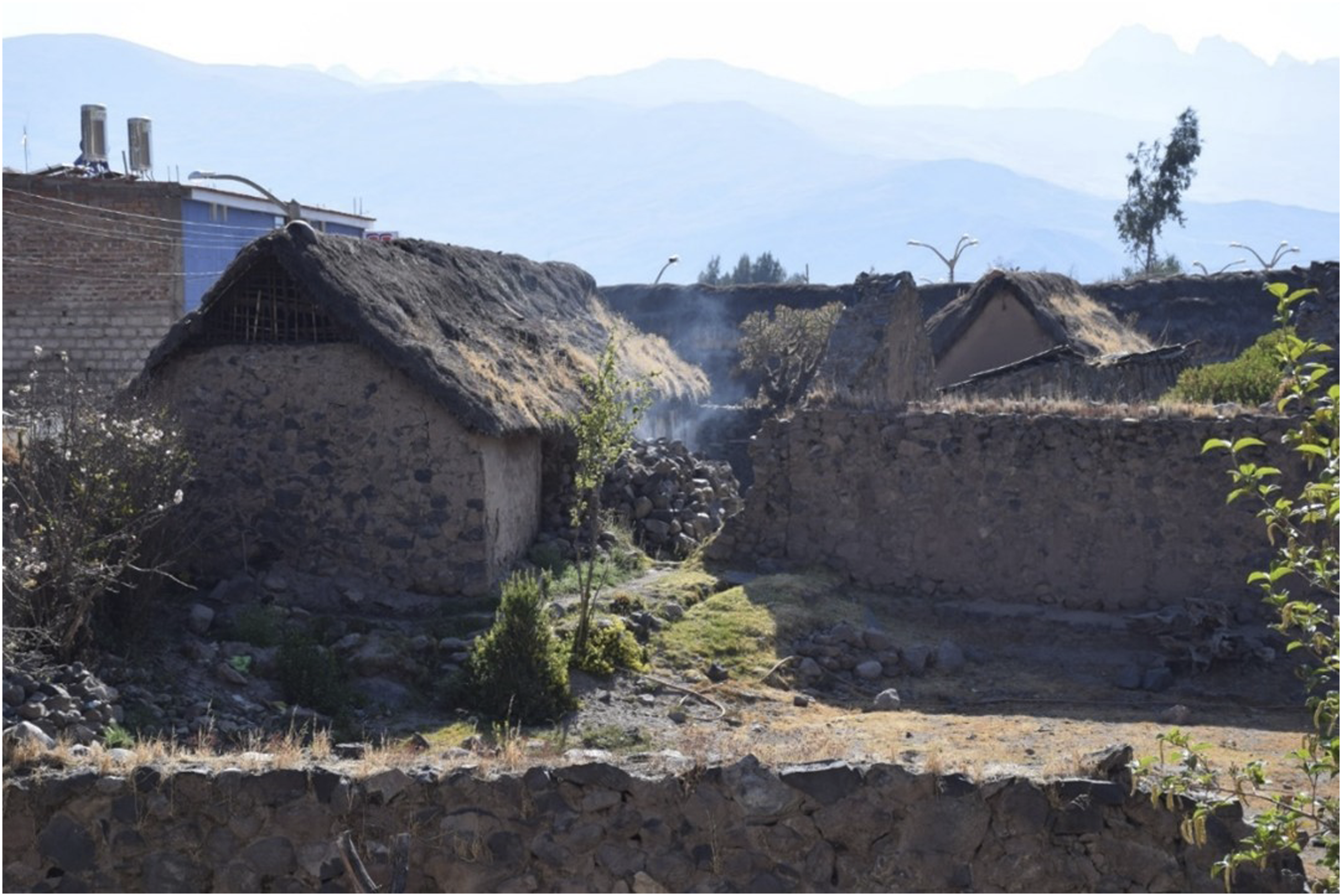
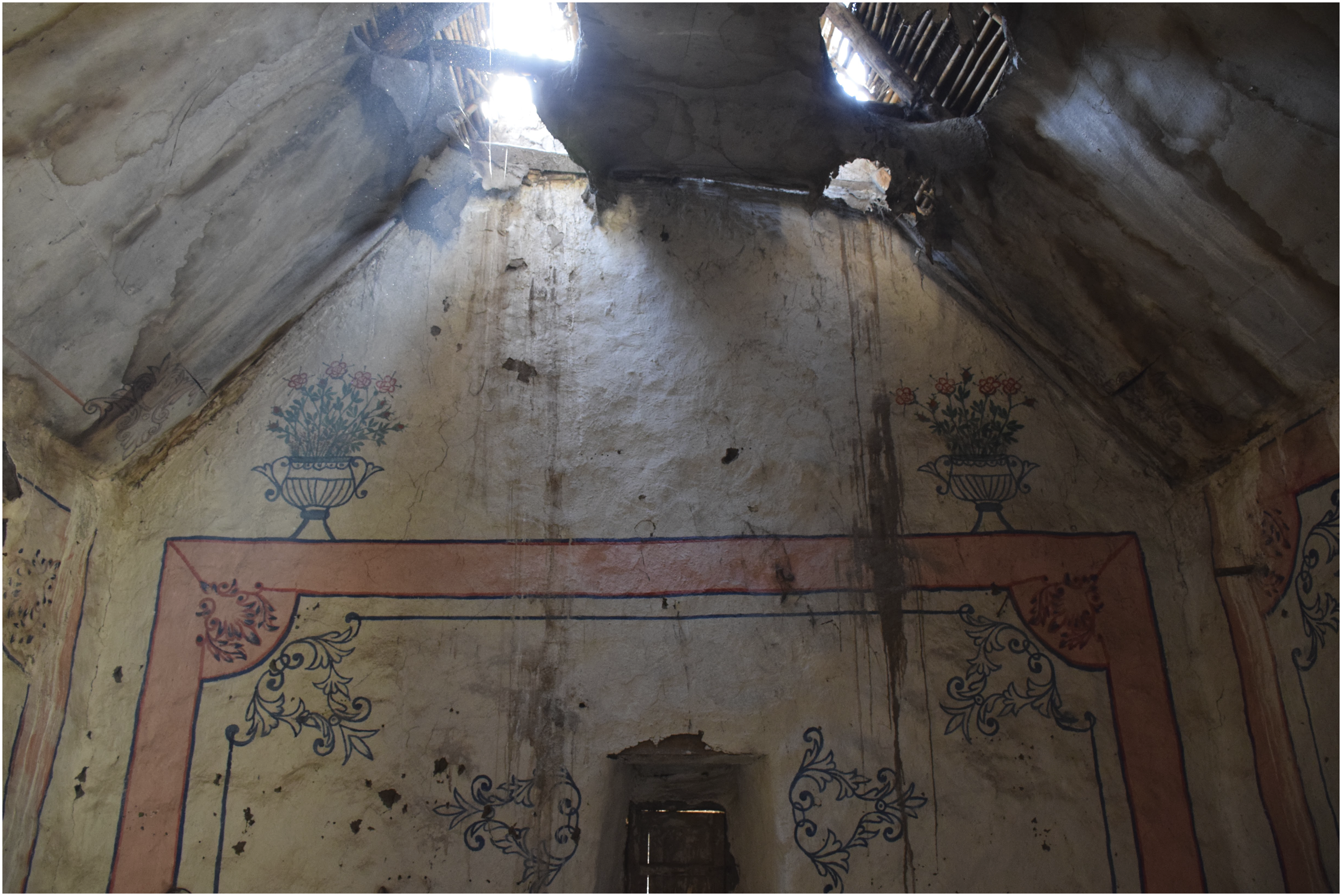
Raul does not use his maternal family’s name that bears the gamonal’s surname, even though he is apathetic towards the father whose last name he now carries. This is exemplified in his indifference while discussing his father, who had left him and his mother at a young age and perished in a highway traffic accident somewhere along the road to Puno several decades ago. Despite descending from the gamonal family, Raul is welcome in the community. Well-educated and trained as a lawyer in Arequipa, Raul became sympathetic to populist and leftist political philosophies and critiques of society of the 20th century, such as those of Mariátegui (1995 [1928]) described and cited above. He eventually returned and taught at the local school in Andagua. However, he would only teach at the school for a short time before retiring to his family’s properties. Today he resides across the valley of Andagua in Pumajallo. We were preparing to venture across the valley one day in the efforts of meeting with him and learning about his family’s history when we encountered him in town during a brief return to his family’s property.
As Raul recounted the history of his family, the contradictions of the postcolonial Peruvian nation-state were evident in the competing narratives of the reality of (Peruvian) citizenry put forth by residents of Andagua. Raul, the sole descendant of the gamonal family in Andagua, expressed this weary optimism: “We are all equal … Well, I would like to believe …” I heard a different sentiment while speaking with another woman who was tending to her storefront—on land that was purchased after once being the property of the gamonal—and who now operates local businesses and agrarian practices. In passing, she casually observed, “No, we are not equal …”
Excavating the recent past
In the former property of the gamonal family adjacent to the plaza, and near where we interviewed Raul, our project carried out two 1 × 1 m excavation test units to investigate the archaeological history of the reducción (see Figure 3). The large, heterogeneous block of the reducción belonged to the gamonal family through the 19th and 20th centuries but was sold to a local community member within the past 15 years. A compound of older plastered stone walls with a decaying gabled and thatched roof at the edge of the plaza still belongs to the gamonal family and was where we interviewed Raul. In the middle of the block, bordered by stone walls at the edge of the street, is an open, terraced area primarily used as a corral and field. The property is adjacent to the stream that runs from Coropuna through town and into the valley. Despite encountering disturbed contexts, the excavations revealed compelling material culture that highlighted the multiple occupations of the area, ranging from Inka fragments to post-Contact local and non-local artifacts, such as green-glazed ware, majolica, and 19th-century transfer-print whiteware.
The project placed one 1 × 1 m excavation test unit (001-002A) in what was once a stable located in the lower step of the terraced property. A large stone wall (greater than 5 m tall) stands to the south, a remnant from when the property was a stable. Excavations reached a depth of 1.4 m, revealing material culture that exhibits a range of historical activities and contexts. The post-Contact archaeological evidence supported the use of the area as a stable and consisted of ceramics, metal (horseshoes, nails), brick, and glass, as well as the presence of faunal remains. In total, excavations of unit 001-002A recovered 646 ceramic sherds with 555 ceramic fragments of orange, brown, and red earthen plain ware (85.9%) (and 460 of these are body fragments). Diagnostic post-Contact ceramics included local green-glazed wares (n = 42, 6.5%), purple-red paint on orange earthenware (n = 14, 2.2%), several non-local artifacts including majolica (n = 10, 1.5%), and the only examples of probable 19th-century transfer-prints (n = 3, <1%) collected by the project (besides one sample recovered in unit 001-002B, also located on the property). While still recovering post-Contact material culture, excavations further recovered diagnostic pre-Contact ceramic sherds (n = 17, 2.6%) from the lowest excavation depths, including black on red (and orange) ceramics, but many of these were small fragments with limited samples of motifs, and may have continued in use and production during post-Contact contexts. The artifacts excavated indicate a pre-Contact and Inka footprint beneath the reducción of Andagua and further demonstrate the performance of gamonal identity through the recent past.
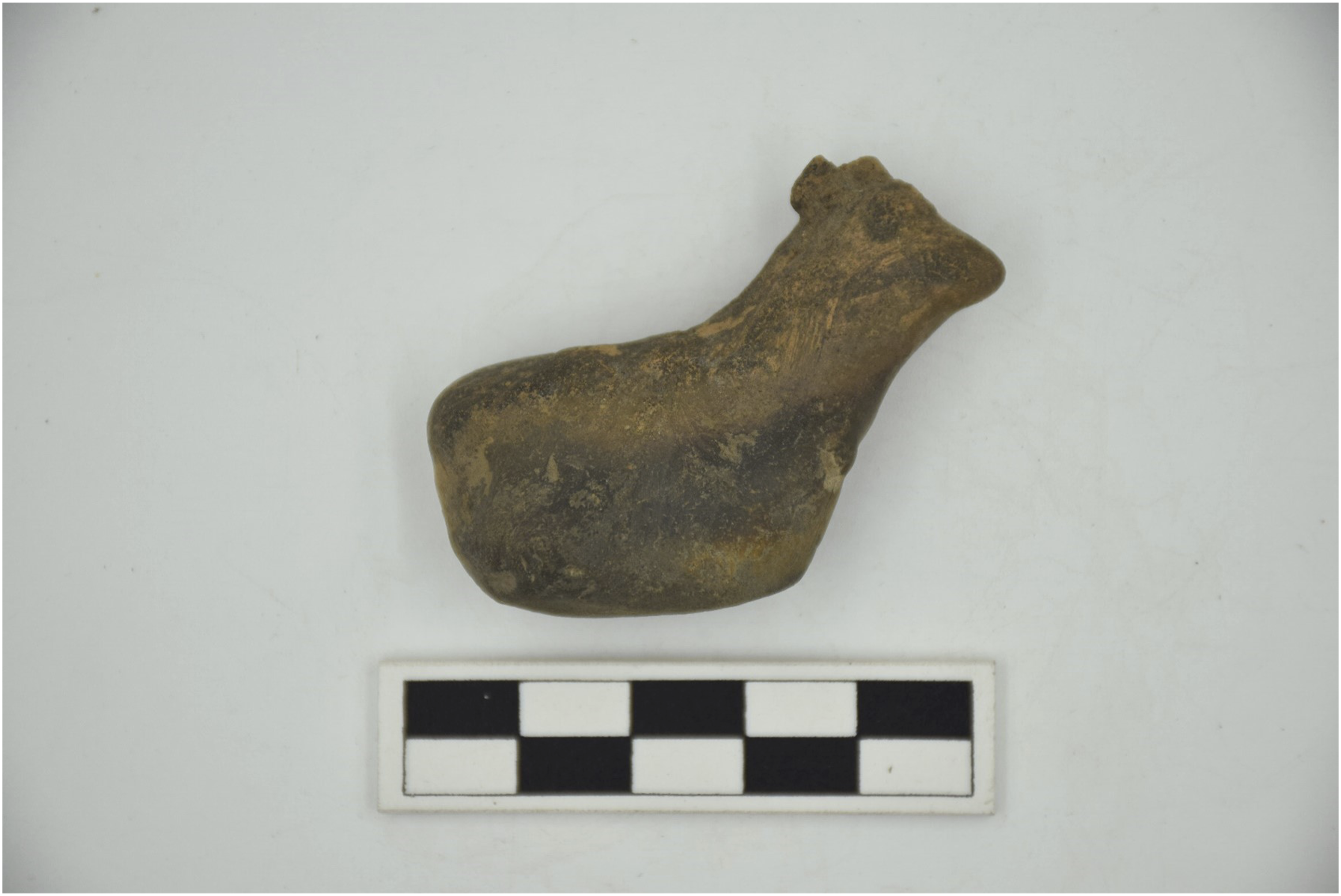
Excavations across the property revealed a probable stone-floor patio (we were told the property once had a bakery in this location). The project excavated to a depth of 0.50 m below the surface before coming across a probable stone-floor patio made of small, round river cobbles. In total, excavations yielded 268 ceramic sherds from this unit, with plain ware sherds of orange, brown, buff-beige, and red slipped and unslipped varieties constituting the majority of the collection and most likely used for serving, cooking, and storage purposes (n = 224, 83.6%). The remaining collection was composed of green-glazed wares (pitchers and bowls) (n = 31, 11.6%), three majolica fragments, red transfer-print ceramic (similar to the other unit on the property), three local purple-red painted earthenware, and two polychrome late pre-Contact sherds (Figure 5). Lastly, at the level of the stone floor, excavations recovered a zoomorphic figurine made from clay (Figure 6). Perhaps it is a toy, or possibly a post-Contact wank’a or conopa (a small, portable sacred object, even though they are usually made from stone; see Mills, 1997; Sillar, 2016). In any case, with finds ranging from imported transfer-print to locally produced pottery (and an ambiguous figurine), the excavations demonstrate the spectrum of the gamonal’s performance of identity, traversing local, “Indian,” and “non-Indian” material culture. 19th-century transfer-print ceramics excavated in the former property of the gamonal. Zoomorphic figurine excavated from unit AND-1-002B, at the gamonal property.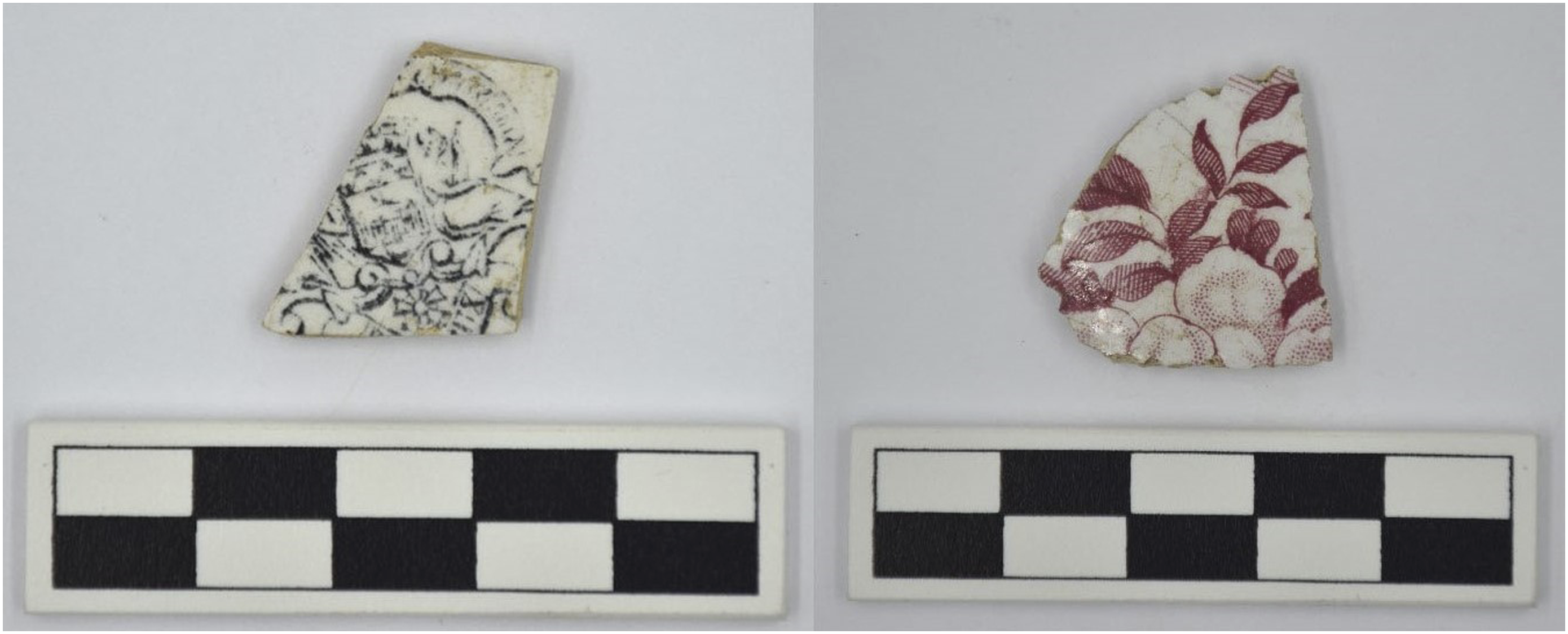
Paccareta and the origins of tomorrow: land and water management in the 20th century
Through the mid-20th century, the gamonal’s claims to properties would diminish as the patriarch passed away and the family’s presence in Andagua dissolved, leaving behind only Raul. In addition, residents purchased or reclaimed the properties through the “hatun queja” and the agrarian reforms. Beyond a system mired in postcolonial contradictions, residents continued to maintain and rehabilitate the surrounding landscape. Recent histories of the agricultural landscapes of Tauca and Paccareta offer interesting contrasts of land and water management in the valley. Collective organization (and determination) is evident in local community members’ rehabilitation of abandoned pre-Contact agricultural infrastructure north of the town of Andagua, at the archaeological site of Paccareta, in the mid-1960s preceding the agrarian reform of the late 1960s.
The Peruvian agrarian reforms were a top down “revolution from above” state program by Juan Velasco Alvarado, general of the armed forces, following a coup seizing power in 1968 (Mayer, 2009). After years of varying state and local efforts, including local land invasions, to address continued land and wealth inequities, Velasco’s reforms were distinct for their breadth, implementation, and incorporation of indigenous cultural themes and representation for significant attempts at wealth redistribution (Mayer, 2009). The reforms involved the appropriation/expropriation of large landholder estate properties and foreign companies, disseminated to newly formed cooperatives (comunidades campesinas) that came with a set of requirements (Cant, 2021; Mayer, 2009). However, in many cases, such as Andagua, the hacienda or gamonal “dissolved fairly rapidly into de facto and sometimes officially recognized indigenous communities (comunidades campesinas) without much fanfare or official notice” (Mayer, 2009: 29). Despite the varying effects of the agrarian reform, including enduring systemic inequities, it is an important marker that transformed the socio-political landscape (Cant, 2021; Mayer, 2009). In Andagua, the agrarian reforms facilitated the development of the comunidad de campesinas, with the local state municipality having jurisdiction over the town of Andagua.
Paccareta, and the Andagua Valley more broadly, offer a contrast beyond gamonalismo and the Peruvian state, exemplifying bottom-up social projects and the local community’s independence of the state. 5 Moreover, they challenge timeless landscapes and show how history and humans’ relationship with the landscape are mediated and bound together. Oral histories recount that dozens of families agreed in principle to work to rehabilitate the land and form a cooperative dedicated to its continued maintenance, benefitting from the subsequent harvests and yields. Of those dozens of families, however, it is emphasized that only 15 families remained committed to rehabilitating the landscape of Paccareta (including one woman representing her family). Indeed, part of the story of Paccareta is the disappointment, the number of families who opted out. Today subsequent generations continue to maintain the agricultural infrastructure of Paccareta, with a couple households living there. Families with deep historical ties to Andagua continue to work the fields but identify their relations with the land to when they rehabilitated the fields in the 20th century.
The continued maintenance and rehabilitation of the agricultural infrastructure in Paccareta and much of the valley is grounded in how labor was historically organized across the Andes through kinship (ayllus) and forms of reciprocity. Ayni, for instance, involves symmetrical reciprocity with little social or economic inequity (while mink’a involves asymmetrical reciprocity), with people working the fields in exchange for another labor turn (Isbell, 1997: 118–120; Murphy 2023). Some people today still organize fieldwork activities, such as planting and harvesting, through ayni. People call upon kin members, including distant cousins from neighboring towns, providing food and drink, with the green-glazed pitchers filled with chicha and passed around in exchange for labor assistance and the promise (or debt) of returning the gift of labor in the future. However, as demographic shifts continue, with young and old alike moving from the rural highlands to urban areas such as Arequipa and Lima, more people are having to rely on paid wage labor for assistance in fields from unrelated people in the valley. Or, people and family members who traditionally labored through ayni and reciprocity now prefer to be compensated in cash, as the national cash and market economy have strengthened their reach in Andagua along with residents bound to broader political-economic landscapes (Murphy, 2023).
The terraces and landscape of Tauca offer another distinctive case, with the land being purchased and rehabilitated by a regional businessman and engineer and sold to families who relocated from Puquina (in Moquegua) when their community’s water source dried up. Tauca, located in the eastern section of the valley, is composed of agricultural infrastructure that was intensified under the Inka, subsequently marginalized during Spanish colonialism, and partially reclaimed and rehabilitated since the 1980s. However, unlike Paccareta, the rehabilitation was facilitated by a businessman and engineer from Chuquibamba, who created a new piping system through a cliffside, channeling water from the Andagua River across the valley. Through engineering a renewed irrigation connection, the engineer-turned-businessman claimed the land and advertised it for sale. Several families from the valley of Puquina near Moquegua saw the advertisement, and upon scouting the territory, purchased it and rehabilitated the fields, and live there in scattered homesteads. A family from Andagua also purchased some of the rehabilitated land.
Carried out in collaboration with geographer Blaise Murphy, soil analyses of a range of agricultural fields throughout the valley investigated the nutrient properties present and relationships with agricultural terrace maintenance, rehabilitation, and disuse. Research indicated that despite cases of disuse, agriculturally relevant soil properties were resilient and did not diminish, thus showing how rehabilitation efforts are possible, resulting from the natural properties and processes of human cultivation (Murphy, 2017). Murphy’s (2017, 2023) work, in dialogue with anthropological and archaeological research, underscores how residents in the Andagua Valley socially organize and maintain the landscape at the limits of state organizations and capitalist market economies contingent upon wage labor.
Scattered across the landscape, green-glazed pitchers (vasijas) are indicative of this communal aspect of labor. The pitchers (vasijas) are ubiquitous and distinctive, used for drinking chicha among communal labor activities, especially fieldwork. Chicha, a low-alcohol and sustaining corn beverage, is a staple on labor projects in the Andes and, following millennia of corn beer consumption at a range of events, intimate to state festivals. The pitchers are filled with chicha, with one individual drinking the entire vessel clean before refilling it and passing it on to another individual. These pitchers are primarily found out in the fields and used for collective labor activities/work parties (faena) where the owner of the field enlists help from a cadre of relatives and friends to complete necessary field work—such as tilling, planting, or harvesting. There are also larger vessels and pitchers (cántaros) that are used for storing and transporting large amounts of chicha, and also produced in Chapacoco and Chilcaymarca. These pitchers can be simple, undecorated with only glazes, while many exist with an array of surface finishes. For example, there are appliques that appear with leaves and other motifs. While many of these vessels remain in use, the project observed and collected representative samples of broken and abandoned vessels across the valley. Moreover, the pitchers were only one type of ceramic form that appeared in similar ceramic paste and styles, composing a broader set that included teacups and bowls of varying sizes.
There is one pitcher sample that clearly identifies and embodies local Peruvian self-identification and subjectivity (Figure 7). It was recovered during survey and though its manufacturing and abandonment dates are unclear, these pitchers in many cases are still used and have belonged to families for several generations, with a general refrain that they are passed along from the “grandparents” (“abuelos”). It is worth mentioning that “grandparents” can loosely characterize several generations of ancestors, and while people may not trace their specific acquisition, they become, in a way, from time immemorial (see also Salomon, 1995, 2002). Though this pitcher is broken, its fragmented remains offer compelling traces, with a complex assemblage of details and appliques indicating a local yet postcolonial Peruvian state identity. Around one side of the rim are the letters “ACOCO,” most likely fragments of Chapacoco, for its location of production. Below that and above a seal (which also features a camelid) are the letters “RU,” probably indicative of “PERU.” On the other side of the vessel located on the rim above the seal are the letters “AÑO 1”. Though the complete date is lost to us, it espouses a Gregorian calendar and sense of time, and with the entire assemblage indexing modern subjects in universal time.
6
At the same time, the vessel is dedicated to a range of practices and relations that both defines Peruvianness and excludes people from equal representation and justice in the contemporary nation-state. Green-glazed small pitcher, marking its regional and historical production and sense of belonging, indicating a postcolonial context.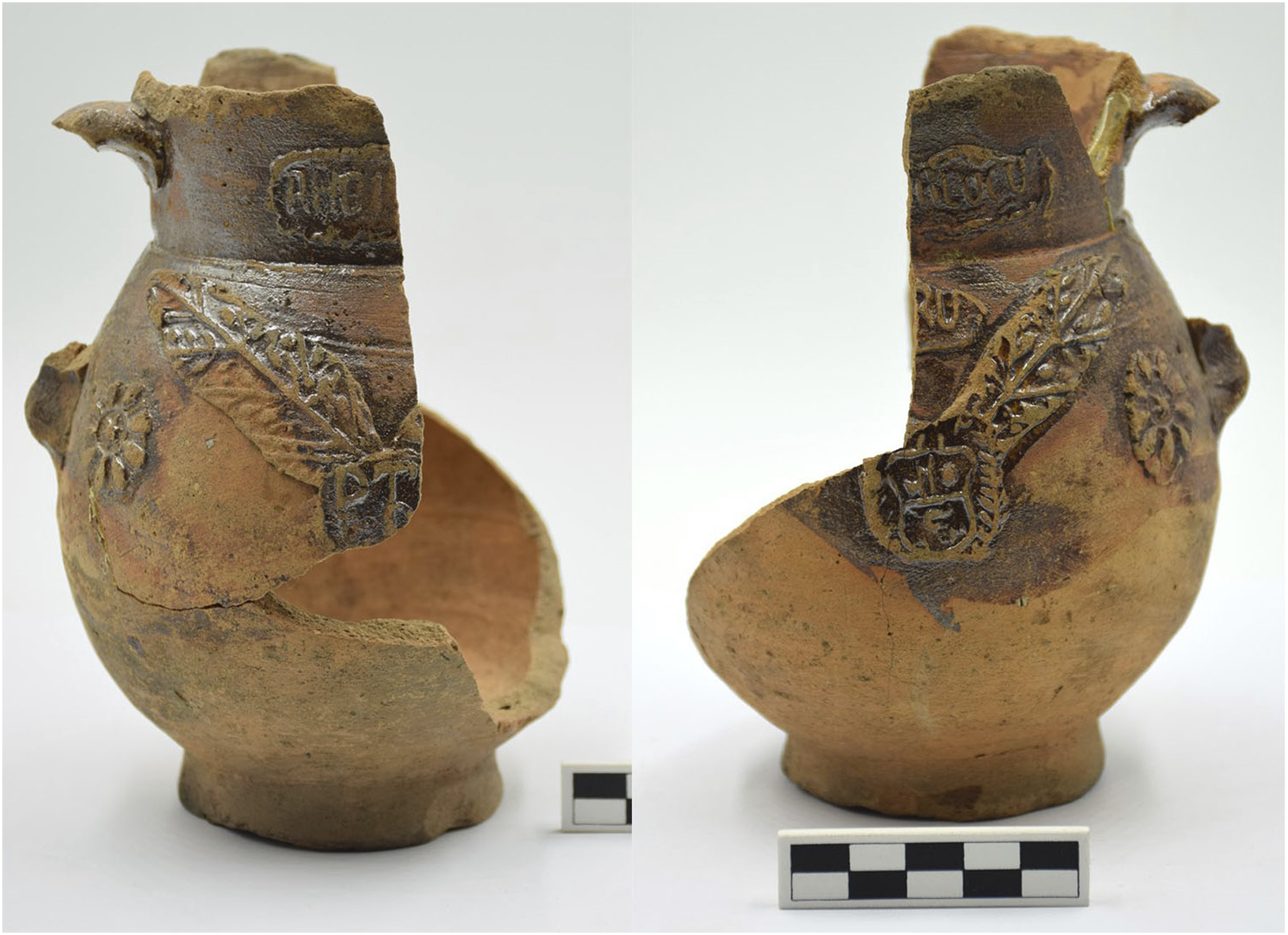
Conclusion
Bridging recent and deep pasts, using multiple methods and engaging with local stakeholders, this work recognizes complex subjectivities and gives space for historical difference and contemporaneity. In doing so, this article outlines some of the main assumptions and dilemmas of the modern nation-state, including enduring issues of sameness and difference, the reach and limits of liberal capitalism, and centralization and decentralization of state power. Contrasting with claims such as a universal citizenry of individuals unburdened by history, and forged through the crucible of colonial violence, archaeological research then evinces the materiality of how the gamonal exploited a post-reducción landscape while performing aspects of identity that were both local and non-local to separate from indigenous residents.
Rather than the historically prominent case of the extirpation of idolatries of the 18th century, Andagua residents identify the contemporary Peruvian Republic and the existence of the system of gamonalismo as a defining experience of their subjectivities and characterized by their most immediate struggles of oppression and disenfranchisement. Indigenous residents of Andagua do not identify Peruvian independence as a marker of liberation; rather, many consider the creation of the communidad de campesinos and the agrarian reforms under Velasco in the late 1960s as a maker of their struggle for equality under the Peruvian state. At the same time, in Andagua the story of Paccareta (and Tauca) serves as an alternative historical movement on the ground. Local collaboration and reclamation of the lands of Paccareta preceded the formal top-down government reforms of Velasco. This history illustrates the discontinuity of local population land management and inhabitation, and demonstrates other forms of organizing and creating social projects at the limits of state power. Moreover, the rehabilitation of Paccareta and continued practices of ayni exemplify social relations that do not depend upon freedom and liberation based on individual, essential subjects liberated from one another (in contrast to the “rugged individualism” performed by gamonales), but recognize the relational foundations for human life. 7
Today, residents also forewarn of an inclination to become like gamonales, subjugating and exploiting others (to accumulate capital and flout social norms). Ultimately, the gamonal is not necessarily limited to the past, with structures and tensions that enable gamonalismo woven into the fabric of contemporary social orders.
Footnotes
Acknowledgements
Thank you to the community of Andagua, co-director Victor Falcón Huayta and all members of the Proyecto Arqueológico del Valle de Andagua. The manuscript benefited from feeback by anonymous reviewers and Blaise Murphy. All errors are my own.
Declaration of conflicting interests
The author(s) declared no potential conflicts of interest with respect to the research, authorship, and/or publication of this article.
Funding
The author(s) disclosed receipt of the following financial support for the research, authorship, and/or publication of this article: University of Texas at Austin, Department of Anthropology and Division of Behavioral and Cognitive Sciences (NSF-DDRIG - SBE, BCS-1540610), Tinker Summer Field Grant and Lozano Long Institute of Latin American Studies (LLILAS).
