




Abstract
Although the study of emotions in archaeology has increased considerably in recent years, loneliness remains understudied. This paper aims to challenge that bias and demonstrate how identifying and exploring loneliness can provide invaluable insights into the human experience, enabling a greater understanding of past societies and their social dynamics. This study, bridging sciences and humanities, aims to promote a debate to address the gap in the archaeological study of loneliness. Taking an interdisciplinary approach, with insights from history, anthropology, and psychology, two case studies are presented using three different lines of archaeological analysis: one from architectural structures which contribute to the feeling of loneliness; one from lonely landscapes that may contribute to the same negative feeling; and one from the social (or individual) strategies used to fight that feeling.
Keywords
Introduction
There is a growing consensus that loneliness is a worldwide problem (Ozawa-de Silva and Parsons, 2020: 613; Barclay et al., 2023: 1). Recognising this, the United Kingdom created a Ministry of Loneliness in 2018, Japan followed its example in 2021, and Portugal is discussing the creation of a state department. Some view loneliness as a “disease of civilization” related to the Western lifestyle (James, 2004: 276). However, a significant part of the academic community thinks otherwise, and albeit with cultural differences, loneliness is studied all over the world: India (Chakravarti, 2023), Mexico and Kenya (Pike and Crocker, 2020), Russia (Parsons, 2020), Palestine (Nazzal et al., 2020), Japan (Ozawa-de Silva, 2020), and even the Sahara (Rasmussen, 2020).
This is also true regarding past loneliness, in which Keith Snell’s (2017) recent observation that loneliness is one of the most forgotten themes in the history of emotions is now being addressed. In recent years, several historians have focused their studies on this emotion (e.g. Barclay et al., 2023; Matuszewski, 2021a; Snell, 2015, 2017). However, in archaeology, contrary to the study of other emotions, which has become more mainstream in the last 25 years (Harris, 2017), loneliness remains understudied.
Studying emotions is one of the most complex investigations that can be undertaken in archaeology. Emotions are challenging enough to study nowadays, with access to people; their study is even more daunting when we only have fragments of past experiences. This complexity is probably the reason why several archaeologists still need to include emotions in their investigations (Tarlow, 2012: 169). Perhaps they still connect the study of past emotions with the top of the Hawkes ladder of inference (Hawkes, 1954), even though some authors have already demonstrated how emotions are accessible to study (Harris, 2017; Tarlow, 2012).
The premise that emotions are—and always have been—fundamental in human beings seems indisputable nowadays (Harris and Sørensen, 2010; Tarlow, 2000). Emotional experiences shape human actions and behaviours, reflected in the materiality we study as archaeologists. Although the study of emotions in the past is indeed based on uncertainties that can lead to incorrect interpretations, what we would lose from not even trying would be more significant, since we would be excluding a fundamental aspect of being human (Masseglia, 2012: 138).
Emotions have been considered in archaeology by Sarah Tarlow (2000, 2012), Lynn Meskell (2002), Oliver Harris and Tim Sørensen (2010), Yannis Hamilakis (2013), Jeffrey Fleisher and Neil Norman (2016), Karen Sonik and Ulrike Steinert (2023), and others. Loneliness, however, is not included in these studies, something this paper intends to rectify.
The lack of data is still a common objection to the archaeology of emotions. However, an analogy might be instructive, specifically with the archaeology of gender, where the certainty that researching it would bring new perspectives significantly increased imaginative approaches. For the same reasons, in order to better understand emotions (and loneliness), we need more imaginative interpretations and uses of archaeological data (Tarlow, 2000: 729). Following this, our proposal in this text is to look at past loneliness more imaginatively and creatively.
“Emotions are materially constituted, and material culture is emotionally constituted” (Gosden, 2004: 39). Thus, archaeology has much to offer in clarifying how emotional experiences, like loneliness, are connected to the physical world. Harris and Sørensen wrote that they wanted to go beyond the traditional focus of emotion in archaeology—bereavement and grief (Harris and Sørensen, 2010: 153). This paper aims to do the same, adding loneliness to the list of emotions studied in archaeology, with one overarching goal: to understand how archaeology can enhance knowledge regarding situations in which loneliness was felt and experienced in the past, the variety of cultural meanings of loneliness, and the strategies adopted to mitigate it. It will be argued that incorporating an understanding and acknowledgement of loneliness in the past is essential to producing fully rounded accounts of human experience.
Nonetheless, before it can be addressed methodologically, loneliness, as a complex concept, must be preliminarily examined from a theoretical perspective. It is precisely in this space that this paper was conceptualised: between theory and practice, between science and humanities. Thus the first part of this paper will be theoretical, framing questions such as: What is loneliness? How is loneliness felt and experienced? Is it universal, or does it have to be understood from a cultural point of view? How has it changed over time? The second part proposes an innovative approach to identifying and examining loneliness through an archaeological lens using past materiality based on three different axes of evidence. Finally, two case studies will be presented. Both case studies examine historical archaeology, for which historical sources will be fundamental. One narrative is inspired by the unconfined landscapes of the Portuguese mountains, while the other is located within the contrasting and restrictive environment of a Portuguese female convent. The first case is about shepherds: it spans the late Middle Ages to the 20th century and discusses the loneliness of dwelling in mountain landscapes. The second case is about nuns: it spans the 16th to the 19th century, exploring the loneliness of living in the confinement of a convent.
Loneliness as a concept
Loneliness is a complex concept, especially when talking about the past. Like other emotional states, loneliness can have different meanings depending on the moment and the societies and cultures we observe (Alberti, 2019: vii; Barclay et al., 2023: 3). One of these differences concerns the linguistic span of the term. In the English language, “solitude” and “loneliness” give different and distinct meanings to the fact that someone is/feels alone—the former being a neutral or positive experience, the latter a negative one (Barclay et al., 2023: 2). In other languages, one word can have both meanings (e.g. Portuguese, in which the word is solidão). Solitude, which can be observed in the case of poets or hermits, contrasts with the modern view of being alone, which often has a negative connotation. Although framed within the word “loneliness” and focusing on its effects, as we will see, this work intends to study the impact of both feelings, together with the blurred emotion that entangles solitude and loneliness.
Fay Alberti (2019: 6) identifies loneliness not as an emotion but as an emotional cluster composed of “a blend of different emotions,” such as anger, grief, shame, and resentment, among others. In this paper, despite recognising Alberti’s proposal's validity, for simplicity we will see loneliness as an emotional state. As mentioned, the definition is not simple, and a very bounded definition may be dangerous since it might block the possibility of seeing beyond that exact definition. Why define it, then? “The reason is that many of the differences, misunderstandings, and frustrations that arise when scholars try to talk to each other come about because […] scholars have used the term to mean different things” (Tarlow, 2000: 714). Lars Andersson (1998: 265) proposes a definition accepted by other authors (Snell, 2015: 62; Alberti, 2019: 5), of loneliness as “emotional distress that arises when a person feels estranged from, misunderstood, or rejected by others and/or lacks appropriate social partners for desired activities.” This means that loneliness is not only about being alone but also refers to a conscious, cognitive feeling of social separation from significant others (people, things, or places). It is about displacement (physical or emotional) (Cacioppo et al., 2009: 978), and is an emotional need concerning the individual's place in society and the world (Alberti, 2019: 5).
How to archaeologically search for loneliness?
Considering these characteristics, what tools does one have to study loneliness in the past? If it is hard to identify loneliness nowadays, how can it be found in past relations where no one is left to tell the story? The methodology developed here is built on interdisciplinary studies, in which certain situations that contribute to increasing, maintaining, or reducing the feeling of loneliness are identified. The materiality resulting from or causing these situations will be the archaeological evidence. Based on six different assumptions, the evidence will be grouped into three axes. The first will come from structures which, consciously or not, contribute to the negative feeling of loneliness, such as buildings and other architecture. This has already been studied in the theory of architecture, archaeology of spaces and confinement (Casella, 2007; Davidson et al., 2008; Kozlowski, 2015; McAtackney, 2014; Myers and Moshenska, 2011), including Foucault’s reference to the impact that architecture might have on loneliness (Zarankin and Salerno, 2011), and the impact on the human senses (Hamilakis, 2013). Another axis comes from lonely landscapes that would be likely to contribute to the same negative feeling; and the third comes from the social (or individual) strategies used to fight loneliness. In this paper, materiality extends beyond mere artefacts and material culture, encompassing all sensory perceptions of the tangible world and focusing “more directly on the broader interpretive connotations around and beyond the object”; it will be extrapolated not only from artefacts but also architectural structures, landscapes, interviews, and historical sources and documents (Meskell, 2005: 2).
The first of the aforementioned assumptions is that loneliness is based on “universal” human structures of need for affiliation. Although some authors disagree with its universality (Alberti, 2019: 9), some scientific studies demonstrate that loneliness has characteristics which allow it to be studied in different cultures and societies along different chronologies. It is the basic human need to be with others and for mutual recognition. Substantial evidence is derived from developmental, comparative, and evolutionary psychology studies, which perceive these specific structures underlying loneliness as universal (Cacioppo and Patrick, 2008). This allows us, as archaeologists, to investigate the evidence that may be derived from human attempts not to be lonely. Of course, some individuals will not feel this need, but most seek social contact (Cacioppo and Patrick, 2008). These “universal” characteristics, although understood differently in different cultures, will have an experience connected to what is identified as loneliness. Humans suffer from isolation, whether by being alone or just by the perception that they are alone (Cacioppo et al., 2009: 977). This need to be accepted will be the basis for building the three aforementioned lines of analysis when framing the archaeological evidence.
The second assumption regards how long loneliness has existed in the world. Some authors argue that loneliness is a young, post-industrial phenomenon (Alberti, 2019: 18). However, other scholars suggest that although the term “loneliness” might be recent, what was felt in the past was similar to today’s experience (Barclay et al., 2023: 3; Matuszewski, 2021: 7-9), a position supported in this paper. It is possible to conclude that loneliness is not a new emotion; this can be demonstrated through theoretical deduction and several past examples, such as those that will be used here. In the past, as today, isolation was used to punish and instil discipline (Barclay et al., 2023: 7). For example, a common punishment for children is to prevent them from playing with other children and to put them in isolation. A prisoner who does not behave well is placed in isolation. Why would this be a punishment? We only consider something a punishment if we feel bad about it. So, most probably, if being isolated in the past was a punishment, it was because people would be likely to experience negative feelings similar to those connected with loneliness nowadays. Loneliness might be a new name, but as an emotional feeling it is ancient (Matuszewski, 2021: 7-9).
A third assumption concerns the difference between individual and social group emotions. Sarah Tarlow (2000, 2012) states that social emotions are more accessible for archaeologists since “the subjective experience of emotion varies from person to person or even within a person. Yet, at a social level, members of social groups can broadly agree on how different emotions are valued and what they might mean” (Tarlow, 2000: 728). Here it is helpful to introduce Barbara Rosenwein’s (2006) concept of “emotional communities.” These communities connect emotional groups with the same interests, values, and objectives, and are likely to feel the same emotions regarding specific situations, like loneliness (Rosenwein, 2006: 24). However, as mentioned by Boddice, “norms and standards within each community compete at the individual level, with individuals adapting their emotional expressions according to context” (Boddice, 2018: 78). This concept of communities is not intended to be rigid, but its use will allow the identification and classification of people who might feel lonely in similar life situations (e.g. prisoners, the elderly, and the homeless, to mention a few). The final objective, as will be seen further on in this paper, is to identify the materiality connected with these emotional groups, such as architectures that provoke the feeling of loneliness, like a prison cell (Figure 1), or the materiality used to fight loneliness, such as the objects gathered by an elderly hoarder as a strategy to fight their feelings. It is important to mention that not all prisoners were confined to solitary cells, and although they might have felt displaced from their former life, they would perhaps have felt less lonely than the prisoners confined in closed spaces, as will be seen in the following assumption. Prison cell at the Lisbon Aljube prison (photo by the author).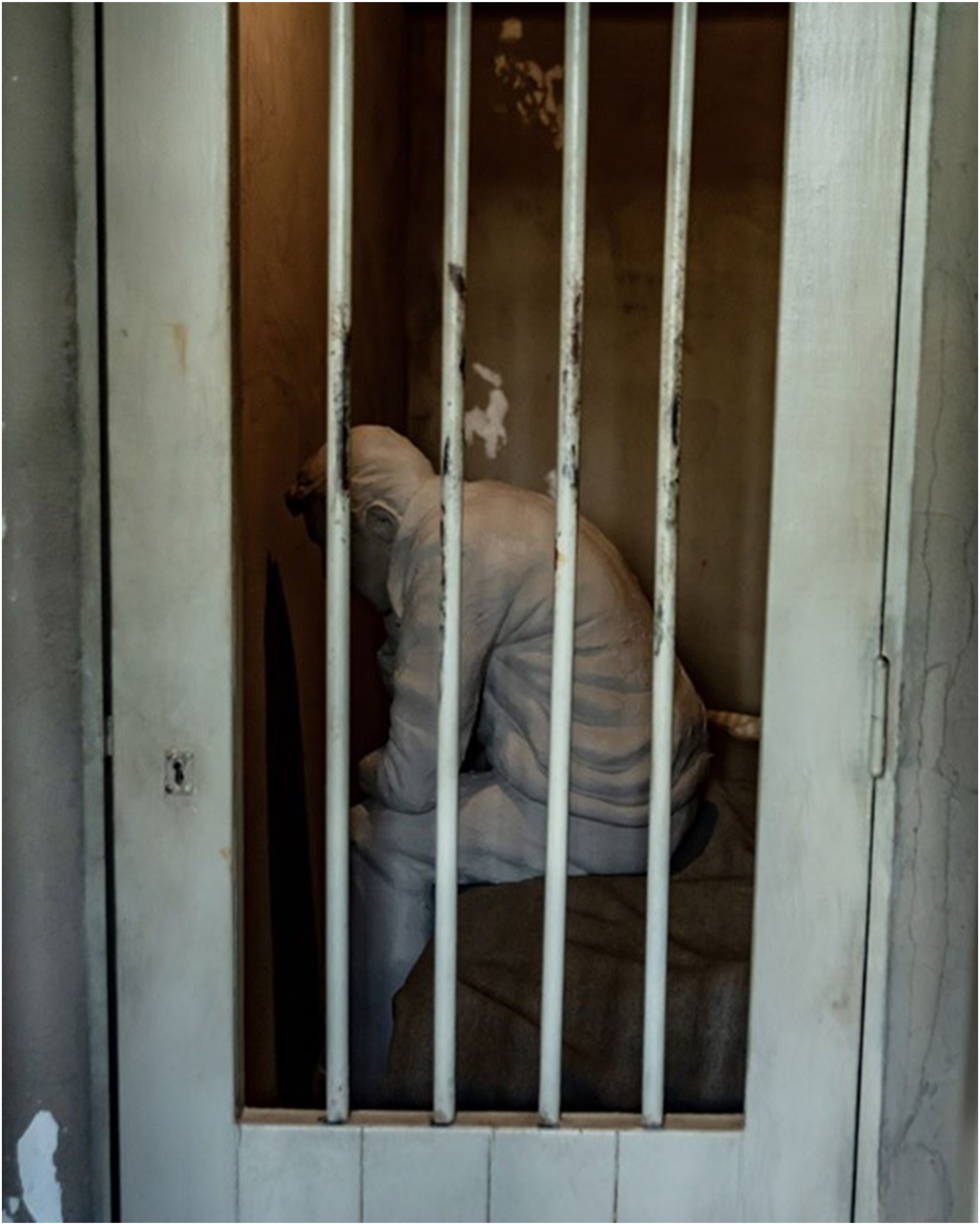
A fourth assumption is based on studies that statistically associate living and being alone with a greater probability of feeling lonely (Cacioppo et al., 2009; Snell, 2015: 63)—although, as stated, being alone is not always associated with loneliness, and vice versa. Nonetheless, we will connect the “being alone” status with the concept of emotional communities. This way, it will be easier to archaeologically identify evidence associated with loneliness by searching for and investigating situations in which people from specific emotional communities were alone or displaced.
The fifth assumption introduces two other important concepts: physical and emotional spaces. Physical spaces are easy to understand, but what about emotional spaces? An emotional space, which is how two (or more) people feel regarding a situation, can be independent of physical space. For example, two lovers who are physically separated and thus do not share the same physical space might share the same emotional space but will probably feel lonely without one another. The converse also maintains: the fact that someone is in the same physical space does not mean they share the same emotional space (Alberti, 2019: 31). The case study regarding the convent's emotional community will show that for some of the nuns, being in a physical space (the convent) not connected with their emotional space (their house, family) would have made them feel displaced and lonely.
A sixth assumption is about distance, physical and mental, from the people and places one loves. This feeling of loneliness can impact emigrants (Popp, 2023: 77), refugees (Alberti, 2019: 13), travellers, people on military service, people in exile (Barclay et al., 2023: 4), or any other people who feel apart from those (people, spaces, or things) they love, whether by choice or enforced. Therefore, when examining the concept of loneliness, it will be crucial to consider the factors of distance, homesickness, and displacement as pivotal markers. Both case studies use the feeling of displacement (physical and emotional) as an essential factor that provokes loneliness.
Now, by combining the concepts seen so far, it will be possible to identify situations for archaeological research (Figure 2). For example, if one searches for physical spaces where people are alone, this raises the likelihood of identifying emotional communities that share the same feeling of loneliness—for example, elderly people who live alone in their houses. However, there are other situations in which physical spaces, even without being lonely places, might provoke loneliness since they are not felt as a shared emotional space: for example, institutions intended to help people, but which, owing to their specificity, provoked states of loneliness in those they intended to help (e.g. orphanages, hospitals, asylums, prisons, convents, etc.). These physical spaces, although potentially trying to improve people’s experience by creating a shared positive emotional space, often could not prevent people from feeling lonely owing to the feeling of being out of place (Walker, 2023: 204). One of the case studies will be related to one of these institutions (convents). Framework explaining the proposed theory of identifying archaeological materialities connected to loneliness.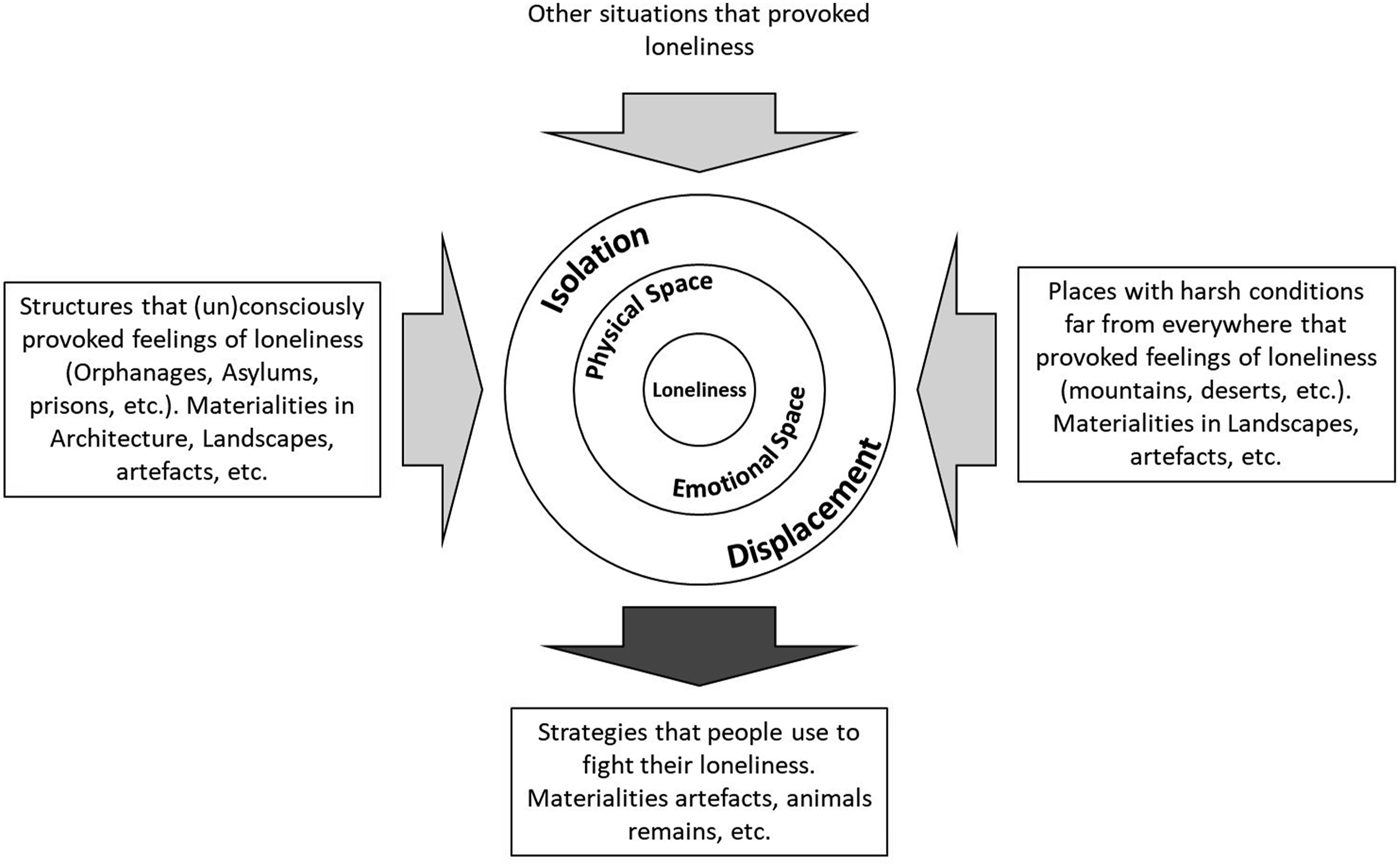
In summary, if we apply the previous assumptions to the structures that provoke loneliness and to the individuals who experience that loneliness, we will archaeologically identify the materiality that might be connected to that feeling (Figure 2). For example, there are asylums, hospitals, prisons, orphanages, and convents where it is possible to identify materiality connected to loneliness. Also, some people live alone, far from their families/family environments (emigrants, refugees), in solitary professions (e.g. fishermen), and in other contexts in which it is possible to identify materiality produced by (or for) them which can be connected with loneliness. These materialities may be strategies used as mementos (photographs, gifts, etc.) to alleviate the lack of loved ones, loved places, or simply homesickness (Alberti, 2019: 85).
The aforementioned case studies will be introduced and connected to one or more of the three lines of analysis (Figure 2).
Only the stones to speak to
The following case study is about shepherds, how lonely landscapes might have caused them to feel lonely, and the strategies they used to fight it.
As we have seen, loneliness strongly correlates with feeling out of place; not only mental displacement, being far away from the people we love or care about, but also physical dislocation from familiar home spaces (Pike and Crocker, 2020: 662). Interviews with modern Portuguese former shepherds (Morgado, 2013) discuss the impact of being alone in the mountains, sometimes for more than six weeks, at a very young age. Archaeological interventions in several Portuguese sites in the Serra da Estrela showed that these mountains, where the shepherds lived, were also inhabited by communities carrying out animal husbandry long ago (Tente et al., 2018: 379). One of these sites is Penedo dos Mouros, a large granite tor excavated for five seasons between 1998 and 2009. It was occupied between the 10th and 11th centuries when a community of a few domestic units inhabited this space (Tente et al., 2018: 385), identified through the remains of architectural structures, material culture, archaeobotanical findings, and zooarchaeological remains.
However, from a loneliness point of view, the most significant occupation was an irregular but repeated one. According to the archaeological remains—mainly ceramic vessels, metal objects, small hearths, and even a small wall protecting the entrance—individual shepherds started to use the natural rock shelter from medieval times (post-abandonment of the 11th-century community) until the 20th century. According to archaeological interpretations, this site was used to sleep during the night or to seek refuge from bad weather (Tente et al., 2018). This is an archaeological confirmation of the words of modern shepherds, who mention such places.
However, there is still one last question to solve. As previously seen, being alone does not necessarily mean feeling lonely, even though psychologists have shown a high correlation between these. Some studies show that people displaced involuntarily, like refugees, will probably feel more displaced than people displaced voluntarily, like migrants and shepherds; however, voluntary displacement might also significantly impact people’s loneliness (Löbel et al., 2022). Evidence shows that individuals voluntarily displaced from their homes have often grappled with loneliness, whether alone or surrounded by others (Popp, 2023).
However, the most significant evidence regarding shepherds’ loneliness comes from where they dwelt: the aforementioned natural caves, where they sought protection for themselves and their cattle (Tente et al., 2018). Penedo dos Mouros is a very isolated place, and was even more so before the 20th century. Without a village in its proximity, this lonely and immense landscape is the most significant archaeological evidence of how lonely one would feel while staying alone in the mountains.
Little has changed. The mountains are the same, the sky is the same, the rock shelters are the same, and it is likely that the importance and meaning that shepherds attributed to Serra da Estrela, whenever they lived, are also the same. It must be acknowledged that this somewhat phenomenological approach may leave us vulnerable to the accusation of anachronism, a common critique levelled against this philosophical approach (Fleming, 2006). Nonetheless, Serra da Estrela landscapes, with their rigid winter weather, the inaccessibility of certain parts, the immense area without a living soul, and the knowledge that shepherds would be there alone for weeks, are clear archaeological evidence of the loneliness shepherds might have felt in the past, and still felt until recent years, before mobile phones and other commodities (Morgado, 2013: 15).
“I used to talk to the dog for the lack of human company,” confessed Rafael, a modern shepherd (Bartelheim et al., 2022: 125). According to Kretzler et al. (2022), a pet—in the shepherd’s case, a dog—can be a good strategy against loneliness. In the aforementioned archaeological excavations, inside the rock shelter shepherds used, 34 bone fragments were identified as belonging to a medium-sized individual classified as Canis familiaris (dog) (Tente et al., 2018: 382-383). Although this specific dog could have been much more than a strategy to fight loneliness, most shepherds admitted that these “friends” fulfilled this purpose when alone in the mountains.
There were also other ways to overcome loneliness. Wood carving was one of the shepherds’ recognised activities, and these objects found inside caves used as shelters in the mountains were probably produced by shepherds to kill time and overcome loneliness (Figure 3). Some of these thrown-away—or simply lost—carved objects were found in Serra da Arrábida on a mountain near Setúbal during cave surveys on a project studying its geological formation (Rui Francisco, personal communication), demonstrating how shepherds would pass their time. Four carved wood objects, Serra da Arrábida (photo by the author—private collection).
An immense uninhabited landscape and the strategies that shepherds used to fight their loneliness in that landscape are clear evidence of how archaeology can help to identify this emotion in the field. As previously stated, some individuals might not have felt alone. Still, it is likely that a significant part of the community, if only for short periods, experienced loneliness while up there in the mountains.
While this case study was based on the open vastness of the mountain landscapes where the shepherds dwelt, the next will be based in a contrasting environment: the confined space of a female convent.
Alone among sisters
This case study will demonstrate how nuns in post-medieval Portugal experienced loneliness. We will study how architectural structures and lonely places conditioned that feeling, and some of the strategies nuns used to fight it.
During archaeological excavation and conservation work in 1988, several letters were discovered inside a wall in the Jesus convent in Setubal, Portugal (Neto, 2010: 378-9). One of these letters can be dated to between the end of the 18th century and the beginning of the 19th (Figure 4). The real name of the nun who wrote it has been forgotten, but her feelings have not. One cannot be certain, but the letters were probably not sent. She was suffering greatly and felt very lonely. Evidence of her suffering is seen in sentences like “The days of spring cannot end the dark pain which has taken root and grows in the core of my unhappy being,” or a desperate “Come to the fruitful forests and take possession of my loneliness, for another does not deserve my heart” (Neto, 2017: 8), when she knew it was not possible to fulfil her love. This was not an isolated case. Letters such as these were written in the privacy of the cell to be exchanged in the outer parlour (Morujão, 2013: 48-49). They were not limited to Portugal, as Claire Walker shows when talking about English cloisters: “For the nuns, monastic solitude intensified the forbidden yearning for loved ones … [and] letters represented a key source of information” (Walker, 2023: 201). Letters are a valuable remedy for loneliness since they are physical objects that remind us that we are not alone (Alberti, 2019: 48). Nonetheless, how could nuns, who have pledged themselves to strict vows of obedience, chastity, silence, enclosure, and poverty, be involved in such an act (Sousa, 2005: 253)? A nun’s letter displayed in the Jesus convent, Setubal (photo by the author).
This is the moment to introduce two theoretical concepts: emotional regimes and emotional refuge. Emotional regimes are “the set of normative emotions and the official rituals, practices and emotives that express and inculcate them” (Reddy, 2001: 129); this is precisely what the convent wanted to exercise in making nuns take vows. Nuns would suffer more or less, according to the distance between the emotional behaviour intended by the convent and the personal effort needed to follow that request (Boddice, 2018: 73). Emotional refuges were “relationship[s], ritual[s], or organization[s] (whether informal or formal) that provided safe release from prevailing emotional norms and allow[ed] relaxation of emotional effort, with or without ideological justification” (Reddy, 2001: 129). As Boddice points out (Boddice, 2018: 76), these emotional refuges would facilitate practices that opposed the regime’s (convent’s) intentions. As we will see, archaeological evidence shows that many nuns would have chosen to be part of the emotional refuges, having practices and strategies to fight emotional regimes.
The nuns’ resistant behaviour was probably connected to their feelings of displacement (which would highly correlate to a certain degree of loneliness). During the 17th century, political problems created a delicate financial situation for most convents and monasteries, which started charging a dowry for the entrance of new nuns. Until then, these institutions had lived exclusively on donations, and since only wealthy families could pay the dowry, this new situation unbalanced the rank of nuns that would have access to convents. These women were used to a certain lifestyle incompatible with the emotional regime they were entering, which would probably make them feel displaced.
Furthermore, these entrances were often not for religious reasons (Almeida, 2012). The reasons for a woman’s entrance into the convent can be classified into two main categories (Walker, 2023: 193), a division which will enable us to comprehend when and how women felt lonely and their strategies to fight this feeling. One category was women forced by their families to enter religious life, either to avoid sharing family assets, or because the women did not want to marry, or to show society how pious a family they were (Silva, 2019: 255). The second category was women who chose to be near God in solitude (Trindade, 2012: 24-27), although, in post-medieval Portuguese convents, this would not have been a great majority (Dávila, 2016).
One might think a woman who took the vows for vocational reasons would not feel lonely. Yet this was not always the case. In female convents, especially after the Council of Trent (1545-1563), enclosure had to be absolute in order to discipline nuns’ lives within the monastic/conventual environment and keep them out of the profane world (Silva, 2019: 358). Thus the religious houses’ architecture was thought to foster nuns into a life of reclusion and solitude (see previous bibliography references). Solitude is different from loneliness—but is it really that different? As mentioned above, some languages use the same word to define both feelings and perhaps, in this specific case, a blurred emotion comprising both solitude and loneliness would be more appropriate to explain what these nuns felt. A recent study by Durà-Vilà and Leavey (2017) examined the voluntary search for solitude among nuns and monks in two current Catholic monasteries in Spain. The study concluded, among other things, that the voluntary choice to search for solitude did not prevent people from feeling lonely. Even knowing that we might be falling into the anachronism trap, Portuguese nuns probably experienced similar feelings in the past.
The existing archaeological excavations in Portuguese convents reveal that these buildings were conceptualised to promote separation from the world and the isolation of their occupants (Gomes, 2012: 38). It is still possible to imagine this loneliness in the austerity of the convents which maintain their primitive architecture, with small cells, sometimes without windows, such as the Madredeus convent built in the 16th century (Azevedo, 2009) or the Mosteiro de Chelas in Lisbon, where small, cold, windowless cells measuring little over 4 m2 were identified (Sucena, 2007). This feeling is even easier to imagine in the monasteries which promoted complete isolation and distance in places far from any interaction with familiar faces, or inside those orders requiring a vow of silence. Did these religious landscape architectures intentionally facilitate the search for solitude, knowing it would come at the price of loneliness? Did solitude in those days have a broader meaning, like the Portuguese word, embracing both English words? The answer will probably never be known. Whether loneliness, solitude, or something between the two, in the convents’ architecture and the monasteries’ isolation, it is possible for archaeologists to glimpse the emotions that were felt in those days.
Would women forced to follow unchosen lives feel lonelier than those previously mentioned? It is difficult to answer. However, it is easy to imagine that loneliness would impact them more. Some nuns might have tried to distance themselves from the secular world, while others did not. Of course, different approaches to convent life would impact their loneliness differently and, consequently, the archaeological evidence. A recent study (Martín-Rodríguez et al., 2022), albeit with high-school students, shows that reactions differ according to the level of loneliness one feels. People who feel high levels of loneliness will most likely display avoidance behaviours regarding interactions with others and stay apart from social relations, using the small cells mentioned above, for example. In contrast, people with low levels of loneliness will most likely have resistant behaviours (emotional refuge practices), acting against the rules or superior orders (emotional regimes).
These resistant behaviours have left archaeological evidence (Walker, 2023: 201). When faced with the demands imposed by vows of obedience, enclosure, chastity, and poverty (emotional regimes), some nuns entered into an emotional refuge, as mentioned above, that would lead to strategies of resistance. These strategies left their mark. Whether socialising with peers or acquiring material possessions, these acts of resistance served as a reminder of the human desire for connection (the basis of the feeling of loneliness) and self-expression, even in the face of institutionalised restrictions (emotional regimes) (Trindade, 2012: 33). These behaviours would have helped them to fight loneliness.
One of these resistance behaviours may have been keeping pets in their cells. Kretzler et al. (2022) show how people use pets to overcome loneliness. So did nuns. Historically, sources tell stories about nuns having pets, such as small dogs and cats, and exotic birds, such as parrots, to fill their affection needs and entertain them during the lonelier moments (Silva, 2019: 378). Archaeology confirms such stories. During the excavation of the Santa Clara-a-Velha monastery (Detry and Moreno-Garcia, 2008), a Clarisse house, archaeofaunal remains demonstrated that small pets were kept inside the religious space. Dog and cat bones are frequently found in religious houses. Still, they cannot be directly associated with emotional relations unless one carefully observes how they are disposed of after death. An interesting case is the dog burial found during the archaeological works at the São Miguel de Refojos monastery, close to the religious house cemetery and archaeologically interpreted as close to its owner (Melo et al., 2020: 67).
Another strategy to fight displacement and loneliness was the use of objects normally associated with the life nuns would have had outside the convent before their entrance (Trindade, 2012: 5). As mentioned, these girls came from noble Portuguese families that would probably have used luxury items in their domestic environments daily. As a strategy used to fight the convent’s emotional regime, joining other girls grouped in emotional refuge against the regime, young girls may have chosen to have with them the material objects that would help to reduce their homesickness and feelings of displacement (Trindade, 2012: 6). Many such luxury artefacts have been recovered from archaeological excavation in convents. Imported Chinese porcelains (Gomes et al., 2015), high-quality Portuguese faience with family coats of arms (Figure 5(a)) (Almeida, 2012; Parreira, 2020), Italian majolica (Figure 5(b)) (Casimiro et al., 2023), perfume and other cosmetic glasses (Figure 5(c)) (Medici et al., 2009), and rings and other jewels (Figure 6) (Mourão, 2004), to mention the most frequent, have been found in archaeological excavations all over the country in layers associated with the daily life of nuns, reflecting that these were the plates they ate from and the cups they drank from, and the jewellery they used every day. This evidence shows the nuns’ resistance to the rules (emotional refuges), where these artefacts were strictly forbidden (emotional regimes), through objects connected to their previous lives, which may have attenuated their homesickness, displacement, and loneliness. a) Santa Clara-a-Velha monastery faience with family coats of arms (Cruz et al., 2023); b) Santa Clara-a-Velha Italian majolica (Casimiro et al., 2023); c) Santa Clara-a-Velha monastery glass bottle (Medici et al., 2009). A nun’s ring found in the Jesus Convent, Setubal (photo by the author).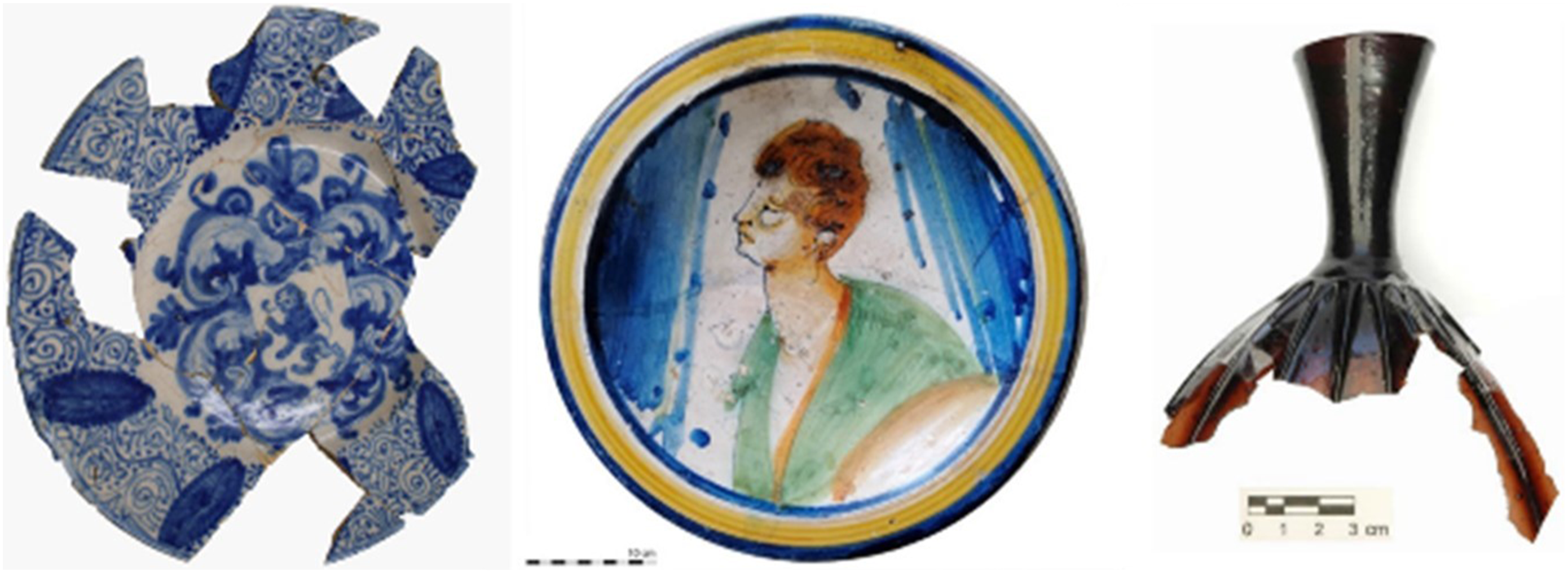

In this case study, it was possible to identify archaeological evidence connected with the three lines of analysis, revealing how extraordinary convents/monasteries might be when studying solitude and loneliness. A convent is a structure intended to help people celebrate God through solitude; however, it also provoked feelings of loneliness in many women who entered it. Second, convent architecture and landscapes were conceived in isolated places to help people achieve solitude. However, once again, the feeling achieved may at times have been closer to loneliness. Finally, the last line of analysis regarded strategies for fighting homesickness, displacement, and loneliness, in this case, fighting (emotional refuges) the strict rules (emotional regimes) imposed by religious orders.
Conclusion
This paper aimed to understand whether it is possible to identify loneliness in the past, something fulfilled after conceptualising it as an emotional state and applying it to archaeological evidence. The initial self-challenge to be creative was not easy to implement. Substantial theoretical framing had to be undertaken before jumping into the past.
After using an interdisciplinary approach, considering history, anthropology, and psychology research, three lines of analysis were identified to recognise loneliness in archaeological evidence. First of all, structures which intended to help people but instead ended up creating a feeling of loneliness, like convents; second, the loneliness that might be felt by dwelling in isolated landscapes, like the mountains in which shepherds dwelt; and, finally, the strategies that people used to fight their feelings of loneliness, like the woodcarving of the shepherds or the luxury objects of the nuns.
Nevertheless, during the case studies, it was not enough to point out the archaeological materiality that proved the existence of loneliness. Important theoretical contextualisation was necessary. Without this, it would not have been possible to interpret loneliness. Two emotional communities were chosen: shepherds and nuns. One is based in mountain landscapes’ open vastness, while the other is based in a contrasting environment, the confined space of a female convent. This was intended to show how similar emotional feelings could arise from such different places. However, different communities could have been selected, and the arguments would still be valid. This proves the theoretical framing is probably robust enough to apply to other situations.
Both case studies were situated in what is called historical archaeology. However, the shepherds’ case study demonstrates that the theoretical framework could have been used for older chronologies. It spans the late Middle Ages to the 20th century and shows examples that can be connected to the lonely landscapes and strategies shepherds used to fight loneliness. The nuns’ case study spans the 16th to the 19th centuries, using examples from all three lines of analysis.
Exploring loneliness in the past demonstrates how vital this research is for understanding the human experience across historical and archaeological contexts. By examining how individuals in the past coped with loneliness, it was possible to analyse the social and cultural influences that shaped that same loneliness. This exploration should remind us that loneliness, albeit in different forms, is a shared human experience. Furthermore, studying past loneliness enables the identification of patterns and trends that can still be seen in contemporary loneliness.
Future directions may involve engaging wider chronologies when analysing loneliness, and hopefully identifying strategies that will give more insight into the crisis of loneliness today.
Footnotes
Acknowledgements
I would like to thank Sarah Tarlow for encouraging me to explore such a remarkable and demanding theme.
Declaration of conflicting interests
The author(s) declared no potential conflicts of interest with respect to the research, authorship, and/or publication of this article.
Funding
The author(s) received no financial support for the research, authorship, and/or publication of this article.
