




Abstract
Community archaeologies should emerge from an awareness of the ways in which archaeological praxis is embedded with multiple pasts, subjectivities, materialities, and national and transnational histories. This longitudinal archaeological ethnography explores the lived experiences, perceptions of the past, and relationship to archaeology and archaeologists amongst villagers residing near the Kerkenes site in Turkey after attempts by the project to develop heritage awareness, a sustainable local economy, and collaborative management of the site within the community. However well-intentioned, considerable challenges to closing the gap in understanding between archaeologists and locals can arise when the efforts of archaeologists become entangled in larger socio-political frameworks beyond their control. Villagers have experienced being dehumanized as Muslim migrant workers in Europe and were Islamic-based nationalist supporters of the conservative Erdoğan regime. The archaeologists’ heritage-making practices inadvertently triggered symbolic associations of the project with the colonial endeavor. Locals produced counter-narratives about the site as a decolonizing response.
Keywords
Introduction
Archaeological sites are complex interaction zones where multiple worldviews, subjectivities, and alterities come together. Many archaeologists recognize that people living in the vicinity of their sites view the history of the site and purpose of archaeological excavation very differently from how professionals do. Meanwhile, the attitudes of community members, some of whom may be employed to work at archaeological sites, can become freighted with resentment at economic inequality and asymmetrical power relations. As such gaps in understanding between “locals” (“local” here describes a place near an archaeological site and “locals” are people who come from that place) and archaeological specialists have become a matter of concern within archaeology over the past three decades, archaeologists have been called to implement ethical, equitable, inclusive and community-oriented practices ranging from information sharing to collaboration (Colwell, 2016; Rizvi, 2022).
Many projects have reported the success of such strategies in benefiting various publics and fostering collaboration especially when the archaeological work was conducted in countries with a settler colonial history (see Atalay, 2006, 2012; Atalay et al., 2014; Greer et al., 2002; Mrozowski and Gould, 2019; Schmidt and Pikirayi, 2016). I witnessed such a successful collaboration between archaeologists and the descendants of colonized people when I worked at the Monasukapanough archaeological site in Charlottesville, Virginia, in 2003. The archaeological findings supported the claim that the site had originally been settled by ancestors of Monacans living today and helped prove their continued occupation in the Virginia region (Hantman, 2018). Archaeology supported the Monacan Indian Nation in achieving formal federal recognition in January 2018. In other cases, however, archaeology actively silences and harms communities through scientific/epistemic colonialism, imperialism, and nationalism (Colwell-Chanthaphonh and Ferguson, 2008; El-Haj, 2001; Kohl and Fawcett, 2006; Meskell, 1998; Nicholas and Hollowell, 2007). Community archaeologies have transformative effects on archaeology not only in urging archaeologists to develop methods that foster collaboration and consider how their projects might serve local communities, but also in urging archaeologists to reflexively re-evaluate and de-stabilize their epistemic and ontological positions and structures of privilege and power towards a decolonial praxis (Bruchac, 2014; McAnany and Rowe, 2015; Rizvi, 2019; Wylie, 2015, 2019).
To contribute to this ongoing discussion, this article shifts attention from theorizing how archaeologists should “work with” local communities to examining how community members perceive and evaluate archaeologists and their research following their attempts to implement community-oriented strategies at archaeological sites. In this case study, I present the results of a longitudinal ethnography conducted among international archaeologists working on and villagers living adjacent to the well-known Iron Age site of Kerkenes in central Turkey. Since the 1990s, the directors of the Kerkenes project have initiated a series of public archaeology and outreach programs designed to make archaeology better understood and more accessible to the community and generate “heritage awareness” of the site amongst the locals. They also promoted tourism to the area and built an ecological center to support a sustainable village economy. Their efforts did not result in sustained collaborative relationships or a greater appreciation of their work at Kerkenes, as they had hoped.
I was invited to join the Kerkenes project as assistant director in 2010, by which time there was a flourishing literature on how archaeology could be more inclusive, ethical, and collaborative (see Atalay, 2006, 2010; Colwell-Chanthaphonh and Ferguson, 2008; Marshall, 2002; Nicholas and Hollowell, 2007; Smith and Waterton, 2009). Having followed the debates on community archaeology, I accepted the position with the intention of developing a truly collaborative site management plan. As a “native” archaeologist on the team and a trained cultural anthropologist, I expected that I would be a good candidate for that. I planned to foster collaboration by offering seminars in archaeological literacy and building local capacity so that the community could become actively involved in making decisions about site management in future.
Soon after I began visiting local residents, however, I realized that most of them were quite ambivalent about the project and the long-term presence of archaeologists in the village and were unwilling to learn more about archaeology. The gap in understanding between community members and the archaeological team appeared too wide and complex to be bridged by me even though I shared national (Turkish) and religious (Muslim) identities with the locals. I abandoned my initial plans and turned to ethnographic research to understand their perspectives on the past, the Kerkenes site, the archaeologists, and archaeology as an endeavor. Archaeological ethnography is used to study community understandings of the past, place, and heritage as well as community values, ideas, and needs (see Bloch, 2019; Breglia, 2006; Castaneda and Matthews, 2008; Castaneda, 2009; Hamilakis and Anagnostopoulos, 2009; Meskell, 2005). Over the next eight years (during the excavation seasons of 2010–2012, 2014–2017, and 2019), I investigated local attitudes using a methodology combining immersive participant observation, open-ended interviews, focus groups, and multi-timed digital ethnography. Most of the interviews were conducted with villagers who had been employed seasonally by the project since the 1990s, including men hired as excavation workers and women hired at the site compound; I also interviewed religious leaders, shepherds, and migrant laborers who regularly returned to the village from working in Europe or resettled in the village upon retirement. Over the years my ethnographic engagement turned into a process of active listening to my hosts’ lived experiences in the worlds in which they participated.
My analysis of their complicated relationships with the project reveals that archaeologists face considerable challenges in implementing collaborative strategies and draws attention to how archaeological practices and the presence of archaeologists in site-adjacent communities can become entangled with larger socio-political histories, locals’ current experiences, and symbolic processes that are mostly beyond the control of the archaeologists.
This article begins by reviewing global efforts to establish “community archaeologies” and recent critiques of their limitations that informed my reflexive re-evaluation of the community-oriented practices pioneered by the Kerkenes project. I briefly describe the site and nearby village and outline the history of community-oriented strategies used by the project. The remainder of the article addresses possible reasons for the continued gap in understanding between locals and archaeologists. To define the gap, I quote from the villagers who described their experiences and perceptions of the Kerkenes project and its foreign archaeologists to me. I then elucidate the ways in which having negative experiences as racialized migrant workers in Europe combined with a rising nationalist discourse in Turkey may have shaped their unique subjectivities. The final section investigates how the project’s efforts to familiarize the locals with its kind of archaeology as a heritage-making practice inadvertently triggered the community to symbolically associate the project with a colonial endeavor and actively produce counter-narratives about the site as a decolonizing response. I conclude by reflexively re-evaluating community-oriented efforts at Kerkenes and the implications of this case study for future community archaeologies.
Community archaeologies, archaeological praxis, and heritage
The “reflexive” turn in the 1990s and 2000s in post-processual archaeology, influenced by post-colonial theory, criticized archaeology for being grounded in Eurocentric and colonial ways of thinking. Such Eurocentrism is captured in the vision of Euro-American archaeologists as the only knowers and stewards of the past, travelling to new landscapes to conduct research without interacting much with site-adjacent communities, who they assume have no part to play in the production of archaeological knowledge (Baltalı Tırpan, 2019; Hamilakis and Anagnostopoulos, 2009). Such a praxis raises concerns about the politics of archaeological models of the past and practices that prioritize scientific knowledge production while alienating indigenous, descendent, and local communities from that production. These critiques resulted in calls for more equitable, inclusive, and ethical research practices (see Atalay, 2006; Franklin, 1997; Hodder, 2000; Nicholas and Hollowell, 2007). Over the past few decades, archaeologists have made an effort to formulate inclusive practices that appreciate multivocality and incorporate local, indigenous, and descendent communities’ oral stories and interpretations of the past in their research. Collaborative and community-based participatory research, indigenous archaeologies, and heart-centered archaeologies have all developed from these efforts (Atalay, 2006, 2010, 2012; Bartu, 2000; Colwell-Chanthaphonh and Ferguson, 2008; Derry and Malloy, 2003; Ferguson and Colwell-Chanthaphonh, 2006; Nicholas and Hollowell, 2007; Smith and Waterton, 2009; Supernant et al., 2020).
Archaeologists have come to realize that their endeavors to understand the past are inherently entangled with multiple national and transnational histories, materialities, subjectivities, and politico-economic and cultural frameworks (Hodder, 2000; Meskell, 2009). Community archaeologies emerge from an awareness of the ways in which archaeological practices are embedded in these realities. The diverse approaches to involving communities in archaeological projects can be viewed as sitting on a continuum from archaeologists sharing archaeological knowledge with communities at one end to communities fully participating and collaborating with archaeologists to design and manage the projects at the other (Colwell, 2016; Ferguson and Colwell-Chanthaphonh, 2006). Some projects have applied “public archaeology” methods to developing community archaeologies, including disseminating archaeological information and providing educational programs designed to impart technical skills and archaeological expertise to various publics (Merriman, 2004). Some archaeologists are motivated to inform and educate local people about their work because they hope to generate “heritage awareness” and an appreciation of archaeology in order to collaboratively safeguard, manage and preserve the “archaeological heritage” for the future (see Atalay, 2010; Gürsu, 2019; Okamura and Matsuda, 2011; Rizvi, 2022). Others have adopted public outreach strategies intended to provide economic benefits to local communities through employment, management of archaeological heritage, or tourism (Atalay et al., 2014; Gould, 2018; Rizvi, 2006).
A constructive critical debate has arisen about whether such community-oriented or collaborative practices are viable in every context or are enough to reduce asymmetrical relations between archaeologists and their projects and local communities (see González-Ruibal, 2018, 2019; González-Ruibal et al., 2018a; Handler, 2008; La Salle, 2010; Wylie, 2019). Some argue that adopting collaborative practices will never completely eliminate existing power imbalances (i.e., the privileged position of the researcher vis-à-vis the local community) (Handler, 2008; La Salle, 2010: 403–405; Supernant and Warrick, 2014) because scientific and epistemic colonialism still operates through the epistemic authority of archaeological knowledge production and the disciplinary power and authority of academic institutions, publishers, and funding agencies (Greenberg, 2019; La Salle, 2010: 405; Nicholas and Hollowell, 2007; Schneider and Hayes, 2020: 129; Rizvi, 2015, 2020: 85). Secondly, the root causes of the power imbalances are related to existing global economic, epistemic, racial, political, and social injustices (Hamilakis, 2018; González-Ruibal, 2019; La Salle and Hutchings, 2016), which have been identified as characteristic of the current “global coloniality” (see Mignolo and Walsh, 2018; Stoler, 2016).
Another critique concerns the “idealized notion of the communities” within collaborative archaeology, which treats all local communities as marginalized groups that would like to collaborate with archaeologists given the opportunity (González-Ruibal et al., 2018a: 509). However, not every community is like the “progressive and politicized indigenous groups or class-conscious working classes” known as the “critically enlightened subaltern” (González-Ruibal et al., 2018a: 508–509). In a similar vein, Handler (2008: 109) argues that it is “arrogant and un-self-reflexive” on the part of archaeologists to assume that local communities will want or “need to” participate in the production of archaeological knowledge and collaborate with archaeologists even when they could make use of archaeological knowledge “to press their own claims in global institutions.” González-Ruibal et al. (2018b: 3) point out that little research has been conducted on how non-progressive or politically conservative communities perceive archaeology and collaboration. Yet other critics have argued that the urge toward collaboration is based on the “epistemological assumption that actors agree on one thing (the past as heritage) but disagree on how to approach it (scientific methods, Western philosophy, myth, ancestral knowledge and ritual)” (González-Ruibal, 2018: 349). Since local communities might have a completely different ontology and understanding of what constitutes their heritage, collaboration may not be possible in every context and therefore difference and alterity should be recognized (González-Ruibal, 2018: 349, 2019: 40; Handler, 2008: 107). Such critiques inform my analysis of why archaeologists’ attempts to communicate archaeological information and encourage collaboration around heritage management at Kerkenes seem to have failed, as outlined below.
The Kerkenes project, Şahmuratlı village, and community-oriented efforts
I first arrived at Kerkenes on June 6, 2010, having taken an overnight bus from Istanbul to the town of Sorgun, where the excavation director was waiting to pick me up in an old Land Rover. The country roads leading out of Sorgun wound through the flat landscape of central Turkey’s Anatolian steppe. I saw Mt. Kerkenes (1472 m) in the distance rising majestically over the steppe. At the top of the mountain is an ancient Phrygian city (270 ha) enclosed by a 7 km-long wall that circumscribes the peak; a Byzantine fortress lies within the wall (Figure 1). This is the Kerkenes site. Aerial view of Kerkenes (courtesy of Kerkenes photo archive).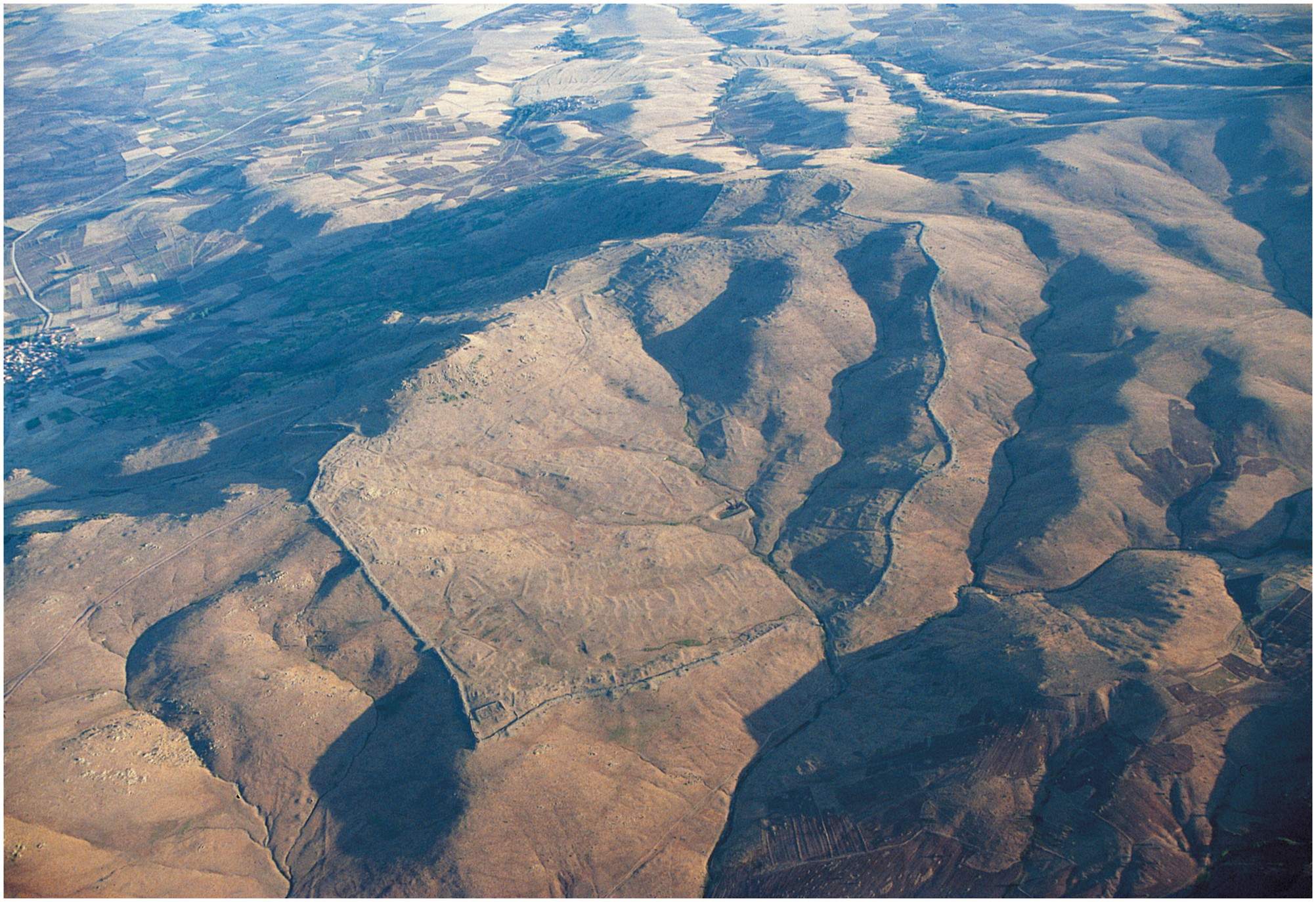
The first archaeological research at Kerkenes was conducted in 1927–1928 by the famous German archaeologists Hans Henning Von der Osten and Eric Schmidt, both from the University of Chicago’s Oriental Institute, who were searching for Hittite remains. When they did not find them, they abandoned the site. It lay unexcavated for nearly seven decades, until research resumed under the direction of Geoffrey Summers and Françoise Summers in 1993. The project was a collaboration between the British Institute of Archaeology at Ankara (BIAA), Middle Eastern Technical University, University of Chicago, and University of California, Berkeley.
The Summers team unearthed a city at Kerkenes, including a palace, temples, urban blocks, houses, and city gates characteristic of the Late Iron Age. Dated ca. 620–550 BC, the city was built by Phrygians, the Iron Age Indo-European people mentioned by Herodotus. Archaeologists believe this could be the location of the capital city of Pteria (Herodotus Book I, 76) and that it was likely destroyed by Cyrus the Great of Persia and Croesus of Lydia after only 70 years of occupation (Summers, 2006; Summers and Summers, 2008). The site also contains evidence of Roman and Byzantine occupations, including a small village, defensive architectural remains, and burials. From an archaeological perspective, the ancient remains of Kerkenes offer a unique opportunity to explore the formation and social organization of pre-industrial urban centers in the area (Branting, 2013).
After the Summerses retired in 2012, work continued under the direction of Scott Branting in a new institutional collaboration between the University of Central Florida, Istanbul Technical University, Abdullah Gül University, University of Chicago, Arizona State University, Boston University, and University of Sydney. Team members under both directorships have mainly come from the United States of America, United Kingdom, and various European countries.
Şahmuratlı is the closest modern village to the site. It lies on the eastern slopes of the mountain, 12 km south of Sorgun and 30 km east of the city of Yozgat in central Turkey (Figure 2). The minaret of a mosque rises from the village center. One- and two-story houses, some of which were constructed using large stones quarried from the site, surround the mosque. Between 2010 and 2019, Şahmuratlı comprised 65 permanent households (approximately 170 people), and an additional 19 households (approximately 30 people) are in residence during the summers. Those who live in the village permanently are predominantly small-scale subsistence farmers who practice cash-crop agriculture and pastoralism. Some of the permanent residents seek part-time positions at a sugar factory, coal mines, or the archaeological site during the summer. Many others migrate to Germany, France, the Netherlands, Belgium, or urban centers within Turkey to find work. Most of these migrant workers and their families return to the village every summer to visit relatives and participate in weddings and other ceremonies; some permanently move back to the village upon retirement. Aerial view of the village and the site at Kerkenes (courtesy of Kerkenes photo archive).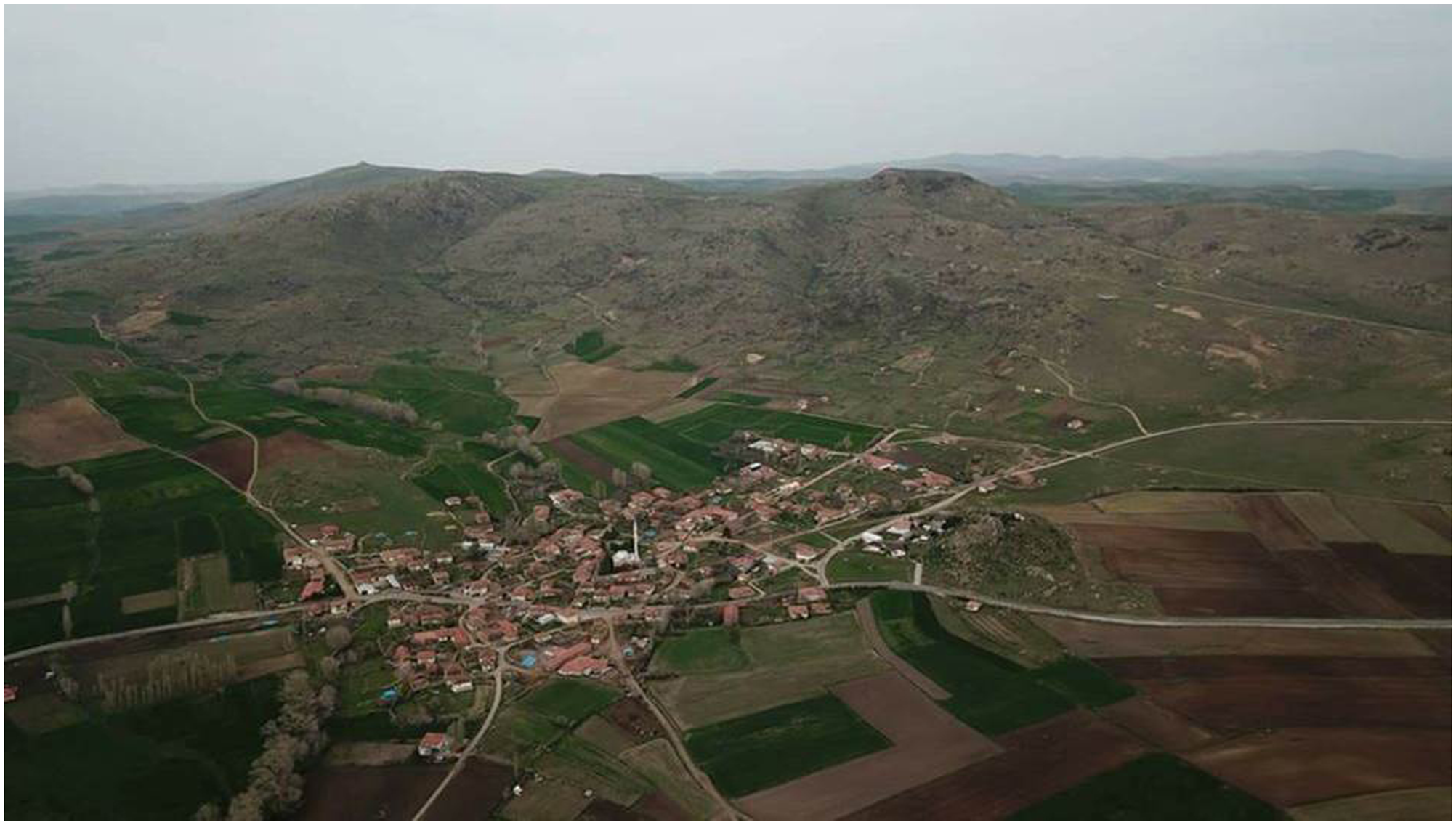
Community-oriented efforts in the village
My analysis of the history of the project suggests three major motivations behind developing community-oriented programs in Şahmuratlı: enhance archaeological findings with ethno-archaeological research; inform villagers about the findings at Kerkenes; and provide short- and long-term sustainable economic benefits to the village. To meet the first goal, the Summerses invited an anthropologist to study local architectural traditions, village life, and legends in hope that they would provide insights into the archaeological interpretation of the findings (Ergenekon, 1997).
The archaeological team also tried to make archaeological knowledge more accessible to the villagers and increase local awareness of the history and archaeological importance of the site by giving public presentations and publishing their findings in Turkish. At the end of every research season from 1997 on, the project published the Kerkenes Newsletter in Turkish and English to inform the academic community and village residents about the project’s goals and findings. The newsletter was delivered to every house in Şahmuratlı. Project directors also reported findings from their archaeological research to local (Yozgat Province) and national newspapers and television stations every year, ensuring that the site had widespread coverage in the Turkish media. Such media coverage was intended to increase “heritage awareness” in the local community and at the same time promote tourism to the archaeological site in order to generate income for the local people. The archaeological team arranged with Andante Travel, an international company that specializes in archaeological tours, to bring tourists to the site every year during the summer and fall.
To further disseminate knowledge about the site, foster an appreciation of archaeology, and enable villagers to reap economic benefits from the project, the archaeologists began collaborating with village residents and provincial political dignitaries to mount an annual Kerkenes Festival. Foreign ambassadors and students from Turkish universities were invited to the first festival, held in 1999. Project directors led visitors and villagers on walking tours of the site, while village residents sold local products and held feasts with folk music and dancing throughout the festival.
While such events benefited local residents in the short-term, the Summers team realized that they were doing nothing to alleviate broader problems of economic poverty and lack of access to basic resources such as potable water. They believed a more sustainable village economy was needed to provide welfare to the residents and support local development. To that end, in 2002, Françoise Summers initiated an independent ecological project in partnership with the Department of Architecture of the Middle East Technical University. The Eco-Center, as it came to be known, would introduce renewable energy technologies such as recycling, solid waste separation for composting, solar panels, solar cookers, and drip irrigation in farming, all to benefit the economically disenfranchised village residents (Summers et al., 2011). 1 Soon after I arrived at Kerkenes (June 12, 2010), Françoise Summers told me that “with the Eco-Center project, we wanted to create income-generating activities for the villagers and especially jobs for women and promote gender equality and also reverse the economic migration from village to cities.” The Eco-Center collaborated with members of the Şahmuratlı Village Association to ensure that villagers’ needs would be addressed. The project obtained funding from several local foundations along with the United Nations Development Programme, Australian Embassy Direct Aid Program, Arkeo-Community Foundation (USA), British Council, Canada Fund, Burdens Charitable Foundation (UK), US, Canadian, and British embassies, and GEF (Global Environment Facility) to build the Eco-Center and run the center’s activities. The Eco-Center distributed solar cookers to help villagers save money on fuel and built a solar house to be used by village women for producing and selling ecological products. A small building in the compound was set aside for the village children to visit with their families, play, and learn about Eco-Center activities.
The Kerkenes archaeology project under the leadership of the Summerses devoted substantial resources to making the project beneficial to local people through employment, heritage tourism, and promotion of “sustainable rural development” via the Eco-Center. According to Françoise Summers, the villagers, especially the women, were content with the employment opportunities provided by the project and the financial support it gave to constructing water pumps in the village and introducing drip irrigation to the farmers.
The Summerses had hoped that the Eco-Center would be permanently integrated into the village economy, but no local leaders came forward to administer the center and navigate the state bureaucracy. Instead, the existence of the Eco-Center seems to have exacerbated pre-existing schisms within the village about local structures of power, ultimately paralyzing its activities. Children stopped visiting the activity building in the compound, which fell into disrepair, leaving old toys and beads strewn over the floor, and the solar cookers that had been distributed by the center rusted unused in people’s yards. After the Summerses retired, villagers ceased using the facilities altogether. The new archaeological team did not take over the Eco-Center because they did not want to become embroiled in local conflict. However, they continued with financially supporting the village’s needs such as repairing the roads and water fountains. They continued the site tours and publication of the Kerkenes Newsletter.
In short, despite many years of trying to transmit archaeological knowledge about the site, the Summerses felt that the villagers never came to appreciate the Phrygian past or demonstrate a willingness to be part of the project beyond straightforward wage labor transactions. The following sections suggest reasons for this gap between the archaeologists’ and village residents’ understandings of archaeology in general and the Kerkenes project in particular.
Local attitudes toward archaeology and archaeologists
The villagers consider the Kerkenes site as part of their own place; unlike the archaeologists, they do not view it “as a separate spatial entity” intended for investigation (Baltalı Tırpan, 2019: 53). The land is used for grazing herd animals and hunting and the villagers know the location and medicinal properties of every seasonal herb, fruit, and other wild plants that grow there. It is a recreational, religious, historical, ancestral, and medicinal place intertwined with personal memories and dreams (Baltalı Tırpan, 2019: 54). Its use as an “archaeological site” adds another layer to their experience of the place, but as Şerife, who worked at the Eco-Center for years, told me, the villagers cannot find an intelligible reason for “why archaeologists love ancient stones.” They mostly complain about no longer being able to recycle the stones to build their houses.
During our conversations, villagers proposed three explanations for why Euro-American archaeologists come to Turkey to study a place they consider part of their village. Many argued that one would only go to a foreign country to make money or visit Mecca. The idea that archaeologists travelled from distant countries just to do research was not convincing. Some indirectly linked the scientific endeavor with a colonial desire to collect material “valuables” from Turkey. They had learned to be suspicious because of reports of ancient artifacts from Iraq and Syria being illegally transported to Western countries via Turkey and rumors that most of the contents of the museums in the West had been stolen from other countries. This explanation was backed up by mainstream media reports about repatriation cases raised by the Turkish government in 2011. That summer, the government threatened to halt German excavations at the nearby site of Hattusha (the capital city of the Hittite Empire) because a Hittite sphinx that had been loaned to Germany in 1917 for purposes of restoration was still on display at the Pergamon Museum in Berlin (Hürriyet Daily News, 2011). When the Germans gave back this monument in 2011, many Şahmuratlı residents heard that it was being returned to the neighboring site only “after being stolen.”
A less common explanation for the archaeologists’ agenda was that they wanted to attain power or prestige. The village headman explained, “They, especially Americans, want to be the imperial [leaders of] the world and they want to become powerful and rule the world through knowledge.” Memiş, who had worked at the site since 1993, had witnessed archeologists obtaining prestige following successful excavations. He commented, “They need the knowledge for their careers. As we saw over the years, many students came here and when they [wrote] books about the site, they became professors like Scott [Branting, the new director].”
A third explanation proffered by most villagers was that archaeologists travelled from America or Europe to find their own ancestors in the land of Anatolia. Whenever archaeologists told the workers at the site that they were excavating a Phrygian temple, the excavation workers and their wives would tell me they were digging up a Christian church. The connection they perceived between the foreign archaeologists and ancient dwellers of the site was not genealogical but cultural, based on the history of Christian religion in Anatolia. Osman, who had worked for the project as a driver since 1994, said, “The most sacred place for us Muslim people is Mecca. […] We have an emotional attachment and therefore we always wonder about [that] place. [It is] just like that for foreign archaeologists. This land is sacred because their Christian ancestors lived here before the Turks came.” Similarly, the headman said, “I actually do understand why they come here all the way from America and elsewhere. Other than gaining knowledge, they come here because they do not have any history in their countries. Thus they come here to find their Christian ancestors.”
The idea that foreign, non-Muslim archaeologists come from elsewhere seeking wealth, power, or their ancestral history in Anatolia is obviously not the image archaeologists want to present to the villagers. Indeed, they worked hard to establish positive interpersonal relations and communicate their knowledge of the site to the locals. The villagers’ negative perception of foreign archaeologists as a group was not due to the personalities of the archaeologists themselves. Most of the villagers found them admirable and some cared about them deeply. Such positive bonds with individual archaeologists did not change the fact that a gap in understanding between the two groups persisted. As discussed next, this was because of deep-seated prejudices toward the “foreignness/otherness” represented by the archaeologists and their research.
Looking behind the gap
Although the foreign archaeologists at Kerkenes are not perceived as evil, they nevertheless represent a symbolic “Other” in the local imagination. For example, villagers commonly refer to foreigners as non-believers or “infidels” (gavurs), a historical descriptor with strong negative connotations. Almost all the villagers are Sunni Muslims who subscribe to the neo-nationalist and Islamist political views of what has recently been called “New Turkey.” Their situated worldviews, collective memories, and experiences as transnational migrant workers further sustain prejudicial attitudes toward the archaeologists as a group.
Almost every family in the seemingly remote village of Şahmuratlı has transnational connections through a history of economic migration to European countries. Satılmış, for example, worked in the Netherlands for 20 years, leaving his wife and children behind in the village. He returned home only after developing a lung disease from working at an aluminum production factory; the factory owners refused to pay for treatment. He was 65 years old when I met him. He explained that he did not trust the foreigners or any other “infidels because I went to the Netherlands to earn some money and they made me work in jobs the Dutch would not work and in the work place they treated us badly. Then [the Dutch] were saying ‘Go back home,’ but I did not understand why because we were working on the jobs they would not do.”
Ömer, a highly respected village elder, shared similar views on Europeans even though the Netherlands was his permanent residence and he only visited the village in the summers. Like Satılmış, he had gone to Europe for financial reasons, not because he was interested in the “infidel’s land.” After working in the Netherlands for many years, he remained on after retirement because his children worked there and life was more comfortable there than in rural Turkey. Nevertheless, he explained that the Dutch “never accept us and wish that we go back to Turkey [because] of course, after all, they are infidels.”
Even Huriye, who grew up in Belgium, has a negative view of Europeans. Although she considers her apartment in Belgium to be more comfortable than the village houses, she brings her children to the village every summer to visit her in-laws. She explained that she always missed Turkey because “I am a real human (insan) [here] in my country, but they [Europeans] look down on us (aşağı görmek) and think we are less than human.” The stigma of growing up Muslim in Belgium was difficult for her. Such experiences of having been mistreated in Europe resurface every summer as Euro-American archaeologists arrive to the village. The archaeologists have no control over the stories, which invariably cast them in the same negative light as all other “foreigners.”
Suspicious attitudes toward the “foreign” have also been regenerated by rising nationalism in Turkey. Cultivated by the current regime under President Tayyip Erdoğan, the official discourse combines strains of neo-Ottomanism, conservatism, and Sunna Islam (see Uzer, 2020; White, 2013). Following the Gezi uprisings of May 2013 and an attempted coup in July 2016, the government has played on public sentiment by portraying the foreign “Other,” along with internal others (i.e., “terrorist groups”), as threats to the unity and harmony of Turkey. Such tropes are constantly presented to the public through mainstream news media and films to stoke stronger feelings of xenophobia. Şahmuratlı residents have always supported nationalist political parties and admired Erdoğan’s claims that he would reconstitute the Islamic and Turkish qualities of the land of Anatolia. Ali, who worked at the archaeological site for many years, expressed a common village sentiment when he said that “Erdoğan is the only power that protects Turkey against the evil Western countries who [have wanted] to damage Turkey since [its] foundation.” His statement reflects local perceptions of the archaeologists: they are not considered evil individuals, but their activities cannot be trusted because they come from “evil countries.”
Religious authority figures also stoke fears about the “foreigners.” A woman named Kübra who had loved going to play in the children’s play center when she was young, and still misses the Summerses’ daughters, told me that the local imam (religious leader) had told the villagers “that the archaeologists were here to brainwash local children and convert them to Christianity.” He instructed them not to send their children to the compound anymore and then started an Islamic education course at the mosque teaching the children to read the Qur’an. In 2017, many years after the children’s center fell into disuse, it was converted into a small mescit (prayer room) that could be used by villagers working at the compound. A year later, the annual Kerkenes Festival was converted into the Şahmuratlı Festival by village residents. The new festival program replaced the traditional archaeological tour of the Kerkenes site with an Islamic prayer ceremony (Mevlid-i Serif) at the village mosque.
These examples demonstrate that local biases against the “foreign” do not come from the villagers lacking information or being “uneducated,” nor do they result from the individual personalities of the archaeologists who stay in the village every summer. Rather, these attitudes are constructed from negative experiences and memories (e.g., of being migrant workers in Europe) and ideas about the threatening foreign Other currently being reproduced and validated in neo-nationalist and Islamist discourses. The public archaeology and community outreach programs instigated by the archaeologists have done little to influence local understandings because these personal and official narratives of the foreign Other are sedimented into the collective memory of the village. At the most basic level, they refuse to collaborate with archaeologists because they do not see the Kerkenes project as theirs. Indeed, they resist archaeological interpretations of the history of the site, discussed next.
Local counter-narrative production as a decolonizing response
The village residents often complained about archaeologists not paying attention to the Islamic history of the site, although the archaeologists told them that there were no material remains dating to Islamic times at Kerkenes. The perception that archaeologists are searching for “their own Christian ancestors” also awakened a dormant fascination with old stories that relate Kerkenes to an Islamic past. The local history of the site was also informed by the dreams of religious leaders, which archaeologists considered incompatible with a scientific epistemology (Baltalı Tırpan, 2019: 54). Even though it was established knowledge among villagers that the archaeological remains are from the time of the gavurs (non-Muslims), community members thus resisted archaeologists’ portrayals of Kerkenes’s non-Muslim history and proposed a counter-narrative to emphasize Islamic and Turkish aspects of the site.
Out of renewed interest in identifying the site as an important marker of national identity, villagers revitalized oral narratives such as the Battal Gazi that endowed the site with a sense of Muslim and Turkish continuity across time (Figure 3). Village elders brought this classic epic to life in their storytelling and younger villagers posted about it on Facebook. Battal Gazi was a legendary war hero who is believed to have fought against the Byzantine nobles and Christian authorities who wanted to evict the Muslim Turks from Anatolia. Battal Gazi is believed to have spread Islam to some parts of Anatolia in the 8th century, but historical records show that he did not reach the central steppes. Even though there is no historical or material record, many villagers continued to relate the alternative narrative and believed that Battal Gazi conquered the city at Kerkenes and brought Islam to the area (see Kafadar, 1996: 62-90 for gazi lores). Villagers and local dignitaries from Yozgat Province visiting the site during the Kerkenes Festival, 2010 (courtesy of Kerkenes photo archive).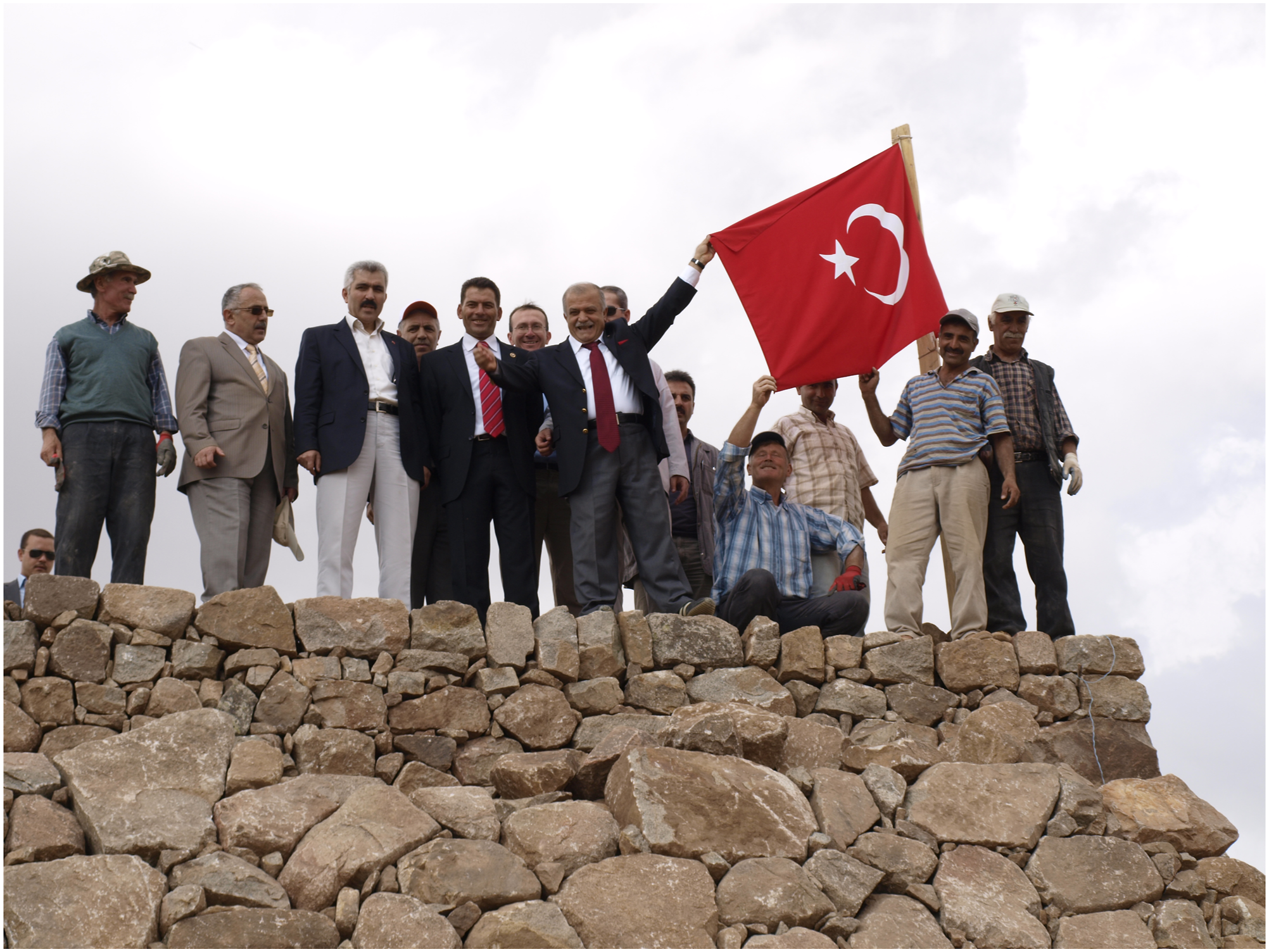
Villagers also referenced television series that portrayed the history of Anatolia as one of conflict between Turkish Muslims and foreign Christians. One of the most popular shows was Ertuğrul Resurrection (2014–2019), which depicted Ertuğrul Gazi, an Oghuz Turk, battling Christian Crusaders and the Byzantine Empire to pave the way for the foundation of the Ottoman Empire in Anatolia. The villagers took great pride in being the descendants of such Muslim war heroes. As the headman said, “Our ancestors were Oghuz Turks from central Asia who came to this land bringing Islam.” Villagers thus saw a parallel between the conflicts portrayed in Battal Gazi and Ertuğrul Resurrection and their contemporary encounters with foreign archaeologists. The archaeologists and their practices at the site had symbolically replaced the ancient foreign Other.
Villagers publicly affirmed aspects of the national history of Kerkenes. Excavation workers posted photos of the Turkish flag with Kerkenes as the background on their Facebook pages. Local authorities also sponsored and filmed a video advertising the place on the village Facebook account. The video began with a bird’s-eye view of Yozgat and the vast lands stretching toward the village, with a gigantic Turkish flag printed over the fields. It then panned to the Kerkenes archaeological site, where the village headman was filmed explaining that the village had been settled during the Seljuk period and the villagers were descended from Oghuz Turks. He talked about the Phrygian history of the visible remains and emphasized that Kerkenes, as an archaeological site, belonged to the village. The short video thus revealed a local re-appropriation of the site with an emphasis on its Muslim past and national ownership of the land.
Conclusion
By following the long-term relationship between an archaeological project and its host community in Turkey, I have suggested reasons why most community members do not embrace but instead resist attempts on the part of the archaeologists to impart their findings, do not want to be involved in the project other than as wage laborers, and are conflicted about the presence of foreign archaeologists in their village. Archaeological praxis and information sparked a struggle over representation that forced villagers to think about themselves and the “foreigners” in relation to the place and its past. The project’s efforts to familiarize the locals with archaeology as a heritage-making practice and imposition of scientific ways of knowing inadvertently triggered the production of counter-narratives as a sort of decolonizing response that challenges Eurocentric knowledge systems in a country that does not have a settler-colonial history (see Mignolo, 2007: 540). These counter-narratives emerged because local villagers associated the project symbolically with colonizing endeavors. For example, the villagers are suspicious of archaeologists coming from Western countries because of the colonial legacy of archaeology, which they know of through repatriation cases and rumors of artifacts from different places constituting museum exhibits in the West.
Such reasoning cannot be explained away or mitigated merely through a reflexive deconstruction of archaeological praxis at Kerkenes since other factors contribute to village perceptions, including local Muslim migrant laborers’ experiences in Europe, Turkish nationalist discourses, and community understandings of the site’s historical and affective significance. Villagers associate archaeology with power asymmetry in part because of their experiences within the current global coloniality’s hierarchies of difference (Mignolo and Escobar, 2010; Mignolo and Walsh, 2018; Stoler, 2016). The pejorative category of the “foreign,” which is equated with all Western people, has been shaped by Muslim migrant workers’ negative experiences of being racialized and dehumanized in Europe, then reinforced in the collective imagination by discourses of the threatening Other promoted by the neo-nationalist and Islamist regime in Turkey. Within that context, archaeologists’ attempts to transform the villagers’ place into a heritage site came to be perceived as colonizing. The project’s efforts to create archaeological heritage awareness only mobilized locals to reinterpret historically meaningful categories and current political events, which resulted in the symbolic transfer of the perceived negative qualities of the foreign Other to archaeology. Their perception of archaeology and heritage is entangled with larger conflicts and ideas about the position of foreign actors within them. That is, archaeology is interpreted in the frame of conflicts: local versus foreign, Islam versus Christianity, Herodotus versus Battal Gazi, and so on—all mapped onto one another.
The locals do not embrace archaeological knowledge because the Kerkenes archaeology project has always been the archaeologists’ project, not theirs. Ever since 1993, it has been an international project designed to scientifically investigate the largest pre-Hellenistic Phrygian site in Turkey and has received funding from major funding sources on that premise. The project’s history reflects pioneering efforts within the field towards making archaeology relevant to local communities and bridging the gap between experts and the public through publications, presentations, site tours, and festivals. However, all the community outreach programs designed by the archaeologists insisted upon a single understanding of the past, the site as heritage, and scientific knowledge that contradicted local knowledge production of the past and experiences of the site. Archaeological praxis at Kerkenes, despite the community-oriented efforts, thus reproduced colonial forms of knowledge production.
Kerkenes as a place continues to simultaneously encode multiple meanings, values, pasts, and national and transnational histories, while mnemonically evoking different ancestors, including those of the villagers and those of the symbolic Other—the archaeologists. The Kerkenes project could have tried to incorporate villagers’ interest in the Islamic and Turkish past of the site into its research program, but since the site contains no archaeological record from Islamic periods, archaeologists thought that doing so would have risked complying with what they see as a local Islamist and nationalist political agenda. However, reducing local understandings of the past and place to a nationalist and Islamist state ideology may blind archaeologists to the complexity of subjectivity formation and multiplicity of the lived experiences of local inhabitants. For example, while villagers like those who live in Şahmuratlı represent the majority in Turkey, in Europe they are subaltern subjects.
Archaeologists can explore ontological and epistemological positions that challenge Eurocentric forms of knowledge production and “… make space for those practices without feeling that their own sets of disciplinary practices are being threatened” (Lyons and Supernant, 2020: 10). Archaeologists still have much to learn about local affective relationships with archaeological sites and local ways of history-making that do not rely on linear time or draw on empirical data as “epistemic resources” (Wylie, 2015: 205). The Şahmuratlı villagers see events across time as being related to each other through present experiences. The revitalization of the Battal Gazi epic in response to the archaeologists’ knowledge is an example of this. Archaeologists do not have to publish such alternative understandings to raise multivocality, however, since the locals actively use social media to share their own understandings, at least at Kerkenes.
As an archaeologist, my ethnographic inquiry has taught me to cultivate humility and not exaggerate archaeologists’ agency. If members of host communities are uninterested in taking part in archaeological practices, the only thing to do is to mind the gap and take no action other than forming respectful, sincere, and humane relationships with the individuals who reside near the sites.
Footnotes
Acknowledgements
I thank all of my hosts in the Şahmuratlı village for sharing and teaching me their lifeworlds over the years. I thank Françoise Summers and Geoffrey Summers, the former directors of the Kerkenes project, and Scott Branting, the current director of the Kerkenes project, for their endless support of my ethnographic project. I especially thank Ira Bashkow and Richard Handler for reading countless versions of this work and commenting on them. I am thankful to Ian Hodder, Patricia Wattenmaker, Feyza Burak Adlı, Seppi Lehner, Ali Yaycıoğlu, Karina Atkins, Jeanne Siler, Asuman Korkusuz Ülgen, Jaida Samudra, and the three anonymous reviewers.
Declaration of conflicting interests
The author(s) declared no potential conflicts of interest with respect to the research, authorship, and/or publication of this article.
Funding
The author(s) received no financial support for the research, authorship, and/or publication of this article.