




Abstract
This paper responds to a need to address the colonial history of collections of Egyptian archaeology and to find new ways in which Egyptian audiences can assume greater agency in such a process. The ‘Egypt’s Dispersed Heritage’ project presents a model of engagement whereby foreign museum collections become the inspiration for Egyptians to express their own feelings about the removal of their heritage abroad using idioms and traditional storytelling of cultural relevance to them. A series of online comics confronting contentious heritage issues, including the display of mummified human remains, eugenics, looting and destruction, is discussed. It is argued that this approach is not only more relatable for Egyptian communities, but moreover provides space for the development of grass-roots critique of heritage practices, both in the UK and in Egypt. Museums have a responsibility to take on board these critiques, curating not just objects but relationships forged amongst them in historical and contemporary society.
Introduction
The extraordinary scale of the colonial extraction of Egyptian artefacts to museums worldwide has recently been documented (Stevenson, 2019). It is a history that is little-known in Egypt and largely glossed over in UK museums. Yet despite the rising crescendo of opinion pieces, social media threads and academic conferences calling for decolonization of museums, inclusion of communities from the Middle East and North Africa (MENA) region has been relatively scant, with Egypt in particular occupying a blind spot. The Egypt’s Dispersed Heritage (EDH) project sought to challenge the Eurocentrism and epistemic coloniality that has characterized the interpretation of Egyptian heritage. It did so by seeking to stimulate dialogue that would be relevant and beneficial to contemporary Egyptians using dispersed heritage and by aiming to increase awareness of those interests in UK museums. The common departure point for these initiatives was UK collections, building upon the idea of ‘contact zones’ in which objects (including photographs and archives) are a ‘source of knowledge and catalysts for new relationships’ (Peers and Brown, 2003: 5) between Egyptian communities and UK museums.
In this paper we identify the need to address the history of dispersal within both Egypt and the UK, before outlining the approach we developed to act on that need, which draws on Egypt’s rich tradition of storytelling, satire and caricature. The EDH project has several initiatives and audiences, but the focus of this article is a comic series written in Egyptian Arabic and posted on social media for Egyptian audiences. These directly confront colonial legacies and address challenging topics such as the status of human remains in museums, white supremacy and eugenics as motivations for collecting, and heritage looting and destruction. In demonstrating Egyptian connections to this heritage, the project also forms an intervention to challenge universal claims upon it (e.g. Cuno, 2008). We argue that eliciting emotional engagements in the presence of collections is a culturally specific task that needs to be relatable, relevant and responsive to community interests and needs. These initiatives are more than dissemination activities, outreach schemes or collaborative narratives, but are also active critiques of heritage practices themselves, both those in the UK and in Egypt. We advocate that museums that participate in such engagements have a responsibility not to just document objects in their care, but to additionally record the relationships forged in their presence as a means of multidirectional curation.
Re-centring narratives: The need in the UK
There are more than 112 collections of Egyptian archaeology in the UK (Serpico, 2006), with recent regional reviews increasing the number known (Potter, 2020). In large measure this is a consequence of how British colonial archaeology was historically organized and funded. In the absence of government sponsorship, British archaeological projects were supported by donations and financial subscriptions to organizations like the Egypt Exploration Fund (EEF) or the British School of Archaeology in Egypt. In return for such sponsorship it was possible for museums and other educational establishments to share in the spoils of archaeological work despite the fact that the removal of antiquities from Egypt had been restricted since 1835. This legislation was circumvented by ‘partage’, a system devised by the French Head of the Egyptian Antiquities Service, Gaston Maspero, and English archaeologist Flinders Petrie in 1883, a year after Egypt became violently enveloped into the British Empire as a protectorate. Partage permitted museum authorities in Cairo to have first pick of objects found while any duplicates deemed suitable for export were free to be removed by foreign archaeologists. This model went on to inform heritage policies throughout the British Empire and other countries’ imperial ambitions (Kersel, 2010). Hundreds of thousands of artefacts, monuments and mummified remains were subsequently propelled beyond Egypt’s borders. And this diaspora was in parallel to material extracted illegally or else dispersed through the antiquities market (e.g. Hagen and Ryholt, 2016). In these ways Egypt became commonplace in public displays worldwide.
These processes of removal were not just physical; they had a profound effect on the relationships between people and things. Egyptian antiquities were domesticated within European frames of knowledge and appropriated as narratives of the development of Western civilization, while simultaneously subject to a cultural dislocation from the landscape and peoples of modern Egypt. The ‘museum effect’ is relevant here, a phenomenon in which there is ‘the tendency to isolate something from its world, to offer it up for attentive looking and thus transform it into art like our own’ (Alpers, 1991: 27). As a result, ‘everything in a museum is put under the pressure of a way of seeing’ (Alpers, 1991: 29). Egyptian material, however, seems to have been more substantially altered by museum forces than many other world cultures, predicated on a set of sharp Orientalist oppositions in which ancient Egypt is associated with the modern West, and present-day Egypt, the East (Colla, 2007: 103). These are collections that have been simultaneously ‘exoticized’ and ‘assimilated’ (Karp, 1991).
The results of this dislocation are apparent from community consultations and audience research on UK galleries focussed on ancient Egypt. These have highlighted largely negative and dismissive views of modern Egypt amongst Western museum visitors in contrast to the reverence for its ancient (almost exclusively pharaonic) past (e.g. Exell, 2015; MacDonald and Shaw, 2004: 122–123). Underpinning these viewpoints is an assumption of Egyptian indifference to antiquities, based upon centuries of an Orientalist gaze from foreign travellers, archaeologists and writers throughout Ottoman Empire (Anderson, 2015). In the period when Egypt was subject to the most intensive exploration for antiquities, in the late 19th and early 20th century, these views were frequently expressed (Reid, 2002: 201). A rhetoric of preservation was thereby mobilized to legitimate the export of antiquities (Gange, 2015). Meanwhile, Egyptians were systematically excluded from work in museums and universities despite the efforts of many Egyptian archaeologists to reclaim the past from foreign control (e.g. Reid, 2002). As a result, ancient Egyptian material is frequently assumed to be an orphaned culture with no relationship to the modern nation and its citizens who just happen to occupy the same territory (e.g. by Cuno, 2008). Such viewpoints overlook the realities of the centuries in which diverse groups have inhabited the landscape of north-eastern Africa, imbuing and drawing meaning from it. The antiquities that speak to these interactions are not so easily divorced from those settings, and modern ‘connected’ communities continue to elicit meaning in their presence and their connection to the landscape (Ingold, 2000). Indeed, this sentiment was expressed by one of the Egyptian visual artists that worked on the EDH project, Moira Adel, who developed the project’s social media visual identity and used a lotus flower to represent Egypt and roots to the landscape.
Many museums in the UK do now address aspects of collections histories in their displays following the ‘narrative turn’ in museum strategies (Francis, 2015), recognizing visitors’ preferences for stories regarding people over things, together with the wider embrace of object biographies as an interpretive tool that foregrounds the transformative relationship between people and things (Gosden and Marshall, 1999). For example, the Egyptology displays at the Liverpool World Museum, which opened in 2017, contain a section devoted to telling the stories of the collectors behind the objects displayed, explaining the basic premise behind partage and the reasons for heritage being sent to places like Liverpool. Similarly, the 2019 text panels of the Egyptian galleries of the National Museum of Scotland include biographies of the archaeologists behind many of the exhibited finds. In these spaces it is largely Western protagonists that are presented, primarily as pioneers or altruistic donors. Amelia Edwards, co-founder of the EEF, is a case in point. Her portrayal as a pioneer in such displays can be countered by the fact that she was also a self-confessed looter: I may say, indeed, that our life here was one long pursuit of the pleasures of the chase. The game, it is true, was prohibited; but we enjoyed it none the less because it was illegal. Perhaps we enjoyed it the more. (Edwards, 1878: 242)
Re-centring narratives: The need in Egypt
The practice of finds distribution outside Egypt, its extent and scope, is largely unaccounted for and remains obscure within Egypt. This is clear from statements made by the director of the Egyptian Ministry of Antiquities’ repatriation department, Shaaban Abdelgawad. In an interview (Shehata, 2016) he confirmed that there was an almost complete absence of records concerning Egyptian artefacts stored and displayed outside Egypt. He highlighted that Egyptian authorities, in their current efforts to combat illicit trafficking of Egyptian antiquities, mainly rely on Western institutions’ documentation of excavated finds and their final destinations to distinguish stolen heritage from that removed through partage agreements in the past.
Since the 2011 uprisings, the presence of ancient Egyptian objects in Western museums has been the subject of more emotionally heated debates than before. Regular media stories and press releases asserting the successes of the return of material looted since 1970, together with calls for the return of iconic symbols of Egyptology – including the Rosetta Stone and bust of Nefertiti – have dominated narratives in Egypt where dispersed heritage is concerned (Ikram, 2010). Unsurprisingly, among Egyptians it is frequently felt that artefacts displayed and stored outside Egypt are stolen. For instance, a previous member of the National Committee of Heritage Repatriation chose ‘Legal Thefts’ as the title of his book (Ashmawi, 2012) in which he describes various means through which antiquities have left Egypt. As Ashmawi’s book makes clear, many Egyptians are unaware of the redistribution of finds after they were legally taken away by the British between 1880–1980. In this respect, labelling all objects as stolen responds to a lack of information about the partage system and to the legacy of the colonial contexts of removal. Some Egyptians believe that such objects should be returned to Egypt (e.g. El Sawy and Maher, 2018), others consider them to be ambassadors that boost tourism and should remain in foreign institutions (e.g. Abdeen, 2016; Hussein, 2015). Both perspectives are based on the prevailing assumption that ancient Egyptian objects outside Egypt are of a higher cultural value than those left in Egypt.
Within the general populace of Egypt perceptions and knowledge about archaeology are largely limited to those involved in the tourist industry or antiquities management. In part, this is a consequence of how children are introduced to ancient Egypt in their school curricula, which has been criticized for its off-putting approach of rote memorization of ancient names, dates and facts irrelevant to contemporary lives (Abdou, 2018; Keshk, 2012). However, we cannot assume a ‘deficit model’ whereby public ignorance is the reason for a lack of positive engagement with ancient material culture (Fredheim, 2020). Although there is limited evaluation of heritage initiatives within Egypt, it is likely that negative responses to ancient Egyptian heritage are also a reaction to colonialism, which underpinned the creation of most governmental entities that today oversee these resources in Egypt.
In terms of the museum sector in Egypt, many Egyptians do not relate to local museums as they have been largely curated and presented for tourists and scholars (Abd el Salam et al., 2017). While there are some new Egyptian-run initiatives foregrounding local community needs, such as at Mallawi Museum and the National Museum of Egyptian Civilization (Moniem, 2005), these remain exceptional. Western models of museum representation remain dominant, having been internalized as an internationally recognized measure of national status homogenized through global standards and training schemes. Such a situation characterizes much of the MENA region where it has been observed that a substantial local critical engagement with heritage practices has yet to be developed to redefine them (Abu-Khafajah and Miqdadi, 2019). Equally problematic is how ancient Egyptian material culture has been catalogued and labelled within Egyptian institutions, using Classical Arabic rather than colloquial Egyptian Arabic. This has had the effect of further distancing collections from the Egyptian public.
A relevant lens on this situation is Walter Mignolo’s development of the concept of coloniality and Pablo Gonzalez Cassanova’s discussion of the effects of internal colonization, as Shelton (2018) has highlighted. This scholarship recognizes how externally imposed inequalities in the distribution and use of resources away from local communities under colonialism are subsequently maintained by being internalized through state control. For instance, in Egypt today, while Egyptian authorities are responsible for the management of archaeological resources, and antiquities are no longer subject to partage or indeed any form of export (with the exceedingly rare exception of museum loans), these resources are regularly removed from local communities towards centralized museums and storage facilities where certain types of authority are assumed vis-à-vis Western intellectual traditions. There is, therefore, an uncomfortable tension ‘between the state-sanctioned accommodation of archaeology and a persisting alienation of many individuals and communities’ (Näser, 2019: 380). Consequently, there is a need for more approachable, accessible, critical and locally relevant resources to shift the tone and direction of discussion around the legacy of foreign archaeological interventions.
Addressing the gap: The Egypt’s Dispersed Heritage project
There have been previous attempts to broach the divides between modern Egypt and widely dispersed collections of ancient Egypt, such as through new collecting initiatives at the British Museum (e.g. Elshahed, 2017) and contemporary art interventions (e.g. Tully, 2011, 2017). The former focused on early 20th-century state appropriations of pharaonic images but without a critical appraisal of their public reception. In the case of the latter, contemporary art can be exclusionary as for many it retains an air of elitism (see also Geismar, 2015). In both cases the results tend to be object-focussed rather than people-focussed, representing but not necessarily giving a voice to diverse Egyptian perspectives. Moreover, these sorts of efforts have proceeded largely to improve representation within the Western museum, not to enfranchise and benefit those at both physical and social removes from it. Where UK museums have undertaken archaeological fieldwork in Egypt (e.g. Regulski, 2018) or brought Egyptians over to work with UK collections (e.g. through the British Museum’s International Training Programme), there is a clear awareness of the need to engage source communities with active, creative programmes, but how those groups are able to speak back to the museum and its collections is less clear.
In seeking to foster more meaningful forms of engagement the EDH project has centred emotive forms of expression. Such an approach resonates with what Perry (2019) has called an ‘archaeology of enchantment’, that acknowledges the ways in which ‘archaeology can move us … and this affective response can motivate us to act back on the world in constructive, ethically-minded ways’. But while Perry’s EMOTIVE project situates the initial agency for the creation of engagements with archaeologists, specifically through digital means, our project sought to provide raw materials for Egyptian communities to assemble the media and the messages for their own engagements. In this, we disagree with Perry’s characterization that ‘archaeology has inherent in it sources of enchantment’ since archaeology is a construct imposed upon Egyptians that has often alienated them and, as noted above, is often considered a dull, specialist subject. Emotional engagement with heritage is also not a new approach for Egypt. It has long been advanced by Egyptians themselves who have argued that ‘modern Egyptians can feel ancient Egypt better than any Western archaeologist’ (Heikal, 1926: 10).
We also see our emphasis on emotive forms of engagement as a counterpoint to the ‘neoliberal effect’ that has largely characterized heritage work with local communities in the MENA region (Abu-Khafajah and Miqdadi, 2019). This has come as a consequence of policy dictums of funding bodies that have insisted on Official Development Assistance (ODA) compliance for applications to work in the region. The emphasis has been on projects that put sustainable development, capacity building and economic opportunities at the forefront of initiatives. The result has often been passive and descriptive approaches to archaeology and heritage, lacking opportunities for direct critical engagement from a local perspective. This is not to claim that our project operates outside of such frameworks, since it is sponsored by the UK’s Arts and Humanities Council (AHRC), funding that is contingent upon the expectation that particular forms of impact will be delivered. It is also a project initiated from outside of Egypt. However, we have not prioritized training in any of our activities in Egypt or sought to educate Egyptians about the history of excavation in Egypt. Rather, any training is for our UK partners: opportunities to listen and learn. Nevertheless, our project involved deriving new approaches for UK museums, which has the potential to be seen as exploitative. We have tried, wherever possible, to be clear about our intentions, to source benefit for all participants and place the agency for production of the process in the hands of Egyptian communities, according to their timescales and priorities. The EDH project initiated dialogue entirely in Egyptian Arabic with communities in Egypt and the initial grant application itself was co-developed with local partners according to their interests and expertise. The project’s activities and resources were designed to be accessible in content and language, people-centred, participatory, imaginative, informal and flexible. Through these means we hoped to provide a space that was open to more critical engagement with archaeological and colonial histories.
Artefacts and archives as contact zones
The rationale for using UK collections rather than those in Egypt for these engagements was to emphasize and strengthen the sense of responsibility between museums and academic institutions in the UK, and the mostly overseas, but currently often immigrant, communities whose heritage is studied, cared for and displayed in those institutions (Peers and Brown, 2003). There are also greater opportunities to potentially destabilize categories and labels using UK-based resources than in Egypt. To this end the EDH project partnered with the Egypt Exploration Society (EES) and five UK museums that hold substantial Egyptian collections from British fieldwork – National Museums Scotland, UCL Petrie Museum of Egyptian and Sudanese Archaeology, Manchester Museum, Liverpool World Museum and the Horniman Museum and Gardens. Their collections and archives were the basis for a series of contact zones.
The concept of the contact zone in the museum sector is best known from James Clifford (1997), who borrowed it from linguist Mary Pratt, as a way of analysing the interactions of museums and their stakeholders. Pratt envisioned contact zones as ‘social spaces where cultures meet, clash, and grapple with each other, often in contexts of highly asymmetrical relations of power’ (Pratt, 1992: 34). In the context of museums, it has been substantially and rightly critiqued as neo-colonial (Boast, 2011) given that power remains centred within museums. Returning to Pratt’s formulation of the contact zone is, however, fruitful in other ways. She emphasized, for instance, the role of transculturation, which raised a set of questions that are particularly relevant to this project (Pratt, 1992: 7): what do people on the receiving end of empire do with metropolitan modes of representation? How do they appropriate them? How do they talk back? The EDH project, therefore, sought methods of deploying colonially extracted objects within spaces of visual culture outside of the museum where Egypt’s own value systems and philosophies could reframe them, where Egyptians could talk back and interrogate them, and in so doing establish counter-narratives to the colonial acquisition and representation of Egypt’s heritage by foreign institutions. One way to achieve this was through comics.
The comics of Nasser Junior
Disseminating the results of research in accessible ways, such as comic based art, is not a radical approach for public archaeology. Fals-Borda’s 1970s community-based research in Columbia employed comic strips, films and recordings, as well as music and drama performances by local groups (Atalay, 2012: 61). The role of comics as a unique combination of visualization and storytelling to better connect communities with heritage has also been established by several projects. Examples include John Swogger’s NAGPRA Comics (Atalay et al., 2019), which are community-based comics about repatriation in the United States, and Magic Torch Comics’ work with marginalized groups on heritage projects. 1 Several community archaeology projects in Egypt have used the medium to communicate ideas and information about archaeological projects (e.g. Lorenzon and Zermani, 2016: 192). Interventions like this are a means to challenge the idea that heritage is subject to unaffecting technical expertise (Wetherell et al. 2018).
Comic art, however, has its own long history in 20th-century Egypt. Adult comics, in particular, spread rapidly in the wake of the Arab spring, facilitated by social media, as a medium of expression, satire and dissent (Ghaibeh, 2015). It is therefore a potent arena for critical dialogue rather than passive narration. Moreover, given how Egyptian material culture is often presented in Egyptian museums using Classical Arabic, comics form a powerful counterpoint in their use of relatable dialogue in colloquial Egyptian Arabic and contemporary slang. What is valuable about this approach is that stories ‘open up a space into which the listener’s own thoughts, feelings, and memories can flow and expand’ and which ‘inspire an internal dialogue and thus ensure a real connection’ (Bedford, 2001: 29).
The EDH engaged several different artists on the basis of their skills, values and interests in producing content that was relevant and responsive to Egyptian communities. All were paid from project funds to produce visual responses to various facets of the history of distribution of archaeological finds to institutions worldwide. Although the artists were commissioned by the project, they had full agency in the design and topics they wanted to explore from a wide selection of images provided by UK partner institutions following discussions about the collections and their histories.
The EDH comic strips, however, were not simply for dissemination of themes and issues in a novel way since their circulation on social media additionally presented opportunities for public discourse. Social media, principally Facebook, is especially powerful in Egypt, a country that has one of the most youthful populations in the world, with an estimated 61 per cent of the population is under the age of 30 (Population Council, 2015). Social media use in archaeology, however, has been criticized as a means of bolstering authority at the expense of decentred engagement or collaboration (Walker, 2014: 229) or of speaking to only insular audiences (Richardson, 2013). Our co-creative approach sought to overcome this by using the artists’ own platforms rather than the project team’s. As a project grounded in a strong sense of social justice (Sandall and Nightingale, 2012), we were also conscious of the potential for exploitation. Consequently, EDH project discussions were fully shared with the artists wherever possible, such as through podcasts and other online events to maximize their visibility.
The first artist employed, and the focus of this article, was Mohammed Nasser, a cartoonist based in Alexandria who produces work primarily for social media under the name ‘Nasser Junior’ (@Nasser_Junior). In a series of 12 comic strips released on Facebook and Twitter from February to October 2020 (Table 1), Nasser’s art explored the intersections of contemporary Egyptian social concerns with heritage issues, using objects and archive images from UK partners as the departure point for scenes narrated wholly in Egyptian Arabic. The title of the comic ‘Nasser, Heba, and Our Dispersed Heritage’ deliberately jettisoned the use of ‘Egypt’ in the title as a means of reclaiming agency over the narrative. Each strip contained between one and six panels. On the surface the scenes seem light-hearted and reductive, but each one was the culmination of long discussions between Abd el-Gawad and Nasser and had to distil complex, sensitive heritage issues, from heritage destruction to human remains, into digestible and humorous short stories. The comics were released to Nasser Junior’s already substantial online audience of more than 161k followers on Facebook and on Twitter, a social media field not primed to engage with archaeological content. Each comic was followed up by sub-tweets providing links to the UK museum and relevant resources for anyone interested in following up the histories and contemporary museum issues connected with each comic theme.
List of comics produced for Egypt's Dispersed Heritage by Nasser Junior.
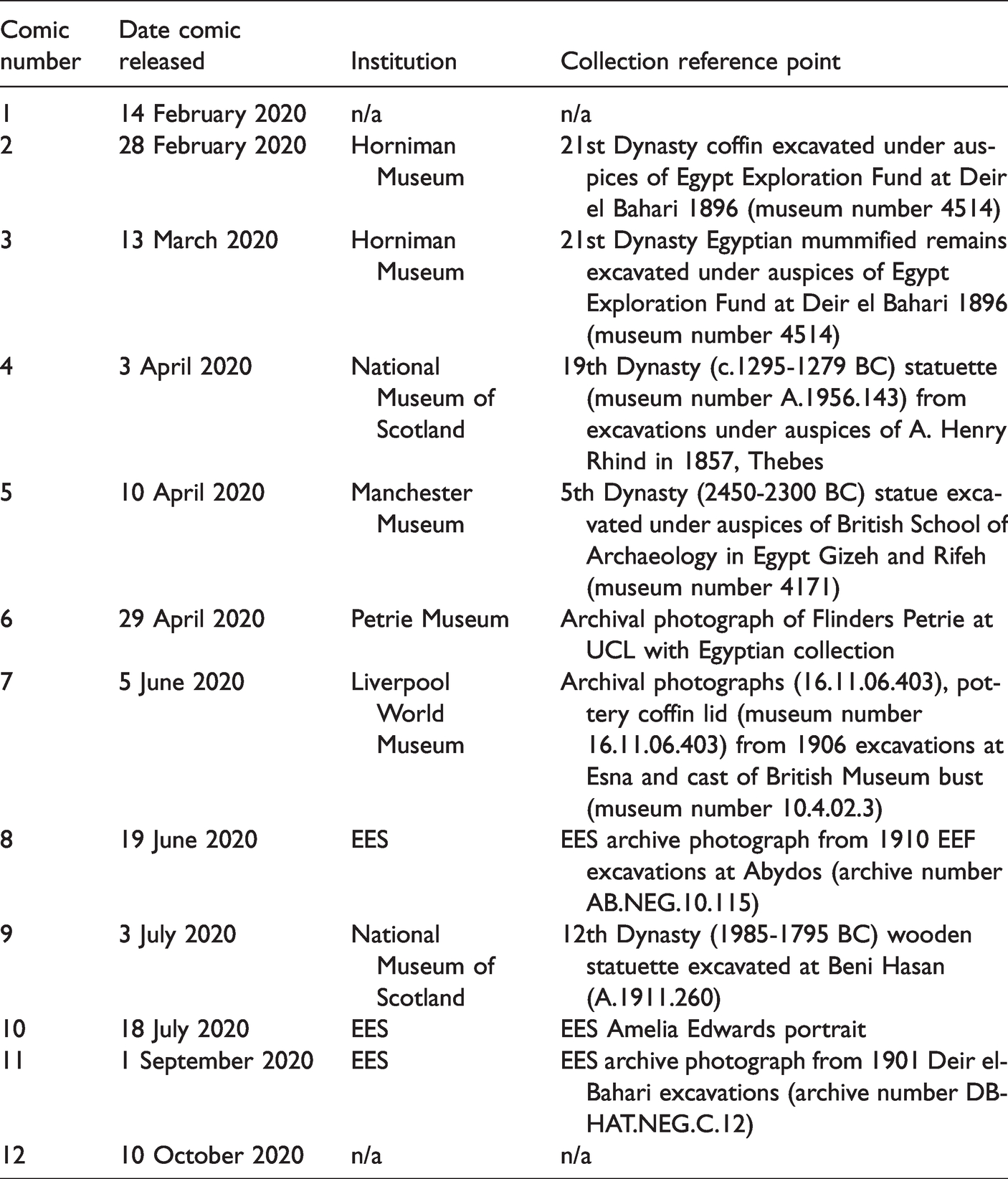
The comics spoke directly to Egyptian humour and current events in Egypt. This was amplified by their presentation on Facebook and Twitter, which set them within a wider ecosystem of images, memes and contemporary commentary that framed and informed their reception (Elhadidi, 2018). As a result, it was often the case that the humour could not be translated effectively into English. By taking an approach which resonated more closely with Egyptian experience than British, it was possible to initiate an open conversation on a range of heritage issues. As one user noted, the comics were relatable through ‘such real dialogue’. It was also a strategy that opened up the possibility for critique of Western treatment of Egyptian heritage.
The first comic strip introduced the project (Figure 1) and featured avatars of Abd el-Gawad and Nasser Junior. In this way the co-creative nature of the project was clearly visible and their discussions around the EDH subject matter foregrounded. The three-panel story demonstrated the multiple levels at which the comic operated between different times; ancient, historic and modern. Opening with Abd el-Gawad’s observation that 27 countries held material initially removed by British organizations, the scene moves to Nasser, who is seen busily wrapping himself in tissue paper like a mummy, musing that maybe now he too could travel the world. This set the tone for subsequent comics and their focus on the relations of people and things (rather than simply things). In this case the comic made the point that it was easier for ancient Egyptian objects to travel than for Egyptians themselves, who are often denied the opportunity to visit Western institutions and to participate in conversations around antiquities on account of the difficulties of applying for visas (e.g. Picheta, 2018).
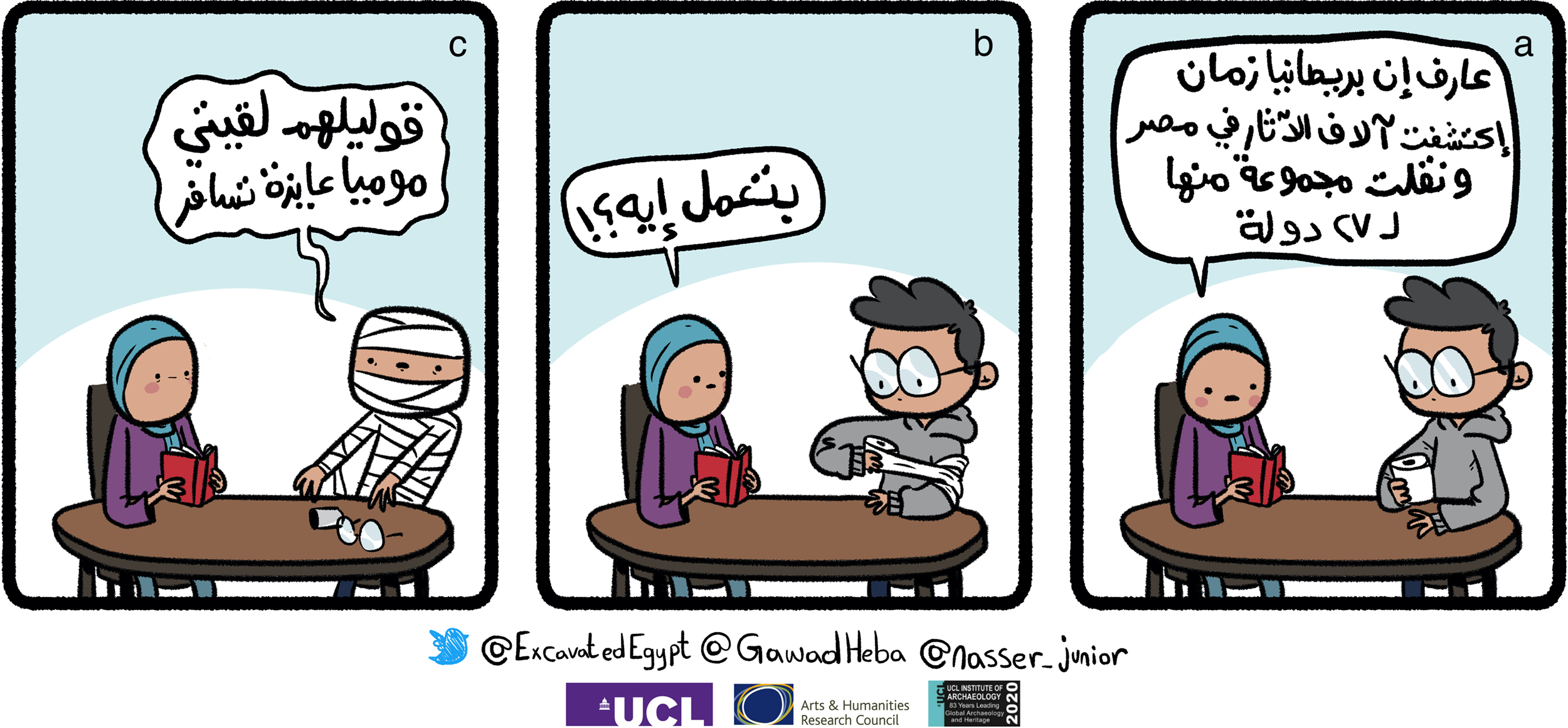
Comic 1 by Nasser Junior. Translation:
Two comic strips were based on the human mummified remains held in South-East London’s Horniman Museum. The first, released on 28 February 2020, presented three mummy cases standing as if part of a red-carpet celebrity photoshoot (Figure 2). While the comic ostensibly addressed perceptions of human remains as museum artefacts, with the aim of presenting them instead as displaced and dispossessed humans, for Egyptians the dialogue also drew upon more recent phenomena. In this comic, current affairs concerning domestic and international migration of Egyptians seeking better employment prospects were also being referenced, given ongoing discussions regarding the mistreatment of Egyptian migrants within Egypt and the Gulf where they are denied annual leave and fair wages (e.g. Sakr, 2016). Responses to the comics drew on both themes, with one Twitter user commenting that it ‘was like us in Port Said’, referring to the similar mistreatment of the migrant workforce at the Suez Canal city, while other interactions responded to the mistreatment of the remains in the West.
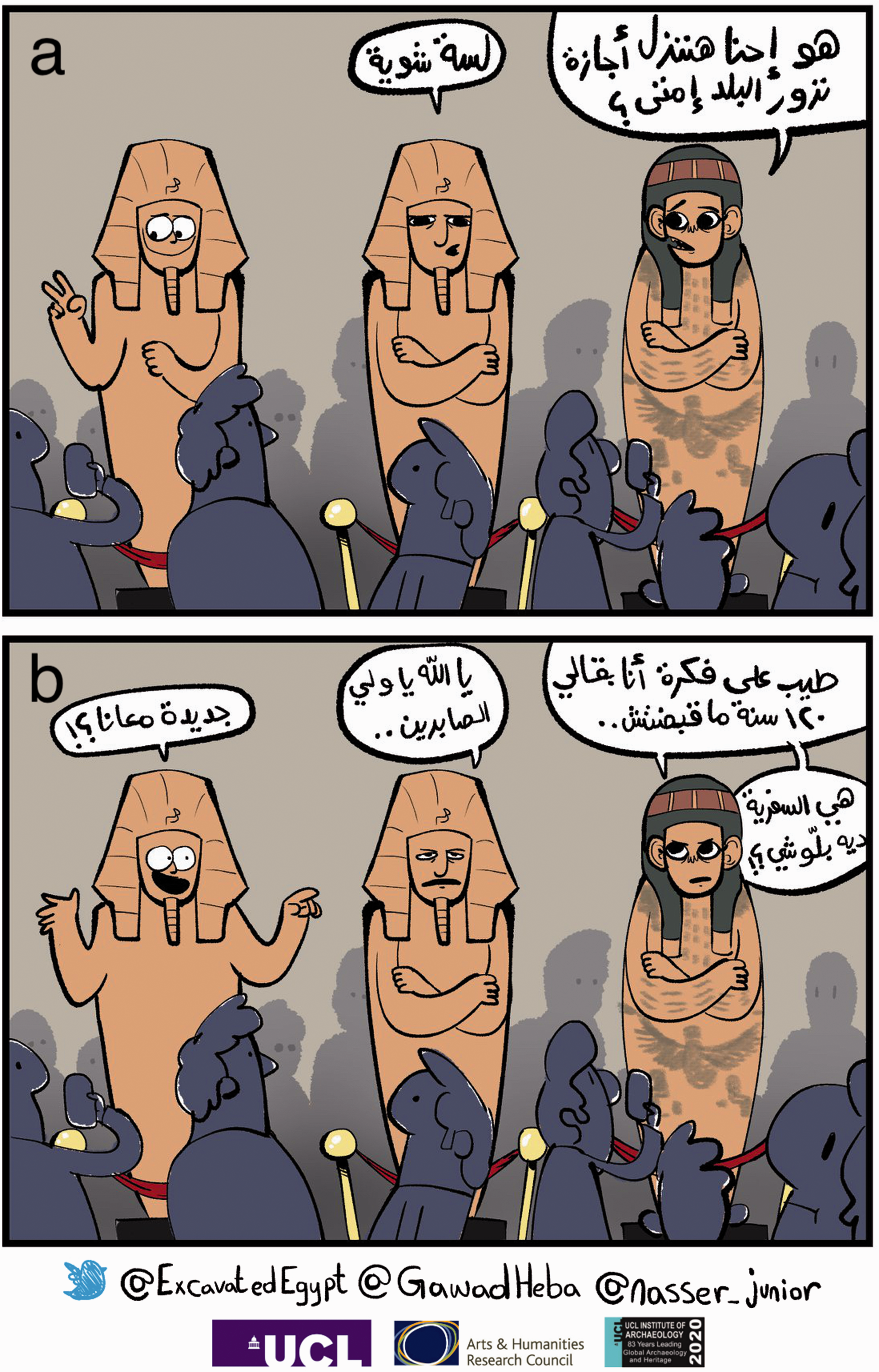
Comic 2 by Nasser Junior. Translation:
The second comic, released on 13 March 2020, was a response to sensationalist news stories relating to studies, of dubious scientific validity, on mummified human remains in UK museums (Atkinson, 2020). An 1897 unwrapping event at the Horniman museum was the departure point. This was then framed in reference to a popular Egyptian meme denoting being ignored, which itself was based on the famous Egyptian comedy movie The Great Fava Beans of China (2004). In the comic (Figure 3) Nasser and Heba are depicted standing over a horrified looking mummified body, either side of which are two white male scientists debating the ethics of their approach. Nasser and Heba struggle to have their voices heard. The comic garnered extensive commentary. ‘Scientists should imagine themselves or any of their family in the same position as these human remains; would they want to be unwrapped and exposed to the world?’ commented one Facebook user. ‘Unless we have their explicit consent, these humans should never be unwrapped or dug up’, commented another. Feelings of inferiority were evident too, with one individual commenting that ‘Egyptians gave up their rights when they gave up their heritage’ while another commented that ‘since authorities allowed human remains to leave the country past and present, we have no right to object’. Others believed that ancient and modern Egyptians are disconnected, as one user pointed out: ‘They are not our ancestors. We have inherited them, and we haven’t protected them, nor did we research or educate ourselves about them’. While we do not assume that these comments are representative of public views, given that not writing comments is the norm on social media (Crawford, 2009), what is clear is that local viewpoints in Egypt on this topic are as diverse as might be found anywhere, reminding us not to construe simplistic, essentialist dialogues of Western versus local perspectives. It is also evident, however, that whatever their opinions, Egyptians were keen to be involved in these debates.
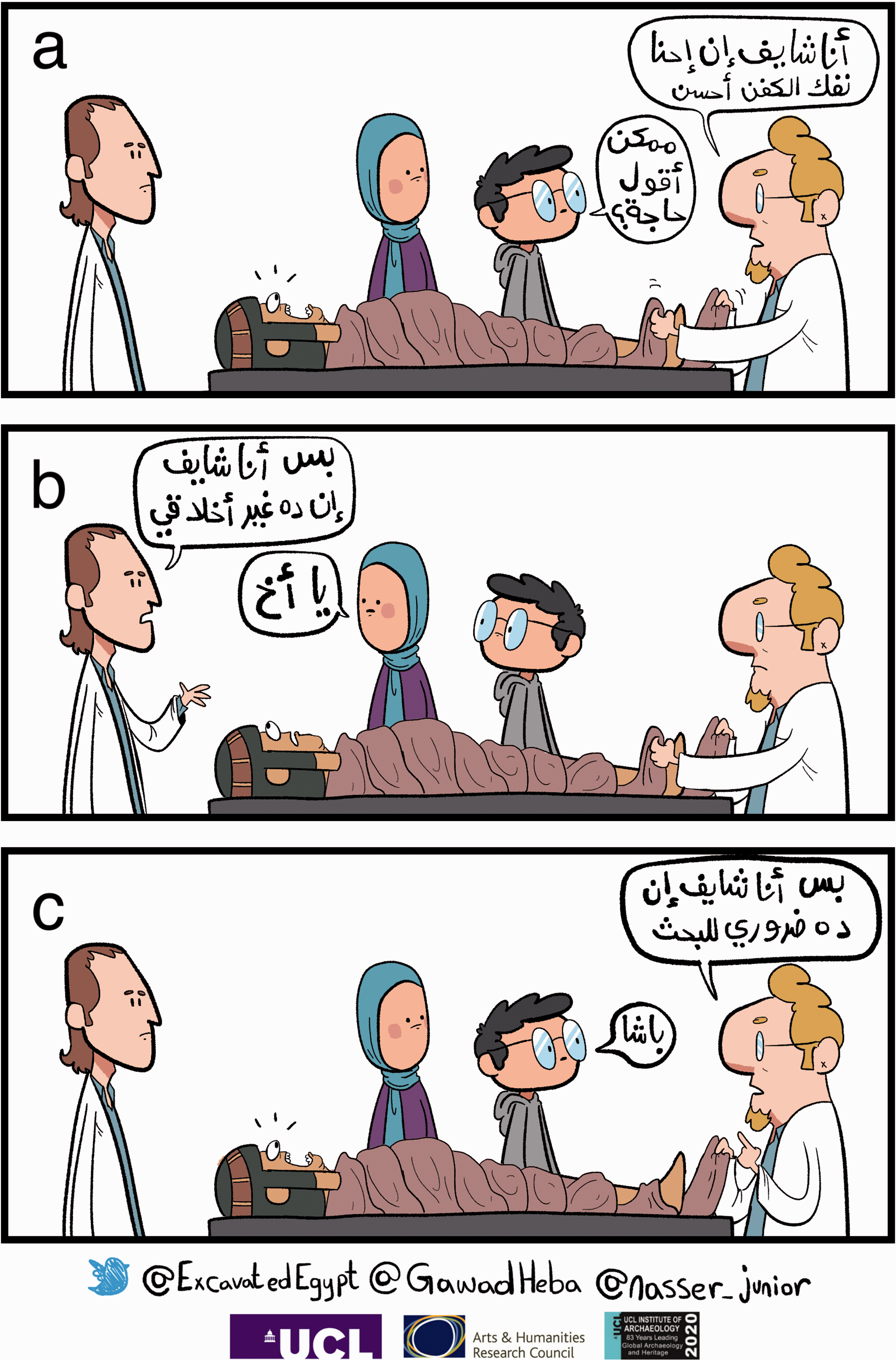
Comic 3 by Nasser Junior. Translation:
In April 2020, a comic (Figure 4) based on an archival image confronted another challenging legacy in the history of archaeology. The subject was the ‘Father of Egyptology’ Flinders Petrie, most often lionized as foundational for the discipline of archaeology and Egyptology, but less often acknowledged as a eugenicist and an advocate of white supremacy (Challis, 2013). To make its point, the comic also drew on debates about how to deal with the legacy of former President Hosni Mubarak in the aftermath of his death in February 2020. Mubarak’s death prompted mixed emotions, with some Egyptians feeling nostalgic for his reign, while others celebrated his demise. The tension was encapsulated in a common meme at the time, that ‘some things are in his favour, some things are against’. This provided the punchline to the comic, in which Heba introduces Petrie to Nasser as someone who had accomplished important work on ‘our heritage’ to which Petrie responds, ‘you mean OUR heritage?’, a reference to the appropriation of Egypt within Western narratives of progress and the exclusion of Egyptians. Heba’s response to Petrie, ‘some things are in his favour, some things are against him’, is presented as an Egyptian solution for how to evaluate figures such as Petrie: a holistic and transparent appraisal of all facets of their legacies. Confronting this also gave the EDH team the opportunity to address and acknowledge publicly in sub-tweets and comments the historic links of the project’s host university, University College London, to its eugenics past. Notably, this post resonated strongly with Egyptian diaspora communities in the UK who had otherwise experienced discrimination and invisibility within current decolonizing debates: ‘UCL home of Eugenics in the past and entrenched colonialists attitudes towards Arabic speaking region and its religion’; ‘Heba, knowing as I do extent of UCL “narratives” when it comes to almost every aspect of our history and historians, I salute you guys. Your works & sheer grit = hope for Egypt & its neighbours’.
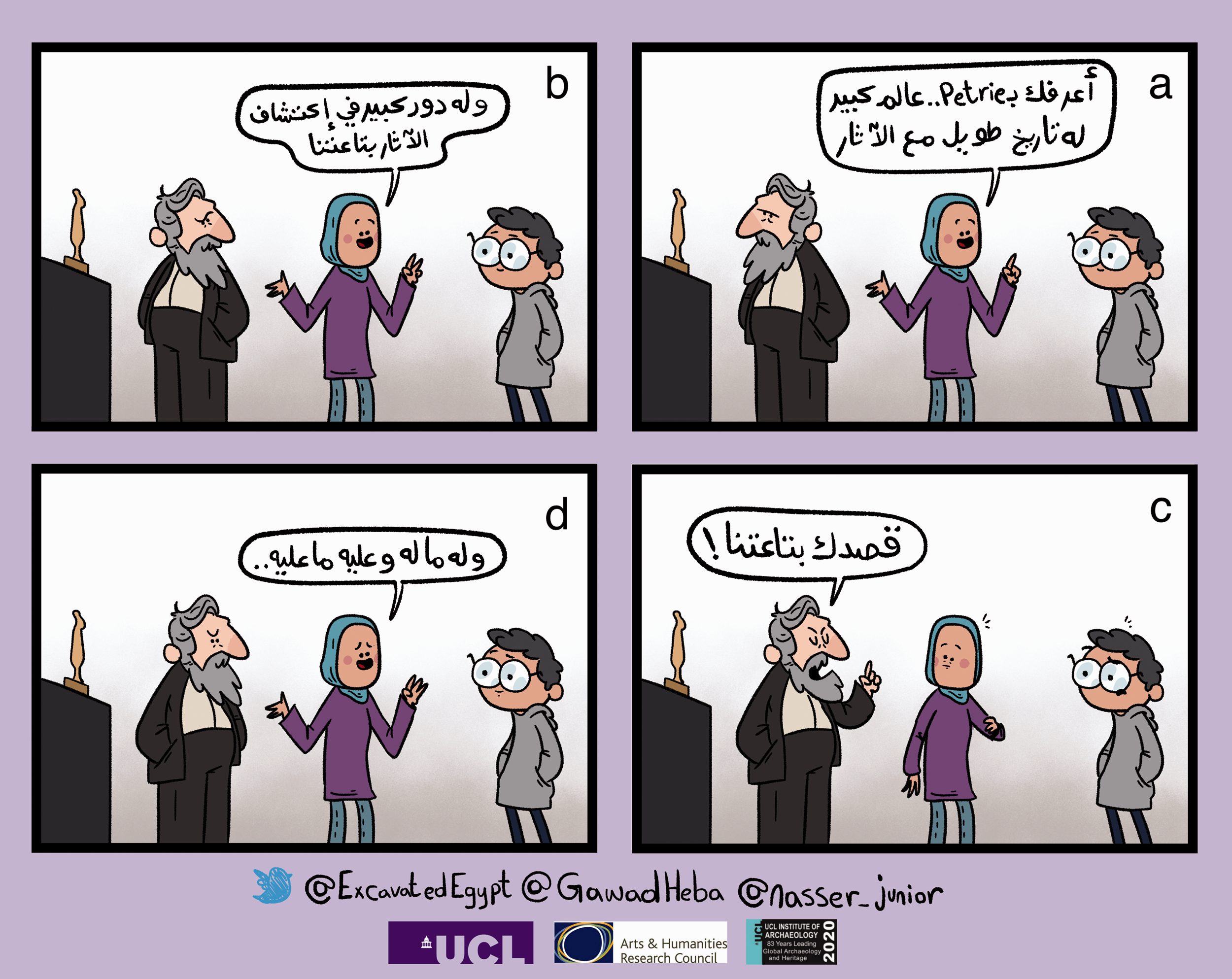
Comic 6 by Nasser Junior. Translation:
Heritage destruction was the topic of two comics. Both addressed the common misconception that the removal of heritage abroad constituted benevolent acts of preservationism with artefacts safely sequestered in Western museums. One comic featured the founder of the EES, Amelia Edwards, snatching an object as a means of ‘saving’ it, and another took the example of the 3000 Egyptian objects destroyed at the Liverpool Museum in 1941 during the WWII blitz as the focus of its narrative. These were intended to act as a form of restitutive narrative, to combat perceptions of inferiority that Egyptians sometimes feel in comparison to Western presentations of the Egyptian past, as well as to challenge the trope of the MENA region as an area primarily characterized by destruction when it is a global phenomenon. Both comics resonated with Egyptian and wider MENA communities’ experiences of the after-effects of not only Western colonialism, but also of more recent political and military interventions in the region. For some, the comic brought back memories of the American invasion of Iraq and the plundering of its heritage. Others recalled heritage destruction and smuggling in Syria by Daesh. Some used both as an occasion to bring up incidents of the mishandling of antiquities by official Egyptian authorities through removal, transfer or conservation and to hold the Egyptian state accountable for heritage (mis)preservation. In these ways the window for multiple axes of critique is apparent.
This imperative to avoid ‘nativist decolonisation’ (Moosavi, 2020), that simply self-validates Egyptian approaches as a stark contrast to UK ones, is also evident in conversations Nasser and Abd el-Gawad had regarding autocolonialism. In the comic, released on 18 July 2020, they pointed to the destruction and neglect of heritage by some Egyptians as represented by a couple drawing hearts on an artefact. The internalization of colonial practices by Egyptians was also the subject of a comic based on a 12th Dynasty (c.1985–1795 BC) female statuette currently looked after in the National Museum of Scotland (A.1911.260). The comic imagined the figurine’s first visit to Egypt since its extraction in 1911 and how she adopts a Scottish accent when expressing her need for a drink. The comic here referenced how travelling abroad, particularly to any Western country, is a source of pride among Egyptians, often leading to strong identification with those places. The comic responds to autocolonialism with the aim of opening up discussion about how Egyptology is Eurocentric, which has Westernized how ancient Egypt is perceived. The Eurocentricism of Egyptology was observed by Egyptian commentators, as one individual made clear in online comments associated with the comic: I have always felt there was something wrong with the way we present Egyptian antiquities. Its seen through the eyes’ of the other rather than our Egyptian eyes. We seem to convey Western point of view not ours.
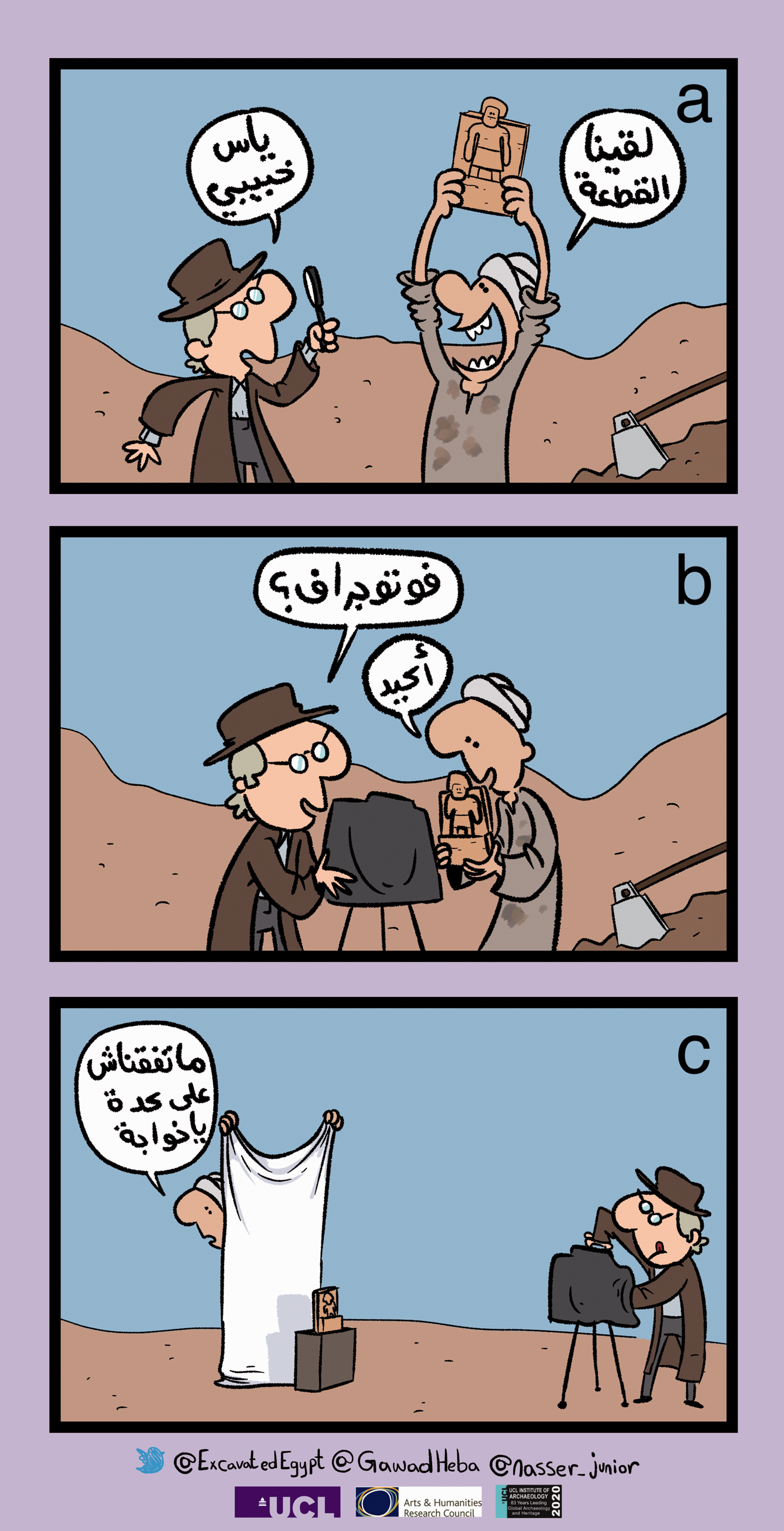
Comic 8 by Nasser Junior. Translation:
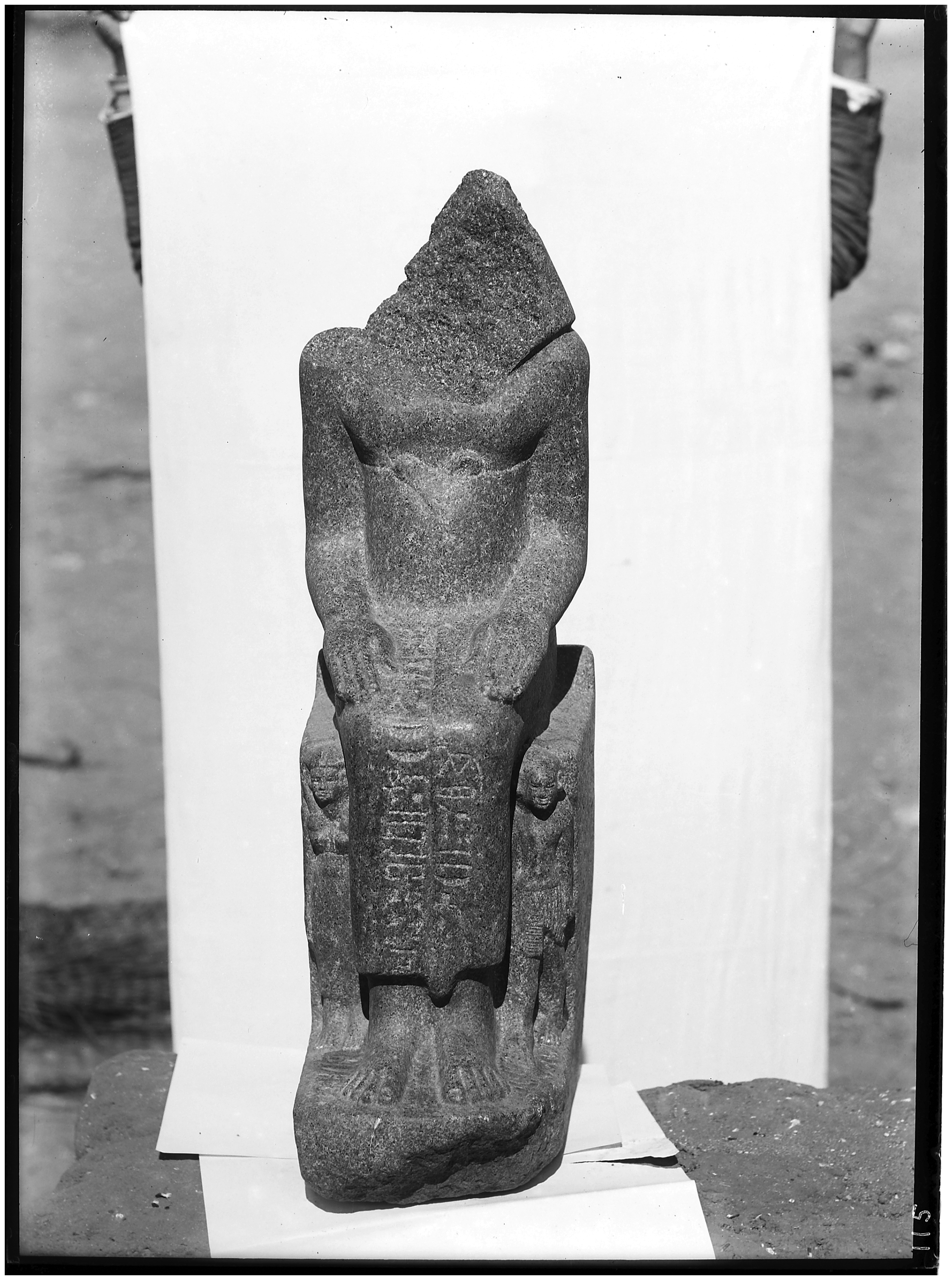
Inspiration for comic 8 – a photograph of statue excavated during the Egypt Exploration Fund’s work at Abydos in 1910 (EES archive image number AB.NEG.10.115). Courtesy of the Egypt Exploration Society.
Establishing multi-directional curation
Despite EDH’s programme of activities being grounded in storytelling and performance in the fast-paced world of social media, we have encouraged our UK partner institutions to embed these voices in more enduring ways. Focussing on specific museum objects and archive records provides the opportunity to link encounters with artefacts through museum databases (e.g. records for National Museum of Scotland A.1956.143 and A.1911.260 now include project conversations), through permanent interventions in museum labelling (e.g. in the Petrie Museum) and in the development of educational resources (e.g. in the Horniman Museum). These approaches have been advocated for ethnographic collections, such as by Srinivasan et al. (2010), who suggested that the inclusion of community voices is as relevant for collections databases as it is for exhibitions since it provides context for distinct ways of knowing objects and embedding those objects within ongoing material and social relations. Museum catalogues often embody the information that is valued by institutions, and so in seeking to capture Egyptian voices within collection management systems for perpetuity the EDH project hopes to facilitate some form of shared interpretive authority between museums and Egyptian publics. It may additionally provide the possibility for centring Egyptian concerns that have previously been marginalized by museums and the disciplines of archaeology and Egyptology. Direct critique of museums from communities in this way is recognized as a vital component of bringing about the possibility of change through participatory practice (Lynch, 2015) and social justice, but questions remain about the ways in which their absorption by institutions might mute their efficacy. However, we would view this move from empowerment to normalization as a positive outcome, albeit one that would continue to require ongoing dialogue.
The comics also demonstrate the ways in which two or more contexts can be juxtaposed to dialogically work to bring different histories and epistemologies together. This is an opportunity for museums to embrace a form of ‘multidirectional curation’ (Adams, 2016; Driver and Nesbitt, 2021) as an alternative form of narrating collection histories to the popular model of object biographies (Gosden and Marshall, 1999), which while powerful can lead to a certain linearity of narrative that does not always easily accommodate multiple perspectives. The concept implements Michael Rothberg’s (2009) ideas on multidirectional memory, which has informed approaches to collections histories (Adams, 2016). Rothberg’s argument was developed to address what occurs when alternate histories of violence encounter each other in public spheres. He argues that in these situations, memory is negotiated through cross-referencing and borrowing. Remembering one set of historical moments can refocus attention on others, even if they seem only distantly related at first. Likewise, these comics present palimpsests of place, between Egypt and the UK, and time, between ancient, historic and contemporary moments in which one set of issues and moments resonates with others, where the Victorian exploitation of an ancient artefact can speak to seemingly unrelated modern injustices and concerns around migration and globalization.
Concluding thoughts
The EDH project hopes to shift the museum effect that has so profoundly domesticated ancient Egypt by producing new ways of seeing, narrating and critiquing collections from modern Egyptian perspectives. We have interlinked multiple heritage issues, past practices and contemporary concerns by focussing on comics that are relatable, relevant and responsive. In so doing, we offer a strong intervention to challenge the cosmopolitanism of those such as Cuno (2008), who have denied autochthonous commentary on supposedly universalist collections. For museums it presents a shift in interest from gathering data about collections to understanding relationships between people and objects in multiple timeframes that have the potential for multidirectional readings.
In presenting these findings we must acknowledge, however, the challenges. The ideal model of co-curation is of equitable dialogue and a decentring of Eurocentric concerns. The practical realities of communication mean that Europe still looms large and can dictate the terms of engagement. There are intermittent incompatibilities and inequities in work rhythms, including differences between periods of extended holidays (Christmas or Ramadan), timing of weekends (Friday/Saturday in Egypt, Saturday/Sunday in the UK), internet connectivity and reliability, and employment (employee versus freelance) workhours. Different scripts, Latin versus Arabic, posed technical hurdles for British computer systems not configured to accommodating other languages. There are also differences between financial cultures, with UK administration a major barrier when dealing with cash economies. As the project was about initiating conversations and fresh dialogues, it did face issues of how to respond to new opportunities; grass-roots initiatives that emerged were not easily retrofitted into activities that had to be sanctioned by university ethical panels or had to fit into large museums' inter-departmental, long-term planning schedules or agendas. Finally, as has long been recognized, setting up cross-cultural, trans-national and multi-institutional dialogues of these sorts takes time, patience, trust and energy. Behind each short comic strip were many hours of negotiation, and the execution of critical discourse on social media could be emotionally draining. We believe, however, that the energy was worth it for the fruitful hours of dialogue and the friendships that they sparked.
Footnotes
Acknowledgments
All social media comments quoted here are anonymous and in the public domain. Nevertheless, they have been used with explicit permission of the individual who posted them, making them aware that their words were being translated into English and used for the academic promotion of the project and its co-ordinators. Our profound gratitude goes to the professionalism, humour and dedication of Mohamed Nasser, Deena Mohamed and the team at El3oba (John Maher, Amgad Rafaat, Ahmed Rafaat) for discussions, support and inspiration. We would like to extend our thanks to our partners in UK Museums: Margaret Maitland and Dan Potter (National Museum of Scotland), Johanna Zetterstrom-Sharp (Horniman Museum), Ashley Cooke (Liverpool World Museum), Anna Garnett and Catriona Wilson (Petrie Museum), Campbell Price (Manchester Museum), Carl Graves and Stephanie Boonstra (Egypt Exploration Society). This research was conducted in compliance with UCL’s ethical guidance, project ID 14901/001.
Declaration of conflicting interests
The author(s) declared no potential conflicts of interest with respect to the research, authorship, and/or publication of this article.
Funding
The author(s) disclosed receipt of the following financial support for the research, authorship, and/or publication of this article: The Egypt's Dispersed Heritage project was funded by the UK's Arts and Humanities Research Council (AHRC), project number AH/S004580/1.