




Abstract
The hobby of metal detecting has mostly been examined from the perspectives of archaeology and heritage administration. Although fulfilling archaeological needs, such an approach neglects the social analysis of this pastime. In 2019, we conducted a survey of metal detector enthusiasts and heritage professionals in Finland, the results of which are compared with those of a corresponding survey carried out in 2014. Within five years, metal detecting has become an established practice, and following the Finnish custom, registered associations for amateurs have emerged to organize the field. This longitudinal survey highlights its importance to civil society, with regard to the ways in which metal detecting develops as a hobby and as a means for amateurs to engage with heritage management.
Metal detecting as an archaeological concern
Scholarly research on metal detecting as a hobby is largely motivated by its relation to legislation, heritage management, and ultimately the preservation of the archaeological record. Whether the view of the archaeologist analysing the phenomenon is unfavourable or sympathetic towards this activity, it is the disciplinary interest that remains the point of reference for numerous articles and studies on metal detecting. Although fulfilling management needs, we will argue, such an approach often disregards the broader social analysis of the hobby. On the other hand, we will also assert that heritage management and archaeology cannot be separated from the analysis of metal detecting but should instead be considered as factors in the functioning of this hobby as a social formation, i.e. as a group which, along with its members, is defined by a complex of concrete economic, political and ideological relations and the state of civil society (e.g. Chambers, 2014).
An analysis of metal detecting as a social formation requires data on the structure and development of these hobbyists as a group. Consequently, to scrutinize the hobby in the Finnish context, we conducted a survey among metal detector enthusiasts and heritage professionals in 2014 and repeated it in 2019, enabling us to see how the hobby had developed over period of five years. In 2014, we based the interpretation of the first survey’s results on the concept of ‘cultural heritage identity’. By this, we are referring to heritage as the basis for social cohesion and as the attitudes, activities and identity formation of certain contemporary communities. Although they might not consider this heritage to be historically or ethnically their own, the members still use it to define their own identity as a group (Immonen and Kinnunen, 2017: 16‒18). The metal detectorist group is an expression of such a heritage identity.
By comparing the results of the 2014 survey with a new survey conducted five years later, we can now expand the view from heritage identities to questions on how the hobby as a social formation has emerged and changed in five years. Together, the two surveys make it possible to distinguish more constant features of the hobby from its more immediate changes, and to see how it has transformed from the years of rapid growth and media attractiveness to a more established leisure activity with registered associations of practitioners.
The aim of analysing metal detecting as a social formation derives from recent studies on this hobby. Archaeological studies on metal detecting can be roughly divided into three categories. Firstly, there are works which evaluate the negative and positive effects of the hobby on archaeological heritage (e.g. Deckers, 2013; Gundersen, 2016; Henriksen, 2005; Hollowell-Zimmer, 2003; Karl, 2016; Lecroere, 2016; Lingström, 2014; Rodríguez Temiño, 2016; Thomas and Stone, 2009; van der Schriek and van der Schriek, 2014; Wessman et al., 2016). Secondly, and closely related to the first category, are publications scrutinising related legislation (e.g. Deckers, 2019; Deckers et al., 2016; Lees et al., 2015; Levada, 2013; Petkova, 2004; Rodríguez Temiño et al., 2019; Sayej, 2019; Trivedi, 2018). Thirdly, and most recently, archaeologists have analysed the hobby as a heritage phenomenon (Balco et al., 2018; Brodie, 2006; Dobat, 2013; Enqvist, 2014; Hart and Chilton, 2015; Thomas, 2012, 2019; Wessman et al., 2016; Wilson and Harrison, 2013). A concern for scholars contributing to the third category is to distance their work in some manner from the overtly normative framework and to provide more open-minded scholarship, which might ultimately serve heritage management interests in a better way. Although we acknowledge the need for an impartial view, we also argue that this kind of dissociated approach is impossible: not because the inquiry could not be separated from archaeological and management concerns, but, primarily, because the hobby and the identity of its amateurs are linked with the issues of professionalism and heritage. Admittedly, metal detecting is not solely about archaeological heritage, but there exists a vital interface between the two; as a result, it cannot be analysed in isolation. Secondly, the concept of heritage itself has been a subject for rearrangement by critical heritage studies, and, in consequence, can accommodate more than archaeologically normative views. In fact, this development has made it possible to use the hobby as a tool to analyse heritage management and archaeological attitudes themselves.
In this article, we develop these two points and analyse their consequences. We do this by employing insights on hobbies from sociology and cultural studies, which apply to long-term analyses on the historical development of the amateur community: what ‘having a hobby’ involves or, more precisely, what the metal detecting hobby is as a social formation and what its relationship with civil society is.
Our approach requires two lines of inquiry that are linked to each other. Firstly, we undertake a historical analysis of the emergence and development of the hobby in Finland. A broader context for understanding the hobby is achieved by analysing the social meaning of having a hobby. In her work on battlefield archaeology and its relation to metal detecting, Natasha Ferguson (2013) introduces Robert Stebbins’s concept of ‘serious leisure’ to describe the hobby, which is defined as ‘the systematic pursuit of an amateur, hobbyist or volunteer activity sufficiently substantial, interesting and fulfilling for the participant to find a (leisure) career there acquiring and expressing a combination of its special skills, knowledge and experience’ (Elkington and Stebbins, 2015: 4). We follow Ferguson’s lead, but contextualize the concept of ‘serious leisure’ as part of the historical development of hobbies in Finland.
Secondly, in addition to the analysis of hobbies, we will analyse metal detecting in relation to the concept of heritage, which remains the motivation for most professionals to become interested in the hobby, while many amateurs define themselves with reference to heritage and heritage management. This happens partly out of legal and bureaucratic necessity, and partly as leisure-based identity formation. We will show how metal detecting can be seen as heritage work, not in an archaeologically normative sense, but as a process that binds together practices and identity. However, we begin our analysis with the emergence of amateur metal detecting and its boom.
The background and results of the 2014 survey
In Finland, the use of metal detectors is legal and does not require a licence. Although Finnish legislation does not specifically mention the device, it nevertheless conditions its use. The Antiquities Act of 1963 states that every newly discovered artefact that can be assumed to be older than 100 years, if discovered in the ground and without a known owner, comes under the authority of the Finnish Heritage Agency (FHA). The Act also states that discoveries must be reported to heritage officials without a delay. If the FHA decides to acquire the find for the nation, the finder has the right to financial compensation, which is based on the material value of the artefact or an appraisal made by the FHA, not its market value. Moreover, all archaeological sites are protected from removal, interference and being constructed upon. Only the FHA has the power to excavate and remove materials from these, but it can grant permits to others to conduct archaeological fieldwork (Antiquities Act, 1963/295; Maaranen, 2016: 274–275).
In Finland, the first experiments in using metal detectors in archaeological fieldwork took place in the 1950s (Immonen, 2016: 234). The earliest instances of non-professional metal detector use occurred around the same time, but they remained sporadic and did not raise concern among archaeologists. Small-scale trials by professional users continued throughout the 1970s and 1980s, when the first publications on the method appeared (Immonen, 2016: 234). Meanwhile constructing or purchasing a detector became more affordable for amateurs and began to receive moderate media attention (Immonen and Kinnunen, 2017: 3). By the early 1990s, the device was mentioned among other survey methods in textbooks on archaeological fieldwork, and archaeologists started to take note of the problems caused by increasing amateur activity. Nevertheless, both scholarly and amateur interest remained relatively limited.
Suddenly, in the early 2010s, the hobby experienced a boom, with the number of amateurs increasing rapidly, accelerated by unprecedented media attention. The discovery of the Viking Age or medieval ‘swordsman of Janakkala’ and a medieval gold finger ring from Espoo were widely reported (Immonen and Kinnunen, 2017: 4). Our initial 2014 survey coincided with this wave of public and scholarly curiosity. Viewed in retrospect, we note that a significant number of our respondents were users who only experimented with the hobby but quickly gave it up later. The responses showed that a typical hobbyist was a male (96%) and aged 31–50 (60.2%; 95% aged 19–65). In marked contrast, for example, to the UK, the level of education of Finnish amateurs was slightly higher than the average for the general population (Henson, 2010: 211, 213): 43.4% of respondents had an upper secondary-level education. On average, the hobbyist invested €100–1,000 in equipment (70.5%; 40.5% €100–500) and spent one to four hours in the field at a time (82.8%; three to four hours spent by 49.3%).
The 2014 results revealed that the reductive distinction between good and evil amateurs is irrelevant if the hobby is understood as a heritage phenomenon (Immonen and Kinnunen, 2014: 112). In spite of the fact that some respondents admitted that they had deliberately abused the technology, illicit acts were marginal since most of the amateurs were interested in local heritage; they were benevolent and thought they were doing the right thing, even though damage recorded at archaeological sites proved deficiencies in their archaeological know-how. On the basis of their responses, professionals felt it was important to educate and create functioning relationships with amateurs, but it was still the amateurs who were the initiators in establishing such contacts. While in the media and professional discourse the role of amateurs had earlier been cast as a passive object, in around 2014 metal detectorists took a more visible and active role. They no longer conformed to a static role but had intently begun to define their own heritage identity and relation to heritage management. This change, however, was not appreciated by professionals.
The 2014 survey of hobbyists and archaeologists was a cross-sectional study, i.e. a snapshot. It did not enable the distinguishing of longer-lasting characteristics from the rapidly fluctuating features of this hobby. Moreover, it was conducted at a time when metal detecting was increasingly becoming established but was still novel enough to gain a great deal of media exposure. In order to gain a more accurate understanding of the hobby, its changes, trends and more permanent factors, we renewed the survey five years later in 2019. While several transverse studies of metal detectorists exist, repeating the 2014 survey made it possible to analyse the social formation of the hobby vertically.
The research design
In order to optimize comparability with the previous survey, we kept the questions of the new 2019 study largely same as in 2014 (Immonen and Kinnunen, 2017: Appendix 1). We added a few options to some multiple-choice questions based on the open answers in the 2014 study and removed questions that we found to be irrelevant. These changes did not affect comparability, with the original 2014 scheme being maintained.
We planned the 2014 survey at a time when other surveys focused on qualitative issues. To create a broader framework for the phenomenon, we chose to select a more quantitative approach (Immonen and Kinnunen, 2017: 5–6). In Finland, political and ideological beliefs as well as economic status are considered private matters and asking about them can be seen as improper. Since we wanted to collect a representative sample and alleviate the risk of a high non-response rate, we formulated a series of basic and unobtrusive questions to collect background variables that enable the teasing out of possible social and ideological factors structuring the responses.
The 2014 survey succeeded in showing that metal detector hobbyists form a heterogeneous group with no clear correlations between background variables and responses (Immonen and Kinnunen, 2017: 7–12). We acknowledged that in-depth interviews and other qualitative measures could have enhanced the results, but we decided not to alter the initial scheme of 2014. While adding more sensitive questions might have revealed some new insights, we considered this highly unlikely, because so few would have responded to such questions. Moreover, this was a rare opportunity to produce a temporal dataset by replicating the 2014 survey, which required us to refrain from altering the questions too much. Between 2014 and 2019, the scholarly discussion had shifted from issues narrowly defined by heritage management to broader considerations. However, since our questions remained quite simple, the survey managed nonetheless to extract data on how the hobbyists saw themselves and how their attitudes had changed between the two surveys. The results also provide feedback on how changes in heritage policies and practices have affected hobbyists.
The amateur profile
Like the 2014 survey before it, the 2019 survey was conducted in the form of an open internet questionnaire advertised on channels used by the amateurs. A total of 156 respondents participated. While this number was 65 fewer than in 2014 (221 respondents), such a decrease reflects the fact that metal detecting had lost some of its visibility in the media during this time. The total number of active amateurs, however, did not seem to have dropped in the five years. On the basis of the 2014, 2019 and other surveys (e.g. Maaranen, 2016; Siltainsuu and Wessman, 2014), the estimated number of amateurs in Finland, with its population of 5.5 million, seems to have stabilized at around 800–900 active members. 1
By comparing the two surveys, we were able to make a number of further observations. No significant changes in the social and economic backgrounds of the hobbyists were evident. Moreover, when analysing the number of amateurs and the length of their experience of the hobby, we observed a considerable change. While a significant proportion were still relative newcomers, this number had halved since 2014. In fact, the proportion of beginners within the number of hobbyists overall peaked in 2013–2014, and five years later less than a quarter of those who had started then were still active. Nonetheless, ending one’s career in metal detecting still followed the same pattern as in 2014: the hobby kept its hold for a maximum of seven years (decline in the number of experienced amateurs is, on average, around 8.3% per year), and after that only the dedicated individuals continue (Figure 1). In other words, many hobbyists were leaving the scene relatively quickly, but the reduction in their numbers was compensated by a constant influx of novices, keeping the total number of hobbyists more or less stable.
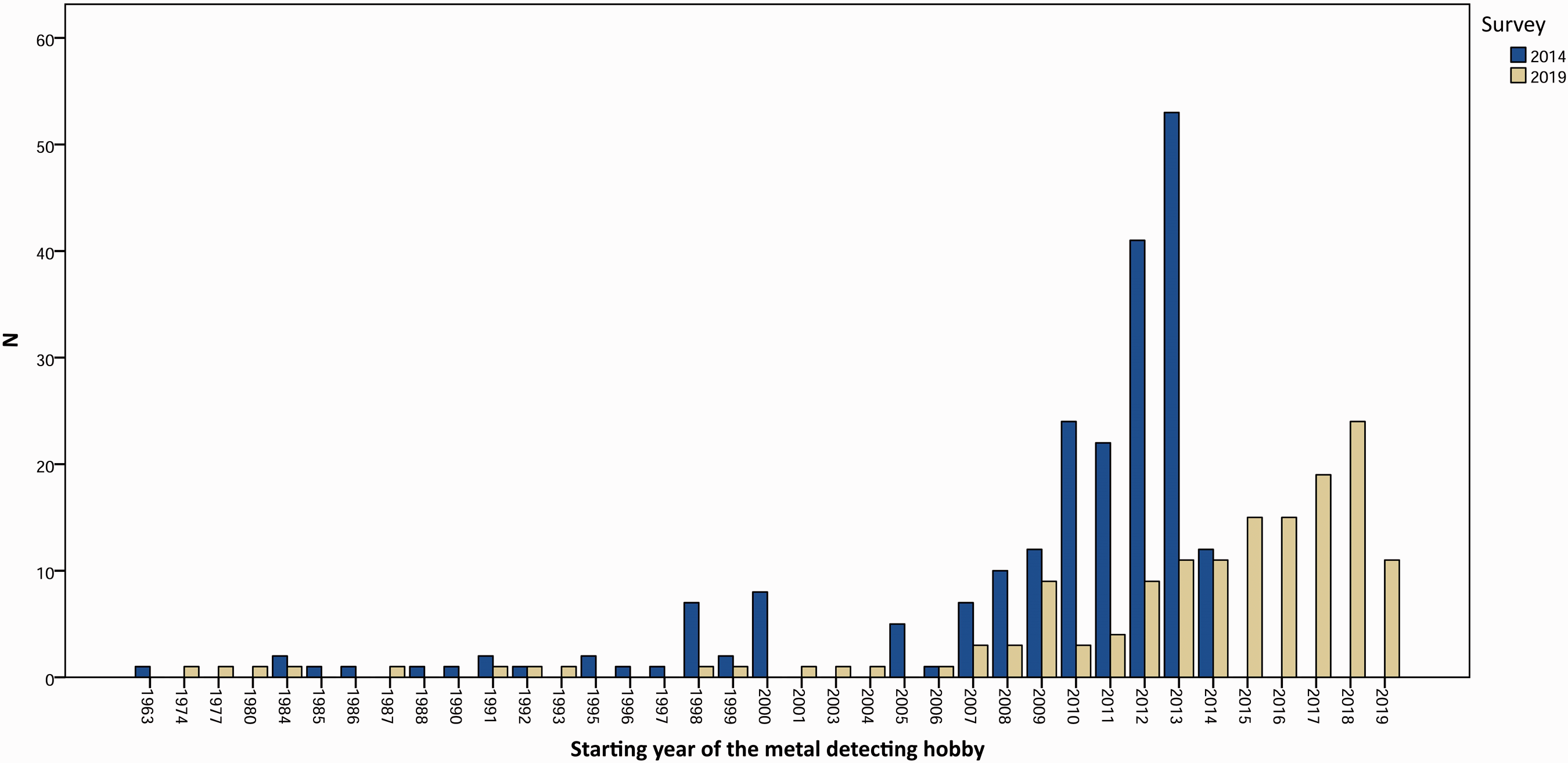
The year when the respondents began their hobby, a comparison made between 2014 and 2019. Statistics for the survey years 2014 and 2019 are only for the beginning of the year.
The gender profile of respondents in 2019 was almost the same as it had been five years earlier: nearly all metal detectorists were male. Although the proportion of women among the 2019 respondents was larger than in 2014, this change is not statistically significant (p = 0.139). Another similarity between the two surveys is the high proportion of middle-aged amateurs (Table 1), although in 2019, respondents were, on average, older than respondents in 2014 (p = 0.002; cross-tabulation and chi-square test). It therefore appears that many young people had dropped out from the hobby (Figure 2).
The age distribution of the respondents in the 2019 and 2014 surveys.

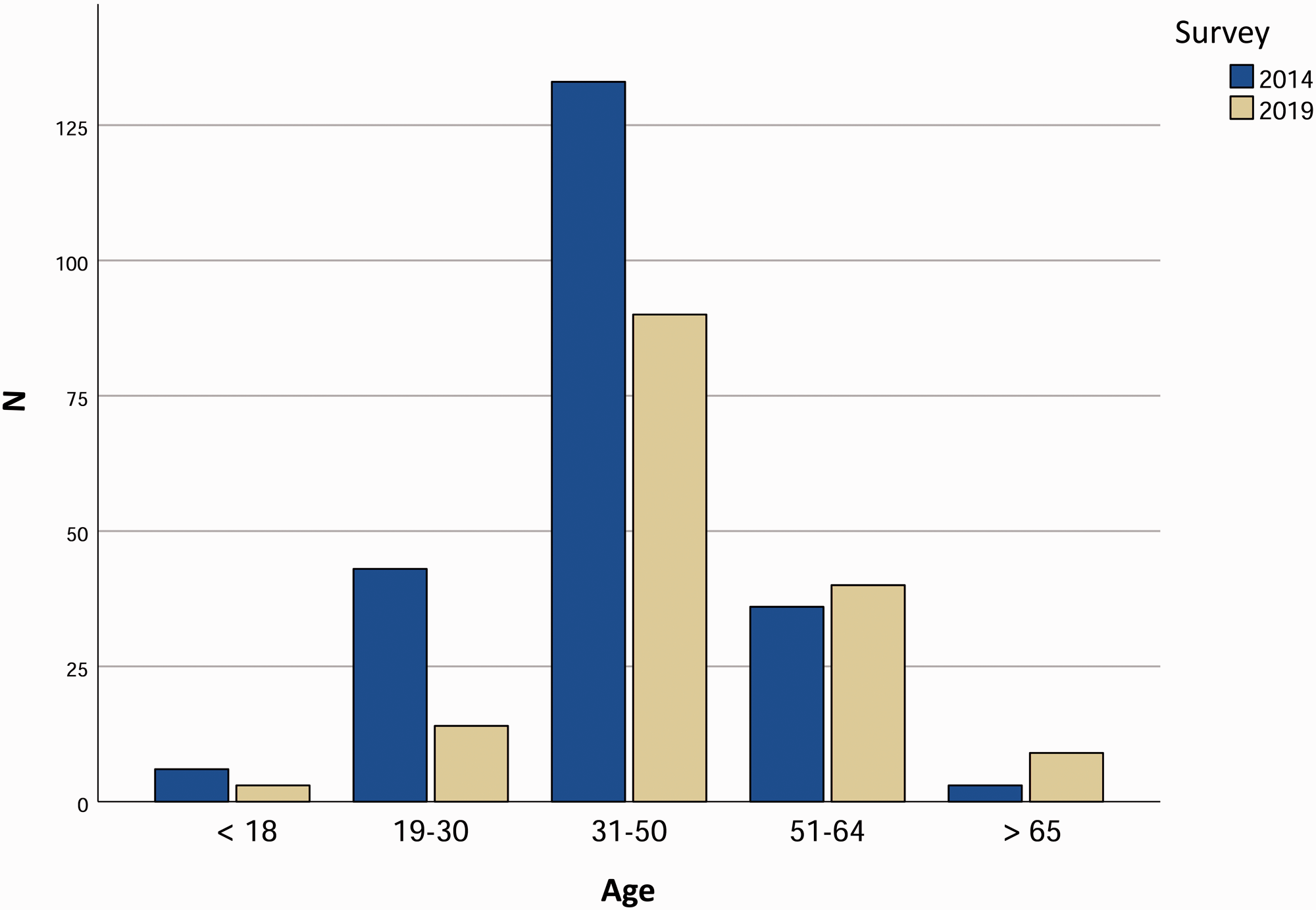
The relative age distribution of respondents in 2014 and 2019.
Despite the change in the age distribution of the hobbyists, the amateurs’ interests and motivations were much the same as five years earlier. When they were asked what they were searching for, the responses were, in rank order, coins, historically valuable objects and ‘anything’. The locations where amateurs used their devices were the same as in 2014; most were easily accessible places near their homes and sites still being actively used or known to have a long history of use by metal detectorists. As in 2014, more than half of the amateurs carried out detecting alone or with a friend, rather than in large groups.
The actual profile of a typical amateur can be compared with how amateurs are generally perceived by professional metal detectorists. In parallel with the amateur survey, we conducted targeted surveys among heritage professionals in 2014 and 2019, charting their attitudes towards metal detecting and amateurs. In the 2019 survey, the respondents found the hobby to be somewhat useful (mean 3.27, scale 1–5), although several of them considered it to be very or rather harmful. The impact of the hobby on the protection of heritage was seen to be slightly negative (mean 2.78), while its effect on research was perceived to be somewhat useful (average 3.33). There were also some who thought the hobby to be particularly harmful.
According to professionals, the biggest problem with the amateurs is that they act recklessly, whereas most hobbyists claim that they act responsibly. Moreover, in their view, many amateurs do not consider heritage institutions as an absolute authority, but rather as service providers: museums help in identifying the finds and reward the best ones by putting them on display. Here the amateurs would be following the logic of customer-oriented services and the market economy. The discrepancy between the views of the two groups seems to highlight the difference between work and leisure, and understanding their relationship requires a broader conception of the nature of hobbies.
Developments in the amateur metal detecting community
Although the size and social backgrounds of the amateur group remained roughly the same between 2014 and 2019, an internal change had taken place. A core of highly dedicated hobbyists had emerged in contrast to less devoted and casual experimenters. At the same time, the amateurs estimated their skills in recognising finds to be better in 2019 than five years earlier (Table 2), and on average a little more money had been spent on hardware (p = 0.019), which may be explained by a cumulative effect: those who had been on the scene longer replaced older equipment with new devices and were willing to invest more in them. Increased internal differentiation, know-how and investments are indicators that after the boom years of the mid-2010s, dedicated amateurs remained, while those with more fleeting interests kept entering and exiting the hobby. Consequently, in responding to the 2014 survey, those who had recently taken up the hobby had an emphasized role, significantly lowering average results. In the 2019 survey, in contrast, responses from less-motivated amateurs were more muted (Figure 3).
Key statistics regarding the respondents’ opinions, and their changes between 2014 and 2019.
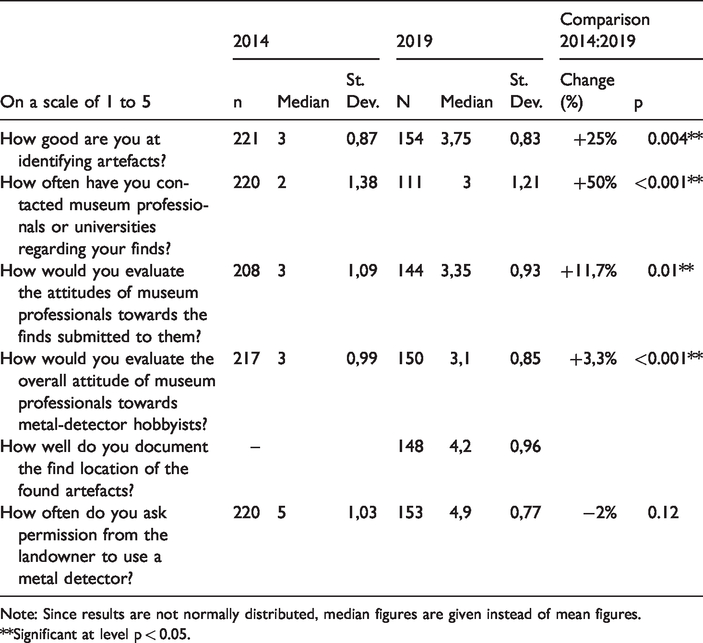
Note: Since results are not normally distributed, median figures are given instead of mean figures.
**Significant at level p < 0.05.
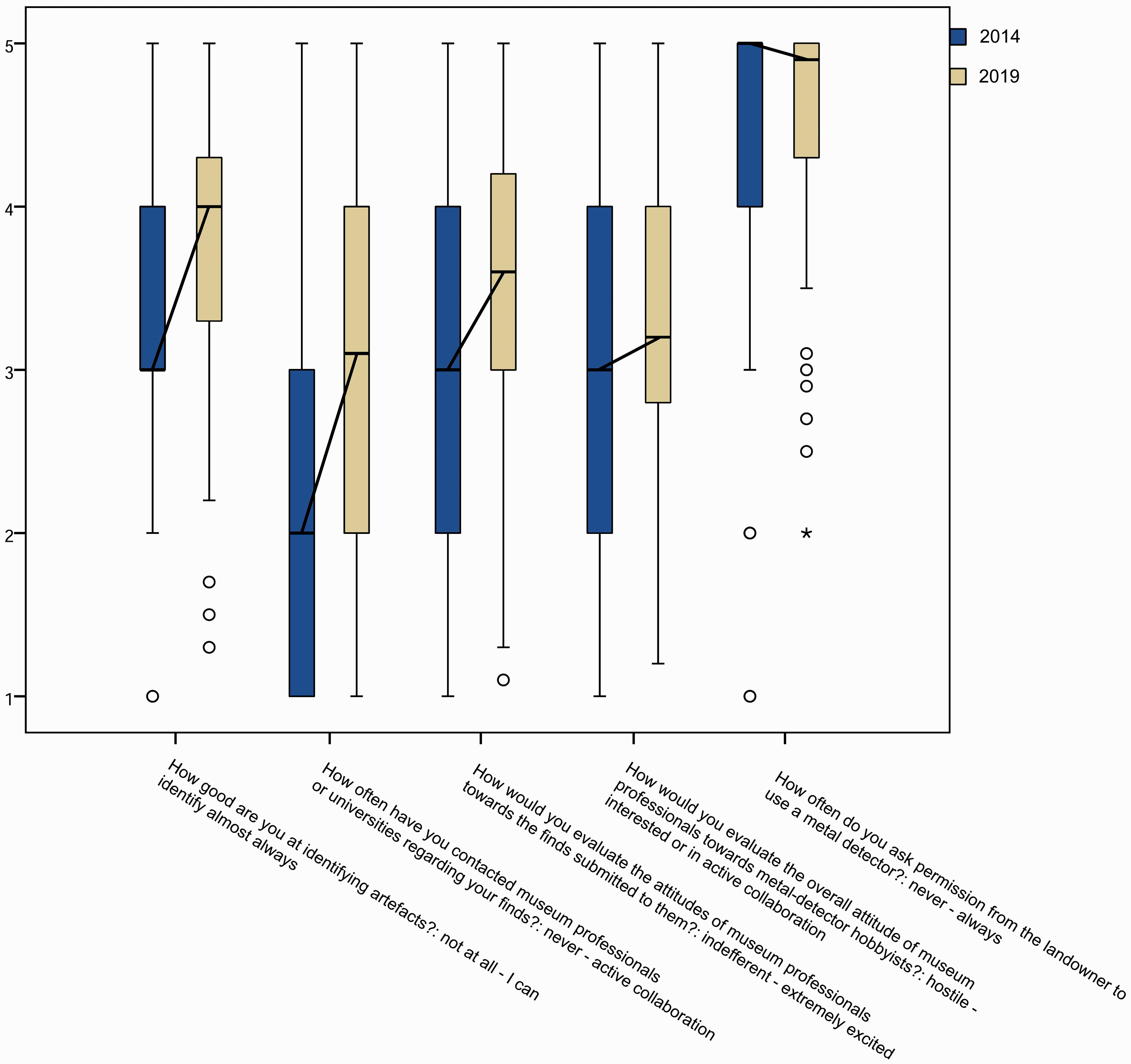
A comparison of the 2014 and 2019 survey results shows how the attitudes and behaviour of the hobbyists have changed in five years.
When the 2014 survey was conducted, archaeologists and media paid a significant amount of attention to the illicit destruction of ancient sites. Nonetheless, there were only three respondents who reported that they had intentionally violated the Antiquities Act. There were no such perpetrators in the 2019 responses and even the proportion of those who had heard of such acts had fallen by more than 10%. The conclusion is further supported by Päivi Maaranen’s (2018: 20, 24) statistics on the violations of archaeological sites in Finland in 2010–2017, which show that an exceptionally high number of transgressions caused by metal detectorists took place in 2014 and 2015. There nevertheless remains the possibility that illicit acts are unintentional (Immonen and Kinnunen, 2014: 113) and thus the decline in misconduct in 2019 compared with the 2014 survey could be explained by the decrease in the proportion of new and ignorant hobbyists and the FHA’s new efforts to educate amateur metal detectorists.
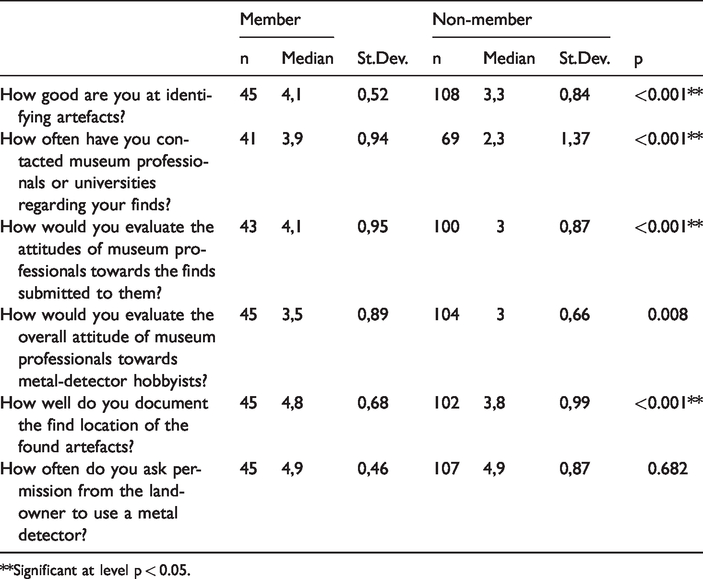
Illicit acts have diminished, or at least have become more differentiated among amateurs, and this change may be related to a change in the relationship between amateurs and professionals. The degree of communication between the two groups proved to be the largest difference between the 2014 and 2019 surveys. This had clearly increased (p < 0.001) (Mann-Whitney U test; Shapiro-Wilk < 0.001). In 2014, the median activity on a scale of 1–5 was 2, but in 2019 it was 3. On the other hand, a surprisingly high proportion (28.8% of respondents) failed to answer this question in the 2019 survey, but it is impossible to determine why. The vast majority of those who did not respond, however, were not members of registered detectorist associations (Table 3).
The impact of membership on the survey. Key statistics.
**Significant at level p < 0.05.
In 2019, 29% of the respondents were members of some amateur organization. Survey responses indicate that the first two years of detecting are spent getting to know the hobby, after which enthusiasm to join a registered association grows (Figure 4): two-thirds or more of those who started in 2009–2015 were members of an amateur organization in 2019. Moreover, membership in an association and participation in metal detector events have a positive effect on, among other things, skill in identifying finds (p < 0.001), recording the find-spot (p < 0.001) and, above all, enthusiasm for contacting museums (p < 0.001) (Figure 5, Table 3).
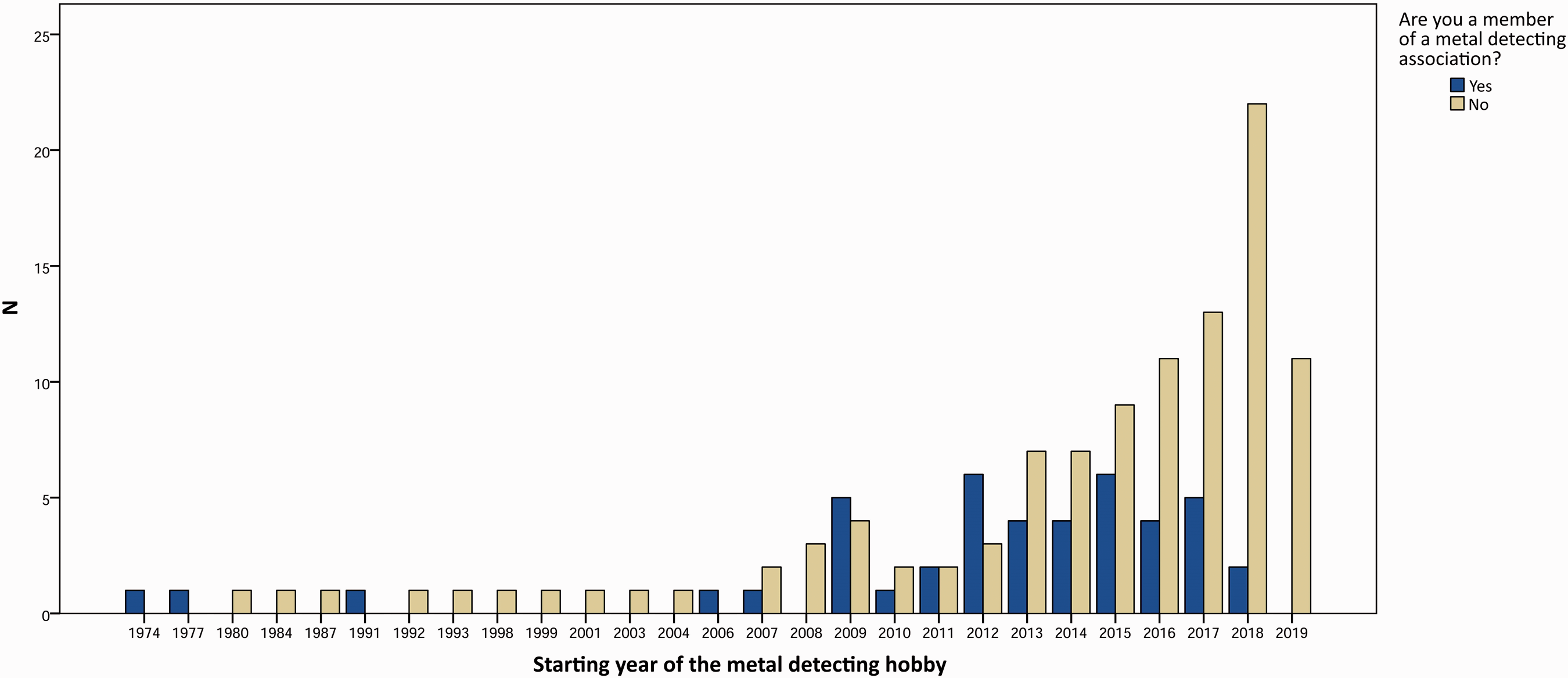
The year when the respondent began to use a detector in comparison with their membership in an amateur organization.
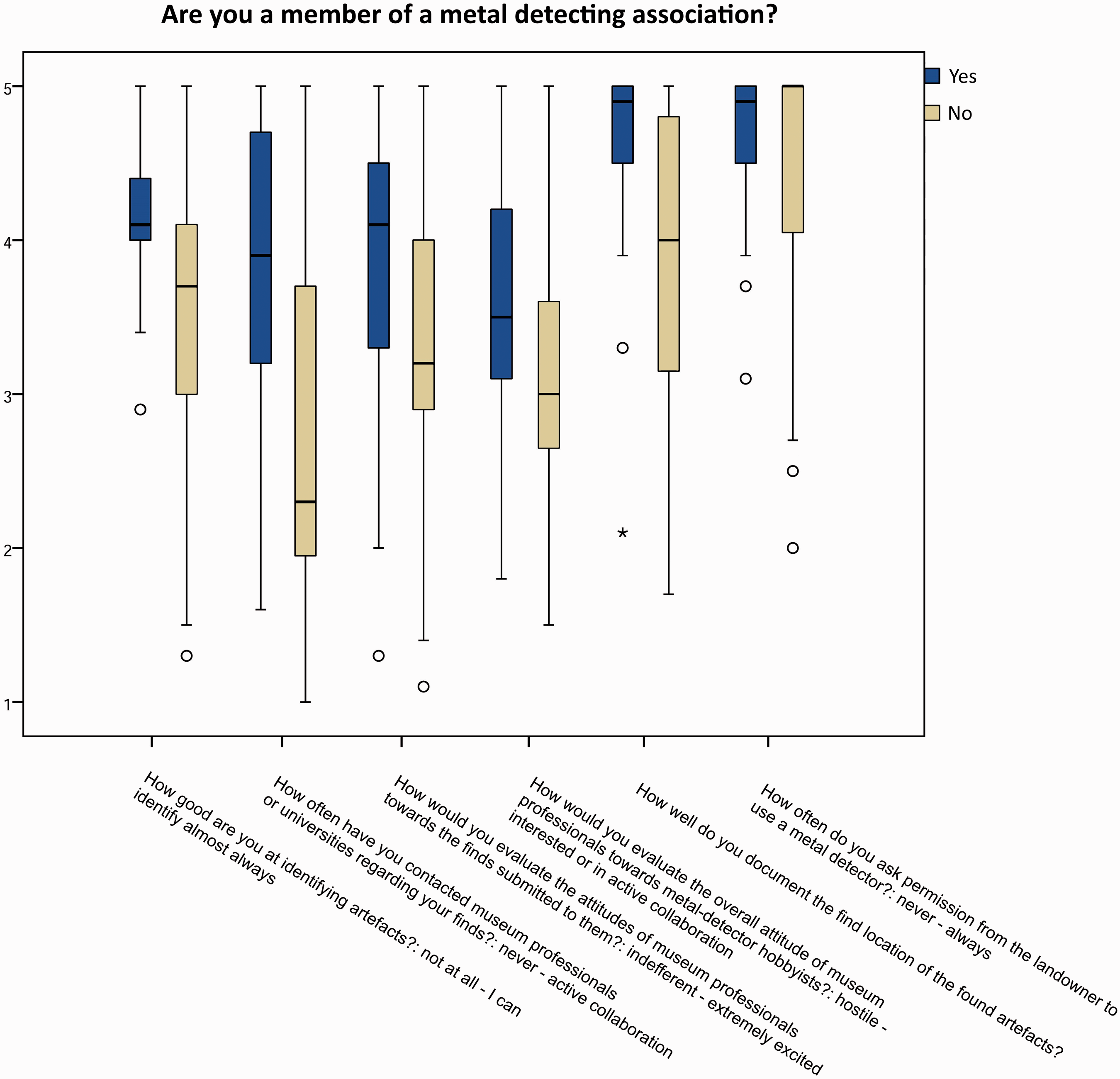
The impact of membership in an amateur organization on other replies in the survey.
The survey also distinguished a group that has been neglected in scholarly discussions. Among the respondents it was possible to identify those who neither participated in any events organized by registered associations nor were in contact with museums, and always used their detectors alone. Such persons, without any contacts with heritage institutions or other amateurs, aside from online contact, can be termed ‘hermits’. A total of 18% of the respondents can be placed in this category. They form a group that does not fit into the established heritage discourse that guides scholarly and administrative actions, and classes amateurs as either good or bad. The hermits are not defined by their effects on heritage administration, but rather by their inclination to avoid contact with others.
Media interest in the hobby still continued in 2019, but a large number of the discoveries that are publicized are made by amateurs active in registered associations. Another change is a shift in communication from dedicated internet forums to social media platforms. In the 2010s, the most important channel for Finnish hobbyists was the aarremaanalla.com discussion site, but its use has waned. We analysed its messaging activity from January 2007 to July 2019. 2 On the basis of our statistics, the site had its most active period in May 2014, after which its popularity has constantly declined (Figure 6). It is likely that communication between amateurs has moved to a Facebook group with the same name, regional Facebook groups and YouTube. As communications concentrate on social media platforms, messaging has also become more private, for example in WhatsApp groups. It may be that after the boom years and the founding of registered associations, the need to establish contacts online with the whole amateur community has declined.
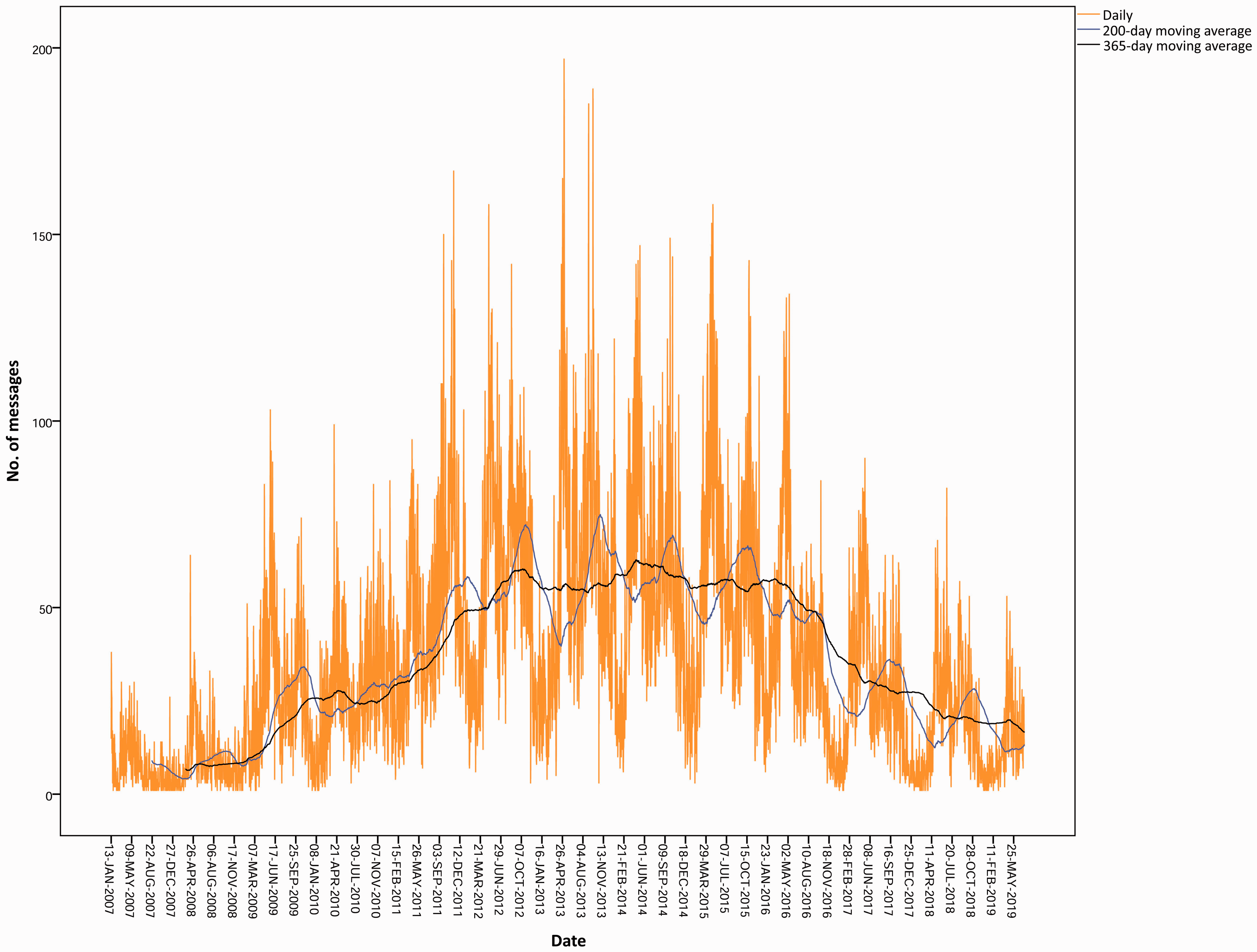
The number of visitors at aarremaanalla.com from 2007 to 2019. The graph indicates the number of daily messages with a 200-day moving average (MA) and a 365-day MA. The 200-day MA shows the annual cyclicality of communication as messages focus mostly on summer months, while the 365-day MA shows a general trend in communication activity according to which the site is losing its relevance.
The popularity of metal detecting can be expressed using the Gartner Hype Cycle, a model that describes how emerging technologies are adopted (e.g. Collar et al., 2015: 2; Linden and Fenn, 2003: 5). A peak in the hype cycle is usually followed by a collapse which then stabilizes and reaches ‘the Plateau of Productivity’. On the basis of our two surveys, the hobby peaked in Finland around 2014, and by 2019 it had shifted to the mature phase. This is manifested in the differentiation among the amateurs, the most dedicated of whom were behaving with growing confidence. One indicator of this has been their increased investment in equipment and time on fieldwork. Another sign is their tendency to interact with professionals with more confidence. In addition, although membership in registered associations was not measured in the 2014 survey, the importance of amateur organizations has grown, as have their networks of communication, education and social control. Metal detecting has become more integrated into civil society, but certain tensions still remain.
Hobbies as a social formation
Metal detecting as a hobby shares certain social and cultural factors with other hobbies. Tracing these similarities and differences enables one to construct a picture of metal detecting as a social formation. Here, the ‘serious leisure perspective’ proposed by Stebbins (2007) can be of help. Ferguson (2013) uses the concept of ‘serious leisure’ to bring out certain features of the hobby, such as the experience of reward and joy combined with social belonging but also the requirements of effort, time and endurance. She especially points out the unique ethos, or sub-culture, typical of ‘serious leisure’. The strong sense of identity, which establishes ‘serious leisure’ hobbies, can be seen when differences in the methods and aims of amateurs and archaeologists create tensions in their cooperation (Ferguson, 2013).
The ‘serious leisure perspective’ describes not only one form of leisure, but in fact forms a theoretical framework, including, in addition to ‘serious leisure’, ‘casual leisure’ and ‘project-based leisure’. The three forms of leisure have distinctive features and forge particular social relationships (Stebbins, 2007), allowing us to characterize the metal detecting hobby not only of those who are heavily involved in the pursuit, but also of those who take part occasionally and without any clearly defined aims. For some, metal detecting is ‘serious leisure’, while for others it is ‘casual leisure’, and as the hobby has become more mature, differences between the two have become more notable.
Despite its usefulness, Stebbins’s framework has problems in connecting with broader cultural and social structures. He describes a hobby as a leisure pursuit that ‘bears no resemblance to ordinary working roles’ (Stebbins, 1992: 10). Steven M Gelber (1999) argues, instead, that leisure and work are not mutually exclusive but establish rather an ideological arrangement supporting the capitalist labour system. Although they might appear as opposites, leisure ultimately reflects the logic of work, and hobbies have emerged as a way to integrate the isolated home environment with the ideology of the workplace. Metal detecting in its serious leisure form displays many such commonalities. The strong, work ethos-like commitment to metal detecting, advancement in one’s career as a hobbyist by upgrading equipment and accumulating know-how, and self-organization into registered associations can be seen as principles shared with working life. Such arrangements confirm the reality of work within the domestic realm and reproduce the structure of society in the mode of capitalist labour within both spheres.
Metal detecting is a form of labour without pay, emphasised by the nearly absent trade in illicit antiquities in Finland and the limited financial compensation given to the finders. However, the competition between amateurs in discovering the oldest and rarest finds seems to be based on the logic of amassing social capital, and in such a competition, media attention and recognition by archaeologists are valued. Moreover, the emergence of registered associations can partly be explained by competition between amateurs, because being a member of a registered association or informal group grants an access to a pool of know-how which gives an advantage in pursuing the hobby.
Metal detecting forms part of the historical development of leisure in Finland. In fact, the first experiments with metal detectors occurred in parallel with significant changes in society after the Second World War. The country was transformed into an urban consumer society (Heinonen, 2013: 15). While the post-war reconstruction period meant heavy investments in labour, it also resulted in the creation of a welfare state, decreased working hours and the equivalent increase in leisure time and consumption. Much of the rise in private income was channelled into hobbies (Peltonen and Heinonen, 2013). The modernization of post-war Finland also altered norms of communality, shifting the focus of its social life from that of an agrarian society to one experienced through consumption and leisure activities, opening up new spaces, activities and events for establishing social ties. The prominence of civil society came to be expressed in an unusually high number of registered associations (Siisiäinen, 1999: 113), and it is typical that people active in registered associations are involved in many at the same time.
In addition to the development of Finnish society, metal detecting displays structural affinities with other hobbies. In particular, it can be compared with two major, typically Finnish hobbies. The first is fishing, which is statistically the most popular hobby in the country (Peltonen and Heinonen, 2013: 255–256). Taking up fishing does not require any major investments or technical skill, although there is in theory no limit to one’s expending in equipment and fishing expeditions. As an outdoor activity, fishing can be practised in summer or winter (if necessary, through a hole in the ice). It can be pursued alone or in small groups, or as part of competitions arranged for hundreds or even thousands of participants at a time. The second most popular form of leisure activity in Finland, especially among the so-called boomer generation, is to spend time at summer cottages. These are places away from home but still home-like, considered to be more primitive and closer to nature. In addition to other similarities, gender roles within the hobbies of fishing and summer cottage use resemble the profile of metal detecting, as all these activities are considered harder and technical outdoor pursuits, which, like certain games and DIY, tend to be favoured by males (Peltonen and Heinonen, 2013).
Analysing metal detecting as a social formation shows that it is not only an international phenomenon, but is partly made possible and conditioned by the development of Finnish society. Consequently, it should be seen in relation to other hobbies which, in turn, are intertwined with historically layered civil society. In terms of the DIY skills, gender roles, outdoor activities and social flexibility involved, metal detecting resembles fishing and spending time at a summer cottage. This is emphasised by the amateurs’ conceptualisation of heritage institutions as service providers: a matter of leisure. In spite of these similarities between metal detecting and other hobbies, this comparison also highlights the distinguishing feature of metal detecting: it creates a particular relationship with heritage. A conception of heritage focused on sites and objects, however, does not adequately capture all the social implications of metal detecting when considered as a social formation. A broader conception is required, and here the idea of cultural sustainability can be helpful.
Towards cultural sustainability
At the core of the concept of cultural sustainability are processes through which people give continuity to tangible and intangible traditions over time by absorbing, creating, transforming and modifying them (Lane, 2015). The key issue is how change is possible without threatening continuity, while at the same time promoting cultural engagement and sharing (Soini and Birkeland, 2014: 217). Strengthening cultural sustainability supports the transformative power of human communities (Bushell, 2015: 492–506), and in this framework heritage is not so much a collection of sites and objects as something that is both affected by and supports material, cultural and social change. We argue that it is crucial to take this cultural sustainability into consideration when the ongoing social interactions between different groups in metal detecting are analysed and developed.
Cultural sustainability refers to the continuity of social action and thought – both tangible and intangible. Accordingly, its analysis should include relationships between amateurs, local communities and heritage professionals, and the practices of different groups within and between groups (Lane, 2015: 260). Such a broad basis also serves the interests of archaeology better since the cultural sustainability of heritage practices can only be assessed on the basis of their long-term effects (Albert, 2015). Even if a number of sites and objects could be protected at a given time, this would not guarantee the preservation of archaeological heritage unless culturally sustainable structures and practices that promote heritage protection are created in collaboration with local communities (e.g. Boccardi, 2015).
An example of policies aiming at cultural sustainability is the Council of Europe Framework Convention on the Value of Cultural Heritage for Society, or the Faro Convention. It promotes a very broad understanding of heritage and encourages all citizens to participate in its identification, study, interpretation, protection, conservation and presentation (Salmela et al., 2014). Such goals should also be included in the analysis of metal detecting, since culture becomes heritage when a community, such as hobbyists, consider it important, shared and part of their future.
In addition to cultural sustainability, community archaeology, public archaeology, citizen science and crowdsourcing have reinforced interest in engaging amateurs in archaeological work (e.g. Soininen, 2018). Citizen science, in particular, is a concept that has attracted a lot of public attention in Finland, and like registered associations, it has a strong link with Finnish civil society. According to public surveys, sciences are highly valued in the country, and many people outside academia show their willingness to take part in scientific endeavours (Kiljunen, 2019: 38). In the 2014 and 2019 surveys, the responses of metal detectorists evinced their strong interest in history and heritage as well as a desire to advance research. They have adopted an ethos of citizen science, including the desire to collect and process research materials.
According to the 2019 survey, when the professionals engaged with the amateurs, it was primarily through lecturing or coordinating lectures. A quarter of the respondents had organized a research project with amateurs, but with the number of projects remaining small or at least moderate when compared to the enthusiasm expressed by the amateurs to participate in archaeological research. Archaeologists continue to list education and instruction as their most important ways to affect the amateur community, and this educational stance is also reflected in many development projects. They are based not so much on interaction as on one-way communication, either from professionals to amateurs (education) or from amateurs to professionals (data collection). In situations such as excavations and other forms of fieldwork, communication is of a more binary nature, and thus the principles of cultural sustainability – community, diversity and continuity – become better implemented. Such occasions create and reinforce shared meanings and values that are central to the preservation of heritage. The lack of joint field projects with both professionals and amateurs is not necessarily a problem but still a symptom of the principles of cultural sustainability not being fully realized.
Heritage, sustainability and metal detectors
We have approached metal detecting as a social formation with economic, political and ideological significance and ties to the surrounding society. In addition, the hobby has been linked to developments on both national and global levels. Consequently, in spite of the hobby’s boom being part of an international rise in metal detecting, the analysis remains sensitive to historical developments in Finland, especially the emergence of the prosperous welfare state with a great deal of leisure time and a strong civil society. They form the concrete economic, political and ideological framework for the hobby. Metal detecting has affinities with other popular pastimes in Finland: fishing and spending time at summer cottages. These activities all contain a similarly gendered profile and are geared towards the ideals of self-sufficiency and DIY. Even the age profiles of summer cottage ownership and metal detecting appear to converge.
Metal detectorists have evolved into an amateur group with its own characteristics, traditions and attitudes – it is a subculture with a distinct heritage identity, i.e. many define their hobby in terms of heritage and heritage institutions. For some, metal detecting is a casual pursuit, while for others it is ‘serious leisure’ with a competitive component and work ethos, which is also reflected in the assumption that heritage management should act as a customer service provider. Nevertheless, the hobby is still relatively young and in the process of seeking established forms of practice, such as registered associations, and forms of communication. As a result, the hobby could still undergo rapid transformations and redefine its position in the field of heritage and its relations with Finnish heritage management.
Since metal detecting is legal in Finland and has the potential to promote archaeology and heritage work, the focus of most recent discussions on the hobby has shifted to a consideration of how its benefits can be supported and the negative aspects minimized. Archaeologists have established contacts with amateurs, sharing information on good practices, assisting in identifying finds and including hobbyists in archaeological projects (e.g. Siltainsuu and Wessman, 2014; Wessman et al., 2016). From an archaeological perspective, engaging amateurs in archaeological research and heritage work contributes to culturally sustainable preservation (e.g. Moilanen, 2015). However, looking at metal detecting solely from the point of view of archaeology and administration remains problematic, since the approach disregards the full social and cultural complexity of the hobby. The amateurs have developed a strong heritage identity, while the relationship between professionals and hobbyists has not yet achieved the ideals of cultural sustainability: communality, interaction and sharing.
Approaching metal detecting as a social formation has trans-national value: it facilitates detailed and contextualised comparisons between nationally delineated systems with varying social settings and cultural values. In Finland, civil society has been pivotal in establishing the social conditions for the hobby’s development and has also provided the framework for its cultural sustainability. In other parts of the world, by contrast, the elements of cultural sustainability might unfold differently, also affecting the evolution of the hobby and the type of practices and attitudes formulated by amateurs. Moreover, our social formation approach identifies differentiations among amateurs on the basis of their dedication and social contacts, and reveals the logic of work and the market economy that condition the hobby of metal detecting, even if this does not involve wage labour and significant financial transactions.
Footnotes
Declaration of conflicting interests
The author(s) declared no potential conflicts of interest with respect to the research, authorship, and/or publication of this article.
Funding
The author(s) received no financial support for the research, authorship, and/or publication of this article.