




Abstract
This article assesses the role of the pre-modern past in the construction of political identities relating to the UK’s membership in the European Union by examining how materials and ideas from Iron Age to Early Medieval Britain and Europe were leveraged by those who discussed the topic of Brexit in over 1.4 million messages published in dedicated Facebook pages. Through a combination of data-intensive and qualitative investigations of textual data, we identify the ‘heritages’ invoked in support of pro- or anti-Brexit sentiments. We show how these heritages are centred around myths of origins, resistance and collapse that incorporate tensions and binary divisions. We highlight the strong influence of past expert practices in shaping such deeply entrenched dualistic thinking and reflect over the longue durée agency of heritage expertise. This is the first systematic study of public perceptions and experience of the past in contemporary society undertaken through digital heritage research fuelled by big data. As such, the article contributes novel methodological approaches and substantially advances theory in cultural heritage studies. It is also the first published work to analyse the role of heritage in the construction of political identities in relation to Brexit via extensive social research.
Introduction
Research aims
On 23 June 2016, British citizens were called to cast their vote on the subject of the UK’s membership in the European Union (EU) through a referendum that had a remarkable turnout of 72 per cent of the total electorate (Electoral Commission, 2016; see also Gardner, 2017; Schlanger, 2017 for more discussion on the context of the referendum and its impact on higher education and the heritage sector). This voting exercise became the vehicle through which, amongst other things, people expressed their political identities and crafted ‘hoped for’ political futures (Marichal, 2013). As such, it provides a powerful case study to examine the extent to which these identities are tied to the concept of the EU or to alternative polities and underlying ideologies.
The prominent role of the past in processes of identity construction and deconstruction has been documented and discussed in a large corpus of literature concerned with cultural heritage studies (in relation to European identities, see e.g. Carman, 2003; MacDonald, 2012, 2013; Popov and Deák, 2015; Whitehead et al., 2015). However, the ways in which ideas and materials from ancient periods are drawn upon in order to define political selves and negotiate them with others in the public sphere of today’s increasingly Internet-pervaded and networked society remain largely unexplored. Yet, we argue, the pre-modern heritages of Europe should be the subject of further investigation, as they permeate many aspects of our lives (see Alexander et al., 2012; Hall, 2010; Hingley, 2015, 2018 to name but a few examples) and constitute the origin of myth-making practices that are diffused within European territories and often extend to much of the contemporary Western world.
Our article addresses this gap, by assessing how objects, places, practices and people from Iron Age to Early Medieval Britain and Europe (ca. 800 BC–AD 800) were leveraged by those who discussed the topic of Brexit in 364 Facebook pages and a total of over 1.4 million posts, comments and replies published in those pages. We refer to these uses as the ‘heritages’ that lie at the core of pro- or anti-Brexit sentiments, and demonstrate the centrality of narratives of origins, resistance and collapse that are played around tensions between local and global, indigenous and exogenous, insular and multicultural, civilisation and barbarism. We draw on this analysis to show how these binaries are sometimes invoked to uphold opposite positions and highlight the impact of heritage practices from the past in shaping current dualistic thinking.
Investigating experiences of the past: Conceptual framework
The framework supporting this research rests on four main conceptual pillars that have been previously but cursorily outlined in Bonacchi et al. (2016), and which are thus illustrated at greater length in this section. Such pillars constitute the backbone of the project ‘Ancient Identities Today’ (Ancient Identities, 2017a), funded by the Arts and Humanities Research Council and as part of which this study has been undertaken.
First, we are working with an understanding of heritage as the processes and outcomes of using, experiencing and generally relating to the past in the present (Harrison, 2013). This is an interpretation of heritage that cuts across disciplinary boundaries, material and immaterial legacies, human–object relationships, natural and cultural heritage resources, and respects and studies their interlinking and entanglements. Researching contemporary heritages cannot prescind from a joint investigation of the inheritance of objects, places, practices and people from the past, as all or any of these can be more or less consciously encountered, selected, neglected or rehashed, in different ways by different stakeholders, in order to shape our world. Following from our understanding of heritage as process, here we focus on examining how heritage is produced through the act of political activism performed on Facebook. Political activism enacted via social media has been the subject of recent theorisation in the political sciences, with literature usually focusing on assessing the effectiveness of social media to facilitate mobilisation offline (Gerbaudo, 2012; Morozov, 2009; Shirky, 2011; Velasquez and LaRose, 2015). In this article, however, we adopt a less-functionalist approach borrowed from Marichal’s idea of ‘micro-activism’ as the kind of political activism that takes place on social media platforms (Marichal, 2013) and leads to the construction of ‘(hoped for) political identities’, which may or may not result into social change. In line with Marichal’s view of political ‘micro-activism’, we also understand Facebook as the field site from which our investigation departs, as well as a part of the wider public sphere of our society (Habermas, 1997; see also McKee, 2004) – we will then refer to it as ‘Facebooksphere’.
Second, we note the importance of focusing on the longue durée when examining the reception of the past, to better understand the relative values assigned to certain periods and how these are opposed or equalled. This specific approach has been successfully utilised to unpack a number of ‘insistent dualities’ that still inform the ways in which we live the past today (cit. Beard and Henderson, 1999; see Hingley et al., 2018, for a full discussion of this topic).
Third, we recognise the need to investigate the effects that diverse expert practices are having on the construction of specific messages, their circulation, proliferation and ultimate moulding into identities. How heritage values are made and unmade requires research on the politics of expert positions and the extent to which they filter into ‘non-professional’ actors’ lives. The idea of expert practices has been developed in the context of heritage by Jones and Yarrow (2013: 22), to discuss how authenticity is a product of different forms of expertise that interact in the process of preserving the historic environment. The concept is also central to the analysis of the role of what Smith and Waterton (2012: 2) have called Authorised Heritage Discourse (AHD), displayed and communicated by professionals working in the ‘officialdom’ of research, education, museums, sites, archaeological units and libraries.
Fourth, we take a ‘quali-quantitative’ methodological approach, borrowing from the work of Venturini and Latour (2010), who use this label to express the potential of digital methods to suture the division between research on micro- and macro-structures. Such dichotomy was created by traditional researchers in an analogue world but does not exist in reality, since micro-structures and macro-structures ‘are only two different ways of looking at the same collective canvas, like the warp and weft of the social fabric’.
Methodology
Methods and workflows
Our quali-quantitative data collection and analysis began with the ‘navigation’ of big data, characterised by sheer volume, velocity, variety, variability and flexibility, by exhaustive scope, fine-grained resolution and relational nature (Kitchin, 2013, 2014).
In undertaking this research, we have been confronted with the need to delve in ‘big data’ using automated approaches in order to identify Facebook pages about Brexit, but the information contained in these pages and featuring ideas about the past did not possess some of the features described by Kitchin (2013, see above). Its volume and velocity, for instance, were not very large, albeit probably greater than in most heritage studies conducted to date. Data-intensive methods were thus used primarily as means of exploring Facebook as a field of ethnographic investigation in a non-traditional but nevertheless fully immersive manner (Hine, 2015). It is this immersive and exploratory character that defines the data-intensive approaches we have used as (unconventionally) ethnographic.
Amongst social media, we chose Facebook due to its popularity across different socio-demographics (Velasquez and LaRose, 2015), and for the richness of its data and metadata (e.g. compared to Twitter). An additional reason was that this social medium allows users to set up public pages to host discussions on specific themes and lets researchers extract their content through its Application Programming Interface (API). Furthermore, according to a recent report, ‘approximately 63% of [Facebook] users acquire their news from social media, and these news stories undergo the same popularity dynamics as other forms of online contents’ (cit. in Del Vicario et al., 2017). Facebook, thus, provides an ideal space for studying the rehashing of ideas by stakeholders and their circulation across media and platforms. As part of our ethics statement, we note that pages and messages – including posts, comments and replies – were accessed via the Facebook API, and mined with R software.
Over the months of March and April 2017, we extracted the content of public Facebook pages featuring the word Brexit in their title or description and containing posts, comments or replies published from 6 May 2010 to 30 April 2017 (Table 1, online Appendix). 6 May 2010 was the day of the General Election that led to the establishment of the Coalition government, during which the option of a possible referendum on the UK’s membership in the EU was first proposed. We used a set of 569 period-specific keywords relating to Iron Age, Roman and Early Medieval places and people of Britain, in order to locate messages that would be likely to reference the aforementioned pasts in the context of Brexit. These keywords included the names of Iron Age tribes and chiefs, Roman emperors and Anglo-Saxon kings, Roman towns, Iron Age and Anglo-Saxon settlements in Britain, as well as general terms describing the period from 800 BC to AD 800. A full list of the keywords that were used is made available online (Ancient Identities, 2017b) and was compiled via desktop research and vetted through history and archaeology handbooks and listings of sites provided by heritage organisations such as English Heritage, Historic Scotland and Cadw. The posts, comments and replies identified in this way were then verified manually.
In the first phase of the analysis, we examined the metadata of the 364 Facebook pages about Brexit that had been previously extracted, to understand the motivations behind their set up and the context of their use; this metadata consisted of ID (unique numeric value), About (short introduction), Category, Description, General Info, Likes, Link (associated with the page), City, State, Country, Latitude, Longitude, Name, Talking About, Username and Website. Subsequently, we created a corpus composed of all the posts, comments and replies from the 364 Facebook pages and performed topic modelling to uncover the hidden thematic structure of the corpus. This method has been successfully employed before to map out the content of large collections of documents, including historical sources (Newman and Block, 2006; Yang et al., 2011), social media interactions (e.g. Marwick, 2013) or scholarly blogging platforms (Puschmann and Bastos, 2015), without using a priori categories. In particular, we applied Latent Dirichlet Allocation (LDA), a popular probabilistic topic modelling algorithm that, for each of a pre-determined and optimal number of topics, outputs a set of words accompanied by values that represent the probability of each word to be associated with the given topic (Blei et al., 2010, 2003). The model was executed using the Python Natural Language Toolkit and Gensim library (Rehurek and Sojka, 2010), and the optimal number of topics was estimated to be 25 by calculating topic coherence scores as described in Röder et al. (2015). Topics were labelled independently by the authors and then discussed and agreed; each label was assigned so that it would describe the overall association of the 20 terms with the highest probability scores.
We repeated topic modelling on the subset of data containing the 569 period-specific keywords (also referred to as ‘data subset’, from now on) and compared the 21 topics detected in this smaller dataset to the 15 featuring in the Brexit Facebooksphere as a whole. Thereafter, we calculated term frequencies and carried out association analysis (0.30 < coefficient) for the data subset, in order to understand how the past was called upon, which ideas were recurring more frequently and any related concepts. Messages containing keywords about the Iron Age, Roman and Early Medieval periods were not posted by a handful of individuals and the great majority of posters were ‘mono-posters’ (2528 messages with past specific keywords were written by 1909 users). Most users posted only one message, while 279 users posted more than one message and only 26 more than five messages. We also discovered that most messages were posted only once, with only 86 out of 2528 messages posted more than once and up to 15 times (in one case only). Given the low number of multi-posters and multi-posted messages and their minimal impact on the analysis, no filters were applied to account for them.
Finally, we undertook qualitative analysis to gain in-depth knowledge of relevant messages and the influence of heritage expert practices on the discussion. All the messages containing the most recurring past-specific terms were examined via close reading. The thematic threads identified in this way (myths) are presented in the ‘Myths and dualities’ section and exemplified via relevant extracts chosen for their significance. These extracts have been contextualised as much as possible, with information about the author, the page where they were posted and the thread to which they belonged (if any). Deeper grounding could only be provided through further and smaller scale investigations such as posting an anonymous survey on all or a sample of the Facebook pages, or conducting offline ethnographic research with the Brexit-related groups that have a presence beyond the Facebooksphere; this work, however, transcends the scope of this paper and the space allowed, thus we aim to integrate it in future. 1
The Brexit Facebooksphere: Context of study
We worked to characterise the Brexit Facebooksphere by investigating how and why this space was set up by collectives and individuals. Half of the pages were created by groups already established offline and variously built around shared place, party, institutional affiliation, job, related interests, social concerns, nationality and voting preference (Table 2, online Appendix). The majority of these groups were based in Britain and this fact, together with the languages used to communicate (Table 3, online Appendix), suggests interactions involving primarily – although not exclusively – UK-based social actors. Additionally, it indicates that, for the most part, the Facebooksphere of Brexit was tightly connected with mobilisation undertaken offline. Since Facebook-enabled and in-person activism seem to be interlinked, there might be continuity in the ways in which the past is leveraged and heritage is produced within and beyond Facebook pages. This is not to say that this analysis is formally representative of the ‘population’ of activists involved in Brexit referendum discussions, but that some of the repertoires that we will examine are certainly not confined to social media; rather, they are variously embedded in the cultures of some of the communities located in the four UK countries of England, Scotland, Wales and Northern Ireland.
Based on the qualitative analysis of the metadata available, we studied the main reasons why individuals and the aforementioned groups created Facebook pages focusing on Brexit (Tables 4 and 5, online Appendix). From these, 67 out of the 209 pages containing messages that featured period-specific keywords were established for the purpose of campaigning for either the Leave or Remain camp, whereas 52 pages intended to provide news without taking sides. Substantially lower is the number of pages that used the Brexit label to brand and market a product, or those that wished to present and debate specific initiatives, provide a space for general discussion or for humour and satire. This motivational horizon shows how the creators of these Facebook pages understood the latter’s role in the construction of political identities. In most cases, Facebook was used to illustrate and support existing ideas and projects; others turned to it to create a genuinely neutral and democratic arena to acquire and respond to any information provided about the referendum and participate in dialogue. The Brexit Facebooksphere thus comprises but does not only consist of pages that are dedicated to host exchanges of views and opinions. This is in line with the general findings of Del Vicario et al. (2017), who studied the interaction of one million Facebook users with Brexit-related posts from January to July 2016, and identified the existence of two distinct and separate groups acting as echo chambers and holding different perceptions of the same topics.
The past in the Brexit Facebooksphere
Topics
The topic modelling of all the messages extracted from Brexit-focused Facebook pages
shows that discussions in the Facebooksphere covered subjects ranging widely from social
welfare to the economy, international relations, mobility, otherness and (in)security;
assessments of the costs and benefits of the referendum; and voting procedures (Figure 1 and Table 6, online
Appendix). Differently, the thematic structure of the period-specific data subset was less
varied and centred on mobility, origins, identity, cultural tension, security and
nationalism (Figure 2 and Table 7,
online Appendix). LDA visualisation of the posts, comments and replies extracted from the 364
Facebook pages containing the term ‘Brexit’ in their title or description. Terms on
the right-hand side relate to the selected topic. For an interactive version of this
Figure, see the online Appendix. LDA visualisation of the posts, comments and replies extracted from the 364
Facebook pages containing the term ‘Brexit’ in their title or description and which
also feature our chosen period-specific keywords. Terms on the right-hand side
relate to the selected topic. For an interactive version of this Figure, see the
online Appendix.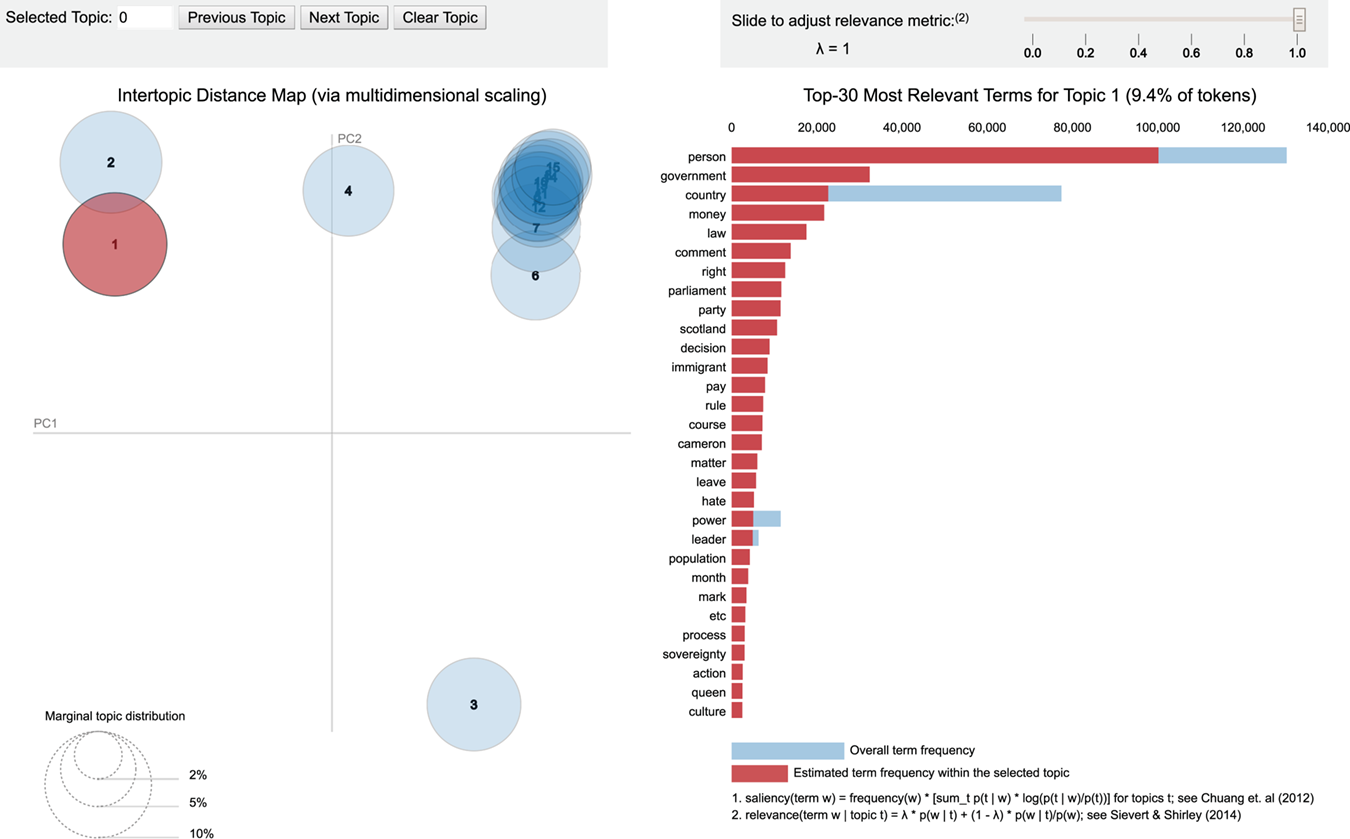
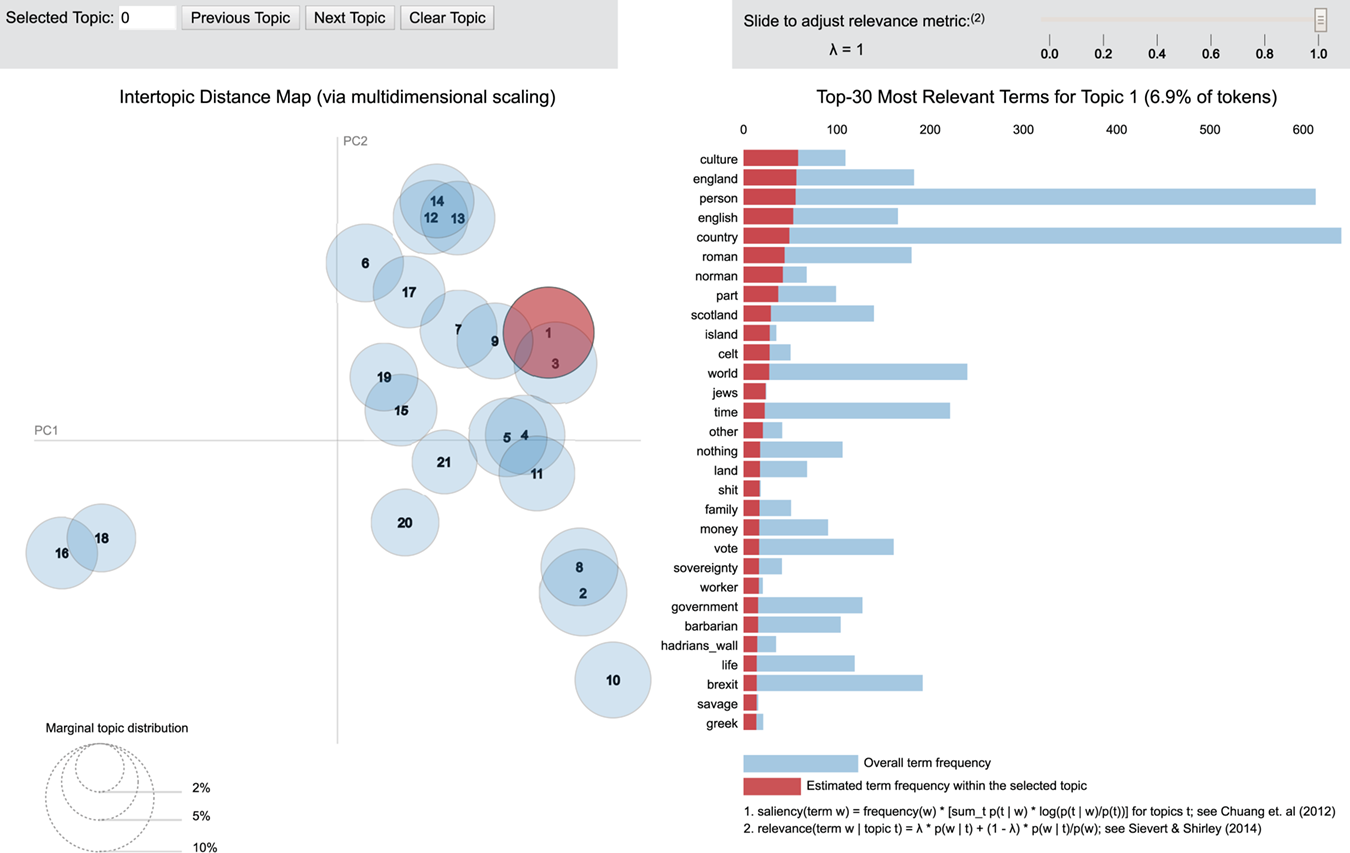
The past was leveraged in relation to certain issues more than others, and especially to the movement of people, their subsequent interactions and the threats and opportunities caused by these dynamics in terms of identity and law and order. Mobility is the thematic origin and trigger of the heritages of Brexit and one of the contemporary issues to which Western societies relate by drawing upon the past (see also Hingley et al., 2018).
Amongst the keywords that were used, the ones recurring more frequently in the data subset of 2529 posts, comments and replies are Roman, britannia and barbar (featuring at least 300 times), followed by hadrian (appearing 200 times), and mediev and norman (present 100 times) (Table 8, online Appendix). These results highlight the prominence of ideas related to the Roman period compared to the medieval past. The word Roman, in particular, appeared only once in the majority of messages that contained it (249) and is associated with terms expressing power dynamics (e.g. inferior, superior) or related to mobility and discrimination (e.g. xenofobia, discrimin, racism, jute), militarisation, occupation and resistance (e.g. occupi, soldier, victori, coloni, armi, conquer, defend) (Table 9, online Appendix). Consistently, Britannia is associated with words from the song Rule, Britannia!, which features often in the corpus (Table 9, online Appendix). This is a patriotic song derived from a poem by James Thomson, which was set to music in 1740, and opposes the freedom of Britannia and Britons to the situation of nations governed by envious tyrants. The latter have been interpreted by some as a reference to the absolutism that was still characterising European monarchies in the 18th century, whereas Britain had already curbed royal prerogative and developed a constitutional democracy. Furthermore, according to Armitage (2000: 173), the song was an expression of the ideas behind the British Empire ‘predicated on a mixture of adulterated mercantilism, nationalistic anxiety and libertarian fervour’. Today, most citizens are not perhaps aware of these historical roots, but remain conscious of the strong nationalistic meaning of the song, so that the prominent use of the word Britannia in the context of nationalist hymning can be interpreted as establishing a direct link between the ancient identity of the Roman province and ideas of British imperialism, independence and economic success.
Myths and dualities
In order to more closely qualify how Roman times were called upon, we proceeded with a
qualitative exploration of the subset of data containing the keyword
Roman. This analysis was aimed at exploring the diversity of ways in
which the period under examination was leveraged. The research revealed the centrality and
frequent recurrence of a parallel drawn between the EU and the Roman Empire and of three
main myths, constructed through binaries that, for the most part, contrast the Roman
Empire to other periods and polities. 1. Myths of origin. The first myth of origin leverages the Roman
past along the lines of Kristian Kristiansen’s conceptualisation of European origins
(1996). The narrative is focused on the civilising power of the Roman Empire
(equalled to the EU), invoked within the pro-remain camp to support the UK’s
membership in the EU. For example, a user writes on the pro-leave page ‘Pro Britain’
that: ‘Well, if it wan’t for the Roman empire, you would ve be still barbarians
living in huts, still pillaging between ur selves, still in stone age! You say you
invented the gentleman? That a joke! […]!’
This idea is likely to be originally rooted in academic thinking and literature
pre-dating the post-colonial turn of the 1980–90s (Hingley, 2015) and is refused by those pro-leavers
who stress that the process of Romanisation of Britain, often portrayed as pacific and
beneficial, was actually characterised by violence and oppression. To build this argument,
a user mentions the Roman occupation together with Norman invasions, showing how very
different realities and past situations can be juxtaposed to back narratives that are
already present in the mind of an individual. In particular, he writes the following
sarcastic post, as a reply to a message made public by the pro-remain page ‘Very British
Problems’ on ‘Mayhem government using tried and tested methods to maintain the purity of
Brexit Britain’: Going back to the original post, I love your description of our “cultural enrichment”
at the hands of the Romans and Normans, though I doubt few of the contemporary
inhabitants would have seen it that way. […] first the Romans turn up with some really
nice homemade biccies and a big slice of rape and murder…things pick up a little later
when the Normans arrive with a cheeky red and a nice dose of oppression, whilst
stirring up racial hatred between the Celts and non Celtic people’s that still hasn’t
receded to this day… […] If you’re going to make the case for the EU, it’s probably
best NOT to mention Britain’s history with Europe! She is not british tho she is african british. She is a migrants or the descendent of
a migrant, she has no say on britian. Only the descendent of those who build this
nation up from the fall of the Roman Empire have a say. We are called native
brits. England was a microcosm of Europe even in those early days. Britons were of Greek
descent, Welsh, Irish were also part Greek and Scythian. Scots picts, were remnants of
Scythia, even as their name reads. Danes, Saxons, Normans, Angles, from Germanic
heartlands, and northern Skane naval lands. Romans founded Londinium. 2. Myths of resistance. Myths of resistance characterise both the
EU and Roman Empire as dominant polities that deprive populations of their freedom,
sometimes also compared to Nazi Germany. An Indonesian national living in
Washington, for example, explained the reasons behind Brexit by posting, on the page
‘Pro Great Britain’, a message stating that ‘Exit is the only solution’ after
Britain has been ‘bullied to join this “roman empire” with no constitution in place
yet’. In another case, a user replied to a post referencing the Sunday
Express article entitled ‘Bratislava 2016: “Show some respect” Hungary
blasts EU for deceiving nations with “tricks”‘ (Kegl, 2016), with these words: If the people of the 27 countries don’t react soon they are going to find
themselves living in a Dictatorship ruled over by a select few bent on personal
power and wealth. Reminds me of the Roman Empire or should I say ‘The Fourth
Rike’. […] I understand it is now clear that the New Roman Empire has Invaded Britain and
whole British Empire and hence Commonwealth was formed by our ancestors in fear of
this situation. It is history of British Commonwealth, which was formed to meet the
demand of WW2 to survive against European invasion. […] [User from London commenting
on a post by Brexit News on ‘High court ruling puts Brexit in the balance’]. 3. Myths of collapse. Myths of collapse revolve around the idea of
the ‘fall’ of the Roman Empire/EU or Britain, if the latter remains in the EU. Here
we find a choice of terminology (e.g. fall, collapse) that aligns with
interpretations of the passage from the Roman to the post-Roman period as a break,
and, in places, echoes the title of Edward Gibbon’s The History of the
Decline and Fall of the Roman Empire (1789). The reasons that are
mentioned as the possible causes for this ‘fall’, however, are varied and include
migrations and integration of barbarian/foreign peoples (as Gibbon’s thesis also
argued), the fact that empires are naturally destined to end, expansionism, economic
decline, centralisation, bureaucracy and excessive regulation. Myths of collapse are
mostly, but not exclusively, used to support pro-Leave positions. For example, a
pro-leave user comments in these terms on a post by Pro Great Britain that reports
the results of a YouGov poll on whether Britain’s decision to leave the EU had been
right or wrong: ‘The Roman Empire collapsed as hordes of barbarians assimilated into
their culture - the Franks, the Visigoths, the Vandals etc etc And now hordes of
coarse barbarians from the East are arriving into the UK every week.’ As for some of
the previous myths, parallels are often extended to other polities besides the Roman
Empire and the EU. Again, this shows that comparable images and situations are
searched across centuries and juxtaposed very simply (simplistically?), by both
Brexiteers and Remainers: Anyone who voted to remain and still crying, should remember throughout
history, all empires were built to fall. Being British we should know that
better than most. (Remember the Roman Empire? USSR?). [Post of a self-declared
leave campaigner, published in the page ‘Pro Great Britain’] However after a few centuries of Britain, Brexit will be the turning point of
the final chapter of the UK. I believe that Britain like the Habsburg Empire,
Yugoslavia, USSR, the Ottoman or Byzantine or Roman Empire, is on its final
chapter. Brexit will bring a gradual economic decline, followed by secession of
Scotland, NI, Gibraltar and finally Wales, so England itself will eventually
return to the EU and join the Eurozone before 2030. [Greek national commenting
on a post published on the page ‘Brexit’ about the possible end of the EU as a
result of a ‘bomb effect’ triggered by Brexit]
The authors of these Facebook messages see the Brexit referendum as an opportunity
to resist by voting Leave, and, in some cases, Boudica or (retrospectively) the British
Empire are invoked also as symbols of such resistance to Rome and the EU:
Discussion
The analysis undertaken in this paper has shown the role of discourse around the pre-Roman, Roman and post-Roman world in the making of political identities related to Brexit and the centrality of notions of imperialism in this context. These findings resonate with the part that the above-mentioned periods have played in the very formation of the EU. As noted by Hingley, for example, the idea of the EU has drawn extensively on that of the Roman Empire, especially as regards the pursuing of frontier integration and multiculturalism (Hingley, 2018; Hingley et al., 2018). Furthermore, the study has offered supporting evidence for the hypothesis proposed by Andrew Gardner (2017), that a relation exists between the void left by the end of the British Empire, the rejection of Britishness, the embracing of regional identities that roughly overlap with those of pre-Roman local groupings and the choice to vote for Brexit. This tension between supranational structures and regional ones lies at the core of the ways in which individuals and groups relate to the past in order to address social issues today.
The friction between global and local realities is connected with a number of other ‘insistent dualities’ that are invoked in political micro-activism performed on social media. As explained in a previous article (Hingley et al., 2018), the concept of ‘insistent dualities’ refers to all those oppositions through which the past can be interpreted by contemporary stakeholders. It is a notion framed by Beard and Henderson (1999) in relation to Boudica/Boadicea and the ways in which the Roman occupation of Britain has been perceived. In particular, the authors ask whether Roman Britain is ‘Roman or native’, ‘British or foreign’, ‘part of the seamless web of our island story or an ignominious period of enemy occupation’, ‘the origins of (European) civilization on our shores, or an unpleasant, artificial intrusion that actually managed to postpone (British) civilization for almost a thousand years’ (Beard and Henderson, 1999: 47).
Our analysis has revealed how dualities concerning civilisation and barbarism, indigenous and exogenous, cultural integration and insularity are utilised to shape political identities in the context observed. These binaries are leveraged to mould the three myths – of origin, resistance and collapse – through which people support their positions on Brexit and on mobility and border control more at large. These myths are frequently leveraged to back opposed views in very simple terms, and often extending parallels and comparisons to more recent periods. The pattern of framing the present by drawing on multiple periods simultaneously confirms the validity of the longue durée approach that informs this research, and that it is crucial to study public experiences of the past without regarding the latter as a closed and packaged entity relegated to distant dimensions.
The myths that characterise the ways in which the ancient world features in discussions about Brexit seem to have been fed and nurtured by past expert practices in the arenas of education, media and communication and heritage (the AHD mentioned at the beginning). The very prominence of the Roman world, compared to the Iron Age period or, to a lesser extent, the Middle Ages, is likely to rest on the high visibility that has been given to it in the National Curriculum for schools in England (Hingley et al., 2018). In fact, the idea of the Roman Empire, its formation, development and ‘end’ has been discussed as tightly linked to the destiny of the EU in archaeological, and other social science literature, but the same has happened for the Holy Roman Empire. The latter, for example, has been identified by some commentators in the political sciences and historical disciplines as comparable to the EU due to its permeable frontiers, polycentric government and ‘devolution’ model ante litteram (Henry, 2010; Wilson, 2016; Zielonka, 2011). Nevertheless, it appears only very seldom in the data subset we analysed.
From 1989 onwards, the National Curriculum in England has also contributed to characterise the Roman Empire as both an invader and a strong and civilising military power that has brought progress and advancement to Britain, thus restating an idea of Roman origins that has had some currency since at least the Victorian and Edwardian period (Hingley, 2000; Hingley et al., 2018). Over the decades, the factual end of television programming has massively built on a widely diffused idea of the Roman world as positive and beneficial, proposing programmes and series that align with this image and further reinforce it (Hingley et al., 2018). We have encountered the reception of televised discourse, for example in relation to the series ‘What the Romans Did for Us’ (Wilkinson, 2001), which was mentioned as supporting evidence for pro-Remain positions. Education, in turn, is often largely influenced by the AHD that is palpable through museum displays, on-site interpretations and educational talks given to school pupils (Sharpe, 2017) – to name but a few examples. These narratives tend towards stasis rather than swift adaptation, and often end up communicating the results of outdated interpretations of the past. It is thus not surprising that the National Curriculum is still constructed on the notion of Romanisation, despite the critique to which the latter has been subject for over three decades, as a result of post-colonialist reflections (Hingley et al., 2018).
As a way forward, we suggest the myths and repertoires of images and symbols we have exposed can be used to facilitate dialogue between heritage ‘professionals’ and citizens over the meanings of the past and their implications in relation to issues of autonomy, mobility and border control. This is a kind of communication that resonates with both rationality- and emotion-driven decision-making processes in what has been recently defined a ‘post-truth society’. The use of the term post-truth peaked precisely in 2016, concomitantly with the Brexit referendum and the US Presidential elections; it describes people’s tendency to rely strongly on peer-to-peer communications enabled by social media, basing their choices on beliefs more than ‘facts’ (Higgins, 2016; Oxford Dictionaries, 2017). The myths that are typically used to construct and express political identities in national or supranational (European) terms possess an immediacy that can be quickly evoked. At the same time, the very fact that the myths we have encountered are solidly grounded in expert practices of the past paradoxically contrasts with the idea of a loss of faith in expert and authoritative knowledge, to the point of challenging the very validity of post-truth as a notion.
Conclusions
The analysis presented in these pages should not be considered as necessarily limited to Facebook, because it shows strong connections with some of the places and regions of Britain and with groups that operate in those areas. Brexit-related discussions on Facebook have drawn on landmarks such as Hadrian’s Wall, and fully unleashed their multiple values as both natural and cultural, tangible and intangible, object- and practice-centred heritages. Our research has then emphasised the viability of the concept of ‘context of heritage production’, as the kind of human activity, here exemplified by political activism, that can potentially unfold across both online and offline fields. The adoption of this concept and of quality-quantitative methodologies allows scoping dynamics regarding the public experience of the past that may also continue in those parts of our everyday lives where the Internet is absent. On- and off-line, ideas tied to the Roman past and imperialism have been leveraged to frame ‘simple’ myths of origin, resistance and collapse in support of either or both of the pro-leave and pro-remain camps. Materials, practices and places from the ancient past are linked to modern times and used to discuss matters that relate to identity and otherness in ways that reveal the longue durée impact of past heritage expertise.
Supplemental Material
Supplemental material for The heritage of Brexit: Roles of the past in the construction of political identities through social media
Supplemental material for The heritage of Brexit: Roles of the past in the construction of political identities through social media by Chiara Bonacchi, Mark Altaweel and Marta Krzyzanska in Journal of Social Archaeology
Supplemental Material
Supplemental Fig1 -Supplemental material for The heritage of Brexit: Roles of the past in the construction of political identities through social media
Supplemental material, Supplemental Fig1 for The heritage of Brexit: Roles of the past in the construction of political identities through social media by Chiara Bonacchi, Mark Altaweel and Marta Krzyzanska in Journal of Social Archaeology
Supplemental Material
Supplemental Fig2 -Supplemental material for The heritage of Brexit: Roles of the past in the construction of political identities through social media
Supplemental material, Supplemental Fig2 for The heritage of Brexit: Roles of the past in the construction of political identities through social media by Chiara Bonacchi, Mark Altaweel and Marta Krzyzanska in Journal of Social Archaeology
Footnotes
Authors' Contributions
CB designed research; CB and MK performed research; CB, MA and MK analysed data; and CB wrote the paper.
Acknowledgements
The overall framework presented in the ‘Introduction’ section of this article – subsection ‘Investigating experiences of the past: Conceptual framework’ – was developed jointly by the lead author and Richard Hingley to inform the proposal of ‘Iron Age and Roman Heritages: Exploring ancient identities in modern Britain’ (Ancient Identities in Modern Britain), a project funded by the UK Arts and Humanities Research Council (2016–2019; ancientidentities.org). We are thankful to the members of the Ancient Identities in Modern Britain team of which Chiara Bonacchi (Co-investigator) and Marta Krzyzanska (Research Assistant) are part – Richard Hingley (Principal Investigator), Kate Sharpe (Post-Doctoral Research Associate) and Thomas Yarrow (Co-investigator) – for their comments on an earlier version of this paper. We are also grateful to Andrew Gardner, Rodney Harrison and the two anonymous reviewers for their suggestions and help to improve the work that is here presented.
Declaration of Conflicting Interests
The author(s) declared no potential conflicts of interest with respect to the research, authorship, and/or publication of this article.
Funding
The author(s) disclosed receipt of the following financial support for the research, authorship, and/or publication of this article: We express our gratitude to the UK Arts and Humanities Research Council for financing our research through the standard mode grant number AH/N006151/1 of £862,252. The grant was awarded to undertake the project ‘Iron Age and Roman Heritages: Exploring ancient identities in modern Britain’, (Ancient Identities in Modern Britain). The project data will be archived with the UK Archaeology Data Service at the completion of the project in 2019.
Supplementary Material

Note
Author Biographies
References
Supplementary Material
Please find the following supplemental material available below.
For Open Access articles published under a Creative Commons License, all supplemental material carries the same license as the article it is associated with.
For non-Open Access articles published, all supplemental material carries a non-exclusive license, and permission requests for re-use of supplemental material or any part of supplemental material shall be sent directly to the copyright owner as specified in the copyright notice associated with the article.
