




Abstract
The secondary products revolution is re-appraised here as a critical process in human history that created durable and enduring relationships between people and their livestock. The secondary products revolution is conventionally described in terms of agricultural intensification and a step towards urban development. This process marks a shift from a strategy in which most animals are culled when they reach an optimal weight, which for ruminants occurs relatively early in life, to one in which individual animals are selected for their potential to yield one or more renewable products over the course of life and raised until they can no longer produce secondary products, which tends to occur in adulthood. This new mode of practice placed individual members of two species on an intersubjective ontological plane and moreover, spelled a shift in the temporality of human–livestock relations. This paper draws out the consequences of these ever-closer relationships in the course of human efforts to exploit renewable resources from domesticated animals. In particular, secondary products exploitation extended the lives of lactating female stock, sheep and goats desired for their fibres, oxen engaged in ploughing and donkeys working as pack animals. In this paper, the implications of these new long-term human–animal relationships, which originated and intensified sporadically in different regions of the Near East starting as early as the Neolithic, are discussed in light of the new temporality that attended practices of long-term stock-keeping. This model is examined in light of zooarchaeological, micromorphological and representational evidence for human–livestock relations from the Chalcolithic and Early Bronze Age of the southern Levant.
One day the Cogia laying hold on a crane, took it home, and saying that its beak and feet were very long, cut them off with a knife; and placing it on a lofty place, said, ‘Now you look like a bird’. Nasreddin
Introduction
Nasreddin Hoca, the 13th-century Sufi philosopher and folk hero, provides this satirical anecdote. Nasreddin could not fathom the crane as a bird because it had a seemingly unsuitable physicality for flight. His good intention of truncating the crane's non-bird-like parts would have produced an animal that, although bearing a semblance to more familiar birds, would have ceased to be a whole bird. Nasreddin's mistake was in not recognising the crane as a unified organism constituted by interdependent anatomical parts, none of which functions without the others. This allegory is apt for what follows, superficially because its subject is an animal, but critically because it illustrates a normative attitude towards an animal. The character in the tale carries with him a priori notions of how a bird should be structured. He is either unable or unwilling to shed these assumptions when he encounters a species with which he is unfamiliar.
In a similar vein, the human perception of non-human animals in the modern urban environment is equally weak. Although scientists have gained profound knowledge of animals through developments in the fields of evolutionary biology, systematics and ecology, the majority of urban denizens fail to notice, let alone interact with, most of the animals that live among them (Waldau, 2013: 222). This disengagement from animals has produced a set of ontological assumptions that hold humans in contradistinction to other animals. In fact, the entire anthropological enterprise is based on the premise that humans are exceptional among animals and therefore merit a field of study devoted to understanding their unique role in the world.
This particular perspective on animals is a product of dualist ontology, itself an outgrowth of post-Enlightenment thought. People in the past and contemporary people living at the margins of the Western world have conceptualised animals in a myriad of forms. The ways that people relate to animals are as variable as the ways that people relate to one another (Ingold, 1988: 1). As beings or objects, animals are employed as subsistence resources, capital, companions, predators, prey and kin. As ideas, animals are regarded as metaphors of social relations, morality, wealth, prestige, triumph and violence. The diversity of attitudes towards animals that this short list exemplifies makes clear the difficulty of interpreting the behaviours towards and meanings of an animal species from the archaeological past. To understand how people in the past related to animals is an exercise in teasing out historically located logics. In cases for which communities represented animals in text or art, this exercise is feasible. However, it is daunting for zooarchaeologists who are tasked with gaining historically specific knowledge of animals from prehistoric communities that only left for posterity the biological remains of their animals, since animal remains are conventionally thought to be silent on these matters.
From the outset, it is critical that I make clear my use of the word animal. On its face, the term is simple and familiar and should not be a source of debate. However, the anthropological and archaeological literature on human–animal relations contains two categorically different, but often conflated, animal connotations: one that refers to the physical organism (i.e. an animal being) and the other refers to a metaphysical representation of the organism (i.e. the Animal Spirit or Master of Animals known from Mesopotamian history and Amazonian ethnography). At the risk of perpetuating a potentially false dichotomy between reality and representation, it is nonetheless essential to define the topic at hand. My concern is with the flesh-and-blood animal, which produced an objective reality in the past, and moreover, a posthumous expression suitable for archaeological enquiry.
Human–animal relations may be broadly understood as the interactions, both literal and representational, between humans and other animals. Throughout its history, zooarchaeology has been principally concerned with questions of human–animal relations, such as hunting strategy, domestication, animal husbandry and animal sacrifice. Zooarchaeologists, however, have only recently embraced the ‘animal turn’ that now pervades much cross-disciplinary research in the humanities and social sciences. In fact, zooarchaeology, as a largely methods-driven discipline, remains firmly rooted in addressing questions of basic subsistence with an expanding and increasingly exacting repertoire of analytical techniques based in biological science. The slow of reaction of zooarchaeology to engage with emerging research produced in other disciplines, such as ethology, cognitive sciences, philosophy and anthropology, urges us to redress this long-standing insularity (for a notable exception see Russell, 2012).
This paper seeks to draw out the consequences of the ever-closer relationships that developed between people and livestock in the course of human efforts to exploit renewable resources, such as milk, fibre and traction, from livestock. The emergence of these innovations, which occurred sporadically in different regions of the Near East from the Neolithic to Early Bronze (EB) Age, has come to be known collectively as the secondary products revolution (SPR). The phenomenon refers to a series of agricultural subsistence changes that initially saw livestock exploited solely or primarily for their primary products (i.e. meat, hide and bone) to a subsequently expanded set of practices for extracting renewable secondary products. While the SPR is conventionally couched in terms of agricultural intensification and a stage in the process of urban expansion in the Near East and Europe (Greenfield, 1988, 2010; Sherratt, 1983), this paper presents a complementary perspective that discusses the implications of the new temporality that attended practices of long-term stock-keeping.
The development of human–livestock co-dependence
Animal domestication
Definitions of animal domestication are numerous and diverse, but this is mostly a consequence of individual researchers choosing to emphasise different aspects of the domestication concept (see Russell, 2002; Zeder, 2012 for thorough reviews). All agree that domestication was a redefining process for human–animal relations, but difference of opinion rests on the significance of the locus of change, whether biological or social. One popular view focuses on the apparent imbalance that characterises the relationship of masterful humans who control selection, taming, breeding and feeding of submissive animal domesticates (Bökönyi, 1989; Clutton-Brock, 1994; Ingold, 1996). Another perspective emphasises domestication as a marked shift in resource focus from products of dead animals to maintaining the essential products of living animals: their progeny (Meadow, 1993: 296). Others prefer to emphasise that domestication was not a one-sided process. Rather, humans and animals selected each other by entering into mutualistic relationships that were adaptively beneficial for both species (O'Connor, 1997: 152–153). Discussions of the social side of domestication tend to explain the phenomenon in terms of a shift in perception from animal categories (species) to individuals (Ducos, 1978). Still others hold the opposite view that a shift in perception from individual prey to the entire herd occurred alongside the domestication process (Mlekuž, 2013). Zeder (2006: 107) describes biological aspects of the human–domesticate relationship as one of asymmetrical mutualism. Here, domestication is mutualistic since both humans and domesticates increase their reproductive fitness, but asymmetrical because humans alone have the capacity for social learning through knowledge transmission.
Secondary products
Since the Neolithic, people living in temperate regions of the Near East primarily relied upon four principal livestock species – sheep, goat, cattle and pig. Before the emergence of dairying, these animals were exploited for their meat and other primary products. However, a decisive modification to human–animal relations occurred with the origin of dairying, as this critical innovation precipitated changes in food choices, storability, daily scheduling and many other related realms of practice (Sherratt, 1983). The earliest evidence for secondary products exploitation is found in milk fat residues from Neolithic (end of the seventh millennium BC) ceramic vessels (Evershed et al., 2008). The critical question, however, is not the origin of secondary products exploitation, but the onset of intensive or systematic secondary products exploitation practices (Greenfield, 2010: 43–44; Isaakidou, 2006: 96). In other words, when did the scale of secondary products exploitation change to the point of spelling the economic transformation that set the stage for urban development?
Sherratt (1981, 1983) considered the early appearance of secondary animal products as innovations that were collectively as ‘revolutionary’ as Childe's Neolithic Revolution that entailed the initial domestication of plants and animals. He coined the term ‘Secondary Products Revolution’ to encapsulate what he inferred to be a dramatic subsistence shift from the use of livestock as providers of primary products to the use of livestock as providers of renewable secondary resources. While primary products require the death of the animal for exploitation, secondary products are repeatedly exploited from an animal over the course of its life (Greenfield, 1988: 573). Sherratt proposed that the intensive dairy, fibre and traction exploitation practices in the Chalcolithic (mid-fifth to mid-fourth millennium BC) had a revolutionary impact on economic, social and ideological developments in the Near East, which collectively established the conditions for urbanisation in the EB Age (mid-fourth to mid-late third millennium BC).
Thirty years later, we now understand that the origin of dairying long predates the origins of traction and wool exploitation (Evershed et al., 2008; Vigne and Helmer, 2007) and the timing and geographical spread of secondary products was variable (Bogucki, 1993; Greenfield, 2010, Marciniak, 2011). Another overturned conventional wisdom is the juvenile male slaughtering regime for sheep and goats, which was long thought to be Neolithic orthodoxy (Payne, 1973). This strategy aimed to exploit meat from immature male individuals when they achieved an optimal weight (when the growth rate slowed and the labour and material resources required to keep them alive were counterbalanced by their value as meat) and to keep a larger number of mature female individuals for breeding purposes. However, it is now apparent that early Neolithic livestock managers engaged in a variety of strategies designed to variously provision meat and propagate the herd. Demographic profiling based on biometric faunal data from published sources from across the Neolithic Near East found that the herd management strategy of culling young male animals for meat provisioning only became de rigeur after about 7500 BC (Arbuckle and Atici, 2013).
Although the individual innovations of the SPR did not rapidly emerge and diffuse together as a package as Sherratt initially envisioned, the impact of secondary products was transformative for societies that relied upon them. Dairying provided a means of procuring animal proteins without slaughtering the source. The ox-drawn plough allowed new agricultural strategies through the cultivation of previously uncultivable soil types, which expanded the amount of land devoted to orchard and cereal crops. Equally critical in the Near East was the use of the donkey as a pack animal, which allowed more intensive agricultural production through the mobilisation of agricultural tools, water and harvests.
The nature of human–livestock relations that was established with the advent of domestication transformed when the scale of secondary products exploitation intensified. People would have formed distinctive relationships with specialised livestock animals, as each of the secondary products developed independently in different places and at different times. Ethnographic literature on pastoral systems shows that the nature of these relations would have been contingent upon any number of variables, including the economic and social values of the harvested product, product yield, and the type, sex, colour and fatness of the animal (Evans-Pritchard, 1940; Fijn, 2011). Intensive production of secondary products also facilitated broad social transformations. While dairying is conventionally lauded as a breakthrough in the exploitation of nutrients and calories (Redding, 1981: Table IX-2; Sherratt, 1981: 284), less commonly recognised is the fact that the daily dairying schedule engenders physical proximity and a degree of trust between humans and dairy stock (Armstrong Oma, 2010: 182; McCormick, 1992). The intensive application of animal traction in the late fourth millennium further transformed human–livestock relations. While hoe agriculture entailed widespread community involvement, the ox-drawn plough would have required a smaller number of specialists to feed and direct draught animals. Specialist handlers working closely with a limited number of draught livestock entail the formation of intimate and co-dependent partnerships. Thus, the technology to harness the strength of cattle and donkeys represented an improvement upon and replacement of human labour. In economic terms, this innovation freed human labour for agricultural expansion, craft specialisation and large-scale building projects. In a similar economic vein, the advent of animal traction and transport produced a conceptual shift from animals as sources of nutrition to animals as capital assets (Bogucki, 1993: 498–499). Ungulate domestication in the Neolithic set into motion a course towards mutual dependence between livestock and people, but the emergence of intensive secondary animal products exploitation firmly established co-dependency.
The term ‘co-dependence’, along with its permutations, is used repeatedly in this article and serves three principal purposes: (1) as a linguistic way of transcending the human–animal boundary; (2) to indicate the relational nature of humans and animals that lived and worked together; and (3) to emphasise that members of two species came to rely upon each other to the point of inextricable interconnectedness (Hodder, 2011). These notions of co-dependency are loosely aligned with ideas found in Actor–Network Theory (Latour, 1993). In this sense, people and livestock as well as milk, traction, transport, fibres, ploughs, fields, crop harvests, agricultural tools, water and a host of other material and immaterial components acted in a relational web of dependency. In the section that follows, I make a case for the development of co-dependent relationships between secondary products-yielding livestock and their human keepers in the southern Levant during the Chalcolithic and EB Age.
Human–livestock relations in the Chalcolithic and EB Age of the southern Levant
The southern Levant in the period that spans the Late Chalcolithic (c. 4500–3700 cal. BC) to Early Bronze I (EB I) (c. 3700–3100 cal. BC) witnessed key transformations in urban settlement pattern, craft production, water management, land use, mortuary practice and long-distance exchange relations (Milevski, 2011; Philip, 2001; Regev et al., 2012; Rowan and Golden, 2009). Discussions of these developments tend to locate their collective importance in providing the conditions necessary for urban-scale settlement nucleation that developed in EB II–III (c. 3100–2500 cal. BC) (Finkelstein and Gophna, 1993; Grigson, 1995; Horwitz and Tchernov, 1989; Joffe, 1993). One of the most dramatic and impactful changes occurred in the realm of food production. New agropastoral innovations and intensification of existing ones, such as water management technologies, olive and grape orchards, plough and pack animals, dairying, and wool production, altered the landscape and how people moved about this space (Philip, 2003). These elements became inextricably connected starting in the Chalcolithic and EB periods, as intensified agropastoral production fostered the frequent commingling of people, livestock, crops and agropastoral technologies such that they occupied overlapping spatiotemporal contexts in settlements and hinterlands. An exposition of the pertinent southern Levantine evidence will demonstrate the convergence of these elements in the Chalcolithic and EB periods, and in particular, the existence of the conditions for human–animal co-dependency.
Supplying secondary products entails high maintenance costs and long-term relationships with people. We know much from Near Eastern ethnographic literature about the costs of keeping livestock (e.g. Abu-Rabia, 1994; Kramer, 1982; Sweet, 1960). In terms of maintenance costs, dairy stock in hot climates such as the southern Levant may require foddering close to home in order to avoid the risk of milk spoiling during transport. If kept within the settlement, even if only temporarily, space must be reserved for livestock. Furthermore, enclosures must be built around this space in order to protect the stock against predators. This appears to have been the case at the Chalcolithic village of Tel Tsaf in the Jordan Valley (Figure 1). Micromorphological thin sections from unpaved ground surfaces of two circular structures revealed clusters of dung spherulites (Hubbard, 2010). These spherically shaped calcareous particles, formed in the stomachs of animals and excreted in their dung (Shahack-Gross et al., 2003), indicate that the circular structures at Tel Tsaf were used as livestock enclosures. The evidence from dung spherulites shows that not only livestock were kept within the village but also their pens were located within a few metres of the rectilinear dwellings occupied by people. A similar form of micromorphological evidence from the Chalcolithic site of Grar in the northern Negev suggests that animal dung was collected and used as fuel in a series of three superimposed hearths (Katz et al., 2007). Much like the evidence from Tel Tsaf, it appears that livestock and people at Grar were living in sufficiently close proximity for this secondary product to be collected and burned on site. While these examples of secondary products extraction entail a mode of exploitation, the daily feeding, watering and cleaning interactions between people and livestock kept at or near the home provide the conditions for intimate social relations between people and their animals.
Map of the southern Levant showing sites mentioned in the text.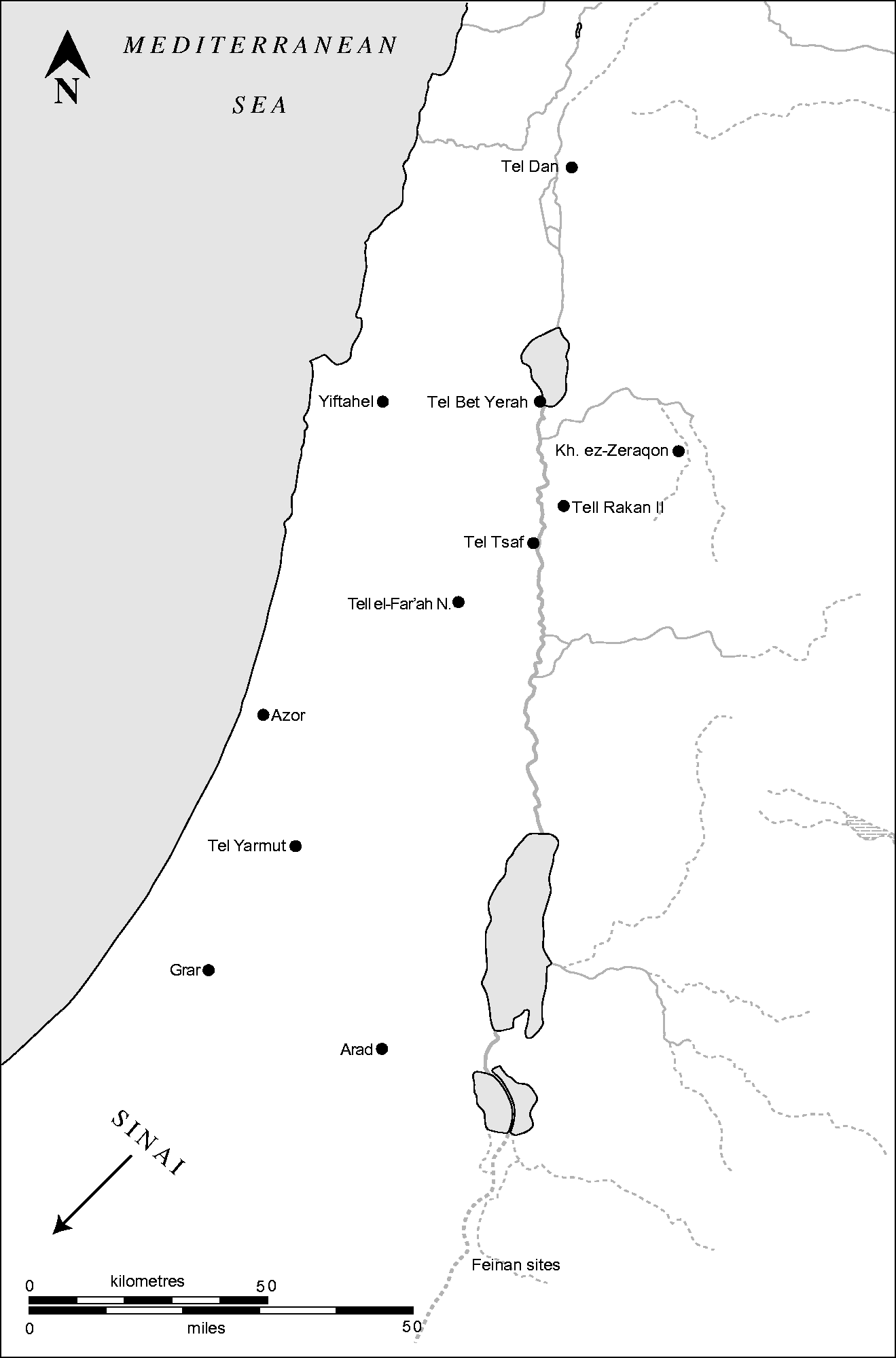
Draught cattle that plough agricultural fields require fodder and a large water supply when they are working, pasture when they are not working and an investment of several years of rearing and training (Halstead, 1995). Intersecting lines of zooarchaeological evidence, such as mortality profiles and pathology data, as well as rare ceramic representations of cattle at work, reflect the importance of cattle in the Chalcolithic and EB and their likely deployment in traction activities. Iconographic depictions of cattle are rare in the EB, but a bowl that contains a clay model of a pair of yoked oxen from a probable EB I context at Tell el-Far'ah North provides strong evidence that cattle were employed in heavy labour (Amiran, 1986: 12, Figure 3). Diachronic patterns that track age-at-death data for cattle from the Neolithic through EB are uncommon. This is a consequence of at least two intersecting factors: faunal remains have been collected from few southern Levantine sites comprising more than one Neolithic through EB component, and of these few sites, dental and epiphyseal fusion data required to reconstruct mortality patterns from cattle are so few that statistically sound culling profiles are often precluded. Yiftahel in the Lower Galilee provides a rare view of cattle mortality from Pre-Pottery Neolithic (PPN) and early EB I levels, although the small sample of long bone epiphyses on which the data are based is small (Horwitz, 1997). Two additional caveats to consider are that epiphyseal fusion data are inherently biased in favour of fused bones that are more resilient against taphonomic attrition relative to low-density unfused bones, and fused long bones signal the minimum age at death, not the actual age at death. With these provisos in mind, the Yiftahel data imply that cattle were slaughtered sometime between the ages of two and three years in the PPN, but their longevity increased slightly in EB I when they were maintained at least to the age of 3.5 years and possibly beyond (Horwitz, 1997: Figure 17.7). This pattern that emphasises mature cattle is consistent with milk or traction exploitation, but if one particular product was emphasised in the PPN or EB I at Yiftahel, the answer is beyond reach of the evidence.
This diachronic pattern of cattle mortality viewed from a single site in the southern Levant is complemented in a broad geographic in a meta-analysis of sheep and goat mortality profiles from the northern Levant and northern Mesopotamia (Helmer et al., 2007). This study found that most Pre-Pottery Neolithic B (PPNB) assemblages reflect a mixed strategy of meat and milk exploitation; Pottery Neolithic-Chalcolithic assemblages showed high degree of intersite variability, with some focused on meat and others focused on milk or fibres; and EB assemblages were focused almost exclusively on secondary products. The results of Helmer et al. (2007) clearly show that, while a variety of stock management strategies were practised from the Neolithic through Chalcolithic, by the turn of the EB Age, sheep and goat across the northern half of the Near East were routinely raised into adulthood.
With regard to the duration of human–animal relationships, dairy stock must reach sexual maturity before lactation is possible and draught stock must be trained for up to several years and males may be castrated before they can be put to work. Evidence from arthrotic palaeolpathologies is useful for identifying livestock that reached an age sufficiently advanced to develop such lesions (Bartosiewicz, 2013: 130–154). Lower limb bone exostoses are lesions associated with advanced age and these growth deformations are often attributed to long-term draught exploitation (De Cupere et al., 2000; Higham et al., 1981). A broad survey of pathologies reported from southern Levantine faunal assemblages spanning Neolithic though recent historical periods found that, from the EB onward, pathologies are exclusively found on livestock species that produce secondary products (sheep, goat, cattle and donkey) (Sapir-Hen et al., 2008). Furthermore, the work of Sapir-Hen et al. (2008) found that arthrotic pathologies (termed ‘induced pathologies’ by the authors) are only found on lower limb bones of cattle. While the database that informs these results is sparse, the available evidence indicates that cattle reached advanced age and likely incurred these lesions from repetitive work activities.
In fact, the value of draught power is not entirely located in animal labour itself but also in the crop harvests from the soils that the animals plough. For cereal crops, this delayed return may be a matter of seasons, but newly planted orchards may not produce fruit for several years. Thus, the return on investment for animal traction is substantially delayed in the context of agricultural production, which would have contributed to long-term dependencies between people and livestock. The evidence of orchard crops is critical to a discussion of plough technology, as it was the replacement of digging stick technology with the plough that allowed farmers to till formerly uncultivable soil types in the hills of the Mediterranean forest zone (Finkelstein and Gophna, 1993). The southern Levant offers much evidence for the domestication and the subsequently swift intensification of grapes and olives starting in the Chalcolithic. Olive production appears to be small in scale in the Chalcolithic, but by the EB, evidence for large-scale production such as storage jars, spouted vessels, querns and mortars is reported from several sites, including Tell Rakân II, Tel Bet Yerah and Tel Yarmut (Banning, 2007: 222; De Miroschedji, 1999: 8–9; Esse, 1991: 123–124). The grape appears to have been domesticated as early as the Chalcolithic, but large-scale production is apparent in the EB (Miller, 2008). Wine production on a mass scale is most evident in Tomb U-j at Abydos, Egypt, dated to Naqada IIIA in the Egyptian chronology, which is coeval with late EB I in the Levantine sequence. This royal tomb contained approximately 700 southern Levantine-made wine jars, some of which contained tartaric acid residues, grape pips and preserved grapes (McGovern et al., 1997).
Livestock traction and transport would have been essential to the production and mobilisation of these fruit crops. Pack donkeys in particular would have been useful for transporting water, agricultural tools, harvests and various commodities over short and medium distances (Ovadia, 1992; Philip, 2001: 188) and donkey caravans may have been responsible for moving copper from Feinan and Sinai to a Mediterranean port or perhaps as far as its foreign recipient (Milevski, 2011: 191–192; Stager, 2001: 632–633). The economic and cultic importance of donkeys in the EB is well documented in the material record. While equid remains tend to comprise a minor component of faunal assemblages, their prominence as subjects in zoomorphic clay figurines suggests that they were highly regarded in EB society. Equid figurines, many of which are depicted carrying a pair of containers on their backs along with a few that are depicted with saddles or harnesses from EB II–III contexts, have been found over a wide swath of the southern Levant, from Tel Dan in the north to Arad in the south, and from Azor in the west to Khirbet ez-Zeraqon in the east (comprehensively reviewed in Milevski, 2011: 184–188). Of the laden donkey figurines from primary contexts, all but one are from burials. These figurative representations of donkeys and their burdens lend support to the premise that people, donkeys and the goods they transported became co-dependent elements in a unified field of practice.
The new agricultural practices that accompanied the SPR would have created dramatic changes of the landscape and how people moved about this space. Agricultural fixtures, such as check dams, traction and pack animals, and fruit orchards were new to Chalcolithic and EB Age landscapes. These new features of the landscape would have also created a shift in temporality, as ploughing, planting, harvesting and processing tasks supplanted annual scheduling of smaller scale agricultural practices. Taken together, the intimate relationships formed with livestock as a consequence of the new SPR temporalities would have spelled important changes in agricultural practices in terms of labour saving, higher yields, storable surpluses and valuations of agricultural staples (Philip, 2003: 108).
Discussion
The Chalcolithic–EB Age of the southern Levant is interpreted as a cultural entity that enacted human–animal co-dependence through the establishment of protracted and systematic secondary products exploitation practices. While livestock domestication brought humans and animals into overlapping spaces, it was the advent of intensive secondary products exploitation that instigated a shift in annual scheduling of agropastoral activities and, in turn, fostered new temporalities based on long-term milking, shearing, ploughing and transport regimes with individual animals. Ultimately, enduring interpersonal relationships formed between secondary products-yielding livestock and their human keepers. It is the lived experience of these relationships, from human and non-human animal perspectives, to which the discussion now turns.
Animal perceptions of humans
Ethological research is currently overturning the idea that humans are the only animal species capable of complex social learning. Simple forms of social learning have been observed in many mammal, bird, fish and invertebrate species (Whiten and Van Schaik, 2007). More complex forms of social learning have been found in chimpanzees, elephants and dolphins, among other species. Proponents of animal consciousness argue that non-human animals are active, sentient, wilful subjects that are as much engaged with each other as people are with each other (Cartmill, 2000; Griffin, 1976, 2001). This emerging field of research has repeatedly demonstrated that several non-human animal species enact complex cognitive abilities during competitive foraging events. For example, some animals have knowledge of what other competitors can and cannot see and they use this knowledge to gain success in foraging. Such behaviours have mostly been observed in non-human primates, but critically for the present discussion, these abilities have been observed in domestic goats. Results from experiments found that goats make complex foraging choices that depend on factors such as position in the dominance hierarchy relative to conspecifics and the visual gaze of a competitor (Kaminski et al., 2006). Goats have also been found to follow the directional gaze cues from other species (in this case, humans) in order to find hidden food (Kaminski et al., 2005). These and other empirical results from animal behaviour research form a compelling case for extending attributions of self-awareness, agency and consciousness to certain non-human animals that include livestock species (Griffin, 2001; Whiten, 2013). This emerging evidence from ethology should compel zooarchaeologists to redress outmoded ideas of human exceptionalism by taking seriously the possibility of non-human animal social intelligence and human–animal co-sociality (Waldau, 2013).
Before scientists found empirical support for a theory of animal consciousness, non-Western indigenous people widely regarded animals as active agents, as they do to this day. These indigenous ontologies almost certainly long predate the Cartesian dualism of person/animal. These perspectives raise the question: If humans and non-humans alike are conscious beings, then what, if anything, distinguishes us from them? The anthropological answer to this question lies in the enigmatic realm of culture (Laland and Hoppitt, 2003). However, the more tangible answer is the uniquely human capacity for intellectual reason. A goat engaged in the purposive act of browsing may have intuitive thoughts and feelings with respect to food and the social interactions with the herder and other goats in the herd (Kaminski et al., 2005, 2006). However, this goat and all other non-primate animals do not possess a priori knowledge necessary for deductive reasoning (Davidson, 1982), but nonetheless make complex decisions (Wynne, 2004).
Human perceptions of animals
While the issue of non-human animal consciousness inspires fierce debate among biologists and, more recently, anthropologists, a rather more contentious assertion, and one with fewer adherents, is that non-human animals exist in an intersubjective world of meaningful social relations. Ingold draws a categorical distinction between the hunter–wild animal interaction, which is conceived as a relationship based on trust, and the herder–livestock interaction, which he conceives as a relationship based on domination (Ingold, 1994). The pastoralist acts as a provider, guardian and executioner and in this sense holds a mastery over the dependent herd. Ingold interprets the pastoralist's material culture, such as the whip, spur, tether and harness, as tools used to restrict or stimulate movement through superior force. In effect, the relationship between humans and livestock, particularly those that are subjugated in work, is rendered as one between master and slave.
Tapper (1988) also explores the theme of animal slavery. He identifies parallels between slavery and draught animals in terms of the human control of the feeding and reproduction of subservient animals. Tapper also finds similarities between pastoralists who lead their herd across pastures and feudal lords who provide protection in exchange for payment. A similar perspective draws an analogy between the pastoralist and the slave master (Tani, 1996). This analogy is supported by the example of the bellwether, a castrated sheep or goat employed to lead the flock. Castration serves to make otherwise aggressive animals obedient, but it effectively removes the animal from the reproductive portion of the herd, thus creating an outcast that is neither a member of the herd nor one of the herders. Rather, the bellwether serves the liminal role of mediator between the herder and the flock. Since most of a dairy herd is composed of female animals, the wether is regarded as a guardian of the females, which makes it functionally analogous to the human eunuch. This characterisation may be extended to castrated draught animals (Clutton-Brock, 1994: 31–32). Castration not only reduces aggression but also induces weight gain, which is a helpful attribute for animals engaged in hauling and ploughing. The consensus among these scholars is that coercive dominance characterises the relationship between people and their livestock.
Ingold's (1994) distinction of trust held between hunters and wild animals and domination held between herders and domestic animals has been critiqued on a number of grounds. Armstrong Oma (2010) regards Ingold's thesis as untenable for characterising people who share a common mode of exploiting animals a common ontology with respect to animals. She even objects to the term human–animal interaction. Instead, she makes the case for human–animal intra-action, a term that connotes mutuality and co-constitution of being. Her argument for intra-action is particularly satisfying in a discussion of the social contract between dairy stock and their managers. Although the two parties are not equal, their relationship must be founded on trust rather than coercion in order for the animals to be sufficiently calm to let down their milk. Armstrong Oma, while challenging Ingold's aphorism of the virtuous hunter and the oppressive herder, perpetuates a different metanarrative: the Euro–American presumption of the existence of a duality between trust and domination in indigenous ontology.
Pálsson (1996) presents a more forceful critique against the trust–domination dualism, although not against Ingold's (1994) thesis in particular. Pálsson argues that to separate orientalism and paternalism (approximately equivalent to domination and trust, respectively) perpetuates the modernist duality of society and nature. Rather, Pálsson offers a third paradigm, environmental communalism, which rejects the nature/society separation. This concept promotes a dialogue among people and environment, two spheres that constitute a unified totality. Pálsson's proposal to consider society and nature together as a total concept parallels Bateson's (1972) ‘ecology of mind’ model that views mind and nature as an indivisible whole, and Latour's (1993) theory of hybrids that blends society/nature and human/non-human. The environmental communalism paradigm, moreover, challenges assumptions of economic exploitation, indigenous protection and the objectification of animals, which are the hallmarks of orientalism and paternalism.
The gnomic utterances used to describe the nature of human–animal relations, which have constituted the prevailing discourse, now appear outmoded. Notions of unity-in-opposition and environmental communalism present a welcome challenge to the dualistic aphorisms of trust/domination and human-as-master/animal-as-slave. Indeed, moral ambivalence and ontological fluidity with respect to domesticated animals find empirical support in the archaeological record. The now pervasive ‘animal turn’ in social science scholarship dissolves the human–animal boundary (e.g. Knight, 2005; Waldau, 2013). Under the guise of human–animal relations studies, which has only recently gained traction in archaeological research, humans and animals are in a continuous state of mutual becoming and are therefore co-constituted. Postulations of fluid interspecies boundaries and hybrid sociality are responses to long-standing anthropocentric conceptualisations of Homo sapiens as a species exclusive of all others (Overton and Hamilakis, 2013).
In keeping with these alternate perspectives on shifting human–animal relations is the work of Orton (2010), who argues that initial animal domestication in the European Neolithic triggered an ontological shift from animals as commodities to animals as ‘sentient property’. He proposes this neologism as a purposefully contradictory term to capture the dual nature of domestic animals as possessions and social subjects. With respect to the Neolithic of southern Britain, where cattle remains are commonly found in association with human remains in mortuary contexts, Ray and Thomas (2003: 40) contend that the partnership formed between people and cattle was intimate to the point of ontological equivalency. The conclusions drawn from these examples point to a transformation in human–livestock relations as a consequence of the domestication process bringing livestock into the fold of human society.
Notions of endurance and closeness form the central argument in an essay that at once argues against the premise of interpersonal relations between the hunter and his prey and for the possibility of intimate, interpersonal relationships between humans and domesticated animals (Knight, 2012). Knight makes the pragmatic, if not utilitarian, evaluation that hunting, as an act of stalking and killing prey that occurs in the course of a brief one-off encounter, is an implausible circumstance during which members of two species can become sufficiently familiar with one another such that their relation might be considered intimate. Instead, Knight maintains that domesticated animals are far better candidates to enter into intimate relationships with humans. He cites their tameness and captivity as qualities that create a spatiotemporal context of frequent and close interactions (Knight, 2012: 343). Individual humans and animals build histories of repeated encounters, the cumulative effect of which is a depth of familiarity. While Knight's detractors find his thesis instrumentalist in tone and reductionist in approach [see comments in Knight (2012)], he nevertheless makes a compelling argument against the hunting-as-trust (Ingold, 1994) and cosmic economy of sharing (Bird-David, 1992) models on the basis of the temporal durability of human–animal relations.
A particularly clear example of enduring human–livestock relations, but one that does not shy away from interspecific complexity and ambiguity, is found in the oppositional ontologies held by commercial and hobbyist livestock breeders and slaughterers in modern northeastern Scotland (Wilkie, 2005). Workers in commercial livestock production, particularly those responsible for slaughter, regard animals as deindividualised commodities, whereas those working in the hobbyist sector, particularly those who are responsible for breeding, decommodify livestock by recognising each animal as an individual. In the interstices between commercial slaughterers and hobbyist breeders are commercial breeders and hobbyist slaughterers who report ambiguous or ambivalent feelings about their animals. Wilkie found that the closer workers are to the breeding side of the process, the easier it is for them to acknowledge their emotional affect for their animals. Breeders, who spend long periods of time intimately nurturing animals from insemination to weaning, associate their work with the production of life rather than death. These workers express an intersubjective affinity for individual animals. Slaughterers, on the other hand, have brief, indirect encounters with livestock in the moments before their deaths. These workers do not form emotional bonds to individual animals, but instead treat animals categorically as a herd or simply as meat, perhaps as an effort to mollify the burden of the executioner.
Wilkie's case of divergent ontological positions among Scottish livestock producers provides two important insights to consider when thinking about human–livestock relations in the past. First, the ontological position of domesticated animals is likely variable within a single culture, a point that should dissuade anyone from making monolithic statements about the nature of such relations. Second, the longevity and directness of interaction between an individual human and an individual animal is the critical factor that establishes the degree to which individual members from two species can become socially connected.
An ethnographic case that echoes the interspecific complexity found by Wilkie concerns farmers in a Greek island community who hold multiple ontologies with respect to their animals. Theodossopoulos (2005) describes the farmer's relationship with his livestock as one based on both resource exploitation and kinship. Greek farmers initially regard individual livestock animals as useful instruments of food and labour, but over time this relationship becomes more intimate as the animal becomes a member of the household. Livestock are brought into the moral sphere of the household because their keepers feel a sense of duty to animals that diligently provide their secondary products and eventually, their primary products. Farmers are compelled through a moral obligation of reciprocity to return the favour by providing care and protection to their livestock. Over the two- to three-year period of rearing and training, a draught animal is cared for by its owner or guardian in a controlling, domineering fashion, just as a child is treated (Theodossopoulos, 2005: 22). But over the longer period during which that animal works, its owner or guardian develops an affective, nurturing attitude that reflects a sense of kinship, just like a member of the family. The ontological shift that develops over the prolonged period of collaboration between animal and person does not entail the replacement of a domination ethos with a trust ethos. Rather, the prior exploitative attitude is mediated by affective care for an animal that is regarded as a member of the household. These Greek farmers, who form enduring and close relationships with their livestock, ambiguously regard livestock as instrumental and affective.
A final example of the complexity and ambiguity found in human–livestock relations is offered by a Mesopotamian cuneiform text from Nippur dating to the early second millennium BC (Old Babylonian period). This tablet, which describes inheritance of property, lists cattle along with other household property such as a wagon, grindstone and door (Postgate, 1992: 97). However, the same text describes cattle with personified names much like a member of the family (Postgate, 1992: 164). These dual connotations of property and persona suggest that Babylonians regarded cattle as both resources and kin.
In this section, I have attempted to reconcile animal domestication and SPR frameworks with perspectives from human–animal studies emphasising temporality as the critical factor leading to intimate co-sociality. The southern Levantine evidence, which shows that people, livestock and agricultural technology and practice became spatially and temporally imbricated in the period that spans the Chalcolithic to EB, supports the premise of a permeable human–animal boundary approaching ontological intersubjectivity for secondary products-yielding livestock and the humans that cared for them.
Conclusion
The theory advanced in this paper offers a grounded alternative to the transhistorical theories of human–animal relations that have dominated archaeological discussion. Initial ungulate domestication in the Neolithic was novel both in terms of its mode of exploitation and the nature of human–animal relations that developed in its course. However, the potential for intimate human–livestock relations was only made possible when the lives of animals were extended with the advent of secondary products exploitation. While the energetic benefits of milk and traction would not have been lost on people in the past, secondary products transformed several other facets of society. Over the course of the long-term process of becoming domesticated and continuing through the development of intensive secondary products exploitation, people and their livestock developed varying degrees of intimate social relationships.
This theory holds temporality as the critical element that defines human–livestock relations. Just as Knight (2012) argues that the brief encounter between hunter and prey does not provide an opportunity for members of two species to get acquainted, I have argued that animal domestication in and of itself is not a sufficient explanation for the spatiotemporal context of human–livestock relations of the Chalcolithic and EB of the southern Levant. Rather, I contend that intensive secondary products exploitation merits recognition for fostering the ever closer and frequent contact between humans and livestock that was required for routine extraction of milk, fibre, traction and transport. Exploitation of secondary products shifted focus away from primarily slaughtering young animals for meat and towards long-term maintenance of livestock. The longevity of lives of animals that provide secondary products afforded the opportunity for individual members of two species to achieve mutual familiarity and thereby enter into social relationships. The emergence of intensive secondary products exploitation redefined domestic animals to the extent that livestock and people formed a relational web of dependency (Hodder, 2011). This new set of practices created a human dependency on healthy cows, ewes and does for regular and frequent milk production, and healthy oxen and donkeys for labour, while livestock in turn depended upon people for nothing less than their existence.
The model of human–livestock relations for the southern Levantine Chalcolithic–EB Age that is presented in this paper considers domestic animals to have been ontologically entangled within a world of agricultural practices that included material and immaterial constituents. Material constituents included livestock, humans, agricultural fields, cereal and orchard crops, fodder, water, meat, milk, fibres and labour, while immaterial constituents included perceptions of wealth, power, trust and domination, work and kinship. Although the lens of Western thought would place some of these elements at odds with one another (e.g. human/animal, pastoralism/agriculture, trust/domination and power/kinship), a relational ontology of human–livestock interactions reflected in the social and economic conditions described for the Chalcolithic–EB Age of the southern Levant does not find opposition between competing interests, but rather conceives of these concepts as ambiguously held in tension. This world of contradictions, quite apart from our own, is conceived as a coherent reality.
Footnotes
Acknowledgements
I wish to thank the Institute of Archaeology, University College London for providing institutional support. I am grateful to Louise Martin, Kate Mossman, Lynn Meskell and three anonymous reviewers for their valuable comments on earlier drafts of this paper.
Funding
Funding for this research was provided through a postdoctoral fellowship from the Social Sciences and Humanities Research Council of Canada (SSHRC).