




Abstract
Despite the lack of an official and widely agreed definition, “natural wine” has given rise to a transnational movement and a distinctive market segment. Drawing on Bourdieu’s notion of cultural fields, recent research has conceptualized natural wine as an emerging field shaped by producers and cultural intermediaries; however, the role of consumers in these symbolic struggles remains underexplored. This article asks how symbolic valuations of natural wine differ between consumers and wine professionals, and which sociocultural factors contribute to these differences. We draw on a face-to-face survey of 415 attendees at the longest-standing natural wine fair in Spain, combining free word associations with measures of wine involvement, dietary and lifestyle habits, and attitudes towards natural wine and its potential certification. Our findings show that consumers and professionals share several symbolic associations with natural wine, but weight them differently. Consumers more often frame natural wine through legibility-oriented cues such as organic production and the absence of sulphites or additives, whereas professionals more often emphasise minimal intervention and production practices, while also expressing stronger scepticism towards formal certification. The clearest divide, however, concerns preferred modes of legitimation: consumers are more likely to favour regulatory and labelling devices that stabilise the category, while producers and distributors more often resist formal certification as a threat to autonomy. The natural wine fair thus appears as a key arena where competing symbolic valuations are negotiated at the interface between supply and demand, showing how disputes over authenticity and regulation are articulated across different positions within the emerging natural wine field in consumer culture.
Keywords
Introduction
The global spread of the natural wine (NW) phenomenon since the early 2000s has opened a prolific scientific and public debate. NW has been characterized as a social movement against traditional forms of highbrow snobbery in the fine wine world (Le Grand, 2024, 2025). It brings together a diverse global community of rural winemakers, urban consumers, distributors, bloggers and sommeliers who are interconnected by sustainability and environmental concerns regarding wine production and consumption (Alonso González and Parga-Dans, 2023). However, despite its growing visibility, this movement has not succeeded in establishing an internationally agreed definition of NW beyond the specific French case, due to competing interests among the actors involved. The very act of defining NW raises socio-symbolic controversies and disagreement between winemakers, enologists, distributors, tasters and hospitality professionals (Alonso González et al., 2022), and the possibility of an official certification represents a cornerstone of the debate (Parga-Dans et al., 2023).
A growing body of research has examined the social and cultural dimensions of wine drinking in contemporary societies (Demossier, 2010; Maguire, 2021). Studies of wine culture, understood as the appreciation of wine by different social groups, have often been fragmented across disciplines and focused mainly on France and other “Old World” countries (Inglis and Almila, 2022). Economic sociology has addressed phenomena such as valuation processes and price formation in the wine market (Beckert et al., 2017), while the sociology of consumption has analysed wine-drinking habits, motivations and consumer profiles (Charters and Pettigrew, 2008). Recent research has adopted Bourdieu’s (1984) cultural field perspective to conceptualise NW as an emerging field that challenges established hierarchies of taste in the fine wine world (De Benedittis, 2025; Le Grand, 2025; Maguire, 2018a).
However, the role of consumers in the cultural field of NW has been largely overlooked in the debates about its cultural meanings and perceptions. Consumer and marketing research on NW has expanded, exploring profiles, perceptions and willingness to pay in this growing segment (e.g., Palmieri et al., 2024; Vecchio et al., 2021; Vecchio et al., 2023). These studies show interest in wines with natural and sustainable attributes, but also persistent confusion between NW, organic, biodynamic, “no added sulphites”, minimal-intervention or low-intervention. However, they tend to treat consumers as recipients of symbolic frameworks defined upstream, rather than as actors who help shape the field alongside producers, distributors, sommeliers and critics.
In this article, authenticity is approached not as an intrinsic property of wine, but as a socially attributed and contested form of worth. In food culture, authenticity has long functioned as a key classificatory ideal through which actors distinguish legitimate products, practices and identities (Carroll, 2015; Johnston and Baumann, 2014). In this sense, NW is a particularly revealing case, since struggles over authenticity concern not only whether a wine is perceived as “real” or “natural”, but also who gets to define legitimate naturalness, acceptable intervention, sensory legitimacy and appropriate regulation. Disputes over labelling and certification should therefore be seen not as external to authenticity, but as one of the principal institutional arenas through which authenticity and symbolic value are negotiated within the wine field (Beckert et al., 2017). Rather than reconstructing the field as a whole, the article examines how selected positions within the emerging NW field mobilise different modes of legitimation.
This article aims to contribute to filling this research gap. It draws on data collected at the longest-standing NW fair in Spain, held annually in Barcelona since 2005 and organised by the Asociación de Productores de Vino Natural (Spanish Natural Winemakers’ Association, PVN). This case is analytically strategic for three reasons. First, wine fairs in emerging market segments create dense interaction settings where alternative communication structures between producers and consumers can develop beyond conventional mass-marketing channels (Rodrigues et al., 2020), which is particularly relevant in the case of NW. Second, the fair functions as a meeting point between actors on the supply (producers, distributors, restaurateurs and opinion leaders) and the demand side (interested consumers) in a market that is already socially visible but still lacks official statistics and a legal definition. Third, the Spanish market is paradigmatic for understanding NW as a cultural field: Spain is an Old-World wine country with a long viticultural tradition and the world’s largest surface area of organic vineyards (OEMV, 2023), which makes it an exemplary context for analysing how representations of taste and quality associated with NW are constructed and contested.
By focusing on how different actors position themselves within the emerging cultural field of NW, we ask: (1) how do symbolic valuations of NW differ between consumers and wine professionals; and (2) which sociocultural factors, such as wine involvement, lifestyle and sustainable consumption practices, are associated with these differences? Our starting hypothesis is that consumers and professionals will mobilise partly divergent symbolic repertoires when evaluating NW, and that symbolic valuations will also vary across professional subgroups (producers, distributors, hospitality and opinion leaders) and among consumers according to their level of wine involvement. In what follows the paper discusses the theoretical and methodological framing, to then present and discuss the main results.
Theoretical framework
Wine as a cultural product and a field of symbolic valuation
Wine quality is not simply inferred from intrinsic properties or straightforwardly read off labels, but mediated through classificatory devices, expert discourse, embodied competences and historically variable conventions of evaluation (Ashton, 2014; Beckert et al., 2017; Charters and Pettigrew, 2005). This uncertainty is partly related to the limited informational content of wine labels (Parga-Dans and Alonso González, 2018). Until 2024, European Union (EU) wine labels were not required to list ingredients or nutritional information, despite the widespread use of oenological additives (Alonso González and Parga-Dans, 2025). Since 2024, nutritional and additive information in EU wines can be accessed via QR codes, but wine still offers less on-label transparency than most foods, leaving quality heavily mediated by social representations (Annunziata et al., 2016; Pabst et al., 2021; Vecchio et al., 2018). As a result, wine quality is difficult to assess from extrinsic characteristics alone, and is instead shaped through social representations, imaginaries and marketing quality processes (Parga-Dans and Alonso González, 2017).
From a sociological perspective, wine can be approached through Bourdieu’s (1984) theory of cultural fields, which conceptualises fields as social spaces where cultural goods are produced, distributed and consumed, and where actors compete for prestige and recognition. In this view, the “wine field” is structured by struggles over the attribution of symbolic qualities to wine and the accumulation of cultural capital, as producers, critics and consumers seek to distinguish themselves through their knowledge of legitimate wines and tasting practices (Beckert et al., 2017). This field-oriented approach resonates with consumer culture theory and practice-based perspectives that conceptualise markets as arenas where cultural meanings, identities and social distinctions are negotiated through everyday consumption practices (Arnould and Thompson, 2005; Warde, 2005). From this point of view, wine consumption is not simply an individual choice but part of broader lifestyle configurations and repertoires of practice.
Within this framework, uncertainty about wine quality has fostered the delegation of taste to expert rankings, cultural intermediaries and wine guides (Maguire, 2016; 2018b). Cultural intermediaries – such as critics, sommeliers and specialised retailers – play a key role in constructing and codifying wine quality judgements through tasting notes and classification systems (Maguire and Zhang, 2016). Recent research, however, shows a mismatch between chemical, sensory and extrinsic cues in expert assessments (Parga-Dans et al., 2022), which may contribute to consumer confusion in a context of declining per capita wine consumption at the global level (Ohana-Levi and Netzer, 2023). Against this background of informational asymmetry and contested expertise, wine offers a fertile terrain for examining how symbolic valuations are negotiated within a cultural field.
Natural wine as an emerging and contested cultural field
Since the 2000s, there has been a global spread of NW as an ill-defined and heterogeneous movement (Black, 2013). NW acquires different meanings depending on national context, producer association or the position of the actors involved – whether producers, journalists, intermediaries or consumers (Dubois et al., 2026; Sáenz-Navajas et al., 2024). Unlike organic and biodynamic wines, which are governed by certifications and codified practices, the category of NW remains the object of ongoing debate and lacks an internationally agreed definition (Alonso González et al., 2022). This definitional openness has attracted increasing scholarly attention.
On the supply side, research has documented how the definition and possible certification of NW have become a major source of controversy. The term “natural wine” on labels was recently restricted by the European Commission, on the grounds that it could mislead consumers and harm the image of other wines presented as “non-natural” (European Commission, DG Agri, 2020). This decision was triggered by the mobilisation of the French Syndicat de Défense des Vins Naturels, whose efforts led to the temporary certification Vin Méthode Nature and opened an ongoing legal debate at the European level (Chartier and Pineau, 2025). Many winemakers fear that a formal NW certification would pave the way for standardisation and industrial co-optation of the niche, as they argue has already occurred with organic wine (Alonso González and Parga-Dans, 2023; Parga-Dans et al., 2019). Meanwhile, uncertainty around the qualities and properties of NW has enabled greenwashing strategies and false appeals to “naturalness” in the wider wine industry (Fuentes-Fernández and Gilinsky, 2022).
In practice, NW usually refers to wines made from organically or biodynamically farmed grapes, with limited technological intervention and restricted use of additives. In parallel, several producer associations have emerged in defence of NW, such as L’Association des Vins Naturels and Sans Aucun Intrant ni Sulfite (SAINS) in France, Triple A, Viniveri, Vinnatur and VAN in Italy, and the PVN in Spain. These associations organise specialised fairs and festivals that create meeting spaces between winemakers and consumers. Yet each association applies different criteria regarding the practices allowed in natural winemaking, including the use of sulphites, filtration, selected yeasts and other oenological inputs, and the resulting diversity of definitions and policy arrangements contributes to widespread confusion among consumers about what counts as a NW (Alonso González and Parga-Dans, 2020).
Building on Bourdieu, recent work has explicitly conceptualised NW as an emerging cultural field that challenges the aesthetic and social foundations of the fine wine field. Le Grand (2024) shows how middle-class actors differentiate themselves from the traditional fine wine field by mobilising sustainable and low-intervention narratives and promoting new symbolic values associated with NW’s taste and quality, while De Benedittis (2025) documents, through ethnographic research, new tasting practices and classificatory schemes that normalize and even valorise sensory traits previously treated as defects in wine. Complementing these sociological accounts, recent sensory work has shown that red NW tend to form a recognisable sensory cluster and are often evaluated as lower quality than conventional counterparts, despite shared sustainability values (Ballester et al., 2024). Together, these studies portray NW as a subfield structured around alternative criteria of taste and quality, in which traits conventionally coded as faults in mainstream wine evaluation may be reinterpreted as signs of vitality, singularity or low intervention (Cohen, 2013; De Benedittis, 2025). Within this subfield, actors struggle over the legitimate definition of taste and quality, as well as over the appropriate degree of regulation, thereby transforming NW into a site of intense socio-symbolic controversy.
Supply–demand interface and the missing consumer perspective
While the sociological literature has begun to characterise NW as a cultural field by focusing primarily on producers and cultural intermediaries (De Benedittis, 2025; Le Grand, 2024; Maguire, 2018a), a parallel and growing body of consumer and marketing research has approached the segment mainly through individual choice models (e.g. Capitello and Sirieix, 2019; Fabbrizzi et al., 2021; Galati et al., 2019; Goldstein and Dubois, 2025; Sottini and Menghini, 2025). Other contributions analyse NW consumer profiles and preferences for label information (Migliore et al., 2020; Palmieri et al., 2024; Vecchio et al., 2021), revealing heterogeneous patterns across socio-demographic and cultural contexts. However, this body of work generally conceptualises consumers as recipients of product attributes and information, rather than actors who actively contribute to shaping the NW field in relation to other participants. Conversely, field-oriented research on NW has largely prioritised the supply side, investigating the perspectives of producers, distributors and opinion leaders, while leaving the role of consumers comparatively under-explored.
As a result, we still know little about how symbolic valuations of NW compare across the demand and supply sides, or how they vary according to actors’ sociocultural characteristics, lifestyles and levels of wine involvement. From a Bourdieusian perspective, these differences may be expressed through lifestyle repertoires, including dietary habits and sustainable consumption practices, which may align positions in social space with positions in the emerging NW field. In particular, it remains unclear to what extent NW consumers’ representations of taste, quality and “naturalness” converge with or diverge from those of winemakers, distributors, hospitality professionals and critics, and how these differences inform current controversies around the definition and certification of NW. Addressing these questions requires an empirical strategy that brings together the cultural field perspective and consumer research, and that captures both consumers and professionals within a shared interactional setting.
In this article, Bourdieu’s field perspective is not used to reconstruct the full relational structure of the wine field, but to examine how actors occupying different positions within the emerging NW space mobilise distinct evaluative principles and stakes. Our empirical focus is therefore narrower: we analyse differences in symbolic valuations, attitudes to certification and lifestyle repertoires across consumers and professional subgroups brought together in a field-configuring event. The next section presents that design, based on a survey conducted at a Spanish NW fair, which allows us to examine how symbolic valuations vary across positions in the field and intersect with sustainable lifestyles.
Methodology
Data collection
Data were collected through a face-to-face survey with attendees at two consecutive editions (2023 and 2024) of the Spanish NW fair in Barcelona. Data collection took place in February 2023 and February 2024 using the same questionnaire and fieldwork protocol. In total, 415 respondents completed the survey (201 in 2023 and 214 in 2024). The target sample size was planned on the basis of attendance figures from previous editions (around 1,000 visitors), and respondents were selected on site according to their availability and willingness to participate, following a convenience sampling strategy. To avoid duplicate participation, the 2024 questionnaire included a screening question asking whether the person had already completed the survey at the previous edition of the fair; those who answered affirmatively were thanked and not re-interviewed. Preliminary tests revealed no systematic differences between the two waves in terms of socio-demographic profile, familiarity with NW, wine involvement and the main attitudinal scales, so we pooled them into a single cross-sectional dataset for the analysis presented below (see Supplemental Table S1).
The structured questionnaire consisted of 22 questions organized into five thematic blocks: free word-association task (“please tell me the first three words that come to mind when you hear the expression NW”); NW consumption and perceptions, general interest in wine and attributes; diet and lifestyle; and sociodemographic profile and respondents’ position in the wine field. The original questionnaire was administered in Spanish; an English translation of the key items used in the analyses is provided in Supplemental Appendix 1.
Before participating in the survey, all respondents provided informed consent, which included information about the purpose of the research, the voluntary nature of participation, the number of questions, the estimated duration and their right to withdraw at any moment. Fieldwork procedures adhered to an action and data protection protocol in line with the UNE-ISO 20252:2019 standard on market, social, and opinion research, encompassing insights and data analytics. The study received approval from the CSIC Ethics Committee (213/2023).
Data analysis
Lemmatisation and categorization of free associations
Respondents were first asked to answer a free word association task in which they had 30 seconds to mention the first three words that came to their mind when hearing the term “natural wine”. Answers were recorded in three open-ended variables and then transcribed verbatim into a database. Before conducting any analysis, the evoked words were formatted and grouped following established procedures for lexical analysis in consumer research (Bécue-Bertaut et al. 2008; Symoneaux et al. 2012).
The procedure involved four steps. First, typing errors and obvious spelling mistakes (in Spanish, Catalan and English) were corrected. Second, we carried out a lemmatisation process which converted each expression into a standardised form (lemma) by: (a) deleting connectors, auxiliary verbs and adverbs, and (b) transforming verbs into infinitive and nouns into singular form. Third, we semantically grouped synonyms into common lexical categories. For instance, terms such as “eco”, “organic”, “ecologic” and “bio” were grouped under the category “Ecological/Ecology”; “sulphite-free”, “few sulphites” and “sulphites” were grouped under “(Without) sulphites”; and expressions such as “chemical-free”, “additive-free” and “preservative-free” were grouped under “No additives/No chemicals/No preservatives”. This process resulted in a set of 33 semantic categories that were applied across the three free association positions, which yielded similar patterns; for parsimony, we report detailed results only for the first evoked word.
Finally, those words that were ambiguous, idiosyncratic or with very low frequency of elicitation were assigned to a residual category labelled “Other words” instead of forcing them into an existing category. This decision was taken by three members of the research team in order to avoid over-interpretation and over-grouping of rare terms, in line with recommendations by Symoneaux et al. (2012). The final database therefore included both the original verbatim answers and their corresponding lemmatized categories, which were used for subsequent analyses.
Statistical analyses
The data analysis proceeded in two main steps and was performed using SPSS 22.0. First, we computed descriptive statistics to profile the sample in terms of socio-demographic characteristics, wine involvement, dietary and lifestyle habits, sustainable consumption habits and familiarity with NW. Second, we carried out analyses of variance (ANOVAs) to compare mean levels of wine involvement, perceptions of NW attributes and attitudes towards regulatory initiatives across groups (Norman, 2010). We considered two main groupings: (a) a dichotomous distinction between wine professionals and non-professional consumers, and (b) a five-category distinction between professional subgroups (production, distribution, hospitality, opinion/prescription) and consumers. Group differences were examined using one-way ANOVA. When the homogeneity of variance assumption was violated, we report the corresponding Welch ANOVA results. As a robustness check, and given that normality assumptions for residuals may not always hold, we complemented these tests with non-parametric alternatives: Mann-Whitney U test for two-group comparisons and Kruskal-Wallis tests for factors with more than two groups. Unless otherwise indicated, statistical significance was set at p < 0.05; we highlight results with p < 0.01 as more robust.
Results
Sample description
Sample characteristics.
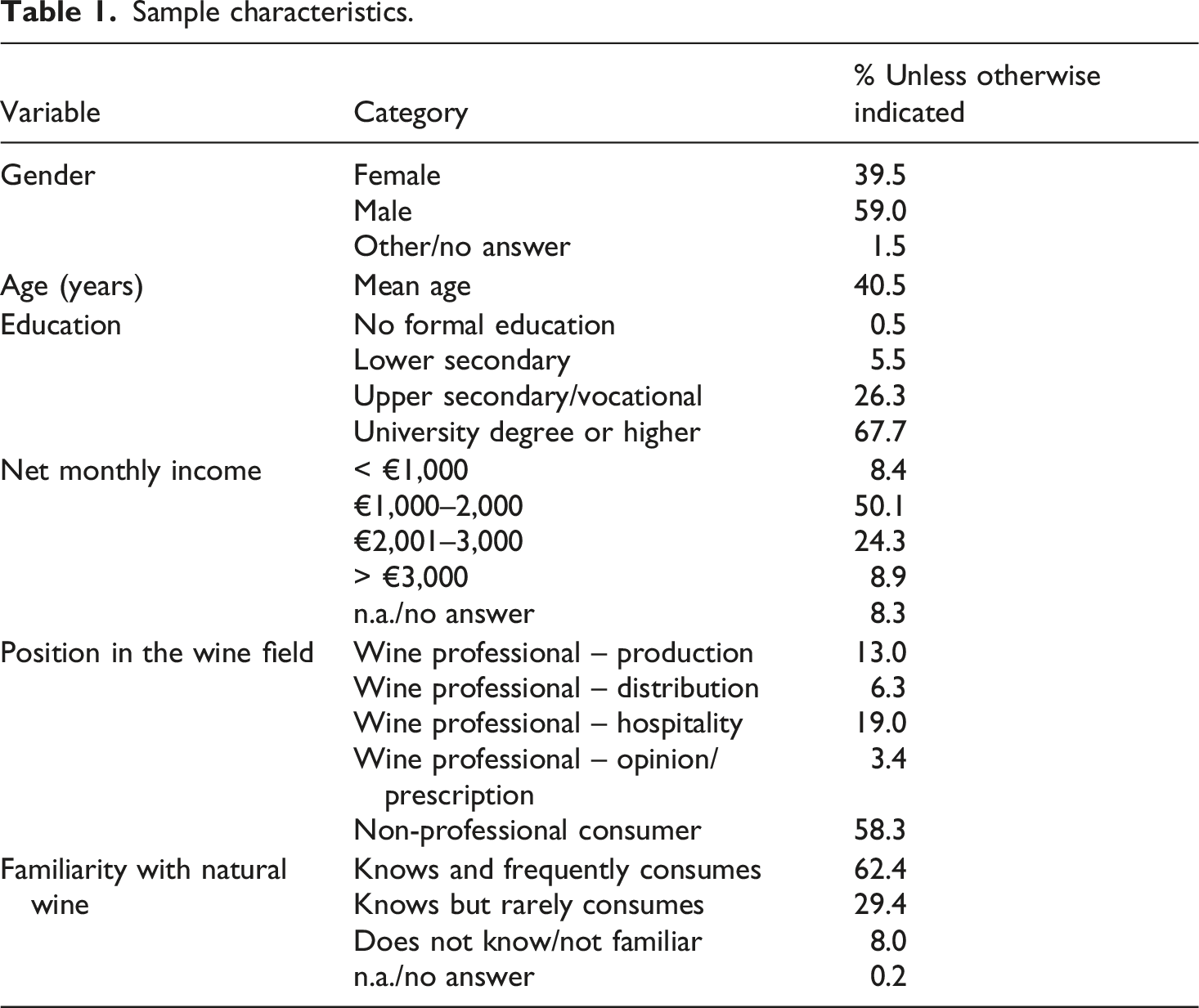
Regarding their position in the wine field, 58.3% of respondents were non-professional consumers, whereas 41.7% were wine professionals: 19.0% worked in hospitality (restaurants and bars), 13.0% in wine production, 6.3% in distribution and 3.4% in prescription and opinion (e.g. journalists, critics, bloggers). Most attendees (62.4%) reported that they “know and frequently consume” NW, 29.4% “know but rarely consume” it, and only 8.0% declared that they did not know NW.
Respondents displayed very high levels of wine involvement. Mean scores indicate that they generally agreed with statements such as “I have a great interest in wine” (M = 4.45), “I carefully select the wines I buy” (M = 4.44) and “I do not need a special occasion to drink wine” (M = 4.34). Overall, the sample is relatively young, highly educated and economically secure, with high wine involvement and frequent familiarity with NW, reflecting the self-selected nature of attendees at a specialised fair. Rather than approximating the general wine-drinking population, the fair captures a socially selective and highly involved niche public, which is analytically useful for examining how positions within the emerging NW field relate to different forms of competence, involvement and attitudes towards regulation. Thus, the fair operates as a high-involvement “elite public” rather than a mass-market event, so our findings are best read as capturing the symbolic vanguard of the Spanish NW audience rather than the average wine drinker.
NW mental representation: Aesthetics, taste and quality
Most frequent lexical categories associated with “natural wine” (first evoked word), by type of actor (%).
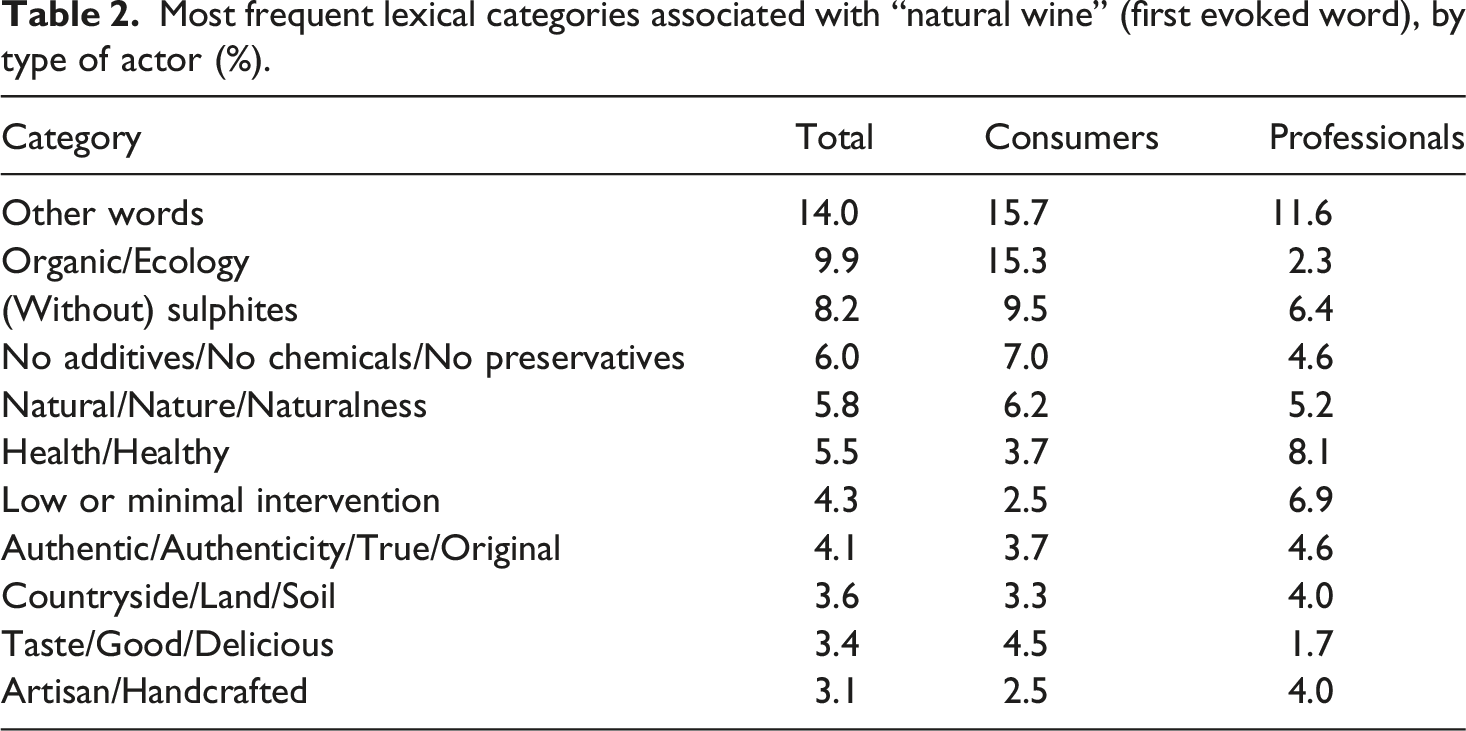
Among consumers, the most frequent first associations to NW refer to “Organic/Ecology” (15.3%), followed by “(without) sulphites” (9.5%) and “No additives/No chemicals/No preservatives” (7.0%). Among wine professionals, the most frequent categories are “Health/Healthy” (8.1%) and “Low or minimal intervention” (6.9%), while “(Without) sulphites” (6.4%) and “Natural/Nature/Naturalness” (5.2%) also remain salient. The differences should therefore be read as differences in relative emphasis rather than as mutually exclusive symbolic understandings. Because Table 2 reports within-group percentages for the first evoked word, these differences do not indicate that professionals produced fewer associations; rather, they suggest a higher concentration of consumers’ responses around a few highly salient cues, whereas professionals’ responses are distributed more evenly across several recurrent categories.
The overlaps are important. Sulphites appear prominently in both groups, naturalness is also salient among consumers, and authenticity is similarly present in both sets of responses. What seems to differ more clearly is the orientation of the dominant cues mobilised by each group: consumers more often evoke legibility-oriented categories such as organic, additives and sulphites, whereas professionals more often foreground production logics and evaluative terms such as health and minimal intervention, whose meaning is less easily stabilised through labels and depends more on field-specific competence. Rather than revealing fully divergent symbolic repertoires, the free-association task points to shared concerns that are weighted differently and that anticipate subsequent differences in attitudes towards certification, regulation and the legitimate stabilization of the category. In this sense, authenticity is less a single lexical marker than a broader classificatory stake that cuts across different ways of defining what counts as a legitimate NW.
Diet, lifestyle and sustainable consumption profiles
We next examined respondents’ diets, lifestyles and sustainable consumption practices in order to characterise the broader profiles associated with NW. These variables are not treated as definitional features of NW, but as adjacent dispositions that help situate respondents within broader repertoires of sustainable consumption. Most respondents described their diet as omnivorous (41.9%) or Mediterranean (38.6%), while 8.4% defined it as “environmentally sustainable”. Vegetarian and vegan diets were less common but non-negligible, particularly among professionals (8.6% vs 6.2% among consumers). In turn, 4.5% of consumers reported following a “fitness” diet, compared with 2.3% of professionals. Overall, professionals were slightly more likely to describe their eating habits as environmentally oriented.
Sustainable consumption practices were widespread among fair attendees, but again more pronounced among professionals. In the total sample, 59.3% reported consuming organic products “often” and 66.5% consuming local or proximity products “often”. Disaggregating by group, 83.2% of professionals declared that they “always” or “often” consume organic products and 91.9% do so for local products, while among consumers these proportions were 64.5% and 82.2%, respectively. Thus, professionals are more systematically embedded in sustainable food consumption routines.
Regarding physical activity, 61.2% of respondents reported practising sports two or more days per week. However, activities commonly framed as wellbeing or mindfulness (e.g. yoga, pilates, tai chi or meditation) were much less frequent: 68.7% of the sample declared that they never practised them. This suggests that NW is embedded less in a broad wellness-oriented lifestyle than in sustainable food practices centred on organic, local and low-intervention consumption.
Perceptions and consumption of NW
NW was widely known among fair attendees: 91.8% had heard of NW and 62.4% reported consuming it frequently. NW was consumed mainly at home (42.2%) and in bars and restaurants (41.9%). In terms of purchasing channels, respondents most often bought NW in specialised bars and wine shops (46.3%), followed by direct purchases from producers (27.2%), which underscores the importance of short supply chains in this market segment.
Consumption patterns differed markedly between groups. Among wine professionals, 90.2% reported consuming NW “frequently”, whereas only 42.6% of consumers could be classified as frequent NW drinkers. When asked about their willingness to pay a price premium for a hypothetical NW certification, professionals appeared more sceptical: 44.5% stated that they would not pay any premium and 26.0% would pay only 10% more. Among consumers, 50.0% would be willing to pay a 10% premium, while 26.9% would not pay more. These results already suggest a tension between professionals’ anti-regulatory stance and consumers’ greater openness to institutionalised guarantees.
We then examined general attitudes towards wine and specific perceptions of NW. Respondents expressed high interest in wine, reporting strong agreement with the statements “I have a great interest in wine” (M = 4.45) and “I carefully select the wines I buy” (M = 4.44). Among wine attributes, the environmental impact of wine received the highest and most consensual importance score (M = 4.31), whereas other attributes such as sulphites, toxic residues or sugar content exhibited greater variability in concern.
Regarding NW, the highest and most consensual agreement levels were observed for statements emphasising environmental and low-residue-related dimensions: “NW contributes to environmental improvement” (M = 4.64), “It is part of a sustainable lifestyle” (M = 4.50) and “It does not contain pesticide or heavy metal residues” (M = 4.49). Respondents also strongly supported the initiative “Inclusion of an ingredient list on the bottle label” (M = 4.45). These results reinforce the idea that NW is widely perceived as environmentally friendly and as aligned with sustainable food practices, while also attracting strong support for greater transparency in wine labelling.
Symbolic valuations, certification and group differences
Differences in symbolic valuations between wine consumers and professionals. Means on 1-5 Likert scales (1 = strongly disagree; 5 = strongly agree).
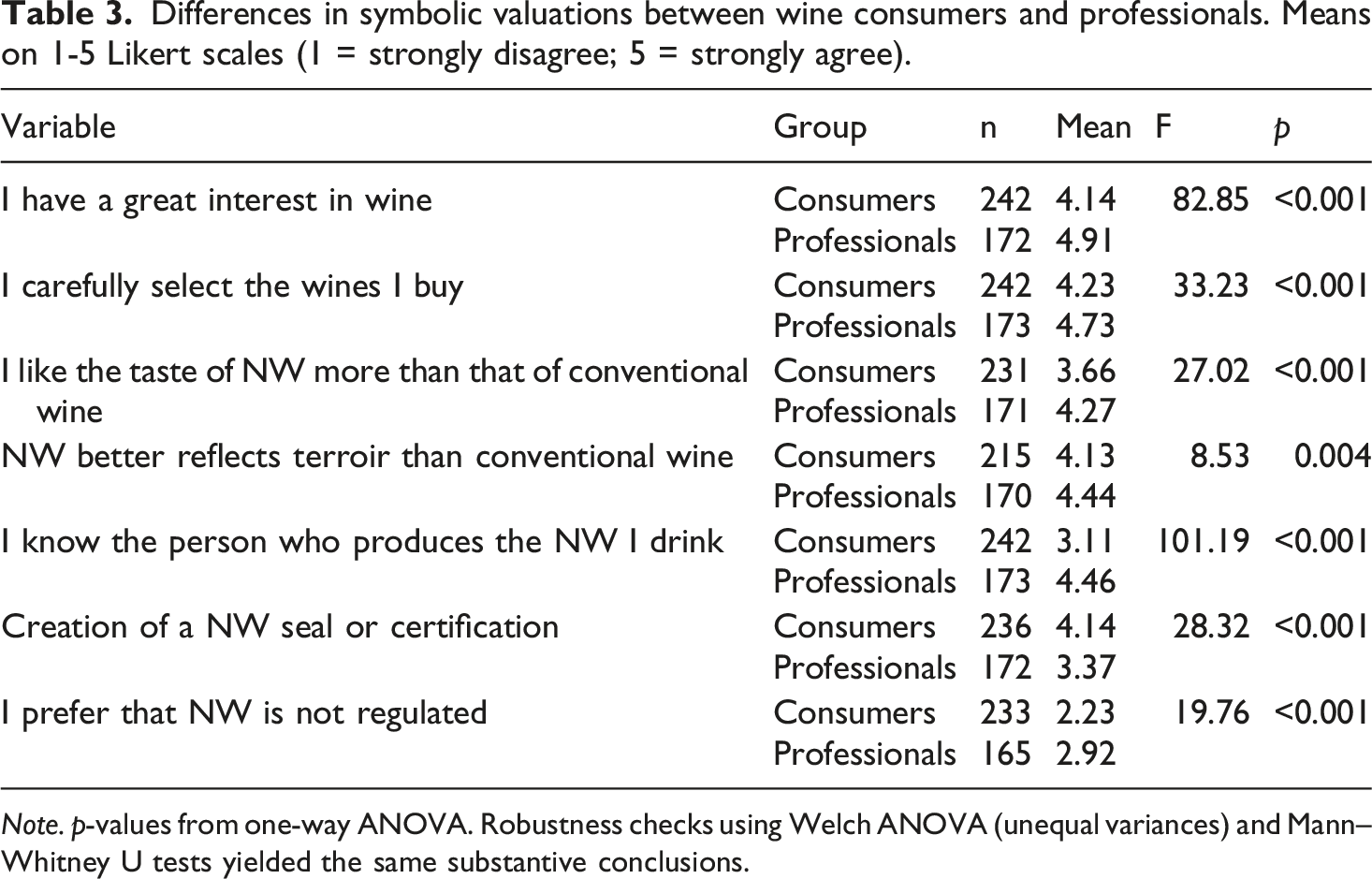
Note. p-values from one-way ANOVA. Robustness checks using Welch ANOVA (unequal variances) and Mann–Whitney U tests yielded the same substantive conclusions.
Differences in symbolic valuations across consumer and professional subgroups (production, distribution, hospitality, opinion/prescription) – Means on 1-5 Likert scales.
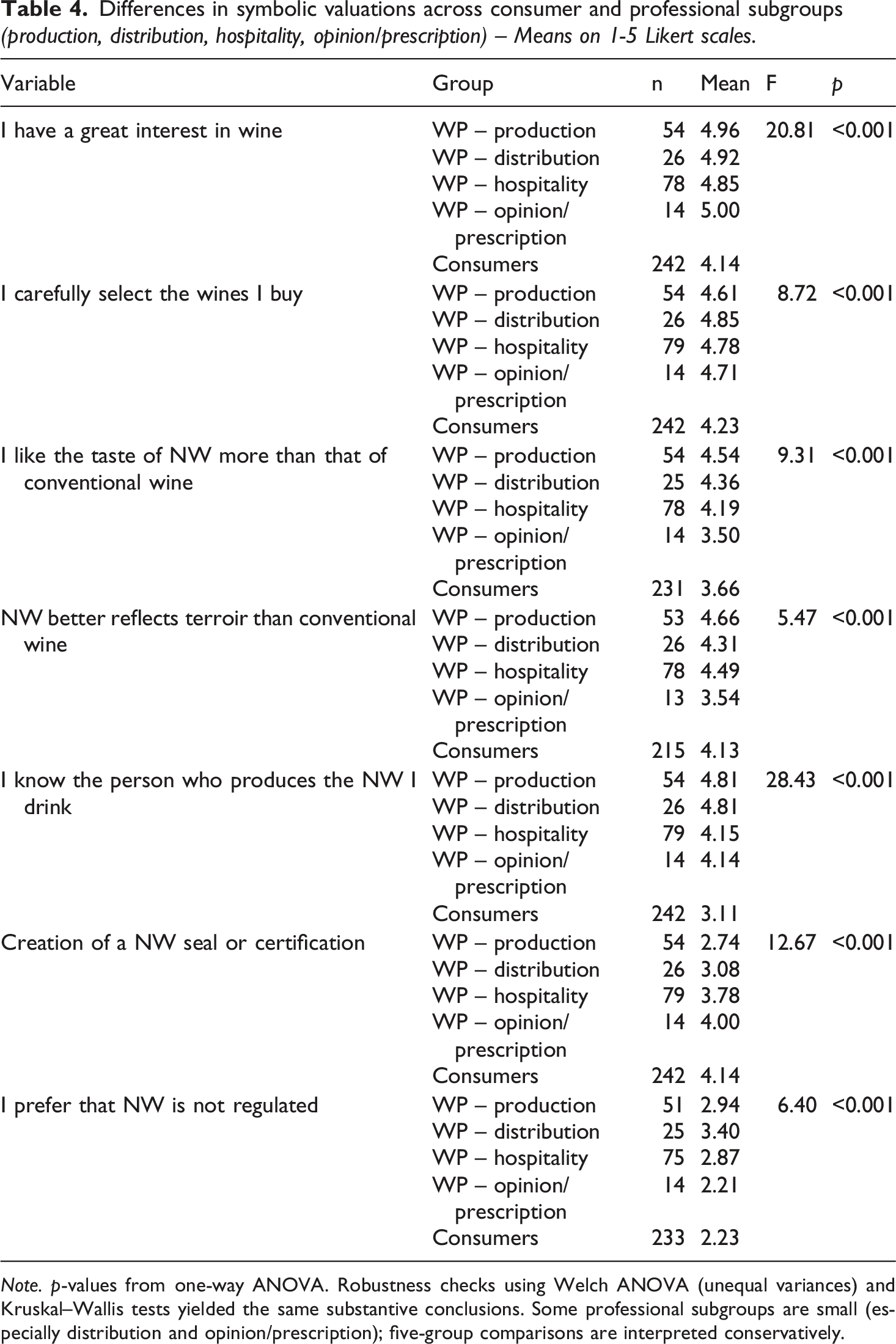
Note. p-values from one-way ANOVA. Robustness checks using Welch ANOVA (unequal variances) and Kruskal–Wallis tests yielded the same substantive conclusions. Some professional subgroups are small (especially distribution and opinion/prescription); five-group comparisons are interpreted conservatively.
Comparisons indicate that producers and, to a lesser extent, distributors tend to: (a) as expected, report the highest agreement with statements such as “I know the people who produce it” (M = 4.81), (b) express the strongest belief that NW better reflects terroir than conventional wine (M = 4.66), and (c) show, together with distributors, the highest support for the statement “I prefer that NW is not regulated” (M = 2.94). By contrast, opinion/prescription professionals are more cautious regarding terroir claims and less supportive of non-regulation, while consumers and opinion leaders are the groups most supportive of creating a formal NW certification. This pattern suggests a tension between segments of the professional field that defend NW’s autonomy and resist formalisation, and those that are more aligned with consumers’ demand for guarantees provided by a certification.
Discussion
Supply–demand asymmetries in symbolic valuations
The results indicate that symbolic valuations of NW differ between consumers and wine professionals, but less as fully opposed understandings than as overlapping repertoires that are weighted differently. Consumers more often evoke ecology, additives and sulphites, and they show stronger support for ingredient labelling and formal certification. Professionals, by contrast, more often foreground health and minimal intervention, while also displaying greater scepticism towards external codification of the category. The key divide is therefore not simply between actors who value NW and actors who do not, but between different ways of rendering the category legible and legitimate (Beckert et al., 2017; Maguire, 2018a).
This distinction is especially visible in relation to certification. For many consumers, certification and enhanced labelling function as stabilising devices that reduce uncertainty and make an institutionally fluid category easier to identify (Beckert et al., 2017; Galati et al., 2019; Pabst et al., 2021). For many professionals, especially producers and distributors, the same devices are more likely to be read as threats to autonomy, experimentation and peer-based recognition (Alonso González and Parga-Dans, 2023; Parga-Dans et al., 2019, 2023). In this sense, disputes over certification are not external to symbolic valuation, but a main arena in which authenticity, authority and legitimacy are negotiated within the field (Bourdieu, 1984; Le Grand, 2024).
These asymmetries reflect a field structured by uncertainty and contested evaluative criteria. The NW fair becomes a site where shared concerns around ecology, intervention and authenticity are articulated through different justificatory logics and competing expectations about how NW should be defined and communicated (Le Grand, 2024; Maguire, 2018a).
Sociocultural factors and lifestyle dimensions
The second research question asked which sociocultural factors help explain differences in symbolic valuations of NW. Three elements stand out: wine involvement, sustainable lifestyles and professional position within the field. First, wine involvement is systematically higher among professionals than among consumers, and it is a key differentiating factor in our ANOVA-based comparisons. Highly involved actors are more likely to express strong taste preferences for NW and to associate it with terroir and authenticity. This pattern is consistent with a Bourdieusian view in which cultural competence and legitimate taste are unevenly distributed across field positions and are acquired through sustained participation in the field (Bourdieu, 1984).
Second, the results suggest that NW consumption is embedded in broader sustainable food consumption practices rather than in a broad wellness-oriented lifestyle repertoire. Descriptively, frequent NW drinkers are also more likely to regularly buy organic and local products, and a non-negligible share of respondents describe their diet as environmentally sustainable or vegetarian/vegan. Professionals tend to be even more systematically engaged in organic and proximity consumption than consumers. The relatively low prevalence of wellness-oriented practices such as yoga or meditation suggests that, in this case, NW is linked less to a holistic wellness repertoire than to everyday patterns of organic, local and low-intervention food consumption.
Third, internal distinctions among professional subgroups show that the supply side is itself differentiated and internally contested. Producers and distributors tend to articulate a more radical defence of NW as a more terroir-expressive product that should remain free from formal regulation, while opinion and prescription professionals occupy a more ambivalent position, closer in some respects to consumers. These internal cleavages highlight that positions within the professional field (production, distribution, hospitality, opinion) entail different stakes in potential certification and different ways of claiming legitimacy and authority around NW.
Natural wine as a contested cultural field
Taken together, the findings confirm that NW operates as an emerging and contested cultural field rather than as a stabilised market segment (Le Grand, 2024). Consumers and professionals share a family resemblance of values around ecology, intervention, naturalness and authenticity, but they differ in how these values are weighted and, above all, in how they believe they should be institutionalised. Consumers are more likely to support certification and labelling initiatives that codify the category and provide legibility in an uncertain market. Many producers and distributors, by contrast, are more inclined to read certification as a form of institutional capture that could compromise the movement’s autonomy and experimental ethos (Alonso González and Parga-Dans, 2023; Parga-Dans et al., 2023).
These struggles over the definition and certification of NW are not merely technical disputes about production rules; they are institutional expressions of broader conflicts over authenticity, autonomy and symbolic capital within the wine field (Bourdieu, 1984). Previous research shows that NW challenges established hierarchies of taste by revaluing sensory “defects”, foregrounding drinkability and celebrating artisanal, low-intervention practices (Black, 2013; De Benedittis, 2025; Nossiter, 2019). Our findings resonate with sensory studies documenting distinctive profiles and ambivalent quality judgements for NW (Ballester et al., 2024), and extend Le Grand’s (2025) analysis by incorporating the consumer perspective and internal cleavages within the professional field.
Bourdieu’s field theory also invites a more internal reading of these differences (Bourdieu, 1984). Producers and, to some extent, distributors appear closer to a more autonomous pole of the field, privileging field-internal criteria such as cellar practice, embodied judgement and craft-based legitimacy, while showing greater resistance to certification. Consumers, and partly opinion/prescription actors, are comparatively more open to heteronomous devices that render the category legible through transparency and formal guarantees. The fair thus reveals not only a supply–demand divide, but also tensions between autonomy and external recognition within the field.
By situating consumers and professionals within the same empirical setting, the study shows how supply–demand asymmetries and internal professional cleavages jointly shape the cultural significance of NW. The fair appears as a temporary microcosm of the NW field where competing symbolic valuations are displayed, contested and sometimes aligned. This contributes to a sociological understanding of NW as a cultural field in the making, characterised by ongoing uncertainty, negotiation and controversy around what counts as “natural”, what counts as “good” and who has the authority to decide.
Conclusions
This article has examined how different actors position themselves within the emerging cultural field of NW by comparing the symbolic valuations of wine professionals and consumers at a Spanish NW fair. Our analysis suggests that consumers and professionals do not inhabit entirely separate symbolic worlds. Rather, they share overlapping associations with NW while weighting them differently and, above all, diverging in their preferred modes of legitimation. Consumers are more likely to favour institutional devices such as ingredient labelling and certification that render the category more legible, whereas producers and other wine professionals are more likely to defend autonomy from formal codification.
The study has some limitations. First, it is based on a non-probabilistic sample of attendees at a single NW fair in Spain, which restricts the generalisability of the findings to other contexts and countries. Even within Spain, respondents correspond to a highly involved and socio-culturally privileged segment of the public, so the analysis maps the symbolic frontiers of the NW field rather than mainstream perceptions of wine. Second, our cross-sectional survey design does not allow us to trace how symbolic valuations evolve over time. Third, some professional subgroups are small (especially distribution and opinion/prescription), so five-group comparisons should be interpreted cautiously. Future research could address these limitations by comparing different national contexts, examining other arenas where NW is negotiated (such as online forums or specialised bars), and combining survey data with qualitative methods to analyse in more depth how consumers and professionals articulate and contest the meanings of NW.
The findings also reveal important cleavages within the professional field itself. Producers and distributors are more strongly attached to anti-regulatory positions, while opinion-oriented actors and consumers are comparatively more open to institutionalised guarantees. This suggests that struggles over the definition and certification of NW express broader conflicts over authenticity, autonomy and symbolic authority. NW thus appears not only as an emergent market niche but as a contested cultural field in which value is negotiated through struggles over classification, regulation and legitimate expertise. More broadly, the article contributes to consumer culture debates by showing how contested categories are stabilised not only through market devices, but also through ongoing struggles between consumers and professionals over the principles that define legitimate consumption.
Supplemental material
Supplemental material - Natural wine as a cultural field: Consumers, professionals and symbolic struggles over authenticity and regulation
Supplemental material for Natural wine as a cultural field: Consumers, professionals and symbolic struggles over authenticity and regulation by Eva Parga Dans, Pablo Alonso González, Raimundo Otero Enríquez, Rubén Barroso Martínez, Jordi Ballester in Journal of Consumer Culture
Supplemental material
Supplemental material - Natural wine as a cultural field: Consumers, professionals and symbolic struggles over authenticity and regulation
Supplemental material for Natural wine as a cultural field: Consumers, professionals and symbolic struggles over authenticity and regulation by Eva Parga Dans, Pablo Alonso González, Raimundo Otero Enríquez, Rubén Barroso Martínez, Jordi Ballester in Journal of Consumer Culture
Footnotes
Acknowledgments
The authors thank the organisers of the Barcelona Natural Wine Fair and all survey participants for their generous collaboration. An AI-based language assistant was used to support English editing and text polishing; all empirical analyses, interpretations and conclusions are entirely the authors’ own.
ORCID iDs

Ethical considerations
The study protocol was approved by the Ethics Committee of the Spanish National Research Council (CSIC) (ref. 213/2023). All participants were adults and provided informed consent prior to taking part in the survey.
Consent to participate
The consent procedure included information about the aims of the research, the voluntary nature of participation, the approximate duration of the questionnaire and the right to withdraw at any time without consequences.
Funding
The authors disclosed receipt of the following financial support for the research, authorship, and/or publication of this article: This research was supported by the FutureFoodS call European Union under grant ID No.197 Transforming European Food Systems: Sustainability, Equity, Governance and Resilience as core elements (TrueFoodS); by MCIN/AEI under grant PID2021-126272OA-I00 El reto de la certificación del vino natural: controversias culturales, asimetrías de información y patrones de consumo (NAWICERT) and by Fundación CajaCanarias and Fundación la Caixa under the project 2024POB01. The funder had no role in the design of the study, data collection, analysis, interpretation of the data, or writing of the manuscript.
Declaration of conflicting interests
The authors declared no potential conflicts of interest with respect to the research, authorship, and/or publication of this article.
Data Availability Statement
The survey data that support the findings of this study are not publicly available due to privacy and data-protection constraints, but anonymised data and documentation can be obtained from the corresponding author on reasonable request.
Supplemental material
Supplemental material for this article is available online.
Author biographies
References
Supplementary Material
Please find the following supplemental material available below.
For Open Access articles published under a Creative Commons License, all supplemental material carries the same license as the article it is associated with.
For non-Open Access articles published, all supplemental material carries a non-exclusive license, and permission requests for re-use of supplemental material or any part of supplemental material shall be sent directly to the copyright owner as specified in the copyright notice associated with the article.
