



Abstract
This paper contributes to theorisations of atmospheres within consumer culture by exploring multiple pools of atmosphere at Christmas markets. Whilst existing literature tends to conceptualise a singular dominant atmosphere enveloping a consumption space, our paper instead reveals multiple atmospheric pools consumers sense when moving through the micro-spaces of consumer settings. Based on observational fieldwork, interviews and focus groups conducted with visitors to Manchester’s Christmas markets, UK, we guide readers on a tour of three market sites with contrasting atmospheric affordances. Drawing on Mason’s affinities theory, we foreground the spatial drivers of atmospheric multiplicity, focusing on multisensory consumer experience. Our paper concludes with recommendations for those responsible for designing market spaces to ensure consumers are able to move through heterogenous micro-spaces with enjoyment and ease.
Introduction
This paper explores multiple pools of atmosphere experienced in consumption spaces. Interest in consumer experience has been intensifying since the 1980s, following Holbrook and Hirschman’s (1982) seminal cry for researchers to pay attention to fantasies, feelings, and fun. The ‘experience economy’ (Pine and Gilmore, 1999) is now in full swing, with the experiential used to breathe life back into empty shops and animate towns and cities (White et al., 2023). This experiential focus has led to re-energised attention on atmosphere. Retailers became attuned to enthralling customers through in-store design back in the 1800s (Tadajewski, 2025) and hence atmosphere has long been considered in the marketing field (e.g. Kotler, 1973). There has been an ‘atmospheric turn’ in human geography and urban studies (Gandy, 2017), with an atmospheric ‘twist’ also underway in organisation studies (Michels and Steyart, 2017). As Degen et al. (2015: 8) thus suggest, atmosphere is ‘certainly back in vogue’.
Despite being referred to as a ‘vague’ (Griffero, 2014) or ‘slippery’ (Steadman and Coffin, 2024) concept, atmosphere is typically deployed to convey the emotional feel of place. The etymology of atmosphere lies in the Greek ‘atmos’ meaning vapour/steam and ‘sfaira’ meaning sphere/ball (Steadman and Coffin, 2024). Hence, atmosphere has traditionally been conceptualised as having an ‘enveloping character’ or ‘sphere’ (Jorgensen and Beyes, 2023; May and Lewis, 2022) or enveloping one in a ‘warm embrace’ (Thibaud, 2014). Perhaps driven by these historical connotations, existing studies have often referred to a singular dominant atmosphere suffusing a consumption space, whether the ‘subdued’ atmosphere of a funeral parlour (Kotler, 1973) or ‘convivial’ atmosphere of a holiday resort (Rokka et al., 2023). A brand might attempt to design an overarching atmosphere to ‘stabilise’ the ‘brand experience’ (Concha, 2019: 71), such as the ‘happy’ ambience of Disney stores (Martin, 2025) or ‘luxurious’ feel of a designer shop (Dion and Borraz, 2017). However, as atmospheres have ‘no outline, no clearly defined shape, no exact limits’ (Thibaud, 2014: 50), consumer settings are not always neatly enveloped by a singular atmosphere.
This paper moves beyond singularised understandings of atmosphere by foregrounding consumption environments as comprising multiple ‘micro-atmospheres’ (May and Lewis, 2022). Emergent literature has recognised the multiplicity of atmospheres, with a focus on atmospheric fluctuation (e.g. Degen and Lewis, 2019; May and Lewis, 2022), how people experience atmospheres differently (e.g. Degen and Lewis, 2019; Preece et al., 2022), and the unpredictable quality of atmospheres (e.g. Michels and Steyart, 2017; Steadman and Millington, 2025). Less attention has been given to the spatial drivers of multiplicity, which is surprising given atmosphere’s ‘characteristic spatial form’ (Anderson, 2009: 80). Furthermore, where contrasting atmospheric qualities of spaces have been explored, the emphasis has often been on a single sensory stimulus, such as lighting (Edensor, 2012; May and Lewis, 2022).
Subsequently, this research foregrounds spatiality, multisensory affordances, and focuses on a smaller spatial scale than existing work. Our primary research question is: How do consumers experience multiple pools of atmospheres at Christmas markets? As a ‘marketplace icon’ (Broeckerhoff and Galalae, 2022) forming part of the wider commercial drive to cultivate vibrant festive experiences in towns and cities, our context affords opportunities to examine how consumers navigate distinct micro-atmospheres in an experiential setting. To help theorise atmospheric multiplicity at the Christmas markets, we draw on Mason’s (2018) insights into ‘affinities’–those particularly potent affective sparks, charges, and energies consumers encounter. Consequently, we advance conceptual understandings of atmospheres by: (1) moving beyond the traditional view of atmosphere as singular, (2) foregrounding the spatial and multisensory drivers of atmospheric multiplicity, and (3) demonstrating the value of affinities theory for conceptualising atmospheric experience. We first turn to research emphasising the singularity of atmosphere.
Singular atmospheres
Atmosphere has been conceptualised as a singular entity and hence as an overarching mood suffusing a space here and now (May and Lewis, 2022). Scholars have, for example, referred to atmosphere as a ‘dominant tonality’ (Thibaud, 2014: 61), ‘invoking coherence’ (Jorgensen and Beyes, 2023: 7), and possessing ‘singular affective qualities’ (Larsen and Patterson, 2025: 4). Thibaud (2014: 61) further suggests ‘we can sum up an ambience with a single word…’. Studies have accordingly described the ‘oppositional’ atmosphere of alternative neighbourhoods (Chatzidakis and Maclaran, 2023), ‘overwhelming’ atmosphere of Primark stores (Martin, 2025), ‘luxurious’ atmosphere of designer outlets (Dion and Borraz, 2017), and ‘convivial’ atmosphere of holiday resorts (Rokka et al., 2023). Such theorisations abound in the atmospheric design literature, Kotler (1973: 50) suggests the design of retail stores involves creating ‘a unified décor and tone’ through ‘total design’ principles. For instance, he contrasts the ‘subdued, quiet, and orderly’ atmosphere of a funeral parlour, with the ‘bright, noisy, loud, and rough’ atmosphere of a discotheque (ibid: 51). Whilst noting potential challenges in achieving a consistent atmosphere in ‘elaborate’ service settings, such as a hospital, Bitner’s (1992) ‘servicescapes’ framework similarly considers service environments as holistically designed through their multisensory qualities to communicate a service provider’s ‘total image’.
Enriching these conceptual discussions with empirical insights, Concha (2019) suggests market organisers carefully design market spaces to curate a ‘signature’ festive atmosphere encouraging relaxation, enjoyment, and spending, with the market’s ‘vibe’ reflecting brand identity. Equally, despite noting the ‘multiplicities’ of hybrid spaces, De Molli et al. (2020: 1504) explain how a Swiss film festival spreading across the city of Locarno is designed to offer ‘a degree of continuity of experience’, using corridors to provide coherence of feeling between different spaces. Likewise, Rokka et al. (2023: 5) unpack a ‘convivial affective atmosphere’ which ‘encircles’ visitors at Club Med resorts.
In summary, atmosphere is often conceptualised as temporally and spatially singular to offer a consistent consumer experience. Some consumption spaces may well be designed to produce a more singular atmosphere to communicate a coherent brand image. However, scholars are beginning to recognise how many consumer environments comprise multiple micro-atmospheres–or pools of atmosphere–that feel different, to which we now turn.
Towards atmospheric multiplicity
Nascent research acknowledges the existence of multiple ‘micro-atmospheres’ (May and Lewis, 2022), ‘pockets’ (Steadman et al., 2021) or ‘pools’ (Edensor, 2012) of atmosphere. As Anderson and Ash (2015) explain, places often comprise ‘multiple affectively discrete’ atmospheres, with an intense dominant atmosphere often spreading in more extreme instances of mass terror. Existing research emphasises how temporality, personal background, and unpredictable forces drive such multiplicity.
First, atmospheres ‘are never finished, static or at rest’ (Anderson, 2009: 79) and this temporal dynamism means a place can produce different atmospheres across times of day, seasons, and years (May and Lewis, 2022). To illustrate, Degen and Lewis (2019: 511) reveal how changes to the urban experience through regeneration around the Smithfield Market in London produces ‘a multiplicity of overlapping atmospheres’. They find those lacking personal attachment to the market experience a sensory clash between this historic place and the more polished corporate spaces now surrounding it (ibid).
Second, atmospheres comprise a temporal ‘porosity’, whereby present-day atmospheres are shaped by memories of the past and anticipated futures (Steadman et al., 2021). We thus ‘land’ in atmospheres differently depending on personal background (Preece et al., 2022), with atmospheres perceived and experienced in multiple ways (Degen and Lewis, 2019). For instance, Steadman et al. (2021) find long-term fans of Manchester City Football Club often hold more negative perceptions of atmospheres during matches at the Etihad Stadium than newer fans due to ‘rose-tinted’ memories of the former home ground.
Third, atmospheres are ‘uncertain, disordered, shifting’ (Anderson, 2009: 78) meaning they are open to unpredictable forces (Paiva and Sánchez-Fuarros, 2021) and cannot fully be controlled or ‘ordered’ (Steadman and Millington, 2025), sometimes fracturing planned atmospheres. To demonstrate, Michels and Steyart (2017) unpack how weather, musical improvisation, and unplanned audience behaviours impacted the atmosphere of a music event in Berlin in unpredictable ways, diverging from designed experiences.
Following understandings of atmosphere as a ‘spatially extended feeling’ (Böhme, 2014: 8), emergent research has recognised how different spaces might feel dissimilar due to contrasting material and sensory affordances. For example, Steadman and De Jong (2022) reveal how beer festivals comprise distinct ‘micro-spaces’ designed with different music styles, colours, lighting, and material objects, with some areas feeling more welcoming than others. Similarly, in the Montreal Casino, Lynch et al. (2020) draw contrasts between the ‘maelstrom of sensation’ in the slot machine rooms, ‘clinical’ ambience of the responsible gaming room, and calculated ‘silence’ of the poker sections. Whereas, on a housing estate, May and Lewis (2022) compare the ‘inviting’ atmospheres of illuminated private spaces (e.g. sun-kissed balconies) with the ‘eerie’ feel of darker public areas (e.g. stairwells).
We build on this literature in three ways. First, we foreground consumers’ experiences of atmospheric multiplicity which is often not the main emphasis. For instance, Steadman and De Jong (2022) focus on belonging, Lynch et al. (2020) sensory design, and May and Lewis (2022: 85) lighting and temporality. Second, we attend to the spatial drivers of multiplicity, foregrounding a smaller spatial scale than extant work by considering the atmospheres of micro-spaces within wider spaces (e.g. a tent, bar, or single market stall in wider a market site). Finally, we explore the multisensory constitution of different pools of atmosphere, moving beyond focus on a single stimulus such as lighting (e.g. Edensor, 2012; May and Lewis, 2022). To help theorise the spatial and multisensory dynamics of atmospheric multiplicity we draw from affinities theory.
Theorising atmospheres through affinities
Affinities theory was coined by Mason (2018: 186) to denote the ‘...sparks or charges of connection that intensify, enchant or indeed toxify personal life’. Mason (2018) draws inspiration from the lively relational workings of ecological systems to theorise how humans meld with other people, animals, objects, sensory environments, and weather to elicit potent affinities. Mason outlines three key facets of affinities: sensation, socio-atmospherics, and kinship, the first two most relevant to our study.
First, she explains how affinities become charged through our embodied and sensuous experiences, since ‘affinities come alive and take shape as sensations’ (Mason, 2018: 56). Sensations are what give affinities their potency. Accordingly, Campbell (2019) reveals how affinities can surface for men in dementia care facilities through interactions with the material and sensory qualities of the space, such as sights of peeling paint and sounds of the weather. In a holiday resort, one might feel pleasurable affinities through the relaxing sensations of the sun warming the skin, the sweet taste of a cocktail, and sounds of jazz music suffusing the hotel lobby; or, alternatively, uneasy sensations might surface through remembered and imagined terrorist attacks on tourist hotspots (Edensor, 2024). Given this emphasis on the sensuous, alongside Mason's (2018: 42) contention that ‘sensations are always multiple’, affinities thus enable us to theorise how the multisensory constitution of different (micro)spaces elicits multiple atmospheres of contrasting emotional tones.
Second, Mason (2018) suggests, rather than being static containers, places are lively conduits for ‘socio-atmospherics’– using the prefix ‘socio’ to signify how atmospheres are not just shaped by present-day goings-on, but also broader social forces and histories (Campbell, 2019; Steadman et al., 2021). In this sense, affinities moves the focus ‘...beyond the singularity of atmospheres in the here and now’ (May and Lewis, 2022: 86). Although overlooked in consumer research, affinities theory has been used to study the atmospheres of care homes (Campbell, 2019), housing estates (Hicks, 2020; May and Lewis, 2022), and sports clubs (Lee and Potrac, 2021). Whilst atmosphere as a broader concept possesses different intensities and some might feel more ‘mundane’, such as those bubbling away in the background of everyday home life (Pink et al., 2014), affinities are a ‘piercing connection’, ‘association that sears’ (Mason, 2018: 171) and ‘spark’ that ‘strike [s] us’ (ibid: 188) within particularly ‘charged spaces’ (ibid: 173). Much like a Christmas market, where we might encounter a multisensory concoction of warmly glowing lights, heady spiced cinnamon, and warm drinks, generating intense atmospheres. Whilst Mason does not render the differences between atmospheres and affinities explicitly clear, we therefore consider affinities a particularly potent form of atmospheric experience.
Subsequently, affinities enable explorations of ‘connections, entanglements, energies, forces and flows’ (Mason, 2018: 200) surging through experiential consumer settings. Yet rather than proscribing ‘...a doctrine of affinities, with exact rules, definitions and orthodoxies’ (Mason, 2018: 200), affinities offers a flexible mosaic of ideas. We extend affinities into consumer culture to theorise multiple atmospheres at Manchester’s Christmas markets.
The study
A multi-method qualitative study was deployed across all of the Manchester Christmas market sites: Albert Square, St Ann’s Square, King Street, New Cathedral Street, Cathedral Gardens, Exchange Square, Corn Exchange, Market Street, and Piccadilly Gardens (Figure 1). The spatial layout of the markets during core data collection (Source: Day, 2019).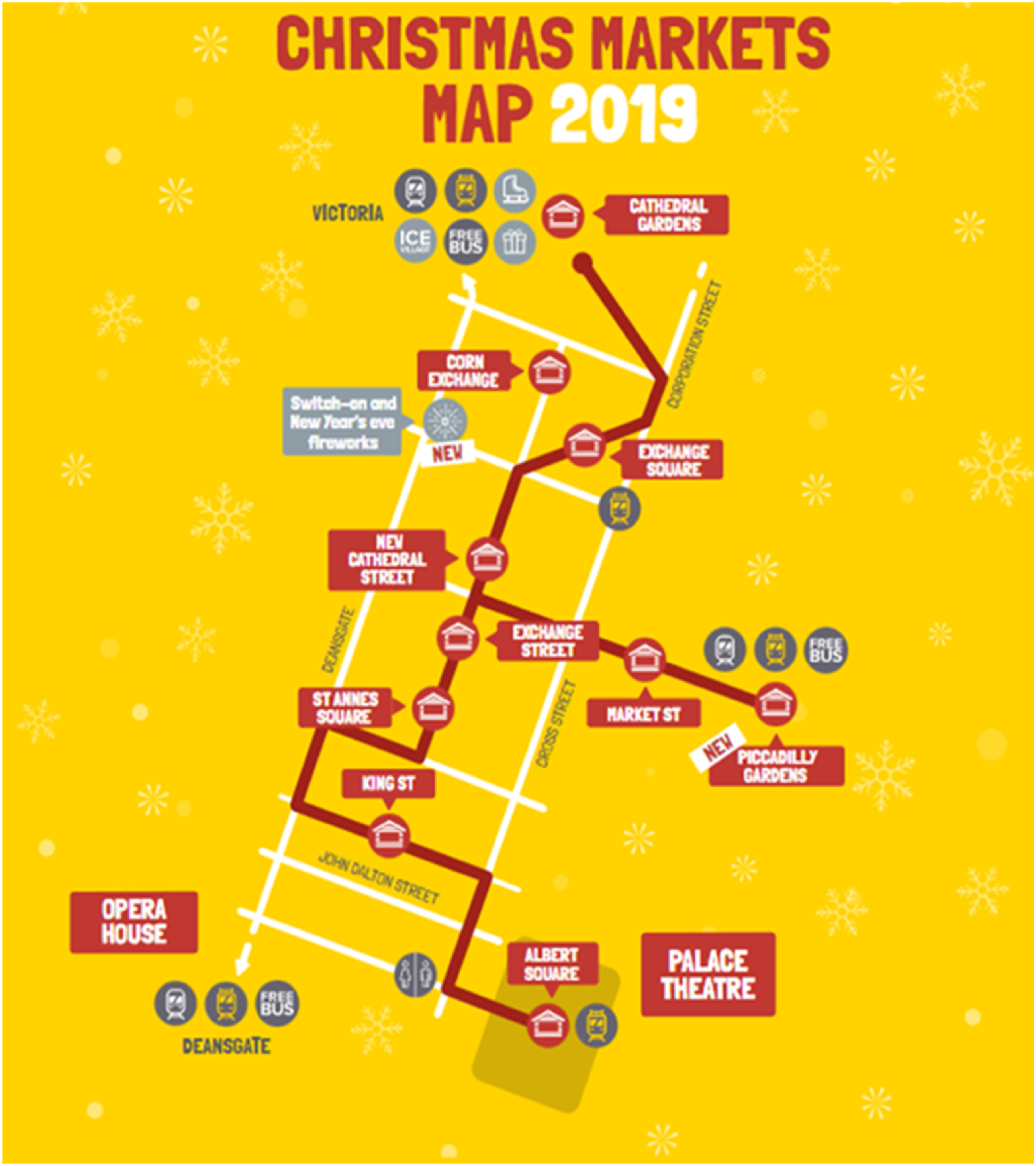
The first author conducted participant observation (20 site visits) at the markets in 2019, 2021, and 2022 across different days and times of the week. Participant observation ‘...bring [s] to the fore emotional and sensory aspects of “being in the field”’ (Wilkinson and Wilkinson, 2024: 174) and has thus been used to study the atmospheres of other consumption sites: from food markets (Hracs and Concha, 2024) to football matches (Steadman et al., 2021). The first author explored each market site, attuned to the spaces’ contrasting multisensory qualities, interacted with stallholders, consumed items (e.g. hot chocolate), and wrote detailed fieldnotes both during observation and following walk-along interviews. Fieldnotes captured the route taken, the multisensory design and qualities of different spaces, behaviours and social interactions. Photographs and videos were also taken to ‘spark...insight into how atmospheres feel’ (Sumartojo, 2024: 161) and elicit reminders of the original research encounter during analysis.
Table of interview participants.
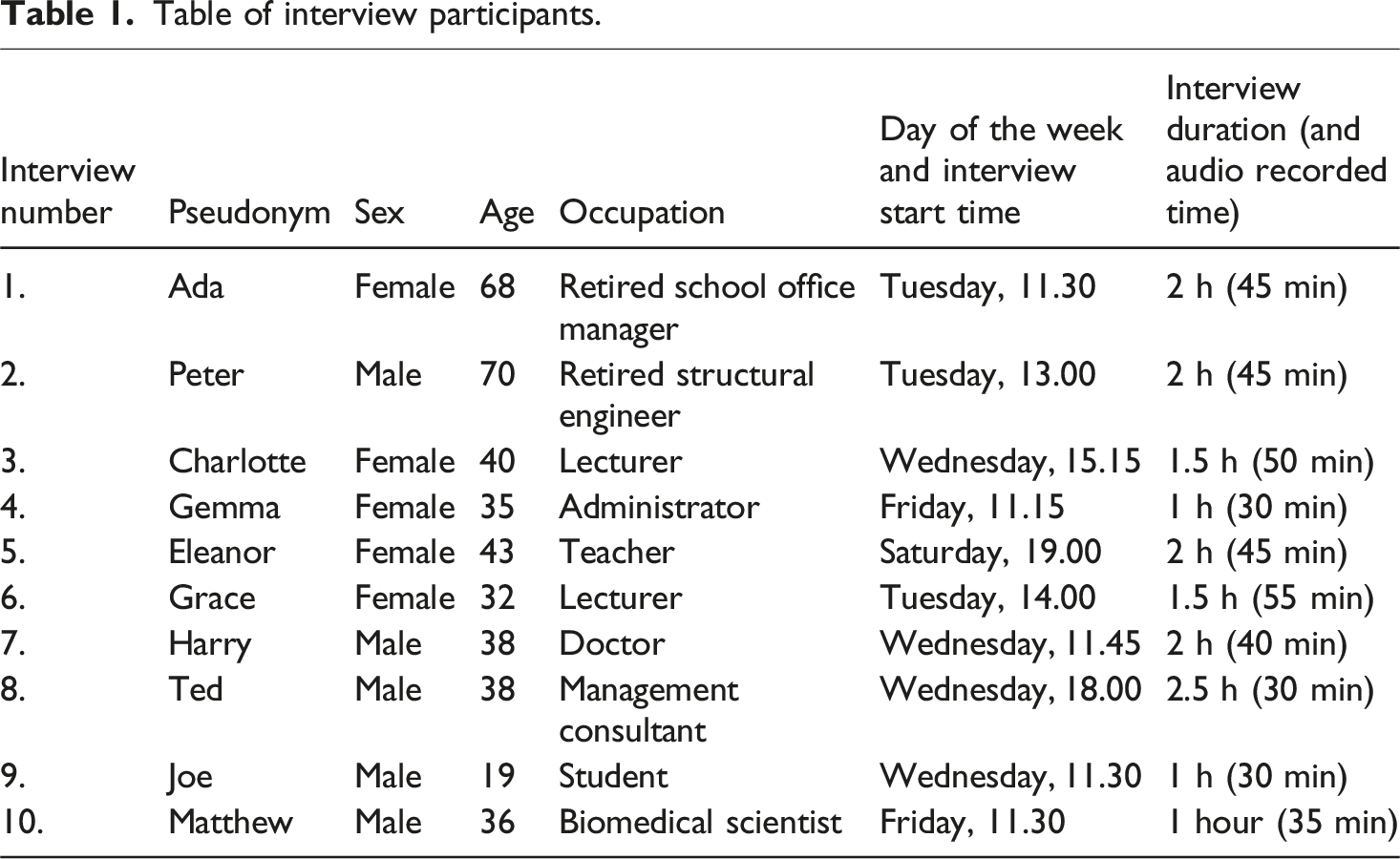
January-February 2020, the first author conducted two sit-down focus groups with 13 market visitors, with 9 participants in the first group and 4 in the second due to more limited availability on the second date. Focus group participants were less varied in age than interview participants (mostly in their 20s, 30s and 40s), yet there was a split in terms of sex and a range of occupations. Whilst walk-along interviews were helpful for capturing real time insights, sit-down interviews remain useful for provoking participants’ reflections of past atmospheres and how they might change (May and Lewis, 2020). Focus groups discussed past market visits, perceptions of atmosphere, and feelings in different areas of the market. Each focus group lasted for approximately 60-min, was audio-recorded with participant consent and transcribed verbatim.
Data analysis conducted by both authors was inspired by reflexive thematic analysis (Braun and Clarke, 2022). This involved reading through the data multiple times and digitally noting down initial codes and themes. We moved iteratively between interview transcripts, fieldnotes, and photographs given the added complexity of environmental cues and disruptions in the in-situ walking interview recordings. Next, codes were further reviewed and refined, with themes such as sensory experience, atmospheric pools, and temporality identified and related to affinities literature in latter stages of interpretation. We were also reflexive about our positionalities. Whilst the first author spent time at the markets during data collection, the second author has spent leisure time at the markets over the years. This first-hand experience is valuable since atmospheres are ‘felt from inside, within, and not in analytical distance’ (Pink et al., 2014: 353) and thus provided added context and insight. In the below, however, rather than presenting our data thematically, to immerse readers more fully into the market’s contrasting micro-atmospheres, we instead offer a journey around Manchester’s Christmas markets, inspired by sensory tours around a sheep head’s farm (Steadman et al., 2023) and the Montreal Casino (Lynch et al., 2020).
Context: Christmas market atmospheres
Evidenced by the surge in Christmas markets, light shows, and grottos, place managers are increasingly concerned with delivering the ultimate Christmas experience (Broeckerhoff and Galalae, 2022), which involves manufacturing an alluring festive atmosphere (Jensen and Fusté-Forné, 2023). Festive atmospheres have been considered in relation to the festive theming of London’s public spaces (Eldridge and Pappalepore, 2019), the ‘happy atmosphere’ of home Christmas lights (Edensor and Millington, 2009), or ‘enchanting Christmas atmosphere’ of Tivoli Gardens (Jensen and Fusté-Forné, 2023). Our focus is on the neglected context of Christmas market atmospheres.
Christmas markets as a European tradition have been present in the UK since the early 1980s, transforming ‘from small-scale spaces of mundane consumption to major global cultural commodities for experiential consumption’ (Broeckerhoff and Galalae, 2022: 81). The LGA (2018) reports around 30 Christmas markets in the UK in 2007, which had risen to over 100 by 2017, during which time they generated over £500 million to the UK economy. Christmas markets are also important sites of multisensory consumption. However, consumers ‘land’ in atmospheres in different ways (Preece et al., 2022) meaning, whilst some might enjoy Christmas markets as ‘unique spaces of traditional festive atmosphere’, others may consider them ‘inauthentic, raucous funfairs’ (Broeckerhoff and Galalae, 2022: 83). Consequently, Christmas markets offer interesting atmospheric dynamics for investigation.
Manchester’s Christmas markets began in 1998 with just 17 stallholders who were exclusively Germanic. They now sprawl across nine city-wide sites and host over 200 stallholders of varying nationalities (Visit Manchester, 2025). The markets attracted over nine million visitors over the 6-week opening period November-December 2013, with the gross economic benefit of the markets estimated to have been £91 million 2013–2014 (LGA, 2018). The markets subsequently extend the Christmas shopping experience across the city of Manchester (ibid). The theme of Christmas itself elevates our context to heightened levels of multisensory experience, since Christmas manifests as ‘a bewitching, affective assault on the human sensorium’ (Hancock, 2020: 803), despite being increasingly steeped in materialism (Miller, 2017). There are a variety of market micro-spaces extending across the city of Manchester, ranging from Albert Square to markets running the length of whole shopping streets like King Street. Their contrasting material and sensory configurations offer a rich lens through which to explore multiple pools of atmosphere. The markets run over a 6-week period in the run up to Christmas Day and are open 10am–9pm, thus enabling us to observe how pools of atmosphere might transform across times of day through fluctuations in light, weather, and density.
Findings: A tour around Manchester’s Christmas markets
We now take readers for a tour around Manchester’s Christmas markets to convey the shifting atmospheric qualities felt by the first author and participants as they navigated the different market micro-spaces. We will sojourn three market sites producing distinct affinities, beginning with the market’s beating heart: Albert Square.
Albert Square: Bustling festive atmospheres
Albert Square is a large, paved, pedestrianised urban square overlooked by the Grade I listed neo-gothic Town Hall, flanked by roads and a range of mostly Victorian buildings housing offices, restaurants and bars. The wide spatial layout of the square gives the Christmas markets a feel of being enshrouded within the shadowy urban perimeter. The markets are organised around the central Prince Albert memorial in front of which one finds a popular sausage stall. There are several aisles formed by alpine wooden hut stalls which permeate out from this central hub. Through its warm festive lighting, rising food smells, and bodies gathered closely together, Albert Square envelops me in its warm embrace, immediately giving the impression of a rich pool of festive atmosphere. As Ellie concurs, ‘...You’re in the markets, you don’t feel like you’re in Manchester anymore’ (Focus group 2).
There is a sense of Albert Square being the hub of the markets, enticing visitors into its multi-sensory vortex, reflecting the ‘seductive’ quality of atmospheres (Biehl-Missal and Saren, 2012). Interview participant Peter noted, ‘I think the centre is Albert Square with the Town Hall… I would say that’s the place that people sort of go’, whilst Ted echoed, ‘I think the Town Hall one is obviously, it’s a nice focal point… It gets absolutely packed and so I probably only go there’. As I look around, warm lighting, wooden huts, and Christmas garlands (Figure 2) combine to visually evoke the spirit of Christmas more intensely than the other market sites, with potent affinities ‘enchanting’ the square (Mason, 2018). For Charlotte, ‘...there is a Christmas feel right now’, with festive affinities becoming more potent closer to Christmas, as for her ‘the feeling is more Christmassy the closer you get’, indicating how the emotional and affective intensity of atmospheres can also fluctuate (Steadman et al., 2021). For pools of atmosphere are not static, but can ebb and flow, such as when day turns to night: When I first arrived at the markets it was still light and slowly twilight emerged and then darkness... It really looks beautiful because it is dark enough to see the brilliance of the lights but yet not dark enough to obscure the town hall… The time of day really has a huge impact on the experience and the atmosphere (fieldnotes). Wooden ‘Weihnachtspyramide’ and drinking hut.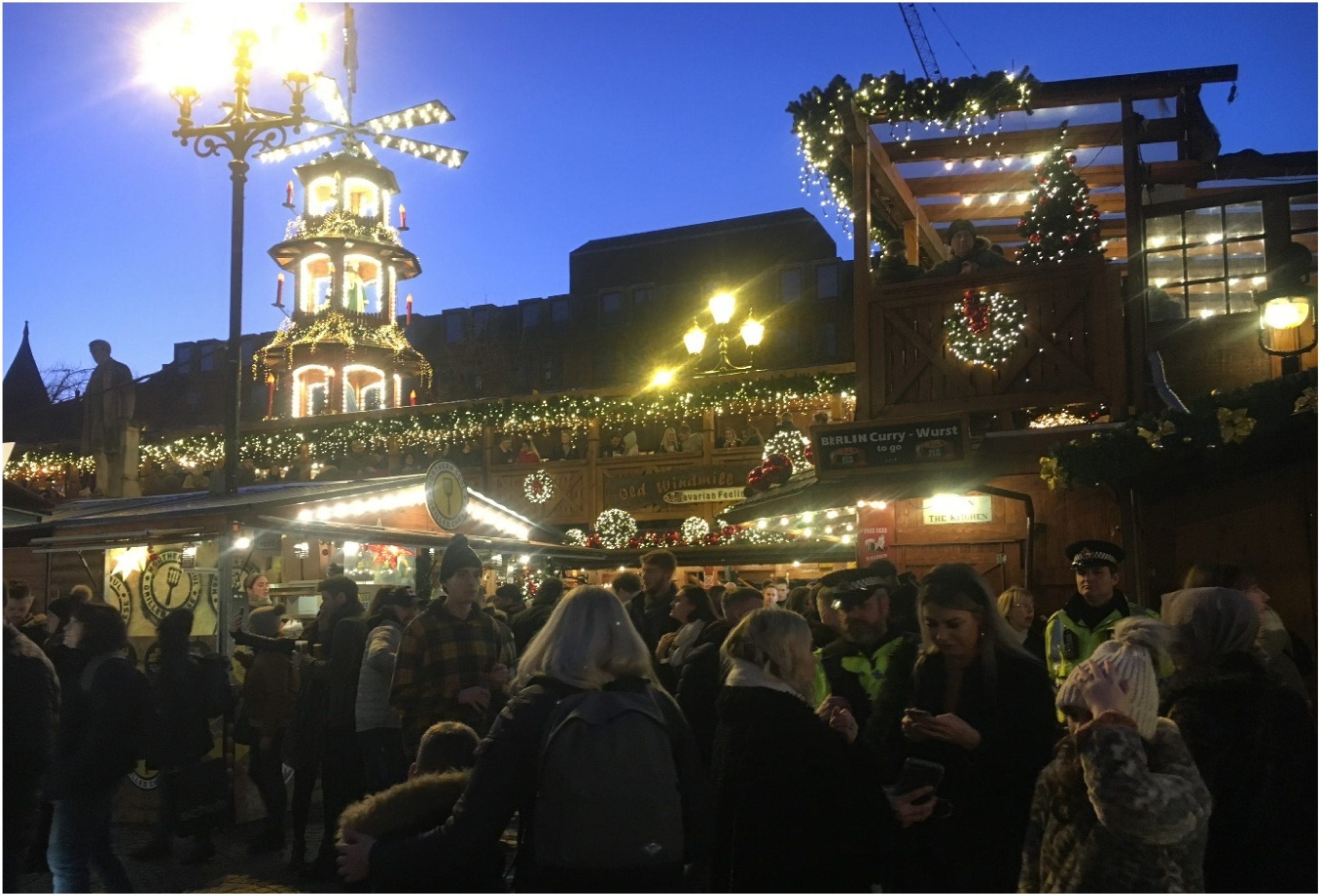
It is not only visual stimuli which elicit the festive atmosphere, but smells can evoke memories of past visits and an eager imagining of what lies ahead, as ‘the nostrils awaken a forgotten image’ (Pallasmaa, 2005: 54). There is attunement to the olfactory atmospheres (French and McLean, 2024) infusing the space informed by familiar smells from past visits or ‘historical affinities’, indicating a ‘temporal layering’ of the space (Mason, 2018). As ‘I start to smell cooked food, I imagine sausages sizzling on the large grills that I know will be there from previous visits’ (fieldnotes) and follow the source of the smells. Navigating past the more central market stalls, I find myself in the centre of the square facing a large round stall with a huge smoking grill in the middle. As Hracs and Concha (2024: 10) explain, ‘food possesses an agentic capacity’, in this case drawing visitors towards the central food stalls, which function as a ‘centre of experience’ (De Molli et al., 2020) in the wider square by emitting particularly powerful and ‘magical’ affinities. As Eleanor observed, for some stallholders ‘it’s almost like a forcefield around their stalls’, whilst Ted remarks, ‘there’s always loads of people around the sausage stall’. Here, the cosy festive atmosphere is at its most intense, influenced by the presence of multiple sensations acting as ‘forces, flows, energies and atmospherics, sometimes feeling ethereal or mystical’ (Mason, 2018: 46). People appear roused by the sounds and smells of sizzling sausages and sensation of hot steam rising which creates a ‘smokescape’ (Jensen and Fusté-Forné, 2023) creating intense affinities, for food and drink are ‘active ingredients’ co-producing market atmospheres (Hracs and Concha, 2024): I can hear sizzling and see clouds of smoke rise up and then disappear into the night sky. The smell of the sausages is very strong here... It is the busiest point... I notice the people here are lingering more; they don’t seem to want to move on, happy just to soak up the atmosphere... (fieldnotes).
Opposite is a wooden drinks stall selling hot glühwein with a large singing Rudolf’s head attached to the front (Figure 3). The intermingling of Christmas décor, spicy scents of glühwein and charcoal smell of sausages, with festive songs and hum of people talking and laughing, gathered to have a drink, creates a rich and intense Christmas atmosphere, with the festive affinities made more potent by the collective experience (Mason, 2018). The textures of hugging a mug of hot glühwein further deepens the atmosphere, with a ‘thermalscape’ (Jensen and Fusté-Forné, 2023) rising, encouraging consumers to dwell in the space. As Charlotte remarked, ‘I like to cup it [the hot glühwein] and it almost plays into the whole Christmas theme. It’s cold but we are having something warm’, further revealing how multiple sensations combine to produce festive affinities. Wooden 'Weihnachtspyramide' (traditional German pyramid shaped Christmas decoration) and drinking hut.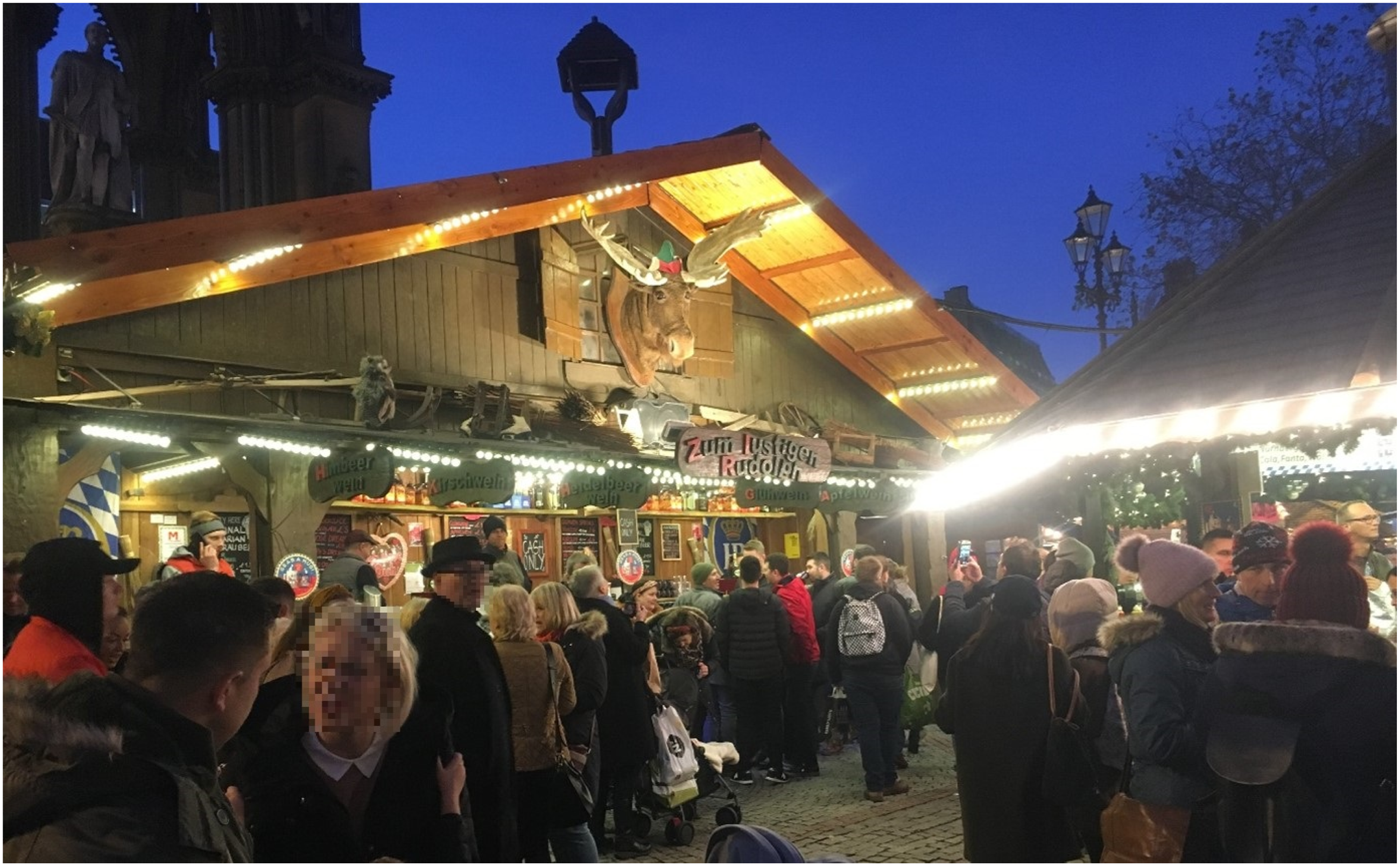
Leaving the singing Rudolph bar behind, I meander back through the busy market stalls, turn a corner and see a large, covered tent. I venture inside and am struck by the immediate change in atmosphere, which has shifted from feeling festive to a party atmosphere. Festive music has been replaced by upbeat songs more fitting to a nightclub, it is dark inside and I feel uncomfortably close to others, with the overcrowding hindering the experience (Egresi et al., 2021). I observe, ‘the feeling is one of being in a little microcosm, not part of the festivities outside’ (fieldnotes). Ada likewise feels the dance music diverges from the other sensory qualities of the market, which leads to an unfavourable perception of this space due to perceived sensory incongruence (Spangenberg et al., 2005): This bar is playing music that isn't really very good. Personally, I get more into the Christmas spirit when they play a few Christmas carols, which I think if it's a Christmas market they should be playing. It gets you into the mood somehow (Ada).
Eager to escape the bustling hubbub and ‘flushed’ out of the space by ‘affects of discomfort’ (Kuruoğlu and Woodward, 2021), I emerge out of the far side of the bar and onto the edge of the square. There was a frequent acknowledgement that the multiple, smaller side street markets or less central aisles provided some respite from the sometimes overwhelming atmospheres of the central stalls in Albert Square. Busy is one of the most common adjectives used by participants to describe the atmospheres of Albert Square; however, there appears to be an atmospheric ‘tipping point’ (Anderson and Ash, 2015) between the market feeling vibrant or overcrowded. As Ellie commented, ‘I think it definitely cheers you up to begin with… there seems to be kind of a turning point… instead of it being exciting and busy, it’s just busy’ (Focus group 2), highlighting the potentially toxifying nature of affinities (Mason, 2018) which can surface through the sensory clashes emerging in ‘synchronous spaces’ (Steadman and Millington, 2025). Michelle similarly noted: I do think like the bustling and the busyness is nice for a little bit, like it's that feeling of Christmas and community... I think you get to a point where you're almost saturated and you’re kind of like that's enough hustling and bustling around people, let's go somewhere else now’ (Focus group 2).
Although relieved to escape the sensory overwhelm of the central spaces, the peripheral areas are darker, there are fewer people, and the stalls do not feel as festive (Figure 4). Here the impact of light and dark to effect atmospheric experience is evident (Lineham, 2024). Charlotte too, walks along edges of Albert Square and observes, ‘it definitely feels different. You feel you are on the peripheral for sure… I feel that this is different from being right in the kind of heart of the Christmas market…’ Charlotte’s experience emphasises the difficulty in pinning down a singular atmosphere due to their shifting nature, supporting Mason's (2018: 46) view, not only that sensations are multiple, but affinities ‘emanate (and circulate, and reverberate), operating in a multi-way dynamic’. Keen not to venture back into the bustling central spaces, I leave Albert Square to explore some of the smaller sites across the city, beginning with King Street. The quieter peripheral areas of Albert Square.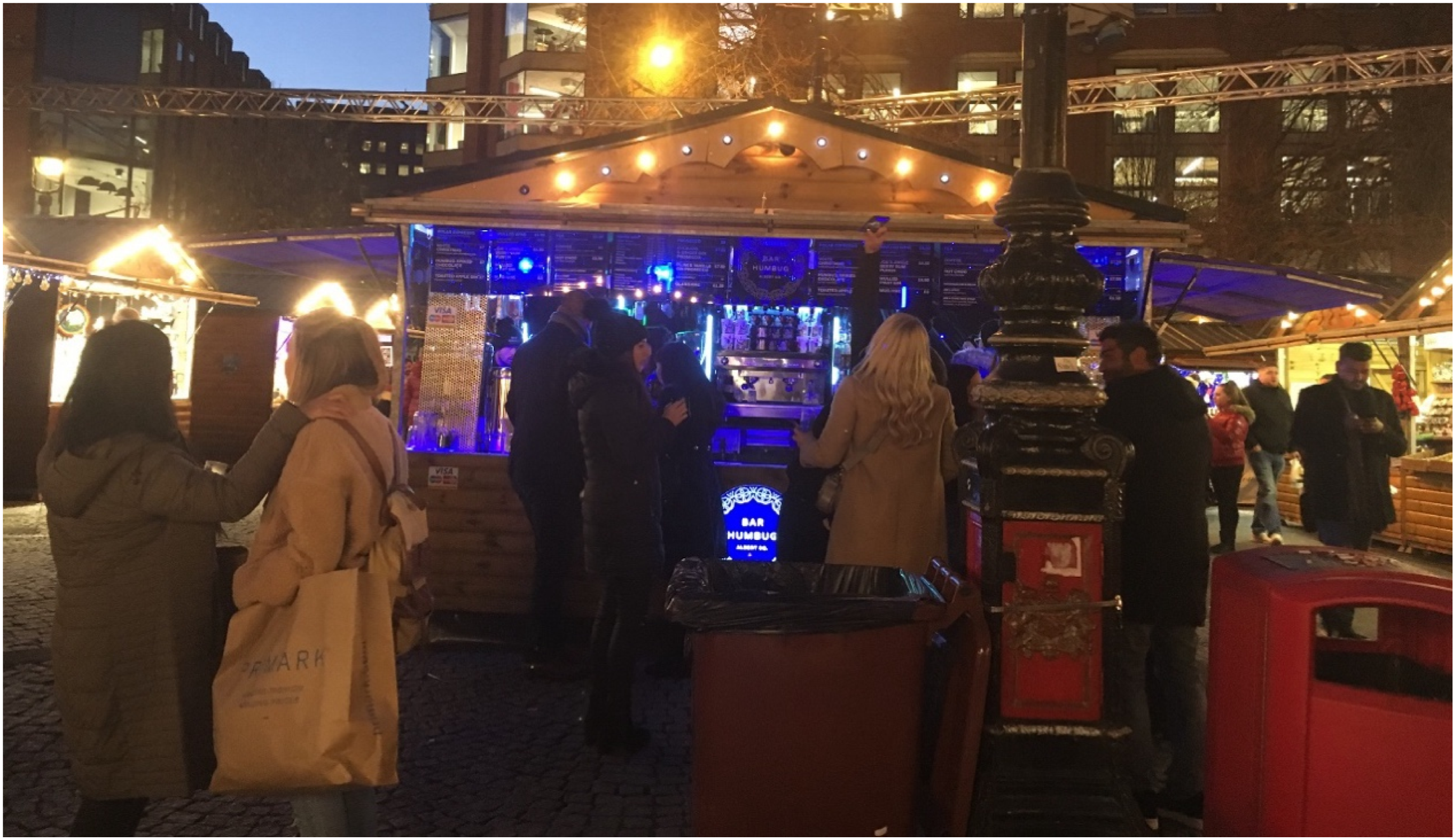
King Street: Subdued upmarket atmospheres
The expansion of the Christmas markets across the city has splintered its atmosphere into multiple sites with contrasting material and multisensory configurations. As Ada reflects, ‘...now it’s all over the city...there are lots of side streets, other places you can go and see, so it makes it more of a day out’. King Street is a short walk from Albert Square and is a pedestrianised premium shopping street lined with upmarket shops housed in historic buildings. In comparison to the larger, more open layout of Albert Square, King Street is a narrower, enclosed street where a higher concentration of food stalls follow a linear layout, occupying the middle section of the street, allowing for pedestrians to walk either side (Figure 5). As I stroll down King Street, I am immediately hit by a multisensory concoction of cooking food smells, sights, and sounds, which combine to create a cosy ambience, echoing how visitors to Tivoli Gardens often crave hot food and drinks, driven by anticipated feelings of cosiness amidst the cold weather (Jensen and Fusté-Forné, 2023): I wander down King Street and absorb a mix of smells as I go – mulled wine, sweet smells of deserts and fried foods... Steam floats off into the cold air above from hot pans of garlic mushrooms and fried potatoes. I love the sizzling sounds and the steam coming off the pans. It’s somehow quite cosy (fieldnotes). The rows of food stalls on King Street.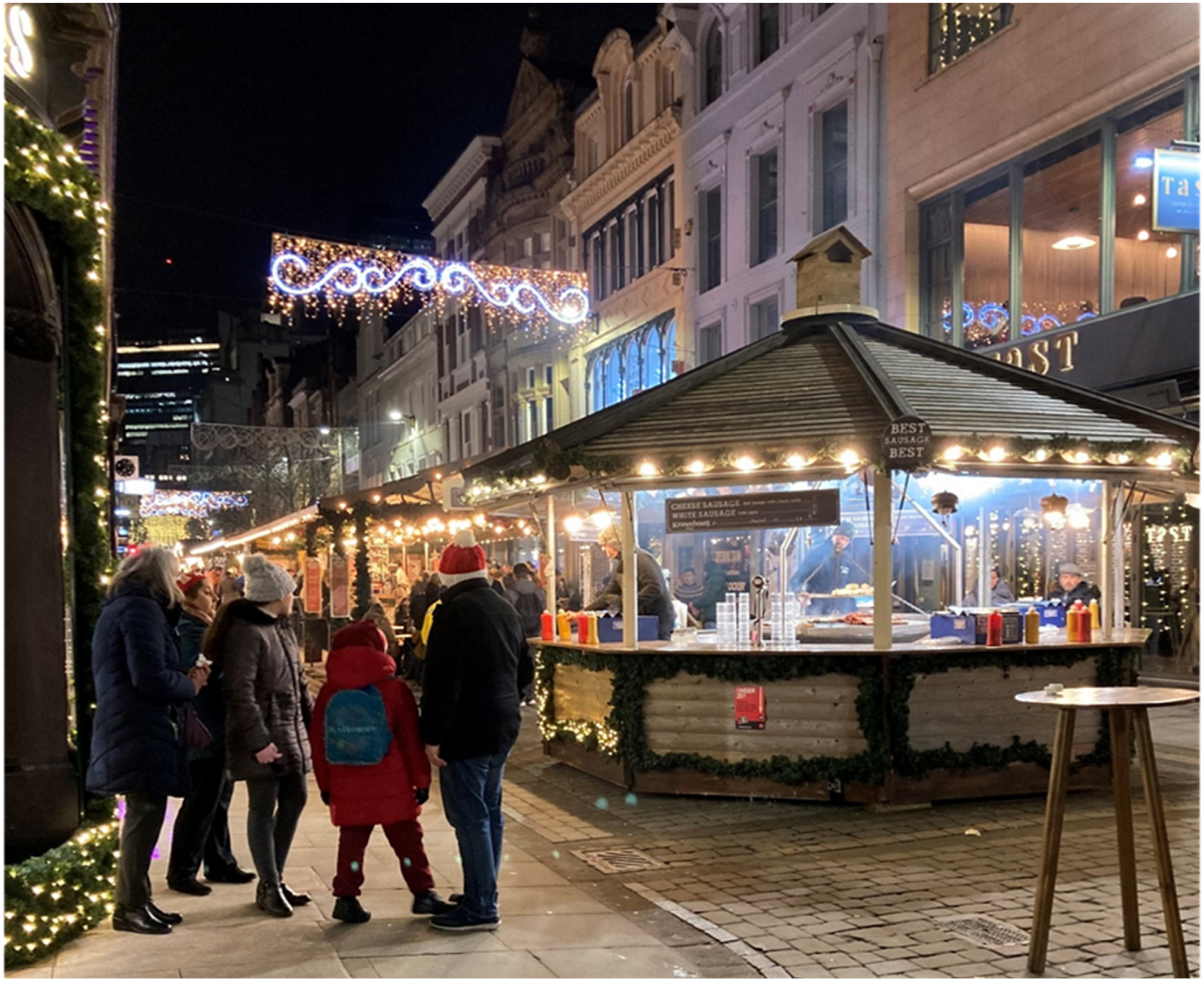
However, this cosy olfactory atmosphere (French and McLean, 2024) soon dissipates given ‘atmospheres arise from configurations of multiple elements that change all the time’ (Sumartojo, 2024: 162) and affinities are ‘lively’ (Mason, 2018). My attention turns to a series of underwhelming sights that do not appear to fit with the Christmas theme (Figure 6), such as ‘a garden furniture stall which looks a bit like a building site’ and suddenly ‘I’m not feeling the magical atmosphere I expected’ (fieldnotes), reflecting the ability of discordant sensations to induce a shift in consumer experience (Larsen and Patterson, 2025; Spangenberg et al., 2005). Harry echoes my feelings, remarking how ‘it doesn’t feel quite as Christmassy at these ones… It seems a bit more upmarket, maybe here, or a bit more relaxed… a more upmarket feel’. This concurs with Nordvall (2016) who recognised the conflict between creating a Christmas atmosphere across sprawling areas, which can dilute the cosy Christmas feel. A garden furniture stall on King Street.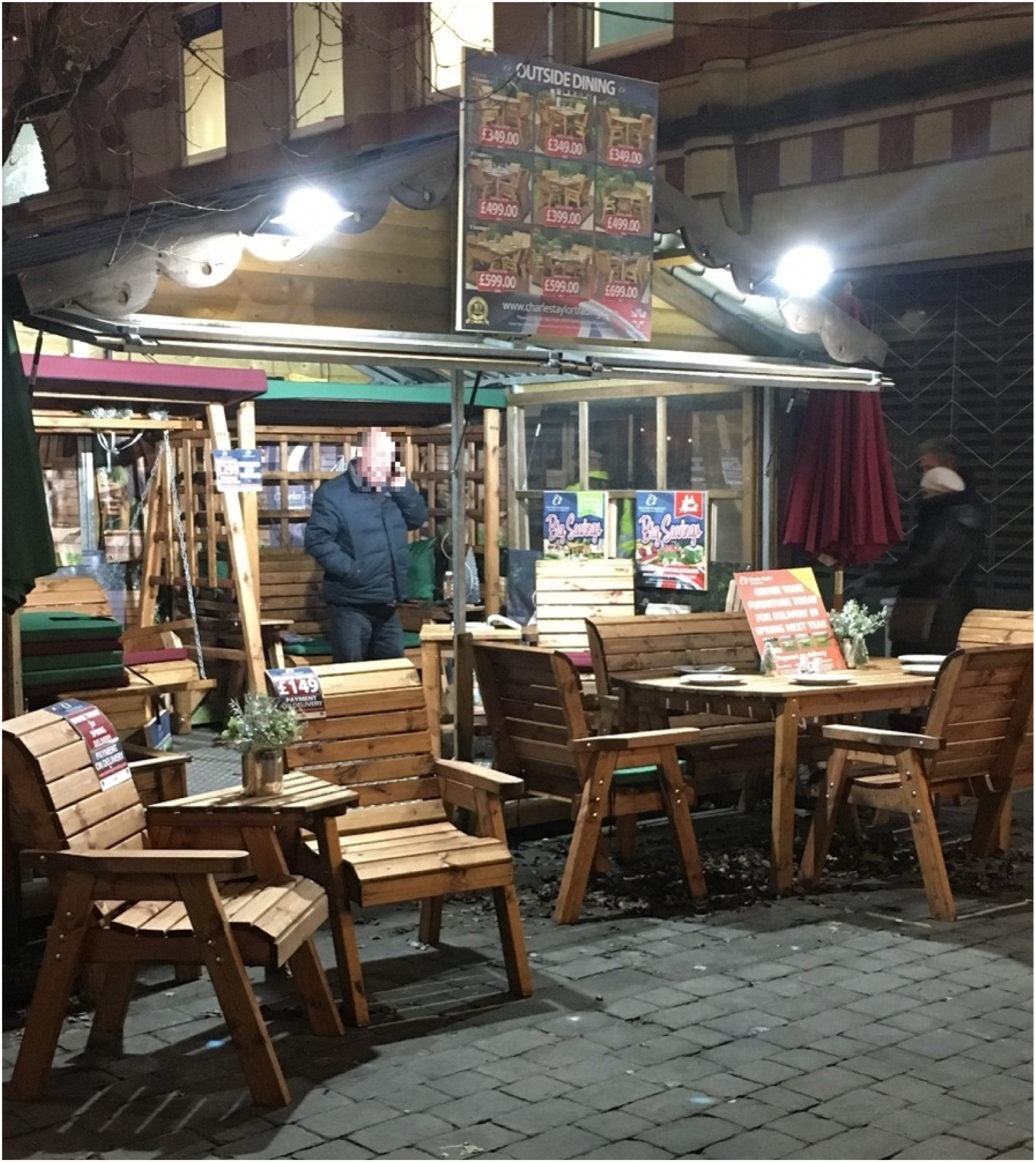
Like Harry, I do feel more relaxed in this space, however, and observe ‘the whole market has a totally different vibe to the one at Albert Square’ (fieldnotes). The more relaxing atmospheres are evoked by the lower density of bodies, reduced intensity of sensory stimuli such as more understated lighting, and the relaxing sounds of popular Christmas songs in a jazzy style playing softly in the background. As Ellie concurred: Each section has a slightly different feel... King Street tends to be quieter... In previous years we've kind of gone to the main markets and then once we've got fed up moved to there because it's easier to get seats and it's a bit quieter... (Focus group 2).
King Street, therefore, is often considered the quieter, upmarket area where people go to avoid the overwhelming crowding of Albert Square. But there is not a singular upmarket or relaxing atmosphere enveloping King Street, reflecting how ‘...atmosphere of place is made up of simultaneous interacting, overlapping and sometimes contradictory “micro-atmospheres”’ (May and Lewis, 2022: 86; their emphasis). Contrasting pools of atmosphere are encountered as visitors walk along the street, often influenced by a ‘sense of wondering, or imagining, or remembering…as relational lines of energy and forces of affinity’ (Mason 2018: 54). For example, Harry gestured towards a particular café which he tells me ‘is quite nice because it is covered over and it is more relaxed and there is seating’ as he remembers past enjoyable visits with friends, in comparison to the stalls without seating areas and shelter from the elements which can feel less relaxing. As I walk even further along King Street away from the café, I experience ‘...pockets of quiet which almost feel eerie ...the spacing of the huts at points feel quite far apart’ (fieldnotes), which is especially felt at night-time when darkness sets in, echoing how dark stairwells in housing estates can evoke an eerie atmosphere (May and Lewis, 2022). The atmosphere has notably shifted from relaxing to unsettling, with negative affinities bubbling up ‘toxifying’ the experience (Mason, 2018). Feeling a bit anxious and eager to get back into the Christmas spirit, I wander over to St Ann’s Square.
St Ann’s Square: Discordant and disruptive atmospheres
St Ann’s Square is the site of Manchester’s first ever Christmas market. At one end is the historic St Ann’s Church and a cobbled more traditional square. The site has a rectangular layout and merges onto New Cathedral Street at the other end, with much of this part of the square surrounded by shops housed within historic buildings. The site feels more open than the narrow and cosy King Street, yet on a smaller scale than Albert Square. The market stalls line both sides of the square with multiple walkways for accessing the market from various directions. Entering St Ann’s Square, I am initially immersed in a festive atmosphere, where ‘this part of the markets feels more Christmassy [than King Street] with the old church to the side and more traditional looking stalls… It is busier here’ (fieldnotes). However, a photobooth caravan on the edge of the market ruptures the Christmas mood. It has shiny curtains and a large lit up sign saying ‘photo’ on the roof, feeling out of keeping with the festive spirit (Figure 7). The photobooth caravan.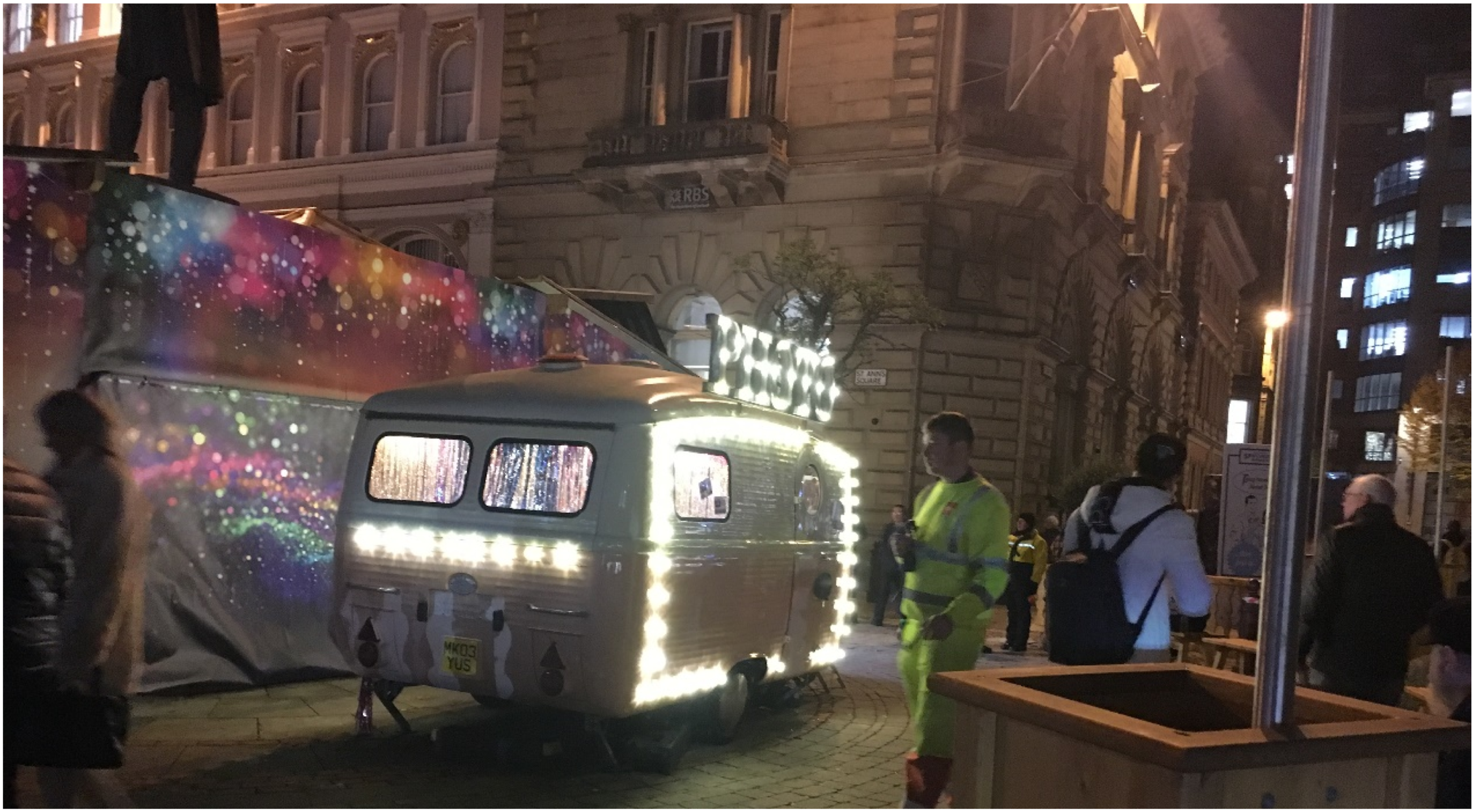
I wander away from the caravan down one of the aisles in search of a more Christmassy atmosphere and notice each stall elicits its own distinct ‘pool of affect’ (Edensor, 2012), depending on its design and merchandise. For instance, at one stall I visited with an interview participant we looked at bath bombs and tried on cosy hats, which produced festive affinities; yet, I now approach a stall selling metal objects, many of which have a Star Wars theme, which has a completely different vibe (Figure 8). I suddenly feel cold and shiver as my body responds to the cold blue LED lighting– a colour of lighting ordinarily used in supermarket toilets to discourage drug usage (Lineham, 2024), in opposition to the warm lighting used to create a cosy feeling of ‘hygge’ (Bille, 2020). There is nothing festive about this stall; as Charlotte agrees ‘this does not really appeal to me… I have stopped because I am thinking, “gosh, I didn’t expect to see this here”, more than “I am stopping because I like it”’. This atmospheric clashing and disorientation (Steadman and Millington, 2025) is also part of the charge of affinities, as there can be affinities of ‘opposition, alterity or negativity’ just as positive ones (Mason, 2018: 1). Changing weather can further contribute to feelings of sensory discordance as visitors might hope for a cold yet dry wintery day, but in reality ‘if it’s wet, it’s just, it’s so miserable because there is nowhere to be sheltered from the rain and rather than enjoying what’s going on, I just think it’s wet, it’s wet, it’s wet’ (Matthew, Focus group 2), literally dampening even the most potent pools of festive atmosphere. An unusual market stall in St Ann’s Square.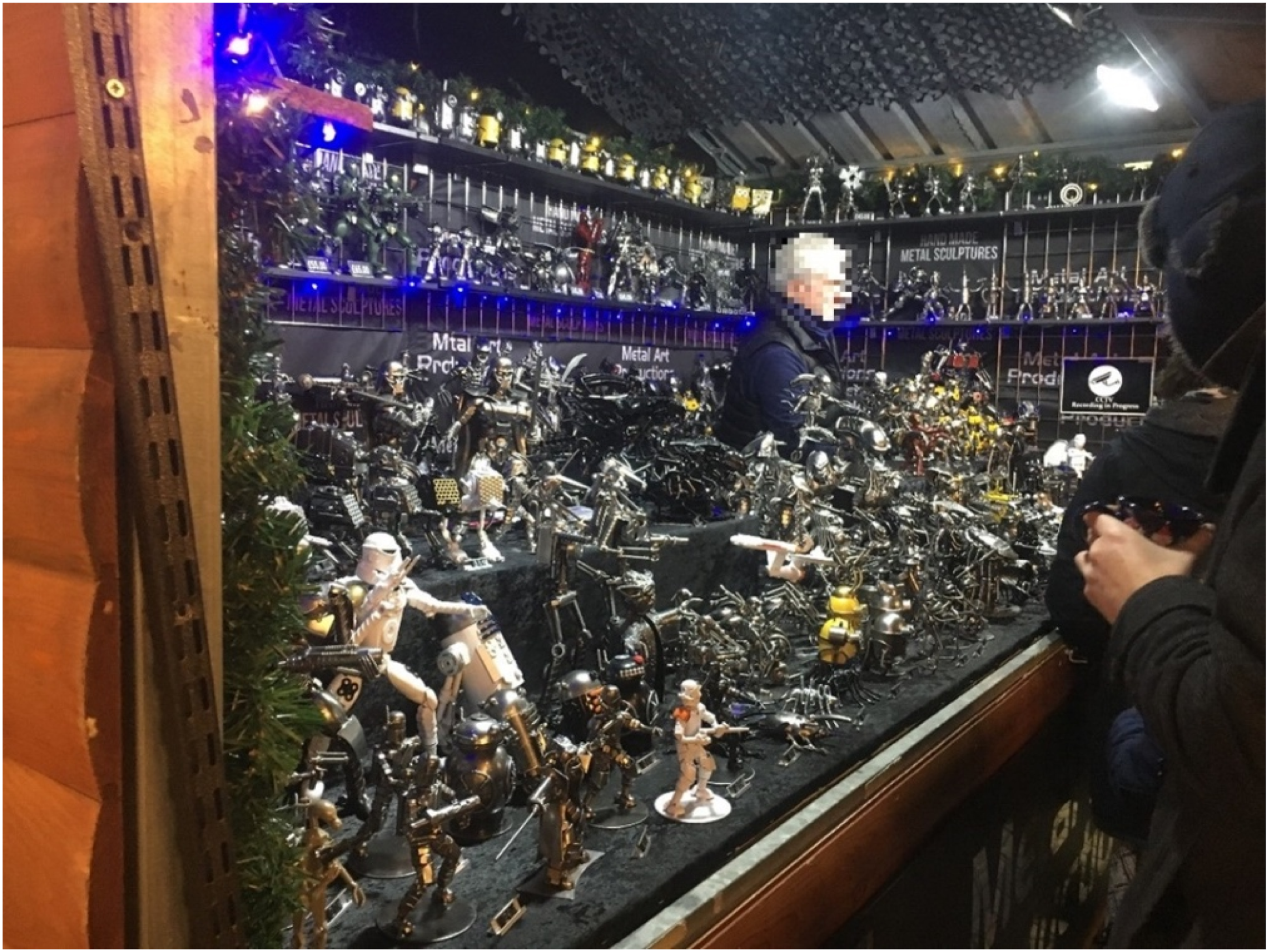
As I ramble onwards, there is a nice linear flow to the market which leads down to New Cathedral Street and onto Exchange Square. Matthew observes how people tend to move through this space more quickly than Albert Square, as ‘if it’s just a like a little strip like St Ann’s, for example, it’s more like walking through the street rather than being at a Christmas market. You just walk up and down it dead quick’. There are several interesting features to observe along the way which grab my attention, such as a man dressed as a traditional nutcracker, a busker, and a fake tree with a face that talks: There is a busker who is singing opera… Some small children are watching and throwing coins into his case. The man has a good voice and is holding everyone’s attention… but it seems strange to me that everything he is singing is totally unrelated to Christmas. The music here is very loud and changes the atmosphere to provide an unintentional break in the market (fieldnotes).
The sense of atmospheric disruption (Steadman et al., 2021) caused by lack of Christmas music, which creates a ‘dissonant sonic ecology’ (Larsen and Patterson, 2025), is further compounded as I notice a homeless woman on the shadowy edge of one side: There is a homeless man comforting her, stroking her back trying to warm her up. They are surrounded by sleeping bags... A DPD delivery man asks how they are. The man says he is a lot better now but the woman seems hardly rousable. Two young girls look on and question what they are doing... (fieldnotes).
The spell of the markets is now broken for both me and other onlookers and my mood changes to one of sadness, as I realise that not everyone is welcomed into the markets, reminded of how consumption settings are often designed through their ambient qualities to exclude certain social groups (Kuruoğlu and Woodward, 2021; Steadman and De Jong, 2022). The festive atmosphere of the markets seems to function as an invisible line separating them from the goings-in in the wider city– or as a ‘temporary Christmasscape’ (Jensen and Fusté-Forné, 2023). However, since atmospheres are ‘porous’ (Steadman et al., 2021), sometimes the atmospheres outside the markets in the wider city can seep into the market spaces, reminding visitors that not everyone has the luxury to get into the Christmas spirit; for Christmas reinforces the divide between the ‘haves and have nots’ (Salonen, 2016). As Paiva and Sánchez-Fuarros, 2021: 394) contend, ‘there is always something that escapes… that interferes with the planned atmosphere’. With negative affinities now seeming to ‘toxify’ this space (Mason, 2018), I leave the markets for the day.
Concluding discussion
This paper took readers on a journey around three areas of Manchester’s Christmas markets with distinct atmospheric qualities. These micro-spaces functioned as ‘facets’ generating ‘flashes of insight’ (Mason, 2018) into consumers’ experiences with contrasting pools of atmosphere in consumption spaces. First, we sojourned the bustling atmospheres of Albert Square, revealing how the heady combination of festive décor, sizzling sausages, and warm bodies gathered in the busy central stalls co-produce potent festive affinities. But, smaller pools of atmosphere are also encountered, such as the party vibe of the bar tent and eerie feel of the quieter, darker peripheral aisles, sometimes generating negative affinities. In contrast, King Street produces subdued upmarket atmospheres through its high concentration of food stalls, combined with lower density of people and understated Christmas décor. Yet the street also contains micro-spaces eliciting their own distinct vibe, such as the quiet and relaxing seating areas around the bars. Finally, rather than enveloping consumers in a dominant atmosphere, St Ann’s Square contains contrasting pools of atmosphere, some of which can disrupt the consumer experience (Steadman et al., 2021), such as performers singing non-festive songs and stalls selling non-Christmassy items.
Subsequently, our main contribution lies in revealing how consumers might sense multiple contrasting pools of atmosphere, rather than ‘a single, overarching, or dominant one’ (Anderson and Ash, 2015: 42). Existing research tends to describe a dominant atmosphere pervading a consumer setting (e.g. Dion and Borraz, 2017; Rokka et al., 2023), whilst emergent work is beginning to recognise how multiple atmospheres might be driven by temporal fluctuations, differing perceptions, or unpredictabilities (e.g. Degen and Lewis, 2019; Edensor, 2012). We instead foreground the spatial and multisensory drivers of atmospheric multiplicity and drill down to a smaller spatial scale than existing literature. By immersing readers in contrasting pools of atmosphere at the Christmas markets we demonstrate how, not only do distinct market sites afford different atmospheres (i.e. Albert Square vs King Street), but so do the micro-spaces found within each site (i.e. central stalls vs peripheral aisles), focusing on the multisensory configurations of single stalls, tents, bars, and aisles, as well as wider market sites. Our study therefore advances thinking on the consumption of atmospheres beyond notions of singularity and the overall ‘tonality’ of place (Thibaud, 2014) and builds on bourgeoning work which recognises how consumption environments can contain multiple distinct, overlapping or sometimes clashing atmospheres (Anderson and Ash, 2015; Degen and Lewis, 2019; May and Lewis, 2022).
Our secondary contribution is extending ‘affinities’ theorising into consumer culture, which Mason (2018: 3) describes as ‘an invitation to think and theorise differently’. Thinking with affinities sensitised us to the shifting mix of human and non-human forces co-producing the contrasting feel of market micro-spaces. Affinities encourages a move beyond identifying and describing the human and non-human entities being connected together, as may be the case with assemblages theorising, for example (Mason, 2018; Wilkinson and Wilkinson, 2024). Instead, affinities enables greater attunement to the potent sparks, charges, and forces that arise and can be felt through the process of the things being connected together (Mason, 2018), such as people’s interactions with light and dark, decor, sounds of music, chatter, and sizzling sausages, smells of cooking food, tastes of glühwein and hot chocolate, and warmth of rising steam, hot drinks and bodies gathering. Future research could extend affinities theorising into other experiential consumption contexts containing distinct micro-spaces and atmospheres, such as themeparks or music festivals.
Finally, our findings hold implications for market managers seeking to produce an enjoyable consumer experience. On the one hand, participants enjoyed the excitement of encountering heterogenous spaces and stalls, as this can fuel a sense of discovery and delight (Hracs and Concha, 2024; Lynch et al., 2020). On the other hand, perceptions of sensory discordance (Larsen and Patterson, 2025), such as non-festive music playing or stalls selling non-Christmassy items, led to negative atmospheric experiences. This highlights the importance of maintaining a careful balance between offering exciting pools of atmospheric difference for consumers to explore, whilst also ensuring some level of thematic coherence (Steadman and Millington, 2025). Relatedly, participants identified an atmospheric ‘tipping point’ (Anderson and Ash, 2015) between the market feeling vibrant or overwhelmingly busy. It is therefore important to consider the spatial layout of markets to ensure they are busy enough to feel lively, yet not overly congested, with more relaxing micro-spaces potentially being built in to provide consumers with temporary pools of respite from the bustling hubbub of central market spaces.
Footnotes
Acknowledgements
We would like to thank the participants who kindly agreed to take part in this study. We also thank the reviewers for their constructive feedback on earlier versions of our manuscript.

Ethical considerations
This study was approved by the Manchester Metropolitan University Business and Law Research Ethics and Governance Committee (approval no. 15004) on November 01, 2019. Respondents gave written consent for review and signature before starting interviews.
Funding
The authors received no financial support for the research, authorship, and/or publication of this article.
Declaration of conflicting interests
The authors declared no potential conflicts of interest with respect to the research, authorship, and/or publication of this article.
Data Availability Statement
The datasets generated during and/or analyzed during the current study are available from the corresponding author on reasonable request.