



Abstract
While consumption and identity have been intimately connected in both everyday life and academic research, the practice-theoretical turn has led to identity being sidelined in consumption research. This paper explores how people make their identities discursively available through accounts of textile disposal and how identity affects what makes sense for them to do. Based on interviews with Norwegian households, two major life transitions, cohabitation and parenthood, are examined as sites for negotiations of clothing and textile disposal. Findings suggest that cohabitation alters the physical location and context of relationships, requiring couples to negotiate shared material arrangements while navigating expectations of proper cohabitation. Similarly, transitioning to parenthood reshapes daily practices, as parents navigate competing practices of sustainability and family life. Findings reveal a parental learning process in which understandings of consumption evolve, shifting what is seen as “appropriate” or “necessary”. This paper contributes to a nuanced understanding of consumption as it views individual identity as influencing the performance of practices and the materials deemed necessary, thereby extending the understanding of consumption beyond mere engagement in practices. Individual variations in practice enactment highlights consumption as a complex process encompassing both mundane, routinized behaviors and reflexive practices of accounting for these behaviors.
Introduction
Consumption and identity are closely intertwined in both everyday life and academic work. Previous studies on identity in consumption have predominantly focused on how acquiring items expresses identity, emphasizing their symbolic meanings and the signals they convey in identity formation (Halkier et al., 2011). Fashion consumption studies, for instance, have emphasized how people use clothing and other fashion items to express themselves and construct their personalities through stylistic choices (van der Laan and Velthuis, 2016). Similarly, research on motivations behind home decorations has considered it an individualistic activity, with the home serving as a key site for identity expression (see for example Cieraad, 2002; Clarke, 2021; Gram-Hanssen and Bech-Danielsen, 2004; Hauge and Kolstad, 2007; Young, 2004). The practice turn in consumption research shifted focus towards the routinized and mundane aspects of consumption (Halkier et al., 2011) as a response to the earlier ‘cultural turn’, which emphasized lifestyle, identity, taste, and the symbolic dimensions of consumption (Welch et al., 2020). Over the past three decades, practice theory has significantly influenced discussions and research on consumption (Evans, 2019; Halkier and Jensen, 2011). In this framework, consumption is not regarded as a practice but as a moment within practices, where consumption desires are generated through practices rather than originating from individual preferences (Warde, 2005). Within clothing research, this perspective has reframed consumption as habitual and routinized rather than a deliberate process of identity construction (Chamberlin and Callmer, 2021; Miller and Woodward, 2012; van der Laan and Velthuis, 2016).
However, scholars have argued that the practice turn has resulted in a neglect of the reflexive individual’s capacity not only to perform practices but also to make practices discursively available, accountable, and negotiable in social interactions (Christensen et al., 2023; Welch et al., 2020). In response, this paper proposes an understanding of identity as closely tied to reflexivity. By explaining and justifying their practices, people engage in reflexive processes that express and shape their identities within shared cultural frameworks. This paper employs the concept of identity to explore textile disposal, aiming to better understand how people make sense of and perform everyday practices. Although identity has been applied in prior social practice research (e.g., Bottero, 2015; Lindemann, 2014; Mateer et al., 2021), it remains underutilized in practice-theoretical consumption studies. An exception is Weber and Francisco Maffezzolli (2022), who explored the relationship between consumer culture and social identity. However, while they conceptualize identity as based on social group affiliation, this paper views identity as both transpiring from and shaping the everyday practices people participate in.
Expressions of identity during interviews were most pronounced when participants recounted major life changes. This paper focuses on two such life course transitions, moving in with a partner and having a child, and explores how households negotiate textile disposal during these periods of changes. Following Wethal et al.’s (2024: 258) definition, negotiations are understood as “the handling of conflicting goals, expectations, commitments and constraints that come into play when individuals perform practices.” Life changes foster the emergence, adaptation, and dissolution of practices, requiring practitioners to realign their expectations with new circumstances and evolving self-conceptions. Examining these negotiations provides valuable insights into how textile consumption unfolds amid disruptions to routinized everyday practices.
Textile disposal and life course changes
Textile disposal carries significant environmental implications, as waste generation poses a major challenge in the textile and clothing industry (Niinimäki et al., 2020; Vladimirova et al., 2024). Understanding consumer textile disposal behaviors is crucial, as the timing and methods of disposal directly influence textile lifespans, waste production, and opportunities for reuse and recycling (Laitala, 2014). From a practice theoretical perspective, disposal is embedded in everyday practices and can be seen as a constitutive element of broader practices (Southerton and Yates, 2014). Evans (2019) expands on Warde’s (2016) influential understanding of consumption as acquisition, appropriation, and appreciation to also encompass devaluation, divestment, and disposal. In this paper, disposal is understood as the act of discarding items, whether through waste disposal, recycling, donation, or redistribution to friends and family (Laitala, 2014).
The ways in which people dispose of items carry certain meanings, as disposal practices contribute to the reproduction of specific practices (Gregson et al., 2007b). Roster (2014) argues that disposal provides individuals with opportunities to cultivate new identities, while Lucy (2022: 770) suggests that “[t]he possessions we get rid of, why, and how we do it can show us much about shifting understandings of the self, our relationships with objects and each other, and wider cultural shifts”. Both studies focus on highly specific and isolated moments of disposal prompted by divestment interventions: an art project in Roster’s study and participation in the reality TV series Tidying up with Marie Kondo in Lucy’s study. In contrast, this paper examines disposal as part of the everyday practice bundles associated with major life transitions, specifically moving in together and becoming parents.
Major life course changes often lead to the emergence of new practices, changes to existing ones, or the disappearance of certain practices altogether. Scholars have suggested that such transitions present opportunities for guiding consumption towards more sustainable patterns, as they disrupt established habits and make people more receptive to interventions (Darnton et al., 2011; Paddock, 2017; Schäfer et al., 2012; Thompson et al., 2011). Disruptions to routine create openings for the adoption of new practices (Shove et al., 2009). However, Burningham and Venn (2020) critique the notion that life transitions occur as discrete moments of change, arguing instead that they unfold as drawn-out processes involving multiple intersecting changes. The practice-theoretical approach employed in this paper diverges from the “moments-of-change” perspective centering practices rather than individuals as the primary units of transformation (Burningham et al., 2014).
Several studies have explored how food-related practices change during major life transitions. For example, Marshall and Anderson (2002) found that young Scottish couples who had recently moved in together adjusted their eating habits to align with ideals of “proper family life”, signaling a departure from single life. Similarly, Bove and Sobal (2006: 82) observed that cohabiting couples became more interested in “eating at home as part of an overall rise in enthusiasm for simply being at home to enjoy both their new relationship and their new residence.” The transition to parenthood is likewise recognized as a critical juncture for shifts in meal-related routines, as new parents reassess their identities and priorities (Burningham et al., 2014; Burningham and Venn, 2020; Schäfer et al., 2010). This period often increases receptivity to dietary prescriptions emphasizing parental responsibilities for child nutrition (Jaeger-Erben and Offenberger, 2014; Plessz et al., 2016). However, parenthood also introduces challenges, including increased work-family stress. Studies indicate that time squeeze frequently leads parents to opt for convenient but nutritionally suboptimal meal solutions (Greene et al., 2022; Southerton, 2003; Wethington and Johnson-Askew, 2009).
Despite extensive research on how life course transitions influence food consumption, this perspective has not been widely applied to clothing consumption. Interviews about textile disposal revealed that significant life course changes activate identity-work as social practices evolve, with moving in together and becoming parents emerging as key transitions where practice emergence, change, and disappearance require couples to negotiate their identities. Furthermore, as practices change over time, some previously necessary items become obsolete, some remain relevant, and new items may be introduced (Rinkinen et al., 2020). Tse and von Pezold (2023) argue that “objects play an important role in (re)shaping how significant life events are/were experienced, remembered and felt”. As practices change, identities adapt to new life circumstances, often leading to the disposal of things that no longer align with the evolving practices.
Thus, while previous research has linked disposal to identity, it has largely focused on specific moments of disposal rather than everyday practices. Major life course transitions have been studied in relation to consumption, particularly in the context of food, but not in relation to clothing and textiles. Building on these gaps and responding to calls for more reflexivity in practice-based research, this paper proposes incorporating identity as a lens to better understand how clothing disposal occurs through the practices involved in major life transitions. The following section outlines the theoretical framework, particularly concerning the conceptualization of identity.
Social practice theories and identity-work
Social practice theories can be defined as “a collection of accounts that promotes practices as the fundamental social phenomenon” (Schatzki, 1996: 11) rather than a single, unified theory. Despite the diversity within this theoretical framework, two key commonalities can be identified: practices are understood as organized activities and as intimately intertwined with materiality (Schatzki, 2018). The theories emphasize that human actions are not isolated choices but rather part of broader routines and habits that structure daily lives. Following Schatzki’s (2002) definition, practices are unfolding nexuses of actions that are interlinked through practical understandings, rules, a teleoaffective structure, and general understandings. Practical understandings refer to specific abilities inherent in the actions composing a particular practice which all participants of that practice can perform. Rules encompass explicit formulations, principles, and instructions that guide people in performing specific actions within the practice. A teleoaffective structure consists of ends, projects, and tasks associated with each practice, which are normativized and hierarchically ordered. General understandings pertain to the norms and interpretive frameworks that guide individual actions (Schatzki, 2002).
Practices unfold amidst material arrangements, which must be considered to fully understand practices while remaining conceptually distinct from them (Schatzki, 2010a). In the context of consumption, Shove et al.’s (2007) conceptualization of ‘having’ and ‘doing’ is useful as this deals specifically with why people acquire, use, and dispose of things in their homes. Based on household interviews about kitchen renewals, they argue that acquisition is not merely about signifying difference, performing self-identity, or pursuing novelty for its own sake. Rather, they assert that “[…] consumption is organized in terms of past, present and future practice. At least in the kitchen, things are acquired, discarded and redesigned with reference to culturally and temporally specific expectations of doing and of having – not of having alone” (Shove et al., 2007: 37). Having is thus always connected to doing within the site of domestic life, as material and social structures shape what can be acquired, used, and discarded.
To understand major life transitions through a practice-theoretical lens, Schatzki’s concept of ’site ontology’ is applied, which challenges a static or merely locational understanding of space by conceptualizing sites as emergent, relational configurations produced through the interplay of practices and material arrangements (Middha, 2020). A site is not just a backdrop for action but a constitutive milieu where social life unfolds in three interrelated senses: the basic physical location, the contextual or thematic location, and the deeper, intrinsic context (Schatzki, 2002). Applying this framework to a couple moving in together, their shared home does not merely function as a new physical setting, it emerges as a socially and materially constituted site through the ongoing entanglement of their practices, from the negotiation of household routines to the distribution of objects that carry relational significance. Schatzki’s concept thus moves beyond a common-sense notion of location to highlight the mutually constitutive dynamics of how sites are produced, reproduced, and transformed through the interplay between practices and material arrangements.
From a practice-theoretical perspective, identity-work both emerges from and shapes practices. People become who they are through participating in existing practices (Schatzki, 2004, 2017), particularly by internalizing the general understandings associated with these practices. Identity also plays a crucial role in the teleoaffective structure, as the way people perceive themselves guide the performance of practices by affecting which outcomes are desired. According to Schatzki, practical intelligibility governs human activity by specifying what makes sense for individuals to do, based on their projects, emotions, and perceptions (Schatzki, 2002, 2010b). Furthermore, the way we understand the world is shaped and structured by social practices as intelligibility does not exist in isolation but is always rooted on the background of practices. Social practices provide the framework within which things make sense as they define what things are for us and how we interact with them (Schatzki, 1996). People’s projects, their aims and desires, are thus perceived as culturally constituted (Ortner, 2006). However, according to Ortner (1989), the recognition that people have projects entails an acknowledgement of their capacity to assess their circumstances and make informed decisions about how to act within them designating action as intentional.
In this paper, identity is viewed as both socially shaped and tied to individual sense-making, simultaneously emerging from and guiding practices. Incorporating this understanding of identity into practice theory offers a valuable contribution to consumption research. It also helps explain individual variations in how practices are carried out, which is crucial for analyzing consumption as a complex process encompassing both routinized behaviors and expressions of social norms, values, and identities through everyday actions and material engagements.
Methodology
Data collection was inspired by the wardrobe studies method which understands clothing consumption as part of everyday dress practices (Klepp and Bjerck, 2014) with a particular focus on the material aspects of how people interact with clothing in daily life (Skjold, 2016). This method facilitates an understanding that emphasizes the material elements of social practices and explores the interconnectedness between discourse about clothing and the physical garments themselves (Hebrok and Heidenstrøm, 2019). In this study, the entire household’s collection of textile-based items is included, not only clothing. In addition, items leaving the household are the focus, not the physical context of the wardrobe or how discarded items relate to kept items. Thus, the method applied in this study should be understood as an adaptation of the wardrobe study method focused specifically on household textile disposal.
Overview of participants.
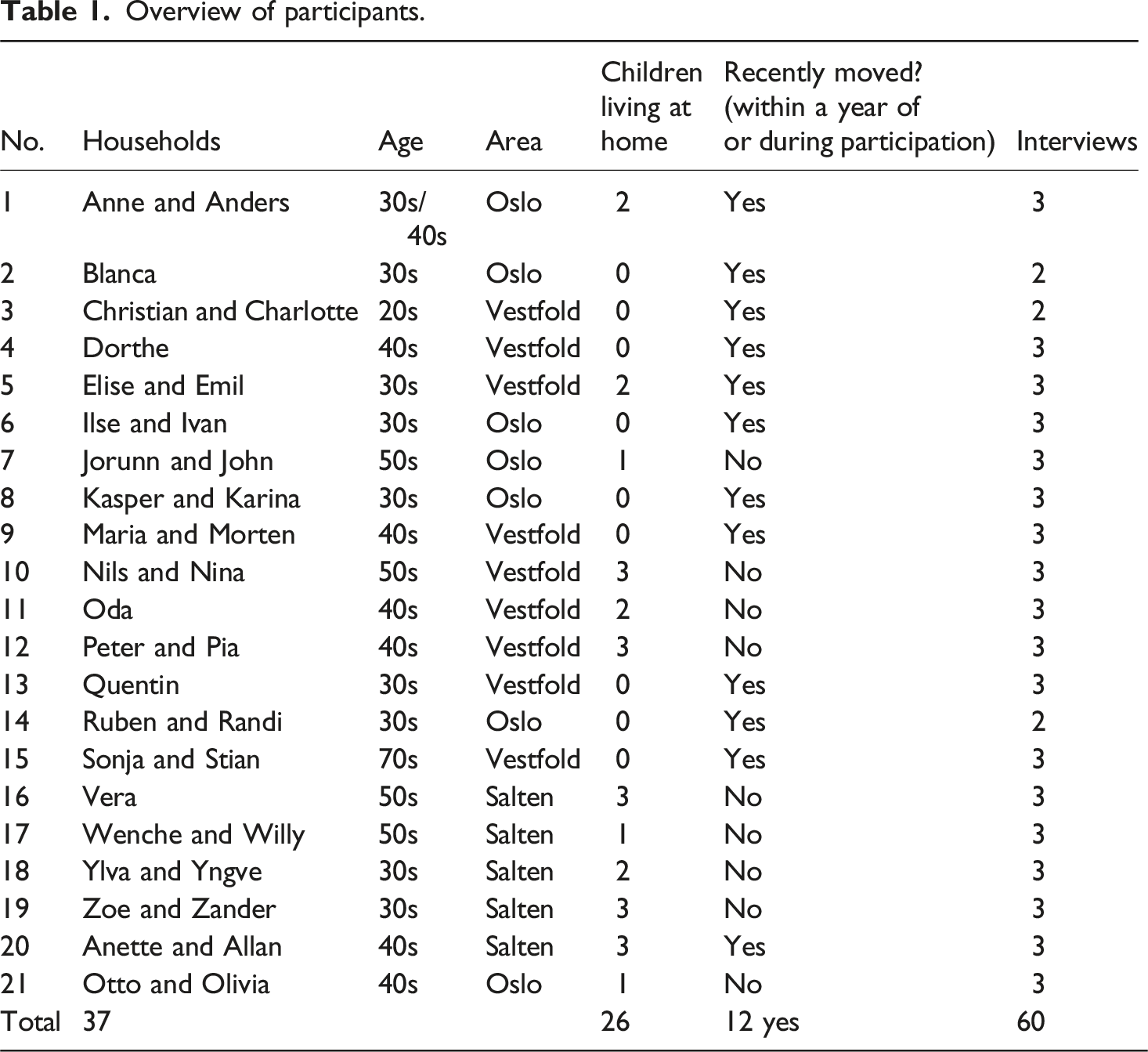
Data collection took place over a 1-year period, from October 2021 to October 2022, with each household participating for 6 months. Start-up interviews, lasting up to 1 h, were conducted at the start of the participation period. These interviews aimed to map participants’ general habits and interests regarding clothing and textile consumption as well as to provide information about the study and terms of participation. Through the 6-month period, participants collected all textile items that would have otherwise left their households. These included garments and footwear, household textiles (such as linen, towels, and cloths), and textile-based equipment (such as bags, packaging, and toys). Larger furniture and fixed textile installations, such as carpets, were excluded.
Follow-up interviews centered on the collected textile items were conducted around the 3-month and 6-month marks. The duration of these interviews varied depending on the quantity of textiles collected, ranging from 20 min to 3 h. These interviews typically took place in participants’ homes, in living rooms, kitchens, or on porches. During the interviews, participants and the researcher examined, discussed, touched, and sometimes smelled each textile item, laying them out on a table or the floor. Participants provided details about each item’s history, including duration and frequency of use, method of acquisition, repairs or alterations made, and reasons for disposal. This approach was designed to engage participants’ sensory relationship with their textiles, as “clothing matters not only through its visual appearance but also through its smell, touch and sound” (Woodward and Greasley, 2017: 666). Engaging participants with the physical items helped elicit memories about acquisition and usage, insights that are often difficult to capture through traditional conversational interviews (Woodward, 2007).
Interviews were coded using a Stepwise-Deductive Induction approach. This method ensures that coding remains closely grounded in empirical data by employing terms directly derived from participants' responses, thereby maintaining alignment with interviewee statements (Tjora, 2019). Codes were developed based on interview content and subsequently organized into overarching categories. This process identified several major life course transitions as key influences on textile consumption, including completing education, leaving the parental home, moving, changing jobs, retiring, and experiencing the loss of a family member. Among these, two life course transitions, moving in together and having a child, emerged as focal points due to their prevalence in the dataset and their inherently relational character. Both transitions involve negotiations among multiple household members regarding textile disposal, distinguishing them from life changes that primarily affect individual consumption behavior.
Cohabitation and parenthood
A recurring theme in the interviews was the influence of temporal and spatial circumstances on participants’ decisions to discard items. Practices containing clothing and textile consumption were closely tied to identity, as participants navigated between old, new, and altered performances of practices. The analysis highlights participants’ experiences and reflections illustrating how two major life course changes influence clothing and textile disposal. The following sections explore how identity influences the disposal of clothing and textiles during these transitions.
Moving in together
The transition to cohabitation transforms the home into a shared space, merging individual practices into shared ones. Gregson et al. (2007a) argue that waste is intrinsically connected to mobility, as the moving process necessitates decisions about what to keep and discard. This was evident in several interviews, particularly among participants who moved during the study. Dorthe (woman, 40s), who moved between the first and second visit, hired movers and evaluated each item based on its moving cost. Similarly, Quentin (man, 30s) explained, “Now I’m going to move so I want to bring as little as possible with me so I will be getting rid of more than I would normally do.” Blanca, who had moved shortly before the study, recalled “there was a point when I was so exhausted that I just threw out a bunch of stuff.” These accounts illustrate how the practical demands of moving led participants to dispose of more items than they typically would.
Cohabitation alters both the physical location and context of the relationship. During the study, female participants frequently discarded clothing or household textiles on behalf of their partners. In some cases, this process began even before moving in together. For example, Ilse (woman, 30s) and Ivan (man, 30s) sorted through Ivan’s wardrobe before cohabiting, removing items deemed unsuitable for their shared space. Ilse humorously recounted, “We did a round in his closet before we moved in together [laughing]. Which was entertaining.” This preemptive evaluation considered not only the material condition of Ivan’s clothing but also its suitability for their future shared practices. Schatzki (2010b) suggests that actions are not confined to the present but have a history as well as being future oriented. In this context, preparing for shared living prompted the disposal of Ivan’s clothing.
During the study, other participants experienced similar interventions. Ruben (man, 30s) parted with a pair of outdoor pants and a base layer shirt, while Kasper (man, 30s) discarded a pair of sweatpants. Kasper referred to these as his “lazy clothes” (“daffeklær” in Norwegian), meaning that these were clothes specifically for relaxing at home. When asked about his pants, Ruben remarked:
Ruben: I am very fond of them, [Randi] is not very fond of them, they’re starting to be very worn. So, yes, perhaps it’s okay to throw them out.
Interviewer: Do you remember how long you’ve had them?
Ruben: Since 2019. So, it’s only 3 years actually. I could probably have had them for another 7 years until they were completely worn out.
Interviewer: But they were voted down?
Ruben: Yes, they were voted down.
Similarly, Kasper’s “very comfortable” gaming-pants had become almost see-through. His partner, Karina, deemed them too worn out to continue wearing. When asked if he could still use them at home, he responded: “No, it gets silly at a certain point. They have just expired. That’s it. They have even torn in the bottom.” Both Ruben and Kasper acknowledged that they would have continued wearing these garments if not for their partners’ inputs, but they also seemed to agree on the disposal. In some cases, clothing was discarded without the owner’s knowledge. Elise (woman, 30s) disposed of one of Emil’s (man, 30s) shirts because she found it “extremely ugly”. This shirt was part of a hand-me-down collection from Emil’s brother. Elise explained, “He is not allowed to wear it, so I knew that I would be fetching it from his wardrobe,” adding, “A grown man cannot wear this”. Changing expectations and evolving shared practices led to the removal of certain clothing items, as they were no longer considered appropriate for the everyday practices in these households.
Household textiles were also subject to scrutiny. Morten (man, 40s) and Maria (woman, 40s) discarded a pillowcase and a bathmat. The pillowcase was Morten’s first decorative item after moving away from home, but Maria objected, saying “he tried it in the shared home, but he was not allowed” as she found it aesthetically unappealing. The bathmat, initially permitted as a compromise was later deemed “a stupid purchase” by Maria and discarded. Similarly, Ruben and Randi eliminated several household textiles, including a washcloth and four towels from the 1970s that Ruben had inherited from his mother. Although Ruben saw no functional issues with them, Randi wished to dispose of them “due to esthetic reasons”. Interestingly, Ruben and Randi also discarded a bathmat they had purchased together upon moving in. Ruben reflected: [It] was bought when we moved in together as a new item. There is nothing wrong with it. A lot of things are bought when you haven’t planned ahead and then it’s just buying and throwing away. It’s not so great really.
Despite his reluctance, Ruben ultimately agreed with Randi’s decision, highlighting a tension between his ideal of using items until they are completely worn out and the reality of aesthetic and practical reassessments in shared living spaces.
The experience of making initial purchasing mistakes when moving in together was echoed by Christian (man, 20s) and Charlotte (woman, 20s), who discussed replacing a carpet that had mismatched their evolving home aesthetic:
Christian: When we moved in, it fit with the décor and the colors and that stuff. But after a while, it didn’t. We have changed our style several times
Charlotte: That’s what happens when you move away for the first time and have to have everything and then it’s a little.
Christian: A little too much maybe.
Charlotte: A little bit of something that fits and some things that maybe you should have waited with.
Beyond cohabitation, Christian and Charlotte were also navigating their first experience of independent living. This dual transition required a learning process and negotiation of shared household practices, leading to the eventual disposal of items initially acquired but later deemed unsuitable or unnecessary for their shared home.
Having a child
Discussions about clothing and textile consumption related to preparing for and adapting to the arrival of a child emerged in all interviews with parents but were particularly prominent in the cases of families with young children. Research indicates that new practices emerge both before and during early stages of parenthood (Thomas and Epp, 2019), with many first-time parents beginning the preparations months before the child’s arrival (Jaeger-Erben and Offenberger, 2014). This preparatory phase often includes key practices such as reorganizing and redecorating the home to accommodate the space for a baby (Clarke, 2004). Reflecting on this period, Elise (woman, 30s) described how shopping for baby clothes during pregnancy was an emotional and participatory act: “There is something about that feeling of, like, buying clothes for your unborn baby. I remember that I thought that was a very nice thing. You can get a sense of how it is going to look on them.” Consumption research has emphasized how acquiring items for a child serves as an expression of parental love, positioning the child as the center of devotion while reinforcing parental identity, particularly for mothers (Gregson et al., 2007a; Miller, 1998). In addition to purchasing new baby clothes, all parents in the study had received clothing from friends and family, either as gifts or hand-me-downs. Many expressed receiving an excess of clothing, often more than they could use. Jorunn (woman, 50s) described this as a transfer of responsibility, where the giver prioritized offloading the items rather than considering their usefulness for the recipient. This aligns with Gregson et al.’s (2007a: 685) notion of new parents functioning as “conduits to get rid of certain things”.
In Norway, it is customary for close friends and family to make a “maternity visit” to new parents. This visit carries social expectations, one of which is bringing a gift. Afflerback et al. (2014) describe these events as “consumption rituals” due to their emphasis on material gift-giving. Consequently, new parents frequently received items they neither needed nor used. Anne (woman, 30s) and Anders (man, 40s) recalled receiving two pink headbands when their daughter was born. These items remained unworn 5 years later. Anne described them as “something you will receive as gifts when you have just had a baby, but which is completely useless because you will never put it on your baby.” Elise also mentioned receiving baby clothes from family and friends that she characterized as “silly clothes” (“tulleklær” in Norwegian). These were impractical garments purchased more for the amusement of adults than for the baby’s comfort. While Elise and Emil (man, 30s) had initially bought such items for their first child, by the time they had their second, their understanding of practicality had changed, leading them to prioritize comfort. As a result, some clothes from their daughter were not reused for their son because they were deemed unsuitable. This reflects a shift in their practical intelligibility. Their evolved experience as parents reshaped their understanding of what is appropriate or necessary. The decision to discard impractical clothing highlights how parental experience influences material consumption over time.
A similar shift occurred with Anne, who initially described herself as fashion-conscious when she enrolled in the study. However, during the start-up interview, she revised this in light of motherhood: I wrote that I try to be fashion-conscious, and now I have thought about that. Yes, I would like to fit in, but for me, becoming a mother has made me think that being a mother is more important than being fashion-conscious. I don’t want to prioritize time and money on that. I can do that when they get bigger instead.
This shift in Anne’s practical intelligibility reflects how motherhood reoriented her consumption priorities. Previously, fashion-conscious shopping made sense to her, but with the arrival of children, practices involving time spent with her children and buying according to their needs became intelligible. This aligns with Miller’s (1998) arguments that shopping can be an act of love to build family relationships, as well as Godin’s (2022: 400) notion of motherhood and “love as accomplished or expressed through consumption.” Similarly, Burningham and Venn (2020) found that mothers in their study lost interest in buying for themselves, instead prioritizing purchasing for their children. This shows how practical intelligibility becomes centered around family needs rather than the individual, shaping parental engagement with consumption.
Heath et al. (2016) suggest that mothers of young children often face ethical dilemmas when sustainable practices compete with practices of child-care. Anne described encountering such challenges after they became parents: [B]efore we had children, for example, we tried to cut meat consumption, ate almost no meat. But then we had children and the best thing she knew was ham and hot dogs. So, then it’s like that. So, I think, not that I should in a way blame it on that, but I think maybe it’s a bit more challenging, yes, it is. And there is another thing, I read a very nice article once about someone who recommended capsule wardrobes for small babies and young children. That they shouldn’t have very many items of clothing. And I thought that it sounded very reasonable until I had child number two, and he was such a spit-up baby who vomited all the time. And I just had to have lots and lots of small clothes because I had to wash it all the time. So, there are some things like that that sound really nice in theory but just didn’t work in practice with small children, I have to admit. I think, for me at least.
This further demonstrates how practical intelligibility evolves as parents navigate the competing demands of sustainability and childcare. Former sustainable practice engagements, such as minimizing meat and clothing consumption, had to adjust or disappear. Wethal et al. (2024) refer to this as a compromise, where people negotiate sustainability performances against expectations and needs of the family. This point will be discussed further in the following section.
Discussion
This paper examined two major life course transitions: moving in with a partner and having a child. A common feature of these transitions was how participants navigated identity changes by comparing to idealized notions. Shove et al. (2007: 25) argue that both imagined and real accomplishments of practices are “bound up with prevailing discourses of home and ‘normal’ or ‘idealized’ family life”. In this context, clothing and household textiles were discarded when failing to align with expectations for shared domestic practices and with the couple’s vision of expressing their collective identity. In this way, disposal enables the cultivation of a new shared identity (Roster, 2014). This finding parallels Marshall and Anderson’s (2002) research on food practices, suggesting that, at least for female participants, their partners’ appearance within cohabitation needed to conform to certain ideals of a mature, grown-up relationship. While many practices persist after moving in together, their performance as a couple reconfigures their meaning and the expectations surrounding material arrangements based on ideas of “who we are together”, “what we do together”, and what that should look like. For example, Ruben’s and Kasper’s willingness to discard their worn-out clothes reflects a complex intersection of identity and practical intelligibility. They may have valued these items, but the shift to shared living spaces reshaped their perceptions of practicality and acceptability and, together with their partners, they negotiate the appearance of their couple’s identity through their material surroundings. As Halkier (2020) argues, the negotiation of practices occurs to accommodate specific social contexts and relations. The transition from individual to shared living redefined social and symbolic expectations, necessitating negotiation and compromises over what constitutes an appropriate domestic appearance. This ultimately led to the disposal of textiles, illustrating how major life course changes elicit textile disposal as sites for the emergence of new or changed expectations and practices. This illustrates both the effect of identity on textile disposal and how identities are shaped and enabled by disposal of items.
Findings in this paper support previous research on gendered everyday practices in the household, particularly for clothing consumption (Khalid and Razem, 2022; Mechlenborg and Gram-Hanssen, 2020; Tseëlon, 2001) where responsibility for keeping the home as well as all members of the household looking presentable is placed with the female partner. In this study, several of the male participants’ belongings were discarded, often as a result of their female partners’ decisions. Gregson et al. (2007a) describe this phenomenon as “purging”, wherein female partners clear out their male partners’ possessions to construct a shared home. They argue that “releasing these things is seen to be not just expressive of, but constitutive of, love relations: a sign of commitment, love, and devotion on the part of the male partner” (Gregson et al., 2007a: 691). Thus, disposal of items deemed unfit plays a crucial role in communicating an envisioned identity of proper cohabitants. Interestingly, although male participants often believed their possessions could still be used, they rarely contested their disposal. This passive acceptance may stem from gender norms positioning the female partner as responsible for home and clothing. If so, these findings could be indicative of how perceptions of identity, in this case based on gender, play a part when couples negotiate new or altered practices after major life course transitions. The female partner may be perceived as the more competent practitioner in these areas.
The transition to parenthood similarly introduced new expectations, reshaping household practices and material consumption. The arrival of a child often reconfigures the ideals of family life, as exemplified through Anne’s struggle to balance sustainable practices with family life, such as eating less meat versus feeding her daughter what she enjoys. Parenthood transforms routine practices such as meal preparation into a practice with the goal of feeding the family where the child’s needs take precedence. This exemplifies how different normative orientations may sometimes collide (Halkier, 2022). Evans (2011: 112) argues that when expectations of being a good parent conflict with sustainability goals, “the moral worth of caring for one’s child provides legitimate grounds for not engaging in practices of sustainable consumption.” However, in other cases, sustainability and parental responsibility align, as illustrated by Elise and Emil’s evolving consumption. Initially, they purchased new baby clothes but later opted for secondhand items, reflecting a shift in parenting expectations. Thus, disposal of unfit baby clothes contributes to the development of a skilled parent identity.
Both transitions generated a surplus of textile items, whether through merging households or accumulating baby-related gifts and purchases. Expectations of doing cohabitation and family life influenced which things were considered unnecessary or unsuitable and therefore dispensable. These expectations are culturally and temporally specific (Shove et al., 2007), shaping what is deemed essential (e.g., the necessity of a bathmat in a shared home) but also dependent on the identity of people (e.g., choosing the “right” bathmat). As the couples learn and develop their identities through the practices in which they participate (Schatzki, 2017), these expectations are subject to change. For example, when Christian and Charlotte moved in together, their actions reflected a learning process where their initial choices were based on immediate, short-term goals (e.g., filling the space with decor) but over time, as they engaged in shared practices, these early choices lost relevance and certain items (like the carpet) became temporally inappropriate.
As practices emerge and change, so do desires and material demands within practices (Rinkinen et al., 2020). However, this study shows that the specificity of these desires and demands is influenced by the identities of the practitioners. While bathroom practices necessitate a bathmat, this does not explain why one bathmat is discarded in favor of another. This may also not be explained solely through such cultural conventions as fashion, as this study illustrates how style was not just blindly adopted but negotiated between the cohabiting partners. A bathmat, in this sense, transcends its function, embodying personal and relational identities. Therefore, understanding everyday consumption depends on understanding the complex connections between practices as well as the role played by their material and social arrangements, systems of provision (Rinkinen et al., 2020), and, as argued in this paper, the identities of their practitioners.
Taken together, the findings show the important role of identity in shaping consumption and how identity may be shaped and enabled by disposal, offering a nuanced perspective that accounts for reflexivity in action. Theories of social practice emphasize “aspects of common social processes which generate observable patterns of consumption” (Warde, 2014: 279). However, as this paper shows, while consumption exhibits patterned regularities due to shared general understandings and expectations, they are not identical. How they are carried out depends also on aspects pertaining to the individual carrying them out which affect the reproduction and change of practices. A focus on identity permits insights into how people’s expectations of the carrying out of practices and their material facilitation look and how this affects consumption. This provides a perspective on consumption as, at the same time, an element of routinized everyday life processes and as imbued with individuality, creativity, reflexivity, and communication.
Conclusion
This paper examined households’ negotiation of textile disposal during two major life course changes, moving in with a partner and having a child, and the role of identity in these processes. This study contributes to the call for incorporating reflexivity by demonstrating how identity, a concept closely tied to self-expression, provides valuable insights into how consumption is affected when social and physical contexts for practices change. During these major transitions, participants’ adjusted perception of their identities in their new life situations prompted textile disposal.
Moving, in general, led participants to discard more textiles due to practical engagements with mobility. The transition from a single-person to a two-person household altered both physical location and context of the relationship. During this transition, couples negotiated the material arrangements of their shared lives, often navigating conflicting expectations regarding the future possessions and domestic practices. These expectations were shaped by general understandings of proper cohabitation but were also specified through a process of identity adjustment as couples transitioned from living alone to cohabiting with a partner. Similarly, the transition to parenthood redefined expectations regarding possessions and daily practices based on notions of normal or ideal family life. Parents faced situations where sustainable practices sometimes competed with practices centering on family life and the welfare of their children. Furthermore, as all participating families with toddlers already had at least one older child, findings illustrate a parental learning process involving a shift in the practical intelligibility regarding consumption. Ideas of what is “appropriate” or “necessary” in the parenting context evolved as parents engaged with childcare practices. Once again, this process was intertwined with identity adjustments as participants navigated both the transition to and the learning process of parenthood.
Taken together, findings in this paper illustrate how a more complex understanding of consumption emerges when identity is considered. As practices change, materials that no longer align with them are ejected as they fail to meet expectations for future practices. However, the specific ways in which these changes and expectations manifest and influence consumption cannot be explained solely through general understandings or prevailing discourses on what is considered normal or ideal. The individual’s identity affects how practices are performed and contributes to determining the materials deemed necessary for these practices, thereby influencing consumption beyond mere desires arising from practice engagement.
This study shows that the way we understand ourselves both influences and is influenced by our disposal practices. Future practice theoretical studies on consumption would benefit from greater attention to processes of intentionality and reflexivity. While this article has focused on identity-work, little attention has been paid to the justifications people employ in their meaning-making processes. Further research exploring the cultural conventions underpinning these justifications could provide deeper insights into how people attribute value to and justify their actions.
Footnotes
Acknowledgements
I extend my gratitude to Kirsi Laitala, Arve Hansen and Tamzin Rollason for their insightful comments and constructive feedback on earlier drafts of this manuscript.

Ethical considerations
The project (ref. 338093) was reviewed and approved by Sikt – Norwegian Agency for Shared Services in Education and Research to ensure compliance with data protection laws on September 28, 2021.
Consent to participate
Participants received detailed information about the study, including participation expectations and measures for ensuring anonymity. Participants were provided with written documentation detailing the project’s purpose, participation requirements, privacy safeguards, data handling procedures, and their right to withdraw consent. Participants gave written consent for participation in textile collection and interviews before starting interviews.
Consent for publication
Written consent to publish was obtained along with consent for participation for all participants in this study.
Funding
The author disclosed receipt of the following financial support for the research, authorship, and/or publication of this article: This research was supported by funding from the Research Council of Norway and the Norwegian Retailers' Environment Fund under grant number 318862.
Declaration of conflicting interests
The authors declared no potential conflicts of interest with respect to the research, authorship, and/or publication of this article.
Data Availability Statement
Data cannot be shared as this would breach the participants’ confidentiality.