



Abstract
This article examines how consumers responded to the disruptions of the COVID-19 pandemic through the lens of Consumer Culture Theory (CCT). Based on 25 in-depth interviews conducted in Portugal during the first lockdown (April–July 2020), the study shows how everyday consumption was reconfigured not merely as functional adaptation, but as a cultural process involving moral reflection, identity negotiation, and emotional self-regulation. We develop an interpretive typology of four consumer orientations: Moral Minimalists, Creative Domesticators, Digital Drifters, and Reflective Realigners, situated within a perceptual matrix contrasting reflexivity and digital engagement. Each type illustrates how cultural logics, moral judgments, and digital infrastructures shaped distinct responses to systemic rupture. This framework contributes to CCT by theorizing crisis as a sociohistorical rupture that unsettles routines, foregrounds moral economies, and intensifies the interplay between agency and structure. It also extends sociological debates on moralized markets, domestic provisioning, and digital mediation, showing how everyday acts of shopping, cooking, and online connection became sites of symbolic negotiation and ethical distinction during disruption.
Keywords
Introduction
The COVID-19 pandemic disrupted everyday life, exposing how consumption practices are entangled with cultural meanings, moral evaluations, and affective labour (Campbell et al., 2020). Globally, people experienced an abrupt reconfiguration of routines, supply chains, and social relationships, turning acts such as shopping, cooking, or caring into sites of uncertainty and symbolic negotiation (Hamilton et al., 2015; Thompson, 2004). As lockdowns and risk anxieties redefined public and domestic spheres, consumption emerged as both a material constraint and a coping mechanism and interpretive resource.
Consumer Culture Theory (CCT) offers a robust framework for examining these dynamics, showing how consumers use marketplace resources to construct identities, perform moral selves, and navigate sociohistorical ruptures (Arnould and Thompson, 2005; Askegaard and Linnet, 2011; Moisio and Arnould, 2005). From this perspective, crises are cultural moments that reveal the intersection of structural constraints and cultural improvisation (Chatzidakis et al., 2021; Giesler and Veresiu, 2014).
Building on earlier calls (Hamilton et al., 2015; Hill, 2001), recent work has emphasized the need to expand CCT’s theoretical reach into contexts of vulnerability and disruption (Campbell et al., 2020; Chatzidakis et al., 2021). In line with this agenda, this article examines how consumers in Portugal reconfigured practices and meanings during the first wave of the COVID-19 pandemic. Based on 25 in-depth interviews conducted under lockdown, it explores how individuals adapted everyday routines, recalibrated moral judgments, and negotiated the role of digital infrastructures amid collective uncertainty.
This study makes three main contributions. First, it advances CCT by showing how everyday consumption becomes a site of moral economy, reflexive self-work, digital mediation, and emotional regulation during crisis. Second, it introduces an interpretive matrix of consumer orientations mapped along the dimensions of reflexivity and digital engagement. Third, it offers empirical insight into how consumers negotiate material constraints, affective labour, and moral discourses, engaging with debates on moral economies (Sayer, 2005), market boundaries (Fourcade and Healy, 2007, 2013; Zelizer, 2011), and routinized practices (Warde, 2014).
By examining how individuals adapt, interpret, and perform identity through crisis consumption, this study contributes to emerging literature on consumption in unsettled times (Kirk and Rifkin, 2020; Sarmento et al., 2019). It situates the pandemic as a sociohistorical rupture that foregrounds the symbolic power of mundane practices alongside the moral, reflexive, and digitally mediated dimensions of consumer culture, offering a conceptual bridge between CCT’s classic domains and sociological work on morality, practice, and the cultural politics of care and risk in marketplace life (Miller, 2012; Sayer, 2005; Warde, 2014; Zelizer, 2011).
We address the following research questions: • How did consumers adapt their daily practices and relationships to consumption under lockdown conditions? • How did consumers attribute cultural meanings to consumption, scarcity, digital reliance, and moral responsibility? • How did the crisis provoke critique, negotiation, or reinforcement of dominant market ideologies and moral boundaries of consumption?
By answering these questions, this article positions consumption as a critical lens to understanding how individuals interpret and respond to systemic rupture, not only as rational actors, but as moral, relational, reflexive, and digitally embedded subjects situated in specific cultural contexts.
Theoretical framework
The COVID-19 pandemic provides a unique empirical context where the cultural dimensions of consumption become visible. Rather than focusing solely on behavioural shifts, this study adopts a Consumer Culture Theory (CCT) perspective (Arnould and Thompson, 2005) to analyse how individuals re-signify practices and values amid disruption. Within CCT, understood as a tradition combining theoretical consolidation with critical reflection (Cronin and Fitchett, 2022), consumption is viewed not as a response to market stimuli but as a cultural practice shaped by symbolic meanings, affective attachments, and sociohistorical contexts. CCT therefore offers a robust lens for examining consumption as a site of meaning-making, moral negotiation, and symbolic struggle in moments of crisis.
Understanding consumer culture theory (CCT)
Consumer Culture Theory (CCT) examines how consumption both shapes and is shaped by cultural, social, and historical forces. Rather than viewing consumers as rational decision-makers guided by utility, CCT emphasizes the symbolic, ideological, and experiential dimensions of marketplace practices (Arnould and Thompson, 2005, 2015, 2018). It analyses how individuals and collectives use market resources to construct identities, express values, and negotiate their position within broader social structures.
CCT comprises four interrelated domains: (1) consumer identity projects, exploring how consumption is used in self-construction; (2) marketplace cultures, examining how consumers co-create and participate in subcultures or brand communities; (3) sociohistorical patterning of consumption, analysing how macrostructures such as class, gender, and nation shape practices; and (4) mass-mediated marketplace ideologies, investigating how dominant discourses are reproduced or contested through consumption (Arnould and Thompson, 2005).
Recent work has expanded the scope of CCT to address themes such as moral responsibility, emotional labour, and structural inequality (Chatzidakis et al., 2021; Giesler and Veresiu, 2014). This is especially relevant in crises, where consumption is infused with ethical reflection, affective coping, and systemic critique. CCT also emphasizes the dialectical relationship between agency and structure, showing how consumers are both shaped by and capable of reshaping dominant ideologies through everyday practices (Moisio and Arnould, 2005). This flexibility enables CCT to analyse consumption during sociohistorical ruptures, when meanings, identities, and moralities are in flux.
CCT has also engaged with the digital mediation of consumer life, recognizing online interactions as central to contemporary consumer culture. Scholars show that digital infrastructures blur boundaries between connection and isolation (Turkle, 2011), constitute the fabric of everyday life rather than supplement it (Couldry and Hepp, 2017), and reshape marketplace cultures and consumer subjectivities (Kozinets, 2015). These contributions reinforce CCT’s capacity to analyse how cultural practices evolve under technological mediation, particularly in crisis contexts.
Consumption in times of crisis
Crises act as sociohistorical inflection points that disrupt routines and compel consumers to adapt, improvise, and reconfigure practices. Consumption then goes beyond practical necessity, becoming a symbolic resource to navigate uncertainty, negotiate identity, and enact moral positions. As Hamilton et al. (2015) note, the impacts of crises are uneven, shaped by structural inequalities, access to resources, and social support.
Studies on economic downturns show that consumers respond through strategies such as frugality, do-it-yourself production, and community exchange (Sarmento et al., 2019). These practices address material needs while also functioning as ethical and emotional work. For some, consumption is a site of resilience and care; for others, it exposes exclusion and precarity (Baker et al., 2005). Research demonstrates that consumer vulnerability is dynamic and relational, shaped by context, identity, and power relations (Hill, 2001), underscoring calls to expand CCT’s scope to include marginalized voices and structural constraints (Hamilton et al., 2015).
Crises foreground moral evaluations of consumption. Decisions about what is responsible or ethical, such as hoarding, buying local, or supporting community businesses, become cultural scripts through which people position themselves and others (Chatzidakis et al., 2021; Vikas et al., 2015). Giesler and Veresiu (2014) show that consumer subjectivity is governed by moral discourses linking marketplace behaviours to ideologies of responsibility and citizenship. This aligns with sociological perspectives on moral economies, where consumption is tied to judgments of care, responsibility, and social worth (Sayer, 2005; Zelizer, 2011). Crises amplify these evaluations, rendering ordinary acts morally charged and socially consequential.
Inequalities in access and resources shape how consumers experience crises. Fourcade (2011) argues that markets are moralized along social fault lines, where economic, digital, or infrastructural differences become culturally significant. Similarly, Fourcade and Healy (2007) show that markets are structured by evaluative frameworks defining legitimate and responsible consumption. During disruption, these disparities are magnified: while some shift smoothly to digital platforms or bulk provisioning, others face exclusion, scarcity, and vulnerability, highlighting how structural inequalities condition crisis consumption.
Yang et al. (2025) show that consumers draw on cultural repertoires during unsettled times through modes such as formulaic, versatile, freewheeling, and troubleshooting responses. These modes indicate that coping with crisis involves creative cultural work as individuals reassemble familiar tools to navigate constraints. Similarly, Campbell et al. (2020) identify responses to perceived threats ranging from avoidance and confrontation to adaptation, offering a framework for understanding how crises reshape consumption practices.
These destabilizing conditions demand heightened reflexivity, as consumers negotiate cultural scripts to maintain a coherent sense of self and moral standing (Thompson, 2004, 2005). Crisis consumption is therefore not merely functional survival but embedded in moral, emotional, and structural logics that CCT is uniquely positioned to analyse. These insights frame the analytical dimensions of this study: how consumers adapted practices, negotiated moral meanings, and recalibrated values and market ideologies under conditions of rupture.
COVID-19 as a sociohistorical rupture
The COVID-19 pandemic exemplifies what Thompson (2004) calls a marketplace mythology rupture, a disruption that unsettles the cultural narratives through which consumers organize their lives. Declared a global health emergency by the WHO in March 2020, the pandemic triggered lockdowns, mobility restrictions, and widespread uncertainty affecting physical health, emotional well-being, economic security, and social cohesion (WHO, 2020). By late 2020, over 80% of the global workforce had experienced disruption, with millions facing job loss, income insecurity, and precarious work (ILO, 2020).
In Portugal, strict lockdown measures, including school closures, suspension of non-essential commerce, and stay-at-home mandates, transformed daily routines and consumption patterns. SIBS Analytics (2021) reported a 40% fall in electronic transactions during the first lockdown and 19% in the second. At the same time, e-commerce doubled from 9% to 18%, and contactless payments increased from 12% to nearly 40%. CaixaBank Research (2021) reported a 21% rise in B2C e-commerce in 2020, reaching 3.6% of GDP. More broadly, the OECD (2020) highlighted the pandemic as a catalyst for digital transformation, accelerating reliance on online infrastructures while exposing new inequalities.
These shifts show that the pandemic did not simply restrict consumer choice but disrupted the routines and temporalities that structure everyday consumption (Kirk and Rifkin, 2020). As Warde (2014) notes, routines are usually tacit and taken for granted, but crises render them visible and negotiable. Everyday acts such as shopping, cooking, or provisioning became improvisational tactics (De Certeau, 1984), as consumers reconfigured routines to regain symbolic control. This disruption revealed the embodied nature of daily practices and opened space for moral improvisation and reflexive adjustment. The home became a key site of re-domestication (Evans, 2014), where care and feeding work (often gendered) (DeVault, 1991) were re-signified as practices of resilience, prudence, and solidarity.
Digital platforms became critical mediators of reconfigured practices, linking consumption with affective management and social connection. Turkle (2011) shows that digital immersion produces ambivalence, connecting and isolating users, while Couldry and Hepp (2017) argue that digital media constitute the infrastructure of everyday life. These insights frame pandemic digitalization not as a neutral channel shift but as a cultural transformation of intimacy, coping, and control. This underscores that digital engagement must be analysed as a stratified practice mediated by reflexivity, resources, and cultural logics.
From a CCT perspective, COVID-19 is not only a public health emergency or economic shock but a cultural rupture that reconfigures consumer subjectivities, moralities, and social imaginaries. It exposed structural vulnerabilities while compelling consumers to improvise, reflect, and adapt (Kirk and Rifkin, 2020). These adaptations were uneven: some embraced voluntary simplicity and critique of consumerism, while others experienced constraint as a loss of identity or agency, demonstrating how crises intensify the interplay between structure and agency. This aligns with Fourcade and Healy’s (2013) concept of classification situations, where differential access to resources, infrastructures, and symbolic capital produces stratified consumer experiences.
These consumer recalibrations unfolded within a broader sociocultural context in which everyday life became a site of moral negotiation and ethical self-regulation. Sociological perspectives on moral economies highlight how consumption is entwined with judgments of care, responsibility, and social worth (Sayer, 2005; Zelizer, 2011). Viewed through CCT and sociological debates, the lockdown can be seen as a moral laboratory where distinctions of class, morality, and digital inclusion became newly visible and contested.
Anchoring the discussion in Portugal’s pandemic context, this study responds to calls to expand CCT beyond its traditional focus on affluent and stable consumer environments (Arnould and Thompson, 2005; Hamilton et al., 2015), and sets the stage for analysing consumer typologies under lockdown.
Methodology
This study adopts a qualitative, interpretive approach rooted in the epistemological principles of Consumer Culture Theory (CCT). Rather than producing generalizable findings, the goal is to generate context-rich insights into how individuals experienced and gave meaning to consumption during the COVID-19 pandemic. From a CCT perspective, consumption is viewed as a cultural practice shaped by symbolic, affective, and relational dimensions, especially in times of crisis (Arnould and Thompson, 2005; Thompson, 1997).
Research design and data collection
The empirical material consists of 25 semi-structured interviews conducted in Portugal between April and July 2020, during a period of strict lockdown, nationwide confinement, and socio-economic disruption. This design aligns with CCT’s qualitative tradition, which privileges methods that access symbolic and experiential layers of consumer life (Arnould and Thompson, 2005; Goulding, 2005). Semi-structured interviews were chosen to elicit in-depth narratives and reflexive accounts suited to exploring meaning-making during a sociohistorical rupture (Thompson, 1997). Although direct observation would capture embodied routines, lockdown constraints made interviews the only feasible method; participants were therefore encouraged to narrate everyday practices in detail, offering insights into reflective evaluations and habitual routines.
Participants were recruited through purposive sampling to ensure diversity in age, gender, education, professional status, and household composition. The sample included individuals living alone, in couples, and in multigenerational households, with or without children, and with varied employment situations, including active professionals, furloughed workers, retirees, and economically vulnerable individuals.
Interviews were conducted remotely (via phone or video call) in line with public health guidelines, enabling participants to reflect on their experiences from their domestic settings and enhancing immediacy and authenticity (Goulding, 2005; Thompson, 1997). To capture both reflective and habitual aspects of consumption, the interview guide combined open-ended prompts (e.g., “tell me about a typical day during lockdown”) with situational questions about domestic routines, food management, and digital consumption. All interviews were recorded and transcribed verbatim. Participants provided verbal informed consent and were assured of confidentiality and their right to withdraw. Interviews lasted between 30 and 90 min and followed a semi-structured guide balancing comparability with openness to participant-led reflection.
Sample composition.
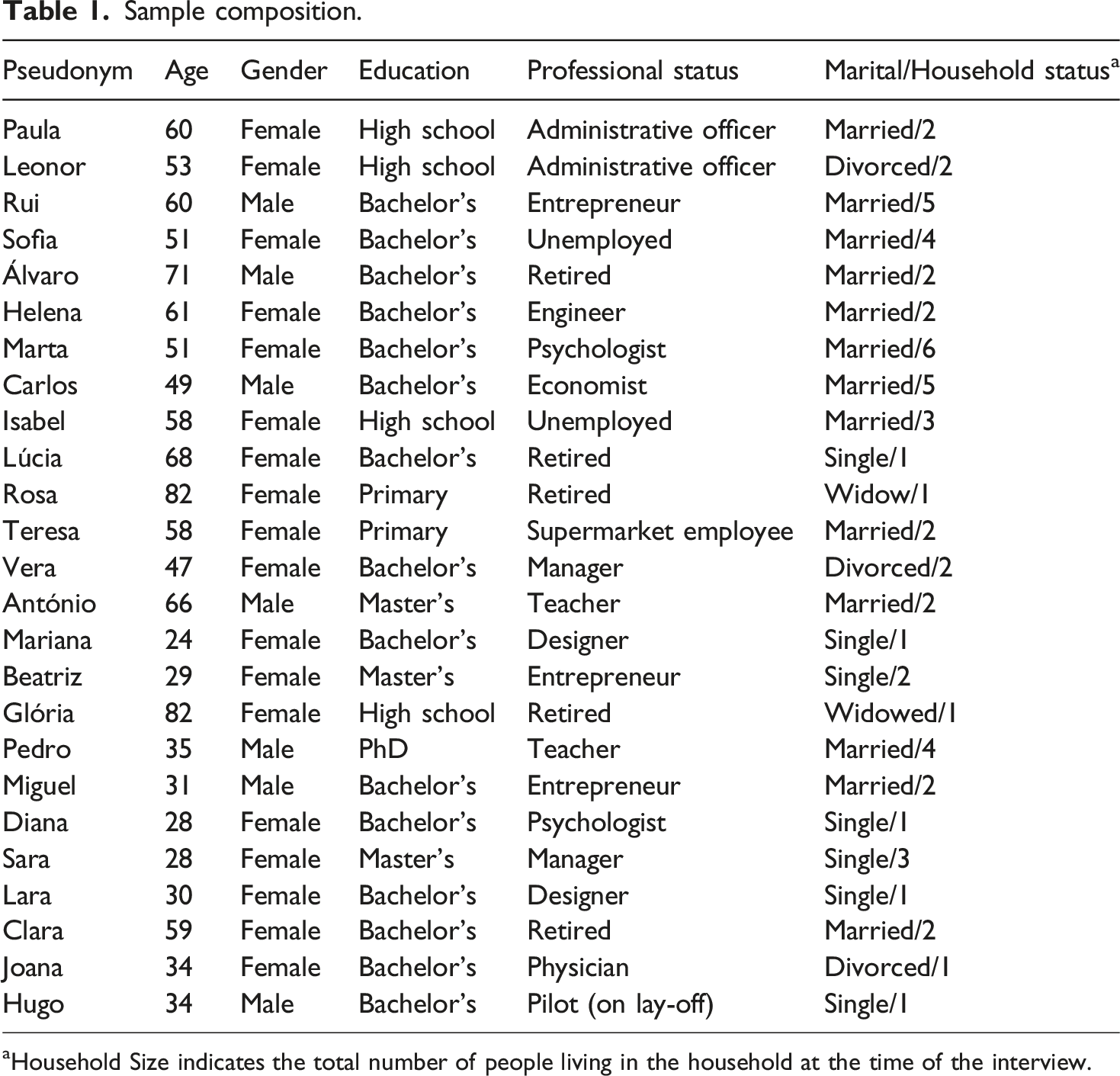
aHousehold Size indicates the total number of people living in the household at the time of the interview.
While diverse in age, gender, household composition, and professional background, the sample was predominantly white, urban, and middle-class. This reflects recruitment limitations during lockdown, including reliance on remote interviews and digital access. As such, the findings may not capture the experiences of racially minoritized or economically marginalized individuals, or those whose spiritual or religious orientations shaped coping strategies. Future research should include underrepresented voices in consumer culture scholarship during systemic crises.
Data analysis
Data were analysed thematically using an inductive–deductive strategy grounded in Consumer Culture Theory (Arnould and Thompson, 2005). Initial coding was informed by sensitizing concepts from the literature, such as consumer identity, market ideologies, moral economies, and socio-material adaptation, while remaining open to emergent themes. This interpretive strategy aligns with the hermeneutic principles of CCT (Thompson, 1997) and qualitative approaches in marketing research (Goulding, 2005), which emphasize co-construction of meaning through iterative engagement with participants’ accounts.
Coding and interpretation involved multiple rounds of close reading, memo writing, and discussion, with cross-checking among the authors to enhance reflexivity and interpretive rigour. The aim was to identify underlying logics, affective patterns, and illustrative cases. All interviews were anonymized, and excerpts used in the paper were translated into English.
The four consumer typologies are interpretive constructs rather than naturally emerging categories. Their development followed an abductive logic, combining inductive insights from participants’ accounts with sensitizing concepts from CCT, moral economy, and practice theory. This involved constant movement between data and theory, allowing typologies to emerge as interpretive syntheses. In line with Thompson’s (1997) hermeneutic principles, they were shaped through iterative analysis and critical reflection on patterned orientations toward consumption. They are analytical devices that distil recurring logics of meaning-making, while acknowledging that some participants displayed overlapping or hybrid orientations.
Ethical considerations
This study followed established ethical guidelines for qualitative inquiry. Participants were fully informed about the study, gave verbal consent to participate and be recorded, and were assured of confidentiality and their right to withdraw. Given the emotional strain of the pandemic, interviews were conducted remotely and with sensitivity, allowing participants to set the pace. When interviewees expressed fatigue or vulnerability, the interviewer offered to pause or discontinue. Pseudonyms are used throughout, and identifying details were altered to protect confidentiality.
Findings and discussion: Typologies of pandemic consumption
The interpretive analysis of 25 in-depth interviews led to the construction of four consumer typologies that capture distinct orientations toward consumption during the COVID-19 lockdown: Moral Minimalists, Creative Domesticators, Digital Drifters, and Reflective Realigners. These typologies are interpretive constructs developed through reflexive engagement with the data, theoretical framework, and Portuguese cultural context. Following hermeneutic principles in CCT research (Thompson, 1997), we acknowledge that the typologies were shaped by researcher positionality, the affordances of semi-structured interviews, and iterative dialogue between inductive insights and sensitizing concepts.
Presenting the findings through these typologies allows us to move beyond fragmented descriptions and provide contextualized accounts of how participants navigated moral boundaries, domestic practices, digital mediation, and value recalibration in response to systemic rupture. While analytically distinct, the typologies are not mutually exclusive; some participants displayed hybrid positions depending on context and emphasis. Each participant was allocated to the typology reflecting their dominant orientation, based on tone, emphasis, and reflexive framing. This interpretive flexibility is consistent with the study’s methodological orientation and reflects the complexity of lived experience during crisis. Each typology is illustrated with exemplar narratives and quotes, highlighting diversity in responses and shared underlying cultural logics. We now examine each of the four typologies.
Moral Minimalists
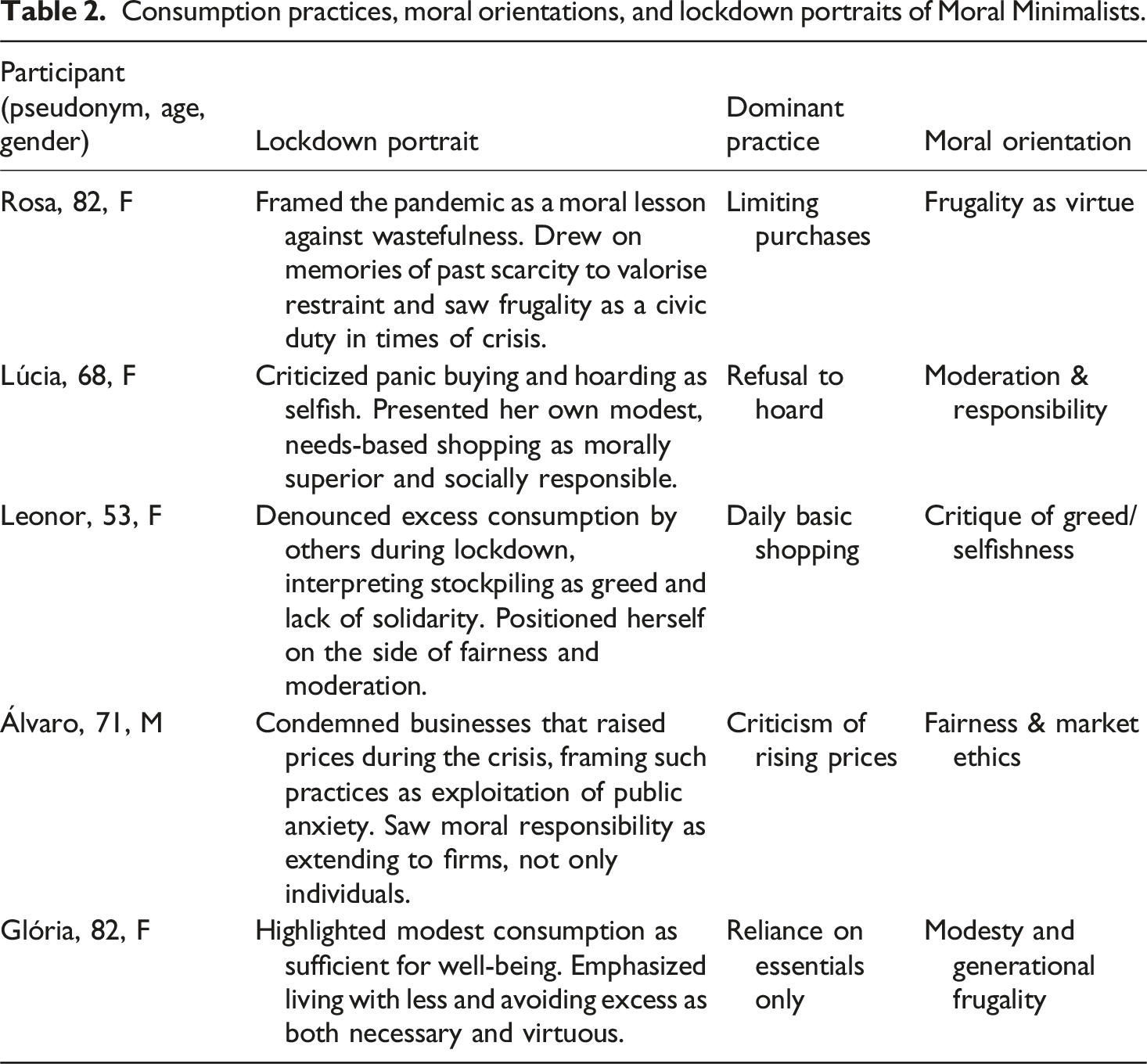
Moral Minimalists interpreted lockdown as a moral lesson in frugality, restraint, and ethical responsibility. For them, the crisis reinforced long-held values of thrift and moral order, positioning consumption as a terrain of ethical distinction. Their practices echo Sayer’s (2005) notion of lay normativities, where routines are shaped by judgments of decency and selfishness, and resonate with Zelizer’s (2011) concept of relational work, which emphasizes how values and transactions are negotiated in everyday relationships. The pandemic brought moral tensions to the surface: interviewees frequently invoked judgments of what they considered responsible, excessive, selfish, or classed behaviour. These perceptions illustrate CCT’s concept of market-mediated moral distinctions, whereby consumers assign value and identity not only to goods but also to those who consume them (Thompson et al., 1994).
Older participants in particular mobilized memories of past scarcity to frame the pandemic as a corrective against excess. Rosa (82, retired) reflected: “I think this came as a lesson. People were living too luxuriously – now we learn not to waste.” Similarly, Lúcia (68, retired) expressed indignation at panic buying: “It made me feel bad. I just wanted what I needed. Seeing people with five packages of rice or toilet paper!… It was revolting.” Leonor (53, administrative officer) echoed this critique: “There were people who bought and bought… I thought, ‘how greedy can you be?’ It’s like they didn’t care about others.” Such statements exemplify how panic buying (widely condemned in public discourse and policy messaging during the Portuguese lockdown) became a symbol of moral failure. As Campbell et al. (2020) note, crises often amplify threat responses, and in this case, restraint was valorised as civic virtue while excess was stigmatized as selfish privilege.
At the same time, moral judgments also intersected with structural inequalities. Participants observed that not everyone could stockpile or shift to online delivery, highlighting the material limits of consumer agency and the unequal distribution of consumer vulnerability. This intertwining of ethics and inequality aligns with Bourdieu’s (1984) insights into how class distinctions are performed through consumption, as well as Fourcade’s (2011) argument that market practices are moralized along social fault lines.
Critiques were also directed at companies perceived as opportunistic or exploitative. Álvaro (71, retired) condemned rising prices during the crisis: “Some businesses took advantage… prices went up. That’s not right. People were already anxious, and they still squeezed more from them.” Such evaluations extend moral boundary-making from consumers to firms, showing how subjectivity is governed by cultural expectations of fairness and responsibility in the marketplace (Giesler and Veresiu, 2014; Vikas et al., 2015).
In addition, Glória (82, retired) reinforced these themes of thrift and responsibility. Drawing on her long-life experience, she stressed that the pandemic underscored the value of modesty in consumption and reliance on essentials: “I didn’t need much, just the basics. People exaggerate… we can live with much less.” Her account frames restraint not only as a practical adaptation but also as a moral virtue rooted in generational wisdom.
Consumption practices, moral orientations, and lockdown portraits of Moral Minimalists.
Creative Domesticators
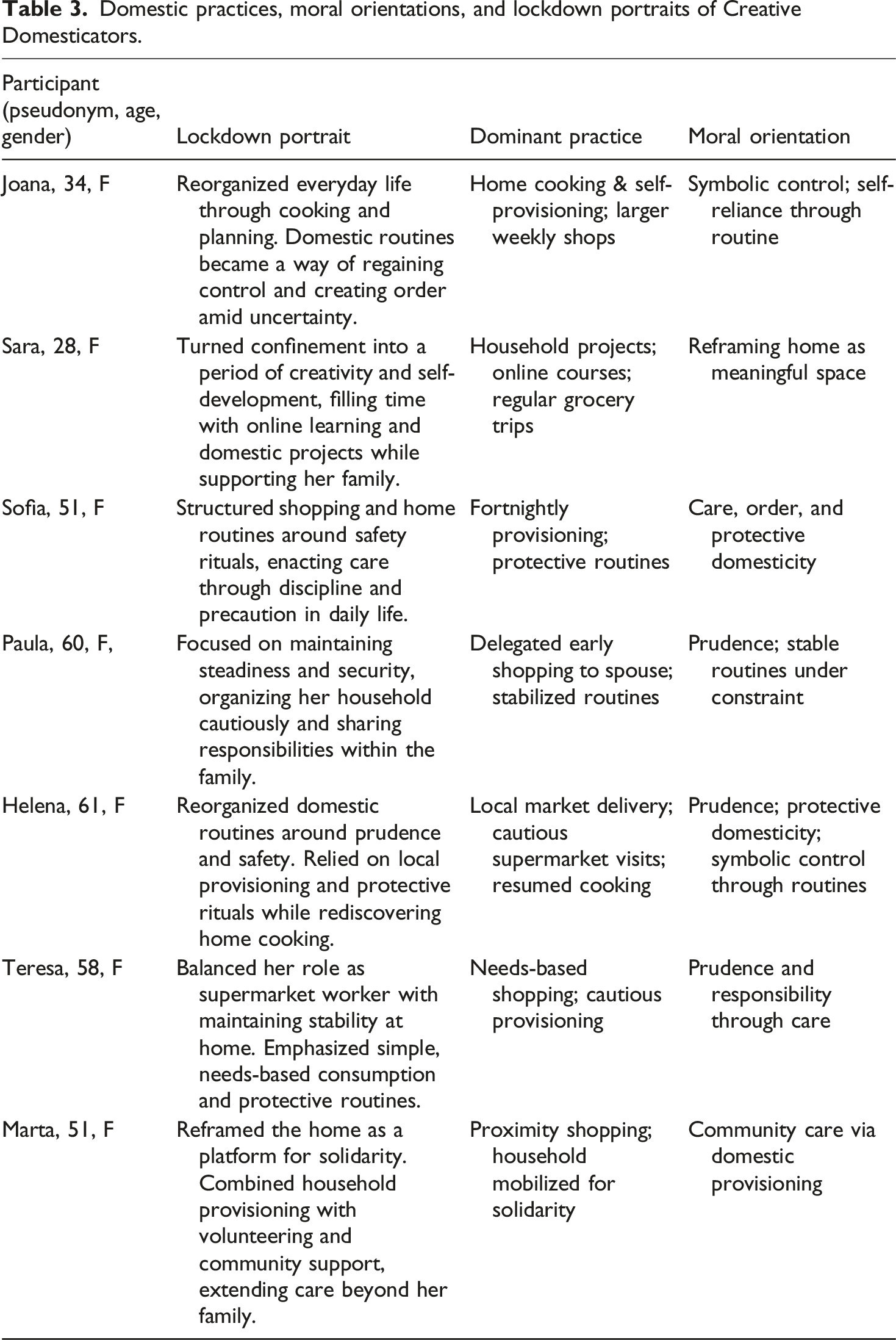
Creative Domesticators treated the home as a productive and morally charged space where routine, care, and small-scale improvisations provided symbolic control amid uncertainty. Their reflexivity was instrumental, focused on sustaining domestic stability and responsibility rather than existential critique. They engaged in protective rituals and reorganized household practices, aligning with practice theory on the centrality of routine and moral economy perspectives on care (De Certeau, 1984; Miller, 1998; Warde, 2014). Digital technologies played a minimal role, with coping centred on material and affective domestic practices.
Joana (34, physician) described how restaurant closures and the absence of domestic help transformed her relationship to everyday provisioning: she now cooked regularly, planned larger shopping trips, and “ended up consuming much more at home.” Similarly, Sara (28, manager) explained that although she had not been “home-oriented” before, she was “enjoying doing things at home,” filling her days with online courses and household projects while maintaining regular grocery trips for family needs. These narratives illustrate how the home, once peripheral to everyday identity, became a stage for new routines that symbolized agency and order.
For Sofia (51, unemployed) home-making was organized around a strict rhythm of fortnightly provisioning, conducted under carefully designed protective rituals of masks and gloves. Paula (60, administrative officer) likewise emphasized prudence, describing how in the first month her husband handled shopping while she stabilized routines at home. These examples show how domestic provisioning became both a safety practice and a way of asserting moral responsibility in a context of heightened vulnerability.
Helena (61, engineer) described a similar orientation toward prudence and domestic stability. She reorganized routines by relying on a local market that delivered food to her doorstep and used the supermarket only when strictly necessary. She also underscored protective rituals such as wearing gloves, masks, and even carrying wooden sticks to avoid touching surfaces. Reflecting on these changes, Helena noted: “I started cooking again, which I had not done for years… we began eating differently, more carefully.” Her narrative illustrates how practical adaptations around food and protection were framed as ways of maintaining order and responsibility within the household, consistent with the ethos of Creative Domesticators.
In addition, Teresa (58, supermarket employee) exemplified how domestic and provisioning routines were lived through the lens of prudence and care. Working in food retail during the lockdown, she experienced first-hand the anxieties of scarcity and safety. At home, she emphasized maintaining stability through simple, needs-based consumption and careful organization: “I just buy what we need, no more. It is about keeping things calm and safe.” Her narrative highlights how everyday provisioning is infused with responsibility and protective discipline, further reflecting the ethos of Creative Domesticators.
Creative domesticity also extended beyond the household. Marta (51, psychologist) shifted from bargain-hunting across supermarkets to proximity shopping, while also mobilizing domestic time and skills for community initiatives, such as fundraising with the St. Vincent de Paul (a Catholic charitable organization providing support to families in need) and supporting mask-making. Her case illustrates how domestic practices can bridge into collective solidarity, turning household routines into resources for community care.
Domestic practices, moral orientations, and lockdown portraits of Creative Domesticators.
Digital Drifters
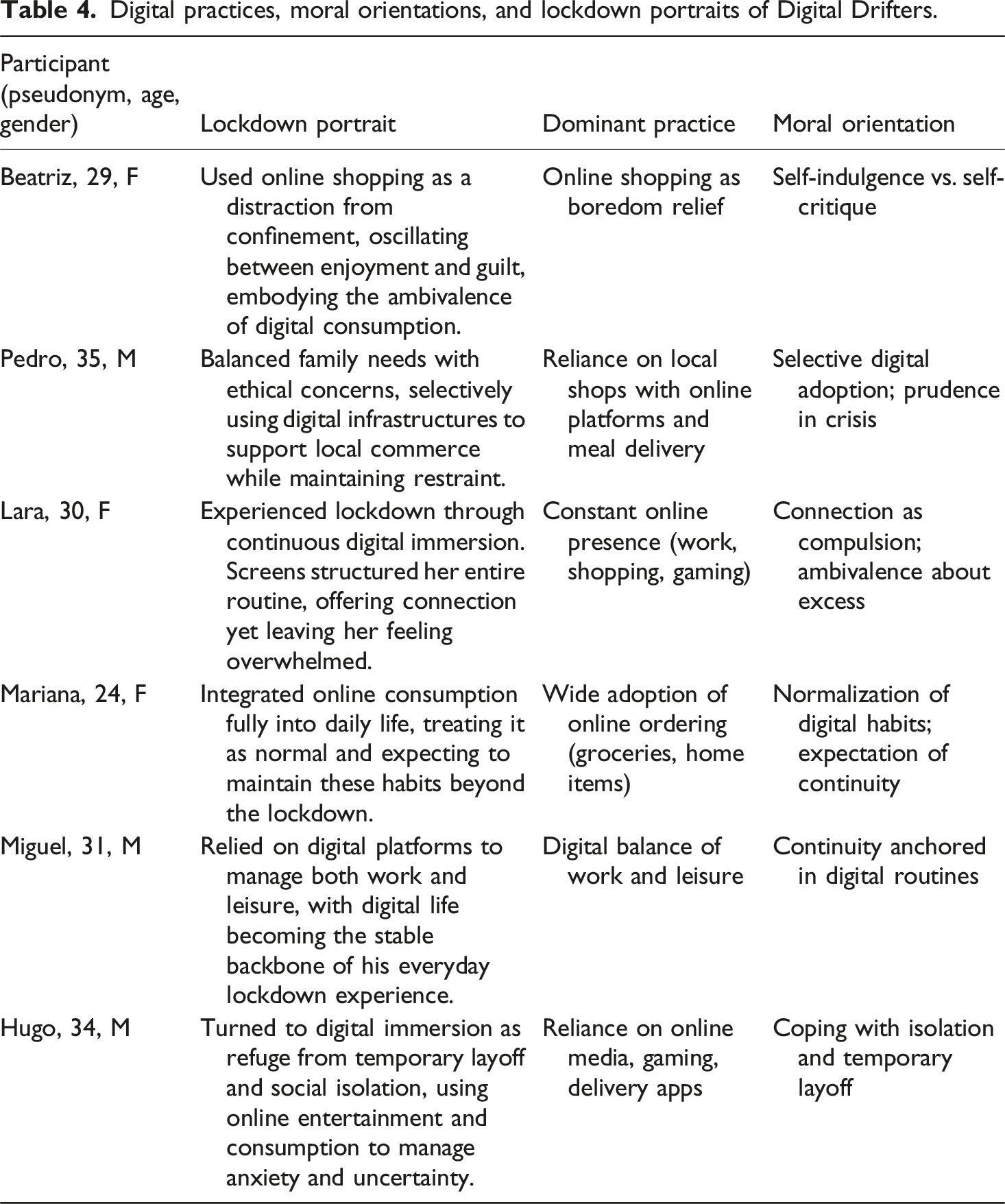
Digital Drifters relied heavily on digital technologies during lockdown, using screens for shopping, entertainment, communication, and emotional regulation. Their accounts reveal ambivalence: digital engagement provided connection and distraction, but also fatigue, self-critique, and overwhelm. This typology aligns with Turkle’s (2011) concept of being ‘alone together,’ where digital immersion blurs connection and isolation, and with Couldry and Hepp’s (2017) view of digital media as the infrastructure of everyday life.
Despite their deep digital entanglement, Digital Drifters often articulated subtle moral discomfort with their own practices, expressing guilt over screen-time, a sense of passivity, or unease about “wasting time.” These expressions suggest latent forms of moral evaluation, even in the absence of deliberate reflexive critique. Their consumption was shaped less by intentional realignment and more by affective coping and ambient pressures. In this sense, they occupy a distinctive position in our typology: highly immersed in digital infrastructures, but with limited reflexive engagement in constructing moral boundaries.
Beatriz (29, entrepreneur) explained that she often turned to online shopping not out of necessity but as a way to cope with confinement: “I was buying things online that I didn’t even need… it was boredom. Just being at home, it felt like shopping gave me something to do.” Her reflections show how online consumption acted as temporal filler and mood regulation, echoing research on moral economies of consumption (Wheeler, 2017), where buying oscillates between self-indulgence and self-blame.
For Pedro (35, teacher), digital infrastructures became central to household provisioning. He and his wife deliberately privileged local shops “that had online sites” and complemented groceries with meals ordered through delivery apps. At the same time, he emphasized reducing non-essential purchases, presenting digital engagement as compatible with restraint and prudence. His case illustrates how digital reliance was selectively adopted in ways that aligned with ethical concerns, echoing Warde’s (2014) argument that crises make routinized practices visible as sites of negotiation.
Lara (30, designer) described her days as dominated by screens: “I’m always online!… Work, Netflix, calls with friends. It’s my window to the world.” Similarly, Mariana (24, designer) reported that she “ordered everything online,” from groceries to home items, and expected to maintain these habits after the crisis. These accounts show how digital practices were normalized as everyday tactics (De Certeau, 1984), while simultaneously carrying ambivalence about excess and overexposure.
Miguel (31, entrepreneur) acknowledged that while his consumption routines remained relatively stable, he increasingly relied on digital platforms to balance work and leisure, noting that “the computer became the centre of everything, from work to winding down.” Hugo (34, pilot) went further, framing digital immersion as both coping mechanism and escape: “With no flying, no going out, I just stayed home… Netflix, gaming, deliveries, it was my way of not thinking about everything.” Their cases underscore the dual role of digital consumption: as survival infrastructure and as an ambivalent refuge.
Digital practices, moral orientations, and lockdown portraits of Digital Drifters.
Reflective Realigners
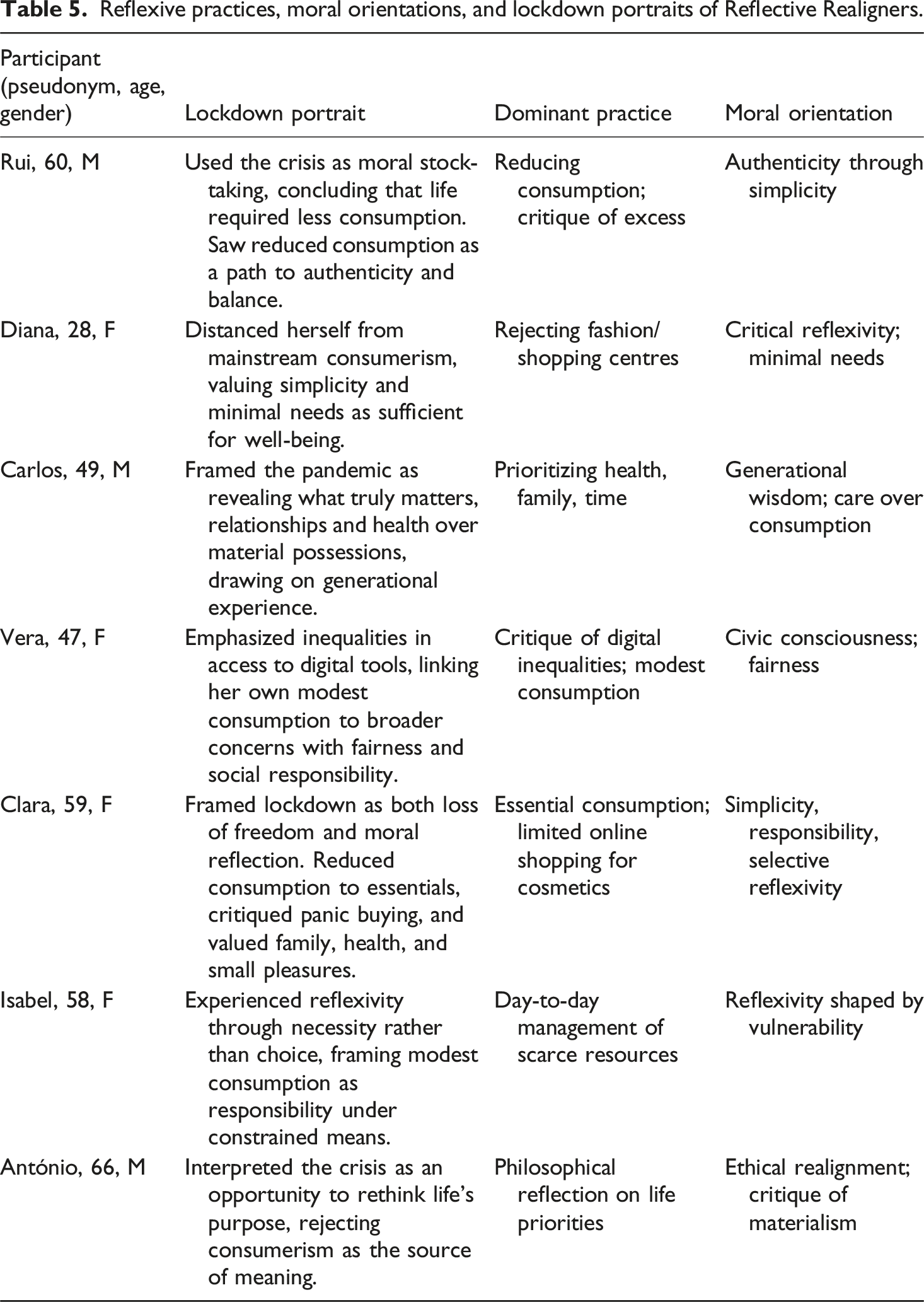
Reflective Realigners used the disruption of lockdown to reassess their values, priorities, and consumption habits. Unlike Creative Domesticators, whose reflexivity was practical, Reflective Realigners engaged in existential and moral reflection, framing the pandemic as a turning point that invited simplicity, restraint, and ethical reorientation, aligning with literature on voluntary simplicity, consumer resistance, and ethical consumption (Cherrier, 2009; Connolly and Prothero, 2008; Sassatelli, 2007). Digital technologies played only an instrumental role; their transformation was primarily driven by internal, value-based reflection.
For Rui (60, entrepreneur), the pandemic was a moment of moral stock-taking. He explained: “We were consuming too much before… this crisis shows we can live with much less, and maybe we should.” Such reflections framed reduced consumption not as loss but as a pathway toward authenticity, echoing Campbell’s (1987) notion of the “romantic ethic,” where moral self-realization is tied to restrained consumption.
Diana (28, psychologist) similarly emphasized the value of simplicity: “I don’t miss shopping centres, I don’t miss fashion. I realized how little I need to feel fine.” Her narrative illustrates what Connolly and Prothero (2008) describe as critical reflexivity, where consumers distance themselves from mainstream consumerism and reconstruct identities around alternative values, though often in ways marked by tensions and contradictions.
Carlos (49, economist) framed the pandemic as exposing the futility of overconsumption: “In the end, all those things we used to buy don’t matter… what matters is health, family, and time together.” His perspective highlights how reflexivity often emerged from generational experience, combining critiques of consumerism with moral appeals to family and care.
Vera (47, manager) focused her reflections on inequality in digital access, pointing out that “For some, it was just a matter of switching to online shopping. For others, it was a real struggle!… No car, no credit card, nothing delivered to their area…”
While her critique resonates with Fourcade’s (2011) notion of moralized markets, she also framed her own consumption choices as increasingly modest and intentional, blending reflexivity with civic consciousness.
Clara (59, retired) described the lockdown as a period of both material restraint and moral reflection. She limited her consumption almost exclusively to essential food and hygiene products, while abandoning shopping for clothing or household goods: “I am not worried about buying anything except food. Clothes or other things…I ignore them completely.” For her, the confinement was primarily experienced as a loss of freedom, describing herself as a “prisoner,” yet she also recognized unexpected positives such as stronger family bonds and greater appreciation for health and small daily pleasures. Although she experimented with online shopping, she ultimately distrusted the system after repeated failures and reverted to proximity supermarkets, retaining only online purchases of cosmetics. Clara’s account illustrates how reflective realignment combined critique of consumer excess, revaluation of simplicity, and selective engagement with digital infrastructures.
Isabel (58, unemployed) drew on her precarious position to critique excess and emphasize responsibility. She noted: “Some of us have to manage day by day… not everyone can stock up, not everyone have the means.” In her account, reflexivity emerged less from choice than from necessity, showing how moral evaluation intersects with structural vulnerability.
Finally, António (66, teacher) presented a more philosophical reflection: “This was a chance to rethink life. We don’t need so many things… consumption is not what gives life meaning.” His words condense the spirit of the Reflective Realigners: consumption as a site for ethical realignment and critique of materialism.
Reflexive practices, moral orientations, and lockdown portraits of Reflective Realigners.
Synthesizing consumer typologies: Reflexivity and digital engagement
The four typologies can be understood through their positioning along two intersecting dimensions: reflexivity and digital engagement. Reflexivity captures the extent to which individuals reassessed consumption habits and articulated new moral orientations, while digital engagement refers to their reliance on online infrastructures for shopping, coordination, entertainment, and emotional regulation. As shown in Figure 1, the typologies are not rigid categories but occupy a perceptual space that highlights their relative emphases. This positioning illustrates how reflexivity and digital engagement intersect to shape moral orientations toward consumption. Moral Minimalists show high reflexivity and low digital engagement; Creative Domesticators demonstrate low reflexivity and low-to-moderate digital engagement; Digital Drifters exhibit low reflexivity and high digital engagement; and Reflective Realigners show high reflexivity and moderate digital engagement. Perceptual positioning of consumer typologies during lockdown.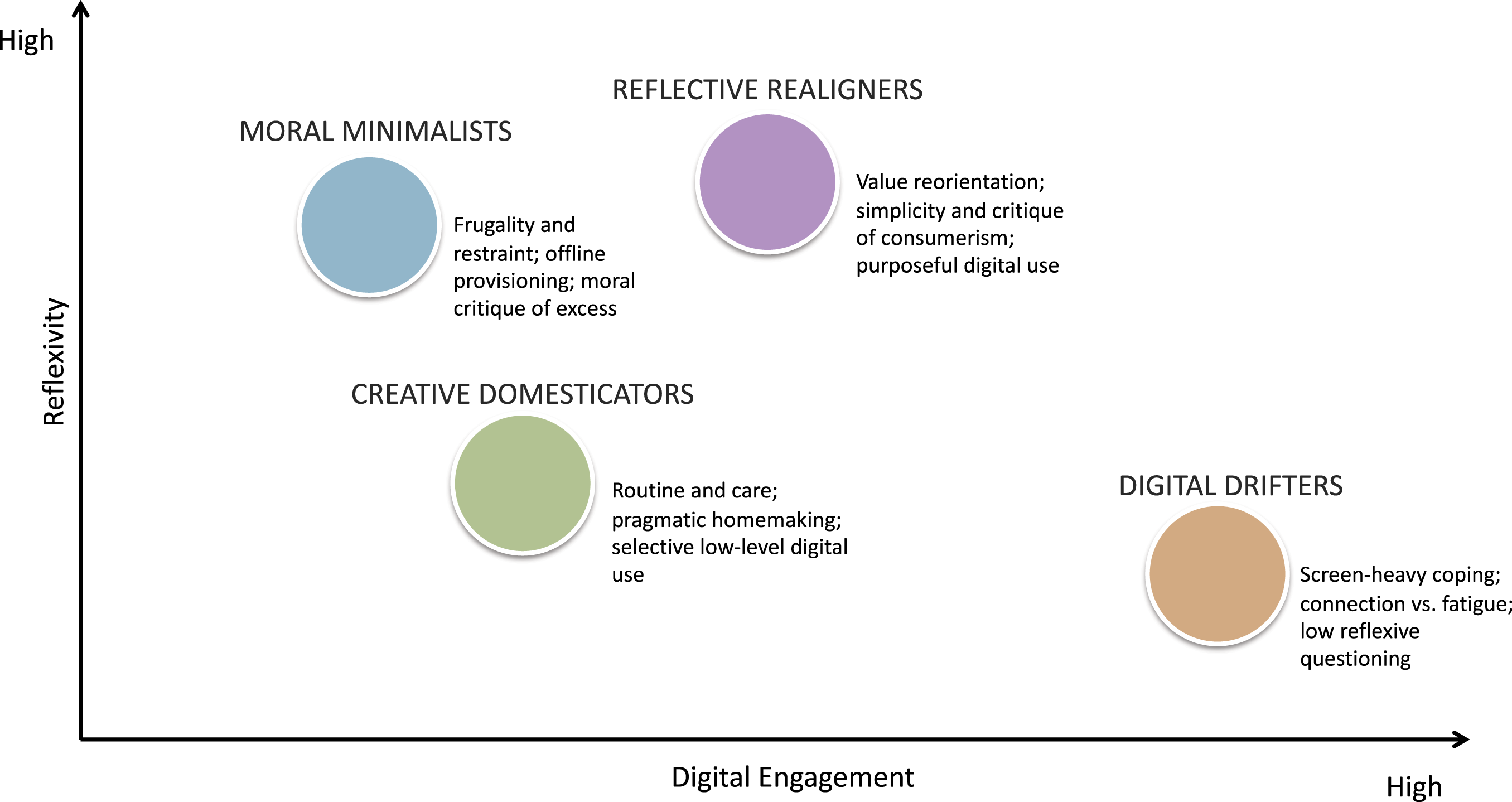
Framing the typologies through this perceptual map highlights both contrasts and overlaps, responding to calls for greater theoretical integration in consumer research and aligning CCT with debates on moral economies (Sayer, 2005; Zelizer, 2011), market classification (Fourcade and Healy, 2007, 2013), and mediated everyday life (Couldry and Hepp, 2017).
Conclusion
This study explored how consumers navigated the disruptions of the COVID-19 pandemic through the lens of Consumer Culture Theory (CCT), focusing on the interpretive, moral, and digital dimensions of everyday consumption. Based on 25 in-depth interviews conducted during the early lockdown in Portugal, the analysis shows that consumption practices, meanings, and identities were reconfigured under conditions of confinement and uncertainty. Rather than functional adaptation, consumption emerged as a cultural process involving moral reflection, identity negotiation, and emotional regulation. The typology developed, mapped along reflexivity and digital engagement, offers a conceptual tool for understanding differentiated consumer orientations and illustrates how agency and structure intertwine in crisis contexts.
Theoretical implications
The main theoretical contribution of this study lies in its interpretive typology of pandemic consumer responses, theorized within a perceptual matrix connecting consumer practices to the intersecting dimensions of reflexivity and digital engagement. This mapping advances CCT by demonstrating how moral critique, digital mediation, and value recalibration intersect during sociohistorical rupture.
The study extends prior CCT work on identity, ideology, and sociohistorical patterning (Arnould and Thompson, 2005; Thompson et al., 1994) by showing how crises amplify the dialectic between agency and structure. It demonstrates how consumers draw on moral repertoires (Sayer, 2005), negotiate market boundaries (Fourcade, 2011; Zelizer, 2011), and reconfigure routines (Warde, 2014) under disruption. The perceptual map integrates these insights with broader debates on moral economies, market classifications, and digital infrastructures.
Practical implications
This study offers practical implications for how policymakers, NGOs, and businesses engage with consumers during crises. Recognizing that consumer responses vary across orientations toward morality, domesticity, digital infrastructures, and reflexive recalibration enables more targeted interventions. One-size-fits-all strategies are inadequate; interventions must reflect the cultural logics that guide behaviour under disruption. For example, consumers motivated by moral restraint require different engagement than those using digital infrastructures for coping, highlighting the need for tailored and inclusive approaches.
These findings reaffirm that marketplace practices are culturally mediated and morally charged (Giesler and Veresiu, 2014; Zelizer, 2011). Attending to these interpretive dynamics enables more responsive engagement in future crises by supporting the diverse ways individuals construct meaning, negotiate responsibility, and sustain everyday life under systemic rupture.
Directions for future research
Future research could examine how consumer meaning-making evolves beyond the immediate disruption of the pandemic and how cultural, economic, and digital contexts condition these trajectories (Askegaard and Linnet, 2011; Warde, 2014). Longitudinal studies could assess whether moral recalibrations persist as new marketplace normalities emerge (Campbell et al., 2020), and netnographic or multi-sited ethnographic approaches (Kozinets, 2015) could illuminate how online and offline spheres intersect in shaping emergent consumer identities.
Extending this typological approach to more diverse contexts would enrich understanding of crisis consumption. Future studies should incorporate an intersectional lens to examine how inequalities related to class, gender, race, and spirituality shape consumption practices and moral evaluations (Collins, 2019; Dhamoon, 2010). These dynamics are conditioned by unequal access to resources, infrastructures, and symbolic capital, such as unpaid care work, digital exclusion, or faith-based coping strategies.
Emerging research highlights how religious and spiritual practices served as coping mechanisms during the pandemic (Bentzen, 2021), and how racialized and gendered politics of care exacerbated inequalities (Akhter et al., 2022). Exploring these dynamics through ethnographic, netnographic, or longitudinal designs would advance a more inclusive and critically attuned CCT. In particular, extending this typological framework across more diverse cultural, racial, gendered, and spiritual contexts would deepen understanding of how consumption is shaped by inequality and moral stratification during crisis.
Footnotes

Funding
The authors disclosed receipt of the following financial support for the research, authorship, and/or publication of this article: this work was supported by the Fundação para a Ciência e a Tecnologia; UID/05422/2023 (CEOS.PP).
Declaration of conflicting interests
The authors declared no potential conflicts of interest with respect to the research, authorship, and/or publication of this article.