



Abstract
Life-course transitions (major life-events, such as becoming a parent and moving home) have been identified as moments of opportunity to reset automated human activities in ways that foster socially desirable outcomes (such as more sustainable practices). Numerous intervention studies that seek to nudge automaticity into reflexivity have been trialed with mixed empirical results. Social practice theory, by contrast, considers habits (and routines) as empirical observations of continuously reproduced performances of social practices. Studies framed within this perspective reveal that life-course transitions are often multiple and intersecting (e.g. people often move home, change jobs or have children simultaneously), that experiences vary across social groups, and that it is material settings that frame any alterations in the ways in which practices are performed. Focusing on mobility and food practices, interviews conducted with Danish households before and after moving home were analysed using Schatzki’s (2019) concepts of activity events and chains to examine the ways in which food and mobility activities are coordinated and connected with a diverse range of practices. Our findings demonstrate that altered material arrangements (of infrastructures, local services and homes) created diverse challenges for activity event coordination. General patterns of mobility and food practices were not radically changed during home transitions, but dynamic forms of coordination within activity chains were necessary to hold practices together in familiar ways. We argue that activity event coordination reveals the dynamic stabilization of social practices and, together with altered material arrangements, should represent the focal point for approaches that seek to reconfigure practices towards socially desirable outcomes.
Keywords
Introduction
Moments of life-course transition, such as moving home or becoming a parent, are frequently identified as “windows of opportunity” where the “bad habits” of individuals might be redirected towards more socially desirable outcomes, such as sustainable everyday practices (e.g. Thompson et al., 2011; Verplanken and Roy, 2016). Such arguments focus on habitual actions, the repeated and taken-for-granted performance of practices whereby a changed circumstance offers the opportunity to re-adjust actions and re-set habits. Critiques of this argument point to the complex and situated conditions in which practices are performed, emphasising that practices are often shaped by material arrangements, cultural understandings and normative obligations to others (Burningham and Venn, 2020). In these critiques, habits are less a matter of individual action and more a consequence of the organisation of shared social practices. These debates about the fundamental basis of habitual action have gained prominence in the context of behaviour change, and specifically with respect to the widely recognised necessity of reducing the resource-intensity of everyday consumption to address climate change (Welch and Southerton, 2019).
This study explores the performances of social practices related to mobility and food before and after households undergo a life-course transition, focused on relocating to new housing. Mobility and food practices were examined through qualitative longitudinal data of Danish households, with attention paid to the ways in which households negotiated new material arrangements as they transitioned between different housing situations. Our analysis explores the ways in which mobility and food practices changed during moments of transition. To trace connections, we operationalise Schatzki’s (2019) concepts of activity events and chains, examining the different ways in which food and mobility activity events are held together, and with what implications for the performance of multiple practices. Our findings demonstrate that changed material arrangements (of infrastructures, local services, and homes) created diverse challenges for activity event coordination that could be observed in simultaneous alteration and continuity of practice performances. In conclusion, we argue that activity event coordination reveals the dynamic stabilisation of social practices and, together with altered material arrangements, should represent the focal point for approaches that seek to reconfigure practices towards socially desirable outcomes.
Life-course transitions, habit discontinuity and social practices
The “habit discontinuity” thesis, which conceptualises habit as a form of automaticity in response to specific “cues” that sediment as people repeat actions in stable circumstances (Verplanken et al., 2008), has gained considerable attention in debates regarding behaviour change (Warde and Southerton, 2012). This is especially the case during moments of life-course transition, which are held to create opportunities for habit discontinuity by identifying and modifying the cues that trigger habitual and automatic actions so that individuals can return those actions to matters of reflection. Such discontinuities may compel people to renegotiate their ways of doing things, be more receptive to new information, and adopt a conscious mindset of being “in the mood for change” (Verplanken and Roy, 2016). Within this approach relocating home is often cited as a transition that provides opportunities for influencing pro-environmental choices and the adoption of sustainable behaviours, such as reduced car usage (Bamberg, 2006). An example includes Thøgersen’s (2012) intervention study where participants were given free 1-month public transport passes, finding that those who had recently relocated home or workplace were most likely to adopt public transport use during the intervention. Other studies produce contradictory results (Burningham and Venn, 2020). Schäfer et al. (2011), for example, tested the effects of two types of intervention (information mailing and personal consultation) during two forms of life-course transition: home relocation and having a first child. Although changes in habits were identified results were mixed, and interventions appeared most effective for those who did not undergo a transition.
Beyond intervention studies, research informed by social practice theory (SPT) has identified life-course events as important junctions in people’s lives where practices are altered. Plessz et al. (2016), for instance, demonstrate how the birth of a child and cohabitation with a new partner bring with them different configurations of resources, skills and shared expectations about the performance of practices of eating. Eating practices are also addressed by Paddock (2017), who demonstrates how the birth of a child changes the organisation and performance of a range of practices, including the planning, provisioning and eating of food. Burningham and Venn (2020) focus on transitions into motherhood and retirement to reveal that it is the intersections of altered social roles and aspirations, temporalities, infrastructures, and socio-economic settings that underpin changes to practice performances. Finally, House (2019) examines the ways in which life-course events such as moving, obtaining a new job or beginning a romantic relationship represent moments of interruption to otherwise stable eating practice performances. House describes these interruptions through the concept of phased routinisation, to emphasise that interruptions are multiple, contingent, episodic and transitory moments of the continuous reproduction of practices that can, nevertheless, result in long-lasting modifications to diets. In these studies, life-course events are not singular and isolated moment of change, but fluid and intersecting processes with multiple overlapping adjustments and continuities across everyday practices.
Just as is the case for the habit discontinuity theory, routine forms of action are central to SPT. The principal distinction is that while the former theory locates the impetus for change in the intentions and beliefs of individual actors, SPT regards habitual and routine action as an empirical observation of faithfully reproduced patterns of shared activity (Shove et al., 2012). Furthermore, habits and routines are not to be conflated. As explained by Warde and Southerton (2012, p. 20) theories of practice treat habit as acquired dispositions: “a propensity or tendency to act in a particular manner when suitable circumstances arise.” Dispositions can be thought of as culturally derived and shared orientations towards the performance of practices. Routines, on the other hand, represent sequences of activities performed with a high degree of temporal regularity that are often framed by institutionally timed events, such as times of work, school and meals (Southerton, 2013).
In SPT the empirical observation of faithfully reproduced practices (i.e. habits or routines) are explained through the recursive relationship between practices as entities and as performances (Shove et al., 2012). Practices are configured as entities (as recognisable, intelligible and describable) by the many elements that comprise the conditions of their existence. Frequently cited elements are cultural conventions and representations (meanings), objects and infrastructures (materialities) and understandings of competent performance (skills and procedures). Heterogenous elements such as these act to organise, or hold together, constellations of practices. Practices also exist as performances: it is through the ‘doing’ of practices that the pattern provided by the practice as entity becomes meaningful and is reproduced or modified. The impetus for both change to practices and their continuous reproduction is located in the dynamic between practices as entities and as performance: alterations to the elements that organise a practice may relate to adjusted performances, just as adjusted performances may change the arrangement of elements (Shove et al., 2012).
The application of SPT to studies of consumption and everyday life has received considerable recent attention. Particular focus has been on resource-intensive practices (Christensen et al., 2023), such as eating (e.g. Wendler and Halkier, 2023), car driving (e.g. Mattioli et al., 2016), waste sorting (Katan, 2022), and multiple energy and water-related practices (e.g. Gram-Hanssen et al., 2020). Typically, SPT enquiries focus on a single, focal, practice – such as eating, driving, or showering – analysing it as both a coordinated entity and performance, and sometimes consider how that practice may relate to other practices. As such, most SPT studies recognise that practices are always inter-connected, but the primary analytical focus remains on the singular practice.
More recent SPT enquiries have begun to consider the question of how, and in what ways, do practices connect. A common focus is how multiple practices share the same elements in their performances. Material arrangements – to include materials as diverse as infrastructures, technologies, objects and organic matter – are often considered critical elements that connect practices together. As Spurling (2021) explains, material arrangements prefigure what practice performances are possible and therefore, the ways in which they connect. Other studies focus attention on different elements, for example Krog Juvik and Halkier (2023) explore how cultural understandings of a more convenient everyday life create interdependencies between multiple practices across different consumption spheres. Such attention to the elements shared across practices as entities has led to descriptions of connected practices as being bundles, complexes or nexuses (Castelo et al., 2021), and the identification of concepts for explaining how practices come to relate to one another through processes of infusing, circulating, merging, cross-referencing and inter-weaving (Shove, 2023).
With respect to analysing the relationship between moments of life-course transition and changing everyday practices, our analysis explores the ways in which practices are altered following a life-course transition such as a home move. More specifically, we ask whether the connections between activities are altered following a house move, and whether alterations in activity connections reconfigure the general patterning of practice performances in ways that represent moments of opportunity for significant changes to everyday lives? To address these questions, we make two analytical moves. First, given that there are multiple inter-related practices at stake when moving home, we principally focus on two practices (mobility and food) as starting points for exploring they ways in which those practices connect with each other and with other practices identified by participants when describing their daily lives.
Second, we move beyond general descriptions of practice performances to analyse the connections between specific activity events. This approach is informed by Schatzki (2019), who conceptualises practices as composed of actions that are performed as activity events, which in turn consist of a series of activities that form activity chains. Schatzki argues that practice connections can be analysed through the activity events from which practice performances are comprised. Activity events are not practices but specific performances of an activity that often connect multiple practices. For example, taking a work phone call (the practice of working) while driving (the practice of mobility) is a single activity event that connects two practices. According to Schatzki, activity events also form into activity chains, such that taking a work call while driving connects with other activity events within a chain. For example, taking a work call while driving may eliminate the need for a meeting upon arrival, thereby creating an opportunity for, say, a convivial lunch with colleagues.
Analysing activity events and chains offers a means of examining the points of connectivity between multiple social practices, and whether those points of connection hold practices together in a familiar form or relate to adjustments in practice performances (Southerton and Whillans, 2023). An example of this approach is Mylan and Southerton’s (2018) study of laundry practices, in which they analysed activity events – of storing and sorting clean and dirty items, washing, drying, and ironing – by focusing on the chains of connection (sequences and synchronisation) between these activities, and how these activity chains are connected with other social practices ranging from work to fitness. In taking this approach, we regard moving home and both mobility and food practices as analytical entry points for tracing changes in activity events following life-course transitions, and for examining the ways in which connections between those activity events alter or are reproduced across multiple practices not limited only to mobility and food.
Methods
Summary of second round interview participants.
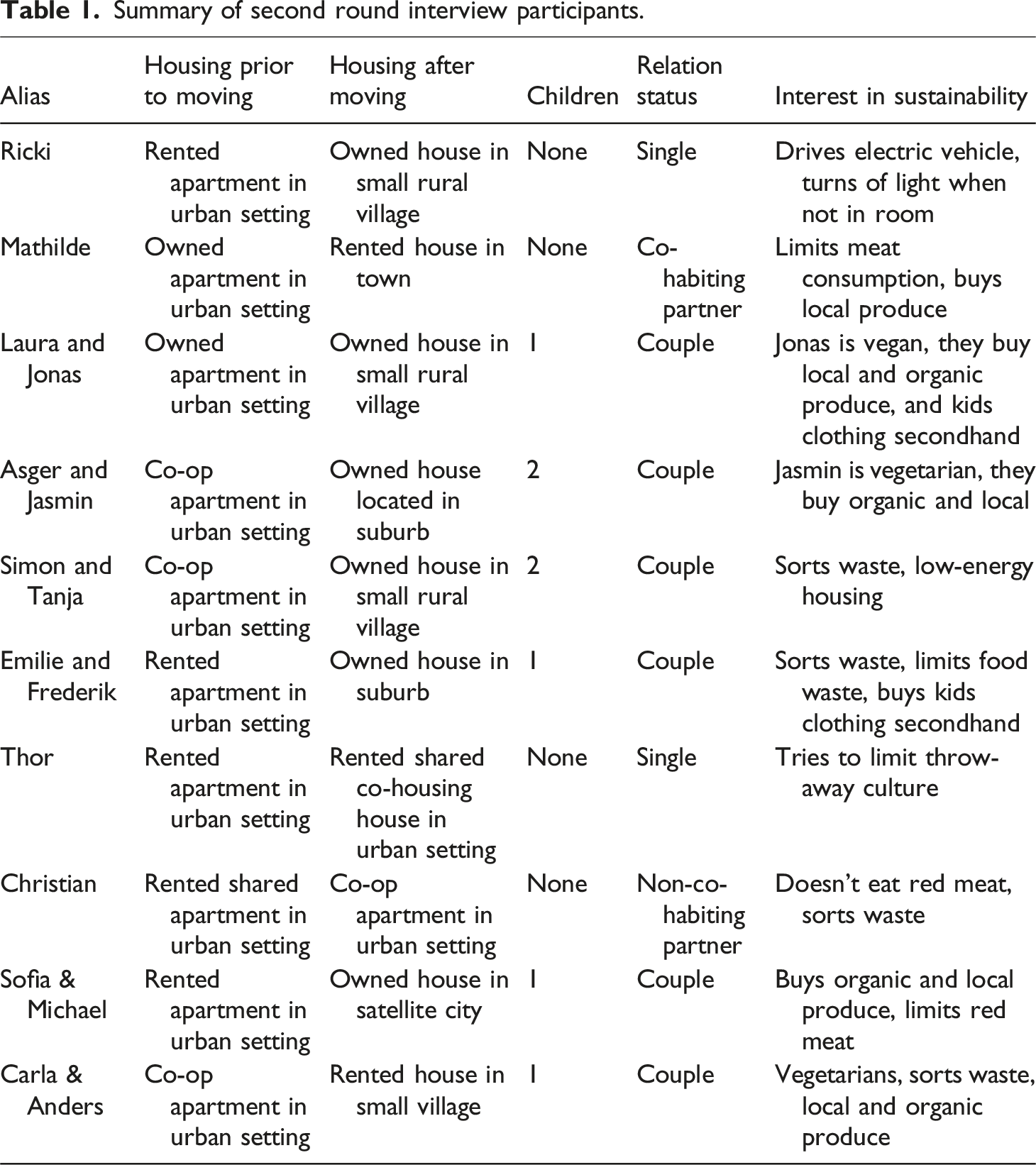
At the time of recruitment all participants lived in apartments, with a range of household compositions (single, living with partner, with or without kids) and were classified as middle-income. Semi-structured interviews were conducted at participants homes and covered the following topics: daily routines; descriptions of their current home; detailed description of activity events related to food and mobility practices; and, aspirations for their future home. To encourage reflection on the details of daily routines, participants were asked to describe a typical weekday, from getting up in the morning to going to bed at night, to specify how they move around, what they ate or drank, and so forth. To aid reflections, participants were asked to draw personal mobility maps (Büscher et al., 2020; Jaeger-Erben, 2013), to include movement to and from different places, the activities involved and why they were performed. Participants were provided with a blank sheet of paper and asked to sketch a representation of their daily mobility. It was clarified that accuracy in geographical locations was not required, rather, the focus was on depicting the sequence, duration, distance and timings of activities, places of interaction while on the move, preferred routes and so forth. Participants were asked to base their drawings on a typical weekday (for further detail see Krog Juvik and Halkier, 2023). During interviews, mobility maps were used as a prompt to discuss the activity connections across multiple practices in the context of participants everyday lives.
Of the 20 households ten were selected for re-interviews, all of whom had moved home within 1 year of the first interviews. As Table 1 summarises, eight of the ten participants had moved from urban apartments to suburban or rural houses, with two moving apartments within urban areas. Consequently, the sample consists of no cases of participants moving into urban settings. The second round of Interviews were conducted in participants new homes following the same topics as the first round to include the use of mobility maps. In these interviews, participants were asked to reflect on whether and in what ways their everyday lives had changed. As with the first stage interviews, all data were anonymized, transcribed and coded using Nvivo. Throughout all stages of data production including recruitment, interviews and the handling of empirical data, ethical standards were upheld.
The analytical approach involved comparison of participants mobility and food activity event maps from before and after their home relocation. Each instance of practice performance was treated as an activity event, with chains traced through participants descriptions of the connections between those events. When analysing these descriptions, attention was focused on the sequences and synchronisation of activities and the forms of coordination (between practitioners and between activity events) that were identified by participants. This approach facilitated the tracing of connections between activities while also considering how the same activity can relate to a range of broadly described practices.
Activity connections, coordination, and material arrangements
As young adults, participants were experiencing a range of major life events, such as completing education, moving in with a partner and starting a family. Eight of the ten households relocated away from urban areas, citing that urban apartments had constrained material layouts featuring small separate kitchens instead of multifunctional combined kitchen-dining rooms, too few and small bedrooms, limited storage space for domestic appliances, and lacked a garden for leisure activities (Krog Juvik and Halkier, 2023). While all participants recruited had expressed a general interest in sustainable consumption, environmental concerns did not feature in their decisions, although six households did seek houses with low energy consumption for reasons of financial economy, and two were undertaking renovations to replace old heating systems.
Our analysis of activity event connections begins with a focus on activity chains that can be broadly described as constitutive of mobility practices. Attention then turns to activity events and chains related to food practices, which encompass a wide range of activities related to the provisioning, transport, storage, preparation, eating and disposal of food. We present our data by first selecting one household and their mobility maps to provide an initial representation of the nuanced ways in which activity events connect as activity chains in a typical day. Cases were selected based on their capacity to capture the range of activity connections described across our sample. Second, we consider how the activity connections identified in the selected cases reflect the range of activity connections analysed across our data. In taking this approach, we discuss activity events and chains principally in relation to the performance of mobility practices (section 4.1), and then principally in relation to food practices (section 4.2). As our analysis of mobility and food practices reveals that activity events and chains permeate multiple practices, we consider the forms of activity event coordination that households navigated in contexts of changed material arrangements and its implications for the ways in which practices connect (section 4.3).
Mobility practice activity chains
During the first round of interviews, Michael and Sofia lived in a 3-bedroom apartment (90-square meter) on the outskirts of Aalborg, were expecting their first child and were both in full-time employment. They relocated to a new build, self-designed, single-family detached house (170-square meter) in a satellite city located 10 km away from the city and 6 km from their previous apartment.
Figure 1 maps mobility related activity chains during a typical day when Michael and Sofia lived in the city with two cars. Michael’s day started at 7am by walking to his car and then driving directly to work; with a reversal of this chain for his return journey. Sofia’s mobility activity chains involved a variety of transport modes as her work is located downtown with no employee parking: “Sometimes [I go] by car, or sometimes by bike. As of right now I often take the bus because I’m pregnant, so it’s nice to just sit down and be transported. And the bus station is right next to where I work, so it’s only like a 100-to-200-m walk, so it’s very flexible. Instead of me having to search for a parking spot downtown”. Mobility map before moving.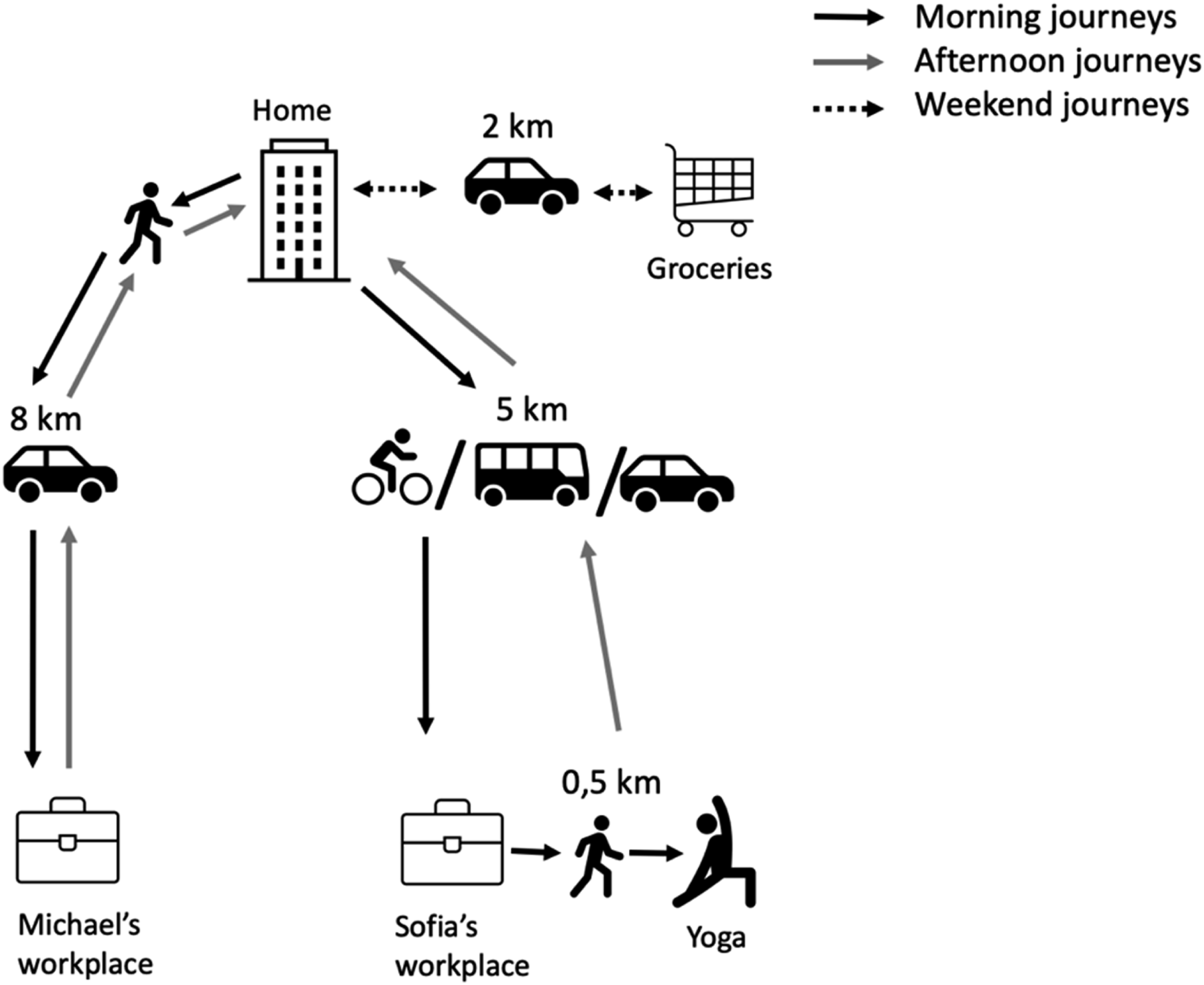
The bus runs frequently, every 10 minutes, with the bus stop 200 m from their home. Sofia’s return journey usually reversed the outbound activity chain, except for a few times a week when she attended yoga classes at a studio that is a 5 minute walk from her workplace. Michael or Sofia occasionally combined the activity of commuting home from work with grocery shopping at a store close to home. Grocery shopping was, however, mainly performed as a sole trip together by car on Sundays to a large supermarket with ample parking, located 2 km from their home. Their car was also used to facilitate sport (swimming) and visit family and friends at weekends.
Figure 2 maps daily mobility activity chains for Michael and Sofia after they had relocated. Larger living space, greater privacy and quiet surroundings were the principal motivations behind their decision to move. They retained their jobs and their daughter started day-care. As illustrated in Figure 2, parts of the household’s daily mobility and connected activities had altered, from a few single trips over shorter distances using a variety of transport modes to more trips with combined activities, over greater distances with less modal variation. The arrival of their daughter added the activity event of childcare to their daily mobility activity chains. Sofia started work later in the morning than Michael and consequentially took responsibility to deliver their daughter to childcare. Her daily commute took longer as she had a greater distance to travel than did Michael, including a diversion for childcare, and Sofia became dependent on use of a car. After dropping off their daughter, Sofia opted to drive to their old apartment where she can park for free and then take the same bus into the city as she did before their house move. While the bus route extends to their new home, Sofia explained that it: “cuts’ off in frequency, because we have moved a bit further out, so it only comes by here every hour on weekends and half hour on weekdays. So, it requires a lot more planning if you want to catch public transport from here. And I find it quite frustrating that I can’t just leave when I want to”. Mobility map after moving.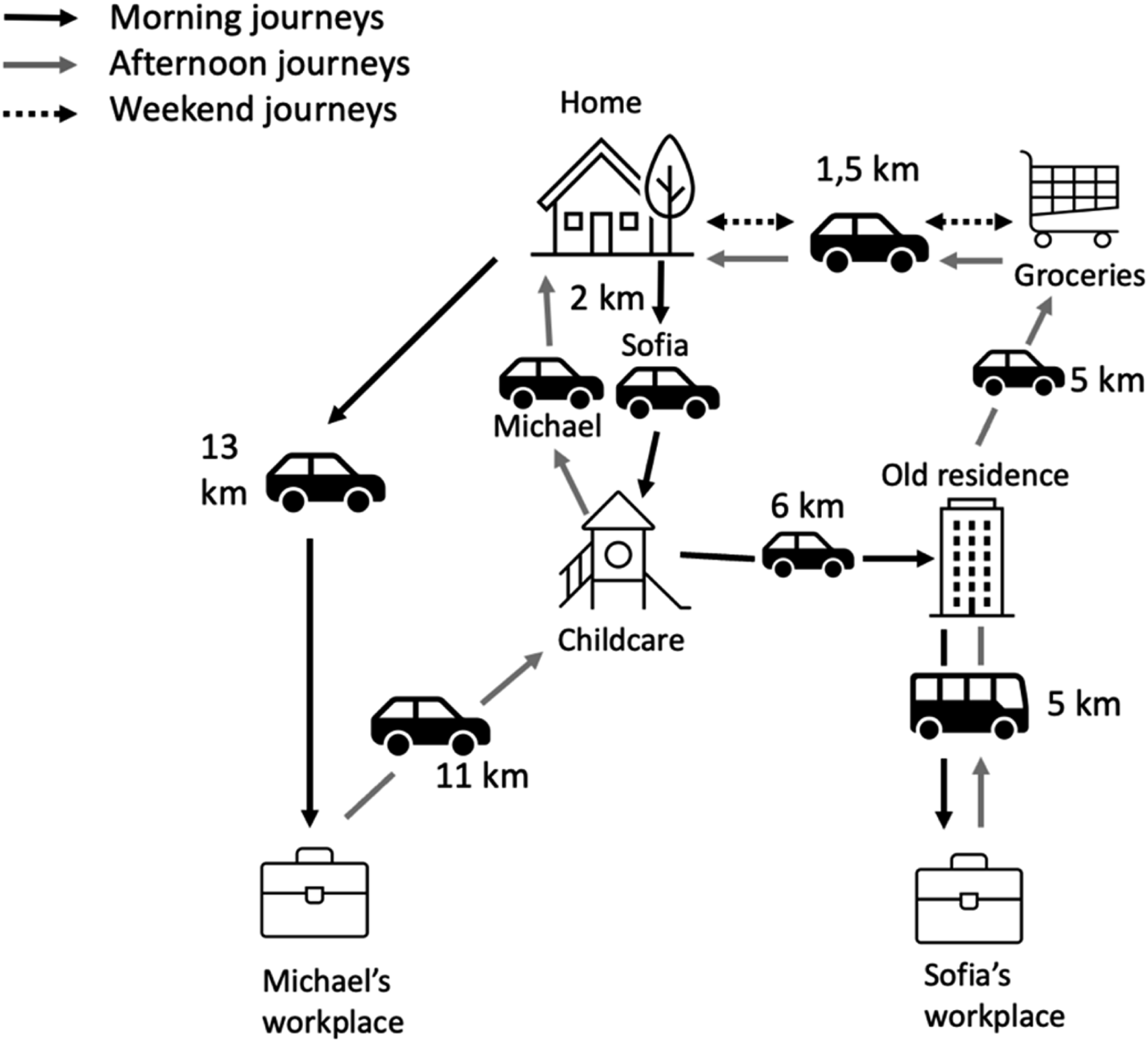
Sofia opted to drive because it offers flexibility. After work she reversed the activity chain, occasionally collecting their daughter or picking up groceries at the local grocery store in town. Michael’s daily mobility remained similar to that of before the move, although he no longer needed to walk to his car before or after driving because the new home has a carport. His daily drive has a longer duration due to increased distance, and because he finished work earlier than Sofia he would often collect their daughter from childcare. Grocery shopping continued as a weekly bulk shop but mostly combined with Sofia’s commute home from work instead of a separate weekend supermarket trip. Visits to family or friends by car continued as before.
The case of Michael and Sofia included two moments of life-course transition: a home move and the arrival of a child. The former increased the distances required to travel for work while the latter added an additional set of activity events connected to mobility. Increased distances corresponded with reduced availability of public transport, but a carport meant that mobility by foot to reach a car or public transport was no longer necessary. The introduction of the activity event of childcare was significant. It can be described as an institutionally timed event, with relatively fixed times for pick-up and drop off that required coordination with another institutionally timed event of work, which also had relatively fixed employment hours. This meant that Michael and Sofia’s daily mobility activity chains after their home move and arrival of a child required additional temporal coordination. The provision of a carport, in this context, was regarded as important. From an environmental perspective, Michael and Sofia became more dependent on commuting by car and travelled longer distances.
When zooming out similar alterations of mobility activity connections were found amongst the eight households that relocated outside of the city. All increased travel distances and reliance on cars. Six of these households included children, three of which reached childcare age after the relocation. In these three households, the introduction of childcare as a new institutionally timed activity event became intricately connected to mobility, influencing the duration and timing of connected activities, and introducing additional challenges for activity coordination. In the three other households with children, a second child had been born after moving that introduced an extra layer of temporal coordination between activity events related to their mobility practices because their children did not attend the same childcare service.
Of the eight households that relocated outside of the city, five practiced the activity of grocery shopping as a standalone trip before moving but, after relocating, only one continued this practice with the others integrating food provisioning activities with commuting home from work. For households moving out of the city, mobility practices assumed greater significance in the context of a typical day. The associated activity chains not only extended in terms of distance travelled and duration, but also with respect to activity connections. This shift is a consequence of the altered material arrangements and changed activity event coordination of mobility practices. This change also meant increased car dependencies across all households. It is important to note that the mobility practices and activity chains of the two households which relocated within the city did not change.
Food practice activity chains
During the first round of interviews Tanja and Simon lived in a one-bedroom (55-square meter) apartment with a small kitchen, together with their one-year-old child who had just started attending childcare. Both were full-time employed in the Copenhagen area. They relocated to a 175-square meter farmhouse on two ha of land in a small rural railway town close to where Simon grew up. They renovated the interior of their new home to include a reformulation of bedrooms (children’s section upstairs, adult’s bedroom & office downstairs), two new bathrooms, a large open-plan kitchen-dining room, a utility room, and electric heat pump. Both partners changed their jobs, and their family expanded with the birth of their second child.
Food related activity chains could be identified from the mobility maps. Figure 3 illustrates a typical day when Tanja and Simon lived in a city apartment. In the morning, they cooked and ate breakfast together with their child, before commuting to work and childcare. During their working day both Tanja and Simon ate a home-prepared lunch while their child was served food at childcare. After work they collected their daughter from childcare, decided what to eat for dinner and either Tanja or Simon went grocery shopping. In this way, planning meals and grocery shopping were daily activities. Consistent with studies of Danish food practices (e.g. Gronow and Holm, 2019), meals relied on a few relatively fixed culinary repertoire of ‘tried and tested’ recipes, including spaghetti bolognese, lasagna, burritos or a choice of meat with potatoes and gravy. Daily shopping was performed in the nearby grocery store 3 minutes away by foot, which meant that only a small number of items could be purchased because groceries were carried home by hand. Once groceries were purchased, one partner prepared the meal in the kitchen while the other entertained their daughter in the living room, with mealtimes flexible. Food practice before moving.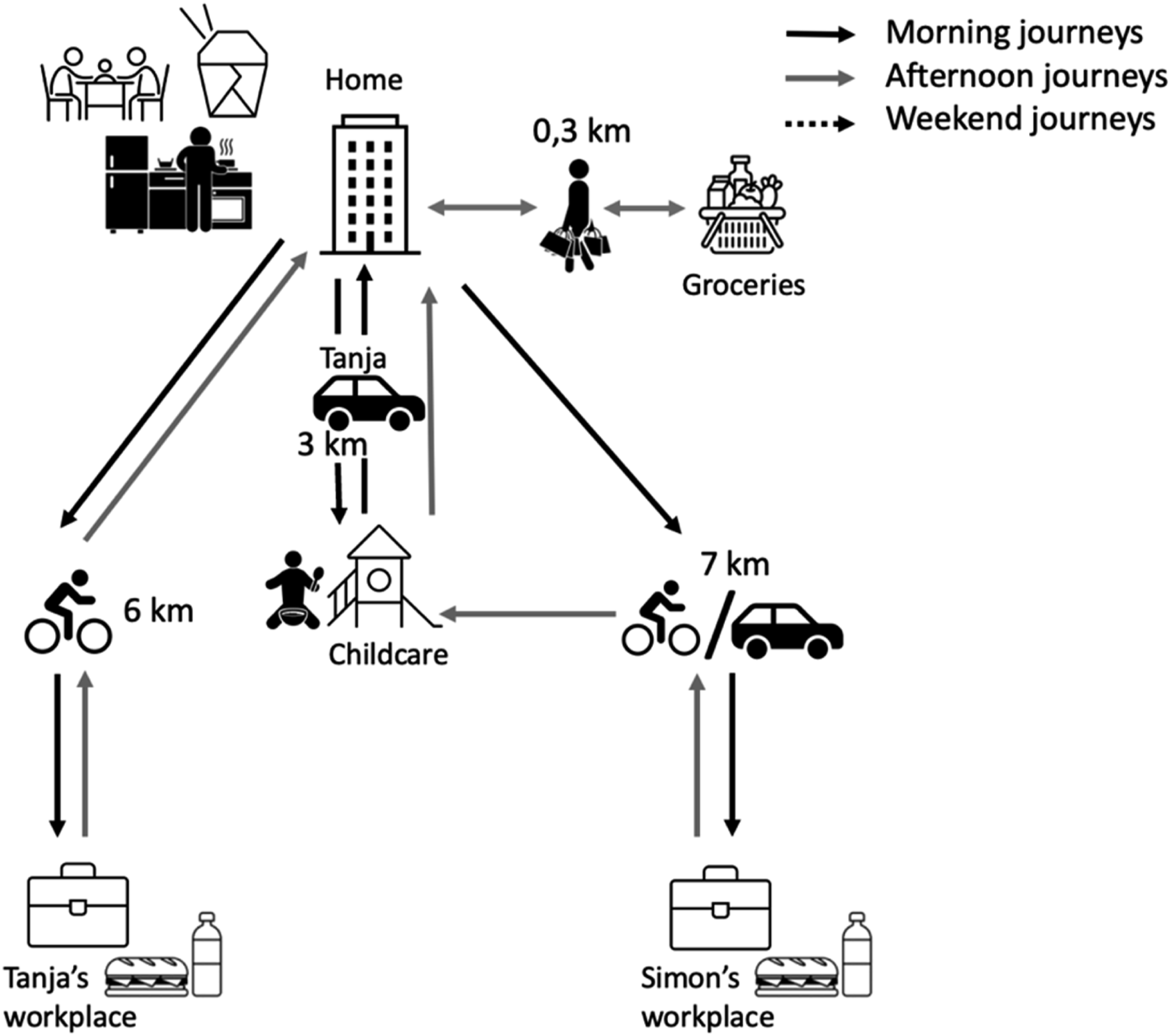
The decision to move out of the city was motivated by wanting to move closer to Simon’s parents, more living space and for their child to grow up around “fresh air, nature in a more quiet and peaceful setting” (Simon). As shown in Figure 4, and consistent with others who moved out of the city, journeys to work were extended in duration with Tanja’s becoming a 45 minute journey and Simon’s 25 minutes, and they became entirely car dependent. Activity events related to food practices altered. Food provisioning events became less frequent, scheduled for roughly every third day, and were often performed in the evening or coordinated with Simon’s extended commute home from work by car. With this shift came the need to plan meals in advance: “You kind of have to plan grocery shopping and other things now, which is a bit different. You can’t just go across the street and be back in five minutes. Even though town really isn’t that far away.” (Simon) Food practices after moving.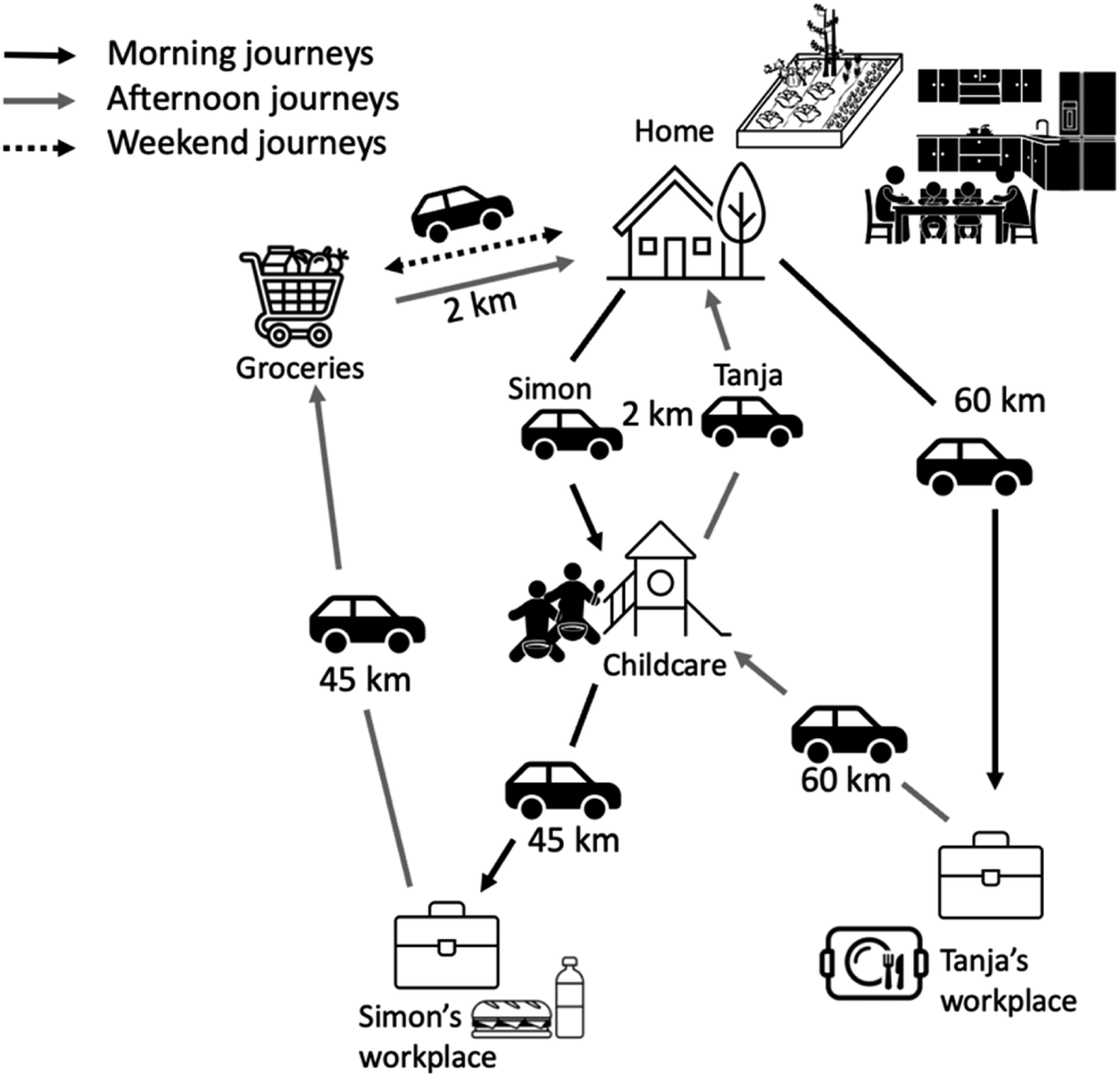
Advance meal planning linked to a desire to regularise the timing of evening meals at 5pm during weekdays: “so we don’t get home where we are tired and then we have to stress about what we want to eat, and then we have to go buy it and so forth. We prefer to get home and then everything is planned.” (Tanja)
As found in other Danish studies (Halkier, 2021), instituting the timing of dinner was regarded as critical for preserving ‘family time’ after dinner and before the children’s bedtime. The household’s repertoire of tried and tested recipes remained the same, although meals taking the shortest amount of time to prepare were prioritised and more ‘greens’ were incorporated into meals courtesy of their vegetable garden. The activity event of cooking a meal took place in the combined kitchen-dining room and was regarded as a social occasion for household members and sometimes with guests. Their large kitchen and utility room provided a large fridge, freezer and extensive storage space that they used to take advantage of sales and bulk food purchases, and freezing leftovers to be consumed on future days.
Like for Michael and Sofia, Tanja and Simon’s case featured life-course transitions of moving home and the arrival of a (second) child. The distinctive feature of their food activities before moving was that daily grocery activities held together a chain of activity events centred around flexible eating. Obtaining food from a local store was easy but restricted in the volume of items that could be purchased because of having to walk back to the apartment. Frequent but small volume grocery shopping was consistent with the material arrangement of the small kitchen and its limited storage space. Material arrangements changed significantly following their move. Grocery shopping became less frequent and subject to advance planning and coordination. The more spacious farmhouse did, however, provide for greater storage space enabling bulk-buying of food items and opportunities for family time provided that mealtimes were instituted around 5pm. Before moving, their daily food consumption activities minimised food waste created by non-consumption of bulk-purchased food and offered flexibility regarding what to eat (Hebrok and Heidenstrøm, 2019). At the same time, bulk-buying and extra food storage space encouraged meal planning and the freezing of leftovers that could also be considered as means of reducing food waste (Evans, 2014).
Similar changes in food activity event chains were observed among the eight households that relocated outside of their respective cities. Prior to moving, four of the eight households performed grocery shopping as a sole trip either after work or on the weekend, and four scheduled provisioning as part of the daily commute home from work. After relocating outside of the city all eight households now performed grocery shopping in connection with their daily commute. Prior to moving, three households planned meals in advance and performed bulk-food provisioning, with five planning meals daily and performed frequent small volume shops. Post-relocation, six of the households planned meals in advance and performed bulk-purchased food provisioning on a weekly or twice weekly basis, utilising additional food storage space. With these alterations food provisioning became predominantly car dependent. Of the eight households relocating outside of the city, two did not have any children. One of these households (Ricki) continued with similar food practices as before moving, involving daily meal planning and food provisioning. The other (Mathilde) shifted from daily planning to a meal-box scheme to reduce food provisioning activities altogether. Food practice activity chains centred around daily food planning and provisioning remained unchanged for the two households that relocated within cities. For all households the content of meals did not change significantly after relocating, although the frequency of ordering takeaway food decreased among those who had moved outside cities.
Home relocation and coordinating within altered material arrangements
Consistent with Burningham and Venn (2020), altered material arrangements were central to changed activity event chains following a home transition. Elements such as the material arrangement of the house (e.g., spaces, storage, amenities) and its proximity to services (e.g., local amenities and mobility modes/transportation systems) enabled and constrained configurations of activity chains. Within urban areas the material arrangement of homes in relation to practices of work, mobility, shopping and leisure is closely integrated. This contrasts with the material arrangements of suburban and rural areas that are ‘unbundled’ with greater distances between amenities (Sheller and Urry, 2000). The material arrangements of these two settings presented different challenges for the coordination of activity events.
The case of Carla and Anders demonstrates the relationship between material arrangements and the shifting challenges of activity event coordination. Before moving, they lived in a small apartment (35-square meters) in the Copenhagen area, consisting of a combined bedroom and living room, a small kitchen and a bathroom. Anders worked part-time and Carla was on maternity leave (with their first child). Because their apartment was too small for private domestic appliances, the apartment complex offered shared laundry amenities in the basement that required coordination of laundry activity events with co-residents. The complex also had a communal courtyard with a sandpit and swing, which they rarely used because it was “very noisy” (Carla) and required coordination with times when other residents were absent. The challenges of coordination created by the small apartment discouraged Carla and Anders from performing particular activities. For example, Carla explained how they sometimes did not use the local park because living on the third floor meant: “when we want to take the baby out in the stroller, then you have to go to the basement and wrestle the stroller up from the basement and such, it's just a bit cumbersome”.
The material arrangements of the apartment complex required coordination of activity chains, and coordination with other practitioners (even if that was to avoid them), in ways that discouraged the performance of some practices – in this case related to laundry and family leisure. All households reported similar coordination challenges presented by shared apartment complex amenities and limitations of household storage space.
Carla and Anders new home was a house in a small village near a forest located 7 km from the nearest railway town. Anders still worked part-time in the city and Carla had started a new job located 15 km away, with Anders parents caring for their child while they were at work. They rented a detached family house (110-square meters) with a large garden, carport and shed. The house had a combined kitchen-dining room, a living room, two bathrooms, a utility room, and three bedrooms. Extra indoor space allowed for a full suite of domestic appliances, a utility room, extra storage space, and an additional fridge and freezer in the shed where the baby stroller was also located. These new material arrangements changed the activity event coordination challenges of their previous home. Gone was the need to coordinate with other residents to perform the laundry or use the communal courtyard. Gone also was the challenge of activity event coordination related to retrieving items from shared storage facilities to participate in leisure practices such as visiting the local park. The provision of a private carport reduced coordination challenges amongst multiple activity events. As seen in the case of Michael and Sofia who no longer needed to coordinate activities of walking to their car when commuting to work, and with Tanja and Simon who could bulk-shop for food because they could park their car outside their new home, Carla and Anders enjoyed having ready access to goods such as their car, stroller and garden for leisure practices at any time they required.
As with the other cases examined, altered material arrangements following relocation created different coordination challenges. Their new house was situated in a small village with few amenities. Like Tanja and Simon and Michael and Sofia, the material arrangements of their new homes led to advanced planning of food and mobility practices. Carla and Anders new activity chains were organised around fixed institutionally timed events of work, childcare and mealtimes, all of which provided regular temporal rhythms around which to coordinate food and mobility practices, and routinise the activity chains from which they were comprised. This coordination between practices was also accompanied by an intensified need to coordinate which partner performs specific activity events within the shared activity event chains that comprised their typical day, whether related to childcare, food provisioning or how either is integrated with mobility activity events. The altered material arrangements that accompany a home move, especially when that involves changing the material arrangements of local amenities and infrastructures as well as of the home itself, underpin shifts in everyday practices. And it is in the resulting challenges of coordinating activity events and practitioners, that the dynamics of practice change can be identified.
Conclusion
The findings of this study are consistent with arguments made by other SPT inspired studies that life-course transitions consist of multiple transitioning events that intersect with a wide array of contextual factors. Alterations in the performance of activity events related to mobility and food practices were most clearly associated with the contrasting material arrangements of those practices before and after relocating homes. Mobility practices were affected by altered relations to local transport infrastructure, with those moving outside of urban areas becoming more car dependent and experiencing longer travel distances and commute times. Reduced access to local services within walking distance also resulted in more car journeys for the purpose of food provisioning. Car dependence together with private residential parking spaces, larger kitchens and additional food storage facilities encouraged a shift from daily grocery shopping to weekly bulk-buying of food. While no change in the content of meals eaten by participants was identified, those who moved away from urban areas engaged in greater planning of meals for the week and settled into steady rhythms of meal eating times that represented institutionally timed events. In this respect, those moving away from cities lost flexibility with regards to the timings of activity events, with mealtimes becoming planned and, for those with children, additional fixed institutionally timed events related to childcare added. However, as demonstrated by Carla and Anders, flexibility was also gained from moving to a larger home with greater self-service provisioning that reduced the need to coordinate laundry practices with other residents, and removed laborious activities to retrieve household items from communal storage spaces. While practices were altered, significant degrees of continuity were also evident. Mobility activity events continued to connect with food provisioning and childcare, timings and mode of transportation might alter but the pattern and content of mealtimes remained similar, and Sofia continued her previous commute to work with an added event of travelling to her old apartment. Simultaneous continuities and alterations of practice performances were evident.
Life-course transitions did not prompt moments of reflection on habitual or routine practices, as would be expected in theories of habit discontinuity. Rather, the alterations to practices identified in our data reflected adjustments to the coordination of activity events as participants navigated and adapted to a different set of material arrangements (e.g. apartment in urban vs house in suburban and rural areas). This is consistent with Bennett’s (2021, p. 17) analysis of habits, in which he argues that habits should be ‘understood as systems of action that are distributed across the relations between human and non-human actors’. In our study, this distribution can be described in terms of the relation between material arrangements and the forms of purposeful coordination of activity events to continue to perform practices in acceptable and familiar ways. Purposeful activity event coordination could be identified across the data in three forms: (1) with other non-household members; (2) with household members; (3) across intersecting practices. Examples included: (1) coordinating access to communal areas and amenities with other residents as in the case of Anders and Carla; (2) coordinating childcare transportation together with commuting activities between couples as in the case of Michael and Sofia; (3) coordinating food provisioning activities together with activity events connected with commuting, childcare, leisure and regularised mealtimes as in the case of Tanja and Simon.
In many respects, these findings are consistent with House’s (2019) concept of phased routinisation that he applies to analysis of food practices. Life-course transitions represent moments in which the modes or ways in which a practice is performed are often altered in relation to adjustments in the elements that configure the practice. For House (2019: 461) ‘a phase refers to an enduring (which is to say, recurrent) configuration of practices which constitutes the prevailing manner of eating at a given point during the life course’ (ibid. 461), and it is these enduring configurations that are often described as habits and routines. As such, practitioners may move between phases in modes of practice performance in relatively subtle ways, such as those identified in our data, without radically changing the overall patterning of that practice. What appears as continued habitual and routine actions mask the active and subtle ways in which everyday practices are both reproduced and held together. As House argues, apparent continuity of practices in familiar ways should not be interpreted as inertia because the faithful reproduction of any mode (or reproduction) of practice performance always requires active participation and improvisation.
As opposed to analysing a single practice and noting its intersections with other practices during its performance, our approach focused on the activity events and chains through which multiple practices are constituted. Mobility and food represented entry points into practices, but our principal focus was on the connections between activity events in a typical day for our participants before and after moving home. In this way, phased routinisation is about how activity connections are formed, maintained and coordinated in relation to other practitioners, between household members, and within and across practices. This is an important analytical distinction, because analysis of activity connections demonstrates that any forms of phased routinisation are not matters related to individual practitioners but fundamentally matters of shared practice performances with others, to include the negotiation and co-performance of activity event coordination.
This line of reasoning also means it is important to recognise that forms of activity event coordination are not more or less challenging before or after a transition. Focusing only on the altered activity chains of mobility practice performances after a home move could be interpreted as more complex due to the greater number of car trips to facilitate multiple daily practices. A quick comparison of the mobility mapping in Figures 1 and 2 provides this impression. However, this interpretation overlooks the activity coordination challenges of mobility practices for those living in cities, who also need to coordinate multiple modes of transport, daily grocery shopping, and so on. Rather, altered material arrangements present different activity chain coordination challenges.
This observation raises two important considerations for policy approaches that seek to intervene at moments of life-course transition. First, while life-course transitions matter as moments through which phased routinisation can occur, they do so only in so far as such transitions re-position practitioners, and therefore practices, in relation to material arrangements. Second, policy approaches that seek to intervene in moments of life-course transition to instigate change should focus attention on altered conditions of material arrangements, what that means for activity event coordination, and how those forms of coordination may stitch or hold together multiple practices in particular patterns.
Viewed from this perspective, and taking the example of sustainable consumption, the key policy questions shift from simply asking whether life-course transitions lead to higher or lower resource intensity in specific practices (e.g. driving more or installing energy efficiency heating). Instead, the focus is more about whether the altered material arrangements and new forms of activity event coordination reconfigure multiple practices in ways that may be more or less resource-intensive. Questions that could be asked are, for example, what activity connections and coordination (and therefore shifts in related practices) might result from initiatives such as the 15 minute city, promotion of food box schemes, meat reduction or provisioning of different modes of mobility, and modifying existing material arrangements and institutions (see for instance Christensen et al., 2024)? And, in what ways might activity event connections be targeted during moments of life-course transition when the coordination of activities are being re-phased?
Overall, the analysis of activity events and chains developed in this study provides further evidence regarding a core claim of SPT: that practices are held in a state of dynamic stabilisation such that alterations and continuity occur simultaneously. In this study, activity events and chains were analysed through a mapping of linkages between the activity events that comprised, although were not limited to, participants mobility and food practice performances. Such analysis is always partial. In this study three forms of partiality can be observed. First, our sample only included cases of home moves within or out of urban areas, and analysis of activity event coordination before and after home moves into cities would offer a basis to consider if reverse effects can be identified. Second, only the activity events and chains of partners living together were analysed. In principle, and to gain a fuller understanding of activity coordination between multiple practitioners, activity events and chain could be analysed for a larger sample of practitioners (e.g. all household members or co-residents of apartment complexes). Third, by focusing principally on mobility and food practices this analysis presents a partial analysis of activity events and chains. While complex, analysing activity chains of multiple practices (e.g. working, leisure, childcare) would build the empirical picture of activity event coordination. Developing activity event and chain analysis offers an empirical basis upon which to explore and understand processes of dynamic stabilisation of everyday social practices; processes often mistakenly described as automated and habitual behaviour.
Footnotes
Acknowledgements
We would like to thank Caroline Samson for collaborating in the first round of interviews, Bente Halkier for her continuous support of this research and comments on drafts of this article, and Andres Blok for his review of the initial ideas underpinning the data analysis. We are also grateful to the ESRC Centre for Sociodigital Futures (ES/W002639/1) for providing a research environment conducive to international collaboration.
Declaration of conflicting interests
The author declared no potential conflicts of interest with respect to the research, authorship, and/or publication of this article.
Funding
The author(s) disclosed receipt of the following financial support for the research, authorship, and/or publication of this article: This research was funded by the Independent Research Fund of Denmark as a part of the research project Food, Mobility, and Housing in the Sustainable Transition of Everyday Life. Award number: (0217-00108B, 2020).
